



Abstract
Early exposure to books significantly shapes infants’ language, cognitive, and socio-emotional development. Parental beliefs about reading play a critical role in shaping the quality and frequency of home literacy practices. However, global crises such as the COVID-19 pandemic may have disrupted traditional pathways to fostering early literacy, especially by limiting access to baby books. This study investigates the factors influencing Turkish mothers’ reading beliefs about reading to their babies aged 0 to 2 years during and after the COVID-19 pandemic. It further explores how book availability, visibility, and social media exposure affected maternal reading beliefs and behaviors. Using an explanatory sequential mixed-methods design, quantitative data were collected from 288 mothers via standardized questionnaires and photographic assessments of baby books, supplemented by qualitative data from semi-structured interviews with 20 mothers. Analyses examined differences between pandemic and post-pandemic periods and explored relationships between book availability, experiential variables, and maternal reading beliefs. Findings revealed that post-pandemic mothers exhibited stronger reading beliefs compared to those during the pandemic. Increased book visibility, social media exposure, and the establishment of reading routines positively influenced mothers’ engagement in shared book reading. Educational level positively correlated with stronger reading beliefs, whereas the number of children negatively impacted these beliefs. No significant association was found between bookstore visits and reading beliefs. Ensuring the accessibility and visibility of developmentally appropriate baby books, both physically and through digital media, is crucial for reinforcing positive parental reading beliefs, particularly during periods of societal disruption.
Plain Language Summary
This study explores Turkish mothers’ beliefs about reading to their babies aged 0-2 and the factors associated with these beliefs. It compares mothers’ experiences during the COVID-19 pandemic and after it. The study examines how the visibility of baby books at home and exposure to baby book-related content on social media relate to maternal reading beliefs. It also considers experiential factors such as access to books and babies’ engagement with books. During the pandemic, many mothers reported difficulties finding and purchasing baby books because of limited availability, closed bookstores, and higher prices. Mothers also described seeing fewer baby book promotions on social media, where content was often focused on health and basic needs. These conditions were linked to lower exposure to baby books and weaker confidence or motivation to read with babies. After the pandemic, mothers reported easier access to books and more frequent exposure to baby book promotions online, which supported finding more suitable books and establishing more regular reading routines. Overall, mothers who reported higher book availability and greater exposure to baby book content on social media also reported stronger beliefs about the value of reading to babies. The findings suggest that making baby books more visible and accessible, at home and through digital platforms, may support early shared reading and early literacy development. These findings may help teachers, health workers, and policymakers design programs that improve access to books and encourage parents to start reading with children from the very beginning.
Introduction
Early exposure to books plays a foundational role in fostering the development of children’s language, cognitive, and socio-emotional skills. Numerous studies have demonstrated that children introduced to books during infancy exhibit more advanced vocabulary, stronger verbal comprehension, and higher academic achievement compared to their peers (Debaryshe, 1993; Fletcher & Reese, 2005; Medawar et al., 2023; Steiner et al., 2022). The act of shared book reading between caregivers and infants is more than a passive transfer of information; it constitutes a dynamic interaction that lays the groundwork for later literacy, critical thinking, and emotional bonding. Particularly during the first 2 years of life, infants’ brains are highly plastic and responsive to linguistic and social stimuli, making early book exposure especially consequential (Justice & Sofka, 2010).
Maternal reading beliefs refer to mothers’ attitudes, values, and assumptions about the importance and benefits of reading to their children. These beliefs influence how frequently and in what ways mothers engage in shared reading with babies (Crosh et al., 2024; Jain et al., 2021), and they shape both the emotional and instructional quality of these interactions (Bingham, 2007; Krijnen et al., 2020; Wu & Hindman, 2025). Mothers who hold strong beliefs in the developmental value of reading tend to read more often, purchase age-appropriate books, and establish consistent routines (Bingham, 2007; Jain et al., 2021). These beliefs are shaped not only by mothers’ personal orientations but also by broader contextual factors such as socioeconomic status, parental education, number of children, and cultural values (Peixoto et al., 2022; Raikes et al., 2006; Yarosz & Barnett, 2001). Limited access to books or disparities in parental knowledge may further influence how families support early literacy. Overall, research underscores the importance of cultivating positive reading attitudes and ensuring equitable access to literacy resources, as early exposure helps prevent “aliteracy,” or a lack of interest in reading despite the ability to read (Cutspec, 2006).
For books to support early literacy, they must be both accessible and visible within the child’s environment. Book availability refers to the ease of obtaining books, whereas book visibility captures how frequently books appear in children’s daily surroundings, including homes and digital platforms. Research shows that when books are placed in prominent, child-friendly locations, they act as environmental cues that encourage caregivers to initiate reading (Hartas, 2011; Hemmerechts et al., 2017; Niklas et al., 2020). This aligns with ecological and behavioral models emphasizing that the physical arrangement of an environment shapes routine behaviors (Bronfenbrenner, 1979; Vasta, 1999). Visibility extends beyond physical spaces to the digital environment, where social media and online platforms increasingly influence parents’ exposure to books (Sari et al., 2020). In this study, digital exposure refers to targeted literacy-related content, such as baby book promotions and reviews, that may shape maternal beliefs and reading behaviors. Such digital representations, often delivered through promotions, reviews, and influencer posts, can increase the cognitive salience of books for parents and influence purchasing decisions (Antczak, 2024; Oruç & Aydın, 2022; Tiidenberg & Baym, 2017).
As digital platforms increasingly shaped parents’ book-related choices, the onset of the COVID-19 pandemic introduced new barriers to families’ access to physical books and traditional literacy resources. In Turkey, the closure of libraries, preschools, and bookstores substantially limited opportunities to obtain baby books, while rising book prices and economic strain further restricted access (Education Reform Initiative, 2021; Turkish Publishers Association, 2021). Similar patterns were reported internationally, with studies documenting declines in book purchases, library borrowing, and time spent reading physical books during lockdowns (Nolan et al., 2022; Soulen, 2022). These disruptions occurred at a time when infants’ need for linguistic and cognitive stimulation remained critical. The pandemic also altered parents’ daily routines, increasing caregiving responsibilities and psychological stress, particularly among mothers, who often assume primary childcare roles in Turkey (Çetin & Kıral, 2021). Increased responsibilities often meant that reading activities, though valued, were deprioritized in favor of more immediate caregiving needs (Günlü et al., 2021). Although online communities and digital book promotions provided partial support (Mertens et al., 2024; Moon et al., 2019), disparities in digital literacy and internet access created additional inequities, especially for low-income and rural families (Ehsan & Jahan, 2021).
Previous research on parental reading behaviors during the pandemic has predominantly focused on families with preschool or school-aged children, highlighting changes in reading frequency, screen time usage, and educational engagement (Meoded Karabanov et al., 2023; Wheeler & Hill, 2021). However, infants and toddlers represent a uniquely vulnerable group whose early literacy development relies almost entirely on adult mediation. Despite their developmental importance, little is known about how the pandemic affected shared reading practices and maternal reading beliefs during infancy. To date, although reading with young children has been found to support early language and literacy development and parents’ desire to read is positively associated with reading with their children (Jain et al., 2021), few studies have focused on parents’ shared reading with babies (Dickinson et al., 2012; Muhinyi & Rowe, 2019) and their beliefs about reading (Auger et al., 2014; Egan et al., 2022; Lin et al., 2015). These experiential factors, combined with environmental constraints, likely exert complex influences on parental attitudes and behaviors surrounding early literacy practices. Given these realities, a more nuanced understanding is needed of how pandemic-related changes in the physical and digital environment influenced maternal reading beliefs and behaviors during the infancy stage. Such insights are critical for informing policy initiatives, literacy promotion programs, and interventions aimed at supporting early childhood development in the wake of global crises.
Given the environmental and experiential factors that influence early reading behaviors, this study draws on two complementary developmental perspectives: Bronfenbrenner’s ecological systems theory and Bandura’s social cognitive theory. Bronfenbrenner (1979) emphasizes that children’s early experiences are shaped by environmental conditions within nested systems, such as family resources, book availability in the home, and exposure to digital content. These ecological influences were particularly relevant during the COVID-19 pandemic, which altered families’ access to books and literacy-related environments. Bandura’s (1986) concept of reciprocal determinism provides a framework for understanding how maternal beliefs, environmental cues (e.g., book visibility, social media exposure), and reading-related behaviors (e.g., book purchasing, establishing routines) mutually reinforce one another. These frameworks guided the selection of variables and the formulation of research questions by linking maternal reading beliefs to their environmental and behavioral contexts.
The Present Study
In response to the gaps identified in prior literature and the unique context of the COVID-19 pandemic, the present study investigates the factors influencing Turkish mothers’ beliefs about reading to their babies (aged 0–2 years) during and after the pandemic. Because prior research indicates that parental beliefs and home literacy practices may influence one another in both directions, the present study does not conceptualize book availability as a causal determinant of maternal reading beliefs. Mothers with stronger reading beliefs may be more inclined to acquire books, whereas greater availability and visibility of books in the home may also reinforce positive beliefs about reading. Accordingly, this study adopts an associational perspective and examines how book availability and maternal reading beliefs co-occur during and after the COVID-19 pandemic. Unlike previous research focusing primarily on older children (preschool or school-aged children), this study emphasizes babies’ developmental dependency on caregiver mediation, especially for early literacy exposure. The study explores whether maternal reading beliefs differed between the pandemic and post-pandemic periods, and identifies the experiential and environmental factors that contributed to these differences. Particular attention is given to the role of book availability, book visibility within the home, exposure to book promotion content on social media, the establishment of regular reading routines, and babies’ active engagement behaviors. Furthermore, the study examines how maternal demographic variables, such as education level and number of children, moderate these relationships. Four research questions guide the inquiry:
RQ1. Do maternal reading beliefs differ between the pandemic and post-pandemic periods?
RQ2. How are book availability and exposure to social media associated with maternal reading beliefs?
RQ3. How are experiential factors associated with maternal reading beliefs?
RQ4. How do maternal demographic characteristics relate to maternal reading beliefs?
Methods
Research Design
This study adopted an explanatory sequential mixed-methods design (Creswell & Plano Clark, 2017), combining quantitative and qualitative data collection and analysis procedures. The primary rationale for employing a mixed-methods approach was to obtain a comprehensive understanding of the factors affecting maternal reading beliefs by first identifying statistical relationships and then exploring the underlying reasons through participant narratives. The sequential design allowed the researchers to explain and deepen the interpretation of quantitative results using rich qualitative data. This design choice aligns with best practices in early childhood and educational research, where understanding both statistical patterns and personal experiences is crucial for a holistic analysis.
Participants and Recruitment
Participants were 288 mothers of babies aged 0 to 24 months, recruited in two distinct phases: during the pandemic period (January–June 2022, n = 148) and after the pandemic restrictions were lifted (January–April 2024, n = 140). Recruitment was conducted through social media parenting groups, online parenting forums, and family health center mailing lists across Turkey. Although initial efforts targeted both mothers and fathers, the low response rate and incomplete data from fathers necessitated focusing solely on mothers. The targeted sample size was based on power analysis recommendations for non-parametric statistical tests. Using G*Power software, it was determined that a minimum of 260 participants would be needed to detect medium effect sizes (Cohen’s d = 0.5) with 80% power at a 5% significance level for between-group comparisons (pandemic vs. post-pandemic). The final sample of 288 mothers exceeded this requirement, enhancing the reliability and generalizability of the results within the studied population. Table 1 presents demographic details about the mothers.
Demographic Information of Mothers.

Categories were coded ordinally and SD reflects coded dispersion.
In the second phase of the study, 20 mothers who had participated in the quantitative survey were purposively selected for qualitative interviews. The selection aimed to capture a range of experiences based on factors such as reading frequency, book purchasing behavior, and social media exposure reported in the survey. The goal was to represent diverse perspectives from both the pandemic and post-pandemic groups. The qualitative sample was equally distributed across the two phases, with 10 mothers selected from each period (n = 10 pandemic, n = 10 post-pandemic), ensuring a balanced exploration of maternal experiences during and after the pandemic. This purposive sampling strategy allowed for deeper exploration of emerging quantitative findings while maintaining alignment with the mixed-methods design.
Ethical Considerations
Ethical approval was granted by the Research and Publication Ethics Committee of Anadolu University (Approval No. 83/85). Participation was entirely voluntary. Mothers provided informed consent electronically prior to data collection, and they were informed that they could withdraw at any time without consequence. Data confidentiality was assured, with all personal identifiers removed and replaced with anonymous codes. The data were securely stored on password-protected computers, accessible only to the research team.
Data Collection Procedures
Data collection was conducted entirely online due to pandemic restrictions during the first phase and continued online post-pandemic to maintain consistency. The survey instruments were hosted on a secure online platform, ensuring data encryption during transmission. Participants completed the survey instruments at their convenience. Upon completion, mothers were invited to submit photographs of their baby books through a separate secure upload link. Following quantitative data collection, volunteers for the qualitative phase were contacted individually to schedule interviews.
Instruments
Quantitative data were collected using three main instruments: a demographic information form, an adapted version of the Parent Reading Belief Inventory (PRBI), and a literacy behavior questionnaire. The demographic form captured maternal age, education level, economic status, number of children, and baby’s month and gender.
Demographic Information Form: The demographic form captured maternal age, educational background, economic status, number of children, month and gender of the baby. These variables were analyzed as potential covariates influencing maternal reading beliefs.
Parent Reading Belief Inventory (PRBI): Reading beliefs were assessed through the PRBI, originally developed by DeBaryshe and Binder (1994) and modified for use with mothers of babies aged 0 to 2 years. To ensure content validity, the original 42-item Parent Reading Belief Inventory (PRBI) was evaluated by a panel of five experts in early childhood education and language development. Based on Lawshe’s (1975) method, all five experts independently rated each item as “essential,”“useful but not essential,” or “not necessary.” Ten items (e.g., items focusing on phonemic awareness instruction) were rated as unnecessary by all five experts and were removed. The remaining 32 items were then re-evaluated by the same panel. All 32 were rated as “essential” by all experts, yielding a CVR value of 1.00 for each retained item, which exceeds the minimum threshold (CVR ≥0.59) recommended for panels of five experts (Wilson et al., 2012). This process provides strong evidence for the content validity of the adapted scale for use with mothers of babies aged 0 to 2 years. The final adapted version included 32 items across six subscales: efficacy, affect, participation, reading instruction, resources, and environment. Items were rated on a five-point Likert scale, and the reliability analysis showed a high internal consistency (Cronbach’s alpha = .87). Additionally, construct validity of the adapted 32-item version was examined through Exploratory Factor Analysis (EFA) using Principal Component Analysis with Varimax rotation (N = 148). The Kaiser-Meyer-Olkin (KMO) measure of sampling adequacy was 0.84, and Bartlett’s Test of Sphericity was statistically significant (p < .001), indicating that the data were suitable for factor analysis. The analysis extracted six components with eigenvalues greater than 1, accounting for 66.38% of the total variance. These components were broadly aligned with the original subscales of the PRBI. Communalities ranged from 0.52 to 0.96, and the rotated component matrix showed strong factor loadings (many above 0.60), confirming the multidimensionality of maternal reading beliefs.
Literacy Behavior Questionnaire: The literacy behavior questionnaire evaluated mothers’ frequency of activities such as book purchasing, establishing reading routines (e.g., bedtime stories), observing babies’ active participation during reading, and exposure to baby book promotions on social media platforms. The literacy behavior questionnaire was developed specifically for this study, based on a synthesis of previous early literacy research (e.g., Niklas et al., 2020; Weigel et al., 2006) and aligned with the domains explored in the Parent Reading Belief Inventory. Items aimed to capture mothers’ frequency of book-related behaviors, such as purchasing baby books, establishing daily or bedtime reading routines, observing babies’ active participation during reading (e.g., pointing, vocalizing), and being exposed to baby book promotions on social media. The initial pool of 12 items was reviewed by a panel of three experts in early childhood education to assess content relevance, clarity, and developmental appropriateness. Based on expert feedback, minor wording adjustments were made. The final version included seven items, each rated on a four-point Likert scale ranging from “never” to “frequently.” Sample items include: “I observe my baby turning pages or pointing to pictures while we read” and “I encounter baby book promotions on social media platforms.” Reliability analysis conducted with the 2022 sample (N = 148) yielded a Cronbach’s alpha of .87, indicating acceptable internal consistency.
Photographic Checklist of Baby Books: Participants were requested to submit up to three photographs of books they read with their babies. A team of five early childhood education experts independently rated these photographs based on criteria including visual and textual content suitability for the baby’s developmental stage. Ratings were assigned on a two-point scale (1 = not appropriate, 2 = appropriate). Inter-rater agreement was high (Krippendorff’s alpha = .81), supporting the reliability of the checklist evaluations.
Semi-Structured Interview: Following the quantitative phase, semi-structured interviews were conducted with 20 mothers who volunteered for further participation. Mothers were selected purposively to ensure representation across different experiences with book purchasing during and after the pandemic. The interview guide was developed based on preliminary quantitative findings and included questions about barriers and facilitators to reading, the influence of social media promotions, and babies’ engagement during reading activities. Pilot tested with two mothers to ensure the clarity, flow, and appropriateness of the questions. Feedback from the pilot interviews was used to revise wording and structure prior to full implementation. Interviews were conducted via video calls, each lasting approximately 30 to 50 min, and were audio-recorded with participants’ consent. Transcripts were produced verbatim and validated through participant checking to ensure data accuracy. Who the quotations belonged to was shared by making abbreviations: Abbreviations were given with the mothers’ statements (P: Pandemic, PP: The post-pandemic, PM (N): Pandemic mother and number’s, PP M (N): Post-pandemic mother and number’s).
Statistical Analysis
Quantitative data analyses were conducted using IBM SPSS Statistics 27. Initially, the normality of variable distributions was assessed via the Shapiro-Wilk test and examination of histograms and Q-Q plots. As the data did not meet normality assumptions, non-parametric tests were employed. Mann-Whitney U tests were used to compare maternal reading beliefs between pandemic and post-pandemic periods. Kruskal-Wallis tests examined differences across multiple categories, such as levels of book availability and frequency of social media exposure. When significant, effect sizes (η2) were calculated and interpreted according to Cohen’s (1988) thresholds (η2 = .01 small, .06 medium, .14 large). To investigate bivariate relationships between continuous predictors (e.g., maternal education, book purchasing frequency, baby engagement) and maternal reading beliefs, Spearman’s rank-order correlation coefficients (r) were calculated. Furthermore, regression analyses were conducted to assess the predictive power of key experiential and environmental variables. To examine the impact of factors such as social media exposure, book availability, and reading routines on maternal reading beliefs (PRBI total score), multiple linear regression analyses were conducted. Model fit was assessed using R2, adjusted R2, F-statistics, and standard error. Standardized regression coefficients (β) were interpreted to determine the relative strength of each predictor.All statistical tests were two-tailed, with significance set at p < .05. Descriptive statistics (frequencies, means, standard deviations, and rank means) were also computed to describe sample characteristics and experiential behaviors.
The qualitative phase of the study was designed to provide explanatory depth to the quantitative findings, in line with the principles of an explanatory sequential mixed-methods design. Qualitative data were analyzed using thematic analysis following Braun and Clarke’s (2006) six-phase model: familiarization with data, generation of initial codes, searching for themes, reviewing themes, defining and naming themes, and writing up the findings. Coding was initially performed independently by two researchers to enhance the trustworthiness of the analysis. Intercoder reliability was assessed using Cohen’s Kappa, yielding a strong agreement score of 0.82. Emergent themes were compared with quantitative findings to identify convergences, divergences, and explanatory patterns. Thematic saturation was achieved after approximately 16 interviews, at which point no new codes or themes were identified in subsequent transcripts. This saturation point was determined based on the criteria proposed by Guest et al. (2006), ensuring that the final thematic framework captured the breadth and depth of participants’ experiences. Coding was conducted iteratively during data collection, allowing the researchers to track theme emergence and redundancy. The remaining four interviews confirmed the stability of the thematic structure and contributed illustrative quotations but did not introduce additional conceptual categories. Representative quotes were selected to support each theme and are presented in the findings section to enhance transparency and provide contextual richness. Findings from the qualitative phase were triangulated with quantitative results to enrich interpretation. While “availability” was quantitatively measured, “visibility” emerged as a salient qualitative construct, revealing how environmental cues within the home affected reading behaviors. These integrated insights offer a nuanced understanding of the dynamic factors shaping maternal reading beliefs. To ensure the ethical management and security of data, all survey responses, photographs, and interview transcripts were anonymized and securely stored on encrypted, password-protected institutional servers. Access to the data was limited to the investigator. In accordance with institutional regulations, the data will be retained for 5 years following the conclusion of the study and will then be permanently deleted.
Results
Quantitative and qualitative analyses revealed significant differences in Turkish mothers’ reading beliefs between the pandemic and post-pandemic periods, as well as notable relationships between experiential factors and maternal reading beliefs. The findings are presented in the following sections, organized by research questions. Each subsection begins with a brief statement indicating which research question is being addressed, followed by the corresponding quantitative and qualitative evidence. In brief, RQ1 is addressed by comparing PRBI scores and interview accounts across the pandemic (2022) and post-pandemic (2024) periods. RQ2 is addressed by examining how book availability and social media exposure relate to maternal reading beliefs, supported by expert evaluations of book suitability. RQ3 is addressed by testing associations between experiential factors (e.g., routines, purchasing, infant engagement) and maternal reading beliefs. RQ4 is addressed by examining demographic correlates of maternal reading beliefs and by evaluating their contribution in regression models. In addition, regression analyses were conducted to further address RQ1 to RQ4 by examining the relative contributions of environmental, experiential, and demographic predictors to maternal reading beliefs in the 2022 and 2024 datasets.
Maternal Book Reading Beliefs Across Periods
To address RQ1, maternal reading beliefs were compared between the pandemic (2022) and post-pandemic (2024) periods using the Parent Reading Belief Inventory (PRBI) and interview data. As shown in Table 2, post-pandemic mothers demonstrated significantly higher overall reading belief scores compared to pandemic-period mothers (PRBI total score: U = 7,097.00, Z = −4.621, p < .001, r = .27). This pattern was consistently observed across all sub-dimensions of the Parent Reading Belief Inventory, particularly in affect (U = 7,904.50, Z = −3.485, p < .001, r = .21) and participation (U = 5,882.00, Z = −6.390, p < .001, r = .38), indicating moderate to strong differences. Smaller yet significant effects were found in efficacy (r = .14), resources (r = .18), environment (r = .13), and reading instruction (r = .12), highlighting a general trend of increased maternal reading beliefs post-pandemic across multiple domains.
Differences in Maternal Reading Beliefs Across Pandemic and Post-Pandemic Periods.
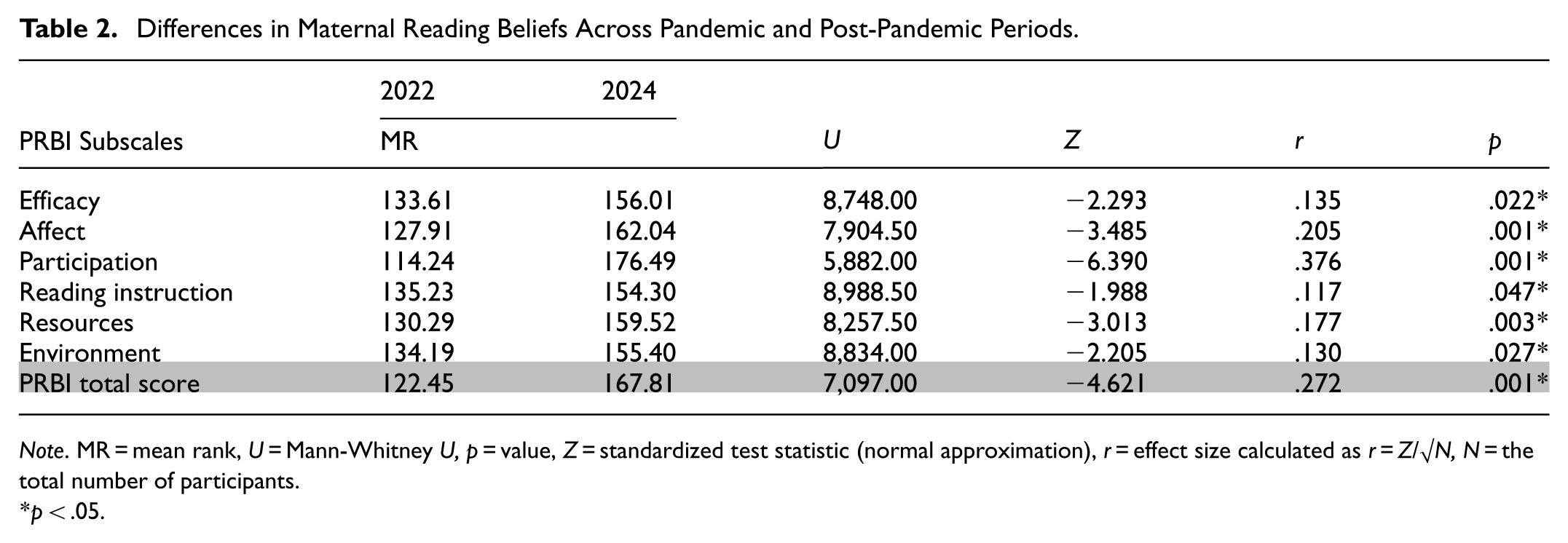
Note. MR = mean rank, U = Mann-Whitney U, p = value, Z = standardized test statistic (normal approximation), r = effect size calculated as r = Z/√N, N = the total number of participants.
p < .05.
According to Cohen’s criteria (1988), r values of .10, .30, and .50 represent small, medium, and large effect sizes, respectively. The results suggest that the most pronounced difference between groups occurred in the “participation” dimension of maternal reading beliefs. Interview data provided further depth to these findings by highlighting how mothers navigated book access and reading practices during different phases of the pandemic. Mothers during the pandemic frequently reported encountering barriers to developing strong reading beliefs, citing challenges such as limited book availability, insufficient promotional content regarding baby books on social media, high book prices, and lack of appropriate book choices. In contrast, post-pandemic mothers described greater access to books, enhanced exposure to book promotions, and increased interest in creating literacy-rich environments for their babies. The results of the interviews were used to create a summary of the factors affecting mothers’ desire to read books to their babies, which is presented in Figure 1.

Factors affecting book reading beliefs according to mothers.
The following two quotes illustrate how mothers perceived changes in book access and attitudes over time:
At the beginning of the pandemic, I couldn’t find any baby books; the options were very limited. However, towards the end of the pandemic, I slowly started to see some books, but there still wasn’t much variety. (PM1) Social media is very effective now. I see so many beautiful books and feel motivated to buy them for my baby. (PPM5)
Book Availability and Social Media Exposure
To address RQ2, associations between book availability, exposure to baby book-related content on social media, and maternal reading beliefs were examined using Kruskal-Wallis tests, correlation analyses, and qualitative accounts.
In 2022, the book availability was associated with significant differences in maternal reading beliefs (H = 25.602, df = 2, p < .001). In 2024, this effect became even more pronounced (H = 55.370, df = 3, p < .001). According to Cohen’s (1988) guidelines, effect sizes η2 = .163 (2022) and η2 = .385 (2024) can be considered moderate to large. Similarly, the relationship between social media exposure and beliefs about reading books was significant both in 2022 (H = 25.200, df = 2, p < .001, η2 = .160) and 2024 (H = 52.232, df = 3, p < .001, η2 = .362) data. These results indicate that mothers who are frequently exposed to book promotions on social media have higher reading beliefs. In particular, a very large effect size of η2 = .362 was observed in 2024.
Correlation analysis was conducted to examine the relationships between social media exposure, book availability and maternal reading beliefs. The results revealed statistically significant positive correlations between overall reading belief scores and variables (p < .05). Notably, social media exposure demonstrated the strongest association with maternal reading beliefs (r = .717, p < .001), suggesting that frequent encounters with baby book-related content on digital platforms may play a substantial role in shaping parental literacy attitudes. Book availability (r = .504, p < .001) was also moderately correlated with reading beliefs, highlighting the importance of environmental support.
Descriptive statistics further support this pattern: during the pandemic, the majority of mothers either never or rarely encountered baby book promotions on social media, with mean ranks of 16.00 (n = 11) and 49.54 (n = 76), respectively. In contrast, post-pandemic mothers reported much higher exposure, with 58 mothers in the “frequently” category showing the highest mean rank (108.59), and 54 mothers in the “occasionally” category (mean rank = 54.65). These shifts illustrate the growing presence of book-related content across digital platforms and may be associated with stronger maternal reading beliefs. These quantitative findings were further supported by qualitative data, in which mothers described how access to books and exposure to social media content influenced their reading behaviors and motivations. For instance, two mothers reflected on this influence as follows:
At the beginning of the pandemic, I didn’t see anything about books on social media; there were always promotions for clothes, accessories, and such. Baby books never crossed my mind. (PM3) Now, I see baby book videos everywhere on Instagram. It makes me want to buy more books for my child. (PPM3)
Suitability of Books Selected for Babies
The developmental appropriateness of the books submitted by mothers was evaluated by experts to describe the quality of book selections across periods. To further contextualize RQ2, these evaluations were interpreted alongside changes in book access and exposure to book-related content on social media. During the pandemic period in 2022, 29.82% of books were rated as developmentally inappropriate for babies, while in the post-pandemic period of 2024, this figure dropped to 17.64%. This change suggests an increased awareness among mothers regarding age-appropriate book characteristics following the pandemic. These expert evaluations were conducted by a panel of five early childhood education specialists who independently reviewed up to three photographs of baby books submitted by each participant. The experts rated the books on a two-point scale (1 = not appropriate, 2 = appropriate) based on criteria such as visual simplicity, tactile features, and text suitability for babies aged 0 to 2. Inter-rater reliability was high (Krippendorff’s alpha = .81), indicating consistency in expert judgments.
Incorrect selections were most common among mothers of children aged 19 to 24 months, who often purchased long, narrative-driven storybooks more suited for preschoolers. The reasons cited for these mismatches, especially during the pandemic, ranged from a lack of developmental guidance to limited bookstore availability and challenges with physically browsing and assessing books due to lockdowns. To illustrate, one mother shared:
I had trouble choosing the right books during the pandemic. Bookstores were closed, and there wasn’t enough information online. When I tried to read, my baby didn’t want to listen. (PM10)
In contrast, mothers in the post-pandemic period described a more informed decision-making process, often guided by digital content. Many attributed their improved book choices to social media posts, book influencers, and online videos that demonstrated developmentally appropriate options by age group:
I saw book videos with puppets and music on Instagram. They showed which books were suitable for babies by month. It helped me a lot. (PPM10)
These qualitative accounts aligned with the quantitative trend and underscored how the visibility and promotion of age-appropriate books on digital platforms contributed to more suitable book selections. However, given the cross-sectional nature of the study, causality cannot be inferred. Rather, the observed improvement in selection may be associated with enhanced digital exposure and increased access to book-related information in the post-pandemic context.
Experiential Factors Associated with Maternal Reading Beliefs
To address RQ3, associations between experiential factors and maternal reading beliefs were examined using Kruskal-Wallis tests, correlation analyses, and qualitative accounts. Kruskal-Wallis tests revealed a significant relationship between maternal beliefs about reading books and various experiential variables during both the pandemic (2022) and post-pandemic (2024) periods (Figure 2). According to the analysis results, the frequency with which mothers established a book reading routine with their babies had a strong effect on their beliefs about reading in both years (2022: H = 34.604, df = 3, p < .001, η2 = .220; 2024: H = 41.648, df = 3, p < .001, η2 = .284). Similarly, the frequency of purchasing books for babies was also found to be significant, particularly in 2024, with a large effect size (2022: H = 14.508, p = .002, η2 = .080; 2024: H = 64.188, p < .001, η2 = .450). The baby’s active participation during book reading (e.g., turning pages, pointing, listening attentively) (2022: H = 17.251, p = .001, η2 = .099; 2024: H = 20.584, p < .001, η2 = .129) and the baby’s request for the book to be read again (2022: H = 16.023, p = .001, η2 = .090; 2024: H = 22.207, p < .001, η2 = .141) also significantly supported maternal beliefs about reading. According to Cohen’s (1988) effect size criteria, these findings show significant effects ranging from small to large, with the variables of book purchasing and routine formation reaching a large effect size, particularly in the 2024 data. In contrast, the variable of frequency of visiting bookstores was not statistically significant in either period (2022: H = 6.615, p = .085; 2024: H = 1.793, p = .616). This pattern suggests that access to books through digital environments, rather than physical spaces, may be more strongly associated with reading beliefs.

Maternal reading belief scores according to the frequency of actions.
Correlation analysis was conducted to examine the relationships between maternal shared reading beliefs and experiential behaviors. The results revealed statistically significant positive correlations between overall reading belief scores and all predictor variables (p < .05). The establishment of reading routines (r = .458, p < .001) demonstrated a moderate association with maternal beliefs, underscoring the importance of consistent literacy practices and environmental structure within the home. Maternal beliefs were also positively correlated with children’s observable engagement during reading, including their desire to be read to (r = .343, p < .001) and their requests for repeated readings (r = .310, p < 0.001), suggesting a dynamic, reciprocal relationship between parent and child in the reading experience. Additionally, purchasing books for the baby was moderately associated with maternal reading beliefs (r = .429, p < .001). Although correlation analysis indicated a weak but statistically significant association (r = .128, p = .030), the Kruskal-Wallis test results suggest that group differences based on bookstore visitation frequency were not meaningful. This discrepancy may reflect the limited practical influence of physical bookstore visits compared to other experiential variables.
Overall, the results underscore the multifaceted nature of reading beliefs and the synergistic role of environmental, behavioral, and relational factors in fostering early literacy development. These statistical associations were further illuminated through qualitative data, which revealed how daily parenting experiences shaped mothers’ beliefs about reading. In particular, mothers described how their routines, purchasing habits, and babies’ engagement influenced their motivation and consistency in shared reading. Mothers who regularly bought books and created consistent reading routines described a more positive and engaged experience with their babies. They highlighted that the presence of books in everyday environments, such as on sofas or play areas, naturally encouraged babies to explore books and initiate reading sessions. For example, one mother explained:
When I was visiting baby stores, I always saw cloth books and sponge books. I bought them before my baby was born. Now, the sponge book is our favorite. My baby looks at the pages and pops them into his mouth. It’s part of our playtime. (PPM2)
Establishing a bedtime reading ritual also emerged as a significant factor in supporting maternal motivation:
We read a book every night before sleep. My baby brings me the book himself. It’s our quiet time together. (PPM4)
Conversely, some mothers expressed hesitation about introducing books too early, often due to developmental assumptions or lack of perceived interest. As a result, reading routines were infrequent or absent, and maternal reading beliefs remained low.
At home, I keep books in a drawer. I sometimes put them on the couch. But honestly, it feels too early for reading. She just stares or throws the book around. I don’t insist on it. (PPM6)
Another mother echoed similar sentiments:
I bought a book because I saw it on social media, but she showed no interest. I thought maybe she was too young for it. (PM2)
Mothers’ perceptions of their babies’ reactions to books significantly influenced their motivation to maintain reading activities. Active participation from babies, such as turning pages, pointing to pictures, or requesting a book again, was reported to reinforce mothers’ desire to read more frequently.
My son looks at the pictures, babbles when I read, and asks me to read the same book again. It makes me so happy. I feel that he enjoys reading with me. (PPM1)
On the other hand, mothers who faced challenges, such as babies showing no clear interest, tearing pages, or being restless during reading, often felt discouraged and reduced their reading efforts.
I bought a fairy tale book. It was too complicated. My baby just tried to tear the pages. After that, I didn’t buy another book. (PM9)
Interestingly, some mothers expressed that their initial low reading engagement was not only due to the baby’s behavior but also to a lack of understanding about how early and how differently babies interact with books compared to older children:
I thought babies start reading around school age. I didn’t realize babies could interact with simple books. It felt pointless at first. (PM7)
Social media exposure also played a dynamic role. Mothers who saw frequent book-related content online reported being more motivated to buy and use books with their babies. In contrast, during the pandemic, when such promotions were rare and basic needs (food, hygiene products) dominated online visibility, mothers felt less inspired to invest in books.
During the pandemic, I only saw cribs and diapers on Instagram. If I had seen more baby books promoted, maybe I would have thought differently. (PM8)
In the post-pandemic period, increased digital promotion of baby books, coupled with easier access to books in stores and online, appeared to foster a greater interest and habit in establishing reading routines among mothers.
Nowadays, my Instagram feed is full of baby books, suggestions for different age groups, and videos of babies enjoying books. It inspires me to keep going. (PPM8)
These findings collectively underscore the intertwined roles of environmental exposure, parental perceptions of babies’ engagement, and consistent reading practices in strengthening maternal reading beliefs.
Demographic Influences on Maternal Reading Beliefs
To address RQ4, relationships between maternal demographic characteristics (e.g., education level, number of children, maternal age, economic status, and child gender) and maternal reading beliefs were examined using group comparisons and correlation analyses, supplemented by qualitative accounts. Kruskal-Wallis test results indicated a statistically significant difference in maternal reading beliefs by educational level (H = 55.329, df = 5, p < .001, η2 = .18), indicating a large effect. Mothers with higher levels of education reported significantly stronger beliefs regarding the value and importance of reading to their babies. This finding was further supported by correlation analysis, which showed a moderate, positive relationship between maternal education and total PRBI scores (r = .362, p < .001). These results suggest that maternal education not only reflects awareness of early literacy practices but may also foster greater confidence in engaging babies in book-related activities. In contrast, the number of children a mother had was negatively associated with reading beliefs. Kruskal-Wallis test findings showed a significant difference based on number of children (H = 8.907, df = 2, p = .012, η2 = .024), and correlation analysis confirmed this relationship (r = −.266, p < .01). Mothers with multiple children tended to report lower reading belief scores, potentially due to reduced time, attention, and resources available for individualized reading routines. Other demographic variables, including maternal age (H = 6.568, p = .087), economic status (H = 2.810, p = .422), and child gender (U = 10,019.00, Z = −0.394, p = .694), did not demonstrate statistically significant relationships with maternal reading beliefs. Similarly, no significant correlations were found between the baby’s age or gender and PRBI scores. These quantitative results were echoed in the qualitative findings, where several mothers with higher educational backgrounds articulated a clear awareness of the developmental value of early reading.
I learned about the importance of early reading during my university years. That’s why I started reading to my baby from day one. (PPM7)
On the other hand, some mothers with lower education levels expressed uncertainty or hesitation about when and how to introduce books to babies.
I wasn’t sure if it made sense to read to a baby. I didn’t have that kind of experience growing up. (PM5)
Similarly, the number of children emerged as a practical barrier in mothers’ narratives. Participants with more than one child described limited time, competing responsibilities, and difficulty maintaining consistent reading routines:
With my first child, I used to read every evening. Now with two kids, it’s hard to find quiet time for reading. (PM6)
Regression Analyses
To identify the predictors of maternal shared reading beliefs, four multiple linear regression analyses were conducted using datasets from 2022 and 2024. In both years, two models were tested: the first included behavioral, environmental, and child-related predictors, while the second extended the analysis by incorporating demographic variables. In all models, the total Parent Reading Belief Inventory (PRBI) score served as the dependent variable. These analyses further address RQ1-RQ4 by evaluating the relative contributions of environmental, experiential, and demographic factors across periods.
In the 2022 behavioral model, the regression was statistically significant and explained 44.5% of the variance in maternal reading beliefs (R2 = .445, Adjusted R2 = .417), F(7, 140) = 16.03, p < .001. Social media exposure (β = .438, p < .001), buying baby books (β = .181, p = .005), and book availability at home (β = .184, p = .005) were significant positive predictors, while the effect of reading routines was not significant (β = .139, p = .081). Variables such as bookstore visits, child’s active participation, and rereading requests were not significant. These results suggest that, during the pandemic, maternal reading beliefs were more strongly associated with material and digital access than with interactional routines with the child.
When demographic variables were added to the model in 2022, the explanatory power increased to 54.4% (R2 = .544, Adjusted R2 = .504), F(12, 135) = 13.45, p < .001. In this extended model, social media exposure (β = .363, p < .001), maternal education (β = .321, p < .001), reading routines (β = .194, p = .010), book availability (β = .142, p = .020), buying baby books (β = .155, p = .013), and rereading requests from the child (β = .224, p = .015) were significant predictors. Maternal age, economic status, number of children, and child gender were not significant contributors. These findings underscore the importance of both digital exposure and maternal education, along with active literacy behaviors, in shaping beliefs about reading during the pandemic.
In the 2024 behavioral model, regression analysis revealed a substantially stronger model fit, explaining 80.7% of the variance (R2 = .807, Adjusted R2 = .797), F(7, 132) = 78.72, p < .001. Social media exposure (β = .637, p < .001), buying baby books (β = .271, p < .001), and book availability (β = .133, p = .020) remained significant predictors. Notably, experiential predictors such as reading routines, child engagement, and rereading requests, which had been relevant in the 2022 model, were no longer statistically significant in 2024. This indicates a potential temporal shift in parenting patterns, where digital exposure and consumer behavior appear to dominate over interactive practices in predicting maternal reading beliefs.
Finally, the extended 2024 model, which included demographic variables, explained 81.2% of the variance (R2 = .812, Adjusted R2 = .794), F(12, 127) = 45.66, p < .001. Consistent with previous models, social media exposure (β = .631, p < .001) and buying baby books (β = .261, p < .001) remained the strongest predictors. Book availability showed a marginal effect (β = .112, p = .058). Importantly, none of the demographic variables (maternal age, education, economic status, number of children, or child gender) emerged as significant predictors in this model. These results suggest that, by 2024, maternal beliefs about reading were predominantly shaped by exposure to digital content and book-related consumer behavior, with demographic characteristics playing a negligible role.
Figure 3 illustrates the standardized beta coefficients of variables that significantly predicted maternal reading beliefs in 2022 and 2024. Social media exposure emerged as the strongest predictor in both years, with its influence markedly increasing in 2024. While variables such as maternal education, reading routines, and child-driven rereading requests were significant in 2022, their predictive power diminished or became non-significant in 2024. Conversely, book purchasing behaviors remained consistently important across both time points.

Standardized beta coefficients of significant predictors of maternal reading beliefs in pandemic and post pandemic period.
Overall, the comparison of models between the two time points reveals a significant increase in explanatory power over time, indicating that maternal reading beliefs became more stable and predictable in the post-pandemic context. The diminishing role of maternal education in 2024 may reflect the equalizing effect of digital access and the normalization of early shared reading behaviors across a wider demographic. These findings may reflect a gradual shift in the ecology of early literacy, moving from a focus on parent-child experiential interactions and demographic factors toward increasing influence of digitally mediated and consumption-related variables, such as social media exposure and book purchasing behaviors, in shaping maternal reading beliefs.
Discussion and Conclusion
The present study offers important insights into how Turkish maternal reading beliefs toward their babies aged 0 to 2 years were influenced by the COVID-19 pandemic and the post-pandemic period. By adopting an explanatory sequential mixed-methods approach, the study not only identified significant differences in maternal reading beliefs across periods but also explored experiential and contextual factors shaping these beliefs.
Mothers, as babies’ first teachers, play a central role in early literacy development, and parental literacy practices at home are critical during this period. Notably, reading beliefs, rather than the frequency of literacy activities, are strong predictors of children’s later reading and writing skills (Weigel et al., 2006). In this study, maternal reading beliefs differed significantly during and after the pandemic, shaped by contextual recovery as well as environmental and behavioral factors such as digital exposure and book availability. Prior research with parents of children over age two reported increased reading during the COVID-19 period (Meoded Karabanov et al., 2023; Read et al., 2022; Wheeler & Hill, 2021), likely because families spent more time at home; however, these findings reflect preschool-aged children who engage more consistently with storybooks. Smith and Thelen (2003) emphasize that maternal beliefs and children’s literacy skills are interdependent, highlighting the need to consider environmental influences alongside parental beliefs. During the pandemic, many mothers faced health concerns, financial strain, work responsibilities, and heightened caregiving burdens, and these stressors, culturally intensified in contexts where childcare falls predominantly on mothers, were linked to increased stress and depression (Günlü et al., 2021). Consistent with this, mothers in the present study reported feeling overwhelmed, which reduced both the quality and frequency of shared reading, echoing findings that pandemic-related disruptions interfered with reading routines (Wheeler & Hill, 2021). Additionally, national reports indicated that economic difficulties and logistical disruptions during this period limited families’ access to baby books (Education Reform Initiative, 2021; Turkish Publishers Association, 2021).
The findings also showed that experiential factors, such as purchasing books, establishing reading routines, and observing babies’ active engagement, played an important role in reinforcing maternal reading beliefs. This pattern aligns with Bandura’s reciprocal model of development (1986), which proposes that beliefs and behaviors mutually shape one another. Frequent shared reading and visible infant engagement appeared to strengthen maternal beliefs, whereas perceived disinterest often reduced motivation. Mothers’ perceptions of book availability and visibility further emerged as influential, consistent with evidence that visibility, rather than mere ownership, predicts reading frequency (Niklas et al., 2020). Post-pandemic improvements in access and exposure to baby books corresponded with higher engagement in shared reading, suggesting the value of policies that support not only book distribution but also book visibility. Although non-parametric analyses identified significant group differences across several experiential variables, regression analyses revealed a more nuanced picture. In the 2024 extended model, reading routines and infant engagement were no longer significant predictors, likely due to multicollinearity among related variables such as social media exposure, book availability, and purchasing behavior. As Vatcheva et al. (2016) note, multicollinearity can reduce the interpretability of individual predictors without undermining overall model fit. The declining predictive power of demographic variables in 2024, particularly maternal education and number of children, may reflect a shift toward digital and consumer-based pathways in shaping maternal beliefs (Aldekhyyel et al., 2022; Mertens et al., 2024; Tiidenberg & Baym, 2017). These trends highlight the need to reconsider traditional frameworks of early literacy engagement and to account for emerging influences, such as digital marketing and social media ecosystems, that increasingly structure literacy-related decision-making.
Another important dimension of the study concerns the role of social media use during and after the pandemic. Quantitative and qualitative findings indicated a strong association between mothers’ exposure to baby book promotions on social media and their reading beliefs; mothers who frequently encountered such content reported stronger beliefs and greater motivation to purchase and use books. During the pandemic, however, mothers noted that social media feeds were dominated by information related to basic needs, reducing the visibility of early literacy materials (Jonnatan et al., 2022). This shift in digital content may help explain the lower maternal reading beliefs observed during this period. In the post-pandemic context, as online content diversified and commercial activity resumed, mothers encountered more book promotions, which may have supported more positive reading beliefs (Holiday et al., 2021; Miller et al., 2016; Song et al., 2020). Supporting this interpretation, We Are Social’s 2022 to 2024 reports documented decreases in overall screen time but increases in targeted digital marketing, including book promotions (We Are Social 2022; 2023; 2024). In Turkey, where social media usage remains high, with 66.8% of the population using it and an average daily use of 2 hr and 44 min, digital platforms appear to play a significant role in shaping consumer behaviors relevant to early literacy (We Are Social, 2024). Pandemic-related stressors (Günlü et al., 2021), reduced physical book access due to supply chain disruptions (Barua, 2021; McKibbin & Fernando, 2020), and rising book prices (Turkish Publishers Association, 2021) may have further heightened the importance of digital environments for maintaining book visibility. Accordingly, the findings point to a meaningful association between mothers’ exposure to book promotions on social media and their reading beliefs.
While non-parametric analyses indicated significant differences in maternal reading beliefs across demographic categories such as education level and number of children, these variables did not remain significant predictors in the multiple regression models, particularly in 2024. Maternal education was associated with stronger reading beliefs in group-level comparisons, but its predictive power diminished once behavioral and environmental variables were included, suggesting that experiential and contextual factors play a more substantial role (Epstein et al., 2018). This divergence highlights the importance of examining both bivariate and multivariate perspectives when interpreting determinants of maternal beliefs. Although prior research links higher parental education to greater developmental awareness and engagement in early literacy practices (Bingham, 2007; Hartas, 2011), the current findings indicate that education alone may not account for variations in reading beliefs when proximal factors such as social media exposure, book availability, and purchasing behaviors are considered. Qualitative data support this interpretation, as mothers across educational backgrounds described similar emotional and experiential motivations for reading. A similar pattern emerged for number of children. Despite evidence that larger families may experience resource dilution (Downey, 2001), this variable did not significantly predict reading beliefs in the multivariate analyses, suggesting that behavioral and environmental influences may outweigh traditional demographic predictors in the current context. Interestingly, economic status was also unrelated to maternal reading beliefs, contrasting with assumptions that higher income predicts stronger literacy environments (Feitelson & Goldstein, 1986; Hemmerechts et al., 2017). Instead, maternal education appeared more salient than household income in shaping literacy-related behaviors, with mothers across income levels drawing on free digital resources, public materials, and home-based strategies to support early literacy.
A notable finding from the qualitative data was the strong influence of babies’ behaviors on mothers’ motivation to continue shared reading. Mothers who observed positive reactions, such as pointing, vocalizing, or requesting repeated readings, reported feeling validated and encouraged to maintain routines, whereas perceived disinterest or disruptive behaviors (e.g., tearing pages) often reduced motivation. This pattern echoes findings by Lin et al. (2015) and Preece and Levy (2020), who highlight the predictive role of child engagement in sustaining parental reading practices. The study also revealed improvements in the developmental appropriateness of books selected by mothers after the pandemic, with the proportion of unsuitable books decreasing from nearly 30% to 17%. This shift may reflect increased access to online developmental guidelines and book recommendations through social media, underscoring the potential of digital interventions to support not only book ownership but also informed book selection. However, barriers persisted, particularly high book prices for specialized materials such as sensory, musical, or interactive books, costs often driven by international sourcing. These challenges reinforce the need for policies that promote equitable access to high-quality children’s literature, including free book distribution through public health programs, libraries, and community initiatives (Rossmanith et al., 2014).
Taken together, the findings extend ecological and social-cognitive theories in ways that are particularly relevant to contemporary early literacy environments. Within Bronfenbrenner’s ecological systems theory (1979), the results show that digital exposure, specifically mothers’ encounters with baby-book promotions on social media, functions as a distinct exosystem-level influence that was not emphasized in earlier ecological formulations. Recent scholarship has similarly argued that digital contexts now operate as indirect yet powerful ecological influences on parenting and learning (Johnson & Puplampu, 2008; Livingstone & Third, 2017). The current findings contribute to this emerging line of work by demonstrating that digital visibility can shape microsystem processes, such as shared reading routines, even in the absence of direct social interaction. Thus, the study points to a need for updating ecological models to incorporate digitally mediated environmental cues as core developmental influences. In relation to Bandura’s social cognitive theory (1986), the observed reciprocal associations among environmental cues (book availability and social media exposure), maternal beliefs, and reading behaviors provide empirical support for reciprocal determinism while highlighting a contemporary extension: digital environments may amplify or accelerate feedback loops between beliefs and behaviors. This idea aligns with research showing that online media can reinforce parental attitudes and decision-making processes through repeated exposure and algorithmic personalization (Tiidenberg & Baym, 2017). By documenting these dynamics during a period of significant societal disruption, the present study clarifies how social-cognitive and ecological mechanisms operate under conditions of environmental constraint and change, thereby offering a theoretical contribution that adapts these frameworks to modern parenting and literacy contexts.
In conclusion, this study provides valuable evidence regarding how Turkish mothers’ beliefs about reading to their babies were shaped during and after the COVID-19 pandemic. Findings indicated that environmental factors, including the availability and visibility of baby books, social media exposure, and experiential engagement with babies, were significantly associated with maternal reading beliefs. During the pandemic, limited access to books, scarcity of promotional content related to baby literacy, and heightened caregiving challenges may have contributed to a decline in maternal reading beliefs and practices. In the post-pandemic period, improvements in book accessibility and the revitalization of early literacy promotion through digital platforms appeared to correspond with stronger maternal reading beliefs. Importantly, the study highlights the reciprocal nature of parental beliefs and behaviors: mothers who frequently purchased books, established consistent reading routines, and observed active engagement from their babies tended to developed stronger and more sustained reading practices. Furthermore, maternal education level emerged as a critical factor associated with early literacy practices, while economic status was less predictive, underscoring the importance of educational interventions over solely economic ones. By focusing specifically on mothers of babies aged 0 to 2 years, a relatively understudied population, this study helps address a significant gap in the early literacy literature. It underscores the need for multifaceted, culturally responsive strategies that not only promote book ownership but also enhance book visibility, accessibility, and parental confidence in early literacy practices, particularly during times of societal disruption.
Limitations and Future Directions
While the present study offers valuable insights into the factors influencing maternal reading beliefs during and after the COVID-19 pandemic, several limitations must be acknowledged. First, the sample was composed exclusively of mothers, as fathers’ response rates were insufficient for meaningful inclusion. As a result, the findings reflect maternal perspectives only and may not capture the full dynamics of parental involvement in early literacy practices. Future research should aim to include a more balanced representation of fathers or other caregivers to provide a more comprehensive understanding of early home literacy environments. Second, the study relied primarily on self-reported data for assessing maternal beliefs and reading behaviors. Although efforts were made to triangulate these reports with photographic evidence and qualitative interviews, self-report measures are inherently subject to recall bias and social desirability effects. Mothers may have overestimated their reading frequency or the degree of their babies’ engagement. Future studies could incorporate direct observational methods to validate self-reported behaviors and enhance data reliability. Third, the study was conducted within a specific cultural and national context, namely Türkiye, where educational systems, cultural values regarding reading, family structures, and digital access patterns may differ from those in other countries. Consequently, caution should be exercised when generalizing these findings to broader or international populations. Comparative studies across diverse cultural settings would enrich our understanding of how context-specific factors influence maternal reading beliefs and behaviors. Fourth, while the study captured changes in maternal reading beliefs across two time points (during and after the pandemic), it did not employ a longitudinal design. Thus, while differences were observed, causal inferences regarding the lasting effects of the pandemic on maternal literacy practices cannot be firmly established. Longitudinal research tracking reading beliefs and practices over time would provide deeper insights into the stability and evolution of early literacy behaviors. Fifth, while the qualitative interviews offered rich insights into maternal experiences, the number of interviewed mothers (n = 20) was relatively small compared to the quantitative sample. Although thematic saturation was achieved, expanding the qualitative sample size in future research could allow for greater variability in experiences and perspectives, particularly among subgroups differentiated by socioeconomic status, education level, or urban-rural residence. Finally, the study did not deeply examine the role of digital literacy skills among mothers, despite indications that online exposure to baby book promotions significantly influenced reading behaviors. Future research should explore how digital competencies mediate the relationship between environmental exposure and literacy practices, particularly in an increasingly online-centric world. Despite these limitations, the study makes a meaningful contribution to the field of early literacy development by highlighting the critical role of environmental, experiential, and digital factors in shaping maternal reading beliefs during an unprecedented global crisis.
Footnotes
Acknowledgements
I would like to thank all the mothers who participated in the study. I would also like to thank Mrs. Dr. Kara Eren and Mrs. Dr. Şallı for her efforts to ensure reliability in the analysis of the qualitative findings of the study.

Ethical Considerations
It was taken by Anadolu University Research and Publication Ethics Committee in accordance with the Ethics Committee Decision No. 83/85 dated 24.06.2022.
Funding
The author received no financial support for the research, authorship, and/or publication of this article.
Declaration of Conflicting Interests
The author declared no potential conflicts of interest with respect to the research, authorship, and/or publication of this article.
Data Availability Statement
The participants of this study did not give consent for their data to be shared publicly. The data are not publicly available due to privacyrestrictions and the associated ethical approval. Anonymized data can be made available on reasonable request.