




Abstract
This study investigates the effect of a digital influencer’s negative opinion on people’s investment decisions in a company. We conducted an experiment with 281 participants, randomly allocating them into one of two conditions. In the experimental group, participants received comprehensive information about the company, and a digital influencer expressed criticism in a video they watched. Conversely, in the control group, participants were provided solely with financial information about the company. Subsequently, we solicited participants to assess the company and reveal their investment intentions. The results indicated that the participants in the experimental condition had a lower evaluation of the company than those in the control condition. They also disagreed more with the company’s growth prospects and showed less willingness to invest, aligning with the influencer’s opinion. Factors such as gender, age, education level, or investment experience did not moderate the effect of the influencer. This study provides insights into the role and impact of digital influencers in the business domain and reveals that they can shape public perception of specialized accounting information. It examines how they influence our communication and underscores the importance of regulatory awareness of their activities.
Introduction
Through experimental research, the study seeks to understand whether people are willing to invest in a company even when a digital influencer expresses a contrary opinion. New technologies influence the business world by providing fast and dynamic information. In the past, companies shared their accounting information more traditionally. In recent years, social media have come to play an essential role in disseminating this accounting information (Guindy, 2021). Unlike traditional media, on social media, information spreads widely and quickly (Deng et al., 2018; Jung et al., 2018; Lee et al., 2015); this creates a kind of connection between users (Kramer et al., 2014; Xiaomei et al., 2018), reaching more people at a lower cost to share information (Guggenmos & Bennett, 2021; Lei et al., 2019; Miller & Skinner, 2015).
Digital influencers are those who produce high-reach content. They transmit, decode messages, and transmit information among users, being opinion leaders (Abidin, 2015; Torres et al., 2019; Uzunoglu & Kip, 2014). They are opinion makers and have the power to influence the attitudes and decisions of their followers (Boerman, 2020; Jiménez-Castillo & Sánchez-Fernández, 2019; Nascimento et al., 2020; Veirman et al., 2017). It remains unclear whether and how a digital influencer’s opinion affects corporate communication; this article investigates people’s willingness to invest in a company despite a digital influencer expressing a contrary opinion using an experimental study.
In finance, it is increasingly common to share individual analyses of financial securities (H. Chen et al., 2014; Hu et al., 2020; Uzunoglu & Kip, 2014), and there are cases of dissemination of opinions on investments. On the other hand, instead of relying only on information disclosed by companies, investors have used information on social media and content generated by influencers to guide their decisions (H. Chen et al., 2014; Jia et al., 2020; Torres et al., 2019). Our research explores how digital influencers operate on social media and impact communication, drawing on three theoretical approaches: communication theory, information asymmetry theory, and social influence theory.
According to Shannon’s (1948) communication theory, accuracy in message transmission between sender and receiver is crucial. Therefore, researchers must examine the communication channel (i.e., social media) and how the recipient interprets the transmitted message. Our study also incorporates aspects of information asymmetry theory from the perspective of decision-making investors (Blankespoor et al., 2014; Bourveau et al., 2019; Cuadrado-Ballesteros, et al., 2016; Dorminey et al., 2015; Liu, 2021; Roychowdhury et al., 2019) and social influence theory, which examines the role of influential agents in shaping communication and decision-making processes (Kelman, 1958; Ki et al., 2022; O’Keefe, 2016; Pelinka & Suedfeld, 2017).
Understanding whether investors consider influencers’ opinions in their investment decisions is essential for several reasons. Some studies indicate that influential users on social networks play a role in spreading highly speculative rumors, which can affect stock prices (Jia et al., 2020). However, we still do not clearly understand to what extent we can trust their information and whether they can analyze it accurately (H. Chen et al., 2014; Deng et al., 2018). This uncertainty is mainly due to the lack of literature on the subject.
The current evidence has provided an initial understanding of how influential social media users operate. However, the literature on social media use in the corporate environment still requires further development (Hales et al., 2018; Nerantzidis et al., 2024). There is limited understanding of how social media interactions among various stakeholders can drive improvements in corporate communication. Although research on this topic has been increasing, it has primarily examined how companies initiate and use social media as a corporate disclosure tool. (Blankespoor et al., 2014; Deng et al., 2018; Jung et al., 2018; Lee et al., 2015).
However, studies exploring the intersection of the accounting environment and digital influencers remain scarce. For instance, Cade (2018) analyzed the relationship between corporate disclosure and the responses of influential social media users, while Furinto et al. (2023) examined the influence of financial and digital literacy on investment decisions, highlighting the scarcity of research in this field. Our study advances this discussion through an experiment in which a digital influencer expresses disagreement with a company, revealing the impact of such opinions on users who engage with them. Thus, our research carries significant theoretical and practical implications.
Current evidence has given us an initial understanding of how influential social media users operate. However, studies that explore the relationship between the accounting environment and digital influencers are still limited. For example, Furinto et al. (2023) examine the influence of financial and digital literacy on investment decisions and suggest that studies in the field are still limited. This study focuses on a situation where a digital influencer expresses disagreement with a company. The objective is to investigate how this influencer’s presence affects users’ decisions in the face of this information.
We performed a controlled experiment to conduct this study. We collected data from participants and randomly divided them into two groups: one group received only accounting information, while the other watched a video where a digital influencer analyzed and expressed her opinion about the events. The experimental method is particularly relevant for investigating the research question, as it allows for the direct and independent measurement of participants’ perceptions. This approach helps determine whether a digital influencer exerts social influence (social influence theory), interferes with a company’s communication process (communication theory), and affects participants’ investment decisions (information asymmetry theory).
Initially, all participants assume the role of potential investors and evaluate various aspects of the company’s perception, such as profitability and cash flows. After this initial assessment, they decide whether to invest in the company’s stock and whether they agree with the management’s growth forecasts. The results indicate that merely watching a video featuring the digital influencer’s opinion can alter investment decisions and perceptions of the company. Participants exposed to the video were less likely to invest in the company and were more inclined to disagree with the growth projections made by management.
Social media communication is dynamic, relying on various formats such as messages, images, videos, and user reactions to disseminate information. Our study demonstrates that information spread through video content influences user decision-making, an area that remains underexplored in the literature. Nerantzidis et al. (2024) highlight that most social media studies focus on textual characteristics of financial disclosures. In contrast, visual elements, such as videos—widely used on these platforms—remain largely unexamined. By incorporating this new perspective, our study makes a practical contribution to the research field.
This study contributes to the emerging literature on the role and impact of digital influencers. The increased uncertainty generated by a digital influencer’s opinion can exacerbate information asymmetry and weaken financial markets, as our findings reveal that digital influencers can shape public perception of specialized accounting information. This phenomenon underscores the reality that sources without deep technical expertise influence public opinion and financial decisions. Our research offers valuable insights for regulators, accounting professionals, and general users, highlighting the need to monitor the role of influencers in financial markets. Additionally, it emphasizes the function of social media as an intermediary in disseminating of financial information. This topic is highly relevant, as it addresses companies′ challenges and represents a new form of corporate communication.
Literature Review and Development of Hypotheses
With the advent of social media, companies have lost some control over their information environment, resulting in incredible difficulty in predicting and managing the dissemination of information (Miller & Skinner, 2015). In this new scenario, other stakeholders can share opinions about the company and disseminate them widely, creating positive or adverse effects, mainly if the recipients have limited knowledge on the subject. In addition to providing more accessible information, social media allow capital market participants to reveal how they interpret information (Cade, 2018), which can influence companies’ communication.
Studies on information and social media are recent and explore varied approaches (Blankespoor et al., 2014; Cade, 2018; Deng et al., 2018; Jia et al., 2020; Jung et al., 2018; Lee et al., 2015). Even so, studies are necessary because traditional, mass, and linear media dissemination for many individuals have ceased to play a central role due to digital platforms, which allow the dissemination of horizontal, non-linear information in real-time and interactive (Cade, 2018). Social media is a modern phenomenon, with impacts that are still not fully understood, as well as the relationship between digital influencers and the business environment.
This study is grounded in three theoretical approaches: communication theory, social influence theory, and information asymmetry theory. The communication theory, developed by Shannon (1948), establishes that the transmission of a message involves the source of information, the transmitter, the transmission channel, the receiver, and the destination. An adequate communication process must convey the meaning of the source of information produced to the recipient (Chambers, 2006; D. H. Li, 1963; Smith & Smith, 1971). Studies that use the theory to explain a company’s communication process consider that the information user is responsible for decoding the message (Bedford & Baladouni, 1962; Merkl-Davies & Brennan, 2017; Williams, 2015).
The receiver of the message plays an essential role in the process; however, their performance in decoding the message can be affected by several factors, one of them being the degree of knowledge they have about the coding used by the sender. Although studies have considered that the information user (destination) decodes the message, social media can separate this role. This study argues that, in these channels, a receiver may decode the message to the destination, changing the previously established communication process. If, for example, the digital influencer performs the role of the decoder, the way he decodes the message will impact the information user. Figure 1 shows how the communication theory starts to be structured when the digital influencer assumes the role of message decoder.
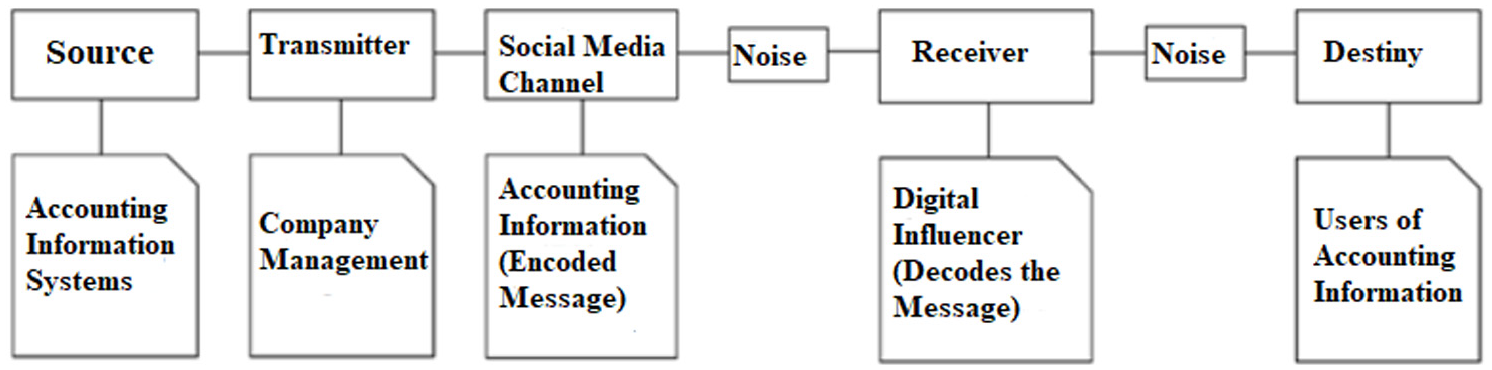
Communication theory applied to the digital influencer as a message decoder.
Our study also incorporates information asymmetry theory from the perspective of decision-making investors, social influence theory, and the credibility of digital influencers, who play a role in shaping the communication process. Information asymmetry theory is particularly relevant in this research context, as it examines how information affects the behavior and decisions of economic agents and influences market efficiency from an economic and financial standpoint (Blankespoor et al., 2014; Bourveau et al., 2019; Core et al., 2015; Cuadrado-Ballesteros et al., 2016; Dorminey et al., 2015; Leuz & Verrecchia, 2000; Liu, 2021; Roychowdhury et al., 2019). The concern with information asymmetry arises because asymmetrical information environments tend to increase the cost of capital, as investors demand higher returns under such conditions (Core et al., 2015; Cuadrado-Ballesteros et al., 2016; Leuz & Verrecchia, 2000; Roychowdhury et al., 2019).
Meanwhile, social influence theory examines how individual interactions shape behaviors, attitudes, and beliefs. Under certain conditions, an influential individual can drive changes in attitudes and behaviors through communication (Kelman, 1958; Ki et al., 2022; O’Keefe, 2016; Pelinka & Suedfeld, 2017). Such changes manifest when the influenced individual complies with the influencer’s opinion, identifies with the message, or internalizes the expressed opinion based on their beliefs and values (Kelman, 1958; Ki et al., 2022). Within a network, an influential individual strategically positions themselves to influence others through different mechanisms (Wong, 2015; Zhu et al., 2024). In social media, digital influencers hold significant presence and credibility, meaning their opinions can shape users’ decisions, particularly among their followers (Jia et al., 2020; Torres et al., 2019; Uzunoglu & Kip, 2014). When audiences perceive an influencer as authentic, their capacity to influence becomes even more effective.
On one hand, companies disclose information as part of their communication process. On the other, external users receive this information but, operating in an asymmetrical environment, often rely on alternative sources or channels to interpret its content. Given the impact of social media on corporate communication, and the influence and credibility of digital influencers, users who accept messages disseminated by these opinion leaders may make unfavorable financial decisions. The information shared in influencers’ opinions may be incomplete or inaccurate.
According to Arnaboldi et al. (2017), social media technologies offer opportunities for users to exchange information while enabling others—such as digital influencers—to collect and analyze these insights online, significantly affecting the communication process and potentially increasing information asymmetry. These emerging challenges impact investors’ decision-making abilities, particularly among less experienced investors, who, overwhelmed by excess information, may turn to digital influencers for guidance.
The existing literature on social media, corporate disclosures, and information asymmetry suggests that when companies disseminate information via social media, it has the potential to reduce information asymmetry and enhance investor protection (Blankespoor et al., 2014; Bourveau et al., 2019; Dorminey et al., 2015; Liu, 2021). However, when other social media users, such as digital influencers, generate content related to corporate disclosures, it can amplify market rumors, making the informational environment more asymmetrical (Blankespoor, 2018; Jia et al., 2020; Jung et al., 2018).
In the context of the stock market, information shared by influential figures on social media has a more significant impact on investor decisions (Ichev et al., 2019). When these influencers criticize a company and that company does not respond on social media, these criticisms tend to be considered more relevant (Cade, 2018). In addition, audiences perceive content generated by different types of users with varying levels of reliability, directly linking credibility to their influence (Tang, 2018).
Jia et al. (2020) show that merger rumors that do not materialize cause distortions in stock prices. They are more accentuated when initiated by users with more significant influence on social media, contributing on a grander scale to the distortion of information. Because high-influencers tend to have more followers and are more active, their content has greater reach and a chance of repeat exposure. In addition, information posted by influencers is likely to be considered more credible by investors with limited capacity (Jia et al., 2020). The results presented by Ichev et al. (2019), Cade (2018), Tang (2018), and Jia et al. (2020) corroborate the idea that the digital influencer acts as a message decoder for the destination (information user).
The role of the influencer as a decoder of the message can happen due to a series of factors. One of them is that the digital influencer is part of a culture of participation, intensified in society’s current way of life, which facilitates and encourages digital communication. With the participation of people, users of digital platforms began to assume roles previously exclusive to specialists. With social media, users have become more critical in the communication scenario and become content creators. The result is individuals who can influence others in these channels.
Another reason is related to the language used in business (Chambers, 2006; Killian, 2010; Merkl-Davies & Brennan, 2017). Companies write business reports using a complex narrative. The digital influencer communicates through informal language, often with verbal reports expressed in videos, in a simple and direct language. The literature has already shown that small changes in how researchers present information can impact people’s interpretation (framing effect; e.g., Elliott et al., 2012; Hodge et al., 2010; Kadous et al., 2017).
Considering that individuals perceive consensus as a corrective cue (Axsom et al., 1987; Cade, 2018; Cialdini & Goldstein, 2004) and that investors seek to form well-founded opinions about a company (Friestad & Wright, 1994), they are likely to be receptive to additional information that appears to aid their evaluation. Given that the recipient must decode the message transmitted through a channel, our research establishes that the digital influencer, acting as a social influence agent, assumes the role of decoding information for participants, potentially influencing their decision-making process. Since, in the experiment, the influencer’s message is negative—contrasting with the company’s—we expect this to affect how participants assess the company. Therefore, we propose the following research hypothesis:
However, even if the influencer decodes the message and interferes with how participants interpret the company’s communication (accounting communication), participants still recognize the company’s information as relevant in the decision-making process. (Aharony et al., 2010; Beyer et al., 2010; Chalmers et al., 2011; C. J. P. Chen et al., 2001; Healy & Palepu, 2001; Lei et al., 2019). Therefore, the belief that this information is more reliable and relevant will interfere with the participants’ evaluation. Given this, hypotheses 1b and 1c establish that:
The question of the language used in social media leads us to believe that the form of communication used by influencers tends to favor their opinion over other users of the platforms, reinforcing the role of decoding the message. For example, Rennekamp and Witz (2020) show that investors are more sensitive to signs of public involvement when disclosures use informal language. The use of informal language affects willingness to invest, depending on what that language stands for, because informal language is more conversational and better suited to building rapport (mutual trust; Heylighen, 1999; Heylighen & Dewaele, 2002). Considering that the influencer opposes buying the company’s shares in the research and disagrees with the forecasts, we establish the following hypotheses:
According to Miller and Skinner (2015), people often look at how others react on social media (herd effect) and follow their cues, especially when they are uncertain about what to do (Axsom et al., 1987). Investors, for instance, want to assess the criticisms that companies receive and use any helpful information to achieve this goal (Friestad & Wright, 1994). However, even a simple negative comment can damage the investors’ impression of the company and its reputation (Cade, 2018). When an investor reads a review, he will depend on his knowledge to judge its validity. If he has difficulty evaluating the review or does not trust its source, he will seek other clues to assist him (Cade, 2018). People generally tend to trust information more when there is a consensus among others (Axsom et al., 1987).
When realizing that a large audience on digital platforms reacts favorably to the influencer’s positioning, the individual can accept it as a reliable source and identify the public’s favor as a consensus. In a social media environment, the number of “likes,”“comments,” and “shares” are observable measures of audience engagement with communications from an influential source (Cade, 2018). People perceive likes as social cues that convey messages from the post creator to their network (Zhu et al., 2024). The reactions a post receives further reinforce the social acceptance of a digital influencer (Zhu et al., 2024).
Based on this assumption, the participants can assume that the number of likes and comments on the content generated by the influencer is a form of consensus when assessing the reliability of the criticism. Therefore, the influence related to the decision to invest or not in the company should be more significant for participants who watch the indicated video with the highest number of reactions on social media, and this will further contribute to the influencer playing the role of message decoder. Therefore, the following hypotheses state that:
Taking into account that individuals perceive consensus as a suggestion for correction (Axsom et al., 1987; Cade, 2018; Cialdini & Goldstein, 2004) and investors want to form valid opinions of the company (Friestad & Wright, 1994), they should be receptive to additional information that seems to help them in the assessment. There is support for the notion that customers and investors defer to what other users share through social media communications (Y. Chen et al., 2012; Deans, 2011). This influence on users who are less informed or undecided in their choices and decisions occurs because it considers the crowds’ wisdom (Tirunillai & Tellis, 2012). Likes serve as social cues that convey messages from the post creator to their network; we assume this because one of the characteristics of influencers is creating direct content that is visually more interesting and easy to understand. (Y. Li & Xie, 2020).
Materials and Methods
This study employs a between-subjects experiment to investigate how the presence of financial influencers in accounting-related content affects participants’ investment decisions. The experiment was designed to measure the effects of key variables through statistical regressions.
We conducted the study in six stages. The first stage involved selecting participants, consisting of 281 students from Brazilian universities. This target group was chosen based on their cognitive ability to evaluate financial information and make investment decisions, as demonstrated by previous studies (Haesebrouck et al., 2021; Kahneman & Tversky, 1983; Mortensen et al., 2012). Additionally, research suggests that students are valid participants in this type of experiment (Bozkurt et al., 2021; Webb et al., 2013).
In the second stage, we developed the experiment, beginning with a 12-month preliminary analysis of Brazil’s leading financial digital influencers. During this period, we monitored posts across social media platforms such as Twitter, Instagram, Facebook, and YouTube, examining elements like language, tone, emphasis, arguments, jargon, and visual features. Based on this analysis, we designed a script inspired by a real case, incorporating typical characteristics of financial influencers. The video production involved a specialized audiovisual team, including hiring an actress selected through a casting process. Additionally, professional editors incorporated graphics, tables, and visual information—view counts, likes, and comments—to ensure the content closely resembled real videos commonly found on social media.
In the third stage, we experimented, structuring it into three distinct scenarios. One group had access only to the company’s original content; another received the accounting content accompanied by a low-engagement video, characterized by fewer interactions; and the third group received the same accounting content along with a high-engagement video, featuring significantly greater reactions. We randomly assigned participants to one of the three conditions, following the randomization principles established by Jadad et al. (1996). We instructed participants to assume they were evaluating a hypothetical company in the construction sector and needed to decide whether to invest in it. We provided them with detailed financial information, including the balance sheet, income statement, cash flow statement, performance indicators, and growth projections. The influencer’s video presented an unfavorable opinion about purchasing the company’s stock and projected lower growth than the company’s forecast.
The fourth stage involved data collection through a questionnaire, ensuring voluntary participation. The questionnaire included questions about respondents’ personal information, their perceptions of the company and the influencer (when applicable), and their final investment decision regarding the company presented in the experiment.
The fifth stage consisted of statistical analysis and data modeling. To capture participants’ overall perception of the company, we evaluated seven items: debt payment capacity, liquidity, indebtedness, profitability, cash flow, growth forecast, and overall company perception. Given the high correlation among these items, we applied Principal Component Analysis (PCA) to reduce redundancy and obtain a consolidated index called PCA_EVALUATION. With the processed data, we estimated five regressions to assess the effects of key variables on the dependent variables. We represent the general model specification as follows:

Where: Yi represents the dependent variable, which can take the following values: PCA_EVALUATION, NO_INVEST (with and without video), and AGREE (with and without video); Xi is the vector of key variables, varying by model; Zi is the control variable vector, comprising eight variables; α is the intercept; β and γ are the estimated coefficients; and ϵi represents the error term.
Table 1 presents the study variables and their corresponding abbreviations. We tested the collected data using regression analysis.
Study Variables.

Finally, in the sixth stage, we validated the statistical models. We analyzed the data through statistical regressions and tested the models to ensure they met all necessary assumptions. We conducted all required validations to ensure the robustness and reliability of the results presented in the following sections.
Results
Descriptive Statistics and Cross-tabulation
Table 2 presents the descriptive statistics of the variables, providing a better understanding of the characteristics of the respondents’ data under study. While some participants were more dissatisfied or disagreed (grade 1) with the company’s information, others were more satisfied and agreed, assigning the highest score to the questioned items.
Descriptive Statistics.

All the variables, except PCA_Evaluation, refer to the scores given by the participants, which ranged from 1 to 10. The last two variables in the Table (CONFID_INFL and RELEV_INFL) refer to two questions about the level of confidence and relevance of the influencer’s information, and we applied to the group that had access to the video.
Participants gave a lower average score for confidence in the information produced by the company (6.10) compared to the confidence in the influencer’s information (7.27) among those who watched the video. However, the accounting information is considered more relevant (8.06) than the influencer’s (7.59). This result draws attention, as it could indicate that the influencer had no impact on the participants’ decision, which is invalid, as will be shown later. A possible explanation for this result is that people have difficulty recognizing who influences them. Allied to this, most participants are students of the accounting sciences course, which led them to identify accounting information as more relevant. About 75% of the participants are younger people who, on average, attend approximately four semesters of the course. It is also noteworthy that participants are more confident (average 6.1) than experienced investors (average 4.16).
Before presenting the results of the regression models, Table 3 displays two analyses: one comparing participants’ responses regarding the decision to invest or not in the company (Panel A) and another examining whether they agree or disagree with the company’s growth forecast (Panel B).
Perception Difference.
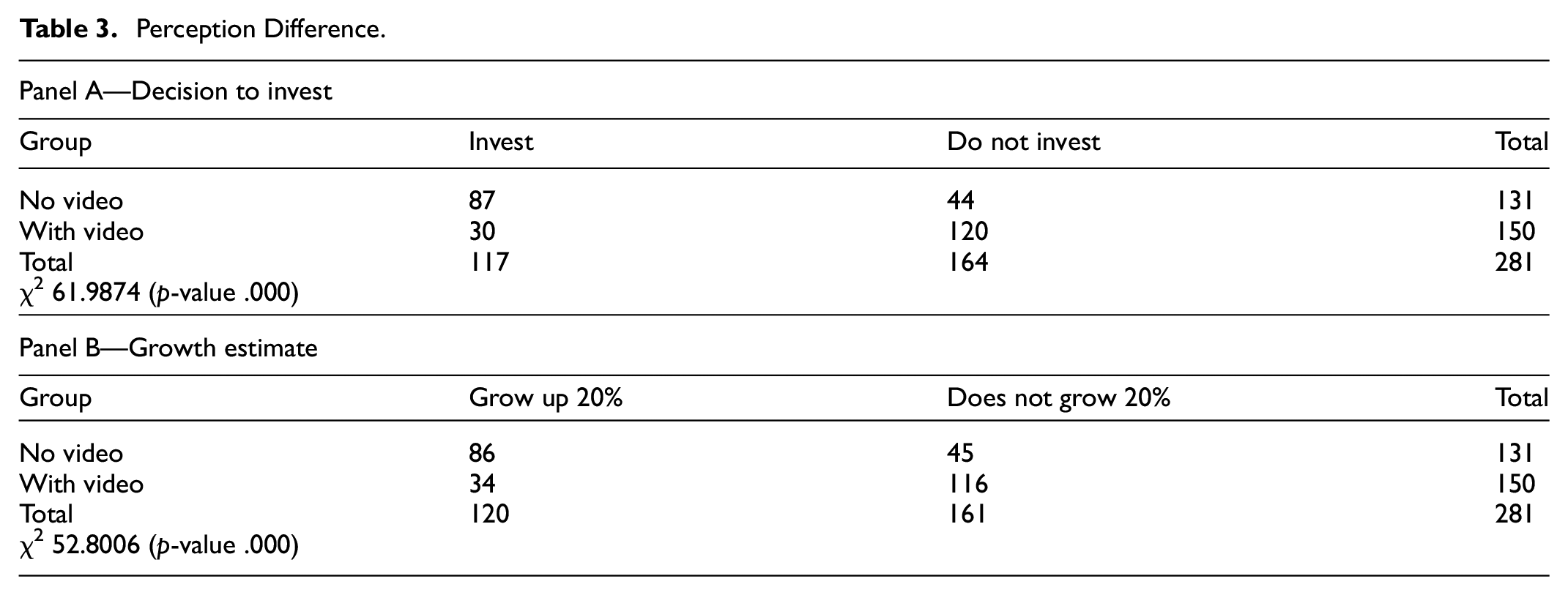
Most participants who did not have access to the video responded positively regarding the investment in the company. Most of those who watched the video chose not to invest (panel A of Table 3). Similarly, in panel B, most participants who did not have access to the video agreed with the future growth forecast presented by the company. In contrast, the majority disagreed among those with access to the influencer’s opinion. In general terms, it is possible to state that when watching the video, there was a change in the participant’s opinion, influenced by the position presented.
Regression
After tabulating the questionnaire responses, we performed several regressions, applying robust error treatment to verify the validity of the hypotheses. Each regression assessed the assumptions, and we calculated the results using the stepwise method. Since the values obtained by the stepwise method did not show significant differences concerning the complete model, we decided to include only the results of the complete model in the article. Initially, we analyzed only two groups: those who watched the video and those who did not. The number of reactions will be analyzed later. Table 4 shows the results of the first five regressions.
Results of the Regression Models.
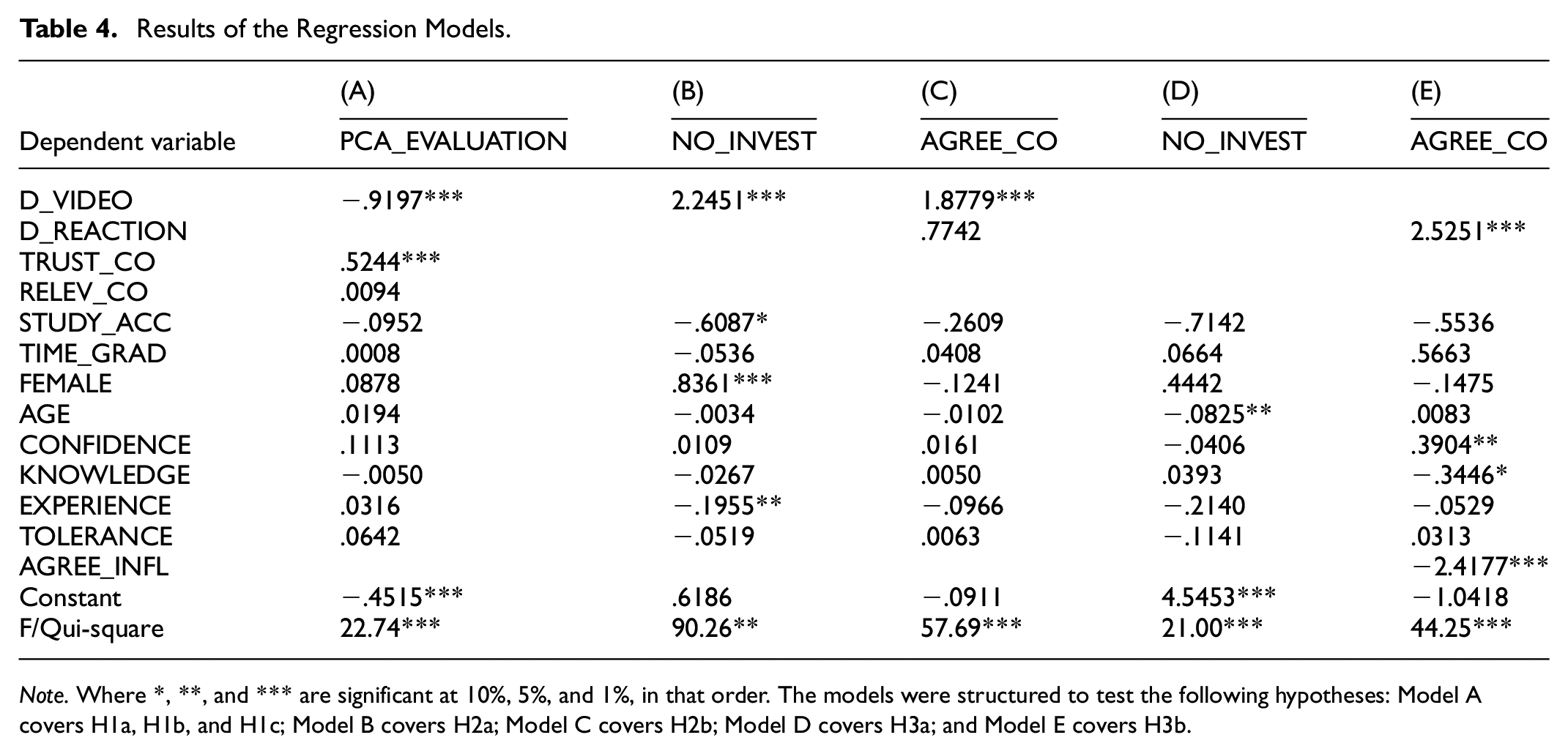
Note. Where *, **, and *** are significant at 10%, 5%, and 1%, in that order. The models were structured to test the following hypotheses: Model A covers H1a, H1b, and H1c; Model B covers H2a; Model C covers H2b; Model D covers H3a; and Model E covers H3b.
Column A of Table 4 presents the regression with the company’s evaluation by the participants as the dependent variable. It is possible to notice that those who had access to the opinion of the digital influencer (D_VIDEO) evaluated the company more negatively, which may be a sign of the influencer’s interference; then hypothesis 1a is confirmed. Meanwhile, participants who indicated greater confidence in accounting information (TRUST_CO) evaluated the company more positively, confirming hypothesis 1b. However, the evidence found does not allow us to state that the relevance of accounting information (RELEV_CO) is an essential factor for the participant’s assessment, as the variable is insignificant; we reject Hypothesis 1c. The participants who were more confident in their answers (CONFIDENCE) and those more risk tolerant (TOLERANCE) rated the company more positively, although this result was not significant.
The decision not to invest in the company was also analyzed (column B of Table 4). Those with access to the video (D_VIDEO) are likelier to follow the digital influencer’s opinion and not invest in the company, as stated in hypothesis 2a. These results confirm the evidence presented in the cross-tabulation. Participants taking a course other than accounting sciences, females, and those with experience were less likely to invest in the company.
Descriptive statistics showed that the participants best evaluated the variable predicting future growth (mean 6.2). However, when asked directly by the participant whether or not he agrees with the predictions, the evidence in column C of Table 4 shows that a significant portion of the respondents do not agree with the predictions. Then, hypothesis 2b is confirmed.
We used only the data from the questionnaires answered by participants who had access to the influencer’s opinion to test hypotheses 3a and 3b. Thus, we categorized participants who watched the video with the least engagement (likes, comments, and views) as Group 0. Meanwhile, we categorized those who watched the video with the most engagement as Group 1.
The previously calculated models in columns B, with the decision not to invest in the company (NO_INVEST), and C, agree with the company’s predictions (AGREE_CO), of Table 4 were calculated using this segregation. In columns D and E, the results focus on reactions (views, likes, and comments).
There is no statistical evidence that participants with access to the opinion of the digital influencer flagged with more reactions were less likely to invest in the company (column D). Among the control variables, reactions indicated that only age (AGE) was significant. Therefore, hypothesis 3a cannot be confirmed. Some events that occurred at the time of application of the experiment may have interfered with the results. When the experiment was planned, it was unknown which places would authorize the application of the research nor what types and quality of projection equipment would be used.
In some cases, the projection equipment made it difficult for participants to see the information about the reactions, making the measurement of the variable less accurate. However, participants who watched the video with more reactions were more likely to follow the digital influencer’s opinion, disagree with the company’s future growth forecast, and agree with the digital influencer’s opinion. That is, hypothesis 3b is confirmed. The results presented in Table 4 were also analyzed using the stepwise parsimony approach, removing non-significant variables and assessing whether this affected the study’s conclusions. The results obtained, which we have not presented here, showed no substantial variations, further reinforcing the study’s findings.
Discussion
This study confirmed hypotheses 1a, 1b, 2a, 2b, and 3b, reinforcing the evidence discussed in the literature and demonstrating that digital influencers act as intermediaries who reinterpret messages for the final recipient, as supported by communication theory and defended in this research. These findings also validate the argument that influencers gain credibility and establish themselves as agents of social influence on social media. By fulfilling this role, they actively shape the decision-making process of nonprofessional investors, as outlined in social influence theory.
Subramanian (2021) previously demonstrated in a study among adults in India that social media influences investment decisions by shaping user perceptions. Similarly, Chairunnisa and Dalimunthe (2021) identified the role of influencers in herd behavior within the Indonesian market, while Kipp et al. (2019) examined the impact of social media on nonprofessional investors. These studies consistently show that social media affects user decisions, aligning with the results presented in this research.
Cade (2018) also highlighted that criticisms made by influential social media users can significantly impact the perceptions of nonprofessional investors, particularly when widely shared. Our study expanded upon Cade’s (2018) findings by demonstrating that digital influencers can influence decision-making when perceived as credible, even when users do not extensively share their content across social media platforms.
Similar to the findings of Rennekamp and Witz (2020), our study reveals that participants were more responsive to engagement cues presented in an informal tone in the influencer’s videos than to the formally structured financial reports. Nerantzidis et al. (2024) argue that research on social media should focus more on visual resources, such as videos, which people widely use across platforms. By incorporating an experimental approach that examines an influencer’s opinion conveyed through video, our study provides further evidence that informal language plays a significant role in communication.
Blankespoor et al. (2017) emphasize that the body language of individuals presenting financial information contains additional cues that can influence how users perceive the credibility of the information. Our findings support this discussion, demonstrating that the digital influencer’s message overshadowed the financial disclosures provided by the company. This study underscores that the intervention of digital influencers affects users’ decision-making, thereby altering corporate communication dynamics. Additionally, we tested whether the influencer’s credibility—measured by participants’ trust in their opinion—impacted their responses, and their willingness to like, comment positively, and share the video. The results, also not presented in the text, show that the participants who gave higher scores to confidence in the influencer’s information, who agreed with the growth forecast expressed by her, and who showed an intention to enjoy the video consider the opinion of the digital influencer as relevant.
Confirming hypotheses 1a, 1b, 2a, 2b, and 3b reinforce the previously discussed literature evidence and show that the digital influencer acts as a message decoder for the final recipient, as supported by the communication theory and defended in this study.
Participants had the opportunity to provide additional feedback on the experiment. One participant remarked: “It is essential to have a guided vision for those who want to apply and do not know where to start.” In contrast, another participant confirmed “I would base the decision to invest my money on the opinion of the influencer.” The influencer’s opinion was necessary for this last participant, especially when she said the company’s stock was expensive. These comments reinforce the impact of the digital influencer’s opinion on the participant’s analysis and decision-making and corroborate the statistical results shown in the study.
Concerning the variable trust in accounting information, the results remain similar to those shown in the primary test (see Table 4); participants who indicated that they trusted accounting information more positively evaluated the company. The participants from both groups, who consider themselves to know more about the subject, evaluated the company more positively. The other variables added to the model were not statistically significant in the company’s assessment.
In addition to conducting the robustness test with interactive variables, we performed two Tobit regressions. We verified that this censored regression model met its assumptions. We built these regressions to check the consistency of the decision not to invest in the company and to disagree with the growth forecast, considering the censored respondents related to the control group, who did not have access to the influencer’s opinion. Evidence shows that the results remain similar even when applying the Tobit model. Participants who watched the video tended to agree with the digital influencer’s opinion and not invest in the company.
At this point, it is worth noting that the study’s results corroborate Williams’ (2015) statement that although companies disclose accounting information in formal language, people understand it better when decoded in informal language, especially in a verbal report. The study showed that the verbal report, in more straightforward language, is characteristic of digital influencers and significantly impacts the information user.
The choice to carry out the study in an experimental format brought some limitations to the research inherent to the chosen method. The most important is the difficulty of generalization. Regarding the application process, in some places where we project the video, the visualization of the information bar containing the number of likes and views of the video, which corresponds to the D_REACTION variable, was impaired. The limitations of the research do not substantially affect the conclusions reached.
Final Considerations
Summary and Key Findings
This study demonstrated that the influencer acted as a social influence agent and a “decoder,” shaping how people interpreted the company’s message. These findings align with the principles of communication theory and social influence theory. Participants who watched and engaged more with the video were likelier to disagree with the company’s growth projections and align with the influencer’s opinion, ultimately affecting their investment decisions.
The relationship between high information asymmetry and investors’ expectation of higher returns has been extensively discussed in the literature (Cuadrado-Ballesteros et al., 2016; Leuz & Verrecchia, 2000; Roychowdhury et al., 2019). If digital influencers disrupt corporate communication by introducing informational discrepancies through their opinions, this may increase the expectation of higher returns, regardless of improvements in corporate disclosure quality.
Similar to Cade (2018), who explored the influence of prominent social media users, and Rennekamp and Witz (2021), who found that investors seek alternative sources to assess the credibility of financial information, our study confirms that digital influencers impact investment decision-making. This influence has potential implications for asset pricing and market volatility, further emphasizing the role of social media in shaping financial behavior.
Implications and Directions for Future Research
Social media platforms employ various formats for information dissemination, including text, images, videos, and user reactions. This study highlights that video-based content significantly influences user decision-making, an area still underexplored in academic research. As Nerantzidis et al. (2024) argue, most studies on social media focus on the textual aspects of financial disclosures, while visual elements—such as videos, which dominate digital platforms-remain insufficiently examined. By addressing this gap, our study makes meaningful contributions to theory and practice.
Additionally, our findings offer practical insights for companies seeking to monitor and manage the influence of digital personalities on social media. Cade (2018) provides evidence that companies can mitigate the impact of influencers’ opinions by actively responding to comments made by influential figures. Based on our research, this underscores the importance of proactive corporate engagement in digital spaces to manage reputational risks and investor perceptions.
This study brings important contributions to understanding the role of digital influencers in financial communication; this is relevant because companies are already dealing with this phenomenon, representing a new way of communicating about finance. The academy must deepen in this matter. In addition, regulators can also benefit from the study by monitoring the opinions of digital influencers that can impact the financial market.
The findings of this study may also be helpful for market regulators and accounting standard setters in developing specific rules for the role of social media users in financial discussions. Public authorities should consider establishing new regulations that clearly define how much a digital influencer’s opinion can go. The study’s evidence suggests that users value the opinions of digital influencers, highlighting the importance of more precise guidelines to enhance the informational environment of the market.
For future research, we suggest replicating the experiment with a different sample while modifying the opinions of digital influencers, the type of content, exposure time, and other variables examined in our study. This approach could provide valuable insights into the issues investigated. Additionally, given the dynamic nature of social media technology, research on this topic should keep pace with the evolving communication strategies of digital influencers.
Footnotes
Acknowledgements
The authors would like to thank José Mauro Madeiros Velôso Soares (Universidade Federal Rural da Amazônia), Mariana Pereira Bonfim (Universidade Federal Fluminense), Adriana Isabel Backes Steppan (Universidade Federal do Rio Grande do Norte), Francielle Rodrigues do Nascimento Voltarelli de Freitas (Universidade Estadual do Oeste do Paraná), and Rafael Martins Noriller (Universidade Federal da Grande Dourados) who applied the research at their institutions. The authors would like to thank Enago ( ) for the English language review.
Ethical Considerations
The study is non-interventionist research. That is, the participants were introduced to the case, and they were free to make their analyses and interpretations; therefore, there was no need for approval from the ethics board. The survey unequivocally states that participation is entirely free, and participants can withdraw from the study at any juncture without incurring any repercussions. It’s crucial to emphasize that the research content pertains solely to a hypothetical scenario, bearing no influence on each participant’s daily life or personal affairs. For these reasons, the research did not go through an ethics committee.
Consent to Participate
When starting the experiment, participants had access to the informed consent form. At this point, they were informed of their voluntary participation, as well as that they agreed to contribute to the study and could stop participating in the research at any time, if they wished.
Author Contributions
Lyss Paula de Oliveira: Conceptualization, data curation, formal analysis, investigation, methodology, project administration, validation, visualization, and writing—original draft.
César Augusto Tibúrcio Silva: Conceptualization, data curation, formal analysis, investigation, methodology, supervision, validation, visualization, and writing—review & editing.
Funding
The authors received no financial support for the research, authorship, and/or publication of this article.
Declaration of Conflicting Interests
The authors declared no potential conflicts of interest with respect to the research, authorship, and/or publication of this article.
Data Availability Statement
The project contains the following underlying data:
Data.xlsx. (Anonymised answers to questionnaire).
POP à Aplicação do Experimento 1 Grupo A.docx (Procedure for administering the questionnaire in Group A)
POP à Aplicação do Experimento 1 Grupo B.docx (Procedure for administering the questionnaire in Group B)
Roteiro do Vídeo - Experimento 1.pdf (script for the actress’ performance in the video produced)