



Abstract
Social media influencers with a foreigner profile can play a critical role in fostering mutual understanding across various cultures. The research focuses on a rising genre of social media channel on Chinese digital platforms: foreign influencers. Given the policy context and widespread skepticism toward Western media, these influencers offer audiences an insider’s perspective to better comprehend other nations, as well as a third-party viewpoint for understanding China. This study investigates how foreign social media influencers on Chinese digital platforms shape Chinese audiences’ intercultural understandings, examining the interplay of political, cultural, and commercial filters in this process. Drawing on Van Dijk’s ideological square, Fanon’s postcolonial critique, and Brons’ theory of othering, we employ grounded theory to analyze in-depth interviews with 15 active followers. Findings reveal a tripartite filtering mechanism: (1) Cultural filters position influencers as trusted cultural brokers for foreign societies yet shallow outsiders regarding China; (2) State filters show audiences rejecting overt propaganda while relying on state media’s symbolic authority to validate influencers’ legitimacy; (3) Commercial filters drive audiences to dismiss flattery as performative while accepting critical yet “friendly” perspectives. The study demonstrates how audiences negotiate self-other dichotomies within China’s ideologically saturated digital ecosystem. The “three-filter” model advances theorizing on mediated intercultural engagement in platform societies.
Introduction
It is commonly accepted that the media plays a critical role in a nation’s image cultivation and identity formation (Fernandes, 2000). In China, a group of video creators known as foreign influencers (a term coined by Chinese state media) is playing a significant role in shaping the intercultural understandings of Chinese audiences. The term “foreign influencers” refers to an emerging group of video producers on Chinese digital platforms. Most of them are international migrants, including students, business professionals, and tourists. Their videos are often distributed via prominent Chinese websites, including the microblogging platform Sina Weibo, the video-sharing platform Bilibili, and the short video-sharing platform Douyin (a Chinese version of TikTok). These non-Chinese media practitioners in their videos fluently communicate in Mandarin, sharing their experiences in China and discussing cultural differences. Some gain significant influence over time. For example, Jerry Kowal has over 6 million followers on Sina Weibo. His prominence led to an interview with CCTV about his COVID-19 coverage in New York. Similarly, Raz Galor’s video “How to Produce a BBC-Style Documentary on Wuhan” went viral and was widely covered in Chinese state media.
In summary, foreign influencers have been significant actors on the Chinese internet. Introducing their homelands helps Chinese audiences broaden their understanding of other countries, while their outsider perspectives may also shape how Chinese audiences perceive their own countries. Such intercultural encounters may lead to identity gaps, which refer to discrepancies between personal identity (self-evaluation), relational identity (others’ perspectives), and enacted identity (self-expression). Due to the longstanding inaccessibility of global media and social media platforms within China, along with the relative absence of foreigners in its racially homogeneous society, Chinese audiences have historically had limited exposure to “other” voices and intercultural perspectives. The recent surge of foreign influencers creating content directly on Chinese social media now injects under-represented perspectives into the mainstream, offering a novel channel through which Chinese audiences can re-encounter both China and the wider world. While previous research on foreign influencers primarily focuses on the influencers themselves and applies quantitative methods to examine how their content aligns with Chinese socio-political culture, our study shifts the focus to the audience. We empirically examine how these foreign influencers’ portrayals are received and how they reshape audiences’ intercultural understanding. Drawing on a multi-dimensional perspective that incorporates commercial, cultural, and political factors, we employ qualitative interviews to uncover the nuanced and dynamic processes through which audiences engage with and interpret influencer’ representations. This approach highlights the socio-political dynamics that shape influencer and audience interaction and sheds light on how this emerging phenomenon fosters new forms of intercultural dialog within China’s media environment.
Self and Otherness in National Identity Formation
Intercultural Identity and the Dynamics of Self–Other
The formation of self-identity is inherently shaped by interactions with the “other.” In this context, the dynamics of identity gaps align with intercultural contract theory, which suggests that in intercultural exchanges, individuals negotiate differences and establish mutual agreements, or cultural contracts. These contracts outline norms and conditions that govern the interactions, guiding how identities are constructed within these exchanges. In addition to the contractual and interactive aspects, cultural contract theory highlights the importance of external validation in the process of identity formation. Karanikola and Panagiotopoulos (2025) provide an empirical case where third-party mediators orchestrate the validation, negotiation, and contract transitions in intercultural contexts. This process encourages more rights-based agreements and mitigates risks of identity gaps in intercultural exchanges. Fanon (1952) argues that the self and the other are interdependent and exist in a dialectical tension. Similarly, Collier (2005) views cultural identity as a fluid dynamic, shaped by both self-perceptions and the perspectives of others. The theory also incorporated a critical perspective and emphasized identity formation’s power and hierarchical structure. From a Lacanian perspective, identity is not intrinsic nor something to be owned; instead, it evolves through one’s relationship with the other. Lacan separates the terms “other” and “Other,” considering the former as an internally divided selfhood and the latter as external constraints. The external images reflected in the mirror constitute a series of misrecognition by which the identity is formed. Thus, external representation is also critical for identity formation to Lacanian theorists.
Besides, identity formation is inherently oppositional, integrating both self-perceptions and others’ views. It is argued that a full understanding of identity can only be achieved through relationships with others. “Identity builders” are the factors that shape one’s self-image and distinguish individuals from others. Therefore, negative perceptions of others play a crucial role in the construction of self-identity (Bowen, 2011). Foreign others’ image reflects the interaction between self-identity and othering. As a part of social discourse, othering builds a collective identity of “us” by labeling a group of individuals “other” (Conceison, 2004). Similarly, Berg (2025) introduces the concept of “digital othering,” where refugees face exclusion due to stereotypes. According to Brons (2015), the Self-Other distantiation unfolds in three stages. It begins with encountering others and recognizing them as “not-self,” establishing a self-other dichotomy. In the second stage, otherness constructs identities by defining what we are not, in contrast to the other. The final stage intensifies this division, where out-group members are despised, and ingroup members are lauded. Hence, identity formation entails the narrative construction of uniqueness. How to distinguish Self from Others becomes an institution for developing self-identity (Fürsich, 2010). To present a favorable image of oneself, the presence of a repulsive other has been a common socialization mechanism. The media can be a significant player in this process. The portrayal of anti-globalization sentiments in the United States helps build the image that China is championing globalization and free trade. Framing other nations’ malfunctioning democracy similarly implies China Model’s superiority (Fairclough, 2003). Van Dijk’s “ideological square” elucidates a similar mechanism in ideology formation and conflicts. The ideological division is fueled by depicting the in-group favorably and the out-group negatively (Van Dijk, 1998).
Othering and National Identity in the Chinese Context
In the context of traditional Chinese culture, this “Other-Self” dichotomy persists, continuing to shape daily cultural practices and influencing the national identity of the contemporary Chinese people. Confucian influence forms an East-West dichotomous structure, with the Han in the center and foreigners on the perimeter. On China’s digital platforms the foreigner influencers share a same profile to Chinese audiences: Lao-Wai. The term is a Chinese slang term that combines two characters: “Lao” meaning “old” in a colloquial, affectionate sense and “Wai” meaning “outside” or “foreign.” In the Chinese context, the phrase is a colloquial term for “foreigner.” Whether Laowai is a pejorative term is hotly debated among academics. According to Mao (2015), the phrase categorizes migrants as outgroup members in a neutral manner. Birks (2012) feels the term implies friendliness and respect, as “Lao” is a popular prefix used in Mandarin to denote closeness or respect. However, a misconception stemming from colonial history may lead some to believe that the term “laowai” exclusively refers to Westerners (Stanley, 2013). During the “Century of Humiliation,” Westerners first entered the closed Chinese empire, and the conflicts and warfare of that era gave rise to terms like yangguizi (洋鬼子, “foreign devil”) and waiguolao (外国佬, akin to “gringo”) to describe these unfamiliar outgroups. Some argue that the term evokes anti-Western sentiments rooted in the invasion of Western forces during the late Qing Dynasty (Stanley, 2013). Y. Liu and Self (2020) demonstrated that the term extends beyond physical appearance, suggesting exclusion, alienation, and prejudice. They argued that it embodies three key dimensions: an inability to understand Chinese culture and society, inherent racial differences, and perceptions of psychological inferiority and moral corruption. Lan (2022) further empirically analyzes how white expatriates in China experience a dual rupture of “white superiority” stereotypes and racial alienation in workplace. Consequently, the term conveys that Westerners are foreign, inferior, and morally flawed, and as such, “Laowai” is often regarded as a derogatory term for Westerners.
Likewise, this dichotomy has reinforced the legitimacy of the current regime while shaping contemporary Chinese national identity. Nationalism is a critical institution for ruling legitimacy since it fosters national identity while fending off external influences (Pye, 1993). In the same vein, Chinese patriots defend the regime and argue against external voices based on the nation’s development (Li, 2019). The contrast between past humiliation and present sovereignty independence reinforces the appeal of the “Chinese Dream” narrative. The transition from “Old China” to “New China” is central to understanding contemporary Chinese nationalism. “Old China” fosters a sense of victimization by alluding to traumatic encounters with Western colonizers. Instead, “New China” symbolizes a self-sufficient, powerful nation that stands resilient against future threats. The “Old-New” contrast resulted in a shared narrative that defies Western humiliation and extols today’s achievements, as well as generations’ hard work and sacrifice (Wong, 2002). The patriotic education campaign reinforced national identity in three dimensions: national tradition and history, territorial integrity, and national unity. They are inextricably linked: Chinese history encapsulates the nation’s glorious past while condemning foreign oppression and aggression, emphasizing the serious importance of territorial integrity. National unity, in turn, ensures the country’s prosperity and territorial integrity (S. Zhao, 2004). As a result, “national rejuvenation” molds the idea that individual interests are inextricably tied to national rejuvenation.
Media and Audience Reception in Intercultural Encounters
Audience Reception in Intercultural Encounters
The self-other dichotomy also influences the dynamic between media and audiences in intercultural communication. Audience reception in intercultural encounters reflects a tension between the potential of foreign media to promote cultural inclusivity and the tendency of domestic media to reinforce prejudices.
First, research widely recognizes that engagement with foreign media content can foster cultural tolerance by enabling non-confrontational and neutral interpretations. Empirical evidence suggests that exposure to multicultural elements is a stronger predictor of prejudice reduction than direct contact with outgroups (Sparkman, 2020). Shim et al. (2012) found that frequent exposure to American dramas led Korean audiences to perceive the characters as more attractive and realistic, fostering more favorable attitudes toward Americans. Additionally, Brannon and Walton (2013) find that consuming foreign cultural products stimulates interest in outgroup values, reducing prejudice through curiosity and engagement. Moreover, audience appreciation can sometimes conflict with inter-state tensions. In China, South Korea, and Southeast Asia, governments and domestic media often criticize Japan due to its colonial history. However, in the realm of popular culture, audiences frequently bypass government standing, reject official narratives, and set aside historical resentments and suspicions (Otmazgin, 2013, p. 181).
Xenophilia, marked by curiosity about foreigners, acceptance of cultural differences, and active engagement with diverse cultures, is a common audience attitude toward foreign media. However, in intercultural communication, xenophobia more strongly shapes the dynamic between audiences, media, and outgroups. Media representation is considered pivotal in shaping audience perceptions, often outweighing prior knowledge and experiences, especially in culturally or geographically distant regions (Goidel et al., 1997). ElDakhakhny (2024) introduces “cultural odor” to describe how audiences attribute a perceived “fragrance” or “stench” to foreign cultural products, influencing their reception and preferences. Simplistic and rigid portrayals tend to be more influential than open representations, reinforcing stereotypes of foreigners through mass media. Thus, domestic media often reinforce negative stereotypes of foreign groups, fueling exclusionary sentiments among audiences. Moyo and Chiumbu (2020)’ research on African radio found that the media employs exclusionary narrative frameworks when reporting on transnational migration, fueling audience hostility toward “the other.”Conway et al. (2007) find that ethnic minorities are frequently portrayed as symbolic threats to dominant values and moral standards. Similarly, Sinkkonen and Elovainio (2020) highlight how Chinese news media depict the United States and Japan as hostile nations, deepening public distrust. Even when audiences consume foreign media, domestic narratives can create cognitive dissonance. Shi et al. (2011) observe that while Chinese audiences enjoy American films and cultural products, domestic media framing sustains their critical view of U.S. foreign policy. Johansson (1999) further illustrates how Chinese media stigmatize foreign groups, such as through the sexualization of Western women, reinforcing in-group superiority and exclusionary attitudes.
Social Media Influencers and Intercultural Audience Reception
As the media landscape evolves, the traditional media-audience structure has given way to a more complex environment shaped by meta-coverage and intermedia mediation. Social media influencers have emerged as intermediaries, playing a distinct role from mass media. However, perspectives on audience reception in intercultural contexts diverge, reflecting differing views on technology’s influence and the persistence of power dynamics. The functionalist and critical perspectives stand in opposition.
The functionalist perspective argues that the decentralization and fragmentation of social media reshape the structure, narratives, and patterns of traditional culture, giving rise to new forms of online community culture. Digital media is considered advantageous for intercultural perceptions that were previously shaped by stereotypical images from mass media because of the plurality it offers. It is believed that the formation process is no longer restricted by face-to-face communication that is fixed in space and time. Consequently, virtual cultures may alter cultures formerly dominated by indigenous identification (Singh, 2010). Clothier (2005) believes that cultural identity is becoming more hybridized as a result of diverse groups and cultural influences from virtual communities. Third culture, similar to hybridized identity, refers to situations that integrate distinct cultures into a cohesive entity, which is considered an ideal way of intercultural dialog (Casmir, 1993). In the same vein, Wang (2025) examines how cross-cultural short-video creators construct “third culture spaces” by tailoring content strategies across Chinese and Western platforms, thereby fostering intercultural fusion and influencing audience identity and receptivity.
The critical turn underscores the ideological meaning-making embedded in mediation and the power dynamics among socioeconomic groups, emphasizing culture’s profound influence on audiences. G. M. Chen (2000) identifies three key cultural factors shaping audience behavior in intercultural communication: ways of thinking, communication styles, and cultural backgrounds. The internet can empower marginalized groups by enabling them to use social media to assert their identity and resist dominant cultural narratives (Hopkins, 2008). However, power asymmetries persist within virtual communities, as noted by G. M. Chen and Dai (2012). Contextual factors shape intercultural encounters, particularly through power negotiations within the privilege-disadvantage dialectic. The extent of integration depends largely on the cultural gap between foreigners and native groups (Rainer & Weber-Menges, 2009). Moreover, virtual communities can reinforce stereotypes and prejudices related to gender, ethnicity, and religion (Downs & Smith, 2010).
Generally, foreign influencers, as international media products, could theoretically enhance domestic audiences’ cultural inclusiveness and cosmopolitan empathy. However, they are simultaneously perceived as integrated agents of China’s media landscape, which may strategically reinforce stereotypes about foreign cultures. Furthermore, the power dynamics between foreign influencers and domestic Chinese audiences warrant critical examination in this context. Unlike Western developed countries, online communities in China are largely culturally homogeneous rather than racially diverse. As a result, domestic cultural influences play a dominant role in shaping online discourse and community dynamics.
While existing research has examined how cultural elements influence audience reception in inter-cultural communication, little attention has been paid to the role of the “self-other” dichotomy in shaping audiences’ cultural orientations and identity construction within this process.
In summary, mediation is not neutral; it serves as an active power metaphor that transforms experiences into new forms (McLuhan, 1994). It is argued that Chinese audience actively engage on social media platforms, where the platforms, audience engagement, and the state collaboratively shape audience digital identities (X. Wang & Picone, 2023). State regulations, censorship, and unpredictable policies make social media influencers a precarious career, while platform technologies create new marketing connections, with likes and shares serving as key metrics of influencers’ commercial success (Craig et al., 2021). Luo and Kim (2024) reveal that virtual influencers on Chinese social media construct a hybrid identities shaped by cultural messaging, commercial branding, and state narratives. It reflects the layered dynamics of self-mediation within digital platforms. Therefore, virtual worlds are not utopian or neutral; rather, the digital environment is designed to foster growing electronic commerce within the boundaries of state policies (Brookey, 2009). As Marwick (2016) indicates, influencers understand their audience and feel responsible for maintaining engagement. This is further highlighted by the attention economy, where successful influencers are commodified to attract viewers and generate financial value (Bishop, 2018). Consequently, influencers establish their profile as consumable objects through self-mediation, though how audiences process and consume this content requires further exploration.
Studies on Foreign Influencers in China
It is well accepted that self-identity construction commonly entails validating in-group while disparaging others. In ideological confrontations, a similar scenario exists. The rivalry among countries over “whose stories win” turns global networks into an arena for “self-other” narratives. In-group identity is a critical component of national identity and the wellspring of nationalistic sentiment. China’s “self-other” narrative is rooted in the shared memory of the “century of humiliation” and a dedication to “national rejuvenation.” However, the case of foreign influencers shows a different scenario in a country with a homogenous population and a thriving influencer economy (Nelson & Temples, 2011). In China, foreign influencers appear as an exotic presence due to limited access to global social media and news platforms, positioning them as distinct “others.” Yet, they are still influenced by local culture, state governance, and commercial interests, making their “otherness” more complex and embedded within the domestic context.
The phenomenon of foreign influencers in China has garnered significant scholarly attention due to their growing influence. Shi et al. (2022) highlight that foreign influencers gain advantages from their “insider” role in their home cultures, offering authentic perspectives to attract Chinese audiences. The research also considers that their Chinese proficiency is critical for their popularity in Chinese social media, helping legitimize their cultural access to the Chinese cybercommunity. Sullivan and Wang (2024) offer a systematic typology that categorizes foreign influencers into four distinct types and conceptually discusses the potential impact of government regulation. They relate the success of foreign influencers to their strategic “convergence” that downplays cultural differences and alignments with media policies. Similarly, Huang (2021)’s research categorized influencers’ content in terms of video types and topics. The research addressed influencer–audience engagement, but its primary focus was on how influencers convey affinity, rather than examining audience perceptions. X. Zhao (2023)’s research focuses on the expression styles of foreign influencers in intercultural communication, examining how they adopt “soft form” as a style to bridge the gap with audiences from different cultures. Xu and Qu (2025)’s paper is a conceptual discussion grounded in China’s official stance, characterized by a distinctive policy-oriented style, focusing on exploring the role of influencers in “telling China’s stories well.” They identify foreign influencers as a potential group for public diplomacy via the strategy of “Borrowing Mouths to Speak.”Du (2025) investigates how influencers in Japan engage in cultural and economic practices via Chinese social media. The study reveals that influencers adopt the strategies of identity performance to navigate deep-rooted Sino-Japanese hostilities and patriotic pressures in the media environment.
In sum, the extant research has focused on the emerging foreign influencers in China, systematically categorizing their types, expression styles, and content topics, while analyzing how these characteristics contribute to their success. Some studies have also incorporated contextual factors, such as politics, commercial interests, culture, and nationalism, to examine the broader influences shaping the media practice of foreign influencers in China. However, these studies only center on the influencers themselves and the question of “why they succeed,” largely relying on quantitative analyses of influencer-produced content but failing to incorporate audience responses as empirical data. The video content is the result of a media-audience engagement dynamic, rather than a direct cause-and-effect relationship. Besides, the foreign influencers already have substantial experience with Chinese communities before launching their channels, meaning their behavior and content are shaped by these prior social interactions. Additionally, audience responses play a crucial role in influencing how the influencers navigate their content. As previously mentioned, the “self-other” interaction is key to shaping cultural contracts and the negotiation process. Therefore, it is insufficient to analyze contextual factors such as politics and culture solely through the lens of foreign influencers’ video content. A qualitative study on audience responses would provide a more nuanced and comprehensive understanding of these issues.
Against this backdrop, the study draws on three interrelated but distinct theoretical perspectives to analyze how Chinese audiences interpret foreign influencers within a specific socio-political media space. Van Dijk (1998)’ s ideological square offers tools to identify the discursive “self-other” polarization in audience responses. Fanon (1952)’s postcolonial critique provides insight into how a racialized profile is contextually inscribed into media engagement, illuminating the embodied consequences of foreign visibility. Brons (2015)’ tripartite model of othering offers a processual logic to analyze how difference is constructed, attributed, and instrumentalized in self-other negotiations. Together, these frameworks enable a multi-layered examination of audience reception, combining cognitive and ideological mechanisms, and the concrete framework of mediated practice.
Within this theoretical lens, the present study seeks to address the following research question:
Core Question: How do foreign influencers impact the intercultural understandings of Chinese audiences?
Sub-question 1: How does the self-other dichotomy shape Chinese audiences’ understandings of other nations?
Sub-question 2: How does the self-other dichotomy influence Chinese audiences’ perceptions of China?
Sub-question 3: How do the political, cultural, and commercial contexts shape the self-other dichotomy in audience reception?
Research Method
The research methods were selected to address the study’s core questions. This study seeks to deeply understand how foreign social media influencers affect their followers, focusing on how audiences develop attachments to influencers and how these connections shape their intercultural understandings. Using an interpretive approach, the study examines the dynamics of media consumption, prioritizing contextual conditions and nuanced insights over broad generalizations or cause-effect measurements. Data were collected through in-depth interviews, employing purposive sampling to ensure representation of a targeted demographic. The audience market for social media influencers on Chinese digital platforms is vast but highly competitive. To stand out, most influencers develop distinctive profiles and target specific audience segments (Weninger & Li, 2023). Unlike mass media, influencers tend to attract followers with more consistent demographic characteristics. Studies have also established clear links between audience preferences and demographic factors such as age and education (Marline, 2010). In this study, much of the influencers’ content was viewed on Bilibili, a platform popular among young Chinese audiences. As a long-form video platform, Bilibili has become a hub for educational content creators and college students. Sampling criteria included participants who subscribed to more than two foreign influencer channels across different digital platforms, actively engaged with video content through comments, or frequently shared or liked the videos. Participants were identified through fan groups and comment sections. Interviews were conducted in Mandarin and later translated by the researchers.
Influencers Jerry Kowal and Raz Galor, known for their videos on China-West cultural differences, were chosen for their popularity and recognition from Chinese state media. Their work, including Jerry’s COVID-19 reports and Raz’s critique of BBC’s China portrayal, makes them ideal for studying foreign influencers’ impact on Chinese public opinion. Grounded theory guided an iterative, purposive sampling process. We began with an initial set of five participants chosen to vary in followership duration and engagement motivation. After preliminary coding, we recruited ten additional participants to fill emerging conceptual categories, particularly variation in followership length, engagement intensity, and motivation until no new themes arose (saturation at n = 15). Participants were 15 active followers of Jerry Kowal and Raz Galor (see Table 1). They comprised 7 males and 8 females, aged 21 to 27, with followership spanning 1 to 3 years. Recruitment took place via targeted posts in WeChat fan groups and Bilibili comment threads. Eligibility criteria required (a) commenting or liking at least five influencer posts, ensuring substantive exposure to the influencers’ content. We used a semi-structured interview guide-grounded in intercultural communication and influencer studies and refined through two pilot interviews-that covered three core domains: engagement motivations, interpretations of content, and shifts in intercultural understandings and perception of nations. Conducted in Mandarin by the third author via WeChat video call or in person and co-checked by the first author. With respect to research ethics, our interview questions focused on participants’ media use and intercultural perceptions to minimize risks. While some discussions naturally touched on the topic about state media, the interviews deliberately avoided probing into participants’ personal political views. When participants showed hesitation, the researchers refrained from further questioning to prevent discomfort. All data were anonymized, and pseudonyms were used in transcripts and analysis to protect participant confidentiality. The study contributes to academic understanding of intercultural communication in China’s digital environment, offering insights of scholarly value while providing participants with a respectful space to reflect on their media practices. Written informed consent was obtained from all 15 participants, and signed forms are securely stored by the researchers.
Demographic Information for Participants.
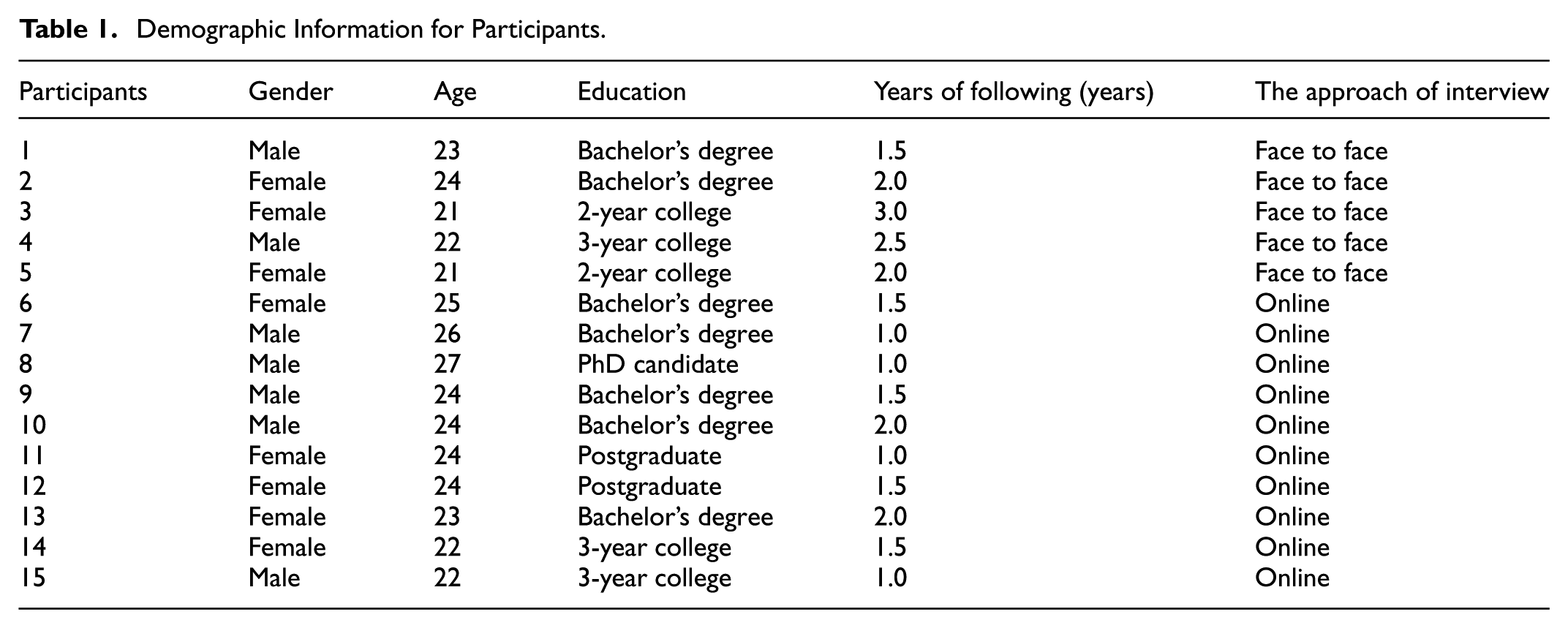
The demographic information of participants is shown in Table 1:
Grounded theory guided three iterative coding phases. In open coding, we used NVivo to generate 162 nodes-recurring themes such as “curiosity,”“demonization,” and “accent”-while writing analytic memos after each transcript to track code definitions and merging decisions. During axial coding, constant comparison grouped these nodes into 16 core categories, and in selective coding we mapped them onto Corbin and Strauss’s (2008) paradigm components (phenomenon; context; causal conditions; intervening conditions; actions/strategies; consequences). To ensure reliability, a second coder independently reviewed all categories, agreeing on 13 of 16; the remaining three were reconciled through discussion (Burla et al., 2008). No new categories emerged after the 13th interview, confirming theoretical saturation. Descriptions and corresponding examples for the categories are shown in Table 2.
Grounded Theory Data Coding.

Findings and Discussion
The coding process resulted in a model that illustrates how Chinese audiences interpret foreign influencers. This model highlights participants’ actions and the contextual conditions and influences that shape their interpretations. The model encompasses six broad categories and a total of 16 categories, as depicted in Figure 1.

Model of the audience reception of foreign influencers.
Self-Other Differences: Cultural Brokers and Deepened Cultural Empathy
In the case, the self-other difference emerges as a key factor driving the audience to follow foreign influencers. At this level, the action reflects the audience’s positioning of influencers as cultural brokers, with curiosity acting as the primary motivation for engagement. Most participants noted that their attraction to other ethnic traits was the most direct reason they clicked on a video. The flourishing self-media market has created a broader context for this trend. Additionally, China’s racially homogenous society, where interactions with other racial groups are limited, serves as a mediating factor. While mainstream media, films, and television dramas have traditionally portrayed foreign cultures from a professional and official Chinese perspective, social media influencers offer a more intimate and interactive form of engagement through direct participation. As a result, many participants consider influencers to be a trustworthy source of cultural insight, motivated by a desire to gain an insider’s view of life in other countries.
I was interested in him due to his perspective as an ordinary person. I wanted to know what people in the United States think about Trump blocking TikTok. And then I found out that he was doing a lot of content about the United States on his channel, and I was interested in that stuff (P5).
In general, audiences leverage a “self-other” framework to understand the cultural positioning of influencers. Participants highly valued Jerry’s credibility in presenting America, appreciating his perspective as an ordinary American. This suggests that cultural empathy has been enhanced, particularly in terms of gaining a more comprehensive understanding of other nations.
For example, I had always heard that express delivery in the United States is slow, whereas it is fast in China. However, in his videos, he investigated and analyzed the work processes, which helped me understand the contrast between the two countries. This deepened my previous superficial understanding and made it more profound. (P5).
In sum, influencers provide audiences with a more nuanced understanding of other countries by offering information beyond the scope of domestic mainstream media. Their videos cover topics such as America’s political system, political parties, and public participation in elections, allowing viewers to explore societal issues like the Donald Trump phenomenon in greater depth. Rather than portraying the United States as chaotic and dysfunctional, these videos highlight the complex factors behind social issues like gun control. By offering cultural context, influencers help audiences appreciate the diversity of both nations and contribute to bridging the cultural divide.
Ultimately, the “self-other” framework strengthens the influence of these content creators over traditional media in presenting foreign countries, fostering greater cultural empathy. Their coverage of America’s political and social issues provides deeper insights, offering a more nuanced view of topics like gun control and the Trump phenomenon. Through this, they enhance understanding and promote appreciation for cultural diversity, playing a key role in bridging cultural divides.
Self-Other Interaction: Concerns Over National Image Abroad and Filtered Substitute Feedback
Cyber-nationalism is a significant issue that warrants thorough consideration. The self-other interaction within this dynamic has a dual impact. While the foreigner identity of influencers enhances their appeal, it also undermines their credibility on certain issues from the perspective of Chinese audiences.
Concerns over national image abroad form a key contextual backdrop shaping how audiences engage with foreign influencers. As noted, social media platforms often amplify xenophobic sentiments through narratives such as the “century of humiliation” and “national revival.” Many perceive China as experiencing a resurgence, reclaiming its historical prominence following a period of colonial invasion and poverty. This narrative cultivates a cautious attitude toward the West, further reinforced by perceived biases in Western media. Here, mass media and amateur serve as mediating conditions. Displeased audiences have expressed dissatisfaction with what they perceive as distorted portrayals of China in Western media, criticizing them as inaccurate, inflammatory, and politically motivated. Examples such as the “BBC filter” going viral on the Internet have significantly fueled anti-Western sentiments. Many perceive a stark disconnect between China’s achievements and their portrayal in mainstream Western media.
This disparity has heightened concerns over China’s global reputation and fostered a strong desire for international recognition of its progress and accomplishments. The environment has created opportunities for individual content creators and the rapidly growing social media landscape to address these perceptions and influence global narratives. As a reflection, the audiences increasingly seek outsider views, turning to influencers as alternative sources of global perspective amid declining trust in Western media. The influencers are consequently gradually replacing Western media outlets as emerging “out-group voices” for global affairs. In this context, these internet celebrities, with their ordinary foreigner profiles, fill the discourse void left by the discredited Western media.
Western media tends to have a biased view of China, which means they don’t always give a fair picture of what’s really happening there. But he (Jerry) is an ordinary people with no political background. He can provide an objective and neutral evaluation of China (P6).
However, it is crucial to interrogate this perceived “objective.” As Van Dijk’s theory indicates, ideological positioning hides behind the thoughts of “neutrality.” What audiences describe as “neutral” or “objective” may, in fact, reflect a preference for depoliticized content that aligns with their implicit expectations. The expectation is shaped by prior domestic polarized narratives and functions as part of the ideological square, amplifying the credibility of the in-group while devaluing oppositional others.
Thus, the substitution does not process in a neutral space. Drawing on Fanon, we recognize that the endorsement of these foreign others is not a simple act of acceptance; rather, it is a process that is racialized, embodied, and regulated. The perceived authenticity of foreign influencers is mediated by both their racial profile and their distance from political institutions. Yet this visibility is fragile. Essentializing foreigners’ cultural incomprehension plays a role in circumscribing the topics to “safe” domains. While foreigners’ viewpoints spark curiosity, they are still seen as incomprehensible outsiders, even if they speak fluent Mandarin or have long-term lived experiences in China. Participants oscillate between the curiosity for outsiders’ views and an ingrained cultural hierarchy that reserves the authority for ingroups. In the media engagement, they grant a foreign influencers license to speak on “safe” topics (cuisine or travel) as these domains require little embedded cultural knowledge. Yet as soon as influencers venture into politics, history, or social issues, their outgroup profile triggers reflexive gatekeeping: initial “not-self” curiosity, conditional approval for trivial topics, and final dismissal as mere entertainment once they broach insider issues. The ambivalence reveals how cultural pride converge to police who may “explain China” and under what conditions. In this sense, what appears as “entertainment” is also a form of boundary-setting that defines what intercultural actions are acceptable and what topics cross a line. This selective acceptance suggests that even non-state-aligned audience practices may echo the logic of the ideological square as indicated by Van Dijk.
So, this guy’s got a bunch of videos up on his channel. When he’s talking about the US, he usually covers heavy stuff like racism, pandemics, and elections. But when he’s talking about China, it’s all fun and games, with videos about food or online shopping experiences. I mean, I guess we can’t really expect too much from a foreigner, right? They don’t get our culture like we do (P10).
Self-Other Conflict: State Authorization and International Friends
The “self-other” comparison is a common strategy in international communication, often used to emphasize an in-group’s uniqueness or superiority. Media frequently highlight other nations’ unfavorable conditions, particularly in nation-building or ideological contexts. While China’s state communication employs a similar modus operandi, audience interpretations of foreign influencers reveal new mechanisms at work. On one hand, emphasizing resistance to Western influence and celebrating China’s historical achievements remains a common strategy among officials to strengthen anti-colonial sentiments and national identity. As a result, participants frequently perceive China as an ascending power and the United States as a declining superpower, despite its dominance in various domains.
We can all agree that the United States is without a doubt the most powerful country in the world, right? Even though China has made some impressive developments in recent years, there is still a wide gap between the two. Unfortunately, my view of the United States has taken a hit since the outbreak. As a kid, I used to think the US was the epitome of democracy and freedom, but now I realize it’s far from perfect. There are a lot of serious issues that need to be addressed. (P2)
On the other hand, “Escalating China–West tensions” emerges as a new contextual factor. the rise of foreign influencers reflects a growing rejection of traditional mainstream media norms, particularly the entrenched China-West dichotomy. Similar to Western media, the portrayal of Chinese media is becoming increasingly ideologically driven in its context, which also causes irritation among audiences. Audiences, especially those attuned to global news, have grown weary of the ideological battles between these two camps. Western media is often met with skepticism, while state-run media is avoided for its overtly political tone. This leads to a demand for external voices amid the tension between state propaganda and distrust of Western media. In this context, foreign influencers are valued as non-political or non-intentional news sources.
They’re not politicians or anything like that, so they can give us a fresh perspective that’s not all wrapped up in politics. It’s kind of nice to have a non-political viewpoint for once (P8).
Paradoxically, the audiences’ weariness toward state media should not be simply interpreted as resistance to the state; state media itself functions as a key symbolic reference through which audiences evaluate foreign influencers. Similarly, their demand for the voices of “non-political” individuals does not come into play in a political vacuum; rather, it is intricately shaped by the implicit but crucial role of state authorization as a mediating factor. While previous debates on Chinese nationalism have focused on “top-down” versus “bottom-up” dynamics, audiences in this research exhibit a paradoxical mix of acceptance and rejection. Over the past few decades, China’s media landscape has transitioned from a hierarchical, state-dominated system to a more networked environment, reducing the declining dominance of state media as a sole mouthpiece. Yet, state media and its official recognition continue to play a crucial role in empowering or legitimizing the credibility of foreign influencers among Chinese audiences. Nine participants explicitly related Jerry’s CCTV interview and Raz’s collaboration with Xinhua to the evaluation that their channels were “professional,”“credible,” and “objective.” When we probed with follow-ups like “Do you regularly watch these media?” and “How does the interview make Jerry credible?,” participants offered vague replies like “Maybe it’s irrelevant…just a feeling.” Acknowledging the limited evidence, we refrained from further national-media questions to avoid derailing the interviews and raising participants’ wariness. Although the interview fragments on this theme were too scattered for full excerpting, the limited data clearly show that the national media’s influence on their perception of foreign information is symbolic rather than logical or rational. It is also important to clarify that the state endorsement and the success of foreign influencers are not causally linked. Rather, state media functions as a symbolic gatekeeper, conferring an aura of legitimacy and adding value through affective endorsement. It does not dictate audience choices but quietly calibrates trust in foreign voices within a highly competitive media environment.
This case illustrates the complex and paradoxical relationship between audiences and state media. On one hand, audiences resist the political and didactic tone of state media. On the other hand, state recognition lends credibility to influencers, ensuring their content appear neutral, non-threatening, and aligned with national interests. Although state media may be losing appeal due to its ideological stance, its authority remains a key standard for safeguarding national interests (as self) and assessing potentially adversarial foreign others. Rather than acting as an overt form of censorship, state authorization functions as an internal filter, enabling audiences to identify trustworthy voices. In conclusion, despite increasing dissatisfaction with politicized media, state endorsements continue to be essential for legitimizing content and its creators in the eyes of Chinese audiences.
I believe that he is quite objective. His channel is a responsible source of media. In fact, many of his videos have been well-received and promoted by CCTV News. From my perspective, he’s become a sort of representative for Westerners living in China. (P8)
Accordingly, the demand for acceptance leads audiences to categorize influencers as “friends,” especially those who echo national narratives. This dynamic reveals a clear “friend-enemy” distinction in how Chinese audiences view foreign influencers. Mild criticism from figures like Jerry or Raz is seen as acceptable because they are viewed as “friends,” in contrast to the typical “enemy” role assigned to many Western media outlets. More importantly, influencers have helped ease Chinese audiences’ anxiety about international public opinion. They are expected to portray China’s stance and image accurately, offering a third-party perspective that is both trusted and valued.
What’s most refreshing is that he doesn’t come across as hostile as some Western media sources. In fact, I consider him to be a friend of China. (P13)
The impact is multifaceted, intricate, and in some ways, paradoxical. Influencers have, to some extent, taken on a role similar to that of Western mainstream media in China, offering external perspectives that align with the growing perception that China’s achievements are increasingly recognized globally. However, the influence of these influencers remains limited. The cultural insularity of China restricts the scope of cross-cultural exchange, preventing it from being entirely unimpeded.
The primary value of foreign influencers lies in filling the gap left by discredited Western media, providing alternative external feedback. At the same time, Chinese audiences have internalized the state stance, which act as a filtering mechanism for views from foreign others. While state media may no longer hold the same mass influence, its role as a symbolic authority in gatekeeping external narratives remains significant. This dynamic has created a filtered environment for global opinions within China, shaping how domestic audiences engage with external perspectives.
Conclusion
Foreign influencers in China offer a unique channel for engaging with the dominant culture, serving as rare and trusted outsiders who provide third-party perspectives in a tightly controlled information environment. Their popularity reflects audiences’ demand for alternative viewpoints beyond state media, yet these perspectives still require state media’s recognition to gain legitimacy. This paradox underscores a deeper ideological tension between perceived objectivity and institutional authority, reflecting the ideological square’s “self-other” framework (Van Dijk, 1998). As a result, commodified, state, and cultural filters reinforce a new cycle of mainstream-dominated media imagery. While earlier studies on foreign influencers concentrated on the influencers themselves, analyzing their videos to show how they catered to China’s socio-cultural environment. We adopt a “self–other” framework, through in-depth interviews with audiences, to uncover a more complex negotiation of otherness in which foreign influencers are at once embraced as validators and viewed with suspicion as outsiders, resonating with Brons’ model of attributed difference and strategic othering. Ultimately, the research highlights the influence of these three filters on the foreign influencer phenomenon on Chinese social media platforms.
The first is the cultural filter. Previous studies have extensively explored the relationship between identity formation and perceptions of foreign others. Research on the cultural adaptation of outsiders suggests that their identities evolve, becoming less rigid and more complex (Kim, 2017). In the case of foreign influencers, this intercultural identity emerges among the participants in a distinct way. On the one hand, these influencers have taken on the role of cultural brokers for their homelands, influencing audiences’ impressions of foreign countries. Thus, influencers can become opinion leaders on global issues and affect public perceptions of other countries. Consequently, the work of foreign influencers broadens and deepens audiences’ understanding of different societies. Intercultural awareness and sensitivity will somehow benefit from this. On the other hand, their portrayal of China offers the domestic public a third-party perspective for constructing their national identity. Audiences are interested in foreigners and expect confirmation of the nation’s success from them. However, they also considered foreigners shallow outsiders incapable of fully comprehending China’s social realities. Consequently, the influence on the perceptions of China is limited. This ambivalence illustrates the embodied mentality of racialized recognition as theorized by Fanon (1952), where the Other is looked to for affirmation yet remains structurally excluded from discursive legitimacy.
The second is the state filter. It demonstrates how state ideology continues to structure reception, not only through formal censorship but through the internalized “ingroup-outgroup” discourse structures that Van Dijk (1998) identifies. The terms “ethnoscapes” and “mediascapes,” coined by Appadurai (1990), describe transnational populations and the global flow of media content, respectively, while “ideoscapes” refer to the circulation of political and ideological ideas. Foreign influencers can be seen as part of the “ethnoscape” due to their demographic and cultural mobility. Their popularity in China suggests a shift away from institutional media narratives (“mediascapes”) toward more personalized, value-driven content shaped by ideological alignment (“ideoscapes”). Concerning the external environment, dissatisfaction with the mainstream media routine drives audiences to watch influencers’ videos. Affected by the global political climate, the China-West binary opposition storyline has become increasing unfavorable among domestic audiences. By contrast, influencers’ non-official points of view become critical in attracting Chinese viewers. As a result, the leverage of foreign influencers was bolstered by unfavorable domestic state propaganda and distrustful Western media. Participants were avoiding the overly politicized information environment built by mainstream media. Ordinary people’s status is the key factor that draws them to follow foreign influencers’ channels. However, certain pre-set filters in their media consumption demand greater scrutiny. Despite the diminishing influence of state media, the state’s position continues to be a pivotal element in the audience’s assessment of influencers. The significance of national position and mistrust of western media develop an inner apparatus for assessing media. Participants are getting increasingly dissatisfied with the state media’s increasingly aggressive reporting. However, several norms in line with the state serve as their inner criteria for assessing information resources. As shown in the case, the interview and reports by the state media brought the influencer compliments like reliable and responsible. Participants are dissatisfied with the tone of state media and yearn for civil society voices. However, it is still critical for these speakers to obtain endorsements from the state media. While the state media may not be as popular as it once was, it remains a trustworthy and politically correct authority to the audiences. In short, the national positions remain the top priority across the board.
The last is the commodified filter. It is a dependent institution that relies on the other two. It also highlights potential adverse consequences that have emerged following the extensive commodification of foreign influencers. China’s small foreign population and thriving social media market make foreigner self-media a selling point. As a result, national identity and state authority co-create a unique atmosphere for personal media and foreign influencers. It was shown that an increasing number of foreigners intentionally target patriots and nationalists as possible audiences. Influencers’ coverage of China is different from that of the principal Western media. They seldom aired critical views, and some of them even lauded China’s accomplishments sensationally. There are undoubtedly worries regarding censorship, audience positioning, public acceptance, and, most vitally, commercial considerations. The commercial logic adopted by domestic media companies is the third institution that shapes the phenomenon of foreign influencers on Chinese social media networks. However, it should be noted that the audiences are not zealous partisans who are addicted to sensational flattery and impervious to criticism. They are, on the contrary, aware of the commercial motivations behind the influencers’ flattery and are dismissive of this type of media practice. Meanwhile, the cultural institution limits its impact on their perceptions of China. Their belief in the system is basically confirmed rather than significantly reinforced by the mediation. The reflexive awareness also aligns with Brons’ notion of “sophisticated othering,” where audiences accept difference while simultaneously questioning the motivations behind it. The commodified filter, then, functions as both an extension and a distortion of the ideological and cultural mechanisms underpinning audience reception.
Overall, audiences develop greater intercultural understanding as they challenge pre-existing stereotypes and cultivate cultural empathy through engagement with foreign influencers. They have begun to gain deeper insight into societal issues in other countries, gradually reshaping earlier assumptions. In this context, foreign influencers serve as a bridge between China and other cultures. Yet this role is marked by contradictions. While audiences turn to them for alternative viewpoints, they also perceive these outsiders as lacking the capacity to fully comprehend Chinese society or articulate genuinely insightful perspectives. Outwardly, they are repelled by the didactic, politicized tone of mainstream propaganda. Yet the party and the state continue to wield symbolic authority, shaping how audiences assess the legitimacy of foreign narratives. This produces an ambivalent attitude of resentment toward propaganda’s form, coexisting with loyalty to its national stance. As a result, foreign influencers not only fill the information void left by Western media but also play a supplementary role in reinforcing domestic narratives.
To explain this complex dynamic, the study proposes the three filters that accounts for how audience interpretation is shaped by cultural, state, and commercial forces. Drawing on Van Dijk’s theory of discursive polarization, Fanon’s insights into racialized recognition, and Brons’ processual model of othering, the framework reveals that audience responses are filtered through ideological, embodied, and reflexive lenses. These filters determine whether foreign voices are embraced, contested, or neutralized. This model contributes to intercultural communication theory by demonstrating how digitally mediated encounters with cultural “others” are conditioned by media governance, cultural insularity, and symbolic authority. The findings reveal a contingent, power-laden process of meaning-making where intercultural understanding is selectively enabled and discursively constrained. In terms of grounded theory, the “three-filter” model offers a mid-range conceptual tool that theorizes the reception of intercultural audiences within a nationally bounded, ideologically saturated digital environment. In doing so, the framework not only extends the theoretical scope of othering and media ideology but also contributes an original mechanism to understand digital nationalism, audience agency, and mediated intercultural engagement in the platform society.
This study has several limitations that open pathways for future research. The analysis primarily focuses on audience reception, leaving the production side, such as influencer motivations, platform algorithms, and state-influencer dynamics, less explored. Future studies could adopt a comparative or multi-sited approach to examine how platform governance intersects with state power and commercial interests in shaping mediated intercultural encounters.
Footnotes

Ethical Considerations
This study was reviewed and approved by the Research Ethics Committee of the School of Journalism and Communication, Henan University (Approval No. 2021100001).
Consent to Participate
All participants were fully informed about the purpose and procedures of the study, and written informed consent was obtained prior to participation. Signed consent forms were collected from all interviewees and securely stored by the researchers. The study design minimized potential risks, participation was entirely voluntary, and the anticipated benefits to participants and society outweighed any potential harm.
Funding
The authors disclosed receipt of the following financial support for the research, authorship, and/or publication of this article: This work was funded by the 2024 Henan Provincial Annual Project for Philosophy and Social Sciences (Grant No. 2024CXW009) & National Social Science Funding for Educational Research (CHA220297).
Declaration of Conflicting Interests
The authors declared no potential conflicts of interest with respect to the research, authorship, and/or publication of this article.
Data Availability Statement
Data available on request from the authors.