




Abstract
This study aims to assist social media platforms that rely on user-generated content in identifying effective strategies to motivate and retain high-quality influencers (content creators). The authors employed “participant observation” and “semi-structured in-depth interviews.” Firstly, the primary author engaged in self-media management for nearly 7 years, experiencing and exploring various aspects of influencers’ live as a content creator. Through detailed note-taking and documentation, valuable insider perspectives were provided. Secondly, preliminary interviews with 10 content creators who met the study’s criteria were conducted, and five most representative influencers were selected for further “semi-structured in-depth interviews,” which were recorded and videotaped. The authors compiled all research data, coded it, and analyzed it using “thematic analysis.” The study found that “creator self-identity” constructed during social media content creation helps influencers (content creators) overcome challenges and sustain their efforts. Three methods to strengthen “creator self-identity” were identified: (1) sacrifice, (2) sense-making positive feedback, and (3) identity community interaction. The theoretical contribution of this study lies in the perspective that “moderate self-sacrifice can, in turn, reinforce creators’ self-identity,” enriching existing literature. In terms of practical contributions, the study applied the “marketing mix (6P)” framework with the findings to provide systematic, applicable recommendations for social media platform managers. Finally, the study’s originality and deep insider perspective on the influencer community make it a noteworthy and significant contribution to the field.
Introduction
With the rise of the Internet and social media platforms, self-media (or we-media) has gained significant influence, often surpassing traditional media and reaching previously inaccessible areas. Operating self-media and developing personal brands offer numerous business opportunities, creating the emerging “self-media content industry.” Many people pursue new careers as influencers, creating content on topics they are passionate about to achieve personal fulfillment and autonomy.
Mainstream social media platforms (e.g., YouTube, Instagram, Facebook, podcasts, TikTok) compete for user attention and heavily rely on influencers to produce high-quality content. Without content, these platforms are merely empty shells. Despite incentives such as money, fame, self-expression, and self-realization, few influencers survive the initial stages of zero fans and profit, overcome difficulties, and continue creating high-quality content to achieve real returns.
Thus, retaining and developing spontaneous high-quality content creators (influencers) while attracting new ones is a major challenge for social media platforms. To address this, the researchers conducted an exploratory study to help social media platforms that rely on user-generated content retain valuable influencers and find effective ways that motivate them to create high-quality content spontaneously.
During the research process, the authors identified “self-identity” and “sacrifice” as key elements motivating self-media influencers to create high-quality content. Previous studies have shown that self-identity impacts clothing choices (Safdar et al., 2020), shopping behaviors (Lavuri et al., 2023), and pro-environmental actions (Whitmarsh & O’Neill, 2010). Factors such as culture, race, religion, and gender shape self-identity (Dien, 2000). However, no studies have suggested that “self-sacrifice” can also enhance self-identity.
Research on consumer behavior often examines monetary sacrifices for consumption (Gupta & Kim, 2009; Howard & Kerin, 2006; Jindal et al., 2020). Studies on “self-identity” and “sacrifice” focus on how “seeing others’ sacrifices” can enhance one’s self-identity (Leung & Shek, 2020; Ruggieri et al., 2023) or how self-identity makes individuals more willing to sacrifice, such as for pro-environmental consumption (Kumar et al., 2023). Yet, no research has explored the direct relationship between “self-sacrifice” and “self-identity.” This study aims to fill this gap by investigating how “self sacrifice” influences one’s “self-identity.”
The marketing mix (6P) was found to be an effective tool for summarizing managerial implications. Previous research has used the marketing mix to promote consumer behavior (Jindal et al., 2020) and reduce perceived sacrifices by organ donors (Bradford & Boyd, 2020). However, no studies have explored how the 6Ps can help influencers strengthen their “creator self-identity” and overcome social media challenges, sustaining high-quality content creation. This study introduces the marketing mix (6P) to enhance influencers’“creator self-identity,” aiding them through early stages and retaining valuable content creators for social media platforms.
In summary, this study aims to: (1) Identify key factors and motivations driving content creators to persist through challenges and produce high-quality content. (2) Explore the correlation and reciprocal impact between “sacrifice” and “creator self-identity.” (3) Apply the Marketing Mix (6P) to develop effective strategies for enhancing “creator self-identity” and retaining high-quality creators.
Through “participant observation” and “semi-structured in-depth interviews,” the study found that motivation to overcome initial difficulties is closely tied to creator self-identity. Results show that “creator self-identity” is crucial in early self-media operations, and can be strengthened through (1) sacrifice, (2) sense-making positive feedback, and (3) community interaction. The initial stage is divided into start-up, growth, and harvest phases, with different methods needed for each. The Marketing Mix (6P) systematically strengthens creator self-identity at each stage, aiding platforms in retaining high-quality influencers.
As a complement, first, most of the content creation and self-media management activities of social media influencers take place on the virtual network, with few physical environments and objects involved. It is not necessary to apply the seventh option “Physical Evidence” in the “Marketing Mix (7P),” so this study decided to apply “Marketing Mix (6P)” for the research analysis and discussion. Second, individuals operating self-branding or personal branding self-media are commonly known as influencers, internet celebrities, key opinion leaders (KOL), or creators. Given that rapidly rising internet celebrities are a minority, this study focuses on the general public aspiring to build their personal brands through self-media with specific content. To differentiate these renowned internet celebrities from general content creators, we will consistently use “influencer” to denote our research subject—the operator of personal branding self-media. Finally, to better focus on “user-generated content-centric social media platforms” and “influencers managing self-media,” this study defines “high-quality content” by the following three criteria: (1) content that goes beyond mere personal social sharing, (2) content intentionally created to serve the audience, (3) content that provides tangible value to the audience (e.g., entertainment, knowledge, empathy, news).
In subsequent sections, the study first reviews related research on “self-media” and “self-identity.” Then, outline the research methods. Finally, the authors present the original findings and discuss implications for practice and theory.
Theoretical Background
Self-Media
In the digital era, self-media’s influence is burgeoning, drawing attention to its trends, marketing strategies, influence, and commercial viability. Khamis et al. (2016) delve into the rise of self-branding, micro-celebrities, and social media influencers, while Posavac and Posavac (2002) explore predictors of women’s body weight concerns from a self-media perspective.
Online celebrities now shape consumer purchasing decisions, with self-media influencers increasingly promoting their own brand products (Tseng & Wang, 2023). Influencer involvement positively impacts consumer psychology and purchase intent (Tseng & Wang, 2023; Xu & Pratt, 2018). A consistent image between influencers and consumers leads to effective celebrity endorsement benefits (Shan et al., 2020). Hermanda et al. (2019) find that influencers and self-concept significantly affect purchase intent and brand image, echoed by Shen’s (2019) discussion on TikTok’s tourism marketing potential.
Compared to traditional celebrity endorsements, consumers trust self-media celebrities more, influencing brand attitudes (Jin et al., 2019). Aw and Chuah (2021) suggest social media’s interactivity fosters influencer-follower relationships, driving commercial value. Brands increasingly leverage influencer marketing, but this can erode follower trust (Audrezet et al., 2020), prompting the need for influencers to balance commercial interests with authenticity.
Self-media influencers grapple with maintaining authenticity as their following and commercial value increase (Balaban & Szambolics, 2022). Beyond marketing methods and authenticity, recent research delves into semantic recognition, such as Hou et al.’s (2021) machine learning analysis of self-media data context. Y. Wang et al. (2019) propose machine learning techniques to identify self-media marketing intentions, while Zhou and Feng (2019) discuss controlling and preventing self-media rumors, which pose risks to social stability.
Self-Identity
Self-identity refers to how individuals perceive themselves over time, such as identifying as a green consumer (Sparks, 1999). According to identity theory (e.g., Thoits & Virshup, 1997), people often categorize themselves using socially relevant descriptors, including social roles (e.g., wife, mother), demographics (e.g., gender), social types (e.g., environmentalist, minimalist), and personality traits (e.g., introversion, responsibility).
Identity formation is multifaceted, including elements like place identity reflecting socialization in the physical world (Proshansky, 1978). Additionally, possessions influence self-perception, with individuals using or discarding items to signal self and group identities (Wheeler & Bechler, 2021).
In the digital era, social media shapes self-identity, impacting mental health and offline interactions (Sadagheyani & Tatari, 2020). Adolescents’ self-identity involves discovery and development, influenced by social media (Wallace & Buil, 2023). Mobile social media usage correlates positively with self-identity and friendship quality, aiding self-identity formation (W. Wang et al., 2019).
Self-identity guides behavior, with individuals aligning actions with their identity (Stets & Burke, 2000). Social self-identity influences social media usage (Pan et al., 2017), with behaviors reinforcing identity in a continuous cycle (Bem, 1972). Thus, it’s likely that influencers’ self-identity would also influence their self-media management, motivating them to create high-quality content. People tend to define their identity based on various factors such as culture, gender, race, education, profession, and more (Dien, 2000). This study focuses on individuals’“career identity” and, through the research analysis process, identifies and introduces a unique form of self-identity among influencers (content creators) named “creator self-identity,” which refers to influencers’ self-identification as social media content creators.
Regarding “self-identity” and “sacrifice,” self-identity can make people more willing to sacrifice for their beliefs. For example, religious self-identity can have a positive impact on self-sacrificial behavior (Martel et al., 2021). People may even be willing to pay higher taxes and prices and accept lower living standards to protect their favorite places and self-identities (Knez et al., 2020).
Moreover, seeing other’s sacrifice can also enhance one’s self-identity, with parental sacrifice boosting adolescents’ self-identity (Leung & Shek, 2020). E-leaders’ sacrifice enhance followers’ self-identity and fosters followers’ prosocial behavior as well (Ruggieri et al., 2023). However, whether “self-sacrifice” can enhance one’s “self-identity” is still a relatively unknown area and deserves further exploration. Therefore, the study aims to deeply explore the relationship between “self-sacrifice” and “creator self-identity” to fill this research gap. In the Finding section, rich field data will be applied to illustrate how moderate “self-sacrifice” can help influencers strengthen their “creator self-identity,” encourage influencers to continue to create spontaneously, and help social media platforms retain valuable influencers (content creators).
Methodology
This study aims to understand the reasons that drive influencers to create spontaneously and without compensation in the early stage of self-media operation, so as to guide social platforms that rely on user-generated content to overcome obstacles and obtain high-quality platform content. Since the process of self-media creation undoubtedly involves a strong “creator-self-identity,” this study also provides a clear context for understanding the relationship between “self-identity” and “personal-branding self-media creation.” Finally, the study discusses the collection and analysis of data.
Data Collection
This study focuses on actual self-media management experiences, thus deeming “participant observation” and “semi-structured in-depth interviews” as suitable research methods. Influencers (content creators) are an emerging profession and identity in the social media generation. They refer to people who operate self-media by creating original content on social media platforms. They gain personal influence that cannot be underestimated through online traffic, reach, and followers, and thereby gain income, opportunities, and more free and independent career choices. Given that top Internet celebrities operate on a large corporate scale and have significant fan support, platform assistance plays a minor role. Amateur self-media operators who operate self-media for pure leisure and life recording, put too little effort, and achieve few results are usually new to the industry and do not know much about the career of an influencer (content creator), thus they are not the main focus of this study as well. Therefore, this study excludes “large-scale top influencers” and “small-scale bottom amateur operators” and only selects emerging core content creators (influencers) who meet the following criteria based on the first author’s understanding of the industry as an insider: (1) self-media operation for over a year, (2) over 5 hr weekly dedicated to self-media, (3) owning at least one social media account with over 500 followers but with no social media account exceed 100,000 followers, (4) already start earning through self-media.
First, regarding the “participant observation,” to have a deeper understanding of the self-media industry and the mental journey of content creators, the first author created a “career development theme” self-media brand in 2016 and continued to operate it for over 7 years till now. The first author operates the self-media brand on multiple different social media including Instagram, Facebook, YouTube, and Podcast, just like how influencers do nowadays. The first author spends an average of more than 5 hr per week on self-media content creation and gained almost 5,000 followers on one single social media. The direct and indirect income generated through operating self-media started to cover all living expenses and has become the first author’s current full-time job in the seventh year. The first author is often invited to participate in TV shows, online programs, speeches, interviews, and book publishing as a self-media content creator. Over the past 7 years, the first author has continued to observe and record the process, experiences, and self-observation, providing valuable insider perspectives and in-depth insights into this research. Rich and valuable field data including the observation within the industry, and changes in the mentality of self-media management and content creation were collected by field notes, blog articles, videos, and audio.
Second, regarding the “semi-structured in-depth interview,” the study collected interviewees through the authors’ self-media circles and snowball sampling based on the previous-mentioned screening conditions and conducted initial interviews with 10 social media content creators. Then 5 more representative creators were selected for further “semi-structured in-depth interviews” of 1.5 to 2 hr. The author sent the invitations through private messages on social media, provided an interview guide, and explained the interview methods and content through private messages. After preliminary analysis of the interview data and results, researchers continued to interview and conducted semi-structured in-depth interviews of 30 min with the other four qualified creators until reaching saturation and it was confirmed that no more new findings could be drawn.
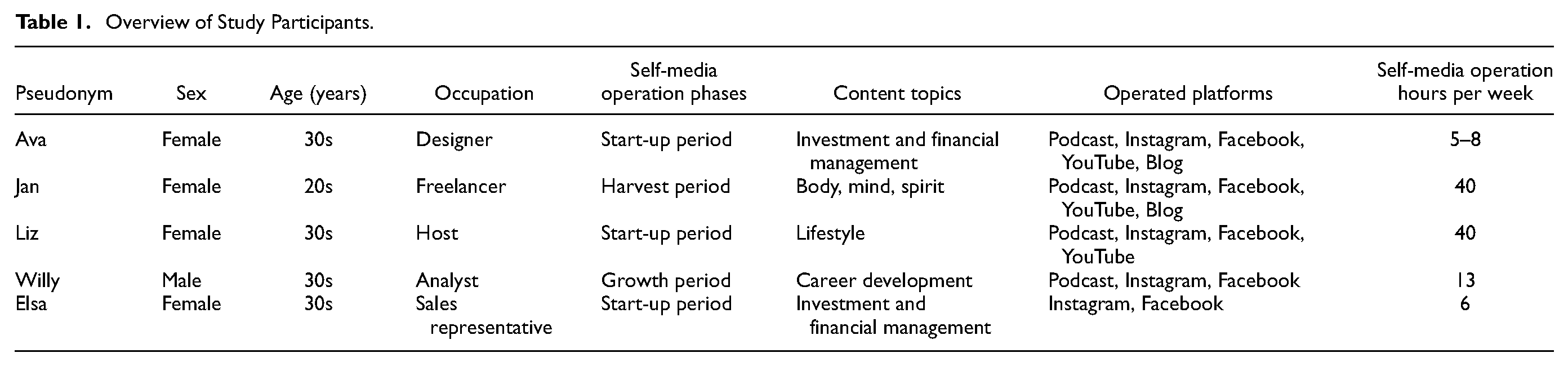
The final interview analysis data includes 5 “small and medium-sized individual self-media influencers” representing various ages, genders, early stages of self-media management, content topics, and occupations (see Table 1). The study collected and observed interviewees’ public self-media content beforehand and conducted online interviews to delve deeper into their self-media creation process. Drawing from the first author’s self-media management experience, we devised in-depth interview topics, swiftly establishing rapport with interviewees. Interviews commenced with individuals detailing their initiation into personal-branding self-media, followed by probing questions on the challenges, sacrifices, and strategies for overcoming obstacles in self-media operation. Confirming the existence and development of “creator-self-identity,” researchers employed further inquiries and observations to elucidate its role in “overcoming self-media operation difficulties.”
Overview of Study Participants.
To maintain the openness of the exploratory research, all interviews were conducted with open-ended questions. The researcher asked questions such as the following and extended the questions to ensure that the interviewees could express themselves freely and completely: What made you continue to create in the early days of self-media with zero income? What difficulties did you encounter during the creative process? What are the happiest and hardest things in self-media management? What enables you to survive the most difficult times and continue to create high-quality content?
In addition to grasping each participant’s unique circumstances, researchers prompted them to outline their self-definition, gradual construction of creator-self-identity and methods for self-adjustment and resilience in managing self-media. Participants were also asked to outline the entire self-media operation and content creation process, the involvement of individuals, and the social media platform’s role. Interviews lasted 1.5 to 2 hr on average, with follow-up via social media and email. The researcher and the interviewee made an appointment to conduct one-on-one “semi-structured in-depth interviews” using online conferencing software, and the entire interview content was recorded and transcribed through audio and text. After the interview, the author continued to collect data through “participant observation” and “tracking the content of the interviewees’ self-media accounts,” and continued to observe the personal experiences and the interviewees’ self-disclosure on their self-media, to verify the interviewees’ statements made in interviews and inferences drawn in research analyses.
The study complies with research ethics. For each interview, the research connotation, conduct method, process, and privacy will be explained in detail to the interviewees in advance, and a consent form will be signed in advance to ensure that the interviewees are fully informed and agree. All interviewees will be anonymized using pseudonyms in this study (refer to Table 1 for an overview of participants).
Data Analysis
The researchers utilized field notes, video recordings, and transcripts to document the interviews and participatory observations. They then commenced the “Thematic Analysis.” First, the researchers thoroughly read and reread the data, making detailed notes and initial analyses. Second, they identified recurring concepts such as self-identity, creator, sacrifice, influencer, dream career, and meaning of life. These concepts were then tagged with relevant words and phrases, generating initial codes. Final codes for analysis were derived from pertinent research in psychology, sociology, and marketing about “self-media” and “self-identity.” Third, they searched for related themes based on these codes, combining them to derive deeper insights and concepts. Fourth, the themes were repeatedly reviewed, broken down, and reassembled, with continuous reference back to the context of social media management to verify their understanding of the data. This iterative process continued until a coherent logic and understanding emerged. Finally, each theme was defined, and named, and the findings were documented in this research manuscript. The research provides a detailed examination of challenges encountered during different phases of early self-media operation, the resultant outcomes, and the evolution of self-identity. In addition, the study delineates setbacks at varying junctures, gains during each operational stage, support mechanisms at play, and the process of enhancing creator self-identity.
To minimize subjective bias in the first author’s “participant observation,” this study implemented the following practices: (1) the first author maintained openness and pragmatism when collecting data, remaining mobile and receptive to new perspectives; (2) “semi-structured in-depth interviews” were employed to gather diverse viewpoints and insights; (3) while collecting and analyzing data, the first author not only provided subjective insights of an insider as an influencer but also consistently stepped back to interpret the data as an objective observer; (4) the second author didn’t engage in the participant observation about self-media management, thereby, offered a more objective perspective during data analysis.
Findings
The study categorizes the personal branding self-media management process into three key phases: (1) Start-up period, with the highest follower count ranging from 500 to 2,000 across all social platform accounts; (2) Growth period, with follower counts between 2,000 and 10,000; and (3) Harvest period, with follower counts between 10,000 and 100,000. Our experience shows that leveraging the marketing mix (6P) effectively supports influencers’ creative processes, particularly in reinforcing the “creator-self-identity” developed during self-media management and content creation. Creator-self-identity emerges as the primary factor enabling influencers to surmount challenges and sustain high-quality content creation. The study utilizes the six elements of the marketing mix to manage and enhance creator-self-identity in self-media operations: product, price, process, place, promotion, and people (refer to Table 3). Additionally, the study identifies three effective means to bolster influencers’ creator-self-identity: (1) sacrifice, (2) sense-making positive feedback, and (3) interacting within identity communities. These methods can be applied at any stage of self-media operation (refer to Table 2).
Definitions of the Three “Creator-Self-Identity” Strengthen Methods Among the Three Phases of the Self-Media Operation Process.

The elements in Marketing Mix (6P) play a key role in analyzing the “management implications and suggestions” of the research results: (1) product, in this study, represents content created during self-media operation; (2) promotion, represents marketing and promotion for self-media content; (3) place, represents self-media creative environment, (4) price, represents costs and revenue generated from operating self-media; (5) process, represents the self-media running process; (6) people, representing people in contact with in the process of self-media operation: followers, other influencers, advertising partners, …, etc. The authors apply Marketing Mix (6P) to provide practical management suggestions for social media platform managers based on the results of this research (see Table 3).
Marketing Methods and Actions to Increase “Creator-Self-Identity” and Retain the Social Media Influencers.

Although “individual influencers” and “social media platforms” have both played an important role in each stage of self-media operation, the “start-up period” is relatively more influenced by platforms, while in the “growth period” and “harvest period” the influence of individuals (creator-self-identity) seems to become stronger and stronger. In the start-up period, since novice influencers do not have many contacts, resources, and experience, they will need and expect social media platforms to provide good influencer communication communities and environments. In the “growth period” and “harvest period,” influencers have gradually held the resources, formed their social networks, and can even organize their communities and initiate activities. Therefore, influencers at this time have gradually no longer relied on a single social media platform, and they have other higher expectations for the platforms. Senior influencers expect social media platforms to play their role as intermediaries, effectively control the order of the platform, strengthen the social media interaction rate, increase opportunities for content exposure, and even drive the development of the entire related content industry.
According to the data analysis of participant observation and in-depth interviews, the study find that in different phases of the initial stage of self-media operation, influencers will experience different changes of mindset. In the “start-up period,” influencers usually operate self-media simply with the desire to share and express, and vaguely expect to use the self-media to monetize in the future; in the “growth period,” influencers will start to actively pursue marketing data and the commercial value growth of their self-media, and even begin to be dominated by marketing data performance; moving to the “harvest period,” self-media has come to a relatively stable period, influencers will begin to re-examine the purpose of running their self-media, and then think about whether to move on to the next step and operate their self-media in a more systematic and corporate way.
In the upcoming section, the study will utilize data excerpts to elucidate influencers’ personal branding self-media management experiences, explore the role of creator-self-identity in overcoming challenges, and analyze how “sacrifice,”“sense-making positive feedback,” and “identity community interaction” reinforce creator-self-identity and aid in overcoming obstacles. While the three self-media operation stages are presented discretely, the process and generation of self-identity function more as a continuum, as data may encompass multiple phases from various perspectives.
Start-Up Period
How to Strengthen “Creator-Self-Identity” in This Period?
Sacrifice
Through participant observation, the study has noticed that the more sacrifices one makes for their self-media, the more they feel bound to it, making it harder to let go. For instance, during the initial phase, the first author invested time, creative energy, learning costs for social media management, modest advertising fees, social time, and even dealt with cyberattacks. Surprisingly, these sacrifices didn’t cause much distress but rather felt like investments. Influencers often see these sacrifices as investments for a successful self-media venture and become more confident in their role and identity as influencers. Our interviewees shared similar sentiments.
I started blogging in 2016 and continued to write without profit until 2018. I found it strange, so I read a lot of related books. In 2018, I decided to take courses on self-media management to learn and spent a lot of money on it. Then I reconsider my brand positioning. … Yes, after spending a lot of money, I want to work harder (running self-media) to earn it back. (Ava) In order to run a self-media, I have to sacrifice sleeping and playing time. After taking care of the child, I create at the midnight and get up early in the next morning to go to work again. When my family asked me to go out with them, I said I don’t want to play, I want to do the podcast recording at home. I have always told my family that I want to record the podcast. So for many months, my child was taken out by my family on weekends, and I enjoy the whole day of creating time at home. …Because the child will make noise or ask for my accompany, the only time I can fully devote to my podcast creation is when my child is not at home. So when someone wants to take my child out to play, I will be very happy. It is my exclusive creative time again ! (Liz) There is one time I posted a post in a social media community, and was scolded by a lot of haters who had different opinions from mine. But at the same time, I also saw that some netizens spoke for me. Because the comments under that post were too many, my self-media account unexpectedly received a lot of followers, and a lot of people came to read my blog articles, too. I suddenly felt that maybe this can be a kind benefit as well. (Ava)
Sense-Making Positive Feedback
Talking about how to regain confidence and cheer up after being attacked and abused by internet haters, Ava said:
Sometimes, I see some comments inadvertently and find that there are still some people who left messages to express gratitude. For example, a netizen said that he used to study in fragments before, and rarely saw such systematic knowledge sharing as what I offered. His message is really long and I feel very touched by it. …Actually, running a self-media is often subject to some criticism, but those attacks usually come from people you don’t know at all. Useful feedbacks often come from your followers or students, and they are the people who you should really pay attention to. (Ava)
It is very important for influencers to see their own progress through hard work in the early stage. Reaping some small results can strengthen their creator-self-identity, and make influencers more willing to continue to operate self-media and create high-quality content.
When I started blogging, it happened to be the advertising bonus period of Facebook. Social media advertising was very effective at that time. My first blog article (a promotional article written for a wedding ring store) received a lot of views. Because the wedding ring store used my article as promotional material and kept spending on social media ads. In the end, my post gained more than 100,000 views! So I was encouraged. This seemed to be full of potential, so I started to continue writing more and more blog posts. (Ava)
The inability to get instant sense-making positive feedback is often the main reason why novice influencers give up halfway. All kinds of small sense-making positive feedback obtained in the early stage of self-media operation, such as money, community interaction, number of views, etc., can give great encouragement to novice influencers and help them continue their creative process.
About 80% of the people (influencers) die in the early stage of little post-views and zero profit. Usually, you feel depressed when you don’t see any results after your hard work. You must feel very tired! No matter how enthusiastic you are willing to keep sharing, as long as no one is watching, there will be a sense of loss. (Ava) The most influential thing for me is the encouragement from the audience. The feedback from the audience often stimulates my adrenaline when I want to give up. As long as there is a private message, rating, or comment from the audience, I will be inspired to create and release a new podcast episode immediately. The effect is really obvious… Once when I was exhausted in creative energy, I received a private message from an audience saying that he liked my podcast very much, he sponsored me NT$600 and expected me to keep updating. Then, I create a new episode right away. (Liz)
Novice influencers need to receive timely feedback and encouragement from audiences. Not only can it help novice influencers build their creator-self-identity, but it can also bring them strength, a sense of accomplishment, and inspiration. This also in turn makes them willing to work hard to overcome difficulties and continue to create. Therefore, when novice influencers choose a platform, they pay more attention to whether the platform provides a complete background data monitoring system than small monetary rewards. Because they need to see their progress and growth.
Honestly speaking, for influencers, those small sponsorships and advertising profits are just small incentives, and they are not things that will really support you. I think the most important thing is a good background data system that allows influencers to intuitively see and monitor whether their channel is growing or not. Is it slowly climbing up? Because this feedback will motivate influencers and make novice influencers feel that they are making progress and can persevere for a longer time …when there is no profit at all and no one leaves a message, you see the growth of that background system data and find out that there are actually more and more people watching, and you will have a sense of accomplishment and feel encouraged. (Ava) The sense of accomplishment is one of the main reasons why I do this (self-media). Although I don’t have many follers now, I still feel very happy knowing that they support me and that my content is helpful to them. Doing this is actually full of achievement. (Elsa)
Therefore, it is very important for novice influencers to receive “sense-making positive feedback” instantly. This is of great help to both strengthen the creator-self-identity and support influencers to continue their journey.
Identity Community Interaction
Attending related classes, participating in related activities, getting to know other influencers in similar phases, and joining self-media influencer communities can all help influencers learn new knowledge and gain motivation to move on. Peer-to-peer encouragement is a big support for novice influencers. Seeing the progress of other peer influencers also makes them want to keep working even harder.
What you should do when you encounter difficulties is to invest in learning. For example, I have a course on blog monetization, and many students in the class are self-media influencers. They don’t have creative energy at first as well, but they were motivated after coming to the class. Because there are encouragement and support among your peers. Seeing the progress of other influencers around you, you will be motivated… The class can make you re-examine what you have done before, and know how to adjust afterward. You will feel reborn, and start to make some changes. Then you will have the motivation to continue to operate (self-media). It does not mean that this motivation can support you forever, but at least it will allow you to persist for another one or two years. (Ava)
Through participant observation, the author found that when influencers gather together, they often have a sense of belonging and in turn deepen their creator-self-identity. When the author sees that everyone is facing similar difficulties, the author feels like one of them because they are all going through the same difficulties. And when there are other people facing difficulties with you, you will feel more empowered to overcome them. Interviewee Liz also had similar experiences.
The reason why I didn’t give up was that I met a group of good friends who did podcasts as well. We started to manage podcasts at about the same time, we can ask each other when we have questions, and we also support each other during difficulties. We often cooperate with each other and engage in each other’s podcast episodes. When I really want to give up, I will look at other influencer friends. When I see other influencers keep producing even when they are struggling too and also wanted to give up, I will be encouraged. I will realize that I’m not alone, and I am not the only one who is stuck with this sense of powerlessness. (Liz) Everyone (other influencers) says that they want to stop updating, the business can’t continue, and there is no way to continue with the frequency of self-media updates like this. But after complaining, they still continue to create. That’s the kind of creation of ‘dying struggle’. Then, I will think that maybe everyone is like this. So, I will stop to push myself too hard. When other influencers are not giving up, I will have the confidence to continue. So I think influencers must have friends in the creative circle to encourage each other during self-media operation. (Liz)
Novice influencers will expect that social media platforms can provide an environment or communities where influencers can communicate with each other. Because the influencer exchange communities are like support groups, allowing influencers to encourage each other and bring support to each other. And by joining influencer-related communities, influencers can also cooperate with each other and gain more exposure opportunities.
I hope that social media platforms can provide a place for influencers to encourage and support each other. A platform that allows influencers to exchange ideas and collaborate with each other. I think it is quite important. This will make influencers more motivated and less likely to give up due to lack of purpose. (Elsa)
In addition, by sharing and imparting knowledge about self-media management in influencer-related identity communities, influencers can also gain a sense of accomplishment and regain the motivation to move on.
(Although encountered a lot of setbacks in the process of running self-media), at least I still have a positive environment, that is, the blog management course that I offered. When I share my experience and knowledge with others selflessly, see their progress, and receive their feedback, I feel very delightful. (Ava)
Growth Period
How to Strengthen “Creator-Self-Identity” in This Period?
Sacrifice
Influencers often tend to enjoy the pain of the creative process. They will use sacrifices to prove their enthusiasm for a specific thing (self-media creation), and because of their sacrifices, their creator-self-identity will in turn been strengthen as well. They will continue to work with enthusiasm while complaining in the mean time, with a feeling of “no pain, no gain.”
Too many sacrifices have been made to run the self-media. influencers should all have similar experiences. I don’t remember passing by how many nights and weekends with no one cares so as to accumulate to the current results. Everyone’s Time and energy are limited, so in fact, a lot of time that could be used to relax will be sacrificed. In addition, even if you like to do a thing very much, there must be some parts of it that you don’t like. I can record a 30 minutes podcast episode by preparing just 30 second script. But if you ask me to edit the audio documents, I will drag out for 30 days. So, it is also important for influencers to be patient and endure those things you don’t really want to do. (Willy) I think most people have similar experience. If you are willing to do something for a long time without making a profit, it must be because of enthusiasm, nothing else. You must be interested in something so much and love it so badly, to do it for free for more than one year. At this time, you usually don’t value money so much. Because you like the thing you are doing more than the rewards it can bring you. (Willy) As an influencer and an insider in the self-media industry, the first author especially related to the “painful but happy feeling of sacrifice” during the content-creating and self-media managing process. The “sacrifices” we make to create content are a way of proving our identity as “content creators (influencers)” to ourselves and others. The feeling is that the more sacrifices you make, the more you feel like an insider and think that you are qualified to be called a “content creator (influencer)” in this industry.
Sense-Making Positive Feedback
Interviewee Willy mentioned that the formation of creator-self-identity is actually a gradual process. It doesn’t happen right away, but slowly takes shape. In this process, gaining “sense-making positive feedbacks” will also greatly encourage the formation of influencers’ creator-self-identity.
I think it’s usually just an interest (hobby) in self-media at the beginning. The interest will develop to a certain extent before it can generate profits, and then the purpose will be born slowly. It is a concept that changes dynamically. Just like me, at first I just wanted to output, so I started to do my podcast. I hope to share some of what I have learned. Later I found that the content I created can really help some people. Then I started to have commercial cooperation opportunities with some brands. After that, you will start to think, should this become my new goal (starting a serious self-media creation career)? (Willy)
In the process of self-media operation, it is very necessary to continuously obtain instant “sense-making positive feedback.” Because for influencers, not seeing the response from the audience is one of the biggest blows.
When you edit a great sound file, and then someone clicks a like, you will feel a sense of accomplishment. Feel like wow, that’s my work! Sometimes it is these small encouragements that make influencers feel like they could do three more episodes. (Willy) I go through a period of self-doubt about every six months. I will suddenly start to think, what the hell am I doing? Why don’t you go out and have fun during the holidays? Especially when you spend three hours editing an audio file, uploading it to the Internet and expecting to show of to the whole world, then find out that there are only fifty people tune in after a week later. You’ll want to die (joking) ! Hahaha. (Willy)
Moreover, for the influencers of “growth period,” the sense-making positive feedback they want to see is no longer simply “someone watches or someone responds.” The influencers of “growth period” will pursue the growth of the overall marketing data of their self-media, and will also be more concerned about the improvement of the commercial value of their self-media accounts.
When I first started running self-media, I would be happy for three days if a fan replied to my Instagram stories, or if someone left a message. But slowly this feeling of happiness will diminish with time. Now I feel, If the number of viewers of an episode doesn’t reach 10,000 times, I won’t be able to sleep. In this period, you will need to start considering the commercial aspect of your self-media. You will need to struggle, thinking whether to do the kind of content you like, or the things that your audience or advertisement partners may like. So I think influencers are quite easy to fall into depression in any self-media operating period. (Willy)
In addition, influencers in the “growth period” will also start to take the social content they create more seriously because of their increasing influential power. At the same time, it will also generate a sense of responsibility and mission as a influencer, and in turn strengthen their creator-self-identity.
There is once an audience told me that he decided to do related work because he listened to a certain episode of my podcast. I suddenly realized, wow! my work is amazing! So I I am doing an influential thing right now. But after becoming influential, if what I say is wrong, it will also affect others to make wrong judgments. And I am responsible for this. So there will be a strong sense of responsibility come after that. I found that my podcast is not just for myself, but many other people will listen to it and influence their life choices after listening. So now I will pay more attention to the language accuracy and content quality of the episodes I produced. (Willy)
Identity Community Interaction
In the process of managing self-media, the first author find that communicating and interacting with other influencers can indeed increase influencers’ creative motivation, and influencer-related identity communities can also play a supporting role during the low ebb of self-media managing process. Interviewee Willy also held the same view.
The way to get through the low ebb, honestly, is to find a group of friends who create with you (peer influencers) ! And then, it’s even better if the family and friends around you can also support you. So I fully recommend influencers to share your plans with people around you. Because they can help you through the saddest moments, and of course your audience and other self-media influencer friends can help you, too. You can’t always hide and do your own stuff all the time. (Willy)
In addition, through participant observation, the author also found that participating in the influencer-related identity community can not only increase the enthusiasm for managing self-media, but also allow influencers to have a stronger sense of identity with their “influencer-self-identity.” Other interviewees had similar experiences.
The reason why I met many other influencers is that a few years ago, I participated in a influencer exchange event co-organized by several big podcasters. I even tried to go on stage to share about my podcast. … I think this is very exciting! That’s the kind of excitement and enthusiasm that I am talking about. (Willy)
Harvest Period
How to Strengthen “Creator-Self-Identity” in This Period?
Sacrifice
In the “harvest period,” influencers will spend more energy on managing self-media. Many of them have even resigned from their original jobs to devote themselves to self-media. So one of the biggest sacrifices made by influencers is the sacrifice of “energy,” that is, the personal energy they consume to create social media content.
Full-time influencers have flexible time and freedom. So these are not the problems. For me, it’s energy. Operating self-media will consume a lot of my creative energy! (Jan)
The energy of individuals is limited, and while influencers can enhance their creator-self-identity through sacrifice, once depleted, it’s challenging to fully recover and requires substantial time to recharge. As Jan, one of the interviewees, mentioned, she endured a prolonged period of struggle before returning to manage her self-media due to a sense of mission as an influencer. Knowing that her content was helping others and that people were awaiting her return compelled her to continue creating. This belief imbues influencers’ energy sacrifices with meaning and societal value, fostering their willingness to persevere.
(Talking about an experience of breaking down and crying beside the road because of too much pressure) Later, I wrote all the things during that period of time as EDM and sent them to my followers. The response rate of that email was surprisingly high, and many people replied to encourage me. I still keep these emails. But those emails didn’t truly help me on the inner level, so I know that I really need to take a break. But this break is not permanent, it is only temporary. Thereby, I stopped updating all the way from September to October, and arranged a lot of travel, relax, and healing itineraries …I wanted to give up so much, but still insisted on it in the end because there are still some people waiting for me to update and some people are helped through my content. (Jan)
In addition to sacrificing time, energy and money, influencers often have to sacrifice the opportunity cost of not doing other things. For example: original full-time job and other career options. But sometimes the greater the sacrifice, the more determined the influencers are to manage their self-media. Because they have taken the initiative to choose the career identity they want for themselves, which is their “influencer-self-identity.”
When I started blogging, I still had a full-time job, so I only wrote articles after work. Later, I left my original job during the self-media opertion period of zero fans and zero profits, and started to do my podcasts full-time. The deposit was consumed for the first three to four months, and there was no income at all in the mean time …When the deposit was almost exhausted, I went to find a part-time job. The purpose of my part-time job is very clear — just to make money. As long as the money I earn can cover my living expenses, it’s enough. In the part-time job, I observe my colleagues and record inspiration secretly, …and use all the free time to create for my podcast after work. (Jan)
Sense-Making Positive Feedback
During the “growth period,” audience encouragement and feedback play a vital role for influencers. This positive feedback not only strengthens influencers’ creator-self-identity but also helps them navigate challenges in various self-media operating phases. Hence, when selecting a social media platform, influencers prioritize platforms with robust social interaction features and monitoring mechanisms, alongside promotion and dissemination capabilities.
In the process of running self-media, the biggest setback I encountered may be being kidnapped by the marketing data. This is something that every self-media influencer will encounter. My suggestion is that when you find yourself trapped in the marketing data, put your attention back on your own content. Concentrate on serving those followers who like you. Because the audience will give you motivation, and they will use some warm words to help you get rid of the pursuit of the marketing data performance. (Jan) …When choosing a social media platform, whether the platform can help spread the content out and whether it can allow me to interact with the audience more efficiently is my main focus! (Jan)
When the sense-making positive feedback is insufficient in the self-media operating process, influencers sometimes also need to find and produce sense-making positive feedback for themselves. By taking the initiative to record the self-media growth, influencers can find the reason and motivation to continue to operate their self-media.
Sometimes you feel like, why there are no one following or liking? That’s normal! I suggest influencers make their own chart and record the number of listeners for each episode. Then you may find out that your self-media is growing silently. Even if the increase is very small, it is still a kind of progress. When you realize it’s still moving forward, you will not feel trapped in the same place. (Jan)
Identity Community Interaction
In the “growth period” influencers start to have many opportunities due to the growth of scale. At this time, influencers already have their own network of contacts in self-media industry, and there are many opportunities to cooperate with other influencers. For example, by featuring each other on self-media, which is also called “Feat. (featuring, which means a guest appearance),” influencers can not only promote each other but also strengthen their “creator-self-identity.” Because it is also a way of knowing we are the same group of people called “content creators.” They will get the feeling of accomplishment and a sense of “we belong to the same group” and “we’re all in this together.”
This year I organized a marketing event with some podcasters, and I think this can become my masterpiece of life. On Valentine’s Day, I designed a set of story scripts and invited other influencers to share a certain theme concept. We are all host from different show, there are six podcast participate. Audiences are directed to finish one program before moving on to the next one. Finally, if they want to know the full story script, they have to listen to all six episodes from six different podcast show. Just like a puzzle game. It’s really fulfilling. After this event, I feel like I can rest for the whole year. (Jan)
In addition, influencers will also feel happy because they have the opportunity to interact with people in the industry due to operation self-media. This in turn deepens their creator-self-identity. And these members of the self-media industry include: other influencers, followers, business partners, guests of the show, …, etc.
The biggest achievement of running a self-media is that I have met a lot of people. Including interview guests, followers, clients and other talented influencers. Every time I interview a guests with great talent, I am so happy and surprised that they really come to my show. Doing a interview show is like inviting a lot of great people to give me one-on-one speeches. I think I am the one who gets the most from doing this (self-media). (Jan)
Discussion and Conclusion
The study divides the self-media business process into three phases: start-up, growth, and harvest, detailing how creator-self-identity influences influencers’ behavior. Three effective ways to strengthen creator-self-identity are identified: sacrifice, positive feedback, and identity community interaction. Finally, the marketing mix (6p) is utilized to analyze how social media platforms can deepen influencers’ creator-self-identity (see Table 3). The research sheds light on how content-based social media platforms can consciously strengthen influencers’ creator-self-identity, retaining talented influencers. This study brings significant and valuable contributions in both theoretical and practical aspects and provides a new perspective for related research.
Theoretical Implications
This study contributes to the literature by the following aspects: (1) demonstrating how moderate “sacrifice” can in turn enhance the creator’s “creator self-identity,” (2) explaining how creator-self-identity motivates influencers’ creative behavior, summarizing three effective ways to strengthen creator-self-identity, and (3) applies marketing mix to strengthen influencers’“creator self-identity” and describing how the 6P elements work in analysis and organize the results in rich details.
First, previous research primarily focused on how “self-identity” promotes people’s willingness to perform “sacrificial behaviors.” For instance, a strong environmental self-identity prompts pro-environmental actions without external incentives (van der Werff et al., 2013), while religious self-identity motivates sacrifices for religion (Gómez et al., 2021). Only a few studies have mentioned how seeing “others’ sacrifices” can strengthen one’s self-identity, for example: parents’ sacrifices improve adolescents’ self-identity (Leung & Shek, 2020), and e-leaders’ sacrifices enhance followers’ self-identity and promote prosocial behavior (Ruggieri et al., 2023). However, scant research discusses how “self-sacrifice” enhances one’s “self-identity.” This study fills this gap by exploring how sacrifices during content creation strengthen the “creator self-identity” of social media influencers.
Second, previous self-media research emphasized marketing effects and commercial value, primarily from the perspectives of platforms and advertisers, neglecting the motivations and challenges faced by influencers. Furthermore, few studies delve into career self-identity, like “creator-self-identity,” and its impact on behavior, let alone propose effective strategies to enhance it positively, crucial for both influencers and platforms.
Finally, although there is a study that applied the Marketing Mix to reduce sacrifice during organ donation (Bradford & Boyd, 2020), none have ever used Marketing Mix to bolster influencers’“creator-self-identity.” Hence, this study filled the gap by applying “Marketing Mix (6P)” in the result analysis process, conducted an in-depth analysis of the research results, and provided valuable practical advice for social media managers (see Table 3).
Managerial Implications
Social media platforms are constantly evolving, captivating the attention and time of the internet generation, and presenting numerous business opportunities. However, users can easily switch between platforms, resulting in the rapid rise and fall of social media platforms. For platforms relying on user-generated content, high-quality influencers (content creators) are crucial assets. This study offers systematic guidelines to help platforms retain their emerging core influencers effectively.
The research highlights the pivotal role of “creator-self-identity” in influencing influencers’ behavior. While money, fame, and self-expression may attract influencers initially, it’s the creator-self-identity that aids in overcoming challenges and retaining them. This identity fosters a deep connection between influencers and their self-media, motivating them to produce content consistently, driven by personal passion and purpose.
The study identifies three ways to fortify influencers’“creator-self-identity”: (1) sacrifice, (2) sense-making positive feedback, and (3) identity community interaction. The research provides rich field data and in-depth discussions about the impact of these factors on “creator self-identity,” and applies “Marketing Mix (6P)” to summarize a set of systematic methods and action guides for social media platform managers to enhance the “creator self-identity” of emerging core influencers of the platform actively and effectively (see Table 3).
As a reminder, to strengthen the creator-self-identity of creators through the results of this study, special attention must be paid to avoiding potential ethical issues. The knowledge from this study should only be used to help influencers overcome the difficulties in the self-media operating process with the full informed consent of the participants.
In summary, the contribution of this study to the managerial aspect is also significant. Social media platform managers no longer have to passively watch their valuable influencers leave. Through the findings and highly applicable practical recommendations of this study, effective methods can be used to proactively support core influencers and enhance their “self-identity as creators,” thereby proactively retaining talent and cultivating a thriving ecosystem.
Limitations and Future Research
Regarding the limitations of this study and the directions for future research, first, according to the participant observation of this study, the research results do have a certain degree of cross-cultural universality. However, since the interviewees are mainly self-media influencers based in Taiwan, it would provide richer information and evidence if future related research could collect data from different countries and cultural backgrounds. Second, this study only focuses on emerging core self-media influencers with “followers between 500 to 100,000” and does not include “large-scale top influencers” and “small-scale bottom amateur operators.” This is also a field that can be further explored in future research. Third, in the interviews, several influencers raised the issue of confusion over multiple career identities, saying that they would introduce themselves with more “acceptable” career identities depending on the occasion and the person they are facing. This is an interesting aspect that scholars could explore in more depth. Fourth, the relationship between “creator self-identity,” self-media content, and self-authenticity is still a relatively vacant research field. Finally, whether the degree of personal identification with one’s many career identities will affect the degree of dedication and performance in different career fields is also a topic worthy of discussion. The above are the areas that this study failed to cover. It is hoped that related research in the future can have the opportunity to conduct more in-depth exploration and discussion on these directions.
Footnotes
Acknowledgements
First and foremost, I sincerely thank my advisor, for her professional guidance and valuable insights throughout the research process. We are also deeply grateful to our family and friends for their unwavering support and encouragement. Additionally, we extend our thanks to those who offered assistance along the way; your help made this possible. Finally, our heartfelt thanks go to all the research participants – without your contributions, this study would not have been possible.
Declaration of Conflicting Interests
The author(s) declared no potential conflicts of interest with respect to the research, authorship, and/or publication of this article.
Funding
The author(s) received no financial support for the research, authorship, and/or publication of this article.

Data Availability Statement
Data sharing not applicable to this article as no datasets were generated or analyzed during the current study.