




Abstract
Child or early marriage, primarily due to cultural factors, continues as a tradition and seems to be a growing phenomenon in Jordan. This research explores the lived experience of early marriage from the perspective of adolescent girls and young women. A qualitative research design and in-depth face-to-face interviews in the Arabic language were conducted with 36 female subjects, married before the age of 18 and all newlyweds, married for less than 3 years. Six major themes emerged from the interviews to describe the experience of the participants: “Feeling remorse about getting married early”; “Loss of authority and feeling powerless”; “Reasons behind early marriage”; “Feeling pressure to have the first baby”; “Early marriage and pregnancy health consequences”; and “The positive aspects of an early marriage.” The lived experience revealed in this study confirm the overall negative effect of girls entering marriage at a young age, Early marriage is a violation of human rights, and robs girls of their childhood, education, work, and other life choices, in addition to the reported adverse psychological and physical effects.
Introduction
The World Health Organization (WHO) defines an adolescent as “any person between the ages of 10 and 19.” This age range falls within the WHO definition of young people as “individuals between the ages of 10 and 24” (World Health Organization, 2012) P(1).
The marriage of female adolescents and young persons in this age group is generally considered or perceived as “early marriage,” a public health issue, a social risk, and an individual tragedy, associated with mental health issues, obstetric risks, and educational problems (Erulkar, 2013; Sezgin & Punamäki, 2020; Wang & Qiao, 2020; World Health Oganization, 2012). Moreover, early marriage leads to higher rates of domestic violence and abuse (Adedokun et al., 2016; Sezgin & Punamäki, 2020; Wang & Qiao, 2020). Indeed, recent research has highlighted that girls who marry at a young age are at greater risk of intimate partner violence than their older counterparts (Sezgin & Punamäki, 2020).
Early marriage usually ends a girl’s education, her potential to pursue a career or vocation and her right to make her own life choices. It also leads to early pregnancies. However, young married girls are not always able or allowed to raise their children, in many cases their mother-in-laws taking over the role of mother. Furthermore, research indicates that becoming a mother at a young age can lead to high levels of “depressive” symptoms (Sezgin & Punamäki, 2020).
In addition, factors such as marriage at a young age, undeniably, marriage at a young age, incompatibility, poverty, lack of full awareness, or ignorance among girls about the realities of married life and bringing up children often lead to their offspring becoming victims when the family unit disintegrates (Higher Population Council, 2017). Adolescent marriage is often the result of entrenched gender inequality, making girls disproportionately affected by the practice.
Literature Review
Some studies suggest that adolescent marriage is viewed as a logical option given local alternatives and positively in certain situations. Some parents In Kenya, for example, they view adolescent marriage as a means of securing their girls’ futures through alliance formation in the face of changing livelihoods and the limited opportunities for young girls (Archambault, 2011). On the other hand, young girls view early marriage as gaining independence or respect within their homes and community (Boyden et al., 2012); improving their lives by: helping their family economically (Knox, 2017); or protecting their health through the limitation of sexual partners (Clark et al., 2009). Parents also report that early marriage protects daughters from social and health risks associated with premarital and/or transactional sex and childbearing (Stark, 2018). Some studies also highlight the imbalance between spouses, professed costs to adolescent marriage including violence, and lack of preparedness for married life (Nasrullah et al., 2014). These studies indicate that in some contexts parents and daughters view early marriage as a strategy of risk-reduction, and they do not acknowledge the negative consequences of early marriage.
While most studies argue that early marriage has adverse consequences not only for the married couple, but also potentially for their offspring as well. Overall, research shows that adolescent marriage affects social and economic status as well as physical and psychological health (Marphatia et al., 2017; Wodon et al., 2017).
The Middle East and North Africa (MENA) region, many women continue to face limitations of basic rights, including for divorce, inheritance, asset ownership, access to justice, and freedom of movement. The Global Gender Gap Index has narrowed by 0.5 percentage points since last 2019 and by 3.6 points since 2006. Unfortunately, the Middle East and North Africa has the lowest score (61.1%) of all regions. Assuming the same rate of progress going forward, it will take approximately 150 years to close the gender gap in the MENA region, 15 years shorter than what was predicted. Gender bias in Jordan is maximizing the gender discrimination that significantly constrains the women economic participation. It also has an influence on Jordanian women educational level that led to more challenges (Abdelrahmimsid, 2017). Jordan ranked 10 out of 19 regional and 138th out of 153 global countries in the 2020 Global Gender Gap Index report launched by the World Economic Forum (2020). In Jordan, the Cabinet issued new regulations in 2009 regarding the legal age for the early marriage of girls. These new regulations cover the exceptions where marriage is allowed between the ages of 15 and 18 years (Husseini, 2017). Very early marriage (before age 15) is uncommon and illegal, with only 2% of women and no men age 20 to 49 married before age 15. They also include regulations that allow a maximum of a 15-year age difference between husband and wife, provided that the husband is single and that the marriage would not stop the girl from continuing her education.
In Jordan there are no civil marriages and all marriages must be performed according to a recognized religious tradition. In the period 2005 to 2013, there were 72,860 registered marriages in Jordan, and of these (11.3%) were among girls aged 15 to 19 years old. Despite the fact that the national marriage registration rate for girls aged 15 to 17 years showed a decreasing trend in the period 2005 to 2013, the change was slight and the overall number of girls getting married in this age group increased following the introduction of the 2009 regulations, increasing from 5,349 in 2009 to 9,618 in 2013. During the period 2010 to 2015, the governorates in Jordan with the three highest percentages of child marriage were Al-Zarqa, Al- Mafraq, and Irbid with 25.5%, 18.8%, and 17.7%, respectively (Higher Population Council, 2017). According to the most recent available statistics for the nation as a whole, approximately 8% of girls in Jordan are married before the age of 18 (UNICEF, 2017).
In light of the above, the aim of this study is threefold:
To explore the female lived experience of early marriage;
To explore the reasons behind early marriage; and
To explore the sources of information and the support systems present before and after marriage.
Conceptual Framework
In this study, we followed the theoretical framework used by Lilian et al. (2015) to explain the relationship between causes and consequences of adolescent marriage. Lilian et al. (2015) argue that early marriage adds to a cycle of illiteracy, ill-health, poverty, and feeling of hopelessness. Education and empowering girls through education and employment are the keys to breaking such cycles. Their research indicates that girls married early experience violence, abuse and forced sexual relations. They also show reduced levels of sexual and reproductive health, and lower levels of education with correspondingly high illiteracy rates whose penalty comprises of: forced sexual relations, violence and abuse, sexual and reproductive health ignorance and inadequate education (Lilian et al., 2015).
Methods
This research study sought to elicit the lived experience of early marriage from the female perspective. Therefore a qualitative research design was used and the in-depth, face-to-face interview technique was employed as the means of data collection. The four research questions that were posed to the participants in the interviews were as follows:
Can you tell me the story behind your marriage?
What information did you have before marriage?
What were your expectations of married life?
Who offered you the help and information you needed before and after your marriage?
Ethical Consideration
This study was approved by the Institutional Review Board of the Ethics Committee at the University. All the research participants signed the required consent form after they had been given information about the nature and purpose of the study. The participants were assured that the issues arising from their individual interview would not be discussed with others in ways that might identify them. The researcher also promised not to disclose what the participant had said in their interview to any other individual. The confidentiality of the data was maintained by using codes and storing the data in electronic files secured by passwords. Finally, for the purpose of disseminating the data and findings of this study, the names of individuals and/or places have been anonymized to protect the identities of the participants.
Sample and Sampling Technique
The participants for this study were selected by using snowballing, which is a purposive sampling technique. The first participant was one of the university students was met by the researcher. Then this student identifies the researcher to other married student at the university. After that the participants suggest, through their social networks, other eligible participants who meet the research criteria and could potentially add to our study. The criteria for inclusion were as follows: married before the age 18, married for less than 3 years, living with their husband, free from physical and psychological illnesses at the time of interview. A total of 40 married girls were approached. Among these, 36 agreed to participate and four refused without explanation.
Data Collection
In-depth interviews in the Arabic language were conducted by the primary investigator with all of the participants at the health center or at a location of their choice. Data was collected from January 2019 to May 2019. The researcher is female with a PhD degree. To identify the tradition core practices, data were collected using open-ended questions. All interviews were audio recorded using digital voice recorder. The duration of the interviews ranges between 30 and 45 minutes. The data collection process continued until no new themes emerged from the data.
Analysis
The Thematic Content Analysis Tool (TCAT; Berg & Lune, 2012) was used to analyze the data. The TCAT, which is a manual tool, exposes the thematic content of the interview transcripts by finding common themes in the texts for advance analysis (Anderson, 2007). The primary investigator (PI) read through the entirety of the material gathered via face-to face interview in order to get an initial feel for what the participants had said about their experience of early marriage. Then, to facilitate the identification of the essential aspects of the material and elicit themes in an objective manner, the PI organized the data and categorized the content by using codes. The PI then sought to identify commonalities among the aspects across the female accounts of the different participants in order to draw out key themes. Following this, the PI sent the themes to ten of the participants who were randomly selected to ensure that the themes were elements of the described experience that could not be changed or lose their meaning.
Results
Sociodemographic Characteristics
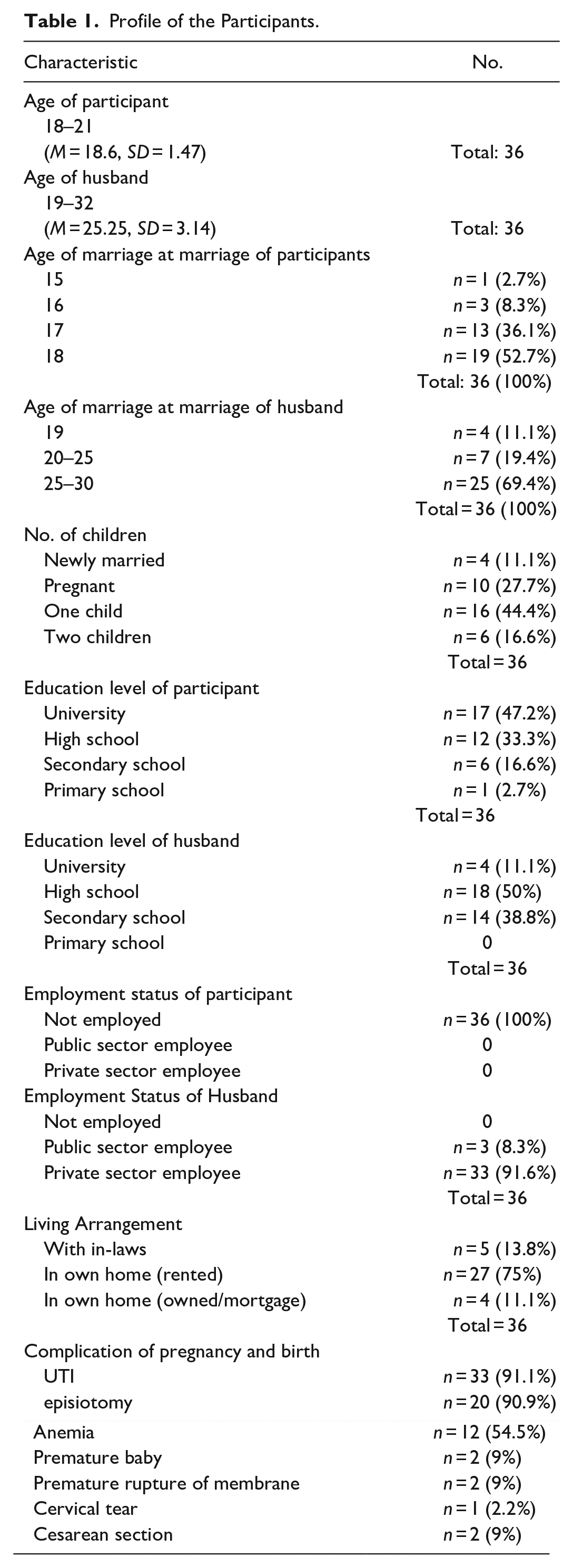
Thirty-six young married women consented to participate in the study. The participants were living in different cities in Jordan (Amman, Irbid, Al-Mafraq, Madaba, and Al-Zarqa). All of the participants entered into marriage between the ages of 15 and 18 years old. Their current ages ranged between 16 and 21, (M = 18.63, SD = 1.5). All of the participants (36) were living with their husbands, and five of them with their in-laws. Five of them had one child, one had two children, and three were pregnant.
All of the mothers were literate; nearly half of them (n = 17) were university students, and 12 completed high school and six completed only secondary school. Nearly all were considered to have low- to middle-range incomes. The current ages of their husbands ranged between 19 and 32 years old (M = 25.3, SD = 3.15). All of the husbands had completed a high school education. Three of the husbands were working in the public sector and the others (33) were working in various and organizations in the private sector. See Table 1.
Profile of the Participants.
Six major themes emerged from the interviews to describe the lived experience of early married girls “Feeling remorse about getting married early”; “Loss of authority and feeling powerless”; “Reasons behind early marriage”; “Feeling pressure to have first baby”; “Early marriage and pregnancy health consequences”; and “The positive aspects of early marriage.” See Table 2.
Themes and frequencies of responses.


The phrase “feeling remorse” was mentioned by almost all of the participants when they described their feelings about their whole experience of marriage. They also reported experiencing a range of more complicated feelings on a continual basis, and especially upon getting pregnant, during pregnancy and upon the arrival of a baby, when they found themselves “at a total loss” in a state between married life and motherhood. Most of the study participants also reported a lack of skills in being “a good wife” and/or “a good mother.”
Feeling Remorse About Getting Married Early
Usually, newlywed young girls feel happy and excited about marriage (Mrayan et al., 2016). As the participants were married before the age of 18, some of them envisioned that married life would be akin to a fairy tale. Five of the participants said that they thought their life would be better than that of anyone else, and that it would be full of love and flowers. This expectation is encapsulated in the words of one of the participants who said: “Together, we planned to keep our life full of love and to live in heaven.”
However, this vision of married bliss changed as soon as they got married and struggled with all the different aspects of married life.
Another participant said:
My husband used to bring me chocolate and flowers during the months of our engagement, he promised to keep this habit all lifelong. But unfortunately, this habit changed after a few months of marriage. He started to shout at me and get angry if my cooking was not good or if I didn’t complete the housework. And sometimes he calls me names. . . (crying). . . my life is very difficult, to achieve a balance between household responsibilities and my study tasks is very difficult.”
It became clear from the interviews that the responsibilities of married life were more complicated than the participants had imagined. In between their own household duties, family visits and invitations, they were leading complicated lives every day. No one respected the fact that they were still young and did not have enough skills to run a house. In this regard, one of the participants said:
My husband used to invite his friends for lunch or dinner without even asking me. One day he came home with his friends and asked me to prepare dinner. . ..He became very angry when I said that I didn’t know what to make. . ..”
Almost all of the participants stressed that they were raised within an overprotective family. They said that their family did not prepare them for married life. At the same time, their family did not offer any information that could help them to go through the marriage experience more smoothly However, some of them were raised in a family whose primary concern was to get their girls married because marriage was seen as protection [sotra] for a girl. This One of the participants said: “I wasn’t allowed to talk about marriage with my family; it is considered impolite.”
Another participant said: “Since I was a school girl, my family wanted to get me married, I was raised in a family who believe in child marriage and always say it is sotra [protection] for the girl.”
Loss of Authority and Feeling Powerless
As indicated by the following extracts, for most of the participants the main reason for their marriage was their in-laws’ desire to have grandchildren and to extend their family. This is clearly expressed by one participant who said:
“I was forced to become pregnant directly after my marriage. The only reason behind my husband’s marriage was that his parents wanted grandchildren. . . my husband hindered me from using any type of family planning.”
Even though the in-laws knew that their daughter-in-law was young, they insisted that they wanted her to get pregnant and refused to let her use any type of family planning. For most Jordanians, when a man has a job with a regular salary, he is considered ready for marriage and having a family, as explained by one of the participants:
“People usually think that having a job and be financially ready is enough to get married and have children. They don’t think about the wife and that it is too much responsibility. I only blame myself and my family. . .. Things are unexpectedly very different.”
The participants were also not able to express an opinion or share in the decision-making because they were considered immature. This lack of involvement in household decisions is exemplified by one of the participants who said: “My husband discusses our family issues with his mother, they treat me as an immature girl, and they don’t share things with me”
Another participant complained that she was not allowed to be alone with her baby. The mother-in-law had taken on the role of the mother in caring for the baby and in deciding what type of care to provide, and the participant could not refuse this help because it would be considered disrespectful to one’s elders who are considered to be experienced. The participant said: “My mother-in-law decides everything for my baby, she says I am still a child and can’t take care of a child. . .” adding, “My mother-in-law has swaddled my baby and bathed her with salty water, she gives her boiled herbs. . . my doctor at the university told us that all of these practices are wrong and can harm the baby. . . but they don’t listen. . .”
Reasons Behind Early Marriage
A number of different reasons were revealed to be behind the early marriage of most of the participants. One of the participants said that her family was very poor and they could not pay her tuition fees, so her marriage was seen as the solution to this difficulty. This was why her feelings about her marriage were mixed; she felt ambivalent and was in a state between being happy and not happy. Her husband agreed to pay the tuition fees, but unfortunately, this was the only help he offered. He did not offer any other type of help, and made negative remarks about it, as indicated by the participant who said:
“Yes, he paid my tuition fees, but in return I paid a lot. Because he paid my fees, I couldn’t ask him to buy me anything, no new clothes or shoes, no gifts. . .”
Another participant said that her family had forced her to get married because they were worried about her. They told her that she would not be allowed to go out of the house if she did not get married. Another participant said that her father was worried because the area they were living in was full of young men, and her family was very conservative, as she explained:
“My father is a very conservative man, I was not allowed to go anywhere alone even if it was to school. This was the only reason behind me being early married. . .. In my community married women, sometimes, have a little more choice than single girls.”
Another participant said that the only reason for her marriage was because her brothers had accused her of having an affair. They hit her very badly and locked her in the house. They also promised to marry her to the first man who asked, and that was what eventually happened, leaving her no choice but to agree. She said:
“My brothers thought that I was having a relationship with someone, even though I told them it was not true, they didn’t believe me and this is the only reason why I am married now. . .”
Also, for many of the participants, early marriage was a family tradition. The families of the participants considered that a girl was ready to be married directly after she had reached puberty. Usually, these girls were married to their cousins because both families had the same concerns. One of the participants said: “. . .because my brother wanted to marry his cousin, my uncle said, ‘We will give you our daughter, if you give us your daughter’.”
This is called a swap [badal] in Jordan. This type of marriage is an old tradition, and is still practiced in some rural areas in Jordan within the same family. The main reason for this practice is to keep the family inheritance in the same family, passing it down from father to son.
Another reason behind early marriage was the desire of some families to have a very young daughter-in-law because they wanted to teach her their own family rules and traditions. Such families believe that young girls are easily trained guided and shaped in the manners they desire in the way they want. One of the participants, who was married at the age of 16, said: “My in-laws want to raise me with their own daughters because they want me to be the same as them. . .. I live with them in the same house as if I had been born in this house. . . we cook and eat together, we do the housework together, and we do everything together. . . Emmmm, it’s good but I’ve lost my privacy.”
Feeling Pressure to Have First Baby
Almost all of the participants said that they were not allowed to use family planning by their mother, mother-in-law, and husband. At the time of the interviews, sixteen of them had only one child, six had two children, and ten were pregnant. The participants said that their husbands had made/were making a tremendous amount of effort to attain financial security. Financial security was the major concern of both the participants and their husbands because this is considered a primary prerequisite for having children, as exemplified by one of the participants who said:
“Having a baby directly after marriage was a big challenge for us. We had to save money for the hospital and the newborn expenses. . . preparing for the arrival of a new baby is not easy.”
One of the participants said that their life became complicated after the arrival of their first child. So many unexpected difficulties were added to their life. Having a newborn baby in the first year of marriage was not easy for her, as she explained: “For many nights my newborn baby stayed awake all night long . . .. My husband did his best to help me, but he didn’t know how to calm the baby down, especially because my baby was breastfed”, adding, “Even if you live with a good husband, this is not enough. My husband tried to help me with the baby, but he couldn’t. I am the only person who could give the required care for our baby.”
The interviews also revealed that the participants were not able to abandon their old role of being/a school-age daughter living with their own parents and could not determine what kind of mothers they wanted to be. They said that they had gleaned their mothering characteristics from their role models, and that they were not able to make their own decisions because they did not have enough experience. This identity struggle and transitional stage is exemplified by one of the participants who said:
“I couldn’t do anything by myself. . . I didn’t know how to cook or clean. . . I moved suddenly from being a schoolgirl to a wife and a mother. . . my mother provided support to me all the time during my pregnancy and after the birth of my baby.”
Jordanian families are generally always available to provide social support and to help young parents in their new life. However, despite the availability of this support, young parents often feel a loss of control, as expressed by one of the participants who said:
“I lost control. . .. I felt that things were out of my hands. I couldn’t manage to do anything alone. My life was a big mess.”
Having a baby after a few months of marriage is a very difficult experience. During this period of life, young women go through many different major life transitions. So to add another major transition, such as the transition to motherhood, made their early married life even more complicated. This challenge is encapsulated by the words of one of the participants who said:
“I was trying to cope with my new life events, being newly married and living in a new house, a new family, then the pregnancy came to add another stress to my life. These stresses made the first year of my married life difficult and not easy to manage. It was a devastating experience and it was very hard to cope with it.”
Early Marriage and Pregnancy Health Consequences
All of the participants mentioned at least one negative consequence of marriage and pregnancy on their physical or mental health.
In regard to their physical health, almost all (n = 33) of the participants experienced a urinary tract infection (UTI) before or during pregnancy. Twelve of the participants experienced iron deficiency anemia during pregnancy. Another participant had a premature baby and said that her baby was admitted to the neonatal intensive care unit for 2 weeks. Two of the participants had a premature rupture of the amniotic membrane; one of them ended up with a bad cervical tear two had their baby by cesarean section. Moreover, all of our participants who had normal vaginal delivery (n = 20) had an episiotomy. Most of them received routine antenatal care, but none of them attended postnatal care. Some of the participants’ experiences are illustrated in the following extracts: “My baby was put in the incubator for 35 days. . .. Those days were very difficult for us. . . I will not forget that bad experience.” “I went to the hospital because my waters broke at home. . .. They told me that it was because of my UTI.”
In regard to mental health, psychological signs and symptoms were experienced by most of the participants. These included sadness, loneliness, crying, anxiety, and anger, which were mentioned by almost all of the participants. One of the participants said that she used to cry every day and felt very lonely: “After the arrival of my baby, my breasts were very sore, I couldn’t breastfeed my baby very well, he was crying all night. I had a very bad perineal incision which made my days very difficult. I was crying all the time. . .. No one could offer the help I needed.”
One of the other participants said: “I would get angry for no reason. . . I felt sad all the time.”
Another participant said: “In those days, I didn’t want to see anyone, I wanted to be alone. . .”
The Positive Aspects of Early Marriage (Two Participants)
Despite all the negative aspects of early marriage experienced among the participants, there was some positivity among some of them regarding their early marriage. For example, one of them said that, despite all the new responsibilities, getting married was the best thing that had happened to her because before her marriage she had been living with her stepmother who had not treated her well: “Getting married was the best thing that happened to me. My mother has been dead since I was 6 years old and my father got married a few months after her death. His wife was not good to me. She wanted me to do all the housework, the cooking, and take care of her children. . .”
Another participant came from a family of 11 brothers and sisters and her father’s salary was very low. Thus, she was living in a very poor, large family and she felt that the only choice open to her was to get married to lessen the burden on her father: “My family is a very large family. I had 11 brothers and sisters and my fathers’ monthly income was only 350 dinar. It was not enough for us. We lived in a very poor situation. This is why getting married was kind of a help and support for my family.”
Discussion
This study found that young Jordanian women feel regret or remorse about having married early and being wives and mothers in their late teens and early twenties. Unfortunately, for most of them, it was not their own choice to enter into an early marriage. Despite the fact that, all of our participants were socially supported, almost all of the participants had or were experiencing the feeling of being completely lost. And from the remarks and comments they made during the interviews it is clear that they were neither physically nor mentally prepared for marriage. They were especially unprepared to have children at a young age. The feeling of unpreparedness was the main reason behind their feeling of loss of control. This finding is in line with two previous local studies that found that new parents, both female and male, face challenges and difficulties during this critical life stage (Mrayan et al., 2016, 2019). This study also revealed that a number of different reasons were behind early marriage, associated with cultural mores or social norms and beliefs.
Previous studies in different contexts around the world argue that a blend of social, cultural, religious, and economic factors lie behind child marriage, including poverty, inheritance issues, and family-domestic obligations (Kamberidou, 2020; Sezgin & Punamäki, 2020; Wang & Qiao, 2020). These studies focus on the reasons behind its continuation along with the, harmful ramifications which include gender obstacles to education and employment, barriers to women’s contribution to economic growth, depriving girls and women of their, human rights, and in particular, depriving developing economies from realizing their full socio-economic potential (Kamberidou, 2020).
Not only economic or financial factors, usually an escape from poverty, reproduce this practice, but early marriage is also considered a family obligation, a means of protection, especially during periods of potential conflicts as well as a way of intercepting or preventing sexual behaviors that deviate from socio-cultural and religious values (Adedokun et al., 2016; Bartels et al., 2018; Bayisenge, 2012).
In Jordan, poverty is the major reason behind most of the early marriages that take place (Nahas, 2017). Poverty was a key reason behind the marriage of 47.2% (n = 17) of our participants. Wodon et al. (2017) and The Higher Population Council (2017) confirms that poverty is one of the reasons for early marriage, as well as cultural traditions that include having large families, in addition to socio-cultural gender perspectives, prejudices and attitudes (Lowe et al., 2019). Even more religion, culture, and institutions of public and private sectors have limited Jordanian women economical contribution opportunities (Abdelrahmimsid, 2017).
The results of the current study provide first-hand female accounts and testimonies that confirm these identified factors. Regardless of the specific reason or combination of reasons that led to their early marriage, the 36 female participants assert they were not given any choice in the matter. They were essentially forced to accept the marriage arrangements made for them.
This study also found that the participants entered married life without the information or skills required to help them go through this developmental life stage smoothly. As was made abundantly clear from the interviews, all of the participants had experienced one or more negative effects of marriage and pregnancy on their physical and psychological health. As regards the effect of pregnancy specifically, out of the six participants who had children at the time of the study, most of them developed anemia and/or a UTI, one had a premature birth, two had a premature rupture of the amniotic membrane, and all six had an episiotomy. These findings support the results of a previous study conducted in Jordan, which found that girls who were married before the age of 18 and became pregnant experienced a variety of negative health issues (UNICEF, 2017). Furthermore, a resent Chinese study showed that adolescent marriage is a major cause of unplanned pregnancy, unsafe abortion and vulnerability to sexually transmitted infections (Wang & Qiao, 2020).
Furthermore, in this study, almost all of the participants said they felt remorse, stress, and a sense of loss in their married life. Becoming a wife and becoming a mother for the first time are two major transitions at any age (Mrayan et al., 2016). The moment that a young woman becomes a mother for the first time, she takes on a major role and responsibility in shaping the health and well-being of the next generation. Indeed, older research shows, in terms of stressful life events, that having a baby ranked as high as six out of 102 (Dohrenwend et al., 1978). According to current research, having a baby is one of the most stressful, but most common, examples of the changes that occur within a marital relationship (Mrayan et al., 2016).
Pregnancy and childbirth are major events that deeply affect the life of the mother and other family members as well, and can therefore affect the dynamic of the whole household, particularly when the young couple lives with the husband’s parents (Mrayan et al., 2016). For instance, as some of the mothers in the study sample remarked, they felt ill-prepared and inadequate for motherhood, a feeling that was sometimes exacerbated by the mother-in-law (grand-mother), taking over the mothering role. Indeed, the new mother faces many responsibilities and challenges in relation to her family’s and her in-law’s social, economic, and cultural expectations.
Conclusion
Child marriage is not a new phenomenon in Jordan, but a tradition or common practice, where it takes place due to certain circumstances, such as poverty, socio-cultural beliefs, and the social stigma of not having a large family. However, the incidence and frequency of child marriage has, overall, become worse since the new legislation concerning the legal age—the minimum age—at which girls are allowed to marry, approved by the Cabinet in 2009 The results of this study, along with the literature review, clearly show and confirm that child marriage has numerous negative or devastating effects on the physical, psychological, and social development and well-being of girls and young women. Therefore, girls (and their mothers) need to be empowered to say no to child marriage. As knowledge is power, teaching schoolgirls, mothers and families in general, about the negative consequences of early marriage could contribute to decreasing the number of early marriages in Jordan.
Implications and Contributions
This study found that child marriage has numerous negative effects on the psychological and physical well-being of adolescent girls and young women. These findings have implications for future research to design quantitative research studies on the drivers of adolescent marriage such as the high value and gender norms around marriage, familial and cultural beliefs around family marriages, customs, and religious beliefs, and living in rural areas as key factors in the prevalence of child marriage. For policymakers and health practitioners because they highlight the issues that need to be addressed when designing culturally sensitive programs and interventions for girls. These programs should focus on empowering girls, especially through education, to make decisions about their own life and on preparing them for marriage at a suitable time in their life and in an appropriate manner. At the institutional level it is recommended to review the policies and set of laws surrounding adolescent marriage, including the recent legislation. Also a review of the definitions and beliefs among institutions around the terminology and definitions related to adolescent marriage
The need for a change in social attitudes and norms could be promoted through consolidated community-based programs that involve several stakeholders, such as health institutions, local civic organizations, mosques, and schools. These stakeholders offer the best avenues for raising awareness on the negative consequences of child marriages or marrying girls at a young age. Such programs could also emphasize the many benefits of delaying marriage, improving in the long run the economic, social, and health status of young people, both female and male. the findings of our study highlighted the crucial need to provide a community based support groups for those young married and the young married and pregnant/mothers.
Limitations
This study has potential limitation. Because we used snowballing to identify our participants, the process was very slow because the participants were the one who introduced us to the possible participant. Because most of our participants were young women, we had to ask the permission from their husband before the conduction of the interview. And finally, the interviews location was a limitation too. Some participants were living with their family in-law, this made it difficult to find the suitable time and day to conduct the interview without interruptions.
Footnotes
Acknowledgements
The authors would like to thank all the participants who participated in this study for sharing their experiences.
Declaration of Conflicting Interests
The author(s) declared no potential conflicts of interest with respect to the research, authorship, and/or publication of this article.
Funding
The author(s) received no financial support for the research, authorship, and/or publication of this article.
