




Abstract
This study examines how pre-service teachers conceptualize the power of education to challenge and delegitimize social inequalities, and how they articulate these understandings through video-selfies (velfies)—short, self-recorded multimodal performances combining voice, gesture, image, and affect. Conducted within an undergraduate teacher education program in Romania, the research engaged candidates in embodied, narrative, and performative reflection on issues of inequality, recognition, empowerment, and professional identity. Using interpretative video analysis (IVA) informed by multimodal social semiotics, we identified and examined moments of narrative and affective density (“instances”) across 17 velfies. These were assembled into three recurring pathways of justice-oriented becoming: Maria and the stories of inequality, I see you, and I am a future creator. The pathways reveal how participants moved from recognizing structural inequities, to enacting pedagogical presence and care, to imagining themselves as agents of educational transformation. Beyond generating research data, velfies functioned as embodied pedagogies, making visible the emotional, ethical, and relational dimensions of teaching for justice. The findings demonstrate that multimodal, performative reflection can deepen critical awareness, disrupt deficit narratives, and support the formation of justice-oriented teacher identities.
Plain Language Summary
This study explores how future teachers—also called pre-service teachers—understand and express ideas about social justice in education. We asked participants to create short video-selfies, or velfies, in which they reflected on how education can both reproduce and challenge inequality.
The velfies allowed these future teachers to combine spoken words, images, gestures, and emotions to tell stories about their experiences and values. In many of the videos, they imagined characters like Maria, a child facing poverty or exclusion, and reflected on how teachers can recognize such students and help them build better futures. Other videos focused on the teachers themselves—how they want to care for learners, act ethically, and create classrooms where everyone feels seen and valued.
By analyzing seventeen velfies using interpretative video analysis, we found three main ways the participants made meaning: telling stories of inequality (Maria and the stories of inequality), expressing care and recognition (I see you), and envisioning educational change (I am a future creator).
The study shows that creating velfies can help future teachers see education differently—not only as knowledge delivery, but as a way to practice empathy, fairness, and transformation. Through these short, self-recorded videos, they learned to connect their personal experiences with wider social issues and to imagine what it means to become a justice-oriented educator.
Keywords
Introduction
As socio-economic disparities deepen and educational systems face mounting demands, the call for social justice-oriented teacher education (SJTE) has become urgent. Preparing pre-service teachers (PSTs) to address systemic inequality necessitates not only instructional competence but also critical consciousness, emotional engagement, and an ethical commitment to transformation (Cochran-Smith, 2010; Le et al., 2024; Roegman et al., 2021). Despite this broad consensus, a persistent gap remains between espoused commitments to social justice and the lived experiences of PST learning—especially in under-researched national contexts. Romania exemplifies this gap: although policy initiatives such as Educated Romania (Romanian Presidency, 2021) and the subsequent laws of education promote inclusion, policy approaches to SJTE often reduce equity to technical interventions, neglecting structural issues such as (learning) poverty, segregation, or ethnic marginalization (European Commission, Directorate General for Education, Youth, Sport and Culture, 2024). Critical pedagogies are rarely integrated into pre-service programs, and teacher candidates receive limited support to reflect on their own positionalities (Hosseini et al., 2025).
As Gandolfi and Mills (2023) emphasize, justice-oriented teaching is not only conceptual but grounded in situated, relational practice—an orientation largely absent in Romanian teacher preparation, where justice is often framed as abstract rather than pedagogically actionable. Empirical studies are still limited, and those that do address related themes tend to focus on specific aspects such as vulnerability or targeted support for students with special educational needs, often through technical or compensatory measures (Kiss et al., 2023; Luştrea, 2023), leaving broader questions of structural inequality and teacher agency underexamined. Comparative research in Eastern Europe suggests that pre-service teachers’ beliefs about justice are often shaped more by inherited hierarchies and cultural norms than by transformative pedagogical experiences (Koliqi et al., 2023; Peček & Macura-Milovanović, 2015).
This study addresses that gap by examining how PSTs conceptualize the power of education to challenge and delegitimize social inequalities—such as engaging in education practices to support economically disadvantaged, low-achieving pupils or early school leavers—through the creation of video-selfies, or velfies. Velfies are short, self-recorded videos that allow students to narrate, embody, and reflect upon their professional identities using multiple communicative resources (Ciolan & Manasia, 2025; Sterling-Fox et al., 2020). They exemplify multimodality, understood as meaning-making through the orchestration of linguistic, visual, gestural, auditory, and spatial resources within situated activity (Jewitt, 2017; Kress, 2010). While velfies have gained attention as pedagogical tools (Sterling-Fox et al., 2020), their analytical potential as research instruments remains under-theorized (Ciolan & Manasia, 2025; Lepp et al., 2023). We argue that velfies make visible the affective, embodied, and relational dimensions of teacher identity formation—dimensions that are often inaccessible through traditional written or monomodal data.
Conceptually, our study draws on Fraser’s (1998) tri-dimensional model of justice—redistribution, recognition, and representation—and Bernstein’s pedagogic rights framework (Duarte et al., 2024), which together frame justice not only in material terms but also as a function of symbolic and participatory inclusion. We further ground the analysis in the funds of identity approach—FOI—(Esteban-Guitart & Moll, 2014), which situates identity as socially and narratively constructed through autobiographical and cultural resources. These frameworks allow us to examine how PSTs perform and position themselves in relation to social justice in education, both cognitively and affectively.
Through an interpretive case study situated in an undergraduate PST education course, we investigate how PSTs conceptualize the power of education to challenge and delegitimize social inequalities. In so doing, we seek to contribute to the literature on multimodal justice praxis in teacher education, particularly in regions where such approaches remain emergent.
The study is guided by the following research questions (RQs):
To contextualize this inquiry, the following section reviews existing literature on SJTE, the role of multimodality in identity construction, and the emerging use of velfies as pedagogical and research tools.
Literature Review
Socio-Economic Inequalities and Social Justice in Teacher Education
SJTE is shaped by intersecting systems of power, privilege, and exclusion. Early liberal theories, such as Rawls’ (1999) model of justice as fairness, emphasized equality as a moral imperative, yet largely framed injustice as the unequal distribution of resources. While influential, this distributive view has been critiqued for overlooking how cultural and symbolic exclusions structure educational experiences. Critical theorists have extended the conversation by foregrounding how injustice is also a matter of recognition—whose identities are valued—and representation—whose voices shape institutions. Fraser’s (1998) triadic model of redistribution, recognition, and representation offers a powerful lens to analyze the complex and overlapping dimensions of inequality.
In teacher education, Fraser’s model helps unpack how well-intentioned concepts such as “inclusion” or “diversity” are frequently depoliticized. These terms are often framed as professional competencies or attitudes rather than indicators of structural critique and transformation (Dunn, 2024; Hosseini et al., 2024, 2025). In contrast, the equity tradition within teacher education (Cochran-Smith & Keefe, 2022) insists on justice as praxis: a sustained pedagogical commitment to interrogating and disrupting systems of oppression. SJTE aims thus to support PSTs in confronting how privilege and marginalization shape learning and professional becoming. Hosseini et al. (2024) identify key commitments across SJTE programs: naming structural inequities, centering marginalized perspectives, engaging affect and reflexivity, and modeling justice through pedagogy. These principles reimagine teacher education as a transformative, dialogic space where professional learning is inseparable from social consciousness (Bondy et al., 2017, 2022; Sensoy & DiAngelo, 2017).
Despite growing theoretical consensus, the global development of SJTE remains uneven. The field is dominated by scholarship from Anglophone contexts, particularly the United States, Canada, and Australia, while regions such as Eastern and Southern Europe remain underrepresented (Hosseini et al., 2024; Leite et al., 2023; Purdy et al., 2023). Even where reforms promote equity or inclusion, social justice is often treated as a rhetorical value or technical outcome, disconnected from broader institutional critique (Monge et al., 2022). Purdy et al. (2023) note that many European teacher education systems continue to prioritize competency-based, instrumental models that marginalize ethical, relational, and critical dimensions of teaching. As a result, justice-oriented work is often positioned at the margins of formal curricula, relying on the commitment of individual instructors or isolated initiatives.
Romania offers an especially relevant context for this kind of inquiry. Shaped by post-socialist reforms and transnational policy borrowing, Romanian teacher education has formally adopted inclusive language, yet often lacks the pedagogical depth and institutional commitment to meaningfully address systemic inequities. Manasia and Parvan (2025) show that many PSTs enter the profession with limited exposure to structural critiques of inequality and continue to hold deficit-based views of marginalized groups, particularly students at risk of poverty and those from rural backgrounds. Furthermore, inherited beliefs about merit, neutrality, and cultural hierarchy are rarely interrogated in coursework. These dynamics make it crucial to explore how justice becomes meaningful—or remains elusive—in the everyday thinking and identity work of Romanian PSTs.
Understanding how PSTs navigate these tensions requires engaging with the affective and embodied dimensions of justice. As Gandolfi and Mills (2023) illustrate, teachers committed to social justice often confront competing demands between their ethical commitments and institutional constraints. These insights resonate with Matias’s (2016) framing of emo-social justice, which emphasizes the interplay of knowledge, feeling, and self in justice-oriented teaching. Dunn (2024) similarly argues that teacher education must cultivate the emotional literacy and ethical awareness required to navigate discomfort, contradiction, and vulnerability in pursuit of equity. Without such engagement, equity discourses risk becoming affirmed in theory but disavowed in practice.
Pedagogical frameworks like funds of knowledge and funds of identity (FoK/I) offer practical entry points for embedding justice in teacher preparation. These approaches challenge deficit views by centering students’ lived experiences and cultural practices as sources of knowledge and agency (Esteban-Guitart & Moll, 2014; Volman et al., 2023). When integrated into co-constructed, relational curricula, FoK/I strategies have been shown to improve student engagement, self-efficacy, and belonging (Volman et al., 2023). Yet their effectiveness depends on sustained critical reflection and collaboration. As Zhang-Yu et al. (2023) and Liao et al. (2022) caution, these approaches risk being reduced to superficial gestures if not grounded in deep partnerships with families and communities. In this sense, justice-oriented pedagogies require more than methodological tools—they demand shifts in stance, structure, and institutional culture.
Emotional and Embodied Dimensions of Inequity in Teacher Education
Injustice is not only structural or cognitive; it is also emotional and embodied. Zembylas (2020) conceptualizes the “emotional geographies” of injustice, demonstrating how shame, fear, and inadequacy circulate in educational spaces, reinforcing hierarchies of worth and belonging (Safta-Zecheria et al., 2025). Jasini et al. (2019) and De Leersnyder et al. (2020) show that emotional repertoires are socially patterned: affiliative emotions like gratitude or compliance are often expected from marginalized individuals, while disengaging emotions—anger, frustration—are pathologized or suppressed within institutional norms.
These dynamics are mirrored in teacher education. PSTs are typically encouraged to express empathy and care, yet emotions crucial for perceiving and naming injustice—such as anger, grief, or vulnerability—are frequently marginalized (Charteris & Gregory, 2024; Datnow et al., 2023). As Dunn (2024) argues, developing critical emotional literacy—the ability to examine how emotions are entangled with power—is essential for justice-oriented practice. Without this, social justice discourse becomes less pedagogically transformative. This focus stands in contrast to dominant models of teacher education that continue to privilege knowledge to practice approaches (Donath et al., 2025). In this context, Purdy et al. (2023) highlight how current European teacher education policy frameworks often center on technocratic accountability, sidelining more expansive, value-driven models that engage teachers as emotional, relational, and moral agents. Against this backdrop, emotional and embodied pedagogies offer a corrective and necessary condition for meaningful teacher formation.
Multimodality in PST Education
In the past decade, multimodal approaches have gained traction in initial teacher education (ITE), often promoted as tools to foster inclusion, engagement, and reflective practice (Almumen, 2023; Barton & Ryan, 2014; Cook & Chisholm, 2025; Salo & Kajamies, 2024). Yet their implementation remains uneven. A persistent tension concerns whether multimodality is understood as a technical extension of literacy into visual and digital domains or as a transformative stance that reconfigures how knowledge, identity, and power operate in education. Many programs adopt the former, offering digital storytelling or infographics as creative supplements to written reflection while leaving text-based norms and assessment hierarchies intact (Ajayi, 2017; K. A. Mills & Exley, 2014). This risks aestheticizing multimodality, treating alternative forms as decorative rather than epistemic (Jewitt, 2017; Kress, 2010).
In contrast, a growing body of work frames multimodality as a relational, ethical, and affective mode of knowledge-making. Drawing on a/r/tography and ecological theories, Brooke et al. (2024) conceptualize multimodality as grounded in embodied practice and situated within complex institutional and social ecologies (Irwin & De Cosson, 2004; Springgay et al., 2008). Similarly, Pandya and Ávila (2014) and Almumen (2023) show how multimodal composition enables teacher candidates to bring their cultural histories and emotional experiences into professional reflection—surfacing the affective labor of reconciling personal and institutional expectations. However, scholars caution that without critical framing, multimodal work can flatten complexity or reproduce dominant narratives under the guise of creativity (C. Walsh, 2023; Z. Walsh et al., 2020). To avoid this, intentional scaffolding and dialogic critique are essential. When facilitated well, multimodal reflection becomes a form of emotional inquiry, where vulnerability, discomfort, and identity tensions become generative rather than threatening (Martínez Carratalá & Miras, 2025; Smith, 2022). Collaborative interpretation and structured feedback can transform emotional friction into insight, fostering solidarity and deeper reflection (Brooke et al., 2024; Zembylas, 2020).
Despite its potential, multimodality’s connection to social justice remains underexplored. Most research highlights creativity and engagement (Kress, 2010) but rarely investigates how multimodal practice shapes equity-focused teaching. Pandya and Ávila (2014) link critical digital literacies to analyses of race, migration, and language politics, while Volman et al. (2023), building on funds of knowledge (Esteban-Guitart & Moll, 2014), illustrate how multimodal work bridges home–school divides. These works reposition multimodality as a justice praxis centered on participation, recognition, and epistemic plurality (Jacobs & Rowsell, 2020; Kuby & Rowsell, 2017). Still, structural barriers remain. Standardized curricula, disciplinary silos, and monomodal assessment regimes privilege written literacy and marginalize embodied or visual modes (Z. Walsh et al., 2020). Teacher educators often lack the support needed to assess multimodal work with theoretical depth (Ajayi, 2017), reinforcing its status as enrichment rather than core pedagogy. Recent scholarship counters this by advocating for embodied, justice-oriented multimodality that foregrounds affect, ethics, and cultural sustainability (Brooke et al., 2024; Kuby & Rowsell, 2017). When approached this way, multimodality enables teacher candidates not only to represent learning but to rehearse new relational and epistemic possibilities—acts of listening, witnessing, and reimagining authority (Jacobs & Rowsell, 2020).
This reconceptualization grounds the present study. We approach velfies—short, self-recorded video reflections—as multimodal practices that enact these principles. Velfies extend reflection beyond text into embodied, performative engagement, integrating voice, gesture, and spatial context. In doing so, they invite PSTs to experience and articulate justice as as a lived, emotional, and relational practice.
Learning About Social Justice via Embodied Pedagogies: From Social Media to Pedagogical Velfies
Recent scholarship has examined how teachers engage with social justice through digital media, particularly on social platforms. Shelton et al. (2022) explored culturally relevant professional learning on Instagram, revealing how teacher-influencers curate equity-focused content and communities of practice. Davis and Yi (2022) critiqued the commercialization of teacher activism online, highlighting tensions between authentic advocacy and platform-driven branding, while Peterson (2024) showed how algorithmic visibility and aesthetic appeal shape what counts as “activist” teaching.
However, such scholarship centers on public-facing performances—spaces where teachers negotiate visibility, branding, and algorithmic pressures. By contrast, the use of velfies (video-selfies) in PST education operates in a pedagogical, private, and reflective context. Within this setting, velfies function as low-tech, self-recorded videos through which PSTs narrate and perform their developing professional and ethical identities (Ciolan & Manasia, 2025). As part of a broader digital turn in reflective practice, velfies enable candidates to document learning in ways that are situated, embodied, and affectively charged. Empirical research demonstrates that such video-based reflection enhances self-awareness and pedagogical noticing (Tripp & Rich, 2012) and provides access to the tacit, emotional dimensions of teacher identity formation (Gaudin & Chaliès, 2015; Lepp et al., 2023).
Unlike written journals or public social media posts, pedagogical velfies engage an expanded semiotic repertoire—facial expression, gesture, voice, rhythm, and spatial positioning—allowing PSTs to make visible what is often silenced in teacher talk: emotion, uncertainty, and embodied knowing (Esteban-Guitart, 2023; Jewitt, 2017). This multimodal expressiveness is particularly relevant for SJTE, where affective tension, empathy, and vulnerability are integral to unlearning deficit discourses (Brooke et al., 2024; Zembylas, 2020). Whereas social-media activism privileges visibility and curation, velfies in coursework boost authenticity, reflexivity, and exploratory meaning-making within a protected learning environment (Ciolan & Manasia, 2025).
Drawing on Ciolan and Manasia’s (2025) typology, velfies cluster into echo and performative modes. Echo velfies foreground introspection—static framing, slow pacing, direct address—while performative velfies employ dynamic movement, spatial transitions, and collaborative expression. Both modes are interpretive rather than hierarchical, offering distinct ways of articulating professional becoming. Cook and Chisholm (2025) found that such embodied video reflection helped PSTs connect social-justice concepts with lived classroom realities. Similarly, Lepp et al. (2023), observed that first-time video reflection provoked discomfort and self-consciousness but ultimately deepened relational understanding when facilitated through trust and feedback. These findings underscore that velfies, though emotionally demanding, cultivate the critical emotional literacy essential to justice-oriented practice (Dunn, 2024).
The rationale for using velfies as research instruments stems from their multimodal affordances. As performative tools, they generate data that capture both what PSTs articulate and how they express affective and embodied stances toward social justice. Video affords visibility into embodied hesitation, confidence, and empathy—dimensions inaccessible through text alone (Chilton & Leavy, 2020). Analyses of teacher-education videos have shown how gesture, gaze, and pacing reveal shifts in pedagogical stance (Gaudin & Chaliès, 2015; Loughran & Berry, 2005), validating velfies as robust multimodal data sources. At the same time, lessons from social-media scholarship remain instructive. Davis and Yi (2022) warn against the commodification of advocacy, while Shelton et al. (2022) highlight inequities in digital capital—insights relevant to PSTs’ varied comfort with self-representation. Accordingly, velfie pedagogy must emphasize process over production, valuing sincerity, emotional honesty, and critical framing above technical polish. As Lepp et al. (2023) suggest, scaffolding, guided feedback, and collaborative viewing help normalize vulnerability and transform video reflection into a collective, ethical practice rather than a performative exercise.
This study offers empirical insight into how PSTs in Romania used velfie-based reflection to navigate and perform justice-oriented becoming, extending current understandings of reflective practice through affective and embodied modalities.
Inquiry Context
The study was conducted within Fundamentals of Education and Curriculum Theory, a 14-week core course in an ITE program at a large public university in Romania. The course was redesigned using a curriculum grounded in experiential and embodied pedagogies (Manasia & Negreanu, 2024). It integrated challenge-based learning and velfies (Ciolan & Manasia, 2025; Sterling-Fox et al., 2020), organized around seven macro-level educational challenges such as digitalization, inclusive curriculum design, and education for sustainability. Each unit opened with a fictionalized vignette authored by the instructors (Manasia, 2025), drawing on personal experience and literary inspiration to surface themes of inequality, memory, hope, and belonging. These vignettes were rooted in traditions of narrative inquiry and reflective pedagogy (Barkhuizen, 2011; Huber et al., 2013; Leavy, 2015), and were complemented by optional cultural prompts—curated films, novels, and music—that extended emotional engagement and critical reflection (see Figure 1).

Recommendations featured in the course.
A cap activity was the Week 12 LEARNATHON, a hackathon-style event where student teams addressed real-world educational problems. Velfies served as a core reflective practice throughout the course. PSTs were invited to create short, self-recorded video responses to the open-ended prompt Education changes lives—a phrase deliberately framed to prompt reflection on how education can reproduce or disrupt systemic inequality. The task was scaffolded through an instructor-created tutorial velfie (see Figure 3), which modeled how educational experiences may shape individual or collective trajectories marked by privilege or exclusion. This tutorial explicitly guided PSTs to draw on personal, relational, or community-level experiences in which education intersected with social advantage or marginalization. To support authenticity and expressive freedom, no technical or aesthetic standards were imposed; instead, students were encouraged to respond creatively, using voice, body, and space to convey affective depth and critical insight.
Velfies enabled PSTs to embody emotion, articulate emerging stances on justice, and navigate the tensions between personal conviction and professional formation. Drawing on these artifacts, the study analyzes how PSTs expressed and negotiated their understandings of the power of education to challenge and delegitimize social inequalities within a curricular space where such reflection remains emergent.
Method
Researcher Reflexivity
We approached this study as teacher educators and qualitative researchers with firsthand experience facilitating discussions on inequality, justice, and belonging in pre-service teacher education (Bondy et al., 2022). Our team spans education sciences, linguistics, and law, bringing distinct disciplinary lenses to our analysis. Two members of the research team were course instructors who facilitated the course and were familiar with the institutional and pedagogical context. The third researcher, who did not participate in course delivery, brought an outsider perspective and acted as an interpretive auditor, reviewing velfies and analytic memos independently. This configuration supported reflexive dialogue and strengthened interpretive credibility through critical distance. We recognize that our dual role as instructors and researchers offered opportunities for trust-building, but also carried risks of reinforcing power asymmetries. Rather than claim neutrality, we viewed our positionality as constitutive of the research process.
To model reflective and embodied inquiry, each of us recorded a personal velfie at the beginning of the course—excluded from analysis—which illustrated how our educational trajectories shaped our orientations toward justice (Figure 2). These recordings functioned as both instructional tools and reflexive acts, foregrounding our affective investments in the work. During analysis, we wrote analytic memos to capture thematic insights and emotional responses—moments of resonance, resistance, and discomfort. Throughout, we remained attentive to the ethics of representation, continually questioning whose voices were amplified and how our interpretive decisions shaped justice narratives. Although formal ethics approval was secured (see “Method” section), we approached reflexivity as an ongoing ethical practice—integral to both our analytical process and our relational engagement with the data (Holmes et al., 2022; Savolainen et al., 2023).

Selected frames from a researcher’s velfie illustrating affective memory and mobility.
Study Participants and Data Collection
All 64 PSTs enrolled in Fundamentals of Education and Curriculum Theory, a core undergraduate course in a Romanian ITE program, participated in a velfie task integrated into the course design. Students chose to work individually or in self-selected small groups, resulting in the creation of 18 velfies: 2 produced individually and 16 collaboratively by 62 participants. One video was excluded due to technical issues, yielding a final dataset of 17 velfies submitted for analysis. Each video was assigned a unique code (VEL_001 to VEL_018) and ranged in length from 92 to 340 s, demonstrating varied expressive formats such as direct-to-camera narration, peer dialogue, and performative storytelling.
The velfies were created between March and May 2024 in response to the open-ended prompt Education changes lives, which invited personal, relational, or systemic reflections on how education can reproduce or disrupt inequality (see the Inquiry context for reference). To support this task, PSTs received an asynchronous tutorial video introducing four key production steps—selecting a theme, crafting a script, choosing a location, and considering basic technical setup. The tutorial emphasized authenticity and emotional engagement over production polish (Figure 3). Although the tutorial was asynchronous, in-person seminars offered opportunities for clarification and discussion. Velfies were submitted via Moodle or a secure video-sharing platform and stored in compliance with institutional data protection protocols.

Selected screenshots from the velfie tutorial video illustrating the four production steps. The Romanian text in the frames corresponds to the steps outlined in the video tutorial on velfie creation: (A) Pasul 1: Alegeţi tema—Step 1: Choose your theme; (B) Pasul 2: Creaţi un scenariu—Step 2: Create a script; (C) Pasul 3: Alegeţi locaţia—Step 3: Choose the location; (D) Pasul 4: Echipamentul—Step 4: Equipment.
While other course artifacts were generated (e.g., Learnathon presentations), this study focuses exclusively on the velfies. All contributors provided written informed consent for the use of their work in the research, and ethical approval was obtained from the university’s research ethics committee (Approval No. 10533, November 2023).
Analysis
This study employed interpretive video analysis (IVA) (Knoblauch et al., 2014) to investigate how PSTs reflected on and performed their understandings of the power of education to challenge and delegitimize social inequalities. IVA, grounded in interpretive sociology and video ethnography, does not treat video as objective data to be coded but as a form of social performance requiring contextual, situated interpretation. Meaning is not extracted through abstraction but reconstructed from within participants’ lived experiences and expressive practices. As Knoblauch and Schnettler (2012) noted, IVA centers on participants’“first-order constructs”—their own understandings and expressions—which researchers interpret through theoretically informed, second-order constructs.
To analyze how meaning was conveyed in the velfies, we combined IVA with a multimodal social semiotic framework (Jewitt & Price, 2012), enabling us to examine how gesture, voice, spatial organization, and visual design worked together to produce layered meaning. Our analytic approach integrated four interrelated dimensions, drawn from Ciolan and Manasia’s (2025) velfie typology and expanded through multimodal inquiry frameworks (Q. Wang & Hannes, 2020): (1) sequentiality (the temporal unfolding of meaning through rhythm, silence, and verbal cues), (2) spatial configuration (bodily orientation, framing, distance), (3) interactional dynamics (gaze, address, and engagement), and (4) production aesthetics (editing, lighting, and color, which shape tone and atmosphere).
Analysis unfolded in four stages. First, each of the 17 velfies was reviewed—individually and collaboratively—to identify segments marked by expressive intensity or affective charge. These were designated as instances. In line with multimodal video analysis (Jewitt & Price, 2012), we defined instances as short, semiotically dense episodes marked by shifts in interactional order or expressive conventions. We identified 52 such instances (10–60 s;
Second, each instance was transcribed using a multimodal matrix (available in OSF repository) detailing speech, gesture, gaze, spatial composition, sound, and affect. These were interpretive reconstructions attentive to how modes interacted over time. For example, slow pacing, minimal movement, and dim lighting connoted introspection and critique, while direct gaze, expansive gestures, and saturated color schemes produced atmospheres of connection or hope. Meaning was read from the affective-emotive whole, interpreted through recursive viewing and team dialogue.
Third, we conducted collaborative analysis through five iterative sessions. Here, selected instances were revisited, interpretations refined, and visual-narrative assemblages constructed. These assemblages (e.g., Figures 4 and 10)—comprising stills, multimodal transcripts, and annotations—enabled us to trace how meaning cohered across sequences. This practice reflects Knoblauch’s emphasis on “slow analysis,” allowing emergent interpretation to stay grounded in participants’ expressive logic rather than externally imposed codes (Knoblauch et al., 2015). One member of the research team, who was not involved in course delivery, acted as an external reviewer. She independently viewed all velfies, examined selected multimodal transcripts, and reviewed analytic memos during the collaborative sessions. Her outsider position enabled critical questioning of emerging interpretations, surfaced alternative perspectives, and supported reflexive dialogue within the team.

Assemblage of Maria’s journey in VEL_007, representing rural marginalization and educational aspiration.
In the final stage, we examined how instances connected across velfies by mapping their narrative content, multimodal features, and ethical orientations. We noticed that certain expressive and thematic elements tended to cluster together—often appearing in similar sequences across different videos. To explore these patterns systematically, we grouped instances based on recurring combinations of narrative form (e.g., fictional voice, direct address), visual framing (e.g., camera proximity, gaze direction), affective tone (e.g., critical, empathic, hopeful), and articulated stance (e.g., critique of injustice, recognition of learner, projection of future self). These groupings were refined through iterative comparison and discussion, and developed into three recurring trajectories of meaning-making, which we termed pathways. We named the pathways based on the dominant focus of their sequences: “Maria” (focused on structural injustice and fictionalized figures), “I See You” (centered on recognition and relational presence), and “Future Creator” (emphasizing agency, aspiration, and pedagogical change). Ten velfies followed the full sequence of these three frames, five concluded with the second, and two deviated.
Methdological Integrity
We maintained methodological integrity by ensuring a consistent connection between the study’s framework and its research inquiries, as detailed by Levitt et al. (2021). Our objective—to investigate how pre-service educators express social justice in education through velfies—required close attention to variations in expressive forms, emotional tone, and narrative composition. We validated data adequacy by examining the complete collection of velfies created, which encompassed both echo responses and more dynamic, multimodally rich pieces, as outlined in the Literature review. This thorough inclusion enabled us to interact with a wide array of justice-centric expressions. Ethical clearance was obtained from the institutional research ethics committee (Approval 10533/2023), and all participants willingly provided written consent for the usage of their videos, still images, and interpretative excerpts. Reflexivity was upheld throughout the research process through shared memos, positional debriefings, and collaborative interpretation sessions, in alignment with interpretive methodologies that emphasize researcher positionality (Savolainen et al., 2023). Analytical procedures were directed by a multimodal mapping matrix that outlined how meaning was formed across sequential, spatial, gestural, and technological aspects. Sections of increased semiotic intensity—designated as instances—were assembled into interpretive collections to enable cross-modal and cross-case analysis. In accordance with interpretive video hermeneutics (Knoblauch et al., 2014), the analysis included multiple viewings, layered annotations, and the pinpointing of instances (Jewitt & Price, 2012). Divergent interpretations were viewed as analytically beneficial and incorporated into the interpretive process. To enhance transparency and traceability, all analytical resources—including the matrix template, transcripts, and assemblages—are accessible in the OSF repository.
Findings
We present the findings as three meaning-making pathways that reflect how velfies expressed PSTs’ evolving justice orientations and professional identities. Each pathway—Maria and the ubiquitous story of inequality, I See You!, and I Am a Future Creator—represents a distinct configuration of critique, care, and aspiration as articulated through narrative, gesture, and design.
Maria and the Ubiquitous Story of Inequality
In response to RQ1—What is the nature of pre-service teachers’ understandings of educational inequalities and social justice?—one meaning-making pattern emerged: the construction of fictionalized, emotionally resonant characters, most notably Maria, as recurring narrative anchors. Across 11 instances, Maria appears as a semiotic figure through whom pre-service teachers articulate their engagements with marginalization, poverty, and limited access to opportunity—particularly in rural or under-resourced contexts. In other velfies, the names of Ilona and Liliana are introduced to symbolize underprivileged children and youth.
These characters operate as focal points that allow pre-service teachers to articulate understandings of inequality through situated, emotionally resonant narratives. In VEL_007, Seq_1 (Figure 4), the narrator explains: “Her options were limited. Maria knew that to escape poverty, she had to continue learning.” The tone is reflective and didactic, constructing a clear moral arc anchored in personal perseverance. The sequence constructs a linear success narrative, underlining persistence and self-education in overcoming adversity. While the tone is hopeful, it also subtly reinforces meritocratic assumptions—education as a matter of individual will—without attending to deeper structural constraints. However, the transition from personal advancement to community engagement offers a nuanced expansion of justice as relational and collective. The use of third-person narration (rather than first-person testimony) introduces narrative distance, allowing Maria to become a symbolic figure—an archetype of transformation through education.
This framing intensifies in VEL_007, Seq_2—see Figure 5, where the line Education was the key that opened doors to a better life signals belief in education as inherently transformative—a sentiment supported visually by static, composed settings that suggest calm and resolution. The assemblage reinforces this message through a deliberate shift in visual voice: Frame A presents Maria speaking in the first person, positioning the statement as lived experience and grounding it in an intimate, personal register. Frame B then introduces the narrator, whose voice and stable framing operate as an authoritative echo, amplifying and legitimizing Maria’s words. The pairing of these perspectives—embodied testimony followed by narrative affirmation—creates a layered rhetorical effect, blending personal conviction with external validation. Yet this framing risks overemphasizing individual effort as the primary path through structural barriers (Figure 6).
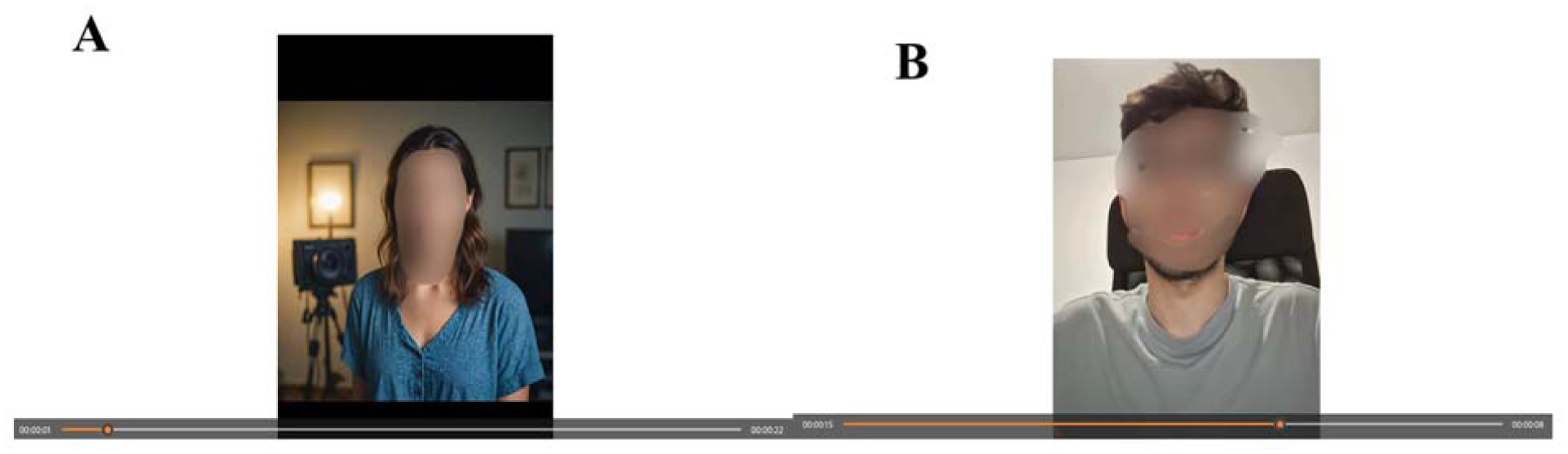
Assemblage from VEL_007, Seq_2, showing the shift from Maria’s first-person testimony to the narrator’s reinforcement of the message.
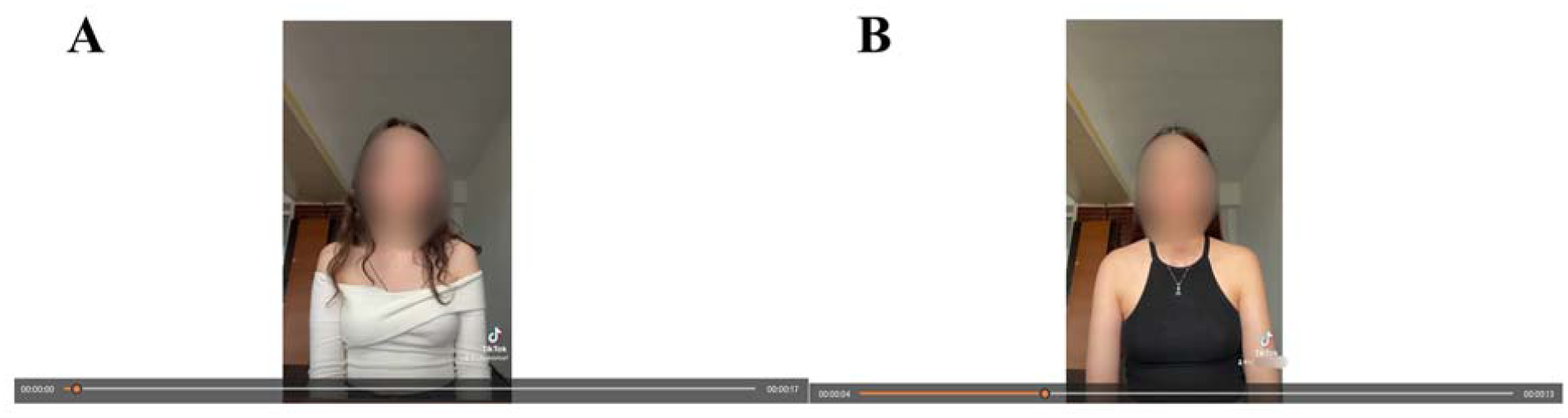
Assemblage from VEL_008, Seq_1, showing the two narrators delivering the voice-over that recounts Maria’s trajectory.
At the same time, other velfies introduce more complex or contradictory readings of justice. In VEL_008, Seq_1, the tone shifts: “With a heavy heart, Maria accepted her fate and took up work in the fields.” The affective register here is melancholic, and the narrative halts without resolution or recovery. This moment disrupts the redemptive arc by presenting Maria’s resignation as both a personal and structural loss. Maria is neither saved nor triumphant; instead, she embodies deferred aspiration and institutional neglect.
This growing awareness of systemic entanglement becomes more explicit in the second instance—VEL_008, Seq_2—where the narrator observes: “The teachers failed to truly help Maria. But the system failed them, too.” The scene develops as a pointed juxtaposition: on one side, a portrayal of structural incapacity that constrains teachers’ agency; on the other, the sudden appearance of a volunteer who recognizes Maria’s potential and offers direct support. In the narration—“With their help, Maria was able to return to school”—the volunteer’s intervention functions as a decisive narrative pivot, recasting the possibility of justice as emerging from community-based, non-formal actors rather than from the institutional apparatus meant to ensure it. The affective tone is hopeful yet shaded by regret, acknowledging both the transformative potential of human connection and the insufficiency of formal educational structures.
A distinct articulation of this relational framing appears in VEL_004, Seq_2, which introduces Ilona as a figure of educational exclusion. The teacher character states: “We offer a second chance to people like Ilona—to support them in building a new future.” As illustrated in Figure 7, this narrative unfolds through a sequence of visual and embodied shifts. In Frame A, Ilona is seated in isolation beneath a tree—withdrawn and grounded, echoing the narrative claim that the system “didn’t give [her] a first chance.” The teacher’s entrance in Frame B and their direct encounter in Frame C mark a pivotal turning point. In Frame D, Ilona appears upright and in motion, holding a tablet—symbolizing renewed access and tentative transformation. This visual transition from stillness to movement is portrayed as enabled through recognition and relational attention (Figure 8).

Ilona as a figure of exclusion and imagined transformation.

Assemblage of Maria’s appearances illustrating re-entry, aspiration, and persistence across varied registers.
In contrast to earlier performative yet fictionalized depictions, in VEL_012 Maria appears as a real participant, interacting directly with the narrator and another pupil. This blurs the boundary between constructed character and lived subject, embedding the narrative of inequality in documented, co-present reality. The connection is made explicit in the narrator’s self-disclosure: “As a small addition to Maria’s response, I am the godmother of this girl and I truly wished she could learn more if school doesn’t allow it. I wanted her to have a good future, and not one lacking education. I decided to offer her extra lessons like math and Romanian. When she wants, I also teach her dance, and in the future I’d like to teach her to sing or even play an instrument” (VEL_012, Seq_3, 03:10–04:00).
Maria’s additional appearances further consolidate recurring patterns of inequality. In VEL_010, Seq_2 (01:20–02:07), the re-entry script is stated explicitly: “She began to attend school.” In VEL_010, Seq_3 (02:10–02:35), redirected aspiration is named directly: “Maria’s dream was to become an engineer.” Inclusion paired with ongoing barriers recurs in VEL_013, Seq_1 (00:30–00:40), while VEL_008, Seq_3 (02:15–02:45) closes on persistence amid deferred goals. A system-facing register frames VEL_009, Seq_4 (02:20–03:00), and a peer/meta voice answers Maria in VEL_012, Seq_5 (03:10–04:00). Across these instances, modal instances co-vary with stance: third-person narration clusters with institutional commentary; first-person address underwrites perseverance narratives; movement sequences index transition; static, front-facing shots sustain a reflective tone.
I See You! Recognition, Empowerment, and Pedagogical Presence
In addressing RQ2—How is teacher agency multimodally constructed in relation to addressing or mitigating socio-economic inequalities—our analysis examines recognition and empowerment as interrelated components of the “I see you” meaning-making path. Within this framing, velfies depict teacher agency through multimodal enactments of recognition—the sustained witnessing of learners and affirmation of their worth—and empowerment—the fostering of learners’ capacity to act, often through mentorship, shared learning, and expanded horizons.
Recognition is constructed through self-disclosure, attentive presence, and the provision of personalized support (Figure 9). In one instance, a narrator, speaking plainly from a domestic setting, commits to continuing academic and creative lessons for a pupil she identifies as her goddaughter (VEL_012, Seq_5). Minimalist production, and vocal tremors convey sincerity, situating teacher identity in both care and agency while foregrounding intergenerational support as a counterbalance to institutional gaps. In another example, a teacher is depicted noticing and nurturing a student’s artistic potential (VEL_014, Seq_1). The warm, affirming tone and stable, centered framing construct the teacher as a benevolent guide, but the narrative follows a familiar “teacher-as-rescuer” arc—positioning justice as individual mentorship rather than systemic transformation. Across these examples, recognition is mediated through intimate framing, controlled affect, and relational investment, producing powerful images of care while leaving broader structural inequities unchallenged.

Assemblage illustrating recognition as pedagogical presence.
In this path, empowerment emerges as a relational, cyclical process in which the act of receiving support becomes a catalyst for offering it to others. Rather than being an abstract ideal, empowerment is made visible through concrete encounters—moments where agency is affirmed, practiced, and passed on.
In VEL_003 (Figure 10, Frame A), a teacher guides Liliana, a student enrolled in a remedial program at her former teacher’s urging. The scene culminates with Liliana reading a line from Malala Yousafzai’s We Are Displaced—“When I close my eyes and think of my childhood, I see pine forests and snow-capped mountains.” The camera lingers as the teacher gently caresses her hair, the embodied gesture reinforcing the spoken act as both an achievement and an opening into possibility. Thus, empowerment is staged as recognition, intimacy, and affirmation against the backdrop of early school leaving.

Assemblage illustrating empowerment as collaborative engagement and expanded horizons.
As we observed in VEL_009 (Figure 10, Frame B), this principle takes on an intergenerational dimension. Mrs. Ionescu, the teacher figure, recounts her journey from childhood poverty to becoming a teacher: “I had to work hard to get into school and then into university… now I’ve come back to help children in similar situations.” Delivered directly to camera in a static outdoor setting, her testimony reframes personal struggle as a resource for motivating others, foregrounding the moral duty to “give back” as a defining element of professional identity.
Empowerment also appears as a reflexive practice. In VEL_011 (Figure 10, Frame C), the narrator reflects, “When I started to share what I had learned with others, I realized how powerful that was—not just for them, but for me too.” This framing dissolves the teacher–learner binary: knowledge circulates, and in sharing, the giver deepens her own understanding.
Finally, VEL_014 (Figure 10, Frame D) locates empowerment in metaphor and spatial transformation. Moving from the “darkness” of hardship to the light of an art gallery, the narrator closes with gratitude to a teacher whose belief made her dreams tangible. The shift in location—from an intimate interior to a public cultural space—visually encodes the expansion of horizons, suggesting that empowerment is as much about access to new worlds as it is about personal resilience.
I am a Future Creator
In relation to RQ3—How do pre-service teachers build their professional identity in response to structural inequalities encountered in educational contexts?—this meaning-making path frames teaching as a forward-projecting act. Thus, the velfies served to narrate current practice and to envision the teacher’s role in shaping equitable futures. The future creator orientation often begins with direct, declarative commitments to action, gradually moving from an acknowledgment of systemic failure to the enactment of practical support and collective advocacy. As observed in VEL_001, Seq_3 (Figure 11, Frame A), the absence of speech and ambient sound shifts the viewer’s attention to the image of a boy with his head bowed beside the digitally superimposed “2 + 2 = 5.” This silent moment operates as a visual metaphor for systemic educational failure, signaling both cognitive disruption and emotional withdrawal, establishing the moral urgency that underpins later commitments to change.

Assemblage of velfie sequences articulating commitment to education as a transformative and justice-oriented force.
Building on this urgency, VEL_002 (Figure 11, Frame B) introduces a structured, reasoned appeal. Two narrators take turns outlining education’s transformative benefits—personal development, health awareness, poverty reduction, and emotional intelligence—framing these as investments in the future. The static indoor setting, steady framing, and absence of visual embellishment keep the focus on the clarity and sincerity of the spoken message, positioning teaching as a deliberate, well-informed, and future-oriented practice.
This forward-looking stance is further embodied in VEL_004, Seq_2 (Figure 11, Frame C), where a staged dialogue between “Maria” and “Ilona” dramatizes the teacher’s role in opening “a second chance” for learning. The use of an outdoor setting and empathetic body language positions education as mobile, accessible, and grounded in human connection. Ilona’s scripted aspirations—“I want to learn to read… leave this village, and find a job”—anchor educational justice in concrete, life-changing outcomes rather than abstract ideals.
The trajectory culminates in VEL_009, Seq_3 (Figure 11, Frame D), where a direct outdoor appeal links personal transformation to societal responsibility: “Let us invest in education to offer all young people the chance for a better life.” The minimal gestures and steady eye contact maintain a persuasive tone, transforming individual stories like Cristina’s into a collective call for systemic commitment.
A further development of this orientation appears when the imagined future centers on learner self-direction. The assemblage in Figure 12 (Frames A and B) voices the story of Edi, now older, who speaks in the first person, acknowledges the teacher’s formative role, and claims his own trajectory. The brighter palette, close/mid shots, upright posture, and steady gaze stage maturation and agency, while gratitude marks recognition as the scaffold for autonomy. As observed in VEL_015, Seq_3 (Frame C), the sequence shifts to a broaden agency from “I” to “we”: “Each of us can contribute to education—… simply encouraging children around us to pursue their studies.” / “Our small actions can have a big impact on lives and our shared future.” / “Teachers’ actions can change the future.” Surfaced in VEL_013, Seq_2 (Frame D), collective empowerment is a catalyst for deconstructing inequalities: “We can build a better future for all children….” The decisive tone hands agency to teachers collectively.
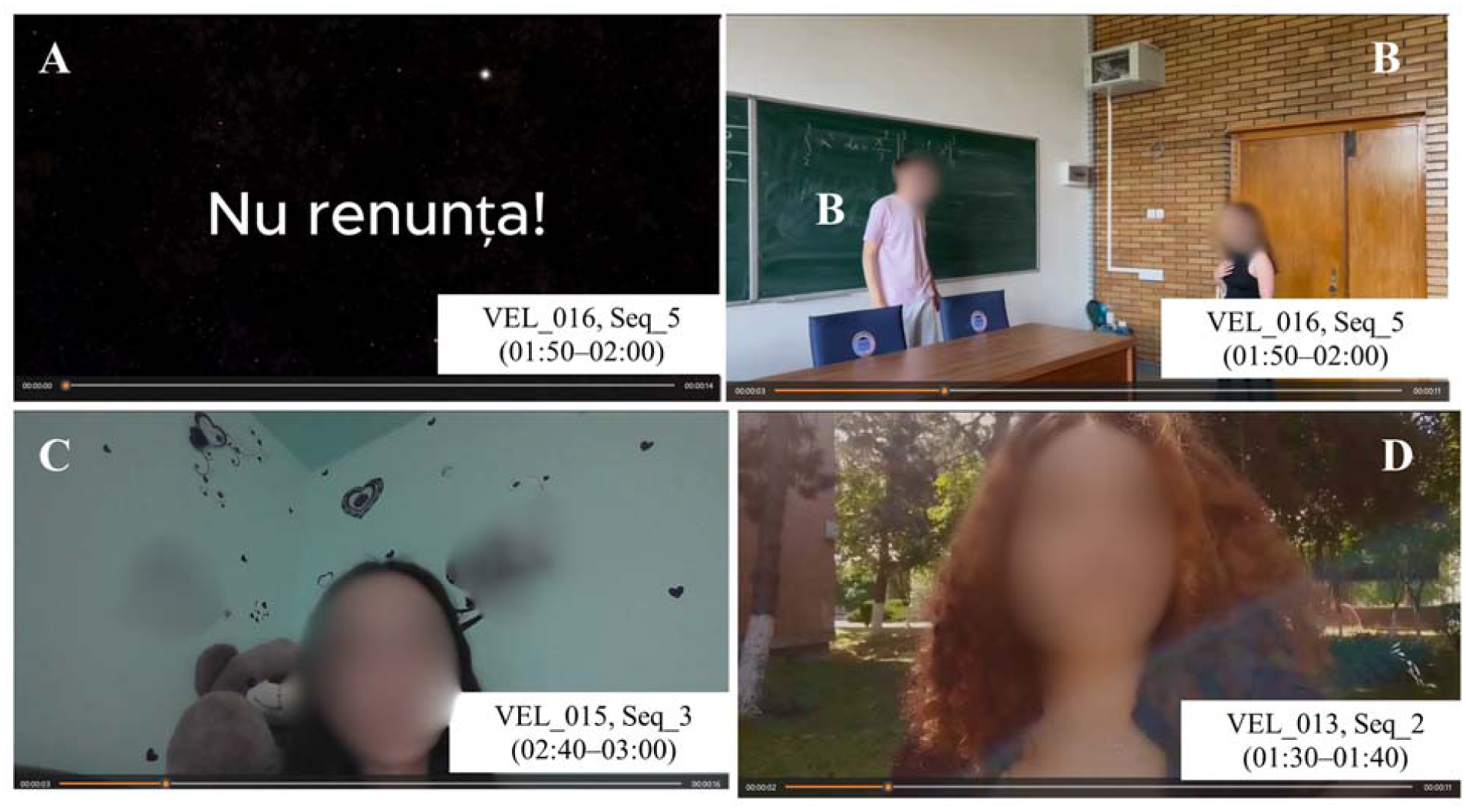
Assemblage of velfie sequences where pre-service teachers transfer agency to future learners.
The production of velfies provided means for pre-service teachers to consider and performatively voice the co-construction of future and the collective de-construction of inequalities. Unlike Maria and the ubiquitous story of inequality, which centers on narrating barriers, or I see you!, which foregrounds recognition and empowerment in the present, I am a future creator meaning making path positions the teacher as an active designer of futures—futures where equity is embedded in pedagogy, sustained through enduring relationships, and enacted in partnership with learners.
Discussion
This study examined how pre-service teachers conceptualize the power of education to challenge and delegitimize social inequalities—such as supporting economically disadvantaged, low-achieving pupils or early school leavers—through the creation of velfies as part of ITE coursework. These velfies functioned simultaneously as pedagogical tools and as multimodal research artifacts. Our design was grounded in the understanding that learning is inherently multimodal (Esteban-Guitart, 2016), and that justice-oriented reflection emerges through verbal reasoning and embodied, aesthetic expression. Using IVA (Knoblauch et al., 2014) and multimodal analysis (Jewitt & Price, 2012), we identified and assembled meaning-dense instances to examine how participants expressed, performed, and projected justice-oriented identities. In what follows, we discuss the three emergent meaning-making pathways and reflect on the pedagogical significance of velfies as embodied practices.
Maria Speaks for Many: How PST Represent Structural Injustice
Across the velfies, narratives of inequality frequently crystallized around recurring fictional characters—most notably Maria—who embodied intersecting disadvantages such as poverty, geographic isolation, and systemic neglect. These characters functioned as semiotic anchors, allowing PSTs to externalize abstract concepts of injustice into situated, emotionally resonant stories. Unlike prior research that identified a tendency among teacher candidates to individualize inequality (Hosseini et al., 2024; Lemley, 2014), these representations foregrounded structural barriers—such as underfunded schools, teacher shortages, and unequal access—thus aligning with Fraser’s (1998) theory that justice must encompass both redistribution and recognition.
The recurrence of Maria as a shared figure of exclusion suggests a deliberate pedagogical move, echoing Avraamidou’s (2020) argument that repeated character use supports symbolic coherence and narrative identity work. In this sense, storytelling emerged not only as an expressive modality but as a critical pedagogical strategy. As Picower (2021) and Cochran-Smith et al. (2016) contend, narrative practices can disrupt deficit framings and create openings for structural critique. These findings echo broader calls in teacher education to move beyond surface-level engagement with diversity toward deeper justice-centered pedagogies (C. Mills & Ballantyne, 2016; Purdy et al., 2023).
Yet, a recurring tension persists: although PSTs identified systemic injustice, the interventions they proposed were predominantly localized and individualistic. Figures like godparents, volunteer mentors, or idealized teachers were cast as the primary agents of change. This reflects international critiques that social justice in teacher education often remains confined to “pedagogies of care” or “rescue,” where structural transformation is substituted by acts of personal compassion (Cerna et al., 2021; C. Mills, 2013; Zeichner, 2019). Such narratives risk reproducing neoliberal tropes of heroic individualism that obscure the need for institutional accountability and collective action (Purdy et al., 2023).
The velfies’ multimodal affordances intensified the affective and political force of these stories. Visual choices—like Maria walking alone through a rural village or Ilona’s stillness beneath a tree—were not arbitrary. These curated assemblages (Rowsell & Pahl, 2015) reflect a growing justice literacy among participants, one aligned with Sensoy and DiAngelo’s (2017) notion of inequality as historically produced and institutionally maintained. In this sense, the velfies allowed PSTs to move beyond performative reflections, enacting instead what Lemley (2014) describes as the “naming” of structural violence—a foundational step toward justice-oriented praxis.
Recognition and Agency: Pathways of Justice-Oriented Becoming
Two interconnected meaning-making pathways—I See You and I Am a Future Creator—illustrate how PSTs cultivated recognition and agency through their velfie-based reflections. These trajectories show how multimodal storytelling can serve as a site for professional identity rehearsal and pedagogical positioning, supporting the development of justice-oriented dispositions (Gandolfi & Mills, 2023; Purdy et al., 2023).
In the I See You pathway, recognition emerged as a foundational pedagogical stance—an affirmation of students’ dignity, struggles, and aspirations. Through direct gaze, steady framing, and empathetic address, participants enacted “ethical witnessing” (Picower, 2021). Rather than offering abstract commentary, PSTs engaged in imagined dialogues with students, positioning themselves relationally. These enactments resonate with Fraser’s (1998) conception of participatory parity and Esteban-Guitart and Moll’s (2014) emphasis on affirming funds of identity. The I Am a Future Creator pathway extended this recognition into projective agency (Priestley et al., 2015), as PSTs imagined education as a catalyst for transformation. Velfies in this category emphasized outcomes such as literacy, civic engagement, and social mobility. In VEL_009, for example, a participant’s public call to “invest in education” linked personal experience to societal responsibility, suggesting a vision of teaching as advocacy. These narratives align with Datnow et al.’s (2023) argument that teacher education must connect micro-level care with macro-level critique.
These pathways served as identity rehearsal mechanisms, enabling participants to test and refine emerging professional orientations. From a FOI perspective (Esteban-Guitart, 2016), the movement from recognition to agency marks a shift from deficit-oriented interventions toward capacity-building. This trajectory reflects Markus and Nurius’s (1986) theory of possible selves and aligns with evidence that emotionally engaged, reflective learning fosters professional alignment with equity goals (Almumen, 2023; Cerna et al., 2021). The embodied and aesthetic form of velfies—through gesture, voice, spatial framing—enabled participants to communicate meaning beyond verbal reasoning (Perry, 2023; Springgay & Freedman, 2012).
This process signals a broader reorientation in teacher education: from content delivery to reflexive transformation. As discussed by Donath et al. (2025), practices that emphasize situated, emotionally resonant learning promote deeper internalization of inclusive values and ethical commitments. Velfies supported this by allowing PSTs to move beyond theoretical engagement with inequality, instead rehearsing justice-oriented teaching identities in contextually grounded, embodied ways (Ciolan & Manasia, 2025).
Finally, the two trajectories reveal that recognition and agency are co-constitutive dimensions of socially just teaching. Recognition grounds pedagogical relationships in respect and attentiveness; agency projects those relationships toward transformation. Together, they underscore that SJTE is iterative, affective, and relational—shaped by how teachers imagine, position, and perform their roles in relation to others (Masud & Marsoobian, 2024; Volman et al., 2023; Z. Walsh et al., 2020).
Velfies as Pedagogies That Bring Body in
The velfies produced in this study illustrate how ITE can enact embodied pedagogy—approaches that position the body as central to learning, knowing, and teaching (Bondy et al., 2022; Perry, 2023; Springgay & Freedman, 2012; C. Walsh, 2023). Embodiment encompasses the teacher candidate’s physical presence and the affective intensities of gaze, voice modulation, posture, and gesture, which, as C. Walsh (2023) argues, carry epistemic weight in justice-oriented pedagogy. Velfies represent a digital evolution of participatory visual methodologies—such as Photovoice (Ciolan & Manasia, 2017; C. Wang & Burris, 1997)—but their performative, time-based nature transforms them into dynamic identity enactments (Choi & Rho, 2021; Lyle et al., 2020). Through the layering of verbal narrative, bodily expression, and environmental cues, participants constructed self-authored professional identities grounded in lived experience, community knowledge, and aspirations for justice (Esteban-Guitart, 2023; Zhang-Yu et al., 2023).
The embodied nature of velfies also highlighted the affective labor of becoming a justice-oriented educator—labor that requires emotional attunement, ethical reflexivity, and vulnerability. As Matias (2016) and Bondy et al. (2022) argue, engaging with inequity in teacher education is cognitively and emotionally demanding, often surfacing discomfort, fragility, or anger (Avraamidou, 2020). Our analysis found that such emotional registers were often embedded in bodily presence—leaning forward to convey urgency, averting the gaze to express empathy, or pausing to allow visual resonance.
Limitations
This study is situated within a single institutional and cultural context, which may limit the transferability of findings to other ITE programs. Its design, embedded in one course and involving a single cohort of PSTs, fosters analytical depth over generalizability and does not allow for comparative or longitudinal claims. As a method, velfies privilege participants who are digitally fluent and comfortable with self-presentation, potentially marginalizing those less at ease with performative modes (Almumen, 2023; Bezemer & Jewitt, 2010). Aesthetic and technical decisions—such as framing, editing, or setting—may also reproduce dominant cultural norms, constraining the range of multimodal expression (Kress, 2010; Rowsell & Pahl, 2015).
While IVA enables in-depth exploration of embodied meaning-making (Knoblauch et al., 2014), its interpretive orientation resists standardization and does not pursue inter-coder agreement, which may affect transparency and comparability (Jewitt & Price, 2012). Finally, the personal and visual nature of velfies raises enduring ethical challenges around vulnerability, emotional exposure, and the circulation of digital artifacts—issues widely noted in participatory visual research (Choi & Rho, 2021; Ciolan & Manasia, 2025; C. Wang & Burris, 1997). These considerations shaped what participants chose to disclose and how they positioned themselves within the task.
Conclusions and Implications for Future Research and Practice
This study highlights the pedagogical value of multimodal, embodied practices—specifically velfies—in supporting SJTE. Future research should explore how these practices influence teacher identity and praxis over time, particularly in varied institutional and cultural contexts (Cerna et al., 2021; Gandolfi & Mills, 2023). Longitudinal studies are needed to examine whether such reflexive, arts-based tasks facilitate shifts from awareness to sustained action (Almumen, 2023; Picower, 2021). Moreover, aligning professional learning models with multimodal approaches can foster more holistic engagement by attending to emotion, motivation, and ethical stance as drivers of pedagogical change (Kennedy, 2018; Priestley et al., 2015).
At the policy level, the findings suggest a move toward value-centered frameworks that recognize teaching as emotional, relational, and moral work (Purdy et al., 2023; Reagan & Hambacher, 2021). Explicit knowledge alone is insufficient; countering the dominance of rescue pedagogies requires systemic attention to inclusion and equity (Cochran-Smith et al., 2016; C. Mills, 2013). Within practice, embedding arts-based, reflexive modalities in ITE programs can deepen PSTs’ sense of agency and moral responsibility, especially when coupled with safeguards that ensure emotional safety and diverse representation (Avraamidou, 2020; Choi & Rho, 2021).
To evaluate SJTE effectively, research must move beyond measuring knowledge acquisition to examine the development of professional dispositions, including willingness to change, self-efficacy, and critical justice orientation (Datnow et al., 2023; Masud & Marsoobian, 2024). As the I Am a Future Creator trajectory illustrated, PSTs’ transformative intentions must be matched by opportunities and support to enact change. Finally, this study echoes calls for greater methodological rigor in teacher education research. As noted by Nīmante et al. (2025) and Kowalski et al. (2020), there remains a scarcity of large-scale, longitudinal, and comparative studies that include both teacher and student outcomes. Evaluating the transfer of ITE into classroom practices requires more robust designs, particularly those capturing complex, nonlinear processes across multiple dimensions (Donath et al., 2025; King et al., 2023). In an era of accelerating educational reform, understanding how teachers internalize and apply social justice principles is essential for building responsive, equitable systems of learning.
Footnotes
Acknowledgements
We are deeply grateful to the pre-service teachers who generously shared their time, creativity, and stories through the velfies that made this study possible. Their willingness to reflect openly on issues of inequality, identity, and hope has enriched this research in ways that extend far beyond the scope of our analysis. We would also like to thank our colleagues in the teacher education program for their encouragement, constructive feedback, and inspiring conversations that helped shape both the course design and the study itself. Special appreciation goes to those who offered critical insights during seminars and workshops, and to the external partners who engaged with our students during the Learnathon, bringing valuable perspectives from practice, policy, and civil society.

Ethical Considerations
The study followed institutional ethical standards for research with human participants. All students were informed in advance about the purpose of the study, the voluntary nature of participation, and the procedures for consent, confidentiality, and data protection. Participants who chose to contribute submitted their velfies voluntarily and provided written consent for their inclusion in the analysis. Data were collected and stored securely in accordance with institutional protocols. Ethical approval for this study was granted by the National University of Science and Technology Ethics Committee on Human Research (Approval No. 10533, November 2023).
Consent to Participate
Informed consent was obtained from all individual participants involved in the study. Participation was voluntary, and students were fully informed of the study’s purpose, procedures, and their right to withdraw at any point without penalty.
Consent for Publication
All participants provided written consent for the use of their velfies in research dissemination. Any identifying details have been anonymized to protect confidentiality, and excerpts or stills included in the publication have been used with participants’ explicit permission.
Funding
The authors received no financial support for the research, authorship, and/or publication of this article.
Declaration of Conflicting Interests
The authors declared no potential conflicts of interest with respect to the research, authorship, and/or publication of this article.