




Abstract
This article examines the influence of teacher educators (TEs) on the development of epistemology and tolerance among the prospective teachers (PTs) studying in a newly introduced 4-year Bachelor of Education (BEd) program offered in the Departments of Education of Universities (DoEUs) and Government Colleges of Education (GCEs) in Pakistan. The new BEd is part of United States Agency for International Development (USAID)–led teacher education reforms in Pakistan to curtail the teaching of extremist values that are implicated in breeding extremism. The stated policies and recommended practices of the program are based on the principles of constructivism, critical thinking, creativity, and effective communication, which are expected to shape the PTs’ ways to conceptualize knowledge and knowing, and ultimately their attitude to different social dimensions. Considering that the aforementioned reforms have not focused on the development of the TEs, it is worth examining how the traditionally trained TEs implement this new program, and to what extent they are shaping the epistemology and attitude of the PTs. Using a descriptive quantitative pre–post intervention design, this study collected data on the epistemic and tolerance development of PTs of a DoEU and a GCE. Data were also collected on TEs’ epistemology, tolerance, teacher–students interactions, and teaching strategies. The analysis highlights a significant relation of TEs’ epistemology and tolerance on their teaching strategies as well as on the development of the PTs’ epistemology and tolerance.
Introduction
This study is part of a larger research project funded by the Higher Education Commission (HEC) of Pakistan to examine the influence of United States Agency for International Development (USAID)–led teacher education reforms in Pakistan. This article is based on one part of the abovementioned project. It specifically examines the influence of teacher educators (TEs) on the development of personal epistemology and tolerance of the prospective teachers (PTs) toward different social dimensions during their 1½-year study at a newly introduced Bachelor of Education (BEd) program. It is a comparative study of a Department of Education of Universities (DoEU) and a Government College of Education (GCE) where this BEd program is offered.
In the context of Pakistan, prior research highlights the high level of intolerance of the masses toward other religions (Council on Foreign Relations [CFR], 2009), ethnicities (Khan, 2017), women’s education (Shaukat et al., 2014), and women’s employability (Burki, 2017). This intolerant attitude was mainly flourished in the 1980s when the radical changes were introduced in the traditional as well as religious education of Pakistan (Awan, 2017). The religious and social fundamentalist values were embedded in the educational policies, curricula, textbooks, and teaching, which “created intolerant worldviews among students” (Winthrop & Graff, 2010, p. 2). In other words, these values reshaped the ways students understand the nature and sources of reality—known as personal epistemology.
Individuals’ personal epistemology is linked with their learning, teaching, the way they see others, and their opinions (Hofer, 2000, 2001; Holma & Hyytinen, 2015; Schommer, 1990). An individual’s personal epistemology can fall on a spectrum having epistemologically naïve on one end and epistemologically sophisticated on another (Schommer-Aikins & Hutter, 2002). Research suggests that epistemologically sophisticated individuals show a great level of tolerance toward different social dimensions as compared with epistemologically naïve (Adhyatm, 2015).
A thorough review of different documents related to BEd reveals that the program is based on the principles of constructivism, critical thinking, creativity, and effective communication (HEC, 2012; USAID–United Nations Educational, Scientific and Cultural Organization [UNESCO], 2006). It is expected that if TEs effectively implement these principles in their practices, they may produce epistemologically sophisticated PTs, who should be more tolerant and less extreme in their attitudes toward other religions, ethnicities, and women’s education and employability. This study attempts to examine the development of epistemology and tolerance of PTs studying in a DoEU and a GCE, and the relative influence of TEs in this process.
Why Comparing DoEUs and GCEs?
DoEUs and GCEs are significantly different from one another in terms of TEs, PTs, and resources. DoEUs usually attract highly qualified TEs, possessing postgraduate qualifications from developed countries. The DoEUs offer competitive salary packages, congenial environment, continuous professional development opportunities, and clear career progression to attract highly qualified TEs, while GCEs have a limited budget, limited resources on-site, and hardly any professional development opportunities for the TEs. The salaries are also comparatively low at the latter. Thus, with all these limitations, the GCEs attract local graduates and/or those who fail to get a place at any DoEU.
Likewise, DoEUs attract competent students, who have to meet strict admission requirements. The candidate must have an aggregate score of a minimum 50% (in some cases 60%) in their higher secondary examinations and must also demonstrate a competitive score in the university entrance test. Whereas, GCEs accept applications of those who even secured 40% in their higher secondary examination. There is usually no admission test as well. Students simply pay the fees (which is comparatively lower than the fees of DoEU for the exact same program) to enroll.
DoEUs have Quality Assurance Cell (QEC), which is responsible to ensure the quality of content and delivery of the program. Students are provided an opportunity to give feedback on their content of the courses and teaching of TEs at the end of every semester. The QEC ensures that students have attended 90% of the classes, and TEs have covered at least 75% of the course specified in the course outlines before conducting examinations. The QEC also ranks TEs on their innovative teaching strategies, and gives them feedback or arrange professional development training as per the need. However, there is no such mechanism in the GCEs. In conclusion, BEd is being offered in two different contexts by two different types of TEs within two different monitoring and evaluation regimes. Thus, this research has generated interesting data on PTs’ development of epistemology and tolerance while covering both of the aforementioned domains.
Background of the Study
Globally, extremism has become a major concern as it links to terrorism and religious fundamentalism (Davies, 2008). Pakistan, particularly, faces this problem since the 1980s when General Zia, a self-imposed dictator, Islamized the state in an attempt to legitimize his military regime, thus promoted religious fundamentalism in all aspects of life (Shams, 2016). The religious fundamentalism was reinforced through education by amending education policies, curricula, and teacher education, and establishing religious schools. The fundamentalist discourse consistently used in government policies, state-controlled media, political speeches, religious sermons, curricula, and teachers’ instructions in the public sector and religious schools shaped the epistemology of the masses, particularly young minds. Religious authority and fixity of knowledge were highly promoted with little or no space for critical and analytical thinking (Awan, 2012). With this approach, the military regime gained its political grounds at home and used highly motivated young students from religious schools to implement its foreign policies (Fair, 2015).
Since 9/11, the United States and Pakistan have developed a mutual interest in strengthening the education system of Pakistan that would curtail the teaching of extremist values that are implicated in breeding extremism. Realizing the important role teachers play in bringing a sustainable social change, special attention was paid on the teacher education reforms. In 2009, USAID launched a $75 million 5-year Pre-Service Teacher Education Program (Pre-STEP). The basic objective of Pre-STEP was to implement BEd which is loaded with teaching methods that may instill democratic attitudes and behaviors among PTs. One of the key features of the Pre-STEP program was to design and implement BEd in 22 DoEUs and 75 GCEs in 2012.
Here it is important to mention that the stated motives of the international nongovernmental organizations (NGOs) and funding agencies have been challenged with the arguments that these organizations mostly have hidden agendas (Bruckner, 2017; Cohen, 2003; Moss et al., 2005; Varga, 2014). However, this aspect of USAID reform initiatives is beyond the scope of this research and requires a thorough investigation. This research specifically examines the stated policies and recommended practices of the BEd, and evaluates the extent to which these policies and practices are implemented by TEs in the DoEUs and GCEs, and the way these have influenced the PTs’ epistemologies and attitudes.
Features of the BEd Program
A thorough review of the recommended curriculum of BEd reveals that the program is based on four principles, that is, constructivism, critical thinking, creativity, and effective communication, which are embedded in all the proposed teaching, learning, and assessment strategies of the program (HEC, 2012). The program strongly advocates learner-centered pedagogies and promotes strategies like argumentation, collaboration, cooperation, analyzation, reasoning, reflective skills, inquiry-based learning, problem-based teaching, experimentation, action research, acceptance of diversity, and so on (USAID, 2010). The traditional authoritarian attitude, corporal punishment, and rote memorization are portrayed as a social evil to be avoided. The program cherishes diversity, acceptability, inclusion, and multiplism. It highly emphasizes that TEs must use the learner-centered approach in teaching different courses of this program. It also highly emphasizes that TEs must embed the principles of constructivism, critical thinking, creativity, and effective communication in their overall teaching strategies, and ensure that these principles are implanted in PTs’ attitudes and practices. With these policies and practices, it was hypothesized that if the stated principles and recommended strategies of the BEd are implemented properly and effectively, it would produce highly motivated, competent, mindful, and action-oriented professionals, who would have a multiplistic view to critically analyze content presented to them (USAID, 2010). The essential ingredients to effectively implement the program includes highly qualified trained and motivated TEs, interactive teaching–learning environment, availability of resources including science labs, adjacent schools for practicum, and most importantly administrative willingness. This study specifically focuses on the quality of TEs and the way they may influence the development of PTs’ epistemology and tolerance.
Literature Review
Extremism, Tolerance, and Education
Research suggests a strong correlation between education and extremism (Bajoria, 2009; Koehler, 2016). To understand this relation, we need to understand extremism. Tutu (in Davies, 2009) portrays an extremist as someone who holds a position where his or her ideas are treated as exclusive, and that there is no room for a different point of view, and that this person tries to impose his or her ideas on others by means of violence. And when a group adopts this behavior by harming the functioning of the democratic order, the extremism starts to gain a political end (Sieckelinck et al., 2006). Pape (2006) argues that extremism is usually confused with religion. He argues that “religion is rarely the root cause of extremism, although it is often used as a tool by terrorist organizations in recruiting and in other efforts for their cause” (in Davies, 2008, p. 2).
Extremism, however, is often aligned with fundamentalism, which does have a religious base. Here, issues arise over literal interpretations of scriptures and the sexism, racism, and homophobia that may result from such readings. Studies show that the stronger the religious conviction, the less tolerant individuals are likely to be toward, for example, gays and lesbians (Kahn, 2006). However, not all fundamentalists are extremists or terrorists, but fundamentalism may predispose adherents to extreme positions (Davies, 2009).
Individuals who hold extreme positions show less tolerance (Adhyatm, 2015). Tolerance by definition implies superiority: one only tolerates things one does not like or that one disapproves of. Such individuals firmly believe in the notion that there is one right answer, truth or path, and that there are no alternatives. In dealing with alternatives, they either react violently or show intolerance (Barnes, 2006; Davies, 2008). Individuals, who hold the extreme position, whether on religious beliefs, cultural practices, or political ideas, usually lack an instinct to ask questions or reflect on their beliefs (Crabtree, 2012). This is linked to the ways in which their epistemological beliefs were constructed or are shaped. Breton et al. (2002) argue that people typically rely on authoritative knowledge of other people. Giving an example from daily life, Breton et al. (2002) say that people rely on the authoritative knowledge of professionals like doctors, lawyers, and many others. But when it comes to history, religion, ethics, society, and what is right and wrong, some people keep a stronghold of past authoritative assertions and reinforce them by avoiding questioning or reflecting on their knowledge and understanding, while others develop tendencies to think, reflect, and react to their previous knowledge and understanding.
These tendencies are developed through the kind of education individuals get and the way they get it (Bajoria, 2009; Barnes, 2006; Davies, 2008, 2009; Koehler, 2016). Davies (2009) claims that formal education in most of the countries with a high rate of extremism does little to develop individuals’ tendencies to think, reflect, and react. The focus of education in such countries is to bend the minds of masses by limiting their ways of understanding and imposing politically informed knowledge with an authoritative approach. Consequently, uncritical and uncreative minds are produced who believe in a single truth and have uncritical respect for a belief (Davies, 2009).
Personal Epistemology
“What is knowledge” and “how it is acquired” (personal epistemology) are important questions that shape the ideas and actions of individuals. Therefore, understanding the ways in which individuals perceive the nature of knowledge and “knowing” has become the center of attention in developmental psychology research. The study of epistemology may include the beliefs about the certainty of knowledge, the source of knowledge, the justification of knowledge, the acquisition of knowledge, and/or the structure of knowledge, depending on the theory (Hofer, 2000; Kuhn et al., 2000; Perry, 1970; Schommer, 1990). In the field of education, research on personal epistemology got its place for two main reasons. First, it focuses on the development of students’ creative and critical thinking (Bok, 2009), which, research suggests, are linked with students’ views of knowledge and knowing (Lucas & Tan, 2013). Second, based on their findings, the researchers on personal epistemology offer different pedagogical recommendations for a better outcome, thus linking the research with teaching (Brew & Jewell, 2012).
William Perry (1970) pioneered the research on personal epistemology while examining the ways in which Harvard freshmen grow intellectually and ethically throughout their graduating years. Based on lengthy longitudinal interviews, Perry (1970) proposed a unidimensional developmental theory about college students’ beliefs regarding the nature of knowledge and the source of knowledge. According to Perry, “students’ view of knowledge evolves from naive egocentrism, absolutism and dualism towards a relativist view of knowledge” (in Holma & Hyytinen, 2015, p. 335). Based on Perry’s work, Marlene Schommer conceptualized personal epistemology as a system of independent beliefs that develop more-or-less independently. She proposed four dimensions of knowledge acquisition: (a) structure of knowledge (ranging from isolated bits and pieces to integrated concepts), (b) stability of knowledge (ranging from absolute to continually changing), (c) speed of knowledge (ranging from quick all-or-none to gradual), and (d) ability to learn knowledge (ranging from learning is innately fixed to taming with time and experiences). Schommer argues that it is wrong to simply assume that all these beliefs are in synchronization and may develop at the same rate (Schommer-Aikins & Hutter, 2002). Following this approach, Schommer developed a 63-item Epistemology Belief Questionnaire (EBQ) that she validated with college students (Schommer et al., 1992), high school students (Schommer, 1993), and adults (Schommer, 1998). Although some studies fail to replicate Schommer’s factor structure with factor item subsets (Kardash & Howell, 2000), some studies fail on their attempt to use the individual items as a basis for the factors (Hofer, 1997), and even some attempted to develop new tools on their disagreement with Schommer’s proposed dimensions of epistemology (Hofer, 1997), the EBQ remains the primarily written assessment of personal epistemology and widely used.
The Role of the Teacher in Developing Learners’ Epistemology
Teachers’ beliefs on teaching and their roles in the classrooms have been widely studied (Rind, 2016; Prosser et al., 1994; Samuelowicz & Bain, 1992). Although different classifications are used in each study, they all conceptualize teaching at a spectrum, with teaching as “helping students develop conceptions” at one end, and teaching as “transmitting the concept of syllabus/teachers’ knowledge” at the other (Prosser et al., 1994, pp. 223–225). Teachers in the former category perform the role of facilitators or collaborators, working together with students to construct new knowledge and understanding of various concepts. This approach leads to the classes which are learner-centered. To facilitate knowledge construction, teachers adopt inquiry-based instructions, problem-based teaching, and practical teaching. Collaborative and cooperative learning strategies are used by learners to mutually construct new meanings. The situation created in these classes usually promotes analytical, evaluative, and creative skills among learners (Entwistle et al., 2000). By contrast, teachers in the latter category perform the role of knowledge transmitters. They are inclined toward didactic teaching of the subject matter. Learners are expected to be passive recipients of knowledge, while teachers control the goals, structure, and pace of the teaching.
Research suggests that the epistemological beliefs of teachers are generally consistent with their preferred teaching practices (Rind, 2016; Sinatra & Kardash, 2004; Yadav & Koehler, 2007). Yadav and Koehler (2007) found that those teachers who adopted didactic teaching approaches usually believed perceived knowledge as objective and learning ability as innate. Whereas, those teachers who were found to adopt more constructivist-oriented pedagogies perceived knowledge as constructed and learning as a variable. Rind (2016) also found that teachers who had a positivist view of knowledge and learning adopted teaching strategies that promoted memorization, drills, and practice. He found that these teachers considered lectures as the best way to transmit knowledge.
There is little room of questioning in the classes of these teachers. A good student is considered to be the one who doesn’t challenge the knowledge which is in the books and which the teacher honestly tries to transmit to students. Assessments are also based on this assumption; therefore, those students who reproduce what is taught to them in the class are rewarded and those who do not are victimized. In doing so, teachers unconsciously produce dependent students who are mostly rote learners with no critical thinking and creative skills. (p. 131)
Methodology
This research attempted to examine the development of epistemology and tolerance of PTs studying in BEd offered in a DoEU and GCE during the period of 1½ years, and the influence of TEs in this process. It was done in three phases. In the first phase, quantitative data were collected from PTs (n = 99; female = 54%; DoEUs = 38; GCEs = 61) on their epistemology and tolerance toward different social dimensions in early 2018. In the second phase, systematic structured observations were conducted to understand the TEs–PTs’ interactions in the classes of the DoEUs and GCEs. In the final phase, the same PTs were approached to respond to the same questionnaires in August 2019. This time only 72 (female = 65%; DoEUs = 32; GCEs = 40) responded. Thus, we only used the data of these 72 PTs for comparative analysis. During this phase, we also approached TEs (n = 24, 20% female; DoEUs = 12, GCEs = 12) to respond to the same questionnaires. These TEs have taught to the above-mentioned PTs at different times during the last 1½ years. With this approach, this study attempted to answer the overarching question:
The following subquestions were generated to seek the answer to this question.
To what extent the epistemology and tolerance of PTs develop before and after intervention in the DoEU?
To what extent the epistemology and tolerance of PTs develop before and after intervention in the GCE?
Is there any significant difference in the development of epistemology and tolerance of PTs in the DoEU and GCE?
Is there any significant difference in the epistemology and tolerance of TEs of DoEU and GCE?
Do the epistemology and tolerance of TEs correlate with the epistemology and tolerance of PTs in DoEU and GCE?
Is there any difference in the TEs and PTs interactions in the classes at the DoUE and GCE?
Instruments
Two questionnaires (i.e., Epistemology Belief Questionnaire & Tolerance Questionnaire) and a structured observation checklist were used in the current study: for data collection.
Epistemology Belief Questionnaire (EBQ)
The original EBQ is based on 63 Likert-type items, divided into four dimensions: structure of knowledge, stability of knowledge, speed of knowledge, and ability to learn knowledge. As it is used for the first time in the Pakistani context, the confirmatory factor analysis (CFA) was conducted to verify its consistency. The results of the CFA for epistemology showed that the scale consisted of 43 items and four subdimensions (χ2 difference = 758.14; df = 107, p = .00). In this way, there are 24 items for structure of knowledge, four items for stability of knowledge, four items for speed of knowledge, and 11 items of ability to learn. The test–retest reliability of the original EBQ was .74 (Schommer, 1990). Test–retest reliability of the original factors varied between .85 and .63 (Schommer, 1993). In the current study, the Cronbach’s alpha coefficient for the factors was found to vary between .522 and .729. The Cronbach’s alpha coefficient for the scale as a whole was found to be .729.
Tolerance Questionnaire (TQ)
This is a self-developed tool that originally consisted of 40 items divided into five dimensions, that is, tolerance toward women education, mobility, and employability, other religions, and other ethnicities. To validate this tool, exploratory factor analysis (EFA) was conducted, which showed that the scale consisted of 20 items and four subdimensions (χ2 difference = 567.84; df = 112, p = .00). It has been stated that the rate between chi-square goodness of fit and degree of freedom should be five or lower. If the rate of χ2/SD is lower than five, the factor structure is consistent (Kline, 2015; Meyers et al., 2016). In this way, there are five items each for women’s education, women’s employability, other religions, and other ethnicities. The Cronbach’s alpha coefficient for the factors was found to vary between .72 and .89. The Cronbach’s alpha coefficient for the scale as a whole was found to be .86.
Structured observation
An observation checklist was prepared to assess (a) TEs and PTs’ interaction in the classroom, and (b) TEs’ teaching strategies. The purpose of the first part was to measure the time and nature of TEs’ and PTs’ participation in the classroom. As per the checklist, the class period is divided into multiple slots each of 15 s. The observer is required to mark tallies (maximum five) in the cell against the types of interaction he or she observed after an interval of 15 s. For TEs, the type of interactions includes (a) describing and explaining content, (b) accepting and using PTs’ ideas, (c) questioning, (d) providing feedback, (e) giving directions, (f) encouraging and motivating PTs, and (g) criticizing. The PTs’ interaction includes (h) answering to TEs’ questions, (i) asking questions, (j) spontaneous talks, and (k) silence and external interruptions. The observers were required to observe the class for 60 min and generate 1,200 tallies. While training the observers, we realized that they lose their concentration after 18 to 20 min of observations. Therefore, we decided to send four observers in each class. We divided them into two pairs. The first pair had to observe the class for 15 min, then rest while the second pair observe the next 15 min. In this way, we generated the data on classroom interactions. We used the average scores from the four observers for our analysis. For this purpose, eight classes were observed.
The second part of the observation checklist measures the TEs’ teaching strategies. The observer is required to mark tallies (one) in the cell against the types of teaching strategies he or she observed after an interval of 5 min. The type of teaching strategies includes (a) lectures, (b) discussion, (c) demonstration, (d) project method, (e) group work, and (f) inquiry. The observers were required to observe the class for 60 min and generate 12 tallies for each class. Four observers observed the classes, and their average scores were used for further analysis. For this purpose, 10 classes were observed. In this way, a combined total of 18 classes were observed.
Data Analysis
The quantitative data were analyzed using descriptive statistics including mean, standard deviation, minimum and maximum scores, percentages, and frequency. To find out if the data on epistemology and tolerance are normally distributed, the Kolmogorov–Smirnov test was carried out. The analysis revealed the p value is less than .05, therefore Mann–Whitney U test was employed to find the significant difference between the development of epistemology and tolerance of PTs of DoEUs and GCEs. The bivariate Pearson correlation was used to determine the relation and direction of each epistemic dimension of TEs and PTs. The same process was repeated for each dimension of tolerance of TEs and PTs.
Findings
This section is divided according to the sub–research questions. Each subsection answers one sub–research question.
Epistemic and Tolerance Development Among PTs of DoEUs Before and After the Intervention
Table 1 shows the mean score of DoEUs before and after intervention in the Structure, Stability, Speed, and Ability to learn. The mean scores in the Structure before and after the intervention are 81 and 52.6, respectively. The highest score for the Structure in the epistemology scale is 120 and the lowest is 24. The lower numbers represent developed epistemology. Those PTs who scored between 24 and 59 are referred to as epistemologically sophisticated, those between 60 and 95 as epistemologically mixed, and those between 96 and 120 as epistemologically naïve. In the Stability, the mean scores before and after the intervention are 13.5 and 9.7, respectively. The highest score for this dimension in the epistemology scale is 20 and the lowest is 4. Those who scored between 4 and 9 are referred to as sophisticated, between 10 and 15 as mixed, and between 16 and 20 as naïve. In the Speed, the mean scores before and after the intervention are 11.3 and 10.2, respectively. The highest score for this dimension in the epistemology scale is 20 and the lowest is 4. The same range of scores was applied here to categorize PTs as in the Stability. Finally, the mean scores in the Ability to learn before and after the intervention are 37.8 and 22.3, respectively. The highest score for this dimension is 55 and the lowest is 11. Those PTs who scored between 11 and 24 are referred to as sophisticated, those between 25 and 39 as mixed, and those between 40 and 55 as naïve.
Statistics of PTs’ Epistemology and Tolerance Before and After Intervention in the DoEU.

Note. PT = prospective teacher; DoEU = Department of Education of Universities.
Table 1 also shows the percentage of naïve, mixed, and sophisticated before and after intervention in the Structure, Stability, Speed, and Ability to learn. The highest concentration of PTs fell at the naïve and mixed end of the spectrum of epistemology before and after intervention in all the dimensions.
Table 1 also shows the mean scores of DoEU on tolerance toward different social dimensions. In women’s education, the mean scores before and after are 12.2 and 11.12, respectively. The highest score for the tolerance towards women’s education in the tolerance scale is 25 and the lowest is 5. Those who scored between 5 and 10 are referred to as tolerant, those between 11 and 17 as moderates, and those between 18 and 25 as intolerants (the same formula is applied to categorize PTs‘ attitudes towards women’s employability, other religions, and ethnicities). In the women’s employability, the mean scores before and after intervention are 14.3 and 13.8, respectively. In other religions, the mean scores before and after are intervention 17.3 and 14.4, respectively. Finally, the mean scores before and after intervention in the other ethnicities are 15.1 and 11.3, respectively. Table 1 also shows that on the tolerance scale of women’s employability, other religions, and other ethnicities, a large percentage of PTs fall at the intolerant end both before and after the intervention.
Epistemic and Tolerance Development Among PTs of GCEs Before and After the Intervention
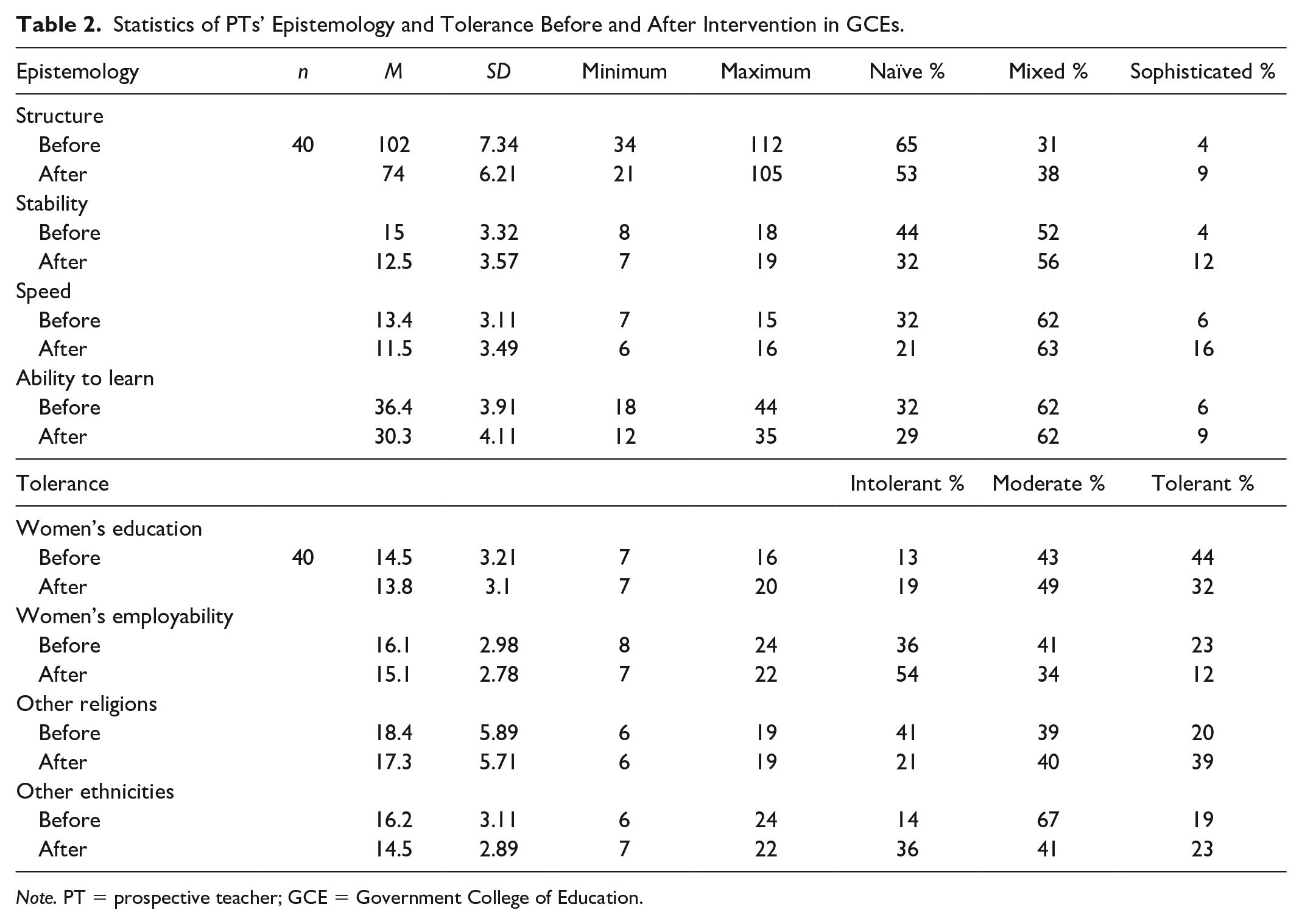
Table 2 shows the mean scores of GCEs before and after intervention in the Structure, Stability, Speed, and Ability to learn. The mean scores before and after intervention in the Structure are 102 and 74, respectively. In the Stability, the mean scores before and after intervention are 15 and 12.5; in the Speed, the mean scores before and after intervention are 13.4 and 11.5; and in the Ability to learn, the mean scores before and after intervention are 36.4 and 30.32, respectively. Like PTs of DoEUs, the majority of the PTs of GCEs fell at the naïve and mixed end of the epistemic spectrums in all the dimensions of epistemology before and after intervention.
Statistics of PTs’ Epistemology and Tolerance Before and After Intervention in GCEs.
Note. PT = prospective teacher; GCE = Government College of Education.
Table 2 also shows the mean scores of GCEs on tolerance toward different social dimensions before and after the intervention. In women’s education, the mean scores before and after intervention are 14.5 and 13.8, respectively. In women’s employability, the mean scores before and after intervention are 16.1 and 15.1; in the other religions, the mean scores before and after intervention are 18.4 and 17.3; and in the other ethnicities, the mean scores before and after intervention are 16.2 and 14.5, respectively. A large percentage of PTs fall at the intolerant end of the spectrum of all the social dimensions before and after the intervention.
Difference in Epistemic and Tolerance Development Among the PTs of DoEUs and GCEs
Table 3 shows no significant difference in all the epistemic dimensions of DoEUs and GCEs before intervention (Structure: U = 616.5, p = .79; Stability: U = 640, p = 1.00; Speed: U = 374.5, p = .422; Ability: U = 564.5, p = .391); whereas there is a significant difference in the epistemic development of DoEUs in all the dimensions after intervention (Structure: U = 574, p = .004; Stability: 414.5, p = .001; Speed: 293.5, p = .000; Ability: U = 541.5, p = .000). Similarly, there is no significant difference in tolerance of DoEUs and GCEs towards all the social dimensions before intervention (Women’s Education: U = 483.5, p = .074; Women’s Employability: U = 568.5, p = .416; Other Religions: U = 588, p = .554; Other Ethnicities: U = 442.5, p = .091). Surprisingly, there is no significant differenec in the tolerance of DoEUs and GCEs towards all the social dimensions after the intervention as well: Women’s Education: U = 461, p = .042; Women’s Employability: U = 486, p = .080; Other Religions: U = 473.58, p = .078; Other Ethnicities: U = 601.5, p = .661.
Results of the Mann–Whitney U Test on DoEU and GEC PTs on Epistemology and Tolerance Before and After the Intervention.

Note. DoEU = Department of Education of Universities; GCE = Government College of Education; PT = prospective teacher.
Epistemology and Tolerance of TEs of the DoEUs and GCEs
Table 4 shows the epistemology and tolerance of TEs of the DoEUs and GCEs. In the epistemic dimension of the Structure, the mean scores for the TEs of DoEU and GCE are 62 and 82.3, respectively. The Mann–Whitney U test suggests that the TEs of DoEUs are significantly developed in the Structure than the TEs of GCEs (U = 55, p = .002). Whereas, the mean scores in the Stability for the TEs of DoEUs and GCEs are 9.8 and 14.2, respectively. The inferential statistics suggest a significant difference in the epistemic development (U = 41, p = .003) of TEs of DoEUs as compared to the TEs of GCEs. The mean scores of Speed for the TEs of DoEUs and GCEs are 9.3 and 11.9, respectively. Here, again the TEs of DoEUs are significant developed (U = 52, p = .000) than the TEs of GCEs. Finally, the mean scores in the Ability to Learn for TEs of DoEUs and GCEs are 21.2 and 35, respectively. The TEs of DoEUs are significantly developed (U = 24, p = .005) in this epistemic dimension as well.
Statistics of Teacher Educators’ Epistemology and Tolerance in the DoEUs and GCEs.

Note. DoEU = Department of Education of Universities; GCE = Government College of Education.
On the scale of tolerance, the mean scores of the TEs of DoEUs and GCEs for the social dimensions of women’s education are 9.1 and 10.4, respectively. There is no significant difference in the attitudes of TEs of both institutes towards women’s education (U = 68, p = .816). The mean scores of the women’s employability are 12 and 12.5 for DoEUs and GCEs, respectively. The inferential statistics show no significant difference between them (U = 71, p = .954). For other religions, the means scores are 13.2 and 13.9 for DoEUs and GCEs, respectively. Here again, no significant difference is found (U = 71, p = .953). Finally, the mean scores in the other ethnicities for DoEUs and GCEs are 11.1 and 10.7. The inferential statistics do not show any significant difference here too (U = 64, p = .662).
Correlation of TEs’ and PTs’ Epistemology and Tolerance
In the case of DoEUs, there is a positive significant correlation between the TE’s and PTs’ Structure (p = .002), Stability (p = .004), and Ability (p = .005). Similarly, there is a positive significant correlation between the TE’s and PTs’ tolerance toward women’s education (p = .000), women’s employability (p = .001), and other religions (p = .005). In the case of GCE, there is a positive significant correlation between TE’s and PTs’ Structure (p = .000) and Ability (p = .003). Likewise, there is a positive significant correlation between TE’s and PTs’ tolerance toward women’s education (p = .001), women’s employability (p = .001), and other ethnicities (p = .000).
TEs and PTs Interaction in the Classes of DoEUs and GCEs
Graph 1 shows the TE and PTs’ interaction in the classrooms of the DoEUs and GCEs. The data from the observations show that on average, 81% of the class time in the GCEs are used by the TEs, with only 17% allocated to PTs. Whereas, in the DoEUs, TEs use 68% of class time, and give 38% to the PTs. The graph also shows that the culture of question-answering among TEs and PTs is comparatively richer in the DoEU. At the same time, the TEs of DoEUs acknowledge the PTs’ opinion more often than the TEs of the GCEs.

Teacher educators—PTs’ interaction in the classrooms.
In line with the findings of Graph 1, Graph 2 shows that TEs of the DoEUs use lecture for only 23% of their teaching-time, whereas 77% of their teaching-time is based on discussions, demonstration, project work, group work, and inquiry. On the contrary, the TEs of GCEs use lecture up to 54% in their teaching-time.

Teaching methods used by teacher educators in the DoEU and GCE.
Discussion
The data analysis highlights seven key findings related to TEs. These findings are as follows: (a) There is a significant difference in the epistemic development of TEs of DoEUs as compared to the TEs of GCEs; (b) there is no significant difference in the tolerance of TEs of DoEUs and GCEs for any of the social dimensions; (c) majority of the TEs of DoEUs and GCEs fell at the intolerant end of the tolerance scale for all the social dimensions; (d) TEs of DoEUs were found to give more time to PTs in the class participation than the TEs of GCEs; (e) TEs of DoEUs were found to comparatively use more learner-centered inquiry-based teaching strategies than TEs of GCEs; (f) the scores of TEs on each dimension of epistemology correlate with the scores of PTs in each respective epistemic dimension; and (g) the scores of TEs on the tolerance scale for each social dimension correlate with the PTs’ score on tolerance scale for each respective social dimension.
Likewise, two main findings related to PTs are (a) no significant difference was found in the epistemology of PTs of the DoEUs and the GCEs before the intervention. However, there is a significant epistemic development among PTs of the DoEUs after the intervention, although it did not develop to the sophisticated level as expected. (b) There is no significant difference in the tolerance level of PTs of the DoEUs and GCEs before and after the intervention. Although the overall tolerance of PTs for all the social dimensions have improved to some extent after the intervention, there is still a significantly large percentage of PTs in the DoEUs and the GCEs who showed intolerant attitude toward women’s education and employability, other religions, and ethnicities. These findings are further discussed with reference to seven key findings related to TEs in the following section.
There is no significant difference in the epistemology of PTs of the DoEUs and GCEs before the intervention. Because most of the PTs of DoEUs and GCEs have got their pre-university education from a similar education system, it is not surprising that their epistemological development has no significant difference. In fact, research criticizes the pre-university education system of Pakistan that promotes low-order learning skills like memorization and mere understanding. Creatively, critical thinking and analytical skills are far-fetched concepts even for some of the teachers (Halai, 2008; Halai & McNicholl, 2004). As the sophisticated epistemology is linked with higher-order learning skills (Bok, 2009; Fisher, 2011), it is not surprising that the majority of the PTs in their first semesters are epistemologically naïve.
However, there is a significant epistemic development among PTs of the DoEUs after the intervention. This is mainly related to the TEs of DoEUs, who were found to be epistemologically sophisticated, gave more time to PTs to participate in the classes, and used learner-centered interactive teaching strategies. Research suggests that epistemologically sophisticated teachers tend to use those teaching strategies, which promote high-order learning skills among students, and thus develop their epistemology (Rind, 2016; Sinatra & Kardash, 2004; Yadav & Koehler, 2007). Whereas, the TEs of GCEs were comparatively less epistemologically developed, which explains their teacher-centered monolog teaching strategies, and teacher-dominated teacher–students interactions in the classes. It is, then, not surprising if their PTs have not epistemologically developed to a desirable level.
Despite that PTs of DoEUs have epistemologically developed, the majority of them fell in the middle of the epistemic spectrum, rather than on the sophisticated end. The obvious explanation is related to the duration (i.e., 1½ years—three semesters) of observation used in this study. Whereas, these PTs are expected to continue their BEd studies at the DoEU for 4 years. Thus, it is expected that they would reach to sophisticated end at the epistemic spectrum by the end of their final year. The same can be assumed for the PTs of GCEs. However, the results of a similar longitudinal study that followed the PTs of DoEUs and GCEs for 4 years of BEd found that majority of the PTs fell in the middle of the epistemic spectrum even after completing their 4 years of studies in the BEd (Rind, in press).
Another explanation of this is related to the epistemic development of the TEs. As this study found, one third of TEs of the DoEU were epistemologically naïve. Moreover, the findings also highlight the correlation between the scores of TE and PTs on each epistemic dimension. It was also found that the epistemologically naïve TEs tend to use teacher-centered traditional teaching methods that hinder the critical thinking and creativity of PTs. All these indicate that TEs would have influenced the epistemic development of PTs to a sophisticated level. These findings complement the previous research which linked teachers’ epistemology with their teaching approaches that directly hinder the development of students’ high-order learning skills and indirectly their epistemology to sophisticated level (Rind, 2016; Sinatra & Kardash, 2004; Yadav & Koehler, 2007).
Moreover, Rind (in press) found a conflict between BEd objectives and assessment strategies used by TEs. The program aims for the PTs to achieve high-order learning skills, including analysis, synthesis, evaluation, and creation (HEC, 2012; USAID, 2013). However, institutional policies of DoEUs and GCEs promote the traditional unseen examinations, which only assess PTs’ memorization and comprehension skills. Rind (in press) found some TEs of DoEUs use teaching strategies that promote creativity and critical thinking among PTs; however, these TEs were found struggling to keep PTs motivated for these activities, as the skills promoted by these activities were not assessed in the unseen examination. Extrinsically motivated PTs focused only on those activities which helped them to get good grades, hence they resisted all those activities which promoted high-order learning skills, which, as mentioned earlier, are linked with the sophisticated epistemology.
There is no significant difference in the tolerance of PTs of the DoEUs and the GCEs before and after the intervention. Although the overall tolerance among PTs for all the social dimensions have improved to some extent, there is still a significantly large percentage of intolerant PTs in the DoEUs and the GCEs. This is also related to TEs’ tolerance toward different social dimensions. It was found that a large number of TEs of DoEUs and GCEs showed an intolerant attitude toward women’s education and employability, other religions, and ethnicities. It was also found that the scores on tolerance scale for women’s education and employability, other religions, and ethnicities for TEs and PTs correlate. Rind (in press) conducted in-depth interviews with the TEs of DoEUs and GCEs to measure their tolerance toward the aforementioned social dimensions. Rind (in press) found that almost 75% of TEs showed their intolerant attitude toward women’s education, employability, other religions, and ethnicities. While talking to male TEs, Rind (in press) found that some of them were in favor of early marriages of girls, hence “girls’ education up to grade ten” was justified. Others considered it unsafe for girls to commute longer distances for education, hence limited girls’ education was justified. Some referred to traditional roles associated with girls (i.e., bearing child, domestic chores, etc.) to make their point against women’s employability. Rind (in press) found the same arguments given by PTs, who believed that women are “weak” and “vulnerable to exploitation,” therefore “she may avoid working and let the men do the job.” PTs also believed that women’s mobility should be restricted due to “safety” and “security” reasons. Rind’s (in press) findings complement the previously published research in the context of Pakistan (Asian Development Bank [ADB], 2000; Latif, 2009; Rind, 2015).
Similarly, analyzing the religious tolerance of TEs, Rind (in press) found that the majority of the TEs openly defended their religions, and attempted to convince the interviewer that their religion or religious sect is “truer” and “more appropriate” than other religious beliefs/sects. Most of them used arguments to support their religious beliefs as well as to oppose others’ beliefs. This showed that they have a tendency to be reactive if religion/religious sect is discussed in classroom settings. These findings complement the previous research conducted in the context of Pakistan (Ispahani, 2017; Lall, 2008). Rind (in press) further verified TEs’ behavior by talking to the PTs, who found their TEs taking sides to a particular religion/religious sect when such discussion takes place in the classroom setting. Rind (in press) found the same behavioral trend in the PTs’ argument about other religions.
The same reactive approach was observed by Rind (in press) when he put the TEs in an argument related to their ethnicity versus other ethnicities. Rind (in press) found that the majority of the TEs referred to people of other ethnicities as “intruders,” “migrants,” “uncultured,” and “uncivilized” reflecting their frustration with members of other ethnicities. Strangely, most of these TEs have never had a firsthand bad experience with any member of other ethnicities, rather their beliefs are based on the information that has been shared with them by their elders or peer. Rind (in press) found that PTs’ perception of other ethnicities was also established in the same way and was reinforced by the TEs when such discussion/situation took place in formal or informal universities/GCE settings.
Conclusion
This study attempted to highlight the importance of TEs in developing the epistemology and tolerance of the PTs toward different social dimensions. Using a comparative approach, this study showed that a similar program generated different outcomes in PTs’ epistemology and tolerance because of the epistemology and attitude of the TEs. Contrary to previous research (Adhyatm, 2015; Davis, 1997), this study shows that epistemologically sophisticated TEs may have an intolerant worldview toward women’s education, employability, other religions, and ethnicities. And that these attitudes of TEs may effectively transfer among the PTs. Although there is a number of methodological and theoretical limitations of this study, it offers a glimpse of recent teacher education reform from the perspective of epistemology and attitude of TEs and PTs. There is a number of other factors that may shape the epistemology and tolerance of PTs including the institutional culture, family values, peer pressures, and so on, which require further investigations. Another limitation of this study is its limited exposure to TE epistemology and tolerance. There is a need for in-depth research on exploring the development of TEs’ epistemology and tolerance, and the ways in which these are correlated.
Footnotes
Declaration of Conflicting Interests
The author(s) declared no potential conflicts of interest with respect to the research, authorship, and/or publication of this article.
Funding
The author(s) disclosed receipt of the following financial support for the research, authorship, and/or publication of this article: This research is partially funded by Higher Education Commission, Pakistan’s NRPU, Project # 6257 and Chinese National Social Sciences Fund Education Youth Project (No. CHA180269).
