




Abstract
This article describes the results of a national survey of teacher preparation programs in the United States. It asks three major questions: (a) What strategies do programs use to promote and teach the dispositions they desire in preservice teachers? (b) What strategies are used relatively, commonly? and (c) How do institutions perceive the effectiveness of the strategies they use to promote and teach dispositions? The purpose is to fill a void in the scholarship about the promotion of desired dispositions, the means by which this is done, and institutions’ perceptions of perceived effectiveness, not to recommend or compare strategies.
Introduction
The 21st century has seen an explosion of interest in and attention to preservice teacher dispositions. These are attitudes and beliefs manifested in behavior. For example, a student teacher acts in such a way that he or she communicates to students that the student teacher is committed to the learner’s best interests. Another illustration is that the student teacher demonstrates the perception that the learners in his or her charge are efficacious, deserving of support but not rescue (Wasicsiko, 2005). Organizations like Interstate New Teacher Assessment and Support Consortium (INTASC), National Council for Accreditation of Teacher Education (NCATE), and Teacher Education Accreditation Council (TEAC) have all devised standards for new teachers, and dispositions, as well as knowledge and skills, are central to those standards (Rose & Terndrup, 2007). It is worthy to note that NCATE, rather than recommending a model of teacher dispositions as it once did in 2001, now urges each member institution to devise its own definition or model. Thus, a common definition of dispositions does not exist. Still the various descriptions and definitions associated with the concept of dispositions reflect a common emphasis on the values and beliefs made actual by a practitioner as they frame the practitioners approach or actions or both to the teaching and learning context. More poetically expressed, they are the “habits of heart and mind” the practitioner or aspiring practitioner brings to the formal teaching and learning environment (Rose & Terndrup, 2007).
A Boolean search of the Internet using “pre-service teacher dispositions” as the descriptor in July 2009 produced 2,420 “hits.” These articles, books, and papers approach the topic from a variety of angles: what models exist; what effective dispositions look like in different contexts, for example, student teaching or working with minority students; the tracking and assessment of preservice candidates’ dispositions; the cooperative efforts among institutions to develop models and assessments (Rose & Terndrup, 2007); and criticisms of various models and even the general idea of attending to dispositions at all (Manzo, 2006).
There is a considerable body of literature about specific methods used to promote the development of desirable dispositions in candidates; see Austin, 2004; Seguin & Ambrosio, 2002; Wasicsiko, 2005; and Wilkerson & Lang, 2007. However, no research has been published that describes the large body of methods and strategies used across institutions to teach and promote dispositions considered desirable in preservice candidates. This article purports to do that.
In the fall of 2008, a nationwide survey of teacher preparation programs asked those institutions a variety of questions regarding their attention to preservice teacher dispositions. The major focus of these questions was this: What means do programs pursue, if any, in formally teaching and promoting the dispositions they deem desirable? The survey also asked at what point or points in the teacher preparation program they used these means of promoting dispositions and how institutions perceived the effectiveness of these means to be. The survey also asked if the institutions had formal disposition models, and it collected demographic information about the responding programs, for example, public or private, number of candidates recommended for certification each year, and so on. This study is a logical continuation of work that I and other members of a statewide consortium have done to develop a system for adopting a template of dispositions aimed specifically at preservice candidates and the assessment of candidates with this template. These efforts naturally raised this question: If teacher preparation programs are going to develop standards and assess students on these standards, how then do they teach and promote them?
This study fills a void in the scholarship on teacher preparation programs regarding the strategies they use in promoting desired disposition. It also provides a catalogue of strategies for faculty and programs interested in formally promoting dispositions. It is descriptive, not seeking to compare or evaluate disposition standards across institutions or the strategies they use to promote them. It does not address the issues of assessment and screening of candidates because this work has been widely pursued (Diez & Raths, 2007; Wilkerson & Lang, 2007).
Method
A pilot study was carried out that enlisted other teacher preparation programs belonging to a consortium to which the principal investigator belonged. After feedback from that pilot study, the electronic survey was modified. Its principal areas of investigation are as follows:
Did the institution have a formal model for preservice dispositions, and, if so, how was it derived?
Which specific strategies, if any, did the institution use to promote its candidates’ understanding of and practice of dispositions deemed desirable?
How did these strategies fit into more general categories, for example, “direct instruction” or “student writing?”
What other strategies did the institution use to this end?
How would each institution rate the effectiveness of the strategies it used?
At what point(s) in the teacher education program were these strategies used?
As a review of the literature at that time revealed no discussion of strategies used to teach and promote preservice teacher dispositions, this article depends on the strategies identified by the pilot study to provide a framework of particular strategies that respondents could select from, but respondents to the larger study were urged to identify additional strategies.
Also, institutions were asked at what point or points in their program they used a given strategy: (a) in beginning/early-on coursework, for example, educational foundations, developmental psychology, and so on; (b) in midlevel coursework, for example, instructional methods, classroom management, human relations in teaching, and so on; or (c) in culminating courses/experiences, for example, student teaching and/or student teaching seminar.
In addition, respondents were asked how effectively they perceived each means to be, and those perceptions were averaged to find a mean. A 4-point Likert-type scale was used for this ranking with 1 being “ineffective,” 2 being “rather ineffective,” 3 being “somewhat effective,” and 4 being “very effective.”
Last, information about the demographics of the responding institutions was collected. For example,
the number of candidates seeking initial teacher licensure;
geographic place, affiliation, for example, regents institution, church-affiliated, and so on;
delivery system, that is, traditional, online, or a hybrid or both.
Comparison on the basics of demographics will be deferred to a different time, given the amount of information gathered about different disposition standards and strategies to promote them.
This survey was administered electronically after gathering email addresses of teacher preparation programs’ most direct administrator, for example, dean of a college of education or department chairperson. In a few cases, the heads substituted another member of the institution to complete the survey. The respondents were explicitly asked to respond in terms of how their institution would rate each strategy, but it was left to the respondents to solicit perceptions of their colleagues. This study did not in itself seek information about how much each respondent sought their peers’ opinions. This could be an area for further refinement of such research.
The survey was sent to approximately 50% of such programs in each state and the District of Columbia. An attempt was also made to maintain a mix of types of institutions from each state, that is, a proportionate mix of state schools and independent schools. The survey made clear that individual respondents could remain anonymous, but the electronic survey instrument does allow the researcher to go back and find out salient information about a given response, for example, from a large school or small school or from a school that identifies itself as being significantly church-related. A pilot study of institutions was first conducted in October 2008, and the finalized survey was sent out in November 2008.
The survey was sent to 330 institutions, and 236 responded to the survey. The survey began by asking respondents if their institutions had formally adopted a framework or model for preservice teacher dispositions. Then the survey focused on means by which these programs promoted and taught what they felt were appropriate dispositions in preservice educators, whether or not they had formally adopted a disposition model. The information about specific strategies is categorized into more general sets of strategies. These are made up of (a) direct instruction, (b) student writing and self-analysis, (c) conversations, and (d) observations, simulations, and case studies. Respondents’ comments are interspersed in these sections when they serve to illustrate a strategy grouping, for example, “direct instruction” or otherwise shed light or interest. There will be no attempt to provide a comparison of responses in terms of statistical significance as the purpose of this article is largely to catalogue and share strategies used widely across teacher preparation programs.
How Institutions Developed Their Disposition Models
The first pair of questions asked institutions if they had formally identified a “set of preservice teacher dispositions that we strive to promote,” and the second asked them if their institution “has identified a set of strategies and assessments of the preservice teacher dispositions that we strive to promote.” About 85% indicated that they had adopted a formal set of dispositions to promote, and 70% maintained that they had adopted strategies and assessments aimed at dispositions. Thus, significantly fewer of the institutions that had adopted a model had also formally considered how to teach and promote that model (79%). Many qualitative responses indicated that the programs’ models were linked to other aspects of the program, the school as a whole, and/or a national system. One respondent wrote, “All are aligned with our teacher education model, the standards, KSDE [Kansas State Department of Education], and NCATE.” Interestingly, another program head wrote, “We are not currently an NCATE school, so we do not have ‘dispositions.’” When asked what resource or entity most shaped their dispositions, 72.5% indicated that the institution itself, rather than an outside entity like NCATE, was the primary force behind their conceptual model of dispositions.
One respondent made a distinction between professional behavior and dispositions: “We distinguish between professional behavior (being on time, prepared, appropriate dress, etc.) and dispositions, by which we mean observable actions that show us what beliefs preservice teachers hold about teaching and students.” Another stated, “We are deeply troubled by most efforts to assess dispositions, believing that it is fraught with peril. We use classroom performance to assess dispositions indirectly, because dispositions can only be determined through evaluating actual practice.”
The Use of Direct Instruction in Teaching Desired Dispositions
The concept of direct instruction is presented first as a very general lecture and discussion methodology, then broken out into more specific strategies. These include exploring a very specific “helper” model, espousing basic professional behaviors, and instructor modeling.
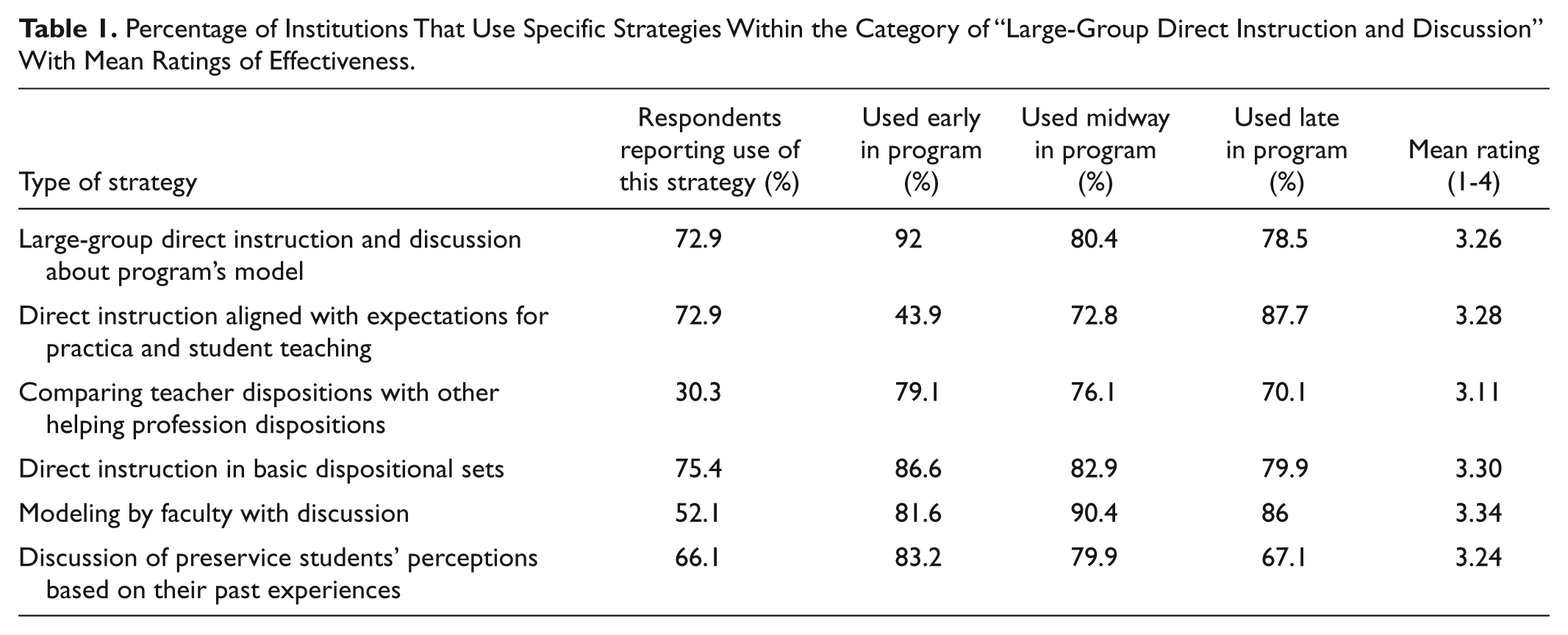
When the programs were asked if they used large-group direct instruction and discussion about their disposition standards, 72.9% indicated they did so in one fashion or another. Of those responding affirmatively to this strategy, 92% used large-group direct instruction at the beginning of their programs, 80.4% used it midway, and 78.5% use it near the end. The mean ranking of this strategy was 3.26 on a 1 to 4 Likert-type scale with 4 being “very effective.” Institutions were also asked if they used direct instruction aimed specifically at aligning their dispositional skill set with the performance expected of candidates in practica and student teaching. About 73% affirmed that they did so, ranking this strategy at 3.28. Its use increased as candidates progressed in the programs. Programs utilizing this strategy did so 43.9% of the time at the early level, 72.8% in their midway courses, and 87.7% near the end.
The survey asked institutions if they provided instruction where the dispositional qualities of teachers are compared with those in other “helping” professions, for example, nurses, social workers, and so on. This avenue was explored because a model of teaching and promoting educator dispositions was based on such a comparison popularized by Art Combs, Richard Usher, and Mark Wasicsiko (Wasicsiko, 2005). This approach is traditionally presented in a daylong training session at the Annual Symposium on Educator Disposition Conference put on by the Center for Educator Dispositions at Northern Kentucky University. About 30% of responding institutions stated that these used this strategy. Of those that used this strategy, 79.1% used it at the beginning level, 76.1% used it midway in the program, and 70.1% used near the end of the program. Institutions that use this strategy ranked it at 3.11.
The survey asked if programs provided direct instruction in “basic” dispositional skill sets, for example, courtesy, promptness, and consistent attendance. This question resulted in the highest percentage of affirmative responses to any of the questions about teaching and promotion: 75.4%. Institutions ranked this strategy at 3.30, and 86.6% used it at the beginning of their programs, 82.9% midway, and 79.9% near the end.
Another direct instruction strategy was the modeling of desired dispositions by education faculty and discussion of these dispositions set in light of that modeling. More than 52% said that their institutions used this strategy, ranking its effectiveness at 3.34. This modeling and discussion was conducted 81.6% in beginning coursework, 90.4% in middle coursework, and 86% in ending coursework. One respondent pointed out that this modeling was part of a larger examination of instructors’ pedagogical strategies, and treated like any other aspect of instruction (Table 1).
Percentage of Institutions That Use Specific Strategies Within the Category of “Large-Group Direct Instruction and Discussion” With Mean Ratings of Effectiveness.
Qualitative responses to the use of direct instruction revealed considerable use of “teachers” beyond the tenure track faculty. One respondent said, “We use informal dinners with recent alumni and student teachers who can share experiences and advice.” Others indicated that they involved local administrators and their students in conversations about dispositions so that the candidates could see how the administrators valued appropriate dispositional skill sets. Many respondents wrote that they used multiple forms of direct instruction to promote their disposition model, and that they valued this approach. As one stated, these direct approaches allowed that program to,
Build students’ schema for the concept of disposition so that they can (a) distinguish dispositions from nondispositions [and] (b) self-monitor their professional dispositions. This includes development of a common vocabulary that enables them [the students] to engage in conversations about dispositions with peers, instructors, and supervisors.
Student Writing About Dispositions
The second major type of strategies is the requirement that candidates write about dispositions. These strategies would include journaling after direct instruction about the program’s model, formal self-analysis through the lens of the institution’s disposition model, informal reflections/journaling about the candidates’ previous experiences as precollegiate students, formal writing about those precollegiate experiences, and candidate responses to instructor feedback.
Asked about the use of journaling and other informal writing after candidates have experienced direct instruction about the institutions’ models, 52.1% answered affirmatively. This activity was much more common near the end of students’ preparation, 87.7%; than midway, 74.6%; or early, 56.6%. This strategy received an average ranking of 3.32.
The most commonly used writing strategy was having students write informally about dispositions in light of their previous academic experiences, with 66.1% of programs indicating they used this strategy. This strategy received a mean rank of 3.22, and it was used less as candidates progressed through their preparation with 83.2% of programs responding that they used it at the introductory level, 79.9% in the middle, and 67.1% near the end.
About 56% of programs indicated that they required candidates to write a formal self-analysis of their fit with the program’s disposition model, giving this method a mean ranking of 3.32. This task was widely used at all levels of the programs that practiced it, but increasingly used as students progressed 64.6% early, 73.1% in the middle, and 83.8% near the end of the candidates’ preparation.
When institutions were asked if they required their students to write about their previous experiences in a more formal, analytic way, 40.1% said they did. This strategy received an average ranking of 3.24 and was used less as a candidate progressed: 83.2% of affirmative responders used it at the beginning, 79.9% in the middle, and 67.1% at or near the end.
The least-used writing strategy (24.6%) was requiring that students respond to their instructors after getting disposition-related feedback from the instructors. Interestingly, this method received the highest of all the writing strategies—3.48—from schools that used it. Not surprisingly, this strategy was used considerably more at the end of the program (92.7%) than the middle (78.2%) or beginning (58.2%). As most programs become increasingly field-based as students progress into practica and then student teaching, students are more likely to increasingly get observation-based feedback and possibly feedback to journals chronicling the candidates’ experiences (Table 2).
Percentage of Institutions That Use Specific Strategies Within the Category of “Student Writing About Dispositions” With Mean Ratings of Effectiveness.

Respondents volunteered that journals and portfolios about dispositions were required most frequently. Several respondents elaborated on their use of having the candidates use their program’s model as a taxonomy for self-analysis. Most mentioned using similar writing assignments at multiple levels, as the quantitative data indicate, and many mentioned that the dispositional self-reflection and writing was woven into a broader form of self-analysis. One program alluded to online student-to-student discussions of candidates’ dispositions, as well as other areas of development. One program chairperson indicated that her program required students to “write critiques of their partners in the practicum courses.” Another respondent indicated that candidates must address in writing the issue of their dispositional readiness before being allowed to matriculate:
All students applying to be admitted to the programs must complete a noncredit field experience and submit a packet of materials, identifying competencies and dispositions, reflecting on the experience, and predicting how they will attain the same level of expertise and professionalism [as the practitioner].
Interestingly, this program produces as many newly licensed teachers from degree-holding, returning students as it does from traditional, bachelor-degree-seeking candidates.
Conversing About Dispositions
The third major type of teaching opportunity was that of conversation: one-on-one debriefings of student and instructor, student-to-student discussions, and small-group conversations. The most commonly used form of conversation to promote dispositions was individual faculty–candidate discussions with 51.7% of programs stating that they did so. This was ranked as moderately effective at 3.06 and increased in use as candidates progressed: 64.7% early, 78.2% in the middle, and 81.5% toward the end. Second most common were small-group discussions with 45.3% of the respondents indicating their programs did so, giving this strategy a mean rank of 3.30, and using it increasingly: 64.4% in beginning courses, 75% in midway courses, and 82% near the end of the program. About 38% of the institutions used student-to-student conversations, ranking them at 3.00. The use of this strategy increases as students progress: 82% near the end compared with 75% midway. In beginning coursework, these conversations occur 64.4% of the time (Table 3).
Percentage of Institutions That Use Specific Strategies Within the Category of “Conversing About Dispositions” With Mean Ratings of Effectiveness.

Observations, Simulations, and Case Studies Related to Dispositions
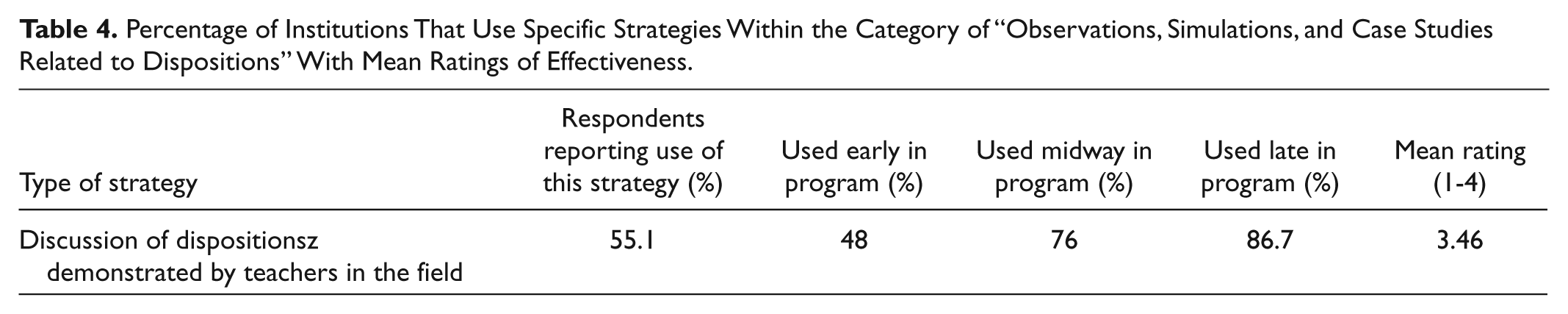
The last series of questions were based on the ideas of observation of real classroom settings or hypothetical case studies as a means of promoting dispositions. The analysis and discussion of dispositions demonstrated by actual teachers in the field was the most commonly used with well over half (55.1%) of programs indicating that they did so; about 48% of these respondents stated that they did so at the beginning level, 76% did so midway, and 86.7% did so at the end. On average, they ranked this strategy at 3.46. Videos of real classroom settings were used by about one third (33.9%) of programs. It is not clear if these videos were of practicum students, student teachers, or practicing teachers. This strategy is used increasingly as students progress: 46.7% early in the program, 67.5% midway, and 84.2% late. The use of these videos was rated at 3.32 on average (Table 4).
Percentage of Institutions That Use Specific Strategies Within the Category of “Observations, Simulations, and Case Studies Related to Dispositions” With Mean Ratings of Effectiveness.
Half of the respondents indicated that they used hypothetical situations and case studies to teach about dispositions, and the mean ranking they gave this method was 3.42. This was done about half the time (58%) at the beginning level, and 73.1% at both the midlevel and near end of program. The analysis of dispositions shown in staged classes on video occurs at 30.5% of the responding institutions. This technique was ranked relatively low at 3.20. About half (46.8%) of the schools used this at the beginning level, 82.8% midway, and 76.6% near the end.
Last, 32.6% of programs reported using the analysis of other students in field experiences as a means of promoting appropriate dispositions. These programs ranked this strategy at 3.42. About 60% of these schools used this strategy at the beginning level, 80% at midway, and 62.9% at the near-end point. Qualitative responses shed light on much of the data just presented. One respondent commented,
Case studies are probably the most effective way to get student to think about quality teaching. Videos are certainly an option, but there are not a large number available that actually capture extended periods of student–teacher interactions. Practica and field observations are probably the most useful strategies.
Several other respondents commented on the scarcity of good teaching scenarios on videotape. Four respondents mentioned practicum students or student teachers being video-recorded and those recordings used by a larger group for discussion, both in terms of dispositions and in the larger pedagogical arena.
Other Qualitative Responses
The survey concluded by asking respondents to add additional comments as they saw fit. One consistent theme was that programs as a whole were bifurcated regarding their attention to identifying and promoting a set or model of preservice teacher dispositions. On one hand, we are told,
From the day students enter the education classes, dispositions are discussed, analyzed, [and] reviewed. When students apply to enter the Education Program at the end of their sophomore year, they must meet with a faculty interview team and questions are asked which address the dispositions. Feedback is also provided to the students at the end of the interviews.
On the other hand, about one third of the respondents offering other qualitative responses said that their conception of dispositions was in flux. “[This is] an area that we are currently working to refine, as we are not satisfied with our current system,” wrote the head of a rather prestigious teacher preparation institution. Another said, “We have little formal discussion of dispositions, although we are talking about including it in our program. At this point, I’m not sure that our students are familiar with the term, but they are familiar with the concepts.”
Discussion
Some significant themes arise from this study. First, more than half (10) of the 19 strategies identified explicitly in the study are used by the majority of the programs. These include direct instruction about basic professional qualities, for example, courtesy and promptness (75.4%); large-group discussions about the program’s model (72.9%); direct instruction aligned with expectations for practica and student teaching (72.9%); discussion of preservice students’ experiences as students (66.1%); informal journaling about candidates’ precollegiate experiences (66.1%); self-analysis, using the institution’s model (55.9%); discussions of dispositions demonstrated by teachers in the field (55.1%); modeling by faculty with ensuing discussion (52.1%); journaling after direct instruction (52.1%); and one-to-one debriefings between candidate and faculty (51.7%).
Only 4 of the 19 identified strategies were used by less than one third of the institutions. These include candidate responses to instructor feedback (24.6%), comparing teacher dispositions to dispositions in other helping professions (30.3%), analysis of dispositions shown in the context of a staged video (30.5%), and analysis of other students in field experiences (32.6%).
Second, all of the strategies explicitly identified in this study are perceived to be at least moderately effective, “moderate” being defined as a score of at least 3 on a 4-point Likert-type scale. The five perceived as most effective include candidates’ written responses to instructor feedback (3.48), discussions of dispositions demonstrated by teachers in the field (3.46), hypothetical situations and case studies (3.42), journaling after direct instruction (3.34), and modeling by faculty with ensuing discussion (3.34). The five strategies perceived as relatively ineffective compared with these top five are student-to-student discussions (3.00), one-to-one debriefings of student and instructor (3.05), analysis of dispositions in staged video (3.09), comparing teacher dispositions with those dispositions used in other helping professions (3.11), and analysis of other students in field experiences (3.20). See Table 5 for a complete rank ordering of these strategies perceived effectiveness.
Mean Ratings of Effectiveness by Institutions Using Specific Strategies and Percentage of Institutions Using Those Strategies.
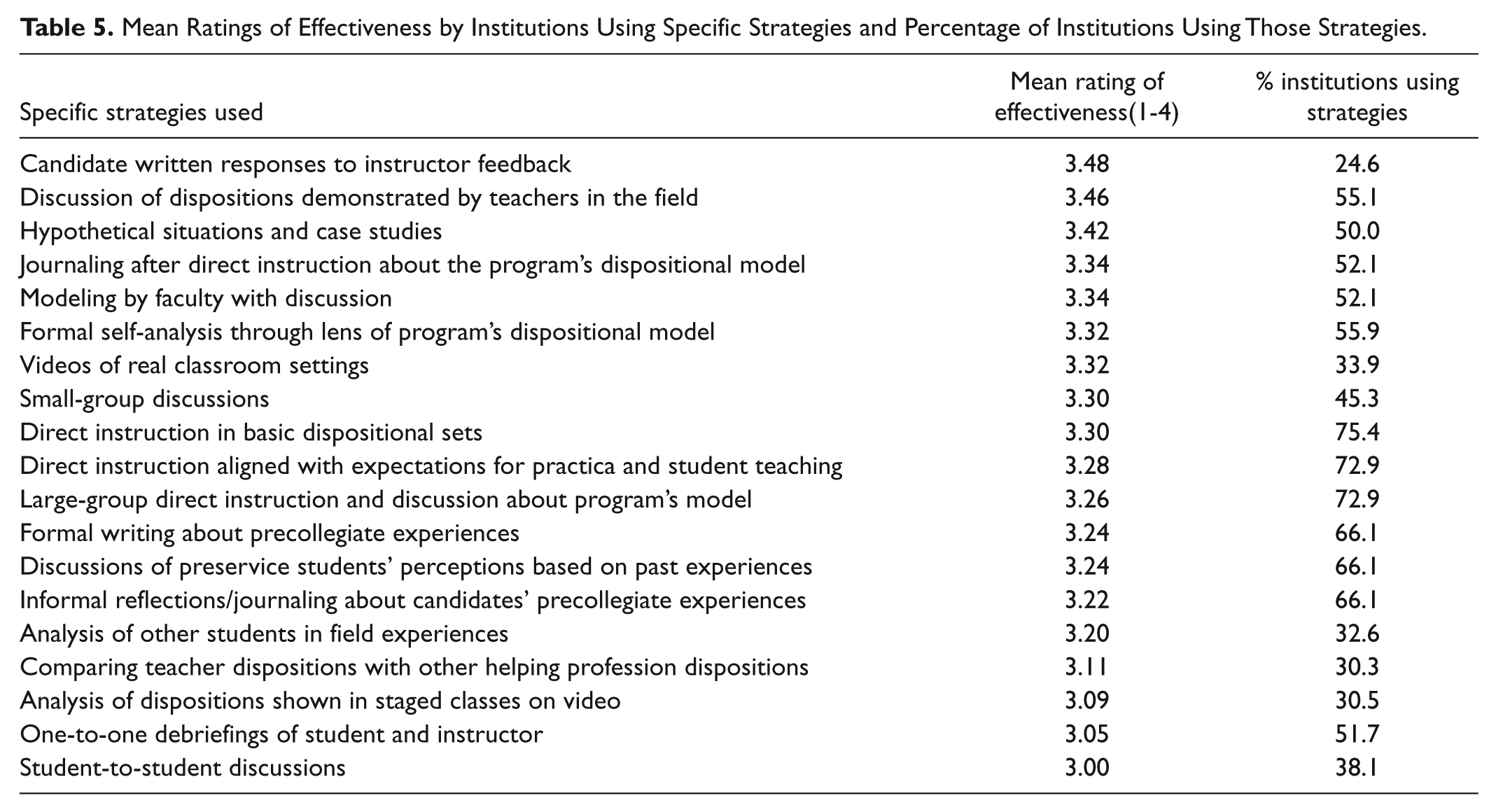
Third, the correlation between perceived effectiveness of specific strategies and the rate of their use is uneven. True, candidates’ response to instructor feedback is ranked most highly of all strategies (3.48), and it is implemented by all 19 institutions, but the second most highly ranked (3.46)—discussions of dispositions demonstrated by teachers in the field—is used by less than half the institutions (7). The third most highly ranked—hypothetical situations and case studies (3.42)—is used by a narrow majority of programs (11). When one looks at the five strategies ranked as the least effective, all five are practiced by the majority of the responding institutions, with four of the five used by 74% of the institutions or more. See Table 6 for the delineation of this information, as well as a more comprehensive portrayal of all the strategies’ perceived effectiveness.
Mean Rating of (5) Effectiveness of Specific Strategies and (6) Rate of Specific Strategies Used by Institutions.

Fourth, there are some odd noncouplings of strategies in terms of their perceived effectiveness. Candidates’ written responses to instructor feedback was the most highly rated, but one-on-one debriefing was rated next to last. One might wonder why the medium of exchange creates such a disparity. Videos of real classroom settings are rated fairly high, 7th of 19, but the analysis of dispositions shown in staged video is ranked near the bottom, at 17th. Both strategies are used by about one third of the responding institutions, 33.9% and 30.5%, respectively.
Conclusion
This study suggests that certain teaching tools could be further developed such as videos and case studies. One respondent mentioned the scarcity of high-quality videos that would illustrate dispositions in action. As a practicing teacher educator, I have found very little in the way of videos that demonstrate a teacher in action with the exception of videos dealing with classroom management issues. Videos designed to illustrate issues more specific to dispositions would be very welcome. The same holds true of case studies focusing on educator dispositions in context. With the exception of a set used by the Center for Educator Dispositions, there seem to be none that focus the learner primarily on dispositions. Those put out by the Center are aimed very specifically at the disposition model espoused by the Center, and some are rather dated. More contemporary case studies focusing on dispositions in action and specifically in the context of a practicum or student teaching setting would be most welcome.
Last, at a later time, it would be informative to return to this data and see what role institution type—size, location, affiliation, and so on—might play in terms of strategies used. For example, it might be interesting to see if very large programs use student writing less than smaller programs.
Footnotes
Declaration of Conflicting Interests
The author(s) declared no potential conflicts of interest with respect to the research, authorship, and/or publication of this article.
Funding
The author(s) received no financial support for the research and/or authorship of this article.