



Abstract
Research on the beliefs of pre-service and in-service English teachers at the primary, secondary, and tertiary levels has provided useful knowledge to teacher education curriculum designers. However, the beliefs of pre-service pre-primary English as a foreign language (EFL) teachers have not been addressed. Thus, a case study was conducted in one pre-primary education program at a public university in the Macau Special Administrative Region of China. Data was collected by providing participants (N = 63) a writing prompt aimed at gathering their beliefs about the teaching and learning of English in the pre-primary context. Qualitative content analysis was used to analyze these written reflection reports of third-year pre-service pre-primary English teachers with the aim of uncovering their beliefs about teaching and learning EFL. Results showed the participants held beliefs about classroom practice, EFL learners and learning, pedagogical knowledge, teaching, content, goals of language teaching, the role of teaching, subject, schooling, hearsay, self, learning to teach, and the teacher education program. Most participants mentioned their beliefs about classroom practice, EFL learners and learning, and pedagogical knowledge, while very few participants wrote about self, learning to teach, or the teacher education program. While many of the beliefs held by the participants were found to be substantiated by early childhood education research, some unfounded beliefs were also uncovered. The results highlighted a need for curriculum designers to reconsider the education program’s ability to meet the needs of the pre-service teachers. Participants required additional training in English content knowledge, use as a medium of instruction, and pronunciation. The polarized view of teaching the mother tongue and EFL should be reconsidered in light of the current views on bilingualism and bilingual education.
Introduction
In recent years, the global discussion regarding the direction that early childhood English education should take has grown into a heated debate (Copland & Garton, 2014). This debate arose due to the relatively recent focus on early childhood English as a foreign language (EFL) education. As teachers are often given decision-making power to select teaching materials and approaches used to instruct language learners, many of these decisions regarding early childhood EFL learners have been considered controversial (Zheng, 2009). These decisions are controversial as they can have powerful consequences—it has been acknowledged that English teachers’ decision-making impacts students’ English learning outcomes (Lin, 2013). English teacher beliefs, manifested as a crucial element that affects teachers’ decision-making, directly influence teaching behaviors (Farrell, 2006). Although there is an abundant body of research about EFL teacher beliefs, most of the investigations have centered on pre-service and in-service secondary/university-level English teachers, leaving pre-primary EFL teacher beliefs overlooked (Copland et al., 2014). While it is evident that pre-primary EFL teacher beliefs about learning and teaching English affect their decision-making and thus their potential to transform the practice of teaching, at this point in time, scholars and teacher educators know little about how or why this occurs. This problematic issue is further exacerbated by the shortage of appropriately-trained EFL teachers capable of teaching pre-primary-level learners English to a proficiency level suitable for their transition to primary school English learning. Most in-service pre-primary EFL teachers are either English majors who lack pedagogical training in the teaching of very young learners or pre-primary education majors whose English competence is questionably weak (Liao, 2002). Further research is needed to reveal pre-primary teacher beliefs about teaching and learning English, especially pre-service teachers enrolled in pre-primary teacher education programs. This is especially important for the context of the current study, the Macau Special Administrative Region of China, as English enjoys a de facto working language status due to its growing importance in education, trade, media, and the gaming industry (Education & Youth Affairs Bureau, 2016). Such investigations can provide insights to teacher educators who can use these findings to better equip pre-service teachers with sufficient knowledge to deliver more effective English language teaching in the classroom. Thus, the aim of this case study was to investigate the beliefs about teaching and learning English held by pre-service pre-primary teachers enrolled in a pre-primary education program.
Literature Review
Teacher Beliefs and Teacher Cognition
In the last 40 years, research on teacher cognition has made an immense contribution to understanding teachers, providing deep insight into teaching practices (Borg, 2003; Johnson, 2006). This is an important area of study as learning about teacher beliefs helps to explain what happens in the classroom and how these beliefs may affect the students (Vartuli, 1999). As Vartuli (1999) pointed out, teachers’ actions and responses in the classroom originate in their pedagogical beliefs. This field of research provides insights into teachers’ beliefs, the nature of those beliefs, and how they influence teaching and teacher learning (Borg & Al-Busaidi, 2012).
Throughout the years, different definitions of the terms teacher cognition and teacher beliefs have emerged, and these two terms have become interchangeable (Borg, 2003). Some researchers in the field may define the term teacher cognition as beliefs, attitudes, and knowledge (e.g., Crookes, 2015). Teacher cognition has also been noted as not only referring to “the study of what teachers think, know and believe” (Borg & Al-Busaidi, 2012, p. 6) but in some cases as also including their emotions and personal identities (e.g., Cheung & Hennebry-Leung, 2020). Löfström and Poom-Valickis (2013) used the term “teacher beliefs” to refer to personal pedagogical theories held by teachers and the effect those theories have on the teachers’ behavior and decision-making in the classroom. Teacher beliefs have also been defined as “psychologically held understandings, premises, or propositions felt to be true” (Zheng, 2009, p. 74). Lin (2013) described four main areas to be considered when discussing the origin of teacher beliefs: personal life experience, personal experience in education, professional knowledge and training, and the context in which these experiences have occurred. It is clear that teachers’ beliefs are often personal, leading to the vast variety of beliefs held by individual teachers. These beliefs could be due to various reasons, such as personal experience, education level, education course material, or even a lack of support from peers (Vartuli, 1999). Calderhead and Robson (1991) found that pre-service teachers base many of their pedagogical beliefs on the attitudes of teachers encountered during their education. This in turn has led to pre-service teachers attaching positive and negative qualities to their former experiences as they form their image of what makes a “good teacher” or a “bad teacher.” Prior experiences in the education system may even influence teachers’ beliefs more than their knowledge of evidence-based practice (Farrell & Guz, 2019). As individualized as teacher beliefs may seem, it is essential to learn about teachers’ beliefs since these beliefs can affect their teaching practice, including the teaching methods they prefer, their beliefs about how students learn, and the decisions they make in the classroom (Lin, 2013).
“[B]eliefs are not only hard to define but hard to measure” (Mede, 2017, p. 462). Measuring teacher beliefs often relies upon teachers’ self-reporting, which may cause issues such as the teachers feeling under pressure to conform to the ideologies they have been taught rather than free to report their genuine beliefs (Di Santo et al., 2017). When investigating teacher beliefs, teachers’ statements need to be examined carefully, as does the relationship between their beliefs and in-class practice (Farrell & Guz, 2019; Johnson, 1994). Despite the difficulties observed when measuring teachers’ beliefs, there are some common themes upon which researchers in the field agree. For example, beliefs are often drawn from personal learning experiences and are, thus, influenced by attached emotions. In addition, researchers agree that there is a strong relationship between teacher beliefs and their practice inside the classroom (Borg, 2003; Chaaban et al., 2019).
Early Childhood Education English Teacher Beliefs
In recent years, the number of studies investigating early childhood education (ECE) teachers’ beliefs has been increasing; this is an important area of study, as early childhood teachers’ beliefs are often different from those of primary and high-school teachers (Jacoby & Lesaux, 2019). EFL teachers of very young learners often draw on their knowledge and experience in early childhood education and child development and incorporate them into their EFL instruction. For example, Jacoby and Lesaux (2019) found experienced in-service teachers of pre-primary ESL students (3–5 years old) strongly believed that the essential factor for learning was providing appropriate support in their students’ developing social-emotional skills. Jacoby and Lesaux also reported that ECE teachers believed learning English occurs naturally with young learners as a result of the classroom environment. Moreover, it has been suggested that providing support in their first language, as well as in English, is important for young EFL learners’ future language and literacy development in both languages (Garrity & Guerra, 2015; Jacoby & Lesaux, 2019; Nafissi & Shafiee, 2020).
As teaching young learners requires different teaching techniques than older age-groups require, it is important for ECE English teachers to have a foundation in the specific skills necessary for teaching this group of learners (Guven & Cakir, 2012). Guven and Cakir (2012) compared EFL primary school teachers’ beliefs about their competence as ECE teachers. The participants in their study had varying degrees of training specific to teaching young learners, language teaching and teaching in general. Their findings showed that teachers who had received specific training in ECE perceived themselves as more competent educators than teachers who had received no specialized training in this area. Conversely, the participants who had not received training in ECE appeared to “lack the competence and confidence to teach English to children” (Guven & Cakir, 2012, p. 50).
English Teacher Beliefs
The impact of English language teachers’ previous L2 learning experiences on their beliefs and classroom practice has been investigated in a large body of research, particularly in the 1980s and 1990s (Borg, 2006). Language teachers’ beliefs about language learning can shape their instructional practices and influence learners’ experiences (Altan, 2012; Johnson, 1994; Mardali et al., 2019; Shieh & Reynolds, 2021). These beliefs often come from teachers’ experiences as language learners, as well as their educational background (Pusparini et al., 2021). Borg (2003, 2006) found that the English teachers’ L2 learning experiences often have the strongest influence on shaping their teaching beliefs, affecting their in-classroom practice. Comparing the beliefs of two teachers of L2 learners, Garrity and Guerra (2015) found that the most important consideration informing their practice was their own experience of learning English. These experiences impacted their teaching beliefs, and therefore their teaching practice, regardless of whether these beliefs were consistent with the evidence-based practice from their teacher education. Furthermore, Moodie (2016) investigated in-service English teacher beliefs in South Korea and found that teachers’ language learning experiences mostly carried negative connotations, and at the same time, motivated the teachers to carry out their in-classroom practice differently in order to provide better experiences for their students. It is important to acknowledge and understand English teachers’ previous L2 learning experience so as to understand teacher beliefs and practices, as well as their development as language teachers (Moodie, 2016). Additionally, teachers’ linguistic background can influence their beliefs about certain aspects of English language teaching, such as pronunciation and accent. There is a growing trend of teaching EFL in the Asian context; the English teachers are often non-native speakers of English who may feel unconfident and unprepared for teaching these aspects (Bai & Yuan, 2019; Tsunemoto et al., 2020). While Bai and Yuan (2019) have explored this area by assessing beliefs of in-service teachers with 3 to 15 years of experience, the current study provides more information about pre-service teachers with no previous English teaching experience and their beliefs about teaching English pronunciation.
Pre-service English teacher beliefs
Teacher beliefs play a prominent role in pre-service and in-service teachers’ planning, preparation, and practice. The beliefs that pre-service teachers hold can affect their response to teacher education courses as new ideas and information being provided in the courses may be filtered through the individual teachers’ beliefs during the training (Zheng, 2009). Pre-service language teachers’ beliefs are often based on their previous experiences as language learners and can negatively affect their students’ experiences in the classroom and language learning, as well as their students’ beliefs about language learning (Altan, 2012). Pre-service teachers’ beliefs about how students learn can be further influenced by many different factors such as family background, childhood experiences, and work experience related to children (Di Santo et al., 2017). The beliefs that result from these experiences can be deep-rooted and sometimes resistant to change despite the efforts of teacher education courses (Calderhead & Robson, 1991).
Pre-service pre-primary English teacher beliefs
Teaching English as a foreign language (EFL) in an early childhood setting has gained popularity in recent years, and EFL lessons are often provided in kindergartens, nurseries, and other pre-primary institutions (Butler, 2015, 2019; Rokita-Jaskow & Ellis, 2019). This trend has been developing rapidly over the last few decades; however, it was not until recently that pre-primary EFL education started receiving attention from scholars (Copland & Garton, 2014). Pre-primary EFL teachers need to incorporate different pedagogical approaches than those teaching older students in order to attend to the developmental needs of younger learners, and this research field should, therefore, be given more in-depth consideration (Cameron, 2001, 2003). The current study aimed to bring more insight into the beliefs of pre-service pre-primary English teachers who are non-native English speakers.
Although it has been noted that more attention should be given to exploring the beliefs of pre-primary teachers, how perceptions of their roles and students’ learning affect their practice, as well as the impact educational courses have on reshaping those beliefs, is a research area that still remains underdeveloped (Brown & Englehardt, 2016; Nafissi & Shafiee, 2020). In one study, Bekleyen (2011) examined how pre-service pre-primary English teachers’ beliefs and perceptions about teaching young learners change over time and can be remedied through reflective education courses and practice. Their study involved first-year university students enrolled in a Teaching English to Young Children course; interviews were conducted before and after the course, which included an in-class practicum. Additionally, classroom observations, analyses, and discussions were carried out during the study. Data analysis showed a change in teacher beliefs and attitudes; Bekleyen found that professional development and teaching practice improved teachers’ self-confidence inside the classroom, as well as their understanding of the needs and learning processes of young learners. This had, in turn, also transformed the teachers’ beliefs about teaching EFL to pre-primary students in a positive direction. At the beginning of their study, the majority of the participants found teaching EFL to young learners to be “terrifying” and “impossible,” whereas after the intervention, the participants found their beliefs altered. However, Bekleyen (2011) explored the beliefs of pre-service teachers majoring in English language teaching; the research in the area of pre-service pre-primary English teachers majoring in early childhood education is scarce. The current study aimed to address this gap in the research.
Research Aims and Question
While it is evident that pre-service pre-primary English teachers’ beliefs are often based on their perceptions about teaching young learners and their experiences as learners, there is a need for further in-depth research of this particular area. The current study aimed to uncover the beliefs that pre-service pre-primary teachers held regarding the teaching and learning of English. The main research question was
What beliefs do pre-service pre-primary teachers hold toward the teaching and learning of English by very young learners?
Methodology
The current investigation used a qualitative case study research method as it could provide the opportunity for researchers to understand the world through “close and extended analysis of the particular” (Hood, 2009 p. 66). While case study can be considered as a method, it can also be considered as an object to be studied (Stake, 1995). In the next section, the case—the pre-service pre-primary teachers—and the context in which they are receiving their teacher education are described. A case study was an appropriate research method because the current investigation was designed to gain concrete, context-specific, extensive knowledge about beliefs in a real-world context. This method allowed the researchers to explore the main features and meanings of the participants’ beliefs. In addition, the rationale is given for selecting this particular case to aid in answering the research question. The research methodology was reviewed by the University of Macau ethics review board and approved under reference number SSHRE19-APP071-FED.
Participants and Context
The 63 participants recruited for this research were in their third year of a four-year Bachelor of Pre-primary Education program in a Faculty of Education at a comprehensive public research university in the Macau Special Administrative Region (SAR) of China. They were all female and were between 20 and 21 years of age. Graduates from this program are considered qualified pre-primary teachers in the Macau SAR. As a comprehensive program, it prepares pre-service teachers through various education courses, including those specific to early childhood education. However, this program provides only a single course related to English language education, taught in the third year. Unlike most programs in the university, this program is taught in either Cantonese or Mandarin Chinese except for the general education courses and the Teaching English in Kindergarten course in which the data for this study was collected. Within the Faculty of Education, the pre-primary education students generally have a lower English proficiency (B1 threshold or intermediate on the Common European Framework of Reference for Languages). In the Macau SAR, 3 years of pre-primary education are offered (typically between the ages of 3 and 5), in which English language is taught as a subject.
Data Collection
The participant data was collected on the first day of the compulsory Teaching English in Kindergarten course. The participants were provided with a prompt aimed at gathering their beliefs about the teaching and learning of English in the pre-primary classroom. A written prompt was provided to encourage the participants to share their beliefs about the teaching and learning of English in the pre-primary context while also providing them the freedom to express their beliefs about any related matters. The participants were given the option to write their responses to the prompt in the form of a written reflection report. While the participants were given the option to write in English or Chinese (their first language), the majority wrote in English (79.37%). The reports that were written in Chinese were translated into English by the second author. The participants were given 2 hours to handwrite their written reflection reports; most of the participants took the entire 2 hours to write their reflections. There were 63 written reflection reports that resulted in a total of 13,104 tokens (Mtokens = 208; SD = 76.14). In the study of texts, the number of running words are called types and the total number of words are called tokens. The prompt provided to the participants is given below:
Write a reflection report concerning the teaching of English as a foreign language to very young language learners (i.e., kindergarteners). Your reflection should include your conception of teaching and learning English as a foreign language at the pre-primary level, a description of how you would teach English as a foreign language at the pre-primary level, and justification for why you would teach English as a foreign language in that way.
Data Analysis
Computer Assisted Qualitative Content Analysis
A computer software program, NVivo 12, was used to manage the 63 documents as well as to code the data and generate categories in the coding frame. NVivo 12 allowed for analysis across the non-numerical unstructured data in a thorough and transparent way (Creswell, 2019). NVivo was used to aid the analysis for three main reasons. First, calculating simple descriptive statistics electronically enhanced the reliability of data. Thus, NVivo 12 was used for such calculations to yield more reliable findings while ruling out human error. Second, electronic interrogation of qualitative data improved the rigorousness of the data analysis procedures (Leavy, 2014); the search function in NVivo allowed for quick and accurate category searches of the data. Lastly, making use of NVivo improved the trustworthiness of the coding process. For example, it was quicker to code a unit of analysis electrically than by using manual techniques (i.e., manual cut and paste). Hence, the reliability, rigorousness, and trustworthiness of this case study were enhanced.
Qualitative Content Analysis (QCA) Procedures
In line with the QCA guidelines (Schreier, 2012), the data analysis included four steps. First, the 63 written reflection reports were read by the first and second author and two research assistants three times to obtain a sense of their whole. During these readings, some sentences and/or phrases that were related to the research question and also represented the pre-service teachers’ beliefs were highlighted for future analysis. For example, “Teaching English means both teachers and children need to work hard” was highlighted as a potential instance of a pre-service teacher’s “Beliefs about Teaching.” Second, the researchers made use of both concept-driven and data-driven approaches to build a coding frame. In the concept-driven stage of building up the coding frame, previous studies were reviewed to generate categories and subcategories (see Figure 1). For example, as it was indicated in Gilakjani and Sabouri’s (2017) research synthesis that pre-service teachers’ previous educational experiences impacted what and how they learned to teach, the subcategory “Beliefs about Schooling” was added and placed under the main category “Beliefs about Self.” Then this concept-driven initial coding frame was tailored to better represent the data (see Figure 2). The data-driven (sub)categories mostly emerged from the reading and re-reading of the data by the two coders. During these readings, the initial highlighted beliefs from the previous readings were referenced while examining for multiple occurrences of similar teacher beliefs. If enough occurrences were found, this resulted in the formation of a data-driven category or subcategory. For example, coder 1 highlighted “I heard [something about] the teacher[s] who teach in the bilingual kindergarten[s]. There are two types of teacher[s]. . ..[I]f the teacher just speak[s] one language, the children need to try their best. . .[and] really feel [it is] hard.” (Participant 9) under a label (i.e., heard from other people without evidence-based support), which later was coded under the data-driven subcategory “beliefs about hearsay” under the main category “beliefs about self.” Hence, the (sub)categories found within the final coding frame can be regarded as valid; they adequately represent concepts found in published literature as well as those in the data. Third, the final coding frame was used by the two coders to independently code the written reflection reports using NVivo 12. Phrases and sentences that captured beliefs in the participants’ reflections were selected by the coders and classified under categories and subcategories during the coding process. As the two coders were unaware of the codes assigned to particular phrases and sentences by the other coder, a consistent and valid understanding of the beliefs of the pre-service teachers could be developed. Lastly, the coding results were read again for co-occurrences of particular beliefs held by the pre-service pre-primary English teachers. This critical step examined coded data within each (sub)category to uncover belief patterns. These patterns were used to provide further thematic description of the beliefs held by the pre-service teachers within each sub(category) and were subsequently referred to as themes.

The concept-driven coding frame.
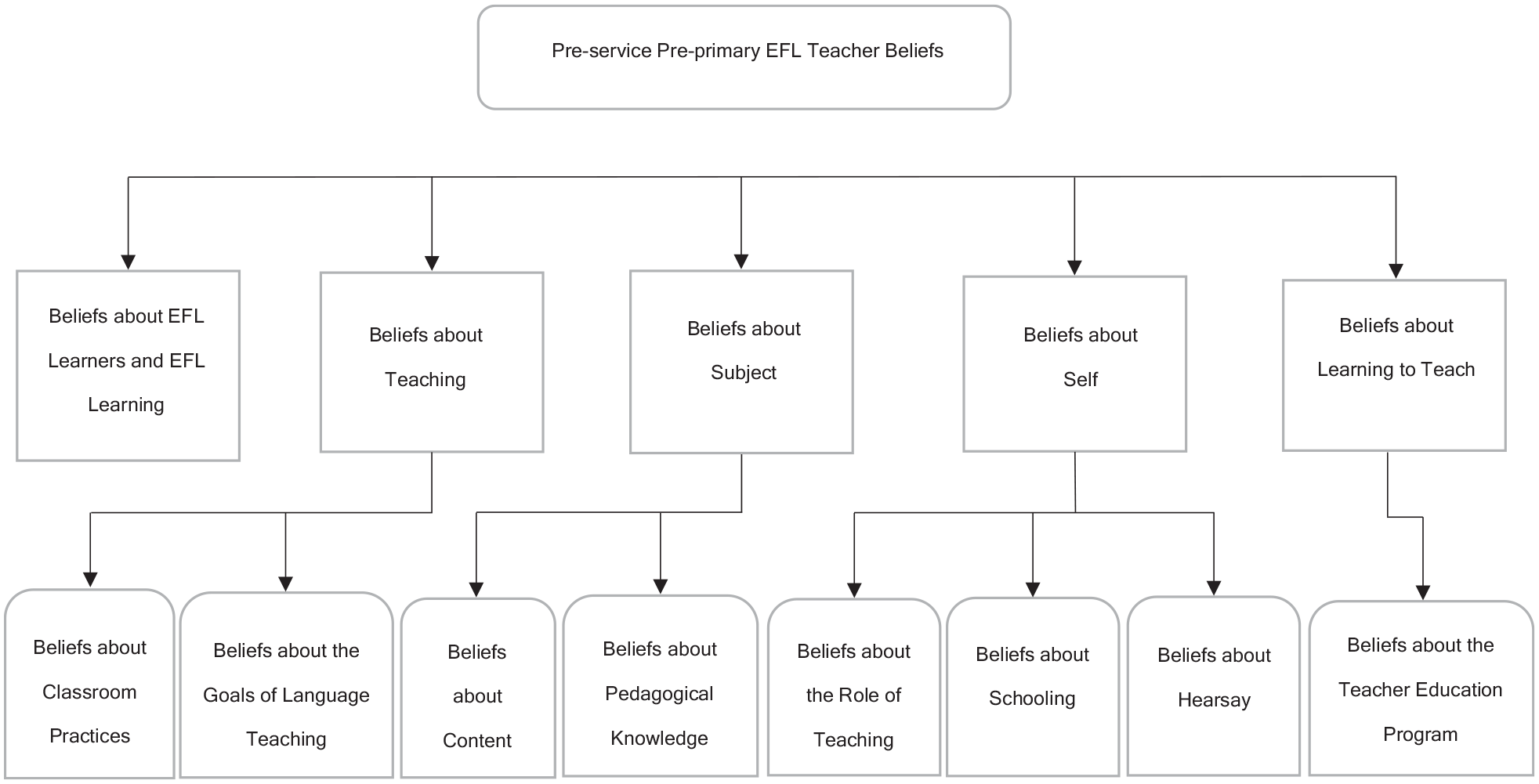
The final coding frame.
Reliability of the Coding Frame
The reliability (i.e., consistency) of the coding frame was checked by going beyond an individual coder’s understanding of the reflection reports. Specifically, an inter-coder approach was adopted by the researchers to ensure consistency in the codes and the use of the coding frame. The two coders with different educational backgrounds (i.e., coder 1 with a background in Applied English Linguistics and coder 2 with a background in Early Childhood Education) individually coded the data; coders with varying educational backgrounds were sought as they would “differ more with respect to the background that they bring to the understanding of the material than does one person at two different points in time” (Schreier, 2012, p. 191). Consistency in coding by coders with different backgrounds provides further evidence of the reliability of the coding frame. According to Schreier (2012), for QCA the most suitable coefficient is the simple percentage of agreement. Dividing the number of agreements by the number of agreements and disagreements yielded an inter-rater reliability rating of .99, which indicated an acceptable level (Miles & Huberman, 1994).
Results
Thirteen key beliefs themes emerged from the pre-service pre-primary teachers’ written reflection reports. Table 1 provides the name of each beliefs theme, a description of the beliefs theme, and the number and percentage of the participants that held a belief categorized under each beliefs theme. None of the participants reported beliefs that could be categorized into all 13 themes. The maximum number of beliefs themes that could describe beliefs held by any participant was eight and the minimum number was one. On average, each participant’s beliefs were categorized under 4.57 beliefs themes (SD = 1.49).
Pre-Service Pre-Primary English Teacher Beliefs Themes.

Note. Participants N = 63.
Pre-service Pre-primary EFL Teachers’ Beliefs about Teaching English to Very Young Learners
Beliefs about classroom practice
The most common type of beliefs held by the pre-service teachers related to their future classroom practice. Li and Oliveira (2015, p. 489) defined classroom practice as a process that “involves multiple agents and their interactions within the classroom as a system. The process can be manifested in diverse formats and structures, and its effectiveness can be influenced by numerous factors both internal and external to the classroom.” Fifty-eight participants (92.06%) wrote about classroom practice as a process of learning. The participants believed classroom practice involves creating both content-rich and age-appropriate activities that can be integrated into a well-rounded enjoyable classroom setting. The effectiveness of what goes on inside a classroom can be influenced by a teacher’s beliefs. For example, Participant 1 shared how she would integrate storytelling and roleplaying as well as singing and games into her EFL instruction. Participant 1 shared: If I teach English to kindergarteners, I think I will tell them. . .interesting stor[ies] and before. . .the storytelling lesson[s], I may put the storybook[s] in the Reading Corner for them to read. . ..I will stick some words with pictures about the story around the classroom [and] after that I will tell them the story. . .[.] [I will] also ask them. . .question[s] about the story and let them role play. . .[thereby giving them] a chance to speak in. . .class[.]. . . [T]hey may have [an] interest [in] lear[n]ing English. Other way[s are] sing[ing] song[s] and play[ing] game[s]. I think I may teach them some words and mix those words in[to] the game[s] or the song[s]. . ..If I teach them words about color, I may play a game. . . [where] they have to find the other student(s) with. . .[matching] color stickers [as]. . . I read or sing a song [using] the color words. [For example], when I sing the color words like red[,] the student[s] with red stickers have to jump or do some actions. I think using this way [to teach helps] them. . .easily remember those words. Also, they may not feel [it is] difficult and boring to learn [a] foreign language. (Participant 1)
Beliefs about EFL learners and EFL learning
Fifty-six participants (88.89%) wrote about EFL learners and EFL learning beliefs. EFL learning refers to the learning of “[E]nglish language skills in a non-English-speaking community or country” (Harris & Hodges, 1995, p. 73). Naturally, the beliefs about EFL learners were regarding the learners whose first language was not English. As the participants were writing about the teaching of English to kindergarteners, their beliefs about the process of EFL learning had a clear early childhood education feel to them. The participants’ beliefs about EFL learners focused on their needs or characteristics. For example, Participant 26 stated that her future EFL learners would be children, whose “nature is playing.” She further emphasized that the content and approaches to teaching language would need to be adjusted to children’s nature. Participant 26 further emphasized “We need to make language learning great fun for them to attract their attention.” Thus, she expected her future learners’ nature to influence how they learned EFL. She expected EFL learning to look like play. Many of the participants showed an understanding that they should facilitate very young EFL learners’ EFL learning through child-centered play-oriented learning activities. They believed early childhood EFL teachers should increase game-playing to promote EFL learning.
Beliefs about pedagogical knowledge
Participants’ beliefs about pedagogical knowledge referred to those beliefs about “being a teacher, involving methods and techniques of teaching predicated on two conceptions of pedagogy: the liberal, emphasizing the autonomy of the child; and the conservative, emphasizing the authority of the teacher” (Farquhar & White, 2014, p. 822). Forty-four (69.84%) participants were found to have referred to various conceptions of pedagogy. The most commonly mentioned area was play-based pedagogy (Samuelsson & Carlsson, 2008). A substantial number of beliefs were found to have focused on learning English through play or emphasizing a link between play and learning. Participant 9, for example, believed that “playing to learn and learning to play is [the] most important concept” in teaching very young learners. To her, the pedagogical knowledge she gained about early childhood education in the pre-primary education program suggested that she should strive for a balance between playing to learn (i.e., the knowledge or skills considered as the end product of pre-primary pupils’ playing) and learning to play (i.e., the activities of playing considered as the end product) (Arnseth, 2006). She felt that play-based pedagogical knowledge provided ample opportunities for very young EFL learners to gain language knowledge through not only teacher-initiated learning activities but also through the provision of child-initiated language play activities.
Beliefs about teaching
“Beliefs about teaching. . .referred to the preferred ways of teaching by teachers” (Teo et al., 2008, p.164). The 34 (53.97%) participants that mentioned beliefs about teaching stated teaching strategies limited in frequency, duration, and quality, or that predominantly adopted a teacher-centered approach should be abandoned. For example, Participant 39 wrote, “The reason I want to [teach in this way] is I hope it can prevent learning by rote. I want to incorporate. . .game[s] and music to cultivate children’s interest in English. . .[so they will] learn English happily.” This particular pre-service teacher identified instances where she thought “learning by rote” had over-estimated very young EFL learners’ language-learning competencies. She wanted to avoid a situation where her future very young EFL learners may feel frustrated, struggle with their learning, or become disinterested in English learning. She believed using music and game-based activities could purposefully engage and cultivate young EFL learners’ interest in learning English.
Beliefs about content
Eighteen (28.57%) participants wrote about the beliefs they held related to content, which refers to “[k]nowledge of the subject and its organizing structures” (Loewenberg Ball et al., 2008, p. 2). Here, the content referred to the English language. The participants wrote about the importance of selecting language content that could develop children’s English listening and speaking skills while deemphasizing the teaching of reading and writing skills. This might, for example, include the learning of words that could be used by the children to talk about their daily lives. For example, Participant 8 wrote that she believed young EFL learners “. . .mainly need to [be] taught speaking and listening.” As very young EFL learners need more time to develop their cognitive abilities, Participant 8 felt only a “little reading” of “simple words” might be considered. The other participants that reported beliefs about content made similar statements, indicating that kindergarten was the time to encourage the teaching of language content through listening and speaking.
Beliefs about the goals of language teaching
Beliefs about the goals of language teaching referred to those beliefs about the “creat[ion of] skillful L2 users with all their extra attributes, not shadows of native speakers” (Cook, 2013, p. 51). Fifteen (23.81%) participants wrote about what they thought were the goals for English language teaching in the very young learner classroom. The participants contrasted the goals of language teaching between younger and older learners by emphasizing that young learners often show enthusiasm for anything new, whether it be a new game played or a new word heard. In addition, young learners are shown to be quite inquisitive as they are still learning about the world and may ask numerous questions during their English lessons. Therefore, the participants believed the goals of language teaching were to encourage these early childhood behaviors so that young learners could build up their listening and speaking skills during their kindergarten years. The participants believed that one of the major goals of language teaching in the early years was to set a precedent by associating English learning with positive emotions. For example, Participant 3 wrote “I hope they can speak English happily and free[ly], not hate and [be] afraid” of speaking English. This participant aimed to set up an environment where very young EFL learners could freely express their ideas and happily engage in learning activities. The participants’ beliefs about the goals of language teaching appeared to be supportive of the inquisitive and playful behavior of children.
Beliefs about the role of teaching
Beliefs about the role of teaching referred to the participants’ beliefs regarding their classroom roles in which “[t]eachers’ roles refer to what teachers do in classrooms” (Keiler, 2018, p. 3). Fourteen (22.22%) participants tapped into their beliefs about the role of teaching by expounding on their views of the importance of facilitating very young EFL learners’ foundation language skills. As Participant 39 stated “. . .teachers. . .play an important role in English learning. Teachers need to cultivate children’s interest in English during this period and lay a good foundation for their English learning.” This pre-service teacher intended to create the potential for the emergence of learning opportunities as a by-product of the children’s interests.
Beliefs about the subject
Beliefs about the subject referred to the participants’ beliefs toward “[a]n area of learning and study; discipline” (Harris & Hodges, 1995, p. 246). Here the subject refers to the English language as a subject of study in the young learner kindergarten classroom. Recent trends in Macau’s early childhood education system have focused on learning English as a route to internationalization (Sansom, 2016). Pre-primary children in Macau begin taking English as a subject from their first year of kindergarten at around 3 years of age. Fourteen (22.22%) of the pre-service teacher participants believed English as a subject is of vital importance to very young EFL learners’ early childhood education. For example, Participant 42 expressed, “In my opinion, English is very important, for it is an international language and one of the indispensable languages for interpersonal communication.” While not a belief mentioned by the majority of the participants, those that did mention beliefs about the subject of English all emphasized the importance of English as a subject in terms of the internationalization of Macau and the frequent contact that Macau residents have with people from all over the world.
Beliefs about schooling
Beliefs about schooling referred to the participants’ beliefs regarding “their own student experiences. . . [that] guide their interaction with and evaluation of ideas presented in course- and field-based experiences, causing them to accept, modify, or discount those ideas” (Schmidt, 2010, p. 132). It was found that 13 (20.63%) participants’ experiences as students influenced their beliefs. These pre-service teachers constructed their beliefs from their own student experiences, which may help guide their future teaching. Their own English learning experiences have the potential of encouraging or discouraging particular teaching behaviors. For example, Participant 20 shared her experience in kindergarten and how her experience shaped her beliefs about learning vocabulary. “In my kindergarten life, I learnt a s[o]ng about. . .several parts of my body. [B]ecause of that song, I still remember the vocabulary.” This pre-service teacher recalled how her vocabulary learning was connected to a schooling experience and understood how this experience has shaped her beliefs about the teaching of English in kindergarten.
Beliefs about hearsay
Beliefs about hearsay were the participants’ beliefs regarding “[w]hat is done or written, as well as . . . what is spoken” without evidence-based support (Falknor, 1940, p. 192). Nine (14.29%) participants’ reflection reports mentioned beliefs that were based on hearsay. Although unspecified in the reflection reports, the people that provided this information to the participants were likely close to them. Messages conveyed by close, trusted relations could have resulted in their having enough impact to affect the participants’ beliefs. For example, Participant 9 shared her dislike about how English was taught in bilingual kindergartens. Although this was not experienced by the participant, her belief against only using English to teach English was solidified by a story she had heard. Participant 9 wrote “I heard [something about] the teacher[s] who teach in the bilingual kindergarten[s]. There are two types of teacher[s]. . .. [I]f the teacher just speak[s] one language, the children need to try their best. . . [and] really feel [it is] hard.” While not experienced directly by the participant, obviously the story she heard had affected her beliefs and she felt the use of both the foreign and first language would be best for very young learners.
Beliefs about self
Beliefs about self were the participants’ beliefs about themselves which emphasized that “. . .teacher self-efficacy and teacher emotions can be important ways for us language teachers to enhance our overall quality” (Xu, 2012, p. 1,400). Five participants (7.94%) held humble and self-conscious beliefs about themselves. For example, Participant 20 shared her perceived competence in teaching English to very young EFL learners, stating “. . . I think [a] teacher has [the] responsibility to improve [her or his] English, because students will learn [at] anytime from every word the teacher says. So, I must pay more attention [to] my sentences, grammar, etc.” This teacher held the belief that though a teacher’s English may not be good enough to teach English to kindergarteners, that was not an excuse to not try to teach English. Instead, this teacher held the belief that it is the responsibility of the teacher to make these self-improvements. Although the number of participants who reported beliefs about self was rather small, they all focused on how to successfully achieve professionalism by improving their own personal qualities to become qualified English teachers.
Beliefs about learning to teach
Beliefs about learning to teach were the participants’ beliefs regarding “[k]nowing how to learn from classroom teaching experiences. It means planning these experiences in a way that affords learning and then reflecting on the outcomes in order to maximize the benefits that can be gained from the experiences” (Hiebert et al., 2003, p. 206). Learning to teach EFL at the pre-primary level requires authentic and hands-on experiences that directly come from teaching practice; however, the participants did not yet have any teaching experiences and, due to the lack of previous language teacher education, may have held few beliefs regarding learning to teach English. Four participants (6.35%) expressed their beliefs about learning to teach. For example, Participant 34 expressed “I want to learn how to plan a[n] English [lesson] that [can be conducted] through games, story-telling, or other interest[ing] ways[. I want] to guide my children to [develop an] interest [in] learning the[ir] second language—English.” This teacher held the belief that learning to teach was learning how to plan an English lesson. The teacher also held the belief that English should be taught through games, story-telling, or other interesting ways and that to learn how to teach required her to be familiar with particular games and story-telling techniques. For this particular pre-service teacher, learning to teach meant becoming familiar with particular language learning activities or tasks and being taught how to incorporate these activities into lesson planning.
Beliefs about the teacher education program
Beliefs about the teacher education program are those beliefs regarding an “[e]ducation program which provides multiple opportunities for [pre-service teachers] to construct and reflect on learning to teach” (Kroll & Laboskey, 1996, p. 63). Although teacher education programs’ strong influence on pre-service teachers’ beliefs have been documented (Bekleyen, 2011), only three (4.76%) participants mentioned their beliefs regarding the teacher education program in their reflection reports. This result is potentially due to the pre-service teachers having had no prior training in the teaching of English. Participant 54 felt strongly about having a course related to English language teaching and questioned whether the teacher education program would be able to explain why she should learn this skill. The pre-service teacher shared: Firstly, I would like to raise [the] question of why we have to teach a second language to kindergarten children. [B]y having a clear concept of why we need to teach English, the [course] will be more meaningful [to] me. . ..I hope to find out the answer in this course. (Participant 54)
The questions raised by this pre-service teacher highlighted an expectation that this pre-primary teacher education program should be able explain to her the importance of teaching English to very young EFL learners. The pre-service teacher went on to share her doubts regarding whether learners so young should be learning a foreign language.
Discussion
During the past 40 years, studies on teachers’ beliefs have aided in the promotion of effective teacher training and practice across multiple educational levels, subjects, and settings. Informed by these beliefs, teacher educators can make adjustments to teacher education programs in order to better prepare teachers for classroom teaching. Whitebook (2003) reported that pre-service teachers enrolled in high-quality early childhood education teacher preparation programs tended to have more early childhood pedagogical knowledge and practical skills to deal with very young learners than those who had only received content knowledge training. Such programs prepare teachers who are more inclined to create age-appropriate teaching activities that cater to the learning styles of very young learners. Furthermore, such programs often result in future in-service teachers who are highly resilient and capable of facing challenges in their future classroom practices. However, these teachers may still have misconceptions concerning what content to teach or how to go about teaching content. For example, pre-primary EFL teachers may inadvertently select language content that is not appropriate for the pre-primary level even though these teachers have received adequate early-childhood education training. Thus, pre-service teachers’ beliefs reflect critical aspects of both their own learning experiences in teacher education programs and their future instructional practices in their future classrooms. Those beliefs, therefore, are important factors that should be considered when designing teacher education program curricula. Informing teacher educators in the Macau SAR with the knowledge necessary to enhance their own instructional practices requires research that has tapped into the beliefs of pre-service pre-primary teachers in training. The beliefs of these teachers in Macau, however, have not been explored. This case study filled this gap by gathering data on the beliefs of 63 pre-service pre-primary education teachers enrolled in a teacher education program in the Macau SAR.
In the current study, the uncovered beliefs about teaching English to very young EFL learners has the potential of providing valuable insights into the planning of teacher education courses in the Macau context and similar Asian EFL contexts. Generally, the findings of this case study revealed that the pre-service pre-primary teachers’ beliefs reflected their epistemological views about their future students, their future teaching, the Macau SAR teaching context, themselves, and their professional development. In particular, existing pedagogical knowledge, early-childhood education knowledge, and teaching strategies obtained through previous early-childhood education teacher education courses were influential sources of these beliefs. Discussion of this case study’s main findings are provided under four overarching categories. These four categories comprise those beliefs themes that were represented by both the majority and the minority of the participants: (1) beliefs about EFL learners and EFL learning; (2) beliefs about teaching and subject; (3) beliefs about self; and (4) beliefs about learning to teach.
Beliefs about EFL Learners and EFL Learning
Although developmental variations among very young EFL learners is the norm, the findings showed that the pre-primary pre-service EFL teachers believed the pre-primary stage to be a time when students are continuing to refine and expand their current linguistic knowledge that encompasses both receptive and productive language skills. Most likely because the pre-service teachers did not have any English language education training, most of their beliefs were founded on what they had been taught regarding first language acquisition. Although they believed that very young EFL learners come into the pre-primary classroom with an increased awareness that English sometimes is used for specific purposes different from how the mother tongue is used, the beliefs they had about the learning of English and the way that very young learners acquire English drew heavily on their knowledge of first language development. As Participant 2 mentioned “I think the best learn[ing] time [for English] is about three [to] six years old. The young children can understand what people say. Their ability [to learn] is very fast and strong.” These sorts of beliefs related to child developmental stages are consistent with research showing very young learners’ ability to master phoneme production rather quickly at their pre-primary stage, which is the first essential step for language learning (Marotz & Allen, 2015). Nafissi and Shafiee (2020) also found Iranian pre-primary EFL teachers believed early years classes should be arranged by pupils’ learning abilities and not ages; this belief came from their own ECE experiences. The participants’ beliefs about EFL learning mostly related to the notion that the process of learning should be fun and that learners should feel they are playing a game, not learning a language. In fact, most participants (88.89%) believed they should facilitate EFL learning by providing a “fun environment” in which learners are engaged in play-like behaviors.
Beliefs about Teaching and Subject
The pre-service teachers believed that their teaching approaches, activities, and content should be influenced by fun and play. For example, the participants believed play pedagogy, games, and silly stories should be used to teach English vocabulary and listening and speaking skills. Otto (2014) claimed engagement in fun games and listening to silly stories could foster vocabulary enrichment. Poole et al. (2005) claimed English listening and speaking skills could be practiced and facilitated through game play involving jokes and silly story telling. This is because these are the activities that make up the type of language that very young learners are engaged in on a daily basis. As very young learners use language for play, their use of language in the classroom should also mimic the daily language routines of children. While playing, L2 vocabulary will be shared and developed both naturally and seamlessly. Poole et al. (2005) urged pre-primary education teachers not to be afraid to tell silly or nonsense stories to encourage meaning-focused listening, as such stories are often found to be very popular among pre-primary children; children also enjoy making up their own interesting stories. Thus, these beliefs held by the pre-service teachers appeared to be founded and, if implemented in their future classrooms, should result in robust language learning by their students. Still, there were a few pre-service teachers who mentioned the teaching of second language literacy, which might not be suitable for young learners in kindergarten. As most learners in Macau kindergartens are from age three to five, they may be too young for the teaching of reading and writing skills (Teale & Yokota, 2000).
Jacoby and Lesaux (2019) reported experienced in-service teachers held similar beliefs about combining pedagogical, child development, and professional practice knowledge to facilitate a natural and seamless English language acquisition process for young learners. It is notable that the experienced teachers in Jacoby and Lesaux with an average of 7 years of teaching experience held similar beliefs to the participants in the current study who had not previously attended any courses related to teaching EFL to very young learners. One major reason could be that the approaches used for teaching the mother tongue are transferable to the second language (Cameron, 2001). Therefore, pre-primary teacher education programs may consider whether it is necessary to separate training for the teaching of the mother tongue and other languages. Instead, it might be more beneficial to promote a bilingual approach to the teaching of language in the kindergarten classroom (Bialystok, 2018).
Beliefs About Self
The findings related to beliefs about schooling, hearsay, and the role of teaching suggest that the pre-service pre-primary teachers were shaped by their social experiences, educational backgrounds, and relationships with others. How they thought about themselves and how they planned to present themselves in their future classrooms as early childhood EFL teachers depended on their own lived experiences. The participants’ educational experiences, whether as learners in kindergarten or as teachers in training in the university, were influential in shaping their beliefs. This result is supported by previous research (Guven & Cakir, 2012). Furthermore, taking part in training specially designed to teach English to children can realign some of those beliefs. Past schooling experiences shaped how the participants in the current study thought about themselves as early childhood EFL teachers. However, previous schooling was not the only influencer; other sources mentioned included the news, culture, books, and friends. For example, hearsay played a particularly influential role in shaping some of the pre-primary pre-service teachers’ beliefs. These participants placed the information gleaned from dialogs or the narratives of others, most likely due to their close interpersonal relationships with these individuals, above what they had learned in their teacher training courses. While some beliefs such as the types of activities that might be suitable for teaching L2 vocabulary were founded, others including when kindergarten learners should be expected to develop literacy skills were not. This finding suggests that hearsay has the potential of encouraging particular beliefs and manifestations of those beliefs. Teacher education programs should ensure that pre-service teachers question any advice given to them on how to teach language and be skeptical of any advice that is not supported with evidence.
Not only did the pre-service pre-primary teachers believe they had the responsibility to create a conducive learning environment filled with child-centered learning activities for their future students, but they also held particular beliefs about the type of early childhood EFL teacher that they should become after receiving their education training. While many of them focused their written reflections on their lack of knowledge regarding the types of activities that should be used in the early childhood classroom to teach language, a number of them also examined their own English competency. These participants felt that they did not possess the required competency to teach English or to teach a lesson using English as the medium of instruction. Some of the pre-service teachers reported misconceptions about their English pronunciation, believing that they needed to possess a native-like English pronunciation to teach English (Jenkins, 2005). Having an internationally intelligible English accent is adequate for teaching English pronunciation or English language (Jenkins, 2005). These beliefs about self came from good intentions, as the pre-service teachers were concerned that their accented English might somehow affect their future students’ learning, regardless that these concerns were unfounded. The professed doubts in their own English abilities or accented English could have been due to the pre-service teachers’ lack of English proficiency and reduced exposure to English in their daily lives. Unlike some of the other faculties in the university, the Faculty of Education uses mostly Chinese as the medium of instruction. This reduced exposure along with a lower proficiency of English by the students enrolled in the pre-primary education program could result in beliefs about self that view their English abilities or pronunciation as lacking.
Beliefs about Learning to Teach
Few participants held beliefs about professional training. As their written reflection reports were focused on the teaching of EFL and they had received no training in English education, the participants may not have had any opportunity to build beliefs about professional training in EFL teaching. They did, however, believe that they would acquire some of these abilities in the course they were enrolled in. Mostly, the participants reflected on their need for training, indicating that the present course would serve its intended purpose. Currently, the pre-primary education program the pre-service teachers were enrolled in only contains a single 1.5 credit hour course that teaches about English language education. As teacher educators and teacher education training have the most influence on teachers’ beliefs (Shieh & Reynolds, 2021), early childhood education programs in the Macau SAR and similar areas may need to consider increasing the number of credit hours devoted to language education.
Implications for Teacher Education
While it appeared that the pre-primary education program had generally prepared the pre-service teachers for how to teach in the kindergarten classroom, it had not addressed certain misconceptions regarding the teaching of English to very young learners. Teacher educators are advised to address hearsay that may influence the beliefs of pre-service teachers. Pre-primary education majors need to develop an understanding of critical evaluation so that even authority figures’ opinions can be critically evaluated to determine whether they have been substantiated by research findings. The pre-service teachers in this case study seemed to have several unfounded beliefs regarding the teaching of second language literacy skills that should be addressed in the instruction provided in the Teaching English in Kindergarten course. Moreover, the amount of instruction on English language content knowledge should be increased as this particular pre-primary education program in the Macau SAR had only allotted a single 1.5 credit course to deal with English language education. This course may not be enough to prepare pre-service teachers to teach EFL given that some of the pre-service teachers held negative beliefs about their own English proficiency and their ability to teach a lesson using English as the medium of instruction. We advise that the development of a course providing instruction on classroom English would be helpful to supplement the current Teaching English in Kindergarten course. A new course could integrate the concept of intelligibility of English pronunciation and how to teach intelligible English pronunciation to young learners. This additional emphasis on English language may help to address misconceptions regarding the need to have native-like pronunciation in order to be able to teach English pronunciation. Lastly, those in charge of curriculum should re-consider whether the teaching of the mother tongue (i.e., Chinese) and that of the second language (i.e., English) should continue to be covered in two separate courses in a polarized manner. As language teaching in the very early years, regardless of whether it is a first or second language, should be complementary and not incompatible, a bilingual education approach may be more suitable. The bilingual approach may help pupils effectively learn English because it not only fits the environmental needs of EFL learners (Ramos Suiza et al., 2019) but can also cater to their language development needs (Mangone, 2020). For example, in monolingual EFL classes, pre-primary pupils may become confused by the sudden influx of English teacher talk. In such instances, a bilingual approach could prevent disinterestedness and assist with scaffolding learners toward higher levels of English learning. Those in charge of curriculum, including education policy stakeholders, should evaluate this issue to determine the role that bilingualism can play in the curriculum aimed at preparing the next generation of kindergarten teachers.
Conclusion
Using a case study method, the researchers found that the participants held beliefs about classroom practice, EFL learners and learning, pedagogical knowledge, teaching, content, goals of language teaching, the role of teaching, subject, schooling, hearsay, self, learning to teach, and the teacher education program. Most participants mentioned their beliefs about classroom practice, EFL learners and learning, and pedagogical knowledge, while very few participants wrote about self, learning to teach, or the teacher education program. While this case study uncovered findings that supported previous beliefs research as well as highlighting particular new findings for the Macau SAR context, it is not limitation-free. As with all case studies, there is little basis for generalization to a wider population. Instead, this case study offers a unique look at the effect of the current pre-primary education curriculum at a public university in the Macau SAR and provides insights into what potential adjustments could be made to better meet the needs of this particular group of pre-service teachers. Case studies at other institutions in Macau, or at other programs within the same institution, within Greater China, and in the Asian EFL context may allow for a basis for generalization of study results. The results of the current study could also be used to conduct a more large-scale study within the Macau context to contrast both pre-service and in-service pre-primary teachers of EFL. Another limitation of the current study is the use of written reflection reports to collect data, which may not have been able to represent all the beliefs of the pre-service teachers. A quantitative study using a questionnaire could address this limitation by drawing upon this study and similar studies’ results to gather data on a more comprehensive set of teacher beliefs. Many of the beliefs held by the pre-service pre-primary teachers were founded on early childhood education knowledge; there were some participants who also held beliefs regarding self and the teaching of EFL that were not supported by research. As previous research has shown teacher education programs to have a large effect on teachers’ beliefs, the courses related to English education could directly address these questionable beliefs. Furthermore, the unique backgrounds of the pre-service teachers involved in the current study indicated a need for additional subject knowledge (i.e., English). Curriculum designers in Macau should consider both the early-childhood education and content knowledge needs of pre-service pre-primary teachers.
Footnotes
Declaration of Conflicting Interests
The author(s) declared no potential conflicts of interest with respect to the research, authorship, and/or publication of this article.
Funding
The author(s) disclosed receipt of the following financial support for the research, authorship, and/or publication of this article: The research reported in this article was supported by the Higher Education Fund of the Macao SAR (28/DSESHSS-UM/2019 & HSS-UMAC-2020-07).
