




Abstract
While prior research often highlights the performance-inhibiting effects of situational constraints, this study adopts transactional theory to examine how their impact is shaped by individual perceptions. Using paired data from 71 team leaders and 369 team members, this study explores the mechanisms through which situational constraints influence work engagement. The findings reveal that situational constraints are not inherently detrimental. When employees perceive these constraints as challenges, their work engagement is positively stimulated. Conversely, when constraints are appraised as threats, they hinder employees from fully committing to their tasks. In the absence of such appraisal, situational constraints did not significantly affect work engagement. Additionally, a growth mindset at both the individual and team levels was found to moderate the indirect effect of situational constraints on work engagement through hindrance appraisals. A strong growth mindset buffers the negative impact of constraints, reducing the likelihood of threat appraisal. This study highlights the dual effects of situational constraints on work engagement and offers practical insights into creating organizational contexts that cultivate a growth mindset, enabling employees to approach stressors with shared optimism and adaptability.
Plain Language Summary
Many things at work can make it harder for employees to do their jobs well, such as a lack of time, resources, or support—these are called situational constraints. Past research often assumes these constraints hurt job performance and motivation. However, our study shows that the way employees perceive these obstacles matters more than the constraints themselves. Using data from 71 teams and 369 employees, we found that situational constraints are not always harmful. When employees see these constraints as challenges, they feel more energized and engaged with their work. But when the same constraints are viewed as threats, they reduce motivation and effort. Interestingly, without any judgment about these constraints, they have little impact on engagement. We also discovered that having a growth mindset, the belief that skills and abilities can improve with effort, helps buffer the negative effects of constraints. Employees and teams with a strong growth mindset are less likely to see obstacles as threats, making it easier to stay motivated. This research suggests that organizations should foster a culture that encourages learning and adaptability. By helping employees reframe challenges positively and supporting their growth, companies can turn workplace barriers into opportunities for success.
Introduction
Situational constraints are work-related conditions that impede employees’ ability to translate their skills and motivations into effective work performance (Peters & O’Connor, 1980). Research has consistently documented their negative influence, which can be categorized into behavioral, psychological, and attitudinal outcomes. Behaviorally, situational constraints have been linked to increased counterproductive work behaviors (Zhou et al., 2014) and higher turnover rates (Stetz et al., 2007). Psychologically, they contribute to stress and emotional exhaustion (Kim et al., 2020), compromising mental well-being and resilience. In terms of work motivation and attitude, they are associated with heavier perceived workload and diminished motivation (Pindek et al., 2019). Together, this body of work highlights the multifaceted risks that situational constraints pose to individuals and organizations.
Despite these findings, recent scholarship questions whether it is sufficient—or even accurate—to conceptualize situational constraints solely as hindrance stressors. Pindek and Spector (2016) argued this view is overly simplistic and proposed a more nuanced interpretation, suggesting that situational constraints may sometimes be appraised positively and even stimulate performance. Empirical work supports this complexity. For example, Harp et al. (2016) found that situational constraints reduced work engagement among volunteers, whereas Coo et al. (2021) demonstrated that situational constraints harmed work engagement when perceived as excessive to peers, yet could be beneficial when appraised collectively within teams. These mixed findings indicate that situational constraints may not be inherently detrimental.
However, significant gaps remain. First, the literature has not reached a consensus on whether they should be viewed solely as hindrance stressors, as most studies focus disproportionately on negative outcomes while overlooking the possibility of positive appraisals. Moreover, relatively few studies (e.g., Coo et al., 2021; Harp et al., 2016) directly examined their impact on work engagement, and the available evidence remains inconsistent. Little is known about the psychological processes that explain when and why situational constraints sometimes undermine, but at other times enhance, engagement. Addressing these gaps requires a theoretical framework that captures how employees interpret and respond to constraints.
Transactional theory offers such a perspective, positing that stressors only influence outcomes when individuals cognitively appraise them as personally significant (Lazarus & Folkman, 1987). Stressors appraised as challenges can foster motivation and problem-solving, while those appraised as hindrances can elevate stress levels and significantly impair an employee’s ability to manage job demands (Lepine et al., 2015). Thus, situational constraints may not automatically yield outcomes, positive or negative, but rather exert their influence through employees’ cognitive appraisals. Moreover, transactional theory suggests that individuals’ evaluations of stressors and their coping strategies are influenced by both external environmental factors and individual characteristics (Lazarus & Folkman, 1987). In other words, an environmental factor is harmful or beneficial only when it interacts with individuals’ motivational and cognitive traits. Contextual and personal factors jointly shape appraisals and coping strategies.
One such factor is growth mindset, a belief that abilities can be developed through effort and learning (Yeager & Dweck, 2020). Employees with a growth mindset are more likely to view setbacks as opportunities for development, reducing the stress and anxiety typically associated with situational constraints. In this study, growth mindset is introduced as a boundary condition that moderates the relationship between situational constraints and work engagement via cognitive appraisals. Furthermore, drawing on situation strength theory, growth mindset is not treated solely as an individual trait but also as a team-level resource. Team-level growth mindset can create a strong situation in which collective beliefs about learning and persistence guide appraisals, reinforce adaptive behaviors, and reduce ambiguity in responses (Dalal et al., 2020). This perspective acknowledges cross-level influences and positions growth mindsets as both an individual and collective buffer against the potentially harmful effects of situational constraints.
This study makes several contributions to the literature. First, it refines the conceptualization of situational constraints by distinguishing between situational constraints as reflections of environmental conditions and as employees’ cognitive appraisals of those conditions. While previous research has predominantly emphasized their negative impacts (e.g., Harp et al., 2016; Kim et al., 2020), this study highlights that situational constraints are signals of hindering work factors, with outcomes depending on appraisal. This reconceptualization provides a more nuanced foundation for understanding how situational constraints operate in the workplace.
Second, this research advances the body of situational constraints literature by exploring the stressor-outcome relationship through the lens of transactional theory. In doing so, it identifies appraisal as the mechanism linking situational constraints to work engagement, clarifying the causal pathway left underexplored in prior studies, such as Pindek and Spector (2016). This contribution not only deepens our theoretical understanding but also opens new avenues for examining situational constraints across different organizational contexts.
Third, this study extends existing moderator research by comparing both individual-level and cross-level effects. While prior studies have examined personal or team characteristics as moderators in the relationship between situational constraints and work outcomes (Clark & Walsh, 2016; Jex et al., 2003), they have largely overlooked collective beliefs at the team level. By introducing team-level growth mindset as a cross-level moderator, this research demonstrates how shared beliefs can shape individual cognitive appraisals of situational constraints. In doing so, it contributes to a more comprehensive multilevel understanding of workplace stressors.
Theory and Hypotheses
Situational Constraints and Work Engagement
Peters and O’Connor (1980) categorized situational constraints into several types, including work-related information, tools and equipment, materials and supplies, budget support, services and help from others, preparation, available time, and the work environment. These inhibiting working conditions reduce the upper limit of potential performance within a given environment, lowering the ceiling of an individual’s optimal work performance. Although situational constraints often arise from objective features of the work environment, it is important to recognize that individuals may perceive and react to these constraints differently, even when facing the same external conditions (Coo et al., 2021). Therefore, situational constraints refer to employees’ perceptions of limitations caused by work situations or events beyond their control that could hinder performance.
Schaufeli et al. (2002) define work engagement as a positive, fulfilling work-related state of mind, characterized by vitality, dedication, and concentration. Engaged employees are typically proactive and enthusiastic in their roles. However, one common reason employees perceive situational constraints is that they feel their work performance is compromised by a lack of necessary resources or support (Kane, 1993). This highlights how situational constraints interfere with employees’ autonomy, as they perceive a lack of freedom and opportunities for self-determination at work. The resulting loss of autonomy reduces employees’ commitment and enthusiasm for their tasks, diminishing their work engagement (Fürstenberg et al., 2021).
Moreover, situational constraints often provoke emotional reactions such as frustration and helplessness. Employees may feel overwhelmed by obstacles that prevent them from achieving their goals. This frustration can lead to withdrawal behaviors and reduced work effort (Pindek et al., 2019). When employees fail to gain a sense of accomplishment at work, they are less likely to take initiative, solve problems proactively, or remain committed to their tasks, all of which are essential components of work engagement. Therefore, this study proposes the following hypothesis:
The Mediating Role of Cognitive Appraisal
According to transactional theory (Lazarus & Folkman, 1987), individuals do not passively respond to environmental stressors; instead, their reactions are shaped by how they perceive and evaluate these events through the process known as cognitive appraisal. Cognitive appraisal consists of two components: the primary appraisal and the secondary appraisal. In the primary appraisal stage, individuals assess whether an event is relevant to their personal well-being or goals. Based on this evaluation, the event may be classified as a harm (reflecting damage that has already occurred), a threat (anticipating future harm), or a challenge (indicating the potential for growth and achievement despite obstacles). If the event is deemed threatening or harmful, individuals move to the secondary appraisal stage, where they evaluate whether they have sufficient resources to cope with the stressor. Cognitive appraisals are critical determinants of how individuals respond to adversity or difficulties.
The way employees appraise situational constraints plays a critical role in shaping their work engagement. When situational constraints are perceived as challenges, they are seen as opportunities for growth and development. This challenge appraisal encourages employees to respond proactively, bolstering their sense of competence and self-efficacy. Prior research has demonstrated that such perceptions can lead to increased enthusiasm and confidence, allowing employees to remain engaged and motivated even under pressure (Huang & Gursoy, 2024; Zilka et al., 2019). For instance, time pressure can stimulate proactive behavior and foster employee innovation (Ma et al., 2021). Therefore, when employees perceive situational constraints as challenges, they are more likely to stay committed and energized in their work.
In contrast, hindrance appraisals reflect the belief that the stressor presents an insurmountable threat, often triggering a defensive or avoidant response. When situational constraints are viewed in this light, employees may feel overwhelmed and incapable of overcoming the challenges they face. This perception undermines motivation and reduces confidence in one’s ability to act effectively, leading to disengagement, withdrawal behavior, and a reluctance to take responsibility (Rice & Day, 2022; Rinker et al., 2024). Employees may avoid tasks, refrain from offering suggestions, or become less inclined to invest effort, harming overall work engagement.
The Moderating Role of Growth Mindset
Transactional theory highlights the interaction between environmental demands and individual psychological traits (Lazarus & Folkman, 1987), suggesting that the extent to which a stressor is appraised as a challenge or a hindrance depends on both situational factors and personal dispositions. For example, when faced with equally urgent situational constraints, employees with different psychological characteristics may adopt distinct coping strategies.
One such psychological trait is mindset. Mindsets reflect individuals’ fundamental beliefs about their intelligence and talents, which can significantly influence their approach to learning (Yeager et al., 2022). People with a fixed mindset believe their abilities are static and unchangeable, while those with a growth mindset believe their abilities can be cultivated through hard work, persistence, and continuous learning. Individuals with a growth mindset are generally more flexible, motivated, and successful than those with a fixed mindset. Empirical studies show that individuals with a growth mindset are more likely to view failure as a learning opportunity, experience fewer negative emotions under stress (Richardson et al., 2021), and remain positive in difficult situations (Lee et al., 2023; Nwafor et al., 2022).
In light of this, the current study posits that employees with a growth mindset are more confident in their ability to overcome challenges. They are more likely to see failure and setbacks as opportunities for progress, motivating them to seek continuous improvement. Such resilience enables them to view situational constraints as opportunities to develop their skills, even in difficult circumstances.
Beyond individual beliefs, contextual factors also shape how stressors are perceived and managed. The theory of situational strength posits that environmental cues, such as clarity, consistency, and constraints, affect the extent to which individual traits influence behavior (Meyer et al., 2020). In strong situations, clear cues and well-defined structures shape and reinforce expected behaviors (Dalal et al., 2020). In contrast, weak situations are characterized by ambiguous norms and unclear information regarding potential actions (Yang et al., 2022).
In the current study, team-level growth mindset serves as a powerful informal cue that shapes behavior, effectively creating a strong situational environment. A team with a strong shared belief in the potential for growth creates a climate that encourages learning and resilience in the face of difficulty. Such a climate serves as a consistent signaling mechanism, shaping how team members interpret stressors like situational constraints. Aligned with the concept of “climate strength” (Jiang et al., 2021), team-level growth mindset reinforces collective expectations and behavioral norms, increasing psychological pressure to adopt challenge-oriented appraisals. As a result, a team-level growth mindset can moderate the relationships between situational constraints and cognitive appraisals. By providing clarity and consistency in behavioral expectations, it reduces ambiguity and strengthens adaptive responses.
Building on the discussion above, this study proposes that employees’ growth mindset can moderate mediating effects of cognitive appraisal. At the individual level, employees with a high growth mindset are more likely to view these constraints as challenges. This perspective increases their willingness to invest effort in overcoming obstacles, mitigating the restrictive effects of situational constraints. Even when constraints are initially appraised as threatening, individuals with a growth mindset may persist through adversity, which weakens the detrimental impact of such appraisals on work engagement. In contrast, employees with a low growth mindset may be prone to interpreting constraints as threats, triggering stress responses that reduce their work engagement. Perceived constraints may also elicit a stronger sense of urgency, leading employees to adopt a contentious attitude toward difficult problems.
At the team level, a collective growth mindset is expected to serve as a contextual moderator by shaping shared norms and interpretations of constraints. Teams with a high growth mindset create an environment that values learning, effort, and mutual support. This shared belief system not only promotes collective resilience but also influences how members collectively appraise situational constraints. Under such conditions, constraints are more likely to be reinterpreted as opportunities for growth and collaboration, contributing to higher levels of work engagement. Therefore, the following hypotheses are proposed:
In summary, the conceptual model constructed in this study is presented in Figure 1.

Theoretical model.
Methods
Sample
Ethical approval for this study was obtained from the relevant institutional ethics committee on October 31, 2021. All participants were informed of the study’s purpose, assured of confidentiality, and provided with the right to withdraw at any time without penalty. Participation involved no physical harm and only minimal psychological burden, and the potential benefits of understanding how work constraints affect outcomes were deemed to outweigh these risks. Written informed consent was obtained from all participants prior to data collection.
This study was conducted in organizations across three provinces in China: Sichuan (two companies), Chongqing (two companies), and Shaanxi (three companies), to enhance the representativeness of the sample. After obtaining consent from the human resources departments of these organizations, teams that met the required number of participants and were willing to participate in the study were selected. Participants held various positions, including roles in engineering, financial services, and marketing. Each supervisor-team consisted of one supervisor and three to five subordinates under their leadership. Most questionnaires were collected on-site, while some were mailed to the researchers by on-site contacts after completion.
Data were collected in two phases, two weeks apart, to replicate the stressor-outcome relationships over an appropriate time period that did not compromise reliability testing (Marx et al., 2003). At Time 1, situational constraints, stress appraisal, and mindsets were reported by subordinates, resulting in 410 employee questionnaires. At Time 2, the immediate supervisors of these employees were asked to evaluate work engagement. All survey items are listed in the Appendix. A total of 401 work engagement ratings from 89 supervisors were received. After removing 32 questionnaires that failed the attention checks or were incomplete, 369 valid questionnaires from 71 teams remained, yielding an effective response rate of 92.02%. Among the 369 employee respondents, 30.4% were aged 36 to 45, 65% were male, and 44.2% held a bachelor’s degree or higher.
Measures
The scales used in this study have been validated in previous research. All original scales, initially in English, followed a rigorous back-translation process to ensure accuracy and reliability (Brislin, 1970). Except for the work engagement scale, all other variables were measured using a five-point Likert scale ranging from 1 (never) to 5 (always).
Situational constraints. This study adopts the organizational constraints scale developed by Spector et al. (1988), which has 11 items (e.g., “I find it difficult or impossible to do my job because of interruptions by other people”). The reliability coefficient for this scale is .93.
Challenge and hindrance appraisals. This study adopts the challenge and hindrance appraisals scale developed by Lepine et al. (2015), which includes three items for each dimension. The researchers modified the wording to pinpoint the target of appraisal specifically to situational constraints rather than general job demands at work (e.g., “I feel these perceived constraints challenge me to achieve personal goals and accomplishment” and “Working to fulfill the demands of my job despite situational constraints thwarts my personal growth and well-being”). The reliability coefficient is .84 for challenge appraisal and .78 for hindrance appraisal.
Work engagement. Employees’ work engagement was rated by their direct supervisors using the work engagement scale developed by Thomas (2007). Supervisors evaluated their team members on a seven-point scale ranging from 1 (never) to 7 (always). An example item is: “This employee is prepared to fully devote themselves to performing their job duties.” The reliability coefficient for job engagement is .92.
Growth mindset. This study adopts the scale developed by Dweck (2000), which contains three items. An example item is: “Your intelligence is something about you that you can’t change very much.” The reliability coefficient for growth mindset is .90.
Control variables. Motivation determines how individuals choose among multiple behavioral options, as people tend to select behaviors that are most motivating (Vroom, 1964). Expectancy theory, a motivational framework, suggests that individuals are more likely to be motivated when they believe their efforts will lead to improved performance, which in turn will produce desired outcomes or rewards. This theory comprises three key components: expectancy (belief that effort will improve performance), instrumentality (belief that improved performance leads to desired outcomes), and valence (the value an individual places on specific outcomes or rewards). Since expectancy, relevance, and valence all affect employees’ motivation to adopt specific work attitudes (Zboja et al., 2020), this study initially included these variables as controls, measured using the scale developed by Chiang et al. (2008). However, the analysis revealed that none of these control variables had statistically significant paths to the endogenous variables. Importantly, the results remained consistent with or without including these controls. Therefore, following recommendations from Becker et al. (2014), the control variables were excluded from the final analysis.
Analytical Strategy
Since teams were nested within companies, each team was assigned an ID number as a higher-level cluster factor. To justify aggregating individual-level scores to the team level, the researchers calculated within-team agreement (rwg; James et al., 1993), along with two intraclass correlation coefficients: ICC(1), which indicates the proportion of variance explained by team membership, and ICC(2), which reflects the reliability of differences between team means (Bliese, 2000). Multilevel modeling is recommended when ICC(1) exceeds 0.05 (LeBreton & Senter, 2008). In this study, the average rwg value was 0.65, ICC(1) was 0.40, and ICC(2) was 0.74. Although the rwg value fell slightly below the commonly accepted threshold of 0.70, both intraclass correlation coefficients exceeded recommended benchmarks, supporting the appropriateness of aggregation to the team level. The lower rwg value may be attributed to the relatively small sample size, which is further discussed in the limitations section. Despite this limitation, the authors proceeded with the analysis. The indirect effects were analyzed using a Monte Carlo approach in the MLmed package. All study variables were assessed at the individual level. Variables were centered; growth mindset was aggregated to the team level to capture cross-level interactions.
Results
Confirmatory Factor Analysis
Confirmatory factor analysis (CFA) was conducted to test the discriminant validity of the study variables, as shown in Table 1. Among the five models tested, the five-factor model showed the best fit (χ2/df = 2.57, RMSEA = 0.06, GFI = 0.85, AGFI = 0.82, CFI = 0.92, NFI = 0.88). Comparisons with competing models revealed significant differences (Δχ2s ≥387.06, Δdfs≥4), confirming that situational constraints, challenge appraisal, hindrance appraisal, work engagement, and growth mindset demonstrated good discriminant validity.
Comparison of Measurement Models (N = 369).
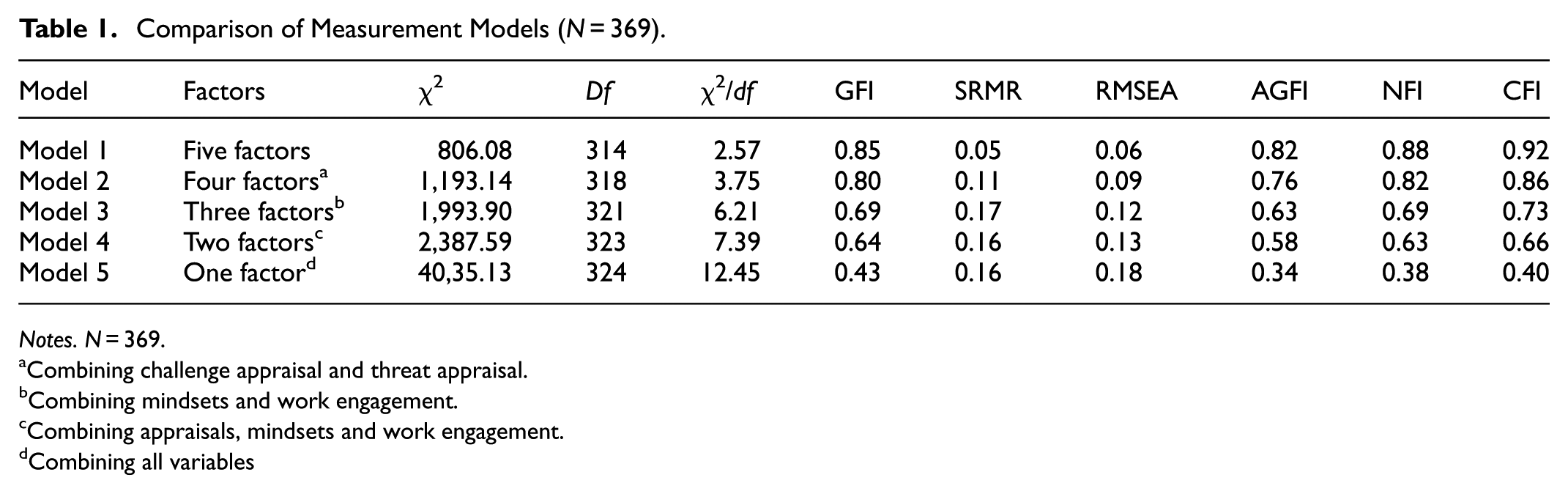
Notes. N = 369.
Combining challenge appraisal and threat appraisal.
Combining mindsets and work engagement.
Combining appraisals, mindsets and work engagement.
Combining all variables
Common Method Bias Test
To mitigate same-source bias, reliable and validated scales were used for all questionnaires; work engagement was evaluated by team members’ immediate supervisors (Podsakoff et al., 2003). Common method bias was tested using Harman’s single-factor method, which extracted five factors. The first factor explained 26.24% of the variance, well below the 40% threshold, indicating no serious common method bias in the study.
Hypotheses Testing
The correlation analysis of the study variables is presented in Table 2, which shows that situational constraints and work engagement were not significantly correlated. Hypothesis 1 proposes that situational constraints have a negative effect on work engagement. According to the regression analysis results in Table 3, without challenge or hindrance appraisal in the model, the relationship between situational constraints and work engagement was not significant (b = 0.06, p > .05). Thus, Hypothesis 1 is not supported.
Descriptive Statistics and Correlational Analysis.

Notes. N = 369. SD = standard deviation.
p < .01, ***p < .001.
Results of Regression Analyses for Hypothesized Relationships.
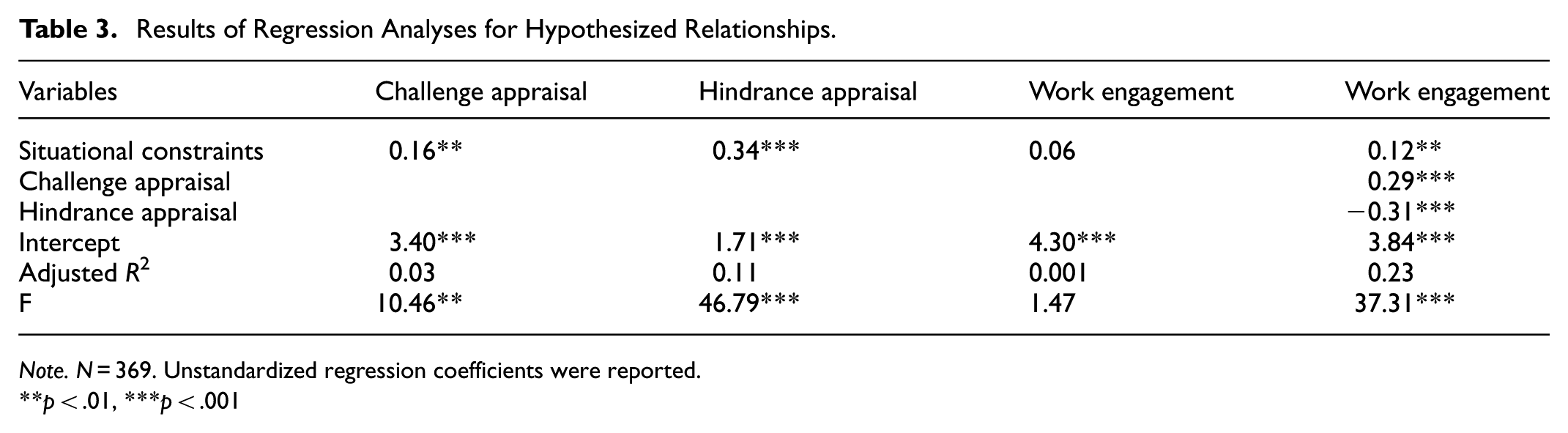
Note. N = 369. Unstandardized regression coefficients were reported.
p < .01, ***p < .001
Hypothesis 2a states that situational constraints have a positive impact on work engagement through challenge appraisal. Hypothesis 2b states that situational constraints have a negative impact on work engagement through hindrance appraisal. Table 5 summarizes the indirect effects. Situational constraints have a significant positive indirect effect on work engagement through challenge appraisal (Effect = 0.01, SE = 0.01, 95% CI = [0.001, 0.03]), and a significant negative indirect effect on work engagement through hindrance appraisal (Effect = −0.04, SE = 0.01, 95% CI = [−0.07, −0.02]). Thus, Hypotheses 2a and 2b are supported.
Hypotheses 3a and 4a predict that growth mindset at the individual level has a moderating effect on the relationship between situational constraints and cognitive appraisals. Table 4 summarizes the path coefficients of the two-level path model, using individual-level growth mindset as the moderator. Based on Table 4, growth mindset at the individual level did not play a moderating role in the positive relationship between situational constraints and challenge appraisal (γ = −0.06, p > 0.05). Hypothesis 3a is not supported. Growth mindset at the individual level negatively moderated the situational constraints-hindrance appraisal relationship (γ = −0.12, p < .01). Hypothesis 4a is supported (see Figure 2).
Path Coefficients of Two-Level Path Modeling.

Note. N = 369. Unstandardized regression coefficients were reported.
p < .01, ***p < .001.

Moderating effect of individual-level growth mindset on the relationship between situational constraints and hindrance appraisal.
Hypothesis 5a predicts that employees’ growth mindset at the individual level moderates the mediating effect of challenge appraisal between situational constraints and work engagement. As shown in Table 5, the indirect effect of situational constraints on work engagement via challenge appraisal is not significant under growth mindset (Effect = 0.02, SE = 0.01, 95% CI = [−0.02, 0.003]). Therefore, Hypothesis 5a is not supported. Hypothesis 6a predicts that employees’ growth mindset moderates the mediating effect of hindrance appraisal between situational constraints and work engagement. As shown in Table 5, the indirect effect of situational constraints on work engagement is significant at the individual level of growth mindset (Effect = 0.01, SE = 0.01, 95% CI = [0.001, 0.03]). Hypothesis 6a is supported.
Summary of Indirect Effects at the Individual Level.

Note. N = 369. The indirect effects were calculated by Monte Carlo approach with 10,000 repetitions.
To examine the cross-level interactions, the MLmed package in SPSS was used, with situational constraints, challenge appraisal, hindrance appraisal, and work engagement entered at Level 1, and aggregated growth mindset entered at Level 2. The path coefficients from the two-level path modeling are summarized in Table 6, while the indirect effects with a Level 2 moderator are presented in Table 7.
Path Coefficients of Two-Level Path Modeling with Team-Level Growth Mindset.
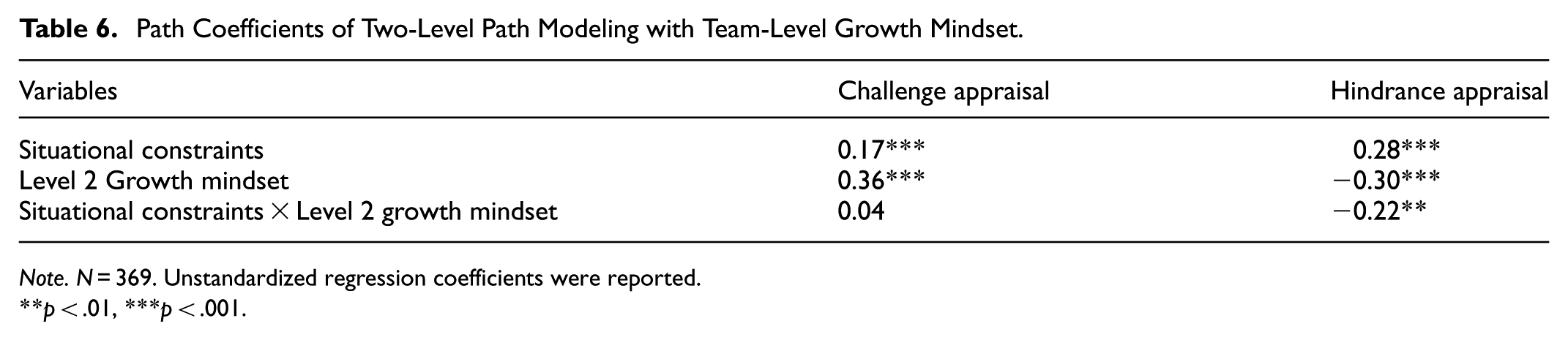
Note. N = 369. Unstandardized regression coefficients were reported.
p < .01, ***p < .001.
Summary of Indirect Effects with Team-Level Growth Mindset.

Note. N = 369. Unstandardized regression coefficients were reported. The indirect effects were calculated by Monte Carlo approach with 10,000 repetitions.
The results indicate that team-level growth mindset did not moderate the situational constraints–challenge appraisal relationship (γ = 0.04, p > .05), but it negatively moderated the situational constraints–hindrance appraisal relationship (γ = −0.22, p < .05), as shown in Figure 3. Hypothesis 3b is not supported, but Hypothesis 4b is supported. For the moderated mediation effects, team-level growth mindset did not moderate the indirect effects of situational constraints on work engagement via challenge appraisal (γ = 0.02, p > .05). However, it moderated the indirect effects of situational constraints on work engagement via hindrance appraisal (γ = 0.22, p < .05). Hypothesis 5b is not supported, but Hypothesis 6b is supported.

Moderating effect of team-level growth mindset on the relationship between situational constraints and hindrance appraisal.
As an additional analysis, the aggregated dispersion of growth mindset was also entered at Level 2 to test whether groups with similar levels of growth mindset or those exhibiting high complementarity would alter the proposed relationships. However, the dispersion of growth mindset failed to moderate the situational constraints–cognitive appraisals relationship and the indirect effects, as shown in Table 8.
Path Coefficients of Two-Level Path Modeling with the Dispersion of Growth Mindset.

Note. N = 369. Unstandardized regression coefficients were reported.
p < .01, ***p < .001.
Discussion
Unlike previous research that underscores the negative impact of situational constraints on work engagement, this study reveals that employees’ perceptions of impediments and barriers do not directly lead to changes in their work engagement. It demonstrates that when employees perceive situational constraints as challenges, their work engagement can be positively stimulated. Conversely, when situational constraints are viewed as threats that inflict inevitable harm or loss, employees may experience reduced enthusiasm and vitality, preventing them from fully committing to their tasks.
At both the individual and team levels, a growth mindset negatively moderates the relationship between situational constraints and hindrance appraisal, as well as the indirect effects of situational constraints on work engagement through hindrance appraisal. Interestingly, the growth mindset, whether at the individual or team level, does not significantly moderate the relationship between situational constraints and challenge appraisals. These findings are consistent with research in education, which indicates that the benefits of a growth mindset are not uniform across all individuals and are more pronounced for those with lower abilities (Yeager et al., 2019). This may also be attributable to the substantial overlap between individuals with a growth mindset and those who view situational constraints as challenges.
The stronger cross-level moderation effect suggests that a collective growth mindset functions as a strong situational factor, guiding team members to perceive situational constraints consistently as less threatening. While individual employees with a growth mindset may effectively reframe situational constraints, their efforts can be less uniform and more dependent on personal disposition rather than collective norms. The absence of significant moderation from the dispersion of growth mindset shown in the additional analysis further emphasizes the importance of shared beliefs. Without consistency in mindset, the team environment shifts toward a weaker situation in which individual differences prevail over collective norms.
Theoretical Contributions
Using transactional theory, this study provides an explanation for the weak or non-significant correlations found between situational constraints and outcome variables in previous literature (Gilboa et al., 2013). For situational constraints to influence work engagement, they must first be appraised as stressors. Without being perceived as personally significant, such constraints may remain background conditions that neither disrupt employees’ work nor affect their engagement. The non-significant relationship between situational constraints and work engagement observed in this study suggests that unless situational constraints are cognitively appraised, they may have little practical consequence for employee outcomes.
Building on this explanation, the study reconceptualizes situational constraints through the lens of transactional theory. Prior research has often assumed that situational constraints are inherently harmful because of their consistent associations with negative outcomes. However, these associations may largely reflect employees’ tendency to appraise constraints as threats, interpreting them as overwhelming demands for which they lack sufficient coping resources. The present findings clarify that constraints themselves are not uniformly detrimental; rather, their effects depend on how employees evaluate their ability to cope with them. This distinction highlights that while situational constraints capture the disruptive presence of work-related barriers, their consequences emerge from employees’ subjective appraisals. Incorporating situational constraints into transactional theory in this way differentiates between inhibiting factors in the work environment and the cognitive processes that transform those factors into either harmful or motivating experiences.
This study also contributes to the growth mindset literature by extending its examination from educational contexts to organizational settings. Much of the prior work has focused on academic achievement, focusing on student achievement and learning outcomes (Li & Bates, 2019). The present findings align with the “mindset context” perspective (Yeager & Dweck, 2020), showing that growth mindset, at both the individual and team levels, functions as a boundary condition for the effects of situational constraints on work engagement, particularly through hindrance appraisal. Rather than serving as a universal resource, growth mindset operates within specific situational contexts, with its buffering role depending on how constraints are appraised. By integrating insights from transactional theory and situation strength theory, this study clarifies the role of growth mindset as a contextual boundary condition that shapes positive responses to workplace challenges, though its positive influence may be contingent rather than unconditional.
Practical Implications
Supervisors need to strengthen employees’ perceived control, as this study highlights the central role of cognitive appraisals in shaping responses to situational constraints, particularly in the Chinese context, where cultural norms emphasizing harmony and face-saving often discourage employees from voicing dissatisfaction directly (Kong & Chen, 2022). Such tendencies increase the likelihood that stressors will be internalized, making it important for organizations to develop targeted problem-solving and decision-making skills among employees. Rather than attempting to cover every possible workplace problem, which is an unrealistic goal given today’s unpredictable work environments, training should focus on the most pressing constraints employees encounter. For example, in technology-intensive settings, offering targeted upskilling not only equips employees with relevant expertise but may also help them appraise situational constraints as manageable challenges and enhance their innovative potential (Montani & Staglianò, 2022). Providing employees with tailored resources and confidence-building opportunities can thus proactively reshape appraisal processes in ways that support engagement.
At the same time, organizations should approach growth mindset interventions strategically. Research demonstrates that a growth mindset can be cultivated (Dweck & Yeager, 2019), but the effectiveness of such interventions is contingent on cultural and contextual factors. In China, where self-critical emotions such as shame and guilt play a stronger motivational role in regulating behavior (Triandis, 2001), employees may be less inclined to take initiative if they fear exposing incompetence. Simply promoting growth-oriented messages may be insufficient, or even counterproductive, if employees interpret them as highlighting personal shortcomings. To address this risk, self-affirmation interventions can be integrated into training programs to reinforce employees’ existing sense of competence, creating psychological safety to engage with growth-promoting messages (Calvete et al., 2022). Embedding these practices into workshops or coaching sessions may reduce defensive reactions and encourage more authentic participation in growth mindset training, particularly in contexts where employees may otherwise hesitate to experiment or admit difficulties.
This study cautions against assuming that growth mindset cultures are unconditionally beneficial. While team-level growth mindset generally fosters climates that encourage members to reinterpret constraints as opportunities for learning, its influence may be most valuable in urgent or high-stakes situations where employees often perceive constraints as threats because of the conflicting demands between delivering immediate results and building future capabilities (Smith & Lewis, 2011). To maximize its benefits, organizations should align growth mindset interventions with moments when resource scarcity and time pressure heighten the likelihood of threat appraisals, ensuring that employees are equipped with the resilience and problem-solving orientation needed to balance short-term performance demands with long-term development goals.
Limitations and Future Research
This study uses supervisors to evaluate employees’ work engagement to reduce same-source bias and social desirability bias (Podsakoff & Organ, 1986). However, while a two-week gap was incorporated between the collection of data on stressors, cognitive appraisals, and supervisors’ ratings of work engagement, this design may not fully capture the dynamic and immediate nature of employees’ appraisals. A daily diary approach would allow future research to track within-person fluctuations in appraisals and engagement more precisely and provide richer insights into the short-term processes underlying stressor appraisal.
Second, although this sample size meets the commonly accepted minimum threshold of 30 level-two units for multilevel modeling (Maas & Hox, 2004), the relatively small number of team-level observations (n = 71) limits statistical power for detecting cross-level interactions. This may increase the likelihood of Type II errors and restrict the generalizability of the findings. Additionally, the number of raters can influence the magnitude of rwg values (LeBreton & Senter, 2008), raising potential concerns about measurement precision. Future research should replicate these findings in larger samples across diverse industries and organizational contexts to test the robustness and stability of the observed cross-level effects.
Finally, this study selects growth mindset as the moderating variable, addressing individual differences in how employees appraise situational constraints. While this adds nuance, it may not fully capture how individuals appraise stressors in varying contexts. Modern work environments are increasingly affected by challenges beyond the workplace, such as insufficient eldercare services (Zhou & Cao, 2023) and the tension between motherhood and professional development (Thébaud & Taylor, 2021). These factors may deplete employees’ resources and spill over into the workplace, influencing how situational constraints are appraised and managed. Future studies should therefore investigate additional boundary conditions, including family responsibilities, organizational support systems, and cultural differences, to better understand when and why situational constraints lead to either challenge or hindrance appraisals.
Conclusions
The current study demonstrates that cognitive appraisals mediate the relationship between situational constraints and work engagement, showing that such constraints are not inherently harmful but depend on employees’ interpretations. By distinguishing between the presence of hindering work factors and subjective evaluations, the study refines the conceptualization of situational constraints and uses transactional theory to explain the weak or non-significant relationships between situational constraints and work outcomes found in prior research. The findings further reveal the moderating role of growth mindset at both the individual and team levels in the indirect effects of situational constraints on work engagement via hindrance appraisal, underscoring its role as a contextual boundary condition rather than a universally positive resource. In doing so, the research advances theoretical understanding while also offering practical insights for organizations aiming to foster resilience and adaptability.
Footnotes
Appendix

Ethical Considerations
Ethical approval was obtained by the ethics review board at the University of Electronic Science and Technology of China on October 31st, 2021. All subjects completed written informed consent in accordance with the Declaration of Helsinki. Research respondents were ensured confidentiality and anonymity. All participation was voluntary. Appropriate steps were taken to protect the rights and welfare of human research subjects, as requested by the university ethics review board.
Consent to Participate
All participants provided written informed consent before entering the research project.
Author Contributions
First Author Luxiaohe Zhang: Responsible for analyzing data and writing the manuscript. Second Author Xuan Yu: Responsible for formulating ideas and developing the theoretical model. Third Author Jun Gao: Responsible for project supervision and editing.
Funding
The authors disclosed receipt of the following financial support for the research, authorship, and/or publication of this article: This work was supported by the Sichuan Petroleum and Natural Gas Development Research Center [grant number SKB23-08]; Systems Science and Enterprise Development Research Center [grant number Xq23B07]; Shaanxi Educational Science Research Planning Office [grant number SGH24Y2705].
Declaration of Conflicting Interests
The authors declared no potential conflicts of interest with respect to the research, authorship, and/or publication of this article.
Data Availability Statement
The data that support the findings of this study are available from the corresponding author upon reasonable request.