




Abstract
This study explores the social and emotional functioning of students with Nonverbal Learning Disabilities (NLD) in Saudi Arabia, with a particular focus on the difficulties these students face and the effectiveness of tailored interventions that were identified to support them. NLD is characterized by deficits in visual-spatial reasoning, motor coordination, and social interaction, despite relative strengths in verbal reasoning. While NLD has been extensively studied in many parts of the world, research in Arabic-speaking regions—and especially in Saudi Arabia—remains limited. This gap highlights the need to investigate how cultural and educational contexts shape the experiences of students with NLD and influence the types of support they receive. To address this gap, the study employed a descriptive survey method, collecting data from 67 educators specializing in learning disabilities in Al-Ahsa, Saudi Arabia. The study, which utilized a 25-item survey that respondents rated, was conducted during the second semester of AY 2024/2025. The survey responses were analyzed using descriptive statistical techniques to identify frequencies and percentages across the responses, and arithmetic averages to organize the responses. The findings indicate that teachers identify academic difficulties as the most common challenge among their students with NLD, followed by deficits in linguistic, social-emotional, and motor skills. The multidimensional nature of NLD is discussed as well as the need for holistic and culturally responsive intervention practices.
Keywords
Introduction
Nonverbal Learning Disability (NLD, also referred to as “NVLD”), is a neurodevelopmental disorder characterized by a constellation of deficits in visual-spatial, intuitive, organizational, evaluative, and other nonverbal functions. The prevalence of NLD is estimated at 3% to 4% in the general population, with most such estimates being determined in the North American context (Margolis et al., 2020). Children with NLD often face difficulties in various areas, such as forming friendships, studying, and managing daily tasks. The condition manifests as difficulties in visual-spatial reasoning, motor coordination, social interaction, language comprehension, and novel problem-solving, yet often coexists with strengths in verbal memory and reasoning (Banker et al., 2021; Coccaro et al., 2024; Goldenring Fine et al., 2013; Rosenblum et al., 2018; Rourke et al., 2002; Semrud-Clikeman et al., 2010; Semrud-Clikeman et al., 2016).
As with other processing disorders under the category of learning disabilities (LDs), NLD tends to be under-diagnosed (Coccaro et al., 2024). However, unlike the more commonly recognized LDs, such as dyslexia, dyscalculia, and dysgraphia, NLD is not specifically described in even the most recent version of the Diagnostic and Statistical Manual of Mental Disorders (5th ed., text rev.; American Psychiatric Association [APA], 2022; Miller, 2025). The concept of NLD was first proposed in theory by a pair of psychologists, Doris Johnson and Helmer Myklebust in the late 1960s; their work was not generally accepted. It was then confirmed and expanded upon by neuropsychologist Byron Rourke (1989), who identified its effect on three general developmental areas, which are fine and gross motor skills, social skills, and spatial-visual-organizational function. For the past several years, researchers have been working to ensure that NLD is incorporated into the next revision of the DSM, as well as proposing a new term for this neurodevelopmental disorder, “Developmental Visual Spatial Disorder,” due to concerns that the current terminology contributes to the lack of understanding of this complex condition (Columbia University Department of Psychiatry, 2020; Margolis et al., 2020).
NLD refers to a cluster of neurodevelopmental conditions that significantly affect the ability to interpret and process nonverbal stimuli and communication. Although primarily observed in children, adults with NLD also experience persistent challenges in social interaction, communication, and academic performance. Which supports the need to underscores the need for tailored support mechanisms. The disorder is considered a childhood-onset condition involving core neuropsychological deficits in visual-spatial processing and psychomotor coordination, along with secondary weaknesses in academic, social, and emotional functioning (Metsala et al., 2017). Thus, NLD constitutes a distinct subtype of learning disability, wherein a child may display average or above-average verbal abilities yet experience marked challenges in visual, motor, social, and academic domains (Dhanalakshmi, 2015).
Recent research indicates that children with NLD face challenges in analogical reasoning, which involves transferring knowledge across different contexts (Schiff et al., 2008). Functional neuroimaging also shows alterations in cerebellar resting-state functional connectivity linked to various symptom domains (Margolis et al., 2019; Ramphal et al., 2021). Since the right brain hemisphere handles nonverbal and visual-spatial reasoning (Ryburn et al., 2009), impairments here are believed to cause many observed difficulties. Consequently, individuals with NLD often struggle to interpret facial expressions, body language, and spatial cues, which can lead to social withdrawal, anxiety, and emotional distress, as demonstrated in a study by Metsala et al. (2017) Children with NLD performed lower than their typically developing peers on tasks involving recognition of happy and sad facial expressions and understanding emotional processes.
Globally, NLD has gained increased attention, with ongoing research seeking to clarify its diagnostic markers and intervention strategies. The social deficits common across children with NVLD and ASD may derive from distinct alterations in connectivity within the salience network. Such findings represent the first step toward identifying a neurobiological signature of NVLD, (Margolis et al., 2019). This condition usually appears during the early school years affecting a small percentage of children. These children may present with strong verbal reasoning abilities, but non-verbal tasks can be complex, which delays diagnosis. This further complicates the diagnostic process due to overlap with Autism Spectrum Disorder (ASD) and Attention-Deficit/Hyperactivity Disorder (ADHD) Identifying individuals as having NLD based on shared experience or expert opinion underscores the need for global awareness of this disorder (Rourke, 1995). Despite this, research on NLD is lacking, particularly in non-Western contexts such as the Arab world—including Saudi Arabia—where cultural, linguistic, and educational factors hinder accurate identification, diagnosis, and management of the disorder.
Literature Review
Understanding Nonverbal Learning Disabilities (NLD)
As noted, NLD is a neurodevelopmental condition characterized by an uneven cognitive profile, where individuals exhibit strengths in verbal reasoning but face significant challenges in visual-spatial processing, motor skills, and nonverbal communication (Semrud-Clikeman et al., 2016). Its specific causes are still not clear, but NLD is considered to be connected to right hemisphere brain injury or white matter developmental deficit or differences, typically occurring in utero; contributing factors may be genetics or the prenatal environment (Rourke, 1989). As with other learning disabilities, NLD is often misdiagnosed or overlooked due to the individual’s relative strength in verbal abilities masking underlying difficulties (Mammarella & Cornoldi, 2014). NLD affects many functions, leading to academic and daily challenges. For instance, students with NLD may excel in reading and spelling but struggle with abstract thinking, interpreting social cues, and navigating physical environments.
Diagnosing NLD necessitates a thorough neuropsychological assessment due to its subtle presentation, which often leads to it being missed. However, as previously noted this can be difficult due to the fact it is not included in the DSM-5 (APA, 2022). Key signs include visual-spatial difficulties, like trouble reading maps or interpreting geometric diagrams. This also includes visual memory deficits (Volden, 2013). Motor coordination issues are common, especially poor fine motor skills, such those that facilitate handwriting or tying one’s shoelaces (Rourke, 1995). For example, Rourke noted that the motor delay in NLD involves psychomotor coordination, which sets it apart from conditions involving general motor delays. Typical indicators include deficits in executive functions (e.g., planning, organization, and problem-solving; Semrud-Clikeman et al., 2016). Emotional regulation problems can affect social interactions. Researchers have utilized sophisticated techniques, including advances in neuroimaging, to examine the neural basis of NLD, focusing on the hippocampus and its connections with regions responsible for spatial reasoning and socio-emotional regulation (Banker et al., 2021). Structural and resting-state MRI studies in Banker et al. (2021) showed significant reductions in hippocampal volume and disrupted connectivity within the salience and visuospatial networks in children with NLD as compared to their typically developing peers. These neural differences strongly correlate with the difficulties in mathematical reasoning and social interactions that are often reported by parents (Banker et al., 2021). Findings suggest that atypical hippocampal structure and network inefficiencies may underlie both the cognitive and emotional challenges those with NLD experience, including issues related to emotional regulation and social interaction. By exploring the neurobiological foundation of NLD, Banker et al. (2021) highlighted the potential of neuroimaging as an objective diagnostic tool, complementing traditional behavioral and neuropsychological assessments to enhance detection and intervention accuracy. Such methods aim to enable more objective diagnoses by identifying structural brain abnormalities alongside conventional assessments. Overall, the diagnostic criteria for NLD include: (a) deficits in visual-spatial intelligence, (b) discrepancies between verbal and visual-spatial intelligence, (c) impairment in fine motor and visual-motor coordination, (d) weaknesses in visual-spatial memory, (e) stronger reading skills compared to math achievement, and (f) social and emotional difficulties (Mammarella & Cornoldi, 2014).
Several intervention strategies have been developed to address the cognitive, social, and emotional challenges associated with Nonverbal Learning Disabilities (NLD). Effective support typically requires multidimensional, individualized, and context-based approaches that target both the strengths and weaknesses of affected students. According to Semrud-Clikeman et al. (2016), structured learning environments that include visual supports, explicit instruction, and predictable routines can significantly enhance learning outcomes. These strategies help students compensate for difficulties in visual-spatial processing and executive functioning by providing clarity and reducing cognitive overload.
In addition to classroom structure, social skills training has been identified as a key component in improving interpersonal functioning among students with NLD. Bellini et al. (2007) found that interventions using role-playing, peer modelling, and social stories help students practice interpreting social cues and responding appropriately. These approaches create safe environments for rehearsing communication and reduce anxiety linked to social misunderstandings. Emotional regulation programs are essential for tackling the socio-emotional challenges associated with Nonverbal Learning Disability. Studies indicate that children with NLD struggle with recognizing and managing emotions, which can lead to anxiety, social withdrawal, and problematic peer interactions. Metsala et al. (2017) found that these children scored lower than their typically developing peers on tests of emotion recognition, understanding, and adaptive emotion regulation. These results suggest that difficulties in emotional processing directly impact social and emotional adjustment. Therefore, interventions focusing on emotional regulation—often based on Cognitive-Behavioral Therapy (CBT)—are essential. Such programs aid students in detecting emotional cues, using coping mechanisms, and managing stress, which can decrease internalizing issues and improve social functioning and adjustment. Strategies such as guided self-talk, mindfulness exercises, and breathing techniques have been shown to decrease anxiety and improve emotional self-regulation in students facing learning challenges. These methods help students manage frustration and stress more effectively, which are frequently amplified by difficulties in social interactions or academics (Malboeuf-Hurtubise et al., 2016).
The use of technology-assisted interventions has also shown promise in supporting NLD students. Banker et al. (2021) reported that visual aids, adaptive digital tools, and multisensory learning applications can help bridge gaps in visual-spatial reasoning and working memory. For instance, tablet-based programs and interactive software can offer immediate feedback, scaffolding abstract concepts into concrete, visual forms.
Early identification and intervention are considered the most effective preventive approaches in mitigating the impact of neurodevelopmental and learning disorders. Research highlights that improved surveillance and diagnostic practices can significantly reduce the burden associated with these conditions (Algra, 2021). Similarly, longitudinal findings demonstrate that access to early intervention services between birth and age 3 years can alter the trajectory of children at risk, reducing both behavioral and learning difficulties later in life, Additionally, the study found not only improved performance in reading and mathematics in elementary and secondary school but also a reduction in special education placement and grade retention, among other practical benefits (Ramey & Ramey, 2004). These findings underscore the critical role of early detection, educational support, and community awareness in minimizing the academic and social consequences of developmental learning disorders.
Finally, researchers emphasize the importance of collaborative frameworks that integrate teachers, parents, and healthcare professionals in planning and implementing interventions. Semrud-Clikeman et al. (2016) both argue that Individualized Education Plans (IEPs) that align classroom strategies with therapeutic goals lead to more coherent and sustainable progress. This collaborative approach ensures that interventions are consistent across settings, promoting both academic and emotional development.
Social and Emotional Challenges
Students with NLD often struggle with social interactions and emotional regulation due to difficulties with interpreting body language, facial expressions, and intonation (Galway & Metsala, 2011; Metsala et al., 2017). As a result, psychosocial adjustment tends to be a major concern for their parents and families (Antshel & Joseph, 2006; Little, 2002). These challenges can lead to social isolation, anxiety, and low self-esteem. These issues were examined by Metsala et al. (2017), who demonstrated that children with nonverbal learning disabilities exhibit deficits in emotion understanding and regulation, which are associated with increased anxiety, internalizing symptoms, and poor peer relationships. Difficulties in thinking and planning may cause overwhelming emotion, which can negatively impact social skills development. Barnhill et al. (2002) investigated the use of a structured social-skills intervention that employed role-playing and modelling techniques to enhance nonverbal communication in adolescents with Asperger’s syndrome and related developmental delays. Over 8 weeks, participants attended sessions designed to improve their ability to interpret and use paralanguage cues (e.g., tone, rate, and emphasis), and to recognize and respond to facial expressions. Role-playing was central, allowing students to practice social interactions in a supportive setting with immediate feedback. Results showed that several participants improved in standardized tests of nonverbal communication, particularly in terms of recognizing facial expressions and understanding conversational tone. However, the authors noted that while role-playing boosted awareness and short-term skills, generalizing these behaviors to real-world social situations remained limited (Barnhill et al., 2002). These findings highlight role-play’s potential as a teaching tool for developing subtle social-perceptual skills in students with social communication challenges and emphasize the need for ongoing practice and reinforcement to achieve meaningful improvements in everyday peer interactions.
Academic Implications of NLD
Problems with visual-spatial reasoning and working memory underpin the academic problems associated with NLD, making subjects such as math and science particularly difficult for individuals with the disability. For example, Mazzocco and Ross (2007) stated that students with NLD struggle with number sense, spatial reasoning, and measurement. Sequencing and problem-solving difficulties add to this challenge. Mammarella et al. (2010) found that children with NLD make more calculation errors and are slower in number ordering than their typical peers.
In terms of reading and comprehension, although students with NLD can read and decode words, they often struggle with the understanding of abstract or inferential text (Mammarella et al., 2010; Stothers & Klein, 2010). However, their early proficiency in word learning and oral expression can be so advanced that it may obscure the presence of their LD (Yalof, 2006). Using visual aids, like graphic organizers, can help students with NLD comprehend the details behind an idea.
Many students with NLD exhibit what is considered writing difficulties and poor handwriting due to challenges with fine motor skills (Mammarella & Cornoldi, 2014). Adaptive interventions and speech-to-text technology can help with these issues.
Cultural and Contextual Considerations
There is substantial evidence that socio-cultural contexts play a decisive role in shaping perceptions of how the individual “fits” in their particular “organization.” This concept of behavioral competency is typically applied to the framework of one’s adult career, however it can also be conceptualized as a factor in school success (Federal Authority for Government Human Resources). To be able to function successfully in the academic setting, even as a young child, there are expectations regarding social interactions with peers and teachers, for example: this is the child’s behavioral competency in the academic setting. Of course, how we define this competency as human beings in diverse societies varies widely from culture to culture, which therefore means that how NLDs are perceived may vary from culture to culture. For example, in most contexts, the ability to make and maintain eye contact for what is perceived as a “reasonable” amount of time is considered a sign that a person has normal functioning social skills. However, in some cultures, making direct eye contact for any length of time might be considered rude or aggressive, whereas in others, being unable to make any eye contact might cause an individual to be perceived as untrustworthy. The deficits in nonverbal skills development identified in those with NLD interferes with their ability to develop behavioral competency, which in part is highly reliant on the ability to understand and learn nonverbal cues (typical social skills development). This challenge can in turn impact the success of those with NLD in the social settings of school and later adult employment (Parmenter, 2008).
In addition to cultural factors, societal attitudes and expectations may impact Saudi students, including a lack of awareness about learning disabilities that may delay diagnoses and result in individuals with NLD receiving insufficient support. According to Alnahdi (2019), it is key that special education be culturally sensitive, where teacher education curricula and training emphasize collaborative methods and parental involvement. In recent years, regional research has highlighted the urgent need for diagnostic tools and interventions that are culturally suitable for children with developmental and learning challenges. On this issue, a significant challenge is the afore-mentioned lack of culturally validated screening and diagnostic tools for the Arabic context. Instruments developed in the West might not accurately reflect the linguistic and cultural nuances of Arabic-speaking populations, increasing the risk of misdiagnosis or overlooked cases (Alasmari et al., 2023; Aldosari et al., 2019; Nasir et al., 2025). Because without clear criteria, NLD is often mistaken for or misdiagnosed as other conditions like ASD or Attention-Deficit/Hyperactivity Disorder (ADHD), which share similar symptoms such as a lag in social skills development and executive dysfunction (Fisher et al., 2022). For example, Aldosari et al. (2019) validated an Arabic version of the Social Communication Questionnaire to in part address this gap in the research regarding appropriately adapted assessment tools for use with Arabic-speaking populations. As with Aldosari et al.’s (2019) work, Alenezi et al. (2022) also focused on those with autism spectrum disorder (ASD) in their work, which proposes a national consensus model for autism assessment and management, emphasizing the significance of culturally appropriate screening procedures in Saudi Arabia.
Beyond diagnosis, researchers have noted that social stigma hampers early intervention, family involvement, and the provision of needed support for a variety of disorders and disabilities in Saudi. As Alluhaibi and Awadalla (2022) demonstrated, social stigma is a recognized barrier for Saudi adults seeking psychological support. Similarly, Mohamed Madi et al. (2019) found that Saudi mothers of children with disabilities often internalize cultural stigma, which further delays their accessing necessary services for their children. Overall, these issues with the lack of adapted assessments as well as sociocultural stigma may significantly obstruct early detection and intervention for Saudi children with NLD in Saudi Arabia. Raising awareness and promoting inclusion in education are essential steps to overcoming these barriers for all students with disabilities.
Within this cultural context, the Saudi educational environment deeply influences students’ academic engagement and learning behaviors. Classrooms in the Kingdom traditionally emphasize respect for teachers, structured learning, and discipline, values rooted in Islamic and Arabic traditions. Teachers who connect academic content to cultural and religious principles, such as linking scientific inquiry with Qur’anic appreciation of knowledge, can enhance students’ intrinsic motivation and sense of purpose. The Arabic language and local cultural narratives also serve as powerful learning tools; for instance, integrating examples from Saudi history, heritage, and literature into reading, social studies, and science lessons fosters engagement by reflecting students’ own identities in the curriculum. Similarly, connecting learning to real-life national contexts—including initiatives in the government’s national framework for moving forward in the 21st century, Vision 2030 (Kingdom of Saudi Arabia, 2016), environmental projects in Al-Ahsa, or local entrepreneurship—help students relate abstract concepts to tangible experiences. Additionally, culturally responsive teaching in Saudi Arabia requires acknowledging the country’s gender-specific learning environments and adapting instructional strategies accordingly. Encouraging collaborative group work among female students in girls’ schools can strengthen communication confidence, while the use of technology-based learning platforms aligns with Saudi students’ growing familiarity with digital culture.
Various interventions have been developed and implemented to support the social, emotional, and academic skills and development of those with NLD; these are listed below.
Direct instruction:Van Luit (2009) suggested children with NLD, who frequently face challenges with visual-spatial and non-verbal reasoning skills, can benefit when tasks are verbally structured and clarified during each step. The author asserted this type of direct, structured, and verbalized instruction is an effective accommodation for students with NLD in the educational environment.
Social skills training: In this method, students use role-playing and video-modelling techniques to learn how to recognize and respond to social cues (Barnhill et al., 2002).
Environmental modifications: Using structured routines, visual aids, and adaptive tools can improve academic performance and social participation (Banker et al., 2021).
Collaborative approaches: When teachers, parents, and health professionals work together, the child with NLD is better supported through the collaborative effort of all their education stakeholders (Semrud-Clikeman et al., 2016).
Technology implementation: The integration of digital technology into Saudi classrooms has increasingly been used to support students with diverse learning needs. Assistive technologies and applications have been implemented to support students with specific disabilities, including BabNoor (for those with ASD and other disabilities that involve language delays) and Aawn (to support verbal and social skills development), provide tailored interventions to students with special educational needs. To facilitate the use of such tools, iPads are provided to students with NDL to promote multisensory learning, while platforms like Lamsa and Kutubee offer interactive Arabic stories and digital curricula to enhance engagement. Additionally, assistive technologies such as text-to-speech and AI-based tools are being adopted in Saudi universities to support these older students with reading difficulties. These examples highlight the growing role of technology in developing cognitive, communication and critical-thinking skills among Saudi students with NLD.
Saudi Context
According to the 2022 General Population and Housing Census, individuals with disabilities and difficulties in Saudi Arabia represent 5.9%, which is almost 1.5 million individuals. Of these, 196,611 experience communication difficulties, while 130,820 face memory-related challenges.
Within this broader context of disability, awareness of NLD is limited and the condition is often misunderstood or confused with other disorders. This is often the case world-wide with NLD, because those with the disability present with such disparate characteristics, including strong verbal abilities versus persistent difficulties with motor coordination, visual-spatial reasoning, and social interactions. As with many LDs, those with NLD often go undiagnosed and fail to receive appropriate accommodations, which can lead to negative attitudes from others (stigma) and poor self-esteem due to the challenges they experience in academic/social setting.
Again, cultural factors in Saudi play a role as families may feel discouraged from seeking timely evaluation or support (Alnahdi, 2019). Parents may hesitate to pursue assessment due to fear, shame, or social judgment. For example, families may attribute a child’s clumsiness or poor performance in school to laziness rather than recognizing it as a learning difficulty. Similarly, teachers, may lack the training or resources to identify NLD, since most teacher education programs in Saudi Arabia focus on general education and do not systematically address learning disabilities like NLD (Semrud-Clikeman et al., 2016).
The consequences in Saudi classrooms are particularly evident in subjects such as mathematics, geometry, and science, where visual-spatial reasoning is essential. For instance, students with NLD may struggle to interpret diagrams, read maps, or solve word problems requiring spatial awareness. Beyond academics, difficulties in reading non-verbal cues, such as gestures or tone, may result in misunderstandings with peers, making it harder for these children to form friendships or integrate socially. In Saudi schools, where group activities and social participation are encouraged, these challenges can further isolate affected students.
Practical applications to address these issues in the Saudi context include:
Teacher training programs that explicitly cover NLD and provide classroom strategies, such as using verbal scaffolding to support visual-spatial tasks.
Parental workshops aimed at reducing stigma and empowering families to seek early intervention.
Culturally adaptedassessment tools developed in Arabic to distinguish NLD from other conditions more accurately.
Inclusive classroom practices, such as integrating assistive technologies (e.g., interactive whiteboards, verbal instructions accompanying visual material) that align with Saudi educational reforms under Vision 2030.
Implementation of such measures would not only enhance early identification but also ensure that students with NLD receive personalized support to improve academic performance and social integration in Saudi schools.
Statement of the Problem and Research Rationale
NLD is a complicated and often overlooked neurodevelopmental disorder with far-reaching implications for the academic, social, and emotional development of affected individuals. Children and adolescents with these conditions struggle significantly with visual-spatial reasoning, motor coordination, and nonverbal communication. While verbal skills tend to be strong, or at least typical, in individuals with NLD, they struggle with more complex communication skills development, nonverbal clues, fine motor tasks, and spatial relationships. When children experience difficulty with communication and social interaction, they may suffer disadvantages academically, socially, and emotionally. Thus, early diagnosis and intervention can help reduce the long-term effects (Semrud-Clikeman et al., 2016).
While NLD has garnered more attention in the last 20 to 25 years, it remains underdiagnosed and under-researched. Furthermore, there is a significant gap regarding how the condition manifests and is managed in non-Western context, including in Saudi Arabia. The unique characteristics of Saudi society—including cultural, linguistic, and educational differences—complicate the identification and support of students with NLD. In addition, diagnostic systems and tools, often developed in the West, may not be suitable for use in the Saudi context without extensive and considered adaptation (Al Maskari et al., 2018). In addition, stigma surrounding disabilities in general and those that are neurodevelopmental in particular, delay diagnosis and intervention.
In Saudi Arabia, these challenges are exacerbated by factors related to policy and culture, such as insufficient training of teachers, inadequate resources, and a lack of culturally suitable materials. Saudi students with NLD are at high risk of educational failure, social exclusion, and emotional difficulties without targeted interventions. Therefore, research must be conducted to overcome these barriers and enable diagnosis and intervention.
Research Questions
What diagnostic markers of NLD can be identified among Saudi students?
What academic, social, and emotional challenges do Saudi students with NLD commonly face?
What strategies and interventions can effectively support the social and emotional development of Saudi students with NLD?
How can educators, parents, and healthcare professionals collaborate to ensure early identification and holistic support for students with NLD?
Research Objectives
While international literature provides insights into NLD, there is a lack of research addressing the unique cultural, educational, and social realities of students in Saudi Arabia. This gap underscores the need for a systematic investigation that both clarifies the nature of NLD in the local context and proposes practical solutions for its management.
Accordingly, the study aimed to:
Identify the diagnostic markers of NLD for use in the Saudi context using internationally recognized criteria to inform the development of culturally relevant assessment tools.
Document the academic, social, and emotional challenges faced by Saudi students with NLD, highlighting the specific barriers that limit their educational success and social inclusion.
Assess and recommend strategies and interventions that can enhance the social interaction, and emotional well-being of students with NLD in Saudi schools.
Explore collaborative approaches involving educators, parents, and healthcare professionals to build a support system that ensures early identification and holistic care for students with NLD.
Contribute to the global dialogue on NLD by situating findings from Saudi Arabia within the broader international research landscape, thus offering insights that bridge cultural and educational differences.
Methods and Procedures
Methodology
The research design chosen was first and foremost descriptive in nature, with focus on discovering the salient and diagnostic markers, key difficulties, and practical solutions for assisting Saudi students with NLD. NLD remains an under-researched condition in Saudi Arabia, and a descriptive survey was a practical starting point to uncover foundational insights and build awareness. This approach also enabled the researchers to address various questions related to diagnostic markers, challenges, and interventions. The study also relied upon cross-sectional methodology, as it involved obtaining data from one group (special education teachers with specialization in LDs in Al-Ahsa) at one moment in time.
Survey method also allows researchers to reach many participants across diverse educational settings, providing a robust dataset for analysis. In the current study, it was particularly valuable for collecting data from educators in both public and private schools in Al-Ahsa, ensuring the inclusion of varied perspectives. The method is also practical and cost effective, since electronic distribution reduces logistical challenges and costs, and the simple format encourages participation from busy educators.
The specific sequence of the study was:
Identification of the study topic.
Instrument development and validation.
Ethical considerations: The researchers obtained official approval from the relevant educational authorities to conduct the study.
Data collection procedures: The researchers electronically distributed the survey directly to the participating teachers. Each participant received a brief explanation of the study’s objectives and instructions on how to complete the scale. The data collection process took approximately 1 month, with reminders sent to ensure a high response rate.
Data analysis was conducted using IBM SPSS (Version 20).
Interpretation and reporting: The findings were interpreted in light of existing literature and theoretical frameworks. Conclusions and recommendations were then developed to inform teacher training and policy development.
Participants and Sampling Method
The study community comprised (169) learning disabilities teachers (87 males and 82 females), according to the statistics provided by the Ministry of Education for the academic year 2024/2025. Snowball sampling was used to recruit special education teachers with expertise in learning disabilities. This method was chosen as it is considered effective for locating participants with specialization in a specific field. To obtain an appropriate sample for the purposes of the study, the researchers—who are themselves special education professionals—first communicated with their fellow teachers with established specialization in LDs to participate in the study through platforms such as WhatsApp. Each invitation to a colleague or peer included a request that the recipient pass along the invitation to other educators with expertise in students with learning disabilities. The final sample consisted of 67 individuals with specialization in learning disabilities who teach in the Al-Ahsa region. The inclusion criteria were: (a) special education teachers with specialization in learning disabilities (b) who teach at public or private schools (Grades 1–12) administered by the Saudi Ministry of Education (c) in Al-Ahsa (d) that offer programming for students with learning disabilities. Prior to taking the survey, each respondent was presented with a description of the study. To receive honest and unbiased responses, anonymity and confidentiality were ensured. Consent was obtained from each respondent.
Instrument
After reviewing the literature on similar studies and the appropriate theoretical frameworks, the 25-item survey instrument was constructed to obtain data regarding teachers’ understanding of the specific diagnostic markers of NLD. The studies referenced for this process included: Banker et al. (2002), Mammarella and Cornoldi (2014), Rourke (1995), Rourke et al. (2002), Semrud-Clikeman et al., (2016), Wilkinson-Smith and Semrud-Clikeman (2014). The survey items were divided into four key domains: (a) academic difficulties, (b) linguistic difficulties, (c) cognitive issues, and (d) delay and challenges in motor skills. The respondents were asked to rate the items on a 5-point Likert scale (1 = strongly disagree, 2 = disagree, 3 = neutral or neither agree nor disagree, 4 = agree, and 5 = strongly agree). The survey window was approximately 1 month, from October 23 to December 24, 2024.
To confirm that the survey instrument was appropriate and valid for the purposes of the study, a series of procedures were conducted. The first of these involved having the survey questions reviewed by five experts in special education and/or psychology. Based on their responses, certain adjustments were made, including modifications to four of the items. Next, the internal consistency of the survey was verified by applying the questionnaire to an exploratory sample (n = 30) of SE teachers and specialists. The correlation coefficient was calculated using Pearson correlation coefficient. Pearson’s r of the items was found to be between .7351 and .9426, which indicates internal consistency. Cronbach’s alpha was used to determine the stability of the resolution; the stability coefficient was .97, which indicates high stability. All of these factors indicate that the instrument was appropriate to achieving the objectives of the study. The survey was distributed online via email, social media, and WhatsApp.
Data Analysis
After the survey was closed following the 1-month window, the survey responses were retrieved, and the final pool of 67 survey responses were analyzed using IBM SPSS (Version 20) to obtain (a) frequencies and percentages for the analysis of the participants’ responses; and (b) arithmetic averages to organize the participants’ responses.
Presentation of the Findings
The findings obtained from the survey responses were interpreted in light of existing literature and theoretical frameworks. Conclusions and recommendations were then developed to inform teacher training and policy development.
Findings Presented as Related to the Research Questions
Findings Related to the First Research Question
In order to identify the diagnostic indicators of students with NLD, frequencies, percentages, and arithmetic means were calculated based on the participants’ ratings of the survey items (see Supplemental Appendix A). The data revealed the respondents’ identify four primary diagnostic markers among Saudi students with NLD, ranked in descending order: executive functioning, visual-spatial abilities, motor coordination, and social perception (see Table 1 and Figure 1). Executive functioning difficulties (83%) were considered the most prevalent, highlighting problems in organization, planning, and self-monitoring. This pattern suggests that in the Saudi context, executive deficits may represent a stronger marker than in other countries. Visual-spatial difficulties (78%) were rated second, reflecting significant struggles with spatial reasoning and abstract thinking tasks. Such challenges are consistent with those of Mammarella and Cornoldi (2014), who noted that visual memory and abstraction tasks are particularly problematic for students with NLD. Within Saudi classrooms, this issue directly impacts performance in mathematics and science, where diagrams and spatial concepts are critical.
Diagnostic Signs that Appear in Saudi Students with NLD.
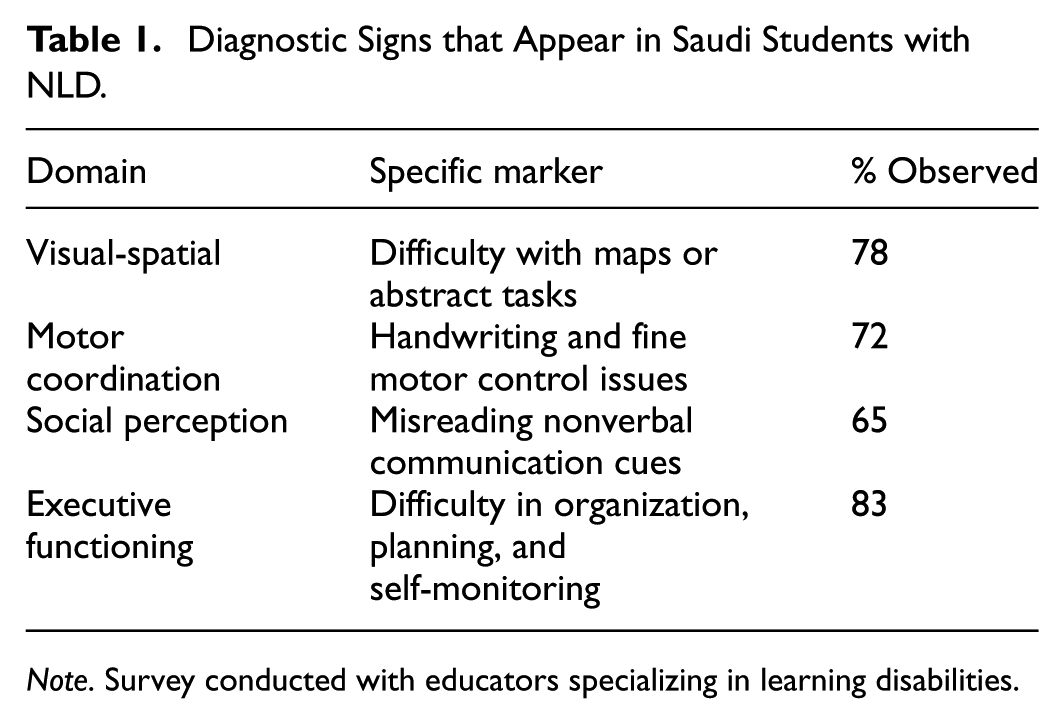
Note. Survey conducted with educators specializing in learning disabilities.
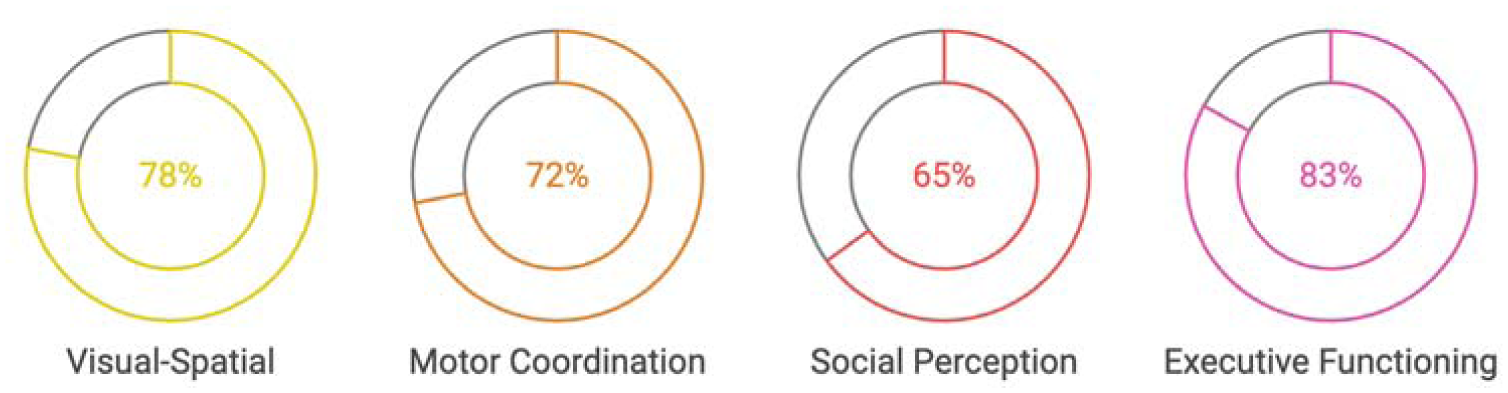
Categories of diagnostic markers in NDL students.
Motor coordination issues (72%) were rated third by the respondents. These challenges include difficulties with handwriting, use of scissors, and shoelace tying, which are often dismissed as mere clumsiness. Although the respondents clearly indicated they view this trait as linked to NLD, it is important to consider the recommendations of researchers such as Wilkinson-Smith and Semrud-Clikeman (2014), who asserted that educators and clinicians should avoid automatically linking motor-skills challenges to NLD. Wilkinson-Smith and Semrud-Clikeman (2014) argue that while some children with NLD may experience fine-motor coordination problems, motor speed alone is not a sufficient or suitable primary diagnostic criterion. They emphasize the need for further research to clearly define NLD’s neuropsychological profile. It underlines the importance of comprehensive assessments across multiple domains. And how to differentiate it from ADHD and other developmental or learning disorders.
Finally, deficits in social perception (65%) emerged as the last critical marker. Respondents indicated that students frequently misinterpreted facial expressions and other non-verbal cues, resulting in social misunderstandings. Overall, while the markers identified are consistent with findings from research conducted outside the Arab World and/or Saudi context, the distribution of the traits suggests cultural and educational influences in Saudi Arabia that warrant consideration in assessment and intervention practices.
Findings Related to the Second Research Question
To identify the most significant difficulties faced by students with nonverbal learning disabilities from the teachers’ perspective, the arithmetic mean of the participants’ responses was calculated.
The results revealed four main categories of challenges that teachers identified as being experienced by Saudi students with NLD, ranked in descending order: academic, linguistic, social-emotional, and motor skills (see Table 2 and Figure 2). Academic difficulties, particularly in mathematics and spatial reasoning, emerged as the most significant challenge. These difficulties are magnified in Saudi classrooms, where the STEM curriculum places heavy emphasis on geometry, measurement, and abstract problem-solving. The inability to manipulate and visualize spatial information may lead to persistent underachievement and reduced participation in advanced science and mathematics courses. These findings are similar to those of Mammarella and Cornoldi (2014).
Challenges Faced by Saudi Students with NLD.


Challenges faced by Saudi students with NDL from the perspective of their teachers.
Linguistic challenges were also deemed to be substantial by the participants. Students with NLD often struggle with figurative language, idiomatic expressions, and following multi-step instruction; Volden and Johnston (1999) identified similar challenges. In Saudi schools, where Arabic instruction is rich in metaphor and figurative constructs, these difficulties may create additional barriers to comprehension and participation in class discussions.
Social-emotional challenges, such as misreading facial expressions and social cues, were ranked by the respondents as the third major concern. These issues can lead to social isolation, heightened anxiety, and reduced self-esteem, as noted by Little (2002). In Saudi culture, where social cohesion and group identity are highly valued, these difficulties may increase stigma against students with NLD, intensifying their struggles, which is an issue other researchers have also identified (Alnahdi, 2019).
Finally, fine and gross motor coordination issues, that is, poor handwriting, were identified as a less prominent but still significant factor (Wilkinson-Smith & Semrud-Clikeman, 2014). Again, while our findings and previous those presented in past studies suggest that motor skills deficits are less important to the NLD diagnosis, they should be considered when potentially more impactful traits, such as visual-spatial and organizational weaknesses, are also present.
Findings Related to the Third Question
After collecting and analyzing the findings related to the first and second questions, it was possible to develop a proposed framework for the most effective intervention strategies to support the social and emotional functioning of students with nonverbal learning disabilities in Saudi schools and other settings.
To this end, we identified several strategies that effectively support students’ social and emotional functioning (see Table 3 and Figure 3). Social skills training, including role-playing and peer modelling, was found to be highly beneficial. As noted by Bellini et al. (2007), these types of approaches allow students to practice social interactions in a safe environment. Emotional regulation techniques, such as cognitive-behavioral approaches, breathing exercises, and mindfulness, have also been highlighted as key to reducing stress and anxiety in students with these challenges. Structured routines are another strategy that was identified, as predictability fosters a sense of security for students with NLD, as found by Semrud-Clikeman et al. (2016).
Intervention Effectiveness.


Intervention effectiveness which need by NDL student.
Researchers have also highlighted various strategies that improve students’ social, emotional, and academic skills. One of these is direct instruction, where lessons are broken into smaller, clear steps, often with visual aids, making learning more straightforward (Van Luit, 2009). Social skills training, a structured behavioral method, has also been found to help individuals recognize, interpret, and respond to social cues more effectively. This strategy involves role-playing, where students practice real-life social interactions in a safe environment. By practicing repeatedly and receiving feedback, children learn to use appropriate verbal and nonverbal behaviors, such as tone, eye contact, and turn-taking, turning social ideas into practiced actions. Peer modelling is also highly useful, allowing students to observe peers demonstrating proficient social behaviors, which supports learning subtle communication skills that are difficult to grasp through instruction alone. Video modelling is also useful in that it can be used to present dynamic examples of successful interactions for students to review repeatedly, improving understanding and memory. These methods together form a comprehensive approach for addressing cognitive, behavioral, and emotional learning challenges. For students with neurodevelopmental differences, like those with NLD, this multimodal approach is especially effective because it offers concrete, visual examples that help compensate for challenges with spontaneous social reasoning. The main goal is to develop socially appropriate responses and promote the generalization of skills and self-regulation, enabling students to apply these behaviors in real peer and classroom situations settings, as noted by Barnhill et al. (2002).
These approaches can be further supported by environmental modifications, such as the use of structured routines, visual aids, and adaptive learning tools in the classroom. These are accommodations that not only enhance academic performance but also facilitate greater participation in social contexts (Banker et al., 2021). Collaborative planning, particularly through Individualized Education Plans (IEPs), ensures that support is clear and consistent across home and school. Goldenring Fine et al. (2013) asserted that such plans are vital in addressing the unique needs of each student. Together, these strategies provide a practical framework for enhancing the social and emotional development of students with NLD.
Interventions are most effective when embedded within collaborative approaches that involve teachers, parents, and health professionals working in unison, thereby ensuring consistency of message and expectations across home and school (Semrud-Clikeman et al., 2016). Such collaboration is formalized in the IEP, which tailors interventions to the specific needs of each student. This method for implementation has been shown to lead to improved outcomes for students with NLD (Semrud-Clikeman et al., 2016). Finally, the increasing role of technology integration in education has provided additional pathways to support students with NDL.
Taken together, these interventions—from direct teaching strategies to social-emotional training and environmental and technological supports, which are then organized through collaborative planning—highlight the multidimensional framework required to effectively meet the needs of students with NLD.
Findings Related to the Fourth Research Question
Creating inclusive learning environments for students with NLD requires that all adult stakeholders (e.g., teachers, parents, and healthcare professionals) engage in coordinated and well-structured interventions. Teachers are at the core of this process. Their role extends beyond classroom instruction to include the early recognition of NLD traits, such as difficulties in visual-spatial reasoning, motor skills development, and social and communication skills delay. Researchers have emphasized that teachers must adapt their pedagogical methods by integrating visual supports, structured routines, and multisensory approaches to help students better access and retain knowledge (Goldenring Fine et al., 2013; Mammarella & Cornoldi, 2014). Moreover, teachers must collaborate with specialists to ensure that therapeutic interventions complement classroom practices, creating a coherent support system for students.
Parents also play a critical role in reinforcing learning and emotional stability outside the school environment. They can benefit from workshops and educational resources that provide a deeper understanding of NLD and practical strategies for use at home. By applying consistent approaches, parents can create a supportive environment that mirrors the strategies used at school. These should include maintaining structured schedules, practicing social skills through storytelling, and providing encouragement. Consistent communication between parents and teachers further ensures that children with NLD receive uniform guidance, reducing confusion and strengthening developmental outcomes (Rourke, 1989).
Healthcare professionals, including psychologists, occupational therapists, and speech-language specialists, play a vital role. Their expertise ensures accurate diagnoses, clarifies the motor skills and socio-emotional challenges of NLD, and helps develop personalized treatment plans. In addition to traditional assessments, newer techniques such as neuroimaging are increasingly utilized to enhance diagnostic accuracy and inform intervention strategies (Spreen, 2011). Therapists also provide targeted interventions, like occupational therapy to improve motor skills and cognitive-behavioral therapy to reduce anxiety and regulate emotions. In summary, teachers, parents, and health professionals must collaborate to create an inclusive learning environment for students with NLD. With coordinated efforts, students’ academic and social development can be supported effectively. When specialized and regular educators work together, outcomes improve for children with NLD and within the educational system (Figure 4 and Table 4).

Collaborative strategies to support students with NDL.
Collaborative Strategies.

Summary of Findings
By surveying teachers and analyzing their responses, we can categorize our findings. Firstly, we identified diagnostic markers, noting that, based on the survey responses, NLD in Saudi students is characterized by difficulties in visual-spatial reasoning, motor coordination, and executive functioning, and linguistic skills. These markers match those documented in the existing literature on NLD, and emphasize how these students are often overlooked or undiagnosed due to the lack of localized diagnostic tools and training (Mammarella & Cornoldi, 2014).
The findings of the current study highlight several challenges, including the significant difficulties in mathematics, reading comprehension, and social interaction students with NLD experience. These issues are further complicated by cultural stigma and limited development of inclusive education practices within Saudi Arabia. Inclusive education remains underdeveloped, and cultural factors, such as low disability awareness and bias against differentiated instruction contribute to social isolation, negative self-image, and anxiety among affected students. The authors suggest improving teacher training, tailoring curricula to students’ cognitive profiles, increasing resource-room support, and strengthening partnerships between parents and professionals to reduce academic and emotional risks. This aligns with Aldosari’s (2019) findings. The survey responses also emphasize the need for appropriate intervention strategies, including social skills training, emotional regulation techniques, and collaborative approaches involving educators, parents, and healthcare providers. Customizing these strategies to suit the Saudi context is essential for maximizing their effectiveness (Semrud-Clikeman et al., 2016). Collaboration is vital for supporting this student group. Continuous cooperation among teachers, parents, and specialists is crucial to creating inclusive environments that enhance academic performance, emotional well-being, and social participation for students with NLD, as supported by previous research (Goldenring Fine et al., 2013; Mammarella & Cornoldi, 2014).
Building on these empirical insights, the findings prompt a deeper analytical interpretation that extends beyond basic description to examine how NLD traits align with the realities of Saudi education. When teachers’ perceptions are contrasted with theoretical models and prior research, a more complex pattern emerges—affirming established neuropsychological principles while also revealing contextual limitations in classroom practice and awareness.
Teachers’ focus on executive-functioning issues as the main feature of NLD strongly supports Rourke’s (1989, 1995) right-hemisphere dysfunction model. Nonetheless, the data extend this model by illustrating how classroom settings influence its impact. In the highly verbal, teacher-centered Saudi classroom, limited autonomy and rote learning intensify students’ challenges with planning, sequencing, and self-regulation. This interaction between inherent cognitive tendencies and pedagogical structure highlights that executive functioning deficits are not static traits but vulnerabilities shaped by context. Mammarella and Cornoldi (2014) also noted that NLD’s behavioral presentation varies with environmental demands, a finding that aligns with the current study.
Visual-spatial challenges were also found to be a factor, according to our respondents, which aligns with Rourke’s (1989, 1995) and Wilkinson-Smith and Semrud-Clikeman’s (2014) descriptions of impaired right-hemisphere integration. However, this NLD trait also exposes a common misconception in education. Teachers tend to see these deficits as carelessness or inattention rather than as neurological differences in information processing. This misunderstanding echoes Wilkinson-Smith and Semrud-Clikeman’s (2014) observation that NLD is frequently ignored when visual-spatial reasoning difficulties are mistaken for lack of motivation. In the Saudi curriculum—particularly in math and science, where diagrammatic reasoning and spatial interpretation are heavily emphasized—such misconceptions can lead to ineffective remediation. These findings highlight the need for educators to view visual-spatial weaknesses not as academic failures but as a unique learning style that requires appropriate support and accommodation.
The language aspect of NLD emphasizes the interaction between cognitive and cultural factors. Participants observed that students often demonstrate verbal fluency but struggle to understand implicit meanings or to interpret figurative language. This contradiction aligns with Volden and Johnston’s (1999) concept of “surface fluency,” in which superficial language skills mask deeper comprehension problems. In the Saudi context, these effects are magnified because Arabic instruction often involves metaphorical, poetic, and religious language, all of which require inferential reasoning. Therefore, this study extends the existing research by demonstrating that linguistic symptoms of NLD are influenced by cultural contexts rather than being universal. Teaching strategies that focus on explicit instruction in inferencing and semantic awareness are essential to addressing this issue.
Social and emotional functioning provides a vital layer of analysis. The participants’ ratings of items on student anxiety, social misunderstanding, and withdrawal support the socio-emotional frameworks described by Little (2002) and Metsala et al. (2017). Yet, the current study reveals that the severity of these issues depends on the context. In collectivist cultures like Saudi Arabia, where group belonging is highly valued, even minor difficulties with nonverbal cues can lead to significant social isolation. This suggests that emotional indicators of NLD are partly shaped by cultural expectations—heightened by communal norms around empathy and conformity. Consequently, interventions should aim not only to develop skills but also to increase awareness among peers and the community to reduce stigma and foster acceptance.
Motor coordination issues, though less emphasized by teachers, still hold significant analytical importance. Wilkinson-Smith and Semrud-Clikeman (2014) warned that fine-motor challenges should not be the sole focus of NLD diagnosis; however, the current study illustrates their indirect impact on self-efficacy and classroom participation. Since neat handwriting and presentation are highly valued in Saudi education, even small motor problems can diminish students’ confidence and lead to negative teacher assessments. This highlights how seemingly minor deficits can lead to significant academic and emotional issues within a sociocultural context.
The teachers’ support for structured routines, clear instructions, and predictable environments aligns with the findings of Bellini et al. (2007) and Semrud-Clikeman et al. (2016). It also reveals an interesting analytical point: these educators employ strategies consistent with evidence-based practice even without formal training. This intuitive application indicates that practical classroom experience can sometimes pre-empt theoretical knowledge. Nonetheless, relying on intuition exposes a systemic challenge: without institutional support or continuous professional development, maintaining and implementing such practices consistently can be uncertain.
Collaboration, as participants repeatedly emphasized, appears to be both an aspiration and a necessity. While Rourke’s (1995) ecological model predicted such multi-level interaction, this study indicates that collaborative systems in Saudi schools remain under development. Teachers are willing to cooperate with specialists and families but face institutional barriers that obstruct consistent implementation. This supports what Albash (2024) stated, that while Saudi teachers and specialists in special education agree on the importance of collaborating to provide services to those with disabilities, the survey responses indicate that Saudi Arabia lacks clear directives in the form of regulations, laws, incentives, and training that would help facilitate the implementation of these practices as required.
The findings of the current study therefore emphasize an implementation gap—where the principles of inclusion are recognized but have not yet been fully embedded into school infrastructure. When considered holistically, these findings reaffirm the theoretical consensus that NLD involves an uneven cognitive profile of verbal strength and nonverbal weakness (Mammarella & Cornoldi, 2014; Rourke, 1989, 1995), while also offering a context-specific argument: that culture and pedagogy influence how these traits are expressed and managed. The value of this analysis lies in reframing NLD as a dynamic interplay between neurological predisposition and educational environment. Teachers’ perceptions reveal not only the symptoms of the disorder but also the systemic limitations that sustain them.
In conclusion, integrating empirical findings with theoretical interpretation confirms that the challenges faced by students with NLD extend beyond cognition to encompass the structural and cultural foundations of education. The study’s authors therefore urge educators and policymakers to re-evaluate diagnostic training, inclusive practices, and cultural perceptions of disability. Ultimately, this analytical discussion emphasizes that educational equity for students with NLD depends not only on remediation but also on transforming the learning environment itself—a transformation rooted in awareness, collaboration, and respect for neurodiversity.
Summary
Implications for Practice
This study highlights several actionable insights that can guide educators, policymakers, and researchers. The first of these is the need for culturally responsive approaches. Our investigation indicates that the lack of Arabic-language diagnostic tools and culturally relevant interventions remains a significant barrier. Efforts should be directed toward developing resources that reflect the Saudi context’s linguistic, cultural, and educational nuances (Alasmari et al., 2023).
Teacher training is also key; such programs and curricula must be designed to provide educators with the knowledge and skills to identify and support students with NLD. Integrating learning disability modules into teacher education curricula will help bridge this gap (Almutairi, 2022).
Enabling and encouraging parental involvement is also key. Parents play a vital role in reinforcing school-based interventions. Workshops and resources tailored to families’ needs can empower them to effectively support their children’s learning and emotional development (Alnahdi, 2019).
Finally, systemic collaboration is necessary to the success of these students and recommendations. Effective collaboration among educators, parents, and healthcare professionals is essential. Developing IEPs and including occupational and emotional therapies are crucial for providing comprehensive support (Semrud-Clikeman et al., 2016).
Limitations and Recommendations for Future Research
Despite the importance of the study findings, there are a number of limitations to this research. Due to reliance on self-reports, the findings are susceptible to response bias, as the responses may reflect subjective perceptions. Secondly, even though descriptive survey design is practical for a niche population, the use of snowball sampling may not adequately reflect the full diversity of perspectives across the Saudi educational system, which limits the generalizability of the findings. Moreover, cross-sectional design restricts the ability to observe developmental changes or long-term patterns among students with NLD; the study did not include an examination of changes or trends over time. These limitations highlight the need for future research that adopts more comprehensive and longitudinal approaches. Specifically, longitudinal studies are essential to trace the developmental trajectories of Saudi students with NLD over time. Future investigations should also examine the effectiveness of culturally adapted interventions and assess their impact on academic, social, and emotional outcomes. Additionally, further exploration of the role of emerging technologies, including neuroimaging and digital learning tools, is recommended to enhance both diagnosis and support for students with NLD. Such research would not only refine understanding of NLD within the Saudi context but also contribute to the improving inclusive education practices for this group.
Conclusion
This research examined teachers’ perspectives on the social and emotional functioning of students with NLD in Saudi Arabia using survey method. Our focus was on diagnostic markers, challenges, and intervention strategies within a culturally specific framework. The findings highlight the multidimensional difficulties these students encounter and emphasize the urgent need for greater awareness, early and accurate diagnosis, and contextually appropriate interventions. Addressing these challenges requires not only targeted support strategies but also collaboration among educators, parents, and healthcare professionals to ensure comprehensive care. The results underscore the necessity of integrating culturally responsive practices into educational policy and practice. Such integration is not merely advisable but essential to guarantee equitable learning opportunities for all students. By filling gaps in diagnosis, reducing stigma, and fostering collaborative approaches, the Saudi educational system can better support students with NLD and enable them to reach their full potential. Ultimately, this research lays a foundation for the development of evidence-based practices in Saudi Arabia while contributing to the broader global dialogue on understanding and supporting students with NLD.
Supplemental Material
sj-docx-1-sgo-10.1177_21582440261422849 – Supplemental material for Teachers’ Perspectives on the Social and Emotional Functioning of Students With Nonverbal Learning Disabilities in Saudi Arabia: Problems and Solutions
Supplemental material, sj-docx-1-sgo-10.1177_21582440261422849 for Teachers’ Perspectives on the Social and Emotional Functioning of Students With Nonverbal Learning Disabilities in Saudi Arabia: Problems and Solutions by Amani Mohammed Bukhamseen and Nourah Ibrahim Abdullah Albash in SAGE Open
Footnotes

Ethical Considerations
The researchers were keen to adhere to all ethical aspects related to conducting the research, in accordance with the standards adopted in educational studies. The study was approved by the Research Ethics Committee (REC) at King Faisal University. In addition to securing the necessary administrative permissions from the relevant authorities to facilitate the implementation of the research instruments. Informed consents were obtained from all parties involved through a form signed by each participant. The objectives and content of the study were explained to the participants. The research design was carefully developed to minimize any potential risk of harm to participants by ensuring anonymity, voluntary participation, and the right to withdraw at any time without consequences. The researchers committed to maintaining full confidentiality of participants’ data and personal information, restricting its use exclusively to scientific research purposes, ensuring that it would not be shared with any party outside the scope of the study, and storing it securely in a way that safeguards privacy. Moreover, the anticipated benefits of the study—both to the academic community and to the broader society—were deemed to outweigh the potential risks. These benefits include contributing to knowledge in the field, informing policy, and potentially improving practices related to the study topic.
Funding
The authors disclosed receipt of the following financial support for the research, authorship, and/or publication of this article: This work was supported by the Deanship of Scientific Research, Vice Presidency for Graduate Studies and Scientific Research, King Faisal University, Saudi Arabia (Grant No. KFU260388).
Declaration of Conflicting Interests
The authors declared no potential conflicts of interest with respect to the research, authorship, and/or publication of this article.
Data Availability Statement
The research data supporting the findings of this study are not publicly available due to ethical and privacy considerations. However, the data are available from the corresponding author upon reasonable request.
Supplemental Material
Supplemental material for this article is available online.
References
Supplementary Material
Please find the following supplemental material available below.
For Open Access articles published under a Creative Commons License, all supplemental material carries the same license as the article it is associated with.
For non-Open Access articles published, all supplemental material carries a non-exclusive license, and permission requests for re-use of supplemental material or any part of supplemental material shall be sent directly to the copyright owner as specified in the copyright notice associated with the article.
