



Abstract
The aim of this article is to understand whether the conditions in Portuguese public polytechnics (PPPs) when studying for a PhD are similar to those in Portuguese public universities (PPUs). Three pillars were analyzed (research, academic staff degree, and precarious rate of academic staff), and to this end, we conducted independent sample t-tests and designed a correlation matrix to shed light on the relationship between the percentage of precarious academic staff and the short-run variables in the environment of PPPs. The main findings reveal differences between PPUs and PPPs, indicating that policymakers failed to ensure that PPPs are competitive vis-a-vis PPUs in this area. Decree-Law No. 65/2018 granting PPPs the right to award doctoral degrees gives rise to a number of risks: a loss of focus in PPPs, the disappearance of the most used system in higher education (binary or dual system), and the absence of higher institutions in Portugal that provide practical training. If this is the path chosen by policymakers and the nature of course programs in PPPs and PPUs are becoming more similar, we strongly recommend that similar conditions should prevail in the two subsystems; this entails greater investment in PPPs and even the possibility of awarding PhD professional degrees in close connection with firms and corporations.
Keywords
Introduction
In recent years, Portuguese polytechnics have faced growing pressure to become more research-focused and to obtain the right to award PhD degrees, a position the Portuguese Polytechnics Coordinating Council (PPCC) has publicly defended. This internal pressure was heightened by an Organization for Economic Co-operation and Development (OECD) report (Guellec et al., 2018) stating that Portuguese polytechnics should be entitled to award doctoral degrees. Following this report, the Portuguese Minister of Science, Technology and Higher Education (Professor Manuel Heitor) set in motion the procedure to draw up a law conferring Portuguese polytechnics with this right. The Portuguese Council of Ministers’ position on the matter was formally revealed in a press release on 15th February 2018 which stated that “the door is now open for the Polytechnics to confer doctoral degrees ( . . . ).” The Minister of Science, Technology, and Higher Education added that this was a critical step in the reform of the Higher Education Sector in Portugal (Silva, 2018).
The ex-president of the PPCC (Nuno Mangas) expressed his satisfaction with the Government’s decision in a press release: “it is a positive measure that meets the guidelines of the Polytechnics and the PPCC” (Lusa News Agency, 2018). The legislative process leading to Decree-Law No. 65/2018 granting Portuguese polytechnics the right to award doctoral degrees was underway, although some criteria and conditions must be fulfilled by polytechnic institutes. Most European countries have a binary system of higher education (HE), in which there are two different types of institutions, that is, traditional (academic) universities and more vocationally oriented institutions; so why fade this system out in Portugal? And why in Portugal specifically? Are Portuguese public polytechnics (PPPs) adequately prepared to award doctoral degrees, namely in terms of the role/commitment of the professors or lecturers and the relative number and quality of research units vis-a-vis Portuguese public universities (PPUs)?
This is such a recent development that there are not yet any empirical findings on the issue. An in-depth analysis on the role of PPPs role is therefore required to fill this empirical gap within the scope of the quality of HE in Portugal. Thus, this research uses secondary data to analyze the research strength (or research quality) of R&D units, teaching quality, and management of higher education institutes (HEIs) in Portugal. Based on these criteria, our modest intention is to understand whether PPPs and PPUs have similar conditions to offer doctoral programs.
Although quality is a highly contested concept, it must be the main priority of every HEI (Tam, 2001). Based on Ghonji et al. (2015, p. 110), “teaching quality is highly dependent on its professors and the capabilities of faculty members are very important.” These authors underline the fact that teaching quality is dependent on the capabilities of professors and lecturers.
However, in their analysis of English and Scottish universities, Lopes and Dewan (2015) confirmed that teaching quality can be seriously affected by the precarious employment conditions of professors. Indeed, Courtois and O’Keefe (2015, p. 61) raised the following question: “what is the impact on equality in education of a system where students who need the most support are taught by precarious workers, whose own working conditions make it impossible to adequately support students?” Is there an over-emphasis on short-term specific skills instead of a strategic approach to HE (Martin, 2003)? Given this line of reasoning and some of the short-run variables/constraints that affect HEIs management referred in several case studies (Mair, 2015), it is important to analyze the contracts of professors/lecturers per year in PPPs and the correlation with the (a) number of courses, (b) number of students, (c) number of places available for undergraduate students, (d) number of students enrolled in all degree levels offered by PPPs (bachelor and master degrees), (e) number of new undergraduate students. These correlations will provide a clearer understanding of the role of professors/lecturers in PPPs, that is, whether they are viewed as a structural key in HE or as merely useful to satisfy a short-term need.
On the contrary, Trow (1996) recognized that research quality is fundamental for the assessment of HEIs, and Johnes (1996) included research output as a measure of performance of U.K. universities. Therefore, research quality is also an important measurement of university performance (Teichler, 2005).
The article is structured as follows. Section “The Higher Education Context in Portugal and Some European Trends” provides an overview of the binary system of HE that prevails in Portugal. This is followed by a literature review describing the state of the art of the key elements in HE for hypotheses. The methodological section explains the research design, variable measures, data analysis, and research procedures. The following section presents the results without making any subjective interpretation. Section “Discussion” discusses the empirical findings in the light of the literature review and raises several practical questions that still remain. The main conclusions are drawn in section “Concluding Remarks” before addressing policy implications, further research lines, and study limitations.
The Higher Education Context in Portugal and Some European Trends
It is important to note that Portuguese HE is predominantly a binary system composed of universities and polytechnic institutes, although we briefly present other institutions that play a critical role in the HE ecosystem.
Polytechnic institutions are oriented toward the development of applied research aimed at understanding and solving concrete problems, the provision of a solid cultural and technical training at a higher level, the development of the capacity for innovation and critical analysis, and the provision of both theoretical and practical scientific knowledge and its application for the purposes of carrying out professional activities.
On the contrary, universities are oriented toward research and knowledge creation with the aim of ensuring a solid scientific and cultural preparation, providing the technical training necessary for professional and cultural activities, and fostering the capacities of design, innovation and critical analysis.
The above descriptions, based on the Basic Law of the Educational System in Portugal established by law 46/1986 and updated by laws 115/1997, 49/2005, and 85/2009, are evidence of the difficulty faced when interpreting and distinguishing between the competences of the two types of HEIs.
However, the two systems are in fact quite different. While the Portuguese polytechnics provide a more practical training and are profession-oriented, the HE in universities is grounded on a strong theoretical base and focuses heavily on research. For instance, Portuguese polytechnics offer a short cycle of studies entitled curso técnico superior profissional (CTeSP), which normally last four curricular semesters including a training period in the workplace. In addition, they offer bachelor and master programs. Prior to Decree-Law No. 65/2018, doctoral programs were only available in Portuguese universities.
We should also underline two critical institutions for science and HE in Portugal: Fundação para a Ciência e Tecnologia (FCT) and Agency for the Evaluation and Accreditation of Higher Education (simplified by the acronym A3ES). The FCT is the reference of scientific research and technology development. Most scientific research in Portugal is conducted in R&D institutions financed and evaluated by the FCT. The research encompasses all scientific fields, from life and health sciences to social sciences and humanities, from engineering and exact sciences to natural and environmental sciences. The FCT currently finances 342 public and private R&D units in Portugal. Moreover, it evaluates the quality of research of institutes or faculties inside public and private research institutions and gives them a scientific category. There are six qualitative scientific categories: exceptional, excellent, very good, good, fair, and poor. The category awarded has a great impact on the level of financing received from the budgetary funds provided by FCT. A3ES is the authority for the evaluation and accreditation of HEIs and their study cycles in Portugal. According to the Directorate General for Higher Education, A3ES is “an independent body vis-à-vis state and institutions and aims to promote and ensure quality in higher education.”
The two HE subsystems in Portugal (PPPs and PPUs) have been complementary, just as in most European countries (Kyvik, 2004; Machado et al., 2008). Indeed, the binary system is common in Europe, in other words, the universities’ role is complemented by professional and vocational HEIs; according to Lepori et al. (2016); only the United Kingdom and France have unitary systems, but there is evidence that more countries are adopting this system in Europe (Santoalha et al., 2018). In fact, the name given to the HEIs providing practical training and profession-oriented teaching varies across countries: polytechnic institutes, vocational universities, professional universities, polytechnic universities, technical universities, applied technological universities, college of higher vocational studies, or, the most common, universities of applied sciences. Notwithstanding, excluding the United Kingdom and France, doctorate degrees in Europe are usually offered by universities and not by the vast majority of the above HEIs.
The benefits of a binary system lie in the diversity of HE (Codling & Meek, 2006; van Houten, 2018) with professional and vocational HEIs spread across different regions more than universities (Santoalha et al., 2018; Teichler, 2008; Teixeira et al., 2014a). Despite the prevalence of the binary system across Europe, there are signs of tensions between the two subsystems (Santoalha et al., 2018), and it is argued that the binary system protects university clientele (Marginson, 2016).
Under a neo-institutionalist approach, some isomorphic pressures tend to homogenize different HEIs (Lepori et al., 2014) leading to convergence into a unitary system (Pinheiro et al., 2019). Despite the trend toward a homogenized and unified system brought by the Bologna process (Witte et al., 2008), it is important to note the return to the binary system in Finland, Switzerland, and Austria (Lepori et al., 2014).
Regardless of the HE system and despite Bologna reform, each country has its own idiosyncrasies. Nevertheless, Pinheiro and Young (2017, p. 119) highlighted European “efforts to modernize university systems in the context of rising competition and pressures toward vertical and horizontal differentiation,” assuming this fact as a current trend in HE.
Literature Review and Hypothesis Development
The notion of quality in HE is viewed in different ways (Lindsay, 1992), and there is little consensus on its definition (Westerheijden et al., 2007). Quality depends on the views of different stakeholders (Harvey & Green, 1993; Newton, 2010) which Srikanthan and Dalrymple (2007) argue can be divided into four main groups: users of services (students), providers (funding bodies and the community, taxpayers), users of outputs (employers), and employees of the sector (academics and administrators).
Coates (2005) discusses students’ engagement as an element of quality, while Warn and Tranter (2001) address the extent to which the development of graduates’ generic competencies predicts students’ perceptions of the overall quality of their degree or its fitness for purpose for entry into the workplace. Marsh (1987) emphasizes the relevance of students’ perceptions as a measure of quality in HE and conducted a review of the extensive literature on the use of student evaluations and their link with teaching effectiveness. Moreover, Ramsden (1991, p. 132) argues that students can contribute to the quality assessment in several domains of HE, such as: “enthusiasm and interest of teachers; clear organisation and goals; feedback on learning; the encouragement of student independence and active learning; an appropriate workload and relevant assessment methods; the provision of a suitably challenging academic environment.”
On the contrary, employers see quality primarily in terms of the outputs (Chua, 2004), namely the skill set that the student brings to the workplace. Employers’ views on the quality of a range of capabilities of university graduates have remained consistent over time (Shah et al., 2015).
Despite the students’ and employers’ contributions to the assessment of HEI quality, this study focuses on the perspective of providers and HE employees, that is, only on endogenous factors of the HEIs.
Providers of HE play a vital role in both the quality and assessment of the institutions. Quality is often judged by the institution’s reputation and the level of its resources (Astin & Solmon, 1981), which are provided by government, funding agencies or private initiative. Highlighting governments’ obvious function as resource providers, Zaman (2015, p. 7) argues that “Policymakers’ objectives should be to ensure scientific achievement, to create new opportunities and to place the teaching, research, economic and social sectors on one line.”
Research is conducted by a wide range of actors from inside and outside HEIs, and it reflects different interests and backgrounds. In line with the Bologna and Lisbon processes, scientific research on HE is receiving growing attention (Brennan & Teichler, 2008); Teichler (2005) and Frenken et al. (2017) confirmed the importance of the research level as a measurement of university performance.
Governments and authorities around the world are trying to allocate more funds for research purposes. For example, in Finland, which is frequently recognized for its exemplary education, polytechnics and universities of applied sciences neither engage in research nor offer postgraduate education (Geuna & Martin, 2003). Therefore, Teixeira et al. (2014b) conclude that between 2003 and 2009, PPUs had a stronger research mission than PPPs. Even in the United Kingdom, which “granted” university status to polytechnics in 1992, the conclusion remains the same; when comparing “old” universities to the “new” universities (former polytechnics), the “old” ones have a much higher level of research (Morgan, 2004). The evidence is so clear that an analysis conducted by research orientation in 19 countries only includes universities awarding doctorate degrees (i.e., it excludes polytechnics and teaching-focused colleges) (Bentley et al., 2015). Given these facts, PPUs are likely to have more and higher ranked research centers than PPUs. In light of these differences in HE, we should test the following hypothesis for Portugal:
Hypothesis 1: PPUs have more and better-ranked research centers than PPPs.
Governments are therefore not only the providers of resources for HE, but they also play a regulatory role in assuring quality. For instance, government regulation helped resolve the crisis of HE in Africa, Asia, and Latin America (Neave & van Vught, 1994). Although HE in most countries is largely financed by governments, according to Landry and Neubauer (2016), this is not the case in the United States, where radical changes in the financial structure over the past 30 years have led to a significant reduction in public funding. But whether funding is public, private, or blended, Usman (2014) notes that effective policy has an impact on HE and defines strategic directions and resources that can achieve institutional missions with quality. Another regulatory function of the public, private, or blended institutions is to assure quality in HE (Trow, 1996); although each country has national-level accreditation and quality-assurance systems, it is necessary to harmonize the quality of HE to facilitate education mobility across countries, cultures, and jurisdictions (Altbach & Knight, 2007). The providers of HE have a direct (or indirect) influence on the quality of their academic staff, and as argued by Hennig-Thurau et al. (2001), the quality of teaching and the students’ emotional commitment to their institution are crucial for student loyalty.
Chatterji and Kiran (2017) argue human capital also has a significant influence on HEI performance. From Becker’s view, human capital is simply the formal education and skills acquired in and out of the job context (Becker, 1962, 1964); as a result, educational attainment is often used as a proxy for human capital levels (OECD, 1998) even though this can be measured in other ways (Noe et al., 2017).
In the academic environment, teacher quality can be effectively assessed by teachers’ certification (Goldhaber & Anthony, 2007). For instance, the Times Higher Education World University rankings evaluate the teaching domain by means of the ratio of doctorates to bachelors and the ratio of doctorates awarded to academic staff, among other indicators. As such, the link between quality teaching and the qualifications of teaching staff is becoming recognized quality criteria. In addition, the Bologna process has put pressure on professors to strengthen their research and competencies profiles, and notably to hold a PhD degree.
Professors’ qualifications influence teaching quality (Cochran-Smith, 2003) and “teacher preparation and certification are by far the strongest correlates of student achievement” (Darling-Hammond, 2000, p. 1). Moreover, public pressure on universities leads to improvements in the quality of education generally and the teaching qualities of the lecturers/professors in particular (Keesen et al., 1996). Portugal is no exception to this trend. There is intense public and institutional pressure on lecturers/professors, and holding a PhD is an almost mandatory requirement for teaching. Drawing on the findings of Teixeira et al. (2014b) for a sample of 30 Portuguese HEIs between 2003 and 2009, the qualifications of academic staff (measured by the number of staff with PhDs in HEIs) increased significantly but PPUs have far more academic staff with PhDs than PPPs. In light of this, we propose the following hypothesis:
Hypothesis 2: In Portugal, PPUs have more PhD professors/lecturers per student than PPPs.
The academic role of employees in the sector is divided into the three domains of teaching, research, and service (Houston et al., 2006); teaching and research are the predominant areas (Cadez et al., 2017), while service or administration takes a secondary role.
However, a precarious academic environment (professors on short-term contracts) may reduce motivation and lead to declining student attendance (Kalleberg, 2009). Typically, temporary adjunct professors have little job security due to their contingent duties, and their students express less interest in their subjects than those of full-time faculty members (Bettinger & Long, 2004). A seminal article by labor economists defines contingent work as “any job in which an individual does not have an explicit or implicit contract for long-term employment or in which the minimum hours worked can vary in a nonsystematic manner” (Polivka & Nardone, 1989, p. 11). This is usually the work typology of part-time professors, invited professors, or temporary/guest adjunct professors in HEIs.
The journal New Directions for Higher Education published a special issue documenting the fact that poor institutional assimilation by part-time faculty adversely affects student learning. The effects included reduced instructional quality, lack of curricular cohesion, and weak guidance (Benjamin, 2003a, 2003b; Cross & Goldenberg, 2003; Elman, 2003; Schuster, 2003; Thompson, 2003; Townsend, 2003). University teaching, an occupation Aronowitz (2001) referred to as “the last good job in America,” is also becoming precarious with the risk of negative long-term consequences such as lower teacher quality.
Several studies suggest that part-time adjunct professors increase college dropout rates (Bettinger & Long, 2007; Ehrenberg & Zhang, 2005), reduce students’ interest in a course (Bettinger & Long, 2004), or inflate grades and have negative impacts on subsequent outcomes when compared to full-time faculty members (Ran & Xu, 2019). Leslie (1998) pointed out that part-time adjunct professors often do not have PhDs or other terminal degrees and so may provide inferior instruction. Part-time professors may also provide poorer supervision, be less committed to teaching, and less willing to extend teaching beyond the classroom (Pisani & Stott, 1998), leading to worse outcomes for students and increased workloads for full-time faculty (Marotta, 2019). In addition, as temporary faculty are generally dissatisfied with their employment conditions (Fulton, 2000; Gappa & Leslie, 1993), some researchers question whether this adversely affects their job performance (Barnes & O’Hara, 1999; Leslie, 1998) and reduces commitment to the HEIs (Barnes & O’Hara, 1999). Professors and lecturers who are in nontenure-track positions, namely guest professors and part-time professors in Portugal, are both hired for a limited period of time.
Increasing competition, constraints on expenditure and the pressures on science and universities to foster a knowledge-based economy have resulted in an over-emphasis on short-term specific skills rather than a strategic vision for HE (Martin, 2003). Furthermore, Mair (2015) explores in detail short-term paths to manage HEIs, and some variables within this short-term approach are relevant to our analysis. However, a long-run, strategic, and planning approach should prevail over short-run management in HEIs (Strike, 2017), as the latter entails high risks (Martin, 2003).
In fact, the emphasis on short-term specific skills rather than a strategic vision for HE has given rise to constraints that can affect the length of academics’ contracts. Although the short-term view is rightly criticized, it does have the advantage of a scale effect (Wingfield, 2012) and cost-savings when recruiting temporary professors (Marotta, 2019); however, these advantages are not applicable at the PhD level. This scale effect is not evident in PhD programs where full-time students usually take 3 to 5 years to complete their studies (Wingfield, 2012). Supervisors’ involvement with HEIs and their students during PhD studies is vital, and teacher instability through temporary contracts can undermine this relational trust (Bernal et al., 2015).
Portuguese HEIs have faced cuts in funding and a decline in the number of applicants (Henriques et al., 2018); the trend toward full-time professors in universities has not been seen in polytechnics in Southern Europe (Gubareva et al., 2017); and finally, the aforementioned scale effect can occur due to the fact that undergraduate courses are the core of professional/vocational HEIs. This leads to the following hypotheses:
Hypothesis 3a: The number of invited or part-time lecturers/professors in PPPs is positively related to a short-run approach to the academic environment.
Hypothesis 3b: The rate of precarious contracts for academic staff in PPPs is higher than in PPUs.
To sum up, the research hypotheses were based on two pillars of Boliver’s (2015) work: research activity and teaching condition.
Methods
Data
HEIs in Portugal are composed of 16 PPUs and 15 PPPs. However, some PPUs also have polytechnic schools (seven) and other HE schools (five) that complete the polytechnic system in Portugal. Thus, it is more correct to say that Portugal has a total of 27 units in the Polytechnic system, and we refer to all of these as PPPs. Indeed, this is also how the Direction of Education and Science Statistics in Portugal separates the university system (16 HEIs) from the polytechnic system (27 HEIs). On average, according to this last source, PPUs had 184,617 students per year from 2001/2002 to 2017/2018, while PPPs had 108,535 students per year.
To test the research hypotheses, secondary data on the HE system were gathered from the FCT and the Direction of Education and Science Statistics in Portugal. As our aim is to understand the arguments underlying the structural change in Portuguese HE reflected by Decree-Law No. 65/2018, the data available until this legal norm (no later than 2018) must be collected.
Drawing on Mair’s (2015) case studies and the aforementioned sources, the following variables guiding a short-term approach in HEIs management are used: number of undergraduate programs, number of student places per year, student enrolment, and entry of new students. Descriptive statistics are available in Appendix A (Hypothesis 1), Appendix B (Hypothesis 2), and in Appendix C (Hypotheses 3a and 3b).
Research Outline and Procedures
As the objective is to compare PPUs and PPPs in different dimensions through Hypotheses 1, 2, and 3b, independent samples t-tests were applied to determine whether there was a significant difference in the population of the two sample means (PPUs and PPPs). Following normality tests (Shapiro–Wilk or Kolmogorov–Smirnov tests) to address the normality of data, parametric, or nonparametric independent samples t-tests were performed.
On the contrary, whether normal distributed (Pearson correlation) or nonnormal distributed data (Spearman’s rank correlation or Kendall’s rank correlation), Hypothesis H3a was tested using a correlation matrix to understand the relationship between the rate of precarious employment and the short-run variables of the academic environment.
Excluding the first hypothesis (where the number of PPPs is even higher than the number of PPUs), some variables must be harmonized to permit comparisons as a result of the substantial difference in the size of PPPs and PPUs. To overcome this issue, two ratios were created:

where i represents each HEI and t is the academic year (2001/2002 to 2017/2018).

where i represents each HEI and t is the academic year (2010/2011 to 2015/2016).
Results
Research
Out of 342 R&D Units financed by FCT, currently only 18 are primarily linked to PPPs; that is, the vast majority are directly or indirectly run by PPUs. This means that approximately 5% of all R&D units financed by FCT are directly led by PPPs. Furthermore, data provided by FCT confirm that there are 53 private R&D institutions (approximately 16% of R&D units) and 271 R&D units led by PPUs (approximately 79% of R&D units). These data clearly demonstrates the relative insignificance of R&D units run by PPPs in the academic ecosystem.
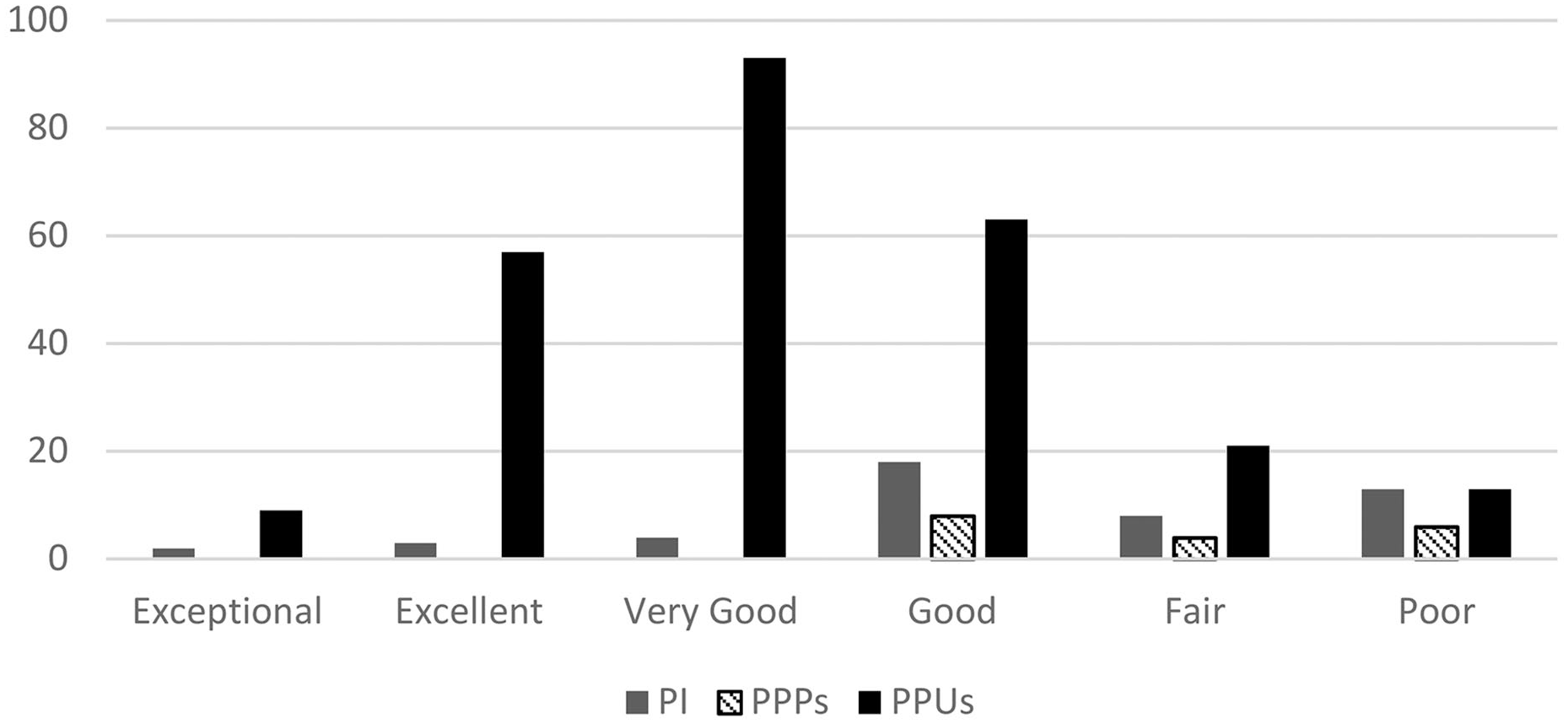
Turning to the FCT assessment of R&D units, the last assessment is from 2013 when 322 R&D units from PPPs (18 R&D units), PPUs (256 R&D units), and private institutions (48 R&D units) were evaluated as exceptional (highest score) to poor (lowest score). Figure 1 provides an overview of the R&D units assessment.
Assessment of Portuguese R&D units in 2013.
Figure 1 shows that none of the PPP R&D units obtained a grade of “very good”; indeed, they were all evaluated as “good,” “fair,” or “poor.” In contrast, more than 86% of the PPU R&D units were evaluated as at least “good.”
It is useful to transform those variables of the grade scale to ordinal variables ranging from 6 (exceptional) to 1 (poor). First, the normality of the grade scale must be tested (Table 1).
Tests of Normality (Grades of R&D Units).

Lilliefors significance correction.
Table 1 shows that grade variable does not follow a normal distribution; therefore, nonparametric tests should be used to compare the PPP R&D units with the PPU R&D units by evaluating the mean difference between them (Tables 2 and 3).
Sums of Ranks.

PPPs = Portuguese public polytechnics; PPUs = Portuguese public universities.
Test Statistics.

Note. Grouping variable (R&D units).
Tables 2 and 3 show that the grades of R&D units in PPUs are higher than the grades of R&D units in PPPs. This difference was statistically significant (1% level) in the two HEI, and the official data are conclusive. Thus, our first hypothesis that PPUs have more and better-ranked research centers than PPPs is confirmed. On average, the grades of R&D units in PPUs (3.73) are approximately 76% higher than in PPPs (2.11)—see Appendix A.
Qualifications of Academic Staff
Similarly, to determine the ratio of PhD Professors to students, it is necessary to confirm the normal distribution of the data (Table 4).
Tests of Normality.

Lilliefors significance correction.
Considering the ratio over 17 years (2001/2002 to 2017/2018) for PPUs and PPPs with a significance level of 5%, both tests allow us to reject the null hypothesis of data normality. Thus, nonparametric tests are performed.
Although small samples are generally criticized as they cannot benefit from central limit theorem, that is, to use distribution-based test, a nonparametric test allows us to analyze the difference between the academic staff with a PhD in PPPs and in PPUs over 17 years (2001/2002 to 2017/2018)—Tables 5 and 6.
Sums of Ranks.

Note. HEI = higher education institution; PPPs = Portuguese public polytechnics; PPUs = Portuguese public universities.
Test Statistics.

Note. Grouping variable (HEI). HEI = higher education institution.
Tables 5 and 6 show that there is a higher prevalence of academic staff with PhD per student in PPUs than in PPPs. This difference was statistically significant (1% level) in the two HEI and the official data are conclusive. According to the Direction of Education and Science Statistics, there were 12,009 professors with a PhD in PPUs compared with 4,452 in PPPs in 2017/2018. These results allow us to confirm the second hypothesis, namely that PPUs have more PhD professors/lecturers than PPPs. Moreover, descriptive statistics show that, on average, PPUs have more than twice as many academic staff with a PhD degree per student (.0525) as PPPs (.0205)—see Appendix B.
Precarious Environment and Short-Term Contracts
Following the previous procedures, the normality of the variables related to the precarious environment in PPPs must be tested (Table 7).
Shapiro–Wilk Test.

Note. PPPs = Portuguese public polytechnics.
The Shapiro–Wilk test presented in Table 7 allows us to conclude that none of the variables follow a normal distribution (p values < .05); therefore, nonparametrical tests, such as Spearman’s rank correlation or Kendall’s rank correlation (instead of Pearson correlation) must be used to analyze the correlation between variables.
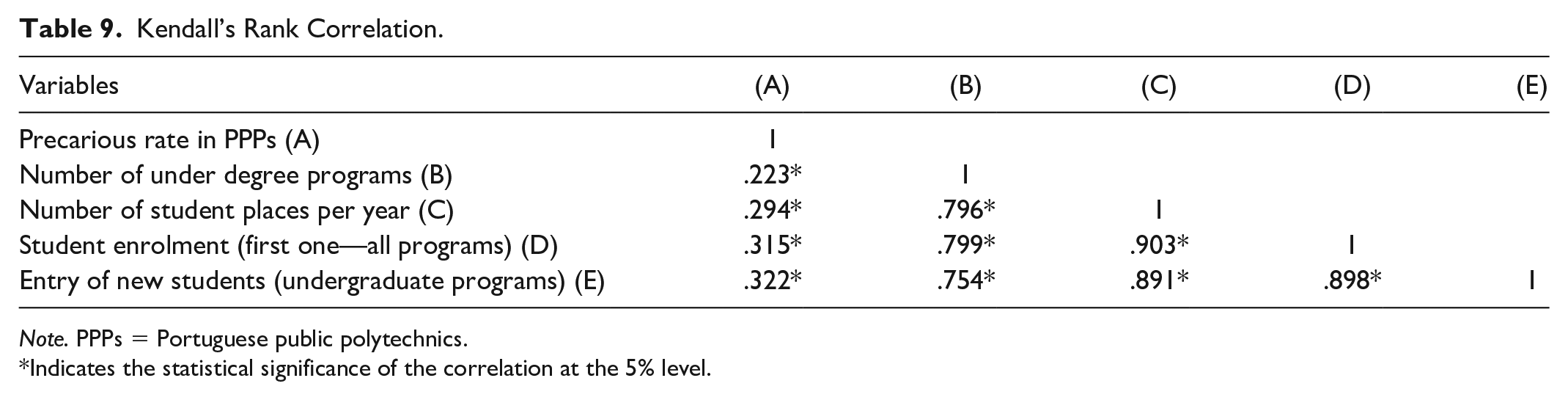
The results from Tables 8 and 9 show that the precarious rate in PPPs is positively related to the short-run contingencies (the variables presented in the first row). The higher the number of undergraduate programs, number of student places per year, student enrolments or entry of new students, the greater the precarious rate in PPPs. Regardless of the rate, the correlations between the precarious rate in PPPs and the other variables (linked to short-run contingencies) are always statistically significant in both correlation tests, as shown in Tables 8 and 9. This finding supports the third hypothesis, namely that the flow of invited or part-time lecturers/professors from PPPs in Portugal is positively related to the short-run academic environment.
Spearman’s Rank Correlation.

Note. PPPs = Portuguese public polytechnics.
Indicates the statistical significance of the correlation at the 5% level.
Kendall’s Rank Correlation.
Note. PPPs = Portuguese public polytechnics.
Indicates the statistical significance of the correlation at the 5% level.
Having confirmed that the precarious rate did not follow a normal distribution through nonparametric tests (Table 7), it is then necessary to determine whether there is any difference between the precarious rate in PPPs and PPUs (Tables 10 and 11).
Sums of Ranks.

Note. HEI = higher education institution; PPPs = Portuguese public polytechnics; PPUs = Portuguese public universities.
Test Statistics.

Note. Grouping variable (HEI). HEI = higher education institution.
The null hypothesis of equal population means (PPUs and PPPs) is rejected; Tables 10 and 11 show that the precarious rate in PPPs is higher than in PPUs, and this difference was statistically significant (1% level). These results support Hypothesis 3b, namely that the precarious rate of academic staff is higher in PPPs than in PPUs. On average, from 2010/2011 to 2015/2016 academic years, the majority of academic staff in PPPs are precarious (54.73%); the precarious rate in PPUs (32.31%) is 22.42 percentage points below that of PPPs (see Appendix C).
Discussion
The three pillars analyzed (research, academic staff degree, and the precarious rate of academic staff) reveal substantial differences between PPUs and PPPs. Given the resources available and the research level on these two systems, it can be concluded that PPUs are better prepared to offer PhD programs than PPPs; moreover, the overriding objective of PPPs is to provide a practical training and deeply profession-oriented studies. In addition, the binary system makes HE more diverse (Codling & Meek, 2006). The measure proposed by the Portuguese government shows further discontinuity with the roles attributed to PPPs and therefore disrupts their specific teaching and research activities.
Offering PhD courses is not in line with the key purpose of PPPs and, more importantly, it will change their space in HE, their relevant role in human capital training and their preparation of students for the labor market. In other words, this measure means PPPs will be teaching the highest level in the HE system but with conditions below those offered by PPUs. This raises three potential problems: (a) PPPs could lose their focus on practical and vocational teaching in the HE system, (b) there is a real risk that practical and vocational teaching will no longer be available in the HE system, and (c) the PPPs are now PPUs’ direct competitors but do not have the same conditions.
We should be aware that “HEIs and their staff are involved in multiple games, with competing goals and different rules. Meanwhile HE policy-making often lacks coherence, with contradictory outcomes in different areas of policy” (Trowler & Bamber, 2005, p. 79). The results reveal the huge gap between PPUs and PPPs and confirm policymakers’ aforementioned lack of coherence with the introduction of this measure in the Portuguese HE system. Indeed, it has practical consequences.
In addition to confirming that PPUs have more and better-ranked research centers than PPPs, the results also reveal that research in PPPs is very weak. PPPs are far from assuring the scientific achievement defined by Zaman (2015). Therefore, where should the PhD students from PPPs conduct their research work? Do the few research centers run by PPPs have the necessary conditions to support the work of PhD students? Do PPPs have research facilities where PhD students feel they can work well?
Further to this critical issue, the results confirmed the second hypothesis that PPUs have more PhD professors/lecturers per student than PPPs, although it should not be neglected the remarkable evolution of PPPs on this domain, particularly in the last decade. Given the importance of qualifications to teaching quality (Cochran-Smith, 2003) and students’ achievement (Darling-Hammond, 2000), how can PPPs offer a PhD course if only 44% of their academic staff had a PhD degree in 2018 according to the Direction of Education and Science Statistics in Portugal? How many PhD theses can a professor be expected to supervise? How many courses should be given by a professor in a PhD program?
Last but not least, Hypotheses 3a and 3b confirmed the prevalence of short-term contracts among academic staff in PPPs, which fosters a short-term academic environment. This may lead to poor student attendance (Kalleberg, 2009), increase student dropout rates (Bettinger & Long, 2007; Ehrenberg & Zhang, 2005), reduce academic staff’s commitment (Barnes & O’Hara, 1999) and even seriously affect teaching quality (Courtois & O’Keefe, 2015; Lopes & Dewan, 2015). From a conceptual and management point of view, PPPs may suffer from what Martin (2003) refers to as an over-emphasis on short-term specific skills rather than a strategic vision of HE. It should be stressed that most academic staff in PPPs (almost 55% in the last academic year available) have a precarious labor contract. This is a huge barrier to teaching in PPPs generally (Courtois & O’Keefe, 2015) but in particular in PhD courses which require a deep bond between the PhD student and his or her supervisor (Lee, 2008). These findings raise the following questions:
In PPPs, how can a professor with a precarious employment situation (typically a 6-month or 1-year contract) supervise a PhD thesis which usually takes 2 or 3 years to complete?
How should such a professor react in these circumstances?
Should a professor with a precarious contract refuse to supervise a PhD student?
How might fee-paying PhD students respond when their research proposal is rejected by a professor with a precarious contract?
Are policymakers and people responsible for PPPs aware of this issue?
These are pertinent questions because the prevalence of short-time contracts of academic staff in PPPs is not in keeping with the supervision period of a PhD thesis, or even a Master thesis (which all PPPs can also offer nowadays).
Concluding Remarks
Given the research level, the human capital (academic staff) and their (short-term) contract conditions, the main findings of this study confirm that the Portuguese government did not ensure that PPPs have the same conditions to provide PhD courses as PPUs. However, Decree-Law No. 65/2018 introduced this change in line with the OECD recommendation (Guellec et al., 2018) and the ambitions of PPCC. Thus, there are no apparent reasons to change the HE system not even a malfunction of Portuguese technology and knowledge transfer system between HEIs and industry can be raised, particularly because academics have been positively engaged in processes of technology transfer in Portugal (Sá et al., 2018). In fact, the technology and knowledge transfer system fosters innovation strengths due to the economic structure in Portugal, which is not highly specialized (Mamede, 2017). On the contrary, if policymakers want to implement this measure successfully, urgent action must be taken to promote public investments and reinforce organizational capabilities in PPPs.
Education policymakers should ensure that the HE system “must be prioritized, properly resourced, and measures taken to develop a hospitable environment for it both structurally and culturally” (Trowler & Bamber, 2005, p. 79). As this has not happened in Portugal, any measure aligning the two HE subsystems into one system makes PPUs and PPPs competitors, to the disadvantage of PPPs, as confirmed by the research hypotheses. Clearly, this might endanger the binary or dual system that is found in Portugal and across most of Europe.
Although the alignment of the two systems might undermine the educational roots, proposals, and mission of PPPs, it is recognized that they play a key role in the Portuguese HE system (Amaral & Magalhães, 2005) and have a marked impact on regional development (Alves et al., 2015). This measure is risky for the binary system, and if policymakers decide to follow that path they should ensure that PPPs have much better research facilities and a steady increase in the number of Professors with PhD degree. In particular, positions should be opened for full-time faculty on a tenure track; this will help bring the stability of faculty staff necessary to assure a deep research engagement between the PhD student and his or her supervisor, as defended by Lee (2008).
Under the current law, whereas PPPs are allowed to offer both short courses and PhD programs, PPUs are not allowed to offer short courses (CTeSP); therefore, theoretically PPPs can offer a wider of courses than PPUs. At least, PPPs should enjoy similar conditions to PPUs so that there is fair competition between the two subsystems. In other words, this transition path from a binary to unitary HE system in Portugal not only implies the same career and incentive-based funding systems, but also an in-depth revision of the guidelines of the HE system. Given the potential disruption this would cause, Portuguese policymakers should be aware of lessons learned and the consequences of HE reforms in the United Kingdom; see for example, Marginson (2018); Goglio and Regini (2017); and Boliver (2015).
It is also important to note some limitations of this study. In particular, the time span of analytical analysis differs from the first to the third hypothesis due to data availability. The short time-series analyzed and the focus on endogenous factors of the HEIs (providers and employees) are also limitations. Our approach focuses on just two pillars of HEIs and neglects the other dimensions suggested by Boliver (2015): academic selectivity, economic assets, and socio-economic condition of students.
Turning to future lines of research. As the OECD appears to favor ending the binary or dual system in Portuguese HE, it might be appropriate to analyze the differences (academic research, human capital, and human capital conditions) between the two subsystems in another country or countries. The measure implemented in Portugal should be monitored carefully over the next few years to determine its success, mainly from the employers’ perspective of the skill set students bring to the workplace (Chua, 2004) in a range of their capabilities remain consistent in time (Shah et al., 2015). Under the circumstances and during this process, the hypothesis of introducing professional doctorate programs (in close connection with firms and corporations) in Portuguese HE, more aligned with PPPs purposes, should not be neglected.
Finally, the current Portuguese Minister of Science, Technology, and Higher Education, Professor Manuel Heitor stated in 2016 that the [qualification of skilled people, teaching staff and their link with society is] a continuous process, long-term framework, while understanding the role played by science–university relationships, besides the currently dominant policies of approaching science through short-term, demand-driven economic development issues. (Heitor & Horta, 2016, p. 147)
If this is the case, some questions remain:
Doesn’t this measure take a short-term approach to science?
What changed between 2016 and 2018?
These questions may also challenge researchers to find a justification for the “invitation” given to PPPs to offer PhD courses despite having poorer conditions than PPUs.
Footnotes
Appendix A
Descriptives.

| HEI | Statistic | SE |
|---|---|---|
| Grades of R&D units | ||
| PPP | ||
| M | 2.11 | .212 |
| 95% confidence interval for mean | ||
| Lower bound | 1.66 | |
| Upper bound | 2.56 | |
| 5% trimmed mean | 2.12 | |
| Median | 2.00 | |
| Variance | 0.810 | |
| SD | 0.900 | |
| Minimum | 1 | |
| Maximum | 3 | |
| Range | 2 | |
| Interquartile range | 2 | |
| Skewness | −.237 | .536 |
| Kurtosis | −1.808 | 1.038 |
| PPU | ||
| M | 3.73 | .072 |
| 95% confidence interval for mean | ||
| Lower bound | 3.59 | |
| Upper bound | 3.87 | |
| 5% trimmed mean | 3.77 | |
| Median | 4.00 | |
| Variance | 1.327 | |
| SD | 1.152 | |
| Minimum | 1 | |
| Maximum | 6 | |
| Range | 5 | |
| Interquartile range | 2 | |
| Skewness | −.451 | .152 |
| Kurtosis | −.035 | .303 |
Note. HEI = higher education institution; PPPs = Portuguese public polytechnics; PPUs = Portuguese public universities.
Appendix B
Descriptives.

| HEI | Statistic | SE |
|---|---|---|
| Ratio (academic staff with PhD/students) | ||
| PPPs | ||
| M | .0205 | .00274 |
| 95% confidence interval for mean | ||
| Lower bound | .0147 | |
| Upper bound | .0263 | |
| 5% trimmed mean | .0203 | |
| Median | .0178 | |
| Variance | .000 | |
| SD | .01131 | |
| Minimum | .01 | |
| Maximum | .04 | |
| Range | .03 | |
| Interquartile range | .02 | |
| Skewness | .478 | ,550 |
| Kurtosis | −1,150 | 1,063 |
| PPUs | ||
| M | .0525 | .00163 |
| 95% confidence interval for mean | ||
| Lower bound | .0491 | |
| Upper bound | .0560 | |
| 5% trimmed mean | .0528 | |
| Median | .0542 | |
| Variance | .000 | |
| SD | .00670 | |
| Minimum | .04 | |
| Maximum | .06 | |
| Range | .02 | |
| Interquartile range | .01 | |
| Skewness | −.742 | ,550 |
| Kurtosis | −.183 | 1,063 |
Note. HEI = higher education institution; PPPs = Portuguese public polytechnics; PPUs = Portuguese public universities.
Appendix C
Summary Statistics, Using the Observations 1:1 to 27:6.

| Variable | M | Median | Minimum | Maximum |
|---|---|---|---|---|
| Number of under degree programs | 53.1914 | 49.5000 | 1 | 168 |
| Opened program vacancies | 876.883 | 635.000 | 20 | 3,281 |
| Students inscription (first one—all programs) | 4,180.94 | 2,928.00 | 112 | 17,988 |
| New students entry (under degree programs) | 908.444 | 603.500 | 25 | 4,130 |
| SD | C.V. | Skewness | Ex. kurtosis | |
| Number of under degree programs | 43.3550 | 0.815077 | 0.626470 | −0.480093 |
| Opened program vacancies | 811.725 | 0.925694 | 1.22660 | 0.833759 |
| Students inscription (first one—all programs) | 4,277.57 | 1.02311 | 1.67583 | 2.26133 |
| New students entry (under degree programs) | 939.821 | 1.03454 | 1.67947 | 2.37454 |
Declaration of Conflicting Interests
The author(s) declared no potential conflicts of interest with respect to the research, authorship, and/or publication of this article.
Funding
The author(s) received no financial support for the research and/or authorship of this article.
