




Abstract
This study investigates the relationship between educational mismatch and wage penalties, with a specific focus on the moderating influence of skill proficiency across various occupational contexts in the United States. Utilizing data from the OECD’s Program for the International Assessment of Adult Competencies (PIAAC), the analysis examines how literacy and numeracy skills shape the economic outcomes of workers whose educational qualifications exceed the requirements of their positions. The findings reveal that educational mismatch is frequently associated with wage penalties; however, the extent of these penalties varies considerably across occupational categories. Furthermore, workers with stronger literacy and numeracy skills are shown to experience smaller wage penalties, as their advanced proficiencies enable them to meet job demands more effectively and demonstrate greater productivity. However, the degree to which skill proficiency reduces wage penalties depends on the specific requirements and structures of different occupations. By analyzing the interaction between educational mismatch, skill proficiency, and occupational variation, this study contributes to a more detailed understanding of wage disparities and highlights the importance of targeted skill development programs. These findings have significant implications for workforce policies, suggesting the need for initiatives that align skill enhancement with labor market demands to mitigate the economic challenges posed by educational mismatch.
Plain Language Summary
Why was the study done?
This study examined whether the association between overeducation and wages differs by occupational category, and whether foundational skills—specifically literacy and numeracy—are linked to variations in this relationship. The goal was to better understand how skill levels are related to wage differences among overeducated workers in distinct job types.
What did the researchers do?
Using data from the OECD’s Programme for the International Assessment of Adult Competencies (PIAAC), the researchers analyzed U.S. adult workers across multiple occupational categories. They assessed wage differences associated with overeducation and tested interaction terms between overeducation status and skill proficiency to determine whether these associations varied by job type and skill level.
What did the researchers find?
The analysis showed that overeducation is generally associated with lower wages, but the strength of this association varies by occupation. Importantly, the interaction terms between overeducation and foundational skills were statistically significant only in certain occupations. Among clerks, service workers, and sales workers, higher literacy and numeracy scores were linked to smaller wage differences between matched and overeducated workers. However, for high-skill occupations such as legislators, senior officials, and managers, the interaction terms were not statistically significant, suggesting that skill proficiency was not related to changes in wage differences associated with overeducation in those roles. These results indicate that the association between overeducation and wages, as well as the role of foundational skills, is highly dependent on occupational context.
Introduction
Educational mismatch, defined as the misalignment between workers’ educational qualifications and job requirements, is a notable concern in the United States labor market. Approximately 26.2% of highly educated workers occupy positions that do not necessitate a college degree, indicating a vertical mismatch (Li & Lu, 2023). This misalignment often leads to inefficiencies in labor markets, with overqualified workers earning less than their skills might suggest and underqualified workers struggling to meet job demands (Garibaldi & Colombo, 2019). These mismatches can contribute to wage disparities, as individuals unable to align their educational backgrounds with occupational requirements may face lower wages and limited career advancement opportunities. The persistence of this issue reflects ongoing structural challenges in labor markets, including the dynamic nature of job demands and the uneven distribution of opportunities across sectors, making it an important area for further study.
While a substantial body of literature has established that workers with educational attainment exceeding the requirements of their positions tend to receive lower wages than their adequately matched peers (Green & McIntosh, 2007; Hartog & Oosterbeek, 1988; Quinn & Rubb, 2006; Rumberger, 1987; Verdugo & Verdugo, 1989), these studies have often assumed that the consequences of educational mismatch are uniform across all occupational settings. However, emerging evidence indicates that the magnitude of wage penalties varies significantly depending on job characteristics, particularly the complexity and core competencies required for specific occupations (Korpi & Tåhlin, 2009; Levels et al., 2014; McGuinness & Sloane, 2011). This finding has implications for non-traditional learners, such as adult workers pursuing continuing education, who may face challenges related to educational mismatch as they navigate diverse occupational contexts.
Traditional models of educational mismatch often implicitly assume that mismatched workers possess surplus education but lack alignment with job requirements. However, research increasingly suggests that workers’ core competencies—such as literacy, numeracy, and problem-solving—play a pivotal role in mitigating wage penalties (Chevalier & Lindley, 2009; Green & McIntosh, 2007). For adult learners, who frequently gain competencies through non-traditional pathways such as professional certifications, on-the-job training, and continuing learning, these core abilities can serve as essential tools for improving productivity and adaptability. In occupations with higher demands for core competencies, advanced proficiencies may reduce the negative impacts of educational mismatch, allowing workers to effectively leverage their skills despite over-qualification. Conversely, in occupations with fewer demands for such competencies, surplus education without practical application may result in persistent wage penalties.
This study leverages the Program for the International Assessment of Adult Competencies (PIAAC) dataset (OECD, 2013), which provides direct measures of foundational core competencies, including literacy, numeracy, and problem-solving abilities. PIAAC includes standardized, skill-based assessments that capture actual proficiency levels, enabling a more precise examination of how these competencies influence labor market outcomes. By incorporating these robust indicators, this research moves beyond the traditional reliance on formal educational credentials alone. For non-traditional learners and adult workers, PIAAC data offers a unique opportunity to examine how foundational competencies interact with educational mismatches across diverse occupational categories. In doing so, the study identifies contexts where strong core competencies mitigate wage penalties and others where their impact is less pronounced. For instance, occupations that demand higher levels of adaptability and problem-solving may allow workers to capitalize on their competencies, even when overeducated, whereas occupations with rigid or standardized task structures may offer fewer opportunities for such alignment.
This inquiry holds relevance for policymakers, educators, and workforce development professionals supporting non-traditional learners. The findings emphasize that continuing education programs must prioritize the cultivation of foundational core competencies—such as literacy, numeracy, and problem-solving—rather than focusing solely on credential attainment. Continuing learning opportunities that emphasize adaptability and transferable skills are essential for enabling adult learners to improve their employment prospects and economic outcomes (Al-Omary et al., 2024; Bakwa Kanyinga et al., 2023; Chen & Ding, 2015; Grafen, 1991). Moreover, recognizing the variability of wage penalties across occupational categories highlights the need for tailored interventions that address the specific challenges faced by workers in different labor market contexts. Policies that integrate continuing education with competency development can help bridge the gap between workers’ qualifications and occupational requirements, reducing the economic disadvantages associated with educational mismatch.
Based on these considerations, this study addresses the following research questions:
To what extent is over-education associated with wage penalties in the U.S. labor market, controlling for demographic and job-related covariates?
How does the magnitude of over-education related wage penalties vary across major occupational categories?
Do foundational skill levels in literacy and numeracy moderate the relationship between over-education and monthly wages, and does this moderating effect differ by occupation?
To address these research questions, this study uses a nationally representative dataset to examine how educational mismatch, skill proficiency, and wage interact. Our findings show that over-education generally leads to wage penalties, which vary across occupations, and that literacy and numeracy skills moderate this relationship differently by job category. To present these results, the article first reviews relevant literature, then details the dataset and measurement methods, followed by the analytical approach and empirical findings focusing on occupational differences and skill moderation. The article concludes with policy implications and future research directions.
Literature Review
Wage Penalty in Educational Mismatch
Historical studies, including those by Rumberger (1987) and Verdugo and Verdugo (1989), established the foundational understanding of the economic impact of over-education. These pioneering works utilized classical econometric models to illustrate that overeducated workers tend to earn less than their adequately educated counterparts. Rumberger’s analysis of the U.S. labor market demonstrated that overeducated individuals suffered wage penalties, which could be attributed to factors such as reduced job satisfaction and lower productivity in roles that did not fully utilize their skills. Similarly, Verdugo and Verdugo’s research confirmed these findings across different datasets, reinforcing the notion that over-education results in economic disadvantages for affected individuals. These early studies set the stage for subsequent research exploring the multifaceted nature of over-education.
Since these seminal works, numerous studies have examined the mismatch between education and employment. Most of this literature has confirmed that some workers are either overeducated or undereducated relative to the educational requirements of their job categories, with over-education typically associated with a wage penalty. That is, overeducated workers tend to earn less than their adequately educated counterparts, even after controlling for other individual characteristics (Green & McIntosh, 2007; Hartog & Oosterbeek, 1988; Quinn & Rubb, 2003, 2006; Verhaest & Omey, 2012). Meanwhile, Research examining the wage effects of over-education presents mixed findings, particularly when unobserved heterogeneity is considered. Some studies report that the observed wage penalties diminish or even vanish once unobserved individual characteristics are accounted for (Bauer, 2002; Tsai, 2010). However, other research suggests that such penalties persist, especially among workers with lower educational attainment, even if the effect attenuates at higher levels of education (Frenette, 2004). Further complicating the picture, Chevalier and Lindley (2009) find that wage penalties associated with over-education remain statistically significant even after controlling for unobserved factors, implying a more robust and structural relationship. Additionally, methodological variations across empirical studies have been cited as a potential source of these inconsistencies, as demonstrated in a meta-analytical reanalysis (Rubb, 2003). Together, these studies show the importance of accounting for both skill heterogeneity and methodological design when assessing the wage implications of over-education.
Quintini (2011) further contributed to this discourse by examining the broader economic contexts and labor market conditions that influence the severity of wage penalties. Her research indicated that the economic environment, including factors such as labor market rigidity and the demand for specific skills, plays a significant role in determining the extent of wage penalties for overeducated workers. It shows the relationship between over-education and wages can be varied by a variety of external factors, making it necessary to consider the broader labor condition when analyzing wage penalties.
Recently, Eguia et al. (2023) studied the long-run effects on wages for workers who initially entered the labor market overeducated but later secured jobs for which they were correctly matched. Their findings indicate that wages of those who manage to overcome initial over-education do converge, albeit very slowly, to the wages of those who were correctly matched from the beginning. This slow convergence points to the existence of scarring effects in wages due to an initial overeducation situation. They also present evidence on the influence of occupational characteristics on wages, beyond just education.
Although a substantial body of research has examined educational mismatch and its wage effects, many prior studies tend to focus either on aggregate wage penalties or on a limited range of occupational categories, often without fully incorporating individual differences in skill proficiency. While these contributions have laid important groundwork for understanding the general consequences of overeducation, they offer only partial explanations of how foundational skills such as literacy and numeracy relate to wage outcomes in specific job contexts (Chevalier & Lindley, 2009). Moreover, existing research has not always adequately addressed the considerable variation in wage penalties across occupational groups, thereby overlooking how the effects of overeducation may differ depending on job-specific characteristics and expectations (Eguia et al., 2023; Quintini, 2011). In this regard, McGuinness (2006) suggests that overeducation is not a uniform phenomenon and that its consequences are shaped by both contextual and individual-level factors, highlighting the importance of more disaggregated approaches that attend to occupational heterogeneity.
Wage Penalty Heterogeneity in Educational Mismatch Across Occupations
Since the foundational works of Rumberger (1987) and Verdugo and Verdugo (1989), it has been recognized that the wage penalty associated with overeducation varies across different occupational categories. These early studies primarily focused on specific samples, such as workers with a bachelor’s degree, or on the workforce, without thoroughly examining variations in wage penalties among distinct job groups. While some occupations show significant wage penalties due to overeducation, others exhibit little to no such penalty. However, previous research has often overlooked these differences, highlighting the need for more detailed analysis across heterogeneous job categories.
Although the relationship between wage penalties and overeducation across job categories has not been directly analyzed in some studies, evidence suggesting that this relationship varies depending on job characteristics can be found in research exploring broader labor market dynamics. For instance, Korpi and Tåhlin (2009) analyzed Swedish labor market data and demonstrated that wage penalties are more pronounced in jobs with lower skill requirements. Their findings suggest the importance of differentiating between various job types when evaluating the impact of overeducation on wages, as the economic consequences are not uniformly distributed across the labor market.
Similarly, Levels et al. (2014) expanded the scope of analysis by examining data from multiple European countries, suggesting that the impact of overeducation on wages may vary across different labor market and educational contexts. Since labor markets could differ in their structure and dynamics, the way overeducation influences wages may also vary accordingly. Furthermore, given that each occupational group might operate within distinct labor market segments, the heterogeneous effects of overeducation across job categories could be shaped by the unique characteristics of these segmented markets. This perspective highlights the potential importance of analyzing overeducation and wage penalties with careful attention to both national labor market conditions and occupational heterogeneity.
McGuinness and Sloane (2011) conducted a more in-depth examination of the heterogeneity in wage penalties across different occupations, identifying that unskilled blue-collar workers face the most significant wage reductions. Their research highlights the pronounced impact of overeducation in sectors where the skills obtained through formal education are less applicable to job performance, resulting in greater wage penalties. However, while this study offers a detailed analysis, it is limited by its focus on specific occupational categories, potentially overlooking the variability of wage penalties across a broader range of job types. By concentrating on unskilled blue-collar workers, the research may miss important distinctions in other occupational sectors where the relationship between overeducation and wage penalties could differ.
Existing studies have advanced our understanding of how overeducation relates to wage penalties across occupational groups and labor market systems. For instance, prior research has clarified that the incidence and magnitude of overeducation-related penalties are not uniform and can vary based on job characteristics or institutional contexts (McGuinness & Sloane, 2011; Levels et al., 2014). These contributions offer important insights into structural and occupational differences. However, many of these analyses do not incorporate direct measures of individual skill proficiency, such as literacy and numeracy, in explaining wage variation. As a result, it remains unclear how foundational skills interact with educational mismatch to shape wage outcomes within and across occupations.
Educational Mismatch, Wage Penalty, and Skill Development
The existing literature has examined the potential for incorporating targeted skill development into educational curricula for adult learners as a means to ameliorate the wage penalties associated with educational mismatch. This approach is grounded in human capital theory, as articulated by Becker (1964), and subsequent advancements in educational research. Becker’s work posited that investment in skill development, particularly through focused training and ongoing professional education, can enhance worker productivity and mitigate the economic disadvantages linked to educational mismatch. This theoretical perspective emphasizes the importance of skills as a crucial component of human capital, which can be leveraged to counteract the negative effects of educational mismatch.
Building upon this foundation, recent scholarship has proposed a model centered on lifelong learning and continuous skill enhancement (Bertola & Koeniger, 2018; Swain-Oropeza et al., 2023). These studies argue that continuous skill development enables adult learners to maintain competitiveness in an evolving labor market, thereby reducing the probability and impact of educational mismatch. Furthermore, Chevalier and Lindley (2009) have argued that adult learners with higher skill levels might be better able to leverage their education in ways that are not captured by simple job-education match metrics. Their research suggests that proficiency in critical skills, such as problem-solving and effective communication, can allow workers experiencing educational mismatch to apply their abilities in ways that justify higher wages, even when their formal education exceeds job requirements.
Recent studies highlight the role of continuing education in fostering skill development, improving professional outcomes, and addressing evolving labor market demands. Across multiple fields, continuous professional development (CPD) activities have been shown to enhance core competencies such as problem-solving, communication, and adaptability. For example, CPD significantly improved health professionals’ competencies, professional behaviors, and client outcomes, with long-term positive effects on career progression (Al-Omary et al., 2024; Bakwa Kanyinga et al., 2023). Beyond the medical sector, continuing education enables professionals in engineering and industrial fields to remain competitive amidst rapid technological advancements (Grafen, 1991). Innovations in flexible teaching methods further help address skill gaps in business, technology, and vocational education, ensuring alignment between education and industry needs (Chen & Ding, 2015). A recent study suggests that wage penalties from overeducation may be exacerbated by AI-driven automation, especially in routine-intensive occupations with low skill complementarity (Brunetti & Mussida, 2025). Collectively, these studies demonstrate that continuing education fosters essential skills, reduces wage penalties associated with educational mismatch, and ensures professionals remain adaptable and productive in dynamic occupational environments.
Furthermore, other empirical studies across various labor markets further demonstrate the mitigating effect of skill proficiency on wage penalties associated with educational mismatch. Green and McIntosh (2007) show the critical role of foundational skills in reducing wage disparities. They call for educational systems that prioritize the development of core competencies such as literacy and numeracy, which are essential across a wide range of occupations. Similarly, Leuven and Oosterbeek (2011) show that adult workers with strong foundational skills frequently command higher wages than their less skilled counterparts, even in jobs that do not formally require their level of education. Similarly, research by Dolton and Silles (2008) in the UK labor market revealed that adult learners who continuously develop their skills through lifelong learning and professional development are better positioned to negotiate higher wages, despite experiencing educational mismatch.
Recent findings further suggest the possibility that foundational skills, such as literacy and numeracy, may contribute to reducing wage disparities among adult learners, with their impact potentially varying across different occupations. Quintini’s (2011) research supports this view, showing that skill proficiency can influence the extent of wage penalties across different economic contexts, particularly in rigid labor markets where job mobility is limited. Notably, her findings suggest that adult learners in rigid labor markets benefit more from skill proficiency, as it allows for better adaptation to specific role demands. This highlights the value of continuing education in helping workers align their core competencies with the requirements of their occupations. In occupations that demand high levels of foundational skills, continuing education allows workers to improve their productivity and reduce wage penalties associated with educational mismatch. Conversely, in lower-skilled occupations, the impact of skill development may be less significant, leading to sharper wage penalties where education does not align with job demands.
While existing literature suggests the importance of foundational skills and continuing education in addressing wage disparities, much of this work has primarily examined the direct relationship between skill proficiency and wages, or has assessed educational mismatch without explicitly modeling its interaction with skills across diverse occupational settings. As a result, the extent to which literacy and numeracy moderate wage penalties associated with overeducation remains insufficiently explored. Moreover, few studies have jointly accounted for occupational heterogeneity and skill variation when analyzing the wage implications of educational mismatch (Chevalier & Lindley, 2009; Quintini, 2011). This study seeks to address this gap by examining how the relationship between overeducation and wages may vary across occupations and foundational skill levels, using direct measures of literacy and numeracy.
Data and Method
Data
This study aims to dissect the intricate relationship between overeducation and its subsequent wage penalties, with a special focus on the moderating influence of workers’ skill levels. Utilizing the cross-sectional PIAAC conducted between 2011 and 2012, which employs a four-stage stratified random sampling design to achieve a nationally representative sample of non-institutionalized individuals aged 16 to 65 (OECD, 2013), we endeavor to explore the consistency of the interplay among overeducation, wage penalties, and individual skill levels across a variety of occupational fields. To ensure valid variance estimation, Balanced Repeated Replication (BRR) is applied using 80 replicate weights provided by the PIAAC dataset. These replicate weights are derived by repeatedly drawing half-samples and adjusting weights based on a Hadamard matrix, allowing for unbiased standard error estimation that reflects the complex survey design (OECD, 2013).
The comprehensive scope of PIAAC data facilitates the examination of conceptual frameworks proposed in this article, as it provides a wide range of indicators including directly assessed literacy and numeracy proficiency scores, educational attainment, occupational classification, employment status, contract type, monthly wages, and key demographic characteristics such as age, gender, race/ethnicity, and other relevant background variables. For this analysis, we draw upon 2,095 cases, excluding those not employed, self-employed, students, and retirees, and also limit our sample to exclude armed forces and skilled agriculture and fishery workers due to the scarcity of information on these groups.
Measure
In measuring variables indicative of educational mismatch—specifically, years of overeducation and undereducation—our study engages with an array of methodologies previously utilized in scholarly investigations to define educational misalignment. These methodologies include subjective evaluations, where the perceptions of individuals regarding the minimum education required for their job roles are considered; objective criteria, such as the application of the Dictionary of Occupational Titles, adopted by Rumberger (1987), to determine the necessary educational levels for specific job fields; and statistical matching techniques. The latter, exemplified by Verdugo and Verdugo (1989), identifies required schooling by calculating deviations from the mean educational level within each job category. Each method possesses inherent strengths and challenges, often making the selection of a specific approach dependent on the availability of data.
Our analysis benefits from the statistical matching approach pioneered by Verdugo and Verdugo (1989), which has been utilized in recent studies (Allen & Velden, 2001; Eguia et al., 2023; Esposito & Scicchitano, 2022; Shin & Bills, 2021; Tsai, 2010; Verhaest & Omey, 2012). This approach is particularly effective for our dataset, which is well-suited to this framework. Crucially, our data includes detailed records on both the required years of education for various job categories and the actual years of education completed by individuals. This comprehensive dataset enables the accurate estimation of the mean and standard deviation of educational years across job categories, facilitating a precise classification of overeducation and undereducation. The PIAAC provides an intricate breakdown of job categories by the labor characteristics, and specifically categorized into eight job area; (1) legislators, senior officials and managers; (2) professionals; (3) technicians and associate professionals; (4) clerks; (5) service workers and market sales workers; (6) craft and related trades workers; (7) plant and machine operators and assemblers; and (8) elementary occupations.
To construct the categorical thresholds for overeducation and undereducation, we first estimate the mean and standard deviation of educational attainment for each occupational group in the PIAAC dataset. These values serve as the empirical basis for classifying individuals’ mismatch status, rather than describing sample characteristics. Legislators, senior officials, and managers show an average educational attainment of 15.8 years (SD = 2.2). Professionals show the highest average at 16.6 years (SD = 2.2). Technicians and associate professionals have an average of 14.0 years (SD = 2.2). Clerks display an average of 13.5 years (SD = 2.0). Service workers and shop and market sales workers show an average of 12.4 years (SD = 2.4). Craft and related trades workers have an average of 12.0 years (SD = 2.1). Plant and machine operators and assemblers show an average of 11.6 years (SD = 2.2). Finally, elementary occupations have the lowest average educational attainment at 10.8 years (SD = 2.5). An individual’s years of education that exceed one standard deviation from the category mean are classified as overeducation, with the surplus years calculated by subtracting this deviation from the individual’s total years of education. Conversely, undereducation is quantified in a similar but opposite manner. This threshold has been widely used since Verdugo and Verdugo’s (1989) work as a common approach to identifying educational mismatch across occupations (Allen & Velden, 2001; Eguia et al., 2023; Esposito & Scicchitano, 2022; Shin & Bills, 2021; Tsai, 2010; Verhaest & Omey, 2012).
In the exploration of the correlation between overeducation and wage disparities, this study employs the foundational framework of Mincer (1974) earning function, integrating three primary variables that are intrinsic to Mincer’s formulation: job experience, years of educational attainment, and the square of job experience, all of which are treated as continuous variables. The dependent variable in our analysis is the monthly wage. Additionally, we incorporate essential demographic information, including race/ethnicity, gender, and type of employment contract. Gender is categorized as a dichotomous variable with female as the reference group. To capture ethnic diversity, we distinguish among Black, Hispanic, and Other ethnic groups, using White as the reference category. Similarly, employment contract type is bifurcated into dichotomous terms, with full-time employment serving as the reference group.
Lastly, we account for literacy and numeracy skill levels. Utilizing the Item Response Theory, the PIAAC dataset provides ten plausible values for literacy and numeracy skills, scaled from 0 to 50. We employ the mean of these ten values for both literacy and numeracy skills in our analysis. However, because the literacy and numeracy skill scores are highly correlated—with a Pearson correlation coefficient of .918—there is a risk that including both variables in the same model may obscure their individual associations with wages. To avoid potential interpretive ambiguity, each score is modeled independently. Additional VIF checks for each model confirmed that the estimates were not distorted by problematic collinearity, with all values well below the conventional threshold of 5.
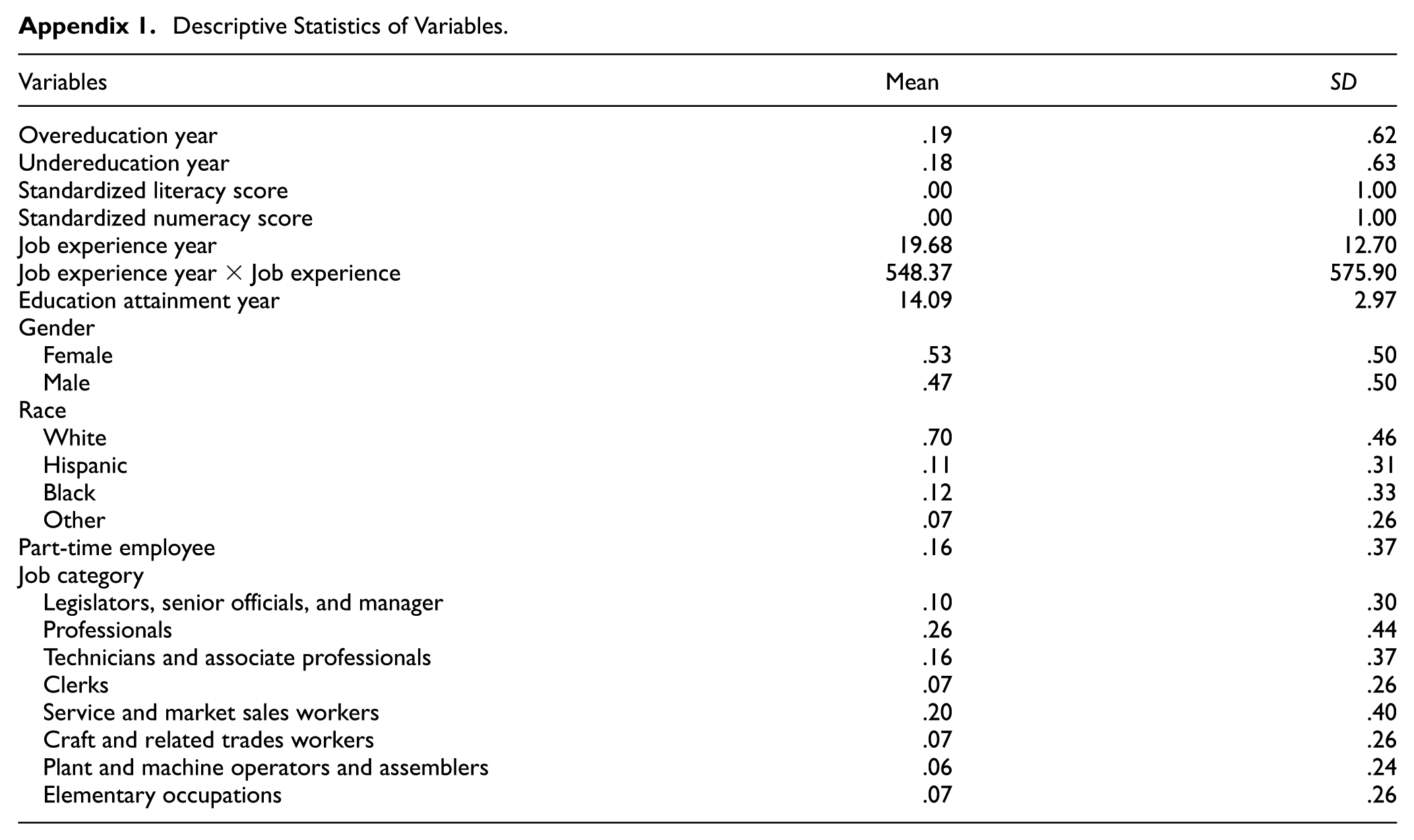
The descriptive statics of the variables are presented in Appendix 1.
Analytical Approach
To gauge the mitigating role of individual’s skill level on the relation between educational mismatch on wages, we primarily employ the pronounced Mincer’s equation:

where log(

where
To investigate the moderating effects of skill levels on the adverse impact of overeducation on earnings, our analysis incorporates interaction terms between years of overeducation and the individual’s proficiency in literacy and numeracy using the following equation:

Subsequently, marginal effects were calculated to discern the adjustments in income levels attributable to varying durations of overeducation across different skill strata. Through the visualization of these marginal effects, we articulate the differential relationship between overeducation and income levels, contingent upon skill level, while holding all other covariates constant at their mean values. Essentially, margin effects capture the sensitivity of income to overeducation, conditional upon the levels of literacy and numeracy competency. This methodological approach facilitates a more intuitive understanding of the interplay between overeducation duration and skill levels in determining income disparities.
Finally, subgroup analyses are conducted across eight specified job categories using Equations 2 and 3, deliberately omitting the job category variable to examine how wage penalties associated with overeducation manifest across various sectors and to what extent skill level serves as a mitigating factor.
Findings
Our analytical framework comprises three distinct equations: one excluding skill scores, and the others incorporating literacy and numeracy scores, respectively. The findings are delineated in Table 1. Notably, the coefficients associated with years of overeducation are consistently negative and statistically significant across all models, indicating that overeducation may precipitate a reduction in wages when other variables are held constant. This reveals that individuals with overeducation receive lower wages compared to their counterparts with equivalent educational attainment, once factors such as job experience year, gender, race, job condition, and category are controlled for, thereby experiencing a wage penalty. This phenomenon persists in models incorporating literacy and numeracy scores.
Predicting Wage Level as a Function of Overeducation and Skill Level.
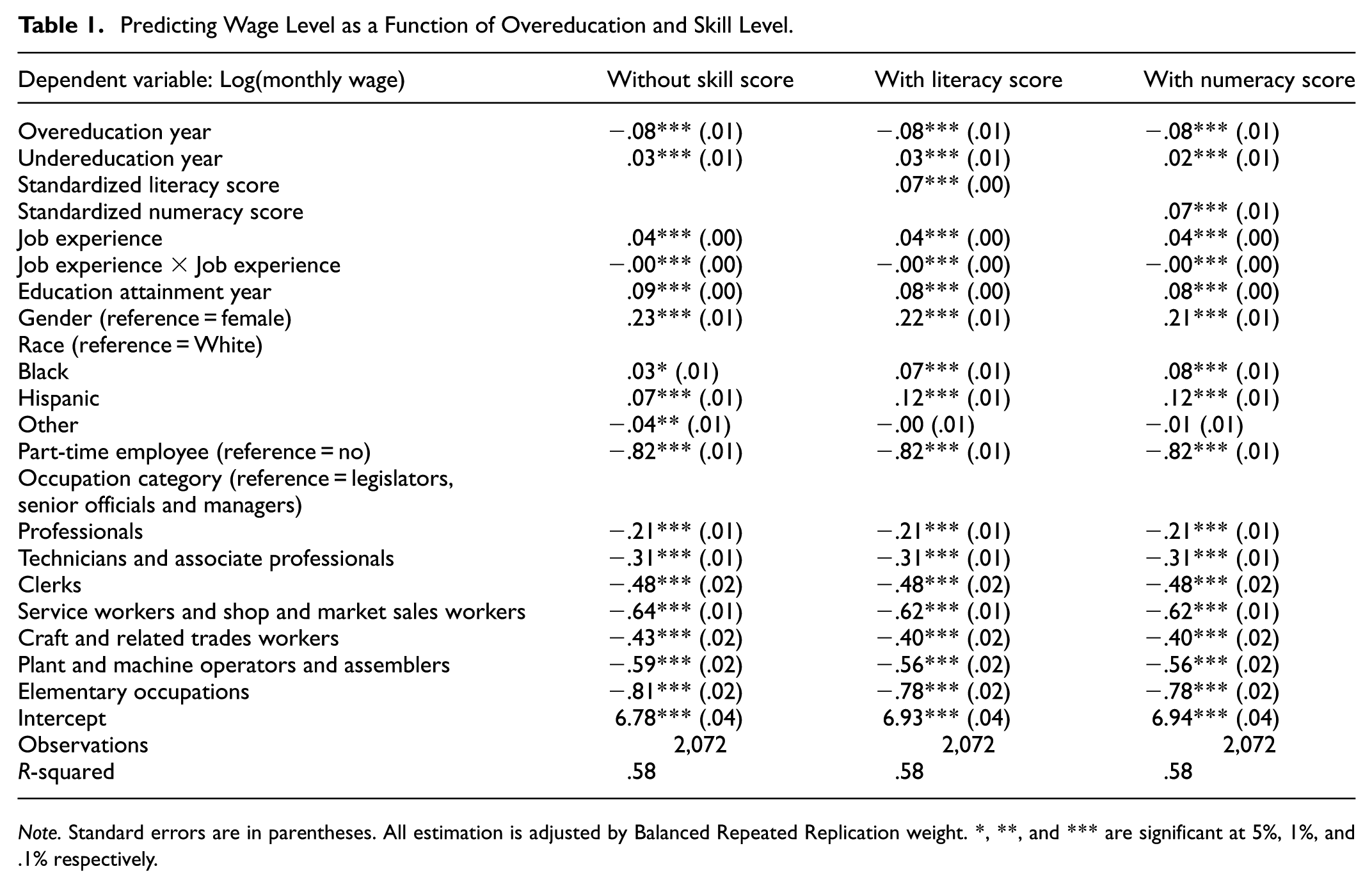
Note. Standard errors are in parentheses. All estimation is adjusted by Balanced Repeated Replication weight. *, **, and *** are significant at 5%, 1%, and .1% respectively.
In contrast, the coefficients for years of undereducation are positive and statistically significant. However, since years of educational attainment are already controlled for in the model, this result does not imply that individuals with less education earn more. Rather, it indicates that among individuals with the same educational background, those who are employed in positions requiring higher qualifications—classified as undereducated—tend to earn more than those working in jobs aligned with or below their educational level. This likely reflects the wage returns to upward occupational mobility or superior labor market signaling.
We also found that literacy and numeracy scores are positively associated with monthly wages, even after controlling for educational attainment. A one standard deviation increase in either skill score is associated with an estimated 7% increase in income, reinforcing the independent contribution of foundational skills to wage outcomes.
Next, Table 2 provide insights into the relationship between job overmatching, job undermatching, and wages, across different job categories, using three distinct models for analyzing monthly wages. Model 1, which does not incorporate skill scores, serves as the base for our discussion. The analysis across various job categories reveals that overeducation is generally associated with a decrease in wages. This suggests that when individuals possess more educational qualifications than their job demands, and accounting for their actual level of education and job experience, there tends to be a negative association with their wages. These findings reinforce the notion that surplus education, when not matched by job demands, is often not rewarded in the labor market.
Predicting Wage Level as a Function of Overeducation and Skill Level Across Job Categories.

Note. Monthly income has been transformed by taking its natural logarithm. All estimations have been adjusted using Balanced Repeated Replication (BRR) weights. The shaded area indicates the 95% confidence interval. The marginal effect represents the relative percentage change in monthly income when the number of years of overeducation increases by one, with all other variables held constant. Standard errors are in parentheses. The results of control variables (job experience, job experience squared, education year, gender, race/ethnicity, part-time) are omitted. All estimation is adjusted by Balanced Repeated Replication weight. Model 1 does not in include skill score. Model 2, and 3 include literacy, and numeracy score, respectively. *, **, and *** are significant at 5%, 1%, and .1% respectively.
Conversely, in Category 3 (Technicians and associate professionals), and Category 8 (Elementary occupations), overeducation years is not significantly associated with wages, suggesting a different dynamic in how education beyond the required level interacts with wage outcomes in this category. The lack of statistical significance may reflect broader educational flexibility in these fields, or possibly the limited economic returns to surplus education in routine or less credential-sensitive roles. This differentiation could imply that overeducation’s effect on wages is contingent upon the specific occupational requirements and how additional education beyond these requirements is valued within each field.
Notably, a one standard deviation increase in standardized literacy score corresponds to an approximately 18% increase in monthly wages for Category 1 occupations, even after controlling for education, experience, and other covariates. This finding shows the substantial role of foundational skills in wage determination at higher occupational levels. Similar strong associations are observed for Category 2 (Professionals), whereas in lower-skilled occupations, such as Category 8 (Elementary occupations), literacy and numeracy scores show weak or non-significant associations with wages. These results suggest that skill proficiency yields greater returns in occupations that involve complex tasks, decision-making, and communication.
We also found a general positive association between undereducation years and wages across most job categories. This suggests that, after controlling individuals’ actual years of education and work experience, those classified as undereducated—that is, employed in positions that typically require more education than they possess—tend to earn higher wages than peers with similar educational backgrounds in lower-level jobs. This likely reflects the wage benefits associated with upward occupational mobility rather than the returns to having less education.
However, this positive association is not uniform across all job categories. Specifically, in Category 1 (Legislators, senior officials, and managers) and Category 3 (Technicians and associate professionals), the positive association seen elsewhere does not hold. This indicates that in these fields, undereducation relative to job requirements may not confer the same potential wage benefits as in other sectors. For high-level managerial or technical roles, where specific educational backgrounds might be more closely tied to job performance and expectations, having less education than typically required could more directly impact wage outcomes.
Finally, Figure 1 provides a visual representation of the marginal effects of overeducation on monthly income, interacting with literacy and numeracy competency levels. This figure is derived from the results of an interaction that is reported in Table S1 (Online Supplement). The figure consists of two panels, with the left panel illustrating literacy and the right panel depicting numeracy. Each panel features a trend line based on standard deviations, reflecting competency levels: one standard deviation below the mean, the mean itself, and one standard deviation above the mean. These trend lines, all situated below the zero axis, indicate that as the number of overeducation years increases, there is a consistent decrease in monthly income, irrespective of literacy or numeracy levels. However, the slope of the lines suggests that the magnitude of income reduction is inversely related to the competency level: the higher the competency level, the less severe the income reduction. This pattern is consistent across both literacy and numeracy, suggesting that advanced skill sets may partially offset the economic disadvantages of being overeducated.

Interaction between overeducation year and skill competency level on monthly income level.
Figure 2 presents the variable relationship between overeducation and income across different occupations, showing that increased literacy and numeracy skills may mitigate the heterogeneous penalties associated with overeducation depending on the job. Above all, the marginal effects of literacy and numeracy in Figure 2 show similar slopes across occupational categories, suggesting that both skills have comparable roles in mitigating wage penalties associated with overeducation.

Heterogenous interaction between overeducation year and skill competency level on monthly income level across job categories.
For legislators, senior officials, and managers, overeducation is associated with a statistically significant reduction in income, indicating that wage penalties persist even among workers with generally high levels of literacy and numeracy. The interaction terms between overeducation and skill proficiency are not statistically significant, suggesting that these competencies do not moderate the wage penalty in this occupational group. A similar pattern is observed among craft and related trades workers, where the interaction effects are also insignificant. This indicates that, in these roles, neither vocationally specific skills nor foundational skills such as literacy and numeracy are associated with variation in the wage penalty. In both occupational categories, the marginal effects of overeducation remain largely constant across skill levels, implying that skill proficiency does not significantly alter the economic consequences of educational mismatch.
In contrast, clerks, service, market sales workers, and elementary occupations, experience a more pronounced decline in income with overeducation, but this penalty tends to be mitigated among individuals with higher levels of literacy and numeracy. The role of literacy and numeracy in moderating these penalties varies across these occupations, indicating a complex relationship between education oversupply and skill proficiency relative to labor market demands. For technicians and associate professionals, overeducation is associated with a statistically significant increase in income on average, but the negative interaction with literacy suggests that this gain diminishes for those with higher literacy skills. In other words, among this group, higher proficiency may not buffer—and may even reduce—the wage advantage of surplus education.
Overall, the data from Figure 2 indicates that while overeducation generally leads to decreased income, the association is not uniform across all job types and is influenced by the level of literacy and numeracy skills. This reflects a complex interplay between education, skill demand, and economic returns. Occupations requiring high-skill competencies seem to absorb the effects of overeducation better, whereas jobs with a lower or mismatched demand for such skills exhibit a clearer decline in earnings with additional years of overeducation.
Discussion
This study investigates the relationship between overeducation and wage penalties, focusing on the moderating role of skill proficiency among adult learners. The analysis confirms that overeducation is generally associated with significant wage penalties. These penalties, however, differ by occupational category and skill level, suggesting that overeducation is not universally penalized but rather contextually moderated. For legislators, senior officials, and managers, while overeducation is linked to wage penalties, the interaction terms with literacy and numeracy are not statistically significant. This suggests that in this group, skill proficiency does not moderate the wage penalties associated with overeducation. Among low-skilled occupations like clerks, service workers, and market sales workers, both the main effects and interaction effects point to more pronounced wage reductions, with skill proficiency offering only partial mitigation. These findings highlight the complexity of the overeducation-wage relationship and shows the importance of occupational context and skill alignment in shaping wage outcomes.
The results of this study align with prior research by Chevalier and Lindley (2009) and Leuven and Oosterbeek (2011), which also indicated that skill levels could influence the economic impact of overeducation. However, this study extends the understanding by providing a more granular analysis across different job categories, demonstrating that the mitigating effect of skills on wage penalties is not uniform but varies significantly depending on the nature of the job. This research contributes by emphasizing occupational heterogeneity, which has been underexplored in general trend analyses of overeducation. This study also supports the findings of Green and McIntosh (2007) and Quintini (2011), which highlighted the critical role of skill proficiency in labor market outcomes, while adding new insights into how these dynamics specifically relate to adult learners.
While foundational skills strongly predict higher earnings in high-skill occupations, their ability to moderate the wage penalties of overeducation appears limited. One possible explanation for the non-significant interaction effects in high-skill occupations, such as legislators, senior officials, and managers, lies in the intrinsic nature of these roles. These positions typically involve complex, non-routine tasks, autonomy, and analytical judgment, which inherently require high levels of foundational skills (Autor et al., 2003). As a result, individuals in such occupations may already possess high literacy and numeracy as baseline qualifications, limiting the marginal wage benefit of additional skills in moderating overeducation penalties. Moreover, because advanced competencies are often prerequisites, the presence of surplus education may not reflect a mismatch but rather a strategic advantage in fulfilling role demands (Wei & Yew, 2024). Compensation structures in these jobs may also be less sensitive to educational mismatch and more influenced by hierarchical responsibility or tenure, further diluting any moderating role of skill proficiency on wage outcomes (Leuven & Oosterbeek, 2011).
In contrast, the stronger interaction effects observed among lower-skilled occupations—such as clerks, service workers, and market sales workers—may reflect the restricted capacity of these jobs to utilize surplus education or advanced skills. These roles often rely on routinized procedures or customer-facing duties, offering limited scope for applying higher-order literacy or numeracy, thereby exacerbating the wage penalty associated with overeducation (Leuven & Oosterbeek, 2011). Furthermore, employers in these sectors may interpret overeducation as a signal of poor fit or turnover risk, leading to wage compression (Korpi & Tåhlin, 2009). Nonetheless, the presence of significant interaction effects in some job categories suggests that foundational skill proficiency still plays a role in wage differentiation. Workers with higher competencies may be better able to adapt or assume more complex responsibilities even within low-skill roles, enabling partial mitigation of wage disadvantages (Quintini, 2011).
The study provides both theoretical and empirical contributions to the existing literature. Theoretically, it reinforces the human capital theory (Becker, 1964), which posits that investments in skill development can enhance productivity and mitigate economic disadvantages. Empirically, the study uses the PIAAC dataset to illustrate that skill proficiency in literacy and numeracy can significantly reduce the wage penalties associated with overeducation among adult learners. The findings suggest that adult learners who continuously improve their skills are better positioned to mitigate the negative economic impacts of overeducation. This suggests the necessity for education systems and labor markets to emphasize skill development, particularly in fundamental areas like literacy and numeracy, to enhance the economic outcomes of adult learners.
In addition, the findings advocate for a more nuanced understanding of the overeducation-wage penalty relationship by highlighting the moderating role of skill proficiency and occupational heterogeneity (Garibaldi & Colombo, 2019). This perspective suggests that the impact of overeducation on wages is not uniform but varies significantly across different job categories and skill levels. It requires to recognize this complexity and focus on integrating continuous skill development into educational curricula and professional training programs. Specifically, targeting fundamental skills such as literacy and numeracy is crucial, as these competencies have been shown to mitigate the wage penalties associated with overeducation. By embedding these core skills into both initial education and ongoing professional development, educational systems can better prepare adult learners to navigate the dynamic demands of the labor market.
For adult learners, policies should actively encourage and facilitate access to ongoing educational opportunities that enhance critical skills. This can be achieved through a combination of government initiatives, employer-sponsored training, and community-based programs. Such policies should emphasize the importance of lifelong learning and provide adult learners with the resources and support needed to continually upgrade their skills (Swain-Oropeza et al., 2023). Furthermore, labor market policies should be tailored to recognize and reward skill proficiency. Employers should be incentivized to value and compensate skill development appropriately, thereby helping to alleviate the wage penalties associated with overeducation. By creating a labor market environment that values continuous learning and skill proficiency, adult learners could improve their adaptability and competitiveness, leading to better economic outcomes despite potential educational mismatches.
Based on the study’s findings, several targeted implications for specific job categories emerge. For legislators, senior officials, and managers, the minimal impact of overeducation suggests that advanced literacy and numeracy skills are highly valued in these roles. Therefore, executive training programs that focus on these skills, along with strategic decision-making and data analysis, should be developed. For professionals, such as engineers and healthcare workers, continuous professional development opportunities that keep them updated with the latest industry standards and practices are crucial. These could include certification programs, workshops, and online courses that enhance both technical and foundational skills.
Technicians and associate professionals exhibit varying interaction effects of literacy and numeracy skills on mitigating wage penalties associated with overeducation. To support these workers effectively, vocational training programs should integrate foundational skills development alongside technical education. Collaboration between employers and vocational schools is essential to provide apprenticeships and hands-on training that enhance both technical competencies and core literacy and numeracy skills. Clerks, service, market sales workers, and elementary occupations face more pronounced wage reductions due to overeducation, with skill proficiency playing a critical role in mitigating these penalties. Therefore, targeted skill enhancement programs focusing on customer service excellence, communication skills, and financial literacy should be developed (OECD, 2019). Employers in retail and administrative sectors should provide training modules that improve these skills, thereby enhancing the employability and wage potential of their workforce. Moreover, comprehensive reskilling and upskilling initiatives are essential to equip workers with evolving competencies required by the changing labor market. These initiatives should combine foundational skill development with new technical and digital skills to ensure sustained employability and career progression (OECD, 2019).
For craft and related trades workers, machine operators, assemblers, and elementary occupations, where overeducation’s impact on income is minimal but basic literacy and numeracy skills still play a role, vocational training should include components that strengthen these foundational skills. Government and industry bodies should ensure that vocational training programs promote basic literacy and numeracy alongside specific vocational skills, enabling workers to perform more efficiently and advance to higher-skilled positions within their trade (OECD, 2020). Given the limited moderating role of foundational skills in these occupations, policies should also consider complementary strategies such as task redesign, formal skill certification systems, or employer incentives for job-role enrichment. These approaches may enhance the productive use of surplus education in roles where foundational skills alone offer minimal wage advantage.
Despite the significant findings, this study has limitations that should be acknowledged. One limitation is the potential for measurement errors in self-reported data on educational attainment and job requirements, which could affect the accuracy of the overeducation classification. Additionally, the study primarily focuses on literacy and numeracy skills, possibly overlooking other relevant skills that could influence the overeducation-wage relationship. Future research should explore the impact of a broader range of skills, such as technical, digital, and soft skills, on wage penalties associated with overeducation. Longitudinal studies would also be beneficial to track the long-term effects of skill development on wage trajectories of overeducated workers. Moreover, expanding the analysis to different countries and labor markets could provide more comprehensive insights into the global applicability of the findings.
Future investigations could advance this research by integrating demographic variables including gender, age, and sectoral distinctions, which may moderate the relationship between educational mismatch and wage penalties. Previous research indicates that wage structures and occupational task requirements frequently differ across demographic cohorts and economic sectors, potentially modifying the significance of overeducation effects (Quintini, 2011). Furthermore, expanding the analytical framework to encompass cross-national contexts would facilitate examination of how institutional arrangements and labor market regulatory frameworks influence the overeducation-wage nexus (Korpi & Tåhlin, 2009; Levels et al., 2014). Incorporating these analytical dimensions in subsequent research would yield a more comprehensive and policy-oriented understanding of skill mismatches across diverse labor market contexts. Such extensions could help identify which labor market systems and demographic characteristics are most susceptible to mismatch-induced wage penalties, thereby informing more precisely targeted and efficacious workforce development policies.
In addition, while this study provides valuable insights into the statistical associations between educational mismatch, skill proficiency, and wage outcomes, the use of cross-sectional data limits any causal interpretation. Unobserved individual traits such as cognitive ability, work ethic, or career motivation may confound the observed relationships, leading to potential endogeneity (Tsai, 2010; Verhaest & Omey, 2012). Future research should employ longitudinal or quasi-experimental designs to more rigorously identify causal pathways. In particular, panel data with repeated measures of skills and job characteristics would allow for better control of time-invariant unobserved heterogeneity. A causal framework is essential to inform targeted interventions in education and labor market policy.
In conclusion, this study highlights the importance of skill proficiency in mitigating the wage penalties associated with overeducation among adult learners. By emphasizing continuous skill development, particularly in fundamental areas like literacy and numeracy, education systems and labor markets can better support adult learners in navigating the economic challenges posed by overeducation. Future research should continue to build on these findings, exploring the role of various skills and adopting a longitudinal perspective to fully understand the dynamics of overeducation and its economic impacts.
Supplemental Material
sj-docx-1-sgo-10.1177_21582440251383620 – Supplemental material for Educational Mismatch, Skills, and Wage Penalty: Evidence from US Heterogeneous Labor
Supplemental material, sj-docx-1-sgo-10.1177_21582440251383620 for Educational Mismatch, Skills, and Wage Penalty: Evidence from US Heterogeneous Labor by Chungseo Kang and Sungwoo Hong in SAGE Open
Footnotes
Appendix
Descriptive Statistics of Variables.
| Variables | Mean | SD |
|---|---|---|
| Overeducation year | .19 | .62 |
| Undereducation year | .18 | .63 |
| Standardized literacy score | .00 | 1.00 |
| Standardized numeracy score | .00 | 1.00 |
| Job experience year | 19.68 | 12.70 |
| Job experience year × Job experience | 548.37 | 575.90 |
| Education attainment year | 14.09 | 2.97 |
| Gender | ||
| Female | .53 | .50 |
| Male | .47 | .50 |
| Race | ||
| White | .70 | .46 |
| Hispanic | .11 | .31 |
| Black | .12 | .33 |
| Other | .07 | .26 |
| Part-time employee | .16 | .37 |
| Job category | ||
| Legislators, senior officials, and manager | .10 | .30 |
| Professionals | .26 | .44 |
| Technicians and associate professionals | .16 | .37 |
| Clerks | .07 | .26 |
| Service and market sales workers | .20 | .40 |
| Craft and related trades workers | .07 | .26 |
| Plant and machine operators and assemblers | .06 | .24 |
| Elementary occupations | .07 | .26 |
Acknowledgements
Not applicable.

Ethical Considerations
This study utilizes publicly available data from the OECD’s Program for the International Assessment of Adult Competencies (PIAAC). As the dataset is anonymized and collected in compliance with ethical standards, no additional ethical approval or informed consent was required for this research.
Funding
The authors received no financial support for the research, authorship, and/or publication of this article.
Declaration of Conflicting Interests
The authors declared no potential conflicts of interest with respect to the research, authorship, and/or publication of this article.
Data Availability Statement
Supplemental Material
Supplemental material for this article is available online.
References
Supplementary Material
Please find the following supplemental material available below.
For Open Access articles published under a Creative Commons License, all supplemental material carries the same license as the article it is associated with.
For non-Open Access articles published, all supplemental material carries a non-exclusive license, and permission requests for re-use of supplemental material or any part of supplemental material shall be sent directly to the copyright owner as specified in the copyright notice associated with the article.
