




Abstract
This study investigates the mechanisms through which parental education shapes children’s income in China, highlighting both direct and indirect effects. Using nationally representative data from the 2020 China Family Panel Studies (CFPS), we extend the standard mediation framework by integrating sample selection correction and endogeneity control through the Heckman two-step procedure and heteroskedasticity-based IV estimator. This approach allows us to isolate causal pathways while addressing labor market selection and the endogeneity of children’s schooling and educational mismatch. We examine four transmission channels—children’s years of education, cognitive ability, work experience, and educational mismatch—while differentiating the roles of fathers and mothers. The results show that both parents’ education significantly improves children’s earnings, but through distinct mechanisms: fathers’ education exerts a stronger direct effect, particularly on labor market outcomes, whereas mothers’ education operates more strongly through schooling and cognitive development. Among the mediators, children’s own education and cognitive ability emerge as the most influential, while educational mismatch has only a limited effect. These findings provide new evidence on the multidimensional nature of intergenerational income transmission, demonstrating how parental education operates through heterogeneous pathways. The study contributes to the literature on social mobility by advancing causal mediation analysis in the Chinese context and offers policy insights into promoting both parental and child education as levers for reducing long-term income inequality.
Plain Language Summary
This study looks at how the education of parents affects the income of their grown-up children in China. Instead of only asking whether parents’ education matters, we ask how it matters. Parents can influence children’s success in several different ways, such as through the number of years their children stay in school, their problem-solving and thinking skills, their work experience, and whether their schooling fits the jobs they get. Using nationwide survey from 2020, we applied methods that help reduce common research problems. For example, not everyone takes part in the formal labor market, and children’s education may itself be shaped by hidden family factors. By adjusting for these issues, we provide a clearer picture of how parents’ education actually affects children’s earnings. We find that both fathers’ and mothers’ education matter, but in different ways. Fathers’ schooling has a stronger direct influence on their children’s income, especially through job-related outcomes. Mothers’ schooling, by contrast, mainly helps children indirectly by boosting their learning achievements and thinking ability. Among the different routes, children’s own years of schooling and their cognitive skills are the most powerful drivers of income. Whether education and jobs are well matched has only a small effect. These results show that parents’ education shapes their children’s income through several different routes rather than just one. This has important policy implications: improving education for both parents and children can strengthen social mobility and help reduce long-term income inequality.
Keywords
Introduction
Parental education has been widely acknowledged as a critical determinant of children’s socioeconomic outcomes, with a strong and consistent body of evidence showing that parents with higher levels of education tend to have children with better income prospects (Card, 1999; Guo & Sun, 2019; Haveman & Wolfe, 1994; Li et al., 2025; Solon, 1999). It is often conceptualized as a form of unobserved human capital transmitted across generations, shaping children’s access to educational resources, cognitive development, and labor market success (Y. Chen & Feng, 2011). Numerous studies confirmed the positive and significant relationship between parental education and children’s income, underscoring its role in the intergenerational transmission of advantage. However, while these findings are well-established, less is known about the mechanisms through which parental education exerts its influence. That is, most existing studies focus on total or direct effects, without fully unpacking the indirect transmission channels, such as children’s own educational attainment, cognitive ability, work experience, and educational mismatch, that may mediate this relationship. As a result, the precise pathways through which parental education impacts child earnings remain underexplored.
In this study, we focus on five key pathways through which parental education can indirectly affect a child’s income: educational mismatch (including both overeducation and undereducation), years of schooling, work experience, and cognitive ability. These factors represent different, yet often connected, routes by which a family’s background and values shape opportunities and outcomes for the next generation.
First, educational mismatch, a situation where an individual’s educational attainment exceeds or falls short of the requirements of their job, can significantly affect earnings. Hartog (2000) and Ramos and Sanromá (2013) emphasized that mismatch not only reduces wage returns but is also more likely to occur among individuals from disadvantaged family backgrounds who may have fewer resources to make informed educational or career decisions. Iannelli (2002) showed that parental education continues to play a role in shaping young people’s qualifications and labor market alignment in early adulthood. Second, years of education are one of the most direct outcomes influenced by parental education. Parents with higher education levels tend to place greater emphasis on schooling, provide more educational support, and have higher expectations for their children’s academic achievement (De Coulon et al., 2011; Dubow et al., 2009). These effects are further reinforced by socio-economic status and cultural capital, contributing to unequal access to quality education and resources. Third, labor market experience—both in duration and quality—is shaped by educational choices and early career opportunities, which themselves are influenced by parental support and networks. According to Lazear (1974, 2009), experience plays a compounding role in wage determination, particularly when aligned with skill development. Rodriguez-Alvarez and Rodriguez-Gutierrez (2018) confirmed that both education and experience jointly determine wage levels, underlining how early parental influence has lasting effects throughout a worker’s career. Fourth, cognitive ability has been shown to mediate the relationship between parental education and income outcomes. Rindermann and Ceci (2018) found that parental education was a stronger predictor of children’s cognitive skills than family wealth, suggesting that better-educated parents provide intellectually stimulating environments and more effective learning support. Furnham and Cheng (2016) similarly observed that early cognitive ability predicts financial well-being in adulthood, underscoring its long-run economic relevance.
If the effect of parental education on child income is found to be statistically significant, analyzing the indirect effects becomes essential to understanding the transmission mechanisms underlying this relationship. To that end, this study employs a causal mediation analysis to investigate whether the impact of fathers’ and mothers’ education on children’s earnings operates through mediators such as educational mismatch (overeducation and undereducation), work experience, and cognitive ability. This framework enables an exploration of how the educational background of parents translates into labor market success for their children, not only directly but also indirectly through skills and labor market participation. It is important to note that mediation analysis rests on the assumption that the mediators occur temporally after the independent variable. In this context, that implies parental education must precede the child’s educational decisions, cognitive development, and work experience. If this temporal ordering is violated, the estimates of the indirect effects may be biased, either overstated or understated.
To strengthen causal inference and address persistent methodological concerns in the study of intergenerational mobility, this paper develops an extension of the standard mediation framework. Specifically, we integrate both selection correction and endogeneity control into a unified mediation model that traces how parental education influences children’s earnings. First, to account for potential sample selection bias, arising from labor market non-participation, self-employment, or informal employment, we adopt the Heckman (1979) two-step selection procedure. In the first stage, a probit model estimates the probability of labor force participation, from which the inverse Mills ratio (IMR) is derived. This IMR is then incorporated into the second-stage wage equation to correct for selection bias, following the approach of Vella (1998) and subsequent applications in labor economics. Second, we address the potential endogeneity of educational attainment and mismatch variables using an instrumental variable (IV) approach. Endogeneity may result from omitted variables (such as unobserved family traits), measurement error, or reverse causality between education and labor market outcomes. To overcome this problem, we employ the heteroskedasticity-based IV method proposed by Lewbel (2012), which generates instruments internally from exogenous covariates by exploiting heteroskedasticity in first-stage residuals. This approach is particularly suitable in contexts such as China where strong external instruments are limited, and it allows us to achieve identification without relying solely on policy shocks or other external sources. By integrating selection correction with an IV strategy into the mediation framework, our study moves beyond conventional models that either overlook selection into employment or treat education as exogenous, thereby offering a more rigorous causal interpretation of parental effects.
To the best of our knowledge, this study is among the first to apply such an enriched mediation framework to examine the differentiated roles of maternal and paternal education in shaping children’s income through multiple pathways. We identify four key mediating channels: children’s years of schooling, educational mismatch (both overeducation and undereducation), cognitive ability, and work experience. Using nationally representative data from the 2020 China Family Panel Studies (CFPS), we explicitly compare the relative importance of fathers’ and mothers’ education in transmitting advantages to the next generation. This dual-parent perspective, combined with the decomposition of direct and indirect effects, provides novel insights into the mechanisms of intergenerational inequality. In contrast to earlier studies that mainly measured intergenerational income correlations or treated education as a single channel, our approach clarifies how parental education operates through a constellation of schooling, labor market, and skill-based mechanisms. By doing so, we not only deepen the understanding of intergenerational mobility in China but also highlight the heterogeneous pathways through which educational advantages are reproduced, offering new evidence with important policy implications.
The structure of the study is as follows: “Literature Review” provides hypothesis based on relevant literature. Section “Methodology” describes the datasets, variables, and models employed in the analysis. Section “Empirical Results” discusses the empirical results, and Section “Conclusions” concludes the study.
Literature Review
Parental Education and Child Wages: Evaluating the Direct Effects
The transmission of economic advantages across generations has long been a subject of economic, sociological, and educational inquiry. Foundational theories such as the human capital model (Becker & Tomes, 1986) argue that parents’ education enhances children’s productivity through investments in skills and schooling. Complementary perspectives like cultural capital (Lareau, 2018) suggest that educated parents transmit behavioral norms, aspirations, and values conducive to academic and labor market success. Social capital theory (Coleman, 1988) further emphasizes the networks, expectations, and resources embedded in family relationships that guide children’s educational and occupational outcomes. These theoretical perspectives consistently emphasize parental education as a critical conduit for shaping children’s human capital and, subsequently, their earnings trajectories.
Empirical evidence generally supports the view that parental education is positively associated with child wages. For example, Blanden et al. (2005) found that higher parental education increases children’s access to quality education and improves labor market placement, thereby raising earnings. Dubow et al. (2009) showed long-term economic benefits of parental education through improvements in children’s academic performance and reduced behavioral problems. In both advanced and developing economies, studies such as Corak (2006) and Dong et al. (2019) have documented persistent intergenerational income linkages rooted in parental schooling levels. However, the strength of this direct relationship varies across contexts. For instance, Bird (2018) and Lundborg and Majlesi (2018) found that once controls for household income and neighborhood effects were introduced, the independent effect of parental education on income often diminished. These findings suggest that the strength of the direct effect may depend on broader socioeconomic environments. Similarly, Iannelli (2002) highlighted that the significance of parental education fluctuates across countries, reflecting differences in educational systems and labor market structures. Under certain labor market conditions, Hartog (2000) and Ramos and Sanromá (2013) argued that educational overqualification may dilute the returns to parental investment in education.
In sum, the direct influence of parental education on children’s wages is well-established in theory and supported by many empirical studies, although its magnitude and robustness can vary across institutional settings and individual circumstances. This study builds on this foundation by first identifying the direct effects of both maternal and paternal education on child income, before exploring in the next section how these effects may also operate through indirect channels such as children’s own education and labor market experiences.
Parental Education and Child Wages: Evaluating the Indirect Effects
While a substantial body of research has explored the intergenerational transmission of income and education (e.g., Blanden, 2013; Corak, 2006; Deng et al., 2013; Valero-Gil & Tijerina-Guajardo, 2002), relatively few studies have examined the mechanisms through which parental education influences their children’s economic outcomes—particularly in the Chinese context. Most empirical investigations have focused on correlational relationships, typically linking higher parental education with improved outcomes for the next generation. However, less attention has been given to how these effects unfold, and through which pathways the transmission of advantage occurs.
One important pathway is educational mismatch, which occurs when an individual’s educational attainment does not align with the requirements of their occupation. Prior research suggests that children from well-educated families are less likely to be mismatched in the labor market. Ramos and Sanromá (2013) found that higher parental education reduces the likelihood of over- or under-education among children, by shaping educational expectations and offering better guidance on school-to-work transitions. The “mobility opportunity model” developed by Breen and Goldthorpe (1997) emphasizes that educated parents tend to instill higher career aspirations and provide more precise labor market information, thereby improving the alignment between children’s schooling and job requirements. In turn, the educational mismatch has direct consequences for income: Hartog (2000) found that overeducated individuals face wage penalties due to underutilized skills, while undereducated workers often encounter job strain and limited earnings potential.
Another major transmission channel is the years of education attained by children. Parental education strongly predicts children’s schooling duration through both cultural and financial means. Well-educated parents are more likely to value formal education, support academic achievement, and provide the resources necessary for educational continuity. This has been shown to lead to longer and more effective schooling trajectories, which directly impact employability and income levels (Card, 1999; Solon, 1999). Valero-Gil and Tijerina-Guajardo (2002) also demonstrated that children’s years of education significantly mediate the relationship between parental background and labor market outcomes in developing countries.
Parental education also affects children’s experience, both quantitatively and qualitatively. Educated parents often facilitate smoother transitions into the workforce by helping their children navigate job opportunities, avoid early detours, and acquire relevant work experience. These advantages accumulate over time, enhancing productivity and wage growth (Lazear, 1974; Rotundo & Sackett, 2004). Rodriguez-Alvarez and Rodriguez-Gutierrez (2018) confirmed that accumulated work experience significantly improves hourly wages, with earlier labor market entry and job continuity influenced by family support. The final pathway considered in this study is cognitive ability, which plays a crucial role in individual productivity and wage determination. Cognitive skills reflect both genetic endowments and environmental inputs. Parental education contributes to cognitive development by creating enriched learning environments, fostering language and reasoning skills, and modeling intellectually stimulating behaviors. Rindermann and Ceci (2018) found that parental education has a stronger effect on cognitive ability than family wealth. Similarly, Ganzach (2000) and Phillipson and Phillipson (2012) showed that parents’ expectations and intellectual engagement significantly shape children’s cognitive outcomes, which in turn influence educational achievement and future earnings. Lindqvist and Vestman (2011), Heineck and Anger (2010), and Yu et al. (2017) all provided robust evidence of the strong predictive power of cognitive ability on wages in both developed and developing countries.
Based on the above evidence and theoretical underpinnings, we propose the following hypotheses:
Despite extensive research on intergenerational mobility, existing studies in China have several important limitations. First, most prior work estimates only the overall association between parental and child outcomes, without disentangling the distinct pathways through which parental education operates. Second, very few studies differentiate the roles of fathers’ versus mothers’ education, even though theory suggests that parents may contribute to children’s human capital through different mechanisms. Third, studies that examine mediators typically focus on a single channel, such as schooling or work experience, rather than modeling multiple mechanisms simultaneously. Finally, existing empirical approaches often overlook issues of sample selection and endogeneity, which may bias estimated effects (Figure 1).

Conceptual framework.
This study contributes to the literature by addressing these gaps. We provide one of the first analyses to examine four mediating channels concurrently, schooling, cognitive ability, mismatch, and work experience, while also distinguishing maternal and paternal pathways. Methodologically, we advance literature by integrating Heckman selection correction with Lewbel IV-based mediation analysis to address both selection bias and endogeneity. This enriched framework allows for a more rigorous decomposition of how parental education shapes children’s income in China, offering new theoretical and empirical insights into the mechanisms of intergenerational inequality.
Methodology
Data and Variables
While the CFPS is designed as a longitudinal panel dataset administered by the Institute of Social Science Survey at Peking University. CFPS has tracked individuals and households across multiple years since 2010, however, this study focuses only on 2020. The decision to use only the latest year is based on two main reasons. First, the 2020 wave is the most recent publicly available data, providing the most up-to-date snapshot of family, education, labor market, and cognitive variables in China. Second, constructing a panel using multiple years (e.g., 2010–2020) often leads to significant sample attrition and increased missing data, especially for variables like cognitive ability, detailed parental background, or income measures. After accounting for panel retention and cleaning for item nonresponse, the remaining longitudinal sample becomes substantially limited, potentially introducing selection bias and weakening the statistical power of the analysis. Thus, focusing on the 2020 cross-section ensures a larger, cleaner, and more representative sample for investigating the impact of parental education on children’s income, while still benefiting from CFPS’s detailed variable construction and nationally representative design.
Following the exclusion of observations with missing or incomplete information on key variables and after applying standard data cleaning procedures, the final analytical sample comprises 3,052 individuals. This refined sample allows for robust statistical inference while maintaining the representativeness of the national population.
The dependent variable is the natural logarithm of individual income (lninc), which represents the respondent’s total annual income. The primary independent variables are the father’s and mother’s years of education, both measured when the respondent was 14 years old. This timing is based on the rationale that parental influence is particularly strong during early adolescence and plays a pivotal role in shaping children’s educational and occupational decisions.
To examine the indirect effects of parental education on children’s income, the analysis incorporates four mediating variables: educational mismatch, years of education, work experience, and cognitive ability. Educational mismatch is captured through two components, overeducation and undereducation, which are defined by comparing an individual’s actual years of schooling with the modal (most frequently observed) years of education among workers in the same occupation. Overeducation occurs when a respondent’s educational attainment exceeds this modal level, while undereducation reflects cases where their schooling falls short of it. Work experience is measured as the difference between the year in which the respondent completed formal schooling and the survey year (2020), providing an approximation of cumulative labor market exposure.
Cognitive ability is measured using standardized test scores. Specifically, the cognitive assessment comprises memory recall tasks and number series questions adapted from the U.S. Health and Retirement Study. The memory test involves four parallel sets of questions of equal difficulty, randomly assigned to respondents. The number series test employs a two-stage adaptive design to evaluate logical reasoning. The final ability score is derived by weighting and standardizing the raw test scores, resulting in a composite indicator of cognitive ability.
Control variables include age, gender, marital status, hukou status (urban vs. rural registration), years of education (eduyears), and Communist Party membership (party). These covariates help isolate the effect of parental education on child income by accounting for key demographic and institutional factors. Summary statistics for all variables used in the analysis are provided in Table 1.
Variable List.

Sample Selection Models
To estimate the effect of parental education on children’s income, we use the following main equation:

where edupar i is years of education of father or mother (eduyfa or eduymo). u i is the error term of individual i and θ is the coefficients. However, income is only observed for employed individuals. This introduces a sample selection bias, as the observed sample is not randomly drawn from the entire population. To address this issue, we adopt the Heckman two-step selection model (Heckman, 1979), which corrects for potential bias arising from non-random employment status.
In the first stage, we estimate the probability that an individual is employed using a Probit model:

where employ i = 1 if the individual is employed and 0 otherwise. Φ is the cumulative distribution function of the standard normal distribution.
Then, the IMR is calculated from probability density function (PDF) of the standard normal distribution (

where z i is the predicted value of the probit model (standardized).
In the second step, we incorporate the estimated IMR as an additional regressor in the income equation (Equation 1). This correction accounts for the potential bias from unobserved characteristics that affect both employment and income, allowing us to more accurately estimate the true effect of parental education on child income. Thus,

Transmission Channels
To explore how parental education influences children’s wages, this section investigates the role of transmission channels, mechanisms through which this relationship may be partially mediated. Rather than treating the effect of parental education as purely direct, we examine whether key mediating variables such as the child’s own years of education, educational mismatch (overeducation and undereducation), work experience, and cognitive ability act as intermediaries in the intergenerational transfer of advantage. This approach enables us to disentangle the direct effect of parental education on income from its indirect effects, which operate through an individual’s educational and labor market pathways.
This study applies to a causal mediation model to estimate both the direct and indirect effects of father’s and mother’s education on children’s income. The goal is to assess how much of the impact of parental education is transmitted through the mediators mentioned above. The mediating variables, denoted as
The analysis proceeds in two stages. In the first stage, each mediator is regressed on parental education using the following equation:

From Equation 5, we obtain both the fitted values of each mediator (

This specification allows us to estimate the direct effect of parental education on income (
This decomposition enables us to quantify how much of the influence of parental education on income is transmitted through children’s education, educational mismatch, work experience, and cognitive ability. It provides insight into the relative importance of each mechanism in the intergenerational transmission of income, following the logic of mediation frameworks used in prior studies such as Papyrakis and Gerlagh (2004), Yogo and Mallaye (2015), and Avom et al. (2020).
However, while the sample selection model effectively addresses the bias caused by non-random labor market participation, it does not account for potential endogeneity in key explanatory variables such as educational attainment and educational mismatch in the income equations. Endogeneity may arise due to omitted variable bias, measurement error, or reverse causality, for example, unobserved family traits may simultaneously influence both educational outcomes and labor market performance, thus biasing the estimated effects of parental education. To mitigate these concerns, this study employs the heteroskedasticity-based instrumental variable (IV) estimator proposed by Lewbel (2012), which generates valid instruments internally from the model’s own exogenous variables. The Lewbel approach leverages heteroskedasticity in the first-stage residuals to construct instruments without relying on traditional external exclusion restrictions. In practice, the heteroskedasticity-based instruments were generated using only the continuous exogenous variables, age, age2, and parental education (father’s and mother’s schooling years). These variables were chosen because they are exogenous, continuous, and exhibit sufficient heteroskedasticity in the mediator-equation residuals, satisfying Lewbel’s(2012) identification conditions. Each variable was mean-centered and multiplied by the first-stage residuals from Equation 5 to construct the internal instruments. We deliberately restricted the generating set to these covariates in order to follow Lewbel’s guidance that only continuous exogenous regressors are suitable for instrument construction.
Crucially, parental education remains the primary explanatory variable of interest in the structural equation and is not instrumented. This assumption follows standard practice in the intergenerational mobility literature, as parental education is completed long before children are born and remains fixed throughout the entire period in which children’s cognitive, educational, and labor market outcomes are formed. Reverse causality is therefore impossible, and parental schooling reflects historical educational opportunities rather than contemporaneous shocks tied to children’s outcomes (Becker & Tomes, 1986; Blanden, 2013; Solon, 1999). Thus, parental education can reasonably be treated as predetermined and exogenous. Instead, the Lewbel-generated instruments are applied only to the potentially endogenous mediators, children’s education, overeducation, and undereducation, thereby correcting for their endogeneity while preserving parental education as an exogenous driver of both the direct and indirect pathways. This combined strategy strengthens causal inference by addressing both omitted variable bias and reverse causality concerns in estimating the intergenerational transmission of income.
Empirical Results
Descriptive Statistics
Table 2 presents summary statistics for the variables used in the analysis. The average years of education among fathers is 7.40, notably higher than that of mothers, which stands at 5.92 years. This reflects historical gender disparities in educational attainment in China, particularly for older cohorts. In terms of educational mismatch, the mean value for overeducation is 1.53, indicating that a significant proportion of individuals possess qualifications exceeding the requirements of their current occupations. In contrast, the average undereducation score is 0.23, suggesting that relatively few individuals are employed in positions that exceed their educational level.
Descriptive Statistics.

The sample also reveals a considerable range in labor market experience. The average number of years of experience is 8.29, but the high standard deviation (9.25) and the maximum value of 98 years suggest substantial heterogeneity across individuals in terms of labor market exposure. Cognitive ability, measured through standardized scores derived from memory and number series tests, has a sample mean of 11.52 with a standard deviation of 0.84, indicating a relatively concentrated distribution of cognitive skills across respondents. Regarding individual characteristics, 53% of the sample holds an urban household registration (hukou), and the gender distribution is nearly balanced, with males accounting for 51% of respondents. Approximately 31% of individuals are married, while only 2% report membership in the Communist Party. These demographic indicators are included as control variables in subsequent regression analyses to account for observable heterogeneity in income determination. Additionally, we performed the variance inflation factor (VIF) and pairwise correlation tests. The results indicate that multicollinearity is not a concern in our model (Table A1).
Probit Regression Results
Table 3 presents the Probit regression results identifying key factors associated with employment status. The results show that years of education (eduyears) are negatively associated with employment probability, and the effect is statistically significant at the 1% level. Although counterintuitive at first glance, this pattern is consistent with labor market dynamics observed in China’s recent cohorts. More educated individuals—particularly younger cohorts who have accumulated additional years of schooling, tend to enter the labor market later and often spend more time searching for desirable or better-matching jobs. As a result, they may experience temporary non-employment despite having higher long-term earning potential. This cohort effect, combined with higher job search selectivity among the more educated, helps explain the negative association between schooling and immediate employment probability. Similar patterns have been documented in transitional and rapidly developing labor markets, where expansion of tertiary education has outpaced the growth of high-skilled jobs. Age has a positive and significant impact, while the squared age term is negative and highly significant, indicating a concave relationship between age and employment. This implies that employment probability rises with age (likely due to experience) but eventually declines, possibly due to retirement or age-related detachment from the labor force.
Results of Probit Model.

**p < .05. ***p < .01.
Regarding gender, males are significantly more likely to be employed than females, reflecting persistent gender disparities in labor market participation. The marginal effect of 0.093 indicates that, holding other factors constant, males are approximately 9.3% points more likely to be employed than females. The hukou (urban household registration) variable is not statistically significant, suggesting that hukou status, once other variables are controlled, does not significantly differentiate employment probabilities in this sample. Marital status has a negative and statistically significant impact on employment, with married individuals being approximately 4.9% points less likely to be employed. This could be due to greater household responsibilities, especially for women, reducing their labor force participation. Interestingly, Communist Party membership (party) has a strong positive association with employment. The marginal effect (0.089) suggests that party members are almost 9% points more likely to be employed than non-members, potentially reflecting advantages in networking, access to state employment, or preferential hiring in public institutions.
Overall, the Probit model yields several statistically significant results, underscoring the importance of accounting for selection into employment. Accordingly, the IMR derived from this model is incorporated into the second-stage wage regression to correct for potential selection bias and to ensure consistent estimation of the determinants of earnings.
The Importance of Parental Education for Child Earnings
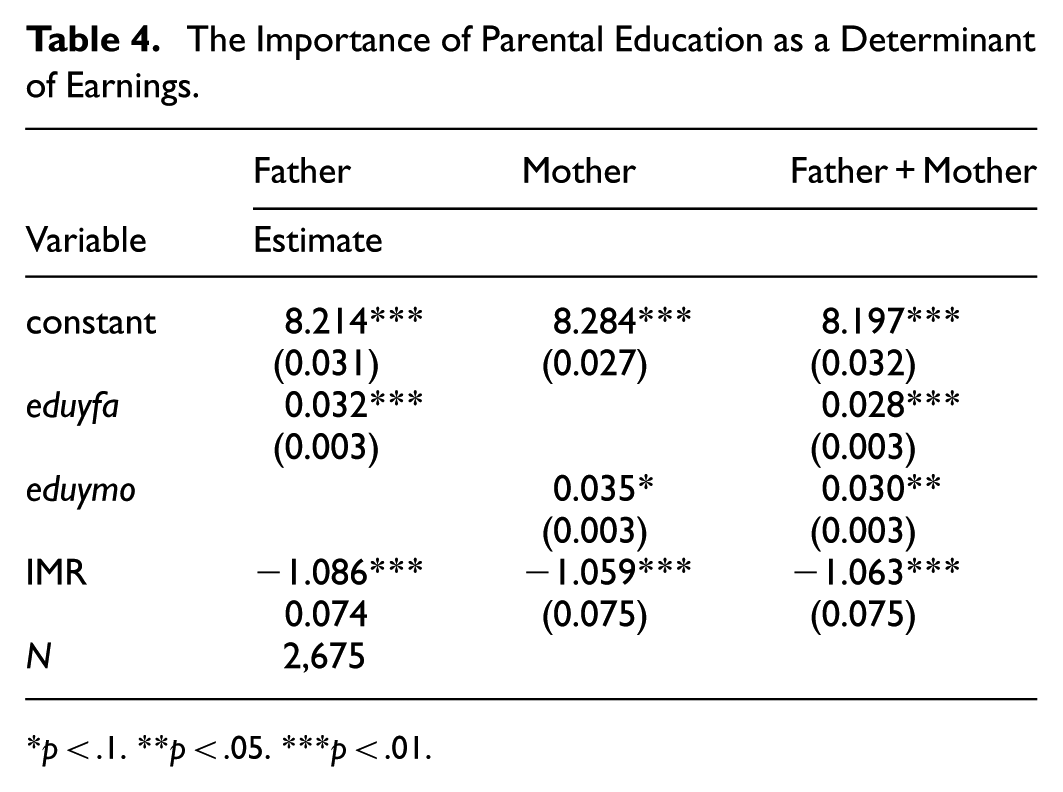
After obtaining the IMR from the Probit model to address sample selection bias, we proceed to estimate the income equation, focusing on the effect of parental education on children’s earnings. The estimation results are presented in Table 4.
The Importance of Parental Education as a Determinant of Earnings.
*p < .1. **p < .05. ***p < .01.
Table 4 reports the results from the income equation, incorporating father’s and mother’s education separately and jointly. The coefficients on father’s and mother’s education are positive and statistically significant, indicating that higher parental schooling is associated with higher earnings for their children. Specifically, the father’s education shows a coefficient of 0.028, while the mother’s education is slightly stronger at 0.030 in the joint model. These findings are consistent with the human capital framework of Becker and Tomes (1986), which posits that parents with more education are better positioned to invest in their children’s productivity-enhancing attributes, through both financial and non-financial resources. Importantly, the significance of both coefficients in the joint model suggests that mother’s and father’s education contribute non-redundantly, possibly due to differing roles in child development. This aligns with Coleman’s(1988) theory of social capital, where mothers often influence daily educational guidance and aspirations, while fathers may shape external network access and employment expectations (Dubow et al., 2009; Jiang et al., 2025; Wang et al., 2020).
Transmission Channels
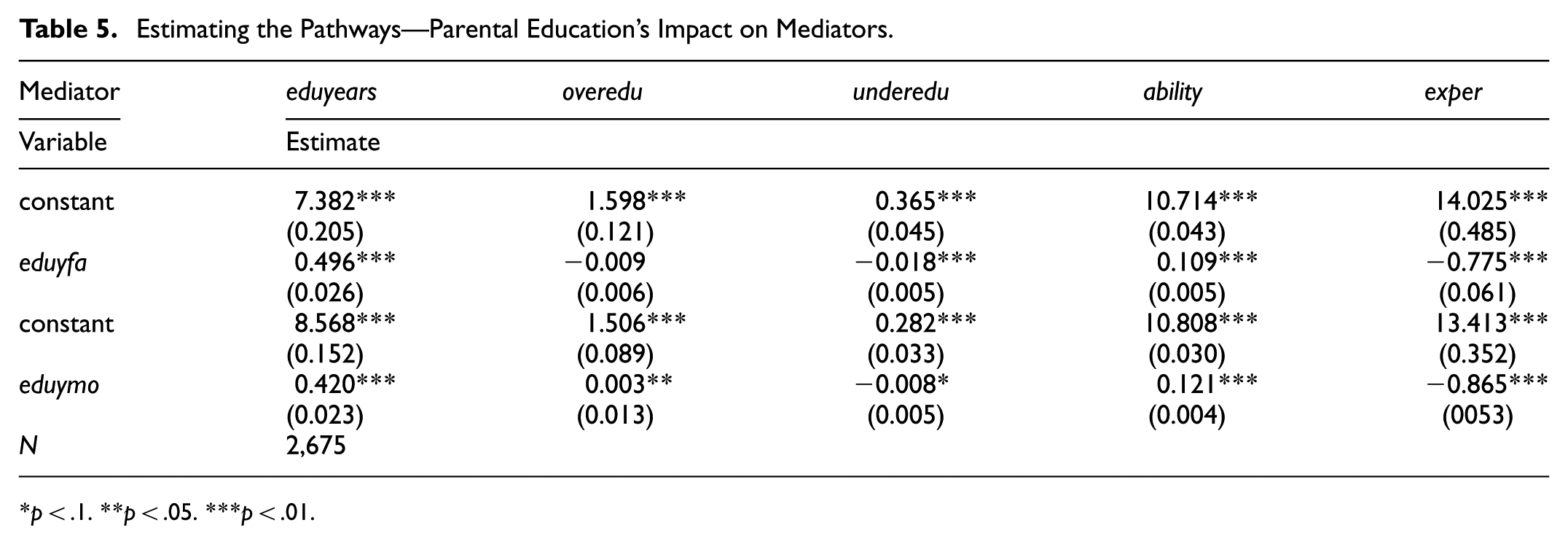
Table 5 presents the regression results of mediating variables on father’s and mother’s years of education, focus on the transmission mechanisms through which parental education affects children’s income. Both father’s and mother’s education have strong and statistically significant effects on children’s educational attainment. A 1-year increase in father’s education is associated with a 0.496-year increase in the child’s schooling, while mother’s education contributes 0.420 years, indicating a robust intergenerational transmission of education, consistent with the human capital framework.
Estimating the Pathways—Parental Education’s Impact on Mediators.
*p < .1. **p < .05. ***p < .01.
Regarding educational mismatch, mother’s education exhibits a small but statistically significant positive association with overeducation, whereas father’s education shows no significant effect. Although this finding appears to contradict Hypothesis 1, the effect size is extremely small and should be interpreted in the context of China’s rapidly expanding higher-education environment. One plausible explanation is that highly educated mothers may encourage their children to pursue more schooling and higher qualifications, even when the labor market cannot fully absorb such high educational attainment. As a result, children may acquire credentials that exceed the requirements of their initial jobs. This pattern is consistent with evidence that educational aspirations in more educated households can sometimes surpass immediate labor-market opportunities. Conversely, both parents’ education significantly reduces the likelihood of undereducation, with father’s education exerting a stronger effect. This implies that more educated parents are more likely to help their children avoid jobs that require more education than they possess, reflecting improved job-education alignment (Ganzach, 2000; Heckman et al., 2006).
Parental education also has a notable influence on children’s cognitive abilities. Both father’s and mother’s education significantly increase cognitive scores, with mother’s education having a slightly larger impact. This reinforces the argument that educated parents provide environments conducive to intellectual development, particularly in early years. Lastly, an inverse relationship is observed between parental education and children’s work experience: children of more educated parents tend to have fewer years of labor market experience. This is likely because they stay longer in the educational system, delaying workforce entry in favor of continued human capital accumulation. These findings support the presence of multiple indirect channels through which parental education shapes children’s earnings, emphasizing the importance of accounting for mediation when analyzing intergenerational mobility (Blanden et al., 2005; Dong et al., 2019; Dubow et al., 2009).
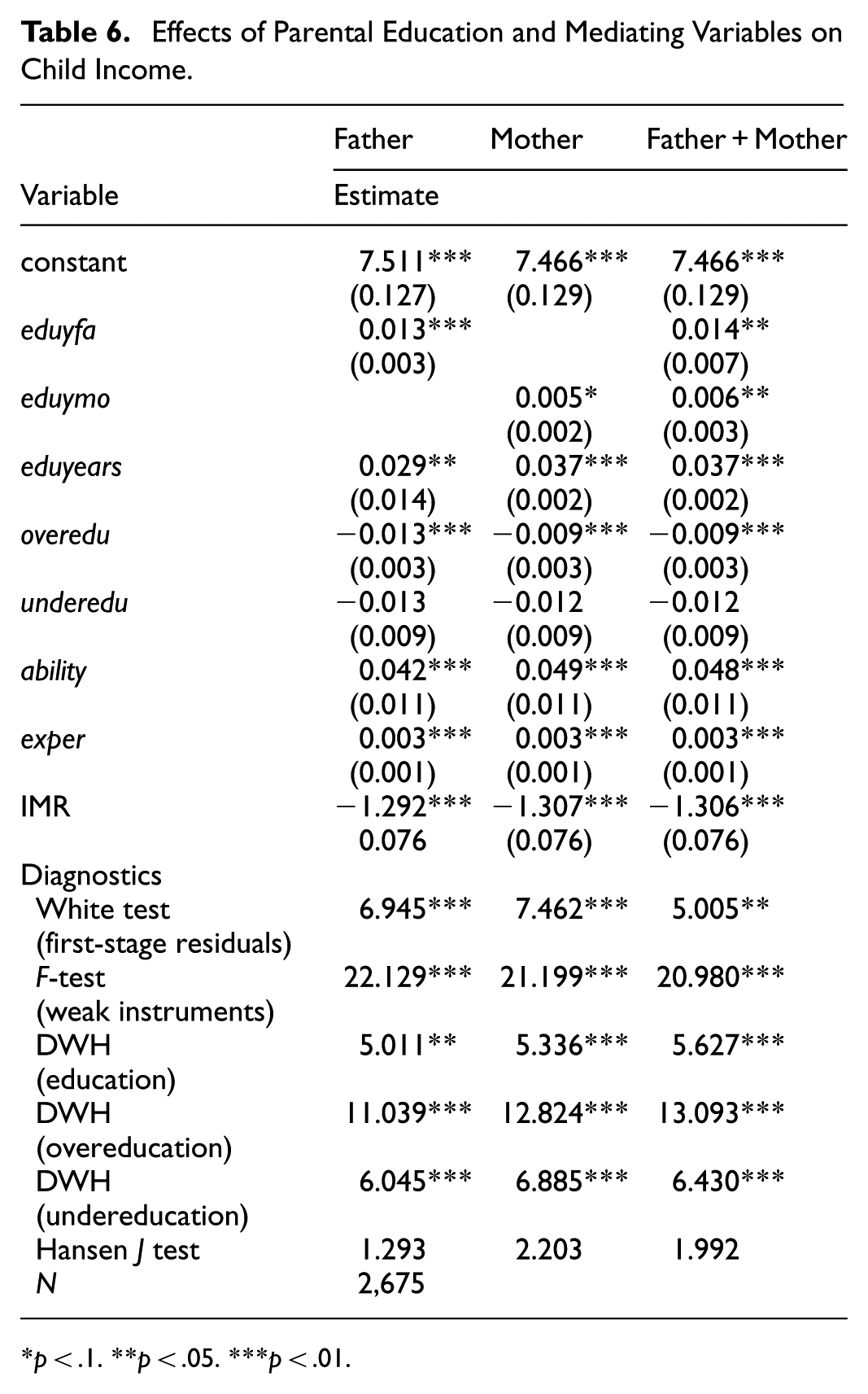
Before interpreting the coefficients of Table 6, it is important to justify the Lewbel IV estimation, which is applied to account for potential endogeneity in the model. To support the validity of the Lewbel IV approach, we conduct a series of diagnostic tests. The White tests reject homoskedasticity in the first-stage residuals, satisfying the key identification condition for Lewbel (2012). The Kleibergen–Paap F-statistics exceed the Stock–Yogo critical thresholds (>10), indicating that the Lewbel-generated instruments are sufficiently strong and not subject to weak identification. The Durbin–Wu–Hausman tests reject the null of exogeneity for children’s education and mismatch variables, confirming the necessity of instrumenting these mediators. Finally, the Hansen J tests do not reject the null of valid overidentifying restrictions, supporting the exogeneity of the Lewbel-generated instruments. Collectively, these diagnostics validate the application of the Lewbel procedure in this context and reinforce the credibility of our causal estimates of parental education on income.
Effects of Parental Education and Mediating Variables on Child Income.
*p < .1. **p < .05. ***p < .01.
Regarding the mediating variables, educational mismatch plays a notable role. The negative and significant effect of overeducation indicates that holding a qualification above job requirements is associated with lower-than-expected earnings, consistent with wage-penalty theory of mismatch of Hartog (2000). Undereducation, although negative, is not statistically significant, suggesting weaker evidence of earnings loss for workers underqualified relative to their jobs. This may reflect informal job matching or skill substitution common in emerging labor markets like China. Cognitive ability remains a strong and significant predictor of income, with coefficients around 0.048 to 0.049, highlighting its pivotal role in determining wage outcomes. This supports extensive literature emphasizing cognitive skills as key determinants of human capital and productivity (X. Chen & Wu, 2025; Heckman et al., 2006; Lindqvist & Vestman, 2011). Work experience also contributes positively, although with smaller magnitude, reaffirming classic labor economics findings that tenure and accumulated human capital raise earnings potential (Ma et al., 2024). Lastly, the highly significant and negative IMR coefficients confirm the presence of sample selection bias. The use of the Heckman correction model is therefore validated, and ignoring this bias would have likely led to underestimating the true returns to parental education.
Table 7 decomposes the total effect of parental education on children’s income into direct and indirect components, highlighting the relative importance of multiple transmission channels. The results reveal a clear asymmetry between fathers and mothers in how their education shapes children’s earnings. For fathers, 42.90% of the total effect is direct, compared with only 13.89% for mothers. This pattern is consistent with Chinese sociological research showing that fathers traditionally contribute more to labor-market–related resources, such as career guidance, occupational expectations, and job-search networks, which can directly shape children’s earnings prospects (Y. Chen & Feng, 2011; Xiao & Asadullah, 2020). Such mechanisms align with longstanding human-capital and social-capital views that emphasize the importance of parental economic knowledge and labor-market connections in determining children’s wage outcomes (Becker & Tomes, 1986; Coleman, 1988). In contrast, mothers exert a larger influence through indirect pathways. Children’s years of schooling account for 46.20% (father) and 43.06% (mother) of the total effect, confirming that formal education remains the dominant mechanism of intergenerational transmission. Prior studies document that mothers in China typically take primary responsibility for children’s daily educational supervision, cognitive stimulation, and academic planning, which directly fosters children’s learning habits and academic performance (De Coulon et al., 2011; Dubow et al., 2009; Wang et al., 2020). This maternal role in educational investment is consistent with evidence showing that parental education, particularly maternal education, strengthens children’s academic achievement and non-cognitive development (Lareau, 2018).
Importance of Transmission Channels.

Cognitive ability represents the second most influential mediator, contributing 17.49% (father) and 16.39% (mother). This is theoretically important: unlike schooling, which reflects formal educational attainment, cognitive ability captures deeper developmental advantages linked to enriched home environments. Our results support a growing global literature (e.g., Heckman et al., 2006; Rindermann & Ceci, 2018) showing that parental education shapes not only academic outcomes but also fundamental cognitive and problem-solving skills that yield persistent labor-market returns. The extremely small mediated contributions (less than 1%) suggest that mismatch does not systematically channel parental advantage. This finding is important because it indicates that, for the cohorts studied, having more years of education matters far more for earnings than securing a perfectly matched job. In China’s developing labor market, where structural transformation has outpaced the creation of high-skill positions, educational attainment itself appears to provide stronger signaling and productivity benefits than precise job-education alignment. This implies that parents’ encouragement of higher schooling, even when it does not match initial job requirements, still yields long-term economic benefits for children. In term of Work experience, it shows an interesting divergence: the negative mediated effect for fathers (−7.59%) contrasts with a positive effect for mothers (7.22%). This asymmetry may reflect well-documented gender differences in career continuity, occupational pathways, and labor force participation. In China, younger cohorts of women increasingly experience more stable early-career trajectories, whereas men may delay labor force entry due to prolonged education or military/social obligations. These dynamics generate heterogeneous experience profiles consistent with prior studies on gendered labor-market pathways (Hannum, 2005; Xiao & Asadullah, 2020).
Overall, the decomposition highlights that parental education affects children’s income primarily by shaping formal schooling and cognitive development, rather than labor-market experience or job–education alignment. More importantly, the results uncover distinct and theoretically meaningful parental roles: paternal education influences children’s outcomes more through labor-market-related mechanisms, while maternal education operates more strongly through cognitive and schooling pathways. This provides novel empirical evidence for gender-differentiated intergenerational transmission mechanisms in China, enriching the literature on human capital formation and offering policy-relevant insights for designing targeted interventions that leverage parental strengths.
Conclusions
This study addresses a central question in the literature on intergenerational mobility: How does parental education influence children’s income, and through which mechanisms does this effect operate? While prior research has consistently shown a positive association between parental education and child outcomes, few studies, especially in the Chinese context have systematically decomposed this influence into direct and indirect effects. We contribute to this gap by applying a causal mediation analysis using CFPS 2020 data, with a focus on four transmission channels: education year, educational mismatch, cognitive ability, work experience.
Our findings reveal that parental education has a clear and positive influence on children’s income. Importantly, this influence operates not only through a direct pathway but also through several indirect mechanisms, reinforcing the role of family background in shaping economic outcomes. The most influential mediating factor is children’s own educational attainment. Parents with higher education are more likely to guide their children toward greater academic success, which in turn enhances their labor market prospects. This finding supports long-standing theories of human capital transmission, emphasizing the importance of early-life investment in education.
Cognitive ability also emerges as a meaningful transmission channel. Educated parents tend to cultivate intellectually stimulating environments, which facilitate the development of their children’s cognitive skills. These skills, closely tied to productivity and problem-solving capabilities, enhance employability and earn potential. This result aligns with prior research emphasizing the role of non-material parental investments, such as time, expectations, and learning supporting children’s long-term success. In contrast, educational mismatch plays a relatively limited role in the intergenerational transmission process. While it is generally acknowledged that overeducation and undereducation can affect labor market efficiency, their mediating effects in this study are marginal. This suggests that the quantity and quality of education may be more important than its exact alignment with occupational demands, at least in the current Chinese context.
When distinguishing between fathers’ and mothers’ education, the findings point to complementary roles. Fathers’ education appears more influential in shaping labor-related outcomes, such as work experience, while mothers’ education has a stronger connection to cognitive development. This division may reflect traditional family roles and social norms but also highlights how both parents contribute in distinct but reinforcing ways to their children’s future economic success.
When comparing fathers’ and mothers’ education, the results reveal both distinct roles and complementary impacts. The direct effect of father’s education on children’s income is larger, suggesting that paternal education plays a strong foundational role in shaping children’s economic outcomes, possibly through authority, decision-making in household resource allocation, and labor market-related guidance. In contrast, the total effect of mother’s education, which combines both direct and indirect pathways, is slightly greater, underscoring the critical role mothers play in influencing their children’s development through channels such as educational attainment and cognitive ability. These patterns reflect differentiated parental investments and align with traditional family roles, where fathers may more directly affect external labor-related attributes, while mothers shape internal capabilities like learning, discipline, and cognitive growth. Together, these results highlight the reinforcing and multidimensional nature of parental education in influencing children’s long-term income potential.
Based on the findings, policy efforts should aim to strengthen the educational foundations of both fathers and mothers, recognizing their distinct yet complementary roles in shaping their children’s future economic outcomes. Given that fathers’ education shows a stronger direct influence on income, initiatives encouraging paternal involvement in education and career guidance could enhance children’s labor market readiness. Simultaneously, the greater total effect of mothers’ education, driven largely by indirect channels such as improved educational attainment and cognitive ability, highlights the importance of empowering mothers through accessible lifelong learning opportunities, especially in underserved regions. Policies should also address gender-based educational disparities, promote family-centered educational support programs, and invest in early childhood development initiatives that leverage parental education to maximize children’s human capital formation and future earnings potential. This dual-pronged strategy, targeting both paternal and maternal education, can foster more equitable intergenerational mobility and support inclusive economic development.
A limitation of this study concerns the use of the 2020 CFPS cross-section as the analytical dataset. Although the CFPS is a longitudinal survey, later waves (e.g., 2022) have not yet been fully released with complete documentation or with all key variables required for this analysis, such as detailed cognitive ability scores and educational mismatch measures. Consequently, we rely on the 2020 wave, which provides the most comprehensive and consistent measurement of parental education, mediators, and income outcomes. While the CFPS employs rigorous probability sampling and the resulting dataset is nationally representative, the analytical sample of 3,052 individuals may not fully capture the demographic and regional heterogeneity of China’s population. Additionally, the cross-sectional design limits our ability to empirically establish the temporal ordering of mediators—an important assumption for causal mediation analysis. Although parental education is predetermined and our econometric strategy addresses endogeneity concerns, cross-sectional data cannot fully replicate the inferential strength of a longitudinal design in tracing developmental and labor-market trajectories. Therefore, our findings should be interpreted in light of these constraints, and future research using multi-wave CFPS data could better validate the dynamic pathways underlying intergenerational transmission.
Footnotes
Appendix A
Correlation and VIF Test.

| Variable | eduyfa | eduymo | overedu | underedu | exper | ability | eduyears | employ | gen | huk | mar | party | age | VIF |
|---|---|---|---|---|---|---|---|---|---|---|---|---|---|---|
| eduyfa | 1.000 | 9.672 | ||||||||||||
| eduymo | .508 | 1.000 | 7.543 | |||||||||||
| overedu | −.011 | .005 | 1.000 | 1.535 | ||||||||||
| underedu | −.057 | −.031 | −.186 | 1.000 | 1.130 | |||||||||
| exper | −.221 | −.284 | .028 | .059 | 1.000 | 3.254 | ||||||||
| ability | .342 | .434 | −.011 | −.087 | −.409 | 1.000 | 9.332 | |||||||
| eduyears | .325 | .316 | .066 | −.136 | −.401 | .379 | 1.000 | 6.990 | ||||||
| employ | .019 | .024 | −.034 | .021 | .023 | .042 | −.021 | 1.000 | 8.411 | |||||
| gen | −.027 | −.011 | .061 | −.002 | .047 | −.045 | −.046 | .144 | 1.000 | 2.139 | ||||
| huk | .198 | .203 | −.005 | −.027 | −.058 | .257 | .266 | .003 | −.008 | 1.000 | 2.391 | |||
| mar | −.083 | −.205 | .030 | −.034 | .274 | −.186 | .132 | −.117 | −.084 | .077 | 1.000 | 2.459 | ||
| party | .002 | .009 | −.013 | .000 | −.057 | .058 | .131 | .039 | −.003 | .005 | .021 | 1.000 | 1.043 | |
| age | −.129 | −.241 | .095 | −.024 | .430 | −.304 | .225 | −.129 | .029 | .119 | .627 | .029 | 1.000 | 8.441 |
Acknowledgements
The authors disclosed receipt of the following financial support for the research, authorship, and/or publication of this article: This research was supported by the Center of Excellence in Econometrics, Faculty of Economics, Chiang Mai University, and was conducted as part of the Ph.D. Degree Program in Economics, Faculty of Economics, Chiang Mai University, with financial support from Chiang Mai University (CMU) under the CMU Presidential Scholarship.

Funding
The authors disclosed receipt of the following financial support for the research, authorship, and/or publication of this article: This research was partially funded by Center of Excellence in Econometrics, Chiang Mai University (Grant Number: CEE2025).
Declaration of Conflicting Interests
The authors declared no potential conflicts of interest with respect to the research, authorship, and/or publication of this article.
Data Availability Statement
The data is available at your request.