




Abstract
Does mental accounting of time influence attendance likelihood for rescheduled events? Does this effect differ in short- versus long-term? We examine these questions by experimentally manipulating mental accounting of time and temporality (short-term vs. long-term). In addition, we examine how context, social norms and company affect attendance likelihood for rescheduled events. The fungibility principle states that resources of equal objective value are interchangeable — one dollar always remains worth one dollar, one hour always remains one hour. Mental accounting challenges the fungibility principle by showing that individuals assign different subjective values to resources based on their temporality, leading to systematic violations of fungibility when they evaluate experiences and time. We present three online experiments. In Experiment 1 (N = 247), we implemented a 2 × 2 mixed factorial design varying social norms (present vs. not present) between-subjects and mental account (same vs. different) within-subjects. In Experiment 2 (N = 280), we adopted a 3 × 2 × 2 × 2 mixed factorial design varying social norms (present vs. not present vs. alone) between-subjects, while mental account (same vs. different), temporality (short-term vs. long-term), and context (leisure vs. work) varied within-subjects. In Experiment 3 (N = 411), we employed a 2 × 2 × 2 × 2 mixed factorial design, varying the activation of social norms via social company (company vs. alone) between-subjects, while mental account, temporality, and context varied within-subjects. Results suggest that mental account, temporality, context, and social norms significantly influence attendance likelihood, whereas the interaction between social company and mental account does not. These findings advance our understanding of temporal decision making.
Plain Language Summary
People often treat their time as a resource — much like money. But do we value all time in the same way? And how do the timing of events, contexts and social environments influence whether we choose to attend an event that has been rescheduled? This research explores how people mentally “account” for their time and how that affects their likelihood to attend rescheduled events. We were especially interested in whether people treat a rescheduled event as part of the same time commitment as the original event or as a new commitment entirely. We also looked at whether these decisions change depending on how far in the future the event is (short-term vs. long-term), whether it is a leisure or work activity, and whether people expect to attend alone or with others. Across three online experiments with over 900 participants in total, we varied key elements like the intervals between the notification of an event rescheduling and the event itself (short-term vs. long-term), the kind of activity (work or leisure), social norms (what people believe others expect them to do), and if they would be alone or in company. We found that all of these factors significantly influence to some extent whether people say they would attend a rescheduled event. Interestingly, simply being with others (social company) didn’t strongly change how people accounted for their time, but social norms did. This suggests that what we think others expect from us can be more powerful than whether we’re alone or not. These findings help us better understand how people value their time and make everyday decisions about whether to commit, or recommit, to events. This has potential applications for event organizers, workplaces, and even public policy planners aiming to improve attendance at rescheduled activities.
Introduction
Time is a finite resource, and allocating it across activities involves complex decision-making processes. Balancing activities is analogous to fitting pieces in a game of Tetris: each event differs in size, complexity, and significance. Some events fit easily, while others are more difficult to arrange. For example, rescheduling a canceled work meeting may not feel equivalent to scheduling a different one of the same duration, in terms of subjective value. Just as Tetris blocks vary, so do planned events and activities, influenced by temporal occurrences and intervals, the context in which they take place, and the presence of social influences. These factors influence decisions about attendance likelihood for rescheduled events, reflecting how individuals mentally value and categorize their time.
Understanding which factors shape time-related decisions aids in optimizing work structures, time allocation, and work-life balance.
Mental Accounting Framework
Mental accounting is a cognitive process derived from the use of monetary resources (Thaler, 1999). It describes how people categorize resources into mental accounts. Each account is assigned a different subjective value per unit (e.g., dollars or minutes). This effect violates the fungibility principle, which states that any unit of a resource is interchangeable with another of the same objective value. Economic theory posits that the fungibility principle applies to temporal (Becker, 1965) and monetary resources (Menger, 1892).
Mental accounting has traditionally been studied in the context of money, yet we propose that similar categorization processes also apply to temporal resources. Time is characterized by measurable units, scarcity, and the necessity of trade-offs, all properties that make mental accounting principles theoretically applicable to temporal decision-making (Antonides & Ranyard, 2017). Like money, time has both a measurable, objective value and a perceived, subjective value. Mental accounting, studied in consumer behavior and finance (Silva et al., 2023; Skwara, 2023), has also been applied to time allocation to examine how individuals balance work and non-work activities (Rajagopal & Rha, 2009). We therefore argue that this phenomenon can be extended to time and attendance likelihood for rescheduled events.
However, mental accounting of time may exhibit unique patterns, as time and money are psychologically different despite both being measurable and quantifiable: time is finite, experienced, non-transferable, less easily tracked than money, and time-based decisions are more heuristic than systematic (Monga & Zor, 2019; Saini & Monga, 2008). People also appear to adjust their cognitive effort based on the perceived opportunity cost of time, responding faster and less deliberatively when time is considered more valuable, reflecting a trade-off between effort and efficiency (Otto & Daw, 2019). Moreover, because time cannot be stored or transferred across life domains, individuals manage losses within specific time categories, for example, reclaiming personal time to offset work encroachments (Hartner-Tiefenthaler & Schoellbauer, 2024). This suggests that, unlike money, time may be reallocated within categories rather than only across them.
Building on Becker’s (1965) concept of temporal opportunity cost, the value of time depends on the foregone benefit of alternative activities, which vary across contexts and periods. When rescheduling or cancelling an activity implies giving up anticipated experiences or benefits, individuals may perceive this as a loss of opportunity, especially if the (future) temporal cost of two activities is otherwise perceived as subjectively equal (Spiller, 2019). Consistent with both loss aversion and the sunk cost effect (Navarro & Fantino, 2009), they are thus more likely to keep or reschedule the original activity rather than forgo it, even when potential gains elsewhere might be equivalent.
These insights highlight that, while time shares similarities with money, the mental accounting of time involves also distinct psychological processes due to time’s finite, non-storable, and context-dependent nature.
Temporal Dynamics of Mental Accounting
According to the temporal construal theory (Liberman & Trope, 1998), near-future experiences are represented more concretely, whereas distant ones are viewed more abstractly, leading individuals to value and allocate time differently in the short-versus long-term. Individuals also exhibit both present bias (Xiao & Porto, 2019) and the sunk-cost effect (Petrov et al., 2023) when assessing experiences. Present bias leads individuals to overvalue immediate rewards and costs compared to future ones, and the sunk-cost effect increases persistence in activities after an initial investment of resources. Additionally, timing and temporal intervals affect experience assessment (Ariely & Zakay, 2001). However, to our knowledge, no study has tested whether manipulating the temporal aspects of mental accounting influences time-related decisions. This study examines how a described interval between the notification of an event’s rescheduling and the event’s occurrence (i.e., temporality) shapes such decisions.
Prior studies suggest that the temporal aspects of mental accounting of money should not be manipulated (Kahneman & Tversky, 1984; Thaler, 1999). Decoupling the notification of a monetary loss from experiences weakens the effect, given that money often serves as a medium to access experiences (Kumar et al., 2020). However, mental accounting of time may operate differently than mental accounting of money: rescheduled events may influence either immediate or future activities. While monetary costs are tracked across accounting periods, temporal costs are typically confined to the period in which they occur (Soster et al., 2010), making people less likely to connect time expenses and benefits that are separated by time intervals. A rescheduled event represents both a loss of a resource and a loss of the event itself: a loss of time as a resource, due to the disruption of the original time allocation, and a loss of the event, as people may miss the opportunity to attend unless they adjust their plans. This may shape time-related decisions. Given the demonstrated role of temporal dynamics in shaping the subjective value of time (Ariely & Zakay, 2001; Bisin & Hyndman, 2020), we go a step further and manipulate temporality to examine its interaction with mental accounting in time-related decisions, specifically the likelihood to attend a rescheduled event (i.e., attendance likelihood for rescheduled events).
Additional Factors Impacting Time-Related Decisions
People make daily decisions about their time, considering various aspects of temporal resources. Beyond mental accounting and temporality, time-related decisions depend on:
Context-related activities: Time spent in leisure versus paid work activities (Aguiar & Hurst, 2007; Rajagopal & Rha, 2009) carries different subjective values. Because leisure time is often rated as more valuable than work (Verbooy et al., 2018), individuals may budget their free time more carefully. In contrast, missed opportunities (i.e., rescheduled events) in the work contexts tend to have more severe objective consequences (Budnick et al., 2020; Fourati & Affes, 2014). Therefore, it is essential to examine how distinct leisure and work activities influence time-related decisions.
Social company: Most time spent on activities is shared with others, and their presence shapes time-related decisions (Bixter & Luhmann, 2021). However, the social company aspect of time is often overlooked (Rajagopal & Rha, 2009), even though company and social recognition can influence temporal priorities and commitment (Pret & Carter, 2017; Schöbel et al., 2016).
Social norms: Injunctive social norms refer to the societal approval for the maintenance of implicit promises (e.g., gifted events, favors, etc.). While their impact on consumer behavior is well-documented (Melnyk et al., 2022), their role in time-related decisions remains underexplored. Social norms are closely tied to social recognition and the presence of others, and understanding the connection between social norms and social company is crucial for comprehending time-related decisions.
The Present Study
This study examines how mental accounting influences attendance likelihood for rescheduled events and whether it interacts with temporality (i.e., short-term vs. long-term notification of a rescheduled event). To our knowledge, no prior research has explored this interaction, as existing studies on the mental accounting of time have primarily focused on balancing work- and non-work activities (Rajagopal & Rha, 2009).
A key gap lies in integrating mental accounting principles with temporal dynamics. While monetary and temporal resources share certain characteristics, time’s unique characteristics make its mental accounting distinct. When allocating time, individuals implicitly weigh opportunity costs, choosing one activity means forgoing others, yet how these trade-offs interact with temporal dynamics remains underexplored.
This study addresses these gaps by posing three main research questions:
Fungibility principle violations: Do they influence attendance likelihood for rescheduled events?
The effect of time intervals on mental accounting: Does short-term versus long-term rescheduling influence the role of mental accounting in attendance likelihood for rescheduled events?
Additional factors: Do temporality, context-related activities, social norms, and mental account interacting with social company shape attendance likelihood for rescheduled events?
Using factorial experiments, we test how these factors influence time-related decision-making. By manipulating these variables experimentally, we aim to better understand the causal relationships underlying mental accounting of time’s unique patterns and examine how temporality influences the perceived value of time.
The experiments were conducted online and implemented rigorous quality controls, including pre-specified inclusion/exclusion criteria, seriousness checks, bot detection, and IP monitoring to prevent multiple submissions. Prior research shows that online experiments using such procedures achieve data quality and replication rates comparable to laboratory studies (Anwyl-Irvine et al., 2021; Birnbaum, 2004; Gagné & Franzen, 2023; Honing & Reips, 2008; Miccoli & Reips, 2025; Prissé & Jorrat, 2022; Reips, 2002, 2009; Reips & Birnbaum, 2011). Recent reviews similarly conclude that well-designed online experiments support robust hypothesis testing (Chuey et al., 2024; Reips, 2021).
Hypotheses
Based on mental accounting of money (Kahneman & Tversky, 1984; Thaler, 1999), people categorize resources into mental accounts. While trying to minimize losses in one mental account, using time from a different account may increase the likelihood to attend a rescheduled event.
Our second hypothesis examines the interaction between mental account and temporality. Due to present bias (Xiao & Porto, 2019) and the sunk-cost effect (Petrov et al., 2023), individuals in short-term scenarios may be more likely to attend rescheduled events, perceiving their initial time investment as worthwhile regardless of their mental account condition. Conversely, in long-term scenarios, individuals in the same mental account condition will report a lower likelihood to attend rescheduled events than those in different mental account conditions.
For the main effect of temporality, based on the present bias (Xiao & Porto, 2019) and the sunk-cost effect (Petrov et al., 2023), we hypothesize that short-term rescheduled events will elicit stronger loss aversion than long-term events, as people tend to value immediate opportunities more highly.
The contexts in which time is spent, such as leisure and work, impact attitudes toward temporal resources. While some studies suggest that leisure is valued more than work (Verbooy et al., 2018), rescheduled work events may have severe objective consequences (Fourati & Affes, 2014).
Social norms influence health behaviors (Cislaghi & Heise, 2018) and consumer decisions driven by intentions (Melnyk et al., 2022). Social norms may also impact the likelihood to attend rescheduled events.
Previous research suggests that social influence promotes healthy behaviors (Umberson & Montez, 2010), and affects temporal preferences (Bixter & Luhmann, 2021). We hypothesize that activating social norms through social company increases the likelihood to attend rescheduled events.
This research tests these hypotheses using three online experiments with a variation of the theater ticket paradigm (Kahneman & Tversky, 1984), adapted to temporal resources. This paradigm provides a straightforward way to examine how people experience rescheduled events across same versus different mental accounts while incorporating additional factors. The dependent variable is measured on a visual analogue scale for greater precision and usability (Reips & Funke, 2008).
Experiment 1: Long-Term Rescheduling and Mental Account
Experiment 1 tested whether mental accounting of time (H1) in long-term rescheduling scenarios and social norms (H5) affects attendance likelihood for rescheduled events. Prior research on the mental accounting of money (Kahneman & Tversky, 1984; Thaler, 1999) has emphasized that coupling the notification of a monetary loss with the experience strengthens this effect for money. However, for time, a rescheduled event represents both a loss of a resource and of an event. Therefore, mental accounting of time may also be relevant in long-term rescheduling scenarios.
Method
Participants
We conducted an a priori power analysis using G*Power (Faul et al., 2009) to achieve 95% power for our main analysis (α = .05), which recommended a minimum of 162 participants. For a repeated measures design with within- and between-subjects factors and interactions, we assumed a partial η2 = .02 (Cohen, 1988), and assumed a .5 correlation among repeated measures. Dropout (attrition) is more prevalent in studies conducted online (Reips et al., 2025). Accounting for dropout (Overall et al., 2006), we targeted 324 participants. The dropout rate in the first wave of recruitment was 51.7%. The calculations of a dropout adjusted sample size are based on the calculation by Overall et al. (2006). Here, N0 refers to the originally estimated sample size and DRP (dropout rate proportion) denotes the anticipated average dropout rate across all subjects. The dropout adjusted sample size that results from this formula is n = 324. The final sample of 247 was deemed adequate for testing the main hypothesis on social norms and mental accounting.
We established a priori inclusion criteria to ensure data quality. Of the 368 participants who indicated serious participation (seriousness check; Aust et al., 2013; Reips, 2009), 247 data sets were included in the analysis. All experiment materials, data sets and analysis scripts for the three experiments included in this manuscript are publicly available on the Open Science Framework (OSF). Data sets were not included if participants failed to answer both research questions (attendance likelihood for a rescheduled event in same and different mental account conditions, n = 98), were identified as Google bots (n = 13), or showed irregular page sequences (n = 2). To prevent multiple submissions, IP addresses were monitored (Reips & Birnbaum, 2011), and only the first data set was retained in cases of multiple submissions (n = 8).
We recruited participants via the social media platform Reddit (173) and the University of Konstanz SONA system (74), where students earn study credits. Reddit participants (18+) could enter a raffle for three gift vouchers (1 × 100€, 2 × 50€).
Participants (N = 247; 119 male) reported age with a median of 20 years (SD = 7.43, range 15–64), which should be interpreted with caution due to broad categories for the youngest (“below 10”) and oldest (“over 69”) participants. The majority reported being students (n = 131).
Design and Procedure
We implemented a 2 × 2 mixed factorial design, varying mental account (same vs. different) within-subjects and social norms (present vs. not present) between-subjects.
To explore the role of context-related activities, participants identified a theater companion for that scenario and their relationship context (e.g., family, friend, romantic partner, or work), which was treated as a quasi-experimental variable.
Mental account conditions were operationalized as either an alternative entertainment activity or planned work on a formal deadline for the following week (Supplemental Appendix A). Each theater activity was hypothetically shared with another person, either associated with a gift (social norms present) or not (social norms not present).
Participants were randomly assigned to one of the between-subjects conditions. The dependent variable, likelihood to attend the rescheduled theater play the following Friday, was measured using a visual analogue scale (VAS; see Figure 1), ranging from “Not likely” to “Likely.”

Example of a scenario web page from Experiment 1.
The online experiment lasted about 3 min. Participants first received information about the study and the informed consent, as well as a seriousness check (Aust et al., 2013; Reips, 2009). After completing socio-demographic questions, they proceeded to the first research question, followed by two pages containing one item each on theater attendance habits (frequency and planned next visit), the second research question, additional measures, and finally, a debriefing page. On the two pages presenting the research questions, participants also specified the relationship context, which served as a quasi-experimental variable.
To reduce order effects, the key research questions were separated by two items on theater attendance habits. Additional measures not included in the current analysis assessed participants’ willingness to wait for or spend money on a rescheduled theater event, along with their perceived pleasantness of working on a bureaucratic deadline.
Experiment 1 was conducted from July to October 2021.
Results
We conducted a mixed factorial ANOVA to test Hypotheses 1 and 5. Additionally, we explored the role of relationship context. We included the mental account variable as a within factor, while the social norms variable was implemented as a between factor. We treated the relationship context as a quasi-experimental condition with three levels (family vs. friend vs. romantic relationship). Data from three participants who selected a work relationship context were excluded due to insufficient observations for ANOVA analysis, reducing the number of levels in the quasi-experimental condition from four to three (Supplemental Appendix B). The analysis reported here included 244 participants.
Data screening and assumption checks were conducted. The data distribution was comparable to a normal distribution, with the homogeneity of variance assumption met and no extreme outliers detected (Supplemental Appendix B). All data points were maintained in the analyses.
A significant main effect of mental account on attendance likelihood for rescheduled events was observed, F(1,483) = 23.64, p < .001, η2 = .05, suggesting that participants in the same mental account condition reported a higher attendance likelihood than in a different mental account condition (Msame = 127.9; SEsame = 3.54; Mdifferent = 103.68; SEdifferent = 3.55).
Figure 2 illustrates the reported likelihood to attend a rescheduled event depending on mental account conditions and social norms.

Participants’ reported likelihood to attend a rescheduled event.
Neither social norms, F(1,483) = 0.06, p = .81, η2 < .001, nor relationship context, F(2,483) = 0.63, p = .53, η2 = .002, had a significant effect on attendance likelihood. The difference in attendance likelihood between social norms present (Mpresent = 116.28, SEpresent = 3.61) and not present (Mnot present = 115.26, SEnot present = 3.49) was minimal. Although no significant effect was observed, descriptive trends suggest that participants reported a slightly higher attendance likelihood in a family context (M = 119.68, SE = 4.53) compared to romantic (M = 114.60, SE = 4.41) or friend contexts (M = 113.04, SE = 4.11).
Discussion
This study tested the effects of mental accounting (H1) and social norms (H5) on attendance likelihood for rescheduled events, while also exploring the role of relationship context. Results indicated a main effect of mental accounting, that is, that participants were more likely to attend a rescheduled event when the alternative activity belonged to the same mental account (e.g., entertainment activity) than to a different mental account (e.g., working on a deadline). However, social norms and relationship context had no significant impact.
These findings support the existence of mental accounting of time, even when the notification of an event’s rescheduling is decoupled from the experience itself. However, unlike previous research on mental accounting of money (Kahneman & Tversky, 1984), and contrary to the directionality of Hypothesis 1, attendance likelihood for rescheduled events was higher in the same mental account condition than in the different mental account condition. This suggests that the mechanisms underlying mental accounting for time may differ from those for money. However, alternative explanations should be considered, including rescheduling temporality, the specificity of alternative activities, and the clarity of distinctions between accounts. First, mental accounting of time may vary between short- and long-term rescheduling scenarios, given the differences in subjective value associated with events occurring in the future (Frederick et al., 2002; Koch & Kleinmann, 2002). Second, the mental account operationalization differed in specificity: the same mental account was described in general terms (e.g., an entertainment activity), whereas the different mental account involved a concrete scenario (e.g., working on a deadline). The level of detail may have influenced perception, making the general alternative (same mental account) seem less restrictive and increasing the attendance likelihood for the rescheduled event. In Kahneman and Tversky’s (1984) study on mental accounting, the same account (theater ticket) was more specific than the different account (bill). The level of specificity itself may contribute to the mental accounting effect. Third, the blurred distinctions between accounts might have weakened the mental accounting effect, with leisure activities (same account) appearing more interchangeable than a formal deadline versus theater (different account). Like monetary budgeting (Xiao & O’Neill, 2018), time budgeting relies on distinct categories and hierarchy, and blurring these distinctions could weaken the mental accounting effect.
The lack of a significant effect of social norms on attendance likelihood may stem from the presence of social company in all conditions, which might have implicitly signaled social norms. Alternatively, the lack of support for Hypothesis 5 might reflect variation in social norms across relationship contexts. While this study does not examine the interaction between social norms and relationship context, prior research suggests that romantic relationships, for example, involve more social rules than other relationship contexts (Argyle et al., 1985).
While Experiment 1 advances understanding of the mental accounting of time in long-term rescheduling scenarios, it has limitations. The operationalization of the mental account variable would have been stronger with a comparison to short-term rescheduling scenarios and greater consistency in specificity both between contrasting activity types and within the same context-related activity category. These considerations informed adjustments in subsequent experiments: We aimed to refine the operationalization of mental accounts and to explore the interaction between social norms and relationship context.
In summary, Experiment 1 suggests that mental accounting of time influences decisions in long-term rescheduling scenarios, but further research is needed to clarify its characteristics and the role of social norms and context-related activity factors.
Experiment 2: Investigating the Temporality of Mental Account, Context-Related Activities, and Social Norms
Building on the insights from the previous experiment, Experiment 2 refines the operationalization of the mental account variable used in Experiment 1 and extends the experimental design by clearly distinguishing between short- and long-term rescheduling scenarios, as well as leisure and work activities. Additionally, we implement a control condition for social norms that does not include other people in the hypothetical scenarios. To better isolate the influence of social norms from the mere effect of company, we introduce an “alone” condition within the social norms variable (Cislaghi & Heise, 2018).
Experiment 2 tested whether the mental account variable (H1) and its interaction with temporality (H2) impact attendance likelihood for rescheduled events. Additionally, it examined whether temporality (H3), context-related activities (H4), and social norms (H5) influence attendance likelihood for rescheduled events.
Method
Participants
We conducted an a priori power analysis using G*Power (Faul et al., 2009) to achieve 95% power for our main analysis (α = .05), which indicated a minimum of 120 participants. For a repeated measures mixed ANOVA with eight repeated measures and three independent groups, we set a partial η2 = .02. Considering an anticipated dropout rate of just over one-third for online experiments (Musch & Reips, 2000), a minimum of 185 participants was deemed necessary to detect the main within-subjects effects. Given the efficiency of Internet-based research in participant recruitment (Reips, 2021), the final sample of 280 respondents was deemed adequate to test our hypotheses.
Similar to Experiment 1, we established a priori inclusion criteria to ensure data quality. Of the 714 participants who indicated serious participation (seriousness check; Aust et al., 2013; Reips, 2009), 280 data sets were included in the analysis. Data sets were not included if participants failed to answer all eight experimental scenarios (n = 404), were identified as automated responses (n = 24), or did not provide informed consent (n = 6).
We recruited participants via the social media platforms Reddit (169) and Facebook (44), as well as the University of Konstanz SONA system (67). Social media participants (18+) could enter a raffle for two gift vouchers (€50 each), while SONA participants received participation credits.
The final sample (N = 280; 161 female) reported a mean age of 26 years (SD = 6.81). Most participants reported being from Germany (n = 91), the United States (n = 91), or the United Kingdom (n = 30), and 119 participants reported being students.
Design and Procedure
We implemented a 3 × 2 × 2 × 2 mixed factorial design varying one between-subjects factor (social norm condition: present, not present, alone) and the three within-subjects factors (mental account: same or different; temporality: short-term or long-term rescheduling; context-related activities: work or leisure).
Each participant sequentially viewed eight experimental scenarios involving the rescheduling of an event. The dependent variable measured participants’ likelihood to attend a rescheduled event. Participants rated their likelihood to attend a rescheduled event on a visual analogue scale (Figure 3), ranging from “Unlikely“ to “Likely“.

Example of a scenario web page from Experiment 2.
Experiment 2 lasted approximately 10 minutes and included an informed consent form, a seriousness check (Aust et al., 2013; Reips, 2009), socio-demographic questions, and a final debriefing page.
The main body of the experiment consisted of 20 web pages, divided into three counterbalanced blocks to control for order effects (Reips, 2002; Reips & Neuhaus, 2002): experimental scenarios (eight web pages), temporal awareness scale (ten web pages), and social norms acceptance (two web pages). The two blocks referring to the temporal awareness scale and social norms acceptance are not part of this study. For examples of these scales’ items, see Supplemental Appendix A.
Experiment 2 was conducted from June to July 2022.
Variables
This section describes the operationalization of variables. For a detailed description of the scenarios, see Supplemental Appendix A.
Mental Account
In the same mental account condition, the rescheduled event came from the same mental account as the time needed to compensate for it (e.g., an event canceled by the provider or rescheduled to interfere with a similar type of activity). In the different mental account condition, the rescheduling and target activity belonged to different accounts (e.g., cancellation due to a different cause from the event’s provider or rescheduling conflicting with a different activity type).
Temporality
Temporality was manipulated via two levels: short-term and long-term. In the short-term condition, participants learned about the rescheduling upon arrival, requiring an immediate change of plans. In the long-term condition, participants were informed in advance, and needed to adjust their plans for the following week.
Context-Related Activities
The context-related activities variable distinguished between target activities typical of leisure versus work contexts. Hereafter, we refer to this condition as “context” for brevity. In leisure contexts, the rescheduled event was a Friday theater play, with leisure-related cancellations and alternatives (e.g., another theater play or a concert). In work contexts, a Monday meeting with a client was rescheduled, with work-related cancellations and alternatives (e.g., a meeting with another client or a work presentation). Each experimental scenario specified the context in the first line and included corresponding images.
Social Norms
Social norms were manipulated via three conditions: present, not present, and alone. In the present condition, the shared activity involved an injunctive norm, such as a gifted theater ticket or a promise to a colleague. The not present condition featured a shared activity without an explicit social norm. The alone condition involved an unshared activity, with no social norms present.
Results
We conducted a mixed ANOVA (factorial repeated measures) to test Hypotheses 1 through 5. The dependent variable was participants' ratings of their likelihood to attend a rescheduled event, measured on a 201-point visual analogue scale (0–200; points not visible as discrete steps to participants). Post-hoc analyses were performed using the Bonferroni correction.
Data screening and assumption checks were conducted. Normality of residuals and homogeneity assumptions were assessed and adequately met. We did not exclude any outliers and retained all data points in the analyses. Details of data screening and diagnostic checks are reported in Supplemental Appendix B.
Mental Account and Its Interaction with Temporality
The ANOVA indicated a significant main effect of mental account, F(1,277) = 33.97, p < .001, η2 = .01, ηp2 = .11. Respondents reported a higher likelihood to attend rescheduled events when the rescheduling and the target activity belonged to different accounts (Mdifferent = 128.50; SEdifferent = 1.76) compared to the same accounts (Msame = 117.59; SEsame = 1.86), as indicated by the estimated marginal means (EMMs).
Additionally, a significant interaction between mental account and temporality was observed, F(1,277) = 43.46, p < .001, η2 = .01, ηp2 = .07. Simple effects analyses further explored this interaction, revealing significant differences between the same and different mental account conditions in the long-term condition (p < .001), but not in the short-term condition (p = .89). In the short-term condition, participants reported nearly identical likelihood estimates for attending the rescheduled event in the same mental account condition (M = 149.5, SE = 2.19) and the different mental account condition (M = 149.2, SE = 2.18). In contrast, in the long-term condition, participants reported a lower likelihood of attending in the same mental account condition (M = 85.7, SE = 2.73) compared to the different mental account condition (M = 108.5, SE = 2.35). The effect size of mental account in the long-term condition was η2 = .17, whereas in the short-term condition, the effect was η2 < .001.
Figure 4 illustrates the reported likelihood to attend rescheduled events based on mental account and temporality interaction.
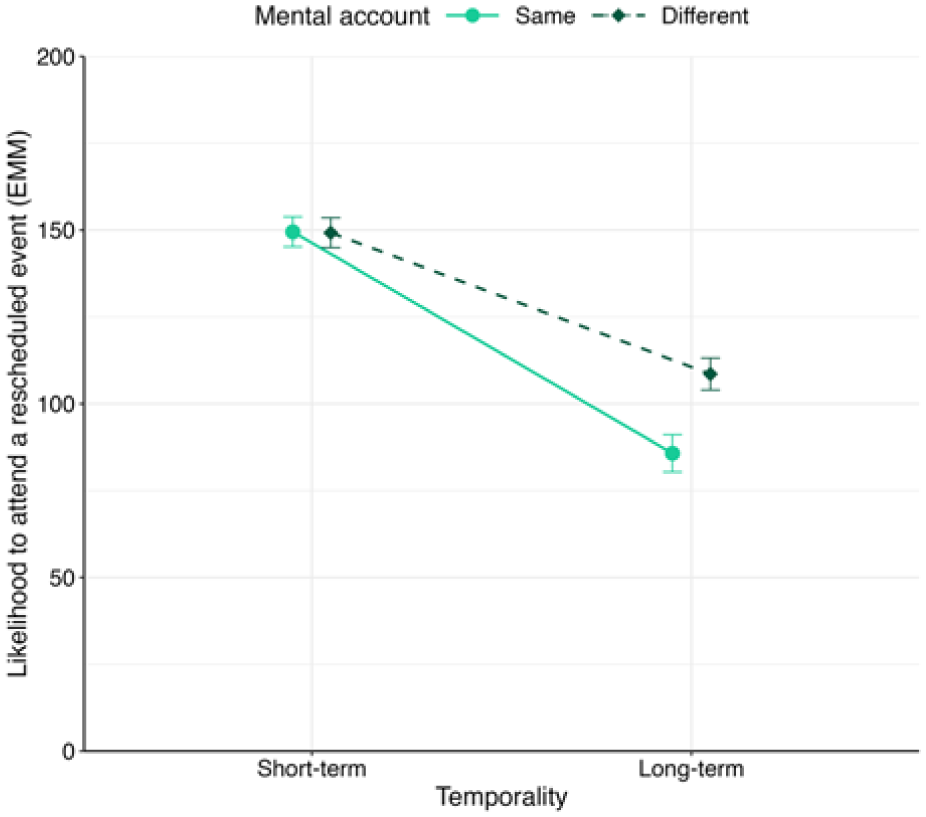
Likelihood to attend rescheduled events based on mental account and temporality interaction.
The Role of Temporality, Context-Related Activities and Social Norms
A significant effect of temporality was found, F(1,277) = 436.55, p < .001, η2 = .24, ηp2 = .61, indicating a higher likelihood of reported intention to attend a rescheduled event in the short-term (Mshort-term = 149.34, SEshort-term = 1.93) compared to the long-term (Mlong-term = 97.12, SElong-term = 2.03) conditions. Significant main effects were observed for context, F(1,277) = 11.55, p <.001, η2 = .005, ηp2 = .04, showing a higher likelihood in the work (Mwork = 127.15; SEwork = 1.74) than in leisure (Mleisure = 119.3; SEleisure = 2.09) condition, and for social norms, F(2, 277) = 11.04, p <.001, η2 = .02, ηp2 = .07, with higher likelihood in the present condition (Mpresent = 132.41; SEpresent = 2.81) compared to not present (Mnotpresent= 122.98; SEnotpresent = 2.52) and alone (Malone= 114.29; SEalone = 2.64).
Notably, we observed a significant interaction between context and mental account, F(1,277) = 87.47, p <.001, η2 = .03, ηp2= .19, as well as between mental account and social norms, F(2, 277) = 7.24, p <.001, η2 = .005, ηp2 = .05. While these interactions warrant further exploration in future research (see Supplemental Appendix B), they are not discussed here as they fall outside the scope of our hypothesis-driven framework.
Estimated Marginal Means of Likelihood to Attend a Rescheduled Event Across Conditions
Figure 5 displays the estimated marginal means (EMMs) of attendance likelihood across all experimental conditions. It illustrates the main effects and the interaction under investigation.
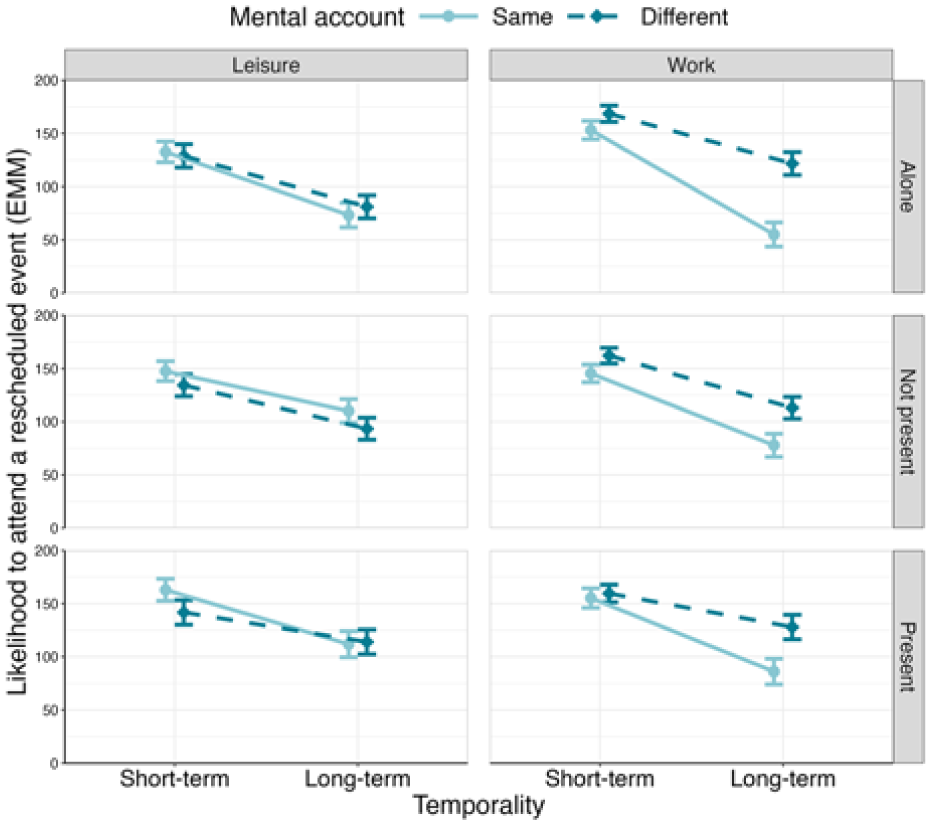
Participants’ likelihood to attend rescheduled events by mental account, temporality, context-related activities, and social norms conditions groups.
Discussion
The results support the hypothesis that time spent on activities associated with different mental accounts has distinct subjective value (H1). Additionally, mental account effects were observed in the long-term condition (H2) but not in the short-term condition, where attendance likelihood for rescheduled events was primarily influenced by immediacy (H3). Social norms also played a significant role, increasing the attendance likelihood for rescheduled events in the presence of injunctive norms (H5). However, contrary to our prediction, participants were not more likely to attend rescheduled events in the leisure context than in the work context (H4), though a main effect of context was observed.
A main effect of mental account on attendance likelihood for rescheduled events was observed, along with a significant mental account × temporality interaction. In the short-term condition, participants reported high likelihood to attend rescheduled events regardless of the mental account, likely due to immediacy bias and a heightened perception of sunk costs associated with short-term rescheduling (Petrov et al., 2023; Xiao & Porto, 2019). However, in the long-term condition, where sunk-cost effects were weaker than in the short-term condition, mental account significantly influenced attendance likelihood. This finding differs from previous research on mental accounting of money (Kahneman & Tversky, 1984; Thaler, 1999), which would suggest that for mental accounting to occur, the notification of an event’s rescheduling needs to be coupled with the occurrence of the event. The main effect of temporality aligns with research suggesting that initial time investments increase commitment to rescheduled events (Petrov et al., 2023).
Social norms also influenced time-related decisions (H5), supporting the notion that individuals act more as homo sociologicus (driven by social cues, norms, and influences) than homo economicus (driven by rational evaluations of gains and losses) (Elster, 1989). However, while evoked social norms significantly impacted the attendance likelihood for rescheduled events, the mere presence of another person did not. This suggests that adherence to social norms, rather than social presence itself, drives decision-making in this context, warranting further investigation.
Contrary to previous research suggesting that leisure is valued more highly than work (Verbooy et al., 2018), our results did not suggest a strong preference for rescheduling leisure activities. One possible explanation is the composition of the sample in Experiment 2, which was primarily students, who may not yet associate rescheduling work activities with concrete negative consequences (Budnick et al., 2020; Fourati & Affes, 2014).
One of the strengths of this experiment is its ability to distinguish mental accounting of time effects by temporality, allowing for a clearer understanding of the phenomenon at different rescheduling time intervals. Additionally, it included diverse context-related activities and social scenarios, which strengthens the generalizability of the findings beyond leisure activities and individual decision-making.
However, some limitations should be acknowledged. First, the sample primarily consisted of students, which may have influenced the results, particularly those related to work activities. A replication of these findings will thus be done with a more diverse sample, including full-time employees. Second, in the study we used different types of incentives, which may have affected data quality in different ways.
Experiment 2 advances our understanding of time-related decisions by highlighting the role of mental account and its interaction with temporality, as well as the main effects of temporality and social norms. To enhance insights into the mental accounting of time, Experiment 3 introduces homogeneous incentives and a sample of full-time employees from selected countries to ensure a shared understanding of the scenarios.
Experiment 3: Interaction of Mental Account with Temporality and Social Company
Building on insights from the previous experiments, in Experiment 3 we minimized unintended context effects by removing scenario images and standardizing all scenarios to occur on a Thursday, preventing weekday-based comparisons. Drawing from Experiment 2, in Experiment 3 we manipulated social norms through social company (alone vs. company). We used a uniform incentive, and the eight main scenarios were fully counterbalanced to control for order effects.
With Experiment 3 we tested Hypotheses 1 through 4 (mental account, mental account × temporality, and the main effects of temporality and context) and Hypothesis 6 (mental account × social company).
Method
The study information, experimental design, sampling procedure, and analysis plan were preregistered on the Open Science Framework (https://osf.io/ky5w6).
Participants
A simulation-based power analysis determined that a sample of 412 participants would provide 80% power at α = .05 to detect the main effects of mental account and temporality. This was based on effect sizes from Experiment 2 (mental account: d = 0.19; temporality: d = 0.98). The Superpower package (Lakens & Caldwell, 2021) confirmed that this sample was adequate to detect the mental account × temporality interaction effect with 80% power at α = .05. The final sample of 411 participants, which was recruited via Prolific with the aim to recruit full-time employees, was deemed adequate to test the main hypotheses. Additional details about the sample size rationale are available in our pre-registration documents on the Open Science Framework.
We established a priori inclusion criteria to ensure data quality. Of the 442 participants who indicated serious participation (seriousness check; Aust et al., 2013; Reips, 2009), 411 data sets were included in the analysis. Based on the pre-registered inclusion criteria, data were not included if participants failed to provide informed consent (n = 2) or failed to complete all eight experimental scenarios (n = 28). No duplicate IP addresses were detected, but one participant submitted twice using the same Prolific ID and was identified as a case of multiple submissions from the same participant; only their first entry was retained (Reips & Birnbaum, 2011).
We adopted pre-screening parameters on Prolific: fluent English proficiency, residence in specific countries (United Kingdom, Germany, France, Austria, Italy, Netherlands, Ireland, Belgium, and Switzerland), full-time employment, work experience, and exclusion of participants who had completed related studies. The pre-screening parameters aimed to include participants from diverse countries while ensuring similar time structures, familiarity with the scenarios, and comparable work schedules. Participants received £1.20 (£12/hour for approximately 6 minutes of participation) as compensation for their participation, with a final median completion time of 4 minutes and 47 seconds.
The participants (N = 411; 255 male) reported a mean age of 39 years (SD = 10.85, range = 19–74). Most participants reported being from the United Kingdom (291), Italy (39), or Germany (35) and identified as employees (342) or self-employed (46).
Design and Procedure
This study employed a 2 × 2 × 2 × 2 mixed factorial experimental design, varying one between-subjects factor (social company: alone or company) and three within-subjects factors (mental account: same or different; temporality: short-term or long-term rescheduling; context: work or leisure).
Participants were randomly assigned to one of the two social company conditions. Each participant was presented with eight scenarios, asking them to imagine a situation that required them to report how likely they would attend a rescheduled event after the original event was canceled. The scenarios were fully counterbalanced and manipulated according to the three within-subjects factors. The dependent variable was the likelihood to attend a rescheduled event, operationalized as a hypothetical behavior measured on a visual analogue scale (Unlikely/Likely), as shown in Figure 6.

Example of a scenario web page from Experiment 3.
The procedure for Experiment 3 followed that of Experiment 2, except for the absence of additional blocks investigating temporal awareness and social norms. Using WEXTOR (https://wextor.eu; Reips & Neuhaus, 2002), the eight experimental scenarios were counterbalanced to control for order effects. Participants first viewed a web page detailing the experiment, including informed consent and the seriousness check (Aust et al., 2013; Reips, 2009), followed by a socio-demographic information page and then the main body with the experimental scenarios. The experiment concluded with a debriefing page.
Experiment 3 was conducted in May 2024.
Variables
This section describes the operationalization of variables. For a detailed description of the scenarios, see Supplemental Appendix A.
Mental Account
The mental account variable had two levels: same and different accounts, operationalized as in Experiment 1.
Temporality
The temporality variable was manipulated at two levels: short-term and long-term. The short-term condition was identical to Experiment 2. The long-term condition was operationalized similarly to Experiment 2; however, the time interval between the rescheduling notification and the target event was stated more explicitly. On Thursday morning, participants were informed that the event scheduled for that evening had been moved to the following Thursday, when a conflict activity was already planned.
Context-Related Activities
Akin to Experiment 2, the context-related activity variable distinguished between leisure and work contexts. However, in Experiment 3, all scenarios occurred on a Thursday, and no images were included.
Social Company
Social company was manipulated across two conditions: alone and company. In the alone condition, participants faced the scenario individually. In the company condition, another person was present in the scenario, sharing the activity but without directly influencing the decision. In both cases, participants only reported their own likelihood to attend a rescheduled event.
Results
We conducted a mixed factorial ANOVA to examine the effects of mental account (H1), temporality (H3) and their interaction (H2) on the attendance likelihood for rescheduled events. The analysis also assessed the main effects of context (H4) and the interaction between mental account and social company (H6). As preregistered, we employed a mixed-effects model within the ANOVA framework to address individual variability by specifying it as a random effect (1 | ID). This approach enhanced robustness against mild violations of ANOVA assumptions. We treated mental account, temporality, and context as within-subjects factors, while we considered social company as a between-subjects factor. Significant interactions relevant to our hypotheses were further explored using post-hoc tests, and we measured the dependent variable on a visual analogue scale (with 201 distinct measurement points not visible to the participants), applying the Bonferroni correction.
We conducted data screening and assumption checks. In line with our pre-registration, we did not exclude any outliers and retained all data points in the analyses. We report the details of data screening and diagnostic checks in Supplemental Appendix B.
Mental Account Main Effect and Its Interaction with Temporality
We observed a significant main effect of mental account, F(1,2872) = 6.19, p = .01, η2 = .002, ηp2 = .02. Additionally, there was a significant interaction between mental account and temporality, F(1,2872) = 33.39, p <.001, η2 = .01, ηp2 = .13. Simple effects analyses revealed significant differences between the same and different mental account conditions in both short-term (p = .02) and long-term conditions (p <.001), suggesting the robustness of this interaction. Specifically, the effect size of mental account was η2 = 0.002 for the short-term condition and η2 = 0.01 for the long-term condition. Participants in the short-term condition were more likely to attend the rescheduled event in the different mental account condition (Mdifferent × short-term = 169.6, SEdifferent × short-term = 1.93) compared to the same mental account condition (Msame × short-term = 164.1, SEsame × short-term = 1.93), as indicated by the estimated marginal means (EMMs). Conversely, participants in the long-term condition were more likely to attend the rescheduled event in the same mental account condition (Msame × long-term = 80.9, SEsame × long-term = 1.93) than in the different mental account condition (Mdifferent × long-term = 67.1, SEdifferent × long-term = 1.93). These results indicate a crossover interaction, where the effect of mental account on the likelihood to attend a rescheduled event depends on temporality, as shown in Figure 7.
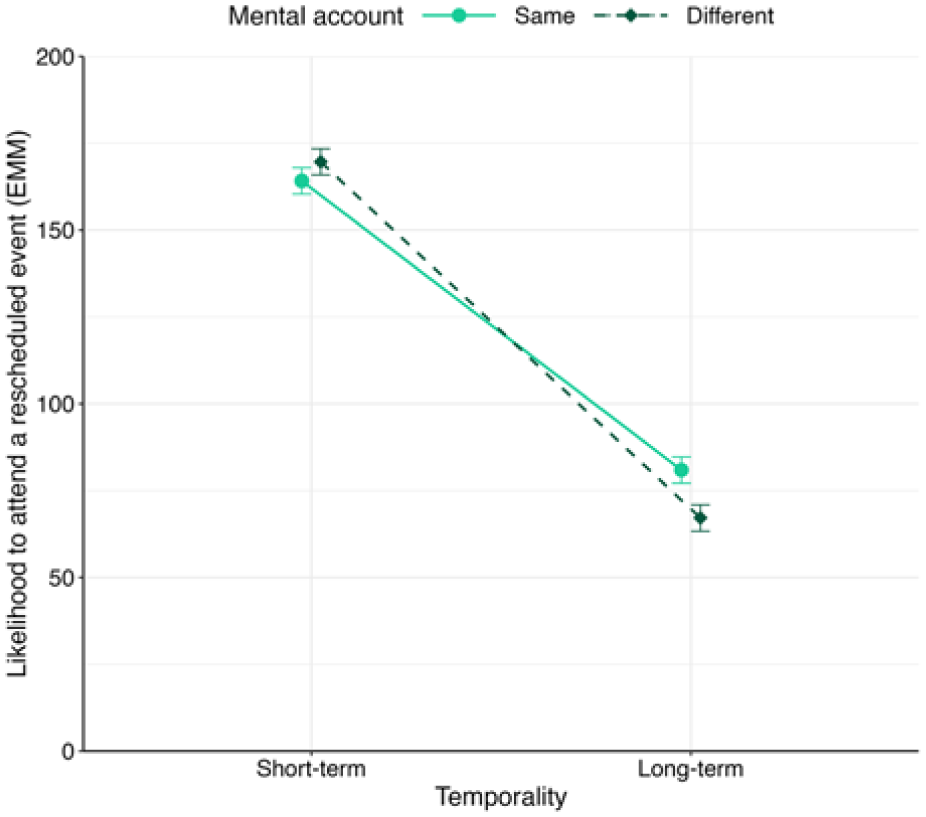
Likelihood to attend rescheduled events based on mental account and temporality interaction.
Temporality and Context-Related Activities
We found a significant main effect of temporality, F(1,2872) = 3103.08, p <.001, η2 = .97, ηp2 = .78, with participants more likely to attend a rescheduled event in the short-term condition (Mshort-term = 166.87, SEshort-term = 1.52) than in the long-term one (Mlong-term = 74, SElong-term = 1.52).
Context also had a significant main effect on attendance likelihood for rescheduled events, F(1,2872) = 51.19, p <.001, η2 = .02, ηp2 = .09. Participants reported higher likelihood to attend rescheduled leisure events (Mleisure = 126.4, SEleisure = 1.52) than work events (Mwork = 114.5, SEwork = 1.52).
Mental Account and Social Company
The hypothesized interaction between mental account and social company was not significant, F(1,2872) = 2.92, p = .09, η2 = .001, ηp2 = .01, so post-hoc analyses were not conducted. Participants in both social company conditions showed minimal differences in attendance likelihood for rescheduled events based on mental account. A slight increase was observed in the same mental account conditions for both the alone (Msame × alone = 121.98, SEsame × alone = 2.08) and company conditions (Msame × company = 123.05, SEsame × company = 2.23) compared to the different mental account conditions (Mdifferent × alone = 120.68, SEdifferent × alone = 2.08; Mdifferent × company = 116.03, SEdifferent × company = 2.23)
Social company had no significant main effect, F(1,409) = 0.49, p = .48, η2 = .0002, ηp2 = .001.
Estimated Marginal Means of Likelihood to Attend a Rescheduled Event Across Conditions
Figure 8 presents the estimated marginal means (EMMs) for participants' likelihood to attend a rescheduled event across all experimental conditions. It depicts main effects and interactions within the ANOVA model, with grids distinguishing context (leisure vs. work) and social company (alone vs. company).
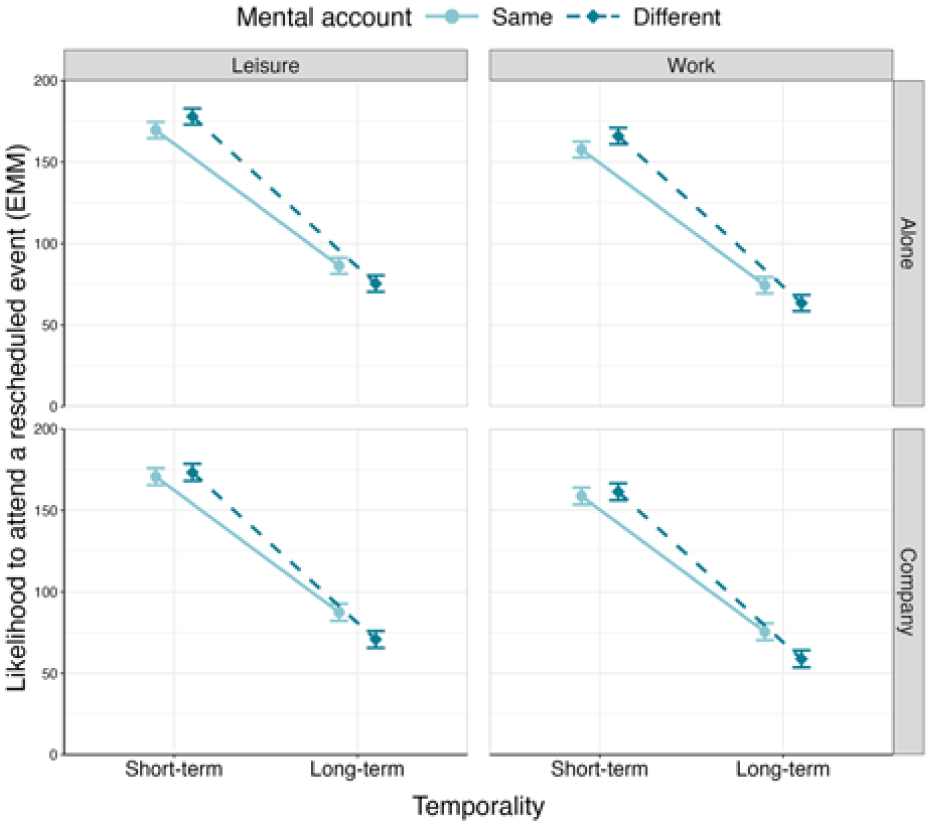
Likelihood to attend a rescheduled event across conditions.
Discussion
The results support the hypotheses regarding the influence of subjective value of time on attendance likelihood for rescheduled events, indicating main effects of mental account (H1), temporality (H3), and context (H4), as well as an interaction between mental account and temporality (H2). However, the expected interaction between mental account and social company (H6) was not observed.
We observed a mental account main effect, contingent on its interaction with temporality. Specifically, the hypothesized direction of the mental account effect (H1) was confirmed in the short-term condition but reversed in the long-term condition. Participants were more likely to attend a rescheduled event in the different mental account conditions for short-term rescheduling, whereas, for long-term rescheduling, they showed increased attendance likelihood in the same mental account condition. This reversal suggests a robust interaction effect (H2), though in the opposite direction than originally hypothesized.
Prior research (Kahneman & Tversky, 1984; Thaler, 1999) suggests that when the notification of monetary losses and the occurrences of their associated event remain temporally coupled, the mental accounting of money effect remains salient. For mental accounting of time and rescheduled events, our results suggest that decoupling the notification of target events rescheduling from their occurrences increases attendance likelihood in the same mental accounts for long-term rescheduling scenarios. This study also examined whether heightened sunk-cost effects in short-term rescheduling scenarios would override the mental accounting effect. The results suggest that while sunk costs diminish the mental accounting effect, they do not eliminate it.
We examined the mental account × temporality interaction to determine whether the heightened sunk costs associated with short-term rescheduling, driven by perceived immediacy and initial resource investments, would diminish the mental accounting of time. In long-term scenarios, we hypothesized that mental accounting would affect the attendance likelihood for rescheduled events, predicting a lower attendance likelihood in the same mental account condition. Instead, participants reported increased attendance likelihood in the same mental account conditions, indicating a distinct valuation of temporal losses when events are decoupled, but in the opposite direction from what was hypothesized. Notably, this increased likelihood in the same mental account condition for long-term scenarios suggests that time spent within the same mental account is perceived as more interchangeable. When future plans involve the same type of alternative activity (e.g., theater play now vs. theater play in the future), attending the rescheduled event may feel less effortful than attending a different type of rescheduled event (e.g., theater play now vs. concert in the future). Thus, within the same mental account, participants chose to attend the rescheduled event rather than plan for another similar activity that could require additional time investment.
The role of short-term rescheduling scenarios in increasing attendance likelihood for rescheduled events highlights the importance of temporality (Ariely & Zakay, 2001) and the influence of initial resource investment (Petrov et al., 2023) in time-related decisions. Additionally, context-related activities strongly influence the subjective value of time. Participants were more likely to attend rescheduled leisure events than work-related ones, possibly due to the perceived negative consequences of missing work events (Budnick et al., 2020; Fourati & Affes, 2014). These findings reinforce the idea that how we spend time is intrinsically linked to its perceived value.
Contrary to previous research suggesting social influence reduces the perceived value of losses (Bixter & Luhmann, 2021; Xu et al., 2015), for rescheduled events, we found no significant interaction between social company and the mental accounting of time. This may be because the scenarios described shared temporal resources, where the presence of another hypothetical person did not actively influence the decision. Further research is needed to explore this reasoning.
Overall, the findings in Experiment 3 support the notion of the existence of mental accounting of time while highlighting that the influence of temporality and context-related activities goes beyond mental accounts operationalized as simply same versus different. Temporality significantly shapes the direction of the mental accounting effect, influencing the attendance likelihood for rescheduled events. Our results also expand previous research by suggesting that even within the same context type (e.g., leisure vs. leisure), activities are valued differently depending on mental account categorization. Finally, the non-significant interaction between social company and mental account highlights an important avenue for future research on time-related decisions in shared contexts.
General Discussion
With this study we investigated how mental accounting of time influences the attendance likelihood for rescheduled events, considering key factors such as temporality, context-related activities, and social influences. Across three experiments, we found that mental accounting of time exists for the attendance likelihood for rescheduled events but operates differently from mental accounting of money (Kahneman & Tversky, 1984; Thaler, 1999). We observed that participants violated the fungibility principle when evaluating attendance likelihood for rescheduled events, with the temporality of rescheduling scenarios playing a critical role in time-related decisions.
In Experiment 1 we found that mental accounting of time applies to long-term rescheduling scenarios, even when the rescheduled event and its occurrence are decoupled. This suggests that individuals evaluate temporal resources differently based on whether losses occur in the same or different mental accounts in long-term rescheduling scenarios.
In Experiment 2 we expanded on these findings by comparing short-term versus long-term rescheduling scenarios and examining the role of leisure and work activities, as well as social norms. We found the mental accounting of time effect in the long-term, but not in the short-term conditions. The presence of injunctive social norms and work activities increased the attendance likelihood for rescheduled events.
In Experiment 3 we further investigated the interaction between mental accounting and temporality. The results suggest that in long-term scenarios, rescheduled events are perceived as more interchangeable within the same mental account. Leisure activities increased the attendance likelihood for rescheduled events. We examined social norms via social company but found no significant interaction between company and mental account.
Together, these findings suggest that mental accounting of time is shaped by temporality, and that temporality, context-related activities, and social norms influence time-related decisions, offering an integrated perspective on time-related decision-making.
Theoretical Contributions
This research advances the understanding of mental accounting of time by introducing insights into time-related decisions:
Decoupling the notification of target event rescheduling from the occurrence of the event does not diminish mental accounting of time. However, Experiment 3 suggested that such decoupling alters the effect’s direction. In short-term rescheduling scenarios (no decoupling), attendance likelihood rose for events in different accounts, while in long-term rescheduling scenarios, attendance likelihood rose for events in the same account. This pattern is consistent with temporal opportunity cost evaluations (Becker, 1965): as temporal distance increases, individuals reassess the relative value of alternative activities and may attribute greater value to maintaining the same type of activity rather than substituting it with a different one. Consistent with loss aversion (Kahneman & Tversky, 1979; Spiller, 2019), this tendency to preserve the original allocation reflects an effort to avoid perceived opportunity losses. Fungibility violations may thus arise from both account differences and perceived relative values across accounts.
The interaction between mental account and temporality may depend on the complexity of planning the future. When time investments are already structured, individuals tend to minimize cognitive effort (Otto & Daw, 2019) and construe future experiences more abstractly, consistent with temporal construal theory (Liberman & Trope, 1998). Considering planning complexity, if rescheduling interferes with similar planned activities (Experiment 3), individuals prefer to attend the rescheduled event rather than allocate resources for the additional planning complexity of a new activity.
The context in which time is spent significantly impacts the evaluation of temporal resources, as highlighted in previous research (Rajagopal & Rha, 2009). Consistent with previous mixed findings, Experiment 2 suggested an increased attendance likelihood for rescheduled events in leisure contexts, while Experiment 3 suggested an increase in work contexts. These differences may be attributed to sample characteristics (a majority of students in Experiment 2 and full-time workers in Experiment 3). Students, with more flexible schedules, may prioritize rescheduled work events over alternative work-related activities, viewing them as more interchangeable. In contrast, full-time workers, facing stricter schedules and higher work-work conflicts in real life, may deprioritize rescheduled work events when competing obligations arise. These differences likely reflect variations in perceived schedule flexibility and control over temporal resources across populations.
Social cues influence the attendance likelihood for rescheduled events, but this effect is not driven by the interaction of social company and mental account. Social norms increased attendance likelihood for rescheduled events (Experiment 2), aligning with prior research on consumer decisions (Melnyk et al., 2022) and social recognition (Pret & Carter, 2017). However, the mere presence of another person (social company) did not impact the effect of mental accounting on attendance likelihood, suggesting that explicit injunctive social norms (e.g., promises or gifts) are stronger drivers than passive social presence.
Taken together, these four aspects demonstrate that mental accounting of time is dynamically shaped by temporality, planning complexity, contextual meaning, and social influence.
Practical Implications
Understanding mental accounting of time has real-world applications for time management, scheduling behaviors, and service industries:
Event organizers can improve customer retention for rescheduled events by emphasizing sunk-cost effects, especially in short-term rescheduling scenarios.
Workplace scheduling policies should recognize that full-time employees are less likely to attend rescheduled work events in long-term scenarios and should aim to minimize the need for such rescheduling.
Policymakers and behavior specialists could improve work policies by structuring incentives around rescheduled work events, such as offering flexible leave options or reinforcing social norms around professional commitments.
Limitations and Future Research
Despite its contributions, this study presents limitations that open avenues for future research, particularly regarding the operationalization of mental account conditions, sample composition, and social influence.
First, our experimental manipulation necessarily used a simplified operationalization of mental accounts, reducing mental accounts to a binary distinction (same vs. different), to ensure clarity and internal validity. While this approach aligns with established work on mental accounting of money, it does not capture the full range of ways people may mentally categorize time. Future research could extend this operationalization by differentiating between types of activities within a single mental account (e.g., immediate vs. deferred commitments; low- vs. high-similarity activities) to better represent how people structure and allocate their time.
Second, differences observed across experiments may partly reflect variations in sample composition. Experiments 1 and 2 included mostly student participants, whereas Experiment 3 involved full-time employees, which may explain divergent patterns between work- and leisure-related contexts. Future studies should systematically compare individuals with different time schedules to determine whether lifestyle and employment status shape time-related decisions.
Beyond these limitations and their related research opportunities, additional directions for future inquiry arise. One concerns the broader social context: we investigated the role of injunctive social norms and company, but other forms of perceived social value, such as belonging, recognition, interactions with significant others may also enhance attendance likelihood. Another promising direction stems from the absence of an interaction between social company and mental account. While this suggests that passive social presence alone may not meaningfully impact time-related decisions, future studies examining active forms of social company (e.g., joint decision-making, collective scheduling, or reputational concerns) may identify conditions under which social dynamics alter mental accounting effects.
These extensions would enhance understanding of how the operationalization of mental accounting of time, along with temporal, contextual and social factors influence time-related decisions.
Conclusion
This research indicates that mental accounting of time exists and is shaped by temporality. Additionally, as hypothesized, temporality, context-related activities, and social norms influence attendance likelihood for rescheduled events. Time-related decisions depend on how time is structured within time frames, context-related activity types, and injunctive social norms. The present investigation supports the idea that time-based decisions are more heuristic than systematic, while also highlighting the context-bound nature of time. These findings advance theoretical understanding by showing how mental accounting influences time-related decisions and how temporal opportunity explains variations in decision patterns. This study offers practical implications for event planning, workplace scheduling, and behavioral interventions.
While traditional economic models often view mental accounting as suboptimal, in reality, the way individuals allocate and plan their time directly influences its perceived value. Understanding these mechanisms is crucial for improving predictions of time-related decisions and optimizing scheduling strategies.
Supplemental Material
sj-docx-1-sgo-10.1177_21582440261421844 – Supplemental material for Mental Accounting of Time: Attendance Likelihood for Rescheduled Events
Supplemental material, sj-docx-1-sgo-10.1177_21582440261421844 for Mental Accounting of Time: Attendance Likelihood for Rescheduled Events by Maria Rosa Miccoli, Malena Miller and Ulf-Dietrich Reips in SAGE Open
Supplemental Material
sj-docx-2-sgo-10.1177_21582440261421844 – Supplemental material for Mental Accounting of Time: Attendance Likelihood for Rescheduled Events
Supplemental material, sj-docx-2-sgo-10.1177_21582440261421844 for Mental Accounting of Time: Attendance Likelihood for Rescheduled Events by Maria Rosa Miccoli, Malena Miller and Ulf-Dietrich Reips in SAGE Open
Supplemental Material
sj-docx-3-sgo-10.1177_21582440261421844 – Supplemental material for Mental Accounting of Time: Attendance Likelihood for Rescheduled Events
Supplemental material, sj-docx-3-sgo-10.1177_21582440261421844 for Mental Accounting of Time: Attendance Likelihood for Rescheduled Events by Maria Rosa Miccoli, Malena Miller and Ulf-Dietrich Reips in SAGE Open
Footnotes
Acknowledgements
The authors express their gratitude to Jil Vossen, who conducted Experiment 1 as part of her bachelor thesis, for her valuable contribution to the experiment execution.
Ethical Considerations
This study was conducted in accordance with the principles of the Declaration of Helsinki and was non-interventional in nature. Accordingly, it received an ethics waiver from the University of Konstanz [RefNo: IRB25KN001-07w].
Consent to Participate
Participants provided informed consent prior to participation and all the data are anonymized: in Experiment 1 through a passive consent procedure with explicit confirmation, and in Experiments 2 and 3 via active informed consent.
Author Contributions
MM (first author), MM (second author) and U-D R contributed to the conception and design of the experiments. MM (first author) managed the data acquisition of the three experiments and conducted the data acquisition for Experiment 3. MM (second author) contributed to acquisition of the data for Experiment 2. MM (first author) executed the analyses and interpretation of data, with the support of MM (second author) and U-D R. MM (first author) drafted the article, MM (second author) and U-D R revised the article and provided their contributions. MM (first author), MM (second author) and U-D R approved the submitted version for publication. U-D R provided resources and supervision.
Funding
The authors disclosed receipt of the following financial support for the research, authorship, and/or publication of this article: All support was provided by the Chair of Psychological Methods, Assessment, and iScience at the University of Konstanz.
Declaration of Conflicting Interests
The authors declared no potential conflicts of interest with respect to the research, authorship, and/or publication of this article.
Data Availability Statement
In line with the Data Availability Statement, the authors made available the dataset on the Open Science Framework. The data sets generated and analyzed for the current study are available in the Open Science Framework repository (Project:  > Files > OSF Storage). Each Experiment folder contains the experiment files, the data sets and the scripts that were used for the main analyses that have been reported in the manuscript.
Supplemental Material
Supplemental material for this article is available online.
References
Supplementary Material
Please find the following supplemental material available below.
For Open Access articles published under a Creative Commons License, all supplemental material carries the same license as the article it is associated with.
For non-Open Access articles published, all supplemental material carries a non-exclusive license, and permission requests for re-use of supplemental material or any part of supplemental material shall be sent directly to the copyright owner as specified in the copyright notice associated with the article.
