




Abstract
In the internet era, digital literacy is crucial for entrepreneurial spirit. This study examines the impact of digital literacy on entrepreneurial behavior, based on the Chinese General Social Survey (CGSS) data. Employing a Probit model to estimate the marginal effects, we find that better digital literacy increases the chances of starting a business—both out of necessity (survival entrepreneurship) and opportunity (opportunity entrepreneurship). Digital literacy helps by improving access to information and enhancing social capital accumulation. Further analysis reveals that digital literacy has a more pronounced effect on middle-aged male individuals with lower education levels and living in rural areas. Overall, this study enhances our comprehension of the welfare implications of digital literacy, offering valuable insights for enhancing the digital literacy of residents to boost the entrepreneurial spirit.
Introduction
Entrepreneurship is commonly viewed as the driving force behind economic growth, contributing to the enhancement of urban competitiveness and the creation of job opportunities (Haltiwanger et al., 2013). This phenomenon encompasses two distinct types: necessity entrepreneurship, driven by a lack of alternative employment and often prevalent in developing economies, and opportunity entrepreneurship, motivated by the pursuit of new business opportunities (Schoar, 2010). Both forms of entrepreneurship play a crucial role in fostering growth within developing economies. In recent years, with the implementation of the ‘Broadband China’ strategy, China’s digital development level and the construction of urban and rural network infrastructure have been steadily improved, with intelligent tools and the internet being widely used (C. Liu & Wang, 2019). Digital technology is becoming increasingly pivotal in both everyday routines and economic operations. According to the 49th Statistical Report on the Development of China’s Internet, as of December 2021, the number of Internet users in China had reached 1.032 billion, with an Internet penetration rate of 73.0%. Spurred by the COVID-19 pandemic, a transformation in payment systems occurred globally, leading to the ascendancy of digital payment methods over cash (T. Liu et al., 2020; Srouji & Torre, 2022).
For the macroeconomy, the entire economic society can gain new momentum from digital transformation (Zaffiro & Mourgis, 2018). The digital economy, which is led by the Internet, big data, 5G, and cloud computing, has been continuously integrated with traditional industries, giving rise to new forms of employment and business models such as micro-merchants, internet celebrities, and self-media operators. This has created new business opportunities and market spaces, offering fresh opportunities for mass entrepreneurship. As the digital economy evolves, proficiency in digital skills has emerged as a critical form of human capital that is strongly associated with the welfare of individuals. This study focuses on the fundamental digital literacy skills that citizens should possess, aiming to explore their application in everyday learning, work, and life (Q. Wang et al., 2023). However, the disparity in digital skills among residents has given rise to the digital divide phenomenon (Y. Zhang, 2023). Against this backdrop, the Chinese government has spearheaded initiatives to boost national digital literacy, rolling out key policies including the ‘Guidelines on Developing Digital Economy for Stabilized and Expanded Employment’ (2018) and the ‘Outline for Action to Enhance the Digital Literacy and Skills of the Entire Population’ (2021). These concerted efforts in popularizing digital infrastructure and competencies are expected to mitigate the digital divide’s impact and shape residents’ entrepreneurial choices. Fostering entrepreneurship among the population is a significant matter concerning the national economy and people’s livelihood. Therefore, studying how digital literacy affects residents’ entrepreneurial decisions is of great importance.
In view of this, this study investigates how digital literacy influences entrepreneurship by using microdata from the Chinese General Social Survey (CGSS). Compared with previous studies, this paper extends the literature with three major contributions. Firstly, existing literature has predominantly focused on the broader digital economy’s effect on entrepreneurship, often overlooking the role of individual digital literacy. From a macro perspective, digital finance (S. Liu et al., 2022), network construction (Li et al., 2024; Q. Luo et al., 2022), and E-commerce (Jiang & Qin, 2024) have all promoted entrepreneurial activities among residents. Micro-level research at the individual level has primarily focused on the positive impact of individuals’ internet use (H. Fan et al., 2023) or their adoption of digital technologies or financial technology (C. Cheng et al., 2024; Y. Luo & Zeng, 2020; Yin et al., 2019) on entrepreneurship. However, the ownership of information devices or the use of digital technologies is merely one aspect of digital literacy (Q. Wang et al., 2023). Therefore, this study attempts to fill this gap by employing a more direct and general measurement method of digital literacy, for better understanding the relationship between digital literacy and entrepreneurship, as well as policy implications for strategic development interventions.
Secondly, this study contributes to the human capital-entrepreneurship literature by shifting the focus from traditional metrics like education level (Block et al., 2013; Z. Cheng & Smyth, 2021; Huang et al., 2021; Van Der Sluis et al., 2008) and established mechanisms such as social capital (Z. Cheng & Smyth, 2021; Glaeser et al., 2002; M. Wang & Ning, 2016) and financing (Gofman & Jin, 2024). In recent years, studies have also emphasized the role of language skills (Wei et al., 2019), financial literacy (Wen et al., 2024), and non-cognitive abilities (Koe Hwee Nga & Shamuganathan, 2010; Yang & Ai, 2019). This paper primarily highlights the positive role of digital literacy as a new type of human capital in the entrepreneurial decision-making of residents (Heckman, 2006).
Thirdly, we also further explore the underlying mechanisms. We propose three potential channels—information access, human capital investment, and social capital construction—and provide corresponding arguments, offering a more detailed theoretical explanation and empirical support for how digital literacy influences entrepreneurship.
This study is structured as follows: Section 2 presents the literature review and research hypotheses. Section 3 outlines the data sources, variable definitions, and empirical methodology. The baseline regression results are analyzed in Section 4, followed by a series of heterogeneity analyses in Section 5 and robustness checks in Section 6. Finally, Section 7 concludes with the main findings and corresponding policy implications.
Literature Review and Research Hypothesis
Digital Literacy and Information Access
According to the theory of information search, higher search costs constrain an individual’s search behavior, forcing them to make production and employment decisions based on limited information (Mortensen & Pissarides, 1999). For potential entrepreneurs, this information constraint is a critical barrier. The entrepreneurial process inherently involves navigating significant uncertainty, requiring information to identify market opportunities, understand supply and demand dynamics, and comprehend regulatory processes (Stiglitz, 2002).
Digital literacy directly addresses this barrier by drastically reducing the costs of information search for individuals engaged in entrepreneurial discovery. As digital literacy improves, individuals become more proficient at using mobile devices and the internet to efficiently gather and process market intelligence (Q. Wang et al., 2023; Y. Zhang, 2023). This capability allows aspiring entrepreneurs to grasp price fluctuations, assess market viability, and identify unmet needs with greater speed and lower cost (Barnett et al., 2019). Furthermore, digital platforms are particularly consequential for entrepreneurship. E-commerce platforms, for instance, have reduced the fixed costs of market entry and diminished the impact of geographical distance on trade, creating favorable conditions for businesses to enter consumer markets in smaller cities and remote areas (J. Fan et al., 2018). Improved digital literacy also enables entrepreneurs to more easily access government-supported entrepreneurial policies, understand licensing procedures, and navigate administrative approvals online (Zhu et al., 2021). By lowering the cost and increasing the speed of acquiring this essential knowledge, digital literacy provides potential entrepreneurs with a competitive advantage in opportunity recognition and venture startup. Consequently, this study proposes
Digital Literacy and Human Capital Investment
Investigate further the potential avenues by which digital literacy can promote entrepreneurial behavior. In addition to the direct ‘information effects’, digital literacy can also increase the human capital investment of residents, generating indirect benefits. Learning plays a pivotal role in personal development, and digital literacy transcends the limitations of traditional learning and higher education models (Zine et al., 2025). The development of the Internet not only expands educational resources but also facilitates equitable resource distribution. Through digital interactive experiences and resource sharing, educational content becomes more accessible. The emergence of online educational tools and platforms has not only provided basic education but also fostered the creation of interdisciplinary practical educational resources (Enache & Crişan, 2014). The ‘2023 China Digital Education Market Data Report’ shows that the number of digital education users in China has reached 349 million in 2023, with a year-on-year growth rate of 11.14%. In such a context, digital literacy has transformed the approach to learning, broadening the scope of education, characterized by the convenient acquisition and popularization of knowledge. Innovative learning modes such as distance education, online education, video teaching, and learning software capitalize on fragmented time, significantly enhancing the efficiency, frequency, and duration of learning (Qi & Chu, 2021). Therefore, digital literacy can contribute, to a certain extent, to enhancing individual human capital investment.
The New Human Capital Theory establishes an analytical framework that shifts the focus from ‘schooling’ to ‘capabilities’ (Heckman, 2006). Self-employed individuals need to perform more tasks in their work than employees, and as a result, their jobs often require a wider range of skills than those of employees, thus necessitating a greater knowledge base beyond basic education (Lechmann & Schnabel, 2014). The increase in human capital investment brought about by the enhancement of digital literacy will be able to improve the efficiency of labor as well as managerial skills (Berniell, 2021). According to Jabbari et al. (2022), experiences like online learning and gig economy participation are significantly linked to stronger entrepreneurial intention. Their research demonstrates that these activities serve as forms of informal skill development and career preparation that mediate the impact of employment on entrepreneurial plans. Building upon these findings, we propose
Digital Literacy and Social Capital Accumulation
Social capital is conventionally categorized into bonding social capital, which derives from strong, intimate ties (e.g., among family and close friends), and bridging social capital, which stems from weaker, more distant connections (e.g., acquaintances, colleagues) that often provide access to novel information and opportunities (Granovetter, 1973; Putnam, 2000). The Internet emerges as a powerful tool for the cultivation of both forms of capital. Its accumulation hinges on three elements: social networks as its structural backbone, social support as the embedded resources, and trust-based interpersonal relationships as the key activation mechanism.
In a context like China, where social capital derived from interpersonal relationship networks often serves as an informal institution to mitigate risks and smooth consumption (Fafchamps & Gubert, 2007), digital literacy significantly expands the scope and efficiency of its accumulation. Traditionally, the maintenance of these networks was constrained by time and space. Digital tools, particularly the proliferation of social media platforms facilitated by initiatives like the ‘Broadband China’ strategy, have transcended these limitations. They provide diverse and efficient channels for individuals to maintain strong ties (bonding capital) and, more importantly, to establish new, weak-tie connections (bridging capital), thereby expanding their social circles (Bauernschuster et al., 2014; Pénard & Poussing, 2010; Wellman et al., 2001).
People obtain funds, information, and assistance in interpersonal relationships by utilizing commonly trusted and familiar social networks, which helps to alleviate information asymmetry, reduce the economic and time costs associated with searching for and integrating fragmented information, thereby increasing employment and entrepreneurial opportunities (Barnett et al., 2019; Cai et al., 2018; Munshi, 2003; Yueh, 2009). For example, Yin et al. (2019) found that the widespread use of mobile payments helps to enrich an individual’s social network and increase the probability of entrepreneurship. Yang et al. (2025) found that digital literacy helps residents access informal social support and improve health. As for ‘Taobao villages’, villagers often begin to pay attention to and gain a deeper understanding of Taobao under the influence of fellow villagers, relatives, and friends who have already engaged in commercial activities on the platform. They receive the impartation of relevant skills and experience from them and eventually join the ranks of entrepreneurs (Cui et al., 2014; Figure 1). Accordingly, this paper proposes

The mechanism of the impact of digital literacy on entrepreneurial behavior.
Data and Methods
Data Source
The empirical analysis in this paper relies on the 2017 Chinese General Social Survey (CGSS), a nationally representative dataset. The CGSS, launched in 2003 by the China Survey and Data Research Center at Renmin University of China, is one of the earliest and most continuous academic survey projects in the country. The CGSS employed a multi-stage stratified sampling method, covering 28 provincial-level administrative units across the country (excluding Xinjiang, Tibet, Hainan, and the Hong Kong, Macau, and Taiwan regions), including 478 villages and neighborhood committees. From 2003 to 2021, the CGSS has released the data from 11 rounds of surveys. However, we have confirmed that the most recent CGSS waves, 2018 and 2021, do not include the comprehensive set of questions on digital literacy that are necessary for constructing the specific variable used in this study. Although the CGSS began incorporating questions about internet usage into its questionnaire starting in 2005, it was not until the 2017 survey wave that questions specifically addressing digital literacy were included. Therefore, the 2017 CGSS remains the most recent dataset available that contains the required information to build our comprehensive digital literacy index. In addition to its core modules, the CGSS questionnaire also contains comprehensive information on demographic characteristics and household economic status. These variables directly inform the measurement of digital literacy and provide critical support for the empirical analysis that follows. After excluding samples with missing values and those who answered ‘don’t know’, a final sample of 3,494 observations was obtained.
Variable Selection
Dependent Variable
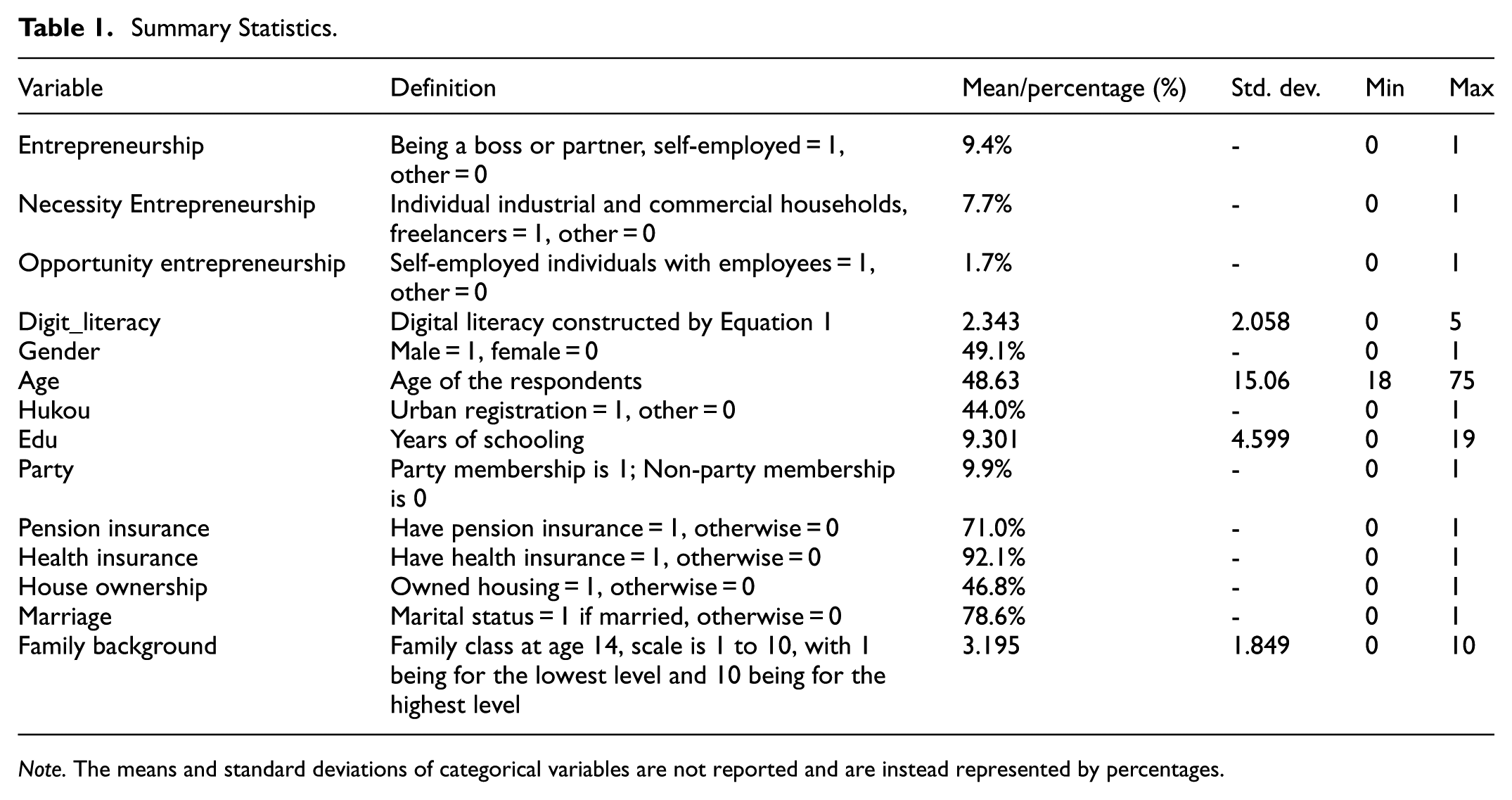
In this research, the determination of whether an individual is engaged in entrepreneurship is primarily derived from their employment status during the survey period. The CGSS survey in 2017 categorized respondents into nine categories: (1) self-employed individuals with employees; (2) individual industrial and commercial households; (3) employed by others with a regular employer; (4) dispatched workers; (5) hourly paid or temporary workers; (6) working or helping in their own enterprise without wages; (7) working or helping in their own home business and receiving wages; (8) freelancers; (9) others. Based on this classification, we categorize options (1), (2), and (8) as entrepreneurs, while all other options are considered non-entrepreneurs, aligning with the approach of Xiong et al. (2018) and M. Zhou et al. (2024). In the 2017 sample, the proportion of entrepreneurial individuals in the overall population is not high, accounting for only 9.40%, which is consistent with the existing literature (M. Zhou et al., 2024).
Furthermore, according to Schoar’s (2010) and C. Y. Liu and Huang’s (2016) definition, in the absence of suitable employment opportunities in the labor market or when job expectations are difficult to meet, individuals often opt for necessity entrepreneurship to fulfill their basic employment requirements. Conversely, those with access to employment opportunities but seeking to enhance their self-worth are more likely to pursue opportunity entrepreneurship. This study also evaluates the influence of digital literacy on various forms of entrepreneurship and examines the presence of any heterogeneity in this context. Based on the above classification, we categorize options (1) as opportunity entrepreneurship, while options (2) and (8) are considered necessity entrepreneurship.
Independent Variables
Early researchers believed that digital literacy is the ability to understand and use information from various digital resources (Gilster, 1997), that is, digital literacy is associated with ‘mastering ideas, instead of tapping the keyboard’. More precisely, Martin (2006) detailed its constituent elements, which encompass the awareness, attitude, and proficiency in utilizing digital technologies appropriately, along with the capabilities related to facilitating constructive social engagement and contemplation on the process. The United Nations Educational, Scientific and Cultural Organization (UNESCO) defines digital literacy in the ‘A Global Framework of Reference on Digital Literacy Skills for Indicator’ as ‘Digital literacy is the ability to access, manage, understand, integrate, communicate, evaluate and create information safely and appropriately through digital technologies for employment, decent jobs, and entrepreneurship. It includes competencies that are variously referred to as computer literacy, ICT literacy, information literacy and media literacy’. Based on the aforementioned information, we referred to Q. Wang et al.’s (2023) approach and constructed a comprehensive ‘digital literacy’ indicator that includes six digital skills considering the availability of data. For an individual i in the data survey, the digital literacy index is expressed as:

In this formula, k denotes the k-th digital skill, K represents the total number of skills under consideration, and

Bar chart for entrepreneurship and digital literacy.
Control Variables
Following prior studies (Xiong et al., 2018; M. Zhou et al., 2024), we control for a comprehensive set of variables at both the individual and household levels. Individual-level controls include gender, age, Hukou status, years of education, Communist Party membership, pension, and health insurance. Household-level controls comprise home ownership, marital status, and family background. Table 1 reports the descriptive statistics for all variables.
Summary Statistics.
Note. The means and standard deviations of categorical variables are not reported and are instead represented by percentages.
Mechanism Variables
The information access mechanism posits that higher digital literacy facilitates access to diverse information sources. Referencing the measurement method of Q. Wang et al. (2023), we measure the variable ‘Information access’ by the CGSS questionnaire item: ‘In the past year, how often did you search for specific information online?’ Respondents could choose from the following options: 1 = Never, 2 = Rarely, 3 = Sometimes, 4 = Often, 5 = Always. A higher score indicates greater frequency of online information searching, potentially facilitated by digital skills. The human capital effects mechanism suggests that digital literacy can enhance individual skills and knowledge, contributing to personal development. Regarding ‘Human capital investment’, previous studies mostly measure it using individual expenditures on education and training. However, due to the lack of this information in the data used in this paper, following Qi and Chu (2021), we alternatively use the frequency of individuals studying during leisure time as a proxy variable for human capital. This variable is represented by the question in the CGSS questionnaire: ‘In the past year, how often have you engaged in studying or “recharging” during your free time?’ Respondents need to choose from the following options: 1 = Never, 2 = Rarely, 3 = Sometimes, 4 = Often, 5 = Always. Following Qi and Chu (2021), we measure ‘Social capital’ by the frequency of personal participation in social interactions last year, captured by the CGSS item: ‘In the past year, have you often engaged in social activities during your free time?’ Respondents need to choose from the following options: 1 = Never, 2 = Rarely, 3 = Sometimes, 4 = Often, 5 = Always.
Grouping Variables
To further explore the heterogeneous effects of various demographic factors on entrepreneurship, we examine the influence of gender, education, age, and place of residence. Based on gender, the sample is divided into two groups: male and female. Educational attainment is categorized into two groups: those with education up to junior high school and those with high school education or above. Age is considered by constructing two groups: the ‘youth group’ consisting of individuals 35 years of age or younger, and the ‘middle-aged and elderly group’ comprising those older than 35. Finally, we analyze the heterogeneous effects based on the respondents’ place of residence, differentiating between those living in urban areas and those in rural areas.
Empirical Model
Since the dependent variable is not a continuous variable but a binary variable, the conventional OLS model may not be applicable. In this research, a Probit regression model was constructed at the micro-individual level to assess the influence of digital literacy on the likelihood of residents starting their own businesses. The Probit model utilizes the cumulative normal distribution function to estimate probabilities and is particularly suitable for capturing the influence of explanatory variables on the probability of this binary outcome. The likelihood of entrepreneurship among residents is calculated based on the following equation:

In this model,
According to the theoretical section, digital literacy can affect individual entrepreneurial behavior through indirect effects. We empirically test these possible mechanisms. Specifically, we test whether the core explanatory variable affects the mechanism variable (M) using regression model (3). On this basis, we further examine the effect of M on Entrepreneurship to provide supplementary correlational evidence.

In model (3), M is the mechanism variable, which includes ‘information access’, ‘human capital investment’, and ‘social capital’. The rest of the variables are the same as in model (2). We further include the mechanism variable in the main regression model (2) to verify whether the mechanism variable M can play a role in the explanatory variable Entrepreneurship, as measured by the significance of δ. A fundamental challenge in testing mediation effects with nonlinear models (e.g., Probit/Logit) is the scale parameter issue. The coefficients in these models are contingent on the variance of the latent error term. Introducing a mediator changes this residual variance, thereby altering the scale of the coefficients and rendering direct comparisons across nested models invalid. To resolve this methodological issue, we employ the KHB (Karlson-Holm-Breen) method (Kohler et al., 2011). It isolates the part of the mediator M that is orthogonal to (i.e., not explained by) digital literacy by regressing M on

Empirical Results
Probit Regression Model
As reported in Table 2, digital literacy exerts a significant positive influence on entrepreneurial behavior across all model specifications, which control for province-fixed effects. The stability of the digital literacy coefficient between the uncontrolled (column 1) and controlled models (column 2) underscores the robustness of this relationship. Based on the positive coefficient estimate in column (2) of Table 2, the corresponding marginal effects presented in Appendix Table A1 indicate that each additional unit of digital literacy is associated with a 2% increase in the probability of entrepreneurship. Further analysis indicates that this effect is driven by both necessity and opportunity entrepreneurship (columns 3–4). The results for other covariates, including gender, party membership, and marriage, are in line with established findings (Xiong et al., 2018; M. Zhou et al., 2024).
Results of Probit Regression Model.

Note. (1) The robust standard errors are presented in parentheses; (2) ***, **, and * indicate statistical significance at the 1%, 5%, and 10% levels, respectively. The same applies to the following table; (3) The marginal effects of the baseline probit model results are reported in Appendix Table A1.
Mechanism Analysis
The aforementioned findings suggest that digital literacy has a significant impact on increasing the probability of residents starting businesses. We further investigate its underlying mechanism. Building upon the theoretical analysis presented in the literature review, this study uses models (3) and (4) to verify whether digital literacy promotes entrepreneurial behavior through information effects, human capital effects and social network effects.
Information Access
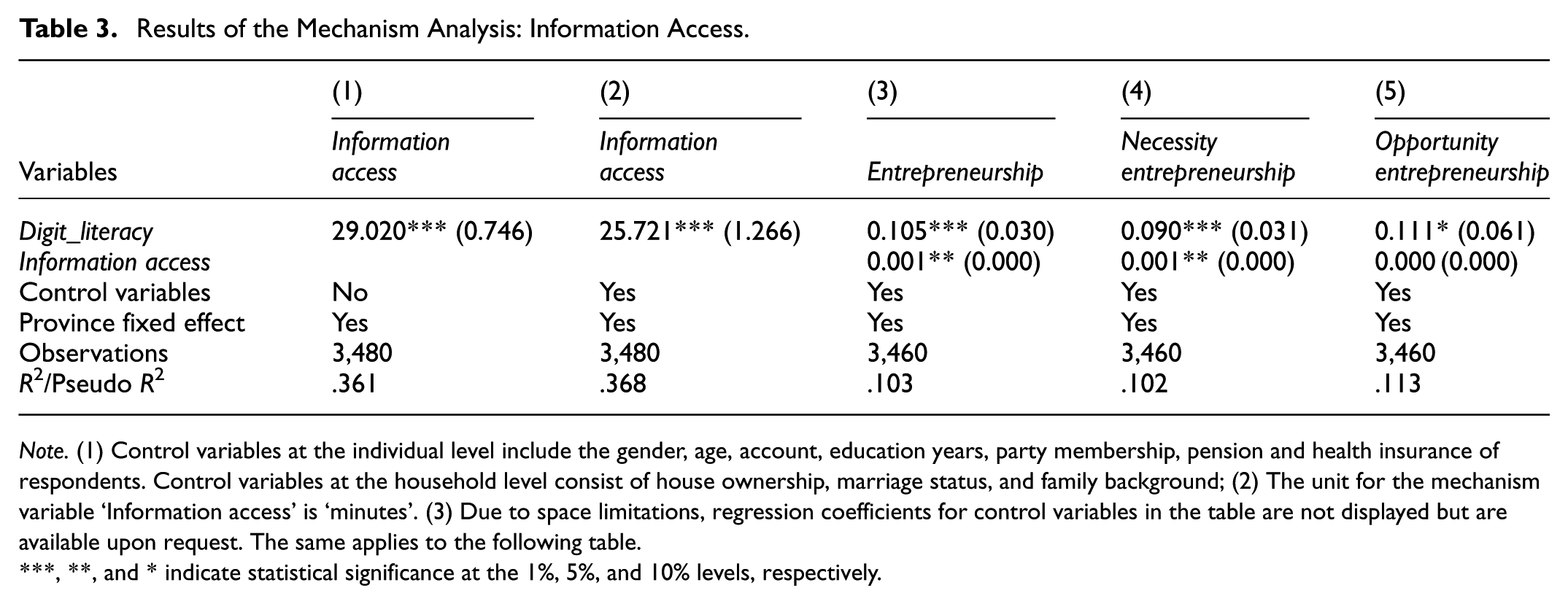
Table 3 shows the results of the information access mechanisms. The results in columns (1) and (2) indicate that higher digital literacy is associated with enhanced information acquisition. Then we incorporate ‘Information access’ as the mechanism variable (M) in model (4) for estimation. The improvement in information acquisition is positively correlated with entrepreneurship in column (3). After introducing the mediating variables, the positive effect of digital literacy on entrepreneurship persists. The findings indicate that information acquisition is one of the key mechanisms, albeit with incomplete mediating effects. Therefore, hypothesis
Results of the Mechanism Analysis: Information Access.
Note. (1) Control variables at the individual level include the gender, age, account, education years, party membership, pension and health insurance of respondents. Control variables at the household level consist of house ownership, marriage status, and family background; (2) The unit for the mechanism variable ‘Information access’ is ‘minutes’. (3) Due to space limitations, regression coefficients for control variables in the table are not displayed but are available upon request. The same applies to the following table.
, **, and * indicate statistical significance at the 1%, 5%, and 10% levels, respectively.
From the results in columns (4) and (5) of Table 3, it can be seen that information acquisition primarily plays a mechanistic role in promoting necessity entrepreneurship, while its effect on opportunity entrepreneurship is limited (although the coefficient is positive, it is not statistically significant). We also employed the KHB mediation effect test method for verification (Kohler et al., 2011). For the outcome variable ‘entrepreneurship’, the results of the KHB mediation effect test, as shown in column (1) of Appendix Table A2, indicate that the total effect, direct effect, and indirect effect are all significant, with the total effect being approximately 1.2 times the direct effect. The mediating variable ‘information acquisition’ can explain 17.52% of the total effect. In detail, for the ‘Necessity entrepreneurship’ outcome variable in column (2), the mediating variable ‘Information access’ can explain 19.98% of the total effect, while the mediating effect for ‘Opportunity entrepreneurship’ remains insignificant in column (3). The possible reason is that daily information acquisition often involves broad but relatively superficial information. Necessity entrepreneurship may rely more on immediate responses to market demand and the utilization of daily information, which can typically be obtained through routine information channels. Moreover, although daily information acquisition can provide some insights into the market, it may not be sufficient to support complex business model innovation, which is a characteristic feature of opportunity entrepreneurship. Opportunity entrepreneurs may require more specialized market research, technical knowledge, and strategic planning.
Human Capital Investment
Then, we replace the dependent variable with the mechanism variable ‘Human capital investment’. As seen from the results in columns (1) and (2) of Table 4, individual digital literacy increases the frequency of studying during leisure time, with the coefficients being statistically significant at the 1% level. However, the results estimated by model (4) in Table 4, columns (3) to (5), show that human capital investment did not significantly increase the probability of entrepreneurial activities. A possible reason may be that the dependent variable is based on the outcome of whether an individual has already successfully started a business, but those who have started a business may not have much free time, leading to a negative correlation between the two variables. We believe a more likely explanation is that digital literacy promotes the accumulation of human capital before starting a business, and the investment in human capital after an individual starts a business no longer significantly increases, thus the impact of studying and recharging during free time on entrepreneurship is not significant. Unfortunately, due to the limitations of the cross-sectional data used, we are unable to obtain specific information on the human capital investment of entrepreneurs before their business success.
Results of the Mechanism Analysis: Human Capital Investment.

Note. (1) Control variables at the individual level include the gender, age, account, education years, party membership, pension and health insurance of respondents. Control variables at the household level consist of the house ownership, the marriage status, and the family background.
, **, and * indicate statistical significance at the 1%, 5%, and 10% levels, respectively.
Social Capital
As mentioned in the literature review, digital literacy can help residents accumulate more social capital, thereby increasing their probability of entrepreneurship. To verify this possible mechanism, we also use the causal chain model examined in the previous text. The regression results are shown in Table 5. As shown in columns (1) to (2), the core explanatory variable is positive and statistically significant at least at the 5% level, with or without controlling for individual and household characteristics, suggesting that digital literacy effectively boosts an individual’s social capital. Then we incorporate ‘Social capital’ as the mechanism variable (M) in model (4) for estimation. The results of columns (3) to (4) show that social capital did not significantly increase the probability of entrepreneurial activities. However, the result in column (5) indicates that the increase in social capital helps to raise the probability of opportunity entrepreneurship, thus
Results of the Mechanism Analysis: Social Capital.

Note. (1) Control variables at the individual level include the gender, age, account, education years, party membership, pension and health insurance of respondents. Control variables at the household level consist of the house ownership, the marriage status, and the family background.
, **, and * indicate statistical significance at the 1%, 5%, and 10% levels, respectively.
In addition, we also replaced the dependent variable with another social capital proxy variable. The specific question in the CGSS questionnaire is ‘From Monday to Friday, approximately how many people do you contact via the internet each day?’. As seen from the results of Table A3, the mediating effect of ‘social capital’ remains stronger only in ‘opportunity entrepreneurship’.
Heterogeneity Analysis
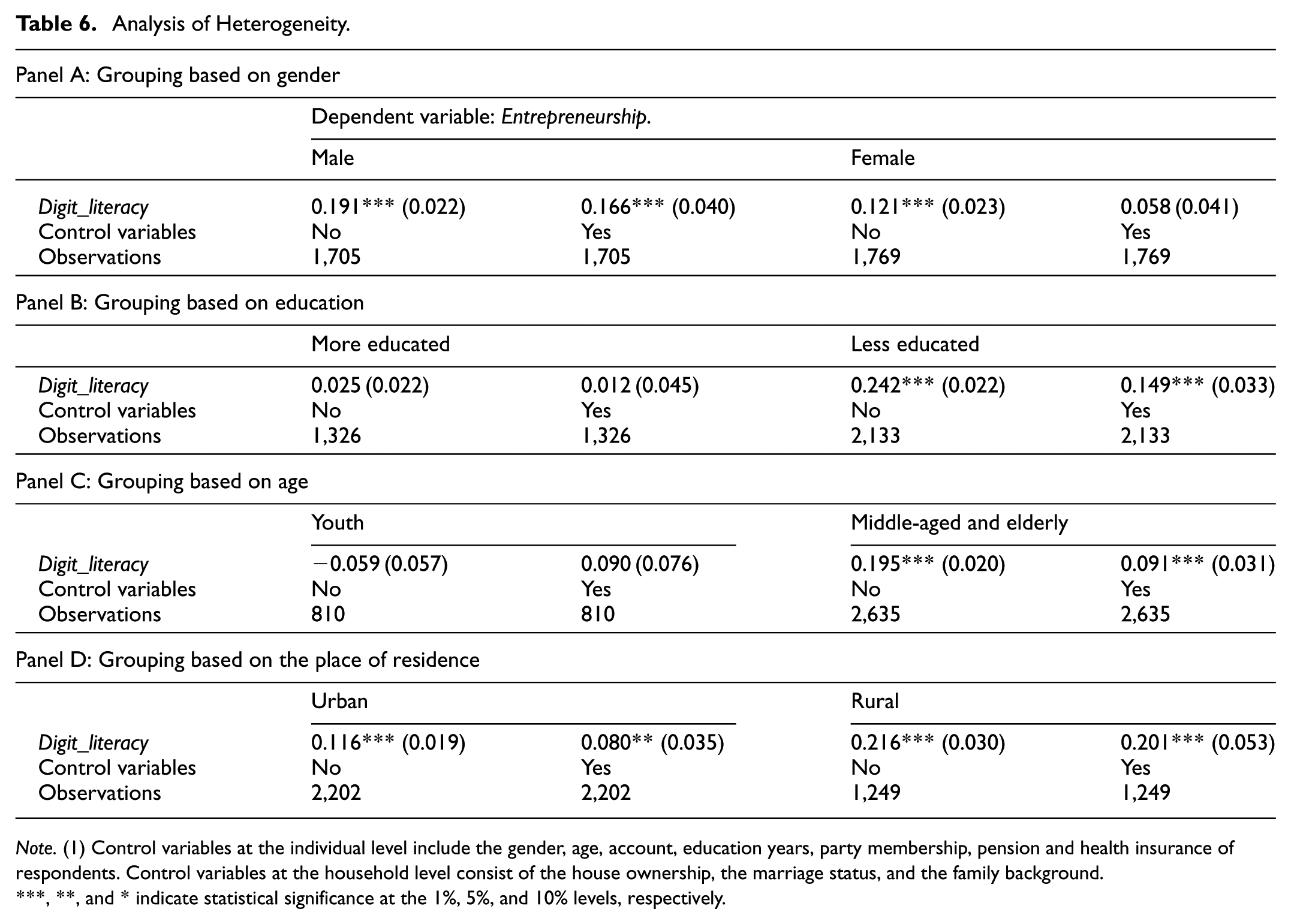
We have verified that digital literacy significantly increases the probability of entrepreneurial activities, but does this effect differ across different socioeconomic statuses? In view of this, we further explore the interactive effects of gender, education, age, and place of residence on entrepreneurship. Specifically, we divide the sample by the different groups to re-estimate the baseline model, and the estimated results are shown in Table 6.
Analysis of Heterogeneity.
Note. (1) Control variables at the individual level include the gender, age, account, education years, party membership, pension and health insurance of respondents. Control variables at the household level consist of the house ownership, the marriage status, and the family background.
, **, and * indicate statistical significance at the 1%, 5%, and 10% levels, respectively.
Heterogeneity of Gender
Panel A in Table 6 shows the estimated coefficients of different genders. After controlling for variables, the regression coefficient for men is higher than that for women and is statistically significant, suggesting that digital literacy has a greater impact for males on the probability of entrepreneurship. The above regression results may be due to objective gender inequalities in entrepreneurship and subjective differences in entrepreneurial attitudes. Some scholars believe that women have lower physical strength, risk-taking ability, human capital, and social capital (Neider, 1987; Sexton & Bowman-Upton, 1990). Almost all major aspects of the entrepreneurial process, such as human capital, financing, development strategies, social networks, and entrepreneurial teams, face varying degrees of gender discrimination. Moreover, China’s traditional Confucian thoughts and historical culture still deeply influence individuals’ thoughts and values (Cho et al., 2020). In family relationships, due to the busyness of household chores, women need to balance their family and work responsibilities. Additionally, the traditional concept of ‘men handle the external affairs and women handle the internal affairs’ often makes women prioritize the family and even choose to give up entrepreneurship. Contrary to women who prioritize the family, men often prioritize their careers and take on the family’s expenses, thus having a stronger entrepreneurial motivation. Therefore, the effect of digital literacy on entrepreneurship is stronger for the male group.
Heterogeneity of Education
Panel B of Table 6 presents the results considering education level. Specifically, following Q. Wang et al. (2023), we divide the sample by the educational level (up to junior high schools, high schools, and above). As can be seen, the core coefficient of the less educated sample is significantly positive at the 1% level, suggesting that the effect of digital literacy on entrepreneurship is stronger for the less educated group. The main reason is that with the rapid development of the digital economy, digital technology has become universally accessible, making it easy for both highly educated and less educated households to access and master digital technology (C. Liu & Wang, 2019). However, from the perspective of internal dynamics, highly educated people possess greater traditional human capital and social resources, which afford them more high-quality employment opportunities (Bai et al., 2024). In contrast, less educated people have weaker human capital, and enhancing their digital literacy can help stimulate the development of their internal dynamics, bringing them more information and social resources. Therefore, digital literacy plays a more significant role in promoting entrepreneurship among low-educated groups. This result is also consistent with existing literature that finds the widespread use of the Internet primarily has a stronger effect on promoting entrepreneurship among low-income and low-education groups (Leng, 2022).
Heterogeneity of Age
We further explore whether effects are heterogeneous across individuals with different ages. Specifically, we constructed the ‘youth group’ and the ‘middle-aged and elderly group’ based on whether the respondents were older than 35 years of age. As shown in Panel C, the positive effect is insignificant for the youth group. The regression analysis for the population aged 60 and above found that the impact of digital literacy is insignificant, indicating that the enhancing effect is concentrated in the middle-aged group. Our result is consistent with some literature that finds the entrepreneurial enhancement effect of digital financial literacy is strongest among the middle-aged group (Y. Luo & Zeng, 2020). The middle-aged may be in a phase of life where they are looking for new challenges or are more open to career changes, making them more receptive to the benefits of digital literacy in entrepreneurship. Besides, middle-aged individuals may have accumulated more work experience, financial and social resources over time, which can more readily translate into entrepreneurial ventures when combined with improved digital literacy. Therefore, digital literacy can help the middle-aged carry out entrepreneurial activities.
Heterogeneity of Place
Finally, we also analyzed the heterogeneous effects of whether the respondents reside in urban or rural areas. As shown in Panel D, although digital literacy significantly increases the probability of entrepreneurship for both urban and rural groups, the effect is stronger for the rural population. Typically, rural and low-income individuals face greater challenges in securing formal employment, particularly in high-paying jobs that can elevate a family’s economic standing. The emerging, and cost-effective digital commerce and finance in China fosters a conducive environment for these individuals with higher digital literacy to establish and manage their own ventures (Kong & Loubere, 2021; Tang et al., 2004). This also indirectly indicates that digital literacy helps to break down the barriers to entrepreneurship caused by ‘environmental’ factors such as place of residence, leading to inequality of opportunity (C. Zhang & Weng, 2024; G. Zhou & Liu, 2024).
Robustness Tests
The Omitted Variables Problem
The causal relationship between digital literacy and entrepreneurial behavior may also be jointly driven by other omitted variables, such as an individual’s curiosity about new things or the innovative atmosphere of a region. We utilize Oster’s (2019) method of boundary testing to investigate potential endogeneity problems stemming from the exclusion of significant unobserved variables. First, we set
IV Approach
Another issue is the reverse causality problem, which means entrepreneurial behavior could affect individual digital literacy. Given that ‘digital literacy’ is not an exogenous variable, we use the duration from the respondent’s first time accessing the internet to the present (in years) as an instrument variable according to wC. Zhang et al. (2023). If the respondent had not yet accessed the Internet by 2017, the value would be 0; otherwise, the value would be the length of the first contact with the Internet and the year 2017. Our choice of instrumental variable is justified on two grounds. First, the duration of internet exposure is theoretically correlated with digital literacy. Second, the timing of first exposure is historically predetermined and thus unlikely to influence current entrepreneurial outcomes through channels other than digital literacy, satisfying the exclusion restriction. This approach is analogous to the exposure metrics employed in existing literature (Chen et al., 2025; Gibson & Rozelle, 2003).
As anticipated, the results of the first-stage regression, presented in column (1) of Table 7, demonstrate a significantly positive coefficient on the instrumental variable. The first-stage F statistic (313.48) indicates that the instrumental variable has strong explanatory power for digital literacy, further excluding the issue of weak instrumental variables. Additionally, the results of the Wald test indicate that the Wald statistic significantly rejects the null hypothesis that digital literacy is exogenous at the 5% statistical level. Column (2) report the results of the second-stage regression, supporting the baseline regression findings that digital literacy significantly promotes entrepreneurial behavior among residents.
Results of the Endogeneity Test.

Note. (1) Control variables at the individual level include the gender, age, account, education years, party membership, pension and health insurance of respondents. Control variables at the household level consist of house ownership, marriage status, and family background; (2) The estimation results obtained through the IV-probit method.
, **, and * indicate statistical significance at the 1%, 5%, and 10% levels, respectively.
Replacing the Measure of the Explanatory Variable
Since the explanatory variable ‘digital literacy’ used in the previous regression model is mainly calculated based on the equal-weighting method, to ensure the robustness of the conclusion, we have recalculated ‘digital literacy’ using a variety of other comprehensive indicator methods. First, we construct an alternative measure of digital literacy by using factor analysis in the robustness check. The estimation result is presented in columns (1) and (2) of Table 8. We also conduct the entropy method to composite indicators, and the results are shown in columns (3) and (4) of Table 8. The results indicate that digital literacy significantly increases the probability of entrepreneurship, regardless of whether control variables are included or not. Therefore, our baseline regression results are robust and irrespective of the method of synthesizing the explanatory variables.
Results of Replacing the Measure of the Explanatory Variable.

Note. (1) Control variables at the individual level include the gender, age, account, education years, party membership, pension and health insurance of respondents. Control variables at the household level consist of house ownership, marriage status, and family background.
, **, and * indicate statistical significance at the 1%, 5%, and 10% levels, respectively.
Conclusion and Policy Implications
While existing literature has extensively examined the role of internet usage in entrepreneurship, the influence of digital literacy—a critical yet underexplored facet of human capital—remains overlooked. Addressing this gap, our study constructs a composite measure of digital literacy from six distinct skills using 2017 CGSS microdata. We then employ econometric techniques to rigorously identify its causal effect on entrepreneurial behavior.
The empirical results demonstrate that digital literacy significantly increases the probability of entrepreneurial behavior, underscoring its potential as an effective human capital for stimulating entrepreneurial spirit. The conclusion remains robust even after conducting a series of robustness tests. The channel through which digital literacy promotes entrepreneurial behavior lies in providing access to information and enhancing social capital accumulation. Furthermore, digital literacy has a more pronounced effect on middle-aged male individuals with lower education levels and living in rural areas.
Currently, China has implemented several initiatives to promote the digital economy, such as the ‘Internet Plus’ action plan and the ‘Digital China’ blueprint. However, these policies focus on the construction of network infrastructure. The evidence of a positive effect of digital literacy on entrepreneurship provides a new justification for the following policies: First, government policy should focus on the cultivation of residents’ digital literacy. It is necessary to establish a comprehensive and targeted digital technology and knowledge popularization education, and increase the implementation of diversified digital skills training. For example, governments should promote the usage conditions, operation steps, and risk prevention skills of digital terminals and software platforms. Secondly, policies must be implemented to alleviate issues such as the lack of knowledge and skills in the process of digital transformation. They should focus on improving the digital literacy of rural populations, middle-aged groups, and people with low levels of education, to prevent the digital divide and social isolation brought about by digital transformation, thereby enhancing regional entrepreneurship.
Our research also has several limitations. First, the CGSS used in this paper is single-period cross-sectional data, therefore, it is not possible to use a panel fixed effects model to eliminate some time-invariant confounding factors, which may bring about certain estimation biases. The second limitation lies in that the data used in this paper cannot verify the risk preference mechanism proposed in the existing literature for digital literacy, which is that digital literacy may enhance the risk preference of the respondents (Hong et al., 2020; Q. Wang et al., 2023), thereby promoting their participation in entrepreneurial activities. Our results confirm the role of digital literacy as a new form of human capital (Heckman, 2006). Future research can focus on the cultivation of early digital literacy and its connection to adult economic outcomes, as well as the associated intergenerational skill transmission.
Footnotes
Appendix
Results of the Mechanism Analysis: Social Capital.

| (1) | (2) | (3) | (4) | (5) | |
|---|---|---|---|---|---|
| Variables | Social capital | Social capital | Entrepreneurship | Necessity entrepreneurship | Opportunity entrepreneurship |
| Digit_literacy | 0.394*** (0.024) | 0.289*** (0.033) | 0.029 (0.049) | −0.011 (0.051) | 0.147 (0.099) |
| Social capital | 0.089*** (0.032) | 0.059* (0.034) | 0.122** (0.053) | ||
| Control variables | No | Yes | Yes | Yes | Yes |
| Province fixed effect | Yes | Yes | Yes | Yes | Yes |
| Observations | 2,092 | 2,092 | 2,081 | 2,081 | 2,081 |
| R2/Pseudo R2 | .165 | .186 | .081 | .095 | .083 |
Note. (1) Control variables at the individual level include the gender, age, account, education years, party membership, pension and health insurance of respondents. Control variables at the household level consist of the house ownership, the marriage status, and the family background.
, **, and * indicate statistical significance at the 1%, 5%, and 10% levels, respectively.
Acknowledgements
We would like to acknowledge the Chinese General Social Survey (CGSS) team, who provide high quality data among Chinese to make our study possible.

Ethical Considerations
This study utilizes secondary data from the China General Social Survey (CGSS), a publicly available and anonymized dataset. Since the analysis did not involve direct interaction with human participants, ethical approval and informed consent were not required for this research. The original CGSS data collection procedures followed ethical guidelines in accordance with Chinese academic standards.
Consent to Participate
This article does not contain any studies with human participants or animals performed by any authors.
Funding
The authors disclosed receipt of the following financial support for the research, authorship, and/or publication of this article: Project supported by the National Social Science Foundation of China (21BTJ037, 24&ZD286).
Declaration of Conflicting Interests
The authors declared no potential conflicts of interest with respect to the research, authorship, and/or publication of this article.
Data Availability Statement
Data sharing not applicable to this article as no datasets were generated or analyzed during the current study.