




Abstract
The digital development in rural areas has become an important driving force for promoting green production in agriculture. But the lack of digital skills among farmers remains a problem. The main reason why farmers cannot master digital skills well is their lack of digital literacy, which leads to market information asymmetry and the inability to truly distinguish the difference between green production and traditional production. Based on this, this article uses field research methods to collect data from 1,116 farmers in China, calculates agricultural green production efficiency using the SBM model, and empirically tests the relationship between farmers’ digital literacy and green production efficiency in agriculture. The results showed that digital literacy has a significant promoting effect on agricultural green production efficiency. Secondly, it was found that digital literacy can effectively enhance farmers’ cognition of green agricultural products and green production technology adoption. Among them, the effect of cognition of green agricultural products is reflected in farmers’ self-cognition and market cognition. The green production technology adoption is reflected in the breadth and depth of technology adoption. Third, we discuss the effect of different dimensions of digital literacy on agricultural green production efficiency. The effect of the digital literacy on the production efficiency of the five typical green technologies used by farmers is further discussed. Although there are certain differences, overall, they all have a significant promoting effect. It is necessary to comprehensively improve farmers’ digital literacy, bridge the digital divide and promote the green transformation of agricultural production.
Introduction
The Food and Agriculture Organization of the United Nations (FAO) released a report titled Transforming food and agriculture to achieve the SDGs which proposes that future improvements in agriculture and food systems will continue to rely on enhanced efficiency-producing more with less-but greater emphasis will be needed on the social and environmental dimensions of sustainability. 1 This provides a new direction for sustainable agricultural development (Campbell et al., 2018; Milani-Bonab et al., 2023). As the largest developing country, China has always actively responded to the call of the United Nations and has consistently advocated for sustainable development in agriculture (B. Wang et al., 2023). From the practical effect of China’s agricultural green development, agricultural green production has achieved good results (Lin & Li, 2023; Y. Luo, 2020). Green production technologies, such as UAV plant protection, soil testing formula fertilization, are also gradually being applied to agricultural production (Nie et al., 2022). Green agricultural products have gradually become an important guarantee for the improvement of comprehensive agricultural benefits and competitiveness (S. Fu et al., 2022; Li Z et al., 2023). For example, the new business model of “live broadcasting, agriculture and e-commerce” has enabled the transformation of agricultural products into high-value “green” products (Sheng, 2021). Internet helps farmers connect green agricultural products with the market, opening up sales channels for these products (Engås et al., 2023; McGrath et al., 2023). This undoubtedly enhances the willingness and efficiency of agricultural green production. In actual production, although the advantages of green agricultural production are obvious, farmers still hesitate about this strategy. Because of the low digital literacy of farmers, they restrict the deep integration and development of digital technology (Kumari et al., 2022). The digital development brings new market opportunities that require a large amount of digital storage, transmission, communication, and utilization capabilities as support. Therefore, the demand for digital literacy among farmers is also increasing. Improving the level of digital literacy among farmers helps connect them to the “digital market” and achieve green and high-quality development in agriculture, as well as comprehensively enhance agriculture green production efficiency (Shu et al., 2021).
In 2006, the European Union released Key Competences for Lifelong Learning – A European Framework (V et al., 2007), in which digital literacy was proposed as one of the eight key competences. With the development of ICTs and the improvement of universal broadband service, the number of internet users in China is now the largest in the world (Vatsa et al., 2023). Early scholars seemingly assumed that the internet could bring revolutionary change to Chinese society (X. Fu et al., 2017; Huang & Meng, 2022; Wang C et al., 2022). However, due to the gap between urban and rural development, the digital divide still exists. There are differences in farmers’ use, development, and innovation capabilities of digital technology (digital literacy), which leads to farmers’ failure to effectively play a digital driving role in the process of agricultural green transformation. According to the report Investigation and Analysis of China’s Rural Digital Competence under the Background of Rural Revitalization Strategy 2 released by the Center for Informatization Study of the Chinese Academy of Social Sciences. The average score for national digital literacy was 43.6, while the score for farmers’ digital literacy was only 18.6, which is 57% lower than the average. Farmers’ digital literacy is generally low. Digital literacy, as a new type of human capital in the Internet era, is crucial for agricultural production. As farmers’ human resource endowment improves, their green production decisions will change, and their green production efficiency will also increase. It is urgent to comprehensively improve the digital literacy of vulnerable groups in society, enhance agricultural green production efficiency. Therefore, we utilized survey data and used the SBM (Slacks-Based Measure) and OLS (Ordinary least squares) models to investigate the relationship between farmers’ digital literacy and green production efficiency. What are the mechanisms that influence this relationship? Will farmers’ cognition of the production of green agricultural products and green production technology adoption also play an important role? This will supplement the existing studies. We empirically tested the relationship between digital literacy and agricultural green production efficiency. We collected survey data from 1,116 respondents. The paper aims to contribute to the research on agricultural green transformation from the following perspectives.
First, in previous studies, scholars have mostly studied the role of farmers’ digital literacy in the construction of digital villages and digital rural life. Qin et al. (2022) found that improving farmers’ digital literacy is the key to promoting the participation of digital rural practice and promoting the comprehensive development of digital countryside. Forney and Epiney (2022) also found that the level of digital literacy of farmers has become an important constraint of rural digital governance. Few studies have focused on the direct relationship between farmers’ digital literacy and agricultural production, particularly in relation to agricultural green production. Our research has demonstrated, at the theoretical level, that there is a positive correlation between digital literacy and agricultural green production efficiency. Farmers with higher digital literacy have greater access to agricultural production information. This also optimizes factor inputs in agricultural production, thereby improving green production efficiency. Second, unlike previous studies that focused on the moderating role of individual capabilities and production efficiency, we examined the relationship between digital literacy and agricultural green production efficiency from multiple mechanisms. Previous studies have focused on the impact of single technology use or the environment on green production efficiency (Chang et al., 2023; Lei et al., 2023). While our study measured the relationship between digital literacy and agricultural green production efficiency. We focused on two key perspectives, including cognition of green agricultural product and green production technology adoption. Finally, unlike previous studies that explored the relationship between farmers’ capabilities and production efficiency (H. Zhang et al., 2023). Our research focuses on the role of digital human capital (digital literacy) in enhancing agricultural green production efficiency in the new era. Digital literacy can have a significant impact on the accumulation of human capital by improving information acquisition and skill development. As farmers’ human capital endowment increases, it affects their allocation of input factors in agricultural production. Our research provides unique insights for sustainable agricultural development and expands the theoretical boundaries of human capital. Only by continuously improving farmers’ digital literacy and accelerating the bridging of the “digital divide,” can we promote sustainable agricultural development in the digital age.
The remainder of this article is organized as follows. Section 2 reviews the existing literature. Section 3 describes the data collection methods, study methods used, and measurement of variables. Section 4 expounds the results of this study and discusses the results in detail. Section 5 discusses the differences between our study and previous studies. Section 6 expounds our research findings and the direction of further expansion.
Literature Review
Digital Literacy and Green Production Efficiency
The digital literacy of farmers is a key point for improving green production efficiency in agriculture. Different from traditional agricultural production technology, it emphasizes the sustainable development is emphasized in agricultural production (Benyam et al., 2021; Izmailov, 2019). Green production emphasizes the use of smaller production inputs, to produce more environmentally friendly agricultural products (S. Fu et al., 2022). Thus, promoting the sustainable development of agricultural production. Compared to the traditional agricultural production mode, green production has higher capital costs and greater uncertainty, including a longer investment payback period and a higher failure rate (Chi, 2022; Z. Li et al., 2021). Therefore, farmers are not always motivated to engage in green agricultural production (M. Li et al., 2020; L. Luo et al., 2022). Digital literacy can improve the efficiency of agricultural green production, mainly due to the enhancement of digital human capital. The concept of digital human capital expands the connotation of traditional human capital theory. Digital literacy is the manifestation of people’s digital skills and competencies in line with the advancements of technology. System theory suggests that individual behavior decisions are influenced by both the core decision-making system and the external environment system (Fryling & Hayes, 2019). Green production by farmers not only depends on their behavior and attitude driven by internal economic interests, but also relies on their ability to act based on external resources and the environment. Therefore, investing in digital human capital increases workers’ digital skills and literacy, and enhances green production efficiency.
Digital literacy of farmers has the characteristics of openness, creativity, and self-growth, all of which contribute to enhancing green efficiency in agriculture (Broekhuizen et al., 2021; Mendes et al., 2022; Nisula et al., 2022). First, the openness of digital literacy can help farmers to enhance the awareness of green production. The digital literacy of farmers depends on the application of Information & Communication Technology (ICT). And farmers use information and communication networks, and their capital investment is minimal. This means that farmers can make better use of the Internet for opening and sharing, gaining more opportunities to observe the market, reducing information asymmetry, and optimizing the input of elements in green production. Second, the creativity of digital literacy can help farmers solve the challenges of high learning cost of green production knowledge and low efficiency of green production. Farmers with high digital literacy can produce green agricultural production content through digital platforms (TikTok App, etc.). In this production stage, farmers can continuously consolidate their knowledge of green production, reassess the level of green production, evaluate the rationality of agricultural materials input. And to share the results of green production and output with other farmers through the digital platform (Z. Li et al., 2023). This result will not only contribute to the improvement of green production efficiency and drive the network followers, but also helps the farmers who do not have green production. Third, the self-growth of digital literacy can help farmers overcome barriers in understanding green production. Digital knowledge is dynamic, iterative and re-shaping. Farmers with high digital literacy can constantly absorb new knowledge, and realize self-evolution under the superposition of continuous iterative knowledge. Z. Li et al. (2023) research found that farmers who use TikTok can establish a social network system through structural holes. They can leverage the benefits of the digital platform to engage in discussions about green production, and how to enhance the green production efficiency. According to Metcalfe’s Law (X. Z. Zhang et al., 2015), the value of the network is the square of the number of nodes in the network, that is, the value of the network increases exponentially with the increase of the number of connected users. As a new node, the new farmers will bring new green production possibilities to agriculture.
Hypothesis 1: The digital literacy of farmers contributes to the improvement of green production efficiency in agriculture.
The Moderating Role of Cognition of Green Agricultural Products
The cognition of green agricultural products is a crucial factor in determining whether farmers will increase their investment in sustainable agricultural production. In 1988, the concept of perceived value first appeared in the Perceived Value Theory proposed by Zeithaml. This theory suggests that improving individuals’ perceived benefits, reducing individuals’ perceived risks, and enhancing individuals’ perceived value of certain economic behaviors are effective ways to encourage individuals to make economic behavior choices. The behavior of farmers choosing green production is the result of the combined effect of value perception, resource endowment, and external conditions. It is a process of “emotional choice.” The cognition of green agricultural products by farmers is the result of farmers judging whether their production behavior can meet their own expectations (Gao et al., 2023). The higher cognition of green agricultural products by farmers, the more willing they are to engage in green production, thereby increasing the investment in green production. With the improvement of farmers’ digital literacy, farmers more and more realize the increasing value of green agricultural products, which is mainly divided into two aspects: First, the self-cognition of green agricultural products. The self-cognition of farmers toward green agricultural products is very important (Lankester, 2012). Farmers with high digital literacy can screen out effective digital information about green production, quickly and accurately solve problems encountered in green production, reduce the invisible costs of green production, and thus enhance the self-cognition of green agricultural products for farmers. In addition, a large amount of digital information on the Internet can effectively avoid the production risks of green agricultural products. For example, farmers can learn green production techniques with low time investment costs through the internet. By using minimal additional costs, they can improve green production efficiency, enhance the quality of agricultural products, and allow farmers to experience the long-term value of green agricultural products. Second, the cognition of green agricultural products market. Farmers’ digital communication competence can effectively improve the ability of farmers to link to the market. Farmers use the Internet as a bridge to establish direct contact with the green agricultural product market through interaction, obtaining direct market information, and breaking the limitations of regional barriers. For example, farmers can gather comprehensive digital information about the prices, sales volume, and geographical indications of green agricultural products through platforms such as Taobao, Jing Dong APP (China’s larger online shopping platform). They can understand the current market cognition of green agricultural products and make judgments based on this information (Wang J et al., 2022).
Hypothesis 2: The cognition of green agricultural products positively moderates the relationship between digital literacy and the green production efficiency in agriculture.
Hypothesis 2a: The self-cognition of green agricultural products positively moderates the relationship between digital literacy and the green production efficiency in agriculture.
Hypothesis 2b: The market cognition of green agricultural products positively moderates the relationship between digital literacy and green production efficiency in agriculture.
The research hypothesis is shown in Figure 1.

Outline of a hypothesized mode.
The Moderating Role of Green Production Technology Adoption
The green production technology adoption is the key to improving green production efficiency in agriculture. Technology adoption refers to the understanding and comprehension of green prevention and control technology formed by farmers based on obtaining relevant information through various channels, thus using green production technology (Gao et al., 2022; Mao et al., 2021). This paper analyzes the technology adoption level of farmers from two dimensions of technology adoption breadth and technology adoption depth. Among them, the technology adoption breadth refers to the extent of farmers’ use of green production technologies, that is, how many green production technologies have been used by farmers. The technology adoption depth refers to the extent of farmers’ understanding of the ease of use and usefulness of green production technologies. The improvement of farmers’ digital literacy provides diversified channels and in-depth knowledge tracking for farmers’ technology adoption. The improvement of farmers’ digital literacy provides diversified channels and in-depth knowledge tracking for their technology adoption. On the one hand, farmers with higher digital literacy can learn more about green production technologies, and they are more likely to choose technologies that match their endowments and needs and use them. Moreover, farmers with high digital literacy have higher creativity and are able to combine multiple physical, chemical, and biological pest control technologies to improve the quality of agricultural products while reducing carbon emissions from agricultural production, thereby increasing green production efficiency (Li Z et al., 2023). On the other hand, farmers of high digital literacy can track the green production technology knowledge, through the depth of green production technology proficiency, mining the potential application of green production technology, help to reduce the green control technology of risk and uncertainty, help farmers increase production to reduce carbon emissions, improve agricultural green production efficiency (Ye et al., 2023).
Hypothesis 3: The technology adoption for green agricultural products positively moderates the relationship between digital literacy and the green production efficiency in agriculture.
Hypothesis 3a: The technology adoption breadth for green agricultural products positively moderates the relationship between digital literacy and the green production efficiency in agriculture.
Hypothesis 3b: The technology adoption depth for green agricultural products positively moderates the relationship between digital literacy and the green production efficiency in agriculture.
Methodologies and Data
Guaranteeing the “rice bowls” of the Chinese people has always been the fundamental requirement for the development of Chinese agriculture. The dual requirements of balancing grain production and controlling environmental pollution has led to the proposal of enhancing agricultural green production efficiency. Furthermore, China’s grain production is large-scale. Therefore, taking grain production as an example can better reflect the actual situation and characteristics of China’s agricultural production.
Sample Selection
The data used in this paper were collected by the investigation team of “Farmer Digital Literacy and Green Agricultural Production” from Northeast Agricultural University in 2023. The team randomly sampled farmers growing rice, corn, soybean in Heilongjiang Province. There are three main reasons for selecting Heilongjiang Province for research: first, Heilongjiang province is the largest major grain producing area in China and one of the three largest black lands in the world. Second, Heilongjiang Province is committed to promoting the digital and green collaborative transformation and development of the province. Third, in the study area, the production conditions of green agricultural products are good, with great development potential, and the agricultural green production technology is more applied (Gong et al., 2022). Therefore, the counties with “geographical identification of green agricultural products” were selected for investigation, with certain typical characteristics. According to the economic development situation and the transportation convenience, we selected 2 to 3 townships from each county, and randomly selected 25 to 30 farmers to carry out questionnaire survey. The questionnaire comprised three parts. The first part asked respondents for their demographic details. The second part is to determine the digital literacy of the respondents, which includes general digital skills, digital communication skills, digital content creation skills, digital security protection skills, and digital problem-solving skills. The third part included questions to respondents’ the perception value of green agricultural products and their adoption of green production technologies. A total of 1,178 questionnaires were distributed in this survey. 1,116 valid questionnaires were finally obtained after screening. Table 1 presents summary statistics for gender, age, educational level, and so on. In general, this study’s sampling distribution of a given area in China (Heilongjiang Province) reflects China’s population distribution.
Summary of Demographic Details of Respondents.

Variables Definitions and Measurement
Dependent Variable
Green Production Efficiency in Agriculture (AGPE)
The dependent variables are measured by measuring agricultural production inputs, yields, and carbon emissions. The specific calculation method and indicators are selected as follows.
Because the DEA (Data Envelopment Analysis) model has strict requirements of the input or output. Tone proposed the non-radial SBM efficiency model based on the relaxation variables, although the defects of the traditional DEA model (Tone, 2002), when there are multiple decision unit efficiency value 1 in the same period, the SBM standard efficiency model cannot sort it. Therefore, Tone et al. (2020) further proposed SBM (Slacks-based Measurement) model and SBM model incorporating undesired output, so as to conduct more objective and comprehensive efficiency evaluation. Based on this, the SBM super efficiency model is used to measure the AGPE, the equation is as follows:


In Equations 1 and 2,
We utilized the research conducted by Monchuk et al. (2010) and Yasmeen et al. (2022) to determine the input and output variables for measuring green production efficiency in agriculture. The input variables include labor force, fertilizer, pesticide, agricultural machinery, diesel oil, land, and irrigation inputs. The output variables include yield and carbon emissions from agricultural production (Table 2).
AGPE Measurement Indicators.

Among them, the undesirable output needs to be calculated. The carbon emissions from agricultural production have the characteristics of being extensive and complex. Based on the methods of measuring carbon emissions from agricultural production used by Ali et al. (2022), this study calculates the carbon emissions from agricultural production in five aspects, including fertilizers, pesticides, agricultural machinery, diesel, and irrigation (Table 3). Calculation method can be found in Equation 3.

Carbon Emission Factor of Each Carbon Emission Source.

Oak Ridge National Laboratory website: https://www.ornl.gov/.
2019 Refinement to the 2006 IPCC Guidelines for National Greenhouse Gas Inventory.
In Equation 3,
Table 4 presents the results of the agricultural green production efficiency measured using the SBM model. AGPE was divided into four categories, including low production efficiency (TE < 0.5), lower production efficiency (0.5 ≤ AGPE < 0.85), higher production efficiency (0.85 ≤ AGPE < 1) and high production efficiency (AGPE ≥ 1). As shown in Table 4, the 417 respondents had low production efficiency, accounting for 37.37%. Two hundred fourteen respondents had lower production efficiency, accounting for 19.18%. One hundred seven respondents had higher production efficiency, accounting for 9.59%. Two hundred fourteen respondents had lower production efficiency, accounting for 19.18%. Three hundred seventy-eight respondents had higher production efficiency, accounting for 33.87%. Overall, the AGPE of the sample is effective. However, a larger number of farmers have a green production efficiency value below 0.5. AGPE is generally at a high level, but there is also a serious polarization phenomenon.
Distribution of the AGPE measurement results.

Core Independent Variable
Digital Literacy (Dig)
Drawing on the Digital Competence Framework 2.2 (Dig Comp 2.2) released by the European Union, we measure the digital literacy of farmers from five aspects: information and data literacy, digital communication, digital content creation, digital safety, and digital problem solving. The specific calculation method and indicators are selected as follows.
The study uses the entropy weight method to weight the dimensionless processing of the calculation data of digital literacy and obtain the farmers’ digital literacy index. The specific calculation is as follows. First, standardize the data to make different indicators comparable. The processing equation is as follows:

In Equation 4,

In Equation 5,
And then, we determined the weights of these indicators:

In Equation 6,
Based on the above analysis, digital literacy reflects the ability of farmers to reasonably acquire, communicate, create, and apply network digital or data through the use of digital devices. Based on the reference to Global Digital Literacy Framework (2018) released by UNESCO and Dig Comp 2.2 released by the European Union, we measure the farmers’ digital literacy from five aspects: information and data literacy, digital communication, digital content creation, digital safety, and digital problem solving (Carretero et al., 2017). Fifteen measurement items were selected based on data availability, and Likert’s five-point scale was used for measurement, ranging from 1 (strongly disagree) to 5 (strongly agree), as shown in Table 5. Cronbach’
The Evaluation Index System for Farmers’ Digital Literacy.

Table 6 presents the results of AGPE, and we conducted further analysis on the relationship between Big and AGPE. As shown in Table 6, farmers with higher digital literacy also have higher AGPE. There is a positive relationship between the two. Later, we will delve deeper into the causal relationship between the two factors.
Distribution of the AGPE Measurement Results.

Moderate Variables
Cognition of Green Agricultural Products (Cognition)
Due to the dual cognition of economic costs and benefits from self-judgment and market judgment on green agricultural production, farmers’ cognition of green agricultural products. Therefore, the self-cognition issue is set as “Do you think producing green agricultural products is beneficial for the (long-term) increase of your family income?” The question of market perception value is set as “Do you think green agricultural products have certain market prospects?” to obtain the self-cognition and market cognition level of farmers. Obtain the self-cognition and market cognition level of farmers through these two questions.
Green Production Technology Adoption (Adopt)
Technology adoption is divided into two dimensions: breadth and depth of use. For the biological pesticide application, organic fertilizer application, biological control of pests and diseases, water-saving irrigation, and comprehensive utilization of straw mentioned in this paper. If farmers have not used any of these technologies, the value is assigned as 0. If they have used 1, 2, 3, 4, or 5 of these technologies, they are respectively assigned values from 1 to 5, so as to measure technology adoption breadth. The technology adoption depth is measured by the farmers’ understanding of the operation of green prevention and control technologies and their understanding of the benefits. It is assigned a value from 1 to 5, with 1 indicating no understanding at all and 5 indicating a very deep understanding. The larger the value, the deeper the farmers’ understanding of green prevention and control technologies.
Control Variables
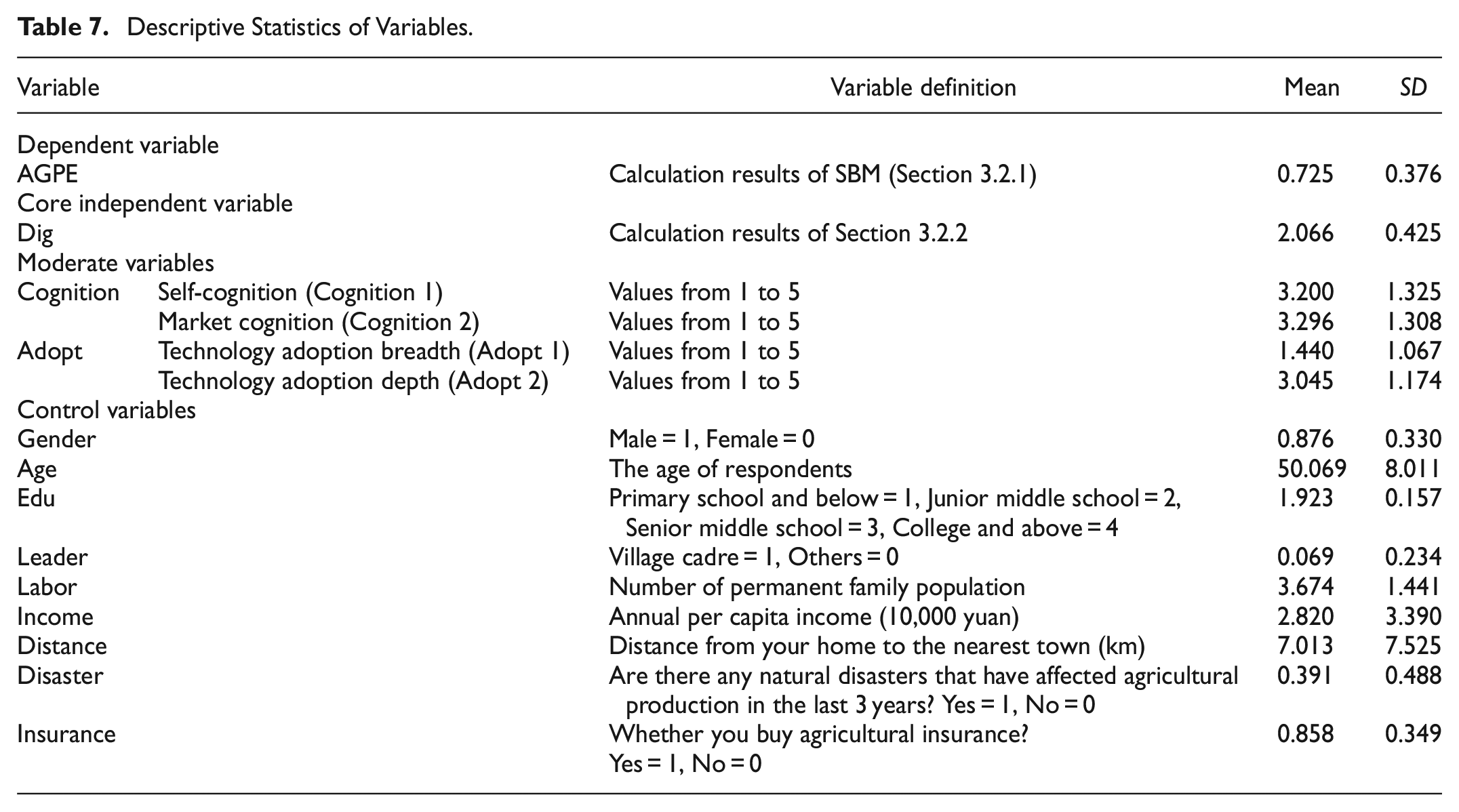
According to the theory of rational peasant and theory of planned behavior. We select control variables based on the characteristics of farmers’ green production behavior. Referring to Guo et al. (2022), Mao et al. (2021), and (Qing et al., 2023), nine variables are used: (1) Gender. The value for male is 1, The value for female is 0. (2) Age, expressed as the age of respondents. (3) Educational level (Edu), expressed as the education level of the respondents. (4) Village cadre identity (Leader), expressed as whether or not they are village cadres. (5) Labor, expressed as labor force quantity. (6) Annual per capita household income (Income), expressed as the ratio of the number of family labor force to the total family income. (7) Distance from home to town (Distance), expressed as distance from farmers’ home to the nearest town. (8) Natural disaster situation (Disaster), expressed as whether natural disasters have occurred in agricultural production in the past 3 years. (9) Agricultural insurance purchase situation (Insurance), expressed as whether to purchase agricultural insurance. Variables are described in Table 7.
Descriptive Statistics of Variables.
Model Set-Up
OLS (Ordinary least squares) model. In addition to being influenced by farmers’ digital literacy, the green production efficiency in agriculture is also affected by factors such as gender, age, level of education, status of village cadres, natural disaster situations, economic conditions, and so on. Therefore, in order to identify the impact of digital literacy level on green production efficiency in agriculture, this study sets the following baseline model:

In Equation 7,
In order to further explore the impact of farmers’ digital literacy on green production efficiency in agriculture, we added the cognition of green agricultural products and the technology adoption for green agricultural products as moderator variables, and constructed the following models:


In Equations 8 and 9,
Results and Discussion
Baseline Results
Analysis of the impact of farmer’s digital literacy on green production efficiency in agriculture based on the OLS model. Considering the potential issue of multicollinearity among variables, this study conducted a multicollinearity test. The test results show that the maximum value of the variance inflation factor (VIF) for each variable is 1.27 (<10), indicating that there is no severe multicollinearity problem among the variables, and the selection of explanatory variables is reasonable. As shown in Table 8, the baseline results are presented. In Column (1) and (2) respectively indicate the impact of farmers’ digital literacy on AGPE before and after the addition of control variables. The estimated coefficients are 0.4807 and 0.4631, respectively. To facilitate further interpretation, Column (3) controls the regional variables. According to the estimated results, the influence coefficient of digital literacy on agricultural green production efficiency is 0.3195. The statistical significance level is 1%, indicating that farmer digital literacy has a significant positive impact on AGPE. The study hypothesis 1 has been verified.
Regression Results of the Influence of Farmers’ Digital Literacy on AGPE.

Note.*p < .1. ***p < .01.
In Column (3), from the point of control variables, the estimated coefficient of farmer’ gender was 0.0427, which was significant at the statistical level of 1%. The result shows that male agricultural producers on AGPE. Due to Chinese farming personnel mainly male, male for green production, to better into agricultural production, enhance the production efficiency (Li X et al., 2023). The estimated coefficient of the age of farmer was 0.0017, significant at the statistical level of 1%, indicating that the age of household heads has a positive impact on AGPE. Because older farmers have been farming for a longer period of time, possess a wealth of farming experience, and have a deeper understanding of the importance of farmland protection. They are also more inclined to focus on improving the long-term green production efficiency (Gao et al., 2022; Li X et al., 2023). The estimated coefficient of the education level of farmers was 0.0116, which was significant at 10% of the statistical level, indicating that the education level of household heads has a positive impact on AGPE. The reason why farmers with a higher level of education have a better understanding of the economic, social, and ecological benefits of green production technology. As a result, they pay more attention to improving AGPE (Zugravu-Soilita et al., 2021). The estimated coefficient of the distance from the farmer’s home to the nearest county was 0.0552, significant at the statistical level of 1%, indicating that the distance from the county government has a positive impact on AGPE. Due to the distance from the county seat, villages receive relatively less publicity and training in green production technology (Li X et al., 2023). As a result, they are more inclined to acquire knowledge about green production through the Internet.
Further Mechanism Testing
In order to examine the impact of farmers’ digital literacy on AGPE, this study considers the farmers’ self-cognition and market cognition of green agricultural products, and technology adoption breadth and depth as the moderator variables. As shown in Table 9 Column (1)–(2), the cognition of green agricultural products has played a significant role in moderating them. Among them, the interaction coefficient of self-cognition and market cognition and farmers’ digital literacy is 0.1769 and 0.2515, respectively. These coefficients are positive and significant, indicating that the cognition of green agricultural products can promote the relationship between farmers’ digital literacy and AGPE. As shown in Table 9 Column (3)–(4), the adoption of green agricultural products technology has played a significant role in moderating them. Among them, the interaction coefficient of technology adoption breadth and depth and farmers’ digital literacy is 0.2918 and 0.3324, respectively. These coefficients are positive and significant, indicating that technology adoption breadth and depth can promote the relationship between farmers’ digital literacy and green production efficiency. This enhancement occurs through four aspects: self-cognition, market perceived, technology adoption breadth and depth. In conclusion, the study hypothesis 2 and 3 were verified. The reason may be that farmers with higher digital literacy can access and learn a wide range of digital resources through the internet, enabling them to acquire certain digital skills and demonstrate a strong accumulation effect of human capital. On one hand, this enhances farmers’ awareness of the value of green agricultural products. On the other hand, it deepens their understanding of green production technologies, thereby fostering intrinsic motivation to enhance AGPE.
Mechanism Test.
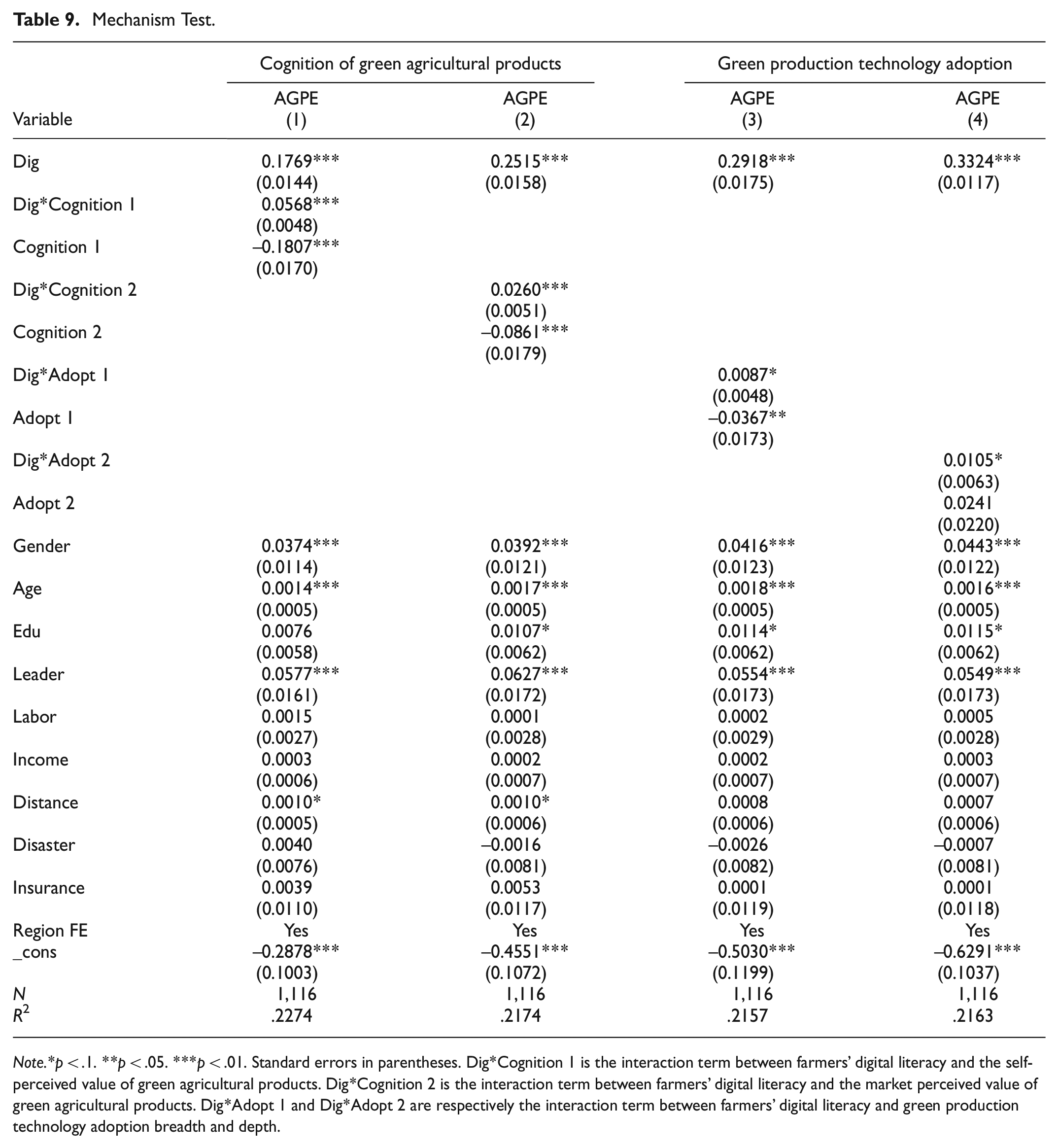
Note.*p < .1. **p < .05. ***p < .01. Standard errors in parentheses. Dig*Cognition 1 is the interaction term between farmers’ digital literacy and the self-perceived value of green agricultural products. Dig*Cognition 2 is the interaction term between farmers’ digital literacy and the market perceived value of green agricultural products. Dig*Adopt 1 and Dig*Adopt 2 are respectively the interaction term between farmers’ digital literacy and green production technology adoption breadth and depth.
Robustness Test
To ensure the robustness of the results, we used three methods to verify the robustness of the model: winsorize, replacement of core variable and replacement method (Table 10). First, the model is re-estimated after randomly shrinking the total sample by 5%−10%. The results are shown in Column (1), where the coefficients and signs of the regression results are more consistent with the original results, and the results are robust. Second, we use the average values of farmers’ information and data literacy, digital communication, digital content creation, digital safety, and digital problem solving to replace the calculation results of entropy method, and re-estimate the farmers’ digital literacy. As shown in Column (2), the sign of the regression results did not change, the fit was good, and the changes in the regression coefficients were not significant. Finally, as shown in Column (3), we re-estimated using Tobit model, and the results were consistent with those of the original equation. Therefore, the estimation results are proved to be robust and reliable by the above three methods.
Robustness Test.

Note.*p < .1. ***p < .01.
Considering the endogeneity between farmers’ digital literacy and green production efficiency in agriculture. Therefore, we chose the mean daily time of Internet use by farmers as the instrumental variable (IV-Dig). As shown in Table 11, consistent conclusions were obtained using the 2 SLS model. In column (1), the estimated coefficient for IV-Dig is 0.9105, significant at the 1% level. The more time farmers spend using the Internet every day, the greater their digital literacy may become, making it easier for them to acquire digital knowledge. Thus, they can improve green production efficiency in agriculture. This is consistent with the theoretical expectation. In column (2), the coefficient of farmers’ digital literacy on agricultural green production efficiency was 0.3435, significant at the 1% level, and the results were basically consistent with the original estimate. The Kleibergen-Paap rk LM statistic value of 282.0951 significantly rejected the hypothesis that the model was not under identified and that the selected instrumental variables were associated with the endogenous explanatory variables. The Kleibergen-Paap rk Wald F statistic value of 1,365.8688 rejected the null hypothesis of weak instrumental variables, indicating that the selected instrumental variables were reasonable and the regression results were consistent with the baseline regression. Therefore, after solving the endogenous in this study, farmer’s digital literacy will still significantly enhance green production efficiency in agriculture.
Endogeneity Test.

Note.***p < .01.
Heterogeneity Analysis
The Effect of Different Dimensions of Digital Literacy on Agpe
We explored the impact of different dimensions of digital literacy on AGPE. As shown in Table 12. different dimensions of digital literacy can enhance the efficiency of agricultural green production. Emphasis will be placed on cultivating farmers’ information and data literacy, digital communication, and digital safety capabilities. To enhance farmers’ capacity in creating digital content and developing digital problem-solving skills to ensure the sustainable development of agriculture.
Heterogeneity Analysis of Different Dimensions of Digital Literacy on AGPE.

Note. Digital literacy includes information and data literacy, digital communication, digital content creation, digital safety, digital problem solving. Dig 1 represents information and data literacy. Dig 2 represents digital communication. Dig 3 represents digital content creation. Dig 4 represents digital safety. Dig 5 represents digital problem solving. *p < .1.
The Effect of Digital Literacy on AGPE Under Different Green Production Technology Use Preferences
We verified the impact of digital literacy on green production efficiency under the application preferences of different green production technologies. This chapter classifies the green production technologies adopted by farmers, including the application of bio-pesticide, organic fertilizers, integrated pest management, water-saving irrigation, and the comprehensive utilization of straw. We measure AGPE of farmers who adopt different types of technologies. As shown in Table 13 Column (1)–(5), the farmers’ digital literacy has a positive and significant impact on green production efficiency of various technology types. The estimated results are relatively consistent, indicating that digital literacy enhances the efficiency of different green production technologies.
Heterogeneity Analysis of Different Types of Green Production Technologies.
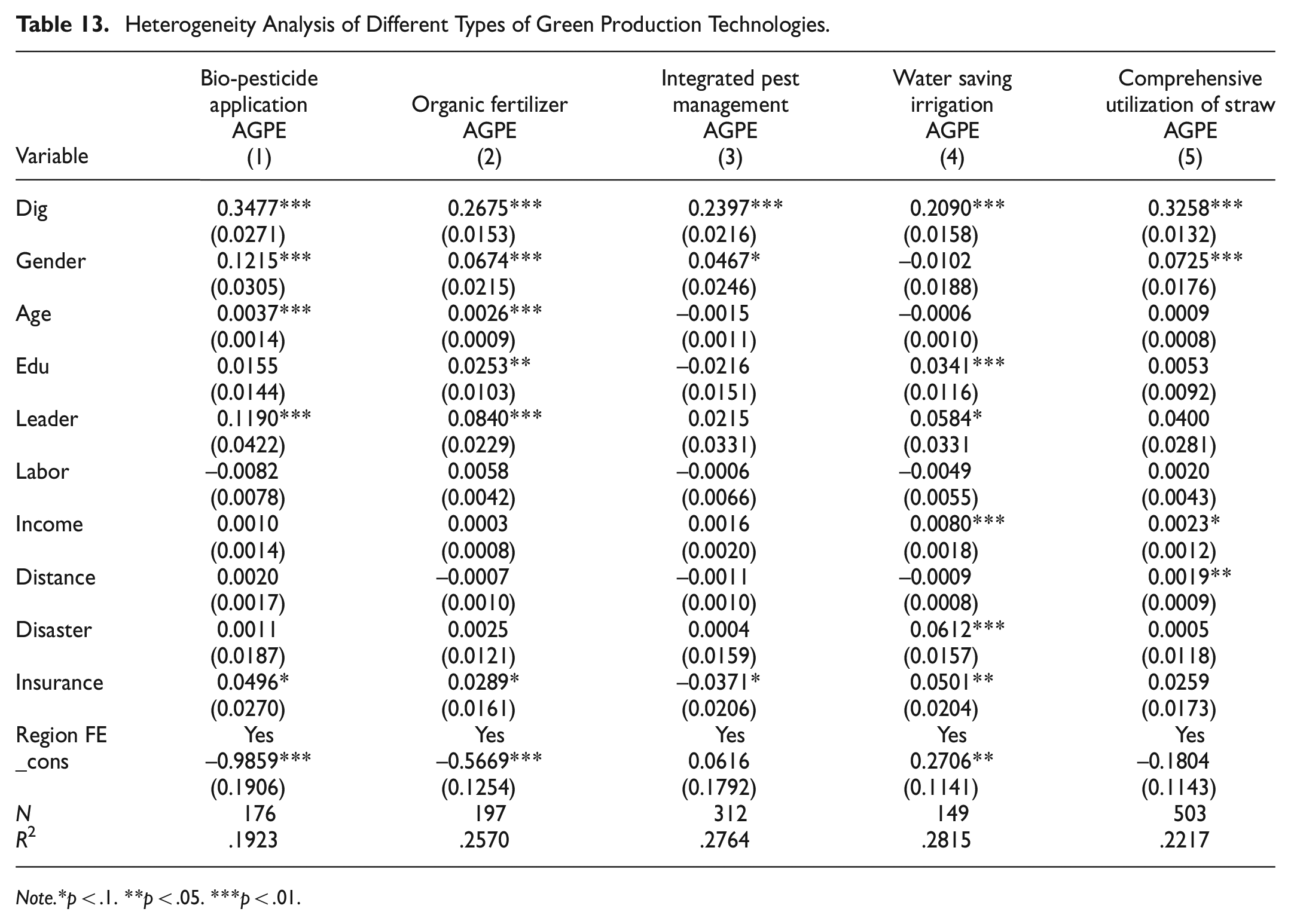
Note.*p < .1. **p < .05. ***p < .01.
Discussion
Developed countries have long realized the importance of modernizing and technologically advancing agriculture. However, due to the diverse national conditions in China, the development of large-scale agricultural technology is being implemented gradually and is still primarily dominated by smallholder farming. Through the implementation of smart agriculture, precision agriculture, genetic modification, and agricultural digitalization, the United States has achieved significant advancements. In comparison, China still needs to further strengthen its agriculture. It should take into account both the environmental and developmental aspects of agricultural production and prioritize the integration of agricultural technology, intelligence, and sustainability. The first step toward this goal is to improve the digital literacy of farmers. After improving farmers’ digital literacy, it will be more conducive for a large number of digital devices and smart equipment to enter rural areas and promote the greening of agriculture.
Most of the previous studies have focused on the impact of farmer behavior on agricultural production efficiency (S. Fu et al., 2022; Gao et al., 2022). However, the micro-level analysis of individual characteristics of farmers is still insufficient. Our research demonstrates that farmers’ digital literacy can greatly enhance the of agriculture green production efficiency. We support this claim by applying the theory of digital human capital to explain the underlying reasons. To bridge the “digital divide” between urban and rural areas and contribute to the coordinated development of digital and sustainable agricultural production. The research results contribute to bridging the “digital divide” between urban and rural areas, promoting the coordinated development of digital and green agricultural production.
Theoretical Implications
The present study has made theoretical contributions in several important aspects. First, this study re-examines the significance of digital human capital in agricultural production. In previous studies, although a large number of scholars have mentioned the important role of human capital in agricultural production (Wegren, 2014), these scholars are more inclined to focus on the influence of laborers’ cultural level and health status on agricultural production (Ibrahim et al., 2022; Zugravu-Soilita et al., 2021). However, with the development of the digital age, the impact of digital literacy on agricultural production as a new capacity still needs to be further explored. Our study examined the impact of digital literacy on agricultural productivity. It not only affects the output, but also contributes to the carbon emissions of agricultural production when measuring green agricultural production efficiency. It shows that digital literacy has effectively improved agricultural green production efficiency.
Second, previous studies have primarily focused on agricultural production efficiency at the provincial level (Z. Li et al., 2021; Xu et al., 2021), with limited empirical research conducted at the individual level. By examining the impact of farmers’ digital literacy level on agricultural green production efficiency, this paper innovatively complements the study on the influence of farmers’ personal characteristics on agricultural green production efficiency. In addition, multi-dimensional digital literacy is constructed to analyze the results of agricultural green production. The results lay the foundation for further research on agricultural green production efficiency.
Finally, the study also examined the role of cognition of green agricultural products and green production technology adoption in moderating digital literacy and agricultural green production efficiency. We find that the cognition of green agricultural products is mainly reflected in self-cognition and market cognition. Green production technology adoption is primarily demonstrated through the breadth and depth of technology adoption. Different from previous studies (S. Fu et al., 2022; Gao et al., 2022), we select the moderating variables from both market demand and factor of production perspectives, guided by farmers’ perceptions of the products as well as the adoption of the technologies. The study’s findings support the implementation of digitalization and environmentally-friendly development in rural areas of China in a practical and tangible way.
Policy Implications
According to the above findings, this study proposes the following policy recommendations. First, accelerate the digital literacy of farmers in developing countries. In promoting the process of green transformation in agricultural production, full consideration should be given to the development of network and digital technologies. This includes building a cultivation mode that improves farmers’ digital literacy, enhancing rural digital infrastructure construction, and optimizing the environment for rural digital development. We should improve farmers’ digital literacy, enhance the efficiency of green production technology, and use agricultural digital technology to promote the green transformation of agriculture. Second, strengthen the cognition of green agricultural products among farmers. On the one hand, we should make good use of the advantages of information transmission of the Internet to enhance the self-production orientation of farmers’ green agricultural products. On the other hand, we should make good use of the information of e-commerce platforms and organize professionals or rural strong people to actively train farmers in their information acquisition ability. To enhance the enthusiasm of farmers in adopting green production technologies based on market demand. Third, the adoption of green agricultural technology is the foundation for improving the efficiency of green agricultural production. The government should vigorously promote digital technology and use online platforms to promote various green production technologies. It is also necessary to increase the promotion of the effects of different combinations of green technologies. Regular training should be organized to provide in-depth explanations to farmers on the operational methods, costs, and benefits of various measures. By continuously deepening and combining knowledge of green technologies, innovative practical applications of green technologies can be achieved, enhancing farmers’ awareness and sense of identification with green agricultural production.
Conclusion
With the rapid development of digital technology, the farmers’ digital literacy has become an important factor affecting agricultural production. Exploring the possible paths to promote green production efficiency in agriculture from the perspective of farmers’ digital literacy is of great significance for accelerating the transformation of agricultural green development and achieving high-quality agricultural development in developing countries. This article uses empirical analysis of research data from Heilongjiang Province, China to examine the impact and mechanism of digital literacy on green production efficiency. First, farmers’ digital literacy has a significant positive impact on green production efficiency of agriculture. In addition, after changing the measurement method of digital literacy for farmers, introducing the OLS model for regression analysis, and using instrumental variable methods for endogeneity analysis, this result has good robustness. Second, the mechanism analysis shows that his cognition of green agricultural products and technology adoption are the main paths through which digital literacy affects agriculture green production efficiency. Specifically, self-cognition and market cognition can effectively promote the relationship between digital literacy and green production efficiency in agriculture, and the impact of self-cognition is better. Furthermore, technology adoption depth and breadth also effectively promote the relationship between the two, and the impact of technology adoption depth is better. Third, we classify different dimensions of digital literacy and find that digital literacy can promote agriculture green production efficiency. Furthermore, the results show that digital literacy can improve the efficiency of five types of green production technologies: biological pesticide, organic fertilizer, biological control of pests and diseases, water-saving irrigation, and comprehensive utilization of straw. Digital literacy can promote the green production efficiency of different technologies.
Although this study attempts to add to the existing research by examining green production efficiency in agriculture from farmers’ digital literacy of perspective, certain limitations may require additional research. First, our study analyzed the cross-sectional data based on 1,116 farmers. In future studies, we hope to make ongoing visits to farmers in order to increase the sample size of this type of study and verify the reliability of our results. Second, we chose China which is the largest developing country for our study. However, its agricultural production methods are different from those of developed and less-developed countries, which may result in the possibility that our findings may not be applicable to some other countries. It would be interesting for future research to look at other international contexts, such as the United States and European countries, as well as less-developed regions. Exploring the impact of farmers’ digital literacy on sustainable and green agricultural development under various agricultural production conditions is highly significant.
Footnotes
Author Contributions
Writing-original draft, Writing—review & editing, Methodology: Siyu Gong. Investigation, Formal analysis: Siyu Gong and Ziye Sun. Writing-original draft, Writing—review & editing, Methodology: Bo Wang. Writing—review & editing, Conceptualization, Funding Acquisition, Supervision: Zhigang Yu.
Declaration of Conflicting Interests
The author(s) declared no potential conflicts of interest with respect to the research, authorship, and/or publication of this article.
Funding
The author(s) disclosed receipt of the following financial support for the research, authorship, and/or publication of this article: The National Social Science Foundation of China [grant number 21BJY249]. The Key Project of Social Science Foundation of Heilongjiang Province [grant number 22GLF524]. The Social Science Foundation of Heilongjiang Province [grant number 22JYE458].
Institutional Review Board Statement
Not applicable.
Informed Consent Statement
Not applicable.

Notes
Data Availability Statement
The data presented in this study are available on request from the first author.