




Abstract
This corpus-based study investigates the translation of modality from English to Chinese in the high-stakes context of the International Military Tribunal for the Far East (IMTFE). Grounded in Systemic Functional Linguistics (SFL), the analysis employs a parallel corpus of trial transcripts to examine the distribution of modal expressions across orientations and values in the source language, and how translation of modality reshapes interpersonal meaning in the target language. The study first establishes a baseline distribution of modal orientations and values in the English source texts, noting a predominance of implicit and median-value modality. Additionally, the findings reveal that translations frequently weaken modal force and increase implicitness. High-value modals are often reduced or omitted, diminishing the perceived authority of courtroom participants, while the omission of explicit hedges erodes politeness strategies, rendering statements more direct and confrontational. Consequently, these shifts significantly alter the power dynamics and communicative tone of the original interactions. The study concludes that such unmitigated shifts can distort legal meaning and emphasizes the need for translators to prioritize modal equivalence to preserve the nuanced interpersonal fabric of courtroom discourse.
Plain Language Summary
This study looks at how small but important words—such as may, must, or should—are translated from English into Chinese in courtroom settings. These words, called modal verbs, play a big role in showing how strong, polite, or respectful someone’s statement is. For example, there is a difference between saying “you must do this” and “you may do this.” In court, such differences are not just about language—they affect how authority, respect, and politeness are expressed. By examining transcripts from the International Military Tribunal for the Far East, this research found that translations often made statements weaker or more direct than they were in English. Words that expressed strong authority were sometimes softened, while polite hedges that made speech less forceful were sometimes left out. This means that the Chinese translations could sound less respectful or more confrontational than the original English. These changes matter because courtroom language is not only about facts but also about relationships, authority, and fairness. If the translation does not reflect the original tone, it can affect how participants are understood and how power is negotiated in legal settings. The study highlights the importance of careful translation in court to preserve both the meaning and the interpersonal tone of what is being said. Getting these details right helps ensure that the legal process remains fair and that all voices are represented as intended.
Introduction
Translation, from a Systemic Functional Linguistics (SFL) perspective, is fundamentally an act of meaning reconstruction shaped by context-bound choices. As Matthiessen (2014, p. 272) asserts, it entails the “recreation of meaning in context through choices”—choices governing both the interpretation of the source text and the generation of the target text. Crucially, SFL conceptualizes meaning itself as tripartite—interpersonal, ideational, and textual (Halliday & Matthiessen, 2004)—providing the framework through which these translational choices operate.
The interpersonal dimension of meaning, central to this framework, governs social interactions and role enactment (Wu et al., 2025b). It focuses on how speakers/writers and addressees engage dialogically, utilizing grammatical resources to perform speech roles, assert authority, establish rapport, or negotiate relationships (Halliday & Matthiessen, 2004). Modality stands as a key grammatical system realizing these interpersonal dynamics. This intricate negotiation of meaning is particularly amplified in institutional settings like the courtroom, where discourse is highly structured yet interactionally fragmented (Coulthard et al., 2017).
Courtroom discourse represents a critical site for examining meaning construction and power negotiation (Olsson, 2008). Legal language relies heavily on precise linguistic devices to construct, contest, and interpret legal meanings—making it a longstanding focus of socio-legal linguistic research (Su et al., 2023). Therefore, translating courtroom discourse presents a unique challenge: it demands the meticulous recreation of its complex interpersonal, ideational, and textual meanings—alongside the power dynamics embedded within them—across linguistic and legal systems (Wu et al., 2025c).
Within this interpersonal dimension, modality functions as a primary grammatical resource (Halliday & Matthiessen, 2004). Modal expressions (e.g., must, may, certainly, possibly) allow legal actors—judges, attorneys, witnesses—to calibrate their degree of assertion, obligation, permission, or certainty (Halliday & Matthiessen, 2004). In the adversarial courtroom arena, these choices perform vital interpersonal work: they simultaneously manage politeness or solidarity while asserting power and authority (Szczyrbak, 2014). Through modality, participants enact their institutional roles, project credibility, and strategically position themselves vis-à-vis others and the evidence.
Consequently, the translation of modality in courtroom discourse becomes a high-stakes act of interpersonal meaning transfer. When translating English courtroom discourse into Chinese, choices in rendering modality directly impact how power relations, speaker commitment, and legal force are perceived in the target text (L. Cheng, 2011). Therefore, examining modality translation offers a critical lens into how the complex interpersonal dynamics and power asymmetries inherent in the source courtroom interaction are re-contextualized across linguistic and legal systems.
Against the SFL-informed background of translation as contextualized choice-making and the centrality of interpersonal meaning (particularly modality) in courtroom power dynamics, this study analyzes modality translation within the English-to-Chinese translations of trial records from the International Military Tribunal for the Far East (IMTFE, 1946–1948). While recognizing the historical specificity of the IMTFE (commonly known as the Tokyo Trial)—an unprecedented tribunal established to prosecute Japanese leaders for crimes against peace, war crimes, and crimes against humanity committed before and during WWII—its unique context offers critical insights. While prior research has established the significance of modality in courtroom discourse (e.g., Boginskaya, 2023; Chaemsaithong, 2018; L. Cheng et al., 2024; Daniel & Unuabonah, 2021; J. Li & Sun, 2018; Mortensen & Mortensen, 2017; Szczyrbak, 2021; Warchał, 2023; Yang & Wang, 2024) and examined translation choices of modality in the diplomatic setting (e.g., Fu, 2016; Fu & Chen, 2019; X. Li, 2018; Tian, 2022), and academic context (e.g., Huang & Li, 2023; Satthachai & Kenny, 2025), a critical gap remains: how modality choices reconstruct power relations in historically significant trials, particularly in non-Western language pairs like English-Chinese. The tribunal’s immense historical gravity, multilingual complexity, and high-stakes nature created an environment where interpersonal meaning, realized through modality, was paramount. Therefore, by examining the translation of modality, the study illuminates how translators navigated the recreation of power dynamics and speaker stance across languages within this unique context. The study intends to address the following research questions:
Literature Review
The existing scholarship on translating interpersonal meaning and modality is examined in the following section, focusing on how modality is expressed and negotiated across languages. It also introduces the concepts of modality orientation and value within the framework of SFL, examining their manifestations in both English and Chinese.
Interpersonal Meaning in Courtroom Discourse
While existing research has significantly advanced our understanding of interpersonal meaning construction within monolingual legal discourse—examining features like evaluative stance in courtroom monologs (Chaemsaithong, 2016), stance and engagement in judicial opinions (Daniel & Unuabonah, 2021), and multimodal stance-taking (Yang & Wang, 2024)—a critical gap remains concerning how interpersonal meaning, particularly realized through lexico-grammatical systems like modality, is reconstructed across languages in high-stakes courtroom settings. These studies provide valuable insights into the deployment and function of interpersonal resources by original speakers (lawyers, judges) within a single linguistic system. However, they do not address the complex translational choices required when these nuanced interpersonal meanings—crucial for enacting power, authority, credibility, and alignment—must be conveyed from a source language (SL) to a target language (TL) within the rigid constraints of legal proceedings. This gap is especially pronounced for linguistically and culturally distant pairs, such as English and Chinese, where expressing equivalence in epistemic commitment, obligation, or alignment is highly challenging. Consequently, this study directly addresses this underexplored dimension by investigating the specific translation choices made for interpersonal meaning (focusing on modality) in the English-to-Chinese translation of historical IMTFE trial records, examining how translators navigated the recreation of power dynamics and speaker stance across languages within this unique context.
Modality Translation in Courtroom Discourse
While prior research has extensively analyzed modality translation in diplomatic contexts—identifying patterns like policy endorsement in government interpretations (Fu, 2016), value/orientation shifts in press conferences (Fu, 2016; Fu & Chen, 2019; X. Li, 2018), and explicitation in political reports (Tian, 2022; Y. Zhang & Cheung, 2022)—and in academic discourse—where modality translation alters authorial stance (Huang & Li, 2023) or reflect source-language epistemic norms (Satthachai & Kenny, 2025)—these studies share a critical limitation: they focus exclusively on unidirectional translation (Chinese-to-English) in monologic genres.
Crucially, modality translation remains underexplored in adversarial legal settings, particularly for English-to-Chinese directionality. Courtroom discourse demands unique attention: unlike diplomacy or academia, it requires reconstructing high-stakes interpersonal dynamics (e.g., power asymmetry, epistemic authority, deontic obligation) in a context where every modal choice forensically shapes legal outcomes. Yet little study examines how translators navigate these challenges when rendering English courtroom speech into Chinese, especially in historical trials where modality encodes juridical power relations vulnerable to distortion across languages.
This gap is consequential: failing to preserve modality in legal translation risks misrepresenting evidentiary certainty, judicial directives, or witness credibility—distorting the very fabric of courtroom interaction. Thus, our study pioneers this inquiry by analyzing English-to-Chinese modality translation in IMTFE trial records, addressing how translators reconfigure interpersonal meaning in a context where accuracy determines historical accountability.
Modal Orientation and Value in English
Within the framework of SFL, modality expresses a speaker’s attitudes toward the validity of propositions—encompassing degrees of assertion, denial, obligation, or prohibition (Halliday & Matthiessen, 2004, 2014). Within SFL, modality is systematically analyzed through two dimensions: orientation(how explicitly the speaker sources their attitude) and value (the degree of certainty or obligation conveyed) (Thompson, 2013). Linguistically, these dimensions are realized through devices, including “modal and semi-modal verbs (e.g., can, must, should, have to), modal adverbs (e.g., always, certainly, perhaps), complement clauses with modal verbs (e.g., I believe/argue that…), adjectives (e.g., it is clear/likely that…), and nouns (e.g., there is a possibility that…)” (Huang & Li, 2023, p. 3).
Modal Orientation and Value in Chinese
Following Halliday and McDonald (2004), modality in Chinese operates along a graded spectrum similar to English, structured by two key dimensions: orientation and value. Orientation distinguishes between subjective/explicit realizations (e.g., verbal/mental clauses that mark speaker stance) and objective/implicit realizations (e.g., modal adverbs or relational clauses that convey probability without attributing it to a source) (L. Cheng & Wang, 2017). Value, categorized as high, median, or low, reflects degrees of certainty or obligation (Pei & Li, 2018; Peng, 2000). Together, these dimensions form a critical framework within SFL for analyzing how interpersonal meaning is constructed and shifted in translated legal discourse.
Methods
This research employs a corpus-based approach to investigate modality translation in the English-to-Chinese translation of IMTFE trial records. Based on SFL, the study systematically analyzes the translation of modality. Building on this analysis, the research evaluates how modality translation reshapes interpersonal meaning and power dynamics in the target texts.
Corpus Description
This study draws on an English–Chinese parallel corpus compiled from the IMTFE trial records. In its final form, the corpus contains 460,917 tokens of English source text (ST) and 682,483 tokens of Chinese target text (TT), totaling 1,143,400 tokens. To ensure a manageable scope while retaining contextual breadth, the materials were selected through purposive sampling of 24 trial days (Saldanha & O’Brien, 2014). Corpus construction followed an adapted workflow (Chang, 2004; Liang et al., 2010), scanned English PDF records and machine-readable Chinese PDFs were obtained (with permission); the English files were converted via OCR and then manually cleaned to correct recognition and formatting errors; both languages were segmented (English in EmEditor; Chinese in EmEditor and CorpusWordParser) and the Chinese texts were POS-tagged; the two language streams were then aligned in parallel at paragraph and sentence levels using ParaConc, with systematic manual verification and correction of alignment pairs; finally, the aligned bilingual files were indexed to produce a search-ready corpus suitable for concordancing and quantitative analysis.
Identification of Modality Markers
To analyze modality translation in English-to-Chinese translation of IMTFE trial records, modality markers were first identified within the English source texts (ST) of the parallel corpus. This involved utilizing AntConc 3.5.9 to generate frequency lists of single words and 3- and 4-g occurring more than 3 times. Preliminary identification relied on established inventories of modality markers specific to legal discourse (W. Cheng & Cheng, 2014; L. Cheng & Sin, 2011; Su et al., 2023), followed by manual verification to classify instances as modal or non-modal.
Results
Distribution of Modality Orientation and Value in the Source Language
The following sub-sections present the results on the distribution of modality, described by its orientation and value.
Orientation of Modality in the ST
The analysis of the IMTFE corpus (Table 1) reveals a significant prevalence of both epistemic and deontic modalities, with epistemic modality occurring 1,678 times, accounting for 49.8% of the total instances, while deontic modality appears 1,691 times, representing 50.2% of the total occurrences, resulting in a combined total of 3,369 instances.
Overall Frequency of Epistemic and Deontic Modality in the ST.

The distribution of modality orientation in the IMTFE corpus (Table 2) shows a clear preference for implicit subjective deontic forms, which were the most common. Explicit objective deontic modality, however, was the least represented, despite all four orientations being present. As shown in Table 2, the implicit subjective deontic modality has the highest overall frequency (42.6%), followed by the implicit objective epistemic modality (20.2%), and the implicit subjective epistemic modality (15.8%).
Distribution of Modality in Terms of Orientation in the ST.

Courtroom participants frequently express claims without identifying their source, as evidenced by the dominant use of implicit subjective deontic and implicit objective epistemic modality, which together constitute almost 63% of the corpus. In addition, the study’s finding of a small proportion (12.6%) of explicit subjective epistemic modality suggests that courtroom participants generally refrain from revealing the subjective source of their claims.
The top three most frequent modal expressions in the ST, categorized by their orientation, are shown in Table 3.
Top Three Modality in Terms of Modal Orientations in the ST.

Value of Modality in the ST
Beyond its type, the SFL framework categorizes modality by its value, denoting the strength of a speaker’s commitment (Halliday & Matthiessen, 2004). The analysis of value, presented in Table 4, reveals a predominance of median-valued modality (44.7%), with high-valued (29.3%) and low-valued (26%) modalities also present. The collective prevalence of median and high values suggests a context where assertions require a substantial degree of certainty.
Distribution of Different Values of Modality in the ST.
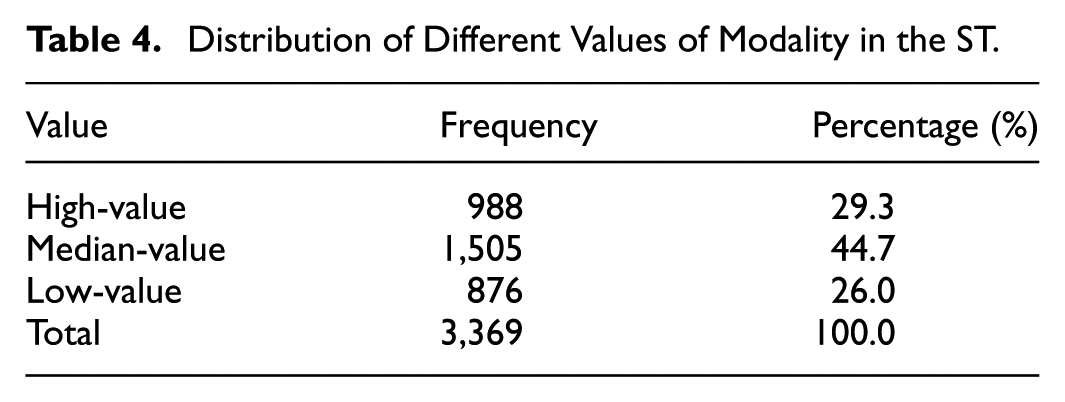
Table 5 presents the distribution of the top five most frequent modal expressions, stratified by their value (high, median, and low) in the ST.
Top five Modality in Terms of Modal Values in the ST.

The Interpersonal Consequences of Translating Modality
This study operationalizes Catford’s (1965, p. 73) concept of “translation shifts”—departures from formal correspondence—by categorizing modality translations as either “shift” or “no shift.” Focusing on English-to-Chinese courtroom discourse, the study investigates semantic modality shifts and their impact on interpersonal meaning.
In this study, high-frequency modality markers (occurring more than 15 times) were selected for analysis of modality shift in the English-to-Chinese IMTFE translation. In total, 3,028 instances of modality marking were extracted. Overall, 84.7% of these cases (2,566/3,028) show no semantic shift, indicating that modal meanings are largely preserved in translation. Semantic shifts occur in 15.2% of instances (458/3,028), while a negligible proportion (0.1%) falls into a “not applicable” category (Wu et al., 2025a). When the shifted cases are examined more closely, the distribution is markedly uneven across shift types (Table 6). Most semantic shifts involve changes in modality value (91.3%), whereas shifts in modality orientation are comparatively rare (8.7%). The following sections examine how these frequent modality markers are translated and assess the consequent effects on interpersonal meaning in the translated text.
Modality Shifts in Terms of Modality Value and Orientation (Wu et al., 2025a, p. 160).
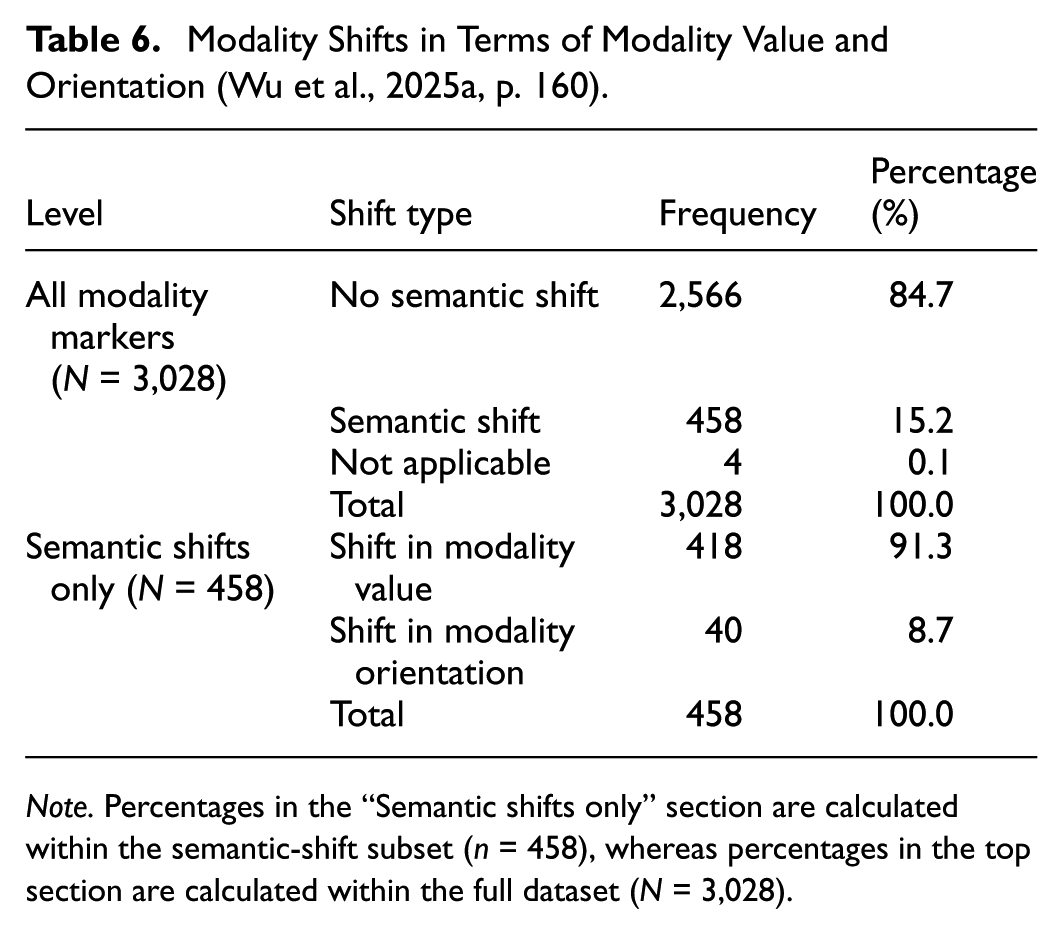
Note. Percentages in the “Semantic shifts only” section are calculated within the semantic-shift subset (n = 458), whereas percentages in the top section are calculated within the full dataset (N = 3,028).
How Shifts in Modality Orientation Affect Interpersonal Meaning
The following section explores the consequences of shifting modality orientation for interpersonal meaning in translation. These consequences are then exemplified through an analysis of specific markers like “I believe.”
The Case of “I Believe.”
In the English-to-Chinese IMTFE corpus analyzed, as shown in Table 7, I believe was translated into
Chinese Translations of “I Believe.”

I believe was used to negotiate the significance and the reliability of the information (Warchał, 2015). To establish a communicative stance in courtroom interactions, one tactic used by counsel is the (I believe) (that) schema, which is employed to challenge the witness’s previous testimony and press for a specific version of events (Example 1), thereby eliciting the desired response (Szczyrbak, 2021).
In a sample of courtroom examination in Example 1, the counsel aims to undermine the validity of the witness’s statements and demonstrate their groundlessness in the testimony. In this example, I believe was used by the counsel to question the reliability of information before asking further questions, aiming to elicit more elements of the desired information. This omission demonstrates the erosion of interpersonal hedging. The translator’s deletion of the cognitive hedge “I believe” removes the speaker’s personal stance and the mitigation it provides. The TT reconstitutes the query as a direct confrontation with the textual record (“your testimony says”), shifting the interpersonal meaning from a subjective recollection to an objective challenge, thereby heightening the confrontation.

In addition, I believe could also be employed to create objects of joint attention and direct the hearers’ attention to whether relevant evidence is present or absent (Szczyrbak, 2021), as demonstrated in Example 2. In the case of Example 2, I believe, inclusive of the counsel in the courtroom, was used to engage the audience, which invites the listener to consider the speaker’s perspective and possibly respond with their beliefs.

In other cases, I believe is used by the speaker in the courtroom to distance themselves from the absolute certainty of the statement, as illustrated in Example 3. By using I believe in Example 3, the speaker marks the subsequent statement as their personal opinion or belief rather than an objective fact. The use of I believe employed by the witness in Example 3 indicates a level of caution on the part of the speaker, suggesting that the speaker is not entirely certain. In the E-C translation, I believe was also not represented in the Chinese TT. Similarly, the omission of I believe in the translation makes the speaker sound more certain.

How Shifts in Modality Value Affect Interpersonal Meaning
The following section discusses how shifts of modality value influence interpersonal meaning in the English-to-Chinese IMTFE translation, which is further exemplified by specific cases of modality markers like of course, and must.
The Case of “Of Course.”
The phrase of course is generally employed to balance power dynamics between speakers by downplaying the speaker’s perceived superiority, which arises from their knowledge (Simon-Vandenbergen & Aijmer, 2007, p. 205, as cited in Szczyrbak, 2017), which also serves as a politeness marker, helping to save face. Szczyrbak (2017) also emphasizes the concessive nature of of course, suggesting that it should be understood as an equivalent of the presupposition as everyone knows. In the ST of IMTFE parallel corpus analyzed, more often than not (108 occurrences out of 121), of course was translated conventionally as
Chinese Translations of “Of Course.”

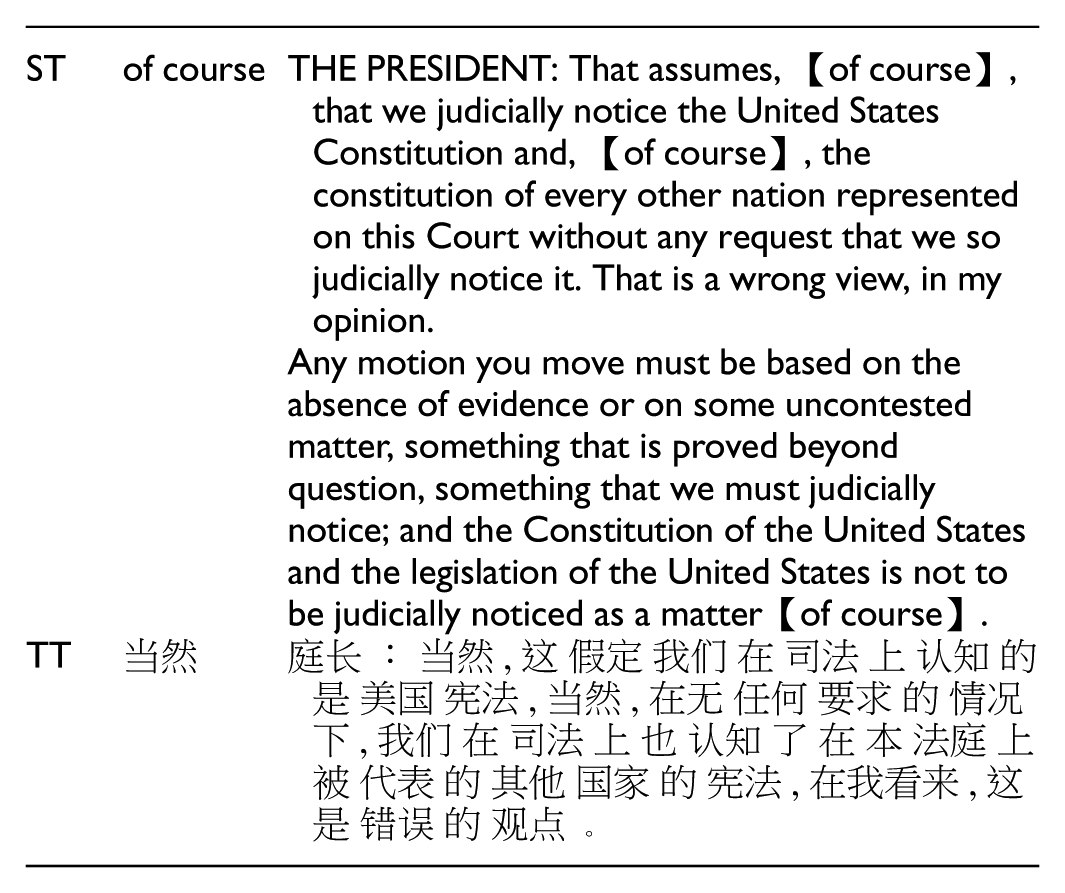
As shown by earlier studies (Simon-Vandenbergen & Aijmer, 2007; Szczyrbak, 2017), the use of of course in interaction is clearly linked to politeness and power relations. Example 4 demonstrates a concessive sequence in which of course is employed to downplay an opposing viewpoint. This makes it particularly effective for anticipatory rebuttals, where the speaker integrates a potential objection into their argument and then refutes it while returning to their original counterclaim (claim—acknowledgment—return to the counterclaim structure).
Szczyrbak (2017) describes the use of of course as following a “Yes, but” concessive schema. The term acts as a marker of partial agreement, first acknowledging a preceding point for rhetorical effect before proceeding to refute it. This strategy of highlighting then downplaying specific arguments enables a speaker to yield a minor point strategically, thereby strengthening their primary position.
As illustrated in Example 4, it shows how of course is used for alignment with an opposing view. The modal expression of course is deployed as part of a larger argumentative schema, where the president initially acknowledges some truth in the opposing view (“That assumes, of course, that…”) before reverting to his stance. Then the president presents his favored argument by refuting the earlier proposition made by the other party in the courtroom.
More precisely, while in Example 4 the president in the court admits that the court judicially notices the United States Constitution (acknowledgment), but it does not mean that the court judicially notice the constitution of every other nation represented on this Court (counterclaim). Thus, while admitting partial validity of the claim made by the litigant (“we judicially notice the United States Constitution”), the president in the court argues that the court will therefore judicially notice the constitution of other nation (“such interference is in my view clearly permitted”).
In the high-stakes face-to-face courtroom interactions, where an immediate reply from the other party is anticipated, the modal expression of course serves the face-saving function in the context. It is deployed by the courtroom participant to balance acknowledgments and counterarguments. Therefore, it can be seen as a device for politeness and fostering solidarity.
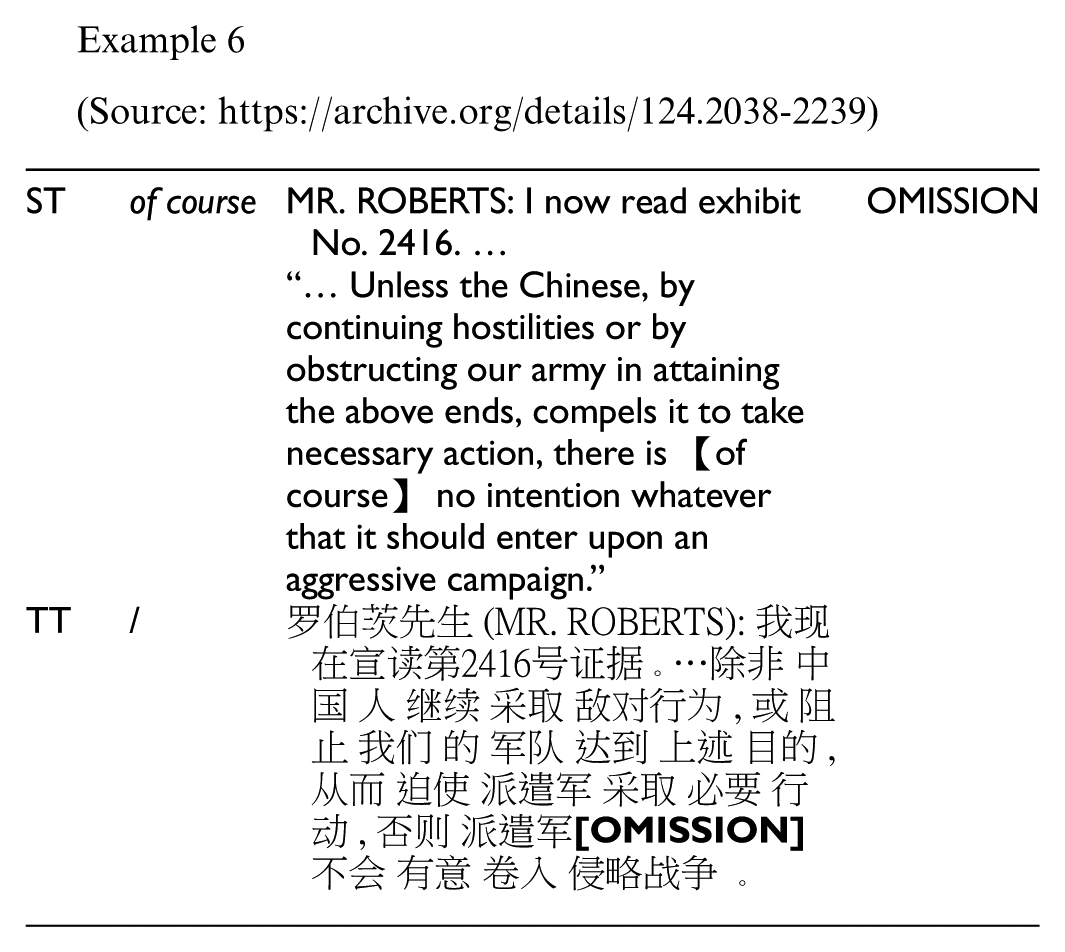
Beyond its concessive meaning, of course also appears in contexts where it presupposes knowledge that is assumed to be universally known (Szczyrbak, 2017). Thus, the as-everybody-knows interpretation of of course (Szczyrbak, 2017) is used to express something that both the speaker and the audience are presumed to be aware of, as illustrated in Examples 5 and 6.
The influence of omitting of course in the translated text, compared to the original, could be seen in Examples 5 and 6. Consequently, the Chinese TT of these examples lacks any equivalent expression that conveys the speaker’s epistemic stance, as of course does in the English ST.
The expression of course read by the defense counsel in the affidavit in the two examples below to convey that “everybody should know that although we endeavor to achieve our goal, we sincerely hope that the conference will yield fair and reasonable outcomes and help establish lasting global peace.,” likewise the second use of of course could be interpreted as “it goes without saying that there is absolutely no intention for it to embark on an aggressive campaign…” Again, of course in the two examples is used as an engagement device to recognize the presence of readers and tries to engage them along with his argument.
In the Chinese version of the Examples 5 and 6, there is no equivalent for of course, and the rhetorical effect is lost also through the omission. Thus, the functions expressed by of course were somehow not represented in the Chinese TT, which makes the TT appear less forceful. However, it should be acknowledged that most occurrences of of course were identified with Chinese equivalents in the TT. It suggests that the translators were consistent and accurate in conveying the intended meaning of of course in the translation.

The Case of “Must.”
Deontic modality conveys obligation and permission, such as, must (
Modal verbs in English are closely connected with the interpersonal function in the clause (Scotto di Carlo, 2017). The function of the modal verbs in Example 7 is precisely to encode the speaker’s position. As illustrated in the examples below, deontic must in Example 7 was used to realize the speaker’s authority.
As shown in the examples, deontic must was used by the president in the court to express strong obligation, which means the witness is required to “answer the question” raised by the counsel in the courtroom interaction in Example 7.
In Example 7, the deontic must was used by the president to indicate a strict procedural requirement, which conveyed a non-negotiable rule that re-examination is limited to clarifying points raised during cross-examination. In a similar vein, must in Example 7 was used to express a direct obligation for the witness to respond to the question if they are able to do so. It emphasized the importance of the witness’s duty to provide an answer, reinforcing the authority of the speaker (the president) and the expectation that the witness complies with the request. The deontic must deployed by the president in the courtroom interactions, as illustrated in Example 7, asserting the authority of the president and reinforcing the procedural boundaries within the courtroom, ensuring that the legal process is followed correctly, and that the necessary actions are taken by the courtroom participants.

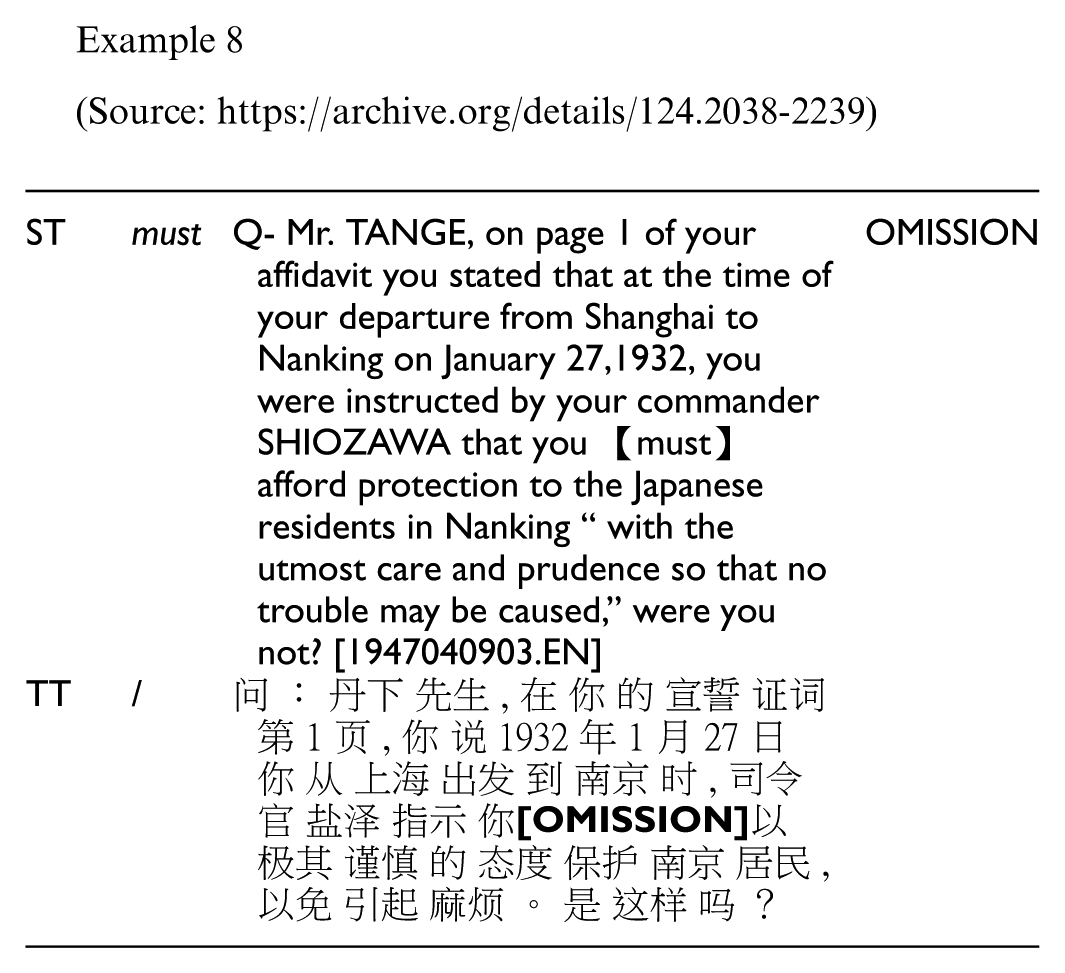
In Example 8, must was used to reinforce the authority of the commander SHIOZAWA by making it clear that the instruction is a command given to Mr. TANGE rather than a suggestion. By using must in the examination, the speaker underscores the expectation of compliance with the instruction.
However, the modal verb must, which is used to convey a strong sense of obligation and authority, was not translated in the Chinese TT. The omission of the deontic must could weaken the perceived authority, making the statement sound less authoritative.
Overall, these examples demonstrate shifts in modality that affect the interpersonal meanings embedded within courtroom discourse. For instance, in the following case involving the modal expression in ST: “I believe you testified to the effect that you did not have any direct conversations with the members of the Lytton Commission.” TT:“
Moreover, about the impact of “must” being rendered without its modal force: ST: “You must answer if you can.” TT: “
Furthermore, the modal phrase “of course,” which serves to maintain politeness and social harmony in ST: “That assumes, of course, that we judicially notice the United States Constitution.” TT: “
These examples illustrate the nuances involved in the translation process and underscore the potential risks of misrepresenting interpersonal dynamics in legal contexts. These translations demonstrate how the shifts in modality can lead to an erosion of politeness and a weakening of the authoritative presence necessary in courtroom interactions.
Discussion
In courtroom interaction, epistemic modality indexes participants’ assessments of a proposition’s likelihood or necessity based on evidence and belief (Koźbiał, 2019). In our data, implicit objective epistemic modality dominates, indicating a tendency to present propositions as factual and institutionally “neutral” while minimizing overt personal commitment—an effective credibility strategy in adversarial settings. This pattern diverges from Su et al. (2023), who report explicit subjective modality as most frequent in judicial judgments; the contrast is plausibly genre-driven, as judgments foreground judges’ reasoned evaluations, whereas courtroom testimony and expert accounts often rely on projecting objectivity. The relative scarcity of explicit objective epistemic modality further reflects the evidentiary reality of testimony, which commonly involves probabilistic inference rather than incontrovertible proof.
Similarly, the significant dominance of implicit subjective deontic modality indicates a preference for conveying obligations and permissions indirectly. Rather than using explicit objective forms, which explicitly state a rule, participants favor implicit formulations that veil the source of authority. This aligns with Boginskaya’s (2023) observations across legal texts and with descriptions of conventional deontic encoding in legal Chinese. Functionally, implicit deontic forms maintain the formality of legal discourse while avoiding the interpersonal abrasiveness of explicit commands, and they fit the courtroom’s procedural logic where duties are presupposed by law and questioning routines.
Additionally, the translation of modality reshapes interpersonal meaning through two primary, and seemingly paradoxical dynamics: the diminishment of authority and the amplification of confrontation. The first major consequence is a systematic diminishment of speaker authority, primarily achieved through the weakening of modal value. As evidenced in the analysis high-value epistemic modals, translations frequently reduced the degree of obligation and certainty expressed in the source text. The finding aligns with a broader tendency noted in legal and diplomatic translation toward mitigation and rhetorical restraint (X. Li, 2018). In the courtroom, however, the consequences are particularly acute. This weakening directly reduces the perceived decisiveness of judicial directives, softens the force of counsels’ arguments, and undermines the credibility of witness testimony by blurring the contours of their certainty, thereby reconstituting their institutional authority and epistemic power within the target discourse.
In addition, the findings corroborate and refine recent English-to-Chinese legal translation/interpreting research showing that institutionally situated linguistic choices recalibrate authority, alignment, and participation by adjusting stance and interactional control (B. Du, 2021; B. J. Du, 2024; Xu, 2024; Xu et al., 2020; T. Zhang et al., 2024; Zhao & Huang, 2025). Specifically, the systematic weakening and de-explicitation of modality observed here—through reduction or omission of high- and median-value markers—aligns closely with corpus-based evidence that English-to-Chinese courtroom translations tend to attenuate speakers’ modal commitment and render stance more implicit (Wu et al., 2025a). Extending beyond this convergence, the study clarifies how such attenuation becomes interactionally consequential: reduced modal force not only diminishes the perceived authority and credibility of speakers’ propositions, but the concurrent loss of explicit modal resources also strips away mitigation that functions as a politeness strategy, producing Chinese renditions that can sound more direct or confrontational than the source utterances. Similarly, evidence from police interviews that translated question design affects interviewees’ understanding and perceived pressure (T. Zhang et al., 2024) resonates with this study’s observation that weakened or implicit modality can reframe obligation and certainty, thereby altering how recipients interpret intent. In lawyer–client consultations, where interpreting conditions and style choices affect role boundaries and responsibility attribution (Xu, 2024; Xu et al., 2020), the results in this study specify modality loss as a linguistic pathway by which commitment and deference are reassigned across participants. Finally, the documented weakening of defendants’ “voice” via pragmatic reconstitution (B. Du, 2021), and marginalization through non-/zero renditions (B. J. Du, 2024) are compatible with the interpersonal consequences identified in this study: when modal stance is diluted and mitigation is removed, translated talk can inadvertently reposition speakers within the courtroom’s hierarchy of credibility and entitlement.
Concurrently, the translation process amplified the confrontational force of utterances through the loss of explicit hedges. In the source text, these explicit, subjective markers serve as interpersonal cushions, softening assertions to maintain courtroom decorum and respect for face. However, the removal in translation renders statements unmitigated, representing a witness’s tentative recollection as a straightforward fact. This erosion of politeness strategies inadvertently makes interactions appear more aggressive and face-threatening, potentially distorting the relational dynamics between participants and misrepresenting the strategic politeness inherent in the adversarial process.
However, modal markers are retained in this study because they constitute a primary linguistic resource for enacting modality and thus construing interpersonal meaning in courtroom interaction—encoding degrees of certainty, obligation, permission, and ability through which speakers negotiate commitment, responsibility, and authority. In trial discourse, where participation rights and institutional power are structurally asymmetrical, even subtle shifts in modal meaning may recalibrate how a question exerts control, how testimony indexes certainty or credibility, and how judicial directives are interpreted as binding or discretionary. Translation choices that weaken, strengthen, omit, or reframe modal meanings can therefore produce measurable shifts in perceived authority, certainty, cooperativeness, and credibility.
Although the precise drivers of these translation shifts require further study, several plausible explanations arise from the interplay of genre conventions, sociocultural pragmatics, and translator agency. First, the pattern may reflect norms in Chinese legal discourse, where formality and impersonality are often privileged over overt subjectivity; translators may therefore recast high-value English modals into less explicit stance marking to better match target-language expectations. Second, the shifts may represent a risk-management strategy in a politically and historically sensitive setting such as the IMTFE, prompting translators to weaken strong claims and suppress subjective markers to avoid any appearance of overstatement or bias. Finally, the pattern aligns with broader Chinese pragmatic preferences for indirectness and relational harmony. The translational choices observed—mitigating force and removing explicit speaker attribution—could be seen as an application of these pragmatic norms to the legal context, resulting in a discourse that sounds less authoritative and more implicitly confrontational to the target-language ear.
In conclusion, courtroom translation reshapes interpersonal meaning through a paradoxical dynamic: genre conventions restrict shift frequency, yet the shifts that occur consistently attenuate speaker authority and amplify confrontational force. Specifically, authority diminishment manifests through the weakening of high-value modals, reducing perceived decisiveness and undermining testimonial credibility. Concurrently, confrontational amplification results from omitting explicit hedges, eliminating politeness markers and rendering accusations direct and face-threatening. This realignment of interpersonal positioning, arising as translators navigate pragmatics within target-language constraints, risks distorting courtroom dynamics where power balances rely critically on nuanced modal expression.
Although the present analysis is grounded in the IMTFE, its contribution is not limited to the historical case. The central claim—that modal resources are pivotal for construing interpersonal meaning and that translation may systematically recalibrate force, commitment, and authority—addresses a communicative problem that remains structurally stable across courtroom settings: legal interaction is institutionally asymmetric, procedurally consequential, and highly sensitive to stance, obligation, and evidentiality. For this reason, the patterns identified in this study plausibly extend to modern English-to-Chinese courtroom translation even where the participants, and legal systems differ.
Conclusion
Drawing on SFL, this study investigated modality translation in English-to-Chinese translations of the IMTFE trial records—a high-stakes courtroom setting—to explore how translation reshapes interpersonal meaning. Using SFL’s modality system as a framework, the study analyzed original English trial transcripts alongside their Chinese translations, comparing modality orientation and value between ST and TT. Results showed that courtroom participants predominantly used implicit modality to depersonalize their assertions, concealing the source of assessment. This strategic avoidance of subjectivity was reinforced by the minimal use of explicit epistemic modality in the ST. Additionally, median-valued modality prevails over high and low values, reflecting a relatively high standard of proof where claims are cautiously weighted toward certainty without absolute commitment. Furthermore, analysis revealed that the translation of modality weakened the original speakers’ modal force and explicitness. High- and median-value modality was frequently reduced or omitted, diminishing the perceived authority of speakers’ statements. Simultaneously, the loss of explicit modal markers eroded politeness strategies, inadvertently rendering translated statements more direct and confrontational. Consequently, these shifts fundamentally reconfigured interpersonal dynamics, altering how their credibility, deference, and intent were perceived in the courtroom discourse.
The interpersonal consequences of translating modality identified in this study—particularly the erosion of high-value modality and omission of explicit hedges—carry critical implications for courtroom translation practice, where unmitigated shifts can distort speakers’ authority and politeness strategies, potentially affecting legal outcomes. To preserve interpersonal meaning, translators should prioritize equivalence for high/median-value modals, and audit politeness erosion by retaining explicit hedges to prevent unintended confrontational tones.
While these insights derive from the historically specific IMTFE corpus, future research should validate their generalizability through: (1) cross-corpus analysis of contemporary trials; (2) triangulation with native Chinese courtroom discourse to disentangle translation norms from target-language conventions; and (3) comparative studies examining how civil/common law traditions and cultural pragmatics shape modality expression. Collectively, these directions would advance understanding of how legal systems, cultural norms, and translator agency co-construct interpersonal meaning, ultimately refining translator training and legal language policy.
Footnotes

Ethical Considerations
This study obtained ethical approval from Universiti Sains Malaysia under the university’s Human Research Ethics Committee (Jawatankuasa Etika Penyelidikan Manusia: JEPeM) code USM/JEPeM/PP/24080764.
Consent to Participate
Informed consent was not obtained because the research does not involve human participants or their data.
Author Contributions
S. W. contributed to the conceptualization, methodology, software, data curation, writing—original draft writing and preparation. M. A. contributed to the supervision, software, validation, writing, reviewing, and editing. Y. W. assisted in improving the academic coherence of the manuscript, validated the English–Chinese translations, and academic depth, and alignment with the study’s findings. All authors read and approved the final version of the manuscript.
Funding
The authors received no financial support for the research, authorship, and/or publication of this article.
Declaration of Conflicting Interests
The authors declared no potential conflicts of interest with respect to the research, authorship, and/or publication of this article.
Data Availability Statement
The data is provided in the manuscript.