




Abstract
As a precise and constructive form of feedback, leaders’ negative feedback is particularly important for employees’ personal development and organizational effectiveness improvement. This study systematically explores the divergent pathways through which leaders’ negative feedback influences employees’ work engagement from the perspective of cognitive appraisal, thereby revealing its “double-edged sword” nature. This study employs structural equation modeling and regression analysis to empirically analyze multi-time point survey data collected from employees across multiple industries. The results indicate that leaders’ negative feedback has a significant positive impact on both challenge appraisal and hindrance appraisal. Challenge appraisal promotes employees’ work engagement, whereas hindrance appraisal inhibits it. Relational identification positively moderates the relationship between leaders’ negative feedback and challenge appraisal, and negatively moderates the relationship between leaders’ negative feedback and hindrance appraisal. This study provides a more comprehensive and dialectical perspective for relevant research on leaders’ negative feedback, and offers theoretical support and practical guidance for enterprises to enhance work engagement by reasonably guiding employees’ cognitive appraisal in management practice.
Keywords
Introduction
With the advent of the VUCA (Volatility, Uncertainty, Complexity, Ambiguity) era, organizations are continuously confronted with highly dynamic and unpredictable external environments, compelling them to establish efficient and precise feedback mechanisms. Leaders’ feedback, as a critical link connecting organizational goals and employee development, serves as an important source for employees to obtain information and reduce cognitive uncertainty (Shet, 2024). It plays a key role in promoting individual employee growth and achieving organizational objectives (Bouwens et al., 2025). Based on the feedback valence theory, leaders’ feedback can be categorized into two types: leaders’ positive feedback and leaders’ negative feedback (Ilies & Judge, 2005). Negative feedback refers to leaders’ criticism of shortcomings in followers’ current work behaviors. It prompts employees to recognize the gap between their current performance and expected standards, thereby guiding them to adjust their behavior to align with organizational expectations (Simon et al., 2022). Compared with positive feedback, negative feedback, as a corrective tool, helps employees more accurately identify work deviations (Ni & Zheng, 2024), view errors from a problem-oriented perspective (Wu et al., 2024), and engage in deeper self-reflection. However, negative feedback also carries certain potential risks. It can reduce employees’ organization-based self-esteem, increase feelings of frustration (Xing et al., 2025), and lead employees to address issues emotionally (Wu et al., 2024). Particularly in Chinese organizational contexts that emphasize “face” (mianzi) culture, employees’ interpretation of negative feedback may be more sensitive and complex. This can cause employees to develop an avoidance mentality toward negative feedback, or even attribute it to leaders’ hostility toward them (Xing et al., 2021), thereby undermining the effectiveness of the feedback. A Gallup survey revealed that among employees who develop negative emotions in response to leaders’ negative feedback, only 10.4% remain engaged in their work, while 79.6% become frustrated and seek other job opportunities. Does a leader’s negative feedback ultimately push employees toward higher work engagement, or pull them into a vicious cycle of lower engagement? Therefore, it is crucial to explore the circumstances under which employees are more inclined to perceive leaders’ negative feedback as motivational signals and proactively transform criticism into intrinsic drive for self-improvement, as this can significantly enhance the quality of talent development. Furthermore, employees’ differential reactions to negative feedback depend not only on the feedback content itself but also on the quality of their relationship with their leaders (Xing et al., 2025). Relational identification reflects employees’ psychological acceptance and value alignment with the supervisor-follower role relationship. Relational identification directly affects employees’ cognitive appraisal process of negative feedback. Thus, within established organizational power structures, relational identification helps reveal how vertical supervisor-follower relationships can buffer the psychological impact of leaders’ negative feedback.
Based on this, this study constructs a dual-path action model from the cognitive appraisal perspective based on the stress cognitive appraisal theory, systematically illustrating the differential influence mechanisms of leaders’ negative feedback on employees’ work engagement. Furthermore, the study incorporates relational identification as a moderator to examine its boundary role in the relationship between leaders’ negative feedback and employees’ cognitive appraisal. This study makes the following marginal contributions: From the cognitive appraisal perspective, taking employees’ deep-seated psychological dynamics as the entry point, it provides new insights for researching the mechanisms between leaders’ negative feedback and employees’ work engagement. In addition, it broadens the boundary conditions of leadership behavior and cognitive appraisal, revealing the differential effects of relational identification on how leaders’ negative feedback on employees’ cognitive appraisal.
Literature Review
Leaders’ Negative Feedback and Work Engagement
Existing research on leaders’ negative feedback mostly explores its positive or negative impacts from a single dimension. On one hand, negative feedback can trigger negative emotions (Motro et al., 2021) and psychological stress (Simon et al., 2022) in employees, thereby reducing their creativity (Kim & Kim, 2020) and task performance (Wu et al., 2024). On the other hand, it can help employees clearly identify their shortcomings, prompting them to adopt proactive behavioral strategies, which in turn enhance proactive behavior (T. Guo et al., 2024) and task performance (Zada et al., 2022). Some studies have also dialectically examined the dual-edged sword effect of leaders’ negative feedback. For instance, research has explored its dual effect on employee learning performance from the employee attribution perspective (Xing et al., 2023), on employee feedback-seeking behavior from the emotional perspective (Xing et al., 2025), and on employee job performance from the coping strategies perspective (Wu et al., 2024).
In summary, in terms of subject, existing studies have primarily explored the impact of leaders’ negative feedback on employee behavior, performance, and creativity, with little research investigating its effect on employee work engagement. In terms of research perspective, existing studies have analyzed the differential effects of leaders’ negative feedback from viewpoints such as attribution, emotion, and coping strategies, while few have examined its mechanism from the cognitive appraisal perspective. In fact, based on the stress cognitive appraisal theory, employees typically process such feedback first through cognitive appraisal before subsequent psychological and behavioral reactions are triggered (Ilgen & Davis, 2000). Neglecting the role of cognitive appraisal is likely to make it difficult to fully depict the impact of negative performance feedback. Therefore, this study investigates the dual-edged sword effect of leaders’ negative feedback on employee work engagement from the cognitive appraisal perspective.
Relational Identification
Relational identification, as an important construct in organizational behavior, has often been examined as a mediating mechanism in explaining how leadership behaviors influence employee attitudes and performance. Existing studies have extensively explored its mediating role between leadership styles and outcomes such as employee well-being (Yang et al., 2025), creativity (Shang et al., 2024), and job performance (Balzano et al., 2025). However, few studies have systematically investigated its role as a moderator. In fact, relational identification reflects employees’ cognitive and emotional evaluation of their relationship with their leader, constituting a key relational context that can profoundly shape how employees interpret and respond to specific leader behaviors. This is particularly critical in contexts such as leaders’ negative feedback, which carries potential threat. An employee’s level of relational identification can shape their cognitive appraisal, consequently, moderate their reactions to such feedback.
Existing research on leaders’ negative feedback has primarily focused on moderators in two categories: employees’ individual traits, such as grit and feedback self-efficacy (Motro et al., 2021), regulatory focus (T. Guo et al., 2024), and proactive personality (Wu et al., 2024); emotional factors, such as self-esteem (Zada et al., 2022). Few studies have explored the moderating role of leader-employee relational exchange from an interpersonal perspective (Xing et al., 2025). However, relational identification, as an employee-centered relational cognition, exerts a more significant impact on employees’ work engagement and cognitive appraisal. Furthermore, with the advancement of digital intelligence technologies, some research has begun to examine relational cognition in human-computer interaction. For instance, Watanabe et al. (2025) investigated the role of relational mobility between AI feedback and work engagement. However, such studies often overlook the relational depth inherent in leaders as real social entities. Therefore, by adopting a human-centric perspective on relational cognition, this study thoroughly investigates the moderating mechanism of relational identification in the process through which leaders’ negative feedback influences employee work engagement. This approach not only helps expand the theoretical boundaries of relational identification but also addresses the current cognitive bias in negative feedback research, which tends to overemphasize individual traits while neglecting the relational context.
Theoretical Background and Hypotheses
Theoretical Framework
The stress cognitive appraisal theory was first proposed by F. Lazarus (1984), posits that stress responses are not directly triggered by stressors but arise from the dynamic interaction between individuals and their environment. Specifically, when encountering environmental stimuli, individuals undergo a two-stage cognitive process: primary appraisal, where they judge whether an event is a challenge or a hindrance, and secondary appraisal, where they evaluate their coping resources and options. This appraisal process directly influences their subsequent emotional and behavioral responses (Folkman et al., 1986). The theory indicates that when individuals perceive a stressor as promoting their development and value realization, they engage in challenge appraisal and adopt proactive coping strategies. Conversely, if they perceive the stressor as threatening to their interests and goals, they form a hindrance appraisal and tend to adopt avoidance or defensive coping strategies (LePine et al., 2005). Based on this analysis, this study employs the stress cognitive appraisal theory as a unique theoretical lens to elucidate how employees form different appraisal of leaders’ negative feedback and how these appraisals subsequently exert differential impacts on their work engagement.
Leaders’ Negative Feedback and Cognitive Appraisal
Leaders’ negative feedback represents a potential workplace stressor that raises employee concerns about their capability to address its impact, given its inherent dual characteristics of challenge and threat. Based on the stress cognitive appraisal theory (F. Lazarus, 1984), an individual’s stressor appraisal depends on whether they perceive it as potentially promoting personal growth. This is particularly salient in Chinese high-context culture, where leaders’ negative feedback conveys not only performance-related information but also shapes employees’ perception of “face” in social relationships, thereby influencing their appraisal path. When employees perceive such feedback as beneficial for capability improvement, they tend to view it as a challenge and a chance to “gain face” from their leader, consequently forming a challenge appraisal. First, employees may attribute the feedback to their own suboptimal performance or correctable mistakes (Geng et al., 2025), believing these issues can be overcome through personal effort. Second, such feedback can stimulate employees’ intrinsic motivation and psychological need for competence, leading them to actively seek learning opportunities, improve skills, and ultimately view the feedback as an opportunity for self-growth (Wu et al., 2024), thus forming challenge appraisal.
Conversely, when employees perceive leaders’ negative feedback as a denial of their personal capabilities, they experience a sense of “lose face,” which subsequently leads to hindrance appraisal (Xing et al., 2025). On the one hand, they may interpret leaders’ negative feedback as a negation of their capabilities, value, or efforts, perceive the feedback style as overly harsh or unfair, or even view it as intentional harassment by leaders (T. Guo et al., 2024). On the other hand, leaders’ negative feedback may evoke feelings of shame in employees (X. Li et al., 2025), thereby activating individual defensive psychological mechanisms and leading to excessive consumption of psychological resources (Pei et al., 2024). In such contexts, employees tend to fixate on the potential losses caused by negative feedback, making it easy to construct a threatening cognitive pattern. Based on the theoretical analysis above, this study proposes the following hypothesis:
The Mediating Role of Cognitive Appraisal
Appraisal as a key psychological process linking stressors and stress responses, plays a core role in stress coping. Based on stress cognitive appraisal theory R. S. Lazarus (1991), when employees encounter leaders’ negative feedback, they engage in a psychological appraisal process to evaluate its potential implications. On the one hand, individuals who perform challenge appraisal often exhibit high self-efficacy (Chen et al., 2024). This positive psychological resource effectively mitigates energy depletion caused by stress, enabling individuals to maintain cognitions about work improvement. On the other hand, such individuals are driven by stronger intrinsic motivation to achieve goals (Teng et al., 2025). This motivates them to engage proactively in tasks and persist in their efforts, which manifests as heightened levels of vitality, concentration, and dedication, ultimately enhancing their performance and work engagement (Kundi et al., 2022).
Employees with hindrance appraisal may exhibit work avoidance to prevent excessive resource depletion and preserve their resource balance (Z. Wang et al., 2022). On the one hand, hindrance appraisal of stress implies potential failure or benefit loss, which triggers negative emotions (Al Hajj et al., 2023). This, in turn, reduces cognitive resource investment and emotional commitment during task execution, leading to passive work states and decreased work engagement (Parker et al., 2024). On the other hand, when employees interpret leaders’ negative feedback as a global negation of their capabilities, their basic psychological need for competence is threatened (Tan et al., 2024). This need frustration activates anxiety responses (Liang et al., 2024), creating persistent psychological stressors. Through these dual mechanisms, individuals not only experience diminished intrinsic motivation for proactive engagement but also suffer from attention distraction and emotional exhaustion due to persistent anxiety, ultimately resulting in significant declines in work engagement. Based on the theoretical analysis above, this study proposes the following hypothesis:
The Moderating Role of Relational Identification
Relational identification refers to the degree to which individuals integrate elements of a specific role relationship into their self-concept (Sluss & Ashforth, 2007). Individuals with high relational identification tend to derive self-worth from fulfilling role obligations. Such identification leads them to prioritize relational considerations in their cognition and behavior, resulting in stronger perspective-taking abilities and more relationship-oriented actions (Cooper & Thatcher, 2010). In Chinese organizational contexts, relational identification is often deeply intertwined with the culture of “face.” After developing strong identification with their leader, individuals perceive the leader’s face as an extension of their own, thereby influencing how they interpret the leader’s feedback.
Specifically, employees with high relational identification highly value the relationship and regard the leader as an “insider.” Consequently, they tend to interpret it from a positive perspective. Influenced by the Chinese “face” culture, employees often interpret leaders’ negative feedback as a signal of trust—an act of “speaking truth behind closed doors.” They perceive it as motivated by the leader’s genuine concern for their development. Even if the content is stern, it is viewed as an embodiment of high standards and rigorous demands, reflecting the leader’s investment in their growth (Cui et al., 2024). This face-granting mechanism encourages employees to perceive negative feedback as a valuable opportunity for self-improvement. It redirects their focus from defensive reactions to learning and growth opportunities, rather than seeing it as a threat to their personal interests. As a result, employees are more inclined to engage in challenge appraisal and less likely to experience hindrance appraisal (Balzano et al., 2025).
Conversely, employees with low relational identification rely more on personal goals and autonomy needs. Their cognitive framework lacks the emotional foundation to perceive their leader as an “insider.” Under such circumstances, the leader’s negative feedback is easily interpreted as “lose face,” thereby triggering defensive reactions from employees. In Chinese high-context culture, face carries significant symbolic and social exchange value. Once employees perceive that the leader has failed to grant due face in the feedback, they are more likely to question the leader’s motives and objectivity, believing that the leader has undervalued their performance or even intentionally suppressed them (Zheng et al., 2023). This leads employees to view leaders’ negative feedback as a threat to their personal interests, undermining their trust in the leader. Consequently, they do not see it as an opportunity for self-improvement and instead engage in hindrance appraisal (Shang et al., 2024), while suppressing challenge appraisal. Based on the theoretical analysis above, this study proposes the following hypothesis:
Moderated Mediation Effect
Based on the above analysis, this study proposes a moderated mediation model hypothesis. When employees have high relational identification, leaders’ negative feedback helps them identify problems, and employees are more inclined to perceive it as leaders’ emphasis and expectations. This leads them to appraise it as a challenging opportunity, which enhances performance and fosters personal growth, thereby motivating employees to invest more resources in work and exhibit high levels of work engagement. Conversely, when employees have low levels of relational identification, due to the lack of internal and external resources, they tend to focus heavily on the hindering effects of leaders’ negative feedback on their own growth. Such cognition causes them to reduce their level of engagement in work. Based on the theoretical analysis above, this study proposes the following hypothesis:
The conceptual model of this study shown in Figure 1.

Conceptual model.
Methodology
Sample and Procedure
This study targeted full-time enterprise employees from China. Participants were recruited through personal networks and on-site surveys, and all provided informed consent. To ensure the validity of the scale, a pilot test was conducted with 164 employees prior to the formal survey. The results were met the required standards for reliability and validity, indicating that the scales used in this study are applicable and suitable for further formal investigation. The relevant empirical results are presented in Tables A1, A2, and A3 in the Appendix 1. The pilot sample was not included in the final valid sample. A multi-timepoint questionnaire design was employed, consisting of two time points separated by a 1-month interval. This approach aimed to alleviate common method bias by temporally separating independent, mediating, moderating and outcome variables (Podsakoff et al., 2003). At time point 1, the questionnaire measured employees’ basic demographics, leaders’ negative feedback, challenge appraisal, hindrance appraisal, and relational identification. All employees were assigned unique identification numbers to facilitate matching across survey waves. A total of 458 questionnaires were initially collected. At time point 2, the questionnaire measures work engagement. A total of 373 questionnaires were initially collected, after excluding those with missing items, inconsistent responses, or mismatched identifiers, 325 questionnaires were obtained (effective rate = 70.96%). Due to potential non-response bias in the questionnaires, this study divided all collected responses into two groups based on the time of submission and conducted an independent samples T-test. The t-value for gender was 0.941 (p = .347), for age was −1.443 (p = .150), for education was −1.045 (p = .297), for work year was 1.003 (p = .317), and for work years with leader was 1.106 (p = .269). None of these reached statistical significance (p > .05), indicating that non-response bias is not substantial and is unlikely to significantly impact the related research findings. The distribution of sample characteristics is shown in Table 1.
Distribution of Sample Characteristics.

Measures
The scales used in this study were all derived from existing English literature and were processed using a strict translation-back translation procedure to ensure the consistency in connotation. All scales were rated on a Likert five-level scales, where 1 meant “strongly disagree” and 5 meant “strongly agree.” The measurement details for each variable are described below.
Leaders’ Negative Feedback (LNF)
The scale of leaders’ negative feedback was adapted from Kim and Kim (2020), which contains seven items, such as “My immediate supervisor pointed out to me that there were deficiencies in my work.” etc.
Cognitive Appraisal
The scale of challenge appraisal (CA) and hindrance appraisal (HA) was adapted from Drach-Zahavy and Erez (2002), which contains four items respectively, such as “After receiving negative feedback from the leader, my task seemed like a challenge to me.” and “After receiving negative feedback from the leader, my task seemed like a threat to me.” etc.
Relational Identification (RI)
The scale of relational identification was adapted from Walumbwa and Hartnell (2011), which contains 10 items, such as “When someone criticizes my leader, it feels like an insult to me.” etc.
Work Engagement (WE)
The scale of work engagement was adapted from Schaufeli et al. (2002), which contains nine items, such as “At work, I feel myself bursting with energy.” etc.
Control Variables
Based on existing relevant studies and the actual situation of this study (Ni & Zheng, 2024; Kim & Kim, 2020), gender, age, education, and work years were used as control variables, in order to eliminate the bias caused by individual differences. In addition, the amount of time employees works year with their leaders could affect relational identification, so work years with leaders were also used as control variable.
Results
Reliability and Validity Test
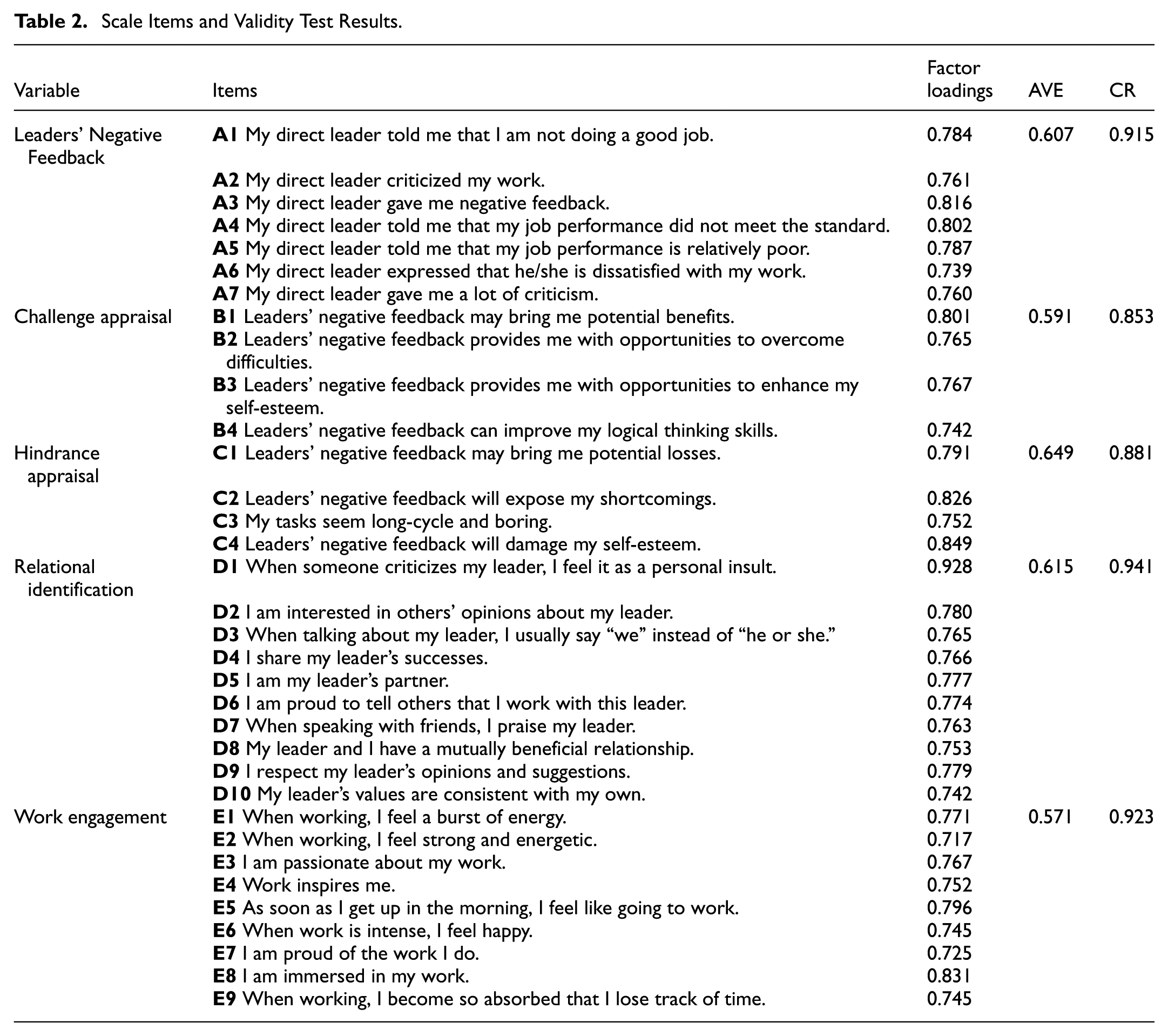
The reliability of the five variables was assessed using Cronbach’s alpha coefficient, computed with SPSS 27.0. The results indicated that the alpha values for leaders’ negative feedback, challenge appraisal, hindrance appraisal, relational identification, and work engagement were .901, .821, .851, .932, and .913, respectively, demonstrating high internal consistency for all scales.
The validity of the five variables was examined through exploratory factor analysis (EFA) and confirmatory factor analysis (CFA) in SPSS 27.0 and Mplus 8.3. First, the KMO index value was 0.895 (p < .001), which was above the standard value of 0.8, making it suitable for factor analysis. Second, the minimum value of CR was above 0.8, and AVE was above 0.5, indicating that the variables have good convergent validity (See Table 2). Finally, in order to test the discriminant validity among the variables, this study used Mplus 8.3 to conduct a confirmatory factor analysis. The fitting indexes for the five-factor model are as follows: χ2/df = 1.568, RMSEA = 0.042, CFI = 0.952, TLI = 0.948, IFI = 0.952, SRMR = 0.044 (See Table 3). All these indexes fall within the desired range, suggesting a good model fit. Moreover, this five-factor model is better than other alternative models. This shows that five variables in the study have discriminant validity. In addition, this study employs the Fornell-Larcker criterion to assess discriminant validity. The correlation coefficients between the variables are all less than the square root of the AVE, indicating good discriminant validity of the scale (See Table 4).
Scale Items and Validity Test Results.
Confirmatory Factor Analysis.

Note. LNF = leaders’ negative feedback; CA = challenge appraisal; HA = hindrance appraisal; RI = relational identification; WE = work engagement, “+” indicates combined variables.
Descriptive Statistics and Correlations.

Note. *p < .05, **p < .01, N = 325.
The values in diagonal brackets are each variable’s AVE square root values.
Common Method Bias Test
Since the data for the variables were in the form of employee self-report, there may be common method bias in this study. Harman’s one-factor analysis was used to test the common method bias. The cumulative explained variance in the first factor is 18.37%, which is less than half of the total variance explained rate of 63.32%. The CFA results show that the five-factor model has a good fit, while the one-factor model does not reach the standard range for each indicator (χ2/df = 9.129, RMSEA = 0.158, CFI = 0.297, TLI = 0.252, and SRMR = 0.202). It indicated the constructs can be distinguished from each other. Moreover, this study also used the Unmeasured Latent Method Construct Variance Comparison (ULMC) to examine common method bias. The results indicated that the controlled unmeasured latent factor model (χ2/df = 1.57, RMSEA = 0.042, CFI = 0.952, TLI = 0.947, SRMR = 0.044) showed no significant improvement in model fit compared to the six-factor model. All changes were below the critical threshold of 0.05, reaffirming that this study was not substantially affected by common method bias (Ayyagari et al., 2011).
Descriptive Statistics Analysis
Table 4 presents the means, standard deviations, and correlation coefficients among the study variables. Leaders’ negative feedback is significantly positively correlated with challenge appraisal (r = .289, p < .01), and significantly positively correlated with hindrance appraisal (r = .208, p < .01). Challenge appraisal is significantly positively correlated with work engagement (r = .360, p < .01), hindrance appraisal is significantly negatively correlated with work engagement (r = −.280, p < .01). These patterns provide preliminary support for the proposed relationships.
Hypothesis Testing
Direct Effect Testing
This study tested the entire model through path analysis using Mplus 8.3, Figure 2 shows the results of the structural model path analysis. Leaders’ negative feedback is significantly positively correlated with challenge appraisal (β = .299, p < .001), leaders’ negative feedback is significantly positively correlated with hindrance appraisal (β = .212, p < .001). Therefore,

Path analysis results.
Regression Analysis Results of Mediating Effect.

Note.*p < .05, **p < .01, ***p < .001, N = 325.
Mediating Effect Testing
In order to further verify the mediating effects, this study used bootstrap method with 5,000 samples sampled (Preacher & Hayes, 2008), the result of mediation analysis is shown in Table 6. The results revealed that the mediating effect of challenge appraisal in the leaders’ negative feedback toward work engagement was significant (CA indirect effects = 0.086, 95% CI [0.050, 0.138]. Thus,
Bootstrap Method of Chain Mediating Effect Results.

Moderating Effect Testing
To test the moderating effect of relational identification, this study centered the interaction term of leaders’ negative feedback and relational identification, and respectively regressed challenge appraisal and hindrance appraisal. As shown in Table 7, relational identification positively moderated the linkage between leaders’ negative feedback and challenge appraisal (β = .211, p < .001). Thus,
Regression Analysis Results of Moderating Effect.

Note.*p < .05, **p < .01, ***p < .001, N = 325.
Int = Leaders’ Negative Feedback × Relational identification.
In order to show the moderating effect of relational identification more intuitively, this study further adopts the simple slope method for analysis. The high-level relational identification and low-level relational identification are defined as the values that are higher (lower) than the mean by one standard deviation, and draws a graph of the moderating effect of relational identification. The results are shown in Figures 3 and 4, indicating that the leaders’ negative feedback toward challenge appraisal was significantly positive for both high relational identification (β = .437, p < .001) and low high relational identification(β = .062, p < .001). Thus,
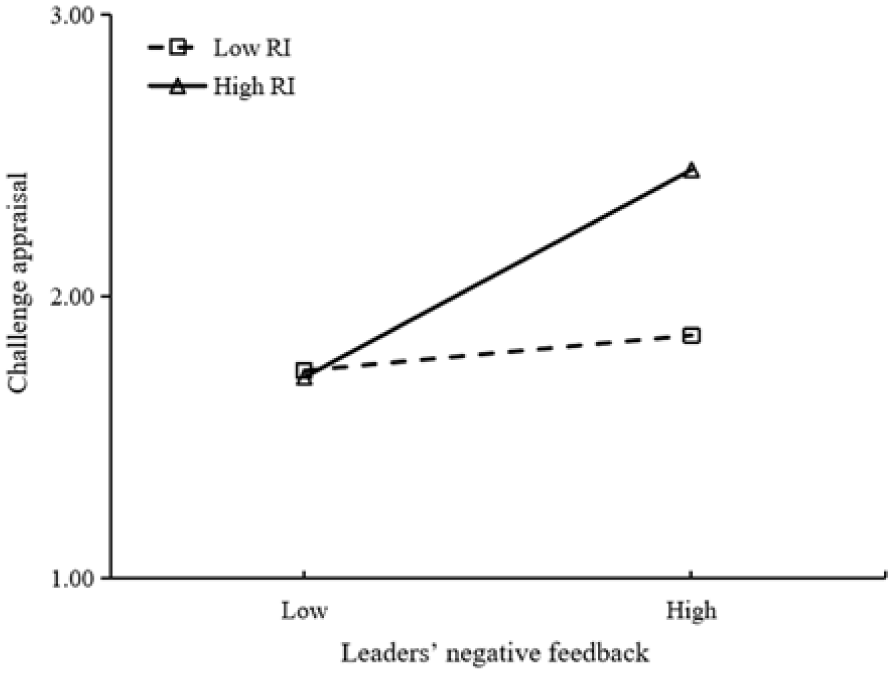
The moderating effect of relational identification between leaders’ negative feedback and challenge appraisal.
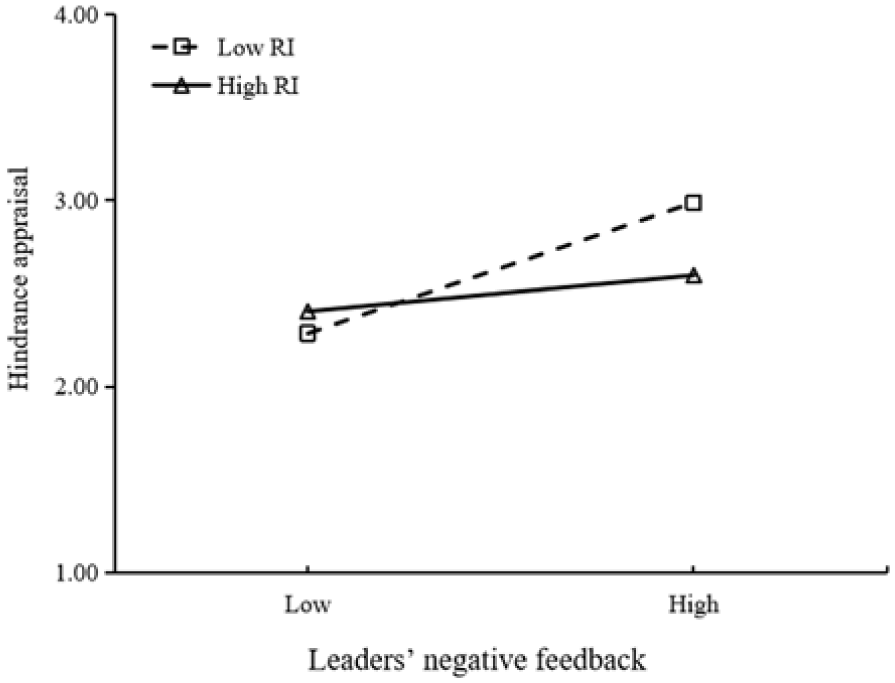
The moderating effect of relational identification between leaders’ negative feedback and hindrance appraisal.
Moderated Mediating Effect Testing
In the path analysis of the full model, the Bootstrap method was used to analyze the 95% confidence intervals (CI) of the indirect effects of leaders’ negative feedback on work engagement, which are mediated respectively by challenge appraisal and hindrance appraisal, under the conditions of high and low relational identification levels. Table 8 shows the results of the moderated mediating effect test. In the “LNF→CA→WE” path, the index of moderated mediation is 0.025 (95% CI [0.003, 0.058], indicating moderated mediating effect is significant. Specifically, when relational identification was low, leaders’ negative feedback had a significant positive indirect effect on work engagement through challenge appraisal (indirect effect = 0.004, 95% CI [−0.013, 0.035]); when relational identification was high, leaders’ negative feedback had a significant positive indirect effect on work engagement through hindrance appraisal (indirect effect = 0.046, 95% CI [0.004, 0.099]); indirect effect difference = 0.042 and 95% CI [0.005, 0.109]. Therefore, the mediating effect is positively significant at high levels of relational identification, but positive yet non-significant at low levels, relational identification strengthens this mediating role. Thus,
Moderated Mediating Effect Analysis Results.

In the “LNF→HA→WE” path, the index of moderated mediation is 0.026 (95% CI [0.003, 0.061], indicating moderated mediating effect is significant. Specifically, when relational identification was low, leaders’ negative feedback had a significant positive indirect effect on work engagement through hindrance appraisal (indirect effect = 0.043, 95% CI [0.004, 0.090]); when relational identification was high, leaders’ negative feedback had a significant positive indirect effect on work engagement through hindrance appraisal (indirect effect = 0.008, 95% CI [−0.008, 0.043]); indirect effect difference = −0.035 and 95% CI[−0.091, −0.005]. Thus,
To more intuitively demonstrate the moderating effect of relational identification on the indirect effect, this study employed the Johnson-Neyman (J-N) figures to plot the moderated mediation effects, as shown in Figures 5 and 6. The solid line represents the linear correlation between the indirect effect and the moderating variable, while the dashed area represents the 95% confidence band. The significant regions indicate that for the mediation path of challenge appraisal, when the value of relational identification is greater than −0.481, the confidence interval exclude zero, thus the indirect effect of leaders’ negative feedback on work engagement via challenge appraisal is significant. For the mediation path of hindrance appraisal, when the value of relational identification is less than 0.759, the confidence interval exclude zero, thus the indirect effect of leaders’ negative feedback on work engagement via hindrance appraisal is significant.

Moderated Mediation Effect of Relational Identification (CA) Johnson-Neyman Diagram.

Moderated Mediation Effect of Relational Identification (HA) Johnson-Neyman Diagram.
Discussion
Based on the face culture within Chinese organizational contexts, this study examines the impact of leaders’ negative feedback on employee work engagement from the cognitive appraisal perspective, unveiling the mediating pathways behind employees’ differential appraisal. The key findings are as follows:
First, existing research has predominantly examined the effects of leaders’ negative feedback from a single dimension, adopting a simplistic either-or perspective (T. Guo et al., 2024; Motro et al., 2021; Simon et al., 2022; Zada et al., 2022). This approach fails to capture its “double-edged sword” nature, namely, the specific conditions under which it produces divergent effects. To address this gap, and diverging from prior research, this study based on the stress cognitive theory, which posits that individuals can develop two distinct appraisal styles when confronted with the same stressor. Building on this foundation, this study investigate the double effects of leaders’ negative feedback from a cognitive appraisal perspective. The empirical results reveal that leaders’ negative feedback positively affects challenge appraisal, while it also negatively affects hindrance appraisal. This indicates that such feedback can enable employees to recognize their shortcomings and potential for improvement, thereby fostering a challenge appraisal; however, it may also trigger feelings of shame and defensive reactions, leading to a hindrance appraisal. Meanwhile, challenge appraisal positively affects work engagement, whereas hindrance appraisal negatively affects work engagement. This indicates that when employees develop a challenge appraisal, they perceive opportunities to enhance their work capabilities, thereby increasing their work engagement; conversely, hindrance appraisal tends to evoke negative emotions and avoidance behaviors, which reduce work engagement. In addition, challenge appraisal mediates the relationship between leaders’ negative feedback and work engagement, suggesting that leaders’ negative feedback enhances work engagement by stimulating employees’ challenge appraisal. Similarly, hindrance appraisal mediates the relationship between leaders’ negative feedback and work engagement, indicating that leaders’ negative feedback suppresses work engagement by eliciting employees’ hindrance appraisal.
Second, unlike previous research that focused primarily on individual traits (Wu et al., 2024; Zada et al., 2022), this study incorporates relational identification into the research framework, revealing that variations in employees’ relational identification with their leader moderate the effect of leaders’ negative feedback on cognitive appraisal. Empirical analysis indicates that relational identification positively moderates the effect of leaders’ negative feedback on challenge appraisal, while negatively moderating its effect on hindrance appraisal. This suggests that employees with high relational identification are more likely to perceive leaders’ negative feedback as an expression of attention and support, thereby developing a challenge appraisal that motivates self-improvement. In contrast, employees with low relational identification are more prone to interpret such feedback as a sign of leaders’ aversion or suppression, consequently forming a hindrance appraisal that inhibits personal development. Compared with previous studies, this research provides a more in-depth exploration of the boundary condition role of leader-member relationships in the feedback-engagement process from a relational perspective.
Third, this study further validates a moderated mediation mechanism. Compared with previous studies, this study offers a culturally sensitive explanation for the dual effects of leaders’ negative feedback in Chinese organizations by incorporating relational identification into the context of face culture. Empirical results demonstrate that relational identification strengthens the mediating role of challenge appraisal, while it weakens the mediating role of hindrance appraisal in the relationship between leaders’ negative feedback and work engagement. This indicates that relational identity, as a key psychological boundary condition, moderates the indirect effect of negative feedback on work engagement through different appraisal paths. When relational identification is high, it amplifies employees’ appraisal of negative feedback as a challenge and opportunity, thereby enhancing work engagement; meanwhile, it attenuates employees’ interpretation of such feedback as a hindrance, thereby preventing a decline in work engagement. This pathway clearly explains why, for some employees, criticism serves as a stepping stone for progress, whereas for others, it becomes an obstacle to improvement.
Theoretical Implications
First, this study expands the research perspective on the mechanism of leaders’ negative feedback. Based on the uniqueness of face culture within Chinese organizational contexts, this study adopts a cognitive appraisal perspective to reveal how employees evaluate leaders’ negative feedback as a stressor, perceiving it either as a challenge for “face-saving” or a threat of “face-losing,” thereby systematically explaining the dual-edged effect of negative feedback on work engagement.
Second, this study incorporates the positive incentive effects and negative interference effects of leaders’ negative feedback into a unified framework, effectively explaining the root causes of conclusion heterogeneity in existing research and providing a key theoretical anchor for solving the negative feedback paradox.
Third, this study extends the boundary conditions for employees’ positive or negative responses to leaders’ negative feedback. Existing research on the differential effects of leaders’ negative feedback has mostly focused on individual trait-based explanatory pathways. However, excessive emphasis on individual differences may overlook the importance of the context in which individuals are situated. Leaders’ negative feedback is fundamentally a dyadic interaction between leaders and employees regarding performance and behavioral conduct. By introducing relational identification as a moderating variable, this study explores how employees with different levels of relational identification interpret leaders’ negative feedback in distinct ways. These findings extend our understanding of the boundary conditions for the differential effects of negative feedback, while also providing a theoretical foundation and practical pathways for Chinese management practices to enhance feedback effectiveness through preserving face and maintaining relational harmony.
Practical Implications
First, leaders should fully recognize the dual nature of negative feedback within the organizational context of Chinese “face” culture, placing strong emphasis on the precise articulation and effective delivery of such feedback. For instance, leaders may adopt strategies such as indirect hints, private communication, and acknowledging strengths before suggesting improvements. This allows issues to be addressed while preserving employees’ dignity and relational harmony. Additionally, organizations could develop specific wording templates for delivering negative feedback and provide regular training for leaders.
Second, leaders should pay close attention to employees’ cognitive and emotional reactions to negative feedback and assist them in making positive psychological adjustments. Specifically, leaders should not merely convey critical information but should consciously guide employees to interpret the feedback as “support for work improvement” rather than “a denial of personal capability.” By reducing its direct association with performance judgment and personal face, leaders can help employees establish a challenge appraisal framework and mitigate the potential threat perception triggered by negative feedback.
Third, leaders need to attach great importance to and actively advance communication and relationship-building with their employees. In Chinese organizational settings, high-quality interpersonal relationships can serve as a “psychological buffer,” effectively strengthening employees’ sense of identity within work relationships. Leaders can enhance relational foundations through daily care, informal communication, and long-term-oriented interactions. This encourages employees to perceive negative feedback as an expression of “guidance from a strict mentor,” thereby strengthening relational identification and acceptance. As a result, feedback-related pressure can be transformed into challenging motivation, enabling employees to engage more fully in their work with a positive mindset.
Limitations and Future Research
First, although this study employed multi-timepoint cross-sectional survey data, the stress appraisal of leaders’ negative feedback by employees may change as the duration of their collaboration with leaders progresses. Therefore, future research could conduct longitudinal studies to assess the dynamic evolution process of the relationship between leaders’ negative feedback and employees’ work engagement, and reveal how leaders’ negative feedback promotes or inhibits work engagement in different ways at various temporal nodes.
Second, this study utilized a sample of employees from multiple industries, it did not delve deeply into the critical contextual factor of enterprise ownership types. Due to fundamental differences in management systems, cultural orientations, and employee expectations across enterprises of different ownership types, the psychological and behavioral responses elicited by leaders’ negative feedback may vary significantly. Future research could further compare different types of enterprises, such as state-owned enterprises (SOEs), private enterprises, and foreign-invested enterprises, to provide managerial insights on how to optimize internal communication and feedback systems for different ownership structures.
Third, while this study introduced relational identification as a moderating variable from a relational perspective, the impact of leaders’ negative feedback on employee behavior may also be influenced by factors such as organizational climate, colleague performance, and behaviors. Future research could adopt multilevel, multidimensional research perspectives and select moderating variables related to the organizational level and colleagues to more comprehensively uncover the mechanisms through which leaders’ negative feedback affects employee behavior.
Conclusion
Based on the stress cognitive appraisal theory, this study constructs a moderated parallel mediation model from the cognitive appraisal perspective to reveal the dual-pathway mechanisms underlying the influence of leaders’ negative feedback on employees’ work engagement. The study finds that leaders’ negative feedback exerts positive effects on work engagement through challenge appraisal, while producing negative effects via hindrance appraisal. Additionally, from a relational perspective, this research uncovers the moderating role of relational identification in these processes. By doing so, the study helps organizations and individuals gain a deeper and more comprehensive understanding of the different cognitive states and behavioral strategies that leaders’ negative feedback may trigger, providing practical guidance for organizations to enhance employee work engagement and optimize work engagement management in real-world operations.
Footnotes
Appendix 1

Ethical Considerations
This study did not involve the collection of any identifiable private information or human biological samples. Our research complies with Section 8.05 of the APA Ethical Principles of Psychologists and Code of Conduct, which permits an exemption from informed consent. Specifically, this study utilized an anonymous questionnaire survey. No personally identifiable information was collected during the distribution or retrieval of the questionnaires. The content of the questionnaire did not involve highly sensitive topics or issues posing a significant risk of personal privacy breaches, and participation was entirely voluntary. All data will be presented in an aggregated format during the analysis phase, making it impossible to trace back to any specific individual. The survey content pertained to factors related to work or organizational effectiveness, and participants faced no employment-related risks. Furthermore, the findings of this study are expected to enhance the understanding of the working conditions and influencing mechanisms among contemporary corporate employees, providing a scientific reference for businesses and organizations, thereby benefiting both the respondents and their respective institutions.
Consent to Participate
Regarding the informed consent process: We implemented an “informed consent” procedure through the online survey platform, or alternatively, obtained signed informed consent forms for offline participants, ensuring that all individuals made a voluntary decision to participate based on a full understanding of the study information.
Funding
The authors received no financial support for the research, authorship, and/or publication of this article.
Declaration of Conflicting Interests
The authors declared no potential conflicts of interest with respect to the research, authorship, and/or publication of this article.
Data Availability Statement
The datasets generated and analyzed during the current study are available from the corresponding author upon reasonable request.*