




Abstract
The study has been conducted to investigate the impact of time pressure and challenge appraisal on job satisfaction experienced by Pakistani university teachers in the twin cities of Islamabad and Rawalpindi. It is the first study which has investigated the relationships between time pressure, challenge appraisal, and job satisfaction in the backdrop of a poly-chronic society and compared the findings with those of a study carried out in a mono-chronic society. Data were collected through a survey by administering questionnaires to the respondents. The findings reveal that Pakistani respondents experience a lesser level of time pressure when compared with the German respondents. Also, there has been lesser variability in time pressure of Pakistani respondents in comparison with the German respondents. The study also finds that, like their German counterparts, Pakistani university teachers consider time pressure as a challenge-related stress. The correlation between time pressure and challenge shows a lower degree of relationship in case of Pakistani respondents compared with a moderate degree for German respondents.
Job satisfaction is an important determinant of employee productivity. It has been variously defined as a delightful sensation experienced by the worker due to the nature of the job (Locke, 1976), an emotional feeling derived from work (Cranny, Smith, & Stone, 1992), and a person’s outlook toward his or her job (Brief, 1998). Weiss (2002), while accepting the argument that job satisfaction is a mental approach, concluded that this is determined by one’s perceptions, experiences, and faith. Researchers have investigated job satisfaction through a large number of predictors.
Time pressure and challenge appraisal have been identified as important determinants of job satisfaction. Time pressure is the demand on the worker to work faster than usual to complete the given tasks (Baer & Oldham, 2006; Kinicki & Vecchio, 1994). Luthans and Youssef (2007) considered challenge appraisal as a momentary judgment of a situation, which is more like a state of mind. Challenge appraisal prompts an individual to initiate efforts to effectively address a given situation (Skinner & Brewer, 2002).
Time pressure and challenge appraisal have a strong relationship with a society’s work ethic and social concept of time. Most of the studies on the relationship between time pressure, challenge appraisal, and job satisfaction have been carried out in societies which follow the Protestant work ethic and mono-chronic concept of time. United States, Germany, England, France, and Scandinavian countries are mono-chronic societies. Third world countries, including Pakistan, represent poly-chronic cultures.
The term “Protestant work ethic” has been coined by Weber (1930). He explains it in a single phrase: “Time is money.” A mono-chronic society represents the Protestant work ethic by laying stress on punctuality, sanctity of schedules, and focus on a single activity at a time (Griffin, 2000). However, a poly-chronic society allows for engaging in multiple activities simultaneously and maintaining a relaxed attitude toward work schedules (Hall & Hall, 1990).
Ohly and Fritz (2010), in their study on the behavior of employees in a German automotive plant, reported that work characteristics such as time pressure and job control can be experienced as a challenge that is positively associated with performance-related behaviors. Their findings represent the dynamics of work characteristics in a highly mono-chronic society.
Mujtaba, Cavico, McCartney, and DiPaolo (2011) considered moral development as a continuous process to enhance an individual’s ability to differentiate between right and wrong. The work ethic of poly-chronic societies has been developed over a period of centuries. Thus, they consider shirking and violating time schedules as perfectly normal. This is the reason Transparency International-Pakistan (2010) rated Pakistan very low in the enforcement and practices of ethical standards.
The current study attempts at analyzing the interaction of time pressure and challenge appraisal with job satisfaction under a poly-chronic overhang by investigating the behavior of Pakistani university teachers. The aim is to probe how work characteristics affect employee job satisfaction in a poly-chronic society. The key questions of the current study are to investigate how teachers in Pakistani universities respond to time pressure, and, does it result in feelings of challenge which lead to job satisfaction? The purpose of this study was to see if the findings of the earlier studies hold good in the third world societies, which follow a diametrically opposite work ethic and social concept of time.
Literature Review
Time Pressure and Job Satisfaction
Robinson and Godbey (1996) had found that whereas in the 20th Century Americans had more free time, their time management and the resultant emotional stability had become more difficult. The researchers concluded that eventually people learn to adjust themselves to the demanding pace of life.
The influence of time pressure on worker performance has shown paradoxical results. Many researchers have reported that job satisfaction is negatively predicted by time pressure. However, quite a number of studies have shown that time pressure exerts positive influence on job satisfaction. Decker and Borgen (1993) considered time pressure as a stressor which negatively affects job satisfaction.
Linzer et al. (2000) have focused on finding how time pressure affects quality of physician care. They have found that time pressure results in job dissatisfaction. Their results also show that in non-operational issues, such as patient–physician relationship, job satisfaction is not affected by time pressure. However, time pressure affects job satisfaction in operational issues such as patient care. Slobounov, Fukada, Simon, Rearick, and Ray (2000), while studying if the demand on the employees to work faster than usual to complete the assigned tasks influences their behavior, confirmed that time pressure, besides reducing the time to perform a task, results in increased behavioral errors that lead to job dissatisfaction.
Workers having less time pressure are more satisfied (Dhondt, Kraan, & Sloten, 2002). In their report on technology and work organization in the European Union, Dhondt et al. have mentioned that whereas time pressure on workers in European Union countries continues to rise, job control has stabilized at the level of 1996. This implies that whereas the demand on the employee to work faster than usual to complete the given tasks has been increasing, there is no commensurate increase in the level of freedom allowed him or her to choose the way to carry out these tasks. This is the reason why the working conditions in the European Union have become more stressful, resulting in high health risks for the workers. According to Dhondt et al., managers are designing the jobs in a manner that requires workers to put in a greater amount of work. They suggest using technology to reduce time pressure on workers.
Nordqvist, Hovmark, and Zika-Viktorsson (2004) have studied the relationships between perceived time pressure, estimated goal achievements, team processes (team support, cooperation, and collective ability), and job satisfaction. The researchers have found that time pressure casts a negative influence on job satisfaction. They have concluded that negativity of time pressure is neutralized through moderation by team support for the collective goal. Donno and Demaree (2008) have also reported that time pressure negatively affects job satisfaction.
Whereas time pressure has been negatively associated with job satisfaction, Podsakoff, Lepine, and Lepine (2007) have reported a positive relationship between the two. Maule, Hockey, Clough, and Bdzola (2000) have carried out a study involving an experiment based on risk scenarios offering a choice between safe and risky actions. According to the findings, time-pressured respondents showed more keenness and energy and applied a number of different strategies to meet the deadline. These outcomes and the applied strategies varied systematically with task structure, particularly the effort manipulation. Fay and Sonnentag (2002) maintained that time pressure may be a facilitator to address job demands. This is further elaborated by Ohly, Sonnentag, and Pluntke (2006), according to whom time pressure acts as a trigger to break the workplace inertia and accelerates performance.
Time Pressure, Challenge, and Job Satisfaction
Why does time pressure cast paradoxical influences on job satisfaction? Carnegie (1948) opined that time pressure results in negative stress on people who are bored with their work. This stress manifests itself in fatigue, both mental and physical. However, an interesting activity leads to positive stress, which keeps people riveted to the activity for hours without feeling fatigued. Carnegie further explains that one’s emotional attitude has a greater impact on producing fatigue than physical stress. When people are immensely interested in a job or undertaking, it ceases to be a fatigue and becomes a pleasure to undertake. In such a situation, the work is not a burden but feels like effortless movement. Carnegie’s thesis has been empirically confirmed by Lepine, Podsakoff, and Lepine (2005) who reported that hindrance stressors directly and negatively influence employee productivity and job satisfaction. Lepine et al. suggested that worker performance can be enhanced, and job satisfaction increased, by distinguishing between challenge and hindrance.
Ohly and Fritz (2010) have found that time pressure, in conjunction with job control, creates challenge appraisal, which results in proactive behavior. Hall and Lawler (1970) reported that job satisfaction results from the pressure exerted on the employee due to the challenging nature of a task. Positive tension created by the challenging and difficult tasks results in a greater degree of job satisfaction than easier and routine jobs (Ivancevich & McMahon, 1977; Locke, 1976). Job satisfaction has also been related to personality traits propounded by Judge, Heller, and Mount (2002).
Ohly and Fritz (2010) presented a conceptual framework which integrates time pressure, job control, and challenge appraisal to predict creativity and proactive behavior. These researchers mention two categories of performance-related behaviors: chronic and daily. Chronic behaviors are the one time measurements recorded at random. Daily behaviors are the averaged ratings of two or more measurements recorded during the day. Fritz and Sonnentag (2009) cited three reasons for factoring daily-performance-related behaviors while measuring performance levels: (a) to help zero-in on the exact situations which trigger these daily behaviors, (b) to facilitate in finding out if the factors influencing such behavior are the same or different in case of chronic behaviors, and (3) to allow for measurements that are closer to the actual experience and behavior. Ohly and Fritz maintain that there is a lack of understanding about the processes which transform chronic work characteristics into daily experiences and affect day-to-day performance. Butler, Grzywacz, Bass, and Linney (2005) reported that work characteristics (time pressure and job control) are not entirely stable. For example, challenge is a momentary appraisal of a given situation and can be better captured on a daily basis. Hence, Ohly and Fritz measure both chronic and daily work characteristics. They theorize that chronic time pressure and chronic job control result in daily time pressure and daily job control, respectively. These, in turn, lead to challenge appraisal, finally predicting proactive behavior. Ohly and Fritz consider time pressure as a catalyst for creating a perception of challenge, which prompts the worker to strive for goal accomplishment.
How do work characteristics result in the perception of a challenge? A demanding situation creates a challenge that can be utilized for accomplishment of individual objectives (Lazarus & Folkman, 1984; Skinner & Brewer, 2002). These researchers relate challenge appraisal with positive response. Their research findings indicate that there exists a positive relationship between challenge and job satisfaction. While investigating the dynamics of stress leading toward positive outcomes and the variables that act as moderators between stress and such positive outcomes, Bosewell, Buchanan, and LePine (2004) have found that challenge appraisal moderates the relationship between job control, time pressure, and job satisfaction. They also maintain that, whereas hindrance-related stress predicts negative outcomes and lower job satisfaction, challenge-related stress leads to positive outcomes and increased job satisfaction. Bosewell et al. confirm Ohly and Fritz’s (2010) finding that time pressure acts as a catalyst for creating a perception of challenge, which prompts the worker to strive for goal accomplishment. They further build up this argument by maintaining that stress may positively influence individual, group, or organizational behavior.
Lepine et al. (2005) have conducted a meta-analytic test of a two-dimensional work stressor framework involving the relationship between stressors with strains, motivation, and performance. They have found that hindrance stressors directly and negatively influence employee productivity and job satisfaction. However, challenge-related stressors have a positive effect on job satisfaction, performance, and neutralizing indirect effects on performance. These researchers have suggested that worker performance can be enhanced, and job satisfaction increased, by distinguishing between challenge and hindrance.
Podsakoff et al. (2007) have investigated the inadequacies in previous research pertaining to employee behavior under pressure due to the limitations of time and nature of work. Their results reveal that challenge casts a positive influence on job satisfaction. A challenging situation acts as a catalyst for worker effort and higher performance leading to job satisfaction (Tomaka, Blascovich, Kelsey, & Leitten, 1993; Study 2). In their study, Tomaka et al. have discussed the use of physiological measures as predictors of stress. Their results indicate that the perceived threat from a given situation creates a task stress. This task stress generates the feelings of challenge which leads to job satisfaction.
There exists a linkage between personal and professional satisfaction and challenge resulting from multiple roles (Carroll, 1997). Andrea and Wallace (2004) have concluded a positive relationship between challenge and job satisfaction across occupational groups.
Theoretical Framework and Development of Hypotheses
The theoretical framework of this study partially incorporates Ohly and Fritz’s (2010) conceptual framework (Figure 1), which establishes linkage between time pressure, challenge appraisal, job control, proactive behavior, and job satisfaction, and findings from studies reporting a direct relationship between challenge and job satisfaction (Hall & Lawler, 1970; Lazarus & Folkman, 1984; Skinner & Brewer, 2002). As the study is oriented toward finding if time pressure experienced by Pakistani university teachers results in challenge appraisal and job satisfaction, and as the researcher did not intend to investigate the processes which transform chronic time pressure into daily time pressure, the theoretical framework (Figure 2) has been kept simple and focuses only on the relationship between chronic time pressure, challenge appraisal, and job satisfaction. A relationship between time pressure and challenge appraisal is to be inferred to find if time pressure creates a challenge-related stress in the Pakistani university teachers.
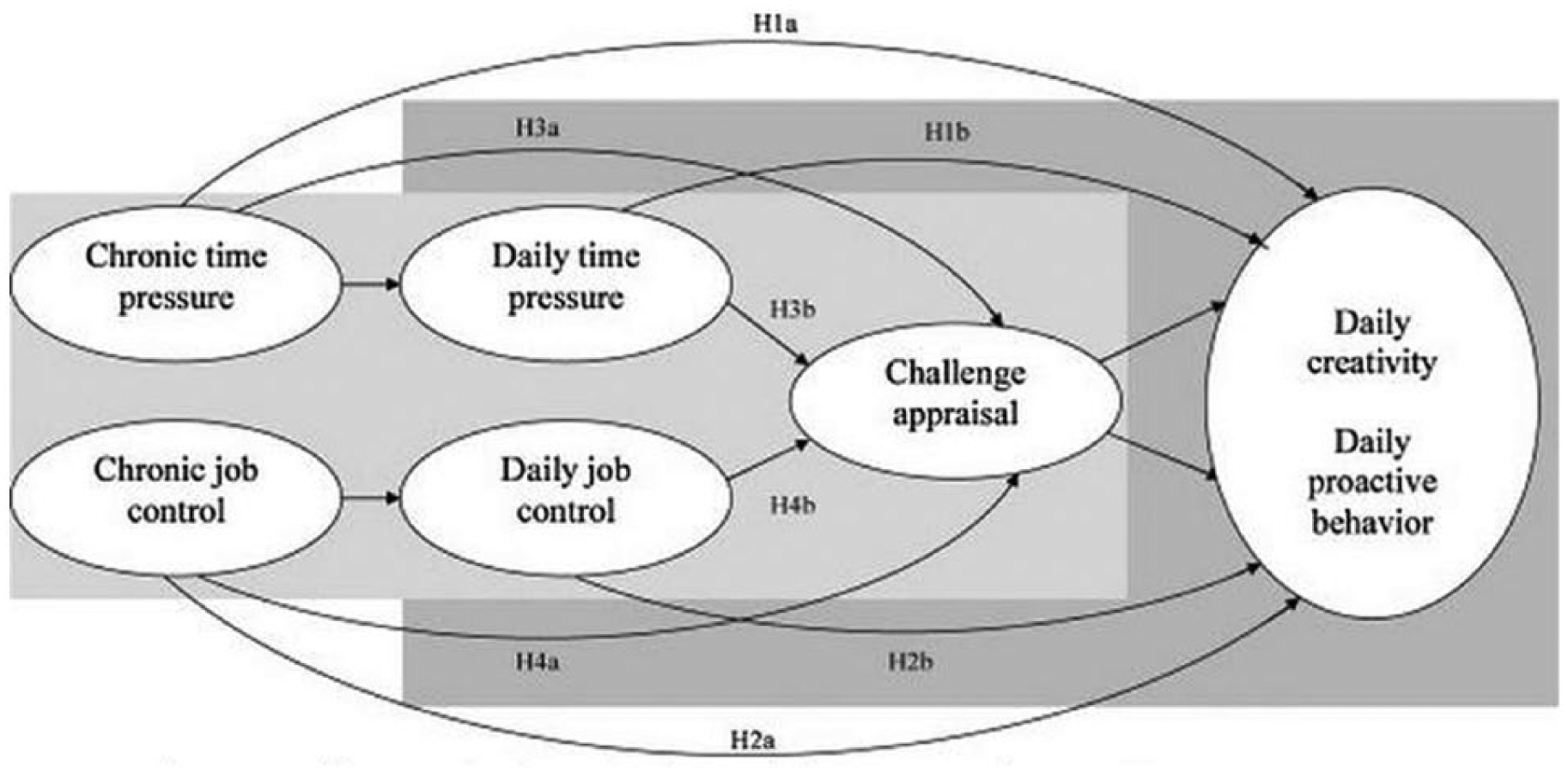
Ohly and Fritz’s (2010) conceptual framework.
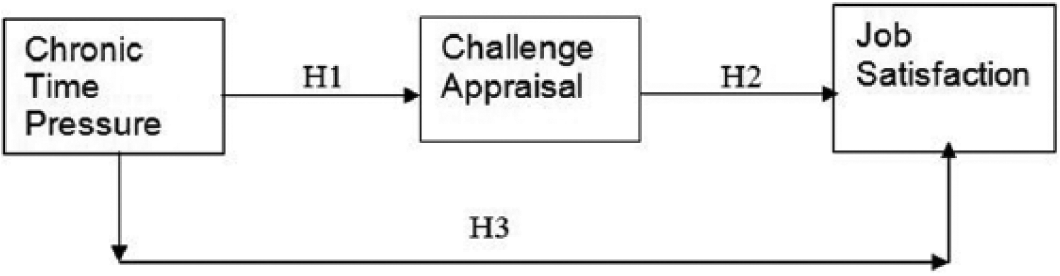
Theoretical framework.
Feeling of a challenge experienced by a time-pressured person may not necessarily lead to job satisfaction. Being a momentary appraisal of a situation, challenge may be a fleeting sensation which may diffuse soon and the individual may revert to his default emotional state. The level of challenge appraisal experienced by university teachers should remain stable enough to lead to job satisfaction.
To validate, in the context of a poly-chronic society, the earlier findings that there is a direct relationship between chronic time pressure and job satisfaction, the third hypothesis has been formulated.
Method
Procedure
The demographic data and information on employee perceptions of time pressure, challenge appraisal, and job satisfaction were collected through a survey method by administering questionnaires to the respondents. All the questionnaires were manually administered. The researcher personally visited the selected universities and briefed the faculty members about the significance of research and the need for developing a holistic model explaining the relationships between time pressure, challenge appraisal, and job satisfaction. It was highlighted that the research will have profound implications on improving the quality of teaching in the Pakistani universities. The researcher wanted to use the probability sampling method because of its greater degree of accuracy. However, there was a considerable reluctance by the respective university registrars to share the data regarding faculty members. Generally, the faculty lists were not up to date. Even when the incomplete faculty lists were provided, many faculty members were not available because of various commitments. This made it nearly impossible to follow the probability sampling method. Hence, reference-chain sampling method was resorted to where, through networking, a chain of questionnaire administrators and respondents was created. Due to the above-cited reasons, data collection took more than 4 months.
Participants
Population of the study comprised faculty members of the universities in the twin cities of Islamabad and Rawalpindi. Higher Education Commission of Pakistan (HEC; n.d.) recognizes 22 universities in the Rawalpindi–Islamabad region, 17 in the public sector, and 4 in the private sector. These universities have a population of approximately 10,000 faculty members. The population keeps fluctuating, mainly on account of visiting faculty. The sample consisted of 282 university professors. Both public sector and private sector universities were included. In all, 400 questionnaires were distributed. One hundred seventy-nine questionnaires were not responded to and 39 were rejected, being incomplete.
Pakistani university teachers, even as their counterparts in mono-chronic societies, are routinely pressured for time. However, teaching profession requires creativity and offers challenges. A significant proportion of these teachers get opportunities to study in foreign universities where they get exposure to protestant work ethics. Over time, their personalities acquire different shades of an amalgam of mono-chronic and poly-chronic values. On account of these characteristics, these people constitute a very good specimen for studying the relationships between work characteristics and job satisfaction in the context of a poly-chronic society which is undergoing a slow, albeit significant social transformation.
Measures
Time pressure has been measured using Instrument for stress-related job analysis (ISTA; Semmer, Zapf, & Dunckel, 1998). The instrument comprises three items related to high quantitative workload. A sample item is “How often must you finish work later because of having too much to do?” ISTA instrument taps time pressure on a 5-point Likert-type scale. To ensure uniformity of measurement with other instruments, the Likert-type scale has been modified by raising it to 7 points (1 = very rarely/never to 7 = very often).
Challenge appraisal has been measured using four items based on Bosewell et al. (2004): The items capture the degree to which individuals consider their work is demanding but not overtaxing their abilities, and bringing them closer to their personal goals. Specimen item is “my work today brings me closer to the accomplishment of personal goals.” Challenge appraisal has been measured on a 7-point Likert-type scale (1 = strongly disagree to 7 = strongly agree).
Job satisfaction has been measured using the 15-item measure in the Job Diagnostic Survey developed by Hackman and Oldham (1974). The instrument has been modified by reducing the number of items to 12. An example item is “Generally speaking, I am very satisfied with this job.” Job satisfaction has also been measured on a 7-point Likert-type scale (1 = strongly disagree to 7 = strongly agree).
A pilot test comprising a sample of 60 responses was conducted to test the reliability of the instruments. Cronbach’s alpha values based on standardized items (Table 2) were .700 for time pressure and .769 for challenge appraisal. These indicated that the instruments tapping the predictor variables possessed reliability. However, the items measuring job satisfaction showed lower internal validity (Cronbach’s α = .637). A critical appraisal of the item statistics measuring job satisfaction revealed that three of the items indicated low mean: (a) Most of the things I have to do on this job seem useless or trivial (M = 2.82), (b) I frequently think of quitting this job (M = 2.18), and (c) I have often trouble figuring out whether I am doing well or poorly on this job (M = 3.52). It was considered that the respondents were reluctant to answer these questions. This would have impaired the internal validity of these items. Consequently, these items were excluded, and the instrument was modified to include 12 instead of the original 15 items. Retest based on the modified instrument (12 items) indicated Cronbach’s alpha coefficient of .772, thus showing that the items in the modified instrument possessed internal validity.
Results and Discussion
Descriptive Statistics
Demographics are shown in Table 1. Male and female respondents constituted 63.1% and 36.9%, respectively, of the research sample. Females thus constituted approximately one third of the sample size. The majority of respondents (53.2%) belonged to 25 to 30 years age group. The survey also revealed that 52.8% of the respondents were single, whereas 47.2% were married. The majority of the respondents (46.1%) were in MA/MSc/MBA category, closely followed by MPhil/MS (35.5%). PhD respondents constituted 18.4% of the sample. The survey indicated that 53.2% of the respondents had 1 to 5 years teaching experience, followed by 23.8% who had 6 to 10 years teaching experience. Only 7.4% respondents had between 11 to 15 years and greater than 15 years experience. Respondents from management sciences and engineering sciences constituted 28.7% and 23.4% of the sample. Remaining (47.2%) belonged to other groups. Permanent faculty members formed 73% of the sample and almost one fourth (26.2%) were visiting faculty. Slightly more than half of the respondents (55.3%) belonged to public sector universities.
Demographics.

Besides Cronbach’s alpha coefficient, Table 2 also highlights data on arithmetic mean, standard deviation, and Pearson’s correlation coefficient. Arithmetic means were 3.543, 2.741, and 3.473 for job satisfaction, time pressure, and challenge, respectively. Within the predictors, variability in time pressure was higher (SD = 0.186) than challenge (SD = 0.044). Seventeen respondents (6%) reported that they were very often pressed for time, as against 12 respondents (4%) who rarely/never experienced time pressure. Highest percentage (30%) reported that they occasionally felt time pressured. Responding to “How often must you finish work later because of having too much to do?” 12 respondents (4%) replied, “very often,” while 21 (7%) replied, “very rarely/never.” Only 15 respondents (5%) felt that very often a fast pace of work was required of them. An equal number replied that they very rarely/never required a fast pace. Highest percentage (22%) reported that they often required a fast pace. In response to the item “I feel challenged,” 4% (11 respondents) strongly disagreed, 31% (87 respondents) agreed with the statement, whereas 11% (32 respondents) strongly agreed. In response to the question “Generally speaking, I am very satisfied with this job,” 7 (2%) respondents strongly disagreed, 83 (29%) agreed, whereas 35 (12%) strongly agreed.
Mean, SD, Pearson’s Correlation Coefficient, and Cronbach’s Alpha Coefficient.
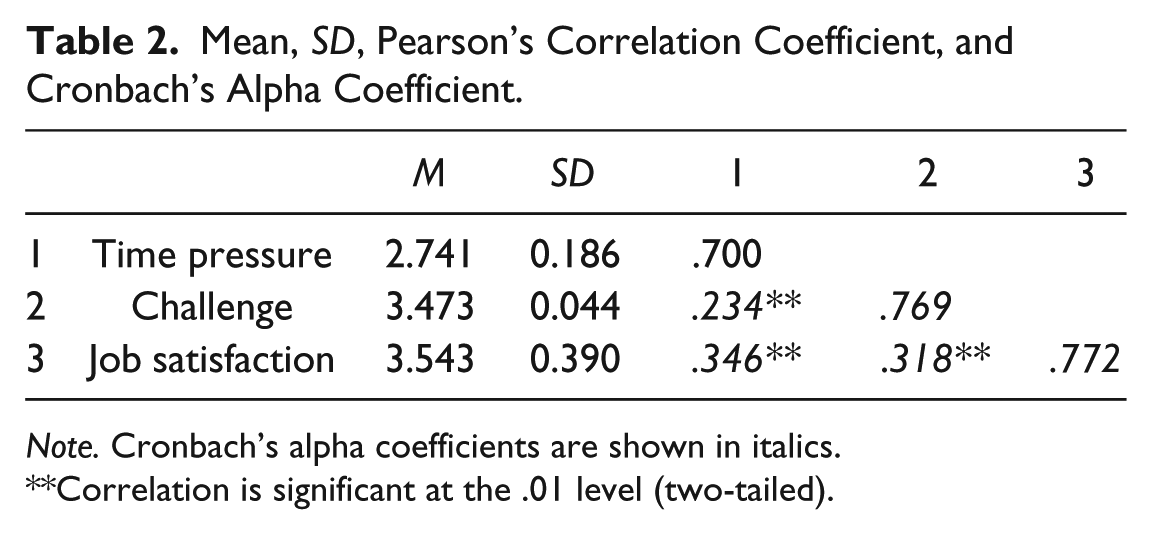
Note. Cronbach’s alpha coefficients are shown in italics.
Correlation is significant at the .01 level (two-tailed).
Table 3 gives the comparison between Pakistani and German respondents. Mean level of time pressure experienced by the German respondents in Ohly and Fritz’s study was 3.42. Mean level of time pressure experienced by Pakistani respondents was 2.74. Pakistani respondents were, therefore, less time-pressured than their German counterparts. Variability for time pressure was also lower (SD = 0.186) in case of Pakistani respondents compared with the German respondents (SD = 0.72). Mean level of challenge experienced by Pakistani respondents was 3.473 when compared with 4.02 in Ohly and Fritz’s study, indicating a lower level for Pakistani respondents. Variability in challenge was also lower in Pakistani respondents (SD = 0.044) in comparison with the German respondents (SD = 1.28).
Comparison Between Pakistani and German Respondents.
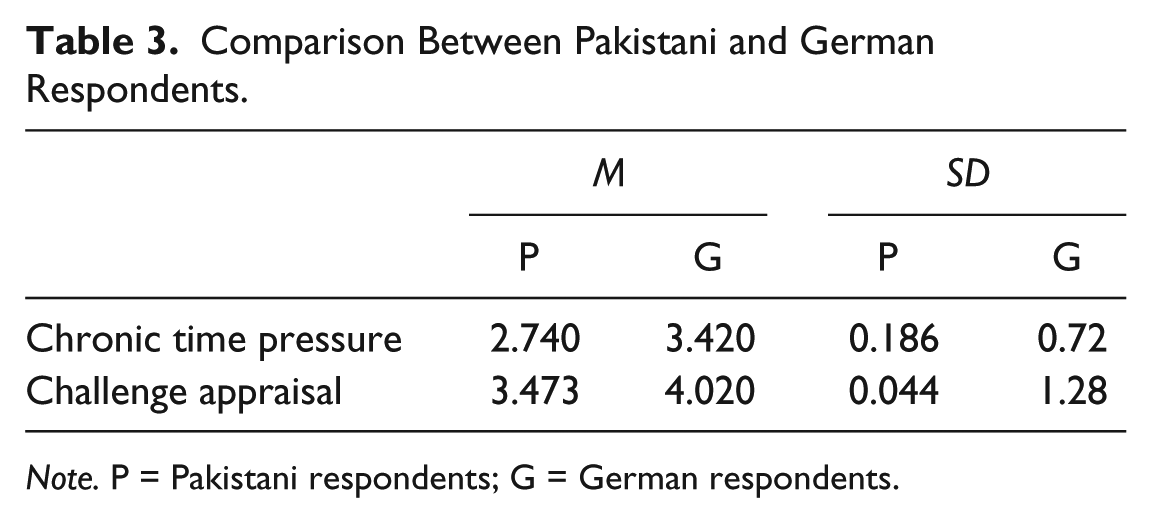
Note. P = Pakistani respondents; G = German respondents.
Inferential Statistics
H1 propounds that there is a significant and positive relationship between chronic time pressure and challenge appraisal. Correlation analysis (Table 2) indicates a positive and highly significant relationship between these two study variables (r = .234, p = .01). According to Davis (1971), this is a low degree relationship. In comparison, Ohly and Fritz (2010), doing their research in Germany, a mono-chronic society, have reported a moderate degree of highly significant correlation between chronic time pressure and challenge (r = .330, p ≤ .001). Regression analysis (Table 4) shows that time pressure explains 5% of variance in challenge appraisal in Pakistani teachers (R2 = .055). One SD change in time pressure results in 23.4 SD change in challenge appraisal (β = .234). H1 is, therefore, validated.
Regression Analysis (N = 282).

Note. F = 9.254. R2 = .055. Dependent variable = challenge appraisal.
According to H2, there is a positive and significant relationship between challenge appraisal and job satisfaction. Correlation analysis (Table 2) indicates a highly significant positive relationship between these two study variables (r = .318; p = .01). It is a moderate degree of relationship (Davis, 1971). Multiple regression analysis (Table 5) indicates that challenge appraisal and time pressure explain 17.9% of variance in job satisfaction (R2 = .179). One SD change in challenge appraisal results in 25.1 SD change in job satisfaction (β = .251). According to Ohly and Fritz (2010), work characteristics have two components, time pressure and job control. Challenge is the symbiotic affect of time pressure and job control, and has a positive relationship with performance-related behaviors. The findings of this study are also in harmony with the findings of Decker and Borgen (1993), Carroll (1997), Andrea and Wallace (2004), and Podsakoff et al. (2007) who reported a positive relationship between challenge appraisal and job satisfaction. The findings reveal that the teachers in Pakistani universities consider their nature of work as challenging. H2 is, therefore, accepted.
Multiple Regression Analysis (N = 282).

Note. F = 13.887. R2 = .179. Dependent variable = job satisfaction.
H3 infers that time pressure correlates significantly with job satisfaction. The direction of relationship has not been mentioned as, according to the literature review, time pressure exerts paradoxical influences on job satisfaction. Correlation analysis (Table 2) indicates a positive and highly significant relationship between time pressure and job satisfaction (r = .346, p = .01). The relationship is of a moderate degree (Davis, 1971). Multiple regression analysis (Table 5) reveals that 1 SD change in time pressure results in 28.8 SD change in job satisfaction (β = .288). These findings validate H3. The findings are in harmony with those of Maule et al. (2000), Fay and Sonnentag (2002), Ohly et al. (2006), Lepine et al. (2005), and Podsakoff et al. (2007) who have reported a positive relationship between the two variables. This positive relationship has been further explained by Bosewell et al. (2004), who maintained that whereas hindrance-related stress predicts negative outcomes, challenge-related stress leads to positive outcomes. This indirectly implies that time pressure, through challenge appraisal, leads to job satisfaction among Pakistani university professors.
Conclusion
It is the first study which has investigated the relationships between time pressure, challenge appraisal, and job satisfaction in the backdrop of a poly-chronic society, and has compared the findings with those of a study carried out in a mono-chronic society (Ohly & Fritz, 2010). The findings reveal that Pakistani respondents experience a lesser level of time pressure when compared with the German respondents. Also, there has been lesser variability in time pressure of Pakistani respondents in comparison with the German respondents. This implies that Pakistani respondents demonstrate conformist behavior, whereas German respondents are individualistic. The findings were expected as the former represent a mono-chronic society, whereas the latter a poly-chronic society. The study finds that, like their German counterparts, Pakistani university teachers consider time pressure as a challenge-related stress. The correlation between time pressure and challenge shows a lower degree of relationship in case of Pakistani respondents compared with a moderate degree for German respondents. The theoretical framework investigated by the study is evolutionary in nature and may be further expanded by adding job control and proactive behavior (Ohly & Fritz, 2010) into the matrix. To improve the rigor of the study, a population where probability sampling is possible, for example, banking, telecommunications, public sector corporations, and so on, is recommended.
Footnotes
Appendix
Declaration of Conflicting Interests
The author(s) declared no potential conflicts of interest with respect to the research, authorship, and/or publication of this article.
Funding
The author(s) received no financial support for the research and/or authorship of this article.