




Abstract
This study examined how extraversion relates to psychological well-being among 335 Chinese international students at a public university in Malaysia, focusing on positive emotional intensity, cognitive reappraisal, and positive emotional expression. Using structural equation modeling, the model explained 48.1% of the variance in psychological well-being. Extraversion was significantly associated with both psychological well-being and positive emotional intensity. While the overall sequential mediation effect was not supported, conditional mediation emerged at specific levels of cognitive reappraisal, with stronger effects observed at lower levels. These findings suggest that sequential mediation may operate in a context-dependent rather than universal manner. The patterns observed may reflect cultural or situational factors influencing emotional processing, highlighting the need for future research incorporating direct measures of cultural and contextual influences.
Keywords
Introduction
With over 130,000 international students currently enrolled in Malaysian higher education institutions, concerns regarding students’ psychological well-being have become increasingly significant for academic success and personal development (The Sun, 2025). This is because psychological well-being plays a crucial role in students’ personal development and overall life satisfaction (Doğan, 2016). Empirical research has consistently demonstrated significant associations between university-related stress and psychological morbidities, including depression and anxiety (Navon–Eyal & Taubman-Ben-Ari, 2025; Sharp & Theiler, 2018). For instance, Lizarte Simón et al. (2024) found that self-efficacy and psychological well-being act as moderators between anxiety and academic engagement. In other words, students with higher self-efficacy and psychological well-being maintain their academic engagement even under high levels of anxiety. This issue is especially salient for international students, who encounter additional challenges, including language barriers, cultural adjustment, and separation from familiar support systems. These difficulties can contribute to social withdrawal, interpersonal strain, elevated dropout rates (e.g., Zhao et al., 2023), and various mental health problems (Mesidor & Sly, 2016; Zhai & Razali, 2022).
Chinese students studying abroad at Malaysian universities face intricate mental health challenges in diverse educational environments, displaying signs of anxiety, bewilderment, and sadness that can negatively impact their academic achievements and social relationships (e.g., Xue & Singh, 2025). These adaptation challenges often stem from emotional instability and heightened awareness of cross-cultural differences, which exacerbate mental strain during the cultural adjustment process (AlQaifi, 2025). From a social constructionist perspective, these challenges are particularly pronounced as emotions are socially constructed phenomena influenced by cultural norms and values (McCarthy, 1994). Chinese international students must navigate between traditional Chinese cultural “feeling rules” and “display rules” while simultaneously adapting to Malaysian cultural contexts (Hochschild, 1979).
Key factors influencing psychological well-being include personality traits and emotional processes (e.g., Burešová et al., 2020). According to trait theory, personality can be understood through five key dimensions, with extraversion being characterized by outgoing, talkative, sociable, and confident temperament (Capra et al., 2013; Costa & McCrae, 1999). Research has consistently demonstrated that extraverts experience higher psychological well-being through enhanced social interactions and positive emotional experiences, while introverts tend toward reservation, timidity, and social discomfort (Zelenski et al., 2013). Meta-analytic evidence suggests that extraversion is one of the strongest personality predictors of subjective well-being, with effect sizes ranging from medium to large across diverse populations (Anglim et al., 2020).
Emotional regulation and expression serve as critical mediating mechanisms in the personality-well-being relationship, functioning as vital pathways for promoting psychological wellness among university students (Mongrain & Vettese, 2003; Scherer, 2005). Appraisal theory provides insight into how international students’ cognitive evaluations of cross-cultural experiences directly influence their emotional responses and subsequent expression patterns (Ortony et al., 1988). The theory’s two-stage process—primary appraisal of event relevance and secondary appraisal of coping resources—helps explain how students navigate cultural adaptation challenges (Folkman et al., 1986). Furthermore, Gross’s dynamic process model offers a framework for understanding how individuals manage emotions through cognitive reappraisal strategies (Gross, 1998). The model suggests that personality traits predispose individuals toward specific emotion regulation strategies, which subsequently influence well-being outcomes through their effects on emotional experiences and social interactions.
The integration of these theoretical perspectives—social constructionism, appraisal theory, Gross’s dynamic process model, and trait theory—provides a comprehensive foundation for understanding how individual differences in extraversion interact with emotional processes to determine psychological outcomes. Additionally, Self-Determination Theory (SDT) offers valuable insights into how personality traits influence psychological well-being through the fulfillment of basic psychological needs (autonomy, competence, and relatedness), which directly contributes to overall well-being (Deci & Ryan, 2012).
Scholars from Chinese contexts often conceptualize well-being as a form of subjective wellness grounded in traditional cultural values and beliefs (Dobosz & Hetmańczyk, 2023). The emotion regulation patterns observed in this study could be understood through the lens of cultural values emphasizing emotional moderation, humility, and interpersonal harmony—values that may encourage individuals to prioritize restraint over overt emotional expression (Matsumoto et al., 2008; Soto et al., 2011). The Confucian notion of zhong yong, longstanding in Chinese cultural systems, is suggested to promote emotional balance and reduce extremes in affective display (Cui et al., 2022). Accordingly, individuals with higher cognitive reappraisal ability may have more thoroughly internalized such cultural orientations, which frame intense positive emotional expression as potentially challenging to interpersonal harmony or norms of modesty (Li & Cui, 2022).
These cultural scripts may influence how cognitive reappraisal operates, potentially leading to culturally nuanced emotion regulation patterns. Therefore, investigating emotion regulation processes among Chinese international students offers valuable insights into how Western-derived models of emotional processing function within non-Western cultural settings. However, a significant research gap remains in understanding how these complex relationships manifest specifically among Chinese international students in Malaysian universities. This population represents a substantial segment of Malaysia’s international student community—approximately 19% of all international students (Malaysian Investment Development Authority, 2022)—yet has received limited attention in psychological well-being research. To date, no integrated study has examined how extraversion, emotional expression, and emotion regulation jointly influence the psychological wellness of Chinese international students in Malaysia.
Understanding these relationships is particularly crucial as psychological well-being represents a fundamental factor in healthy adaptation and success during university years, especially for international students navigating cross-cultural transitions (Molina-García et al., 2011). By identifying the key factors influencing psychological well-being in this population, research can contribute both theoretical and practical knowledge that may help prevent adjustment difficulties manifesting as psychological distress, academic underperformance, or social isolation. Drawing from existing theoretical perspectives, this research develops a moderated mediation framework examining how extraversion affects psychological well-being through emotional mechanisms, with cognitive reappraisal serving as a key moderating factor. The proposed model suggests that extraverted individuals experience heightened positive emotional intensity, which then promotes greater positive emotional expression, subsequently enhancing overall psychological well-being. This progression captures how internal affective states manifest as observable behaviors. Crucially, cognitive reappraisal skills determine the effectiveness of this intensity-to-expression conversion, influencing how successfully individuals transform internal emotional experiences into appropriate external demonstrations that support social integration and cross-cultural adjustment.
The framework incorporates a direct link between extraversion and well-being, acknowledging that personality characteristics operate through multiple mechanisms beyond the specified emotional sequence. By focusing on adaptive positive emotional dynamics rather than dysfunctional patterns, this model aligns with research emphasizing extraversion’s role in amplifying favorable emotional experiences. This approach holds particular significance for Chinese students in Malaysian higher education institutions, where the intersection of individual personality traits and cultural adaptation demands creates unique challenges. In these contexts, the ability to effectively express and regulate emotions becomes fundamental to both psychological adaptation and academic achievement.
Therefore, this study aims to explore how extraversion influences psychological well-being through a moderated sequential mediation model among Chinese international students at one of the public universities in Malaysia. Specifically, this research seeks to: (a) examine the relationship between extraversion and psychological well-being, (b) investigate the sequential mediating pathway from extraversion through positive intensity and positive expression to psychological well-being, (c) explore how cognitive reappraisal moderates the relationship between positive intensity and positive expression, and (d) provide evidence-based recommendations for culturally sensitive support interventions that enhance Chinese international students’ psychological adjustment and academic success.
The main research question examines whether extraversion influences psychological well-being among Chinese international students at a public university in Malaysia through moderated sequential mediation involving positive intensity, positive expression, and cognitive reappraisal. The specific research questions include: (RQ1) Is there a significant relationship between extraversion and psychological well-being among Chinese international students a public university in Malaysia? (RQ2a) Does positive intensity mediate the relationship between extraversion and positive expression among Chinese international students at a public university in Malaysia? (RQ2b) Does positive expression mediate the relationship between positive intensity and psychological well-being among Chinese international students at a public university in Malaysia? (RQ2c) Do positive intensity and positive expression sequentially mediate the relationship between extraversion and psychological well-being among Chinese international students at a public university in Malaysia? (RQ3) Does cognitive reappraisal moderate the relationship between positive intensity and positive expression among Chinese international students at a public university in Malaysia? (RQ4) Does the moderated sequential mediation model significantly explain variance in psychological well-being among Chinese international students at a public university in Malaysia?
The study objectives are to examine the proposed moderated sequential mediation model, investigate individual pathway relationships, determine cognitive reappraisal’s moderating role, evaluate model effectiveness, and provide evidence-based recommendations for culturally sensitive support interventions.
The main hypotheses proposed that:
Literature Review
Extraversion and Psychological Well-Being
Research has consistently demonstrated a strong positive relationship between extraversion and psychological well-being across diverse populations and contexts. Schmutte and Ryff (1997) found that high extraversion is related to key aspects of psychological well-being such as self-acceptance, mastery, and purpose in life. This finding was further supported by Yang and Tu (2020), who demonstrated that extraversion is linked to personal growth and positive interpersonal relationships. Extraversion encompasses two primary dimensions: seeking stimulation and sociability (Hughes et al., 2020). Seeking stimulation involves enjoying novelty and intense experiences, while sociability refers to enjoying social interactions. Extraverts typically employ proactive approaches to enhance the emotions of those around them (Austin et al., 2014), involving adjustments to the environment or changing thought patterns to uplift the emotional well-being of others.
Longitudinal studies have provided compelling evidence for the extraversion-well-being relationship. Abbott et al. (2008) tracked individuals’ levels of extraversion from adolescence (age 16) to young adulthood (age 26) in the UK using structural equation modeling, revealing that higher social competence (extraversion) was associated with greater well-being, particularly among women. Similarly, Kokko et al. (2013) found that higher extraversion strongly predicted higher levels of psychological well-being in Finnish middle adulthood (ages 33–50; N = 369). More recent research has strengthened these findings. Gupta and Parimal (2020) found that extraversion specifically correlated with mastery, positive relationships, and overall psychological well-being. Joshanloo (2022) utilized a 20-year dataset from an American sample, confirming that extraversion not only has positive associations with psychological well-being but also predicts future well-being outcomes.
Emotional Expression as a Mediating Process
Building upon the established relationship between extraversion and well-being, emotional expression emerges as a crucial mediating mechanism that plays a vital role in promoting psychological well-being through multiple pathways. Research has shown that expressing positive emotions in social behavior predicts heightened social connectedness and decreases depressive symptoms (Mauss et al., 2011). Furthermore, engaging in social activities and community involvement is linked to increased overall well-being (Argyle & Crossland, 1987), with these positive emotional experiences enhancing individual psychological well-being (Huppert, 2009). Individual differences in expressiveness stem from the initial activation of emotional responses and the subsequent modulation of these responses (Gross, 1998; Gross & John, 1997). Expressiveness can result from strong reactions to emotional stimuli or a general openness in expressing feelings. Emotional expression is vital in maintaining interpersonal relationships (Mongrain & Vettese, 2003), as expressing emotions or caring contributes to forging social bonds and fostering intimacy (Kennedy-Moore & Watson, 2001).
The importance of emotional expression becomes more apparent when considering the detrimental effects of its absence. Individuals with less emotional disclosure are more likely to experience depression and anxiety (e.g., Kahn et al., 2001). Conversely, the act of expressing emotions has the potential to improve overall well-being by reducing the occurrence or harshness of intrusive thoughts. Lepore et al. (2000) demonstrated that participants who engaged in discussions about their emotions experienced fewer intrusive thoughts than those who were unable to express themselves. Smyth (1998) found that expressing emotions in writing is an effective psychological coping strategy that helps people adapt to stressful situations.
Given the importance of both extraversion and emotional expression for well-being, it is not surprising that research has documented a strong relationship between these two constructs. Studies have shown that individuals with high extraversion tend to express more positive emotions (Stafford et al., 2010; Tan et al., 2016). Wu et al. (2018) found a significant positive correlation between extraversion and emotional expression, supporting the theoretical connection between these constructs. Barr et al. (2013) revealed that extraverted individuals were more accurate in recognizing happy expressions, suggesting a strong connection between extraversion and positive emotional processing.
While emotional expression represents one pathway through which personality influences well-being, emotion regulation strategies constitute another crucial mechanism. Cognitive reappraisal has emerged as a particularly effective emotion regulation strategy for promoting psychological well-being. Moore et al. (2008) found that reappraisal was associated with lower self-reported stress symptoms. This finding was expanded by Haga et al. (2009), who conducted a comprehensive study involving 489 university students from Norway, Australia, and the United States. Their research demonstrated that individuals who utilized cognitive reappraisal more frequently tended to exhibit higher levels of positive mood and life satisfaction while simultaneously reporting lower levels of negative and depressed mood. The study found that more frequent use of cognitive reappraisal emerged as a robust predictor associated with greater positive well-being. Recent research has continued to support these findings. Brown et al. (2022) confirmed that cognitive reappraisal was associated with better psychological outcomes, including lower depressive symptoms and perceived stress. A systematic review by Xu et al. (2024) highlighted the critical role of adaptive emotion regulation strategies for students and educators in higher education, emphasizing the importance of cognitive reappraisal in academic contexts.
Extraversion and Cognitive Reappraisal
Consistent with the pattern observed for emotional expression, the relationship between extraversion and emotion regulation strategies has received increasing attention in recent literature. For example, Shdaifat et al. (2024) found that extraversion, along with cognitive reappraisal, significantly predicted happiness among nursing students, explaining 57% of the variance in well-being outcomes. Individuals high in extraversion are generally more likely to employ adaptive emotion regulation strategies (Page et al., 2021). Tamir (2009) discovered that individuals with high levels of extraversion sought to enhance their feelings of happiness, suggesting a preference for positive emotional states that aligns with cognitive reappraisal strategies.
Cultural Context and Sequential Mediation Model Development
However, it is important to recognize that these relationships may vary across cultural contexts. Cultural factors have a profound impact on shaping how people view and experience emotions (von Suchodoletz & Hepach, 2021). People’s preferences for negative and positive emotions change according to various cultural values (Sims et al., 2015). This difference may stem from different cultural expectations about emotion expression, as well as different views on the role of emotion in social interactions. In Chinese contexts specifically, research by Ge (2020) with 337 Chinese participants over a 4-month period demonstrated that personality significantly predicts both self-assessed interpersonal competence and satisfaction, as well as peer evaluations of interpersonal performance. This finding suggests cultural variations in how personality traits may manifest in relation to well-being, highlighting the importance of considering cultural context when examining the relationships between extraversion, emotional processes, and psychological well-being among Chinese international students.
Based on the above theoretical foundations and empirical evidence, this study proposes the following sequential mediation model. This sequential mediation model was constructed based on the theoretical premise that cognitive reappraisal (CR) serves as a critical regulatory mechanism in the transformation from internal positive emotional intensity (PI) to external positive emotional expression (PE). The sequential pathway reflects the natural progression of how personality traits influence emotional processing: extraversion first predisposes individuals to experience higher levels of positive emotional intensity (PI), as extraverted individuals are characterized by greater sensitivity to positive stimuli and reward-seeking behavior. This heightened positive intensity then activates cognitive reappraisal processes (CR) as individuals evaluate and regulate their emotional responses. Subsequently, this cognitive reappraisal influences how positive emotions are externally expressed (PE), ultimately contributing to psychological well-being (PWB).
The theoretical justification for this specific sequence lies in Gross’s Process Model of Emotion Regulation, which positions cognitive reappraisal as an antecedent-focused strategy that intervenes between emotional generation and behavioral expression. For Chinese international students in cross-cultural contexts, this pathway is particularly relevant as extraverted individuals may experience intense positive emotions but must still navigate cultural display rules when expressing them. The model suggests that cognitive reappraisal acts as a crucial intermediary step between feeling positive emotions intensely and expressing them appropriately, helping individuals modulate the intensity-to-expression transformation in culturally suitable ways. This sequential arrangement allows us to examine how extraversion’s influence on positive emotional experiences is channeled through cognitive regulatory processes before manifesting as observable positive expressions.
Data Collection
Research Instruments
Four validated questionnaires were employed to measure the study variables. The culturally adapted version of Psychological Well-Being Scale (PWB) by Ryff and Keyes (1995) assessed psychological well-being across six dimensions including autonomy, environmental mastery, personal growth, positive relations with others, purpose in life, and self-acceptance. All six dimensions were utilized in this study to provide a comprehensive assessment of participants’ psychological well-being as the dependent variable. Participants responded using a 6-point Likert scale ranging from 1 (strongly disagree) to 6 (strongly agree), with higher scores indicating greater psychological well-being.
The adapted version of Berkeley Expressivity Questionnaire (BEQ) by Xu, Yang, et al. (2025) measured emotional expression, with this study specifically utilizing two subscales: positive intensity and positive expression. Positive intensity assessed the strength and intensity of positive emotional experiences felt internally, while positive expression measured the behavioral tendency to outwardly manifest positive emotions. These two dimensions served as sequential mediator variables in the proposed model. Participants rated items on a 7-point Likert scale from 1 (strongly disagree) to 7 (strongly agree), with higher scores reflecting greater emotional expression tendencies.
The adapted version of the Ten-Item Personality Inventory (TIPI) by Gosling et al. (2003) assessed the Five-Factor Model personality traits, with this study focusing specifically on the extraversion dimension. The extraversion subscale measured participants’ tendency toward outgoing, sociable, and energetic behavior patterns, serving as the independent variable in the research model. Items were rated on a 7-point scale from 1 (strongly disagree) to 7 (strongly agree), with reverse scoring applied to negatively worded items, and higher scores indicating greater extraversion.
The adapted version of the Emotion Regulation Questionnaire (ERQ) by Gross and John (2003) evaluated emotion regulation strategies, with this study specifically utilizing the cognitive reappraisal subscale as the moderator variable. The cognitive reappraisal dimension assessed participants’ tendency to reframe situations cognitively to alter their emotional impact, serving as the moderator of the relationship between positive intensity and positive expression in the proposed moderated sequential mediation model. Participants responded using a 7-point Likert scale from 1 (strongly disagree) to 7 (strongly agree), with higher scores indicating greater use of cognitive reappraisal strategies.
All instruments were culturally adapted for Chinese international students through expert review and content validation procedures to ensure cultural appropriateness and conceptual equivalence while maintaining the psychometric properties of the original scales (see Table 1).
Content Validation Index.

Population and Sampling
The target population consisted of Chinese international students enrolled at a public university in Malaysia. In situations where researchers encounter resource constraints or accessibility barriers, convenience sampling emerges as a practical strategy that can enhance the methodological quality and academic validity of their investigations (Memon et al., 2025). Due to the absence of a sampling frame and the unavailability of demographic information for the target population of Chinese international students at a public university in Malaysia, convenience sampling was employed to recruit participants, acknowledging that this non-probability sampling method may limit the generalizability of findings (Etikan et al., 2016). According to Memon et al. (2017), methodological soundness does not inherently depend on employing probability sampling techniques. Carefully constructed non-probability research designs can yield meaningful scholarly insights, especially when applied to theoretical framework development or measurement instrument evaluation contexts.
Based on Krejcie and Morgan’s (1970) sample size determination table, a sample of approximately 285 to 291 participants was deemed appropriate for the study. Therefore, the achieved sample size of 335 participants exceeded this recommendation and was considered adequate for the research objectives.
Data Collection Procedure
Ethical approval was obtained from the relevant institutional authorities prior to data collection. All participants provided informed consent and were assured of voluntary participation, with the right to withdraw at any time without consequences. Complete anonymity and confidentiality were maintained throughout the data collection process to protect participants’ privacy (Creswell & Creswell, 2017).
This study employed a correlational design with a cross-sectional approach to examine the relationships between extraversion, emotional expression, cognitive reappraisal, and psychological well-being among Chinese international students at a public university in Malaysia. The research utilized quantitative methods through self-report questionnaires to facilitate data collection from a large sample of participants (Mitchell & Jolley, 1988).
The data collection procedure employed a convenience sampling approach utilizing social media platforms and online survey distribution. Chinese international students at a public university in Malaysia were recruited through various social media channels, including WeChat groups, student forums, and university-related social networking platforms commonly used by the Chinese student community. The self-report questionnaires were administered electronically using Wenjuanxing, a widely-used online survey platform that provides secure data collection capabilities. Recruitment posts containing the survey link and study information were shared across relevant social media groups and platforms, with clear instructions provided for completion. Data collection was conducted in accordance with ethical research guidelines, ensuring the protection of participants’ rights and welfare throughout the process.
Pilot Study
A pilot study was conducted with 110 Chinese international students at a public university in Malaysia in the second semester of 2024 to examine the reliability and feasibility of the research instruments. The pilot study utilized Rasch analysis to evaluate the psychometric properties of all measurement tools and identify any problematic items requiring modification.
The results indicated satisfactory reliability coefficients across all instruments (see Table 2): TIPI (α = .81), BEQ (α = .89), ERQ (α = .76), and PWB (α = .90). Rasch analysis revealed that most items demonstrated acceptable fit statistics within the recommended range of 0.6 to 1.5 (Wright & Linacre, 1994). However, two items were identified as problematic and subsequently removed: Item 8 from the ERQ due to abnormally high estimate values (refer to Table A1). Although the item’s infit and outfit statistics were within acceptable limits (Bond & Fox, 2013), its difficulty estimate (1.766 logits) was substantially higher than the other items, suggesting potential cultural or semantic bias. Given that the sample consisted of international students, this abnormal difficulty level may reflect differential interpretation rather than true differences in the underlying construct. Therefore, the item was removed to ensure cultural equivalence and enhance the cross-cultural validity of the measurement model. Item 3 from the PWB scale due to unweighted mean square fit statistics exceeding acceptable limits (MNSQ = 1.27) and significant t statistics indicating model misfit (refer to Table B1).
Traditional Statistics of Four Scales.

Following these adjustments, all remaining items demonstrated good fit characteristics, and separation reliability reached satisfactory levels above 0.89 for all instruments. The pilot study results provided important insights for instrument refinement and established a solid psychometric foundation for the main data collection.
Finding
Data Screening
A comprehensive data quality assessment was performed prior to conducting statistical analyses. The examination of missing values indicated complete data coverage, as the online survey platform required respondents to complete all fields before submission. Outlier identification followed a sequential methodology: (a) Cases with unusual multivariate response patterns were detected through Mahalanobis distance analysis using a chi-square probability criterion of <.001, identifying 10 participants; (b) Extreme univariate values were screened using standardized z-scores with a threshold of |Z| > 2.58, yielding no concerning cases; (c) Response quality was evaluated by analyzing standard deviation patterns in the survey’s final 10 items, revealing 18 participants with SD < 0.5 suggesting inattentive responding; (d) Three additional participants were identified as statistical outliers due to extreme response combinations across multiple measures.
The screening process resulted in excluding 31 participants from the initial 366 respondents, yielding a refined sample of 335 cases. Distribution normality was evaluated through skewness (−0.439 to 0.249) and kurtosis (−1.079 to 0.252) statistics, with all values falling within established acceptable ranges (±2 to ±3), confirming data suitability for planned analyses. Potential common method variance was evaluated through Harman’s single-factor procedure, revealing that the primary factor accounted for 40.746% of the total variance—remaining below the concerning 50% benchmark, indicating minimal common method bias issues (Fuller et al., 2016).
Demographic Characteristics
Demographic analysis reveals distinct sample characteristics: the gender composition demonstrates a moderate female predominance (see Table 3), with women representing 54.9% (184 participants) compared to men at 45.1% (151 participants). Regarding age distribution, the majority of respondents fall within the 26 to 40 years, accounting for 54.9% (184 individuals), while younger participants aged 18 to 25 constitute 23.3% (78 respondents) and those in the 41 to 50 age range represent 21.8% (73 participants). Notably, no participants exceeded 50 years of age.
Demographic Profile of Respondents.

Academic credentials indicate a research-intensive sample, with doctoral students forming the majority at 67.2% (225 participants), while master’s degree candidates comprise the remaining 32.8% (110 participants). This demographic profile characterizes a sample of predominantly younger to middle-aged, advanced-degree-seeking academics with a female-leaning gender distribution and concentrated educational focus at the highest academic levels.
Descriptive Analysis
Descriptive analysis was conducted on all measured variables—Extraversion, cognitive reappraisal, psychological well-being (PWB), and positive emotional expression and positive intensity—calculating means and standard deviations to characterize the sample. Following Saunders et al. (2016), these statistics provide representative values for the entire sample, with standard deviation indicating individual variability around the mean.
To address the psychological well-being level of Chinese postgraduate students in Malaysia, PWB scores were analyzed using histogram visualization and descriptive statistics (see Figure 1). Results indicate moderately positive psychological well-being among participants (M = 4.21, SD = 1.16), surpassing the midpoint (4) on the 7-point Likert scale. The distribution demonstrates approximate normality with slight positive skew, suggesting that while most students report moderate to moderately high well-being levels, a subset experiences lower psychological functioning. The standard deviation of 1.16 reflects moderate individual variation among the 335 respondents, with scores spanning approximately 1.5 to 7.0. These findings indicate that Chinese postgraduate students are generally adapting successfully to their academic and social environment in Malaysia, though the distribution’s left tail suggests that targeted support interventions may benefit those experiencing psychological difficulties.
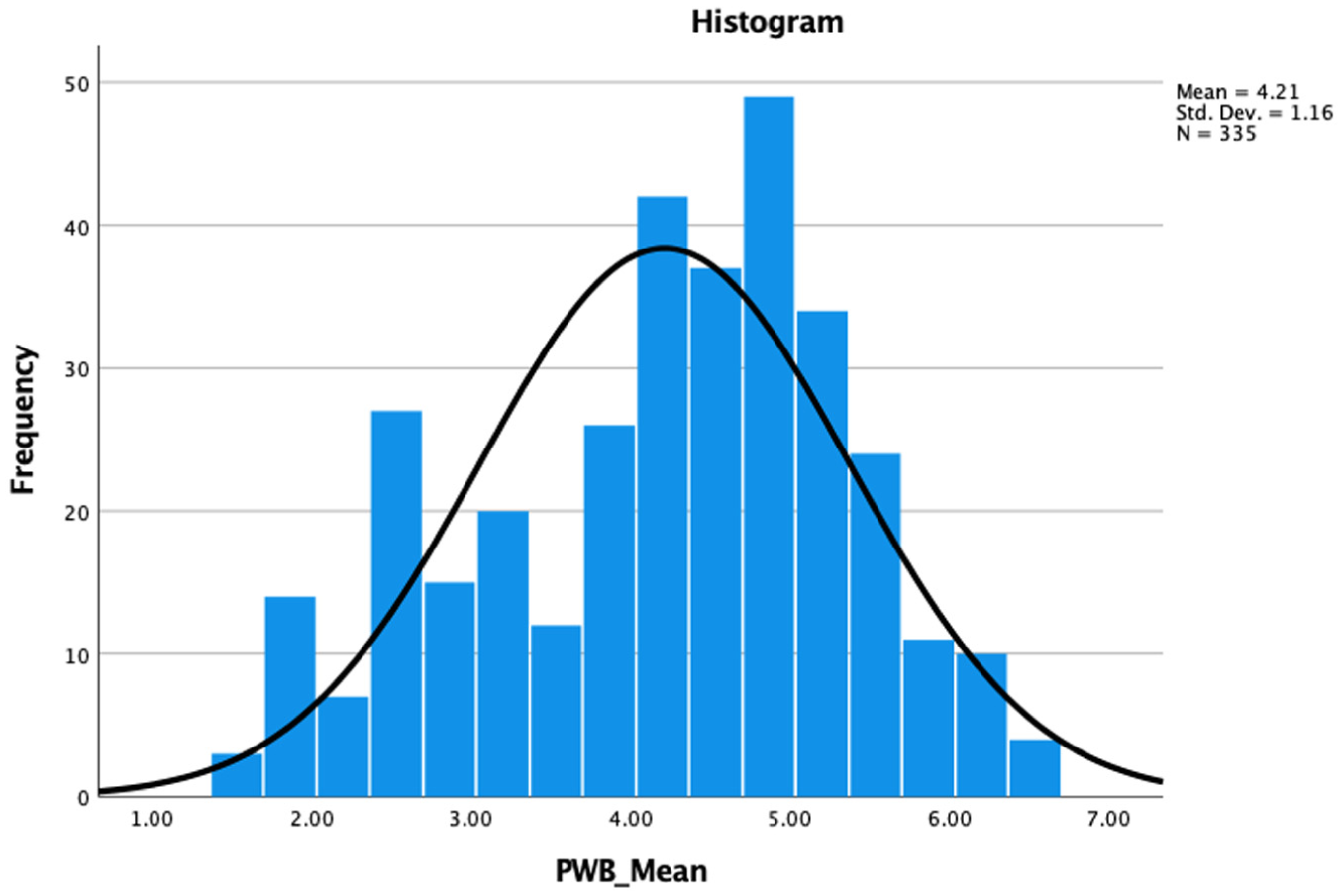
Histogram of PWB’s mean scores.
Inferential Analysis
T-Test
An independent samples t-test was conducted using SPSS 29.0.1.0 to examine gender differences in psychological well-being (see Table 4), with males coded as 1 (n = 151) and females coded as 2 (n = 184). Statistical significance was set at p < .05. Results revealed no significant difference between males (M = 4.18, SD = 1.14) and females (M = 4.24, SD = 1.18); t(333) = −0.538, p = .591. The 95% confidence interval [−0.319, 0.182] included zero, with negligible effect size (Cohen’s d = −0.059), indicating minimal practical difference between genders.
Independent Samples t-Test Results Comparing Psychological Well-Being Scores by Gender.

One-Way ANOVA
A one-way ANOVA examined psychological well-being differences between Master’s (n = 110) and Doctoral students (n = 225; see Table 5). Doctoral students showed slightly higher scores (M = 4.25, SD = 1.17) compared to Master’s students (M = 4.14, SD = 1.13). However, no significant difference was found, F(1,333) = .668, p = .414, η2 = .002, with negligible effect size suggesting minimal impact of study level.
One-Way ANOVA Summary for Psychological Well-Being by Study Level.

A one-way ANOVA compared three age groups: 18 to 25 years (M = 4.14), 26 to 40 years (M = 4.29), and 41 to 50 years (M = 4.09; see Table 6). The middle-aged group exhibited slightly higher scores, but differences were not statistically significant, F(2,332) = 1.025, p = .360, η2 = .006, indicating psychological well-being remained relatively stable across age stages.
One-Way ANOVA Summary for Psychological Well-Being by Age.

Evaluation of Measurement Model
Based on the measurement model evaluation, all instruments demonstrated satisfactory psychometric properties (see Table 7). Reliability was assessed using Cronbach’s alpha (α) and Composite Reliability (CR), with values above 0.7 indicating acceptable internal consistency, while Average Variance Extracted (AVE) values above 0.5 demonstrate adequate convergent validity (Hair et al., 2019).
Evaluation of the Outer Measurement Model & VIF for Multicollinearity.

The Ten-Item Personality Inventory (TIPI) showed excellent reliability across all five dimensions(e.g., Extraversion (α = .927, CR = 0.965, AVE = 0.932)). The adapted Berkeley Expressivity Questionnaire (BEQ) demonstrated strong internal consistency: Positive Expressivity (α = .901, CR = 0.938, AVE = 0.834) and Positive Intensity (α = .881, CR = 0.926, AVE = 0.807). The Emotion Regulation Questionnaire (ERQ) showed excellent reliability for Cognitive Reappraisal (α = .951, CR = 0.962, AVE = 0.836). For Psychological Well-being (PWB), three factors were retained: Autonomy (α = .912, CR = 0.944, AVE = 0.85), a Combined-Four factor (α = .978, CR = 0.980, AVE = 0.817), and Personal Relationships (α = .926, CR = 0.953, AVE = 0.871). Additionally, EM2 and PG1 exhibited VIF values between 5.0 and 10.0, suggesting moderate multicollinearity concerns.
Discriminant validity was evaluated using Fornell-Larcker criterion and HTMT analysis to confirm construct distinctiveness (Fornell & Larcker, 1981). Results confirmed adequate discriminant validity across all constructs, with square roots of AVE consistently exceeding inter-construct correlations and HTMT values below the 0.9 threshold (Yusoff et al., 2020). For the adapted Berkeley Expressivity Questionnaire, HTMT values ranged from 0.145 to 0.553, well within acceptable limits. The adapted Emotion Regulation Questionnaire demonstrated clear differentiation between cognitive reappraisal and emotional suppression (HTMT = 0.457).
The adapted Ten-Item Personality Inventory showed appropriate discriminant validity across all five dimensions, with the highest HTMT value of 0.337. Regarding the adapted PWB, Heterotrait–Monotrait (HTMT) ratio analysis revealed exceptionally high inter-factor correlations among Environmental Mastery (EM), Personal Growth (PG), Purpose in Life (PL), and Self-Acceptance (SA), suggesting that these dimensions were statistically indistinguishable. In line with prior research conceptualizing these subdimensions as facets of a broader, self-directed aspect of psychological well-being (Burns & Machin, 2009; Van Dierendonck et al., 2008; Xu, Jaffri, et al., 2025), the four constructs were merged into a single composite factor. Together with Positive Relations (PR) and Autonomy (AU), this composite constituted a three-factor structure of overall psychological well-being. Item refinement was subsequently conducted based on VIF criteria. The resulting three-factor model demonstrated satisfactory discriminant validity (HTMT = 0.574–0.779), supporting the adequacy of this measurement structure for subsequent analyses.
Evaluation of Structural Model Fit
The structural model assessment encompassed explanatory power (R2), effect sizes (f2), and predictive relevance (Q2) to provide a comprehensive evaluation of model performance (Yusoff et al., 2020). The model demonstrated varying degrees of explanatory power across endogenous constructs, with Positive Expressivity (PE) achieving the strongest performance (R2 = .577, R2 adjusted = .572), followed by the adapted Psychological Well-being (PWB) showing moderate to large explanatory power (R2 = .481, R2 adjusted = .477), while Positive Intensity (PI) exhibited relatively weaker explanatory power (R2 = .210, R2 adjusted = .208).
Effect size analysis through Cohen’s f2 values revealed the relative importance of predictor variables (Gignac & Szodorai, 2016). Cognitive Reappraisal (CR) generated a medium effect on Positive Expressivity (f2 = 0.268), while Extraversion (EX) demonstrated a medium effect on Positive Intensity (f2 = 0.266) but smaller effects on other constructs (f2 = 0.088 and 0.075). The mediating effects varied considerably, with Positive Expressivity showing small to medium effects (f2 = 0.183) compared to weaker effects from Positive Intensity (f2 = 0.028 and 0.022). The interaction effect between Cognitive Reappraisal and Positive Intensity was negligible (f2 = 0.001).
Cross-validated redundancy analysis confirmed adequate predictive relevance, with all endogenous constructs yielding positive Q2 values (Hair, 2014; Vishnoi et al., 2024). Positive Expressivity demonstrated the strongest predictive relevance (Q2 = 0.475), Psychological Well-being (PWB) showed medium predictive capability (Q2 = 0.319), and Positive Intensity exhibited small to medium predictive relevance (Q2 = 0.169). The convergent pattern between R2 and Q2 results reinforces model validity, with Positive Expressivity emerging as the most successfully predicted construct and all measures indicating that the model provides better predictions than baseline mean values, confirming adequate predictive validity for subsequent hypothesis testing.
Hypothesis Testing Results
Using SmartPLS 4.0 and bootstrapping (5,000 subsamples), we tested the hypotheses and examined mediating and moderating (conditional-indirect) effects. The measurement model demonstrated adequate reliability and validity as reported previously. The structural model explained 48.1% of variance in psychological well-being (PWB; R2 = .481, R2 adjusted = .477). The estimated structural model is presented in Figure 2.

Structural model.
The first hypothesis (H1) assumed a positive direct relationship between extraversion and psychological well-being (PWB) among Chinese international students. Analysis revealed a statistically significant positive path coefficient (β = .334, t = 8.657, p < .001), providing strong support for H1. This finding indicates that more extraverted individuals demonstrated significantly higher levels of psychological well-being (PWB).
The sequential mediation hypothesis (H2) was examined through four component relationships. H2a posited that extraversion would be positively related to positive intensity. Results demonstrated a robust positive association (β = .386, t = 8.629, p < .001), confirming H2a. The positive intensity → positive expression pathway did not reach statistical significance (β = .206, t = 1.573, p = .116), leading to the rejection of H2b. H2c hypothesized that positive expression would be positively related to psychological well-being. Analysis revealed a significant positive relationship (β = .338, t = 7.137, p < .001), supporting H2c. H2d examined the complete sequential mediation effect through both mediators. Given the non-significant intermediate pathway in H2b, the full sequential mediation was not established (β = .027, t = 1.441, p = .150), indicating that H2d was not supported.
The moderation hypothesis (H3) examined whether cognitive reappraisal would moderate the positive intensity-positive expression relationship across three conditions. H3a assumed the strongest relationship at low cognitive reappraisal levels (−1SD; β = .160, t = 2.546, p = .011). H3b anticipated a moderate relationship at average cognitive reappraisal levels, which was confirmed (β = .139, t = 2.799, p = .005). Results showed a marginally significant relationship at high cognitive reappraisal levels (+1SD; β = .118, t = 1.879, p = .060), partially supporting H3c. The relationship weakens as cognitive reappraisal increases: it is strongest at low levels and weaker at high levels. This indicates that individuals high in cognitive reappraisal may exhibit a reduced impact of positive emotional intensity on expression, suggesting that cognitive reappraisal can “dampen” this relationship.
The moderated sequential mediation hypothesis (H4) investigated the conditional indirect effects at different levels of cognitive reappraisal. Certain effects achieve statistical significance, while others fall short of the conventional significance threshold and may be characterized as marginally significant or trending toward significance (Pritschet et al., 2016). H4a stated the strongest sequential mediation effect at high cognitive reappraisal levels (+1SD). The conditional indirect effect was marginal (β = .015, t = 1.762, p = .078), providing only partial support for H4a. H4b examined the effect at average cognitive reappraisal levels, which was significant (β = .021, t = 2.173, p = .030), supporting H4b. H4c anticipated the weakest effect at low cognitive reappraisal levels (−1SD). Results showed the strongest conditional indirect effect under this condition (β = .018, t = 2.396, p = .017), contradicting the theoretical assumption in H4c.
Beyond the hypothesized relationships, several significant alternative mediation pathways emerged. A robust indirect effect was observed through cognitive reappraisal and positive expression (β = .191, t = 3.903, p < .001). Additionally, extraversion demonstrated significant indirect effects through positive expression alone (β = .080, t = 3.513, p < .001) and through positive intensity alone (β = .040, t = 2.491, p = .013), suggesting multiple pathways to psychological well-being (PWB; Table 8).
Hypothesis Testing.

Discussion
Overview of Key Findings
In summary, the analysis provided support for H1, H2a, H2c, H3a, H3b, and H4b, while H2b and H2d were not supported. H3c and H4a received partial support. Notably, both H3c and H4c results contradicted theoretical assumption, revealing stronger effects under low rather than high cognitive reappraisal conditions, suggesting a pattern whereby individuals with limited cognitive reappraisal resources may rely more heavily on the positive emotion intensity-expression pathway.
The analysis suggests that cognitive reappraisal may function more as a compensatory mechanism. Individuals with lower cognitive reappraisal tended to show a stronger sequential mediation effect from positive intensity to expression and psychological well-being, which appears to differ from the predictions of traditional emotion regulation models that assume higher cognitive abilities generally facilitate more effective emotional processing.
Chinese international students with higher cognitive reappraisal abilities showed weaker connections between positive emotional intensity and expression, which may reflect culture-specific emotion regulation patterns. While cognitive reappraisal typically involves reinterpreting emotional situations (Gross & John, 2003), it is possible that in Chinese cultural contexts, reappraisal strategies extend beyond stressful situations to positive experiences, potentially reducing direct emotional expression (e.g., Deng et al., 2019).
Confirmed Connections: The Extraversion-Well-Being Framework
The study’s core findings regarding direct and mediated relationships between extraversion, positive emotions, and psychological well-being align with established theoretical frameworks, providing a foundation for understanding the more complex patterns that emerged. The significant direct relationship between extraversion and psychological well-being confirms research demonstrating reciprocal development of these constructs over time (Joshanloo, 2023; Yu et al., 2024). This finding supports literature showing that extraverted behavior functions as an effective psychological well-being strategy, with both social and non-social expressions enhancing psychological adjustment (e.g., van Allen et al., 2021). For international students navigating cross-cultural challenges, extraverted characteristics appear to serve as fundamental resources for maintaining psychological well-being.
The strong extraversion-positive intensity relationship confirms that extraverted individuals experience more frequent and intense positive emotions (Dauvier et al., 2019; Kuijpers et al., 2022). This mechanism appears particularly valuable for international students, where the capacity to generate positive emotional experiences serves as a crucial resource for psychological well-being. Similarly, the significant pathway from positive expression to psychological well-being demonstrates the adaptive value of expressing positive emotions. Research shows that positive emotional expression facilitates well-being through enhanced social connections, broadened behavioral repertoires, and strengthened relationships (Fredrickson, 2001; Reis & Shaver, 1988).
For Chinese international students, these established relationships collectively suggest that extraversion operates through multiple complementary pathways to promote cross-cultural adaptation. The ability to generate positive emotions and express them appropriately functions as valuable adaptation strategies that facilitate psychological well-being in cross-cultural contexts.
While these findings highlight the central role of extraversion and positive emotional experiences in supporting psychological well-being, they also raise questions about the mechanisms through which emotional expression is regulated. In particular, individual differences in cognitive reappraisal may shape how positive emotions are expressed and, consequently, how they contribute to well-being, especially in cross-cultural contexts. The following section examines these sequential mediation effects under varying levels of cognitive reappraisal.
Sequential Mediation Under Cognitive Reappraisal
From a cognitive-resources perspective (Vecchio, 1990), human information-processing capacity is inherently limited. Therefore, individuals who engage in more elaborate emotion-regulation processes may experience greater cognitive demands. In the case of Chinese international students, higher levels of cognitive reappraisal may, in some instances, be associated with a tendency to deliberate more extensively over the appropriateness of emotional expression in cross-cultural settings, which could coincide with reduced spontaneity in emotional display. Rather than reflecting a definitive cultural conflict, this pattern may be related to the simultaneous navigation of different social expectations regarding emotional expression, resulting in a more cautious and deliberative expressive style.
Previous cultural-psychological research has suggested that values of balance and moderation, as well as the prioritization of social harmony, are often emphasized in Chinese contexts (Ekanayaka & Yong, 2025). From this perspective, emotion regulation strategies may be shaped by relational and contextual considerations, in which individuals are guided by social norms to down-regulate emotional expression when overt display may be perceived as socially inappropriate (Murata et al., 2013). Individuals who endorse a zhong yong orientation tend to tolerate contradiction, avoid extremes, and attend to others’ perspectives, which may be associated with more harmonious social interactions (Cui et al., 2022). In addition, prior work suggests that individuals in Chinese cultural contexts may show a relative preference for low-arousal positive states (e.g., calmness or inner peace) compared with high-arousal emotions such as excitement (Tsai, 2023; Tsai et al., 2006). These value orientations may help contextualize, though not determine, observed patterns of emotional processing.
Such cultural–cognitive demands may become particularly salient in cross-cultural educational environments, where students simultaneously manage academic work in a second language, navigate unfamiliar social norms, and maintain psychological well-being. Extensive engagement in cognitive reappraisal under these conditions may place additional demands on mental resources and, in some cases, coincide with more restrained emotional expression (Brockbank & Feldon, 2024). Students with lower levels of cognitive reappraisal in the present sample appeared to rely more on relatively direct emotional processing, which may preserve both cognitive resources and emotional spontaneity, and, notably, the PI → PE relationship was strongest under this condition, highlighting an unexpected pattern compared with theoretical predictions. The stronger coupling between emotional intensity and expression observed in these students may therefore reflect differences in regulatory emphasis rather than differences in overall adaptive capacity.
At moderate and lower levels of cognitive reappraisal, students showed stable positive relationships between emotional intensity and expression, along with evidence of sequential emotional processing. This pattern is consistent with balanced emotional regulation, where cognitive oversight co-occurs with functional coupling between emotion intensity and expression. Among Chinese international students, such patterns were observed alongside flexible emotion regulation strategies, inviting further investigation into how such strategies manifest in cross-cultural contexts.
Beyond the hypothesized relationships, the analysis revealed several noteworthy exploratory findings. The pathway from cognitive reappraisal to positive emotional expression and, in turn, to psychological well-being appeared to be the most prominent in the model. In other words, effective emotion regulation may involve guiding emotions constructively, allowing them to be expressed in ways that align with situational and social contexts. It indicates a cognitively mediated expression process; whereby positive emotional displays are shaped through deliberate regulatory strategies rather than arising solely from spontaneous emotional intensity. In this way, students may effectively balance emotional experience and expression to support their psychological well-being.
This pathway suggests that students with more advanced cognitive reappraisal abilities may engage in what could be termed “strategic positive expression,” where emotional displays appear to be shaped in relation to social context and relational considerations rather than immediate emotional intensity. Their positive expressions tend to align more consistently with situational patterns. The contrast between cognitive-driven and emotion-driven pathways highlights a nuanced pattern in emotion regulation among Chinese international students. Students with lower cognitive reappraisal abilities tend to show stronger direct intensity-expression coupling, whereas those with higher abilities appear to utilize cognitively mediated strategies.
Additionally, multiple parallel pathways were observed, including routes through positive expression alone and through the intensity of positive emotions alone. These patterns suggest that students may employ a flexible repertoire of emotion regulation strategies. Some students appear to emphasize outward expression of emotions, while others show patterns indicative of cultivating the internal experience of positive emotions. Taken together, these findings highlight that emotional functioning appears to be multidimensional, reflecting a dynamic balance between internal emotional experiences and outward expression, with potential variations across individuals and cultural contexts (Huang et al., 2022).
Chinese international students may conceptualize well-being differently due to the intersection of language and culture, suggesting that cognitive reappraisal and emotional expression strategies may be interpreted and applied in culturally nuanced ways. These findings suggest that support approaches for international students should recognize different regulatory profiles as legitimate adaptation strategies. Rather than viewing certain patterns as deficient, understanding these as alternative but equally effective mechanisms could inform more individualized support approaches that build upon students’ existing regulatory strengths.
Implications for Cross-Cultural Adaptation
The sequential mediation effect observed under low, but not high, levels of cognitive reappraisal suggests that the effectiveness of emotion regulation may be context-dependent rather than universally adaptive. This finding echoes cross-cultural evidence indicating that the benefits of social-emotional skills for well-being can vary across cultural contexts (Niu et al., 2023). Such variability may be related to the complex emotional and behavioral adjustments required in Malaysia’s multicultural educational environment.
Students with lower levels of cognitive reappraisal in the current sample appeared to engage in more direct emotional processing, allowing their positive emotional intensity to translate more readily into positive emotional expression and, in turn, higher well-being. By contrast, students with higher levels of cognitive reappraisal did not exhibit this sequential pattern. One possible interpretation is that extensive cognitive monitoring of emotional appropriateness in cross-cultural settings may, in some cases, coincide with reduced spontaneity in emotional expression. Rather than reflecting a culture-specific adaptation in a definitive sense, this pattern may be associated with regulatory tendencies resembling the forms of emotional coping described by Aldao et al. (2014) and Cutuli (2014) as strategies that may inhibit either emotional expression or emotional experience. Although Gross and John’s (2003) framework emphasizes reframing adverse situations in positive terms, it is also plausible that reappraisal processes may be extended to positive events in certain social contexts, potentially shaping how positive emotions are experienced and expressed. These interpretations remain tentative and warrant further empirical verification.
This interpretation is broadly consistent with prior evidence indicating that adaptability mediates the relationships between personality, social support, and psychological well-being among Chinese students (Holliman et al., 2022). Taken together, the present findings suggest that cognitive reappraisal may be indirectly linked to well-being through positive emotional expression, but in ways that appear sensitive to contextual and social factors.
Accordingly, the implications for support interventions are potentially meaningful but should be approached with caution. Rather than assuming that all students would benefit uniformly from higher levels of cognitive reappraisal, support programs may consider helping students identify their optimal regulatory strategies and develop flexibility in applying different approaches across varying social contexts. These recommendations should be regarded as preliminary given the exploratory nature of the present findings and the need for replication in broader cross-cultural settings. Future research should further examine whether these patterns persist across different cultural contexts and clarify the specific mechanisms underlying the observed regulatory differences.
Theoretical Contributions
These findings extend the understanding of Gross’s (1998) process model of emotion regulation, which generally conceptualizes cognitive reappraisal as an adaptive antecedent-focused strategy that can influence emotional experiences before they are fully activated. The present results suggest that higher levels of cognitive reappraisal do not invariably correspond to more favorable emotional outcomes. Specifically, the observation that sequential mediation pathways were evident under conditions of lower, but not higher, cognitive reappraisal indicates that the adaptiveness of cognitive reappraisal may depend on contextual conditions rather than reflecting a universally superior regulatory strategy. Interestingly, students with lower tendencies toward cognitive reappraisal exhibited relatively stronger positive emotion pathways in the current sample, further underscoring the conditional nature of regulatory effectiveness.
From an appraisal theory perspective (Lazarus & Brosch, 2009), the effectiveness of cognitive reappraisal depends on accurate situational assessment and appropriate cognitive restructuring. In cross-cultural or complex social environments, extensive reliance on cognitive reappraisal may, in some cases, be associated with a form of “appraisal overload,” in which individuals navigate multiple and sometimes competing evaluative frameworks. Rather than reflecting a direct cultural conflict, this pattern may be related to the simultaneous consideration of different social norms regarding emotional expression. Under such conditions, cognitive demands associated with reappraisal may, in certain contexts, coincide with reduced emotional expression, which could blur the distinction between typically adaptive and maladaptive emotion regulation strategies. These interpretations remain tentative and underscore the need for future research incorporating direct cultural and contextual measures.
More broadly, these findings suggest that cross-cultural adjustment among Chinese international students may involve multiple regulatory pathways that do not always align fully with Western-derived theoretical predictions. Rather than implying that traditional cultural patterns inherently function as adaptation barriers, the results indicate that different socialization experiences may be associated with distinct adaptive processes operating through alternative mechanisms. The observed diversity in regulatory approaches highlights the importance of avoiding monolithic cultural interpretations and recognizing potential intra-cultural variation in emotion regulation strategies. Overall, cultural background may be linked to multiple possible pathways to psychological well-being, rather than a single universally optimal regulatory approach.
Practical Implications
Based on the finding that Chinese students demonstrate effective adaptation through different emotion regulation pathways, support strategies should be tailored to students’ natural regulatory patterns. Students who naturally express positive emotions more directly should be encouraged to participate in social activities where this expressiveness is valued, such as international friendship programs, cultural exchange events, and peer mentoring roles. These students may serve as natural cultural bridges and should be supported in these roles rather than being coached toward more reserved expression patterns, as their spontaneous emotional expressiveness represents a cultural asset that facilitates cross-cultural connections.
Conversely, students who tend to regulate their positive expressions more carefully may benefit from contextual guidance rather than personality modification. Simple information about when enthusiasm is expected—such as during group projects, social events, or academic presentations—can help these students navigate social expectations without requiring fundamental changes to their regulatory style. Brief workshops on interpreting social cues in multicultural settings may be more effective than extensive counseling interventions for this population.
Universities should recognize that student engagement manifests differently across cultures and avoid one-size-fits-all orientation programs. Instead of teaching all international students to “be more expressive,” support services should focus on helping students understand contextual social expectations across different university settings—classrooms, dormitories, social events, and academic collaborations. This information-based approach respects students’ existing regulatory strengths while providing practical cultural navigation tools. Additionally, international student services should train faculty and domestic students to recognize that engagement takes diverse forms across cultures. A Chinese student who listens attentively and asks thoughtful questions demonstrates equivalent engagement to one who frequently volunteers answers or displays obvious enthusiasm, and this cultural awareness can reduce misinterpretations of student behavior while fostering more inclusive classroom environments.
Counseling approaches should focus on helping students identify specific situations where their natural emotion regulation style may create challenges, rather than assuming all students require increased emotional expressiveness. For students experiencing social difficulties, practical problem-solving around specific interactions—such as expressing appreciation for invitations or participating in group celebrations—may prove more beneficial than exploring deeper psychological patterns. When students report feeling disconnected, counselors should consider whether this stems from different communication styles rather than underlying psychological issues, offering simple bridging strategies such as verbal expressions of appreciation when non-verbal cues might be misinterpreted.
While these recommendations provide practical direction, successful implementation requires institutional commitment, cross-cultural training resources, and ongoing evaluation to ensure interventions respect cultural diversity while facilitating effective adaptation.
Limitations
Several limitations should be acknowledged when interpreting these findings. First, the study was conducted with Chinese international students from a single public university in Malaysia, which limits the generalizability of the results to other institutional settings, host countries, or international student populations. Future studies should employ more diverse and stratified samples across multiple cultural and educational contexts to enhance external validity.
Second, the cross-sectional design restricts causal interpretations, as emotion regulation patterns may evolve over time. Third, all measures relied on self-report instruments, which may be subject to social desirability bias—especially for culturally sensitive constructs such as emotional expression. The brief nature of some scales may also constrain the measurement of construct complexity, and retrospective responses may not fully capture real-world behavioral tendencies. Furthermore, the cultural generalizability is limited given the diversity within the Chinese student population in terms of regional background, socioeconomic status, and prior international experience. Thus, the findings may not extend to all Chinese or other international student groups.
Future Research Directions
Future research should address several key areas to advance understanding of emotion regulation among international students. Longitudinal studies tracking students from pre-departure through their academic journey would clarify whether compensatory emotion regulation patterns represent stable traits or adaptive responses that develop through cross-cultural experience. Cross-cultural validation is needed to establish the generalizability of these findings. Research comparing Chinese students across different host countries and examining students from other cultural backgrounds would determine whether the compensatory framework reflects Chinese-specific patterns or broader cross-cultural mechanisms. Moreover, future studies should adopt stratified sampling methods to ensure more representative participant selection and enhance the generalizability of results.
In addition to quantitative approaches, qualitative methods, such as in-depth interviews or focus groups, could provide richer insights into students lived emotional experiences and contextual factors influencing regulation strategies. Exploring these perspectives would complement statistical findings and help uncover nuanced mechanisms that may not be captured by standardized scales.
Additional moderators (e.g., length of residence, language proficiency, cultural identity) and mediators (e.g., social support, acculturation strategies) should be explored to understand when and how compensatory emotion regulation occurs. More comprehensive models could better explain the emotion regulation-well-being relationship in cross-cultural contexts. Finally, intervention studies using randomized controlled trials are needed to test the practical implications identified in this research. Comparing traditional emotion regulation training with culturally flexible approaches or examining differentiated interventions based on students’ existing regulation profiles would provide evidence for effective support strategies while honoring cultural diversity.
Conclusion
This study contributes to emotion regulation theory by showing that the effectiveness of cognitive reappraisal is contextually dependent rather than universally adaptive in cross-cultural environments. The finding that Chinese international students exhibited stronger sequential mediation pathways under low cognitive reappraisal conditions suggests a need to reconsider traditional assumptions about optimal emotion regulation. It highlights the importance of accounting for cultural and environmental factors when evaluating regulatory effectiveness.
The evidence supports an alternative pathway framework, indicating that successful psychological adjustment can be achieved through diverse regulatory strategies rather than following a hierarchical model of regulatory sophistication. Students with varying cognitive reappraisal tendencies appear to employ distinct strategies that align with their regulatory strengths and environmental demands, each contributing effectively to psychological adjustment.
This framework offers a more inclusive perspective on successful cross-cultural adaptation, one that recognizes individual differences and cultural diversity. Rather than labeling certain emotion regulation patterns as suboptimal, it emphasizes that different strategies may be equally effective when matched to context and individual capabilities.
Although this study focused on Chinese international students in Malaysia, the findings have broader implications for understanding emotion regulation across diverse populations. They suggest that optimal psychological functioning may depend more on the fit between individual regulatory patterns and environmental demands than on any specific regulatory strategy, providing a nuanced approach for emotion regulation research and culturally responsive support practices.
Footnotes
Appendix A
Response Model Parameter Estimates-ERQ.

| ERQ | Unweighted fit | Weighted fit | ||||||
|---|---|---|---|---|---|---|---|---|
| Item | Estimate | Error | MNSQ | CI | t | MNSQ | CI | t |
| 1 | −0.251 | 0.082 | 0.80 | (0.73, 1.27) | −1.6 | 0.80 | (0.74, 1.26) | −1.6 |
| 2 | −0.074 | 0.081 | 0.93 | (0.73, 1.27) | −0.5 | 0.90 | (0.72, 1.28) | −0.7 |
| 3 | −0.498 | 0.081 | 0.83 | (0.73, 1.27) | −1.2 | 0.83 | (0.75, 1.25) | −1.3 |
| 4 | 0.109 | 0.080 | 1.11 | (0.74, 1.26) | 0.8 | 1.06 | (0.74, 1.26) | 0.5 |
| 5 | −0.367 | 0.081 | 1.14 | (0.74, 1.26) | 1.0 | 1.09 | (0.74, 1.26) | 0.7 |
| 6 | −0.060 | 0.082 | 0.90 | (0.74, 1.26) | −0.7 | 0.89 | (0.74, 1.26) | −0.9 |
| 7 | −0.288 | 0.082 | 1.15 | (0.74, 1.26) | 1.1 | 1.13 | (0.74, 1.26) | 1.0 |
|
|
|
|
|
|
|
|
|
|
| 9 | 0.025* | 0.141 | 1.12 | (0.74, 1.26) | 0.9 | 1.07 | (0.74, 1.26) | 0.5 |
| 10 | −0.376* | 0.189 | 0.93 | (0.74, 1.26) | −0.5 | 0.92 | (0.74, 1.26) | −0.6 |
Note. The asterisk indicates that the corresponding parameter was fixed (constrained) for model identification; Items were was boldfaced as misfitting item.
Appendix B
Response Model Parameter Estimates-PWB.
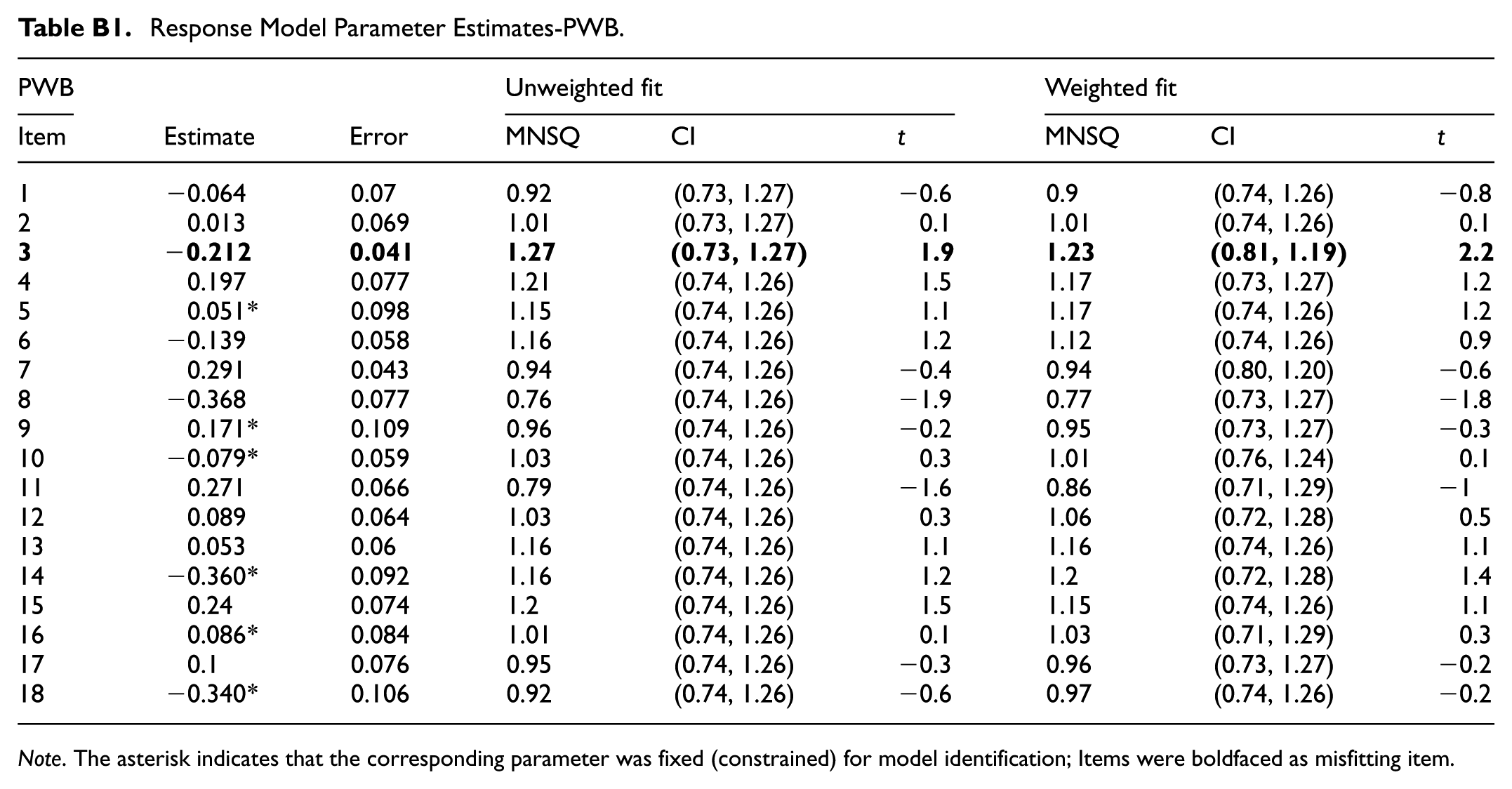
| PWB | Unweighted fit | Weighted fit | ||||||
|---|---|---|---|---|---|---|---|---|
| Item | Estimate | Error | MNSQ | CI | t | MNSQ | CI | t |
| 1 | −0.064 | 0.07 | 0.92 | (0.73, 1.27) | −0.6 | 0.9 | (0.74, 1.26) | −0.8 |
| 2 | 0.013 | 0.069 | 1.01 | (0.73, 1.27) | 0.1 | 1.01 | (0.74, 1.26) | 0.1 |
|
|
|
|
|
|
|
|
|
|
| 4 | 0.197 | 0.077 | 1.21 | (0.74, 1.26) | 1.5 | 1.17 | (0.73, 1.27) | 1.2 |
| 5 | 0.051* | 0.098 | 1.15 | (0.74, 1.26) | 1.1 | 1.17 | (0.74, 1.26) | 1.2 |
| 6 | −0.139 | 0.058 | 1.16 | (0.74, 1.26) | 1.2 | 1.12 | (0.74, 1.26) | 0.9 |
| 7 | 0.291 | 0.043 | 0.94 | (0.74, 1.26) | −0.4 | 0.94 | (0.80, 1.20) | −0.6 |
| 8 | −0.368 | 0.077 | 0.76 | (0.74, 1.26) | −1.9 | 0.77 | (0.73, 1.27) | −1.8 |
| 9 | 0.171* | 0.109 | 0.96 | (0.74, 1.26) | −0.2 | 0.95 | (0.73, 1.27) | −0.3 |
| 10 | −0.079* | 0.059 | 1.03 | (0.74, 1.26) | 0.3 | 1.01 | (0.76, 1.24) | 0.1 |
| 11 | 0.271 | 0.066 | 0.79 | (0.74, 1.26) | −1.6 | 0.86 | (0.71, 1.29) | −1 |
| 12 | 0.089 | 0.064 | 1.03 | (0.74, 1.26) | 0.3 | 1.06 | (0.72, 1.28) | 0.5 |
| 13 | 0.053 | 0.06 | 1.16 | (0.74, 1.26) | 1.1 | 1.16 | (0.74, 1.26) | 1.1 |
| 14 | −0.360* | 0.092 | 1.16 | (0.74, 1.26) | 1.2 | 1.2 | (0.72, 1.28) | 1.4 |
| 15 | 0.24 | 0.074 | 1.2 | (0.74, 1.26) | 1.5 | 1.15 | (0.74, 1.26) | 1.1 |
| 16 | 0.086* | 0.084 | 1.01 | (0.74, 1.26) | 0.1 | 1.03 | (0.71, 1.29) | 0.3 |
| 17 | 0.1 | 0.076 | 0.95 | (0.74, 1.26) | −0.3 | 0.96 | (0.73, 1.27) | −0.2 |
| 18 | −0.340* | 0.106 | 0.92 | (0.74, 1.26) | −0.6 | 0.97 | (0.74, 1.26) | −0.2 |
Note. The asterisk indicates that the corresponding parameter was fixed (constrained) for model identification; Items were boldfaced as misfitting item.
Author Contributions
As the lead author, Min Xu was responsible for the study’s conceptual framework, methodological approach, and initial manuscript preparation. Xiaohan Yang contributed through manuscript review and editorial revisions. Hadijah Binti Jaffri oversaw the research supervision, ethical clearance processes, and manuscript evaluation. Technical support and guidance were provided by Xin Ma throughout the study.

Ethical Considerations
This study received ethical approval from the UTM Research Ethics Committee (UTM REC) during the Main Panel Meeting of Research Ethics Approval Bil 1/2025 held on 10 January 2025. The approved project (Approval No.: UTMREC-2025-109) is titled “The Mediating Role Of Emotional Expression, Emotional Regulation And Self-Esteem In The Relationship Between Personality Traits And Psychological Well-Being Among Chinese International Students In UTM, ensuring all research procedures adhered to institutional ethical standards for studies involving human participants.
Funding
The authors received no financial support for the research, authorship, and/or publication of this article.
Declaration of Conflicting Interests
The authors declared no potential conflicts of interest with respect to the research, authorship, and/or publication of this article.
Data Availability Statement
The data files are available from the corresponding author upon reasonable request.*