




Abstract
Work-family conflict has gained a growing amount of attention in the field of workplace stress, which can negatively impact employee health. Work-family equilibrium is difficult to maintain in contemporary industrialized societies due to the rising demands of both the workplace and the home. This study relied on self-determination theory, conservation of resources theory, psychological safety, innovative human resource management practices, and social exchange theory. It investigates the impacts of work-family conflict on psychological well-being and psychological safety. It also investigates the indirect effects of work-family conflict on organizational performance. This study investigates the influence of innovative human resource management on psychological safety, physical well-being, and social well-being. Finally, the indirect effects of innovative human resource management on organizational performance are examined. The data used in this research was gathered from a variety of Chinese industrial sources. The subjects of this research are China employees of a diverse range of companies. A total of 442 employees were randomly chosen utilizing a sampling technique. According to the findings, work-family conflict has a significant effect on psychological safety but not a significant impact on psychological well-being. Innovative human resource management has a significant effect on psychological well-being, physical well-being, and social well-being. Psychological safety and social well-being also impact significantly organizational performance. Finally, this study provided some important theoretical contributions and practical implications for the reference of industries and academics.
Keywords
Introduction
In recent times, work-family conflict has gained a growing amount of attention in the field of workplace stress, which can negatively impact employee health. Work-family equilibrium is difficult to maintain in contemporary industrialized societies due to the rising demands of both the workplace and the home. Individuals are expected to simultaneously manage numerous tasks, earmarking their efforts between family and work (Fotiadis et al., 2019). The inability to manage the demands of these positions can lead to disagreements between the family and work spheres. Work-family conflict is a type of conflict that arises while managing different roles and is caused by the expectations of numerous incompatible assignments (Obrenovic et al., 2020). Work-family conflict is a psychological concept of not maintaining a balance between home and work life (Csikszentmihalyi, 2003; Sanaz et al., 2014). Hobfoll’s conservation of resources model provides a valuable theoretical framework for comprehending the work-family literature (Grandey & Cropanzano, 1999). People, according to the conservation of resources theory, try to keep, protect, and develop resources. They fear the possible or immediate damage to these valuable resources (Hobfoll, 1989). Resources encompass conditions, objects, energy, and individual traits. When the potential of losing resources increases, stress ensues (Fiksenbaum, 2014). Grandey and Cropanzano (1999) said that their model of work-family conflict and strain backed up the conservation of resources theory. In writing, the possible effects of work-family conflict on personal and organizational health have been discussed (Ford et al., 2007). Work-family conflict hinders employee productivity and effectiveness the work by lowering employee job satisfaction. Furthermore, it influences staff turnover, mental distress, and life happiness (Obrenovic et al., 2020). Previous studies have largely focused on reducing the impact of work-family conflict on a few factors, such as organizational support (Keoboualapheth et al., 2017), job satisfaction (Ford et al., 2007), leadership (Hill & Bartol, 2016; T. Matthews et al., 2013), exhaustion (Y.-S. Chen & Huang, 2016), and the relation between work-family conflict and work-family relationship with work stress (Lu et al., 2017; Smith et al., 2018), job control (Golden, 2013), burnout (Montgomery et al., 2003), and turnover intention (Lu et al., 2017). Despite advances in research, work-family scholars lack a comprehensive grasp of how psychological wellbeing and psychological safety components relate to employee job performance. Resolution of work-family conflict has a psychological impact on employees, which results in a positive job attitude. There has been relatively little empirical research on the association between work-family conflict and organizational performance until now. Prior research in the context of psychological wellbeing has not thoroughly examined the effect of nonorganizational elements on performance (Obrenovic et al., 2020). This study tackles the constraint by introducing the family as a significant element with implications for the psychological safety and well-being of individuals. This study aims to investigate the indirect association between Organizational performance and work-family conflict via psychological safety (Hall et al., 2010; Obrenovic et al., 2020) and psychological wellbeing (R. A. Matthews et al., 2014; O’Driscoll et al., 2004).
In addition, there is broad agreement in the scholarly literature that innovation is essential for the creation of a competitive edge (Smith et al., 2018). Understanding what drives innovation has become one of the most important topics in the literature on innovation (T. Wang & Zatzick, 2019). Innovation is psychologically and emotionally taxing, and people must devote substantial resources to each innovation phase. In addition, when fresh concepts are conceived, a greater emotional investment is required to transcend organizational resistance and win the backing of management. In addition, unanticipated challenges require staff to spend greater effort on problem-solving tasks (Salas-Vallina et al., 2020). Innovative human resource management (IHRM) may be able to provide essential help to tackle this difficult innovation process challenge. Recent research is beginning to study the significance of IHRM as a resource for enhancing employee outcomes on the job (Van De Voorde et al., 2016). This indicates that HRM is a fundamental resource for the workplace, giving employees the tools they need to do challenging jobs (Salas-Vallina et al., 2020). Scholars and practitioners have shown a great deal of interest in employee-centered HR strategies, particularly those targeted at enhancing their well-being, due to their purported interests in both personnel as well as the organization (Guest, 1999). Scholars have traditionally concentrated on all three aspects of employee well-being: social, psychological, and physical. The psychological component includes an employee’s effectiveness as well as efficiency with regard to psychological functioning (Loon et al., 2019), the physical component includes the investigation of subjective feelings of health and energy (Guest, 2017), and the social component includes a favorable impression of interpersonal relationships, social support, and perceptions of fairness at work (Loon et al., 2019). This particular research aims to identify the impact of IHRM practices on organizational performance improvement. However, little is known about the connection between IHRM practices, organizational performance, and employee well-being. This study attempts to comprehend how IHRM methods, such as recruitment, retraining, and redeployment, as well as performance evaluation and remuneration, and Organizational performance enhancement (Som, 2008) affect physical wellbeing, psychological wellbeing, and social wellbeing during the transition process.
This particular research addresses these gaps. First, it determines the influence of work-family conflict on psychological wellbeing and psychological safety. Second, it investigates the indirect effects of work-family conflict on organizational performance. Thirdly, the influence of IHRM on physical wellbeing, psychological wellbeing, and social wellbeing is investigated. The fourth section investigates the indirect effects of IHRM on organizational performance. Based on the conservation of resources theory, self-determination theory, IHRM, psychological safety, and social exchange theory, this study was conducted. This study has a variety of theoretical and managerial ramifications.
Theoretical Background
Conservation of Resources Theory (COR)
The conservation of resources theory claims that in to deal with depression and stress, individuals invest, safeguard, and acquire resources they value. Speaking of “Resources,” they are broadly defined as all valued objects, competencies, human qualities, energies, or situations (Hobfoll, 1989). Numerous publications contain criticisms of this imprecise definition (He et al., 2019). Resources have been known and stated as everything considered by employees as assisting them in achieving their objectives. This newly proposed goal-based explanation facilitates a better understanding of resource features and how they contribute to goal achievement. Employees are incentivized to conserve their resources and reinvest them to acquire more; the gain or loss of resources is contingent on the availability of other excess resources (Öge et al., 2018). Since the 1990s, work-family interaction has been extensively studied using the conservation of resources theory. It asserts that when employees devote an excessive amount of their scarce resources to one position, they have limited resources available for the other ones. Workers will attempt to preserve or regain their resources by spending additional resources (e.g., time, energy, and money) in the threatened role. Time and energy are limited resources for employees, thus it might be challenging to balance home and work responsibilities due to their competing time and energy needs or contradictory behaviors (Hobfoll et al., 2018). Work-related resource depletion might result in resource constraints and difficulties meeting family sphere demands, hence increasing work-family conflict. Therefore, it may be concluded that employees with greater resources have lower work-family conflict. Conservation of resources theory has two fundamental principles: resource conservation and resource acquisition. Resource conservation suggests that people are driven to avoid events or activities that are thought to pose a hazard to their resources in order to prevent resource loss or potential future threats; the concept of resource acquisition proposes that people actively engage with their surroundings to expand their resource reserves. The conservation of resources theory also predicts that individuals will attempt to optimize resource aggregation through purposeful investment of resources, such as demonstrating high workplace engagement or work performance for the sake of promotion or compensation. Thus, workplace resources are frequently reinvested in work-related behaviors (He et al., 2019). Notably, Hobfoll et al. (2018) offered two corollaries to the conservation of resources theory principle of resource investment. The first hypothesis implies that people with additional resources are less susceptible to resource losses and can invest existing resources more effectively, whereas the second hypothesis suggests that a scarcity of resources typically makes investment more challenging and increases the vulnerability to further resource losses. Since Hobfoll et al. (2018) initially introduced the conservation of resources theory, numerous resources have been characterized and investigated by scholars. Recent research has identified cognitive intercultural competence as a psychological skill that promotes job commitment and life satisfaction among ex-pats (Le et al., 2018). Grandey and Cropanzano (1999) argued that the conservation of resources theory describes individual differences in the work-family conflict process to a great extent. Individual differences can influence responses to stress and loss of resources. For example, Individuals with high intercultural competence may, for instance, deal with cross-cultural issues more effectively; they are also less prone to resource loss since they are confident in their ability to do so (Le et al., 2018). This study concludes, based on the conservation of resources theory, that expats with high intercultural competence are motivated to invest more resources at work to acquire additional resources. By creating a model of moderated mediation, we further investigate the underlying principle of cultural intelligence’s impact on work-family conflict amongst Chinese academic ex-pats (He et al., 2019).
Innovative Human Resource Management (IHRM)
In the past two decades, a study has revealed that the strategic HRM application is considered to constitute one of the key influential Organizational performance predictors. Scientists have uncovered supporting proof connecting HRM activities with the performance of corporations (P. M. Wright et al., 2005). This research investigates the influence of strategic HRM practices on business performance during substantial macroenvironmental shifts, drawing on the extensive literature on strategic HRM. In this research, HRM is conceived as a guardedly designed collection of activities that are aimed at enhancing organizational effectiveness and, thus, producing superior performance outcomes. P. M. Wright and McMahan (1992) state it as: “the planned HR initiatives and actions designed to help a firm accomplish its objectives.” HR deployments represent the basic perceptions regarding the (positive) understanding of HRM and what it accomplishes, specifically that it effectively and precisely adapts to the framework of the organization and supports other structures and variables as well (Boselie et al., 2005). A study of the connection between HR methods and company success is likely the most influential and acknowledged work in this field. His finding corroborates a configurational perspective on HRM practices, in which strategies tend to operate synchronously (Huselid, 1995). Another study discovered that behaviors aligned with a highly involved HRM strategy, including highly selected employment, incentives and benefits, and development, were positively correlated with organizational performance (Delaney & Huselid, 1996). Innovative HRM practices are defined in this article as HRM practices that differ from traditional HRM practices. It refers to the modification of an HRM system, policy, program, or practice that is planned to affect or enhance the skills of the employee along with interactions and behaviors and that is more likely to provide the basis for strategic planning and the ways for strategy implementation, is looked upon as new, and generates current expertise and capabilities (Som, 2006, 2008). Following a comprehensive literature review and considering the proposed description of inventive HRM activities, this research analyzed that the HRM department’s responsibility, hiring, holding back the employees, redeployment, performance reviews, and remuneration and incentive practices are the most significant factors (Som, 2008).
Self-Determination Theory (SDT)
Self-determination theory as a concept of work motivation is unique in this kind, by distinguishing between autonomous and controlled motivation, it has demonstrated that self-efficacy, but not controlled motivation, supports both elevated performance and employee health. Thus, the concept has been able to achieve the conventional objective of organizational psychologists, which is to facilitate profitability while also promoting employee well-being. Self-determination theory has long been associated with specifying empirically the social-contextual circumstances that foster autonomous motivation. All humans have three core psychological requirements, including autonomy, ability, and relatedness, which, when addressed, support autonomous motivation, health, and effective performance. Thus, self-determination theory has been primarily focused on improving the need-supportive settings across dimensions that facilitate people’s autonomous motivation and, consequently, their productive work and positive emotions. Research on job features, kinds of justice, supervisory support, and leadership types has proliferated since work environments that meet basic behavioral needs provide greater results.
The concept of basic psychological requirements for autonomy, competence, and relatedness provides the context for comprehending SDT’s consequences for the workplace. Every policy and practice enacted inside a workplace has the potential to either assist or impede basic psychological needs. Anyone interested in enhancing the work environment inside a business and, by extension, the productivity and health of its employees could examine any proposed policy or practice based on its likelihood of doing so by (a) allowing employees to acquire skills and/or to feel secure, (b) experimenting with and begin their activities without feeling pressured and manipulated to perform as directed, and (c) feeling a sense of respect and belonging with both supervisors and colleagues. Policies or practices that assist employees in these three areas are likely to promote autonomy, well-being, and superior efficiency. Those who impede any of these employee experiences are likely to foster controlled motivation, as well as bad health and, at best, volume but not performance quality (Deci et al., 2017).
Social Exchange Theory (SET)
Social exchange theory is one of the most prominent models for comprehending workplace behavior. Its venerable origins can be traced back to at least the 1920s (Malinowski, 1922), linking key disciplines such as anthropology (Firth, 1967), social psychology (Gouldner, 1960), and sociology (Blau, 1968). Although several viewpoints on social exchange have appeared, scholars agree that it comprises a series of contacts that generate commitments (Cropanzano & Mitchell, 2005). Social exchange theory usually explains that these relationships are interconnected and dependent on the practices of a third party (Blau, 1968). Social exchange theory emphasizes that interdependent interactions can build high-quality connections, but only under certain conditions. Networks (Brass et al., 2004), board independence (McLeod et al., 2021), psychological contracts (Birtch et al., 2016), social power (Molm et al., 1999), organizational fairness (Roch et al., 2019), and leadership (Zhang et al., 2018), and are among other factors that have benefited from SET’s explanatory power. Recent assessments, however, have shown difficulties with the hypothesis. Coyle-Shapiro and Conway (2004), for instance, emphasized theoretical uncertainties and empirical requirements, whereas Cropanzano et al. (2001), and others bemoaned typical misconceptions of the broad social exchange theory model.
Homans (1958) provided a concept of exchange-based social behavior over half a century ago. Essentially, he proposed the notion that trades carry symbolic value in addition to material items (e.g., prestige and approval). His writings spanned multiple disciplines and spawned divergent conceptions of social interaction. Although scholars disagree on specifics, they agree on the fundamental “nature” of social exchange theory: Social exchange consists of behaviors depending upon the rewarding responses of employees, which over time result in communally beneficial transactions and relationships (Cropanzano & Mitchell, 2005).
Hypotheses Development
Work-Family Conflict and Psychological Safety
Work-family connections add to the development of constructs psychologically at the workplace, whereas a positive psychological ambiance generates the notion of psychological safety within the organization. An organization is deemed to have a psychologically ambient atmosphere when staff or employees perceive enhancement of their well-being by the working environment (Obrenovic et al., 2020). Without a positive psychological atmosphere, the psychological safety grade is almost certainly low. Work-family conflict has also been connected to mental health issues, and it may result in a deterioration in a person’s cognitive ability (Eshak, 2019). If individuals’ workload is echoed in their relationships with family members, a decrease in the efficiency of their job and family responsibilities may have negative effects on their psychological wellbeing and psychological safety. A crucial psychological condition, psychological safety, influences the inhabitation about individuals in their organizational responsibilities. Psychological safety symbolizes the concept that employees can express and use themselves without worry about damaging their self-image, position, or careers (Newman et al., 2017). Recent research and extensions of conservation of resources theory indicate that loss of resources directly indicated the incidence of work-family conflict, whereas resource gain decreased the positive link between work-family conflict and resource loss (S. Chen et al., 2015). Therefore, when resources get less, there is more conflict (Obrenovic et al., 2020). As critical resources are discovered to be in jeopardy, employees’ perceptions of psychological safety are impacted by stressful events. All the risks of resource loss like economic instability, a risk to self-content, anxiety about employees’ marital status or job assurance, monetary devastation, or an ailing family member, induces stress (Reizer et al., 2010). This theory depicts marital status and tenure as valuable and sought-after resources, given that married individuals have more access to resources like emotional assistance, affinity, and cash, whereas tenure guarantees higher psychological safety and greater performance. For illustration, if a partner’s financial resources at work rise, the other partners might be offered encouragement and contribute to the other’s wellbeing. The conservation of resources model provides an adequate justification for both inter- and intra-role pressure, where family and career pressure are reciprocally associated, expressively, issues in one domain lead to problems in another (Obrenovic et al., 2020). In addition, it is suggested by the crossover model (Westman, 2001) that psychological pressure and work-family conflict may spread via the encroachment impact on other peers. These experiences are associated with a need to limit resource loss, which may result in unfavorable outcomes for the organization, like resignation or sick leave. Work-life balance is a crucial aspect influencing the quality of life of employees, and it can impact personal satisfaction, safety, and health (Obrenovic et al., 2020). Occasionally, work-family conflict produces negative effects like depression (Y. Wang & Peng, 2017) and intoxication (Wolff et al., 2013). There is also a positive consequence of decreased work-family conflict, which is increased work commitment and self-gratification (Obrenovic et al., 2020), both of which are elements that promote psychological safety. Accordingly, the subsequent hypothesis can be proposed.
Hypothesis 1a: Work-family conflict has a negative impact on psychological safety.
Work-Family Conflict and Psychological Wellbeing
Psychological wellbeing is a wide notion that encompasses emotional and mental states, work satisfaction, and life satisfaction as a whole. Psychological wellbeing, which is generally used to quantify hedonic levels of satisfaction, defines an individual’s total psychological functioning efficacy. Psychological wellbeing is enhanced by a sense of control over family and work responsibilities (Obrenovic et al., 2020). Work-family balance is defined as the time individuals understand as accessible to perform their responsibilities-related roles and, is characterized by a sense of control. Work-family conflict causes a decline in employee satisfaction and an increase in psychological stress (Fotiadis et al., 2019). There is a correlation between occupational stress and psychological wellbeing. For example, moderate job pressure causes people to grow professionally by taking the challenge, leading to positive psychological wellbeing (Harter et al., 2002). Abrogating work-family interactions reduces psychological wellbeing as a result of depleted mental resources and elevated psychological stress (Obrenovic et al., 2020). By situating work-family conflict and work-family enrichment inside a single resource-exchange economy, the conservation of resources offers an integrated conceptual framework that clarifies both opposing and enhancing processes of resource investment procedures, specifically the interrelationship of work-family conflict and work-family enrichment (Hobfoll et al., 2018). According to a fundamental principle of conservation of resources, the relationship between work and family is seen as a stockpile of resources, whereas a gain, loss, or danger in one domain can have an impact on the fundamental nature of the other. When demands in one function conflict with expectations in another, stress from handling numerous responsibilities manifests as work-family conflict. This causes pressure, saps energy, and forces the person to devote more mental and physical resources to the troublesome area. When there is more conflict in one area, there are lesser resources available to play one’s part in another. When balancing job and family obligations, resources are depleted, which leads to conflict or a decreased sense of being—Conflict. Employees who lost their passion in the past and demonstrated greater exhaustion concerns also reported a stronger rise in work stress, working hours, and barriers between family and work, supporting the conservation of resources hypothesis regarding resource loss (ten Brummelhuis et al., 2011). Furthermore, there is a strong link between work-family conflict, individual burnout, and distress signs (Obrenovic et al., 2020). The reasons for the change in labor demography and rise in female empowerment, work-family conflict was the primary factor impacting employee welfare in South-East Asian countries (Ibrahim et al., 2009). Work-family conflict has increased as a result of growing female labor force involvement (Lestari et al., 2019), shifting family role expectations, technology advancements, and a greater emphasis on “work anytime, anywhere,” hence creating psychological strain and negatively affecting employees’ psychological wellbeing. Sedaroglu (2021) conducted research that identified some work-family conflict-specific variables that influence psychological wellbeing. We conclude, based on the results presented above, that work-family conflict is a major predictor of employee psychological wellbeing. Accordingly, the subsequent hypothesis can be proposed.
Hypothesis 1b: Work-family conflict has a negative impact on psychological wellbeing.
Innovative HRM Practices and Psychological Wellbeing
Individual psychological wellbeing is a multifaceted concept that researchers have conceptualized in a variety of ways. For instance, Ryff and Keyes (1995) describe it as a depiction of health, which is conceptualized as lifelong progressions of development. Similarly, Panaccio and Vandenberghe (2009) define PWB as being defined by the coexistence of job and life satisfaction as well as the presence of positive affect and the lack of negative affect. Psychological wellbeing, in the opinion of Diener et al. (1997), might manifest as ideas or as an effect. This is in accordance with the psychological wellbeing model that was developed by Ryff, which includes the six elements of autonomy, self-acceptance, personal progress, purpose in life, positive relations with others, and environment mastery (Ryff & Keyes, 1995). In the context of psychological wellbeing, hedonic (positive feelings) and eudemonic (positive functionality) wellbeing are frequently distinguished (Guest, 2017). Life/job satisfaction is a common representation of hedonistic wellness, which is said to be motivated by the desire for rewards and pleasure as well as the avoidance of unpleasant events. Inversely, eudemonic wellbeing, as seen in the work of Ryff and Keyes (1995), offers the chance for consciousness and is derived from the judgment that one’s living position is meaningful. Researchers have discovered a correlation between psychological wellbeing and certain outcomes. Higher psychological wellbeing levels at work are associated with better health, longer lifespans, and happier lives (Cartwright & Cooper, 2008). Moreover, another study evaluated psychological wellbeing in the framework of HRM and revealed a favorable association between job performance and psychological wellbeing (T. A. Wright & Cropanzano, 2000). Similar findings concerning HRM were reported by Robertson et al. (2012), who discovered that psychological wellbeing was more predictive of self-reported levels of performance than positive job and work attitudes. Among the antecedents of psychological wellbeing are many innovative HRM policies and practices that have been studied by researchers, among these are transformative leadership and authentic leadership, and psychological capital (H. Xu et al., 2022), Baluch (2017) investigated emotional quotient, Arnold and Dupré (2012) investigated the perception of organizational support. These results demonstrate the growing scientific interest in psychological wellbeing. Recent considerations argue that, due to changes in workplace conditions such as the entrance of information systems, financial unrest, economic, political, and global upheavals, etc., for companies to boost their performance, they must first address the well-being of their employees (Loon et al., 2019). Employers have so concentrated on putting policies into place that could promote employee psychological wellbeing. These activities, which mostly fall within the purview of HR management, frequently provide paradoxical problems for the company due to the conflicts between those that have a good impact on psychological wellbeing and those that aim to raise psychological wellbeing costs. Using the paradox metatheory lens, this study intends to deconstruct and synthesize the literature to distinguish between HR staff psychological wellbeing behaviors that complement or compete with strategies enabling Organizational performance and change, drawing on the work of Guest (2017). Accordingly, the subsequent hypothesis can be proposed.
Hypothesis 2: Innovative HRM practices have a positive impact on psychological wellbeing.
Innovative HRM Practices and Physical Wellbeing
Guest (2017) asserts that good physical, mental, and social health at work are indicators of excellent well-being. Physical wellbeing is the investigation of a person’s internal states of well-being and vitality. Well-being at work is fostered by effective HRM practices like inspiring, which includes energizing followers and giving them the impression that they contribute to important tasks, strengthening, which includes promoting autonomy and responsibility, and connecting, which includes encouraging cooperation and teamwork. Further, it is suggested that to satisfy the fundamental psychological demands, well-being is represented as work engagement (Schaufeli, 2015). It might be asserted that quality of working life, a precursor of work-related well-being, should be evaluated at the job, workplace, and work-life balance levels (Grote & Guest, 2017). According to self-determination theory (2000), strengthening HRM activities can be viewed as supporting practices since they are job resources that nurture the human requirements of autonomy and relatedness (Strauss & Parker, 2014). A set of six key HRM characteristics, including training, autonomy, supervisor support, error tolerance, recognition, and safe working circumstances, is offered to boost job resources and encourage positive, valuable behavior. The development of self-efficacy, which is a determinant of well-being, is facilitated by strengthening competence, which is a prerequisite for task performance (Salas-Vallina et al., 2020). A supportive atmosphere is one in which employees feel safe and supported by their employer. This comprises leader assistance, which is vital for employee well-being (Salas-Vallina & Alegre, 2018; Salas-Vallina et al., 2020) in terms of basic notions of feeling safe on the job and enhancing error tolerance and recognition. So, both physical wellbeing and psychological wellbeing would rise as a result. Accordingly, the subsequent hypothesis can be proposed.
Hypothesis 3: Innovative HRM practices have a positive impact on physical wellbeing.
Innovative HRM Practices and Social Wellbeing
Social wellbeing comprises a favorable impression of interpersonal interactions, social support, and perceived workplace justice. However, a greater knowledge of the impact of external elements is also required, given the availability of work-life balancing approaches. By connecting, interpersonal ties and coherence are strengthened, hence enhancing the quality of personal communication and the social aspect of well-being for the Guest (Ilies et al., 2017). Positive social relationships precede job satisfaction. Moreover, avoiding harassment and bullying and giving peer support, which we refer to as partnership, are associated with the quality of working life (Guest, 2017). In general, social wellbeing would be strengthened if novel HRM practices were implemented. In the conventional job stress models, such as the Demand-Control-Support model, control over one’s work is viewed as the most important job attribute (Salas-Vallina et al., 2020). In this view, HRM strategies such as empowerment, which encompasses autonomy and employee voice and so facilitates self-control over one’s work, are regarded as a fundamental aspect of employee well-being promotion. Both employee voice and autonomy have been associated with enhanced psychological wellbeing and social wellbeing in general (Häusser et al., 2010). Individuals who feel that they are members of the company are more likely to be engaged and committed to the business. Employees now possess the skills necessary to assume genuine organizational management responsibilities (Salas-Vallina et al., 2020). Core components of HRM strategies focused on well-being include opportunities for voice expression, such as participation and organizational surveys. According to the social exchange theory, workers would perform better in organizations where well-being-promoting HRM strategies are given top priority. The social exchange theory enables us to describe how resources are transferred in a reciprocal process, where one person pays back the positive (or negative) acts of another (Mitchell et al., 2012). Employees who believe cutting-edge HRM techniques enhance their well-being, according to this notion, respond with constructive and positive mindsets, which can be especially energizing and proactive (Salas-Vallina et al., 2020). Accordingly, the subsequent hypothesis could be proposed.
Hypothesis 4: Innovative HRM practices have a positive impact on social wellbeing.
Psychological Safety and Organizational Performance
Various publications have slightly varying definitions of psychological safety (Erkutlu & Chafra, 2016; Kirk-Brown & Van Dijk, 2016; Koopmann et al., 2016). It relies on the definition’s scope, such as individual or team level. However, the majority of them stated that psychological safety is a person’s belief or feeling regarding the consequences of his or her actions. Psychological safety is a common belief among team members regarding interpersonal risk-taking, as well as the feeling of being able to exhibit and do something without fear of negative consequences to one’s self-image, position, or profession. In other words, workers do not fear a negative influence on their position in the company as a result of their activities in the organization, and they are willing to talk freely and voice their opinions without fear of being rejected, humiliated, or penalized by team members (Abror & Patrisia, 2020). Organizational performance is a multidimensional construct (Stam et al., 2014). This concept employs several measures that are separated into two categories including financial along with non-financial performance. Differing slightly, some researchers (Walumbwa et al., 2011) describe the performance as market performance as well as financial performance. Performance can be evaluated depending on the viewpoint of the customer, interrelations, multiple viewpoints, antecedent factors, and perceptual aspects. The three components of business/organizational performance include the value of the shareholder, equity of the customer, and profitability. This indicates that corporate performance can indeed be judged not just by financial indicators, but also through additional performance indicators. Psychological safety does have an impact on organizational performance. There have been two opposing viewpoints about the correlation between psychological safety and organizational performance. On the one hand, it has been suggested that psychological safety will have a direct significant impact on Organizational performance (Abror & Patrisia, 2020). On the contrary, some scholars (Carmeli & Gittell, 2009) contend that psychological safety doesn’t have a direct link with Organizational performance and that it is regulated by other variables, like self-efficacy and cognitive behavior. The link between psychological safety and organizational performance ought to be investigated in the future (Abror & Patrisia, 2020). Consequently, the following hypothesis can be proposed:
Hypothesis 5: Psychological safety has a positive impact on organizational performance.
Psychological Wellbeing and Organizational Performance
Psychological wellbeing must be bolted to its relationship with positive work temperament to such a degree that it may be declared directly that psychological wellbeing is correlated with organizational performance, engagement, and other job-related attitudes. However, psychological wellbeing is also investigated independently. Positive experiences are associated with enhanced psychological wellbeing and physical wellbeing (Obrenovic et al., 2020). Those with greater psychological wellbeing levels are happier and more efficient in the workplace (Cartwright & Cooper, 2008). In recent years, businesses have placed a greater emphasis on supporting social policies, that function as an organization-based source of aid and a barrier against the resource-depleting effect of severe workloads (Obrenovic et al., 2020). The staff is provided with coping skills to enhance their resiliency in difficult conditions. When workers think their contributions are appreciated by their employer, they exert considerable effort to improve their work performance. In addition, per Westman’s (2001) crossover concept, emotional and favorable experiences pass from one colleague to the next, causing an upward spiral by impacting the unit, the division, and the company. Consequently, the following hypothesis can be proposed:
Hypothesis 6: Psychological wellbeing has a positive impact on organizational performance.
Physical Wellbeing and Organizational Performance
The link between social wellbeing and physical wellbeing on organizational performance has been well analyzed and established in the previous study. Ford et al. (2007), for instance, admitted explicitly that positive health-related habits, like exercising, a balanced diet, and sleep, are all highly associated with work performance (Nikbin et al., 2021). Similarly, it has been demonstrated that problem-free sleep does have a prominent impact on good mood in the morning and functional capacity and that it could contribute to recovery, thereby promoting organizational performance and work engagement (Lim & Dinges, 2010; Nikbin et al., 2021). In contrast, both sleep deprivation and poor sleep quality have been associated with weaker organizational performance (Dewald et al., 2010). Similarly, Andreassen et al. (2012) discovered in a research study on students that lower physical wellbeing, such as poor sleep quality, decreases their productivity. Consequently, the following hypothesis can be proposed:
Hypothesis 7: Physical wellbeing has a positive impact on organizational performance.
Social Wellbeing and Organizational Performance
According to Hansen (1999) and Tsai (2001), the knowledge required for improved performance is acquired through social interactions and contact with others. In addition, social interactions might serve as information conveyors, so lowering the time, effort, and resources required to collect data for better organizational performance (Nikbin et al., 2021). According to Tsai (2001), businesses can raise their creativity and effectiveness by fostering social contact, which increases intellectual exchange and sharing inside the firm. Others have also emphasized the significance of social wellbeing in promoting knowledge sharing as the defining characteristic of social capital (Adler & Kwon, 2002). These characteristics are required to obtain superior organizational performance (Rodan & Galunic, 2004). For instance, a study done by Huang and Li (2009) indicated that social interaction between organizational units is correlated with innovation success. Moreover, Rodan and Galunic (2004) emphasized that social interaction among management of a business is essential and assists them in attaining their objectives. In addition, they asserted that social wellbeing across management is substantially associated with organizational performance (Van De Voorde et al., 2012). Consequently, the following hypothesis can be proposed.
Hypothesis 8: Social wellbeing has a positive impact on organizational performance.
Figure 1 of the study depicts the study’s theoretical framework.

Theoretical framework.
Methodology
The data used in this research was gathered from a variety of Chinese industrial sources. The subjects of this research are Chinese employees of a diverse range of companies. A total of 442 employees were randomly chosen utilizing a sampling technique. A self-administered, closed-ended questionnaire was utilized to obtain information from workers.
Considering the varied landscape of Chinese industries, the participants in this study hailed from various sectors, including manufacturing, technology, finance, healthcare, and retail, among others. This diverse mix of industries provided a rich array of organizational environments and methodologies among the respondents. Hence, due to the sample size obtained from diverse Chinese industrial sources, the participant counts within each industry subgroup were inadequate to perform meaningful statistical assessments and derive conclusive insights. The array of industries sampled exhibited significant diversity in organizational frameworks, cultures, and methodologies across various sectors. Consequently, disaggregating the results by industry would have generated intricate and heterogeneous findings, posing challenges in interpretation and generalization (Creswell & Creswell, 2017).
This study utilized cluster sampling in Shenzhen, China, renowned for its diverse industrial landscape encompassing manufacturing, technology, finance, and retail sectors. Shenzhen’s selection stemmed from its emblematic status of rapid industrial growth and urban development in China, notably as a Special Economic Zone hosting multifaceted industries. Various industrial clusters representing distinct sectors were identified within Shenzhen, employing a stratified sampling method to ensure sectoral representation. Industries were stratified by prominence, size, or economic contribution. Sampling units were randomly chosen within each cluster, and surveys were administered to employees to collect data on work-family conflict, HRM practices, and organizational performance, ensuring participant confidentiality to foster candid responses.
A greater number of participants typically leads to increased statistical power, which enhances the ability to identify genuine effects (Gignac & Szodorai, 2016). Through the selection of a sample size comprising 442 individuals, this study sought to guarantee sufficient sensitivity for detecting the anticipated associations between work-family conflict, innovative human resource management, and organizational performance among Chinese workers.
Alternate hypotheses were utilized in this research due to their hypothesis-driven nature, whereby hypotheses were derived from established theories or empirical data (Wallen & Fraenkel, 2013). Moreover, the research questions framed in the study implied directional associations between variables. Additionally, prior research indicated specific relationships, prompting the formulation of alternate hypotheses to examine these assertions within a novel context or demographic (Babbie, 2020).
Queries with responses on a Likert scale indicated the extent to which respondents disagreed or agreed with statements. On a scale from 1 to 7, 7 represented strong agreement, 1 represented strong disagreement, and 4 represented neutrality for the answers to these queries. Using a 5- to 7-point Likert scale improves the assessment instrument’s reliability, according to research. A 10-point Likert scale yields a lower score and so is less dependable (Khan, Chen, Suanpong, et al., 2021). The items to measure work-family conflict are adjusted and adapted from Sanaz et al.’s (2014) study. The items to measure IHRM are modified from Som’s (2008) research. The elements to measure organizational performance are adapted from Tseng and Lee’s (2014) study. The criteria to measure psychological safety are adopted from Baer and Frese’s (2003) research. In addition, the items to measure psychological wellbeing were adapted from Klar and Kasser’s (2009) study. The items to measure physical wellbeing were selected from El Ansari et al.’s (2011) research. Finally, the items to measure social wellbeing were adapted from Pradhan and Hati’s (2022) research. Before the official survey was administered, 100 randomly selected representative employees participated in a pilot study. The questionnaire was evaluated and validated using this test.
Data Analysis
Using the PLS approach, the gathered data was examined (partial least squares). This study has two stages. In the first stage of the research, the constructs’ validity and credibility are examined, and in the second, causal directions and path coefficients are computed (Anderson & Gerbing, 1988; Hulland, 1999). PLS is the most effective technique for keeping suggested relationships and evaluating large research frameworks (Petter et al., 2007). PLS is suitable for evaluating outcomes with an irregular distribution due to the availability of effective indicators for randomness and variable normality in the report’s findings. Additionally, dynamic research frameworks are applied (Chin & Newsted, 1999; Zhao & Khan, 2021). For this study’s data analysis, PLS is preferred to other SEM approaches.
Convergent Validity
PLS-SEM is utilized for complex models (Hair et al., 2014). This study measures the apparent Convergent Validity using Rho A, CR, Cronbach’s alpha, and AVE. Cronbach’s alpha along with rho A and CR is used to determine internal consistency and reliability, respectively. Rho A evaluates the reliability of the instrument by measuring the weights, but not the loadings (Henseler et al., 2014). Rho_A and Cronbach’s alpha (Taber, 2018) must exceed 0.70 to be deemed credible (Van Nguyen & Habók, 2021).
Table 1 demonstrates that the rho A and Cronbach alpha values for each construct are more than 0.70. The CR calculated values for each construct are likewise higher than 0.7 (Chin, 1998), demonstrating the instrument’s internal validity. That result corresponds with Table 1’s findings. Using the parameters acquired from the utilization of AVE, the Average of Variance for every construct, the composite reliability is calculated. This construct’s convergent validity is persistent for values higher than 0.5 (Fornell & Larcker, 1981). As indicated in Table 1, the AVE for the hypothetical construct variables ranges from 0.564 to 0.886, indicating a significant degree of convergence.
Convergent Validity.

Note. FP = financial performance; ICRP = innovative compensation and reward practices; NFP = non-financial performance; IHRM = innovative HR department; IRE = innovative recruitment; IRP = innovative retraining practices; PHYW = physical wellbeing; IPAP = innovative performance appraisal practices; PSYP = psychological safety; SOCW = social wellbeing; PSYW = psychological wellbeing; WFC = work-family conflict.
Discriminant Validity
This indicates the level of distinction between the two constructs. Using the Fornell and Larcker criteria, discriminant validity is determined for this research. This method utilizes the square root of AVE (Average Variance Extracted) to assess latent constructs (Ab Hamid et al., 2017). Table 2 demonstrates that the constructs seem to be more efficient at interpreting variation than competing constructs since the square root of adjusted variance estimates (AVEs) is higher than for competing constructs. The higher AVEs are represented by bold and italic in Table 2. In this research, the discriminant validity was calculated via the bootstrapping approach with a 95% confidence interval. Based on the findings presented in Table 3, discriminant validity was obtained and the reason is that none of the confidence intervals for the correlations between paired constructs’ contained 1 (Ma & Bennett, 2021).
Fornell-Larcker Criterion.

Note. OP = organizational performance; IHP = innovative HRM practices; PHYW = physical wellbeing; PSYW = psychological wellbeing; PSYS = psychological safety; WFC = work-family conflict; SOCW = social wellbeing.
Bootstrapping Confidence Intervals.

Note. OP = organizational performance; IHP = innovative HRM practices; PSYS = psychological safety; PSYW = psychological wellbeing; PHYW = physical wellbeing; WFC = work-family conflict; SOCW = social wellbeing.
Empirical Results
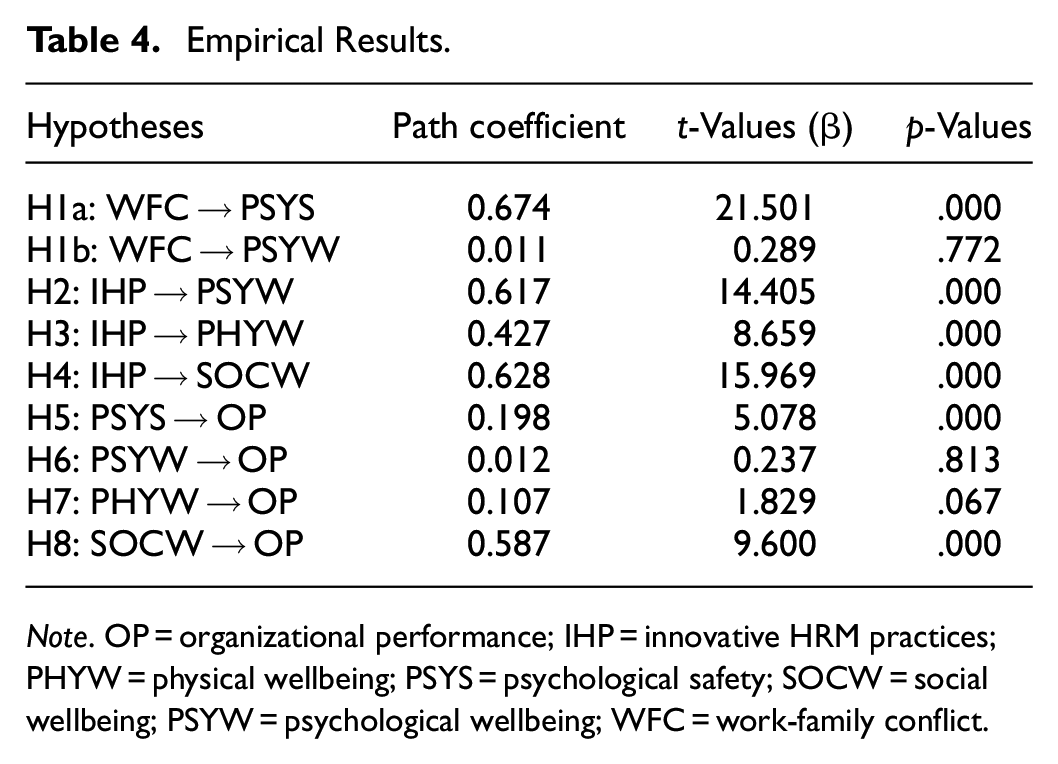
Smart PLS 3.2.8 was utilized to conduct a path analysis for the study framework evaluation. During this step, the inner model is computed. The internal model’s stated hypotheses are verified by determining a p-value and a t-value. The hypotheses are accepted if the t-value is more than 1.96 and also the p-value is less than .05. The R2 represents the ratio of predictor constructs, which is used to measure the study framework’s predictive ability (C.-C. Chen et al., 2021; Khan, Chen, Lu, et al., 2021; Y. Xu et al., 2021). The considerable value of the R2 value is approximately 0.67, moderate if it is approximately 0.33, and inadequate if it is approximately 0.19 (Chin, 1998). The empirical results are shown in Table 4 and Figure 2. Data for this study shows that work-family conflict has a significant effect on psychological safety (β = .674, t-value = 21.501) but not a significant impact on psychological wellbeing (β = .011, t-value = 0.289). IHRM has a significant effect on psychological wellbeing (β = .617, t-value = 14.405), physical wellbeing (β = .427, t-value = 8.659), and social wellbeing (β = .628, t-value = 15.969). Psychological safety (β = .198, t-value = 5.078) and social wellbeing (β = .587, t-value = 9.600) significantly impact organizational performance. However, psychological wellbeing (β = .012, t-value = 0.237) and physical wellbeing (β = .107, t-value = 1.829) did not impact organizational performance.
Empirical Results.
Note. OP = organizational performance; IHP = innovative HRM practices; PHYW = physical wellbeing; PSYS = psychological safety; SOCW = social wellbeing; PSYW = psychological wellbeing; WFC = work-family conflict.

Research results.
The data for Table 5 is generated using SMART PLS and shows the indirect effects of the study. The results show that work-family conflict has a significant indirect effect on organizational performance via psychological safety (β = .134, t-value = 4.660), while not a significant indirect effect via psychological wellbeing (β = .000, t-value = 0.064). IHRM has a significant indirect effect on organizational performance via social wellbeing (β = .369, t-value = 7.595), while no indirect impacts via psychological wellbeing (β = .008, t-value = 0.235), and via physical wellbeing (β = .046, t-value = 1.720).
Indirect Effects.

Note. OP = organizational performance; PHYW = physical wellbeing; IHP = innovative HRM practices; PSYS = psychological safety; SOCW = social wellbeing; WFC = work-family conflict; PSYW = psychological wellbeing.
Discussion and Conclusion
This study relied on self-determination theory, conservation of resources theory, psychological safety, IHRM, and the theory of social exchange. It investigates the impacts of work-family conflict on psychological wellbeing and psychological safety. It also investigates the indirect effects of work-family conflict on organizational performance. This study investigates the influence of IHRM on psychological wellbeing, physical wellbeing, and social wellbeing. Finally, the indirect effects of IHRM on organizational performance are examined.
Work-family conflict had a substantial effect on psychological safety, but not on psychological wellbeing, according to the results of this analysis. These findings were equivalent to those of Obrenovic et al. (2020). The research conducted by Obrenovic et al. (2020) investigated the relationship between work-family conflict and job achievement and measured the impact on psychological safety and psychological wellbeing. In Bahrain, an experimental study was done on data from 277 corporate workers. The data revealed that work-family conflict has a negative effect on psychological wellbeing and psychological safety. The study enriched our knowledge of work-family conflict, job performance, and employee psychology. It provides firms with significant information on how to boost employee productivity and assure greater performance by reducing work-family conflict. The research outcomes parallel the fundamental concepts of self-determination theory and conservation of resources theory, offering insightful frameworks for comprehending the interplay between work-family conflict and employee psychological well-being. Self-determination theory suggests that individuals possess inherent psychological needs, such as autonomy, competence, and connectedness, crucial for their overall well-being and motivation across different life domains, including work and family (Ryan & Deci, 2000). Conflicting demands from work and family spheres can jeopardize these fundamental needs, potentially undermining employees’ sense of psychological safety—their ability to freely express themselves without apprehension of negative repercussions in the workplace (Sedaroglu, 2021).
In addition, this study discovered the notion that IHRM had a substantial and important effect on psychological wellbeing. The outcome is comparable to a previous study conducted by Loon et al. (2019). As per Loon et al.’s (2019) study, it is well-documented that many human resource methods targeted at enhancing the psychological wellbeing of employees and organizational performance are conflicting and even contradictory. In contrast to the contingency method, the study utilized a paradox perspective, which considers conflicts in the actual world to be normal and beneficial to both employees and the organization. The study by Loon et al. (2019) examined the connection between employee organizational performance and psychological wellbeing. The goal of the study was to initiate a paradigm shift and chart a new course of thought on the coexistence of employee organizational performance and psychological wellbeing practices. Furthermore, the observed impact of IHRM on psychological wellbeing highlights the importance of employee-centric approaches in bolstering organizational effectiveness. By placing emphasis on the mental and emotional health of employees, companies can create a positive workplace atmosphere characterized by heightened engagement, contentment, and dedication (P. M. Wright et al., 2005). This can result in enhanced job performance, decreased turnover rates, and overall organizational improvement. From a practical standpoint, these findings carry significant implications. It is imperative for organizations to acknowledge the intrinsic connection between HR strategies and employee welfare, adopting innovative tactics that cater to both individual and organizational objectives. Initiatives such as employee training schemes, flexible scheduling options, and supportive leadership styles can foster an environment of trust, cooperation, and empowerment, thereby enriching employees’ psychological wellbeing and bolstering organizational achievements (Cole et al., 2009; Dhir et al., 2018).
Moreover, based on the results of this specific study, IHRM had substantial effects on physical wellbeing and social wellbeing. Similar outcomes were discovered in a study conducted by Salas-Vallina et al (2020). The objective of Salas-Vallina et al.’s (2020) study was to quantify and explain the idea of well-being-oriented management (WOM), as well as to examine the connection between WOM, harmonious work passion, and innovative work behavior (IWB). In a sample of 362 senior executives, the authors utilized a two-wave SEM to determine whether harmonious work passion mediated the association between WOM and IWB. The research demonstrated that well-being-oriented HRM, or WOM, is measurable and can be articulated. In addition, the implementation of WOM for 1 year supported IWB. Furthermore, the significance of harmonious passion as a mediator in the connection between these HRM practices and IWB was investigated. From a theoretical perspective, these findings align with social exchange theory, which sheds light on the reciprocal interactions between individuals and their social surroundings. This theory underscores the significance of mutual responsibilities and interactions in fostering positive outcomes (Blau, 1968). By prioritizing investments in employees’ physical and social wellbeing through IHRM initiatives, organizations cultivate a sense of mutual trust and reciprocity. This fosters heightened levels of job satisfaction, organizational dedication, and ultimately, enhanced performance (Cropanzano et al., 2017).
In addition, this study revealed that psychological safety had a substantial effect on organizational performance. The findings of this research can be compared to research by Abror and Patrisia (2020). The objective of Abror and Patrisia’s (2020) research was to locate and evaluate key psychological safety and organizational performance references. A systematic literature review was conducted utilizing the Web of Science Citation Index for the study. Based on several rounds of the systematic review technique, 63 significant references from journals with an ABS ranking of four and three were identified. According to the research, the Academy of Management Review is the most important journal on psychological safety and organizational performance. In practical terms, these findings emphasize the critical need for organizations to prioritize the establishment of psychological safety as a core aspect of their organizational ethos. By nurturing an environment where employees feel valued, respected, and empowered to express their thoughts and concerns, organizations can unlock the full potential of their workforce and foster sustained performance excellence (Abror & Patrisia, 2020). Implementing strategies such as leadership development programs, team-building activities, and feedback mechanisms can facilitate the cultivation of psychological safety and foster a culture of ongoing learning and enhancement (H. Xu et al., 2022).
Furthermore, social wellbeing was observed to have a considerable effect on organizational performance, whereas physical wellbeing had a negligible association with organizational performance. The results of this study can also be compared to those of research by Nikbin et al (2021). Through physical wellbeing and social wellbeing, Nikbin et al. (2021) examined the indirect impact of Facebook’s addictive usage on performance. Additionally, the moderating impact of psychological wellbeing on the associations between personality traits and Facebook addictive usage was examined. A total of 301 Malaysians were surveyed online to collect information. The findings indicated that the Big Five personality traits of openness to experience, conscientiousness, neuroticism, and extraversion were substantially associated with Facebook addictive usage. In addition, the findings supported the significant impacts of Facebook addiction on productivity, physical wellbeing, and social wellbeing, as well as the mediating role of physical wellbeing in the link between Facebook addiction and performance. In addition, the results demonstrated that psychological wellbeing moderates the impact of particular personality traits on Facebook addiction. Psychological wellbeing was discovered to have an insignificant connection with organizational performance. The results are in line with findings from an earlier study on psychological wellness (Fotiadis et al., 2019; T. A. Wright & Cropanzano, 2000). In practical terms, these findings emphasize the significance of nurturing social connections and fostering a sense of belonging within the workplace. Implementing initiatives such as team-building activities, mentorship programs, and employee resource groups can create a supportive work environment conducive to enhancing social wellbeing, which in turn contributes to organizational success (Eisenberger et al., 2020). Additionally, organizations stand to gain by devising strategies to address concerns related to physical wellbeing, as this factor holds potential implications for employee engagement and long-term performance outcomes (El Ansari et al., 2011).
Finally, it was discovered that work-family conflict had a substantial indirect effect on organizational performance via psychological safety but a negligible indirect effect on organizational performance via psychological wellbeing. The results can be contrasted with one conducted by Obrenovic et al. (2020). The study by Obrenovic et al. (2020) found that when psychological safety acted as a mediator, work-family conflict had an indirect impact on performance. The bootstrap test verified the relationship’s negative direction and a considerable level of significance. In contrast, when psychological wellbeing functioned as a mediator, the indirect association among both work-family conflict and performance diminished. Although the orientation of the indirect association was equally negative, the significance value was somewhat above the p < .05 threshold. From a theoretical perspective, these findings resonate with the Conservation of Resources (COR) theory, which suggests that individuals are driven to acquire, maintain, and safeguard valuable resources across various domains, including work and family (Hobfoll et al., 2018). The presence of work-family conflict imposes a substantial strain on individuals’ resources, such as time, energy, and emotional investment, potentially undermining their sense of psychological safety in the workplace. In practical terms, these results underscore the significance of organizational interventions aimed at addressing work-family conflict and bolstering psychological safety. Strategies such as implementing flexible work arrangements, fostering family-friendly policies, and cultivating supportive leadership practices can alleviate the burden of work-family conflict and cultivate a climate of psychological safety, ultimately enhancing employee engagement, performance, and organizational success (Grandey & Cropanzano, 1999).
Additionally, according to the findings of the present study, IHRM had minor connections with organizational performance via psychological wellbeing and physical wellbeing but a large indirect influence on organizational performance via social wellbeing. A study completed by Nikbin et al. (2021) can be used to compare the findings of the current study. Nikbin et al. (2021) examined the indirect impacts of the addictive use of Facebook on individuals’ physical well-being and social wellbeing performance. The indirect impact was evaluated using the bootstrapping method. The bootstrapping study revealed that the indirect impact of Facebook usage on physical wellbeing performance was statistically significant. However, the indirect impact of Facebook usage on social wellbeing performance was not statistically significant. In practical terms, these results highlight the importance of integrating social wellbeing aspects into IHRM approaches. Measures like encouraging collaboration, improving communication avenues, and nurturing an inclusive environment can bolster interpersonal connections among staff, thus fostering organizational performance (Haslam et al., 2021). Furthermore, organizations can gain from instituting strategies addressing psychological and physical wellbeing issues, acknowledging their interplay with social wellbeing and overall organizational efficacy.
Theoretical Implications
The current research used the conservation of resources theory, psychological safety, IHRM, self-determination theory, and social exchange theory to build its theoretical framework. This study has several implications for theory. This study added to the work-family conflict literature by doing an analysis that built on the conservation of resources theory and found important characteristics that should be looked at as work-family conflict examples. In organizational settings and mental health care organizations, the conservation of resources theory is applicable to look at how personal involvement with specific roles (Hobfoll et al., 2018) and psychological safety can be linked to stress and work-family conflict. Conservation of resources theory has been previously practiced for job exhaustion, work stress, and an organization’s human resource depletion. Examining how peer support and self-esteem, which are precursors of psychological safety, can contribute to predictors of personal involvement by building on the idea. As a method for preventing work-family conflict, establishing a psychologically secure atmosphere is related to this (Obrenovic et al., 2020). Additionally, this specific research has added a lot to the literature on HR practices by investigating creative HRM with organizational performance. Specifically, this study focused on the following major policy areas: cautious investment in hiring and selection; provision for training and staff development; performance monitoring and assessment; and adequate payment systems with an incentive bonus element (Som, 2008). In addition, this study contributed to the literature on work-family conflict and IHRM by examining their associations with social wellbeing, physical wellbeing, psychological wellbeing, and psychological safety in an expanding economy such as China.
Practical Implications
This study has significant consequences for leaders and managers, suggesting that they must encourage and foster a healthy, comfortable environment that encourages workers to exert effort and attain their full aptitude, increasing organizational performance, and yet relieving work-family conflict that can result in unfavorable organizational behaviors. Because employee performance is so crucial to achieving business goals, it is crucial to establish attractive working environments that encourage employees to perform better. In this sense, comprehending the causes of work-family conflict enables firms to promote attractive working environments and positive employee mental states. Employees who work in organizations with strong organizational cultures report reduced work-family conflict and are more productive. Such corporate cultures reduce the possibility of work-family conflict, and the business may gain from increased employee job engagement. According to the data that is now available, organizational leaders should be aware of how an individual’s well-being affects their work and how their expectations and resources are affected as a result. Changes should be made in response to this influence. As a result, businesses should concentrate on creating a secure organizational culture. Psychological safety and psychological wellbeing determine organizational performance. Managers should therefore focus more on enhancing these two states, particularly by minimizing work-family conflict. Work-family conflict can have a positive effect on employee productivity if its occurrence is reduced and its effects are mitigated. Organizations should decide on and put into practice methods to lessen the incidence of work-family conflict and improve work-life balance. Organizations should think about realistic choices like a flexible work schedule and a reduction in the amount of labor required. Organizations must take into account both the employees’ family and job responsibilities. Only a small percentage of businesses today implement the necessary staff development and retention strategies. Organizations could provide a range of education or training opportunities in this regard so that workers can advance both professionally and personally. It is also crucial to take into account the various techniques employed to manage work-family conflict. According to the literature, work-family conflict can be controlled by concentrating on the issue at hand or on one’s feelings as they relate to the conflict. Additionally, the detrimental impacts of work-family conflict and psychological wellbeing amply demonstrate the detrimental effects of work-family conflict on the users’ health; this advances study in the fields of psychology, information systems, and public health.
Research Limitations and Future Research Directions
Several limitations must be taken into account regarding this research. First, it was comparative. Future research should collect samples at various points at different times to assess the accomplishment of organizational performance with work-family conflict settlement and enhanced psychological safety and psychological wellbeing. The current study examined work-family conflict from the perspective of interference between job and family roles. Future research may examine situations in which individuals have multiple responsibilities to fulfill but are unable to choose between them. Another drawback is the adoption of a convenience sampling strategy. The survey was done on a sample of Chinese company employees. Therefore, the generalizability of the findings is the issue. The current research can be reproduced, and future research must evaluate the study’s conclusions on a sample of enterprises from China and other growing countries. In addition, future researchers can focus on the research framework in rich economies because this study was undertaken in a developing nation. In addition, a comparative analysis can be conducted in the future study between the findings of developing and established economies to gain additional insights.
Footnotes
Declaration of Conflicting Interests
The author(s) declared no potential conflicts of interest with respect to the research, authorship, and/or publication of this article.
Funding
The author(s) disclosed receipt of the following financial support for the research, authorship, and/or publication of this article: This study is supported by the following projects: The Soft Science Research Project of Henan Province in 2024 (Project name: Research on the Protection, Inheritance and Development of Cultural Space of Traditional Villages in Henan Yanhuang; Project number: 242400411147); Research Project on Integration of Production and Education in Undergraduate Universities in Henan Province (Project name: Comprehensive Reform and Application of Multiple Collaborative Practice Teaching Mode of Design Major under AI Enabling; Project number: 2023348073); Research and Practice Project on Undergraduate Education and Teaching Reform of Henan Agricultural University (Project name: Research and Practice on Teaching Reform of General Courses of Public Art in Colleges and Universities in the New Era of "Educating People with Aesthetics and Infiltrating Integration"; Project number: 2024XJGLX002); Research and Practice Project of Research-based Teaching Reform in Undergraduate Universities (Project name: Writing papers in Geodetic Design, Doing in Hometown: Application Research of Research-based Teaching Mode in Practical Teaching of Design Major; Project number: 2022SYJXLX097).

Data Availability Statement
Data sharing not applicable to this article as no datasets were generated or analyzed during the current study.