




Abstract
China’s One-Child per couple policy (OCP) has created a generation of one-child families, and these parents are now getting old. How do they live? This study examined the well-being of this cohort with four indicators: subjective (life satisfaction), mental (depression), physical (health), and psychological well-being (positive psychological functioning). Data were collected from the Chinese General Social Survey (CGSS), and parents aged 60 and above were included. We examined the well-being of one-child older adults compared with those having multiple children across age groups and investigated the effects of children support and rural-urban difference. Compared with those with multiple children, one-child older adults were not at a disadvantage. They were significantly better in mental and physical well-being, with no difference in subjective or psychological well-being. One-child parents had a more stable pattern of subjective and mental well-being across age groups (60–64, 65–69, 70+). Among the three types of support, emotional support significantly predicted psychological well-being. Furthermore, urban older adults, of whom the majority were one-child parents, valued much more emotional support than their peers in rural areas. The findings suggest that the generation of Chinese older adults affected by the OCP live fairly well, and the parental status may shift older adults’ focus on filial piety expectations.
Plain Language Summary
The research investigated the well-being of old Chinese parents who were affected by the One-Child Policy. Focusing on this cohort provides a unique window to understand the relationship between family structure and elderly care in China. It extends the understanding of the impact of the birth control policy from the parents well-being perspective. Furthermore, globally, one-child families are the fastest growing family unit in many countries. Understanding elder care of the one-child family structure and parents well-being may further influence childbirth encouragement in fertility decision-making.
Introduction
China’s one-child per couple policy (OCP) was enacted in 1979 to curb population growth by restricting families to a single child. Despite officially ending in January 2016, the policy created a generation of one-child families. Scholars have extensively examined the effects of the OCP from population structure (J. Huang et al., 2019; Salchli, 2023), economic development (J. Zhang, 2017), and social change perspectives (Y. Cai & Feng, 2021). Much attention has been drawn to the “only child” of the family (S. Zeng et al., 2020; J. Zhang et al., 2020). Nevertheless, little is known about the parents. After decades, this generation, which is restricted to having a single child, is getting older. How do these older adults live? The OCP policy has an immediate impact on family size. A smaller family size could reduce the availability of social support, which may have negative effects on the elderly’s well-being. Furthermore, filial piety as the core pillar of Confucian ethics specifies moral norms of the parent-child relationship, in which children are required to support their parents financially and emotionally (Bedford & Yeh, 2019). Older parents with one child may have to reconsider the expectations considering the only child may not provide enough support. Although many studies looked into older adults’ well-being in China, the question remains unanswered. Thus, the current study aims to fill the gap by examining the well-being of this cohort. To comprehend the consequences of the OCP, we assess the well-being of older parents with one child and with multiple children, as well as the support they receive from their adult children.
Our research contributes to the literature by expanding the understanding of the impact of the OCP from the parents’ well-being perspective. Secondly, this cohort offers a unique perspective on the relationship between family structure and elderly care in China. The OCP presented challenges to the traditional beliefs of filial piety. Can one single child satisfy the obligation of filial piety and make his or her parents happy? The answer can be gleaned from the elderly parents. Lastly, we provide insights into the effects of parental status on well-being. This could influence childbirth encouragement in fertility decision-making.
The OCP and Elderly Care in China
Accelerating aging and shrinking family structures have posed issues for elderly care in China. The one-child population was about 200 million in 2020 and is estimated to reach 300 million in 2025 (National Bureau of Statistics, 2020). Meanwhile, the seventh National Census (National Bureau of Statistics, 2020) revealed that 18.1% of the population, about 255 million Chinese, were 60 year older and above.
Additionally, the OCP has a great impact on urban areas, which may contribute to the disparities between urban and rural elderly care. During the OCP period, more than 90% of all birth in urban areas were one child (Liang, 2014). In contrast to the high level of OCP compliance among urban residents, rural areas exhibited great resistance. In the late 1980s, the government revised the policy to allow rural families to have a second child if the first were a girl. As a result, fewer than half of rural families had only one child, and many had more than two (Xiao & Jia-Ning, 2023).
In urban areas where the OCP was more rigorously implemented, the absence of siblings to assist parental care caused adult children to carry a heavy financial burden and experience significant stress (Cheung & Kwan, 2009; Wei, 2017; Zhan, 2002). Many are concerned that the only-child generation would struggle to provide financial and emotional support to their parents (Feng et al., 2014). The majority of urban older adults with one child tend to reduce their dependency on their children and become financially independent (Feng et al., 2014). While due to the low insurance coverage (Cheng et al., 2015) and pension benefits (Shen & Williamson, 2010), rural older adults who were more likely to have multiple children depend on their children’s support significantly more than urban parents (F. Cai et al., 2012; Tao & Liu, 2019).
Number of Children and Older Adults’ Well-Being
The birth control policy constrains kin availability, a key measure of social resources (Gray, 2009). Given the substantial association between social support and well-being (Tsai, 2021), the number of children could be an important predictor of older adults’ well-being. However, the findings are inclusive regarding the advantages of having multiple children. Some research has suggested that the number of children doesn’t affect social contacts (Baranowska-Rataj & Abramowska-Kmon, 2019).
Furthermore, the cultural belief that having more children is desirable may also play a role. Parents’ well-being may be affected depending on how strong this belief is in their culture. Based on World Value Survey data, Margolis and Myrskylä (2011) found positive effects of having more children for middle and old-aged people in former socialist countries where welfare regimes are much weaker. In China, assisting aging parents, filial piety, is not just a traditional cultural value but also a legal obligation of adult children, as stipulated by the Chinese constitution of 1982 and the most recent Civil Code in 2021. Such cultural norms could justify a stronger relationship between the number of children and the well-being of Chinese parents. For urban older parents in China, their life satisfaction level is positively associated with having more children (F. Wu, 2022). Cross-cultural findings showed that the association between family support and psychological well-being is stronger for Chinese older adults than for American older adults (Poulin et al., 2012).
Provision of Support and Older Adults’ Well-Being
The number of children could be associated with the amount of intergenerational support, and parental socioeconomic and health status may moderate the association (Grundy & Read, 2012). Due to socioeconomic differences, rural older adults in China are more likely to receive monetary support from their children than urban older adults (LaFave, 2017).
A vast array of studies reported that children’s support has a direct impact on the well-being of the elderly (Y. Chen & Feeley, 2014; Peng et al., 2022; Wilkinson et al., 2023). Existing research distinguishes three types of support: instrumental (practical help such as personal care and household chores), financial (monetary help), and emotional support (sharing intimacy and trust) (J. Chen & Jordan, 2018). Types of support could have distinct effects on older adults’ well-being. However, studies have been sporadic and have produced mixed results. For example, a study examining rural older adults’ well-being found that receiving monetary support from adult children but not instrumental support is positively associated with life satisfaction (Guo, 2013). While a recent study showed that instrumental support contributes to life satisfaction for older adults in both rural and urban areas (F. Wu, 2022).
In addition, the past few decades have seen a transformation of filial piety which could be influenced by modernization (Cheung & Kwan, 2009). Findings also suggest that perceptions of filial piety vary but there is a pattern of reduced expectations of their children (W. Zhang, 2022). Furthermore, instead of emphasizing parental authority over children, filial piety today stresses a reciprocal relationship, an emotionally interactive bond between parents and children (Bedford & Yeh, 2019). This transformation reveals the expectation of child support, a shift from material to emotional support, particularly in urban areas (Li & Guo, 2022).
Perception of children’s filial piety was more important than instrumental and financial support for Chinese older adults’ mental health (L. Xu et al., 2017). A recent study found that older adults were more satisfied when they provided financial support to their children and received emotional support from their children in Hong Kong (Peng et al., 2019). Parent-child relationships can also mediate the association between emotional support from children and older adults’ depressive symptoms (Wang et al., 2020). The parent-child emotional closeness is a significant indicator of older adults’ psychological well-being (Suitor et al., 2017). Although research demonstrates differing patterns of elderly care in rural and urban areas, most studies used solely rural or urban samples, preventing a direct comparison.
Present Study
We explore the effects of the OCP on older adults’ well-being through the following research questions:
RQ1: How does the well-being of older adults with one child compare to that of those with multiple children?
We also explored the effect of the age difference. A great focus has been placed on older adults’ well-being of different age groups (Chou & Chi, 2002; Hsu & Jones, 2012; López et al., 2020). Research showed that increased age is associated with higher levels of subjective well-being in spite of age-related declines in cognitive and physical functioning (Kessler & Staudinger, 2009). Given adults aged 60 to 75 in our sample who could be impacted by the OCP the most (who were at reproductive age in the 1980s), we divided older adults into three groups (60–64, 65–69, and 70+) to explore the age difference patterns of older parents’ well-being.
RQ2: Do older adults with more children receive more children support? How does such support influence older adults’ psychological well-being?
We also examined the effects of rural-urban differences on the provision of support. The socioeconomic disparities between rural and urban areas could cause reliance on children’s support differently (LaFave, 2017). Only one-third of urban respondents rely on their children, and two-thirds see pensions as their primary means of support. Thus, the urban and rural differences could interplay the effects of the provision of support on older adults’ well-being.
Data and Methods
Data
Data were collected from the Chinese General Social Survey (CGSS), a national survey that aims to monitor changes in social structure and quality of life. CGSS used stratified sampling covering urban and rural populations in 31 provinces and administrated by trained staff. In 2017, CGSS was administered in 31 provinces, including 100 counties and five metropolises. The sample size was 12,000 households. We included parents aged 60 and above who were about the first generation of Chinese one-child parents (Feng et al., 2014). Sample 1 used the data of the core module, which included all the participants. Sample 2 used the data of the extension module, to which one-fourth of all participants were randomly assigned. The extension module was used to investigate planned research questions for different waves, which asked additional questions and used only subsamples. The randomization process ensures that Sample 1 and Sample 2 are similar in terms of demographic characteristics (see Tables 1 and 3).
Descriptive statistics of sample 1.

ANOVA tests were conducted to compare group differences in age, income, and education. Chi-square were conducted to compare group differences in the rest of the variables.
p < .05.**p < .01.***p < .001.
Measures
Sample 1
Well-being has been agreed upon as a broad, complex, multidimensional concept (Linton et al., 2016). To provide a comprehensive understanding of older adults’ well-being, we selected four indicators: subjective well-being, which refers to overall satisfaction with life (Diener et al., 1985); mental well-being, which focuses on affective states such as depression (Kahneman et al., 2004); physical well-being, which relates to the health of body functions (Supranowicz & Paź, 2014); and psychological well-being, which measures positive psychological functioning including dimensions such as purposeful engagement in life, autonomy and personal growth (Ryff, 2014). In this way, we could assess well-being from both mental and physical perspectives by a hedonic approach that focuses on life satisfaction as well as by a eudaimonia approach that concerns the development and self-realization of the individual.
Subjective Well-Being
Participants were asked, “Do you think your life is happy?” and answered from 1 (very unhappy) to 5 (very happy). This question evaluates current life and has been widely used as a measure of subjective well-being (Powdthavee, 2015).
Mental Well-Being
Participants indicated the frequency of feelings of depression in the past 4 week from 1 (always) to 5 (never). This question measures the emotional state of depression (Lampinen et al., 2006).
Physical Well-Being
The question “How do you feel about your current physical health?” was used to measure physical well-being on a scale from 1 (very unhealthy) to 5 (very healthy).
Number of Children
Participants were asked to provide the number of children they have. We then categorized the participants into two groups: with one child and with multiple children (two or more children).
Age Group
Participants were categorized into three age ranges: 60 to 64 (N = 1,103), 65 to 69 (N = 1,084), 70 and above 70 (N = 1,627).
Demographic Variables
We included gender (1 = male, 2 = female), marital status (1 = never married/divorced/widowed, 2 = married/remarried/cohabiting), household registration (1 = rural, 2 = urban), education (in years), employment status (1 = retired, 2 = employed), and income (annual household income in RMB).
Sample 2
Psychological Well-Being
A 21 questions scale, adapted from the brief Subjective Well-being Scale for Chinese Citizens (SWBS-CC20), was used. The SWBS-CC20 was developed based on the Chinese Happiness Inventory and focused on psychological experience (Lu & Shih, 1997). It contained 10 experiential subscales: personal growth, purpose in life, self-acceptance, competence, positive relation with others, life satisfaction, confidence toward society, physical health, emotional stability, and family relationship (L. Huang & Xing, 2019). Some sample questions are: “I do not know the meaning of my life” (reverse coded); “As I am getting older, I learn a lot from life that makes me stronger and more capable.” In this survey, one question was added to the SWBS-CC20, “I am satisfied with the surrounding natural environment.” Participants were asked to respond with a 6-point Likert scale, from 1 (strongly disagree) to 6 (strongly agree).
This scale includes the six core dimensions of psychological well-being as well as life satisfaction and physical health (Ryff & Keyes, 1995). Considering the nature of the scale and differentiating it from other indicators of well-being, we refer to this measure as psychological well-being (Ryff & Singer, 2008). This scale has been applied to Chinese urban and rural residents (Lu, 1998) and aged people (Xing & Huang, 2014), which shows good psychometric properties. The scale was internally consistent, Cronbach’s α = .84 in our study. Items were recoded and then averaged, with higher scores reflecting higher psychological well-being.
Children Support
Participants were asked about the help they had received from children over the past few years, including financial support (“giving money to parents”), instrumental support (“taking care of family, help with house cleaning, preparing food and chores”), and emotional support (“listening to parents’ thoughts and feelings”). Participants answered questions with a five-point Likert scale from 1 (always) to 5 (rarely). We recoded answers that higher scores indicated more children support.
Analysis
We analyzed sample 1 and sample 2 separately. First, descriptive statistics of samples were listed, and differences between old adults with one child and those with multiple children were analyzed. Then, multiple regressions were conducted with subjective well-being, mental well-being, and physical well-being as three dependent variables, and standardized coefficients were reported. We looked into the effects of the number of children and age groups and then their interactions. For sample 2, we presented the descriptive statistics first. Then, we conducted multiple regressions to explore the associations between the provision of support and the number of children with all demographics controlled for. Last, multiple regressions were conducted to predict psychological well-being. We first added all demographic variables, then children support and interactions between rural/urban and children support to understand how children support may affect elders in rural and urban areas differently.
Results
Table 1 reports the descriptive statistics of all variables of sample 1. The mean age of sample 1 was 69.7 year old (SD = 7.41). 50.6% of the participants were females and 50.5% lived in urban areas, 29.7% had one child, and 70.3% had two or more children. Among well-being measures, all participants reported generally high subjective well-being (Mean = 3.92), rarely felt depression (Mean = 3.76), and were in fair physical health (Mean = 3.02). Participants with one child were much younger (Mean = 66.75), more of them lived in urban areas (76.4%) and with higher education (Mean = 9.00 year of education) than those with multiple children.
Results of multiple regressions revealed that older people with one child were significantly less depressed, β one child = 0.057, p < .01, and physically healthier, β one child = 0.042, p < .05, than those with multiple children (Table 2).
Regression Models Predicting Three Well-Being of Older Adults With Different Number of Children.

Standardized coefficients (β) are displayed.
p < .05. **p < .01. ***p < .001.
In addition, age group significantly predicted subjective well-being and mental well-being. Subjective well-being and mental well-being showed a reverse pattern with age group that people aged more than 70 year old (MeanSWB = 3.96, MeanMWB = 3.78) were the highest, 60 to 64 year old were the lowest (MeanSWB = 3.77, MeanMWB = 3.72) and those aged 65 to 69 were in the middle (MeanSWB = 3.89, MeanMWB = 3.76).
The results held still when we analyzed subjective well-being and mental well-being with physical well-being controlled for. Older adults with one child were significantly less depressed, β one child = 0.041, p = .011, than those with multiple children. No difference showed between the groups in subjective well-being (ps > 0.05).
Interactions of number of children and age group were significant in subjective well-being, β one child*age65−69 = −0.055, p < .05; β one child*age70+ = −.080, p < .001, and mental well-being, β one child*age70+ = −.061, p < .01 that the two groups differed across age groups (Figure 1). Compared with parents with one child, those with multiple children had an uptrend as they got older. Parents with one child were generally stable in subjective well-being (Mean60−64 = 3.85, Mean65−69 = 3.87, and Mean70+ = 3.91) (Figure 1). The two groups showed significant difference when they were between 60 and 64, t = −2.20, p < .05 and after 70, t = 2.68, p < .01.

Subjective well-being and mental well-being between older adults with one child and with multiple children by age group.
Regarding depression, older adults with one child felt less depressed in general (Mean60−64 = 3.85, Mean65−69 = 3.81, and Mean70+ = 3.82), while older adults with multiple children felt less depressed when they got old (Mean60−64 = 3.61, Mean65−69 = 3.68, and Mean70+ = 3.82). The two groups showed significant differences when they were between 60 and 64, t = 3.88, p < .001, and between 65 and 69, t = 2.14, p < .05.
Sample 2 was randomly selected from sample 1 to provide more details about the provision of children support. Table 3 shows the descriptive statistics Sample 2. The two groups showed no significantly difference in psychological well-being, F (1,1032) = 2.30, p = .129, η2 = 0.002, and generally confident in their psychological function (Mean = 4.16). A further comparison showed a significant urban-rural disparity that old parents in urban areas had significantly more emotional support (Mean = 3.04 vs. 2.85) and less financial support (Mean = 2.75 vs. 3.05), as well as better in psychological well-being (Mean = 4.30 vs. 3.99) (see Appendix Table 1).
Descriptive Statistics of All Variables in Sample 2.

*p < .05. **p < .01. ***p < .001.
Then, multiple regressions showed having more children was associated with more emotional support, β one child = −0.068, p = .033, while no difference showed in financial support and instrument support (Table 4). Urban older people received significantly less financial support than rural older people, β urban = −.170, p < .001.
Regression Models Predicting Three Supports From Children to Older Adults.

Standardized coefficients (β) are displayed.
*p < .05. **p < .01. ***p < .001.
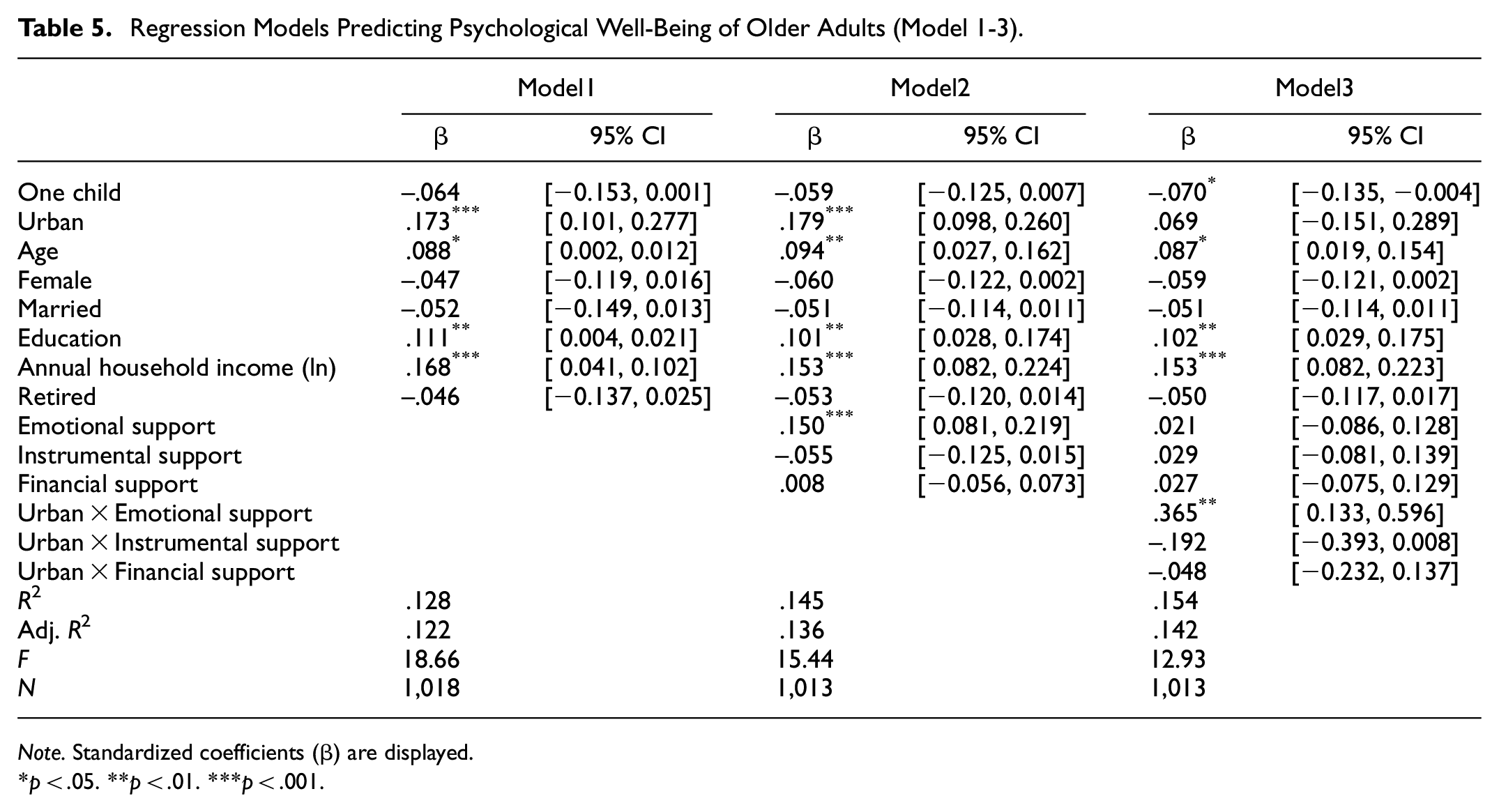
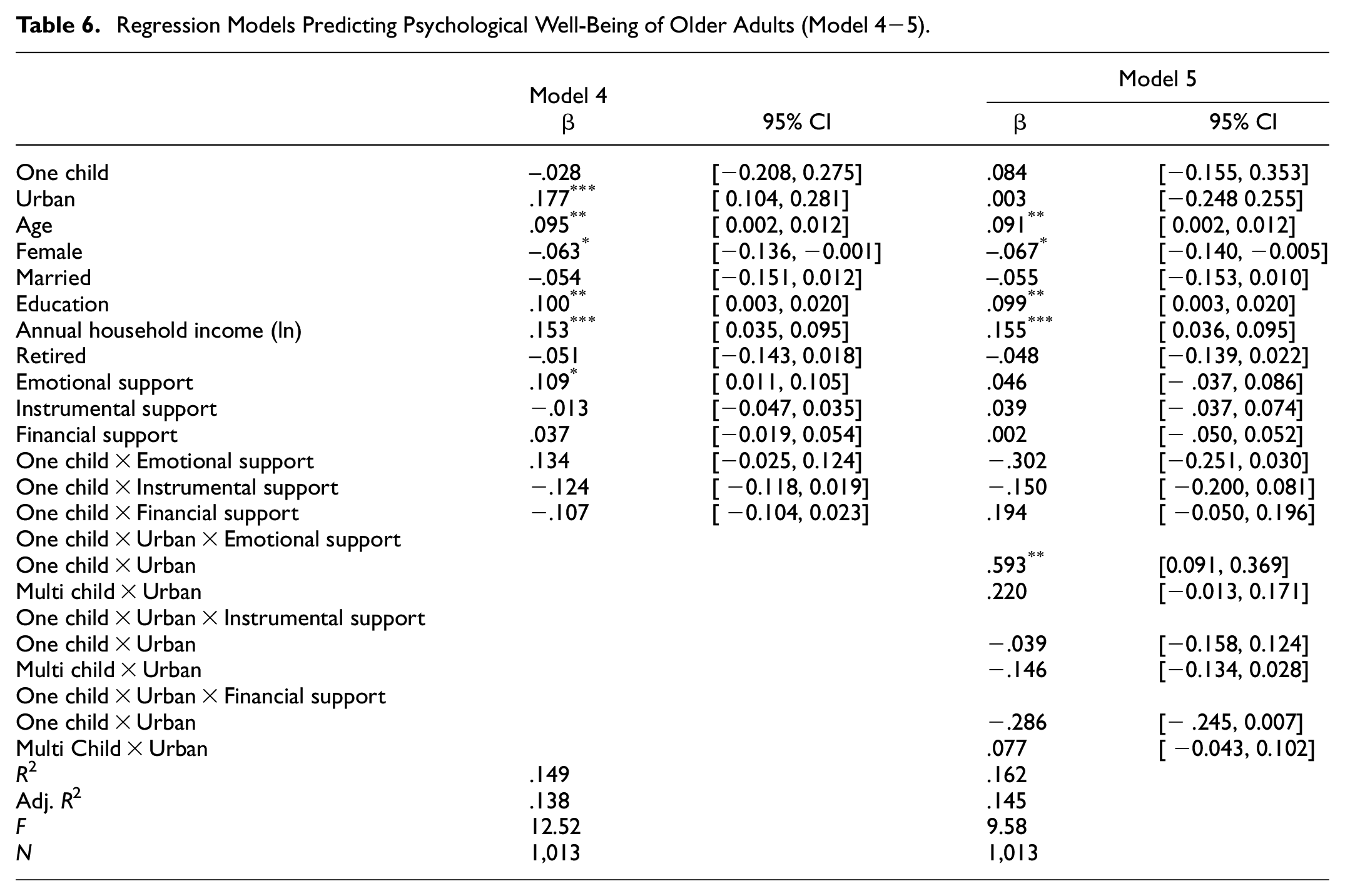
Then, we examined older people’s psychological well-being (Tables 5 and 6). Model 1 showed urban older adults were better in psychological well-being than their rural peers, β urban = 0.173, p < .001. The effect of number of children was not significant. In Model 2, we added children’s support. Only emotional support significantly predicted psychological well-being, β = .150, p < .001. And urban older adults were still significantly better in psychological well-being than rural older adults, β urban = 0.179, p < .001. Last, we added interaction terms and the interaction of urban and emotional support was significant, β urban*emotional support = 0.365, p < .01. For urban older adults, emotional support was significantly important in predicting psychological well-being, B = 0.127, SE = 0.024, p < .001, but not for rural older adults, B = 0.011, SE = 0.028, p = .70, (Figure 2). Other interaction terms were not significant. Further, we examined whether the effects of support were moderated by number of children. Model 4 showed that all the interaction terms between number of children and provision of supports were not significant. In Model 5, we added three-way interactions of number of children, urban and support. The only significant three-way interaction term suggests that the emotional support was significantly important in predicting psychological well-being for urban parents with one child (Figure 2).
Regression Models Predicting Psychological Well-Being of Older Adults (Model 1-3).
Note. Standardized coefficients (β) are displayed.
*p < .05. **p < .01. ***p < .001.
Regression Models Predicting Psychological Well-Being of Older Adults (Model 4−5).

Psychological well-being of rural and urban older adults with on child and with multiple children by emotional support.
Discussion
The OCP in China has ended while its impact has extended into elderly care. This study examined the well-being of older adults who were limited to having a single child compared to those who had multiple children.
Well-Being of Older Adults With One Child
Our results showed that older adults with one child were not disadvantaged. They felt less depressed and were physically healthier than those with multiple children, and showed no differences in life satisfaction and in psychological well-being after controlling for all demographics. The associations between well-being and the number of children varied slightly across the four well-being indicators. Nevertheless, we consistently found that older adults with one child live fairly well.
Although many studies draw attention to the well-being of Chinese older adults, research varies in focus. Some studies test the urban-rural difference (e.g., F. Wu, 2022), examine the effects of living arrangements (e.g., Liu & Chen, 2022), and explore the effects of grandparenting (e.g., L. Chen et al., 2022). The most recent study to examine parental status and the well-being of older adults is nearly a decade old. Guo (2013) investigated parental status and older adults’ well-being in rural China based on a dataset from Anhui province. The results indicated that older adults with multiple children were indistinguishable from those with one child on depression measuring. Our results revealed that one-child parents were significantly better than those with multiple children in mental health, which is based on a less homogeneous national sample of both rural and urban respondents. Notably, our results suggest that the effects of the number of children do not differ between rural and urban areas.
Furthermore, we compared the well-being patterns of different age groups. The mean age of our sample is around 70 year old. Our findings indicated adults above 70 year old were significantly positive about their lives and felt less depressed. Compared with those with multiple children, older adults with one child showed a more stable subjective and mental well-being pattern. One possible explanation is that older adults with one child do not need to support their multiple children at earlier ages compared with those with more children (J. Chen & Jordan, 2018). The other possible explanation is that older adults with one child may be more independent, instead of holding on to the traditional belief of filial piety, that they neither expect a lot from their children nor rely on them (Liu, 2024; W. Zhang, 2022). For older adults with one child in urban areas where welfare system may lower their expectation of support from children.
It is noteworthy that this generation of older adults was forced to have only one child due to the OCP. Literature on the well-being of childless elderly indicates that there may be a difference between voluntarily and involuntarily childlessness. A recent study showed older childfree women reported high degrees of life satisfaction, perceiving themselves as more autonomous with greater environmental mastery (Stahnke et al., 2022). Future studies can follow the direction to examine the relationship between parental status and older adults’ well-being when parents are free from the birth control policy.
How to Support Older Parents With One Child
Substantial evidence demonstrated the benefits of children’s support (Grundy & Read, 2012). Our results showed that rural older adults received significantly more financial support than urban older adults. Older adults with multiple children received more emotional support than those with one child, while the difference was statistically small. The older the parents were, the more instrumental support they received.
Among three kinds of children support, emotional support is crucial to the psychological well-being of older adults. Receiving emotional support can help older adults buffer the effects of stressful events and promote psychological well-being (Bolger et al., 2000; X. Zhang & Silverstein, 2021). Moreover, we found that urban older people valued emotional support more. The revealed interaction effects could be linked to the context of elderly care. In our sample, more than 78% of one-child older parents lived in urban areas. Y. Zhang and Goza (2006) examined this generation of one-child parents 15 year ago. At that time, they were middle-aged parents who needed to care for both younger and older generations simultaneously, as the sandwich generation. The interviews revealed that most middle-aged parents in urban areas considered a more independent elderly care plan for themselves, while rural residents’ future retirement plans were limited due to poverty. A recent study examined elderly care plan of Chinese older parents, a consistent finding with previous study, showed that older adults with one child are more likely to choose institutional care than their peers with more children, who rely more on home care (H. Wu & Fan, 2022).
Furthermore, although urban older adults may accept to manage their later life independently, they still hold high expectations of emotional support from children, which did not change much from traditional filial piety (Tao & Liu, 2019; W. Zhang, 2022). Through participation in the decision-making process of their children’s nuclear family, parents want to cultivate a consultative relationship with their children (Zhong & He, 2014). The affluence of the only-child generation may alleviate the financial support burden (some older parents do not require such support), but they have no siblings to share the responsibility of emotional support (Tu, 2016). Future research should look into the continuation and changes of filial piety to comprehend the development of elderly care in China.
The importance of emotional support for the mental health of older adults was highlighted during the COVID-19 pandemic (e.g., Gorenko et al., 2021), as social distancing measures exacerbated feelings of loneliness. Providing support to older parents can be particularly challenging for only children. Scholars have advocated for digital inclusion initiatives targeting older adults, as enabling them to maintain social connections can help mitigate the negative impact of future lockdowns on their well-being (Y. Xu & Zhou, 2023; Zhou et al., 2022). Moreover, given the long-standing consequences of OCP—the rapid aging of the population, addressing the demographic shift and effectively navigating the country’s elderly care system will require sustained efforts and comprehensive policies (X. Chen et al., 2022; Y. Zeng & Chen, 2022).
Limitations
This study had a few limitations. Although in this study we examined both effects of parental status and urban/rural difference, parental status showed a unique contribution to the variance in older adults’ well-being beyond the effects of urban/rural difference. Also, it was difficult to clearly separate the urban effect and the effect of having one child given the two conditions greatly overlapped. In addition to the demographic variables we controlled for in the analysis, we acknowledge that other variables such as nonkin social capital, independence value orientation, and filial piety expectations, could contribute to the differences between urban and rural older parents. Future research could look into the complex urban-rural divide with more indicators. Furthermore, many variables were measured by single items. Self-assessed questionnaires were used to measure three of four well-being indicators and children’s support. The measurement period for the support provided by children was within 1 year, which could be a short-term measure. It could therefore be difficult to conclude whether support has a short- or long-term effect on well-being.
Conclusion
The present study was to understand the well-being of a unique cohort of older parents impacted by the OCP. Despite being forced to have one child, this generation of older adults showed no differences in life satisfaction and psychological well-being and was less depressed and physically healthier than parents with more children. Additionally, they showed a more stable subjective and mental well-being pattern over the course of aging. More children did not guarantee more financial and instrumental support, although we found more children could benefit older adults with more emotional support. older adults’ psychological well-being is significantly associated with emotional support from children, and urban older adults who were most one-child parents valued that more than their rural peers. The findings indicated the filial piety expectations might shift from financial support to emotional support, which is more so for urban older adults.
Footnotes
Appendix
Descriptive Statistics of Key Variables in Sample 2 by Urban-Rural Split.

| Urban | Rural | ||
|---|---|---|---|
| N = 657 | N = 600 | ||
| Emotional support (1–5) | 3.04 (1.06) | 2.85 (0.97) | 10.16** |
| Financial support (1–5) | 2.75 (1.25) | 3.05 (1.06) | 21.16*** |
| Instrumental support (1–5) | 2.77 (1.24) | 2.77 (1.11) | |
| Psychological well-being (1–6) | 4.30 (0.55) | 3.99 (0.49) | 92.58*** |
Declaration of Conflicting Interests
The author(s) declared no potential conflicts of interest with respect to the research, authorship, and/or publication of this article.
Funding
The author(s) disclosed receipt of the following financial support for the research, authorship, and/or publication of this article: This work was supported by the National Natural Science Foundation of China [71902113].
Ethical Statement
The authors certify that:
The work described has not been published previously.
It is not under consideration for publication elsewhere.
Its publication is approved by all authors.
The manuscript is the original work of the authors.
Informed Consent
This article does not contain any studies with human participants or animals performed by any authors.

Data Availability Statement
The data described in this article were derived from the Chinese General Social Survey (CGSS) at http://cnsda.ruc.edu.cn/index.php?r=projects/view&id=94525591.