




Abstract
There is increased interest in the field of cultural intelligence (CI) internationally, owing to globalization. CI seems to be a particularly important field in a country such as South Africa, which is regarded as one of the most diverse societies in the world. In this article, the relationship between CI, flourishing at work, and thriving at work is analyzed in the context of South African organizations. The purpose of the article is to establish whether CI positively influences flourishing and thriving at work. A survey study was conducted, which was quantitative. The quantitative data was collected by means of a structured questionnaire, which was distributed to a final sample of 366 individuals working at South African organizations. The findings show that CI promotes flourishing at work, and they show that flourishing at work and thriving at work are related. They also indicate that emotional well-being and social well-being mediate the influence of CI on thriving at work, such that the indirect effects are positive and significant. The findings of the study indicate that CI is important in advancing mental health in the workplace. They also point to the importance of CI in a diverse country to promote flourishing and thriving at work. CI is thus important not only when leaders are on international assignments, but also in diverse settings. Through promotion of positive outcomes such as flourishing and thriving at work, organizations functioning in diverse settings are likely to become more effective and competitive.
Keywords
Introduction
The phenomenon of globalization has led to international borders becoming more permeable, and this has resulted in increased interaction in different aspects of human life, with greater interdependence, cultural homogenization, and cultural diversification (Margaras, 2017). This cultural diversification of workplaces has led to a rapid increase in cross-cultural interaction in the organizational context (Chua, 2016; Lee & Sukoco, 2010), which calls for organizational leaders and members to become more sensitive to cultural differences, as well as policy development to promote organizational performance (Du, 2018). Due to the complexities associated with cultural diversity and cross-cultural interaction, leaders are often oblivious to their own cultural prisms through which they perceive others (Solomon & Steyn, 2017). Consequently, executives across the globe have named cross-cultural leadership the top management challenge for the 21st century, which requires that leaders be culturally intelligent (Lin, 2018; Livermore, 2010). Although cognizance is taken of globalization, which has led to diversification of workplaces, South African workplaces have become increasingly diverse over the past two decades, owing to national transformation (Mazibuko & Govender, 2017). South Africa is described as one of the most diverse societies in the world (Gören, 2013), as it is home to 11 official languages, nine of which are African languages with associated cultures (Babane & Maruma, 2017). The South African society is described as fragmented, often troubled, and rife with contradictions (Howell, 2019). Howell (2019) mentions contradictions such as the fact that the Constitution of the country promotes equality and a non-racial society but that South African society is racially defined and is one of the most economically unequal societies in the world, where inequality correlates with race. This makes advancement of CI and appreciation of cultural diversity (Ramos & Schleicher, 2018) in a very unstable and segregated economic, social, and political environment imperative.
One of the factors contributing to the turmoil in the external environment in which organizations are functioning is the limited cross-cultural interaction, which suggests limited culturally intelligent interaction prior to 1994 (Licki & van der Walt, 2021). It is only since 1994, when South Africa became democratic, that the multicultural nature of the country has been embraced and promoted (van der Walt & de Klerk, 2015). However, multicultural policy seems to be inadequate, and it needs to be replaced with intercultural dialog based on equal dignity and shared values (Bogoliubova & Nikolaeva, 2017). Unfortunately, limited exposure to different cultures prior to 1994 has contributed to the lack of intercultural dialog, and consequently CI, in society in general, and also in workplaces (Crowne, 2013; Pavlova, 2014). Llopis (2011) argues that the lack of CI may be regarded as an organizational weakness, due to the negative impact it has on the retention of diverse employees and organizational competitiveness. Besides this, effective management of diversity could promote holistic well-being (Celikdemir & Katrinli, 2020), that is, flourishing and thriving of employees through creative engagements, and this requires CI. It is possible that an employee’s well-being could easily suffer through their inability to function and interact effectively in multicultural organizations, owing to negative emotions experienced during ineffective engagements (Huppert, 2009). Similarly, such individuals may possibly fail to thrive throughout life, in particular during their working life, because of the complexities involved in diverse engagements (Bundick, 2010). By contrast, culturally intelligent individuals, who are respectful and supportive of different individuals and their cultures, will most probably thrive and flourish to a greater degree than those who are not culturally intelligent. This is mainly because CI brings about effective interactions with individuals from other cultures, not only globally, but also within national borders (Licki & van der Walt, 2021).
It should, however, also be acknowledged that the African culture is much more diverse and heterogeneous in nature than Western cultures (Coleman, 2017). Twinomujuni (2017) suggests that Africa has different ethical perspectives, simply because African people have closer social behavioral connections than individual ones. The conflicting world views and group interests between African people and European people have led to Africans often not showing much regard for European cultural values, and therefore “[regarding] any notion of inter-cultural dialog with deep suspicion” (Adeleke, 2015, p. 209). This hampers dialog with other cultures, and, as such, the effectiveness of cultural engagements will suffer. Apart from this general disregard for different cultural values, the main difference between Afrocentrism and Eurocentrism seems to be that Africans operate collectively (Theron & Liebenberg, 2015), while Europeans tend to operate individually (Lago & Manuel, 2017). It is therefore important that CI is understood from an African perspective, to prevent intergroup conflict and group hostility in the organizational context.
Previous research studies on CI have generally considered the CI of international leaders working in different countries (Ang et al., 2007; Ramsey & Lorenz, 2016). Although cognizance is taken of the importance of CI in this context, this article focuses specifically on CI in a highly diverse society that has not fully embraced the value of cultural diversity. When one considers the diverse nature of South African society, and also its workplaces, one realizes that without CI one may find it increasingly difficult to flourish and thrive. This is because the contemporary employee does not work just to earn a fair wage at the end of the month, but also to find meaning in their lives and to contribute to the world at large (de Klerk et al., 2009). This change can mainly be attributed to employees wanting to be recognized as holistic individuals and work becoming more central and a critical part of their lives (van der Walt & de Klerk, 2015). van der Walt and de Klerk (2015) assert that employees are therefore increasingly relying on organizations to provide them with community structures, for them to find meaning and purpose in their lives, which may be enhanced by effective cross-cultural interactions. To achieve this, employees need to be supported by co-workers and management that are culturally intelligent.
Since the constructs of CI, flourishing at work, and thriving at work may be regarded as positive qualities, they are likely to enhance happiness in the context of the workplace (van der Walt & Lezar, 2019). Pennock and Alberts (2016) assert that positive psychology yields valuable insights regarding the experience of a happy and fulfilling life, and that it also provides useful tools that enable people not only to cope with difficult times in life, but also to flourish. Due to the fact that the general South African population is experiencing political uncertainty, violence, xenophobic attacks, corruption, and bribery, it is necessary to consider personal resources such as CI to promote flourishing and thriving. CI is also likely to promote insight into the behavior of culturally diverse people, which may help them to become more skillful at effectively interacting with people from other cultures, which is critical for organizational effectiveness.
The purpose of this study was to establish whether CI positively influences flourishing at work and thriving at work using a cross-sectional design. The reason for this is that sufficient research has not been conducted to establish whether CI is a personal resource which can advance flourishing at work and thriving at work. Furthermore, the constructs of CI, flourishing, and thriving may be regarded as positive qualities, which are likely to enhance happiness in the work context. Within the theoretical framework of positive psychology, these positive qualities would be an antidote to negative work behavior, which is costly to organizations and organizational members (Zhong & Robinson, 2021). Against this background, the primary objective of the study was to establish whether CI has a positive influence on thriving at work. The secondary objective of the study was to determine whether flourishing at work (i.e., emotional, psychological, and social well-being) mediates the relationship between CI and thriving at work.
In the following section, a literature review of CI, thriving at work, and flourishing at work is provided. This is followed by an explanation of the conceptual framework of the study and the research methodology employed, followed by a presentation of the findings of the study, and, lastly, a discussion of the findings and their implications.
Literature Review
Cultural Intelligence
The construct of CI evolved from the cognitive perspective of intelligence, which is concerned with the way people use their intelligence, thus their information-processing strategies (Weiten, 2013). Gardner (1983) proposed the theory of multiple intelligences, which identifies a number of relatively autonomous human intelligences. CI as a form of intelligence may be regarded as a theoretical extension of this theory (Solomon & Steyn, 2017). In Africa, conceptions of intelligence “revolve largely around skills that help to facilitate and maintain harmonious and stable intergroup relations” (Sternberg & Grigorenko, 2004, p. 1432). This assertion confirms the importance of social aspects of intelligence in the African context, and thus the importance of CI to create harmonious and stable relations between different cultures in the organizational context.
Although several different definitions of CI have emerged over time, it seems that scholars are in consensus regarding the conceptualization of CI. Harrison and Brower (2011) define CI as having the ability to adapt across various cultures successfully. Similarly, Rockstuhl et al. (2010) define CI as the capacity of individuals to function effectively in multicultural contexts. CI is also defined as an individual’s capacity to function and manage tasks effectively in culturally diverse settings (Ng et al., 2012). For the purposes of this article, CI is defined as the capacity to function effectively in a complex multicultural environment.
Scholars (Ang et al., 2007; Lovvorn & Chen, 2011) regard CI as consisting of four interrelated components, namely cognitive, metacognitive, motivational, and behavioral CI. The cognitive dimension has three sub-dimensions, namely cultural systems (i.e., the way societies organize themselves to meet the basic needs of their members), cultural norms and values (which include issues such as time, authority, and relationships), and cross-cultural judgment and decision-making (Livermore, 2010). According to Livermore (2010), the motivational dimension of CI refers to an individual’s confidence and drive to adapt cross-culturally and to persevere through cross-cultural challenges. The three sub-dimensions of the motivational dimension of CI are intrinsic motivation, or joy, which can be derived from interacting with other cultures; extrinsic motivation, which refers to the value derived from living and working with different cultures; and self-efficacy, which is confidence in oneself to succeed at working with other cultures (Ng et al., 2012). The third dimension, termed “behavioral CI,” refers to the individual’s ability to act appropriately in a range of cross-cultural situations (Livermore, 2010). This dimension of CI refers to a person’s ability to exhibit appropriate verbal and non-verbal communication when interacting with people who are culturally diverse (Schalk & van der Linden, 2011). The fourth dimension is metacognitive CI, which refers to an individual’s ability to strategise across cultures, which requires cultural understanding in order to solve culturally complex problems (Livermore, 2010). Blasco et al. (2012) assert that it is the metacognitive dimension that distinguishes CI from constructs such as cross-cultural and intercultural competence, a global mindset, social intelligence, and emotional intelligence. This assertion is based on the premise that the metacognitive dimension includes the facets of behavior, mindfulness (or motivation), and knowledge, and thus enables people to be culturally intelligent.
Thriving at Work
Thriving at work is regarded as a psychological or an affective-motivational state which can be shaped, or influenced, by the work context (G. M. Spreitzer et al., 2010). The socially embedded theory of thriving regards the concept of thriving as progress, or forward movement, in one’s self-development (G. Spreitzer et al., 2005). Thus, thriving is not a fixed state or a disposition, but a continuous process that can be facilitated by positive work experiences (G. Spreitzer & Porath, 2012). The importance of contextual features is also asserted by Ryan and Deci (2000), who propose that people have the capacity to grow and develop, but the success thereof depends on the context in which they act (G. Spreitzer et al., 2005). This suggests that it is possible to cultivate thriving through the creation of supportive working environments, which includes resources and relationships. It is therefore assumed that organizational cultures that embrace cultural diversity through the development of CI enhance the experience of thriving at work.
Thriving consists of the dual components of vitality and learning (G. M. Spreitzer et al., 2010). Vitality refers to being alive, passionate, and excited, while learning refers to the growth that comes from gaining new knowledge and skills (G. M. Spreitzer et al., 2010). Since CI encompasses advanced knowledge of oneself and other cultures and cross-cultural skills, it is likely to lead to personal growth, and thus the learning component of thriving will be advanced. Boyd (2015) asserts that increased knowledge helps individuals to expand their search for answers beyond what they already know, and that it fosters heedful relating through information exchange, which leads to an improved collective understanding of individual connections in the work context. However, thriving is a joint experience of learning and vitality, which suggests that although a person is learning, it is possible that they may feel depleted (lacking in vitality), and the experience of thriving will therefore be limited (G. Spreitzer & Porath, 2012). It is also possible that CI may enhance the passion and excitement of people about their work, because they will cope much more effectively with diversity, and they will possibly establish meaningful relationships with culturally diverse individuals.
Thriving at work is enhanced through job resources such as physical (performance feedback, skill variety, task identity), psychological (supervisor and co-worker support), social (team climate), and organizational (salary, job security, role clarity) considerations (Rothmann, 2017). A supportive supervisory climate implies that supervisors will value, assist, and show concern for employees, which will lead to more frequent and effective interactions (Boyd, 2015), which seems to be particularly important in culturally diverse workplaces. Thriving employees will not only be concerned with developing supportive relationships with others in the organization, and with their jobs, but they will also seek to contribute beyond their formal work, by searching for opportunities to engage in affiliative behaviors, such as helping others, sharing, and cooperating, thus exerting energy to go beyond the call of duty (G. Spreitzer & Porath, 2012). The aforementioned behaviors will be conducive to establishing supportive relationships between culturally diverse individuals. It should be noted, however, that thriving at work cannot be cultivated by merely decreasing stressors in the workplace, but it also requires an increase in the presence of specific psychological states, behaviors, resources, and contextual features (G. Spreitzer et al., 2005). This implies that a supportive working environment that promotes CI, as a behavioral factor, could promote thriving at work.
Flourishing at Work
Although flourishing was initially conceptualized in terms of general life, scholars such as Rothmann (2013) explain that it also occurs in organizational and work contexts (Redelinghuys, 2016). Bono et al. (as cited in Erum et al., 2020) regard flourishing employees as individuals that are self-motivated, successful, happy, and continuously learning in the context of the workplace. This positive state can be achieved by individuals through positive work experiences and effective management of job-related factors (C. L. Rautenbach, 2015). For the purposes of this study, flourishing at work will be regarded as holistic well-being consisting of three dimensions, namely emotional, psychological, and social well-being.
Emotional well-being encompasses the degree to which people judge their lives positively; this includes emotional responses and overall or domain satisfaction, such as life, work, family, and health satisfaction (G. Spreitzer et al., 2005). Stelzner and Schutte (2016) postulate that emotional well-being is more than experiencing a mood or emotions; it encompasses the experience of the good life, which includes high positive affect, low negative affect, and life satisfaction. Rothmann (2013) conceptualizes emotional well-being as a multidimensional construct consisting of the following three dimensions: employee judgments of job satisfaction, positive emotions (positive affect), and negative emotions (negative affect).
The second dimension of flourishing is psychological well-being. While emotional well-being is mainly concerned with the happiness of individual lives (Diener et al., 2009), psychological well-being is focused on enabling full human potential (Craven & Marsh, 2008). From the beginning of the psychological revolution, psychological well-being has been constructed as the most distinctive feature of living a healthier and satisfied life (Ryff & Keyes, 1995). This assertion is supported by Craven and Marsh (2008), who state that in efforts to get the most out of life, an individual should focus on how healthy, normal, and exceptional they can be; this will make them feel good about themselves. The scholars further state that individuals who feel good about themselves will exhibit happiness, motivation, low anxiety and depression, and academic striving behaviors.
Sagone and Caroli (2014) explain that psychological well-being consists of a set of psychological features which provide for positive human functioning. Ryff (1989), Ryff and Keyes (1995), and Rothmann (2013) state that psychological well-being is a multidimensional construct consisting of dimensions such as self-acceptance, environmental mastery, positive relations with others, personal growth, meaning and purpose in life, autonomy, competence, and work engagement.
The third dimension of flourishing at work is social well-being. Social well-being includes social acceptance (where the person is positive toward and accepting of diversity in people), social actualization (where they believe in the potential of others), social coherence (where they find society and social life meaningful and comprehensible), social contribution (where they regard their own daily activities as adding value to society and others), and social integration (where they experience a sense of relatedness, comfort, and support from the community) (Rothmann, 2013).
An individual flourishes when they experience high levels of at least one indicator of emotional well-being, and high levels of at least six indicators of psychological and social well-being (Rothmann, 2013). This shows that it is not enough merely to be satisfied with life in general, but one also needs to experience, for example, meaning in life and social acceptance to function well. Functioning well is not only a general life concern. Functioning well at work may hold positive organizational outcomes, and organizational leaders should therefore be concerned with employees’ level of flourishing at work.
In the following section, the relationship between CI, flourishing at work, and thriving at work is discussed, after which the conceptual framework of the study is presented, which is developed from the theoretical relationship established between the variables included in the study.
Hypothesis Development and Conceptual Framework
The Relationship Between Cultural Intelligence and Flourishing at Work
The relationship between emotional well-being and psychological well-being (two dimensions of flourishing at work) and CI has been investigated. According to Le et al. (2018), the most important dimension of CI is cognitive CI. Employees with high CI have been found to attain higher levels of cognitive CI, which means that they become more attuned and sensitive to changes in cultural systems, which allows them to adjust quickly and behave appropriately, to develop positive relations with others (a dimension of psychological well-being) (Thomas & Inkson, 2009). Thomas and Inkson (2009) state that developing positive relations with others will lead to a positive life status, which includes life satisfaction (a dimension of emotional well-being).
Regarding psychological well-being, Berry (2006), Berry et al. (1997), and Ward and Kennedy (2001) found that cross-cultural transition and adaptation generates stress, which suggests the need to appraise and cope with it through acculturation strategies, and so these factors influence psychological well-being (Chen, 2015). Ang et al. (2007) tested whether cultural adaptation, which includes psychological well-being, is related to CI for a US sample of undergraduate students. Their study found that two dimensions of CI, namely motivational CI and behavioral CI, are related to two forms of cultural adaptation, namely cultural adjustment and psychological well-being. In another study, conducted by Chen (2015), it was confirmed that CI was related to psychological well-being for a sample of indigenous students studying in the US.
A study conducted in India showed similar results, finding that CI is a significant predictor of acculturative stress and psychological well-being (Ayoob et al., 2015). Tzu-Ping and Wei-Wen (2017) found that metacognitive CI and motivational CI were statistically significantly related to psychological well-being for an international student sample studying in Taiwan. From the above discussion one may conclude that CI and its dimensions have been found to be related to psychological well-being, and that CI has also been found to be indirectly (through psychological well-being) related to emotional well-being.
Although the relationship between CI and social well-being has not been investigated before, it is assumed that employees with high levels of CI will experience higher levels of social well-being, because they function more effectively (i.e., psychological well-being) and feel good (i.e., emotional well-being). By functioning more effectively as an individual, and experiencing positive affect and life satisfaction, they should be able to fit into their workplaces and society in general through social structures.
Against this background, the following hypotheses are stated regarding CI and flourishing at work:
H1: CI has a positive influence on emotional well-being.
H2: CI has a positive influence on psychological well-being.
H3: CI has a positive influence on social well-being.
The Relationship Between Flourishing at Work and Thriving at Work
It has been asserted that thriving at work guides employees in goal-directed activities and across changing circumstances, and that it contributes to positive mental and physical health (G. Spreitzer et al., 2005). It is further postulated that thriving encompasses psychological well-being (Xu et al., 2016). It is possible that emotional well-being (a dimension of flourishing at work) may be associated with thriving at work. In this regard, a study conducted by G. Spreitzer and Porath (2012) found that thriving employees also often experience job satisfaction (a component of the emotional intelligence dimension of flourishing at work). It is further argued that for an individual to experience life satisfaction (a component of the emotional intelligence dimension of flourishing), they need to show enthusiasm during the delivery of their daily tasks, whether at work or in their personal lives (Williamson, 2011). Calitz (2013) confirms that it is through passionate engagement during work (i.e., vitality) that workers will perform successfully, with the benefit of positive health and emotions.
Against this background, the following hypotheses are stated regarding flourishing at work and thriving at work:
H4: Emotional well-being has a positive influence on thriving at work.
H5: Psychological well-being has a positive influence on thriving at work.
H6: Social well-being has a positive influence on thriving at work.
The Relationship Between Cultural Intelligence and Thriving at Work
Thriving at work is a fairly new concept, and as far as could be established, this construct has not been studied in relation to CI. However, thriving at work holds many benefits for organizations, and study of this construct should therefore continue. Thriving at work and work engagement have often been equated, because both of these constructs are regarded as affective-motivational states associated with positive energy or passion for work (G. M. Spreitzer et al., 2010). In this regard, Schalk and van der Linden (2011) postulate that when one invests in CI, it is likely to improve employee engagement in cross-cultural supervisor–employee interactions. The findings of their study show that higher CI of a leader is associated with higher engagement by employees. It is thus expected that higher levels of CI may also possibly be associated with higher levels of thriving at work. Due to the focus on positive energy or passion for work, one may expect CI to possibly influence the vitality dimension of CI. Liu et al. (2021), in their meta-analytic review of the antecedents of thriving at work, refer to research that found that workplace friendships and social functioning are antecedents of thriving at work. They state that the personal development dimension of thriving at work depends to a large extent on dynamic interactions of others. When considering the culturally diverse work context in which employees function, one may assume that CI will promote dynamic interactions and workplace friendships between employees of different cultures. Against this background, the following hypothesis is stated regarding CI and thriving at work:
H7: CI has a positive influence on thriving at work.
The Indirect Relationship Between Cultural Intelligence, Flourishing at Work, and Thriving at Work
Since more emphasis has been placed on the relationship between CI and the dimensions of flourishing at work, which have been argued to be related to thriving at work, as was discussed in the previous sections, the indirect relationship between CI and thriving at work is also investigated. Based on the proposed relationships between CI, flourishing at work, and thriving at work, the following indirect relationships are tested:
H8: Emotional well-being mediates the influence of CI on thriving at work, such that the indirect effect is positive.
H9: Psychological well-being mediates the influence of CI on thriving at work, such that the indirect effect is positive.
H10: Social well-being mediates the influence of CI on thriving at work, such that the indirect effect is positive.
Figure 1 depicts the proposed conceptual model for the study.

The conceptual model for the study, depicting the relationship between cultural intelligence, flourishing at work, and thriving at work.
The research purpose, objectives, and hypotheses, and the conceptual framework, informed the research method employed in this study, which is discussed in detail in the following section.
Research Method
Research Design
To address the purpose of the study, the study was approached from a positivist stance, because it is acknowledged that external reality exists separately from how it is perceived by the researchers (i.e., objectivism) (Hirschsohn, 2021). The stated hypotheses were assessed using a quantitative research design, which was descriptive in nature. By using a descriptive research design, the relationship between CI, thriving at work, and flourishing at work could be assessed and described as objectively as possible. Primary data was solicited from working individuals who could mindfully complete the structured questionnaire. Data was collected once off by using survey research; as such, the study was cross-sectional in nature (Leedy & Ormrod, 2013).
Sampling
Although it was initially decided that the most appropriate sampling method would be simple random sampling, it was not possible to use this sampling method. The reason for this is that the researcher had to make use of employees that were available and could provide the required information, and the convenience sampling method was therefore used (Hair et al., 2016, p. 183). The final sample for this quantitative study consisted of 366 individuals working at South African organizations and resident in the same geographical area.
From the demographic variables, the sample of the study can be described as mostly female (63%), black African (71%), between the ages of 31 and 40 years (35%), married (48%), permanently employed (94%), having 5 or fewer years’ working experience (26%), holding a certificate or a diploma qualification (43%), employed in skilled occupational categories (43%) in the private sector (63%) in the medical service industry (27%), and having 10 or fewer years’ managerial experience (76%). The study sample is similar to the study population in terms of race. It is estimated that 75% of the South African workforce is black African, and 46% are women (Statistics South Africa, 2022). Thus, in terms of women, a greater proportion of women were included in the current sample than the proportion of women in the labor force (i.e., 46%). This is positive, as the South African government is placing much emphasis on gender equality in the workplace, and it is therefore important to note the views of women in the work context.
Measuring Instrument
After considering the content of the established questionnaire used, the questionnaire was structured as follows. In Section A, participants had to provide information regarding sociodemographic variables, which was used to describe the sample. Section B consisted of questions related to CI. The Cultural Intelligence Scale (CIS) was used to measure CI. The CIS, developed by Ang et al. (2007), is a 20-item questionnaire, and answers are indicated on a 7-point Likert scale, with response options ranging from 1 (strongly disagree) to 7 (strongly agree). Examples of questions are “I can confidently socialize with locals in cultures that are unfamiliar to me” and “I change my non-verbal behavior when a cross-cultural situation requires it.”Mahembe and Engelbrecht (2014) reported that the CIS is a reliable and valid measure of CI for a South African sample.
In Section C, questions related to flourishing at work were listed. To measure flourishing at work, the Flourishing-at-Work Scale-Short Form (FWS-SF), developed by C. Rautenbach and Rothmann (2017), was utilized. The FWS-SF measures flourishing as a three-dimensional construct consisting of emotional well-being, psychological well-being, and social well-being. The questionnaire consists of 39 statements, and responses are indicated on a 6-point Likert scale, with response options ranging from 1 (never) to 6 (every day). Examples of questions are “During the past month at work, how often did you experience satisfaction with your job?” and “During the past month at work, how often did you feel that your work makes a difference to the world?”C. Rautenbach and Rothmann (2017, p. 308) found the questionnaire to be a valid and reliable measure for a South African sample. Section D measured thriving at work by means of the Thriving at Work (TAW) questionnaire, developed by Porath et al. (2012). The questionnaire consists of 10 statements measuring two factors, namely learning and vitality. Responses are indicated on a 7-point Likert scale, with response options ranging from 1 (strongly disagree) to 7 (strongly agree). Examples of questions are “At work, I find myself learning often” and “At work, I have energy and spirit.” In a study conducted by Van der Walt (2018, p. 7), the validity and the reliability of the TAW scale were confirmed for a South African sample.
Once the data collection phase of the study was completed, the data was captured and analyzed. The data analysis process and plan is discussed in the following section.
Data Analysis
To assess the relationship between CI, thriving at work, and flourishing at work, partial least squares structural equation modeling (PLS-SEM) was used, which is a variance-based approach to structural equation modeling (SEM). PLS-SEM is “based on an iterative approach that maximizes the explained variance of endogenous constructs,” which is similar to a multiple regression analysis (F. Hair Jr et al., 2014, p. 107). PLS-SEM allows for measuring the directional relationship between exogenous (independent) constructs and the endogenous (dependent) construct (Hayes, 2018). The statistical software program used was SmartPLS version 3.2.8. The reason for this choice of software was that the study involved theory building, not theory testing. The software also allows for empirical testing of direct, indirect, and total effects, which are required for the purposes of the study (Hayes, 2018). Evaluation of the structural model using PLS-SEM is a two-stage process (Hussain et al., 2018). During the first step, the quality of the measurement model (also referred to as the outer model) was assessed, using the criteria for reflectively measured constructs. To assess the quality of the measurement model, internal consistency reliability was assessed for each construct by means of the Cronbach’s alpha value and the composite reliability (CR) value. For evidence of internal consistency reliability, both the Cronbach’s alpha value and the CR value should be .7 or higher. To assess convergent validity, the outer loadings must be 0.7 or higher and must be statistically significant (p ≤ .05 [two-tailed]) to provide evidence of indicator reliability as part of examining the convergent validity of the measurement of a construct. Also, the average variance extracted (AVE) for each construct must be 0.5 or higher. An item with a loading between 0.4 and 0.7 should be considered for removal only if removal of the item will increase the internal consistency reliability of the construct and/or the AVE of the associated construct above the minimum value.
To assess discriminant validity, the heterotrait-monotrait (HTMT) ratio of correlations was applied, as recommended by Sarstedt et al. (2017). For evidence of discriminant validity, the HTMT ratio must not exceed 0.85. To assess the structural model (also referred to as the inner model), the procedure recommended by Sarstedt et al. (2017) was followed. First, collinearity was assessed using the variance inflation factor (VIF), which must not exceed 5.0. Next, the path coefficients of the structural model were assessed. The statistical significance of the path coefficients was determined by applying a two-tailed test and using the bias-corrected bootstrap confidence interval (BCCI) for p-values close to .05 (two-tailed). Testing of the mediation hypotheses (H8–H10) entailed a mediation analysis.
Assessment of the Outer Model
The validity and reliability results of the assessment of the measurement model of the second-order constructs are presented in Table 1.
Validity and Reliability Results of the Assessment of the Measurement Model of the Second-Order Constructs.

From the results presented in Table 1, one can see that all measurements are above the recommended values for Cronbach’s alpha, CR, and AVE, except in the case of emotional well-being. The Cronbach’s alpha for emotional well-being is −.082, and the CR is 0.5. The low internal consistency of emotional well-being can be attributed to the negative outer loading of negative affect (−0.617; p = .000). For the other two dimensions of emotional well-being, the outer loadings exceed 0.8 and are statistically significant. According to Hair et al. (2016), the criteria for a second-order factor are that all first-order factors should influence other nomologically related constructs in the same way, and that the second-order construct must meet the minimum conditions for good measurement practice. Neither of the two criteria was met in the case of negative affect, as a dimension of emotional well-being. Therefore, negative affect was excluded from the measurement of emotional well-being. After removing negative affect from the measurement of emotional well-being, the measurement model was again assessed for internal consistency and convergent validity. The validity and reliability results of the assessment of the modified measurement model of the second-order constructs are presented in Table 2.
Validity and Reliability Results of the Assessment of the Modified Measurement Model of the Second-Order Constructs.

As seen in Table 2, the outer loading of each first-order factor is higher than 0.4, and is statistically significant. The Cronbach’s alpha and the CR values of each second-order construct exceed .7, and the AVE of each second-order construct also exceeds 0.7.
In Table 3, the results of the HTMT ratios of correlation for the second-order factors in combination with social well-being are presented.
HTMT Ratios of Correlation.

The results presented in Table 3 show that the second-order factors in combination with social well-being also provide sufficient evidence of discriminant validity, as the HTMT ratio of correlation for each pair of constructs does not exceed .85.
Assessment of the Inner Model
In Figure 2, the results of the hypothesis testing are presented.
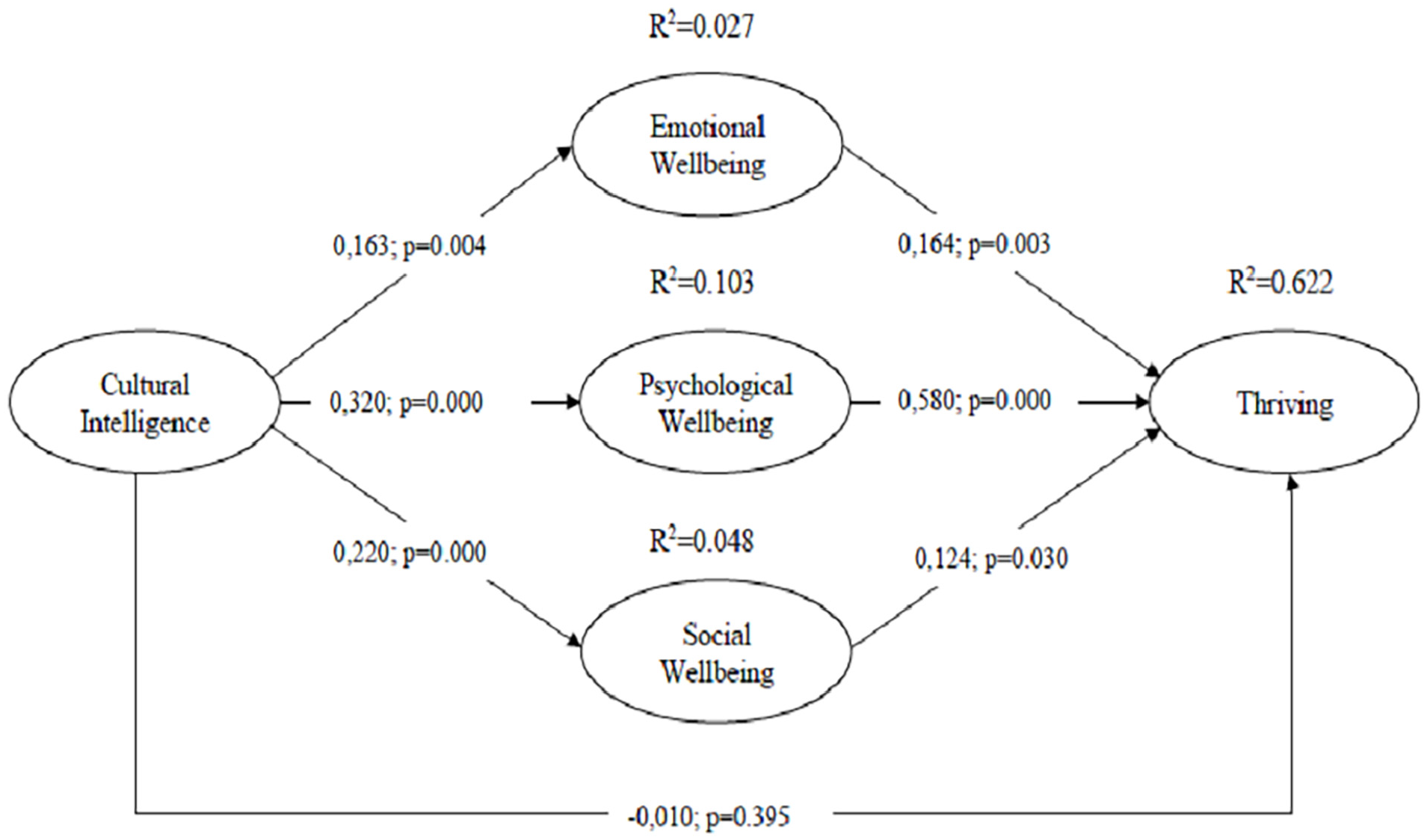
Results of the main effect.
The predictive accuracy of the model depicted in Figure 2 is good (R2 = 62.2%). As seen in Figure 2, CI has a positive and statistically significant influence on emotional well-being (0.163; p = .004 [one-tailed]), psychological well-being (0.320; p = .000 [one-tailed]), and social well-being (0.220; p = .000 [one-tailed]). The influence of emotional well-being (0.164; p = .003 [one-tailed]), psychological well-being (0.580; p = .000 [one-tailed]), and social well-being (0.124; p = .030 [one-tailed]) on thriving at work is statistically significant. Lastly, the direct effect of CI on thriving at work is not statistically significant (–0.010; p = .395).
From the findings presented, the following hypotheses are accepted:
H1: CI has a positive influence on emotional well-being.
H2: CI has a positive influence on psychological well-being.
H3: CI has a positive influence on social well-being.
H4: Emotional well-being has a positive influence on thriving at work.
H5: Psychological well-being has a positive influence on thriving at work.
H6: Social well-being has a positive influence on thriving at work.
The following hypothesis is rejected, based on the findings presented:
H7: CI has a positive influence on thriving at work.
Indirect effects were also computed for the influence of CI on thriving at work through emotional well-being, psychological well-being, and social well-being. The results of the indirect effects are presented in Table 4. The table shows that the indirect influence of CI through emotional well-being and social well-being on thriving at work is statistically significant, but not the indirect influence through psychological well-being. Considering that the direct effect is not statistically significant, and the total effect is 0.230 (p = .000 [one-tailed]), it can be concluded that the three mediators of the relationship between CI and thriving at work fully mediate the relationship.
Indirect Effects.

From the findings presented regarding the indirect relationship between CI and thriving at work, the following hypotheses are accepted:
H8: Emotional well-being mediates the influence of CI on thriving at work, such that the indirect effect is positive.
H10: Social well-being mediates the influence of CI on thriving at work, such that the indirect effect is positive.
The following hypothesis is rejected, based on the findings presented regarding the indirect relationship between CI and thriving at work:
H9: Psychological well-being mediates the influence of CI on thriving at work, such that the indirect effect is positive.
In the following section the findings of the study are discussed, as well as the practical implications of these. The limitations of the study are then discussed, and recommendations are made for future research.
Discussion and Practical Implications
The primary objective of the study was to establish whether CI has a positive influence on thriving at work. From the findings presented in Figure 2, it is evident that CI does not have a statistically significant influence on thriving at work. This finding contradicts the findings of Ren et al. (2021), who found that CI, as a personal resource, had a direct influence on thriving at work. However, their sample consisted of expatriate teachers in the United States. The scholars argue that CI, as a personal resource, helps expatriates to cope better with the uncertainty involved in international relocation. It is thus possible that this uncertainty that employees experience when relocating to a new country and culture increases the need for CI, to cope and thrive in unfamiliar territory. The fact that the current sample works in a country that they most likely grew up in could possibly reduce uncertainty, and, as such, CI is not necessarily a personal resource required to thrive at work when investigating CI in the context of the same country one grew up in.
Furthermore, since CI encompasses advanced knowledge of oneself and other cultures and cross-cultural skills, it is likely to lead to personal growth, and the learning component of thriving will thus be advanced. Boyd (2015) asserts that increased knowledge helps individuals expand their search for answers beyond what they already know, and it fosters heedful relating, through information exchange, which leads to improved collective understanding of individual connections in the work context. However, thriving is a joint experience of learning and vitality, which shows that although a person may be learning, it is possible that they may feel depleted (lacking in vitality), and the experience of thriving will thus be limited (G. Spreitzer & Porath, 2012) or potentially absent.
The secondary objective of the study was to determine whether flourishing at work (i.e., emotional, psychological, and social well-being) mediates the relationship between CI and thriving at work. Although CI was not statistically significantly related to thriving at work, it was found that it was statistically significantly related to the dimensions of flourishing at work (i.e., emotional well-being, psychological well-being, and social well-being). In terms of the relationship between CI and emotional well-being, Le et al. (2020) found that the metacognitive dimension of CI is positively and statistically significantly related to subjective well-being. Furthermore, the job satisfaction dimension of emotional well-being has been found to be positively related to CI (Bal & Kökalan, 2022; Licki & van der Walt, 2021). The relationship established between CI and psychological well-being confirms the findings of Chen (2015) and Ayoob et al. (2015) that CI influences psychological well-being, despite the differences in context and samples between those studies and the current study. The findings of the current study also show that CI is positively related to social well-being. Despite the fact that this relationship has not been confirmed, it was assumed that CI will influence social well-being, because employees that are culturally intelligent function more effectively (i.e., psychological well-being) and feel good (i.e., emotional well-being).
Simard and Parent-Lamarche (2022) assert that negative aspects of psychological health are more dominant in scientific literature than positive aspects, that is, psychological well-being as a positive state. This is concerning if one considers that employees are faced with myriad challenges in the internal and external working environment, and need to be psychologically healthy to function well, cope, and flourish. The established relationship between CI and the dimensions of well-being may be indicative of employees’ desire to establish favorable social relationships with culturally diverse others, to advance their satisfaction and happiness at work. Feeling socially connected at work with culturally diverse others may also help employees to experience their work as meaningful. As such, it is important that organizations remain focused on social interactions, and that they support employee assistance programs aimed at improving interpersonal communication and cross-cultural collaboration and understanding.
The findings showed that flourishing at work is statistically significantly related to thriving at work (see Figure 2). Therefore, it was expected that emotional well-being, psychological well-being, and social well-being would indirectly influence the relationship between CI and thriving at work. This expectation is consistent with the socially embedded theory of thriving, which postulates that personal resources such as positive meaning, which could be associated with psychological well-being; affective resources, which could be associated with emotional well-being; and relational resources, which could be associated with social well-being, promote thriving at work.
The findings further show the significant role that emotional well-being and social well-being play in mediating the relationship between CI and thriving at work. It is possible that employees may feel more comfortable and satisfied when they have high levels of CI, because they can engage more effectively with diverse others, which may increase their level of thriving. The opposite may also be true, namely that despite being culturally intelligent, cross-cultural engagements may be a source of frustration (i.e., negative affect) for employees, which may decrease their level of thriving at work.
Furthermore, based on the findings of this study, social well-being may be an outcome of CI, and it may be a potential antecedent of thriving at work, because social well-being may potentially enhance resources such as positive meaning, sense of knowledge, and relational resources, which promote thriving at work. Regarding psychological well-being, it was found that this dimension of flourishing at work does not mediate the influence of CI on thriving at work such that the indirect effect is positive. It is possible that psychological well-being, as an independent dimension, may be required to cope at work, rather than to thrive at work. However, the absence of psychological well-being may potentially affect coping, and may indirectly affect employees’ ability to thrive at work. The findings of the study suggest that organizations need to focus their efforts on developing employees’ CI and well-being, to ensure that they cope and thrive in increasingly culturally diverse working environments.
Limitations and Recommendations
The study has a number of limitations. Firstly, it was not possible to use the simple random sampling method to select the sample, as was initially planned. The reason for this is that the participating organizations could not provide the researcher with sampling frames to draw the sample from the target population. The researcher also had to make use of employees that were available and willing to complete the research questionnaire, and, as such, the convenience sampling method had to be used to select the sample. However, despite this limitation, care was taken to ensure a sample size that was large enough for rigorous data analysis. This shortcoming implies that the findings of the study cannot be generalized and must be interpreted with caution. However, the study was developmental in nature, and, as such, the findings can be used as the basis to confirm theory in subsequent studies. Secondly, only one measure was used for CI, for flourishing at work, and for thriving at work. Although the ideal would have been to use more than one measuring instrument for each construct, it was not possible due to time constraints and practical considerations. The questionnaire already consisted of 79 questions, and including additional questions could have overburdened respondents and lowered the response rate. Care was taken to confirm the psychometric properties of the questionnaires for the current sample.
It is not only CI that has not been extensively researched in the South African context. Flourishing at work and thriving at work have also not received sufficient attention in academic research. Although these are fairly new constructs, more research is needed to consider the personal and contextual resources that could promote flourishing at work and thriving at work. Expanding research in this area could possibly help organizations to curb the challenge of mental illness, which seems to be rampant in South Africa (Sinkins, 2020). The dearth of empirical studies on thriving at work and flourishing at work also suggests that more research needs to be conducted to confirm and calibrate the psychometric properties of the measuring instruments used to measure flourishing at work and thriving at work.
Conclusion
This study sought to contribute to theory development of CI and mental health research in a culturally diverse society and multicultural work context. Theoretically, the study contributes to expanding knowledge regarding CI, flourishing at work, and thriving at work, by establishing that various direct and indirect relationships exist between these constructs, which have not previously been reported on in this context. It was found that although there is not a direct relationship between CI and thriving at work, flourishing at work plays an important role in mediating this relationship. Of particular importance is that emotional well-being and social well-being mediated the relationship between CI and thriving at work. Practically, the findings of the study could be useful to organizations that are striving to promote cross-cultural interactions and mental health to create harmonious working environments. Through this advanced understanding of CI, it is possible to reduce the current divides and mental health concerns in South African workplaces, including, but not limited to, culturally diverse organizational members, which may result in social cohesion and organizational success in this complex work context.
Footnotes
Declaration of Conflicting Interests
The author(s) declared no potential conflicts of interest with respect to the research, authorship, and/or publication of this article.
Funding
The author(s) received no financial support for the research, authorship, and/or publication of this article.
