




Abstract
This study investigates the mediating effect of brand experience on the relationship between customer motivation and engagement behavior and conceptualizes customer motivation from the multiple dimensions of information seeking, entertainment, and social interaction. Based on 565 valid questionnaires, it analyzes the impact of customer motivation on brand experience and customer engagement behavior using SPSS and AMOS. First, customer motivation with information seeking, entertainment, and social interaction significantly impacts customer brand experience. Second, customer brand experience significantly impacts customer engagement behavior of reuse, feedback, and WOM intentions. Finally, this study explores the mediating role of customer brand experience between customer motivation and customer engagement behavior and its impact on social media. It provides a reference for social media literature research. These findings will provide insights on motivating customers to participate in social media.
Introduction
Digital, mobile, and social media have become an indispensable part of people’s daily lives worldwide. Over 4.5 billion people use the Internet, and over 3.8 billion use social media (Global Web Index, 2020). With the rapid development of communication technology and the rapid popularization of intelligent devices, social media has changed the lives of modern people (Andangsari et al., 2013). Social media provides a highly interactive platform for people to share, co-create, discuss, and modify original content (Kaplan & Haenlein, 2010). Social media allows users to connect through information sharing on the home page, an important channel for people to create, share, and exchange information through online communities and interpersonal networks (Evans & Krauthammer, 2011; Joo et al., 2020). Weibo, one of the most influential social media platforms in China, was considered the research brand. In contrast, brand experience mediates the relationship between customer motivation and engagement behavior.
Research on the antecedents and outcomes of social media participation has opened up avenues over the past few years. Liu and Bakici studied the concept of customer motivation to use social media. They proposed three dimensions: information sharing, entertainment, and social interaction (Liu & Bakici, 2019). Information sharing, entertainment, and social motivation strongly predict customer experience (Leftheriotis & Giannakos, 2014; Liu & Bakici, 2019). The concepts of experience and emotion have been widely recognized in brand-related research. Brand experience includes sensory, cognitive, emotional, and behavioral experiences (Brakus et al., 2009). Brand experience positively impacts brand trust, loyalty, and commitment (Khan, Hollebeek et al., 2018; Khan & Rahman, 2017). Some studies have confirmed the mediating role of brand experience between brand value and customer engagement behavior (Carlson et al., 2019). However, the mediating role of brand experience in the context of social media remains unclear. Consistent with previous research on customer motivation using a multidimensional method, this study can theoretically infer the brand experience evaluation reflecting the use of judgment in the context of social media. Therefore, this study considers brand experience as the mediating variable.
In recent years, customer engagement behavior (CEB) has attracted extensive attention in literature of marketing. Enterprises introduce strategies to encourage customers to participate in some voluntary activities, independent, and brand beneficial behaviors, including purchasing and beyond purchasing behaviors (Kumar et al., 2010; Pansari & Kumar, 2017). Interest in CEB has peaked with the convergence of social and mobile media technologies creating value for brands and customers (Hollebeek & Macky, 2019). CEB is a multidimensional concept comprising cognitive, emotional, behavioral, and social dimensions (Islam et al., 2019). Carlson et al. (2019) studied CEB from four dimensions: purchase behavior, feedback behavior, influencer behavior, and brand page persistence intention (Carlson et al., 2019). Additionally, consumer behavior on social media can also be used as recognition or word-of-mouth (WOM), affecting their purchase intention (Wang et al., 2012). This study examines CEB from three dimensions: reuse, feedback, and WOM intentions based on social media characteristics. Furthermore, although the study theoretically discusses the concept of CEB in the context of social media technology (Hollebeek & Macky, 2019; Khan, Chelliah, et al., 2019), there is no empirical evidence to prove the components of CEB and its impact on consumer behavior. Therefore, it is necessary to make more theoretical and practical elaboration on the specific driving factors of CEB in the emerging social media platform market.
This study explores the impact of consumer motivation on consumer brand experience (in Weibo) in China. It identifies the relationship between customer brand experience and CEB. Furthermore, this research determines the mediating effect of customer brand experience on the relationship between customer motivation and CEB. Weibo, one of China’s leading social media platforms, was selected for this study. The Uses and Gratifications (U&G) theory explains the psychological and social antecedents of media consumption and the subsequent attitude and behavioral effects (Carlson et al., 2019; Hollebeek & Macky, 2019). Based on the U&G theory, this study discusses the impact of customer motivation on CEB and the mediating role of brand experience in the relationship between customer motivation and CEB. Through a survey of 565 customers with Weibo experience, this study mainly discusses the following points. The first is to explore the motivation to have a positive impact on customer brand experience. The second is to verify whether brand experience positively impacts CEB. The following sections discuss the research content of this study and explain the research objectives.
This study contributes to the existing literature on CEBs in several areas. First, customer motivations to use social media are clarified, and the research is carried out from three dimensions: information seeking, entertainment, and social interaction motivation. Second, by examining the mediating role of customer brand experience, this study links customer motivation with their experience using social media. Thus, it expands the literature on CEB. Third, it also helps practitioners motivate customers to use social media based on their social media experience. This paper presents a literature review on CEB, introduces the theoretical basis and development hypothesis, proposes methods and data analysis, and discusses the research results and enlightenment.
Literature Review and Hypotheses Development
Customer Brand Experience
The concept of experience in consumer research, namely experience marketing, and consumption experience (Holbrook & Hirschman, 1982), makes people realize the critical role of brand experience in strengthening the relationship between consumers and brands (Brakus et al., 2009; Chang & Chieng, 2006). Studies interpret the brand experience as a combination of consumption, shopping, product, and service experience generated by the interaction between consumers and brands (Brakus et al., 2009; Chattopadhyay & Laborie, 2005). Brand experience is related to brand personality, participation, attitude, and attachment but differs from the structures of these concepts. An evaluation of the brand from the consumers’ perspective is more comprehensive (Brakus et al., 2009). Brand experience refers to consumers’ perception of the moment they act with the brand (Alloza, 2008).
Currently, with the popularity and application of social media platforms in enterprise marketing, social media brands have been widely studied by scholars. Social media brand experience refers to the overall brand experience that customers obtain from social media. This concept includes customers’ search for information through social media, their feelings, and impressions of social interaction. Thus, brand experience comes from customers’ psychological perceptions and social interactions on social media (Wang et al., 2019). With the popularity of the Internet, scholars have focused on customer experiences in the network environment. Scholars have proposed and validated new concepts about the Internet, including online experience (Novak et al., 2000), online shopping, retail experience (Noble et al., 2005), and online community experience (Nambisan & Watt, 2011).
According to a study by Smith (2016), over 70% of Internet customers are active social media customers. As a leading social media platform, Weibo is similar to Twitter and Facebook. Its most remarkable characteristics are its speed, sound effects, and broad coverage. Customers can find information in a short time. Entertainment is also one of the most critical characteristics of Weibo, attracting many customers. Customers can browse some content they are interested in and enjoy leisure time on Weibo. The most valuable feature of Weibo is its social interaction. Customers can meet some like-minded friends on Weibo and discuss topics of interest with them. According to the official statistics of Weibo, the average daily browsing time of customers is 90 minutes, and 75% of Weibo login comes from wireless devices (Weibo, 2013). Therefore, Weibo uses social media brand experience as a research platform to explore the critical role of brand experience in CEB.
The Uses and Gratifications Theory
The U&G theory examines human consumption psychology, the social antecedents of consumption formation, and consumers’ attitudes and behavior after consumption from the consumption field perspective. This can be traced back to the traditional media analysis (Katz et al., 1973). The main idea of U&G theory is that consumers can meet different needs in different fields by consciously choosing the specific media they identify. These needs include customer information seeking, entertainment, and social needs (Diddi & LaRose, 2006; Rubin, 1985). It also proves that people’s consumption behavior is irrational and compulsive, but they choose their favorite media to meet their needs.
With the improvement and popularization of network technology and the factors influencing the improvement of new media platforms, the application of U&G theory to new media platforms has become a trend. Many scholars have proposed the use of social media from the perspective of this theory. For example, some scholars have proposed analyzing the potential explanatory power of the social networking site (SNS) platform consumer behavior prediction. In this respect, U&G theory applies to the online environment (Lee & Ma, 2012; Leung, 2013). Social media play an essential role in human life. Its function is to bring particular satisfaction to consumers because it provides a platform to consume, interact, share personalized media content and diversified information with other people (Diddi & LaRose, 2006; Dunne et al., 2010). There is much research on the satisfaction of SNS platforms. Lee et al. (2012) proposed that the pursuit of entertainment, information, and social interaction assumes that people use mobile media platforms to seek satisfaction. Lee and Ma (2012) believed that people share information on social media platforms to meet their social needs and enhance their social status (Lee & Ma, 2012). Additionally, Dunne et al. (2010) proposed that social network platforms can satisfy people in terms of entertainment, information search, maintenance of social relations, affirmation, and acceptance.
Based on previous studies, many recent studies have explored social media (such as SNS) from the perspective of U&G theory, which supports the applicability of this method in the network environment. It has potential explanatory power in predicting individual behavior in SNSs (Lee & Ma, 2012; Leung, 2013). This study uses Weibo, a representative social media platform in China, as the research object. Therefore, the U&G theory provides a reasonable theoretical basis for this study. Satisfaction comes from finding and sharing information through the content and by interacting with users. Therefore, there are three types of customer motivation for Weibo users: information seeking, entertainment, and social interaction.
Information seeking motivation and brand experience
Social media has the characteristics of rapid propagation and comprehensive coverage, providing information to customers with the best efficiency. Therefore, information seeking is an essential factor in attracting customers to experience social media (Archer-Brown et al., 2013). Thus, there are three types of customer motivation for Weibo users: information seeking, entertainment, and social interaction.
The information obtained from social media can provide customers with practical experience and satisfy them (Wang & Fesenmaier, 2004). Unlike other media advertising, customers want to obtain accurate, relevant, and prompt information from social media platforms (Sofia Martins & Patrício, 2013). They can search for and obtain accurate, relevant, and prompt information on social media and improve their trust (Chen et al., 2013). Hence, this study proposes the following hypothesis:
Entertainment Motivation and Brand Experience
Social media in the personal field is famous for its entertainment value and pleasure (Xu et al., 2012). Recently, people have also been encouraged to use social media software to join the corporate community (Huy & Shipilov, 2012). Therefore, customers are satisfied and happy browsing social media. Previous studies have shown that entertainment value is one of the main factors that positively affect social media experience (Chin et al., 2003; Haridakis & Hanson, 2009). Entertainment value is the potential and intangible return social media consumers pursue (McLure Wasko & Faraj, 2000). It refers to the way people seek fun and relaxing experiences and pursue personal interests in their spare time. Generally, people can obtain entertainment resources through social media.
Enterprises should use social media platforms to provide a joyful entertainment experience and strengthen the relationship between customers and brands (Kang et al., 2014). Social media based on Web 2.0 technology enables customers to search for a richer entertainment experience than Web 1.0 technology (Habibi et al., 2014). Furthermore, entertainment experiences reflect social media engagement and promote customers to form a positive attitude toward posts (Shareef et al., 2019). Thus, Hypothesis 2 is as follows:
Social Interaction Motivation and Brand Experience
According to the interpersonal communication theory, interaction is a means of communication in interpersonal relationships (Katz et al., 1955), significantly impacting customers’ emotions (Verhoef et al., 2009). Social media provides new opportunities for social interaction among customers through chat, instant messaging, posting, and online comments. Social interaction meets the need for social contact by developing or maintaining communication with others (Walters & Horton, 2015). Previous studies have shown that social interaction plays an essential role in influencing social media use (Chiu & Huang, 2015; Smock et al., 2011).
Social media provides more social interaction opportunities for other brands, and customers can obtain social experiences from interaction (Huy & Shipilov, 2012). Customers can communicate and meet with like-minded people on a brand’s social media page (Larivière et al., 2013). Bolton (2011) believed that interaction is significant for co-creation. Carlson et al. (2019) claimed that the value of social interaction positively impacts customer meetings, communication, and business on mobile social media brand pages. Social media research reports have shown that customers can experience entertainment and satisfaction through communication and social media interaction (De Vries & Carlson, 2014; Jahn & Kunz, 2012; Shi et al., 2016). Based on this discussion, Hypothesis 3 is as follows:
Customer Engagement Behavior (CEB)
Customer engagement is a theory developed in Western management practices. The American advertising foundation was first proposed in 2006. From the perspective of customer engagement has the connotation and characteristics of “beyond loyalty,” “lasting relationship,” “co-creation value,” “participation,” and “interaction,” different from customer loyalty, participation, and involvement (Lu & Ho, 2020).
Van Doorn et al. (2010) described CE as unidimensional and conceptualize it as “the customer’s behavioral manifestation toward firm or a brand, beyond purchase, resulting from motivational drivers.” CE was defined as “behaviors through which customers make voluntary resource contributions having firm focus or a brand but go beyond what is fundamental to transactions, occur in interactions between the focal object and other actors, and result from motivational drivers” (Islam et al., 2019). Vivek (2009) regarded customer engagement as a kind of behavioral concept defined as the intensity of customer participation in the organization’s products, services, and activities provided by the and maintaining contact with it. He also highlighted that although customer engagement is also a behavior concept, it is different from customer participation. Customer participation mainly occurs in a transaction situation, while customer engagement occurs throughout the customer experience process. Regardless of whether there is an actual transaction, customer experience can occur. Thus, customer engagement includes activities and consequences beyond the scope of customer participation. Van Doorn et al. (2010) proposed the concept of customer engagement behavior (CEB). There is transaction behavior. That is, customers pay attention to brand or enterprise behavior. It is driven by motivation, not merely by buying. These behaviors may benefit the enterprise by writing favorable comments, helping others, word-of-mouth publicity, and voluntary suggestions. Alternatively, it may be disadvantageous to the enterprise. That is the organization’s public behavior toward the company. Although customer engagement focuses on brands or companies, it may target many participants, such as suppliers, the public, potential and existing customers, regulators, and company employees. The CEB also includes collaborative creation among customers. This can be achieved by sharing ideas, co-designing, or sharing the production of related products. Therefore, when customers participate spontaneously and independently, collaborative creation provides a customized customer brand experience (beyond the pre-determined choice in co-production). A collective creation behavior proposes suggestions to improve customer consumption experience and guide enterprises and customers to consume. CEB includes participation in the brand community, word-of-mouth recommendations, blog writing, online comments, and spontaneous product design suggestions (Kaur et al., 2020). Moreover, the brand’s content on the Internet can be forwarded for more people to know and understand the brand and ultimately help achieve brand promotion. Customers can influence other potential customers through online comments and answer questions of potential customers.
CEB is different in different environments. Based on social media and CEB as the dependent variables, this study mainly discusses the three aspects of customer reuse, customer feedback, and WOM intentions.
Customer reuse intention
Over the past decade, customer engagement has been a pioneering study of brand loyalty and customer purchases (Prentice & Correia Loureiro, 2017). When a customer experiences a brand, a strong psychological connection is formed (Hapsari et al., 2016), leading to customers’ repeated purchases or use of products of the brand. It may establish a long-term relationship with the brand (Vivek et al., 2012). Previous studies have shown that consumption experiences of customers have a significant impact on future repurchase behavior. Gounaris et al. (2007) highlighted that reuse intention is the core concept for maintaining the continuous relationship between brands and customers. In terms of reuse intention, the expected benefits come from experience mainly. Schivinski and Dabrowski (2016) also showed that customers’ communication experience on brand social media pages impacts brand purchase intention significantly. Experience has a positive effect on customer attitude, affecting customer satisfaction. Experienced customers tend to have better satisfaction and a more positive attitude than inexperienced customers (Chen, 2012). Previous studies have confirmed the influence of experience on the relationship between customer satisfaction and customer reuse intention (Khalifa & Liu, 2007). Thus, this research proposes the following hypothesis:
Customer feedback intention
CEB and customer loyalty are relatively similar. However, from the perspective of behavior, customer engagement emphasizes interaction beyond the transaction, having a broader range, such as customer feedback behavior. After the experience, customers propose reasonable opinions or suggestions on the brand. Customer feedback is usually anonymous, positive, negative, or mixed information (Walther, 2011). Nambisan and Watt (2011) found that customers spontaneously provide feedback and suggestions when satisfied with the brand. Other studies have shown that when customers are happy with their brand experience, they provide feedback and act as brand consultants. Their feedback can help brands identify strategies that have worked from the customers’ perspective (Eisingerich et al., 2014; Hollebeek et al., 2018; Pansari & Kumar, 2017). However, when the customer’s evaluation of the brand experience is negative, the customer may play mischief, not conducive to the customer’s appropriate behavior, such as not browsing the brand page and not providing feedback (Carlson et al., 2019). Therefore, this study proposes the following hypothesis:
Customer WOM intention
WOM is an essential variable for future actions (Kim et al., 2009). Previous studies have shown that the interaction between customers who do not merely share promotional information is an essential factor in customer decision-making (Feick & Price, 1987). WOM regarding products releases information related to the consumer experience through various means, the key determinant of good communication (Nie et al., 2019). WOM communication is also crucial for enterprises because customers evaluate the products and others’ feelings before choosing them (Belanche et al., 2020). Consequently, customers’ WOM is usually more attractive than other forms of communication (Chandler & Lusch, 2015; Villanueva et al., 2018). Siqueira et al. (2020) identified the positive effect of customer experience on WOM behavior. Chattopadhyay and Laborie (2005) found that if customers are satisfied with the service experience, they recommend it to their friends and intend to experience it again. Recommendation or WOM communication has become one of the most effective marketing tools. Comments on social media can affect the financial performance of other brands (Pansari & Kumar, 2017). Based on the above research on brand experience and WOM intention, this study predicts the following:
The Mediating Effect of Customer Brand Experience
Emotional experience plays a vital role in guiding consumers’ future behavior and decision-making. As social media online content increases, creating a joyful consumer experience on social media or websites may reinforce a long-term brand relationship (Klaus, 2013). Jiang (2010) highlighted that experience results from customers and enterprises and impacts customer awareness and behavior. Chaohui Li and Qingjuan (2014) confirmed that brand experience plays a mediating role in the relationship between customer engagement in virtual brand community value co-creation and brand equity. Danhong Cai and Gong (2016) verified that brand experience partially mediates customer engagement and brand loyalty. Liye Zhu and Hao (2018) found that brand experience plays a mediating role in the relationship between customer engagement in two types of brand co-creation and brand commitment. Although several studies on brand experience have aroused people’s interest, brand experience in social media marketing has not been thoroughly studied. Researchers expect that brand experience on social media, like the traditional offline brand experience, will affect consumers’ behavioral responses. Therefore, researchers believe that the expectation of social media brand experience can mediate the relationship between customer motivation and CEB.
In consumer behavior theory, consumer motivation is the prime mover to promote consumer behavior and provide the direction and purpose to consumer behavior (Liu & Bakici, 2019). In addition, brand-related stimuli can be associated with any inherent characteristics of a brand signifying its absence or presence (Morrison & Crane, 2007). These characteristics bring experiences for customers and can be listed as the brand names (Srinivasan & Till, 2002), simple touchpoints such as order forms, customer motivation, application forms, and invoices (Coomber & Poore, 2013), and physical infrastructure (Hanna & Rowley, 2013). Brand-related stimuli (or clues) crucial have been considered by previous studies on experience’s concept in managing experiences to evoke the entire purchasing process (Berry et al., 2002). Customer satisfaction and brand loyalty are the two main consequences of brand experience. However, other variables, such as brand equity (Zarantonello & Schmitt, 2013) and purchase intention (Gabisch, 2011; Morgan-Thomas & Veloutsou, 2013), are important in extant literature. Previous studies have involved the impact of customer motivation on brand experience and brand experience on CEB. However, few studies have used brand experience as a mediator (Khan, Chelliah et al., 2019; Khan, Hollebeek et al., 2018; Khan & Rahman, 2015, 2017). Therefore, this study considers social media platforms in emerging countries as the research object to explore the mediating role of customer brand experience between customer motivation and CEB.
Control Variable
This study introduced demographic characteristics as the primary control variables to further improve the model construction and the scale’s external validity. For example, the attention differences between men and women when using social media and that young people are more likely to have access to social media than other groups. The impact of the length of time spent using social media on potential variables also differs. Gender, age, and the time length of Weibo use every day were selected as the study’s control variables.
Materials and Methods
Theoretical Model
This study examines the impact of customer motivation on CEB in “social media” brands. It tests whether customers’ information-seeking, entertainment, and social interaction motivations positively impact customer brand experience and whether brand experience positively impacts the three dimensions of CEB (reuse, feedback, and WOM intentions). Figure 1 presents the research model.
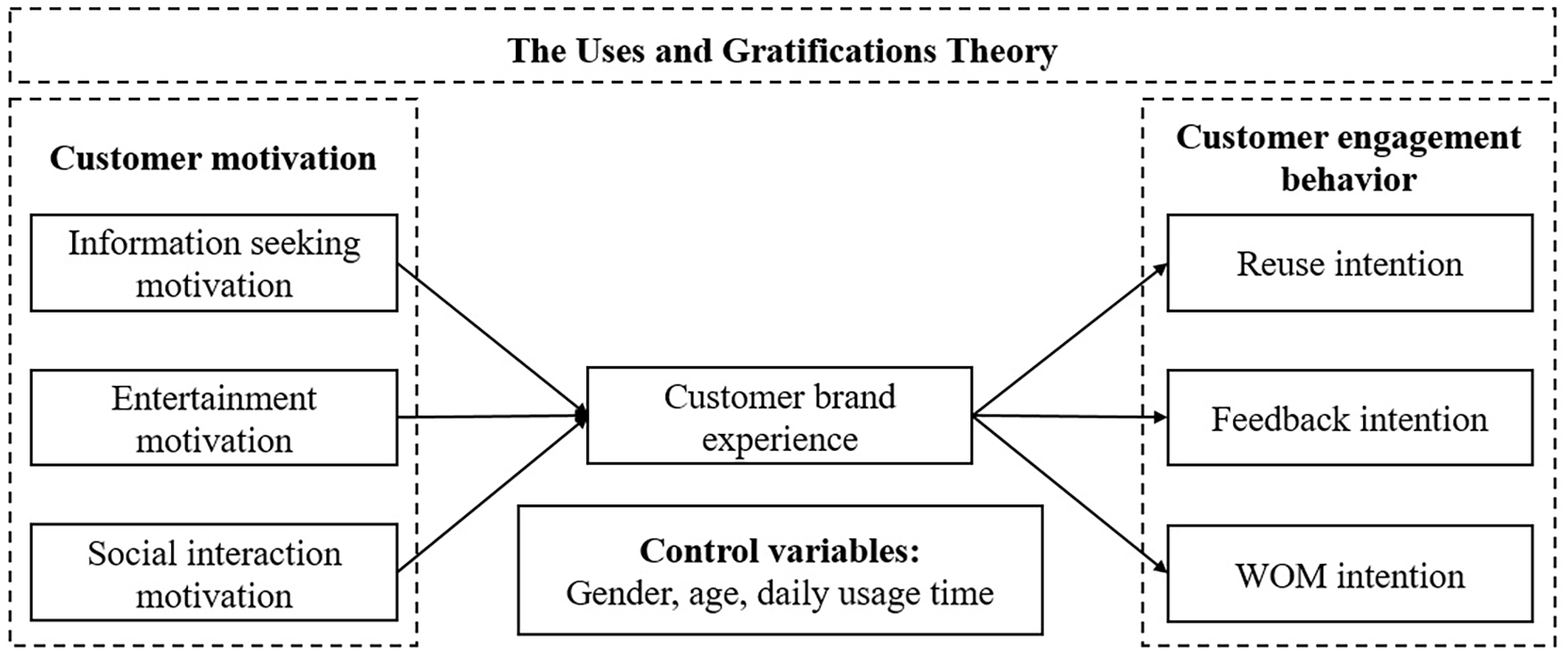
Research model.
Instrument
The project used to measure the structure of the study was adapted from previous studies. This study adopted some procedures to minimize the deviation of standard methods. First, the wording of items and questions should avoid ambiguity, be concise, and straightforward, and ensure no unfamiliar terms and complex grammar. Second, the physical distance between the same construct measures is considered, not adjacent to the exact construction items.
The three items used to measure information-seeking motivation in this study were adapted from Kankanhalli et al. (2005) and Park and Goering (2016). The three items provided by Diddi and LaRose (2006) and Voss et al. (2003) were used to measure entertainment motivation. Social interaction motivation was measured using three items adapted from Liu et al. (2016) and Whiting and Williams (2013). The brand experience was measured using three items adapted from Kim and Choi (2013). Reuse intention was measured using three items adapted from Chiu et al. (2014). Feedback intentions were measured by three items using the scale developed by Verleye et al. (2014). Purchase intention was measured using three items compiled by Ajzen (1991). Finally, the WOM intention was measured by Brown et al. (2005). All constructs were measured on a 7-Likert-scale from “strongly disagree” to “strongly agree.”
Sociodemographic measures included gender, age, average monthly income, and occupation. Gender was measured using a dichotomy. The age range and occupation were measured with a sequential scale, and the average monthly income was measured in local currency and then converted into U.S. dollars.
Data Collection
The back-translation method was followed to ensure translation validity, as the respondents were Chinese. First, a researcher whose native language was Chinese translated the items into Chinese. Moreover, another researcher translated these items back into English independently. The two researchers subsequently compared the two English versions and developed the items’ first Chinese version. We then invited five CEO researchers and a focus group of five Weibo members to check for ambiguity in format and wording. Similar to Facebook and Twitter in the USA, Sina Weibo is the premier social networking platform of China. Based on their feedback, minor modifications were made to improve the user-friendliness and comprehensiveness of the measurement items. Finally, the two initial translators checked this version and finalized the Chinese questionnaire.
Sina Weibo was chosen for this study because of its popularity. As such, it could provide insights into the best practices and serve as an appropriate context for investigating the motivation behind social commerce. Data were collected through the online survey. A survey hyperlink was placed on forums in Sina Weibo. Those people who had social commerce experience were only targeted for data gathering. Each participant’s Internet protocol address and demographic information were tracked and examined to ensure they submitted only one response. The formal questionnaire was issued between February and March 2020. A non-random that sampled survey was used by this study. The survey was conducted through online crowdsourcing platform of China, functioning similarly to Amazon’s Mechanical Turk. The online survey platform that was used in this study was the most representative one in China. Finally, through the questionnaire survey of 610 customers who had used Weibo, 45 invalid questionnaires with incorrect answers, inconsistent answers, and careless contents were eliminated, and 565 valid questionnaires were collected. The sampling efficiency was 92.6%.
Among the data samples collected, 37.7% were men, and 62.3% were women. According to the age distribution, 33.6% were under 20 years old, 58.2% were 20 to 39 years old, 7.8% were 40 to 59 years old, and 0.4% were over 60 years old. From the perspective of occupational distribution, 17.5% were civil servants and institutions, 21.1% were enterprise employees, 2.3% were self-employed, 53.6% were students, 0.7% were retired, 4.8% were unemployed, or others. According to the educational background distribution, 22.3% had high school education, 3.5% had a junior college education, 41.6% were undergraduates, and 32.6% were graduates or above. Regarding the economic level, 34.3% were below the average, 58.2% were above the average, and 7.4% were above the average. Regarding the average time of using Weibo daily, less than 1 hour accounts for 10.1%, 1 to 2 hours for 19.1%, 2 to 3 hours for 33.6%, 3 to 4 hours for 34%, and more than 4 hours for 3.2%. The statistics are listed in Table 1.
Demographics of the Survey Respondents (N = 565).

Data Analysis and Results
Reliability and Validity
It is necessary to test the measurement model and evaluate the structural model to verify the tool’s reliability and validity. The test followed a two-step method recommended by Anderson and Gerbing (1988).
Amos 24.0 was used to evaluate the measurement and structural model proposed in this study. First, the normality of samples is a vital hypothesis based on covariance (Chin, 1998). Therefore, this study first evaluates the normality of samples by checking the skewness and kurtosis of the data. This sample’s skew values range from −0.709 to −0.519, indicating that the skew value is within the acceptable threshold of 3.0 (Kline, 1998). Simultaneously, the kurtosis values of the two samples are between − 1.190 and − 0.428, lower than the standard weight of 8 of Klein. Therefore, both samples conformed to a specific hypothesis.
Principal component factor analysis and confirmatory factor analysis (CFA) were used to evaluate the scale’s reliability and validity. The Kaiser–Meyer–Olkin (KMO) statistical value of this sample is .797, indicating that the data can be applied to factor analysis (Kaiser, 1974). Additionally, because a load of all indicators on the expected factors was higher than .6, while a load of other factors on all hands was lower than .4, this value’s appearance indicated that the scale had good convergence and discriminant validity (Chin et al., 1997).
The 7-factor measurement model is based on the CFA method to evaluate the reliability and validity of the structure. As shown in Table 2, the Cronbach’s α and overall reliability (C.R.) values for each structure were between .779 and .945, higher than the recommended reasonable threshold of .7. Simultaneously, convergent and discriminant validities were tested. The validity of convergence was verified by testing the extracted average variance (AVE) and index load. Table 3 shows that all the average values in the validation results were higher than the recommended level of .5. The results also showed that the standard load of all projects was higher than the required threshold of .7, and the significance was .001. Thus, the data also show that the measurement model has good convergence efficiency (Chin et al., 1997).
Results of Confirmatory Factor Analysis.

Note. All standard loadings were significant at ***p < 0.001.
Correlations Matrix.

Note. Diagonal bold italics entries are values of the square roots average variance extracted (AVE); all others are correlations coefficients. M = mean, SD = standard deviation. ISM = information seeking motivation; EM = entertainment motivation; SIM = social interaction motivation; B.E. = brand experience; RI = reuse intention; F.I. = feedback intention; WOMI = WOM intention.
When the square root of each structure’s mean square deviation is greater than the correlation between structures, the validity of data discrimination can be illustrated (Fornell & Larcker, 1981). For example, Table 3 shows that the square root of AVEs in the two data groups is more significant than the correlation between the structures described in the off-diagonal terms. Therefore, the validity of the discrimination is verified.
The data collected in this study have a single source; therefore, the Harman single factor test was used to verify the deviation of the sample data. Seven factors were extracted from the data, explaining 79.413% of the variance. However, only 25.962% (<40%) of the sample had the most significant influencing factors. Therefore, the results showed no single factor controlling the total variance among the factors studied in this study, and there was no standard deviation.
After testing the validity and reliability of the measurement, this study tests the hypothesis proposed by AMOS 24.0. Table 4 shows the model fitting index’s actual and recommended values obtained after the original model is modified. These data prove that the model’s appropriate index is better than the recommended threshold, showing that the model fits the data well.
Measures of the Model Fit.

Note. RMSEA = root mean square error of approximation; GFI = the goodness of fit index; CFI = comparative fit index; NFI = normed fit index; TLI = non-normed fit index.
According to Bentler and Bonett (1980) and Lee et al. (2012).
According to Browne and Cudeck (1989) and Lee et al. (2012).
Hypotheses Testing
Path modeling was performed to test H1 to H6. The results show that information-seeking motivation (β = .130, p < .001), entertainment motivation (β = .131, p < .001), and social interaction motivation (β = .158, p < .01) positively affected brand experience. Therefore, H1, H2, and H3 are supported. This study believes that these findings can explain how customer motivation affects customer brand experience in social media. Brand experience positively affect reuse intention (β = .451, p < .001), feedback intention (β = .425, p < .001), and WOM intention (β = .704, p < .001). Thus, H4 to H6 are supported. Therefore, our conceptual model provides a reasonable explanation for the different CEBs. The results are presented in Table 5 and Figure 2.
Structural Model Results.

p < .01. ***p < .001.

Results of the research model tests.
This study used a bootstrapping method to test the mediating effect and found that brand experience plays a mediating role in customer motivation on CEB (Preacher & Hayes, 2008). Table 6 shows that the indirect effect of brand experience on the relationship between customer motivations and CEB is significant with a 95% bootstrap confidence interval, excluding 0. This finding shows that brand experience mediates the influence of customer motivation on CEB. Thus, H7a, 7b, and 7c are supported.
Analysis of Mediating Effect.

p < .01. ***p < .001.
Control Variable Results
To improve the scale’s external validity and ensure the scientificity of the verification results, gender, age, and average time of using Weibo every day in demographic characteristics were selected as control variables in this study. According to the study results, gender has no significant impact on latent variables because male and female customers now use Weibo. Age has a considerable effect on reuse intention (β = .273, p < .01), but has no significant effect on other latent variables. As a social media platform, young people’s reuse behavior of Weibo is significantly higher than that of the elderly. Therefore, age significantly impacts reuse intention. Finally, the average time spent using Weibo every day had a significant impact on social media brand experience and WOM intention (β = .152, p < .05) and had no significant impact on other latent variables. The daily use time of Weibo can explain consumers’ dependence on social media and has different effects on brand experience and WOM. In the future, demographic characteristics should be considered as moderating variables to modify and improve this study’s conclusions further.
Discussion and Conclusions
With global and regional media development, social media with global influence and personalized characteristics has become a research topic attracting many scholars. Information communication between brands and customers has changed from asymmetric one-way communication to symmetrical two-way communication, realizing joint value creation. In social media brands, the influence of customer motivation on CEB has attracted increasing attention. This study selects Weibo, the leading social media platform in China, as the research brand and considers customers with Weibo experience as the research object to analyze the hypotheses proposed. The results are as follows.
General Discussion
First, customer’s information-seeking, entertainment, and social interaction motivations impact customers’ brand experience significantly. These findings are consistent with prior studies on social media (Leftheriotis & Giannakos, 2014; Liu & Bakici, 2019). Social interaction has the most significant impact on customers’ brand experiences. As a representative software for social media, this may be because Weibo performs best in social interaction functions.
Second, this study confirmed the positive impact of customer brand experience on CEB. Brand experience has a significant positive impact on customer reuse, feedback, and WOM intentions. These results are consistent with previous studies (Carlson et al., 2019; Islam & Rahman, 2016; Islam et al., 2018). Additionally, brand experience has the most significant impact on customers’ WOM intentions. Therefore, it is of great strategic significance to pay attention to CEB intention in this research. This is because of its impact on reuse intention and can provide a theoretical basis for promoting consumers’ recommendation behavior, such as feedback and WOM intentions, and ultimately help enterprises achieve profitable customer relationships (Kumar et al., 2010, 2016).
Third, this study also explored the mediating effect of customer brand experience on the relationship between customer motivation (i.e., information seeking, entertainment, and social interaction) and the three CEBs’ intentions (i.e., reuse, feedback, and WOM). Thus, the results help us better understand the incentive mechanism and consequences of customer brand experience. Additionally, this confirms previous studies. Therefore, the conceptual model in this research reasonably explains the different CEB.
Finally, gender, age, and average daily time of using Weibo were used as control variables. The results show that gender does not affect the brand experience, reuse intention, feedback intention, and WOM intention. Age controls customers’ reuse intention but does not affect the brand experience, feedback intention, and WOM intention. The average daily use of Weibo controls brand experience and WOM intention but does not affect reuse and feedback intentions.
Theoretical Implications
There is a surge of interest in customer engagement in academia and practice. Mobile social media technology provides further opportunities for the academic development of this concept. Therefore, this study contributes to the literature in several ways.
First, it provides a unique and meaningful model to test customer motivation’s collective influence on social media brand experience and CEB. This study is the first to link customer motivation conceptualization in social media networks with brand experience and CEB in the social media environment. Thus, this study’s contribution to marketing is to explain the relationship between customer motivation more accurately. The motivation mentioned in the survey covers a series of components and customer engagement intention (including trading and non-trading related behaviors) toward the brand in social media.
Second, this study further expands the discourse on customer brand experience in the context of mobile social media in emerging markets. This is realized by conceptualizing and testing the model with Chinese consumers. Based on the abundant literature on U&G theory, brand experience, and related viewpoints (Liu & Bakici, 2019; Rubin, 1985), this study confirms that customer motivation positively impacts brand experience. Customer brand experience positively impacts CEB. These components represent the brand experience valued by consumers and help social media enterprises evaluate the overall customer motivation index. As the customer brand experience occurs in the personal lifeworld and is subjective and constructed by society, research on customer motivation and related perspectives is worthy of attention. Therefore, in the social media environment, consumer motivation is directly affected by numerous stakeholders in the common field, such as other customers who use the brand and their social networks.
Third, in this research, attention to CEB has important strategic significance for research on the influence of customer purchase behavior and customer lifetime value. It provides a theoretical basis for promoting the value co-creation behavior of enterprises and consumers. This includes providing feedback and influencing customer behavior to help enterprises realize profitable customer relationships (Kumar et al., 2016). Consequently, this comprehensive approach involving the impact of customer motivation on CEB can help enterprises identify the psychological processes that lead to different forms of CEB and determine how to stimulate and manage these CEB effectively.
Management Implications
Regarding the academic research contribution, this study successfully confirmed the suitability of the U&G theory in explaining the influence of SNS content marketing on brand experience and CEB in China. And provide the following management implications.
First, enterprises need to meet customers’ motivation and improve their CEB. According to this study, when customers use social media, information seeking, entertainment, and social interaction motivations impact customer brand experience and CEB. Therefore, when using social media to carry out brand marketing, enterprises should pay full attention to customers’ motivational needs, enhance brand reuse intention, and improve brand competitiveness.
Second, managers should focus on maximizing the information, entertainment, and social interaction values of social media brands. For example, in such an emerging market, brands should formulate content marketing strategies and strive to provide customers the ability and knowledge to obtain the maximum information utility from products of the brand. Brands are positioned as allies of customers by engendering and sharing content focusing on meeting knowledge needs of customers mainly. Both customers and brands should strive for the same goal of maximizing the utility of services or products (Carlson et al., 2019). Thus, it is necessary for brands to create interactive content to attract customers to generate motivation. Social media practitioners should also pay attention to emotional values and entertainment. Therefore, designing content strategies and improving the emotional experience (fun, enjoyment, entertainment) through customer cultivation activities on social media platforms is an effective strategy. By customizing a social media information delivery strategy, which focuses on stimulating the emotional response synchronized with core information of the brand, social media managers can strengthen brand value by connecting customer emotion and entertainment content.
Finally, it is important to pay attention to the customer’s social media brand experience, enhance customer reuse intention, pay attention to the customer feedback content, and promote customers’ good reputation. Enterprises should pay more attention to brand experience, especially in developing and launching new products and services. WOM is a valuable tool in attracting new customers that may help potential customers gain trust by browsing positive suggestions issued by customers who have had positive experiences (Hennig-Thurau et al., 2004). Based on this study’s results, as an essential variable in customer reuse and satisfaction paths, social media brand experience has a necessary impact on business activities. Enterprise managers should pay full attention to improve customers’ brand experience to achieve the “win-win” of sales volume and public approval.
From the perspective of human communication behavior and psychological cognition, this study attempts to take “Weibo” as a brand and explore the influence of customer engagement under brand experience mediation. Thus, this study makes up for the lack of current and has a specific reference value and guiding significance for business activities to a certain extent.
Limitations and Future Research
This study’s results have a practical reference value for “social media” brands to stimulate reuse motivation of customers and affect CEB. Simultaneously, it has specific guiding significance for social media operators to establish a good brand image. However, like all studies, this study has some limitations, providing a starting point for the further research. First, this study uses a self-reported online survey to test active users’ and brand consumers’ perceptions rather than actual behavioral data. Second, the self-selection bias may influenced the results. Third, users with low use intensity and brand participation may have different experiences and views on social media platforms. Additional studies, including longitudinal data, can be used to explore whether the results can be epitomized.
Moreover, the research samples were from Chinese consumers using Weibo to follow their designated brands. This study researched brand of the “Weibo” social media platform but did not cover all social media platforms. Customer experiences that were based on social media platforms’ preferences will therefore be different. Future research could examine consumption experience of mobile social media in a broader range of various social media platforms and emerging market countries, especially in developed markets, to heighten their universality.
Second, this study is based on an online questionnaire collected by subjects with Weibo experience, which differs from the actual situation. It takes customer motivation as an independent variable and customer experience as a mediator variable. Future research can also examine the impact of a specific CEB on customer motivation over time, that is, the existence of a feedback loop. Such a survey is necessary to assess whether the results positively impact the brand and CEB. Future research can also explore whether customers’ active participation can make the brand experience valuable to other customers and the enterprise.
Third, in this analysis, demographic variables were not well explained for the test samples selected, as a vast customer group, whether customer characteristics are typical remains to be verified.
Footnotes
Acknowledgements
The authors would like to acknowledge the anonymous reviewers who provided insightful suggestions and comments on improving the quality of this manuscript.
Author Note
Yu Li is now affiliated to Shandong University of Finance and Economics, Jinan, China.
Declaration of Conflicting Interests
The author(s) declared no potential conflicts of interest with respect to the research, authorship, and/or publication of this article.
Funding
The author(s) disclosed receipt of the following financial support for the research, authorship, and/or publication of this article:The research was funded by the Shandong Social Science Foundation [Grant No. 21DGLJ16] and the Doctoral foundation of Shandong Jianzhu University [Grant No. X20006S].
Ethical Statement
The authors of this paper have carefully studied the international research ethics, and this paper does not involve animal and human studies.
