




Abstract
Traditional handicrafts are deeply historically and culturally significant and essential to the intangible cultural heritage of nations and ethnic groups worldwide. This study explores the global research trends on intangible cultural heritage traditional handicrafts since the 2015 establishment of the United Nations Sustainable Development Goals, through a systematic literature review and bibliometric analysis. Using Bibliometrix, we examine 83 articles from Web of Science and Scopus databases to identify research themes, developmental trends, and connections to global policy implementations. The results show an upward trend in publication outputs for traditional handicrafts and sustainability, which aligns with their academic popularity as critical issues of the cross-section. Technological advancements, such as 3D scanning and virtual reality, provide new paths to serve better documentation of craft and public involvement. The analysis also points out that different cultural and economic backgrounds have significantly shaped the protection strategies of various regions, from the combination of tradition and modern technology in East Asia to legal protection and international cooperation in European and American strategies. This highlights the urgent need for scientific mapping of traditional handicrafts preservation strategies, employing interdisciplinary ways, and with consideration for integrating big data analytic techniques. It also underscores the importance of these traditional handicrafts as a core element for the sustainable transmission of cultural heritage globally, preserving the unique dignity and development of each culture.
Keywords
Introduction
In 2003, UNESCO proposed the concept of intangible cultural heritage (ICH), that is, traditional, contemporary, and living culture that is transmitted from generation to generation by word of mouth or in the form of handcraft (UNESCO, n.d.). Its features are passed along from generation to generation in a manner that constructs the foundation of human cultural diversity. ICH is a fundamental aspect of human civilization that is bestowed upon its cultural bearers implicit knowledge and unique abilities, which can only be passed down through oral tradition or apprenticeship (Tan et al., 2019). Thus, ICH has a life. It provides excellent opportunities and challenges for this transmissible approach but also brings many disadvantages, particularly concerning cultural diversity, social identity, and historical context (Giglitto et al., 2022).
Traditional handicrafts represent an irreplaceable part of the cultural heritage of any ethnic group or nation (Yang et al., 2018). These crafts, as tangible expressions of human culture, encapsulate artisans’ wisdom and their communities’ collective memory. The practice of traditional handicrafts showcases the artisans’ craftsmanship and embodies cultural identity, historical continuity, and local distinctiveness (Ramnath & Kim, 2024). For instance, hand embroidery, textile weaving, and lacquerware highlight these artisans’ rich creativity and enduring legacy (Hu et al., 2023). In recent years, traditional handicrafts have gradually received renewed attention from modern society, and some consumers see them as symbols of enhancing personal identity (Ferreira et al., 2019). By owning these handicrafts, consumers not only demonstrate respect for the roots of craftsmanship but also convey a unique cultural identity in social settings. This trend indicates that the demand for traditional handicrafts is growing, but their popularity and cultural promotion remain key factors (Knapik & Król, 2023). Beyond their artistic and historical significance, traditional handicrafts play a critical social role in modern society by fostering local economic development, cultural tourism, and social cohesion (Chen et al., 2021; Grobar, 2019).
Nevertheless, traditional handicrafts are at risk of extinction. These challenges such as the aging of skill inheritors, the decreasing interest of the younger generation in traditional handicrafts, and the impact of industrial large-scale production on the handicraft market (He, 2023). They are collectively threatening the continuation of many traditional customs. However, the danger is that we will lose this cultural heritage without any practical means of preservation and transmission. The question of how to sustain and transmit these crafts within their time has emerged as a central concern for academic community, policymakers, and other entities (Keitsch, 2020).
In recent years, sustainability has come to the annual debate on the preservation of cultural heritage. Sustainability includes cultural sustainability, defined as sustainable cultural development on top of economic growth, social well-being, and environmental protection (Loach et al., 2017). When examining the hidden cultural lives of handicrafts, we can consider how, within one of the four pillars of sustainable development—cultural sustainability neatly ties not only the conservation of traditional craft but also to larger social-economic objectives (Ruggerio, 2021). Hence, sustainable solutions to how traditional crafts survive globalization and modernity are pertinent not only in the context of preserving cultural diversity but also for economic development and social identity.
Current State of Research
There is a global concern now as we increasingly appreciate the importance of protecting our intangible cultural heritage, mainly traditional handicrafts. These are important for their unique human concept and civilization, a phenomenon placed on top due to their historical and social nature. Therefore, preserving our traditional handicrafts is not an end in itself, but the means of safeguarding our cultural identity, which in turn underpins and drives sustainable socio-economic development. While there has been a marked advancement in this research, it is nevertheless confronted with challenges, and knowledge gaps are still present.
The role of technological innovations in preserving ICH was increasingly acknowledged. As noted by Skublewska-Paszkowska et al. (2022) and Mendoza et al. (2023), it can effectively enhance ICH presentation and conservation, as demonstrated by technologies such as 3D digitization, augmented reality (AR), and virtual reality (VR). While these technologies show promise, there has been relatively little research into their long-term implications for the sustainability and preservation of traditional handicrafts. In addition, Su et al. (2019) conducted a bibliometric analysis of ICH research using CiteSpace and pointed out that community participation in heritage protection and development, as well as the authenticity of heritage, have been the focus of attention in recent years. Although it provides crucial information for an international perspective of ICH research, the analyses are generalized, and more detailed studies on the strategies of how to conserve traditional handicrafts on multiple levels, including those related to different cultural backgrounds, are required.
Shafi et al. (2022) proved that in traditional handicraft enterprises, the sustainable development mechanism mainly depends on incremental innovation. When innovation meets the combination of tradition and culture alongside it, the handicraft industry can stand on its feet and rise above the globalization and industrialization worries by unlocking economic growth as well as cultural retention. Moreover, Hu et al. (2023) emphasized the significance of collaborative efforts between designers and craft makers in negotiating the economic feasibility of cultural transfer. The study by Liu et al. (2024) explores the concept of design innovation in traditional handicraft literature through thematic analysis and the convergence of design and craftsmanship.
Although prior research provides valuable insights into many facets of traditional handicrafts preservation, additional progress is necessary in theory and methods. Most literature concentrates on technological or cultural progress, promoting a broader multidisciplinary approach to preservation techniques. Moreover, the central problem results from research projects treating single individuals or areas instead of following global preservation concepts. This study seeks to overcome this gap in the literature. Due to the absence of thorough systematic assessments on the sustainable preservation of traditional handicrafts in improved conditions, a systematic review of the literature from 2015 to 2024 is crucial for developing both the theoretical framework and practical guidance for academic research on the preservation of traditional handicrafts. The study formulates the following research questions based on the provided information:
RQ1: What patterns of collaboration exist among researchers, institutions, and nations involved in traditional handicrafts preservation between 2015 and 2024?
RQ2: What are the temporal trends and dominant research themes and author keywords in the literature on traditional handicrafts preservation during this period?
RQ3: How do preservation strategies for traditional handicrafts differ across regions and cultural contexts, and what are the emerging trends in sustainable preservation?
Methodology
This study employed a systematic literature review and bibliometric analysis to answer the research questions that scrutinized the relevant literature available in selected databases. This method is widely recognized in multiple disciplines such as health sciences education (Regmi & Jones, 2020), economics (Goyal & Kumar, 2021), cultural heritage (Orr et al., 2021), tourism (Mishra et al., 2022)and design (Perry & Pereira, 2023). They are well-established practices due to their reliability and adaptability. A systematic literature review analyzes existing research that provides an objective overview of the evidence demonstrating key research trends and topics within a specified field, allowing potential new forms of understanding, perspectives, or future research agendas (Donthu et al., 2021).
In addition, bibliometric analysis enhances this review by precise measurement of patterns in the literature, providing a more comprehensive analysis framework. Given its scientificity, transparency, and reproducibility of this method are particularly suitable for this study. Its strict review protocol greatly reduces personal bias and errors, ensuring the high quality and accuracy of research results. This methodology can facilitate the identification of trends, prominent authors, and critical themes in the research, therefore offering a comprehensive overview of the respective field. However, it must be acknowledged that systematic reviews have certain limitations in terms of literature retrieval, publication bias, heterogeneity of research, and interpretation and promotion of results (Jahan et al., 2016; Orr et al., 2021).
Data Analysis Tools
The present investigation used the Web of Science Core Collection (WoS) and Scopus databases, trusted sources for identifying high-quality papers connected to ICH handicrafts in prior studies. Extensive literature obtained from these platforms indicates that while manual analysis is dependable, it is also inefficient (Owan & Bassey, 2018). Thus, the study employed bibliometric analysis and scientific mapping utilizing the freely available software package known as Bibliometrix, which is an R programming language (da Silva & Moura, 2020). Compared to VOSviewer, Bibliometrix has advantages in comprehensive analysis and operational flexibility (Aria & Cuccurullo, 2017). While VOSviewer provides superior graphical design for network visualization compared to other tools, the capabilities and automation of Bibliometrix are better suitable for the goals of this task. The platform offers a range of data visualization facilities, including high-frequency word clouds, keyword collinearity analysis, and co-citation network analysis. Significantly, it facilitates the visualization of scientific knowledge graphs and enables the monitoring of the development and themes of research activities (Guleria & Kaur, 2021). At the same time, the data visualizations were enhanced by rendering using Flourish, leading to the creation of more easily understandable charts that effectively highlight the present research patterns and findings.
Data Retrieval Strategy
The data retrieval procedure was finalized on July 28, 2024, by employing sophisticated search queries in the Web of Science (WoS) and Scopus databases to locate published works pertaining to ICH handicrafts. The search period covered January 1, 2015, to July 28, 2024. The starting point of 2015 was selected because the United Nations adopted the 2030 Agenda for Sustainable Development that year, with Goal 11.4 emphasizing the protection and sustainable use of natural and cultural heritage (Wang et al., 2018). This policy provides a robust framework for analyzing the trends and changes driven by this global initiative (Giliberto & Labadi, 2022).
In order to guarantee the accuracy and thoroughness of the search, a meticulous search query was developed using a pre-established synonym merge table (Table 1). The search string included both relevant keywords and wildcard symbols (*) to account for variations in related terms. The search terms were (*heritage* AND tradition*) AND (*craft* OR *skill* OR artisan* OR handmade) AND (Preserv* OR Conserv* OR Protect* OR Safeguard* OR Sustainab*) and were required to appear in the title, abstract, or keywords of the selected articles.
Synonym Merge Table.

Source. Own elaboration.
For quality control, this study only included peer-reviewed journal articles, proceeding papers, and early access articles while excluding book chapters, conference reviews, and editorial materials. Although these sources may offer valuable insights, their lack of rigorous peer-review processes makes it difficult to ensure the same level of scientific accuracy and reliability.
It is important to note that despite using a fixed search period, the dynamic nature of database updates and varying access across institutions may result in different outcomes at different points in time (Mongeon & Paul-Hus, 2016; Zhu & Liu, 2020).
Data Screening Procedure
The data screening process in this study adhered to PRISMA standards (Moher et al., 2009), ensuring both transparency and reliability of the data sources. Figure 1 shows that a total of 1,530 documents were retrieved from the WoS and Scopus databases, with WoS providing 569 and Scopus contributing 961. Initially, we eliminated documents from unrelated subjects and disciplines (n = 410), non-English publications (n = 163), as well as book chapters, conference reviews, and editorial materials (n = 108). Duplicate entries were then removed using Endnote software (n = 192). After reviewing the titles, keywords, and abstracts, additional articles were excluded for being irrelevant (n = 467), lacking full-text availability (n = 10), or not specifically addressing the preservation of traditional handicrafts within ICH (n = 97). Ultimately, 83 articles closely aligned with the research topic were selected and exported in Bibtex format for further analysis within the R environment (Aria & Cuccurullo, 2017).
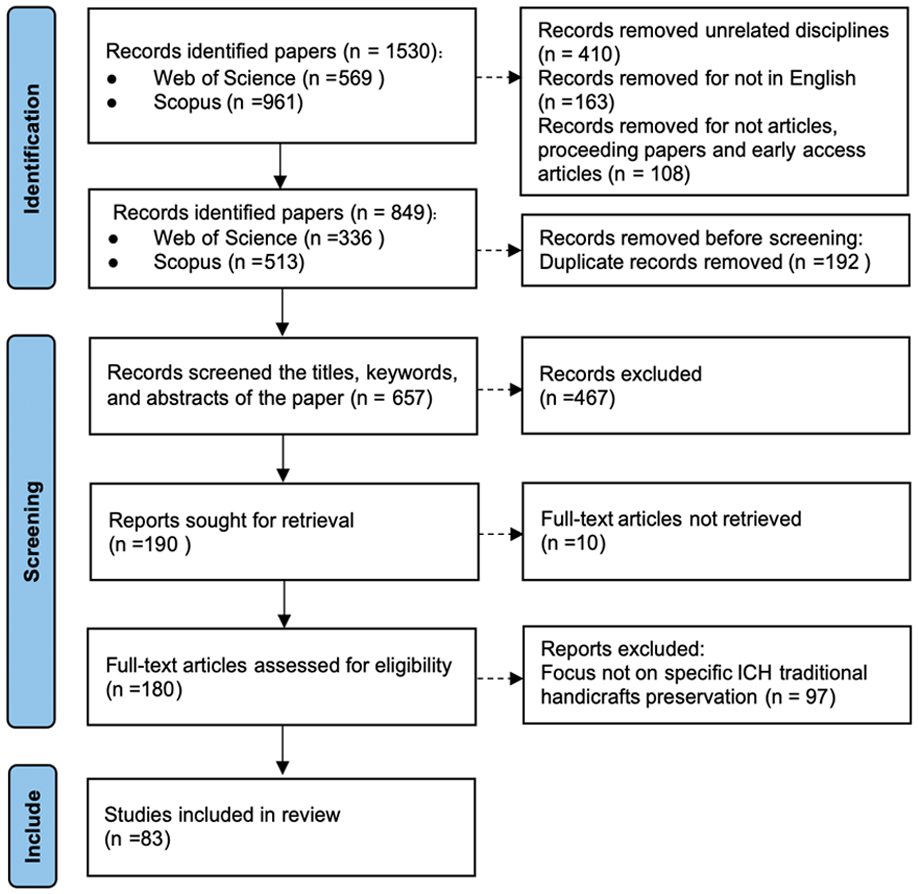
Flow chart of literature search process.
Given that the documents were sourced from both WoS and Scopus, merging the entries was necessary. While these were exported in Bibtex format, inconsistencies in field labels, data structures, and metadata content may arise (Caputo & Kargina, 2022). Bibliometrix, operating through the RStudio environment, proved advantageous in resolving these discrepancies. By inputting the appropriate commands, we efficiently converted the data into a format recognizable by biblioshiny, facilitating further analysis within the platform.
Result
Evolution of Publications and Journals
This study performed a bibliometric analysis on 83 selected papers. As shown in Figure 2, since the United Nations established the Sustainable Development Goals in 2015, research on traditional handicrafts preservation within ICH has undergone three distinct phases of growth. In 2015, only five papers were published, indicating an early exploratory phase for the field. From 2015 to 2017, the research output remained sparse and unsystematic. However, after 2017, the number of publications began to increase, reaching eight in 2018, which suggests that the field was gaining momentum. The most notable expansion occurred between 2021 and 2024, with a sharp rise in publications in 2023, reaching 19 papers. This surge indicates that the field has entered a period of robust research activity.

Annual scientific production.
The 83 papers in this sample were published across 62 different academic journals, representing a diverse range of disciplines. The top ten journals accounted for 30 papers or 36.14% of the total (Figure 3). Among heritage research journals, Sustainability was the most prominent, publishing seven papers, or 8.43% of the total. Lecture Notes in Computer Science (including subseries Lecture Notes in Artificial Intelligence and Lecture Notes in Bioinformatics) followed by six papers (7.23%), and the Journal of Cultural Heritage Management and Sustainable Development contributed three papers (3.61%). These findings highlight the recent academic focus on sustainability and cultural heritage management in research.

Most relevant sources
Leading Authors, Institutions, and Countries in Traditional Handicraft Preservation
Figure 4 identifies Ji, Y, and Li, Y as the top contributors to this research area, with each author producing three papers. As noted by Perry and Pereira (2023), prolific authors can significantly bolster a nation’s research output. The remaining authors in the top ten each contributed two papers. Despite a substantial number of total publications, the pool of prolific contributors remains relatively small.

Most relevant authors.
In terms of institutional research output, Figure 5 shows that Central China Normal University leads with five publications. National Taipei University of Technology and University Kebangsaan Malaysia follow, each contributing four papers.
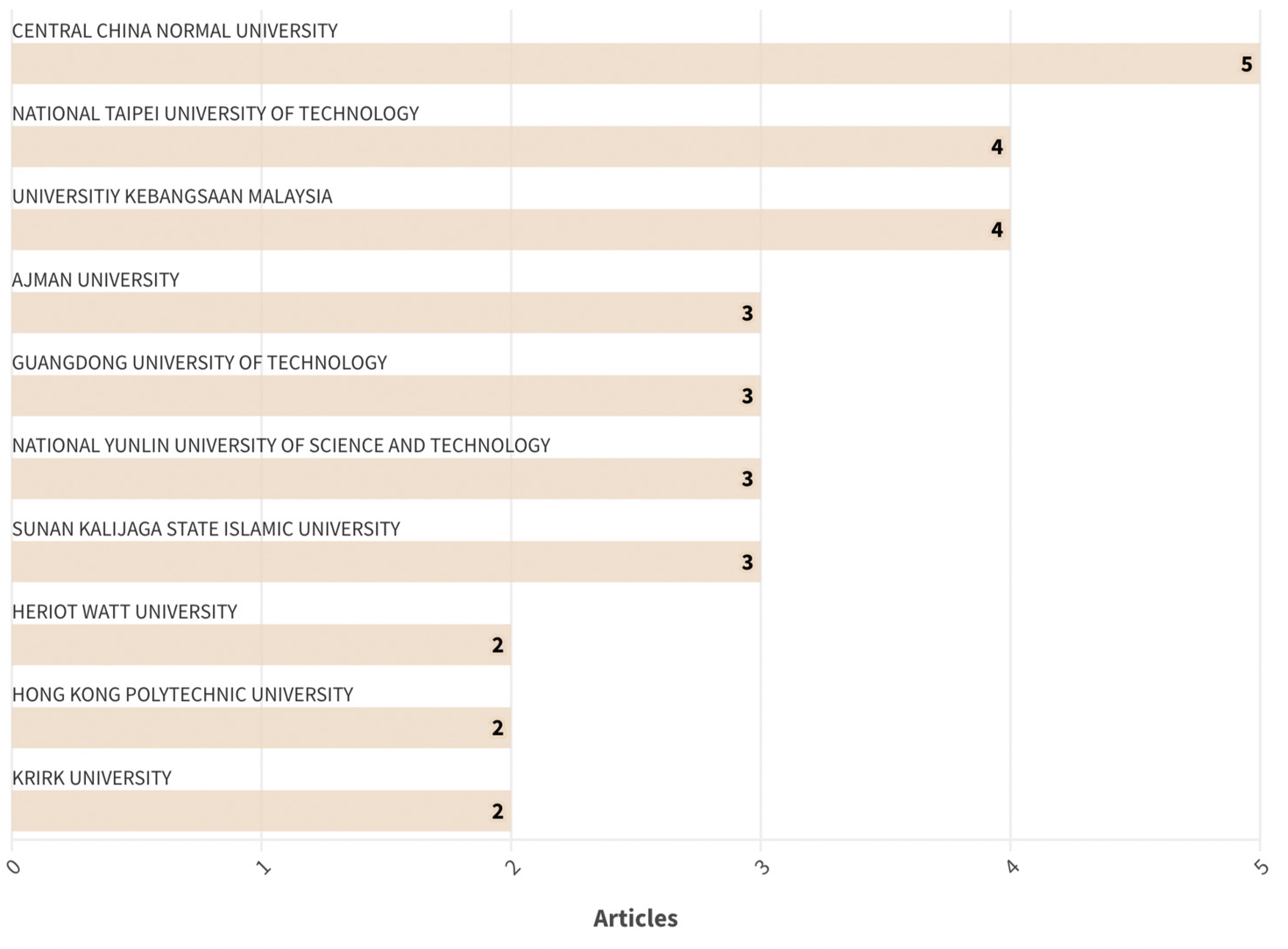
Most relevant affiliations.
Figure 6 displays the co-authoring patterns between countries, with node size representing frequency and connections depicting collaboration networks. China, with a node size corresponding to 59 co-authorships, stands out as the leading nation in this research field. Malaysia and India follow with 10 and 7 co-authorships, respectively. Indonesia, Thailand, and the United Kingdom each appeared six times. China has also exhibited extensive international collaboration, with notable partnerships with Thailand, South Korea, Ghana, and the United Kingdom. Additionally, Greece has collaborated with Switzerland and Germany, Sweden has partnered with Denmark, and the United Kingdom has worked with Malaysia.
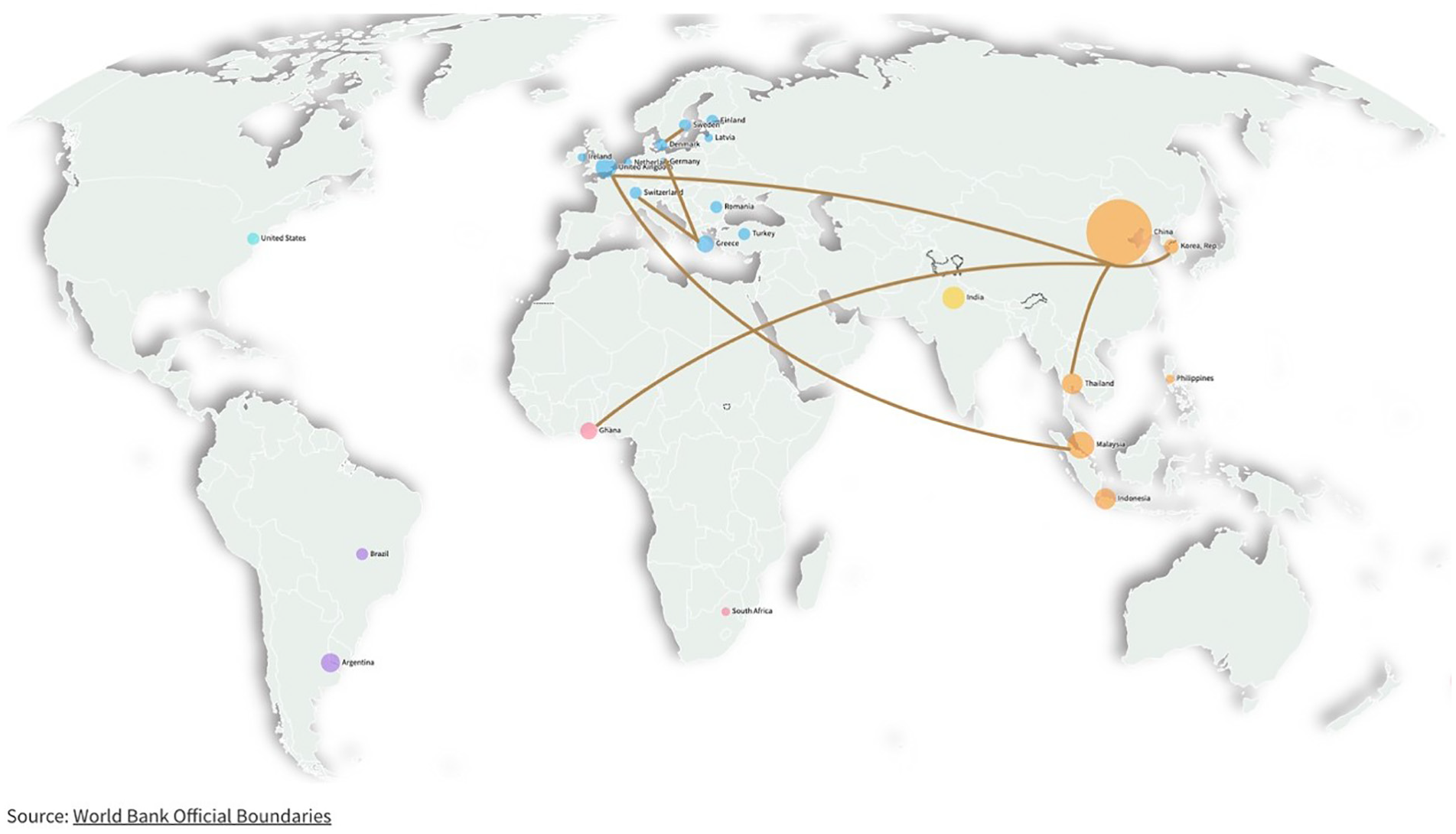
Countries’ scientific production and collaboration.
Thematic Analysis and Evolution
This section focuses on the conceptual structure of protecting traditional handicrafts. By mapping this thematic pattern, one can identify the key themes in that research field and their chronological sequence (Agbo et al., 2021; Farooq, 2022). Figure 7 illustrates a four-quadrant approach employed to assess the significance and prevalence of various research topics. In this model, the top axis graphs the themes based on the density of links, indicating the level of research concentration in these areas. While the horizontal axis quantifies their centrality (Aria et al., 2020). Specifically, motor themes, which reflect established and fundamental elements of the discipline, are situated in the upper-right quadrant, where there is a convergence of high centrality and density. In the case of particularly high centrality, the fundamental themes of the lower-right quadrant exhibit a strong correlation but are not highly concentrated, indicating that while they have a broad influence, they are not extensively explored. In contrast, niche subjects in the top-left quadrant have been extensively explored in their own domains but are seldom applicable to outside contexts. The themes in the lower left quadrant represent emerging or declining research fields, indicating that their development is not yet mature, and their positions are on the edge.

Themes from the 2015–2017 phase.
To further explore the key themes in traditional handicrafts preservation and analyze their evolution, we divided the data from 2015 to 2024 into three distinct phases based on temporal trends. To ensure the identification of multiple meaningful clusters, even within smaller datasets, we set the minimum cluster frequency at 3. Clustering algorithms were then used to generate the thematic analysis based on article titles.
As illustrated in Figure 7, the results for the 2015 to 2017 phase show that “Cultural/Heritage/ Intangible” served as core themes, playing a central and pivotal role in shaping the research landscape. In the lower-right quadrant, “Development” and “Traditional” emerged as widely referenced basic themes. “Protection/Brocade” exhibited high density but low centrality, reflecting a specialized focus on certain cultural heritage types with limited broader influence. Meanwhile, “Design” appeared as an emerging theme, with both low density and centrality, indicating its relatively early stage of development and limited impact on the broader field. Themes such as “Study” and “Crafts,” positioned in the central region of the map, indicate their integrative role, serving as a bridge between more specific themes and the wider research context.
During the 2018 to 2020 period, the research landscape experienced the emergence of several new themes (Figure 8). “Research,”“Embroidery” and “Virtual” were identified as core themes, exhibiting both high density and centrality, signifying their importance and growth in academic discourse. Meanwhile, themes such as “Traditional/Indigenous/Weaving” emerged as interdisciplinary topics that span multiple areas of study. Additionally, “Cultural/ Heritage/ Brassware” were classified as foundational themes, relevant across various fields but with fewer internal connections. In contrast, mature yet relatively isolated themes like “China” and “Digital” were well-developed within their niche but had limited broader impact. Interestingly, “Art” appeared as a marginal theme during this period. “Development” and “Handicraft” were positioned at the boundary between the upper-left and lower-left quadrants, suggesting their current status and future potential in academic research, possibly requiring increased attention and resources. “Craft” occupied a space between the lower-right and lower-left quadrants, indicating moderate centrality and density, reflecting its ongoing development within the academic field.

Themes from the 2018–2020 phase.
In the third phase (2021–2024, Figure 9), “Research” and “Virtual” continued as central themes, showing increased centrality and maturity. Furthermore, “Design” shifted toward the upper-right quadrant, evolving into a core theme with higher centrality and density compared to earlier phases. Themes such as “Heritage/Intangible/Art/Digital/Inheritance/Technology/Traditional/Practice/Dyeing” formed the foundation of this phase’s research. “Weaving/ Textile/Sustainability” emerged as either developing or declining areas, signaling a shift from traditional techniques to practical issues like sustainability. Themes such as “ Preservation/ Approach/Bodo/Sustainability/Handicraft/Collaborative” in the upper-left quadrant were highly specialized but lacked strong connections to other research areas. Of particular note is the position of “Paper/Simulation/Teaching,” which sits at the intersection of the upper-left and upper-right quadrants, indicating its dual role in both specialized fields and the broader research landscape. “Digitalization,” positioned at the junction of the upper-left and lower-left quadrants, reflects its expanding focus and growing relevance in future research applications.

Themes from the 2021 to 2024 phase.
The Sankey diagram in Figure 10 depicts the progression of research themes from 2015 to 2024, emphasizing the growth and interplay of several study fields across the years. The presented image effectively delineates the prominent themes within each phase and their corresponding transitions, therefore illustrating the dynamic changes and interconnected research directions. Between the years 2015 and 2017, the study subjects centered around “Cultural,”“Development,”“Design,” and “Protection,” with a particular emphasis on the preservation of culture and the advancement of design. Through the years 2018-2020, the research diversified to encompass topics such as “Traditional,”“Craft,”“China,” and “Art,” with “Research” emerging as a prominent new domain, indicating the growing significance of academic approaches. Development has remained the enduring central topic. In the 2021-2024 phase, the research field saw further development driven by a heightened emphasis on technology and tradition. This led to the emergence of distinct new domains known as “Digital” and “Traditional.” The future prevalence of “Cultural” and “Design” demonstrates the ongoing formative development of both disciplines, as well as the increasing influence of design thinking. Subsequently, themes such as “Sustainability” and “Preservation” have gained prominence, highlighting a concentration on the sustainable administration of cultural and environmental assets.

Evolution of themes across phases.
Network Analysis of Authors’ Keywords
Keywords have appeared to prove themselves to be the dominant tool for researchers when it comes to conducting database searches in recent years. As demonstrated by Farooq (2022), the introduction of keywords to academic research boosts the visibility of this research. This article will explore the research landscape through the authors’ network of keywords. Referring to Figure 11, “Intangible cultural heritage” and “Cultural heritage” have taken the front row seats within academic discourse, nowadays interwoven within the concept of “Virtual reality” and “Sustainability”. The focus will be on the digital preservation of ICH, traditional handicrafts, and various sustainable development avenues. There has been much talk, in other words, about virtual reality as a tool for the preservation of cultural heritage—something that tells us a lot about where the industry is headed. Moreover, many smaller clusters form within the network, reflecting niche areas such as specific industries and schools or cultural ecology. In simple words, the results reassert the interdisciplinary nature of this study and the immensely important role of technological progress in ICH preservation.

Network of authors’ keywords (Source: Own elaboration).
Most Relevant Authors’ Keywords
This study applied keyword frequency analysis and clustering techniques to pinpoint significant research subjects and patterns in the field of ICH. The most relevant authors’ keywords and their frequencies are summarized in Table 2. The results showed that “Intangible cultural heritage” appeared 17 times as the most significant, indicating that intangible cultural heritage is the central theme of research and discussion. After that, “Cultural heritage” (7) and “Virtual reality” (6) were the key terms showing the trend toward combining traditional heritage with technology in future. More common themes are linked together by a cluster analysis. As an example, Cluster 1 is around “Intangible cultural heritage” but also includes terms such as “Digitalization,”“Sustainable development,” and “Traditional handicraft,” suggesting a very broad research area that possibly extends all the way from preservation to sustainable development through digital processes. Terms such as “Cultural heritage preservation” and “Cultural sustainability” were also deliberated in Cluster 3, suggesting the focus on cultural heritage preservation alongside its sustainable use.
The Most Relevant Author Keywords.

Source. Own elaboration.
Discussion
Interaction Between Research Trends and Global Policies
Since the United Nations Sustainable Development Goals were ratified in 2015, there has been a significant increase in the publication volume of literature in the field of traditional handicrafts protection. This growth trend is in line with the progress made in international policy milestones. The sharply growing number of publications on such topics is a sign of the tangible effect of global policies on academic research, notably in the fields of sustainability and ICH preservation. It also indicates that scholars are not passively accepting these initiatives. This increase in the number of research articles is a signal to move from early exploration of this field to a more detailed mature study, which reflects the general interest and investment in this area.
International cooperation contributes significantly to the development of theory and practices in traditional handicrafts, notably in enhancing technological advancement and ensuring that cultural heritage can be shared freely across borders. For example, the collaboration between China and the UK to digitize heritage improves both applying technology and promoting cross-cultural understanding and knowledge exchange (Liu et al., 2023). These activities are collaborative in nature, facilitating the sharing of resources and ideas to support the United Nations Sustainable Development Goals, particularly those related to the protection and promotion of cultural heritage.
Integration of Technological Innovation and Traditional Preservation
Technological solutions and traditional conservation provide new approaches worldwide to preserve handcraft-based traditions. Digital tools such as 3D scanning and augmented reality technology will be key means of protecting and showcasing traditional skills(Cui, 2023). Not only does it offer education and cultural dissemination by far-reaching, but this tec also saves accurate documentation information and makes it available metadata. For example, virtual reality technology allows users to intuitively experience the handicraft production process in a fully immersive environment, significantly enhancing the public’s understanding and interest in traditional handicrafts such as porcelain (Ji et al., 2024), embroidery (Zhong & Qi, 2020), ceramic art (Cai, 2023).
Interactions in digital applications and virtual platforms are increasingly becoming accessible, enabling global marketing and learning opportunities that transcend physical barriers. These technologies aim to augment existing practices rather than displace them, thereby broadening the applicability and reach of traditional preservation techniques and helping to ensure that these crafts continue to thrive. Thus, beyond policy backing and interdisciplinary collaboration, fostering a seamless integration between technological advancements and traditional preservation approaches is vital. This approach not only respects the distinctiveness of each culture but also promotes pathways for sustainable development.
The Impact of Cultural Context on Preservation Strategies
Although strategies for preserving traditional handicrafts share many commonalities worldwide—such as engaging community members, incorporating technology, safeguarding cultural heritage, and fostering economic support—the cultural contexts in which they are applied vary greatly.
In East Asia, especially in China, preservation efforts have emphasized combining family traditions with modern practices, raising community awareness through educational programs. These efforts are also market-driven, aiming to ensure the sustainably transmission of handicrafts by bolstering community involvement and economic support (Chantamool et al., 2023; Qi, 2018). In Europe, the preservation of traditional handicrafts is based on a dual strategic approach, intentionally balancing safeguarding cultural heritage with national-level policy support, often facilitated through tourism (Kokko & Kaipainen, 2015).
These differences in strategies serve as indicators of how much waves down to cultural contexts have an impact on the preservation of traditional handicrafts. In Europe and the Americas, preservation efforts often emphasize legal protection as well as increased importance being given to international partnerships, especially about the preservation of ecological and ICH. In contrast, East and Southeast Asian approaches are typically family and community-oriented, focusing more on collaborative efforts to meet modernization challenges. Overall, these diverse cultural and economic conditions have shaped unique preservation methods across regions, providing valuable insights and experiences for the global sustainable preservation of traditional handicrafts.
Future Research Directions and Limitations
Future research may usefully enhance interdisciplinary approaches, especially at the intersection of sociology, anthropology, and information science, to design more holistic strategies to protect traditional handicrafts. By mining a range of social, digital, and economic data, from which cultural analysis is also opined, scholars can identify the changing patterns of cultural inheritance and understand their impact on society. In addition, further research should be done to explore the gap between international regulations and their regional applications, as well as to identify which model or measure can best be adopted in different regions for its successful implementation and sustainability from the global to the local level. Another critical kind of research is balancing the harmony between technical development and cultural value preservation. Some difficult but necessary decisions will be taken to protect the intrinsic cultural and historical narrative embodied in traditional handicrafts, particularly as new technologies like artificial intelligence and virtual reality are integrated into preservation efforts. For sustainable issues, future studies should investigate how eco-friendly technology, such as digitalization and virtual reality, can reduce waste materials required by sustainably crafted products and develop natural, reusable resources for economic sustainability. Boosting handicraft sales supports community livelihoods, creating a long-term incentive for the organic preservation and transmission of cultural heritage.
Nevertheless, this research is subject to several limitations. The acceptance of digital preservation measures can vary across cultural groups, impacting the universal applicability of certain strategies. When digital methods face resistance, adjustments to existing protocols may become necessary. Moreover, this study may be incomplete account for socioecomomics background, so that researchers could consider a wider range of factors influencing the preservation of traditional handicrafts with a broader horizon for future research. Data quality and accessibility are also significant difficulties when dealing with long-term studies of ICH because absent data will jeopardize the robustness of the conclusions. While technology-driven preservation methods show much significant promise, their long-term sustainability may be limited in certain socio-cultural and economic contexts. An important priority for future research is to optimize these strategies so that they can make meaningful contributions at the environmental, economic, and cultural levels. This analysis may also be limited due to the focus on English-language sources, which may exclude content such as articles in other languages, conference reviews, and books. Subsequent research should broaden the field by incorporating other databases, various languages, and a more comprehensive range of publication types to strengthen the theoretical foundation and yield more comprehensive findings through review results.
Conclusion
This study employed a systematic literature review and bibliometric analysis to demonstrate how global policies have influenced research on traditional handicraft preservation after implementing the United Nations Sustainable Development Goals in 2015. This issue is of growing interest in academic research and alines with worldwide concerns about sustainable development and the preservation of ICH, highlighting the academic response to these policy initiatives. The use of technological innovations, such as 3D scanning and virtual reality, demonstrate a sound synergy between digital solutions and traditional documentation that provides an expanded global access window for traditional handicrafts. These technologies also support educational initiatives, engage cultural intermediaries, or even revitalize market participation. Advances in international collaborations and technological applications have significantly enhanced global awareness and appreciation of traditional handicrafts. This study highlights the diversity of preservation strategies forged in differing cultural and economic contexts and shows the impact of international and regional policies in practice. Although the study is always limited in data sources and geographic coverage, it provides an excellent basis for assessing global strategies for preserving traditional handicrafts and addressing the sustainability of cultural transmission.
Further studies should integrate interdisciplinary methods and consider how social, economic, and technological factors together impact the preservation and transmission of traditional handicrafts. In turn, bridging the gap between policy and practice will contribute to the development of essential theoretical and practical insights for more effective cultural preservation strategies. This approach aims to sustain the relevance and adaptation of traditional handicrafts in modern society, ensuring they serve not only as a part of cultural and historical heritage but also as a valuable resource for the sustainable development of future societies.
Footnotes
Acknowledgements
Each author carefully read the final version of the manuscript and provided valuable feedback while ensuring the accuracy of the content. The entire team worked together and reached a consensus through cooperation and discussion, ultimately resulting in a final draft that was recognized by all authors.

Funding
The author(s) received no financial support for the research, authorship, and/or publication of this article.
Declaration of Conflicting Interests
The author(s) declared no potential conflicts of interest with respect to the research, authorship, and/or publication of this article.
Data Availability Statement
Data sharing not applicable to this article as no datasets were generated or analyzed during the current study.