




Abstract
Emotion is an important motivation and experience for tourists, and awe is one of the most anticipated emotional experiences in the travel sector. Previous studies of awe have focused on the natural environment and cultural landscapes, but little research has been conducted on awe in relation to intangible cultural heritage. The current study constructs a research framework that explores the relationship between involvement, experience quality, and loyalty. We adopted a self-administered questionnaire to survey visitors who engaged with the beliefs and customs associated with the sea goddess Mazu on Meizhou Island, China. A total of 450 questionnaires were distributed, and 393 valid questionnaires were returned. Through analysis of the response data, we established that awe is an outcome variable of involvement and experience quality, as well as an antecedent variable of loyalty. Moreover, our findings verify the mediating role of awe between involvement and loyalty, and between experience quality and loyalty. In addition, through a multigroup analysis of male and female tourists, we found a significant difference in the influence of awe on loyalty between the genders. This study is the first to examine awe in relation to intangible cultural heritage, and its findings have valuable practical implications.
Introduction
“Intangible cultural heritage” (ICH) is recognized as an indication of an important property of human civilization. Accordingly, its protection is likewise acknowledged to be imperative, but a significant amount of capital investment is needed to ensure this, and the investments available from government and wider society are as limited as a drop in the ocean (Labadi, 2013). Therefore, the development of tourism in relation to ICH has become another important channel through which to obtain funds for its protection (Rodzi et al., 2013). By December 2018, 40 projects in China had been inscribed on the United Nations Educational, Scientific and Cultural Organization’s (UNESCO’s) Lists of Intangible Cultural Heritage, and, currently, almost all of those ICH projects have been undertaken in concert with different levels of tourism development. However, while the development of ICH tourism has the potential to generate essential income, there remains some debate as to whether tourism development can effectively promote ICH protection. Consequently, this issue has become an important topic with respect to the sustainable development of ICH (Rodzi et al., 2013).
The present study proposes to examine awe in the context of ICH. Few previous studies have carried out research on awe in this context, instead focusing on religious beliefs (Van Cappellen & Saroglou, 2012), such as religious temples or royal palaces; the natural environment (Keltner & Haidt, 2003), such as mountains, seas, rivers, and other aspects of the landscape; artistic creation (Juslin, 2013), such as music, art, and dance; human-made wonders (Fingerhut & Prinz, 2018), like the Great Wall of China and the Egyptian pyramids; and major social changes (Barlett et al., 2008). Keltner and Haidt (2003) theorized that there are three main types of awe: awe in respect of nature, awe regarding gods, and awe pertaining to cognition and knowledge. The artistic creation, manufactured miracles, and great social changes mentioned above can all be said to belong to the field of human cognition—to which, of course, ICH also belongs. However, little research to date has been conducted regarding awe as it pertains to ICH. Given the current vigorous development of ICH tourism, it is necessary and valuable to explore such awe in terms of the emotional experience of tourists. This would provide an extension of existing research on the sense of awe, rendering the research theory about awe more widely applicable.
Another contribution of our study is that we try to understand how awe affects behavior during an ICH experience. With respect to the sustainable development of ICH tourism, research regarding tourist behavior is a key point of scholarly interest. Prior research on tourists’ behavior has mainly concentrated on the following constructs: involvement (Sohn & Lee, 2017), experience (J.-H. Kim, 2018), satisfaction (Lu et al., 2017), perceived value (Chen & Chen, 2010), behavioral intention (Altunel & Koçak, 2017), and loyalty (Almeida-Santana & Moreno-Gil, 2018). Frederico and Funari (2019) asserted that intangible heritage is an important part of human civilization and deserves people’s awe. To what extent, then, is tourists’ sense of awe stimulated in relation to ICH? How does such awe affect tourists’ behaviors? These issues are the focus of the present study.
Finally, this study proposes a new research perspective: tourist involvement. Emotion is an important motivation and experience for visitors who participate in natural sightseeing and religious activities (P. L. Pearce, 2009), and awe is one of the most anticipated emotional experiences for tourists (Lu et al., 2017). Davis (2016) suggested that a sense of awe is a kind of quality of experience and it directly affects subsequent behavior. Generally speaking, emotion is the result of a specific event or external stimulus, which is inherently sporadic (Farber & Hall, 2007). Visitors are more likely to experience awe as an emotion when they are in a majestic, spectacular, or sacred environment and atmosphere (Keltner & Haidt, 2003). Bloemer and De Ruyter (1999) contended that involvement is an antecedent variable of emotional response, which, in the present context, also affects the experience quality of visitors. In other words, involvement and experience quality may be antecedent variables of awe. Prior research on ICH has mainly been from the community’s perspective, whereas the primary focus of this study regarding ICH is from the perspective of individuals—particularly tourists. “Community involvement” is located within the owner’s position of ICH, while the “tourist involvement” of this study is based on the appreciation of ICH. Both the community and tourists are stakeholders of ICH, but their perspectives are completely different. We anticipate that this standpoint will enrich future theoretical perspectives of involvement in ICH.
The sustainable development of ICH tourism requires loyal visitors, especially those who are more inclined to give positive evaluations, offer word-of-mouth recommendations, and demonstrate a willingness to revisit (Son & Lee, 2011). Correspondingly, this study constructs a research framework that features involvement, experience quality, awe, and loyalty. By exploring the interrelationships between the abovementioned constructs, we propose to not only expand existing theory but also provide practical inspiration and suggestions for the management and marketing of ICH tourism.
Literature Review
Involvement
“Involvement” has been defined as the individual’s relevance to the needs of the object and the value and interest of the object (Zaichkowsky, 1985). Goldsmith and Emmert (1991) further argued that involvement refers to the degree to which a visitor pays attention to an object, movement, or activity, and their resulting enthusiasm and interest. For tourism and leisure, involvement is considered to be a person’s level of interest in leisure and tourism activities, as well as their emotional reactions related to such interest (Gu et al., 2018). Thus, in the present study, “ICH involvement” is defined as the level of interest and related emotional responses of tourists to ICH projects.
As noted above, most research on involvement with respect to ICH has tended to be more focused on community perspectives (Bakar et al., 2014; Deacon & Smeets, 2013; Prangnell et al., 2010). UNESCO has noted that community involvement is an important part of the protection of ICH and plays an extremely significant role; it has also incorporated community involvement in its Operational Guidelines for the Implementation of the World Heritage Convention (Deacon & Smeets, 2013). The study conducted by Bakar et al. (2014) likewise found that the extent of community involvement directly affects the outcomes of ICH protection.
However, in the process of ICH tourism development, the involvement of tourists must also necessarily be considered. As a result, recent research has taken an individual perspective, especially that of tourists, on involvement with respect to ICH. It has been postulated that this involvement will potentially impact the attitudes, activities, and decision-making processes of tourists (Barber et al., 2010). Equally, involvement has become an important variable in the field of tourism behavior research (Levitt et al., 2019). It has also been extensively studied in relation to other areas of cultural tourism, such as tourists’ religious involvement (Lo & Lee, 2011), tourism motivation, and wine-related travel (Brown et al., 2007).
A number of scholars have discussed the relationship between involvement and experience quality and loyalty. For example, Prebensen et al. (2013) conducted a study of tourists’ perception of experience in tourism destinations and found that visitors’ involvement has a significant positive impact on the destination experience. Altunel and Erkurt (2015) and Altunel and Koçak (2017) also found that tourist involvement has a positive and significant impact on experience quality, which in turn impacts positively satisfaction, willingness to recommend, and inclination to revisit. The impact of tourist involvement on loyalty has also been empirically tested by Bee and Havitz (2010) and Wong and Tang (2016): Both studies concluded that the higher the level of involvement of tourists, the higher their level of loyalty. Because ICH involvement can be viewed as a kind of cultural involvement, relevant research results concerning involvement in relation to other types of culture could provide strong theoretical support for this study’s hypotheses.
There is currently scant research exploring the relationship between involvement and awe, even though a sense of awe is one of the strongest emotional experiences, and is a positive emotion that transcends oneself (Krause & Hayward, 2015). However, there have been more research findings pertaining to involvement and emotional experience. For instance, S. Kim (2012) conducted a survey on visitors at the Dae Jang-yo theme park and found that their emotional and behavioral involvement had a significant positive impact on their emotional experiences. Bloemer and De Ruyter (1999) also concluded that consumer involvement has a direct positive impact on their emotional experience. Prayag and Ryan (2012) studied the antecedent variables of tourist loyalty, and found that involvement in helping to improve the emotional experience led to attachment to the tourist destination. Therefore, it would be reasonable to infer that involvement regarding ICH has a positive impact on the sense of awe. Accordingly, we propose the following hypotheses:
Experience Quality
“Experience quality” is an important variable in the field of consumer behavior research (Kao et al., 2008). It refers to the emotional response of tourists (in the present context) to their desired psychological advantages (Lian Chan & Baum, 2007). In other words, experience quality is the psychological result of tourists participating in tourism activities (Chen & Chen, 2010). Otto and Ritchie (1996), further to their survey of tourists regarding hotels, airlines, and tourist attractions, developed a four-dimensional service experience scale that incorporated hedonics, peace of mind, involvement, and recognition. Kao et al. (2008) also developed a scale of experience quality, encompassing immersion, surprise, participation, and fun. At the same time, these researchers ascertained that the experience quality of a tourist would positively impact their satisfaction and loyalty. The difference between the two scales is that the former referred to hotels, airlines, and tourist attractions, which are more physical environment oriented, while the latter concerned a heritage festival and so focused more on the experience of an environmental atmosphere.
The emotional responses, value perceptions, and behavioral intentions resulting from a visitor’s experience feature in tourist behavior research, and are also the focus of tourism marketing (Kao et al., 2008). The impact of experience quality on visitors’ satisfaction, value perception, and behavioral intentions has been repeatedly demonstrated by scholars (Chen & Chen, 2010; Jin et al., 2015), and tourists’ sense of awe is also a perception that has been identified following a visit (Qaddhat & Wafik, 2019). Overall, these prior research findings suggest that experience quality may directly affect the awe felt by a visitor. For instance, visitors can experience complex emotional reactions such as awe or humility after traveling through the wilderness (Hall & Cole, 2012); similarly, after visitors experienced the esthetic atmosphere of the Yeosu Expo Park in South Korea, they had a strong sense of awe for its scale (Song et al., 2015); in addition, enjoying music while engaging in leisure activities—especially, strong appealing music—can also create a sense of awe (Cotter et al., 2018).
The relationship between experience quality and loyalty has been empirically studied by Han and Jeong (2013), who found that the quality of customers’ experience in high-end restaurants directly affected their loyalty to restaurants and food. Kao et al. (2008) discovered that the quality of a visitor’s heritage festival experience had a positive impact on their loyalty. However, Chen and Chen (2010) concluded that the impact of visitor experience quality on behavioral intentions is not significant, but perceived value and satisfaction play a mediating role in the impact of experience quality on behavioral intentions. In the same vein, Jin et al. (2015) also found a relationship between experience quality, perceived value, and behavioral intention. While these studies did not directly investigate the relationship between experience quality and loyalty, loyalty is shown to be a dimension of behavioral intentions (Kitterlin & Yoo, 2014; Shiau, 2014). Based on the foregoing research, but with consideration given to the context of the present study, the following hypotheses are proposed:
Awe
A sense of “awe” is the perception of the individual’s sensory system after being stimulated and challenged by the outside world—it is a kind of emotional reaction from the inside (Shiota et al., 2007). Moreover, the external stimulus incorporates three types of factors. The first is “social factors,” which are related to psychological exchanges from society, culture, religion, and belief. The second type is “physical factor,” which comes from the impressiveness of nature, such as the vast mountains, rivers, lakes, and seas that directly stimulate the personal sensory system. The third type is cognitive factors, which relate to personal experience and life experience, such as advanced theories and knowledge that may bring about psychological stimulation in individuals (Keltner & Haidt, 2003). In general, a sense of awe can be said to comprise two aspects: one is a recognition of the grandeur and power of the outside world and the other is the apprehension of one’s own smallness (Keltner & Haidt, 2003).
Most previous studies on awe merely discuss it as a concept, whereas very little empirical research has been conducted on it (Coghlan et al., 2012). Most research concerning the sense of awe has focused on famous mountains and rivers (Powell et al., 2012), as well as religion (J. Pearce et al., 2017). Furthermore, although the concept of awe has been adopted into the study of tourism, the awe of tourists has still not been clearly defined. Coghlan et al. (2012) conceptualized a sense of awe as that “elicited through sense of perceptual vastness and requires cognitive accommodation to fit novel, unfamiliar information.” Powell et al. (2012) theorized that there are five subdimensions of awe: spiritual connection, transformative experience, goal clarification, refinement of human–nature relationship, and a sense of feeling humbled. Lu et al. (2017) directly applied the following four main indicators from Coghlan et al. (2012) as measurements of awe: boring or exciting, usual or unusual, arrogant or humbling, expected or unexpected.
In the field of tourism, empirical research on awe has been carried out regarding, for example, the relationship between awe and satisfaction (Lu et al., 2017; Powell et al., 2012), and the relationship between tourists’ awe and their revisiting (Gordon & Baker, 2016). Coghlan et al. (2012) conducted a qualitative study of 55 tourists and found that awe was a positive emotion in the travel experience. Visitors with a positive sense of awe will likely aspire to build stronger connections with the experience objects and be eager to extend the memory of the experience or to experience it again in the future. This process may ultimately lead to loyalty in terms of visitors’ attitudes and behavior. It is worth noting, though, that the results of this qualitative study have not yet been verified by quantitative research.
In religious tourism, the gods appear majestic to tourists as they are beyond the infinite power of humankind, and visitors tend to feel extremely humble in their presence and at sacred sites (Meier et al., 2007). These deities correspond, for religious tourists, to the physical type of external stimulus discussed above. That is, when admiring seemingly unbounded natural scenery, people feel humble and small (Cohen et al., 2010), which represents a physical stimulus. Meanwhile, as a treasure of human civilization (Su et al., 2019), an ICH as a living fossil can bring about both social and psychological external stimuli.
Based on the above review, we propose the following hypothesis:
Loyalty
For the purposes of the present study, “loyalty” is a deep-rooted commitment that means customers will repurchase or revisit their preferred products or services in the future, resulting in repeated purchases of the same brand or brand portfolio. Changes in or influences on the market environment and marketing strategies do not typically affect the behavior of such consumers. Loyalty has been widely studied in various fields of tourism, including festival loyalty (Kitterlin & Yoo, 2014), destination loyalty (Prayag & Ryan, 2012), and brand loyalty (Murray & Kline, 2015). It is a useful indicator for evaluating a visitor’s overall travel experience (Lee & Hsu, 2013) and predicts the future behavior of the visitor, such as revisiting, recommending, and positive evaluations (Son & Lee, 2011). Previous studies have found that, compared with attracting new customers, loyal customers have lower maintenance costs, which offers a good reference value for the marketing strategy of tourism companies and management departments (Murray & Kline, 2015). There are three ways to measure loyalty: behavioral loyalty, attitude loyalty, and a synthesis of them both (Yoon & Uysal, 2005). Bowen and Chen (2001) and Petrick (2004) posited that both attitude loyalty and behavioral loyalty must be shown for a consumer to be considered as truly loyal. Therefore, the present study proposes to adopt a comprehensive loyalty measurement method.
Mediating Effect
Numerous studies have shown that experience quality is the consequence variable of involvement (Altunel & Erkurt, 2015; Altunel & Koçak, 2017), and also an antecedent variable of loyalty (Chen & Chen, 2010; Han & Jeong, 2013). Importantly, the positive impact of involvement on loyalty has been empirically tested (Wong & Tang, 2016). Consequently, we anticipate that experience quality will play a mediating role in the relationship between involvement and loyalty. Bloemer and De Ruyter (1999) found that emotional experience plays a mediating role between involvement and loyalty—and, notably, awe is also a type of emotional experience. Therefore, it is reasonable to infer that awe plays a mediating role in the relationship between involvement and loyalty. Correspondingly, when experience quality has a positive impact on awe, it means that awe is the outcome variable of experience quality. Whether awe directly influences loyalty could be also proved through empirical testing, further to the qualitative research of Coghlan et al. (2012). Following this argument, awe can be considered an antecedent variable of loyalty. In addition, the direct influence of experience quality on loyalty has been empirically tested (Chen & Chen, 2010; Han & Jeong, 2013). Based on the above inferences, we expect that awe may play a mediating role in the relationship between experience quality and loyalty. Thus,
Further to the above hypotheses, we constructed a research model, as shown in Figure 1.

The research model.
This study in the field of ICH tourism sets out to explore the relationship between involvement, experience quality, and loyalty—a relationship that has been empirically tested in other fields. More importantly, this study is the first to empirically investigate awe in the context of ICH tourism, focusing especially on its role in the relationship between the constructs of our research model.
Method
Research Context
“Mazu belief and customs” is the only folk belief and custom project in China that has been inscribed in UNESCO’s Representative List of the Intangible Cultural Heritage of Humanity. Mazu is the country’s most influential goddess of the sea. In the year 987 AD, she died attempting to rescue survivors of a sea disaster off Meizhou Island of Putian city, Fujian Province. Subsequently, she was enshrined in a temple by the local people of the island and worshiped as a sea goddess. Following the development of navigation and the expansion of Mazu’s influence, emperors of ensuing dynasties have conferred upon Mazu the titles of Princess of Heaven, Queen of Heaven, and Holy Mother of Heaven. The core of Mazu belief and customs is to worship and eulogize her virtues, benevolence, and universal love. Mazu belief and customs represent a folk culture in the form of local customs, temple fairs, and various activities in other Mazu temples or in followers’ homes. On the annual day of celebrating Mazu’s birthday, residents on Meizhou Island usually worship Mazu by offering aquatic animals and flowers, burning candles and incenses, and setting off firecrackers, along with performances of singing and dancing. At the same time, people also pray to Mazu for peace, individual happiness, and the well-being of the whole society (see Figure 2).

The statue of Mazu and celebration ceremony.
As of 2008, there were more than 5,000 Mazu temples in more than 20 countries around the world, and the population of followers totaled about 200 million people (https://en.unesco.org/). Since then, the numbers of temples and followers have continued to increase dramatically, with records indicating that there are now more than 10,000 Mazu temples and more than 300 million followers in 45 countries and regions (http://www.mazuworld.com/). With the rapid promotion and extensive diffusion of the goddess’s spirit and virtues, Mazu belief and customs have become a positive energy of spiritual civilization. At the same time, Mazu pilgrimages have also become an important tourist activity. Every year, the celebration of Mazu’s birthday is held at her birthplace, Meizhou Island of Putian city, and always attracts hundreds of thousands of tourists, most of which are female. Figure 3 depicts the statistics for the number of tourists to Meizhou Island within the last 10 years, illustrating that Mazu belief and customs tourism is increasing year on year.

Tourist arrivals to Meizhou Island (http://www.mzd.gov.cn/).
Measurements
This study utilized a self-administered questionnaire to survey visitors who participated in the celebrations of Mazu belief and customs on Meizhou Island. Participants responded to the questionnaire using a 7-point Likert-type scale, with responses ranging from 1 (strongly disagree) to 7 (strongly agree). Table 1 details the questions asked, as well as the sources of the original constructs that were measured (Brown et al., 2007; Campón-Cerro et al., 2017; Coghlan et al., 2012; Kao et al., 2008). Some questions were slightly modified to suit the context of the study.
The Result of Confirmatory Factor Analysis (n = 393).

Note. CR = composite reliability; AVE = average variance extracted.
The questionnaire was divided into five parts. The first part concerned involvement and included the three subconstructs of “centeredness,” “self-expression,” and “attraction” over a total of nine questions. The second part covered experience quality and included four subconstructs—“immersion,” “surprise,” “fun,” and “participation”—over a total of 12 questions. The third part focused on awe, over a total of four questions; the fourth part considered loyalty, through five questions; and the fifth part recorded the basic demographic and behavioral characteristics of the tourist participants.
Because most of the visitors who participate in these Mazu celebrations are Chinese, the questionnaire was translated into Chinese (the questionnaire was then back-translated to check whether the semantics were consistent). On March 16, 2019, 40 tourists participated in a pilot study on Meizhou Island to test the content validity of the study’s questionnaire. No respondents had any questions regarding the questionnaire, and all of them completed it within 10 min. As time pressure to complete a survey can correspond to nonresponse biases (Vercruyssen et al., 2011), the current questionnaire was designed to minimize nonresponse bias by reducing time pressure. To address concerns regarding common method bias (CMB), the names of the variables of the formal questionnaire were hidden, and the topics of each variable were not arranged in order, so that respondents would have no idea of the purpose of the investigation (Richey & Autry, 2009).
Data Collection
The 2019 series of celebratory activities concerning Mazu belief and customs was held at the original Mazu Temple on Meizhou Island from April 25 to 28. Most of the participating tourists arrived at Meizhou Island and stayed in local hotels on April 25. Our study’s data collection was conducted at the hotels where participants stayed, from 19:00 to 21:00 on April 26 to 30. In terms of questionnaire distribution, the number of questionnaires was assigned according to the number of hotel rooms. Specifically, 10 were distributed in hotels with fewer than 30 rooms; 20 in hotels with 30 to 50 rooms; 30 in hotels with 50 to 80 rooms; and 40 in hotels with more than 80 rooms. Thereby, a total of 450 questionnaires were distributed; 412 were returned, of which 393 were valid. Among the respondents, 46.31% (n = 182) were male tourists and 53.69% (n = 211) were female tourists. Regarding age, the highest proportion of respondents (65.4%, n = 257) were aged between 21 and 40 years. Regarding education levels, the greatest proportion of respondents (35.4%, n = 140) had completed education to a high-school level. Finally, most respondents were repeat visitors (69%, n = 271).
Results
SPSS statistical software (version 24.0) was used to check for omissions and outliers in the collected data. No missing or outlier data were found. The kurtosis and skewness indicators verified that the data met the requirements of normal distribution. The total correlation coefficient of each item was greater than .5, and the Cronbach’s alpha of each variable was between .814 and .889, indicating that the scale has good reliability. Confirmatory factor analysis (CFA) results are reported in Table 1.
CMB
We used Harman (1976) single-factor test to detect CMB; specifically, we applied exploratory factor analysis to all items in the data, using the no-rotation method, to identify the resolution of the first factor in the obtained factors. If it did not exceed 50%, this indicated that CMB was within an acceptable range. Following this method, the resolution of the first factor obtained in this study was calculated to be 41.118%, which is less than the recommended 50%. Therefore, CMB was not considered to be an issue in this study.
Measurement Model
Before conducting structural equation modeling analysis, we first conducted CFA. The results show that the model fit was acceptable, χ2 = 736.79, df = 369, χ2 / df = 2.00, goodness of fit index (GFI) = 0.89, adjusted goodness of fit index (AGFI) = 0.86, comparative fit index (CFI) = 0.95, root mean square error of approximation (RMSEA) = 0.05 (see Table 2, CFA). The factor loading of all items was between 0.695 and 0.894 (i.e., greater than 0.7), the composite reliability was between .814 and .890 (i.e., greater than 0.7), and the average variance extracted (AVE) was between 0.594 and 0.730 (i.e., greater than 0.5), indicating a satisfactory fit (Hair et al., 2010; see Table 1).
Results of the Model Fit Measures.

Note. RMSEA = root mean square error of approximation; GFI = goodness of fit index; AGFI = adjusted goodness of fit index; CFI = comparative fit index; CFA = confirmatory factor analysis; NFI = normed fit index; RFI = relative fitness index; IFI = incremental fit index; TLI = Tucker-Lewis index.
This study used the following two methods to check the discriminant validity between variables. Fornell and Larcker (1981) postulated that the AVE square root of each variable should be greater than the correlation coefficient of the relevant variable (see Table 3). In addition, Henseler et al. (2015) posited that the relevant variable’s heterotrait–monotrait (HTMT) ratio should be less than 0.85 (Table 3, italicized numbers in parentheses). The results obtained by both methods were found to be at a satisfactory level.
The Discriminant Validity.
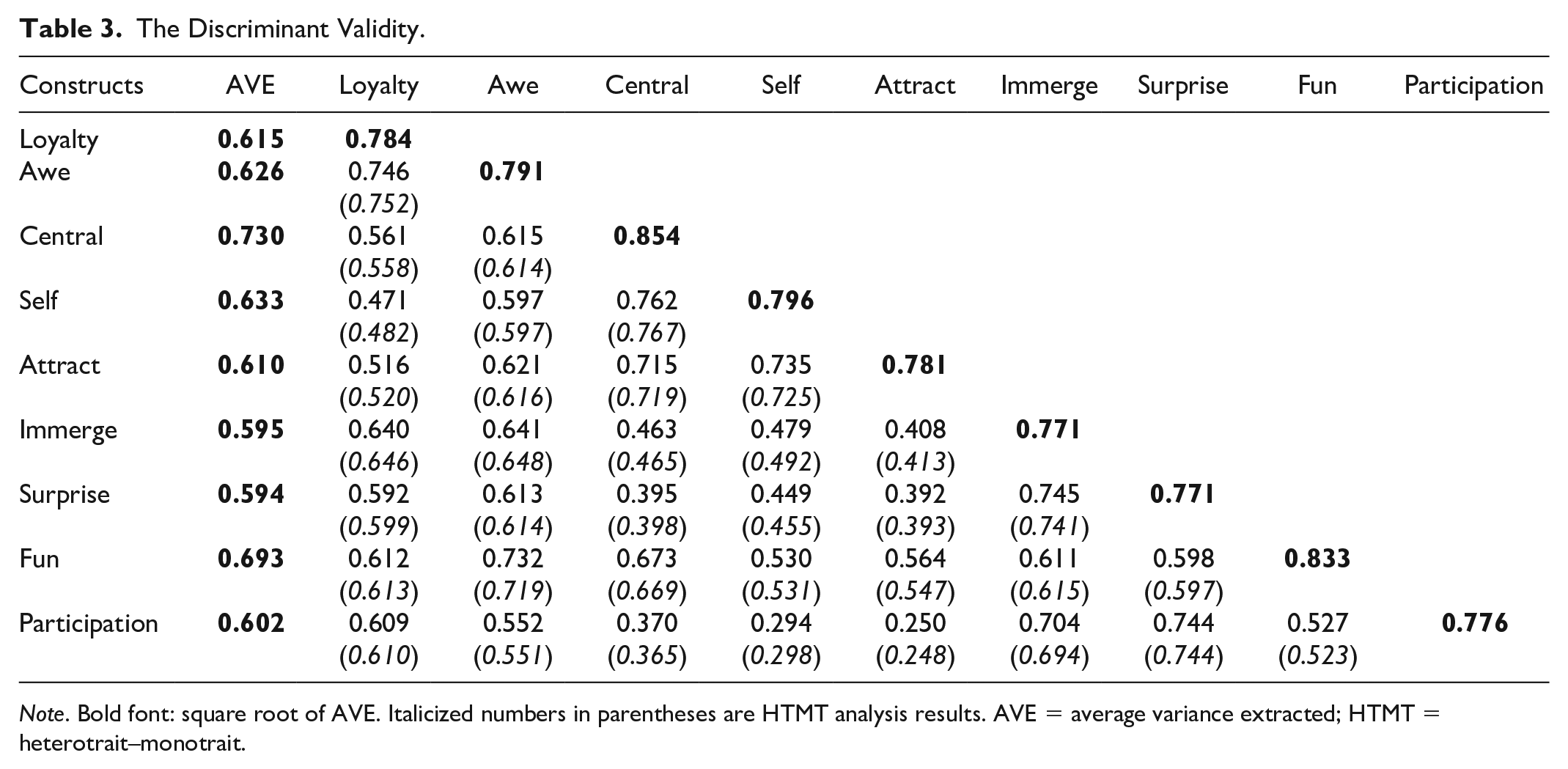
Note. Bold font: square root of AVE. Italicized numbers in parentheses are HTMT analysis results. AVE = average variance extracted; HTMT = heterotrait–monotrait.
Structural Equation Model
The overall model used the maximum likelihood method to evaluate six hypotheses; for the model fit indicators, see Table 2 (structural model). Individual indicators did not reach strict levels: for example, RMSEA = 0.06 (greater than 0.05), GFI = 0.87, AGFI = 0.85 (both less than 0.9). The model fit was modified using Bollen and Stine’s bootstrap modification, and all the indicators met the strict requirements (see Table 2, Bollen–Stine bootstrap). All hypotheses of the model are, therefore, supported except for Hypothesis 3—that is, the impact of involvement on loyalty was not supported (Figure 4); see Table 4 for detailed results.
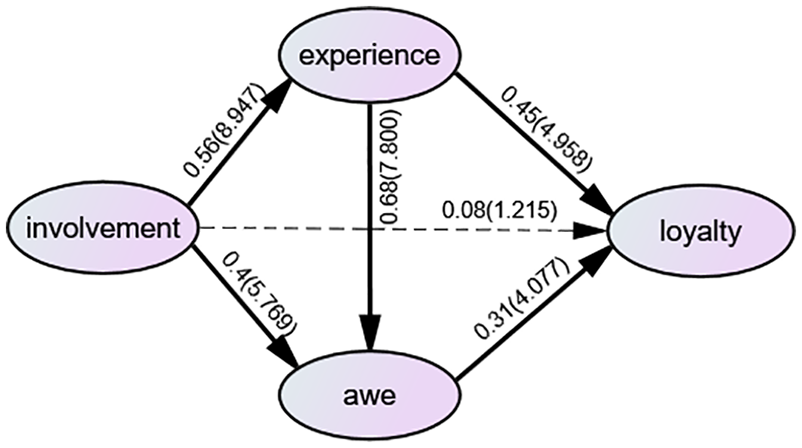
Structure model and path coefficient.
Structure Parameter Estimates.

p < .05. **p < .01. ***p < .001.
Mediating Effect
This study used the bootstrap method (bootstrap = 2,000) to test the mediation hypotheses proposed above. From the results given in Table 5, it can be seen that all theorized mediation effects exist. Experience quality plays a mediating role between involvement and loyalty (Hypothesis 7), and awe plays a mediating role between involvement and loyalty (Hypothesis 8). It is worth noting that the effect of remote mediation also exists: involvement → experience quality → awe → loyalty. Because the direct effect of involvement on loyalty does not exist, the effect of involvement on loyalty is assumed by three mediating effects. The specific indicators of each mediating effect are given in Table 5. In addition, awe was found to play a partly mediating role between experience quality and loyalty (Hypothesis 9).
Mediation Effect.

Note. CI = confidence interval; IN = involve; EX = experience; AW = awe; LO = loyalty.
Moderating Effect
According to the annual information released by Meizhou Island’s tourism administration department, there are far more female tourists participating in its celebrations of Mazu belief and customs than male tourists (http://www.mazu.name/). Therefore, we theorize that gender may play a moderating role with respect to the various hypotheses of our study’s model. Accordingly, we used a multigroup analysis approach to explore the moderating role of gender in the regulation of the variables. As shown in Table 6, the model fit of the multigroup analysis model is within an acceptable range. Before analyzing the effect of gender on each path, we first checked the invariance of sample measurements (Millsap, 2011). The differences in the p value for Δχ2 = 30.858, Δdf = 22, and χ2 between the unconstrained model and the constrained model (measurement weights) were found to be 0.099 (p = .099). However, the differences in the p value for Δχ2 = 63.704, Δdf = 45, and χ2 between the unconstrained model and the constrained model (structural covariances) were found to be 0.035 (p = .035), and the differences in the p value for Δχ2 = 178.974, Δdf = 31, and χ2 between the unconstrained model and constrained model (measurement weights) were found to be 0.000 (p = .000). This indicates that the model of regression weights by the gender group can be considered to have been satisfied with respect to the fitness requirement. In other words, gender does indeed play a moderating role in the various hypothetical relationships of this model.
Results for Invariance Measure.

Note. CFI = comparative fit index; NFI = normed fit index; RFI = relative fitness index; IFI = incremental fit index; TLI = Tucker-Lewis index.
From the results given in Table 7, it can be seen that the results concerning gender in all hypothetical relationships do not change—except for in relation to Hypothesis 6. That is, male tourists’ awe perception is not shown to positively influence their loyalty, whereas female tourists’ awe does. It is worth noting that, with respect to Hypothesis 2 (Z = 2.972 > 1.96), although male and female tourists’ involvement was found to positively influence their sense of awe, the coefficient for male tourists was greater than that for female tourists, and reached a statistically significant level of difference.
Results for the Moderating Effects Models.

Discuss and Conclusion
This study attempted to distinguish the relationships between the variables of involvement, experience quality, awe, and loyalty as they pertain to ICH tourism. In particular, ours is the first research to introduce awe to considerations of ICH tourism and to verify the relationship between awe and loyalty. In addition, this study also included gender as a regulatory variable for multigroup analysis. The results of the present work offer theoretical contributions to the study of ICH tourism, and also point toward some recommendations for management practices.
Theoretical Significance
First, this study’s results show that involvement is an antecedent variable of experience quality and awe, but not necessarily an antecedent variable of loyalty. The involvement of tourists is shown to have a positive impact on their experience quality. This result is consistent with the findings of previous studies (Altunel & Erkurt, 2015; Altunel & Koçak, 2017), confirming that it is equally applicable in the context of ICH tourism. Because involvement is a prerequisite of tourism activities, without a certain understanding of ICH, it is impossible to have awareness of participating in ICH tourism. Only when this idea is put into practice can tourists have the quality of an ICH experience. That is to say, in tourism associated with Mazu belief and customs, the quality of tourists’ experience comes from their involvement in those beliefs and customs. Similarly, the involvement of tourists has a positive impact on their awe perceptions. This finding is supported by the previous literature, and indicates that awe is a type of emotion (Krause & Hayward, 2015). Moreover, the findings of the present study are consistent with those of S. Kim (2012) and Bloemer and De Ruyter (1999), which suggest that involvement has a positive impact on emotions. In our study, the involvement of tourists in Mazu may be due to the influence of legends, recommendations from friends, and residents’ belief activities. When tourists are continuously exposed to this, they may feel awe.
It is worth noting that involvement was found to have no direct positive impact on loyalty in our study, which is inconsistent with the conclusions of previous studies (Bee & Havitz, 2010; Wong & Tang, 2016). These different results are likely due to differences in research context: The current study context is ICH, while the other cited studies focused on sports events. In other research, the conceptualization of involvement has been subdivided into personal (enduring) involvement, physical involvement, and situational involvement (Kaplanidou & Havitz, 2010). Zaichkowsky (1985) posited that personal involvement is driven by the needs of the individual and that the level of involvement of a person depends on the relevance of the object to him or her. Situational involvement refers to “temporarily increasing the relevance of objects or objects of interest,” and it can be stimulated by irritants or special situations. Herein, it can be seen that the involvement of an audience in a sport event is more inclined to the situational type of involvement (Wong & Tang, 2016), while the involvement of tourists in ICH tourism is a type of personal (enduring) involvement. Thus, different objects can lead to different results.
Second, our study’s results confirm that involvement is an antecedent variable of experience quality and awe, and that experience quality plays a mediation role in the relationship between involvement and awe, as well as between involvement and loyalty. Because experience quality has a direct and positive impact on loyalty, this shows that a sense of awe is a perception formed by tourists after an experience, and this perception directly depends on the quality of tourists’ experience. This finding is consistent with those of prior research (Han & Jeong, 2013; Jin et al., 2015). Given that the research object of the present study is different from those of previous works, the findings of this study can be argued to have universal applicability. In the present research, the tourist “experience” refers to personal participation in the religious activities of the original Mazu Temple. It is personal experience that enhances a tourist’s feelings toward ICH, and, evidently, a sense of awe. In this study, experience quality was found to have a direct impact on awe, and our results are consistent with those of previous studies (Hall & Cole, 2012; Song et al., 2015). This suggests that tourists experiencing Mazu belief and customs will have emotional feelings, albeit of a different type to those evoked by religious tourism and nature or scenic sightseeing. As experience quality was found to play an intermediary mediation role between involvement and awe, as well as between involvement and loyalty, this indicates that experience quality enhanced the impact of tourists’ involvement in Mazu belief and customs on their awe in respect of Mazu. In other words, the high quality of the experience helped to raise the level of awe of visitors toward Mazu. Moreover, this same high quality of experience also helped to enhance the impact of tourists’ involvement in Mazu belief and customs on their Mazu loyalty.
Third, this study empirically tested the direct positive effect of awe on loyalty. Our finding in this regard was consistent with those of Coghlan et al. (2012) qualitative study, which indicates that awe is an antecedent variable of loyalty—a finding that should provide a good reference point for further, follow-up research. Furthermore, as Mazu belief and customs also represent a kind of devotion, tourists who may not be believers can nonetheless experience a powerful sense of awe from this spectacular activity and solemn atmosphere, and it is precisely this kind of strong emotion that will motivate them to recommend or revisit Mazu belief and customs. This finding corresponds to those of a study by Gordon and Baker (2016). It is also worth noting that awe plays a mediating role in the relationship between experiential quality and loyalty; that is, awe can enhance the effect of experiential quality on loyalty. This result confirms that tourists’ emotions play an important role in the experience, and that the tourists’ awe created by Mazu belief and customs activities is of positive significance in relation to these tourists’ recommendations and revisits.
Finally, the above results show that experience quality and awe play multiple mediating roles in the relationship between involvement and loyalty. In addition, the existence of the remote mediation effect was confirmed: Involvement → Experience quality → Awe → Loyalty. Therefore, involvement was shown to indirectly influence loyalty through experiential quality and awe, and experiential quality and awe were shown to be both multimediating and remote mediating. This also affirms that, within Mazu-related activities, it is essential to provide high-quality experience and create a strong sense of awe. This study also identified distinct gender differences in respect of the influence of awe on loyalty. Specifically, it was found to be nonsignificant among male tourists but highly significant among female tourists. This result may explain the phenomenon of more female tourists participating in Mazu belief and customs than male tourists: Because their level of loyalty is generally higher, their revisit rate will be correspondingly higher (Campón-Cerro et al., 2017).
In sum, this study contributes to the theoretical framework by introducing the variable of awe into the field of ICH tourism. First, we verified the relationship between experience quality and awe. Second, we established that awe is the result variable of involvement, as well as the antecedent variable of loyalty. Third, we proved that awe plays a mediating role in the relationship between involvement and loyalty, and also between experience quality and loyalty.
Implication for Management Practice
For the tourism administration department, we first recommend that communication channels be broadened to enrich tourists’ knowledge about Mazu and strengthen their belief regarding Mazu’s spirit. For example, the management department could consider making movies and music related to Mazu or compiling and organizing books: This would give visitors a more comprehensive understanding of Mazu and thereby increase the strength of their interest in and affection for Mazu. That is, our findings suggest that strengthening tourists’ involvement with the Mazu spirit in their daily lives is essential for forming and reinforcing their beliefs. Second, our research results suggest that experience quality and awe play important roles in the tourism relating to Mazu belief and customs. The administration department should, therefore, strive to improve the quality of visitors’ experience, such as by optimizing the surrounding facilities, improving the service quality of the ceremony, and bringing tourists closer to Mazu belief and customs. Finally, we suggest that the tourism administration department should probe more deeply into the core and modern values of the Mazu spirit; for instance, shaping a vivid and impressive image of Mazu through the celebration activities so as to strengthen the awe of tourists is vital to promoting positive evaluations, wide dissemination, and revisiting.
In addition, our findings’ practical implications for tourism enterprise marketing are as follows. First, the coefficient of the influence path of involvement on awe was higher among male tourists than among female tourists. However, the influence path of awe on loyalty was not significant in the male group, which means that, for male tourists, awe is manifested more on the psychological level and does not transform or affect their actual participation behavior. This result is worthy of consideration by tourism companies, as it may indicate that there are obstacles to male tourists participating in activities surrounding Mazu belief and customs. For example, scheduling might be one issue, as the time for holding the Mazu celebrations is mostly during nonpublic holidays. Male tourists may find it more difficult to take a few days off because of their particular job conditions, which hinders them from participating. In response to this consideration, tourism enterprises could discuss with the tourism administration department the possibility of adjusting the timing of Mazu belief and custom activities, for example, by holding events on public holidays such as Labor Day and National Day. If this proves impractical, then increasing the number of events occurring during the above-suggested public holidays could be a more viable alternative for providing more opportunities for tourists’ participation. Regarding psychological barriers, men may differ from women in the way they express their beliefs, and they may be more euphemistic. Accordingly, travel agencies and tourism companies, in the development of ICH tourism such as that concerning Mazu belief and customs, should avoid overemphasizing the factors of faith, and instead place greater emphasis on tourism, leisure, and recreation, to ameliorate the psychological factors apparently preventing male tourists from fully participating in activities.
Second, tourism companies should pay more attention to the needs of female tourists, such as their security needs (e.g., pertaining to traffic safety, accommodation, facilities, and catering), shopping needs (characteristic commodities, but also belief- and custom-related commodities), and food needs (daily meals, specialty meals) to optimally serve the large markets of female tourists. Third, as there are now more than 10,000 Mazu temples in the world, additional cultural exchanges between the various branch temples with the original temples of Meizhou Island could be held more frequently to attract greater numbers of tourists. The branch temples and the original temples could also co-organize more activities to attract more tourists.
Research Limitation and Future Study
First, there are many kinds of ICH, and folk belief is a special case, being not only a representation of ICH but also a kind of belief or custom. Our study took Mazu belief and customs as an example of ICH, and this selection may entail certain restrictions. Caution should, therefore, be applied when extending our study’s findings and their implications to other ICH projects.
Second, due to the short period of celebrations of Mazu belief and customs, there was a certain time pressure for researchers collecting data. All researchers were involved in data collection, and the process control was as strict and consistent as possible, but there might be subtle differences in the collected data of each group. Future researchers may consider collecting and testing multiple data from the celebration of Mazu belief and customs each year to ensure the stability of our results.
Third, this study used a comprehensive measurement method to measure loyalty by including attitude loyalty and behavioral loyalty, but the two may differ. “Attitude loyalty” denotes that individuals have strong emotional tendencies, while “behavioral loyalty” is a specific behavior. In future studies, attitude loyalty and behavioral loyalty could be tested separately to see whether there is a difference. For example, we found that the influence of awe on loyalty was not significant among male tourists. However, whether the influence of awe differs between attitude loyalty and behavior loyalty is unclear and warrants further investigation. Fourth, when our study explored group differences, only gender was used as a moderator; there are many other variables that can be tested in future research. For example, is there a difference in the above relationship between the first-time visitor and the repeat visitor? Also, because Mazu is believed to be a sea goddess, the belief system and customs pertaining to her are mainly distributed in coastal areas. Whether there is a difference between tourists from coastal areas and those from inland areas is another interesting topic worth exploring in future research.
Supplemental Material
supplementary_file – Supplemental material for Awe of Intangible Cultural Heritage: The Perspective of ICH Tourists
Supplemental material, supplementary_file for Awe of Intangible Cultural Heritage: The Perspective of ICH Tourists by Xinwei Su, Xi Li, Yingchuang Wang, Zhiming Zheng and Yuanshui Huang in SAGE Open
Footnotes
Declaration of Conflicting Interests
The author(s) declared no potential conflicts of interest with respect to the research, authorship, and/or publication of this article.
Funding
The author(s) disclosed receipt of the following financial support for the research, authorship, and/or publication of this article: The author(s) received financial support for the research from the Macau Foundation: MF1925, Liming Vocational University Fund: LMTD201914, National Social Science Fund: 18BGL155.

References
Supplementary Material
Please find the following supplemental material available below.
For Open Access articles published under a Creative Commons License, all supplemental material carries the same license as the article it is associated with.
For non-Open Access articles published, all supplemental material carries a non-exclusive license, and permission requests for re-use of supplemental material or any part of supplemental material shall be sent directly to the copyright owner as specified in the copyright notice associated with the article.
