




Abstract
This study endeavors to examine the influence of locational conditions on talent employment decisions and to delineate effective nurturing strategies that bolster the sustainable development and core competitiveness of Zhejiang’s Specialized, Refined, Distinctive, and Innovative (SRDI) enterprises. The findings underscore that locational attributes play a pivotal role in shaping talent employment decisions. Specifically, a conducive policy environment, robust infrastructure, and a high degree of regional openness significantly enhance the talent acquisition prospects for SRDI enterprises in Zhejiang Province. A well-crafted policy framework furnishes essential external conditions and incentive mechanisms for enterprise growth, fostering an ecosystem that is conducive to talent absorption and retention. Enhanced infrastructure development not only optimizes the physical operational space for enterprises but also minimizes employees’ commute times and boosts work efficiency, thereby attracting a more talented workforce. Concurrently, regional openness introduces advanced technologies and managerial expertise, creating more development opportunities and career advancement pathways, which in turn enhance the enterprise’s talent appeal. The impact of locational factors varies across industries for SRDI enterprises, indicating that companies should customize their strategies based on the specific needs and conditions of their respective industries. By leveraging locational advantages more effectively, enterprises can attract top-tier talent, thereby fostering business growth and fortifying their market position. Local governments should prioritize the innovation of institutional mechanisms and the provision of a more competitive policy environment.
Keywords
Introduction
With industrial restructuring and intensifying regional competition in recent years, talent resources have become a core factor in enterprise development. However, many regions in China face the dual challenges of “talent shortages” and “talent mismatch.” On the one hand, as China’s demographic structure transforms, industries across the board are grappling with declining labor supply and accelerating cost increases, making recruitment more difficult for businesses. On the other hand, in some cities, talent clustering has failed to translate into industrial innovation momentum effectively.
Along with the excellent development momentum of “quantity and quality advancing together” in recent years, small and medium-sized enterprises have significantly facilitated widespread employment. As General Secretary Xi Jinping pointed out, the development of small and medium-sized enterprises is closely linked to the daily lives of ordinary families. It is a crucial force driving innovation, promoting employment, and improving people’s livelihoods. The “Specialized, refined, distinctive and innovative” (SRDI) types of small and medium-sized enterprises are fundamental. These outstanding enterprises are recognized as “hidden champions” because they embody new vitality, quality, and efficiency.
For SRDI enterprises, on the one hand, their limited scale subjects them to intense “talent competition” with large enterprises. On the other hand, SRDI enterprises often underperform in “soft power” aspects, typically lacking standardized management systems and, more critically, appropriate human resource development frameworks, resulting in insufficient capacity for employee training and development. Consequently, although SRDI enterprises excel in technological innovation, their size constraints and weak internal governance structures exacerbate talent supply-demand imbalances. The “bottleneck” challenges faced by SRDI small and medium-sized enterprises are profoundly reflected in the dilemma of sustainable human capital supply.
Review of the Literature, existing studies have proposed various solutions to address talent shortages, including tapping into the underutilized potential of female workers (Tatli et al., 2013), relying on labor supply willing to accept underqualified and low-wage employment (Brucker Juricic et al., 2021), and adopting robotic technologies to mitigate workforce deficits (Bogue, 2024). However, drawing on organizational sociology and resource dependence theory, organizations are profoundly influenced by their external environments. The locational competitiveness upon which firms rely is not only fundamental to their survival but also a critical determinant of their ability to secure developmental advantages and sustain priority growth. Porter’s theory of industrial clusters provides a profound industrial perspective, elucidating the dynamic coupling relationship among geographical proximity, industrial interdependence, and talent mobility (Jelinek & Porter, 1992). In contrast, Florida’s (2014) creative class theory adopts a human-centered paradigm, proposing a novel logic wherein “jobs follow talent” and “talent follows preferences and environment.” This theory introduces the “3T” framework—Technology, Talent, and Tolerance—as a mechanism for attracting the agglomeration of the creative class, thereby establishing a direct “gravitational model” for talent mobility. Consequently, the geographical positioning of a firm must be regarded as a strategic solution to addressing talent shortages. Empirical studies have explored the influence of location on talent in employment decision-making. For instance, Zhou et al. (2025) demonstrated that public transfer payments enhance health capital and facilitate labor skill training, thereby improving labor supply.
Meanwhile, Wu et al. (2024) introduced a scenario perspective, revealing that city development needs to attract innovative talent. Cities must not only provide high-quality public services and a comfortable material environment but also cultivate a rational, creative cultural atmosphere and lifestyle conducive to sustainable development. Furthermore, the pollution in the location of the enterprise significantly influences talent employment decisions (Yue et al., 2024). However, there is currently little literature to study how enterprise location factors influence talent employment decisions.
Moreover, existing research has predominantly concentrated on large enterprises, with insufficient attention directed toward the spatial strategies of small and medium-sized enterprises (SMEs). Zhejiang Province was selected as the research subject for several compelling reasons. First, in terms of government policy direction, Zhejiang Province has been a pioneer in fostering innovation and entrepreneurship. As early as 2006, Zhejiang introduced the “Seven Strategies” for SMEs, emphasizing specialization, refinement, high-tech orientation, intensification, informatization, branding, and internationalization, thereby guiding SMEs toward the development trajectory of SRDI enterprises. While this policy framework has created significant development opportunities, it has also intensified the spatial mismatch resulting from the uneven distribution of talent across regions. Second, in terms of enterprise cluster maturity, Zhejiang’s industrial clusters, compared to those in provinces such as Guangdong and Jiangsu, remain in the growth stage and face greater challenges in infrastructure development and talent network construction. Notably, Zhejiang led the nation in the number of “Little Giant” enterprises during the second, third, and fourth batches of announcements. However, with the release of the fifth batch of SRDI “Little Giant” enterprises in July 2023, Zhejiang no longer ranked first, reflecting the volatility and phased characteristics of its development process. Third, in terms of typicality and representativeness, Zhejiang boasts a diverse industrial ecosystem, high economic growth rates, and a pronounced innovation-driven character, making it a microcosm of the spatial distribution of SMEs and the dynamics of talent mobility across China. Given these considerations—policy distinctions, cluster development stages, and regional representativeness—conducting research using Zhejiang as a case study holds substantial academic value.
This study investigates the impact mechanisms of locational attributes on talent attractiveness for SRDI enterprises, addressing three central research questions. First, it examines whether a spatial mismatch exists between the geographic distribution of SRDI enterprises and patterns of talent mobility. Second, it explores the preferences of talent toward specific locational attributes and how these preferences influence employment decisions. Third, it assesses how optimized location strategies can alleviate talent shortages.
Methodologically, this research employs ArcGIS spatial analysis and questionnaire surveys to achieve its objectives. Initially, it identifies the spatial imbalance characteristics between the distribution of SRDI enterprises and the agglomeration of talent. Subsequently, questionnaire data are analyzed to elucidate how factors such as economic development level, industrial structure, innovation climate, and living environment collectively shape talent career decisions. Finally, by incorporating industry heterogeneity analysis, the study proposes dynamic corporate location adjustment strategies and provides optimized policy recommendations for governments.
The findings of this research offer a theoretical foundation for formulating regionally differentiated talent policies. By addressing the geographical constraints faced by SRDI enterprises in attracting and retaining talent, this study aims to facilitate efficient matching between talent supply and locational resources, thereby enhancing the sustainable development of SRDI enterprises.
Theoretical Analysis and Hypothesis Formulation
Building on prior scholarly research and the researcher’s in-depth understanding of the influence of enterprise location on talent employment decisions, this paper proposes a set of theoretical hypotheses. These hypotheses form the foundational framework for this study, providing a structured basis for analysis. Through a comprehensive exploration of the roles played by various determinants—such as the policy environment, infrastructure, economic performance, degree of openness, scientific and technological progress, and the quality of the national workforce—this research seeks to deepen the understanding of how enterprise location shapes talent employment decisions. By adopting a macro-policy perspective, the study aims to offer theoretically grounded guidance and actionable recommendations for the development of talent strategies within SRDI enterprises. These strategies are designed to enhance high-quality employment opportunities and contribute to social harmony and stability. The findings of this study hold significant academic value and offer practical relevance for addressing real-world challenges in talent management and enterprise development.
The Influences of Policy Environment on the Talent Employment Decisions for SRDI Enterprises
Within the framework of social responsibility for full employment, the government bears the historical mission of promoting comprehensive employment, alleviating the instability in employment, and safeguarding the rights and interests of workers. Therefore, the talent employment decisions cannot be independent of the influence of local government macro policies.
Studies have revealed that policy environments influence talent location selection through three key mechanisms. First, in terms of fiscal policy. Taking Kamar et al.’s (2019) study as an example, which employed a matrix econometrics approach, it concluded that proactive economic growth policies can significantly stimulate job creation. Moreover, the economic downturn induced by the COVID-19 pandemic was massive and spread at an unprecedented rate, leading to a surge in unemployment. Bredemeier et al. (2023) employed a multi-sector, multi-occupation macroeconomic model to investigate the effects of fiscal policy, revealing that expansionary fiscal measures disproportionately promoted employment growth in social sectors and pink-collar occupations, thereby offsetting the significant losses these groups suffered due to the pandemic. Second, regarding taxation. Ku et al. (2020) demonstrated that place-based wage tax incentives can effectively stimulate local employment when wage rigidity is high. Cheng and Wei (2024), based on a difference-in-differences analysis of digital tax reforms, found that digital taxation can significantly enhance job creation by firms, substantial and non-state-owned enterprises. Third, in terms of welfare systems. Stephan et al. (2015) demonstrated the critical role of public policy in attracting international talent.
SRDI enterprises exhibit high innovativeness due to their technological advancements, market expansion, and management model innovations. Their acute responsiveness to policy changes makes them more susceptible to such variations. While existing studies have explored the impact of government subsidies, tax incentives, and other policies on these enterprises, there remains a notable gap in research concerning the government’s role in enhancing their talent employment decision. Based on the above analysis and discussion, this paper proposes the following research hypothesis:
The Impact of Infrastructure on the Talent Employment Decisions for SRDI Enterprises
As the linchpin of economic and societal progress, sophisticated and efficient infrastructure yields direct and indirect, far-reaching benefits for business growth. Essential services, including energy supply, water resource management, waste disposal, transportation networks, and telecommunications, guarantee the material basis and support information flow for businesses’ stable operation and expansion and play a pivotal role. This section aims to systematically explore the influence and mechanisms of infrastructure development on the talent attraction capability of SRDI enterprises.
The study by Duffy-Deno and Dalenberg unveiled a close correlation between infrastructure stock and labor demand, discovering that a 10% increase in infrastructure leads to a .6% rise in labor demand, indicating a significant positive impact of infrastructure on employment (Duffy-Deno & Dalenberg, 1993), demonstrating its significant employment effect. On the one hand, in terms of transportation, congestion acts as a significant drag on the connection between employment and other opportunities, thereby hindering short-term and intuitive leaps in economic vitality (T. Thomas et al., 2018). According to the perspective of job-housing separation from He (2016), governments should continue to develop public service facilities in new towns and construct rail transit networks connecting city centers and new towns to reduce job-housing separation. Additionally, Lin’s (2017) application of the difference-in-differences method confirmed that the construction of high-speed railways significantly expanded market reach, consequently increasing urban employment with an employment elasticity index between 2 and 2.5.
With economic growth, SRDI enterprises can gain increased financial and resource support, accelerating technological innovation and market expansion while creating more high-quality employment opportunities. Additionally, economic growth stimulates the development of related industrial chains, providing these enterprises with greater access to talent and market opportunities. Based on the literature review and logical reasoning above, this article proposes the following research hypothesis:
The Impact of Economic Levels on the Talent Employment Decisions for SRDI Enterprises
The dynamics of the labor market and the extent to which its demands are met serve as direct indicators of economic performance, explicitly manifested in employment conditions.
First, the regional economic level, as a reflection of economic activity, significantly influences workforce attractiveness. Classical economist Adam Smith posited that the growth of national wealth would lead to an expansion in aggregate social demand and a diversification of consumer goods demand, thereby stimulating an increase in demand for productive labor and fostering a deeper division of labor. This deepening of labor division, by broadening the range of occupations available to workers, enhances overall societal labor productivity. Empirical studies, such as those utilizing panel data from Chinese provinces, have corroborated Okun’s law, demonstrating that economic growth positively impacts job quality while also highlighting the effects of the consumer price index and urban-rural disparities on employment conditions. Additionally, urban scale plays a role in shaping individual employment decisions. For instance, Huang et al. (2021), analyzing data from 278 Chinese cities, revealed that urban employment demand exhibits a nonlinear relationship with city size.
Secondly, regarding wage levels, productivity improvements drive transformations in work, thereby affecting both employment quantity and structure. Advances in productivity generate positive spillover effects, indirectly fostering new business models, employment forms, and job opportunities (David & Salomons, 2018). Furthermore, Phelan (2019) proposed a novel interpretation of the “ripple effects” of minimum wage policies, demonstrating that higher minimum wages reduce the compensating differentials for undesirable, low-skilled jobs. This shift may encourage some workers to leave low-wage, undesirable occupations and seek more favorable employment opportunities.
An open environment gives enterprises greater opportunities and resources, enhancing their attractiveness. The degree of openness, both externally and internally, exerts a direct and profound impact on the ability of SRDI enterprises to attract talent. Such openness can facilitate the introduction of advanced technologies and management expertise while simultaneously creating new employment opportunities. Therefore, based on the above analysis and theoretical framework, this paper proposes the research hypothesis:
The Influence of Degree of Openness to Internal and External Markets on the Talent Employment Decisions for SRDI Enterprises
In the context of globalization and economic integration, the degree of a country or region’s internal and external openness profoundly influences the dynamics of total supply and demand, thereby exerting a significant impact on the labor market. This impact manifests in two primary dimensions: trade openness and tourism openness.
First, regarding trade openness, the liberalization of trade has been shown to create employment opportunities across various industries. Mao and Xu (2024) employed a difference-in-differences (DID) estimation strategy to demonstrate that trade liberalization enabled higher-productivity manufacturing firms to generate more jobs, highlighting the positive correlation between trade openness and employment growth. Similarly, Cisneros-Acevedo (2022) examined the dual marginal effects of import competition on informal employment using Peruvian household survey data. Their findings revealed that trade liberalization, while fostering economic integration, also led to an increase in informal employment, underscoring the complex interplay between trade policies and labor market outcomes.
Second, in terms of tourism openness, the expansion of tourism has been identified as a key driver of employment in sectors such as hospitality, catering, and transportation. For instance, Zervas et al. (2017) investigated the economic implications of home-sharing platforms and found that their emergence significantly boosted local tourism development. This, in turn, expanded employment channels and increased demand for flexible, informal workers, particularly in regions with high tourist activity. These findings suggest that tourism openness not only stimulates economic growth but also reshapes labor market structures by creating both formal and informal employment opportunities.
This research section complements the understanding of talent attraction strategies in an open economic environment, aiming to provide theoretical support and policy guidance for enterprises in formulating more effective talent attraction and retention policies in a globalized context. Based on these studies and arguments, this paper proposes the hypothesis:
The Impact of Scientific and Technological Competitiveness on Employee Attraction for SRDI Enterprises
Technological advancement is a core driver of economic growth and employment expansion. This section will delve into the impact of technological progress and educational development on the labor market and corporate human resource strategies, offering theoretical support and empirical guidance for corporate decision-making in technology innovation and talent recruitment.
First, in terms of technological progress. Technological advancements can enhance corporate productivity and product quality, strengthening market competitiveness and providing employees with more career development opportunities and prospects for promotion. Tanaka’s (2025) research indicates that some firms can derive returns from new technologies and contribute to job creation. M. K. Thomas (2017) also found a complementary relationship between technological investment and the growth of labor opportunities, which can generate employment. Moreover, progress in science and technology can, to some extent, improve employees’ job satisfaction. Chen and Link (2018) found a positive correlation between individuals’ job satisfaction and exposure to robots in the local labor market.
What’s more, in terms of educational development. Education exerts a direct and profound impact on employment and plays a significant role in promoting labor market growth and economic development. Hong (2022) employed an integrated algorithm to accurately analyze talent data, arguing for optimizing international education talent cultivation mechanisms to align with contemporary global trends in science, technology, and education, thereby advancing the internationalization of talent training.
Advances in science & technology, along with innovation capabilities, constitute the core competitiveness of SRDI enterprises, directly influencing their technological proficiency, product quality, and market competitiveness. Because of this, the paper proposes the hypothesis:
The Influence of National Quality on Employee Attraction for SRDI Enterprises
Under the increasingly diversified employment patterns and rising job standards, the comprehensive quality of workers plays a crucial role. Lin (2017) noted that basic qualities constitute an essential dimension in the multidimensional evaluation system for high-level scientific and technological talents.
First, in terms of physical fitness. Good health is the foundation for workers to perform their jobs and has significant implications for improving work efficiency and reducing labor costs. On the one hand, physical health is essential. Fitness activities, pursued for recreation and personal development, influence subjective well-being (Mouratidis, 2018). Moreover, Carlier et al.’s (2014) studies have found that individuals in poor health are less likely to seek or secure paid employment. On the other hand, mental health is equally critical. Zimmer (2021) investigated the link between job loss and mental health issues, revealing that unemployment can trigger psychological problems, which in turn hinder future employment prospects.
Moreover, in terms of social relationships. Social connections not only affect employment quality but also contribute to the maintenance of physical health and psychological working conditions (Van Aerden et al., 2014). Employee well-being correlates with job performance, and positive social and physical environments play a vital role in enhancing well-being (Guest, 2017). Furthermore, Jahoda (1981) proposed that employment fulfills five latent functions: time structuring, expansion of social relationships, pursuit of collective goals, assignment of collective identity, and promotion of social integration, all of which significantly impact individual lives.
The improvement of national competency directly correlates with the professional skills and knowledge levels of the workforce. Moreover, enhancing national competency facilitates workers’ better adaptation to diverse working environments and positions, which aligns with the fundamental talent requirements of SRDI enterprises. Based on the above analysis, this paper puts forward the following research hypothesis:
This literature review systematically examines the impact of six key dimensions on employment decisions, providing a robust theoretical foundation for investigating talent shortages in SRDI enterprises. However, existing research paradigms exhibit significant limitations in explaining the high-end, structural talent shortages faced by this specific group of enterprises. These limitations are primarily manifested in two aspects:
(1) Macro-level research perspective:
The majority of existing studies adopt a macroeconomic approach rooted in regional economics or labor economics, focusing primarily on aggregate employment effects. These studies typically examine general labor markets or broad-based enterprises, failing to address the unique demands and micro-level decision-making logic required for attracting high-quality, specialized talent in SRDI enterprises. Consequently, they fall short of providing precise insights into the specific challenges faced by this strategically important group of enterprises.
(2) Isolation of influencing factors:
Existing research often examines the employment effects of individual factors in isolation, lacking a comprehensive theoretical framework to reveal how these factors interact systematically and collectively shape a region’s locational attractiveness. This fragmented approach limits the ability to understand the complex, interdependent dynamics that influence talent mobility and retention in SRDI enterprises.
Based on a thorough understanding of these research gaps, this paper aims to achieve innovation across two dimensions, thereby offering an in-depth analysis of the talent shortage challenges faced by SRDI enterprises:
(1) Theoretical innovation:
Breaking away from traditional single-factor, isolated research paradigms, this paper innovatively integrates six dimensions—policy, infrastructure, economy, openness, technology, and national quality—into a systematic theoretical framework for locational attractiveness. This framework not only recognizes the importance of each individual factor but also emphasizes their hierarchical structure and interactive coupling relationships. It posits that these factors collectively form an ecosystem that enables a region to attract and retain both SRDI enterprises and high-end talent.
(2) Focused research subject:
This study precisely targets SRDI enterprises and their high-end talent, which are of national strategic importance. By doing so, it bridges the research gap between macro-level employment policies and micro-level high-end talent mobility decisions, providing a more nuanced understanding of the interplay between regional attractiveness and talent retention in this context.
Research Subjects and Methods
Qualitative Research Using ArcGIS
ArcGIS, a suite of geographic information system (GIS) software products developed by the Environmental Systems Research Institute (ESRI) in the United States, enables qualitative research by intuitively presenting complex spatial data. This visualization facilitates easier identification of spatial patterns and distribution characteristics within the data.
Kernel Density Estimation (KDE)
Kernel Density Estimation (KDE) calculates the density of features within the vicinity of each raster cell output, elucidating the spatial distribution pattern of discrete measures in a continuous landscape (Wang et al., 2017). By utilizing KDE, it is possible to delineate the concentration or dispersion of SRDI enterprises within Zhejiang Province and, consequently, infer the agglomeration level of the enterprise clusters. This method allows for a detailed analysis of how densely SRDI enterprises are clustered and identifies potential hotspots of economic activity. The methodology applies the following formula:

Within this formula, s represents the spatial location where the density of SRDI enterprises is being estimated;
Global Spatial Autocorrelation Statistics
Global spatial autocorrelation is a statistical method in spatial statistics that reveals the spatial structure of regional variables (Hua et al., 2016). It primarily explores the spatial distribution characteristics of attribute data values across an entire region. By estimating the global spatial autocorrelation statistic, it analyzes the overall spatial association and degree of spatial variation within the region. The methodology applies the following formula:

Within this formula
Gravity Model
In the 19th century, many scholars observed that the principles and measurement methods established in physics could be applied to social issues, leading to the development of social physics (Carey, 1871). The gravity model is based on Newton’s law of universal gravitation. Social physics typically uses population or GDP to describe the attraction between cities (Liang, 2009). The formula is as follows:

In the formula,
Research Data
This study selected enterprises designated as SRDI from 2021 to 2023 in Zhejiang Province. These enterprises were recognized by the Department of Economy and Information Technology of Zhejiang Province, local municipal bureaus, and the People’s Government. After excluding enterprises whose actual operations fall outside Zhejiang Province, a research cohort of 8,801 SRDI enterprises was identified. The number of permanent residents was based on data released by the Zhejiang Provincial Bureau of Statistics in 2023.
Scale Construction and Variable Definition
Questionnaire Design and Scale Development
The dimension for measuring the influence mechanism of the location attributes of SRDI enterprises on talent employment decisions. We draw upon the career development scale formulated by Weng and Xi (2011). Weng and Xi have refined and adjusted it to meet the specific needs of our research inquiry. The questionnaire design encompasses three major measurement domains: respondents’ essential attributes, their perception and evaluation of the attractiveness of SRDI enterprises, and their satisfaction with locational factors. The construction of the scale for locational factors was implemented based on an integration of the urban competitiveness indicator system by Ning and Tang (2001). All survey items are measured using a 5-point Likert scale, allowing respondents to rate their satisfaction with various locational factors based on their situation. The scale includes five options for each question, with scores ranging from 1 to 5 in increasing order.
Variable Explanation and Definition
Control Variables
The control variables in this study are set as the primary personal attributes of talent, which specifically include occupation type, gender, age range, annual income range, educational level, and job stability, among others.
Dependent Variable
The dependent variable established in this study is the talent employment decisions index for SRDI enterprises (Y). This index is comprehensively evaluated and analyzed from four aspects: achievement of career goals, enhancement of professional capabilities, the pace of job promotion, and salary growth. Fifteen specific measurement items constitute the index.
Independent Variables
The independent variables in this study consist of locational factors across six key dimensions: policy environment (X1), infrastructure (X2), economic level (X3), degree of openness to internal and external markets (X4), scientific and technological competitiveness (X5), and national quality (X6). The policy environment dimension (X1) addresses various aspects, including government financial status, preferential policies, talent subsidies, urban safety, and environmental construction. The infrastructure dimension (X2) encompasses gas station layout, communication networks, transportation accessibility, road conditions, and water supply and drainage systems. The economic level dimension (X3) includes various projects related to economic development indicators like regional GDP, average salary levels, wage growth rates, bank financing, and consumption levels. The openness to internal and external markets dimension (X4) integrates content such as the ease of international trade activities, domestic and international travel frequencies, and preferences for international and domestic products. The scientific and technological competitiveness dimension (X5) covers the scale and quality of higher education, research, and development investment, the number of research institutions, and the attention and preference for emerging high-tech products. Lastly, the national quality dimension (X6) involves social and cultural standards such as educational levels, health status, medical resources, and employment and unemployment rates.
Research Subjects and Data Collection
For this academic study, we selected on-duty personnel from SRDI enterprises in Zhejiang Province as the survey subjects, covering a diverse sample that includes a variety of industries, genders, and age groups. The questionnaires were distributed through the professional online survey platform “Wenjuanxing.” Out of the 355 questionnaires dispatched, we collected 340 valid responses, resulting in a high effective response rate of 95.77%.
To ensure our collected data aligns with rigorous academic ethical standards, this study meticulously safeguards the rights and well-being of every research participant throughout its design and execution via the following comprehensive measures: Firstly, we prioritize minimizing any potential harm to participants. We achieve this proactively by employing anonymous online questionnaires, which inherently reduce risk from the very beginning. The survey content is carefully curated to focus on objective and subjective perceptions of the work environment and policy evaluations, deliberately steering clear of any highly sensitive personal information or private matters. Consequently, the psychological and social risks associated with participation are rendered exceptionally low. Secondly, our research aims to identify key locational factors that influence the talent attraction capabilities of SRDI enterprises. We firmly believe that the broad societal benefits and valuable knowledge contributions stemming from this study significantly outweigh the minimal, yet controllable, risks participants may undertake. The insights garnered will provide robust empirical evidence to guide governments in optimizing talent policies and empower enterprises to refine their talent management strategies, thereby fostering more vibrant regional innovation ecosystems and economic development. Furthermore, participation itself offers individuals a valuable opportunity for systematic reflection on their own work environments, with the aggregated feedback potentially inspiring indirect improvements in organizational management. Thirdly, and critically, this study is conducted under the strict principle of informed consent and voluntary participation. Before the formal questionnaire begins, participants are presented with a clear and detailed “Informed Consent Statement.” This statement illuminates the study’s purpose, procedures, potential risks, and benefits, and crucially, provides direct contact information for any questions or concerns. Participation is contingent upon participants reading this statement thoroughly and then actively affirming their understanding and willingness by selecting: “I have read the above statement, understand the research content, and voluntarily agree to participate in this survey.” Only after this explicit affirmation can respondents proceed to the questionnaire. This structured approach ensures that every completed survey represents a participant’s fully informed and uncoerced agreement.
Statistical analysis of the data was performed using SPSS 22.0 software. In alignment with the characteristics of the collected dataset, our data processing workflow was structured to include several systematic steps: reliability and validity analysis, descriptive statistical analysis, correlation analysis, multiple regression analysis, and robustness checks. These methodological steps were implemented to ensure the scientific rigor of the data handling process and the accuracy of the analytical outcomes. By employing this comprehensive approach, we aim to precisely delineate the relationships between the variables under investigation and provide robust empirical evidence to validate the hypotheses proposed in this study.
Relationship Between the Distribution of SRDI Enterprises and Local Population Numbers
Global Analysis
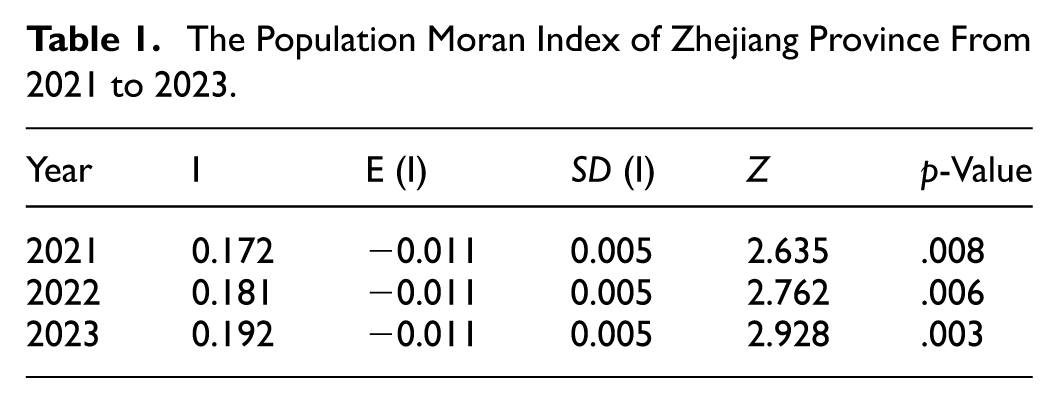
First, to comprehensively assess the spatial structure of talent supply in Zhejiang Province, this study calculated the global Moran’s I index for the permanent resident population from 2021 to 2023 (Table 1). The results revealed that the p-value consistently remained below the .01 significance level over the 3-year period, while the z-value exhibited a steady increase from 2.635 to 2.928. These findings confirm the presence of highly significant and progressively intensifying spatial positive autocorrelation in the distribution of Zhejiang’s permanent resident population. Furthermore, they underscore the existence of robust spatial structural barriers within the province’s talent supply system. Specifically, talent is not uniformly or randomly distributed but is instead highly concentrated in a limited number of hotspot areas, forming interconnected spatial patterns with surrounding regions. In the subsequent sections, this study will further investigate the specific contradictions between this population structure and the distribution of enterprises through both static and dynamic analyses.
The Population Moran Index of Zhejiang Province From 2021 to 2023.
Comparison of Static Kernel Density Plots
A comparative analysis of the spatial distribution of SRDI enterprises (Figure 1) and the kernel density map of the resident population in Zhejiang Province (Figure 2) reveals a high degree of spatial coupling in core cities such as Hangzhou and Ningbo. This alignment underscores the fundamental role of enterprise location selection in shaping talent employment decisions. However, a closer examination at the district level uncovers notable mismatches between enterprise distribution and population density. For example, in Hangzhou, SRDI enterprises are predominantly concentrated in Xihu District, while the population is largely clustered in Shangcheng District and Binjiang District, with a slight southeastward shift in focus.

(a) Kernel Density Estimation of SRDI enterprises in Zhejiang Province in 2021. (b) Kernel Density Estimation of SRDI enterprises in Zhejiang Province in 2022. (c) Kernel Density Estimation of SRDI enterprises in Zhejiang Province in 2023. Note: The map is drawn based on the Standard Map Service Website of the Ministry of Natural Resources, following the standard GS (2024) 0650, with no modifications to the base map boundaries.

(a) Kernel Density Estimation of the permanent resident population in Zhejiang Province in 2021. (b) Kernel Density Estimation of the permanent resident population in Zhejiang Province in 2022. (c) Kernel Density Estimation of the permanent resident population in Zhejiang Province in 2023. Note: The map is drawn based on the Standard Map Service Website of the Ministry of Natural Resources, following the standard GS (2024) 0650, with no modifications to the base map boundaries.
In contrast, significant spatial mismatches are evident in peripheral regions such as Jiaxing and Wenzhou. In Jiaxing, enterprises are densely distributed but lack adequate population support, indicating a disconnect between industrial policies and talent supply dynamics. Conversely, Wenzhou exhibits a dense population but a sparse distribution of enterprises, reflecting a misalignment between traditional labor structures and the demands of emerging industries. This spatial heterogeneity highlights the need for differentiated location optimization strategies to effectively address talent shortages and foster balanced regional development.
Dynamic Population Gravity Map
The urban population gravity model simulates the movement of individuals across different cities. In this study, the year-end resident population figures for each county and district, as published by the Zhejiang Provincial Bureau of Statistics in 2023 were employed to represent the resident population and, by extension, the size of the cities. The geographical coordinates of each county and district’s government seat were utilized to determine the central points for calculating inter-city distances. The population gravity map of various counties and districts in Zhejiang Province (Figure 3) reveals a general positive correlation between the concentration of SRDI enterprises and population flow. Specifically, the majority of population movements are concentrated in counties and districts with a higher density of SRDI enterprises. These findings further substantiate that the locational selection of SRDI enterprises significantly influences talent attraction, demonstrating that the agglomeration of high-quality enterprises can organically mitigate talent shortages.

Population attraction of counties and districts in Zhejiang Province.
However, notable disparities are observed in regions such as Jiaxing, where high enterprise concentration is not supported by sufficient population, and Wenzhou, where a dense population coexists with sparse enterprise distribution. These anomalies highlight the existence of “locational code failure zones,” where spatial mismatches disrupt the expected alignment between enterprise distribution and population dynamics. This spatial heterogeneity provides a scientific basis for the subsequent proposal of differentiated locational optimization strategies, tailored to address the unique challenges of each region.
Survey Results and Analysis
Description of Sample Basic Characteristics
The primary characteristics of the surveyed sample in this study are outlined below (Table 2). Regarding the occupational category distribution, the results indicate that most respondents are involved in the manufacturing industry, which comprises 40.88% of the sample, significantly higher than other sectors. It may reflect Zhejiang Province’s role as one of China’s key economic drivers and suggests that the manufacturing sector might still possess significant allure in the labor market. The gender composition is relatively balanced, which might align with the current trend of gender diversity in the labor market. The respondents are mainly concentrated within the 30 to 40 age bracket. Employees in this age range typically represent the backbone of their professional careers and are likely to possess relatively higher work experience and skills.
Basic Characteristics of the Sample.

Regarding annual income, the majority of respondents earn less than 100,000 yuan, a trend likely influenced by regional economic development levels and the industry’s average salary structure. In terms of education, most participants hold junior college or undergraduate degrees, reflecting both the widespread prevalence of higher education in China and the general demand for higher educational qualifications in the job market. Furthermore, an analysis of job stability indicates that the majority of respondents have maintained stable positions over the past 5 years. This suggests that the job market offers a degree of job security and underscores the importance of stability in talent employment decisions.
Geographic location, as a critical component of corporate competitiveness, significantly influences the decision-making of potential employees during their job search. Our findings highlight the locational advantages of SRDI enterprises, which include policy support, regional economic development, transportation convenience, infrastructure completeness, access to scientific and educational resources, and the livability of the surrounding environment. These multidimensional factors collectively create conditions that attract exceptional talent to such enterprises.
In the context of accelerating globalization and urbanization, a region’s comprehensive competitiveness, openness, and capacity for scientific and technological innovation are crucial considerations for potential employees when evaluating a company’s value and selecting employment opportunities. As shown in Table 2, more than half of the employees consider the location of the enterprise when making employment decisions. This underscores the high importance employees place on a company’s geographical location, revealing that the intrinsic mechanism of SRDI enterprises to attract high-quality talent cannot overlook their regional advantages. Indeed, locational conditions often play a decisive role in career decisions compared to many other factors.
This study further emphasizes the pivotal role of locational superiority in corporate strategic planning. To pursue market leadership, SRDI enterprises should fully leverage their geographical advantages to attract and retain talent. Such a strategy is likely to positively impact the long-term development and competitive strength of the business. For corporate decision-makers, effectively assessing and utilizing the benefits of geographical location can enhance a company’s attractiveness and lay a solid foundation for its future growth.
Reliability Check
To ensure the reliability of the collected data, this paper adopted a comprehensive method for reliability testing (Table 3). Initially, Cronbach’s alpha coefficient was calculated independently for each dimension of the scale, followed by a holistic assessment of the reliability of the entire scale. The data revealed that Cronbach’s alpha coefficients for each scale dimension exceeded the accepted threshold of .7 in psychological research, indicating good internal consistency within the scale. Further analysis showed that the overall Cronbach’s alpha coefficient for the entire scale reached .971, surpassing the acceptable threshold, which suggests that the survey questionnaire possesses extremely high internal consistency. Based on the analysis mentioned above, it is concluded that the questionnaire designed for this study is highly reliable, and the data obtained are robust.
Reliability Test.

Validity Test
Structural Validity
According to the model fit test results, the CMIN/DF (chi-square to degrees of freedom ratio) is 1.764, which falls within the excellent range of 1 to 3. The RMSEA (Root Mean Square Error of Approximation) is 0.047, meeting the superb standard of less than 0.05. Additionally, the IFI, TLI, and CFI results exceed 0.9, indicating an excellent fit. Therefore, this questionnaire possesses structural solid validity.
Convergent Validity and Composite Reliability
Building on the solid structural validity of the questionnaire, we conducted further tests for convergent validity (AVE) and composite reliability (CR). Table 4 shows that the factor loadings for each item within its respective dimensions exceed 0.5, signifying high representativeness. Furthermore, each dimension’s Average Variance Extracted (AVE) is above 0.4, and the Composite Reliability (CR) is more significant than 0.7. These results indicate that each dimension exhibits robust convergent validity and composite reliability.
Convergent Validity and Composite Reliability Test Results.

Descriptive Statistical Analysis
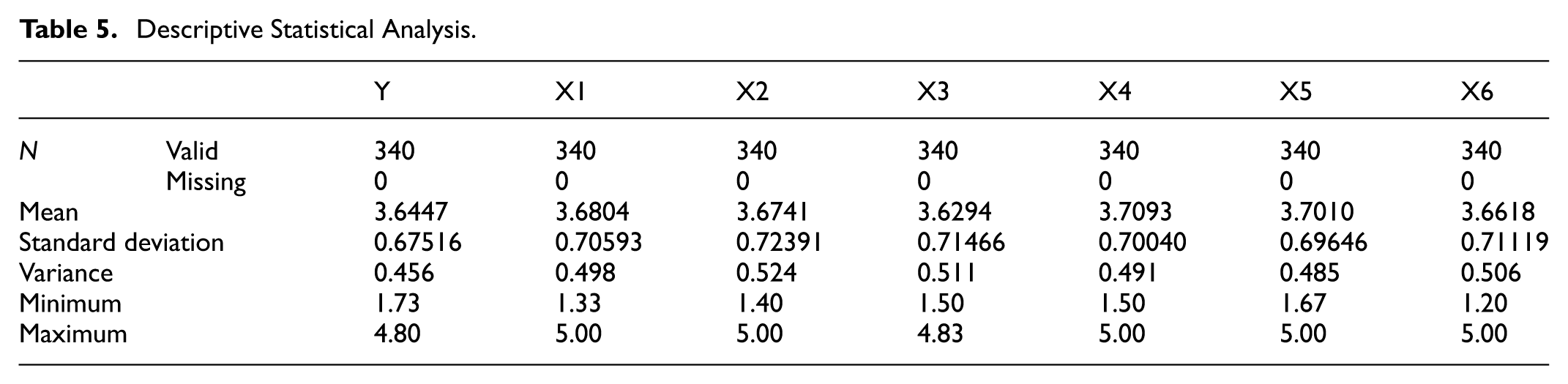
To gain deeper insights into the distribution of research indicators across various dimensions, this study employed SPSS statistical software to conduct a descriptive statistical analysis of key metrics related to the policy environment (X1), infrastructure (X2), economic level (X3), degree of openness to external and internal markets (X4), scientific and technological competitiveness (X5), and national quality (X6). The results are shown in Table 5. By examining trends in the dataset, including measures of central tendency and dispersion, we aimed to comprehensively understand the performance of each indicator across different dimensions. The results are presented in the table below, from which the following observations can be made:
Descriptive Statistical Analysis.
High Satisfaction With Openness (X4)
The mean scores for both external and internal openness (X4) were the highest, indicating that respondents generally expressed greater satisfaction and perceived more benefits in this dimension. This suggests a positive correlation between openness levels and socioeconomic vitality. The elevated satisfaction reflects lower barriers to factor mobility within the region, well-developed market access systems, and higher policy transparency. These conditions enable enterprises, particularly SRDI enterprises, to effectively access technological, capital, and talent resources, thereby enhancing policy effectiveness and market appeal.
Low Satisfaction With Economic Level (X3)
In contrast, the economic level (X3) exhibited the lowest mean value. This result does not necessarily indicate lagging regional economic output but rather reflects respondents’ heightened expectations for the quality of economic development. On one hand, it highlights insufficient efficiency in translating economic growth outcomes into improved livelihoods. On the other hand, it underscores a shift in innovation entities’ evaluation criteria from pure scale expansion to innovation intensity and distributive fairness. This cognitive gap signals the need for regional economic development to transition from quantitative growth to qualitative enhancement.
Volatility in Infrastructure (X2)
Analysis of the infrastructure dimension (X2) revealed the highest standard deviation and variance, indicating significant variability in respondent satisfaction levels. The polarized distribution of infrastructure evaluations corresponds to spatial imbalances in resource allocation, with systematic gaps between central and peripheral areas and among different industrial clusters. Moreover, SRDI enterprises of varying scales and industries exhibit markedly heterogeneous infrastructure needs. For instance, technology R&D firms prioritize information infrastructure, manufacturing enterprises emphasize logistics efficiency, and businesses in remote areas rely heavily on basic transportation networks. This diverse demand structure makes it challenging for a uniform infrastructure provision model to achieve consistent satisfaction, resulting in highly dispersed evaluations. This underscores the importance of adopting differentiated infrastructure improvement strategies tailored to distinct regions or groups.
This descriptive statistical analysis of key metrics provides a robust data foundation for subsequent inferential statistical tests and explorations of causal relationships. Simultaneously, these preliminary findings inspire further discussions on policy formulation and resource allocation optimization, offering valuable insights for addressing the identified challenges and enhancing regional competitiveness.
Correlation Analysis
To thoroughly analyze the correlation between the talent employment decisions index for SRDI enterprises (Y) and critical metrics involving the policy environment (X1), infrastructure (X2), economic level (X3), degree of openness to external and internal markets (X4), scientific and technological competitiveness (X5), and national quality (X6), this research has utilized the Pearson correlation coefficient to examine their relationship respectively (Table 6). The study found a positive correlation between talent employment decisions and these key factors.
Correlation Analysis.

The correlation is significant at the .01 level (two-tailed).
Regression Analysis
Multiple Regression Analysis of Talent Employment Decisions in SRDI Enterprises
Given the observed correlation between the talent employment decisions index for SRDI enterprises (Y) and key metrics—including the policy environment (X1), infrastructure (X2), economic level (X3), degree of openness to external and internal markets (X4), scientific and technological competitiveness (X5), and national quality (X6)—this study employs multiple regression analysis to examine the impact of these variables on talent employment decisions. The hypothesis posits that the attractiveness of SRDI enterprises exhibits a linear relationship with these critical variables.
Goodness-of-Fit Analysis
The multiple regression linear model yielded an R-squared (R2) value of .658, indicating that the model explains 65.8% of the variance in the dependent variable. This suggests a strong fit between the model and the observed data.
ANOVA Test for Model Significance
The ANOVA results demonstrate the overall significance of the regression model. The calculated F-value of 109.907 (p = .000 < .05) confirms that the regression coefficients are significantly different from zero, supporting the model’s validity.
Analysis of Regression Coefficients
The coefficients table (Table 7) reveals the impact of each locational variable on the talent employment decisions index for SRDI enterprises. All variables exhibit Variance Inflation Factors (VIF) below 5, indicating the absence of multicollinearity. While all locational variables positively influence talent employment decisions, only the policy environment (X1), infrastructure (X2), and openness to external and internal markets (X4) dimensions have p-values less than .05, signifying statistically significant positive effects.
Coefficients Table.

Note. Dependent Variable: Attractiveness Dimension of “Specialized, Distinctive, and Innovative” Enterprises
The correlation is significant at the .001 level (three-tailed).
Regression Equation and Hypothesis Testing
Based on the analysis, the regression equation between the independent and dependent variables is formulated as:

This equation indicates that the policy environment, infrastructure, and openness dimensions significantly contribute to the talent employment decisions index for SRDI enterprises. Consequently, Hypotheses 1, 2, and 4 are supported, while the remaining hypotheses require further investigation.
The findings underscore the critical roles of policy environment, infrastructure, and openness in shaping talent employment decisions for SRDI enterprises. These results provide valuable insights for policymakers and corporate leaders aiming to enhance the attractiveness of SRDI enterprises to high-quality talent.
Robustness Check
To further verify the efficacy of this model, the study conducts a robustness check by performing sub-sample regression analyses for different industries. The result shows that the R2 of manufacturing is .768, scientific research and technical services is .776, information transmission, software and IT services are .791, wholesale and retail trade is .650, and others are .771. All industries have exceeded 0.5, indicating good model fitness. And the significance levels are all below 0.05.
We categorize by occupational industries to compare the differences in locational dimensions between various sectors, as shown in Table 8 below.
Collinearity Differences of Locational Dimensions Across Different Industries.

The correlation is significant at the .001 level (three-tailed).
The correlation is significant at the .01 level (two-tailed).
The correlation is significant at the .05 level (one-tailed).
The following conclusions can be obtained:
Conclusion 1: Correlation analysis across industries
Except for the infrastructure and economic level dimensions in other industries with a Variance Inflation Factor (VIF) greater than 10, correlations among locational dimensions under other industry categories are relatively low, indicating strong reliability. It suggests that the locational dimensions under the manufacturing, scientific research and technical services, information transmission software, information technology services, and wholesale and retail industries are less sensitive to multicollinearity effects, ensuring robust analytical results.
Conclusion 2: Industry-Specific influences of locational dimensions
Different industries are influenced by district locational dimensions, as evidenced by the following findings:
(1) In the manufacturing sector, the location factors of enterprises affect the talent employment decisions, as Y = 0.0254 + 0.562 × X2 − 0.155 × X3 + 0.248 × X4. The research finds that improvements in infrastructure (X2) and levels of openness (X4) can boost the talent employment decision for potential employees of SRDI enterprises within the manufacturing industry. A well-developed infrastructure can drive supply-side structural reforms and further upgrade the manufacturing sector. A higher degree of openness expands market size and, through scale effects, can enhance enterprise profitability. Additionally, openness fosters learning from other companies’ advanced technology and management experience. Therefore, improving infrastructure and transparency can attract talent to manufacturing enterprises.
(2) In the scientific research and technical service industry, the influence model for the location factors of talent enterprises that affect employment decisions is Y = 0.246 + 0.456 × X1 + 0.385 × X2. The study shows that locational policy environments (X1) and infrastructure improvements (X2) can increase the talent employment decision of such enterprises. Government financial support can facilitate innovation investments and the output of scientific and technological achievements. On the other hand, talent policies and urban development can enhance subjective well-being and, consequently, draw talent.
(3) The regression model for the impact of locational factors on talent employment decisions in the information transmission, software, and IT services industry is Y = 0.011 + 0.589 × X3
This model reveals that the economic level of a location (X3) significantly enhances the industry’s appeal to employees. The development of this sector is heavily reliant on a supportive financial environment. In cities with higher economic levels, firms within this industry tend to be of superior caliber, which in turn increases their attractiveness to talent.
(4) In the wholesale and retail industry, the influence model for the location factors of enterprises affecting the employment decisions of talents is Y = 0.688 + 0.384 × X1 + 0.235 × X3. The study finds that locational policy environments and economic levels notably impact the industry’s talent employment decisions. Policy advancement can drive growth in the wholesale and retail sectors; for example, promotional policies can stimulate demand and sales volumes. Moreover, areas with higher economic levels have more significant needs, such as boosting sales volumes, generating scale efficiencies, and improving the industry’s profitability.
(5) In other industries, a VIF for the infrastructure and economic level dimensions greater than 10 and statistical significances above .05 indicate that locational influences on employee attractiveness are not sufficiently reliable.
Overall, these findings highlight the varying degrees to which different industries depend on locational dimensions. Specifically, the manufacturing industry is particularly influenced by infrastructure and openness, whereas the scientific research and technical service industries place greater emphasis on policy environments and infrastructure. The information transmission, software, and IT service sector is heavily reliant on the economic climate, while both policy environments and financial levels play a significant role in shaping the wholesale and retail trade. These insights can serve as a valuable guide for government and corporate decision-makers in formulating industrial development policies and talent recruitment strategies. For instance, the government could prioritize investments in infrastructure, promote openness, and refine industrial policies to enhance the appeal of manufacturing, scientific research, and technical service enterprises to employees. Additionally, optimizing talent policies and improving urban infrastructure could further bolster the competitiveness of the scientific research and technical service industries in attracting talent. For the information transmission, software, and IT service industry, as well as the wholesale and retail trade, the government can design growth-oriented policies and provide economic support to increase these sectors’ attractiveness to employees. From a business perspective, understanding these industry-specific dependencies on locational dimensions can help enterprises craft strategic development plans and recruitment strategies. Companies in the manufacturing, scientific research, and technical service industries could focus on strengthening infrastructure, embracing openness, and enhancing competitiveness. Meanwhile, firms in the information transmission, software, IT, and wholesale and retail sectors can leverage government support and prioritize factors such as economic levels and policy environments to improve their appeal to prospective employees.
Conclusion and Future Prospects
Research Conclusion
Based on the study on the impact of the location factors of enterprises affect the employment decisions of talents in Zhejiang Province, the study draws several conclusions:
The empirical findings of this study reveal that infrastructure, policy environment, and the degree of openness are critical spatial optimization factors for predicting talent shortages in SRDI enterprises, thereby supporting
Policy environment, infrastructure, and the degree of openness both externally and internally play a significantly positive role in enhancing the talent employment decision for SRDI enterprises. It implies that governments, businesses, and society should prioritize these locational factors to attract more talent and promote enterprise development. Governments should ensure a favorable policy environment, including tax, fiscal support, and welfare systems, to support businesses in transforming, upgrading, and enhancing employee well-being. Moreover, increasing investment in infrastructure and improving its layout and functions can enhance production efficiency and reduce enterprise transaction costs. External and internal openness can bring broader markets and opportunities to enterprises and promote their learning and innovation capabilities.
The statistical insignificance of the three macro indicators—economic level, technological competitiveness, and national quality—does not imply their irrelevance but rather underscores the distinct logic governing talent decision-making in SRDI enterprises. This finding provides a meaningful revision and supplement to traditional location theory. The lack of significance can be attributed to three key reasons. First, disparities in macroeconomic levels across regions may generate offsetting effects, diluting their overall impact. Second, conventional measures of technological competitiveness often prioritize hardware investments while overlooking innovation ecosystems, introducing dimensional biases that fail to align with the specific needs of SRDI enterprises for technical communities and knowledge networks. Third, as a long-term background variable, national quality exhibits limited sensitivity to the immediate, specialized talent requirements of SMEs.
This insight not only elucidates the empirical results but also enriches location theory, particularly the theory of location choice for SMEs. It reveals that SRDI enterprises prioritize directly perceptible micro-level contexts and institutional provisions over macro-level regional endowments, thereby shifting the focus of location theory from broad-scale factors to nuanced, micro-level mechanisms. Furthermore, the findings support the “threshold effect” hypothesis, suggesting that traditional location factors such as economic level and national quality only exert influence once they surpass a basic threshold. Beyond this threshold, their dominance is superseded by more catalytic factors like policy precision and infrastructure. This provides critical evidence for constructing a stratified location theory model better suited to innovative SMEs.
Second, industries exhibit varying degrees of reliance on locational factors. Consequently, when selecting a suitable location, enterprises must comprehensively consider their unique characteristics and needs. For instance, the manufacturing industry is particularly sensitive to infrastructure and openness, while the scientific research and technical service industry places greater emphasis on the policy environment and infrastructure. The information transmission, software, and IT services industry depends more heavily on the economic level, whereas the wholesale and retail trade industry is more influenced by the policy environment and financial conditions. Therefore, enterprises should strategically focus on the locational factors most relevant to their industry to enhance their attractiveness and competitiveness.
Research Limited and Prospects
This study provides preliminary insights into the spatial optimization of talent shortages in SRDI enterprises. However, it remains constrained in three key areas, which also delineate clear directions for future in-depth research.
First, the study faces limitations in causal inference and dynamic evolution analysis. Our research, relying on cross-sectional data, effectively reveals correlations between location factors and talent decisions but struggles to establish clear causality or capture dynamic pathways. Furthermore, the research focuses on the direct effects of location factors while insufficiently exploring the long-term mediating mechanisms’ influence. Future research should adopt longitudinal tracking designs to collect multi-year panel data, thereby validating potential causal mechanisms and revealing long-term effects.
Second, the generalizability of findings is constrained by regional and sectoral particularities. The empirical analysis, centered on Zhejiang Province, is limited in broad applicability due to the province’s unique economic structure, industrial ecosystem, and policy environment. Additionally, the industry coverage of the sample may affect the representativeness of the findings. Future research might consider other areas and industries to obtain a more comprehensive and diversified set of findings, analyzing the differences in locational factor needs among SRDI enterprises across various areas, providing more concrete guidance for enterprises choosing suitable locations, and offering more specific and compelling recommendations for local governments and businesses in formulating policies and strategies.
Third, a comprehensive framework for analyzing the interactions among multiple variables remains to be developed. While this study focuses on core location factors, enterprise talent decisions result from complex interactions among multiple factors. The effectiveness of location factors may be profoundly influenced by variables such as industry characteristics, enterprise scale, strategic positioning, and market demand. This study has not yet systematically revealed the interactive mechanisms among these variables. Future research could adopt a configurational perspective or develop a multi-level theoretical model to study the nonlinear influence mechanism of location factors on SRDI enterprises and reveal the formation logic behind the growth and talent strategies of SRDI enterprises.
Policy Recommendations
The study offers several pathways and suggestions regarding the locational cultivation of SRDI enterprises:
Strengthen Institutional Mechanisms
The government plays a pivotal role in fostering enterprise and societal development. It should enhance macroeconomic regulation by formulating and implementing policies that support and incentivize both enterprises and individuals. This includes providing financial subsidies, tax incentives, and welfare benefits to facilitate enterprise upgrading and transformation while simultaneously improving employee well-being. Such measures can create a more conducive environment for sustainable growth and innovation.
Optimize Infrastructure Development
Infrastructure is a critical determinant of enterprise productivity and transaction costs. Governments should prioritize increased investment in infrastructure, focusing on optimizing its layout, structure, functionality, and development models. This encompasses advancements in information infrastructure and transportation networks, which can enhance production efficiency and reduce operational costs for enterprises, thereby fostering a more competitive economic environment.
Promote Regional Openness
Both external and internal openness can amplify demand for enterprise products and create opportunities for learning and knowledge exchange, ultimately enhancing managerial and innovation capabilities. Governments and enterprises should actively pursue strategies to attract foreign investment, expand import and export trade, and leverage tourism and other channels to elevate the region’s openness. Such efforts can position the location as a dynamic hub for global economic engagement and innovation.
Footnotes

Ethical Considerations
This study involving human participants was conducted in full compliance with the ethical standards outlined for Research Involving Humans and the Declaration of Helsinki. The study protocol, including all procedures related to data collection, processing, and storage, was reviewed and formally approved by School of Business at Shaoxing University. Prior to participation, all potential subjects were provided with a comprehensive informed consent document in a language accessible to them. The document clearly outlined the study’s purpose, research procedures, potential risks and benefits, data usage scope, confidentiality measures, and the right to withdraw from the study at any time without penalty or prejudice to future care.
Consent to Participate
Written informed consent was obtained from each participant after they had the opportunity to ask questions and confirm their understanding of the study details. Throughout the study, strict measures were implemented to protect participants’ rights and welfare. The researchers affirm that all ethical obligations regarding human subject research have been fulfilled, and no conflicts of interest exist that could compromise the integrity of the study or the protection of participants’ rights.
Funding
The authors disclosed receipt of the following financial support for the research, authorship, and/or publication of this article: The authors acknowledge the support of the Cultivation Project for Leading Talents in Philosophy and Social Sciences of Zhejiang Province (No. 26QNYC025ZD), the Research Project of Humanities and Social Sciences of the Ministry of Education (No. 24YJAZH173), and the Zhejiang Provincial Education Project (No. 2025SCG137).
Declaration of Conflicting Interests
The authors declared no potential conflicts of interest with respect to the research, authorship, and/or publication of this article.
Data Availability Statement
The data that support the findings of this study are available in the additional files of this article.
Declaration of Generative AI in Scientific Writing
The corresponding author states that no generative AI is used for the content of the publication.