




Abstract
The logistics industry is a cornerstone of global trade and economic development, undergoing rapid digital transformation to enhance productivity and operational efficiency. Employee engagement in this transformation is critical, yet limited understanding exists regarding the factors influencing such engagement. This study aims to explore how proactive personality affects employees’ digital transformation engagement and job performance in logistics companies, while also examining the moderating effects of leader-member exchange (LMX) and job autonomy. A quantitative research approach was employed, using survey data collected from 758 employees in logistics firms. Statistical analysis was conducted using structural equation modeling (SEM) to evaluate relationships among variables, supported by moderation analysis to assess the effects of LMX and job autonomy. The findings reveal a positive relationship between proactive personality and digital transformation engagement, as well as job performance. Additionally, digital transformation engagement was strongly associated with job performance. Moderation analysis showed that high-quality LMX reduced reliance on proactive traits, while high job autonomy amplified their impact on engagement. These results underscore the importance of hiring proactive individuals, fostering supportive leadership, and designing autonomous roles to enhance digital transformation success. This study extends theoretical frameworks like the conservation of resources (COR) theory and offers practical strategies for managers and policymakers to drive innovation and workforce efficiency in logistics companies.
Plain language summary
Look at how proactive personality influences employees’ digital transformation engagement and job effectiveness - Explain the moderating effects of leader-member exchange (LMX) and job autonomy on these relationships. - Proactive personality has a positive relationship with employees’ digital transformation engagement and performance. - LMX and job autonomy operate as moderators in the relationship between proactive personality and employees’ digital transformation engagement.
Introduction
In the logistics industry, digital transformation is critical for sustaining competitive advantage in a sector characterized by complex supply chains and dynamic market conditions. DT fosters innovation by incorporating technologies such as artificial intelligence, big data analytics, the Internet of Things (IoT), blockchain, virtual reality (VR), and augmented reality (AR) (Dogru, 2023). VR technology enhances logistics operations by offering immersive training environments for tasks like warehouse management and equipment handling, reducing operational risks and improving employee proficiency. Similarly, AR provides real-time decision support by overlaying vital information directly into employees’ workflows, improving accuracy and efficiency in operations such as inventory management and order fulfillment (Skórnóg, 2023). These technologies not only revolutionize logistics processes but also create interactive and engaging work environments that enhance employee satisfaction and productivity (Guzmán-Ortiz et al., 2020). However, the successful integration of these technologies requires employees to acquire new competencies and embrace continuous learning, emphasizing the role of engagement in ensuring the sustainability of transformation efforts (Jooss et al., 2022).
Despite the transformative potential of digital technologies in logistics, organizations face significant challenges in fostering workforce engagement during these transitions. Employee engagement is a key determinant of how effectively employees adapt to new technologies and contribute to organizational goals (Teixeira et al., 2024). Research has shown that engagement drives productivity, creativity, and overall organizational performance (Sim & Plewa, 2017; Winasis et al., 2021). Engagement is influenced by a combination of individual characteristics, such as proactive personality traits, and organizational factors, including leadership dynamics and job design. Proactive employees, known for their initiative and adaptability, are more likely to embrace digital transformation and contribute innovative solutions (Bakker et al., 2012; Cai et al., 2015).
However, significant research gaps persist in understanding how these factors interact within the unique context of logistics enterprises undergoing digital transformation. While existing studies acknowledge the importance of employee engagement and proactive traits, limited empirical evidence explores the specific mechanisms by which these traits influence engagement outcomes in a technologically evolving logistics sector. For instance, Caniëls et al. (2018) examined the interaction between proactive personality, transformational leadership, and work engagement, highlighting the need for further research in diverse contexts. Moreover, contextual factors such as the pace of technological adoption, the complexity of supply chain networks, and the varying levels of digital maturity across logistics firms remain underexamined. The development of a digital maturity assessment model, as discussed by Tubis (2023) and Tubis et al. (2024), underscores the importance of evaluating digital transformation at both organizational and process levels, yet its application within logistics enterprises requires further exploration. Additionally, little attention has been given to how organizational support systems, such as leadership involvement and digital upskilling initiatives, moderate the relationship between proactive personality traits and engagement outcomes in logistics-focused digital transformations. The role of digital leadership in fostering employee innovative behavior, as investigated by Gao and Gao (2024), suggests potential pathways for enhancing engagement through leadership and empowerment strategies. Addressing these gaps is essential for developing tailored strategies to optimize employee engagement, ensure successful technological adoption, and improve organizational performance in the logistics industry.
This research addresses the critical gap in understanding how proactive personality traits influence employee engagement and job performance in logistics companies undergoing digital transformation. Grounded in the conservation of resources theory (COR) (Hobfoll, 2001), the study explores how employees leverage personal and organizational resources—such as leadership support through the leader-member exchange (LMX) and the autonomy provided by their roles—to sustain engagement and performance in the face of transformative technological challenges. Proactive employees, who are naturally inclined to seek opportunities and anticipate challenges, are theorized to excel in environments that provide these supportive resources. Additionally, the research builds on job engagement theory (Schaufeli & Bakker, 2004), which conceptualizes engagement as a state of dedication, vigor, and absorption in work, pivotal for individual and organizational success. Proactive employees are expected to exhibit higher engagement levels in adopting advanced technologies, including virtual reality (VR) and augmented reality (AR), due to their inclination toward innovation and adaptability. By examining the moderating roles of LMX and job autonomy, the study also employs the principles of job characteristics theory (Hackman & Oldham, 1976) to investigate how job design factors enhance or mitigate the relationship between proactive personality traits and digital transformation engagement.
By contextualizing these theoretical insights within the logistics industry—a sector profoundly impacted by rapid digital transformation—this study advances understanding of how proactive personality traits, leader-member exchange (LMX), and job autonomy shape employee engagement and performance. It enriches conservation of resources (COR) and job characteristics theories by demonstrating their relevance in technology-driven contexts, while also extending job engagement theory to the digital era. This dual contribution bridges theoretical gaps and provides actionable strategies for fostering a proactive, engaged workforce, ensuring both academic advancement and practical solutions for organizational resilience in the digital age.
Literature Review
The Logistics in Vietnam
The focus on Vietnam’s logistics industry as the subject of this study is driven by its critical role in the nation’s rapidly expanding economy and its position as a vital enabler of trade and commerce. With Vietnam achieving consistent GDP growth of 6% to 7% annually and total trade volume exceeding $700 billion in 2022, logistics has emerged as a cornerstone sector, contributing 4% to 5% to GDP and employing over 1.5 million workers (General Statistics Office of Vietnam, 2023; World Bank, 2021). Additionally, Vietnam is strategically located within Southeast Asia, serving as a gateway for regional trade and a critical node in global supply chains. These factors make the logistics industry a significant driver of economic resilience and growth.
The selection of this geographic and industrial scope is further justified by the rapid pace of digital transformation in Vietnam’s logistics sector. The adoption of advanced technologies, including IoT, artificial intelligence, blockchain, and big data analytics, is driving operational efficiencies and cost reductions of up to 20%, positioning the industry as a leader in technological innovation within the region (Du & Jiang, 2022; Helo & Thai, 2024; Le Viet & Dang Quoc, 2023; Reis et al., 2018). Government initiatives, such as the Green Port Development Project, further underscore the sector’s importance by aligning it with national sustainability goals and modernizing infrastructure to reduce emissions by 20% by 2030 (Vietnam Maritime Administration, 2020). The study’s focus on Vietnam’s logistics industry provides a unique opportunity to explore how these dynamics interplay within a rapidly evolving economy, offering insights that are both locally impactful and globally relevant. By examining this context, the research contributes to broader discussions on the role of digital transformation in enhancing logistics performance and economic development.
Digital Transformation in Logistics
To begin with, it is important to differentiate digital transformation from related terms like digitization, digitalization, and industry 4.0. Digital transformation, as described by Reis et al. (2018), is the use of new digital technologies that impact all facets of consumers’ lives and facilitate significant commercial benefits. Gong and Ribiere (2021) offer the following definition of digital transformation in an effort to create a common understanding: “Digital transformation is a fundamental change process, enabled by the innovative use of digital technologies accompanied by the strategic leverage of key resources and capabilities, aiming to radically improve an entity and redefine its value proposition for its stakeholders.”
Currently, there are many studies pointing out the influence of digital transformation on firm performance, including increased sales revenue, improved operational efficiency, cost reduction, innovation, financial performance, and competitive advantages (Brock & Von Wangenheim, 2019; Du & Jiang, 2022; Kindiy & Oklander, 2024; Svahn et al., 2017; Usai et al., 2021). Besides, some research focuses on identifying elements that enable firms to reap the potential benefits anticipated from digital transformation, such as digital culture, digital workforce, digital awareness, digital agility, organizational structure, and digital platform (Guy, 2019; Hanelt et al., 2021; Verhoef et al., 2021).
Digital transformation in the logistics industry is accelerating, driven by the adoption of advanced technologies such as the Internet of Things (IoT), artificial intelligence (AI), blockchain, virtual reality (VR), augmented reality (AR), and big data analytics (Kern, 2021; Raza et al., 2023). These innovations enhance operational performance, increase efficiency, and create opportunities for innovation and resilience within the sector (Vial, 2019; Zhang et al., 2024). IoT enables real-time tracking and monitoring, AI optimizes decision-making and forecasting, and blockchain ensures transparency and security in supply chain transactions, collectively fostering industrial development and technological advancement (Ben-Daya et al., 2019; Saberi et al., 2019). Big data analytics (BDA) has become a cornerstone of supply chain management, offering predictive insights that improve resource allocation and support proactive disruption management (Wamba et al., 2020; Zamani et al., 2022). However, these technological advancements are not without challenges. Organizational inertia and limited digital capabilities often hinder the progress of digital transformation. Addressing these barriers requires targeted investments in infrastructure and strategic planning, as identified by Cichosz et al. (2020). Despite the challenges, the integration of digital technologies and BDA offers significant potential to revolutionize the logistics industry, underscoring the need for robust strategies to maximize their impact.
Leading logistics companies have embraced these innovations to optimize their operations (Didenko et al., 2021). For example, Maersk has heavily invested in digital platforms, integrating IoT and blockchain technologies to streamline supply chains, enhance customer experiences, and improve operational efficiency (Brock & Von Wangenheim, 2019). Similarly, CMA CGM has implemented mobile applications and customer information management systems to modernize its operations, utilizing blockchain to optimize transportation and transaction processes, resulting in increased efficiency and customer satisfaction (Verhoef et al., 2021). Mediterranean Shipping Company (MSC) has also advanced its digital capabilities by incorporating innovative technologies aimed at improving service reliability and overall operational performance (Reis et al., 2018). These examples reflect the logistics industry’s commitment to leveraging digital transformation for competitive advantage and enhanced service delivery (Mutambik, 2024).
Drivers of Digital Transformation
The drivers of digital transformation for individuals in organizations can be categorized into personal, technological, organizational, and environmental factors, each playing a unique and interrelated role in shaping how employees adapt to digital change. Among personal factors, digital literacy is foundational, enabling individuals to proficiently navigate digital tools and technologies (Bikse et al., 2021). This factor underpins adaptability, as employees with higher literacy are more likely to embrace new systems. Closely related is learning agility, which refers to the willingness and ability to learn, unlearn, and relearn in dynamic environments (Vey et al., 2017). While digital literacy focuses on existing competence, learning agility emphasizes continuous improvement and adaptability, making it essential for employees to thrive in rapidly changing conditions. Furthermore, agility, the capacity to quickly adapt to market shifts, complements these traits by preparing individuals to respond proactively to uncertainties (Schlömer, 2022).
Technological factors also significantly influence digital transformation at the individual level. Accessibility, or the availability of digital tools and platforms, serves as a prerequisite for participation, enabling individuals to engage with technologies effectively (Schwab, 2016). However, accessibility alone is insufficient without usability, which ensures that technologies are intuitive and user-friendly, reducing barriers to adoption (Norman, 2013). Building on this, innovation performance—the ability to generate and implement new ideas using digital tools—reflects how technological enablers translate into tangible outcomes for organizations (Wang & Zhang, 2025).
Organizational factors provide the structural and cultural support needed for individual transformation. Supportive leadership fosters an environment conducive to change by encouraging technology adoption and providing the necessary resources (van Dun & Kumar, 2023). Similarly, training programs ensure that employees are equipped with the skills required to engage with digital technologies (Heavin & Power, 2018; Neukirchen & Klumpp, 2019; Ostmeier & Strobel, 2022). While leadership motivates and guides employees, training programs operationalize this vision by building competence.
Finally, environmental factors shape digital transformation through external and societal pressures. Social influence, including peer behaviors and societal trends, shapes individual attitudes toward technology adoption by normalizing digital engagement (Rogers, 2003). In contrast, external factors such as regulatory changes, technological advancements, and competitive pressures compel adaptation, emphasizing the need for individuals to align with broader organizational goals (Poulose et al., 2024; Table 1).
The Drivers of the Digital Transformation Implementation.

Proactive Personality
There are significant implications for both individuals and organizations from the complex, multi-caused notion of proactive personality. The definition of it is the conviction that one can influence changes in the surroundings and transcend limitations imposed by external factors (Bateman & Crant, 1993). A more precise definition of proactive conduct is “taking initiative in improving current circumstances or creating new ones; it involves challenging the status quo rather than passively adapting to present conditions” (Crant, 2000, p. 436). According to Joo and Ready (2012), proactive people take initiative, act, and persevere in effectively implementing change. They also seek out chances and seize them. Consequently, due to the evolving nature of work, proactive conduct is more important than ever.
There is increasing agreement that proactive personalities predict professional success (both subjective and objective), career adaptability, quitting intention, and work performance in a reliable and consistent manner (Cai et al., 2015; Kuo et al., 2019; Loi et al., 2016). According to interactional psychology theories, an individual’s disposition and environment interact reciprocally, this is the theoretical foundation for the links found between proactive personality and professional success. The dispositional tendency of proactive employees to shape the work environment offers several benefits, including an increased likelihood of negotiating work procedures and content, exerting influence to increase the resources available for the job, changing or looking for better ways to complete tasks, and participating in career management activities. As a result, proactive individuals are more likely than less proactive ones to not only complete tasks more effectively but also to be seen by managers as completely motivated and having a better potential for professional success.
Conservation of Resources Theory
The conservation of resources (COR) theory provides a critical lens for examining how individuals and organizations navigate the challenges of digital transformation. Central to COR theory is the premise that individuals are motivated to acquire, preserve, and optimize valuable resources to mitigate stress and achieve their goals, particularly during periods of change or disruption (Hobfoll, 2001). In the context of digital transformation, resources encompass not only tangible assets like technological tools but also intangible ones, such as psychological resilience and social support (Halbesleben et al., 2014).
A proactive personality is recognized as a crucial individual resource enabling employees to effectively utilize organizational support systems, such as leader-member exchange (LMX), and adapt to technological demands. Individuals exhibiting proactive traits are more inclined to engage in resourceful behaviors, thereby enhancing their participation in digital transformation initiatives (Caniëls et al., 2018). However, the availability and interaction of organizational resources can either complement or substitute the necessity for individual resourcefulness. For instance, high-quality LMX—characterized by strong, supportive relationships between leaders and employees—can mitigate the reliance on proactive personality traits by compensating for individual effort (Breevaart et al., 2015). Conversely, job autonomy serves as an amplifying factor, granting employees the freedom and discretion to innovate and self-manage, thereby intensifying the positive impact of proactive personality on digital transformation engagement (Hackman & Oldham, 1976). Recent studies further corroborate these dynamics, highlighting that LMX quality significantly influences proactive behaviors and that job autonomy enhances the effect of proactive personality on employee outcomes (Bakker et al., 2012; Joo & Lim, 2013).
Job Engagement Theory
Job engagement theory provides a critical framework for understanding employee engagement during digital transformation, emphasizing a “positive, fulfilling, work-related state of mind” characterized by vigor, dedication, and absorption (Schaufeli et al., 2002). In the context of logistics and other industries, engagement reflects employees’ active participation in adopting digital technologies, driving innovation, and enhancing organizational workflows. Research demonstrates that engaged employees are more adaptable, creative, and productive—qualities essential for navigating the complex and dynamic requirements of digital transformation (Bakker et al., 2012; Motyka, 2018). For instance, in the Indonesian banking sector, digital transformation efforts have been shown to positively impact employee engagement, underscoring the importance of creating an environment conducive to motivation and productivity (Winasis et al., 2020).
Key organizational resources, such as autonomy, supportive leadership, and skill development opportunities, are pivotal in sustaining engagement during technological change. These resources not only foster intrinsic motivation but also help reduce resistance to change while enhancing employees’ commitment to digital transformation goals (Schaufeli & Bakker, 2004; Zhu, Gardner, et al., 2017). For example, transformational leadership has been identified as a critical factor in enhancing employee engagement in digital transformation, as evidenced in studies from sectors like banking and higher education (Niță & Guțu, 2023; Winasis et al., 2021). Moreover, effective leadership and clear communication ensure alignment between organizational objectives and employee motivation, while digital training and skill enhancement programs build the technical proficiency required to adapt to new workflows and technologies (Men et al., 2020; Ostmeier & Strobel, 2022).
Finally, fostering engagement requires organizations to invest in innovation-friendly environments and equitable access to resources to ensure employees remain motivated and aligned with the organization’s digital goals. A study on the relationship between leadership, engagement, and digital transformation in organizational success further supports the need for balancing employee empowerment with resource accessibility (Lu et al., 2023; Yang & Lin, 2023). As the logistics industry continues its technological evolution, ensuring alignment between employee engagement strategies and digital objectives will be crucial to achieving sustainable success in increasingly competitive environments.
Hypothesis Development
Proactive Personality and Job Performance
In the context of a logistics company, proactive employees play a critical role in driving innovation and efficiency by actively seeking opportunities to improve work processes and address challenges. Proactive individuals consistently pursue new knowledge, adopt innovative methods, and refine their skills to adapt to dynamic operational demands (Bateman & Crant, 1993; Han et al., 2019). This capacity to anticipate and respond to changes fosters enhanced performance, as these employees not only fulfill their assigned duties but also contribute creative solutions that exceed standard job expectations (Kim et al., 2009; Seibert et al., 2001).
Logistics environments, characterized by complex supply chains and rapid technological advancements, require employees who can navigate uncertainty and implement new processes effectively. Proactive employees, through their adaptability, prepare for and embrace technological shifts, enabling seamless integration of digital tools and innovative workflows. This adaptability ensures the organization remains competitive in a fast-evolving industry (Kuo et al., 2019; Parker et al., 2010). Furthermore, their ability to maintain a strategic perspective allows them to identify risks associated with stagnation and advocate for continuous improvement (McCormick et al., 2019).
Theoretical and empirical studies consistently link proactive personalities to superior job performance in organizational settings (Jiang, 2017; Thompson, 2005). In logistics companies, these traits are essential for achieving operational excellence and adapting to external and internal transformations, such as the adoption of digital technologies or shifts in market demands. As such, the following hypothesis is proposed:
Hypothesis 1: Employees with highly proactive personalities will achieve better job performance in logistics companies.
Proactive Personality and Digital Transformation Engagement
In the logistics sector, employee engagement has become a pivotal factor in determining organizational success, particularly in the context of digital transformation. Engagement, defined by Schaufeli et al. (2002) as “a positive, fulfilling, work-related state of mind characterized by vigor, dedication, and absorption,” is essential for fostering adaptability, commitment, and productivity among employees. Research consistently highlights the role of employee engagement in enhancing organizational outcomes and competitive advantage, making it a cornerstone for success in industries undergoing technological transformation (Men et al., 2020; Rich et al., 2010).
During digital transformation, engagement refers to employees’ active involvement and enthusiasm in adopting digital technologies to enhance logistics operations. These include optimizing supply chain efficiency, reducing costs, and driving innovation through technologies such as artificial intelligence, the Internet of Things (IoT), and blockchain. Engaged employees are more likely to embrace these changes, ensuring the success of transformation initiatives by leveraging digital tools effectively (Winasis et al., 2021). This engagement is critical for logistics firms, where operational efficiency and responsiveness to market demands are highly reliant on employees’ adaptability and motivation.
Proactive employees are especially critical in this context. These individuals exhibit a strong inner drive to acquire new knowledge, enhance their skills, and adopt innovative work methods, which aligns with the dynamic demands of digital transformation. Proactive traits have been consistently linked to positive workplace outcomes, such as enhanced performance and innovation (Jiang, 2017). In logistics, proactive employees demonstrate resilience and adaptability, enabling them to navigate disruptions, embrace new technologies, and proactively seek improvements in supply chain processes (Parker et al., 2010). Furthermore, proactive employees thrive during digital transformation due to their natural inclination to adapt to new technology, embrace change, and seek out challenges to expand their expertise. For instance, they continuously refine their digital knowledge and develop skills that align with evolving job requirements, ensuring alignment with organizational goals (Ostmeier & Strobel, 2022; Zhu, He, & Wang, 2017). Their engagement and willingness to innovate provide logistics firms with the human capital necessary to succeed in an era of rapid technological advancement (Winkelhaus, 2022).
Based on these findings, this study proposes that proactive personalities are strongly linked to digital transformation engagement, significantly contributing to organizational success in logistics.
Hypothesis 2: Employees with highly proactive personalities will be positively consistent with digital transformation engagement in logistics companies.
Digital Transformation Engagement and Job Performance
In the logistics industry, employee engagement plays a crucial role in individual, team, and organizational performance, particularly during the ongoing digital transformation driven by Industry 4.0 technologies such as artificial intelligence (AI), blockchain, big data, and the Internet of Things (IoT). Engagement has been consistently linked to improved individual performance (Gorgievski & Moriano, 2014; Lazauskaite-Zabielske et al., 2018; Lin et al., 2016; Shantz et al., 2016) and enhanced team outcomes through better collaboration and shared goals (Badal & Harter, 2014; Suhartanto & Brien, 2018). Moreover, engaged employees contribute to broader organizational success by driving innovation, operational efficiency, and customer satisfaction (Benn et al., 2015; Dijkhuizen et al., 2016).
The advantage of engagement lies in its ability to foster positive emotional states, such as happiness, fulfillment, and energy, which, as Demerouti and Cropanzano (2010) highlight, increase workers’ motivation and initiative. These emotional states enhance cognitive and interpersonal capabilities, such as generating innovative ideas, developing skills, and fostering productive relationships (Bakker et al., 2012). Consequently, engaged employees consistently deliver high-quality work, maintain effective relationships with colleagues and managers, and are recognized as valuable contributors with strong potential for career advancement.
In the logistics sector, digital transformation introduces new operational demands requiring employees to adapt quickly to evolving technologies. Engagement is a vital enabler in this context, ensuring that employees not only acquire but also effectively apply digital skills to improve processes, save time, and boost efficiency (Guzmán-Ortiz et al., 2020; van Laar et al., 2020). By actively participating in the digital transformation journey, engaged workers leverage advanced tools to enhance individual and organizational outcomes, reinforcing the alignment between innovation and business goals. Therefore, based on the arguments above, we think that:
Hypothesis 3: Digital transformation engagement will be positively consistent with job performance in the logistics companies.
LMX as a Moderator of the Relationship Between Proactive Personality and Digital Transformation Engagement
This study explores the moderating role of Leader-Member Exchange (LMX) in the relationship between proactive personality and employee engagement in digital transformation within logistics companies. Drawing on the Conservation of Resources (COR) theory (Hobfoll, 2001), we hypothesize that the quality of LMX shapes how proactive employees engage with digital transformation initiatives. Specifically, high LMX relationships may weaken the influence of a proactive personality on digital transformation engagement, whereas low LMX relationships may amplify it.
LMX theory emphasizes the variability in leader-member relationships within organizations, where leaders form unique relationships with each employee based on daily interactions (Martin et al., 2016, 2018). High-quality LMX relationships are characterized by trust, communication, and access to organizational resources, while low-quality LMX relationships provide limited support, often leaving employees to rely on their own resources. In logistics companies, this variation impacts employees’ ability to adapt to the digital transformation process, as access to critical resources such as training, tools, and managerial support differs significantly between high- and low-LMX groups.
COR theory posits that individuals strive to acquire and maintain resources to cope with demands (Hobfoll, 2001). When organizational resources, such as those provided through high LMX, are abundant, employees are less likely to depend on their personal resources, such as a proactive personality. This dynamic may diminish the positive impact of proactivity on engagement, as resources provided by leaders fulfill many of the requirements for navigating digital transformation (Halbesleben et al., 2014; Li et al., 2020). Conversely, under low LMX conditions, where organizational support is limited, proactive employees must draw on their personal initiative to acquire the digital skills and knowledge needed to engage in transformation efforts effectively.
High LMX relationships afford employees greater access to resources, such as training opportunities, leadership feedback, and advanced technological tools, which facilitate their participation in digital transformation initiatives (Martin et al., 2018). For example, employees in high LMX relationships may receive personalized guidance or be prioritized for internal training programs. However, this support reduces the necessity for proactive employees to independently acquire skills or take initiative, thereby weakening the relationship between proactive personality and digital transformation engagement. In contrast, low LMX relationships leave employees with minimal access to organizational resources, often excluding them from key training and support mechanisms (Serban et al., 2021). In these cases, proactive employees compensate for the lack of external support by leveraging their personal initiative to acquire digital skills, seek external learning opportunities, and adapt independently to technological demands. Thus, the absence of LMX support amplifies the role of a proactive personality in driving engagement with digital transformation efforts.
Hypothesis 4: LMX will moderate the impact of proactive personality on digital transformation engagement in the logistics companies. Specifically, the impact will be stronger with low LMX than those with high LMX.
Job Autonomy as a Moderator of the Relationship Between Proactive Personality and Digital Transformation Engagement
This study examines the interaction between employee proactive personality and job autonomy in influencing digital transformation engagement within logistics companies. Job autonomy, a fundamental characteristic of work in the digital age, is proposed as a key situational factor moderating the relationship between proactive personality and digital transformation engagement (Morgeson & Humphrey, 2006; Shin & Jeung, 2019).
Job autonomy refers to the degree of freedom, independence, and discretion employees have in organizing their work, making decisions, and selecting methods to accomplish tasks (Morgeson & Humphrey, 2006). High levels of job autonomy empower employees to feel responsible for managing challenges and achieving outcomes in their roles. Autonomy also fosters a conducive work environment that encourages creativity, innovation, and adaptability—critical attributes for successful digital transformation (Parker et al., 2006; Shin & Jeung, 2019).
In logistics companies undergoing digital transformation, job autonomy plays a crucial role in enabling employees to adapt to new technologies and evolving job demands. It encourages self-directed learning and the development of new skills, which are essential for thriving in a fast-changing technological landscape. Employees with autonomy are more likely to experiment with novel ideas, suggest process improvements, and engage with new technological applications, thus driving innovation and operational efficiency.
Proactive personality is defined as the tendency of individuals to identify and act on opportunities for change (Bateman & Crant, 1993). Proactive employees are naturally inclined to take initiative, self-manage, and seek solutions to challenges, making them well-suited to environments that demand innovation and adaptability. Job autonomy complements this proactive tendency by providing the freedom and resources needed to act on these initiatives. In a high-autonomy work environment, proactive employees are empowered to exercise their creativity, manage tasks independently, and acquire new digital skills, thereby increasing their engagement in digital transformation initiatives (Parker & Sprigg, 1999; Shin & Jeung, 2019). Conversely, low job autonomy may hinder proactive employees’ ability to contribute to digital transformation, as restricted decision-making and innovation opportunities signal a lack of trust and organizational support. This limitation can dampen their motivation and reduce engagement in transformation efforts (Figure 1). We proposed the following hypothesis:
Hypothesis 5: Job autonomy will moderate the impact of proactive personality on digital transformation engagement in logistics companies. Specifically, the impact will be stronger with high job autonomy than those with low job autonomy.
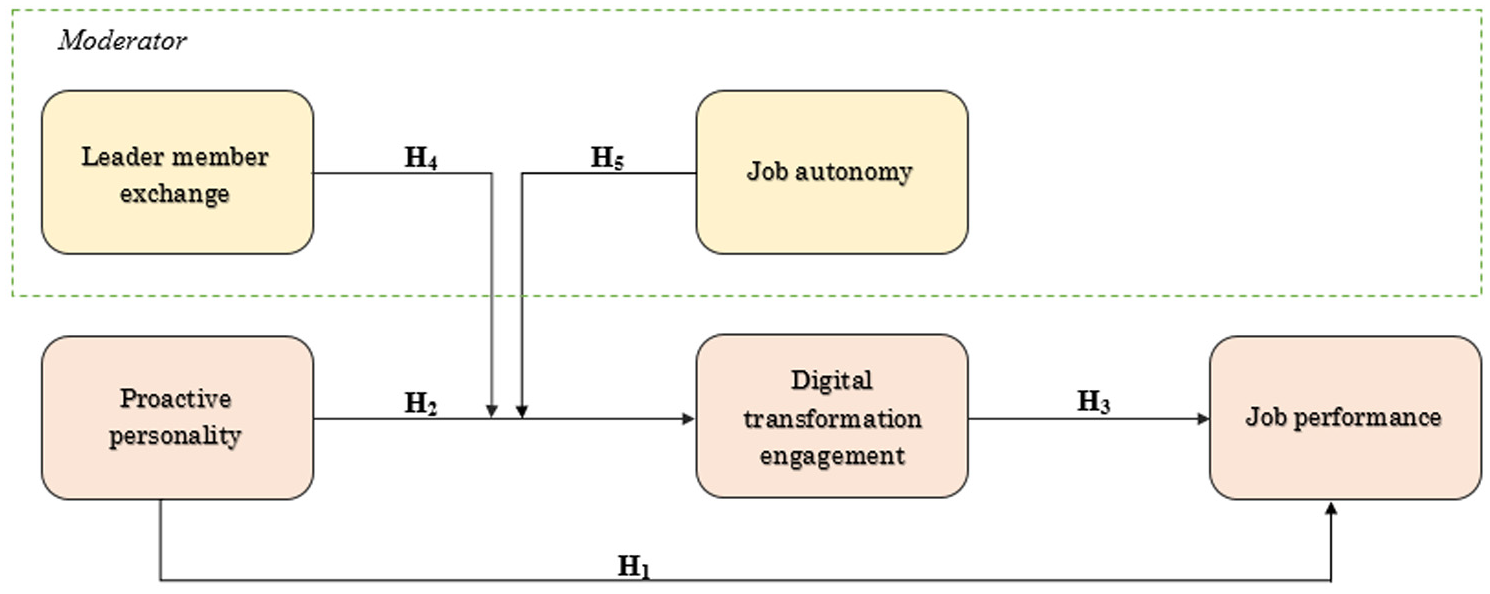
The research model.
Methodology
Sample and Data Collection
The structured questionnaire survey was used to collect the data for this research. At present, the Vietnamese government is especially focused on encouraging economic sectors to become more ecologically friendly and the circular economy. Since the shipping sector is one of the most polluting, digital transformation is being given top priority in order to increase efficiency and reduce emissions. In 2020, Vietnam’s Green Port Development Project got started. Requirements for adopting technology to reduce emissions are crucial for stakeholders in seaports. Consequently, this data is collected from staff in Vietnam’s marine logistics sector, most of whom are leaders in or going through a digital transformation in areas like seaports and maritime transportation. The process of digital transformation has given some businesses a competitive advantage in the transportation services market. These companies are located in the North, Central, and South of Vietnam. This study’s target sample was selected using a convenient technique. We created a list of shipping and logistics companies based on introductions from the Vietnam Maritime Corporation and the Vietnam Logistics Association. We then approached these firms and explained the purpose of the survey. If we receive permission from the company, we will seek a list of personnel to conduct the survey. When contacting survey respondents, we ensure that their information will be entirely anonymous and used just for scientific research.
Questionnaires were sent and collected as a means of gathering and organizing data. In two rounds, data were collected. In two rounds, data were collected. One thousand and fifty questionnaires were sent out in June 2021 for the first round. Eight hundred sixty-two questionnaires were distributed in March 2023 for the second round. Seven hundred fifty-eight valid surveys with 82.1% recovery and 87.9% effectiveness rates remained after questions with obvious errors or incomplete responses were eliminated. This is the lowest response rate that can be considered appropriate.
A total of 340 women (44.85%) and 418 men (55.15%) comprise the participants. The positions held by survey respondents are diverse. Information technology employs 26.3% of the workforce, with 216 people working in sales, which makes up 28.5% of the total. Workers in accounting and engineering make up 16.8% and 23.7% of the workforce, respectively. 4.7% of the population works in another job. The age group of 21 to 30 years old is the most likely to be able to access technology quickly (76.3%), followed by the age group of 31 to 40 years old (16.6%). In contrast, the percentages for individuals under 20 and over 40 are 1.7% and 5.4%, respectively. We also inquired about prior work experience at the place of employment. The majority of participants (54.22%), according to the statistics, have less than 10 years of experience. On the other hand, 37.20% and 8.58% of the population have between 11 and 20 years of experience and over 20 years of experience, respectively. Last but not least, 245 participants, or 32.32%, are employed by multimodal transportation companies. Those employed by ocean transportation and import-export firms ranged from 23.22% to 27.84% in the same period. 10.55% of the workers at the warehouse and yard company are the remaining individuals.
Measures
This study uses a mature scale that has been suitably modified for its purposes by famous international experts who have developed and reviewed it. The original English questionnaire was translated by English professors and experts in the maritime business. To ensure accuracy, the questionnaire was translated into Vietnamese and then back into English. The original English text and the English back-translation were discovered to be quite comparable after comparison and revision. A 5-point Likert scale is used in this study to rate the observed things. Ten interview tests were created after the original questionnaire was created, and the results of the feedback were used to make changes to the test. Inappropriate terminology was also changed, and surveys aligned with academic standards that respondents could comprehend were used. Recommendations derived from the interview tests are included in the final edition.
Proactive Personality
This study measured proactive personality using a shortened version of the Proactive Personality Scale originally developed by Bateman and Crant (1993) and later adapted by Ramadhani and Suharso (2021). The scale comprised the 10 items with the highest average factor loadings, with responses rated on a 5-point scale ranging from 1 (never) to 5 (always). “If I believe in an idea, no obstacle will prevent me from making it happen” is one such example.
Leader-Member Exchange (LMX)
Leader-member exchange (LMX) was measured using a 7-item scale as referenced by Sethi et al. (2023). A sample question is, “How well does your leader understand your job problems and needs?” All items were operationalized using a 5-point Likert-type scale from rarely (1) to very often (5).
Job Autonomy
Job autonomy was measured by the 3-item scale of Shin and Jeung (2019). A sample question is “I have made decisions about what methods I would use to complete my work.” The scale was based on a Likert-type 5-point scale, where 1 represented strongly disagree and 5 represented strongly agree.
Digital Transformation Engagement
Based on the Soane et al. (2012) measure, we created seven elements to assess employees’ participation in the digital transformation on a range of 1 (never) to 5 (always). As an illustration, “I am excited about the organization’s digital transformation initiative.”
Job Performance
A scale of four observable variables, derived from the scales of Dittes and Smolnik (2019) and Widyaputri and Sary (2022), is used to assess how well employees perform on the job. “Digital transformation helps me complete my work better” is one example item.
Control variables: The control variables in this article include gender, age, position, and working experience. These variables were incorporated to account for demographic and professional factors that might influence the primary relationships studied, such as the impact of proactive personality, leader-member exchange (LMX), and job autonomy on digital transformation engagement and job performance. Gender and age were included to address potential differences in adaptability and engagement levels across demographic groups. Position and working experience were controlled to account for variations in job responsibilities and tenure, which could independently affect employees’ engagement and performance. By controlling for these factors, the study ensures that the observed effects of the main variables are not confounded, enhancing the reliability and validity of the findings.
Common Method Variance
CMV is defined as “variance that is attributable to the measurement method rather than the constructs the measures represent” (Podsakoff et al., 2003, p. 879). CMV generates false internal consistency, which is an apparent correlation between variables caused by a single source. When self-report questionnaires are used to collect data from the same individuals at the same time, common method variance (CMV) should be considered. This worry is especially acute when both the dependent and focused explanatory variables are perceptual measures obtained from the same responder.
To evaluate whether CMV was present in this manuscript, we used the Harmon single-factor test (Podsakoff et al., 2003). This study used exploratory factor analysis (EFA) to identify 5 different factors with characteristic values larger than 1.0, and the resulting components explained 65.506% of the total variance (Table 2). The variance described by the first unrotated factor is 28.208%, which is less than 40%, showing that there is no CMV.
Descriptive Information of Participants.

Result
Reliability and Validity Analysis
Construct and Indicator Reliability
Currently, Cronbach’s alpha coefficient, corrected item-total correlation (CITC), and Composite Reliability (CR) are taken into account for reliability analysis (Zott et al., 2011). According to Hair et al., a Cronbach’s alpha criterion of .50 to .70 represented a high degree of reliability. Table 3 (Hair et al., 2011) shows that the scale’s reliability was good, with Cronbach’s alpha for each of the five constructs in this study ranging from .87 to .93.
The Results of Testing CMV.

The minimal recommended criterion was met by all structures in this investigation, with CR values ranging from 0.88 to 0.92. Furthermore, all CITC values connected to construction were greater than 0.50, fulfilling the minimum suggested level (Centobelli et al., 2019). The aforementioned findings demonstrate that the measuring approach suggested in this study is structurally reliable.
Furthermore, an assessment was conducted on the measuring items’ dependability. According to Hair et al. (2011) the project’s load should be more than 0.50. Table 3 shows that all of the measurement items’ factor loads are greater than 0.60, indicating the statistical reliability of the data.
Convergent Validity
This study measured standard factor loadings, CR, and AVE in order to confirm the validity of the polymerization process (Centobelli et al., 2019; Hair et al., 2010). Initially, Confirmatory Factor Analysis (CFA) was used to verify each and every standardized factor loading. The measured value of CMIN/df, as shown in Supplemental Figure, is 2.360, which is less than 5. The GFI, TLI, CFI, and IFI indicators are all more than 0.9. Strong adaptability is indicated by the model’s RMSEA score of 0.042, which is less than 0.08 (Centobelli et al., 2019; Hair et al., 2011). Additionally, Table 3 displays the weight loading for each factor, ranging from 0.630 to 0.966—a value larger than 0.500 that demonstrates statistical significance.
According to Table 3, the CR values for proactive personality, leader-member exchange, job autonomy, engagement with digital transformation, and job performance are, in order, 0.91, 0.90, 0.88, 0.92, and 0.88. It is noteworthy that all of these values exceed the statistically acceptable threshold of 0.80. All of the constructions in Table 3 have AVE values of more than 0.5, ranging from 0.54 to 0.61. These results indicate that all measurement items are roughly equally relevant for measuring the ideas of their connected constructs, and the scale has excellent convergent validity (Centobelli et al., 2019).
Discriminant Validity
The discriminant value of the suggested model is next examined. Table 4 shows the correlations between each variable and the square root of the average font weight. The square root AVE of each variable is more than the correlation coefficient value on each row and column, indicating that the variables have a significant discriminant value. At the same time, both variables show a high positive correlation. Additional collinearity testing revealed that all Variance Inflation Factors (VIFs) were less than 10, indicating that the multicollinearity issue in this study was not very troublesome. Table 5 also includes descriptive and correlational analyses.
Results of Convergent Reliability Testing.

Note. N = 758. CITC = corrected item-total correlation; AVE = average variance extracted; CR = composite reliability; PPE = proactive personality; LMX = leader-member exchange; JAU = job autonomy; DTE = digital transformation engagement; JOP = Job performance.
Validating the Measurement of the CFA Model.

Note. N = 758. AVE = average variance extracted; PPE = proactive personality; LMX = leader-member exchange; JAU = job autonomy; DTE = digital transformation engagement; JOP = job performance.The bold values in the table you provided represent the square roots of AVE (√AVE), located along the diagonal (i.e., where a variable intersects with itself). These are commonly referred to as the square root of Average Variance Extracted (AVE).
The correlation analysis in this study reveals several notable relationships among the key variables. Proactive personality shows a significant positive correlation with digital transformation engagement (β = .443, p < .01) and job performance (β = .212, p < .01), indicating that employees with higher proactive tendencies are more engaged in digital transformation efforts and perform better. Leader-member exchange (LMX) is also positively associated with digital transformation engagement (β = .244, p < .01) and job performance (β = .133, p < .01), underscoring the importance of high-quality leader-employee relationships in fostering engagement and enhancing performance. Furthermore, digital transformation engagement demonstrates the strongest correlation with job performance (β = .410, p < .01), highlighting its critical role as a mediator between individual traits, organizational factors, and performance outcomes. These findings emphasize the interconnectedness of individual and organizational variables in driving successful digital transformation in logistics companies (Table 6).
The Correlation Matrix.

Note. N = 758.
p < .05. **p < .01.
Hypothesis Test Results
Direct Effect Test
The structural equation model (SEM), a generalization of the regression model, has numerous advantages over the regression model, including the ability to handle multiple independent and dependent variables at the same time, which is required by increasingly complicated theoretical models in scientific research. To investigate the previously proposed concept, this study used a structural equation model. The data analysis results show that the suggested model matches the data effectively: χ2 = 561.955, df = 162, χ2/df = 3.469, RMSEA = 0.057, CFI = 0.962, TLI = 0.956, GFI = 0.931, and p < .001.
Employees with a high proactive personality achieve better job performance, as predicted (β = .43, SE = 0.036, p < .001). Hypothesis 1 was supported. Our results indicated that employees with a proactive disposition tend to be more engaged in digital transformation (β = .25, SE = 0.048, p < .05), and engagement in digital transformation correlates positively with job performance (β = .37, SE = 0.046, p < .001). Hypothesis 2 and 3 were confirmed (Figure 2).

The result of the structural equation modeling.
Moderating Effect Test
To avoid multicollinearity difficulties, we focus on the interaction terms of proactive personality, leader-member exchange, and job autonomy before evaluating the moderating effect.
Table 7 indicates a significant negative relationship between proactive personality and leader-member exchange on digital transformation engagement (β = −.064, p < .05). This shows that leader-member exchange has a negative moderating influence on proactive personality and digital transformation engagement. Hypothesis 4 was confirmed (Table 8).
Testing Results of Direct Effect.

Note. N = 758. PPE = proactive personality; LMX = leader-member exchange; JAU = job autonomy; DTE = digital transformation engagement; JOP = job performance.
p < .001.
The Moderating Effect of Leader-Member Exchange and Job Autonomy.

Note. N = 758. Dependent variable: DTE; M2: Controls + PPE; M3 = M2 + LMX; M4 = M3 + interaction effects of PPE × LMX; M5 = M2 + JAU; M6 = M5 + interaction effects of PPE × JAU.
p < .05. **p < .01. ***p < .001.
As job autonomy has a positive moderating effect on proactive personality and digital transformation engagement, Hypothesis 5 was supported by the regression coefficient of the interaction term between proactive personality and job autonomy on digital transformation engagement (β = .024, p < .05), which is significantly positive. Figures 3 and 4 show the differential effects of proactive personality on digital transformation engagement under different leader-member exchange and job autonomy contexts.

The moderating effect of LMX on the relationship between proactive personality and digital transformation engagement.

The moderating effect of job autonomy on the relationship between proactive personality and digital transformation engagement.
Discussion
The findings of this study reinforce and expand upon existing research concerning the relationships between proactive personality, digital transformation engagement, and job performance (Lam et al., 2024). By situating these constructs within the logistics sector undergoing significant technological transformation, this study offers important comparisons with previous literature.
The positive relationship between proactive personality and job performance aligns with earlier studies, such as Bateman and Crant (1993) and Seibert et al. (2001), which highlighted the role of proactive traits in driving individual performance. Similarly, Bakker et al. (2012) demonstrated that proactive employees excel in dynamic environments by shaping their work contexts to enhance outcomes. Our findings resonate with Jiang (2017), who identified proactive personality as a predictor of career adaptability and job effectiveness. However, this study’s focus on the logistics sector underlines the relevance of these traits in technology-driven and operationally complex industries, a context less explored in earlier research.
This research confirms the positive association between proactive personality and digital transformation engagement, consistent with research by Parker et al. (2010), who emphasized the proactive role of employees in managing technological change. Zhu, Gardner, et al. (2017) similarly highlighted the importance of proactivity in enabling employees to adapt to evolving technological landscapes. Unlike previous studies that examined broader organizational contexts, this study provides evidence specific to logistics companies, extending the understanding of how proactive traits facilitate employee engagement in highly specialized and fast-paced environments.
The strong relationship between digital transformation engagement and job performance mirrors findings in the broader literature. For instance, Shantz et al. (2016) and van Laar et al. (2020) both demonstrated that employee engagement in technological initiatives leads to greater adaptability, innovation, and overall performance. By applying this framework to logistics, the study aligns with prior work while addressing the distinct demands of a sector where efficiency and responsiveness are paramount.
The moderating role of LMX in the relationship between proactive personality and digital transformation engagement is supported by research on the variability of leader-member relationships. Studies by Breevaart et al. (2015) and Serban et al. (2021) found that high-quality LMX reduces the reliance on individual proactivity by providing additional organizational resources. Our findings extend these observations by demonstrating this dynamic in the logistics sector, offering insights into how LMX influences employee engagement during digital transformation.
The moderating effect of job autonomy is consistent with studies like Shin and Jeung (2019), which identified autonomy as a key factor in amplifying the effects of proactive traits. By providing employees with greater freedom and discretion, job autonomy enhances their capacity to engage in digital transformation initiatives. This study confirms these findings while situating them within the specific operational and technological challenges of logistics companies.
While many earlier studies explored proactive personality and engagement in generalized workplace settings (e.g., Bakker et al., 2012; Parker et al., 2010), this study applies these relationships to the logistics sector, which faces unique pressures from rapid technological advancements. By examining the interaction of individual, organizational, and job design factors in a sector-specific context, this study builds upon and contextualizes existing research in novel ways.
The Theoretical and Practical Implication
This study offers significant theoretical implications by advancing the understanding of how proactive personality traits and leader-member exchange (LMX) interact within the framework of Conservation of Resources (COR) theory to shape digital transformation engagement. First, it substantiates COR theory’s proposition that resources can act as substitutes for one another (Halbesleben et al., 2014; Hobfoll, 2001), demonstrating that high-quality LMX relationships mitigate the reliance on individual resourcefulness, thereby moderating the effect of proactive personality on engagement. Second, it extends LMX theory by revealing its dual role: while high LMX fosters engagement through resource support (Martin et al., 2016), it also attenuates the proactive personality’s impact by reducing the necessity for self-initiated resource acquisition. Third, the findings emphasize the compensatory role of proactive personality under low-resource conditions, aligning with previous research that highlights the adaptive potential of individual traits in overcoming environmental constraints (Li et al., 2020; Serban et al., 2021). Fourth, by contextualizing these dynamics within logistics enterprises undergoing digital transformation, the study addresses the unique challenges of engaging a workforce in a rapidly evolving technological landscape, thereby contributing to the burgeoning literature on digital transformation in logistics (Štaffenová & Kucharčíková, 2023). Finally, the research underscores the intersectionality of individual and organizational factors, advocating for an integrated framework that considers both personal traits and contextual variables in driving engagement during organizational change. These insights not only bridge theoretical gaps in COR and LMX frameworks but also provide a foundational basis for future studies in industrial and technological transformation contexts.
Besides, the findings of this study provide actionable strategies for practitioners, managers, and policymakers to enhance employee engagement and performance during digital transformation in logistics companies. For practitioners and managers, the demonstrated positive relationship between proactive personality traits and digital transformation engagement underscores the importance of recruiting individuals with high initiative and adaptability (Bateman & Crant, 1993). Managers should focus on fostering high-quality leader-member exchange (LMX) relationships by building trust and ensuring access to critical resources, as this can significantly enhance employee engagement in technologically evolving environments (Hobfoll, 2001; Martin et al., 2016). Furthermore, granting employees greater autonomy in decision-making not only promotes creativity but also empowers proactive behaviors, which are essential for addressing the complexities of logistics operations (Parker et al., 2006).
For policymakers, the findings highlight the need to create supportive regulatory frameworks that encourage organizations to prioritize workforce development. Initiatives such as subsidies for digital skills training and leadership development programs can strengthen the capacity of logistics firms to navigate digital transformation effectively (van Laar et al., 2020). Policies promoting the adoption of flexible job designs that empower employees through autonomy can further enhance organizational adaptability and resilience (Zhu, Gardner, et al., 2017). Collectively, these strategies can help ensure that the logistics industry remains innovative and competitive in a rapidly changing global landscape.
Limitations and Future Research Direction
This study provides critical insights into the interplay between proactive personality, digital transformation engagement, and job performance within logistics companies, yet it has notable limitations that warrant further investigation. First, the cross-sectional research design constrains the ability to establish causal relationships, suggesting that future studies could employ longitudinal methods to capture temporal dynamics and causal pathways more effectively (Podsakoff et al., 2003). Second, the study’s sample is limited to logistics firms in Vietnam, potentially reducing the generalizability of its findings to other industries or regions with different digital maturity levels and cultural contexts. Expanding the research to include diverse geographic and sectoral settings would enhance its external validity. Third, the study does not address individual or organizational factors such as employee digital literacy, firm size, or leadership style, which could act as confounders or moderators. Future research could integrate these variables to provide a more nuanced understanding of engagement and performance outcomes (Centobelli et al., 2019). Lastly, common method variance (CMV) poses a potential limitation due to reliance on self-reported data from the same respondents, despite statistical controls like the Harmon single-factor test. Employing mixed-method approaches or triangulating data sources could mitigate this issue and strengthen the reliability of the findings (Podsakoff et al., 2003). Addressing these gaps will deepen the theoretical and practical contributions of future studies.
Conclusion
This study aimed to examine the influence of proactive personality on digital transformation engagement and job performance in logistics companies, alongside the moderating roles of leader-member exchange (LMX) and job autonomy. Drawing on the conservation of resources (COR) theory and job characteristics theory, the research sought to elucidate how individual and organizational factors interact to drive engagement and performance in the context of technological change. The findings revealed that proactive personality positively affects digital transformation engagement and job performance, highlighting the critical role of employee traits in navigating organizational transformation. Additionally, LMX and job autonomy were found to moderate these relationships, with high-quality LMX relationships mitigating the reliance on proactive traits and high job autonomy amplifying the engagement of proactive employees.
These results underscore the importance of fostering a supportive organizational environment through effective leadership and granting autonomy to employees, especially those with high initiative, to maximize the benefits of digital transformation. By integrating proactive personality traits with strategic job design and leadership practices, logistics companies can enhance workforce engagement and operational efficiency during technological transitions. This study contributes to the growing body of knowledge on digital transformation by providing empirical evidence on the interaction of personal and organizational factors, offering actionable insights for managers aiming to achieve sustainable competitive advantage.
Supplemental Material
sj-docx-1-sgo-10.1177_21582440251353391 – Supplemental material for Research on Factors Influencing the Employees’ Digital Transformation Engagement and Job Performance in Logistics Companies
Supplemental material, sj-docx-1-sgo-10.1177_21582440251353391 for Research on Factors Influencing the Employees’ Digital Transformation Engagement and Job Performance in Logistics Companies by Trung-Hieu Nguyen in SAGE Open
Footnotes

Funding
The author(s) disclosed receipt of the following financial support for the research, authorship, and/or publication of this article: This research was supported by Vietnam Maritime University.
Declaration of Conflicting Interests
The author declared no potential conflicts of interest with respect to the research, authorship, and/or publication of this article.
Data Availability Statement
Data sharing not applicable to this article as no datasets were generated or analyzed during the current study.
Supplemental Material
Supplemental material for this article is available online.
References
Supplementary Material
Please find the following supplemental material available below.
For Open Access articles published under a Creative Commons License, all supplemental material carries the same license as the article it is associated with.
For non-Open Access articles published, all supplemental material carries a non-exclusive license, and permission requests for re-use of supplemental material or any part of supplemental material shall be sent directly to the copyright owner as specified in the copyright notice associated with the article.
