




Abstract
As a kind of job characteristic, feedback often occurs in the organization in order to improve employee performance. Based on leadership identity theory, this study developed a conceptual model involving supervisor developmental feedback, job crafting and job performance. the authors then targeted a large manufacturing enterprise in Hunan, China, obtaining 337 valid data using an on-site questionnaire survey. The data was analyzed using a hierarchical linear regression method, showing that supervisor developmental feedback was positively related to job crafting and employee job performance, and this job crafting was positively associated with employee job performance and partially mediated the relationship between supervisor developmental feedback and employee job performance. Managerial implications and directions for further research are discussed.
Developmental feedback is defined as the extent to which supervisors provide information that enables employees to learn, develop, and improve at work (J. Zhou, 2003). In the organization, the role of feedback in guiding, motivating and strengthening effective behaviors is well-known (Steelman & Rutkowski, 2004). Therefore, providing work-related feedback to employees is an essential task for the supervisor (Leung et al., 2001).
Performance feedback is widely used in the practice of organizational management. Performance feedback makes clear positive/negative evaluation results on the behavior or performance of the employees(D. X. Wang & Hong, 2010). By using performance feedback, the supervisor will directly expose the mistakes of the subordinates, so as to reduce the misconduct in the work and ensure the smooth realization of the organizational goals (J. Zhang et al., 2017).
Superior developmental feedback is different from traditional performance feedback, it includes three unique characteristics: (1) information that is helpful or valuable, (2) the feedback recipient is guided toward making improvements to future performance in the absence of pressure for a particular outcome, and (3) it is informational in essence.
With the rapid development of society, and the profound change in individuals’ values and behavior, traditional performance evaluation feedback is not meeting employees’ needs, supportive developmental feedback is welcomed by employees (e.g., Christensen-Salem et al., 2018; Thuan & Thanh, 2019). Employees hope to get guidance (such as developmental feedback) from their manager in their work, not just get a good or bad evaluation of their work. Therefore, in past decades, developmental feedback has attracted the attention of scholars. Some researchers have shown that development feedback had a positive impact on the individuals’ attitudes and behavior (e.g., Guo et al., 2020; Liu & Gu, 2018; Su et al., 2021; Thuan, 2021; Z. Zhang et al., 2019).
In a highly competitive market environment, job performance is very important for organizational survival and sustainable development. Developmental feedback aims to improve employees’ future job performance (J. Zhou, 2003). Hence, it is necessary to test whether developmental feedback has a positive effect on job performance. However, Previous researchers have shown that intrinsic motivation and feedback-seeking only partially mediate the relationship between supervisor developmental feedback and employee job performance(e.g., Guo et al., 2014; Su, Lyu et al., 2019; S. Wang & Zhang, 2022). Researches indicate that there may be other mediation variables in the relationship between developmental feedback and employee job performance. Therefore, how developmental feedback affects employees’ behavior outcomes (e.g., job performance) still need further exploration.
In this empirical study, the authors investigated job crafting which refers to employees’ initiative to create a working environment suitable for their preferences, skills, and abilities (Wrzesniewski & Dutton, 2001). Leadership identity theory holds that if employees identify with their supervisors’ behaviors, they will turn this identification into a part of their self-concept (Kark et al., 2003). In the organization, supervisors are considered as the most valuable source of information by the employees (Guo & Liao, 2014). Developmental feedback essentially guides individuals to set higher goals and encourages individuals to study hard or change their working methods to improve themselves (J. Zhou, 2003), and it is a kind of supportive behavior (D. X. Wang & Hong, 2010). Consquently, if employees identify with their supervisors’ feedback behavior, they may use developmental feedback to craft their jobs. Researches showed that job crafting can have a positive impact on employees job performance (e.g., Ghitulescu, 2006; Lyons, 2008; Sloan & Geldenhuys, 2021). Thus, in this research, job crafting may be a new mechanism for understanding the essentials of developmental feedback.
Therefore, based on leadership identity theory, the authors examined the mediating role of job crafting in this relationship between supervisor developmental feedback and employee job performance.
Literature Review and Hypotheses
Supervisor Development Feedback and Employee Job Performance
The focus of supervisor developmental feedback first proposed by J. Zhou (2003) is on the future performance, improvement, and development of the employee, who is guided with helpful and useful (i.e., quality) information without pressure for a particular outcome(i.e., performance evaluation feedback). That is, supervisor development feedback is related to employees’ future behavioral results, and employees are not required to achieve a particular outcome (Li et al., 2011).
Studies have shown that supervisor developmental feedback has a positive effect on job performance (Guo et al., 2014; Su, Lin, & Ding, 2019). Providing valuable information for employees’ future learning, work and career development, supervisor development feedback is a kind of positive information support behavior (D. X. Wang & Hong, 2010). At the same time, development feedback does not require employees to realize goals expected by the supervisor, and thus avoids job pressures on employees and gives employees free development space and a relaxed working atmosphere, so that employees can feel more satisfied and happier with their job (Norris-Watts & Levy, 2004).
The purpose of supervisor developmental feedback is to guide employees on how to work and achieve career development (Tiantian et al., 2021). Thereby, after employees receive developmental feedback from a supervisor, they will actively engage in learning by way of improving their work methods and job competencies and exert themselves to achieve the leader’s expected performance goal. Hence, the following hypothesis was proposed:
Supervisor Development Feedback and Job Crafting
The process of employees’ initiative to create a working environment suitable for their own preferences, skills and abilities is called job crafting (Wrzesniewski & Dutton, 2001). There are three different ways for employees to design their work: (1) increasing or reducing the number of job, or changing the way of their job; (2) changing the frequency and intensity of interaction with others at work and inside and outside the organization; and (3) rebuilding the impact of work on yourself or others according to Wrzesniewski and Dutton.
Job crafting is a kind of employees’ proactive behavior for the sake of acquiring a sense of work significance (Bolino & Grant, 2016). D. R. Ilgen and Hollenbeck (1991) asserted that employees could make job modification only when employees were offered full job autonomy by the organization. Studies had displayed that job autonomy affected employees’ job crafting (Leana et al. (2009); Tims & Bakker, 2010), and the more job autonomy employees were given, the more likely they would craft their job (Ghitulescu, 2006). In other words, the employees who possess more job autonomy are more likely to redesign their job in light of their job ability and job experience.
Job autonomy is an important work feature that directly affects job crafting (Wrzesniewski & Dutton, 2001). Whether the employees craft their job is related to the factors of work or organizational situation. As a typical leader feedback behavior, supervisor developmental feedback is helpful to the employees’ future work or career development. There are also no specific goals that employees are required to accomplish so that employees feel uncontrolled by the organization and have a sense of job autonomy. Thereby, a relaxed and stress-free working atmosphere without worrying about making mistakes enhances the opportunities for job crafting (Liang et al., 2012), and employees with more autonomy are more likely to implement job crafting (Debus et al., 2020). Hence, the following hypothesis was proposed:
Job Crafting and Employee Job Performance
Employee job crafting is a positive behavior (Wrzesniewski & Dutton, 2001). Previous studies have indicated that job crafting can play a positive role in promoting employees’ job performance. For instance, Ghitulescu (2006) discovered that task crafting could influence an individual’s work quality and efficiency and that relationship crafting was primarily related to an individual’s work efficiency. Lyons (2008) also pointed out that job crafting could affect an individual’s job performance. Sloan and Geldenhuys (2021) found that task crafting was positively related to employee in-role performance, and relational crafting was positively correlated to extra-role performance.
Job crafting is the redesign of work. Employees redesign their work in order to make their work more dynamic and more suitable for them (Petrou et al., 2012). Through task crafting, employees can simplify work processes and participate in more challenging tasks, which not only helps to improve work efficiency, but also helps to stimulate personal potential, and ultimately achieve the improvement of personal job performance. In addition, after the relationship is crafted, the range of communication is expanded and the quality of communication is improved through the interaction and mutual help with colleagues. A good working relationship atmosphere can make employees more devoted to their work, thus ensuring the improvement of their work performance.
Through self-adjusting work methods, processes, and other contents, employees have the opportunity to design their own work modes according to working conditions, so as to effectively improve their work performance. Hence, the following hypotheses were proposed:
Leadership identity refers to an individual identity formed by employees when they incorporate their perception of leadership into their self-concept (Kark et al., 2003). Leadership identification is one of the important factors that affect the level of employees’ work effort(Oldham, 1976). In theory, employees can utilize feedback to change their work behavior if they identify with the value of supervisor development feedback. Leadership recognition can bring employees a sense of goal and attachment, which will have a positive effect on their work attitudes and behavior (Zhu et al., 2013). In fact, developmental feedback reflects the supervisor’s concern, support and encouragement to employees. Supervisors hope that employees can utilize valuable information for making great efforts to improve their work competency, so that they can achieve their career goals and better experience a sense of work significance and happiness.
Supervisor developmental feedback is a kind of supportive behavior (D. X. Wang & Hong, 2010). According to leadership identity theory, when employees identify with supervisor feedback behavior, they will internalize the value of development feedback as a part of their work content, and will take the initiative to improve their work efforts (Oldham, 1976), and then probably put feedback into practice to adjust work requirements and work resources (such as increasing structural job resources, decreasing hindering job demands, increasing social job resources and increasing challenging job demands). This is beneficial for the improvement of employee job performance. Hence, the following hypotheses were proposed:
To sum up, a conceptual model for study(see Figure 1) is constructed as follows:
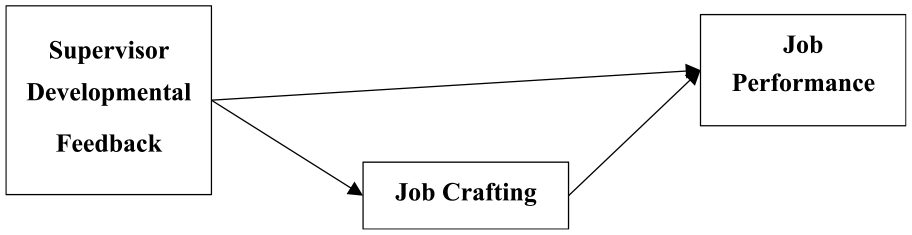
Conceptual model for study.
Method
Participants and Procedure
This study was carried out in accordance with the standards set by the Academic Office of a University in China. There was no unethical behavior, and ethical approval was not required according to the applicable institutional and national guidelines and regulations, because it did not involve human clinical trials or animal experiments.
The authors recruited 400 employees who were willing to take part in the survey for this study from a large manufacturing enterprise in Hunan, China. The authors first contacted their managers personally to request their collaboration with the survey. With their managers’ permission, 400 questionnaires were distributed and all were filled in by employees. Both the aim of the survey and that all of the information would be treated in strictest confidence were specified in all questionnaires. Only those employees who were willing to take part in the study were recruited. We received 400 questionnaires at the first round of data collection and found that all participants completed questionnaires according to the requirements. This implied that 400 participants agreed to join in our survey. After the employees’ support was obtained, the same 400 employees were required to finish the entire survey and 337 responded.
Table 1 shows the statistical results of the demographic characteristics of the sample. Of 337 participants, individuals aged 26 to 35 account for 62.612%. Most employees had gained a bachelor’s degree or above (92.58%) and the rest had not completed an undergraduate degree (7.42%). There were 174 male employees (51.632%) and 163 male employees (48.368%). Employees who have served the company for less than 1 year, 1 to 3 years, 4 to 6 years and more than 7 years account for 23.739%, 38.873%, 18.694%, and 18.694%, respectively (Guo et al., 2020).
Participant Demographic Information.

Measures
According to the standard translation and backtranslation procedure (Brislin, 1980), all of the scales which were from the Western literature were translated into Chinese from English. A 7-point Likert-type scale was adopted in all of the scales (1 means strongly disagree, 7 means strongly agree).
Supervisor Developmental Feedback
J. Zhou’s (2003) measurement scale was used to measure supervisor developmental feedback, including three items. A sample item is “My supervisor provides me with useful information on how to improve my job performance.”
Job Crafting
Tims et al.’s (2012) measurement scale was used to assess job crafting, including 21 items. A sample item is “If there are new developments, I am one of the first to learn about them and try them out.”
Job Performance
Farh and Cheng’s (1997) measurement scale was used to assess job performance, including four items. A sample item is “My job performance is always in conformity with the supervisor’s requirements.”
Control Variables
Employee gender, age, education, and tenure in the present firm may affect the employees’ responses to feedback (see, e.g., Guo & Liao, 2014). So, these variables were used as control variables in this study.
Results
Confirmatory Factor Analyses
Firstly, the authors used AMOS version 17.0 to conduct confirmatory factor analyses (CFA) to evaluate the discriminant validity of the scales. And then, a three-factor model was compared with two other models. Finally, the authors found that the three-factor model best fits the data contrasted with the other models as evaluated by goodness-of-fit index (GFI), incremental fit index (IFI), comparative fit index (CFI), and root mean square error of approximation (RMSEA) as follows: (X2 /df = 1.921, GFI = 0.950, NFI = 0.972, CFI = 0.962, RMSEA = 0.027; see Table 2). All indicators were in accord with the standard (X2 /df <3; GFI ≥ 0.95; NFI ≥ 0.95, CFI ≥ 0.95, 0 < RMSEA < 1) proposed by Hooper et al.’s (2008) standards, showing that the constructs are distinguishable.
Comparison of Measurement Models.

Note. SDF = supervisor developmental feedback.
Descriptive Statistics and Reliability
The means, standard deviations, correlations and Cronbach’s alpha of main variables are detailed in Table 3. Supervisor developmental feedback was positively related with employee job crafting (r = .30, p < .01) and employee job performance (r = .25, p < .01). Job crafting was positively related with employee job performance (r = .11, p < .01).
Descriptive Statistics, Correlations and Cronbach’s Alpha Among Variables.

Note. E = education; SDF = supervisor developmental feedback; JC = job crafting; JP = job performance.
p < .01.
Hypotheses Tests
Using SPSS version 17.0, the authors first put all control variables in the first block (see Table 4) and then implemented a series of linear regression analyses to examine our hypotheses.
Linear Regression Analysis.

Note. SDF = supervisor developmental feedback; JC = job crafting.
p < .05. **p < .01. ***p < .001.
As shown in Table 4 (see model 1), a regression model was applied to confirm Hypothesis 1, and employee job performance was regarded as a dependent variable. The result indicated that supervisor developmental feedback was positively correlated with employee job performance (β = .18, p < .001). Therefore, Hypothesis 1 was supported.
By carrying out a host of regression analyses, the authors found that supervisor developmental feedback was positively associated with job crafting (β = .24, p < .001) (see Model 3 in Table 4). Hence, Hypothesis 2 was supported.
For testing Hypothesis 3, the authors also conducted a whole string of linear regression analyses (see Model 2 in Table 4). The findings demonstrated that employee job crafting was positively related to employee job performance (β = .13, p < .001). Therefore, Hypothesis 3 was supported.
To examine Hypothesis 4, the authors adopted the procedure suggested by Baron and Kenny (1986): (1) the independent variable was obliged to be relevant to the dependent variable, as supported by Hypothesis 1; (2) the independent variable was obliged to be relevant to the mediator, as supported by Hypothesis 2; (3) the mediator was obliged to be relevant to the dependent variable, as supported by Hypothesis 3; and (4) the impact of the independent variable on the dependent variable was obliged to reduce when the mediator was controlled. When job crafting was put into the regression model (see Model 4 in Table 4), the beta coefficient for supervisor developmental feedback significantly decreased from β = .18 (p < .001) to β = .16 (p < .001), and the beta coefficient for job crafting remained significant (β = .09, p < .05). Hence, job crafting played a partial mediation effect between supervisor developmental feedback and employee job performance and Hypothesis 4 was supported.
Discussion
Feedback helps employees increase learning and knowledge of results (Belschak & Den Hartog, 2009). Employees demand such knowledge, especially when their job performance is below the standard, so that they can take corrective measures to improve their task performance (D. Ilgen & Davis, 2000). However, Kluger and DeNisi (1996) found that in one-third of the studies they checked, feedback decreased or had no impact on performance. Prior theoretical and empirical research have indicated that valuable feedback is beneficial to the improvement of employee work performance (e.g., Guo & Liao, 2014; Guo et al., 2014; A. Zhang et al., 2011; J. Zhou, 2003) and brings about a positive behavior (Li et al., 2011). Supervisor developmental feedback is one of feedback. To explain the effect of supervisor developmental feedback on employee job performance, and help understand of how supervisor developmental feedback influences employee job performance, the authors propose a conceptual model based on leadership identity theory. Targeting a large manufacturing enterprise, the authors analyze the direct and indirect impacts of supervisor developmental feedback on employee job performance. The research findings provide some implications to the study and practice of feedback.
The results indicate that supervisor developmental feedback positively affects both employee job performance and job crafting, and then job crafting is conducive to enhancing employee job performance. That is to say, in addition to directly and positively affecting employees’ job performance, supervisor developmental feedback also indirectly and positively influences job performance through job crafting. These conclusions provide certain theoretical contributions. (1) Regarding feedback, researchers should pay more attention to the content and value of feedback and the impact of feedback on employees’ work autonomy. Feedback as a part of the job characteristics (Oldham, 1976) often appears in employees’ daily work.Work autonomy not only reflects the flexibility and freedom to complete work, but also reflects the expectation and degree of employees’ independent decision-making (Hackman & Oldham, 1975). The authors verify supervisor developmental feedback can also induce job crafting, which widens the research on the sources of inducing work autonomy. (2) The authors explore that employee job performance can also be indirectly and positively affected by supervisor developmental feedback via job crafting. Although feedback is beneficial to employees, it is effective only when employees really use feedback to change their work behavior or improve their work performance. According to leadership identity theory, research findings identify that job crafting is an explanatory mechanism for how employees benefit from developmental feedback, extending scholarly understanding of feedback affects employee work outcomes, and meanwhile also enriching the research on feedback.
Employee job performance is very important to the survival and development of an organization in a highly competitive market environment (Morrison & Phelps, 1999). Supervisor developmental feedback can be regarded as a possible manner to promote the betterment of employee job performance. The research results should inform and inspire managers to enhance employees job performance by providing developmental feedback. Hence, one of the implications for management is that managers need not only pay more attention to and provide developmental feedback, and also offer supportive behavior to help the employees improve their performance. In order to motivate employees to improve their work performance, managers can provide support in several ways, the cases in point are mentoring (Allen et al., 2004; C. Chen et al., 2014) and job-related training (Joo & Park, 2010), which is positively associated to employee job performance. Secondly, managers need to attach great importance to the latent impact of job crafting on employees’ workplace behavior. In order to stimulate employees to develop job crafting, managers should try to make the employees’ jobs better matched with their preferences, skills, and competences by providing supportive behavior (Farh et al., 2007; Q. Zhou et al., 2016). Furthermore, managers should also aim to improve employees’ job identity and employees’ identification with leaders by encouraging autonomy (Volmer et al., 2012), and let employees perceive this kind of supportive behavior (such as developmental feedback) from the supervisor, so that employees redesign their work without any pressure.
Although this study was examined in the light of rigorous scientific principles, there are still several limitations. The first limitation is the generalizability of the findings, because all samples are collected in China. Future scholars need to retest our conclusions in Western countries. Due to the fact that all measures are assessed by means of the same survey, common method variance may affect our results. This is another limitation of this study. In the future, a variety of survey instruments should be applied in order to assess these variables. Further, a cross-sectional design is a limitation of this study too, because it cannot explain the causal relationship between variables. To address this, future scholars should take into account a longitudinal design.
In addition, in this study, job crafting is only a mediator in the relationship between supervisor developmental feedback and employee job performance. Thus, other mediating variables such as perceived insider status (X. Chen et al., 2017) and leader identification (Kark et al., 2003) should be considered in future research.
Footnotes
Acknowledgements
We would like to submit the enclosed manuscript entitled “Why does developmental feedback foster employee job performance? the mediating role of job crafting,” which we wish to be considered for publication in “Sage Open.” No conflict of interest exits in the submission of this manuscript, and manuscript is approved by all authors for publication. I would like to declare on behalf of my coauthors that the work described was original research that has not been published previously, and not under consideration for publication elsewhere. All the authors listed have approved the manuscript that is enclosed.
Author Note
Yun Guo is responsible for designing the study, carrying it out, analyzing results, and writing the manuscript. Guobao Xiong is in charge of designing the study and writing the manuscript. Kang-Hwa Shaw interpreted the data for the article and revised the manuscript based on experts’ feedback. Jianqiao Liao is in charge of the conception of the study and revised the manuscript based on experts’ feedback. Zeyu Zhang is in charge of the acquisition and analysis of data for the article and writing the manuscript, Feng Yi analysised and interpreted the data for the article and revised the manuscript based on experts’ feedback.
Declaration of Conflicting Interests
The author(s) declared no potential conflicts of interest with respect to the research, authorship, and/or publication of this article.
Funding
The author(s) disclosed receipt of the following financial support for the research, authorship, and/or publication of this article: The project was funded by Research Foundation for Advanced Talents in East China University of Technology (NO.DHBK2018091), and National Natural Science Foundation of China (NO.71962001;No.72262001).
Ethical Approval
This study was carried out in accordance with the standards set by the Academic Office of a University. There was no unethical behavior, and ethical approval was not required according to the applicable institutional and national guidelines and regulations, because it did not involve human clinical trials or animal experiments. The authors recruited 400 employees who are from a large manufacturing enterprise. The authors first contacted their managers personally to request their collaboration with the survey. With their managers’ permission, 400 questionnaires were distributed and all were filled in by employees. Both the aim of the survey and that all of the information would be treated in the strictest confidence were specified in all questionnaires. Only those employees who were willing to take part in the study were recruited.The authors received 400 questionnaires at the first round of data collection and found that all participants completed questionnaires according to the requirements. This implied that 400 participants agreed to join in our survey. After the employees’ support was obtained, the same 400 employees were required to finish the entire survey and 337 responded.
