




Abstract
The implementation of China’s Social Insurance Law may increase the burden of social insurance contributions on enterprises, potentially affecting their production behaviour. This study empirically examines the impact of the law on green production in labour-intensive enterprises, using sample data from 717 listed companies in the A-share market from 2008 to 2016 and employing a difference-in-differences model. The findings are as follows: (1) the Social Insurance Law effectively reduces the pollution intensity of labour-intensive enterprises, promoting green production, with a more pronounced effect observed in low-pollution, private, and manufacturing enterprises; (2) mechanism tests reveal that the law encourages green technological innovation and increases the capital-labour ratio in labour-intensive enterprises, thereby reducing pollution intensity. This mechanism plays a crucial role in promoting green production; and (3) the law has a significant lag effect on green production in labour-intensive enterprises. This study’s conclusions offer valuable insights into the impact, mechanisms, and logic behind the implementation of the Social Insurance Law, providing new perspectives and empirical evidence to guide enterprises in fostering green production and advancing China’s economy towards green, high-quality development.
Plain language summary
China’s Social Insurance Law requires companies to pay more for employee benefits, which might increase their costs. This study explores whether this law encourages companies, especially those that rely heavily on labour, to adopt greener and cleaner production methods. Using data from 717 Chinese companies between 2008 and 2016, the research found that: (1) The law successfully reduced pollution levels in labor-intensive companies, especially in low-pollution industries, private companies, and manufacturing firms. (2) The law encouraged companies to invest in green technologies and use more machines instead of manual labor, which helped reduce pollution. (3) The positive effects of the law on green production took some time to show, meaning the impact was not immediate but grew over time. These findings show that the Social Insurance Law not only supports workers but also pushes companies to be more environmentally friendly. This research provides useful insights for policymakers and businesses aiming to achieve sustainable and high-quality economic growth in China.
Keywords
Introduction
Social insurance acts as a ‘safety net’, providing support for people in old age and access to medical care. It plays a vital role in stabilising society, regulating the economy, and fostering national economic development, making it an essential social institution worldwide. Consequently, governments have increasingly prioritised the enhancement and development of social insurance systems, continuously enacting policies to improve them. Over recent decades, global social insurance policies have exhibited several trends: the number of policies has steadily increased, particularly after the 20th century, when both the quantity and scope saw substantial growth, marking a qualitative leap. Furthermore, the development of these policies aligns with national productivity levels and economic development. Social insurance policies also demonstrate continuity, undergoing repeated revisions with progressively refined content.
With China’s ongoing economic growth, the government has placed greater emphasis on improving its social insurance system. On 28 October 2010, the Social Insurance Law of the People’s Republic of China was adopted by the Standing Committee of the 11th National People’s Congress and came into effect on 1 July 2011. The law, enforced by state agencies, aims to strengthen the collection of contributions and penalise violators. As social insurance contributions function similarly to ‘quasi-taxation’, their costs are directly reflected in enterprise cost structures owing to the state’s coercive power. Consequently, the Social Insurance Law results in higher labour costs for enterprises (Xu & Li, 2020b; J.-Y. Zhao & Lu, 2018), with both immediate and long-term effects on business operations. This study examines the impact of the Social Insurance Law on enterprises’ green production decisions, in line with China’s ecological civilisation goals of achieving carbon peak by 2030 and carbon neutrality by 2060. It explores the micro-mechanism in terms of energy conservation and emission reduction, providing practical insights for advancing China’s green and high-quality economic development.
The remainder of this paper proceeds as follows: literature review; theoretical analysis and research hypotheses; models, methods, and data; hypothesis testing and result discussion; robustness checks; heterogeneity analysis; and policy implications.
Literature Review
The literature on the implementation of the Social Insurance Law and its impact on labour protection is extensive. First, strengthening labour protections directly affects enterprise operating costs. Stronger labour protections lead to greater cost rigidity for businesses (Banker et al., 2013). On the other hand, reducing social insurance contribution rates may lower workers’ wages and benefits but helps maintain overall labour compensation and demand (H.-Z. Zhao & Luo, 2021). Second, labour protection can influence production efficiency. Higher social insurance contributions can incentivise businesses to improve human resource allocation and labour productivity, thereby enhancing technological efficiency (Zhang et al., 2021). Third, the law affects labour input use. While enterprises cannot fully pass on social insurance contributions to employees or customers (Z. Li & Wu, 2013; Nielsen & Smyth, 2008), they reduce their burden by shifting the employer contribution portion to employee wages, with low-skilled workers being most affected (Feng, 2014). Tao and Zhang (2016) argued that social insurance contributions may crowd out labour, leading companies to reduce their staff to minimise contribution amounts. Finally, the collection of social insurance contributions following the law’s implementation has a significant promotional effect on enterprise innovation, with labour costs and employee benefits serving as key drivers (Z.-B. Chen et al., 2022).
While existing literature largely overlooks the impact of the Social Insurance Law on green production, some studies suggest that the social insurance burden follows an inverted U-shaped relationship with corporate environmental performance (N.-C. Wang et al., 2022). The issue of corporate green development has gained widespread attention globally. Research on this topic explores several dimensions. First, corporate production efficiency is closely linked to pollution emission intensity (Shapiro & Walker, 2018). Second, low-carbon policies can stimulate labour demand in listed companies (Yuan & Xie, 2025). Third, mandatory environmental regulations reduce labour demand in heavily polluting enterprises while promoting green innovation (J.-M. Liu et al., 2023).
Theoretically, the implementation of the Social Insurance Law increases labour costs for enterprises, which may encourage companies to replace labour with more efficient machinery, equipment, and new production technologies (Garrett et al., 2020). This shift can reduce pollution emission intensity and impact the level of green production. To investigate this, this study uses empirical data to examine the relationship between the Social Insurance Law and green production levels in enterprises. It contributes to existing research in several ways. First, it is the first to propose that the Social Insurance Law significantly affects corporate green production. Using data from 717 listed companies between 2008 and 2016, this study applies a difference-in-differences (DID) model for empirical testing. Second, it identifies a key mechanism through which the law improves green production levels in labour-intensive enterprises, showing that the law promotes green technological innovation and increases the capital-labour ratio, thereby reducing pollution intensity. Third, this study finds that the law’s impact on green production in labour-intensive enterprises exhibits a lagging effect. Fourth, it expands research on how the implementation of the Social Insurance Law influences corporate decision-making. Overall, this study broadens the research on the Social Insurance Law’s impact on the Chinese economy, providing new perspectives and empirical evidence for evaluating the law’s effects on enterprises.
Theoretical Analysis and Research Hypotheses
The Social Insurance Law, Green Technological Innovation, and the Capital-Labour Ratio
The implementation of the Social Insurance Law increased default costs for enterprises and reinforced their obligation to pay social insurance contributions (Xu & Li, 2020a). As a result, labour-intensive enterprises faced a significant rise in labour costs compared to other types of enterprises. Xu and Li (2020b) observed a notable increase in the growth rates of social insurance fund income, expenditure, and cumulative surplus after 2011, relative to previous years. G.-C. Liu et al. (2021) confirmed that the law led to higher total labour costs for enterprises. As demonstrated by these findings, labour costs continued to rise for enterprises following the implementation of the law. This raises an important question: confronted with the impact of the Social Insurance Law, how do labour-intensive enterprises respond? Over time, as enterprises experience higher social insurance contributions, reduced net profits, and lower internal operating cash flows (Tang & Feng, 2019; van der Wiel, 2010), they may consider scaling back production.
The effects of the law are long-lasting, and reducing production directly undermines future competitiveness and hinders sustainable development. Consequently, enterprises are likely to seek alternative solutions to mitigate the law’s impact. Typically, they adjust their labour input based on expected changes in the future net present value of employee cash flows, deciding whether to hire or reduce staff (Liao & Chen, 2014). When the law reduces the future net present value of labour input, enterprises facing long-term unfavourable conditions may be prompted by market competition to transform their development models to maintain profitability (Ni & Zhu, 2016). To reduce costs and preserve long-term profitability, enterprises may substitute labour with machinery and equipment, investing in higher-performance, yet more expensive, automated technologies. This leads to an increased capital-labour ratio in labour-intensive enterprises (Tang & Feng, 2019). Alternatively, to enhance long-term sustainability, enterprises may respond to government green, low-carbon, and innovation policies by increasing investment in green research and development and production technologies. This allows them to replace labour with green production technologies and undertake significant green innovation transformations (Jin et al., 2022). Research has shown that the Social Insurance Law has raised labour costs in labour-intensive enterprises, pushing them to reduce hiring and replace labour with more efficient machinery and new production technologies (Acharya et al., 2010; Garrett et al., 2020). This shift drives an increase in the capital-labour ratio (Tang & Feng, 2019) and fosters technological innovation (J.-Q. Li & Zhao, 2019).
Capital-Labour Ratio and Green Production in Enterprises
The substitution of labour with high-performance machinery and equipment increases the capital-labour ratio in enterprises, driving labour-intensive businesses to reduce pollution emissions and shift towards green production in several ways. First, under the same output conditions, the reduction in manual labour decreases material wastage, boosts productivity, and lowers pollution emissions per unit of output (Sheng & Bu, 2022). Furthermore, replacing labour with machinery alleviates severe pollution issues inherent in manual operations (H. Chen et al., 2021). Second, energy consumption is a direct source of pollution in environmental economics (Shao et al., 2019), making it a significant contributor to environmental pollution. The Social Insurance Law encourages the use of high-performance machinery to replace labour, improving energy efficiency and accelerating the transition to more sustainable energy use. Supekar et al. (2019) confirmed that smart manufacturing enhances energy production efficiency by increasing added value of products and reducing energy consumption. Similarly, Sheng and Bu (2022) showed that adopting robots in production can improve energy utilisation efficiency and reduce pollution emissions.
Green Technological Innovation and Green Production
The substitution of labour with green production technologies has driven green technological innovation in labour-intensive enterprises, promoting a reduction in pollution emission intensity and a shift towards green production in several ways. First, from a static perspective, enterprises have already achieved an optimal allocation of existing production factors, such as capital, technology, and resources. However, from a dynamic perspective, replacing labour with new green technologies encourages enterprises to transcend the limitations of their original conditions, enabling a more efficient allocation of production factors. This enhances productivity, reduces energy consumption per unit of output, improves energy efficiency, and encourages a decrease in pollution emission intensities, driving the transition towards green production. Second, green technological innovation can optimise the allocation of production factors across industries, enabling enterprises to shift from being labour- and capital-intensive to green-technology-intensive. This fosters the green upgrading of technology and equipment in labour-intensive enterprises, thereby reducing energy consumption and pollution emissions. Third, green technological innovation in labour-intensive enterprises can improve the efficiency of traditional petrochemical energy use and reduce energy waste in production. It also promotes the development of clean energy by constructing a multi-driver clean energy system. As a result, green technological innovation significantly reduces industrial carbon emissions (C. Liu et al., 2022), further advancing green production in labour-intensive industries. In addition, Amore and Bennedsen (2016) confirmed that green innovation helps enterprises reduce pollution.
Based on the above analysis, the following research hypotheses are proposed:
Hypothesis 1. The implementation of the Social Insurance Law promotes green production in labour-intensive enterprises.
Hypothesis 2. The implementation of the Social Insurance Law promotes green technological innovation and an increase in the capital-labour ratio in labour-intensive enterprises, which is an importantkey mechanism for enhancing green production levels in labour-intensive enterprises.
The Dynamic Impact of the Implementation of the Social Insurance Law
The Social Insurance Law was passed by the Standing Committee of the Eleventh National People’s Congress in October 2010 and came into effect on 1 July 2011. However, until 2019, many provinces collected social insurance contributions through social insurance agencies, whose collection efforts were notably weaker than those of tax authorities. As a result, following the implementation of the Social Insurance Law, labour-intensive enterprises may have exploited loopholes to delay or underpay social insurance contributions for employees, aiming to minimise costs and maximise profits. Additionally, owing to the costs associated with labour layoffs, adjustments in labour demand by labour-intensive enterprises may have been slow (Abowd & Kramarz, 2003; Layard & Nickell, 1986). As a result, the costs for labour-intensive enterprises likely increased gradually in the years following the law’s implementation, leading to a slower adoption of new production technologies and high-performance machinery to replace labour. However, over time, as government collection efforts strengthened, these enterprises may have accelerated the adoption of new production technologies, high-performance machinery, and equipment. Therefore, the impact of the Social Insurance Law on promoting green production levels in labour-intensive enterprises may have been delayed. Based on this, Hypothesis 3 is proposed:
Hypothesis 3. The impact of implementing the Social Insurance Law on promoting green production levels in labour-intensive enterprises exhibits a lag.
Model, Methods, and Data
Difference-in-Differences Model
Construction of the Model
The DID model is used to address endogeneity in natural experiments, particularly to assess the impact of a policy on a specific group. In such experiments, uncontrolled confounding factors may simultaneously affect both treatment and control groups, leading to biased results. The DID model mitigates the influence of these factors by calculating two differences: first, the changes in the treatment and control groups before and after the intervention, and second, the difference between these two changes. This approach controls for confounding variables while enabling an accurate assessment of the policy’s net effect on the treatment group. This study uses the DID model to examine the impact of the Social Insurance Law on green production in labour-intensive enterprises. Given that these enterprises are more sensitive to costs, we hypothesise that the law’s impact is more pronounced in such firms. In Model (1), labour-intensive enterprises serve as the experimental group, while other enterprises act as the control group. Changes in green production in labour-intensive enterprises before and after the law’s implementation are observed (first difference) and compared with other enterprises (second difference), revealing the law’s effect on green production levels in labour-intensive firms.

In this model, GPRODdt represents the level of green production for enterprise d in year t, while Xdt denotes other relevant control variables. The coefficients α0, α1, and α2 are to be estimated. ϕ d indicates enterprise-fixed effects, φ t represents time-fixed effects, and η dt is the random disturbance term.
Dependent Variable
Green production levels of enterprises (GPROD) are measured using two methods, drawing on the studies by Sheng and Bu (2022) and Wu (2021), and based on data availability. The first method, GPROD1, assesses the intensity of sulphur dioxide and nitrogen oxide emissions. This is calculated by the ratio of a company’s sulphur dioxide and nitrogen oxide emissions to its operating income. A lower emission intensity indicates a higher level of green production. The second method, GPROD2, calculates pollution emission intensity based on pollution discharge fees. This is determined by the ratio of a company’s pollution discharge fees to its operating income. Again, a lower pollution emission intensity suggests a higher level of green production.
Core Independent Variable
The core explanatory variable, LAB×SIL, is the interaction term between the dummy variables for labour intensity (LAB) and the Social Insurance Law (SIL), which is the key focus of this study. A significantly negative coefficient for LAB×SIL would suggest that the implementation of the Social Insurance Law reduced the pollution emission intensity of labour-intensive enterprises, thus promoting their green production.
Labour intensity is measured following the research of Ni and Zhu (2016) and Lu et al. (2015) as the ratio of employee compensation to sales revenue. To avoid any influence from the law’s implementation on this measure, this study adopts the approach of Lu et al. (2015) and Xu and Li (2020b), using the labour intensity value for 2010, before the Social Insurance Law was implemented. In line with Xu and Li (2020a) and W. Wang and Zhang (2022), LAB is set to 1 (indicating labour-intensive) if the enterprise’s labour intensity in 2010 exceeds the median for all enterprises in the sample for that year; otherwise, it is set to 0.
The Social Insurance Law came into effect on 1 July 2011. This study assumes that some enterprises, prior to the law’s implementation, chose not to contribute to social insurance in order to minimise costs and maximise profits. These enterprises may have had the flexibility to delay payments as much as possible. Therefore, the years from 2012 onwards are assigned a value of 1, while the years before 2011 are assigned a value of 0.
Control Variables
Based on the research framework, hypotheses, and relevant literature, the following control variables were selected:
Enterprise operating costs (CTdt): Higher operating costs reduce anticipated profits, which can influence the transition to green production. Net profit margin (PRdt): Measured as net profit divided by total assets. Enterprise size (ES dt ): Larger enterprises are more likely to secure loans, facilitating factor substitution. This variable is measured by total assets. Enterprise debt ratio (DRdt): Calculated as total liabilities divided by total assets. Operating cash flow (CFdt): Higher cash flow provides the liquidity needed for factor substitution. This variable is measured as operating cash flow divided by total assets. Enterprise growth ability (GAdt): A higher growth ability, reflected in the growth rate of operating income, suggests greater vitality and a tendency towards proactive measures, such as enhancing machinery performance and technological innovation. Working capital (CCdt): Measured as the ratio of operating capital to total assets. Shareholding ratio of the largest shareholder (BSdt): The largest shareholder’s profit motive may drive the enterprise to improve sustainable competitiveness through factor substitution.
Parallel Trends Test
The DID model relies on specific assumptions. First, the assumption of randomness: the promulgation and implementation of China’s Social Insurance Law has progressively improved the social insurance system for urban and rural residents, better protected their rights to participate in social insurance, and enabled them to enjoy its benefits. This policy aims to foster high-quality social development. Therefore, the implementation of the law can be regarded as a relatively exogenous policy shock for enterprises, satisfying the assumption of randomness. Second, the parallel trends assumption requires that, aside from the policy shock, the experimental and control groups should exhibit similar trends in all other aspects. In this study, a pre-parallel trend test is conducted following the methodology of Moser and Voena (2012).

where YEARt represents the years from 2008 to 2016, and PRE2012 t is a dummy variable, where 1 indicates the period before 2012 and 0 represents the period from 2012 onwards. If the coefficient α1 is not significant, it suggests that the trends in the treatment and control groups were parallel before the intervention. Conversely, if α1 remains significant, it indicates that the treatment and control groups do not satisfy the pre-parallel trends assumption.
Dynamic Test
To more accurately study the dynamic effects of the Social Insurance Law on green production in labour-intensive enterprises, we draw on the methods of Bertrand and Mullainathan (2003) and Ni and Zhu (2016) to construct the following regression model:

The dummy variable 2012SIL represents 2012 as 1 and all other years as 0. Similarly, 2013SIL represents 2013 as 1 and all other years as 0, while 2014SIL represents the years from 2014 onwards as 1 and all other years as 0. The coefficients β0 to β4 are estimated parameters.
Mechanism
Building on the baseline regression (1) and following the approach of W. Wang and Zhang (2022), this study develops the following mediation effect model to further explore the mechanism through which the implementation of the Social Insurance Law affects the green production levels of labour-intensive enterprises:


Here, Metadt represents the mediating variables, which include the firm’s capital-labour ratio and green technological innovation.
Data Sources and Statistical Descriptions
Data were sourced from the China Stock Market & Accounting Research database. To meet the research criteria, we excluded samples from the financial industry, indeterminate enterprises, and companies listed after 2008. Outliers were also removed to enhance the robustness of the empirical results. The dataset includes 717 companies listed on the Shanghai and Shenzhen Stock Exchanges from 2008 to 2016. Descriptive statistics for the variables are presented in Table 1.
Variables’ Descriptive Statistics.

Hypothesis Tests, Results, and Discussion
Discussion of Difference-in-Differences Model Estimation Results
Table 2 shows the test results for the Social Insurance Law at the green production level. The dependent variable is the enterprise’s level of green production, which includes sulphur dioxide and nitrogen oxide emission intensity (GPROD1) and pollution emission intensity derived from pollution discharge fee expenditure (GPROD2). The core explanatory variable, LAB×SIL, represents the interaction between the labour intensity dummy variable and the Social Insurance Law dummy variable. Year- and enterprise-fixed effects are also controlled for in the regression.
Estimation Results of the Difference-in-Differences Model.

Standard errors clustered at the enterprise level are reported in parentheses.
indicates significance at the 10% level; ** indicates significance at the 5% level; ***indicates significance at the 1% level. The same applies to the tables that follow.
The regression is conducted using both the full sample data (with missing data imputed via linear interpolation) and the sample excluding missing data. In both the full sample models (Models (1) and (2)) and the model excluding missing data (Models (3) and (4)), the estimated coefficient of LAB×SIL is significantly negative at the 1% level. This suggests that, following the implementation of the Social Insurance Law, labour-intensive enterprises significantly reduced their pollution emission intensity and improved their green production levels. After the law’s implementation, these enterprises faced increased social insurance contributions and rising labour costs. To ensure long-term sustainability, they may have accelerated transformation by substituting labour with machinery and new technologies, promoting green innovation, and increasing their capital-labour ratio. This would have enabled a reduction in pollution emission intensity, supporting the transition of labour-intensive enterprises to greener production. Thus, Hypothesis 1 is confirmed.
Parallel Trends Test
The key assumption for using DID is that, aside from the policy shock, the treatment and control groups should exhibit similar characteristics prior to the intervention, thus satisfying the parallel trends assumption.
Table 3 presents the results of the pre-treatment parallel trend test. After controlling for year- and enterprise-fixed effects, the coefficient of the interaction term YEARt×LAB×PRE2012 t is not significant in either the full-sample models (Models (1) and (2)) or the models excluding missing data (Models (3) and (4)). This confirms that, before the implementation of the Social Insurance Law, the pre-treatment trends of the treatment and control groups were largely parallel.
Estimation Results of the Parallel Trends Test.

Furthermore, following the methodology of Jacobson et al. (1993) and G.-C. Liu et al. (2021), parallel trends are further verified by constructing an interaction term of the year dummy variable (Year) and the treatment variable, labour intensity (LAB), with 2012 as the base year. If the estimated coefficients before 2012 are not significantly different from zero, parallel trends are considered satisfactory. Figure 1 shows the estimated coefficients and 95% confidence intervals for the interaction term. The dependent variable is the enterprise’s green production level, measured by sulphur dioxide and nitrogen oxide emission intensity (GPROD1) and pollution emission intensity calculated from pollution discharge fee expenditure (GPROD2). The estimated coefficients of the Year-LAB interaction term are not statistically significant at the 10% level in or before 2012 but become significantly negative after 2012. This suggests that, prior to the implementation of the Social Insurance Law, no significant difference in green production levels existed between the treatment and control groups. However, after 2012, pollution emissions were reduced, and green production levels were promoted in labour-intensive enterprises, further confirming the parallel trends assumption.
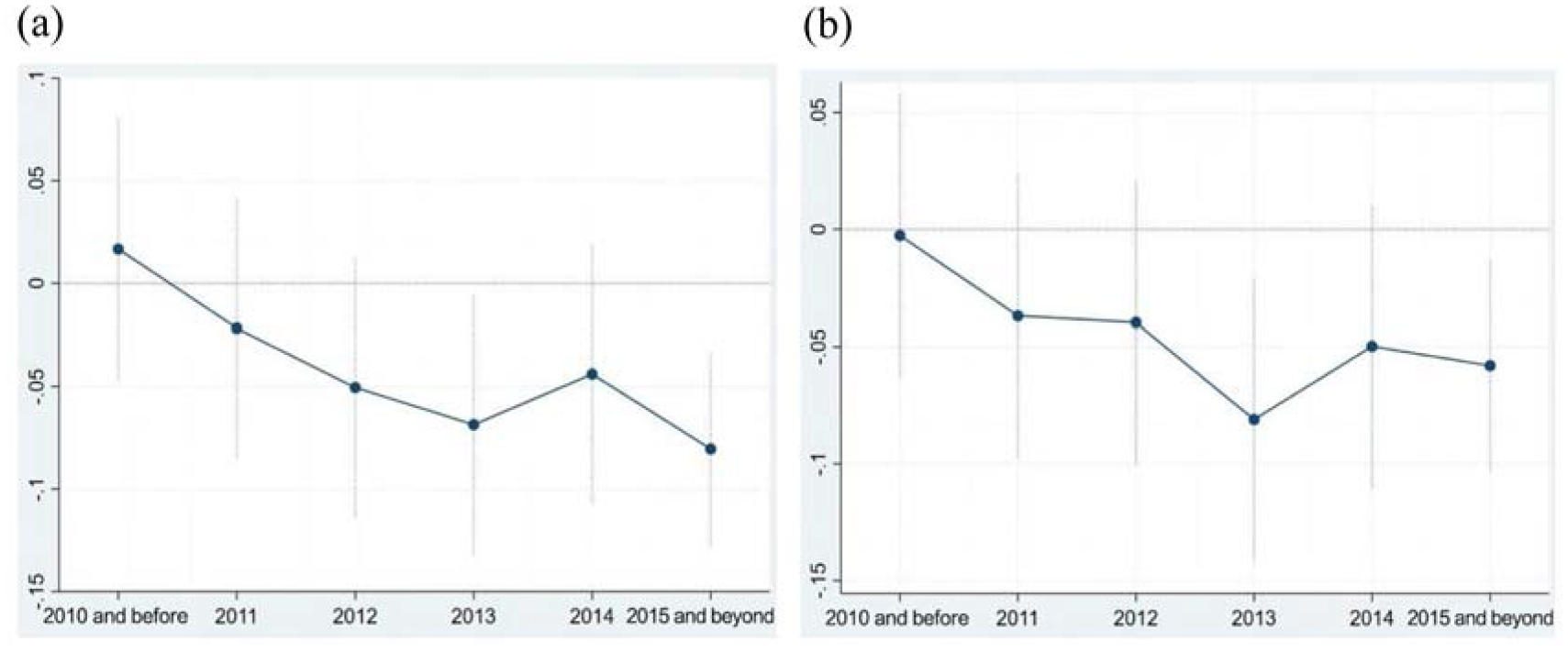
Coefficients and confidence intervals of the parallel trends test. (a) The dependent variable is GPROD1. (b) The dependent variable is GPROD2.
Dynamic Test
Labour-intensive enterprises may delay or reduce their social insurance contributions to minimise costs and maximise profits, resulting in a lag in their efforts to promote factor substitution and adjust green production activities. The dynamic effects of the Social Insurance Law on the green production activities of labour-intensive enterprises are discussed below.
Table 4 illustrates the dynamic effects of the Social Insurance Law on the green production levels of labour-intensive enterprises. In Models (1) to (4), the regression coefficients of LAB×2012SIL are not significant, suggesting that, in 2012, labour-intensive enterprises did not respond to the Social Insurance Law by adjusting their green production levels. The estimated coefficients of LAB×2013SIL are consistently negative, indicating that labour-intensive enterprises began adjusting their green production levels in response to the law in 2013. Similarly, the regression coefficients of LAB×2014SIL are also significantly negative, showing that the adjustment continued after 2014. These results highlight the significant lag effect of the Social Insurance Law on the green production levels of labour-intensive enterprises. Therefore, Hypothesis 3 is confirmed.
Difference-in-Differences Model Estimation Results – Dynamic Test.

Mechanism Test
The theoretical analysis in the previous sections suggests that the Social Insurance Law affects the green production of labour-intensive enterprises primarily by prompting these firms to reduce labour employment and replace labour with new production technologies and more efficient machinery. This, in turn, fosters green technological innovation and increases the capital-labour ratio, leading to reduced pollution emissions and improved green production levels. The following discussion explores these mechanisms in greater detail.
The key mechanism through which the Social Insurance Law drives improvements in green production levels via green technological innovation is its impact on increasing labour costs. To ensure long-term sustainability, firms may invest more in green research and the development of green production technologies, substituting labour with these innovations to enhance their green production levels. Green technological innovations play a crucial role in this process. Based on this logic, this study examines the role of green technological innovation, using the total number of corporate green patent applications as a measure. Table 5 shows that the implementation of the Social Insurance Law has stimulated corporate green innovation, leading to a reduction in pollution intensity and an improvement in green production levels, with green technological innovation playing a significant role. Therefore, Hypothesis 2 is confirmed.
Mechanism Test of Green Technological Innovation.

The core logic behind how the implementation of the Social Insurance Law enhances green production levels by increasing the capital-labour ratio in labour-intensive enterprises is that the law raises labour costs, prompting firms to replace labour with high-performance machinery and other capital-intensive factors. This, in turn, improves green production levels. The capital-labour ratio plays a crucial role in this mechanism. Based on this logic, this study further examines the role of the capital-labour ratio, using per capita fixed assets as a proxy. Table 6 shows that the implementation of the Social Insurance Law led to an increase in the capital-labour ratio in labour-intensive enterprises, which reduced pollution intensity and improved green production levels, with the capital-labour ratio playing a significant role. Therefore, Hypothesis 2 is confirmed.
Mechanism Test of the Capital-Labour Ratio.

Robustness Tests
To further validate the findings of this study and demonstrate the robustness of the results, we conduct robustness tests from the following perspectives.
Instrumental Variable (IV) Test
The main threat to the empirical strategy stems from the potential endogeneity of the Social Insurance Law’s enactment. The law was a significant legal measure by China’s central government to gradually improve the social insurance system for urban and rural residents. Prior to its implementation, many domestic enterprises were labour-intensive with outdated production machinery and technology. The government may have accelerated the law’s introduction to promote green technological innovation, increase the capital-labour ratio in labour-intensive industries, and support the shift towards green production. This could introduce reverse causality, leading to endogeneity issues. Furthermore, data limitations may result in omitted variable bias, which could lead to endogeneity issues in ordinary least squares estimation of the Social Insurance Law’s true effect. To address these concerns, instrumental variables are employed in a two-stage least squares estimation, following Moser and Voena (2012).


Equation 6 represents the first-stage estimation, where the instrumental variable OLD denotes the proportion of the population aged 65 and older at the municipal level. Equation 7 is the second-stage estimation, with variable meanings consistent with those in Equation 1.
Following Lin and Zeng (2020), this study uses the proportion of the population aged 65 and above at the municipal level as the instrumental variable for the Social Insurance Law. The rationale for this choice is twofold. First, social insurance revenue and expenditure primarily focus on pension and medical insurance, with combined contribution rates for both approaching 30%. These revenues and expenditures are closely linked to the elderly population, making the proportion of elderly individuals an important factor for the central government when promoting the Social Insurance Law. Thus, it is strongly correlated with the law’s enactment and implementation. Second, enterprises’ decisions regarding green production are not influenced by the proportion of the elderly population, as it does not directly affect their production choices. Therefore, the proportion of the population aged 65 and above is a valid instrumental variable.
The regression results in Table 7 indicate that in Models (1)-(4), the F-values exceed 10, suggesting no weak instrument issues. The coefficients of LAB×SIL are significantly negative, confirming the robustness of the results in Table 2. Additionally, the absolute values of the estimated coefficients in these models are notably larger than those in Table 2, implying that the endogeneity problem leads to an underestimation of the Social Insurance Law’s impact on green production levels in labour-intensive enterprises.
Instrumental Variable Estimation Results.

Treatment Effect Test
The following robustness test controls for endogeneity through a treatment effect model, with maximum likelihood estimation applied.
The treatment effect model results in Table 8 show that in Models (1)-(4), the likelihood ratio test confirms the presence of endogeneity, supporting the use of the treatment effect model. The treatment-effect regression coefficients of LAB×SIL are all significantly negative, reinforcing the robustness of the results in Table 2. Moreover, the absolute values of the estimated coefficients in this model are significantly larger than those in the corresponding models in Table 2, indicating that endogeneity causes an underestimation of the Social Insurance Law’s impact on the promotion of green production in labour-intensive enterprises.
The Results of the Treatment Effect Estimation.

Testing With Alternative Measures of the Dependent Variable
This section presents further robustness tests using two alternative measures of pollution emission intensity: the ratio of chemical oxygen demand to operating income (GPROD3) and the ratio of greenhouse gas emissions to operating income (GPROD4).
Table 9 reports the results of testing enterprises’ green production levels with these indicators. The coefficients in Models (1) to (4) are all significantly negative, indicating that, regardless of the indicator used, the implementation of the Social Insurance Law continues to promote green production levels in labour-intensive enterprises. These regression results align closely with those in Table 2, further confirming the robustness of the estimation outcomes.
Measuring Enterprises’ Green Production Levels With Other Indicators.

Testing With Alternative Measures of Labour Intensity
In this section, following relevant studies (Lu et al., 2015; Ni & Zhu, 2016), robustness tests are conducted using alternative measures of labour intensity, including annual labour intensity indicators (LAB2), the average annual labour intensity indicator (LAB3), and the fixed assets-to-total assets ratio (LAB4).
Table 10 presents the results of these robustness tests. In Panel A, which uses the labour intensity indicator for each year in the sample (LAB2), the coefficients in Models (1) to (4) are significantly negative. Similarly, in Panel B, where labour intensity is measured by the average annual labour intensity indicator (LAB3), the coefficients in Models (1) to (4) remain significantly negative. In Panel C, using the fixed assets-to-total assets ratio (LAB4), the coefficients in Models (1) to (4) are again significantly negative. These findings suggest that, regardless of the labour intensity measure used, the implementation of the Social Insurance Law reduces pollution intensity in labour-intensive enterprises and promotes their green production levels. The regression results are consistent with those in Table 2, further confirming the robustness of the estimates.
Using Alternative Indicators to Measure Labour Intensity.

Heterogeneity Analysis
Heterogeneity Analysis Between High-Polluting and Low-Polluting Firms
Heterogeneity analysis between high- and low-polluting firms can reveal differences in their adoption of green production technologies and responses to the implementation of the Social Insurance Law. To investigate this, firms are categorised as high- and low-polluting based on the median values of sulphur dioxide and nitrogen oxide emission intensity (GPROD1) and pollution emission intensity calculated from pollution fee expenditure (GPROD2) in 2010. Among the categorised firms, 2,996 are classified as high-polluting and 3,457 as low-polluting based on GPROD1, while 3,042 are classified as high-polluting and 3,411 as low-polluting based on GPROD2.
As shown in Table 11, the absolute values of the estimated coefficients for LAB×SIL in the high-polluting firm samples are noticeably smaller than those in the low-polluting firm samples. This suggests that while the Social Insurance Law promotes green production in all labour-intensive enterprises, its impact is more pronounced in driving green production among low-polluting firms.
Estimation Results for High-Polluting and Low-Polluting Firms.

Heterogeneity Analysis Between Private Enterprises and Non-Private Enterprises
The response to the implementation of the Social Insurance Law may differ between private and non-private enterprises due to variations in their employment structures and wage levels. To explore this, we examine the impact of the law on the green production levels of private and non-private enterprises, with 2,825 private enterprise samples and 3,628 non-private enterprise samples.
The estimation results for private and non-private enterprises are presented in Table 12. In the non-private enterprises, the coefficients of LAB×SIL are not statistically significant. However, in the private enterprise sample, the coefficients of LAB×SIL are significantly negative. This suggests that while the Social Insurance Law promotes green production across all labour-intensive enterprises, its effect is more pronounced in labour-intensive private enterprises.
Estimation Results for Private and Non-Private Enterprises.

Heterogeneity Analysis of Manufacturing and Non-Manufacturing Enterprises
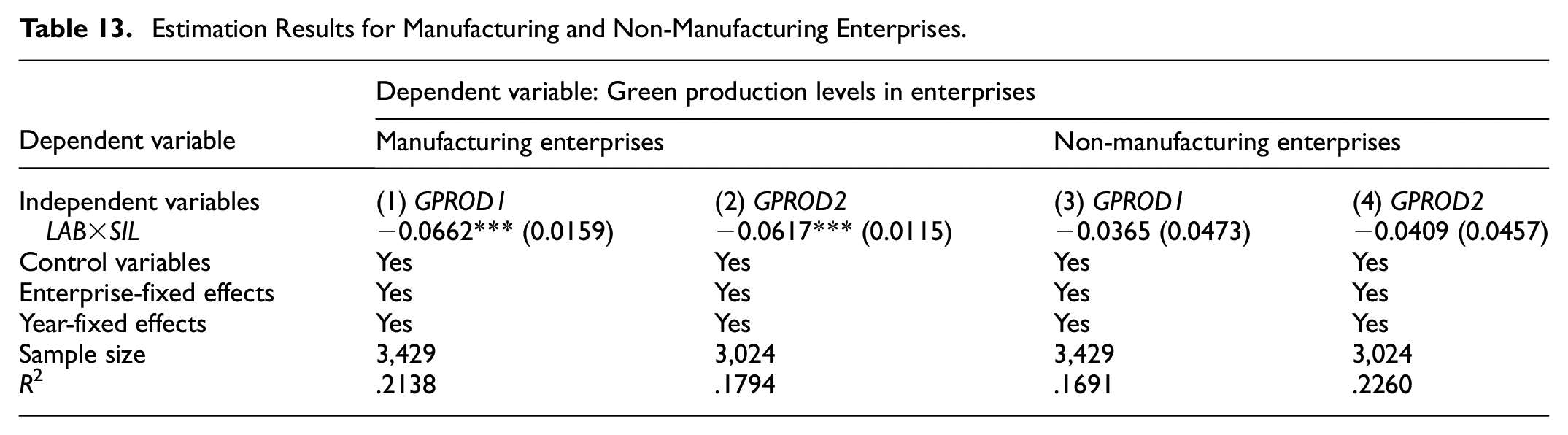
Owing to differences in employment structures and wage levels, manufacturing and non-manufacturing enterprises may respond differently to the implementation of the Social Insurance Law. The sample is therefore divided into manufacturing and non-manufacturing enterprises, with 3,429 samples in the manufacturing sector and 3,024 samples in the non-manufacturing sector, based on the industry classification codes of the China Securities Regulatory Commission.
As shown in Table 13, in the manufacturing enterprise sample, the estimated coefficients of LAB×SIL in Models (1) and (2) are both significantly negative. In contrast, in the non-manufacturing enterprise sample, the estimated coefficients of LAB×SIL in Models (1) and (2) are not significant. This suggests that while the Social Insurance Law promotes green production in all labour-intensive enterprises, its effect is more pronounced in manufacturing enterprises.
Estimation Results for Manufacturing and Non-Manufacturing Enterprises.
Conclusions and Implications
This study developed a theoretical framework and conducted a thorough analysis, showing that the implementation of the Social Insurance Law has increased social insurance pressures, raised labour costs for labour-intensive enterprises, promoted green technological innovation, and enhanced the capital-labour ratio. As a result, the green production levels in these enterprises have steadily improved. This study also posited that the Social Insurance Law has promoted green production in labour-intensive enterprises. Various methods, including the DID model, were used to validate this hypothesis, leading to the following conclusions: (1) The implementation of the Social Insurance Law effectively reduces pollution intensity and enhances green production levels in labour-intensive enterprises. (2) Mechanism analysis shows that the law promotes green technological innovation and increases the capital-labour ratio, which are key drivers of green production. (3) The law has a significant lag effect on green production levels. (4) Its promotional impact is more pronounced in low-pollution, private, and manufacturing enterprises.
These findings provide valuable insights into the impact, mechanisms, and logic of the Social Insurance Law on enterprise decision-making regarding green production. They offer important policy implications for improving the law and labour protection systems, guiding enterprises towards greener production, and fostering high-quality green economic development. Based on these conclusions, this study recommends the following policy actions: (1) The Social Insurance Law helps labour-intensive enterprises reduce pollution intensity and enhance green production levels. Therefore, further improving the law and labour protection system, while maintaining reasonable social insurance premiums, will protect workers’ rights and promote the green production of enterprises. (2) The law encourages green technological innovation and the adoption of high-performance machinery to replace labour, thus promoting green production. Policymakers should guide enterprises to reduce their reliance on labour, innovate technologies, and increase the use of high-performance machinery to advance green production transformation. (3) The law’s significant lag effect on green production levels requires a balanced approach to labour protection and enterprise capacity. Policies should differentiate between enterprise types, such as low- and high-pollution, private and non-private, and manufacturing and non-manufacturing sectors. By gradually standardising social insurance premium payments and improving fee collection, this strategy will protect workers’ rights while supporting the transition of labour-intensive enterprises to greener production, ultimately driving high-quality green development.
Footnotes

Author Contributions
Conceptualization: Bomin Liu and Cai Zhang; methodology: Bomin Liu; software: Junwei Zhang; validation: Cai Zhang and Junwei Zhang; formal analysis: Bomin Liu; investigation: Junwei Zhang; resources: Junwei Zhang; data curation: Junwei Zhang; writing – original draft preparation: Cai Zhang; writing – review and editing: Bomin Liu and Cai Zhang; visualization: Junwei Zhang; supervision: Bomin Liu; project administration: Bomin Liu; funding acquisition: Bomin Liu. All authors have read and agreed to the published version of the manuscript.
Funding
The author(s) disclosed receipt of the following financial support for the research, authorship, and/or publication of this article: This research was funded by The National Social Science Fund of China, grant number 22BJL012.
Declaration of Conflicting Interests
The author(s) declared no potential conflicts of interest with respect to the research, authorship, and/or publication of this article.
Data Availability Statement
The data that support the findings of this study are available from the corresponding author,