



Abstract
AI-enhanced mind mapping has emerged as a vital tool for foreign language educators and learners, which facilitates deep learning and creative thinking through hierarchical and categorical organization of ideas. Despite its motivational potential, there is a lack of empirical evidence regarding its effectiveness, particularly in listening comprehension. To address this, our study aims to investigate the impact of AI-enhanced mind mapping on college students’ English listening comprehension and their perceptions. Participants included 41 first-year English learners at a pre-intermediate English level from a university in Macau. During a 10-week listening teaching period, they were assigned to use Mapify to generate mind maps for understanding TED videos in listening lessons. Pre- and post-English listening tests and reflection journals were conducted to collect data. The results demonstrated that participants displayed statistically significant improvements in listening comprehension, as the post-test score (M = 83.79) was significantly higher than the pre-test score (M = 70.60, p < .01). This exploratory study also found that learners generally held positive attitudes and perspectives toward AI mind mapping. This approach could foster their cognitive, emotional, and behavioral engagement. These findings provide empirical support for integrating AI mind mapping tools in the English as a foreign language (EFL) listening classroom environment.
Background
The emerging paradigm of technology-enhanced Language learning (TELL) offers an encouraging personalized learning ecosystem through AI-powered scaffolding systems (D. Zhang et al., 2024). Contemporary research has highlighted the transformative potential of AI in second-language education, mainly through its ability to provide adaptive scaffolding and real-time feedback (Wang & Xue, 2024). Notably, AI-enhanced mind mapping has been recognized for its effectiveness in information processing and visual organization, which enables learners to generate and categorize ideas (Y. S. Shi & Tsai, 2024). Unlike traditional mind mapping, this tool is adept at automatically extracting key information from texts or videos to achieve the rapid construction of complex mind maps.
The fusion of advanced artificial intelligence and traditional mind mapping techniques is believed to bring new possibilities for educational innovation. This groundbreaking technology provides an innovative means to enhance learners’ cognitive processes by creating a bird’s eye view of the whole knowledge while facilitating a better understanding of concrete notions (Stokhof et al., 2020). Moreover, by structuring information in a hierarchical and interconnected manner, AI-enhanced mind mapping aids learners in more effectively analyzing and interpreting auditory input, making it a valuable asset in listening skills instruction.
Despite the importance of L2 listening in second language acquisition, it continues to challenge EFL learners. Researchers such as Miller (2009) and Siegel (2011) have outlined quite a lot of challenges, including limited exposure time, negative transfer from L1, poor listening habits, overreliance on teachers, physical disturbances like noise, speaker-related aspects including speech patterns and accents, lack of prior knowledge, anxiety and other individual differences. These challenges emphasize the need for educational innovations that focus on the cognitive structures of auditory processing and also revolve around the motivational factors of prolonged engagement (R. Zhang et al., 2023).
Previous research has demonstrated the positive impact of mind mapping on L2 learning, particularly in the areas of English reading and writing (Boerma et al., 2022; Fan & Chen, 2021). However, little attention has been paid to the potential of AI-enhanced mind mapping in listening instruction. Moreover, as a promising technology with significant innovation value, empirical research on the effects of AI-enhanced mind mapping remains scarce.
Therefore, the present study aims to fill this gap by providing a novel investigation into the effectiveness of AI-enhanced mind mapping on L2 listening skills. By empirically examining the performance of EFL learners using this tool during listening lessons and exploring their experience, drawing upon the engagement theory, this research contributes valuable insights to our understanding of the integration of AI technology in language education to promote L2 listening development. Specifically, the remainder of this study elaborates the relevant literature, methodology and findings, followed by a detailed discussion of the implications of the results for learners, educators and researchers.
Literature Review
Engagement Theory
Engagement refers to students’ level of participation or involvement in educational activities. It is generally considered to be a three-dimensional structure that includes cognitive, emotional, and behavioral aspects (Fredricks et al., 2019). Cognitive engagement represents the learner’s intellectual commitment to learning activities, involving active information processing and deep learning (Barlow et al., 2020). Specifically, cognitive engagement manifests itself in two aspects. One is that students invest time and effort in the learning process, striving to learn and understand complex concepts and knowledge, and the other is that students think about their learning and give it meaning (Phillips et al., 2019). Cognitively engaged learners tend to employ metacognitive strategies such as planning, goal setting, monitoring, and evaluation, as well as various learning techniques such as practice, review, and elaboration, to acquire knowledge and skills through mental effort (S. Li & Lajoie, 2022). Emotional engagement is an individual’s emotional response and involvement in learning activities (K. Y. Fung et al., 2024). It correlates with learners’ attitudes toward the learning environment, peers and tasks, and is considered to affect other dimensions of engagement (Hiver et al., 2021). Emotionally engaged learners are shown to be active, purposeful, and autonomous toward learning tasks and peers, expressing positive emotions like enjoyment and enthusiasm instead of negative feelings such as anxiety, boredom, and depression (Phung, 2017). Behavioral engagement is defined as the learner’s involvement in an academic task (Yuan & Kim, 2018). The behavioral engagement dimension has a wide range of indicators, involving the learner’s effort expenditure on tasks and the degree of active participation in the learning process, such as persisting in completing a task on time (Philp & Duchesne, 2016).
Due to the role that educational technology may play in promoting student engagement (Rad et al., 2024; Wang & Xue, 2024), some scholars have empirically explored its impact on students’ engagement in listening practice. For example, Huang et al. (2024) investigated the use of chatbots to improve English listening decoding skills in a fully online learning environment. By comparing the effects of the two teaching methods (flipped classroom and chatbot-assisted learning), the results indicated that chatbot-assisted learning increased students’ engagement and interest, and enhanced listening decoding proficiency. However, the application of AI-mind mapping tools in this domain remains underexplored, particularly through the theoretical lens of the engagement framework encompassing cognitive, emotional, and behavioral dimensions (Fredricks et al., 2019). Furthermore, the potential synergistic effects of combining AI-generated visual representations with auditory input processing in listening comprehension warrant systematic investigation.
L2 Listening Mechanism and Instruction
L2 listening comprehension is a dynamic and complex cognitive process requiring linguistic and non-linguistic knowledge. This process involves both bottom-up and top-down processing (Ducker, 2022). Bottom-up processing entails decoding the auditory input by segmenting speech, identifying words, and utilizing existing linguistic knowledge to understand the incoming stream of sounds (Field, 2019). However, learners often face speech stream processing difficulties and working memory limitations, particularly low-proficiency learners who struggle with word recognition and comprehension (Kissling, 2018; Vafaee & Suzuki, 2020). Top-down processing, on the other hand, relies on background knowledge and context to interpret messages (Leonard, 2019). Effective listening requires learners to activate relevant prior knowledge to predict the content and infer meanings (Yeldham, 2017). Fluency in L2 listening is often manifested as a seamless combination of the two processing styles, which allows skilled learners to respond flexibly to these processes (Rost, 2015).
To help L2 learners overcome these challenges, numerous teaching approaches to enhance listening skills have been put forth, with strategy training being one prominent suggestion. Strategy teaching involves developing cognitive and metacognitive strategies to make up for the actual or potential listening challenges for L2 learners, including strategy-based and metacognitive instruction (Polatcan et al., 2025). This includes strategy-based instruction focusing on skills like prediction and reasoning and metacognitive strategies for planning and monitoring (Goh & Vandergrift, 2021). Research has shown that such approaches significantly improve listening comprehension (Kobayashi, 2018; Yeldham & Gao, 2021). Interactive training has also emerged as a valuable method, combining strategic training with explicit skills like speech simplification and word segmentation to tackle specific listening challenges (Dalman & Plonsky, 2022). Various tasks, such as note-taking (Siegel, 2022), shadowing (Hamada & Suzuki, 2021), and mind mapping (X. Li, 2024), have been identified as effective for promoting L2 listening skills. Among them, mind mapping is based on visual thinking and actively engages learners in the visual organization of auditory input through the combination of words and images (Y. Shi et al., 2023). It can enhance listening comprehension, especially in the case of low-frequency words and complex syntactic structures in academic lectures. Because mind mapping recognizes discourse markers and propositional relations in real-time, while kindling the students’ minds with their prior knowledge and promoting top-down processing.
Digital technology has shown great potential in promoting L2 learning (Wu et al., 2024; Xiong et al., 2025). Resources like movies (Yenkimaleki & van Heuven, 2023), songs (Tsang, 2020) and e-books (Hsieh & Huang, 2020) offer diverse listening materials tailored to different proficiency levels (Yenkimaleki & van Heuven, 2023). Innovations like the digital pen-based learning system (DPLS-RM) help learners overcome challenges like word segmentation by adjusting speech speed and providing visual aids (Tan et al., 2019). Moreover, using TED talk videos has been shown to positively influence listening comprehension based on playback speed and learner proficiency (Zong et al., 2025). TED Talks are speeches held for free on many subjects of studies and professions involving the best narrators who excel in presenting complex issues in an understandable way (Hu & Li, 2017). Each talk is usually not very long, which makes it ideal material to use as a classroom teaching aid (Y. J. Lin & Wang, 2018). The TED speaker’s effort to explain the terms and concepts by means of, for instance, analogies, examples, media, and props that the audience can easily understand and absorb the given information (Nguyen & Boers, 2019). As TED talks are becoming even more popular all over the world, many language education institutions are recognizing their educational potential and implementing them in their curricula as a listening training tool (Rashtchi & Mazraehno, 2019).
Research on enhancing L2 listening through emerging technologies such as AI has experienced a sharp spurt of development. Recent studies indicate that generative AI can improve language learning motivation through interactions with AI chatbots, suggesting its potential in listening instruction (Liu & Reinders, 2025). Although AI has great potential for L2 listening development, there is a lack of empirical research regarding AI-enhanced mind mapping in this area.
Mind Mapping
Mind mapping is an effective learning strategy that uses hierarchy and classification to systematically organize information and construct ideas (Baghestani Tajali et al., 2023; Buzan & Buzan, 1993). As a visualization tool, mind maps integrate and present facts and ideas through the use of lines, colors, pictures, symbols, or keywords (Merchie & Van Keer, 2016). In a mind map, the central image epitomizes the main theme, while the branches display the keywords or visuals, and the lower branches are connected to the subordinate theme, together forming an interconnected nodal structure (Buzan, 2024). By emphasizing basic keywords and drawing clear associations among them, mind mapping visually represents complex thematic relationships and helps learners understand, retain, and analyze these associations (Y. Shi et al., 2023).
In educational practice, an increasing number of educators have applied mind mapping to assist teaching, incorporating it into the classroom to organize and present the material as a pedagogical tool in the teaching process (Tendrita & Hidayati, 2025). Research has demonstrated the tremendous benefits of mind mapping for students, including helping students understand complex knowledge (Stokhof et al., 2020), developing critical thinking skills (Polat & Aydın, 2020), promoting creative thinking (Su et al., 2022), and computational thinking abilities (L. Zhao et al., 2018). Additionally, Zheng et al. (2020) revealed that mind-mapping strategies had a positive impact on students’ academic performance, self-efficacy, and learning motivation.
Mind mapping strategies are widely used in language learning. For example, Fu et al. (2019) conducted an experiment to measure the effect of a mind mapping-based contextual gaming approach, and the findings indicated that this approach improved students’ writing performance and language use. Y. S. Shi and Tsai (2024) posited that mind-mapping apps are also an effective way to improve students’ vocabulary acquisition and memory. Furthermore, researchers in language learning have explored the effects of mind mapping on students’ reading performance. Boerma et al. (2022) examined the additional benefits of using mind mapping in interactive book reading for children’s language development during an 8-week intervention in early childhood classrooms. Merchie et al. (2021) conducted an eye-tracking study on primary school students, which showed that receiving mind mapping before or after text processing was conducive to successful reading learning in targeted teaching. Moreover, Wette (2017) pointed out that mind mapping helps improve students’ awareness of the textual and rhetorical parts of conceptual knowledge and also promotes motivation and self-efficacy. C. J. Lin and Mubarok (2021) implemented a mind map-guided AI chatbot approach (MM-AI) in a college flipped English class to enhance students’ oral proficiency and engagement. By comparing the effectiveness with the traditional chatbot approach (C-AI), the learning effect of MM-AI and the interaction between students and the AI system were verified.
While AI mind mapping demonstrates pedagogical value in language education, current research disproportionately focuses on reading/writing applications, leaving its efficacy in listening comprehension empirically underdeveloped. The purpose of this study, therefore, was to investigate the impact of the AI mind-mapping tool on improving students’ listening performance. The research questions guiding this study were as follows:
Method
Research Design
The present study used a mixed methods design for an experimental study with quantitative and qualitative data to explore the teaching potential of AI mind mapping in improving L2 listening performance. The study design assessed students’ listening performance before and after the intervention while collecting students’ reflections to gain insight into their perceptions of the AI mind-mapping tool.
Participants
The participants were recruited through convenience sampling from first-year students in an English for Academic Purposes (EAP) course in Computer Science programs at a university in Macau. A total of 41 students (29 males [71%] and 12 females [29%]) participated in the study, 16 of whom were from Macau and 25 from Mainland China. They were at a pre-intermediate English level, IELTS 4.5 or so, and had less developed listening skills. Before the study, no one had used GAI to practice listening or generate mind maps. Informed consent was obtained from all participants.
Materials and Instruments
Listening Materials
The listening materials for this study included 10 TED Talk videos (about 5–10 min each) covering diverse topics such as technology, education and cultural studies. All videos were language verified by two applied linguistics experts to ensure that their vocabulary was appropriate for the student’s level.
Technological Intervention
Mapify, an AI which allows users to convert their spoken content into visual forms, was used in this study. After watching the TED Talk videos twice, students had access to Al-generated mind maps with vital information such as the main ideas, connections, and vocabulary. Mapify is an excellent tool for converting various content, like YouTube videos, PDF files, and meeting recordings, into lucid mind maps that can be easily understood and organized. It was offered in three ways, namely input (pasting the YouTube video URL into the tool), summaries (clicking “Mapify” creates a structured mind map summary of the video) and customization (interacting with an AI chatbot and customizing the mind map for their personal learning style), the project aimed to improve students’ understanding and organization of video materials.
Assessment Tools
Listening Tests
TED-ED quizzes were used to assess learners’ listening comprehension. It consisted of eight multiple-choice items and two essay items, with a single answer. Two language experts assessed all tests.
Student Reflections
Besides the use of the listening test, this project gathered students’ reflections. By the time the semester ended, every student was requested to write down a reflective journal on the main question: “What are your thoughts and feelings on using the AI mind mapping tool to enhance your L2 listening skills?” The pupils were motivated to talk about the advantages and disadvantages of Al mind mapping. In reflective journals, the researchers engaged participants anonymously, and each participant was given a specific number (e.g., S18) to report their findings.
Procedure
The study lasted for 10 weeks. There were 3 hr of classes 1 day a week. The participants initially went through a listening pre-test. The students were only pre-intermediate in their English; thus, it was quite hard for them to follow the videos in English. For this purpose, teachers and researchers decided to play each video three times for the students. First, students were exposed to the TED talks. They watched two unaided pre-watchings. Further, the learners created a mind map with Al using the Mapify tool, and after that, they watched the video to get all the information they needed. After the three views had ended, the students took a post-test based on the video content.
Data Analysis
The researchers used two distinct methods to carry out the data analysis with a view to addressing the research questions. The quantitative component aimed at
Findings
RQ 1: Do Students’ Listening Performance Improve With the Use of AI-Enhanced Mind Mapping Before and After the Intervention?
A paired t-test was used to investigate the differences for students in the mind mapping group, and the results can be seen in Table 1: A total of one pair all exhibit significant differences (p < .05). A detailed analysis shows that Pre-Quiz Grades and Post-Quiz Grades showed significant differences at the 0.01 level (t = −5.190, p = .000), and the specific comparison indicated that the mean of Pre-Quiz Grades (70.60) was significantly lower than the mean of Post-Quiz Grades (83.79). A Cohen’s d effect size for the results demonstrated a medium effect size at 0.795 (Cohen, 2013). This indicated that the teaching method of using AI-generated mind maps to assist students in listening comprehension was effective.
Paired t-Test for Students in Mind Mapping Group.
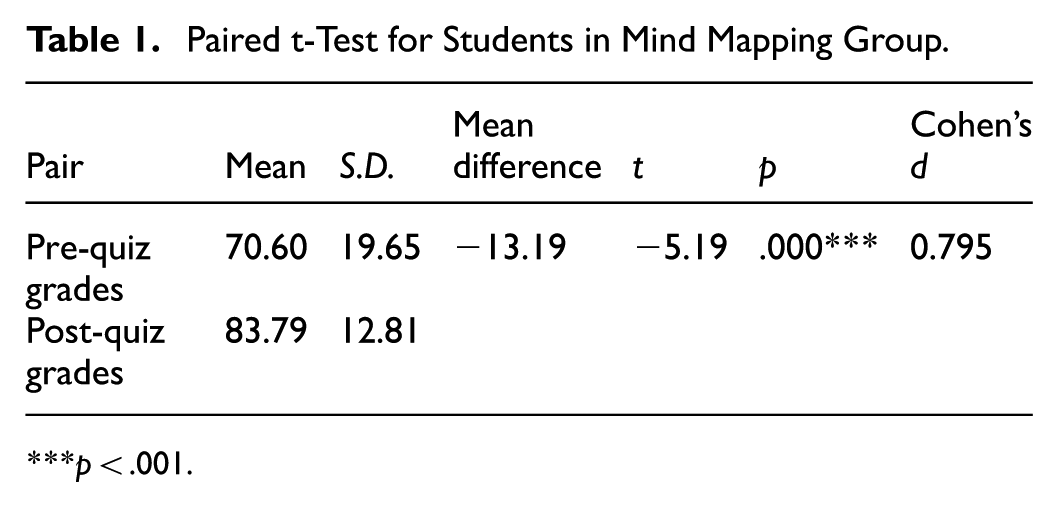
p < .001.
RQ 2: How Do the Students Perceive the Use of AI Mind Mapping in Supporting Listening Practice?
The study exhibited rather complex attitudes toward Al mind mapping (Mapify) as a support tool and a challenge in the listening practice. The reflections of the students were detailed in the form of affordances and constraints based on the cognitive, emotional, and behavioral dimensions of engagement and the corresponding excerpts were carefully interspersed in the text to indicate the thematic patterns (Table 2).
Overview of Mind Mapping Affordances and Constraints.

Affordances
Cognitive Engagement Affordance
When reflecting on the mind-mapping experience generated by Mapify, most students responded that the visual organization of lecture concepts into layers could help them remember concepts better and thus reduce cognitive overload. For example, S39 stated, “Mind mapping helps me better organize and remember information by breaking it down into smaller parts and visually displaying how they relate to each other.” Moreover, the summary function is considered key to filtering out irrelevant details. According to S1, “Summarization forces the extraction of key points and deepens understanding,” so consequently, the capability of the tool to change linear input sounds into spatial figures also aided in the schema development process, which was the case especially when the topic was to be presented in a multidimensional understanding.
Emotional Engagement Affordance
A large number of respondents have expressed a positive emotional and psychological experience, mainly talking about the commendable role of mind mapping in reducing learning anxiety and improving learning motivation by fostering a sense of preparedness. Students reported a noticeable increase in confidence when using AI mind mapping to complete the listening task, as evidenced by S31′s reflection: ‘They boost my confidence and allow me to engage more effectively with new information.’ This psychological transformation echoes the successful experience constructed by visual learning trajectories, which continues to strengthen learners’ sense of competence. In addition, the predictability of mind mapping reduced ambiguity, as S39 noted: “Mind mapping provides a structured approach to organizing information, which is particularly useful for listening tasks.” The tool’s scaffolding effect may reduce anxiety by making abstract content concrete, a finding that is consistent with research on mobile-assisted language learning (Bai, 2024).
Behavioral Engagement Affordance
At the behavioral level, the tool successfully stimulates learners’ active participation through the mechanism of information segmentation. For example, S19 stated, “Together, these methods enhance learning by breaking down information into manageable parts and promoting active engagement with the material.” In addition, Learners recognized how the tool optimizes learning efficiency, and the feedback from S31 was persuasive: “Using mind mapping helps me organize information quickly and identify key themes.” This efficient information processing ability is precisely the core skill of L2 listening comprehension (Goh & Vandergrift, 2021), suggesting the potential value of this tool in skill transfer.
Constraints
Cognitive Engagement Constraint
Despite its benefits, students faced technical application difficulties, particularly in real-time mind map construction. S23 remarked, “I find it complex to create a full mind map during listening,” reflecting the challenge of simultaneous listening, processing, and visual representation—a triadic cognitive demand that may exceed novice learners’ capacities. There are also summarization obstacles, as S3 stressed that “I often struggle to summarize effectively, and sometimes I feel overwhelmed by trying to capture everything,” indicating a possible deficiency in metacognitive strategies for prioritizing information.
Emotional Engagement Constraint
Students experienced frustration when identifying key points under time constraints. S25 described feeling “overwhelmed by the amount of information presented,” suggesting that without explicit training, the tool’s open-ended structure could exacerbate anxiety. S1’s struggle—“difficult to discern which points are main ideas”—highlights the need for scaffolding in distinguishing hierarchical relationships, a challenge documented in graphic organizer research.
Behavioral Engagement Constraint
Participants outlined the insufficient time they faced when using AI mind mapping during tasks, which indicated the challenges encountered in practice. S10 reported, “I find that during listening tasks, I do not have enough time to create comprehensive mind maps or summaries,” pointing to a mismatch between task complexity and learners’ operational fluency. The adaptation dilemma of new users was also prominent, and the frank admission of S19 deserved attention: “I am new to mind mapping and summarizing, and it makes me feel unsure about how to implement these methods effectively.” This barrier to technology adoption suggested that knowledge transfer without systematic training was often difficult to achieve. S12′s request for “more resources or guidance” further highlighted the need for structured instructional support in optimizing the utility of the tool.
Discussion
The study investigated the pedagogical potential of AI mind mapping in L2 listening by addressing two key areas: the impact of AI mind mapping on students’ performance in L2 listening tasks and learners’ perceptions of this tool. The results revealed a significant improvement in scores from pretest to posttest, which indicated that using AI-generated mind maps to assist students in listening comprehension is effective. The findings supported the previous studies that reported a positive effect of mind maps on students’ academic achievement (Y. S. Shi & Tsai, 2024; Wu & Chen, 2017). Additionally, students generally expressed positive opinions on AI-generated mind maps to assist L2 listening, despite some pointing out suggestions to promote teaching practice effectiveness.
The current study illustrated how the AI mind mapping affordances can foster L2 listening comprehension. From a cognitive perspective, AI mind maps were believed to be vital in improving students’ understanding and retention by visually presenting information and transforming abstract listening content into tangible and understandable material (Fang et al., 2023). This finding aligns with the results of An et al. (2025) that students developed a more coherent knowledge construction process at the cognitive level, as reflected in their deepened understanding and broadened learning boundaries. This may be due to the outstanding features of AI mind mapping, which assist learners in quickly identifying the main content and form a clear hierarchical structure in the mind, simplifying information and highlighting key ideas (D. Fung & Liang, 2023). Specifically, AI mind mapping plays a crucial role in facilitating top-down processing. The concise, structured and easily accessible visual display of a large number of concepts and related information can help to trigger association and divergent thinking (Buzan, 2024). This feature encourages learners to activate their background knowledge and previous experience in listening tasks and connect listening content with their existing knowledge framework (Y. S. Shi & Tsai, 2024). Additionally, learners predict and speculate on the content of the listening text through visual presentation. By deepening students’ understanding of the topics and concepts involved in the listening task, AI mind mapping contributes to elevating students’ listening performance. The findings were in line with the arguments of X. Li (2024), who observed that mind mapping develops students’ ability to retain and recall information, distinguish between primary and secondary information, and foster the development of interpreting-specific listening knowledge and skills.
The present study also reported the impact of AI mind mapping on students’ emotional responses during L2 listening tasks. AI mind mapping helped to capture students’ attention and interest, fostering greater willingness and motivation to engage in listening activities (Chang et al., 2018). The findings are consistent with J. Zhao and Yang’s (2023) study, which found that mind map-based learning systems not only improved the L2 learning performance but also had a positive impact on learning motivation, problem-solving skills, and self-efficacy. Students reported alleviated learning anxiety, increased self-confidence, and better preparation for future listening tasks. This may be due to the fact that AI converts lengthy videos into well-organized mind maps, which offer the unique function of generating clear structure and key information of the listening material to reduce ambiguity in content, alleviate students’ uncertainty, and consequently reduce anxiety levels (Chen & Hwang, 2020). Participants affirmed the value of integrating AI mind mapping into listening practice and expressed a desire to continue using this tool in future learning to better cope with similar listening tasks. Having an intuitive overview of the listening task through the mind map empowers students to approach the task with confidence (Hsu, 2019).
The voices of the students revealed the benefits of AI mind mapping on the behavioral engagement of L2 learners, the efficiency gains observed using AI mind mapping highlight its utility in information organization and task optimization, which was similar to previous mind mapping research (Chiang et al., 2025; Gagić et al., 2019). Traditional learning approaches tend to be passive and promote limited learner engagement. Conversely, AI mind mapping provides a vibrant learning environment with support (Jia et al., 2024). Participants affirmed the value of AI mind mapping in improving their efficiency in handling listening tasks and noted its facilitation in quickly capturing key content. The result is likely to be related to the fact that AI mind mapping accelerates information generalization and summary, swiftly synthesizing key listening content while visually illustrating information correlation and hierarchy. Through the use of colors, symbols, images, and spatial arrangements, AI mind mapping promotes visual and structural thinking among learners, which may benefit their knowledge construction and behavioral engagement on learning tasks. This idea is tenable by drawing an analogy to the study by He et al. (2024).
However, reflection journals suggest that the integration of AI mind mapping in listening instruction for L2 learners may require more scaffolding and careful consideration of the students’ workload as well as the time for task completion (Krieglstein et al., 2022). While AI mind mapping offers the unique function of summarizing and clearly presenting video content, students were challenged with limited time and skills to effectively use AI for mind mapping in the process of completing the listening task, echoing previous literature like Beal and Hontvedt (2023). The constrained time might prevent students from fully benefiting from AI-generated mind maps or affect the quality of the construction (Merchie & Van Keer, 2016). According to feedback from students, they were not familiar with mind mapping and summarizing skills and had difficulty using AI mind mapping. The use of AI mind mapping in listening activities can lead to stress and uncertainty for some students about whether to use this tool effectively. These observations may suggest that students require more time, resources, and guidance to practice and become proficient in AI mind-mapping techniques for improving L2 listening skills.
Conclusion
This study employed a mixed methods design for an experimental investigation aimed at exploring the impact of AI-enhanced mind mapping on the listening skills development in higher education EFL contexts in Macau. In the listening course, instructors provided students with AI-enhanced mind mapping as a guiding tool. The findings indicate that AI-enhanced mind mapping significantly promoted EFL learners’ listening comprehension, and students generally expressed positive attitudes and perspectives toward its use.
Previous studies have shown that using mind maps during the learning process can solve the difficulties and challenges encountered, while limited exploration in L2 learning, especially in listening skills development. Our research further extends the relevant field by designing an environment that combines the GAI tool with mind maps to verify its effectiveness in improving L2 listening skills. In addition, based on the findings, AI-enhanced mind mapping have demonstrated significant pedagogical value in promoting EFL listening skills. This implication highlights the importance of integrating such tools into higher education. By transforming multimedia materials into well-structured, concise visual aids, this tool can improve learning efficiency and promote listening comprehension. Therefore, teachers and instructional designers are encouraged to utilize AI-enhanced mind map technology to convert lectures, podcasts or videos into knowledge graphs, helping students better understand the learning materials in EFL lessons. In addition, educators should provide well-designed instructional activities to shape a diverse learning environment. Specifically, in university EFL courses, instructors can use AI-enhanced mind mapping to extract key terms from a TED talk and automatically generate relational tags, and prompt students to expand upon these branches with personal examples to practice their listening. Moreover, GAI tools must be properly integrated with thoughtfully designed scaffolds. To use AI-enhanced mind mapping effectively, additional guidance and support are necessary. Copious resources, including tutorials, instructional guides, and supplementary exercises and training, will facilitate learners’ proficiency with novel learning tools.
While acknowledging its contribution, the limitations of the study should be emphasized. This study was limited by the sample size and intervention duration. To improve the validity of future studies, it is recommended to extend the intervention period or adopt a longitudinal approach to mitigate the novelty effect and strengthen the evidence base. In addition, investigating the effects of AI mind mapping on various dimensions of language learning and the psychology of students with different proficiency levels and personality traits using different learning strategies merits contemplation for future research. Furthermore, the absence of a control group in the study was another limitation. In future studies, the assessment of the effect of AI mind mapping can be perfected by including a control group that does not use AI mind mapping, allowing for clearer comparisons and a more comprehensive evaluation.
Footnotes
Acknowledgements
We are deeply grateful to all the anonymous reviewers for their invaluable feedback, which was detailed and informative. Additionally, we would like to extend our thanks to the participants of this study and the institutions that provided support for our research.

Ethical Considerations
The procedures for human participants involved in this study were consistent with the ethical standards of Macao Polytechnic University.
Consent to Participate
Informed consent was obtained from all individual participants before the study.
Funding
The authors received no financial support for the research, authorship, and/or publication of this article.
Declaration of Conflicting Interests
The authors declared no potential conflicts of interest with respect to the research, authorship, and/or publication of this article.
Data Availability Statement
The datasets generated during and/or analyzed during the current study are available from the corresponding author on reasonable request.*