




Abstract
This study investigated EFL instructors’ beliefs about teaching listening integrated with speaking skills at Hawassa University, Ethiopia through a mixed-methods approach. A comprehensive sampling technique identified survey respondents whereas a purposive sampling technique selected participants for qualitative data. Employing a 5-point Likert scale questionnaires were framed to analyze input and method domains. Conversely, utilizing semi-structured interviews (four themes) and observations (seven themes) were categorized using NVIVO 12 Pro. Descriptive statistics illustrated the importance of input domains (familiar topics, feedback, knowledge elements, authentic materials, technology integration) and method domains (pre-, while and post-listening phases, and task-based instruction). However, qualitative findings showed inconsistencies between beliefs and practices indicating a need for more effective lesson planning, authentic materials, technology integration, and effective implementation of listening phases. Inferential statistics revealed a strong positive relationship between dependent and independent variables, which showed a significant impact. Consequently, a balanced approach to these domains is crucial for effective integration requiring professional development programs to address the finding’s disparities. The study recommends practical training, authentic material design, technology integration, and progressive assessment with an emphasis on lesson planning. It further suggests exploring practical interventions, comparative studies, longitudinal studies, and student focused studies to enhance the quality of these findings.
Plain language summary
The main purpose of the present study was to investigate the beliefs of EFL university instructors about teaching listening in integration with speaking in Ethiopia. The study used a convergent mixed-methods design to collect and analyze data concurrently and merge mixed findings. Both comprehensive and purposive sampling techniques helped to collect quantitative and qualitative data, respectively. The former gives an equal chance to be chosen but the latter provides the researchers to choose participants on purpose to get particular information. The results from the surveys illustrated EFL instructors at Hawassa University believe in the importance of using familiar topics, giving feedback, different types of knowledge, using real listening materials, and using technology for teaching listening integrated with speaking. Moreover, they believe some techniques are helpful for the integration of listening and speaking such as appropriate implementation of pre-, while, and post-listening stages. Contrast-wise, findings from interviews and observations, the study found that the instructors’ beliefs and their practices did not match each other. This suggests a need for better planning, using real listening and speaking activities, integrating technology, and carrying out listening lessons effectively. So, to integrate listening and speaking effectively, it is important to balance the aspects of input and method. We recommend training for teachers should emphasize authentic integrated listening and speaking, incorporate technology, and assess the effectiveness of lesson planning. Further research on students’ experiences, intervention studies, comparative studies, and longitudinal studies should be focused to enhance integrated skills of listening and speaking.
Keywords
Introduction
English is crucial for wider communication in different sectors such as education, science and technology, business, and international relations (Mckay, 2011). This needs effective communication through listening, speaking, reading, and writing involving vocabulary, grammar, and pronunciation. Particularly, in academic settings like universities teaching/learning English primarily requires effective implementation of an integrated approach using macro and micro-skills.
In the dynamic nature of English as a Foreign Language (EFL) instruction, integrating listening and speaking skills has got particular attention to enhancing language learning (Rost, 2016; Vandergrift & Baker, 2015). This study investigates into the beliefs of EFL university instructors at Hawassa University, Ethiopia concerning the integration of listening and speaking skills in the EFL context to explore the comprehensive understanding. This is because very little has been known in Ethiopia regarding teaching integrated listening and speaking focusing on significant input and method (the literature shows details).
The integrated skills approach (ISA) is defined as a conscious amalgamation of macro language skills in English language lessons (Xi, 2019, Hinkel, 2011). The term ISA in this study is used as an integrated skills technique (IST) as it investigates specific EFL classroom practice. The integrated skills technique plays a significant role in achieving the language proficiency for meaningful communication. IST improves the framework of English instruction, teacher-student communication, and learner interest and motivation for meaningful interaction. It requires careful lesson planning based on aural-oral skills and provides opportunities for an authentic (real-life) learning environment (Rost, 2016; Semono & Molotja, 2023). Integration of aural-oral skills plays a significant role because the better EFL learners listen and comprehend listening input, the more comfortable they feel in communicating meaningfully in spoken contexts (Hoang & Ngoc, 2021). This implies that the language education is grounded in spoken language ability as it naturally precedes the written one (Pae & Pae, 2020).
Integrated listening and speaking laid its theoretical foundations of language teaching/learning on behaviorism, cognitivism, and constructivism, mainly incorporating Krashen’s Input Hypothesis and Swain’s Output Hypothesis (Devaki, 2021). Cognitive psychology concepts, like interactive approaches of top-down and bottom-up processing, are significant in promoting the integration of listening and speaking. This concept emphasizes cognitive, metacognitive, and socio-affective strategies to boost the instruction of listening in integration with speaking (Liu, 2022; Skinner, 2019; Sun, 2020). Within these models and strategies, the practical integrated EFL listening and speaking classroom incorporates pre-, while, and post-listening phases. This helps to sequence the lesson in integrated listening and speaking classes (Richards & Rodgers, 2014).
Communicative language teaching (CLT) has an impact on real-life language use, with a specific emphasis on integrating listening and speaking skills in EFL classrooms. It recognizes the interdependence of listening and speaking as a spoken medium that attracts attention for effective aural-oral communication (Richards & Rodgers, 2014). We believe that the teaching syllabi (Communicative English Language Skills course I) entertains this approach and tries to reflect skills integration, say listening and speaking. To implement the integration, it incorporates contents like “study skills, health and fitness, cultural values, wildlife and population,” and these their respective tasks. This indicates the material entertains content-based and task-based instructional strategies (Tekle et al., 2019). However, experiences reveal that the practice appeared unsuccessful for their beliefs.
Nowadays, a belief is an area of research interest in English language teaching (ELT)/learning. With the influence of cognitivism and constructivisim theories since the 1970s, a fundamental change in language research focused on cognitive development and active construction of knowledge rather than teachers’ behaviors. Indeed, the inquiry of cognition emanated from these theories and language teachers began to explore what they know, think, and believe (Zheng, 2015). Contextually, a belief refers to teachers’/instructors’ psychologically held thinking, conceptions, and understanding of EFL teaching and learning (Zheng, 2015). In this study, overlapping terminologies with beliefs like attitude, opinions, perception, concept, and perspective can sometimes be utilized interchangeably (Buehl & Beck, 2015).
The landscape of teaching/learning English in general, and teaching listening in integration with speaking in particular, is dominated by a belief language teachers can hold. It is a significant variable that could influence the teaching practice in English classes (Skott, 2015). Teachers’ thought patterns about teaching the language are guided by a set of personal beliefs they hold based on their experiences. Understanding one’s own belief is important to discuss pedagogical gaps in EFL classrooms, and can drive the practice as grounded in cognitivism and constructivism theories (Akmal et al., 2020; Jones, 2020). Therefore, investigating EFL instructors’ beliefs at Hawassa University is crucial for improving the instruction of integrated listening and speaking.
Literature Review
Beliefs About Integrated Listening and Speaking
Despite its significant role in language teaching/learning, the spoken medium attracted little research attention compared to the written medium. Relatively, the spoken medium is more difficult than the written medium, and it could determine the success of language teaching/learning (Alsaawi, 2019). These skills are highly linked to academic success in the universities (Hoang & Ngoc, 2021). Hence, a belief that teaching listening integrated with speaking should be the recent agenda of Ethiopian EFL teachers at Universities (Barbeito et al., 2021).
Though instructors positively believe in the significance of teaching listening alongside speaking, ELF instructors pay little attention to practice the skills integration (Yenesew, 2019). They frequently focus on the lecture method where classroom communication was dominated by teachers. In fact, they provide little opportunities to students to practice listening and speaking (Ogalo, 2011).
EFL teachers’ positive beliefs help to use appropriate methods to teach language skills (Taye et al., 2022). Conversely, mostly the practices of EFL university instructors fall into the reverse perception. If teachers taught listening skills in integration with speaking skills, students would be able to improve language learning (Genu, 2016). This shows that oral communication does not disconnect listening skills which is important and foundation for oral communication (Abu-Mwais & Smadi, 2017, Gràcia et al., 2021).
Sources of Teachers’ Negative Beliefs
The source of difficulties might be the nature of the skills of listening, that is, it is considered as a highly complex physiological process, and can be influenced by the listeners’ sensory abilities which can initiate learners to speaking. The complexity of listening phenomena begins with physiological processes (input) (Wolvin, 2010). Teaching listening and speaking skills is more complicate than other macro-skills of the language (Sabina, 2018). The reason appeared motivation and disinterest (Jafari et al., 2021; Nguyen et al., 2021).
University instructors viewed natural language skills like listening and speaking skills are difficult and can influence the integration of other language skills. A failure to control listening procedures and employing appropriate listening tasks is a problem to integrate speaking (Abera, 2008; Genu, 2016). For example, in communicative classrooms, most language teacher do not focus aural-oral activities rather they ignore this integration (Maryslessor et al., 2014), and they utilize few activities in integrated listening and speaking (Mutsotso & Nabukonde, 2019).
Local studies reveal that most language teachers believe that they have theoretical awareness but little (wholly opposed to their beliefs) to practice teaching listening in integration with speaking (Abayneh & Mebratu, 2020; Edlework, 2018).
Teachers’ Beliefs of Listening Input
Comprehensible listening input is very important to increase the proficiency of productive language skills like speaking (Trudgill & Hannah, 2013). Fluency in speaking in EFL learners will naturally be built up after sufficient input competence through listening and reading, in this study listening. To integrate listening with productive skills, say speaking, listening input and its proficiency is the springboard (Hinkel, 2018). The concept of input domain in this study focused on different study variables like training, authentic listening materials, familiar topics, and technology integration have a significant contribution to enhance the teaching of integrated listening and speaking in English lessons.
Training (continuous practices like lesson planning) on the integration of listening and speaking facilitates effective teaching/learning of the language (Tavil, 2010). This influences EFL classroom practices and provide the ability to teach these skills in integration (Abad, 2013, Nadri et al., 2019). The study on the effects of training concerning with the communication skills is evident that the trained/experimental group improved language learning over the controlled group (Gibbs & Coffey, 2004). A local study shows the need of updating EFL instructors’ pedagogy through in-service training related to aura-oral skills (Yenesew, 2019) like a study abroad that reveals the need to update aural-oral training and its competencies in the academic setting (Pakharukova et al., 2019). Yet, little has been applied at Hawassa University in this regard as experiences reveal.
Utilizing authentic listening input is linked to real-life contexts. It has a strong impact on integrated listening and speaking strengthening language learning (Castillo Losada et al., 2017; Dimova et al., 2022). A study on EFL teachers’ attitudes toward listening posits that authentic materials like podcasts helps with skills integration and increases learners’ motivation (Omar & Mekael, 2020; Shadiev et al., 2018; Wafia & Karima, 2018). However, instructors rarely employ in actual EFL classrooms in line with their positive beliefs (Kristiana, 2018; B. Wang et al., 2018). EFL teachers frequency utilize non-authentic listening materials (Kochito, 2013). The listening and speaking integration will be posits that if the content is incorporated into multimedia technology this increases speaking performances and presentation skills (Mahdi, 2022). Conversely, EFL teachers focus on more talk themselves than learners and language skills teaching failing to emphasize effective contents(Gràcia et al., 2021).
Familiar topics in listening and speaking classes increase learners’ engagement and motivation (Qiu et al., 2021). It has an important part in listening comprehension and strengthening the integration of these skills. Familiar topics enhance integrating listening and speaking by motivating learners based on their diverse needs. Listening has a pivotal contribution to maximizing competence of speaking ability (Hinkel, 2018; Schmidt-Rinehart, 2016). However, EFL teachers’ utilization of unfamiliar topics impedes not only teaching listening but also teaching it with speaking. Similarly, learners’ negative perception input is another challenge to integrated listening and speaking instruction (Nushi & Orouji, 2020).
Providing feedback orally in the classroom which could negatively influence the instruction of listening integrated with speaking (Kartchava et al., 2020). Providing feedback in English classroom interaction is not largely known in language learning development (Wang & Loewen, 2016). As a technique, feedback enhances the critical-thinking capabilities of EFL learners, little has been observed in practice in integrated skills classes (Yang et al., 2013).
Input domains like linguistic and discourse knowledge beliefs contribute to incorporate teaching aural-oral skills increase the learning of various approaches like top-down and bottom-up (Nordal, 2006). Just as, strategy instruction like cognitive, metacognitive, and socio-affective, benefit from these knowledge that boosts learners’ social or aural-oral interaction and minimizes anxiety (Fathi et al., 2020). Discourse competence improves listening comprehension skills whereby speaking ability will be promoted in EFL classes (Martín Del Pozo, 2016; Ji, 2015). Pragmatic knowledge increases learners’ abilities to understand the context of spoken utterances. It enhances meaningful language learning and helps analyze the speaker’s idea (Fatah et al., 2020).
One of input variable, technology integration like e-learning, Moodle-based instruction, audio-visual material, etc. provides significant contribution to developing language use in real-life settings (Hoang & Ngoc, 2021). A study regarding listening-speaking model in computer-mediated communication settings depict EFL leaners are motivated and increased participation (Zhao & Lee, 2022). A study’s quantitative findings illustrate positive perceptions of EFL teachers (Liang, 2021). A qualitative study reveals similar findings and it increases students’ interest and motivation (Zhang & Fang, 2022). Technology integration into listening lessons improves the integrated aural-oral instructional technique and provides an authentic learning environment. It has robust roles in meaningful interaction in language classrooms as indicated by the constructivist beliefs (Teo et al., 2018). However, some studies depict negative beliefs, that is, teachers have skills gaps in digital literacy (Chand et al., 2020).
Beliefs About Explicit Instruction of Integrated Skills Technique
Explicit instructional technique of integrated skills, particularly aural-oral skills improves language teaching/learning. It is effective methodology that scaffolds learning to increase explicit instruction, authentic materials like audio-visual, web-based instructions, etc. help teaching listening with speaking (Emerick, 2019; Clement, 2007). This technique has substantial importance in listening lessons and can expose learners to speak accordingly. This method helps to improve and develop learners’ self-efficacy using the language in various contexts (Boroumand et al., 2021). Listening strategy instruction significantly enhance the integration and if listening integrated with note-taking technique and oral summary skills learning the language could be increased (Fathi et al., 2020; Rukthong & Brunfaut, 2019)
Content-based instruction (CBI) and task-based instruction (TBI) model integrated language skills and increase the language competence of learners and help them use the language meaningfully in real-life situations (Córdoba, 2016). University instructors show positive views towards TBI which boosts the language teaching/learning interest (Lam et al., 2021). This technique boosts not only the skills integration but also language learning competence (Hoang & Ngoc, 2021). Using appropriate content to help low-proficiency learners and enhances the ability to listen and speak. It promotes learners’ metacognitive awareness and increase language fluency (Lai & Aksornjarung, 2017; Masuram & Sripada, 2020).
Beliefs About the Effective Use of Listening Phases
Effective use of pre-, while, and post-listening phases helps learners outperform the use of the language (Movva et al., 2022). This improves language use not only spoken but also written language use that call for utilizing schemata theory in pre-listening that facilitates learners’ understanding of language use by employing related listening activities (Hu, 2012). For example, using podcast in prelisting stage maximizes learning performances and ability to produce language (Barjesteh & Ghaseminia, 2023). Although gaps indicate the appropriate utilization, effective application of pre-, while, and post-listening tasks in EFL lessons improves skills integration, in this study aural-oral skills (Movva et al., 2022).
Effective implementation of listening stages maximizes the use of cognitive, metacognitive, and socio-affective strategies in real-life language use. Employing each listening technique supports learners’ receptive ability (aural input) and productive ability (oral output) in integration. Students with trouble listening and speaking in real-world circumstances and benefit from strategy instruction through phases of listening. They can develop listening comprehension ability where learners can enrich their language fluency (Irgin, 2021; Newton & Nguyen, 2018).
This belief is attributed to teachers’ cognitions (including knowledge, belief, and attitude), and ability to construct meaning. This requires communicative tasks that better integrate listening and speaking (Hinkel, 2018). An integrated lesson planning is significant based on these phases because integrated English listening and speaking enhances learners’ language fluency and help identify challenges related to skills integration. This integration promotes learners competences like pragmatic knowledge (Qi & Liu, 2020).
An Influence of a Belief on Teaching Practice
A belief has a powerful influence on language classroom practices. A teacher with positive belief can apply methodology appropriately (Nishino, 2012). A positive belief develops motivation for implementing the integrated skills technique. This can maximize teaching. However, a teacher with negative teaching beliefs might not employ the skilled application of strategies of skills integration (Altuwairesh, 2021; Ramadhan & Hussein, 2020).
It is a conception that a belief is deeply rooted in experiences in education from previous education like in colleges and universities. Indeed, it is imprinted in the minds of EFL teachers. For example, if EFL teachers have negative views, they could have resist teaching the language, particularly listening and speaking in an integrated way. The changing views of EFL teachers believed and appear critical to promoting teaching practices of listening and speaking. It is also central to the teaching profession and can help them position as good teachers (Zheng, 2015). Therefore, instructors’ beliefs and belief-driven teaching practices are believed to have a considerable link though it can be inconsistent in different EFL classrooms (Fives et al., 2015).
Practical Gaps
The existing literature on English as a Foreign Language (EFL) teaching has primarily focused on the integration of macro skills (listening, speaking, reading, and writing) in a general sense, with an emphasis on primary and secondary school levels (Abayneh & Mebratu, 2020; Edlework, 2018; Evans, 2018; Yenesew, 2019). Few studies have explored higher education levels, particularly universities in Ethiopia. However, these studies indicate negative beliefs and little practices on integrated listening and speaking skills practices (Karimi & Nazari, 2017, Taye et al., 2022).
Studies on EFL settings often focus on discrete skills, and rarely emphasis on integrated skills though its emphasis is incorporating all macro-skills. It is evident that EFL instructors have good theoretical orientation in employing integrated skills techniques but findings disclose difference in their beliefs (Graham & Santos, 2015; Nadri et al., 2019; Zheng, 2015).
In Ethiopia, the role of teaching listening with speaking in listening lessons has been overlooked, contributing to unsuccessful integration due to instructors’ negative beliefs and a lack of appropriate pedagogical approaches (Andualem et al., 2017; Alemayehu, 2008). This has led to the skipping of most listening and speaking sections by majority of EFL instructors (6/8, 75%) in the English classes as it is frequently observed.
Methodological Gaps
Previous studies have predominantly employed experimental or quasi-experimental approach that confirms the positive impact of integrating listening and speaking in language classes on competencies (Evans, 2018; Hoan & Ngoc, 2021; Sah & Shah, 2020; Tajan, 2016). However, as far as these results affirmation of importance is concerned, this study addresses a non-experimental approach to explore teachers’ beliefs about the integration of listening with speaking though comprehensive study using quantitative and qualitative approaches to get richer data unlike previous researches where mostly focuses survey design. To overcome these limitations our study tries to employ multiple methods approach involving descriptive and inferential statistics, and NVIVO 12 Pro for data analysis.
The present study emphasizes the specific syllabi (Communicative English Language Skills course I) and EFL instructors at Hawassa University. The setting and context is different from the previous studies. Our study is motivated by the need to address existing gaps and advance knowledge in this specific context. The study conceptualizes the overall variables demonstrated in Figure 1 below.
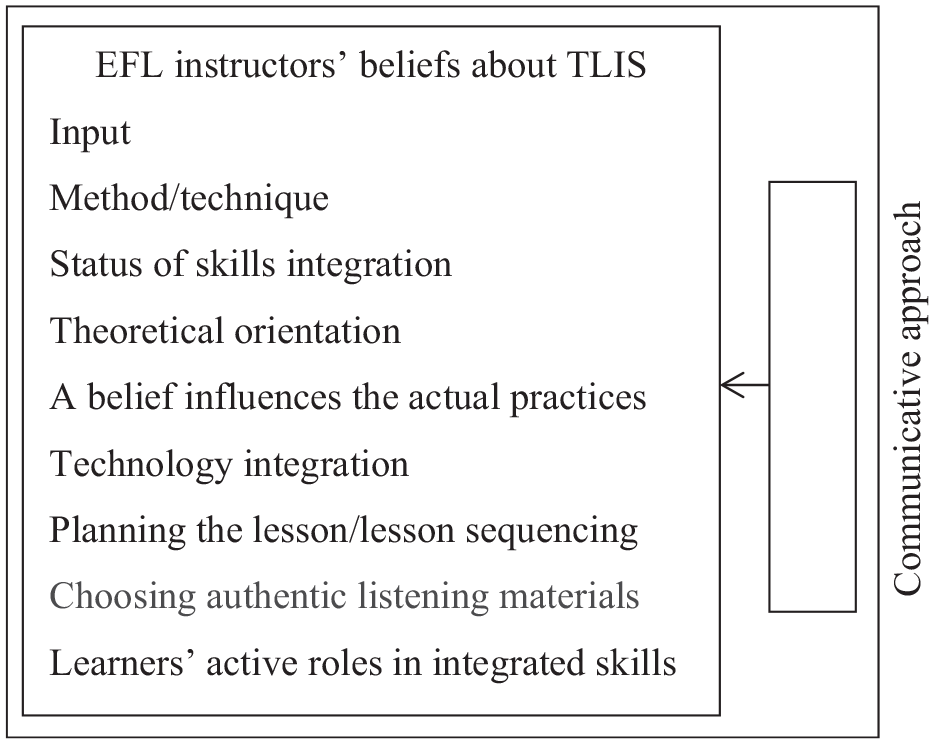
Conceptualized by the researchers.
Conceptual Framework
The conceptual framework illustrates the ideas, concepts, and their relationships to instructors’ beliefs about teaching EFL listening in integration with speaking.
The conceptual framework for language teaching and learning is grounded in the cognitive and constructive theories. The integration of these theories is believed valuable for teaching language skills, especially listening and speaking together. Cognitivism emphasizes the mental processes involved in language learning, while constructivism highlights the active construction of meaning (Yassin et al., 2019). The suggestion is that teaching listening alongside speaking requires both cognitive language use abilities and the capacity to construct meaning in real-life communication. This combination is believed to be beneficial for English as Foreign Language (EFL) teachers when implementing aural-oral skills in English listening classes. The constructivism theory emphasizes the importance of learners’ comprehension ability during language teaching/learning, aligning with the communicative approach (Skinner, 2019; Sun, 2020).
Maximizing comprehensible input is identified as a key strategy to enhance comprehension and contribute to successful instruction of listening skills incorporating with speaking skills (Lyster, 2011). To fill identified gaps, the present study addressed a research question: What are the beliefs of EFL University instructors about teaching listening in integration with speaking as evidenced by both quantitative and qualitative findings?
Methodology
Research Design
The study investigated the beliefs of EFL instructors about teaching listening in integration with speaking. Convergent mixed-methods design was adopted within the umbrella of the pragmatism paradigm which helps to figure out the results from both the positivism and constructivism paradigms (Leavy, 2017). This design compromises the benefits and drawbacks of using both quantitative and qualitative research approaches (Creswell & Plano Clark, 2011). It enhances the data collection and analyses occur in parallel and are analyzed separately; results are compared and contrasted, and then merged to get a fuller comprehension of the issue (Creswell & Creswell, 2018). Consequently, this design is appropriate for the present study’s nature entertains the multiple research approaches.
The quantitative data collection employed a 5-point Likert scale questionnaire while the qualitative data collection used semi-structured interviews and semi-structures observations. Using multiple tools in an investigation helps the researchers triangulate results from different approaches. This provides the opportunity for researchers to comprehend the holistic phenomena (Curry et al., 2009). The quantitative data were analyzed using descriptive statistics (mean and standard deviation), and inferential statistics through SPSS version 20. Qualitative data were analyzed using NVIVO 12 Pro based on the phenomenological approach.
Study Setting
The research was carried out at Hawassa University (HU). It is located in Hawassa City Administration, Sidama Regional State, Ethiopia. It was selected using a convenience sampling technique. Hawassa is 273 km away from the capital city of Ethiopia, Addis Ababa (Mihireteab et al., 2022). The very reason for choosing HU was that while pursuing PhD study at this university, the corresponding author developed relationships with the majority of staff members of the English department. The co-authors have well-established acquaintances and communications with participants as they are staff members. Consequently, data were collected with little difficulties. Its geographical proximity helped researchers collect data with little economy (time and money).
Participants
The participants of the study were EFL instructors. To achieve the objective of this study, each participant must be assigned to teach Communicative English Language Skills course I, for the academic year of 2022/2023. The reason for selecting this course was that it compromises teaching the skills of listening together with speaking by involving other macro-skills. The comprehensive sampling technique was employed to include all available EFL instructors (48), and 40 were recruited for online survey.
The purposive sampling technique was employed, and eight participants were selected. The participants’ willingness and researchers’ smooth communication with them helped to select participants using this technique. Relatively smaller sample help the researchers freely probe participants for in-depth comprehension. Qualitative researchers suggest the importance of using a small sample size (ranging from 4–10), which helps researchers explore an in-depth understanding of the phenomena under study; however, it is not the maximum range (Ismail et al., 2018). To collect qualitative data, face-to-face interviews and personal classroom observations were utilized. Each participant was observed and interviewed separately and individually.
Instruments
Observation
Semi-structured observations were used. The seven theoretical categories were adapted four themes focus on observation guides (open-ended) and three themes emphasize on listening phases (closed-ended forms) but qualitatively analyzed (Onwuegbuzie & Collins, 2007) (see procedures of data analysis section). Followed by these themes, to facilitate indirect or systematic observation that could help associate with actual practices, four open-ended questions were adapted, and based on which themes followed by related sub-categories were categorized(Thompson et al., 2015).
The observation data collection was conducted through both direct and indirect observations. The indirect observations help to address unobservable feature unlike observable feature to interoperate participants’ beliefs (their feelings) through various techniques such as para-linguistic features (hand movement, facial expressions, etc.), and prosodic features (pauses, hesitations, tones of voice, etc.) during face-to-face interviews and classroom observations. This improves the researchers’ understanding or detection of EFL teachers’ beliefs about their actual classroom practices (Zheng, 2015). Hence, eight observations were conducted during listening and speaking lessons. The observations were once per the lesson, each of which took an average time of 1 hr.
Interview
A semi-structured interview was employed for it allows the researchers’ independence to probe respondents for more information and provides greater freedom to ask “what” and “how” type questions. Using interview, the researchers comprehend the instructors’ beliefs about the phenomena in a more detailed manner (Bryman & Bell, 2019). So, four guiding questions were adapted accompanied by related sub-questions to probe participants’ views in-depth (Chang, 2018; Fauzi, 2019). The post-observation face-to-face interview sessions with each interviewee took an average time of 55 min to elicit their practices versus beliefs about teaching listening integrated with speaking.
Questionnaire
To conduct surveys, 16 closed-ended items were adapted concerning the characteristics of EFL instructors’ beliefs about teaching of listening in integration with speaking. These items are categorized into three domains. The first domain is EFL instructors’ general views about integrated listening speaking (as a dependent variable), and the second and third domains represent the items that answer the research question (as an independent variables) (Alrawashdeh & Al-zayed, 2017). Using Pearson’s r, two insignificant items were identified and removed to run 16 significant items.
To understand the respondents’ responses on how listening and speaking should be taught in integration in EFL classes, the items were graded through 5-point Likert scales ranging from “strongly disagree” to “strongly agree” denoted by numbers 1 to 5, respectively (Liu & Keusch, 2017).
Procedures for Data Collection
The researchers followed three steps to achieve data collection. Firstly, both items of surveys and interviews were piloted on randomly selected 10 EFL instructors at Wolaita Sodo University. The Cronbach alpha coefficient was calculated for the questionnaire was .869 which was acceptable. Accordingly, two invalid items were discarded. Likewise, potentially problematic items that seemed inappropriate for the interview were removed.
Next, as far as the principle of convergent mixed-method design is concerned, it could be possible to gather data concurrently (side by side) or by utilizing either of the approaches (qualitative or quantitative). The questionnaire was sent to participants (n = 40) through “Google Forms” online. This software provides opportunities for participants to fill survey freely at any time and everywhere by using their cell phones, personal computers, or desktops with internet access. It is helpful to researchers easily save data into Excel format for analysis. So, all participants responded to the survey.
Then, observation was conducted preceding the interview. This assisted the researchers in minimizing pre-information about the problem and might help to increase trustworthiness. The hard copy of the interview was provided to participants to get overall ideas about it, and they read it in a few minutes. It was conducted orally and individually in target language. Non-verbal behaviors during interviews and observation helped the researchers to observe participants’ behavior indirectly. The data collection took a month of July 2022/2023 academic calendar.
Items of all tools were written in English for the fact that participants could easily understand the message in English as it is the medium of instruction. Four instructors who hold PhD and are ranked associate professors of TEFL evaluated the items of qualitative instruments to monitor trustworthiness. They also evaluated the questionnaire for face and content validity. All data collection and analysis procedures followed the ethical considerations including voluntary participation, confidentiality, and informed consent (Cohen et al., 2018).
Procedures for Data Analysis
Qualitative Data
Qualitative data were analyzed using thematic analysis method. This analysis technique helps explore and discover data without imposing pre-existing expectations. Transcribing each datum and writing down every detail involves looking at words, phrases, or sentences that would give a clearer picture of the participants’ beliefs (Dornyei, 2007). The study adopted six steps recommended by Creswell (2012) for qualitative data analysis Gather and prepare data for analysis
To analyze qualitative data, the NVIVO 12 Pro software was employed. It helps the researchers carefully code data as it is the footstep of data analysis, and analyze the qualitative data thematically (Nowell et al., 2017). The themes depended on researchers’ prior reading or the theoretical understanding and some themes emerged. Prior reading and theoretical understanding serve as the foundation for theoretically derived codes that provide a starting set of ideas (Saldaña, 2016).
The observation data were categorized into seven themes. These include emphasizing on lesson planning, engaging learners, material authenticity, technology integration (using observation guides), and focusing of each listening phase (pre-, while, and post-listening) (using closed-ended form but qualitatively analyzed).
Interview data were categorized into four main themes and associated sub-categories like beliefs about teaching listening integrated with speaking, beliefs about the role of listening material (input), beliefs about learners’ roles in integrated listening and speaking classrooms, and influences of a belief in the actual practices.
The aggregate codes derived from each child node were meticulously counted using NVIVO 12 Pro. Nodes are groups that contain coding and can represent topics, ideas, beliefs, experiences, etc. Finally, the findings were interpreted and reached a sound conclusion (Saldaña, 2016).
Procedures and techniques were appropriately employed to increase the quality of qualitative data. To evaluate the qualitative approach, credibility, transformability, dependability, and confirmability were employed as basic components of trustworthiness (Bryman & Bell, 2019). The observation and interview data were immediately transcribed to minimize the recall bias.
To analyze closed-ended belief items using three listening phases to see instructors’ practices, the researchers adapted PLATO’s (Protocol for Language Arts Teaching and Observation) scale description was utilized (see Table 1). It is the classroom observation framework as a parameter. The data were interpreted into the qualitative stand corresponding to the frequency counted (Bell et al., 2019). Items were adapted related to instruction of listening phases as it is the core for teaching listening in integration with speaking.
PLATO’s Classroom Observation Framework.
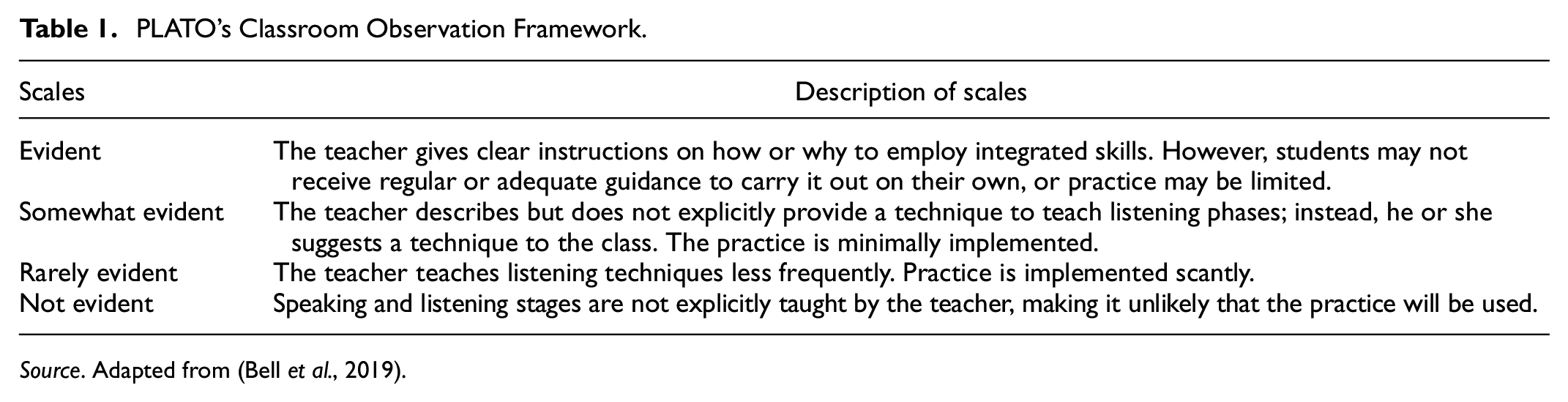
Source. Adapted from (Bell et al., 2019).
Quantitative Data
Survey data were analyzed through descriptive and inferential statistics. The descriptive statistics employed the mean and standard deviations. The inferential statistics used multiple regressions (MR) but it was not intended to manipulate independent variables rather it was intended to show which belief domain (input or method) could most likely to predict teaching listening integrated with speaking. To analyze MR, the inter method was used where the domains were entered into the dependent and independent variables boxes in SPSS version 20. Thus, categorizing variables into domains is useful for analysis in non-experimental research for regression analysis purposes (Cardoso-Pulido et al., 2022).
The assumptions of normality were tested using the checkmark histogram, normal probability plot (normal P-P), and scatter plot. The result of the histogram revealed a bell-shaped graph where the data were normally distributed. As normal P-P and scatter plots depicted, no potentially significant dispersion was observed. The skewness and kurtosis lie between −1 and +1 which shows normal distribution. Thus, it could be possible to conduct the regression analysis of the quantitative data in non-experimental studies like the present study (Samuel & Okey, 2015). Before data analysis, the assumptions of multicollinearity were calculated using tolerance and variance of the inflation factor (VIF). This helps to determine whether the prediction is severe. The VIF for predictor domains is <10, that is, 1.661 for input and 1.309 for method. A tolerance value >0.1, that is, 0.602 for input and 0.764 for method. There was no problem of multicollinearity.
Quantitative Results
Descriptive Statistics
The Tables below present the mean (
Table 2 illustrates that the higher mean ranged from 4.08 to 4.27 and the lower standard deviation ranged from 0.784 to 0.997. Yet, few (2/6) items show higher δ ranging from 1.193 to 1.198. This indicates EFL instructors show higher agreement for the majority of statements (4/6) with relatively lower differences in their opinions. Conversely, for a few statements (2/6), they were likely to disagree with responses but it accompanies higher differences and hesitations in opinions. This result indicates that EFL instructors have positive beliefs about teaching listening in integration with speaking, except for a little dissimilarity.
Domain 1: Instructors’ Understanding About TLIS.

Table 3 shows input category. The results reveal that most statements (5/7) have the highest mean (4.10 to 4.25) that go with lower δ like other statements in the domain. This means that higher responses reflected stronger agreement with these statements in line with insignificant variations in response-related ideas. Likewise, in a few statements (2/7) instructors show agreement. The overall result in this domain illustrates EFL instructors have positive beliefs about the input domain. Particularly, their strong positive beliefs indicate that teaching/learning listening integrated with speaking will be successful if instructors appropriately utilize input variables like familiar topics, provide feedback, use knowledge elements like linguistics, discourse, etc., effective practice (training), and technology integration in teaching listening integrated with speaking classes.
Domain 2: Input.

Tables 4 highlight the higher
Domain 3: Instructors Use of Methods/Techniques.

Inferential Statistics
TLIS indicates teaching listening integrated with speaking.
Table 5 illustrates a strong positive relationship between the dependent variable (TLIS) and input and method domains at R-value. The combined predicted impact of both input and method domains on TLIS were 62.7% of the change accounted for by these variables. Therefore, the result clearly defines that the predictive ability of input and method categories are highly significant at .000, and predicts teaching listening in integration with speaking.
Model Summary a .

(TLIS).
Predictors: (constant), input, method.
The coefficient values of variables (input and method domains) in Table 6 have a significant positive correlation between TLIS at 0.003 and 0.009, respectively. Relatively, the input category has a greater impact on TLIS at B (40.1%) than the method category at B (37.8%). The greater the change in B, the higher the impact increases on TLIS. Similarly, both values of tolerance and VIF (variance of inflation factors) depict that there is no multicollinearity between input and methods domains, and they can predict teaching listening in integration with speaking.
Coefficients a .
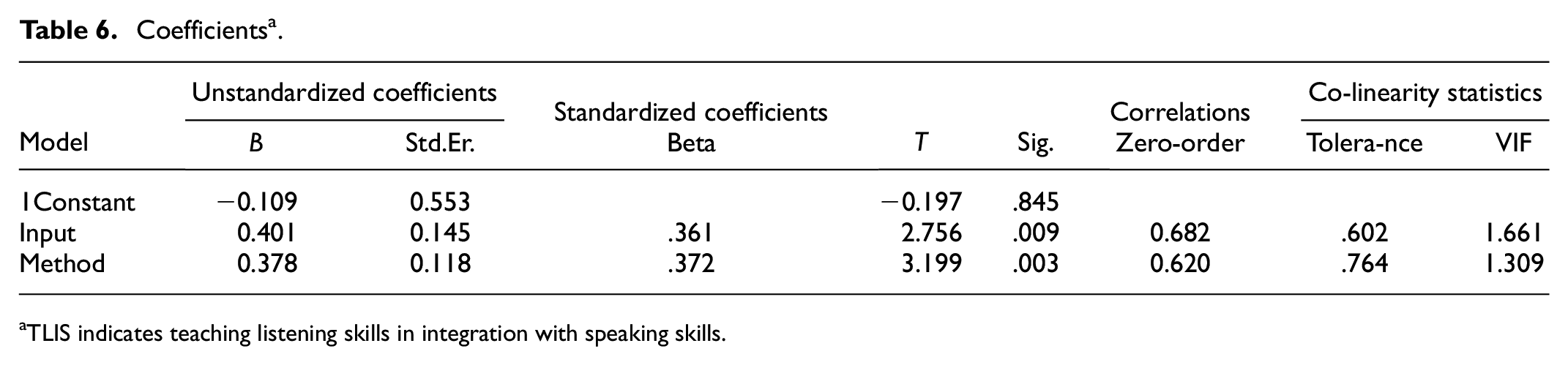
TLIS indicates teaching listening skills in integration with speaking skills.
Therefore, input and method domains have significant roles in teaching listening integrated with speaking in the EFL contexts at Hawassa University. To achieve the skills integration, instructors should effectively utilize each variable under input and method domains (see Tables 3 and 4).
Qualitative Data Findings
Observation Data
Figure 2 below presents the open-ended observation data findings based on four thematic categories. The first category shows planning the lesson through appropriate tasks and effective preparation, the second category indicates engaging learners, the third category reveals the authenticity of material and the fourth category indicates technology integration (see Supplemental Appendix B).

Open-ended observation data findings.
In Figure 2 frequent observations indicate that EFL instructors lack planning the lessons of skills integration in line with appropriate tasks and effective preparation (see Supplemental Appendix B). This indicates the need for critical attention to utilizing appropriate listening and speaking tasks and effective lesson preparation to implement the integration of these skills.
The findings concerning Category 2 in Figure 2 reveal that EFL learners are not engaged actively in listening and speaking lessons except a few of them are involved actively in learning the language. This implies instructors are expected to bring interactive and engaging aural-oral activities to promote learning.
Just as findings of Category 3 depict the instructors’ lack of using authentic aural-oral materials in EFL lessons rather it was rarely evident while using real-life material. Learners have no opportunities to learn the language in meaningful communicative contexts and boost the integration of listening and speaking.
Category 4 describes that instructors are not willing to incorporate technology in the integrated lessons of listening and speaking. For example, the finding shows that only 2/8 EFL instructors integrate technology. This indicates learning listening integrated with speaking seems demotivated.
Accordingly, the qualitative observation data findings address the significant implication to EFL instructors to consider appropriate activities, explicit preparation, active engagement, employing authentic listening material, and technology integration to improve the implementation of integrated listening and speaking.
Figure 3 below presents the summary of findings of closed-ended observation involving three listening phases (see Supplemental Appendix C). This utilizes the PLATO observation scales from not evident to evident (see the description scale in Table 1).
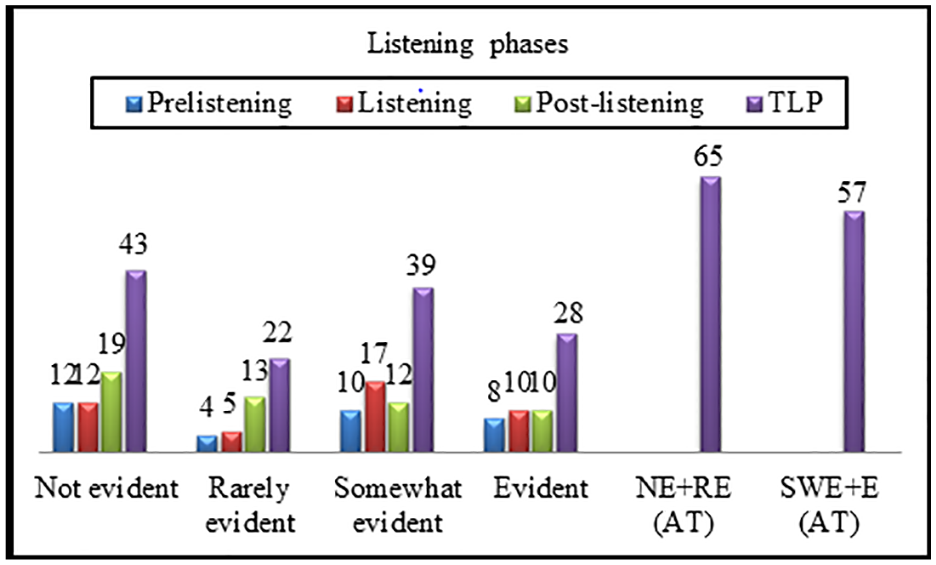
Frequency of findings of structured observation.
Findings in Figure 3 illustrate the highest frequency (43) observed not evident in all three phases of listening followed by somewhat evident (39). Particularly, the practice does not emphasize pre- and post-listening but it mostly emphasizes on listening phase where the observation was evident and somewhat evident (27). This implies EFL instructors’ lack of providing chances for learners to activate schemata that prepare them for learning, and evaluate their learning. Instructors likely negatively perceive learners’ active engagement in listening classes that could enhance learning these skills in integration.
Therefore, findings imply that though the instruction provided some room for listening practices, it needs explicit strategy instruction by employing clear purposes using appropriate listening and speaking activities. This might maximize the implementation of integrated listening and speaking teaching.
Interview Data
The findings of thematic categories of interview data are presented in Tables 7 to 10. It indicates the categories and example quotes from the respondents’ word of mouth. Subsequently, interview data are summarized and presented in Figure 4 below for analysis and qualitative interpretations.
General Beliefs About Integrated Listening and Speaking.

Beliefs About the Role of Listening Material.

Beliefs About EFL Learners’ Active Roles.

Understanding How Beliefs Influence the Practice.


The frequency of similarities of ideas across the interview.
Interview Findings: Executive Summary of NVIVO Counts
Figure 4 presents the executive summary of findings as significant quotes are highlighted in Tables (7–10) above within four thematic categories. Category 1 (beliefs about teaching listening integrated with speaking (importance; theoretical orientation, interdependence, and strategy instruction); Category 2 (beliefs about the role of listening material (input); Category 3 (beliefs about the roles of learners in integrated listening and speaking; and Category 4 (a belief influences the actual practices. The figure depicts the frequencies of redundancies of opinions across the interview.
The general understanding of participants underlay a positive belief as the highest frequency in Figure 4 shows, that is, they share common beliefs (positive beliefs) about teaching listening integrated with speaking that include the importance, theoretical orientation, interdependence, and strategy instruction. They understand that teaching listening integrated with speaking is important (see Table 7).
The finding indicates that a listening material-related belief shows it doesn’t provide enough room for skills integration (see Table 8). Participants show negative beliefs about the material use (task type, relevance, or authenticity), and commitment to select appropriate material.
This figure illustrates EFL instructors have positive beliefs regarding students’ roles of students’ participation in enhancing the teaching of listening in integration with speaking; however, it is not evident in actual classrooms. Likewise, they have positive beliefs about the impact of beliefs and the way they practice on actual implementation of integrated teaching of listening and speaking (see Tables 9 and 10).
However, the overall result of the interview depicts that EFL instructors have positive beliefs about skills integration (listening and speaking) as Figure 4 displays in blue color that shows the highest frequency participants understand the importance of skills integration. Conversely, the yellow color depicts a lower frequency concerning active participation, material authenticity, and impact of beliefs than category 1. This implies participants do not practice what they believe in the classroom.
Major Findings
Descriptive statistical results illustrate EFL instructors believe that the input domain is important for the effective implementation of teaching listening in integration with speaking. It demonstrates that the variables of the input domain including familiar topics, feedback, effective use of knowledge elements such as linguistic and discourse knowledge, use of authentic materials, and technology integration have a significant effect on teaching integrated listening and speaking.
The results indicate that instructors strongly believe that the method domain is significant to implementing the teaching of listening integrated with speaking. It shows that successful implementation of pre-, while, and post-listening maximizes the integration of listening and speaking in EFL classes. It reveals that effective task-based instruction has a significant role in boosting the integrated instruction of listening and speaking.
However, the qualitative findings show EFL instructors lack to use authentic listening materials and incorporate technology into their integrated listening and speaking instructions. Instructors do not employ pre-, while, and post-listening phases to integrate listening and speaking. They lack planning for the lesson employing appropriate tasks, provision of opportunities for learners to practice integrated listening and speaking, and engage learners actively to promote learning the language. Though EFL instructors show positive beliefs, they do not fully put them into actual classroom practice.
The results of the inferential statistics suggest that the combined effect of both input and method domains by R2 (62.7 %) changes in teaching listening integrated with speaking. It indicates teaching listening integrated with speaking has a strong positive relationship with domains of input and method. The input domain has slightly a greater impact than the method domain as the B coefficient of the input domain was 40.1% and the method domain was 37.8%. There is no multicollinearity between input and method variables, and there is no severity to consider.
Discussions
The findings of the present study indicated that EFL instructors did not effectively plan the lesson regarding the integrated skills of listening and speaking. However, findings of previous studies confirm an integrated lesson planning of English listening and speaking enhances EFL learners’ fluency and minimizes learning complexities. For example, pre-planning integrated instruction EFL instructors helps to provide listening input for meaningful language production as well as metacognitive awareness (Maryslessor et al., 2014; Qi & Liu, 2021). The reason for this problem is emanated from utilizing different and difficult tasks in integrated listening lessons, that is, variations in listening inputs (Ji et al., 2022, Rukthong & Brunfaut, 2019).
Studies depicted that still it needed updates and training on integrated skills to improve EFL teachers’ teaching methodology (Nadri et al., 2019; Yenesew, 2019). The quantitative findings of this study matched with these results indicating that training is significant input for the skilled application of integrated teaching of listening and speaking.
The mixed findings of the current study revealed that the practice lacked the implementation of authentic materials (listening input) into integrated aural-oral classrooms though EFL instructors have strong positive beliefs. Similar findings confirm that though EFL instructors have positive perceptions, they did not implement integrated listening and speaking using effective communicative activities to improve teaching/learning (Kebede et al., 2016).
As qualitative findings depicted, most classes were accompanied by a non-authentic environment, that is, they lacked explicit instruction of integrated skills using authentic materials like audio-visual and web-based instructions. This is consistent with a previous study and this disparity implied frequent emphasis on theoretical orientation and allocating little time for actual practice (Emerick, 2019).
Moreover, this mismatch is believed that language teachers frequently dominate the classroom talk rather than providing chances to learners, and they fail to present oral activities and involve learners in integrated aural-oral activities. Likewise, they do not assess the gaps formatively (Gràcia et al., 2021). A similar study showed a problem with using authentic materials could be EFL instructors’ preparation in content as well as testing integrated language skills (Mohammed & Abdurehman, 2020). Conversely, studies depicted that authentic materials improve learners’ oral communication skills and their hypothesis was matched (Salilew et al., 2022).
Effective utilization of authentic listening materials can be related to using familiar topics in listening lessons. Employing such types of topics in listening lessons creates conducive atmosphere for teaching and learning (Qiu & Xu, 2022). Nevertheless, the qualitative findings of this study were inconsistent. This disparity could be related to instructors’ professional backgrounds and input perception (Nushi & Orouji, 2020).
The qualitative result of the present study disclosed that the significance of technology based instruction in integrated listening and speaking classes. Yet, qualitative findings implied that instructors lacked effective implementation. Other qualitative studies’ findings affirmed that EFL teachers mostly fail to implement integrated instruction of listening and speaking, except they believe in practicing skills integration in the classrooms (Hoang & Ngoc, 2021; Liang, 2021; Zhao & Lee, 2022). Unlike the present findings, a another study’s mixed findings revealed that the positive beliefs and its positive impact on productive skills if multimedia technology is integrated into the EFL interactive environment (Mahdi, 2022).
Effective implementation of pre-, while, and post-listening stages has an impact on language learning, particularly it improves the teaching of integrated listening and speaking and listening comprehension ability (Barjesteh & Ghasemini, 2023; Movva et al., 2022; Zohrabi et al., 2015). However, the present study disclosed inconsistent findings. The practice of pre- and post-listening phases was rarely evident, that is, it was frequently not evident and rarely evident. Particularly, pre-listing activities enhance the learning environment as it activates schemata, and it has impact on listening comprehension but our findings differed from these studies (Madani & Kheirzadeh, 2018; Zohrabi et al., 2015).
EFL instructors who have positive beliefs employ listening phases appropriately using listening activities and learning occurs meaningfully. This helped language teachers utilize effective strategy instruction that contributes to skills integration(Irgin & Erten, 2020; Newton & Nguyen, 2018). Nonetheless, findings illustrated it differently. For example, it was not evident in pre- and post-listening phases. EFL instructors rarely presented brainstorming listening, and speaking tasks, and they did not assess their learning and comprehension orally after listening. This reversed their beliefs as some findings showed(Arega, 2018; Yenesew, 2019).
Although this study’s results revealed positive beliefs about task-based instruction boosts the teaching of integrated listening and speaking, EFL instructors in each listening phase did not utilize appropriate integrated tasks. This technique maximizes metacognitive strategies and facilitates integrated skills instruction. In this regard, studies revealed inconsistent findings with this study but it is the important input for learning and improves quality of aura-oral interaction (Chou, 2017; Kruthangka, 2019).
Conclusion
The present study investigated EFL University instructors’ beliefs in teaching listening integrated with speaking through a mixed-methods approach. The study addressed both input and method domains within which different variables were incorporated. To answer the research question, the study employed descriptive and inferential statistics and NVIVO 12 Pro for data analysis.
The findings from different approaches show EFL instructors at Hawassa University have strong positive beliefs about the importance and effectiveness of teaching listening in integration with speaking. They recognize the significance of input domains, for example, familiar topics, feedback, knowledge elements (like linguistic and discourse knowledge), authentic materials, and technology integration. They acknowledge the value of methods domains like pre-, while-, and post-listening phases and task-based instruction.
However, qualitative findings revealed inconsistencies between these beliefs and the actual classroom practices. These findings illustrate instructors did not effectively employ appropriate lesson planning aligned with targeted skills integration tasks, authentic materials, technology integration, and pre-, while, and post-listening stages to fully implement the integration employing both input and method domains in their classrooms.
The results of inferential statistics disclosed that, except for a slightly greater impact of the input category, both input and method categories significantly influenced the effectiveness of teaching listening integrated with speaking. The combined impact of these categories accounted for 62.7% of the variance in integrated instruction.
The major findings of this study disclosed EFL instructors at Hawassa University show positive beliefs about the importance and benefit of input and method beliefs domains. Nevertheless, disparities between beliefs and practices were observed. This is due to the instruction of integrated listening and speaking lacked appropriate lesson planning through aligned tasks, authentic materials, technology integration, and effective implementation of pre-, while, and post-listening stages through task-based instruction to achieve the application of the skills integration incorporation of the key variables of input and method domains.
Our arguments show that it cannot be possible to detach the input domain (this includes appropriate contents) and method domain (this includes appropriate pedagogical approaches). Both are inevitable and two sides of a coin in teaching listening integrated with speaking in the EFL context. The researchers believed that the disparities in the findings emanated from EFL instructors’ imbalanced approach, that is, their greater reliance on theory than practice to minimize the gaps between their positive beliefs and actual practices.
Implications
The findings illustrate a notable incongruity between EFL instructors’ positive beliefs and their actual classroom practices at Hawassa University. This implies a target area that needs improvement requiring interventions to bridge these gaps and promote effective pedagogical implementation of integrated listening and speaking.
Professional development programs (EFL programs) need to train EFL instructors with effective strategies for the implementation of integrated listening and speaking. The programs need to focus on Effective lesson planning with tasks in line with the goals of teaching listening integrated with speaking employing engaging and appropriate activities.
Employing appropriate authentic materials helps to promote the incorporation of listening and speaking. This can be boosted if it integrates effective feedback, the provision of practice opportunities, and significant linguistic and discourse knowledge elements. The collaboration and support to utilizing technology integration. This helps to establish the culture for practice share technology resources for EFL instructors and identify challenges. It provides environments that enhance engagement and real-life settings. Training instructors in the effective implementation of pre-, while, and post-listening phases utilizing effective task-based instructional strategy. This maximizes the success of teaching listening in integration with speaking and helps engage learners actively in the classroom.
The study addresses the gap between EFL instructors’ beliefs and practices to improve the effectiveness of teaching listening in integration with speaking at Hawassa University.
The study has implications for further research ultimately focusing on comparative studies, longitudinal studies, intervention studies, and a study involving students for successful implementation of EFL teaching listening integrated with speaking.
Accordingly, the study forwarded recommendations for EFL teaching/learning at Hawassa University. Professional development programs (teacher training) of EFL should:
Provide practical training and resources to improve the teaching of listening in integration with speaking along with lesson plans utilizing appropriate tasks and materials that actively engage EFL students in the classroom. Besides, emphasize the importance of lesson planning.
Focus on designing and assessing the appropriateness of authentic materials to promote effective teaching of listening integrated with speaking and bridge the gap between EFL instructors’ beliefs and their actual practices. This should accompany proper professional feedback on the practice of integrated listening and speaking instruction. Give the main concern for the inclusion and assessments of authentic listening materials and pre-, while-, and post-listening phases in designing and developing teaching syllabi.
Explore and utilize appropriate technology tools and platforms to enable interactive listening and speaking activities, like online listening resources, dialog (conversation) platforms, and collaborative audio-visual learning. Therefore, curriculum developers should focus on the continuous assessment for effective implementation, challenges, and reflecting on material authenticity, digital literacy, and the explicit instruction of listening phases to maximize the instruction of integrated aural-oral skills.
Emphasize further study focus on assessing practical interventions to bridge the inconsistencies between EFL instructors’ beliefs and their actual practices at Hawassa University. It should inspire instructors to reflect on their perceptions and teaching practices of integrated listening and speaking skills at Hawassa University using self-assessment instruments or peer observation.
Compare the effectiveness of EFL teaching of listening integrated with speaking across different universities or contexts to explore the incongruences between beliefs and practices. Investigate a longitudinal study to see the long-term impact of integrating listening and speaking skills in EFL teaching to assess its long-lasting advantages in learners’ language use and its improvement.
Conduct intervention studies based on the gap identified (particular area for improvement). This would maximize the integrated skills technique. Conduct research directly involving students through various instruments of data collection, like surveys, interviews, or FGD (focus group discussions) to gather their feedback and consider their perspective to triangulate teacher-related findings regarding the integrated skills approach to teaching listening with speaking.
Limitations
The study has limitations. The study was focused on Hawassa University EFL instructors (n = 48). However, its findings might not be directly applicable to other EFL contexts in Ethiopian public universities. This small sample size limits the generalizability of findings rather the study might benefit from a larger and more diverse sample size to improve the generalizability of findings. The study utilized surveys and interviews where the data largely relied on EFL instructors’ self-reports about their beliefs. This is subjected to bias.
The study was limited to EFL instructors at Hawassa University but it would have been crucial if the voices of EFL students about their instructors’ beliefs and practices were considered to triangulate and enhance the quality of findings.
As far as the dynamic nature of language teaching approaches is concerned, it would have been better if the study conducted longitudinal studies to explore the gradual improvement in inconsistency of EFL instructors’ beliefs and actual practices; intervention studies for identified gaps to align the positive beliefs to explore its effectiveness; and comparative studies by involving instructors from different universities in Ethiopia to explore potential variabilities in beliefs and practices. However, the study did not cover these areas of limitations. As a result, the authors acknowledge these and the aforementioned factors limited our study.
Supplemental Material
sj-docx-1-sgo-10.1177_21582440241296581 – Supplemental material for Beliefs of EFL University Instructors about Teaching Listening in Integration with Speaking, Ethiopia
Supplemental material, sj-docx-1-sgo-10.1177_21582440241296581 for Beliefs of EFL University Instructors about Teaching Listening in Integration with Speaking, Ethiopia by Addisu B. Shago, Elias W. Bushisso and Taye G. M. Olamo in SAGE Open
Footnotes
Acknowledgements
The authors thank all Hawassa University EFL instructors for their willingness to participate in data collection.
Declaration of Conflicting Interests
The author(s) declared no potential conflicts of interest with respect to the research, authorship, and/or publication of this article.
Funding
The author(s) received no financial support for the research, authorship, and/or publication of this article.
Ethical Approval
The study should follow the ethical principles of Hawassa University’s Ethical Guidelines and research ethics or methodological procedures. It was approved by the College Ethics Review Committee chaired by Dr. Binyam Moreda Obsu (

Data Availability Statement
The data supporting the current study are available from the corresponding author upon reasonable request.
Supplemental Material
Supplemental material for this article is available online.
References
Supplementary Material
Please find the following supplemental material available below.
For Open Access articles published under a Creative Commons License, all supplemental material carries the same license as the article it is associated with.
For non-Open Access articles published, all supplemental material carries a non-exclusive license, and permission requests for re-use of supplemental material or any part of supplemental material shall be sent directly to the copyright owner as specified in the copyright notice associated with the article.
