




Abstract
Digital technologies have revolutionized L2 writing development inside and outside the classroom. However, existing reviews have primarily focused on formal instructional contexts, leaving informal digital learning of writing (IDLW) critically under-explored. Addressing this gap, we present the first systematic review of 26 empirical studies (2000–2025) on student-centered L2 writing in informal digital contexts. Our analysis examined: (i) distribution of publications, (ii) key facilitators and barriers in IDLW, and (iii) theories or frameworks applied in reviewed literature. The findings reveal that psychological factors (e.g., motivation, attitude) enhance L2 writing development in informal digital learning settings. More importantly, the analysis reveals that existing theoretical frameworks, while valuable, are often applied in isolation. Employing a reflexive thematic analysis allowed us to identify interconnected themes and develop an integrated framework, moving beyond a descriptive synthesis. The theories identified primarily address personal, social, technical, and environmental dimensions, which collectively inform an innovative pedagogical framework for IDLW. Furthermore, our analysis also revealed recurring facilitators and barriers, many of which relate to personalized learning attributes (e.g., self-discipline, learner autonomy, critical thinking). Based on these insights, the study offers critical reflections and practical recommendations to support learners and educators in the field of L2 writing.
Plain Language Summary
This review examines how L2 learners develop writing skills through informal digital learning contexts from 2000 to 2025), analyzing 26 studies. Key findings show that successful L2 writing development depends on three interconnected factors: (1) personal motivation and self-discipline, (2) access to quality digital tools (e.g., AI assistants, apps), and (3) social support from online communities. While technology enables flexible practice and instant feedback, challenges include overreliance on AI (risking plagiarism), distractions, poor time management, and lack of critical digital skills. Most research focuses on Asian university students, with rising interest in ChatGPT post-2022. Recommendations urge learners to balance AI tools with independent thinking and join L2 writing communities, while educators should guide responsible tech use and connect classroom lessons with informal practice. The study highlights the need for more diverse research and long-term analysis of AI’s role in L2 writing development.
Introduction
Writing is a critical indicator of linguistic competence and one of the most demanding language skills to master (Li et al., 2024). As a productive skill, writing requires more than grammatical accuracy and textual coherence, it also requires the ability to generate original viewpoints and construct well-supported arguments (Shen & Teng, 2024; Sun & Wang, 2020). This challenge is particularly acute for L2 writers in EFL/ESL contexts, where linguistic, cognitive, and cultural factors interact with complex synergy, often placing non-Anglophone students at a disadvantage (Umamah & Cahyono, 2022). In response, L2 pedagogy has evolved to include diverse instructional approaches, from product-oriented to process- and genre-oriented methods (Yu et al., 2023). Nonetheless, developing writing proficiency remains difficult when learners depend solely on formal classroom instruction (Naghdipour, 2022; Shen & Teng, 2024).
In recent years, technology integration has greatly transformed L2 writing instruction. As summarized in Table 1, existing literature reviews have primarily examined research-led interventions and classroom-based studies, highlighting the efficacy of tools like automated writing evaluation systems and collaborative platforms (Strobl et al., 2019; R. Zhang et al., 2022). These reviews document the advantages of technology-mediated instruction, but they also acknowledge persistent challenges, such as student reluctance to use collaborative tools and gaps in digital competence (Al-Wasy, 2020; R. Zhang & Zou, 2022). A critical limitation of the synthesis (see Table 1), however, is its predominant focus on structured, formal technology applications where engagement is often mandatory. This creates a significant gap in understanding how L2 writing development occurs through autonomous, informal digital learning beyond the classroom. More specifically, there is a lack of a synthesized, theoretically-informed understanding of the complex interplay of factors that facilitate or hinder writing development in these self-directed contexts.
Previous Reviews on Technology-mediated L2 Writing.

This gap is especially pertinent given the rise of Informal digital learning of English (IDLE), which encompasses self-directed learning opportunities that extend beyond traditional Mobile-Assisted Language Learning (MALL) and Computer-Assisted Language Learning (CALL) frameworks. IDLE involves the autonomous use of digital devices (e.g., smartphones and desktop computers) and resources (e.g., web apps and digital platforms) for English language acquisition. It serves as an essential complement to formal instruction by providing authentic, context-rich, and personalized learning experiences (Lee, 2019).
Emerging research consistently highlights the role of personal, social and technical factors in L2 writing development through IDLE (C. Wang et al., 2024; Yu & Liu, 2021; Y. Zhang & Liu, 2023). Notably, the psychological dimensions in IDLE are increasingly recognized (Gao et al., 2025). Studies confirm that IDLE fosters writing proficiency, motivation, and learner autonomy by encouraging self-directed writing practice (Naghdipour, 2022; W. Wang & Jiang, 2023; Zheng & Lin, 2019). Despite these insights, the theoretical landscape of this field is fragmented. Existing research often draws from isolated theoretical domains such as psychological (Self-Determination Theory), social (Sociocultural Theory), and technological (Technology Acceptance Model) perspectives, without integrating them to explain the holistic experience of L2 writers. This theoretical gap limits our understanding of how L2 writers independently navigate inherent challenges in these informal contexts, such as digital incompetence and tool reliability. To address this, a targeted investigation into how informal digital learning of writing (IDLW) contributes to writing proficiency is warranted. To address this gap, the present study employs reflexive thematic analysis (RTA) to examine the under-explored “what” (themes and trends) and “how” (theories and influences) of IDLW development. Specifically, the study seeks to answer the following research questions:
Methods
To answer the above questions, a systematic literature review was conducted following Preferred Reporting Items for Systematic Reviews and Meta-Analyses (PRISMA) guidelines with 27-item checklist (Page et al., 2021). PRISMA emphasizes transparency, standardized inclusion, and exclusion criteria, and is structured into four distinct stages: identification, screening, eligibility, and inclusion. Reflexive thematic analysis (RTA) was employed as the primary qualitative method for data analysis. It is well-suited for systematic literature reviews, as it emphasizes the researcher’s active and reflexive engagement with the data, allowing for an interpretative exploration of themes (Braun & Clarke, 2019). This approach enhances transparency and acknowledges the subjective nature of interpretation, eliminating the need for inter-rater reliability checks.
Identification
Databases were chosen based on their authority and quality, namely Scopus and Web of Science (WOS), which are considered central databases in the social sciences. The search was limited to peer-reviewed articles. Specifically, WOS can be used to search all SSCI-indexed journals, and Scopus is considered to have the largest abstract and citation database (Linling & Abdullah, 2023). As shown in Table 2 Documents selected strictly meet five eligibility criteria: (i) EFL/ESL, (ii) peer-reviewed articles, (iii) English language, (iv) full-length and published, and (v) year of publication (Sharif, 2019). The screening process was conducted by two independent reviewers with substantial inter-rater reliability (Cohen’s K = 0.70). Any discrepancies were resolved through discussion until consensus was achieved.
Inclusion and Exclusion Criteria.

Data Collection
A comprehensive search for IDLW was conducted using accurate keywords and their synonyms for the purpose of retrieving more potential articles. For example, informal learning was expanded to “learning beyond the classroom,”“learning out of classroom,”“learning in the digital wild,”“extramural learning,” etc. Boolean operators (AND, OR) were employed to refine the search strings (Soyoof et al., 2023). Specifically, the final search string applied in Scopus and WOS was: TITLE-ABS-KEY((writer* OR writing OR essay) AND (EFL OR L2 OR ESL OR English) AND (digital OR technology OR online OR AI OR “artificial intelligence”) AND (informal OR “self-directed” OR self-learning OR “self-regulated” OR “beyond the classroom” OR “out of classroom” OR autonomous OR “digital wild” OR “extramural learning”)).
Screening and Eligibility
Only studies published after 2000 were included due to the focus on digital technologies (Degner et al., 2022). Based on the database filters, 459 records were excluded as they were other document types or in a non-English language. Then, duplicate entries across databases were identified and removed, totaling 156 duplicates. To ensure thoroughness, manual screening process was implemented to ensure eligibility (Sharif, 2019). By manual screening of titles, abstracts, and full-texts, 389 irrelevant articles were removed. This search contributed 23 articles to the systematic review. To ensure comprehensive coverage, cross-referencing was employed (Degner et al., 2022). This involved two methods: a backward search, which involved reviewing the reference lists of each article to find additional relevant studies, and a forward search using Google Scholar to identify studies that referenced the included articles. This approach uncovered three more publications meeting all inclusion criteria. Overall, 26 studies were selected for final inclusion (see Figure 1).

Flow diagram for systematic reviews (adapted from Page et al., 2021).
Data Analysis
In this review, thematic analysis was adopted for the data analysis. Each article was thoroughly reviewed, and information relevant to the research questions was coded. Based on the findings, RTA focuses on the researcher’s reflexive engagement with the data, eliminating the need for inter-rater reliability checks (Braun & Clarke, 2019).
To ensure rigorous and transparent RTA, we actively documented reflexivity through three key practices. The main researcher maintained a detailed reflexive journal to record decisions, and personal biases throughout the process. We documented all analytic decisions among all authors to create a clear audit trail from the data to the final themes. This approach enhances rigor by explicitly acknowledging the researchers’ role in knowledge construction. Specifically, RTA involves six steps: (1) familiarization with the data, (2) generating initial codes, (3) searching for themes, (4) reviewing themes, (5) defining and naming themes, and (6) producing the final analysis. Each article was carefully reviewed, coded, and analyzed to complete a structured data extraction form (see Table 4).
Reflexive Thematic Analysis Results
The Current State—RQ 1
Figure 2a to d presents the distribution of 26 articles (2000–2025), revealing a significant upward trend from 2022 to 2025, exceeding the total output of the previous two decades (see Figure 2a). The publication demonstrates three patterns: (1) technology-focused journals accounted for 38% (n = 10) of the publications, highlighting an emphasis on digital EFL/ESL learning; (2) strong representation in SSCI-indexed journals (46%, n = 12), underscoring the quality of the research; (3) two articles published in psychology-focused journals in 2025, suggesting emerging attention to psychological factors; and (4) only one article appeared in writing-specialized journals, suggesting an under-representation of writing-specific research.

(a) Publications over time. (b) Number of publications by country. (c) Research methods. (d) Research sampling.
Figure 2b illustrates the geographical distribution of the studies. The data reveals a strong regional concentration, with Asia contributing the majority of studies (21 studies, 81%), particularly China (10 studies, 38%). Europe is the second most represented region (five studies, 19%). However, no studies were retrieved from South America or Africa.
Regarding research methodologies, Figure 2c shows that mixed approach dominates (n = 11), followed by quantitative approach (n = 10), and qualitative approach (n = 5). Figure 2d revealed the majority of participants were tertiary students, predominantly tertiary students (96%), and secondary students were only represented in one study. This narrow focus on tertiary-level sampling may be due to their higher motivations and meta-cognitive strategies for IDLW engagement.
Theoretical Orientations—RQ 2
Our analysis finds that IDLW research is theoretically rich yet fragmented. As detailed in Table 3, the field draws from six distinct yet disconnected theoretical domains: (1) Personal perspective focuses on individual autonomy and processes (e.g., LA, SRL, SDL); (2) Social perspective emphasizes collaborative interaction and community (e.g., SCT, CoP); (3) Psychological perspective explains motivational drivers and affective states (e.g., SDT, SET); (4) Technological perspective examines tool adoption, use, and design (e.g., TAM, DST); (5) Environmental perspective frames the broader learning context (e.g., Informal Language Learning Framework); and (6) Cognitive perspective addresses underlying language acquisition processes (e.g., SLA).
Theories and Models Used in the Studies.

This theoretical isolation is the primary obstacle to a coherent explanation of IDLW. The problem is not a lack of theory, but their application in isolation. Since IDLW is an inherently simultaneous process of personal cognition, social interaction, and technological engagement, any single perspective offers an incomplete description. For instance, SRL effectively explains the cognitive and meta-cognitive processes learners employ but does not adequately account for how these processes are socially mediated in online communities or technologically distributed across digital tools. Conversely, SCT explains social scaffolding but often overlooks the individual psychological agency (e.g., motivation, self-efficacy) required to seek out and engage with that scaffolding. To address
A refined framework must therefore synthesize these perspectives, conceptualizing IDLW as a phenomenon where self-regulation is socially mediated and technologically distributed within informal learning environments. Furthermore, a refined framework must integrate the critical layer of affect and motivation, as explained by theories like SDT. This moves the inquiry beyond if learners are motivated to why and how informal environments foster sustained engagement.
Themes Related to Influential Factors—RQ 3
Table 4 synthesizes the influential factors, facilitators, and barriers from 26 studies, categorizing them into three primary dimensions: personal, technological, and social. These dimensions reflect the fragmented theoretical perspectives identified in
Factors, Facilitators and Barriers of the 26 Studies.
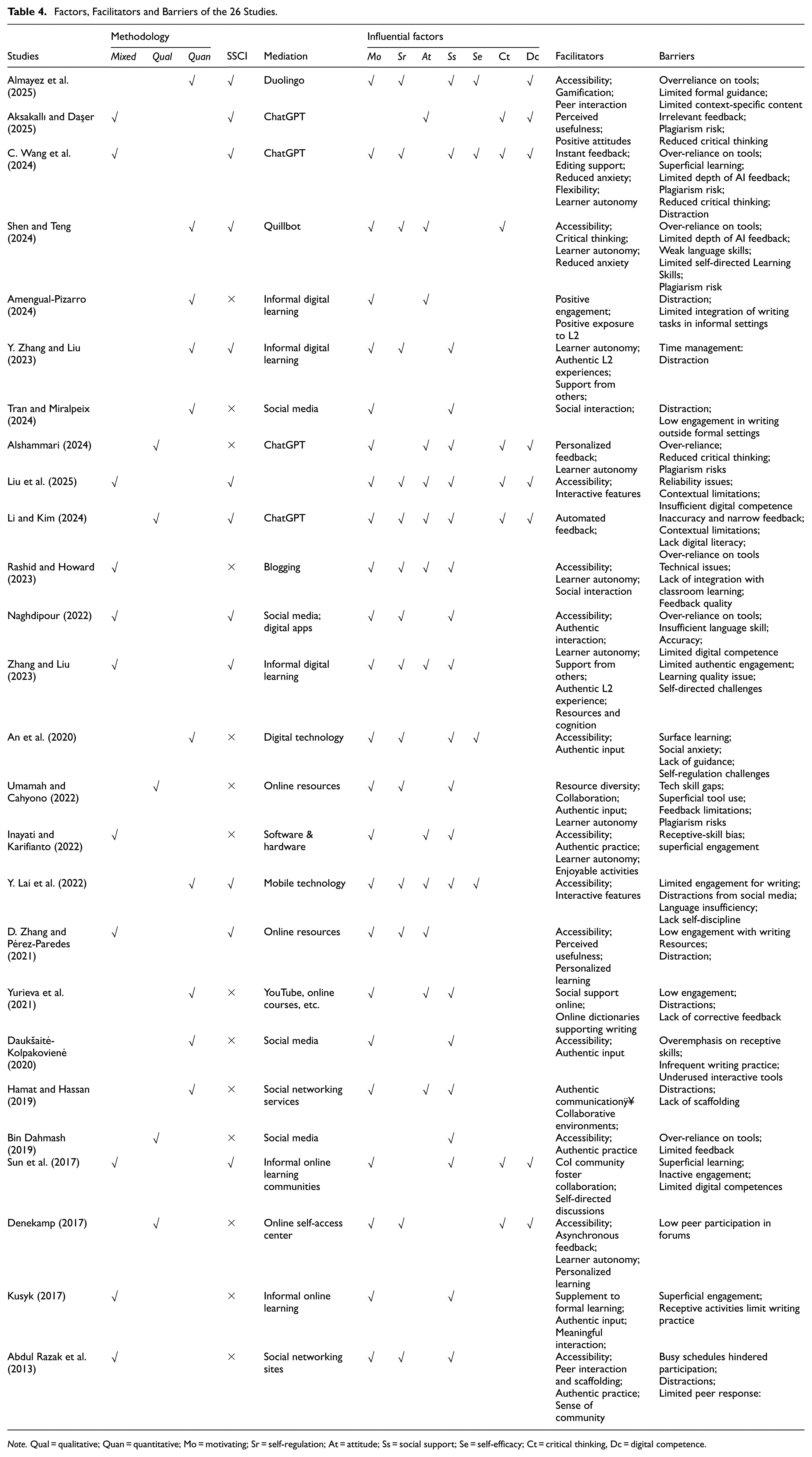
Note. Qual = qualitative; Quan = quantitative; Mo = motivating; Sr = self-regulation; At = attitude; Ss = social support; Se = self-efficacy; Ct = critical thinking, Dc = digital competence.
Theme 1: The Personal Dimension
The personal dimension refers to the internal learner attributes that drive IDLW engagement, primarily consisting of psychological and cognitive factors. Psychological factors are the affective and motivational drivers, explaining the why behind engagement. This finding is strongly supported by the recent publication of studies in psychology-focused journals (Aksakallı & Daşer, 2025; Almayez et al., 2025), aligning with theoretical frameworks like SDT and SET. Motivation (n = 24) is the most prevalent factor, with intrinsic motivation (e.g., personal interest) fostering long-term engagement, and extrinsic motivation (e.g., grades) providing short-term incentives (Kusyk, 2017; D. Zhang & Pérez-Paredes, 2021). A participant’s statement encapsulates intrinsic motivation: “I don’t feel like I’m studying…It’s more like a game. I just want to see my score go up and unlock the next level” (Almayez et al., 2025). Self-regulation (n = 15) is essential for managing learning in informal digital contexts (Almayez et al., 2025), providing clear empirical validation for SRL theory. Attitude (n = 13) significantly influences engagement, with Y. Lai et al. (2022) finding a strong positive effect on self-directed learning (β = .731; Umamah & Cahyono, 2022). Other key factors include critical thinking (n = 8) for evaluating resources (C. Wang et al., 2024) and self-efficacy (n = 4) for sustaining effort (Li & Kim, 2024). In addition, cognitive factors concern the internal mental processes of acquisition, such as attention, memory, and information processing, placing them squarely within the personal dimension. These processes are the focus of many SLA theories (Tran & Miralpeix, 2024). Collectively, these psychological and cognitive factors constitute the core internal engine of IDLW, determining a learner’s ability to engage with and persist in L2 writing development within informal digital contexts.
Theme 2: The Technological Dimension
Digital competence (n = 8) emerges as a critical factor in IDLW. It represents the capacity to critically evaluate digital resources and navigate ethical concerns (Aksakallı & Daşer, 2025; C. Wang et al., 2024), aligning with notions of critical digital literacy. Our analysis highlighted the role of both hardware (e.g., mobile phones providing accessibility) and software (e.g., platforms enabling authentic interaction and AI tools providing feedback). The effectiveness of these tools is often framed through models like the TAM and DST, as their perceived usefulness directly influences adoption and sustained use (Liu et al., 2025; D. Zhang & Pérez-Paredes, 2021). However, our findings push beyond TAM’s core constructs of perceived usefulness and ease of use. The data shows that a tool’s usefulness is not inherent but is co-constructed by the learner’s psychological profile (e.g., a motivated learner explores more features) and social context (e.g., a tool is deemed useful if it facilitates desired peer interaction). This theme underscores that technology is not a neutral container but an active participant that shapes the learning process, forming the technological dimension of the IDLW ecosystem.
Theme 3: The Social Dimension
Social factors (n = 21) were frequently associated with IDLW. This theme provides strong empirical validation for SCT, emphasizing that L2 writing development is often a socially mediated process. Online communities (e.g., fan forums, learning groups) provide crucial spaces for peer feedback, collaborative learning, and exposure to diverse perspectives (Y. Zhang & Liu, 2023), effectively functioning as Communities of Practice.
These findings empirically demonstrate how scaffolding and collaborative dialog occur organically in digital wilds. However, the data also refines SCT by showing that successful social mediation is contingent on individual psychological factors (e.g., a learner’s self-efficacy to engage) and technological factors (e.g., a platform’s design that supports positive interaction). Peer interactions provide not only cognitive scaffolding but also emotional support (Umamah & Cahyono, 2022). Overall, social factors enhance IDLW by creating supportive and interactive learning environments, but their effectiveness depends on the quality of interactions and the balance between collaboration and independent learning (Zhang & Liu, 2022).
Facilitators and Barriers—RQ 4
Our analysis of 26 studies identified key recurring facilitators and barriers affecting L2 writing development in informal digital learning contexts. Critically, these are not merely lists of positive and negative factors; they represent the practical outcomes of the dynamic interplay between the psychological, technological, and social themes identified in
Recurring Facilitators
Technology accessibility and personalized learning for IDLW. This technological factor enables the satisfaction of psychological needs for autonomy and competence (Almayez et al., 2025; Shen & Teng, 2024; D. Zhang & Pérez-Paredes, 2021)
Social dimensions prove crucial, with peer interaction fostering L2 writing collaboration (Liu et al., 2025; Naghdipour, 2022; Y. Zhang & Liu, 2023).
Authentic learning experiences and gamification (Naghdipour, 2022; Zhang & Liu, 2022). For example, gamification, interactive elements, and enjoyable activities boost learner motivation (Almayez et al., 2025; Inayati & Karifianto, 2022; Y. Lai et al., 2022), while instant feedback and editing tools enhance L2 writing accuracy (Li & Kim, 2024; C. Wang et al., 2024).
Learner autonomy is consistently promoted through IDLW (Rashid & Howard, 2023; Shen & Teng, 2024).
The perceived usefulness of digital resources and positive attitudes enhance motivation for L2 writing through IDLE (Aksakallı & Daşer, 2025; Shen & Teng, 2024; D. Zhang & Pérez-Paredes, 2021), while reduced anxiety and positive emotional experiences create conducive learning environments (C. Wang et al., 2024).
Digital communities foster social collaboration and L2 writing development (Abdul Razak et al., 2013; Sun et al., 2017).
Recurring Barriers
Over-reliance on digital tools (Almayez et al., 2025; Li & Kim, 2024; C. Wang et al., 2024) leads to: (1) superficial learning for L2 writing (An et al., 2020; Zhang & Liu, 2023), (2) reduced critical thinking (Alshammari, 2024), and (3) plagiarism risks (Aksakallı & Daşer, 2025; C. Wang et al., 2024). This is a psychological failure in self-regulation and critical thinking, exacerbated by technological affordances that encourage passive acceptance, leading to superficial learning and plagiarism. This problem requires a combined view of technology and psychology to be fully understood.
Distractions and Poor Time Management. (Amengual-Pizarro, 2024; Y. Lai et al., 2022; Tran & Miralpeix, 2024; C. Wang et al., 2024; Y. Zhang & Liu, 2023). These self-regulation challenges are worsened by the inherently distracting nature of digital technology and the lack of structure in informal learning environments.
Receptive-Skill bias. This highlights a psychological lack of meta-cognitive awareness about the need for output, combined with a technological environment that prioritizes consumption, and a missing social context that values writing (Inayati & Karifianto, 2022; Kusyk, 2017).
Insufficient digital competence. It prevents L2 writing development through IDLE, where L2 writers encounter risks regarding reliability and quality of digital resources through IDLE (Li & Kim, 2024; Liu et al., 2025; Naghdipour, 2022; Rashid & Howard, 2023; Umamah & Cahyono, 2022).
Low Peer Participation & Social Anxiety: This is a social barrier that nullifies the potential for scaffolding (e.g., SCT), leading to psychological disengagement and preventing learning (An et al., 2020; D. Zhang & Pérez-Paredes, 2021).
Discussion
This systematic review provides a comprehensive overview of IDLW, moving beyond the formal instructional contexts that have dominated previous research. By synthesizing findings from 26 empirical studies, we argue that IDLW is best understood as a dynamic ecosystem where psychological, technological, and social dimensions are inextricably linked. This discussion interprets these findings through a theoretical lens, presents an integrated framework to conceptualize IDLW, highlights the study’s contributions, and acknowledges its limitations.
Interpreting Trends and Gaps Through a Theoretical Lens
The rising use of AI tools, particularly ChatGPT, represents a significant trend in IDLW, reflecting a broader shift toward autonomous, self-directed learning practices (Shen & Teng, 2024; C. Wang et al., 2024). This trend underscores the growing importance of the learner dimension, specifically constructs like self-regulation and intrinsic motivation as defined by theories of SDT and SRL.
However, L2 writing remains underrepresented in IDLE research, with only 9 of 26 reviewed studies focusing on it. Furthermore, while studies often explore general writing skills (e.g., brainstorming, editing, grammar correction), they seldom address genre-specific practices (e.g., argumentative or academic writing), which are crucial for academic development. Furthermore, ethical concerns like plagiarism and reduced critical thinking indicate a lack of engagement with critical theoretical perspectives. Frameworks like Critical Digital Pedagogy are needed to interrogate the power structures embedded in AI tools and to understand how over-reliance can undermine the meta-cognitive and critical thinking processes that are central to advanced writing development.
From Fragmented Theories to an Integrated IDLW Ecosystem Framework
The results from
To address the theoretical fragmentation, we propose an integrated IDLW ecosystem framework (Figure 3). This model synthesizes our analysis into four interacting dimensions: (1) The learner dimension, encompassing psychological (e.g., motivation), cognitive (e.g., critical thinking), and meta-cognitive (e.g., self-regulation) factors; (2) The technological dimension, defined by digital competence and the critical evaluation of online resources; (3) The social dimension, characterized by help-seeking behaviors and social support within informal digital communities; (4) The environmental dimension which refers to the informal, self-directed context beyond the classroom, shapes and is shaped by the dynamics of the other three dimensions.

Pedagogical framework for IDLW.
The innovation of the framework is its dynamic interdependence. IDLW emerges not from any single dimension but from their interactions. The environmental dimension is the foundational context that enables the informal learning space. Facilitators occur when dimensions align consistently. For instance, strong self-regulation enables effective use of technological tools to engage in digital communities within an autonomous environment. Conversely, barriers represent negative interactions (e.g., low digital competence) hinders engagement with digital communities, reducing learning effectiveness within the informal environment. Thus, the proposed framework directly answers
Contribution and Implications
This review makes several key contributions, primarily demonstrated through the interpretive depth afforded by our methodological choice of reflexive thematic analysis. Prior reviews as summarized in Table 1, have predominantly employed meta-analyses and content analyses, focusing on descriptive features of technology and English language studies (Al-Wasy, 2020; R. Zhang & Zou, 2022). In contrast, this systematic literature review utilizes RTA, offering a more critical and interpretative exploration of the data. By moving beyond superficial descriptions, RTA provides deeper insights into the complexities of IDLW. Most importantly, it allowed us to forge a clear dialog between the empirical data and theoretical constructs, leading to the proposed integrated framework.
Another contribution to this review focusing on informal digital learning. Prior reviews on L2 writing and technology have primarily centered on teacher-led interventions and formal educational contexts. However, given the characteristics of contemporary students and the prevalence of digital technologies, personalized learning in informal settings becomes a trend.
Furthermore, the proposed integrated IDLW ecosystem framework provides a holistic lens for researchers and educators to enhance L2 writing development. Its key innovation lies in explicitly integrating the environmental dimension with the learner, technological, and social dimensions, acknowledging that they are deeply interconnected.
Limitations
This study has several limitations. First, the inclusion criteria were restricted to two major databases (Scopus and WoS) and peer-reviewed journal articles, which may have omitted relevant studies from other sources or in gray literature. Second, many original studies failed to report effect sizes (a common issue), which precludes a more precise meta-analytic understanding of the relative strength of each factor. Third, the overwhelming geographical focus on Asian contexts and the predominant focus on tertiary students limit the broader applicability of these findings.
Conclusion and Recommendations
This systematic review employed RTA to synthesize qualitative evidence from 26 studies, moving beyond a descriptive account to construct a holistic understanding of IDLW. The core thematic finding is that IDLW functions not as a list of isolated factors but as a complex, interconnected ecosystem. Our analysis reveals that development emerges from the dynamic interplay between psychological, technological, and social factors within informal digital environments. Facilitators for L2 writing development arise from the synergistic alignment of these themes (e.g., high self-regulation enabling effective tool use for social collaboration), while barriers are the direct result of their misalignment (e.g., low digital competence inhibiting access to social learning communities). This systemic view, derived from thematic synthesis, is the primary contribution of our review.
Our findings suggest that effective IDLW requires strategies that leverage key facilitators and address barriers. For learners, they should consciously cultivate strategies to manage digital distractions, critically evaluate online resources, and engage constructively in digital communities. This involves connecting meta-cognitive self-awareness (psychological) with effective tool use (technological) and collaborative norms (social). For educators, we recommend a transition from the role of instructor to that of an ecosystem facilitator. Educators can bridge formal and informal learning by recommending reliable digital writing tools, designing assignments that require critical analysis of AI-generated content to foster discernment, and explicitly teaching strategies for ethical digital tool use and productive online help-seeking behavior.
Building on the gaps identified in this systematic review, we propose three key directions for future research. First, future research is recommended to employ longitudinal and mixed methods to capture the complex interplay between ecosystem dimensions. Second, future research should focus on diversity of research contexts and participants. There is a critical need to expand research beyond tertiary students in Asian contexts to include underrepresented regions and diverse educational levels (e.g., secondary schools, professional development) to validate and refine the proposed framework. Third, research should investigate genre-specific writing practices. Research should move beyond general writing proficiency to investigate how the IDLW ecosystem supports the development of competence in specific genres, such as source-based writing.
Footnotes

Ethical Considerations
Not applicable. As this research is a systematic literature review, it did not involve the recruitment of human participants, the collection of primary personal data, or any form of direct interaction with human subjects. Therefore, formal ethics approval and consent to participate were not required.
Consent for Publication
The manuscript is submitted for publication.
Authorship Contribution
Aiju Liu: original draft and final draft; Hong Dong: methodology.
Funding
The authors received no financial support for the research, authorship, and/or publication of this article.
Declaration of Conflicting Interests
The authors declared no potential conflicts of interest with respect to the research, authorship, and/or publication of this article.
Data Availability Statement
The data and material can be used by any reader who can access to the publication.
Publication Ethics
The authors have adhered to the journal’s publication ethics policies, ensuring proper citation of all source materials and the integrity of the synthesized findings.
GenAI Use Disclosure Statement
The authors declare no use of generative AI.