




Abstract
The hybrid nature of reading-to-write tasks calls for more empirical research on understanding the relationship between L2 reading, writing, and proficiency. This study examines summaries written by 46 Emirati university students, who were asked to write a 150-word summary of an expository text on the topic of “consumerism” during class hours. The summary was assessed based on an analytic rubric. It was also assessed quantitatively in terms of the inclusion of the number of important ideas from the source text, namely, content analysis scores. In addition, the students’ language proficiency, reading proficiency, and writing proficiency had already been externally ascertained with their recent IELTS scores. Significantly positive correlations were found between summary scores and IELTS reading scores, IELTS writing scores, and IELTS proficiency scores. Only a significantly positive relationship was found between content analysis scores and IELTS reading scores, but not the IELTS writing scores and IELTS proficiency scores. This implies the importance of enhancing students’ reading, writing, and language proficiency to help them write an effective summary, and reading in itself is insufficient in the production of an effective summary.
Over the past two decades, there has been a shift from discrete reading-only tasks and writing-only tasks within both L1 and L2 classrooms to hybrid tasks, assignments, and assessments that involve both reading and writing. In an academic setting, such tasks are seen as more authentic, as they seem to provide a more accurate representation of what students do, particularly what is expected of them at tertiary levels. Several studies have focused on what students do when writing a summary and on the effectiveness of the use of source texts (Cumming et al., 2016; McCulloch, 2013). There can be no doubt about the importance of summary writing in a learner’s academic output, particularly in higher education where students regularly are asked to do their own research and to submit essays that exhibit not only just acceptable levels of writing in terms of syntactic control and mechanics but also that key information from sources has been identified and then re-portrayed in the student’s own words through paraphrasing or summarizing. Nevertheless, the question remains as to what factors affect the potential quality of a summary and what attributes a proficient summary writer brings to the reading-to-write class, either as part of their normal day-to-day studies or during assessments that might be key to passing a particular course.
It has long been recognized that certain operations take place during the type of task under discussion, tasks that involve reading one or more source texts and then transferring some or all of the important information into a new piece of writing, or in simple terms, a summary. The seminal study by Kintsch and van Dijk (1978) identified and labeled the various operations intrinsic to writing an effective summary; these operations involve the organization of a text into a cohesive unit, reducing a text to enable its gist to be understood and then the production of a new text which must be created from memory and the understanding of the original piece of writing. Clearly, students often need to make considerable mental effort when analyzing a text (Ali & Razali, 2019), and numerous studies have remarked on the challenging nature of this type of reading-to-write tasks that students are regularly required to do, especially in tertiary education (Alaofi, 2020; Chuenchaichon, 2022). As aptly pointed out by McDonough et al. (2014), summary writing necessitates a good command of reading comprehension, writing abilities, as well as linguistic repertories for paraphrasing, which may pose challenges in particular for L2 writers with low proficiency.
In terms of reading, writing and, language proficiency, various studies have attempted to show what factors might be affecting summary writing and what it is that the effective summary writer brings to the reading-to-write task. Asencion Delaney (2008)) in a study involving both L1 and L2 university students reported a low correlation between the reading-to-write tasks and the independent writing measure, and the correlation between the reading test and the reading-to-write tasks had only weak significance. In contrast, Mokeddem and Houcine (2016), in a study on intermediate ESL university students in Algeria, reported that reading comprehension was a significant factor in terms of summary production. Likewsie, Choi et al. (2018) examined the summary writing skills of advanced Korean learners of English and found that reading levels played a major role as regards summary writing.
Regarding language proficiency, researchers have maintained that it impacts source use (see Cumming et al., 2016 for a meta-analysis of a number of studies that have been made about students writing from sources). In a study that emphasized a systemic functional approach to summary writing, Yasuda (2015) demonstrated that higher levels of proficiency resulted in more effective lexico-grammatical choices being made. Moreover, when investigating university students in Malaysia, Romly et al. (2018) found that lower levels of proficiency were likely to cause problems with reading comprehension. Likewise, Marzec-Stawiarska (2016) noted that lower-level proficiency students were more likely to use bottom-up strategies when reading as opposed to their higher-level peers who were able to move away from smaller linguistic units using top-down organizational strategies and the successful utilization of schema. The accumulated studies seem to suggest that a higher level of proficiency would result in greater source integration while copying and failing to paraphrase effectively was more prevalent among leaners with lower levels (Li, 2021; Stander, 2020). To add complexity of the issue, with a focus on Chinese college students, Li (2014) suggested that when summarizing, writing strategies rather than the learners’ reading and writing levels, had a greater effect on task performance. He further posited that their general proficiency levels had negligible influence over both reading and writing strategies.
Clearly, sufficient levels of reading and writing ability are necessary to tackle a hybrid reading-to-write task. Nevertheless, the conflicting results from the correlational studies and research suggests that more evidence is needed regarding reading, writing, proficiency, and integrated task scores. To further investigate what students do when attempting a hybrid read-to-write task in L2, it may be insightful to see what kind of information is extracted by learners to be used in the summary. It would be intuitive to suggest that the higher such levels, the better the summary writing will be, but more empirical studies are needed. Moreover, further research can be established which of the skills, if any, has the most positive effect on accurate textual conflation. To address this, the present study is also interested in measuring what kind of information L2 learners use in a summary writing task, and how the use of content is correlated to L2 reading, L2 writing, and L2 language proficiency. These are the questions that are the focus of the current study:
Research Question 1: What is the relationship between L2 reading and L2 summary writing in terms of both summary scores and the content analysis scores?
Research Question 2: What is the relationship between L2 writing and L2 summary writing in terms of both summary scores and the content analysis scores?
Research Question 3: What is the relationship between L2 language proficiency and L2 summary writing in terms of both summary scores and the content analysis scores?
Method
Participants
The participants involved in this study were all 19- or 20-year-old female university students enrolled on a pre-majors General Education program at a government university in the United Arab Emirates. All were Emirati with Arabic as L1, and English as L2. They were in the second semester of this program. Students in the General Education program were required to take three academic writing courses at three different levels before moving to their disciplinary studies. The first writing course focused on the basic paragraph-level writing, and the second writing course on the summarizing and paragraphing skills, and the third one on argumentative skills. The participants were taking the second-level writing courses with both researchers. It should be noted that the study was based on a convenience sample where 57 students from three different sections taught by the researchers participated in the study on a voluntary basis. Written consent forms were obtained from all the participants who were willing to participate. In the end, 46 students’ summary tasks were analyzed, as the remaining 11 either had not done the IELTS examination or were unwilling to participate in the study. The overall IELTS scores taken by these students in the previous year ranged from 5 to 7 with a mean of 5.5.
Procedure
As part of their regular writing course, students were being instructed in summary writing for the first 4 weeks of the semester with 3 hours per week, and at the end of this summary writing module, they were asked to complete a summary writing assessment, which accounted for 15% of the final grade. Due to the high-risk nature of this assessment, presumably the participants took this test seriously. In the summary assessment, the students were required to read a 725-word text on the topic of “consumerism” (see Appendix A) and then write a summary of that text in approximately 100 to 150 words within 80 minutes (see Appendix B for the writing task). In addition, these students’ IELTS scores were provided in their academic records as part of university entrance requirements. It should be noted that ethical clearance of the study was obtained from the institutional ethics committee.
Analysis
All students’ summary writing was graded with the prescribed university rubric, a four-band criteria scale (see Appendix C) and consequently a percentage score was awarded. The analytic rubric consists of four different areas: 1) content including an effective thesis; grasping key information; approximate citation of the source text, 2) organization, coherence and cohesion, 3) style and tone, and 4) language use including grammar and punctuations. In addition, to examine how well the students were able to extract main ideas for the summary task, a further score was awarded for the purposes of this study using the content analysis. The first researcher had a PhD in applied linguistics while possessing extensive teaching experiences in academic writing as well as grading academic essays. The second researcher had a MA in applied linguistics and also had a dozen years of experiences in teaching academic writing. They analyzed the text independently and developed the rubric for the importance of ideas based on the hierarchy of the information, and 5 points was awarded for inclusion of the one key idea of the whole text and 3 points given for each sub-point of which there were 5, providing a maximum total of 20 points. Both intra and inter-rater reliability were accounted for; the two researchers blind-scored ten papers and the inter-rater reliability for scoring the summary was 87.9% based on Cohen’s Kappa, and the second author randomly marked each summary twice and the intra-rater reliability based on the percent of the agreement was 94%; Both authors did the content analysis of all the students’ summaries, and the inter-rater reliability was 95% based on Cohen’s Kappa.
Although not the main focus of the present study, the second researcher also gained additional information about the mental processes that students went through and the strategies the students employed during the summary writing task. After the assessments had taken place and after they had been scored; 10 of the students agreed to be interviewed about the writing task. Written consent forms were obtained from these ten students who were willing to participate in the interviews. They exhibited different levels of achievement with the task and who had different recorded levels of reading, writing and language proficiency, as determined by their IELTS scores. They were all asked the same questions, either individually or in pairs. The questions concerned what they did during both the reading stage and the writing stage; these post think-aloud interviews possibly shed further light on the results that follow. All the data files and Supplemental Materials of the present study can be accessed through the Open Science Framework website (the link is shared in the author note on the title page.)
Results
Correlational Analysis
Table 1 presents the basic statistics of students’ IELTS reading, writing, and proficiency, summary scores, and content analysis scores, including minimum, maximum, mean, and standard deviation.
Statistics of Students’ IELTS Scores, Summary Scores, and Content Analysis Scores.

The first research question examined the relationship between L2 reading and L2 summary writing in terms of the summary scores and the content analysis scores. Correlational studies were conducted between IELTS reading and the summary scores and the content analysis scores, and a significantly positive correlation was found between IELTS reading scores and overall summary scores (r = 0.55**, p = .000), and IELTS reading scores and content analysis scores (r = 0.35**, p = .009).
The second research question examined the relationship between L2 writing and L2 summary writing in terms of the summary scores and the content analysis scores. Correlational studies were conducted between IELTS writing and the summary scores and the content analysis scores, and a significantly positive correlation was found between IELTS writing scores and overall summary scores (r = 0.44**, p = .000), but no significant correlation was found between IELTS writing scores and content analysis scores (r = 0.24, p = .070).
The third research question examined the relationship between L2 proficiency and L2 summary writing in terms of the summary scores and the content analysis scores. Correlational studies were conducted between proficiency and the summary scores and the content analysis scores, and a significantly positive correlation was found between IELTS proficiency and overall summary scores (r = 0.60**, p = .000), but no significant correlation was found between IELTS proficiency and content analysis scores (r = 0.25, p = .069).
Additional Analysis: The Post-Think Aloud Interviews
Post-think aloud interviews were conducted with a selection of ten students who exhibited different levels of achievement with the task and who had different recorded levels of reading, writing and overall proficiency, as determined by their IELTS scores. These were done within 2 days of the actual production of the summary. Clearly, this time-lag is a limitation of this study; as the summary was a “live” assessment, concurrent commentary was not feasible. Nevertheless, despite this constraint, the comments that some of the students offered may shed some light on the cognition and metacognitive processes that took place.
The cohort of 10 students were asked ten questions; 5 of these concerned the reading stage of the assessment, and 5 the production of the summary. To best exemplify some of these results, a comparison is offered here between two of the students: Mary who scored highly on the assessment, and who had recorded high IELTS scores and Sally who had not. Both pseudonyms are used to protect the identity of these two students. Their respective scores were as follows (Table 2):
Comparison of Scores for Mary and Sally—IELTS and Summary Scores.

While many of the answers were interesting, for reasons of economy this section will highlight the answers to two of the questions. One of the reading questions asked is stated as “Once you saw and started reading the text, what strategies did you use to establish what the topic of the whole text was about?” The response from Mary is quoted as below:
I like to read the whole article twice just to get the main topic by like finding what …words, so like they may illustrate what the main topic is and things … try to focus on all the paragraphs and try and see if there are other main topics.
In contrast, Sally commented that “The title: I had to read the first paragraph to understand what the article was about. That’s it.”
One of the writing questions states “After you finished, did you re-check your summary to make sure the main ideas were included? If so, did you go back to the source text?” In response to this question, Mary said:
Absolutely I re-checked the summary or two reasons. First, I like to see if the main idea was included and all of the other main ideas, the important ones. And second to check if there was any repetition, like sometimes two ideas could be very similar and I merge them into one idea.
However, Sally commented that she did not feel the need to go back to the source text.
From these brief answers alone, stark differences begin to materialize in terms of what a successful student might do, as opposed to one that had lower levels of proficiency. The answers given in the post-think aloud interviews and the comparison of proficiency scores have several implications regarding text construct and also potential teaching applications that might be employed. These are discussed in the section below.
Discussion and Implications
Summary writing serves not only as an effective way to assess students’ understanding of a text but also as a constructive process for learners to acquire new information. Students are engaged in comprehending a text, identifying main ideas, and then recreating the text in their own words (Dunlosky et al., 2013). However, students in different levels of academic studies from primary schools (Bulut & Akyol, 2019) to university students (Alaofi, 2020; Chuenchaichon, 2022) have been found to be lacking in skills and strategies for writing an effective summary.
The current study found positively significant correlations between reading, writing, proficiency, and overall summary scores, but only a significant correlation between reading and the scores in content analysis, which assessed how many important ideas were extracted by the students. This seems to indicate that writing a coherent summary involves a combination of effective reading, writing, and a good level of language proficiency as well. This is consistent with Kintsch and van Dijk (1978) who identified various operations intrinsic to writing an effective summary, including reducing a text to its gist to be understood and then the production of a new text and the organization of a text into a cohesive unit. This finding is also consistent with previous correlational studies pointing to the positive correlation between reading measures, writing measures, and summary writing (e.g., Asencion Delaney, 2008; Choi et al., 2018; Mokeddem & Houcine, 2016). The present study found only a significant correlation between students’ reading levels and the scores in content analysis, which assessed how many important ideas were included in the summary, even further suggesting that a good level of reading only is not sufficient for producing an effective summary.
In sum, this study partly provides additional empirical evidence for the challenging nature of this type of reading-to-write task, namely, the summary writing, which necessitates the good reading, writing, and proficiency from the students. However, due caution should be exercised in the interpretation of the findings of the present study, as the participants were only female university students enrolled in a pre-majors General Education program due to the convenience sampling of the study. Admittedly, another limitation of the study is the relatively small sample size, which may limit the generalizability of the results.
The students’ post think-aloud interviews revealed that students who summarized effectively employed a number of different strategies to process text in order to differentiate between information that was essential and that of lesser importance. This finding is in line with Li (2014), who indicated writing strategies seemed to play a more important role on summary writing than the learners’ reading and writing levels. This implies that students may need scaffolding and writing interventions to help them write a high-quality summary. The student with much higher proficiency interviewed seemed to employ more top-down strategies rather than bottom-up approaches when reading compared with the student of lower-level proficiency. This finding confirms previous studies on how language proficiency affects students’ reading strategies in summary writing (e.g., Marzec-Stawiarska, 2016). Admittedly, such think-aloud protocols are not without flaws (see Bowles, 2010 for a detailed critique); however, the process may reveal strategies that learners employ, and such strategies might be both transferrable and teachable.
Conclusion
Reading-to-write tasks have often been considered as a learning resource when reading-to-write tasks require students to select, evaluate, and use content from the source but also an alternative writing task where reading serves to provide content information and text revision models. The reading levels affect how students select and evaluate from the source texts, and the writing levels affect how they combine the selected information in their summary writing. The current study has empirically supported that reading-to-write tasks are affected by reading levels, writing ability, and proficiency as well. It is important to note that the ability to extract important ideas from the reading text is significantly correlated with students’ reading levels, but not the other two. To help students master the summary writing, the fundamental writing skill to the success of academic studies, students’ reading, writing, and proficiency are necessitated in this hybrid task, as evidenced in the present study. Further studies are desirable in delving to the actual cognitive and writing processes involved in this type of reading-to-write task by using some writing process tracking programs. More insights and nuances may be gained by tracking the whole process of this hybrid activity. Given only one assessment used in the present study to capture the students’ overall proficiency in L2 reading, writing, and summary writing, future studies can include a variety of assessments to enhance the generalization of the study, as suggested by the editor. Furthermore, since only one topic was used in the study, different topics can be incorporated in future research to control the potential confounding variable of motivation or prior knowledge of the topic. Previous research also indicates that the genre of source text has an effect on the quality of summary writing (e.g., Choe et al., 2022). Future research can triangulate the findings of the present study with different types of reading texts for the summary writing task.
Footnotes
Appendices
Appendix B
Appendix C
Rubric for Scoring the Summary Task.
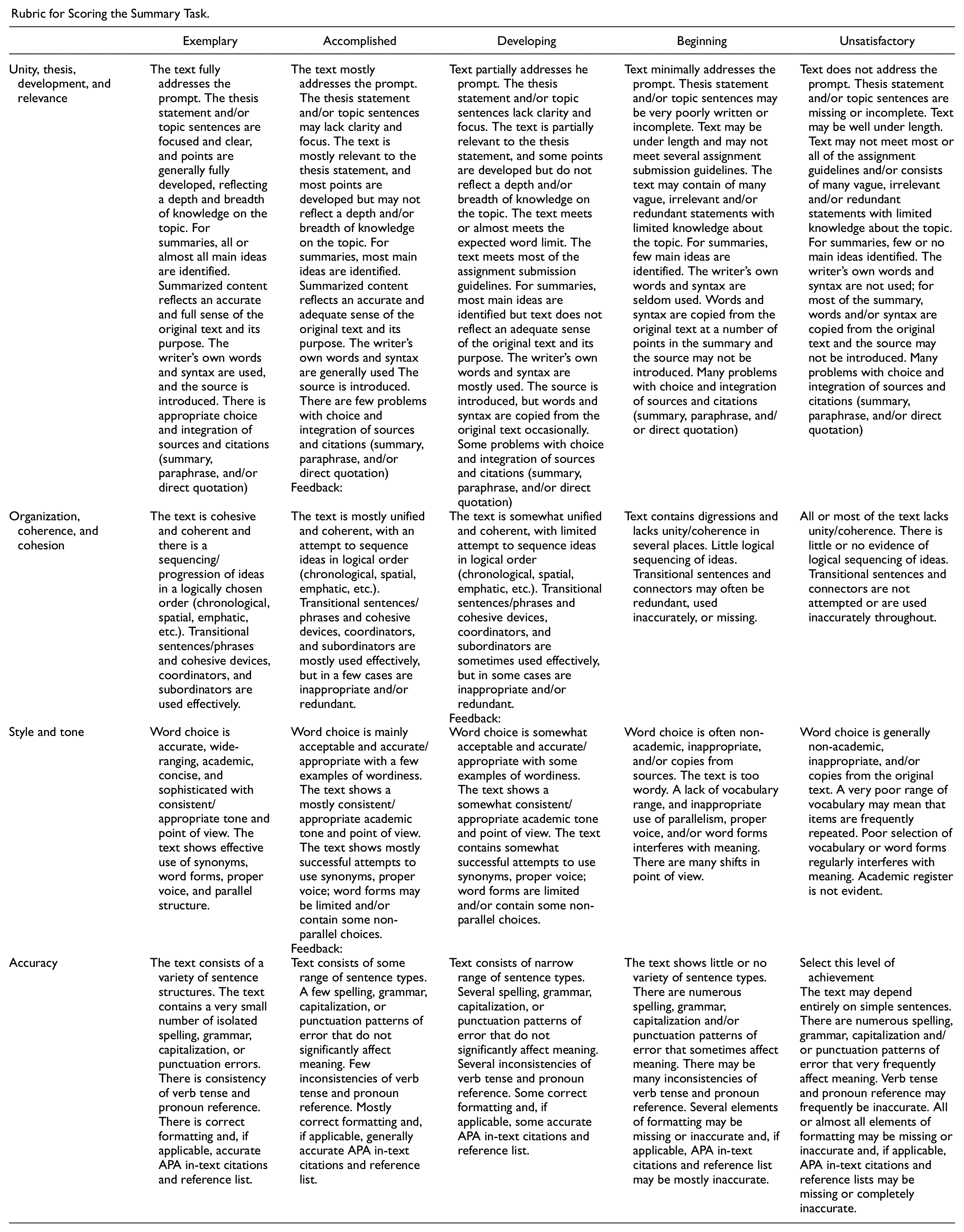
| Exemplary | Accomplished | Developing | Beginning | Unsatisfactory | |
|---|---|---|---|---|---|
| Unity, thesis, development, and relevance | The text fully addresses the prompt. The thesis statement and/or topic sentences are focused and clear, and points are generally fully developed, reflecting a depth and breadth of knowledge on the topic. For summaries, all or almost all main ideas are identified. Summarized content reflects an accurate and full sense of the original text and its purpose. The writer’s own words and syntax are used, and the source is introduced. There is appropriate choice and integration of sources and citations (summary, paraphrase, and/or direct quotation) | The text mostly addresses the prompt. The thesis statement and/or topic sentences may lack clarity and focus. The text is mostly relevant to the thesis statement, and most points are developed but may not reflect a depth and/or breadth of knowledge on the topic. For summaries, most main ideas are identified. Summarized content reflects an accurate and adequate sense of the original text and its purpose. The writer’s own words and syntax are generally used The source is introduced. There are few problems with choice and integration of sources and citations (summary, paraphrase, and/or direct quotation) Feedback: |
Text partially addresses he prompt. The thesis statement and/or topic sentences lack clarity and focus. The text is partially relevant to the thesis statement, and some points are developed but do not reflect a depth and/or breadth of knowledge on the topic. The text meets or almost meets the expected word limit. The text meets most of the assignment submission guidelines. For summaries, most main ideas are identified but text does not reflect an adequate sense of the original text and its purpose. The writer’s own words and syntax are mostly used. The source is introduced, but words and syntax are copied from the original text occasionally. Some problems with choice and integration of sources and citations (summary, paraphrase, and/or direct quotation) | Text minimally addresses the prompt. Thesis statement and/or topic sentences may be very poorly written or incomplete. Text may be under length and may not meet several assignment submission guidelines. The text may contain of many vague, irrelevant and/or redundant statements with limited knowledge about the topic. For summaries, few main ideas are identified. The writer’s own words and syntax are seldom used. Words and syntax are copied from the original text at a number of points in the summary and the source may not be introduced. Many problems with choice and integration of sources and citations (summary, paraphrase, and/or direct quotation) | Text does not address the prompt. Thesis statement and/or topic sentences are missing or incomplete. Text may be well under length. Text may not meet most or all of the assignment guidelines and/or consists of many vague, irrelevant and/or redundant statements with limited knowledge about the topic. For summaries, few or no main ideas identified. The writer’s own words and syntax are not used; for most of the summary, words and/or syntax are copied from the original text and the source may not be introduced. Many problems with choice and integration of sources and citations (summary, paraphrase, and/or direct quotation) |
| Organization, coherence, and cohesion | The text is cohesive and coherent and there is a sequencing/progression of ideas in a logically chosen order (chronological, spatial, emphatic, etc.). Transitional sentences/phrases and cohesive devices, coordinators, and subordinators are used effectively. | The text is mostly unified and coherent, with an attempt to sequence ideas in logical order (chronological, spatial, emphatic, etc.). Transitional sentences/phrases and cohesive devices, coordinators, and subordinators are mostly used effectively, but in a few cases are inappropriate and/or redundant. | The text is somewhat unified and coherent, with limited attempt to sequence ideas in logical order (chronological, spatial, emphatic, etc.). Transitional sentences/phrases and cohesive devices, coordinators, and subordinators are sometimes used effectively, but in some cases are inappropriate and/or redundant. Feedback: |
Text contains digressions and lacks unity/coherence in several places. Little logical sequencing of ideas. Transitional sentences and connectors may often be redundant, used inaccurately, or missing. | All or most of the text lacks unity/coherence. There is little or no evidence of logical sequencing of ideas. Transitional sentences and connectors are not attempted or are used inaccurately throughout. |
| Style and tone | Word choice is accurate, wide-ranging, academic, concise, and sophisticated with consistent/appropriate tone and point of view. The text shows effective use of synonyms, word forms, proper voice, and parallel structure. | Word choice is mainly acceptable and accurate/appropriate with a few examples of wordiness. The text shows a mostly consistent/appropriate academic tone and point of view. The text shows mostly successful attempts to use synonyms, proper voice; word forms may be limited and/or contain some non-parallel choices. Feedback: |
Word choice is somewhat acceptable and accurate/appropriate with some examples of wordiness. The text shows a somewhat consistent/appropriate academic tone and point of view. The text contains somewhat successful attempts to use synonyms, proper voice; word forms are limited and/or contain some non-parallel choices. | Word choice is often non-academic, inappropriate, and/or copies from sources. The text is too wordy. A lack of vocabulary range, and inappropriate use of parallelism, proper voice, and/or word forms interferes with meaning. There are many shifts in point of view. | Word choice is generally non-academic, inappropriate, and/or copies from the original text. A very poor range of vocabulary may mean that items are frequently repeated. Poor selection of vocabulary or word forms regularly interferes with meaning. Academic register is not evident. |
| Accuracy | The text consists of a variety of sentence structures. The text contains a very small number of isolated spelling, grammar, capitalization, or punctuation errors. There is consistency of verb tense and pronoun reference. There is correct formatting and, if applicable, accurate APA in-text citations and reference list. | Text consists of some range of sentence types. A few spelling, grammar, capitalization, or punctuation patterns of error that do not significantly affect meaning. Few inconsistencies of verb tense and pronoun reference. Mostly correct formatting and, if applicable, generally accurate APA in-text citations and reference list. | Text consists of narrow range of sentence types. Several spelling, grammar, capitalization, or punctuation patterns of error that do not significantly affect meaning. Several inconsistencies of verb tense and pronoun reference. Some correct formatting and, if applicable, some accurate APA in-text citations and reference list. | The text shows little or no variety of sentence types. There are numerous spelling, grammar, capitalization and/or punctuation patterns of error that sometimes affect meaning. There may be many inconsistencies of verb tense and pronoun reference. Several elements of formatting may be missing or inaccurate and, if applicable, APA in-text citations and reference list may be mostly inaccurate. | Select this level of achievement The text may depend entirely on simple sentences. There are numerous spelling, grammar, capitalization and/or punctuation patterns of error that very frequently affect meaning. Verb tense and pronoun reference may frequently be inaccurate. All or almost all elements of formatting may be missing or inaccurate and, if applicable, APA in-text citations and reference lists may be missing or completely inaccurate. |
Acknowledgements
The authors gratefully acknowledge the support from all the students who participated in the study at Zayed University, United Arab Emirates. The authors are also thankful to the editor and reviewers for their constructive feedback and suggestion during the revision process. Any errors and omissions are, of course, our own.
Declaration of Conflicting Interests
The author(s) declared no potential conflicts of interest with respect to the research, authorship, and/or publication of this article.
Funding
The author(s) received no financial support for the research, authorship, and/or publication of this article.
Ethics Statement
The ethical clearance for the present study was obtained from the Zayed University Ethics Research Committee, and the approval number is ZU19_027_F. The following Committee Members and Office of Research representatives were present at the meeting:
Dr Anoud Bani-Hani, Assistant Professor, College of Technological Innovation
Ms. Shurooq AL Hashimi, Research Development Coordinator, office of Research
Dr Balqees Ahmed, Assistant Dean for Research and Graduate Studies, College of Business
Dr Melissa Chiovenda, Assistant Professor, College of Humanities and Social Sciences
Dr Dalya Haroun, Associate Professor, College of Natural and Health Sciences
Dr JR Ratliff, Assistant Professor, University College
Dr David Palfreyman, Associate Professor, College of Education
Malak Quota, Assistant Professor, College of Arts and Creative Enterprises
Balqees Ahmed, Assistant Dean for Research and Outreach College of Business
Maryna Verlinden Bondaruk, Assistant Professor, College of Natural and Health Sciences
Written consent forms were obtained from all the participants who were willing to participate in the study. Protection of the students’ identify in the form of pseudonyms was exercised in the case of reporting an individual student’s responses in the interviews.
