




Abstract
Anxiety is widely recognized as a significant affective factor that influences second language (L2) writing proficiency. However, its specific contributions to writing motivation and engagement, and how it interrelates with these constructs, are not clearly defined. To address this research void, this study explored the role of anxiety in the relationship between motivation and engagement in Chinese as second language (CSL) writing among 229 Vietnamese university students. A variety of specialized Chinese writing tasks were designed for this study, and quantitative research methods were utilized. The findings revealed that motivation in writing indirectly influenced behavioral engagement through anxiety, showing a positive correlation with both constructs. Contrary to expectations, anxiety did not impede learners’ performance. Additionally, the study uncovered that the students’ consistent attitudes toward Chinese writing and their self-awareness protected their cognitive engagement from potential disturbances of affective anxiety. Furthermore, the research indicated a significant impact of anxiety across various segments of the Vietnamese student population, while the moderating effect of “different writing tasks” was negligible. The study also suggested that task selection, aligned with Vietnamese university students’ preferred learning styles, could potentially increase their interest in the Chinese language without reducing their motivation and engagement in writing tasks.
Introduction
A pivotal factor in the achievement of second language (L2) writing is motivation, the level of which directly influences learners’ performance in writing tasks and the ultimate outcome of their writing efforts (Hayes, 2012; Hidi & Boscolo, 2006; Y. J. Lan, 2020; Lan et al., 2023; Wang et al., 2023). The writing motivation includes the learners’ performance, their feelings during the task, and their understanding of writing itself (Mahfoodh, 2017; Wang et al., 2023). In L2 learning contexts, writing motivation directly relates to learners’ writing capacities, encompassing their attitude and beliefs about L2 writing, as well as the effort they exert during the writing process (Cui & Luo, 2022; Lamb, 2017).
Engagement, defined as the effort, time, and persistence devoted to achieving desired outcomes (Chen & Yuan, 2023; Dörnyei & Kormos, 2000; Zhang & Hyland, 2018), is generally high among learners with high writing motivation in L2 contexts (Hu & Lam, 2010; Lee, 2017; Wang et al., 2023; Yu & Lee, 2016). Among L2 learners, those with higher motivation tend to achieve better results in writing tasks (Lee, 2019; Wang et al., 2023). This is particularly evident among Vietnamese university students, where increased motivation contributes to improved integration of their integration of their L2 understanding into their writing, resulting in enhanced skills and heightened engagement (Y. J. Lan, 2020; Lan et al., 2023; Mai & Bao, 2020; Tahmouresi & Papi, 2021; Tran, 2007). Thus, a significant correlation exits between writing motivation and engagement.
However, research indicates that high engagement does not necessarily equate to high motivation among Vietnamese university students in different L2 writing tasks, particularly those involving peer feedback and support (Han & Hyland, 2015). This discrepancy may be influenced by the varying difficulty of writing tasks with peer support (Dang, 2022). Further research suggests that motivation and engagement are essentially linked to changes in learners’ personal emotions (Boo et al., 2015; Chen & Yuan, 2023; Waninge et al., 2014). Low levels of writing motivation can lead to dissatisfaction, reduce enthusiasm, and decreased interest in writing, which can, in turn, increase anxiety (Mahfoodh, 2017; Zhang & Wang, 2023). Increased dissatisfaction in writing, a form of personal anxiety, has been negatively impact engagement and lead to decreased motivation among Vietnamese university students (T. H. N. Tran, 2017). However, tasks that offer greater autonomy can effectively stimulate motivation and engagement, leading to increased positivity, proactive behavior, and reduced anxiety (Nguyen & Jaspaert, 2021).
Current research has established a correlation between Vietnamese CSL learners’ writing motivation and engagement, which is affected by anxiety. However, it hasn’t been determined if this impact is interactive or unidirectional. Additionally, while factors associated with Vietnamese CSL learners’ writing motivation and engagement under high anxiety levels have been explored, the effects of low or moderate anxiety levels remain unidentified. Most importantly, the relationship between these learners’ writing motivation and anxiety hasn’t been comprehensively examined. This leaves open questions about whether anxiety acts as a mediating factor between writing motivation and engagement, and how this relationship appears in various writing tasks.
Literature Review
Motivation and Engagement in L2 Writing
L2 Writing Motivation
Motivation plays a pivotal role in the achievement of second language (L2) writing (Mahfoodh, 2017; Waller & Papi, 2017; Wang et al., 2023). It involves attitudes towards the writing task, emotional experiences during the process, perceived value of writing, and anticipated learning goals (Cheng, 2017; Waller & Papi, 2017). Studies have shown that learners with high writing motivation often perform better and spend less time on the writing process, particularly excelling in vocabulary and grammar (Mahfoodh, 2017). Therefore, motivation in writing is considered an influential predictor of successful writing outcomes (Hayes, 2012; Waller & Papi, 2017; Wang et al., 2023). To measure L2 writing motivation, numerous research instruments have been developed, such as the “Intrinsic/Extrinsic” (Amabile, 1985), “Students’ Self-reported Motivation” (Lam & Law, 2007), “The L2 Motivational Self-system” (Waller & Papi, 2017), and “L2 Writing Motivation Questionnaire” (Lee et al, 2017). The questionnaire developed by Waller and Papi (2017) is highly relevant and thus adopted by this study, as it is specifically designed to investigate L2 writing motivation from three different perspectives, including the L2 writing ideal self (WIS), the L2 writing ought-to self (WOS), and the L2 writing learning experience (WLE).
L2 Writing Engagement
High motivation in learners can significantly increase their engagement level, which directly influences the time and energy they dedicate to tasks related to L2 learning (Chen & Yuan, 2023; Dörnyei & Kormos, 2000; Zhang & Hyland, 2018). The intrinsic force driving this engagement is often identified as motivation, whereas the manifestation of such motivation is noted as engagement (Martin et al., 2017). To assess the degree of engagement in L2 learning, researchers frequently utilize the Motivation and Engagement Scale (MES) by Martin (2010). The MES is a valuable tool because it not only concentrates on the motivational aspects of L2 learning but also evaluates the learners’ performance in terms of their engagement level. This helps to capture the structure of motivation and engagement accurately and reliably in L2 learners (Martin et al., 2017). In light of this, the current study employed the MES to gauge the participants’ level of engagement, aiming to provide an in-depth understanding of their motivation and engagement structure in the context of L2 learning.
The Relationship Between Motivation and Engagement in L2 Writing
Early research merely posited that writing motivation positively predicts writing ability, while engagement was merely seen as the time invested in writing tasks (Tran, 2007). However, more recent studies have revealed a strong correlation between writing motivation and engagement (Zhang & Hyland, 2018). For instance, contemporary research has shown that as writing motivation increase, there is a corresponding improvement in L2 learners’ engagement (Zhang et al. 2020). Yu et al. (2019) further demonstrated that the combined effect of combining writing motivation and engagement significantly enhances L2 learners’ writing skills. Moreover, with the growing focus on emotional factors in L2 writing, studies have highlighted that the relationship between motivation and engagement is influenced by emotions such as anxiety, proficiency levels, and learner beliefs. For example, negative emotions like anxiety can hinder the positive interaction between motivation and engagement, leading to a decrease in writing performance (Han & Hyland, 2015; Waninge et al., 2014).
Overall, current research supports a strong positive relationship between writing motivation and engagement, indicating that higher motivation leads to greater engagement and improved writing outcomes (Han & Hyland, 2015; Yu et al., 2019; Zhang et al. 2020). However, emotional factors, particularly anxiety, can disrupt this relationship, potentially diminishing writing performance. Despite these insights, there is still a significant gap in the literature regarding how motivation, engagement, and emotional factors interact across different cultural and contextual settings. Additionally, there is a need for empirical studies that explore effective strategies to reduce anxiety and foster motivation, thereby optimizing writing outcomes in L2 learners.
The Influence of Anxiety on Motivation and Engagement in L2 Writing
Writing Anxiety
Defined as the tension and fear experienced during language learning activities, anxiety is a significant factor in the process of acquiring a second language (Cheng, 2017; Cheng & Chiu, 2018; MacIntyre & Gardner, 1994; Wang et al., 2023). More specifically, anxiety in L2 writing refers to the negative emotional responses that learners display during writing tasks (Cheng, 2002). Influenced by various factors such as linguistic abilities, sociopsychological considerations, cognitive aspects, and classroom events, writing anxiety and the writing process share a complex, potentially interactive relationship (Mahfoodh, 2017; Lee & Krashen, 2002). In other words, while anxiety can influence the L2 writing process, it can also be a result of it.
To accurately measure learners’ writing anxiety, researchers have developed several questionnaires such as the Writing Anxiety Questionnaire (WAQ) (McKain, 1991), the Second Language Writing Anxiety Inventory (SLWAI) (Cheng, 2004), the Causes of Writing Anxiety Inventory (CWAI) (Rezaei & Jafari, 2014). Among them, the SLWAI is effective in predicting L2 learners’ writing anxiety and is considered to have high internal consistency and reliability, as well as acceptable content validity and construct validity; and more importantly, it is widely recognized and employed as a robust instrument for measuring foreign/second language writing anxiety (Cheng, 2017; Rezaei & Jafari, 2014; Teimouri et al., 2019). Therefore, this study adopts the SLWAI to assess participants’ L2 writing anxiety levels.
The Interplay of Anxiety, Motivation, and Engagement
Historically, anxiety has been seen as a primary predictor of L2 learning failure. For instance, increased anxiety levels have been linked to dissatisfaction in writing, decreased writing interest, and reduced engagement among L2 learners (T. H. N. Tran, 2017). This negative emotion can lead to a decline in motivation, thereby affecting personal writing positivity and initiative (Nguyen & Jaspaert, 2021). However, recent studies suggest that anxiety’s role in L2 learning is not solely negative. When managed effectively, it can serve as a motivational force, prompting learners to address issues in their writing and improve their writing skills (Zhang et al., 2020). Additionally, the impact of anxiety on writing motivation appears to depend on the learner’s proficiency in L2. High-proficiency learners may react positively to anxiety, whereas those with lower proficiency might experience fear, thereby affecting their writing motivation and engagement (Nguyen & Jaspaert, 2021). Recognizing this complexity, some researchers advocate for a more nuanced understanding of anxiety in L2 writing, suggesting a focus on the interaction between anxiety, motivation, and engagement (Zhang et al.,2020). This approach aims to provide a more comprehensive understanding of how anxiety impacts L2 writing proficiency, facilitating a deeper grasp of its multifaceted influence.
The Interaction of Anxiety, Motivation, and Engagement in the Context of CSL Writing
In recent decades, a growing global interest in teaching and learning Chinese as a second language (CSL) has increased significantly, as highlighted by numerous studies (Lan et al., 2023; Sun & Luo, 2018; Zhang & Tsung, 2021). Many of these studies have focused on various aspects of CSL writing, such as the writing process (Cheng & Chiu, 2018), task design (Cui & Luo, 2022), technological assistance (Lan & Tam, 2023), and motivation behind learning CSL writing (Wang et al., 2023). Among these, motivation and engagement have emerged as critical factors in enhancing the effectiveness of CSL writing instruction (Zhang & Tsung, 2021). However, anxiety, a key emotional factor that can significantly influence both motivation and engagement, remains underexplored, especially among Vietnamese CSL learners.
In Vietnam, the study of CSL has gained prominence due to the increasing economic, cultural, and political ties between China and Vietnam. Many Vietnamese learners approach CSL with pragmatic motivations, primarily viewing it as a tool for career advancement. However, this utilitarian focus can also lead to heightened anxiety, as learners feel pressured to achieve proficiency quickly to meet professional expectations (Nguyen, 2016). Additionally, Vietnamese CSL learners face unique linguistic and sociocultural challenges. Despite both languages being tonal, differences in phonological and syntactical structures create significant hurdles, leading to increase anxiety, particularly in oral and written communication (Q. H. Tran, 2017). Despite these challenges, recent studies indicate that Vietnamese CSL learners benefit from culturally responsive teaching strategies, which include collaborative learning and technology-enhanced tools. These methods have been shown to reduce anxiety while simultaneously boosting motivation and engagement (L. Lan, 2020; Vu & Pham, 2022). Nevertheless, more research is needed to explore how specific cultural dynamics influence anxiety, motivation, and engagement in the context of CSL learning among Vietnamese students. This research gap underscores the need for targeted studies in this area.
Previous research has highlighted that a lack of self-confidence can lead to heightened anxiety, resulting in reluctance among Vietnamese CSL learners to actively participate in writing courses (Q. H. Tran, 2017; Trang et al., 2012). This reluctance undermines motivation and hinder the development of writing skills. However, evidence suggests that anxiety can alleviated through peers’ collaboration, teacher guidance, and the use of technology, which helps boost both motivation and engagement, ultimately improving writing skills among Vietnamese CSL learners (L. Lan, 2020; Mai & Bao, 2020; Yu et al., 2020). Furthermore, anxiety has been found to negatively affect writing motivation, which indirectly lowers engagement levels in L2 learners (Cheng, 2017; Tahmouresi & Papi, 2021; Zhang et al., 2020). For beginning CSL learners, anxiety often stems from challenges such as complex vocabulary, incorrect guessing, and difficulties in comprehension. However, learners often develop coping strategies to manage their anxiety (Sun & Luo, 2018). As learners become more experienced, anxiety tends to diminish, and positive emotions can counteract its effects (Zhang & Wang, 2023). For Vietnamese CSL learners in particular, immersive writing experiences have been shown to increase both motivation and engagement. These learners actively seek more writing opportunities when immersed in meaningful tasks, reducing the impact of negative emotions such as anxiety (Lan et al., 2023). Thus, the structure and nature of writing tasks play an important role. Research by Wang et al. (2023) suggests that Vietnamese learners’ motivation and anxiety levels are strongly influenced by the degree of freedom in writing tasks. When learners have more autonomy in their writing, motivation tends to increase, while anxiety decreases.
Despite the substantial research on motivation, engagement, and anxiety in CSL learners, there remains a gap in understanding how anxiety specifically impacts engagement in different learning environments and task structures, especially for Vietnamese learners. While strategies for reducing anxiety have been explored, more empirical research is needed to investigate how different types of engagement interact with motivation and anxiety to influence writing outcomes. Addressing this gap will provide a more comprehensive understanding of how to enhance writing instruction for Vietnamese CSL learners.
Theoretical Framework
The social-dynamic framework (Dörnyei & Ushioda, 2011) conceptualizes language learning, particularly L2 acquisition, as an interactive process involves motivation, cognition, and emotion. Among the emotional factors, language learning anxiety has been identified as a key contributor to individual differences in language acquisition. The negative impact of L2 anxiety on language learning is well-documented (Brunfaut & Revesz, 2015). Moreover, L2 anxiety has been suggested to act as a mediating variable, particularly in the relationship between corrective feedback and outcomes like L2 writing performance (Sheen, 2008) and motivation (Öz et al., 2015).
Previous research grounded in the social-dynamic framework has examined the effects of anxiety and engagement in L2 learning, finding that motivation enhances learning effectiveness through increased engagement (Zhang et al., 2020). However, the specific dynamics among motivation, anxiety, and engagement in CLS writing remain underexplored. Thus, this study builds on the social-dynamic framework to investigate how anxiety, motivation, and engagement interact in CSL learners’ writing processes.
We propose a hypothetical structural equation model (Figure 1) in which anxiety mediates the relationship between motivation and engagement in CSL writing. Specifically, we posit that motivation influences engagement, with anxiety acting as a mediating factor in this relationship.

The hypothetical research model.
The Present Study
To address the research gap identified in prior studies, this research designs specific Chinese writing tasks to examine the influence of anxiety on the writing motivation and engagement of Vietnamese university students. It also aims to explore whether the impact of anxiety differs depending on the nature of the writing tasks. The study begins by collecting data through survey questionnaires, which will then be used to develop a structural equation model. This model will be based on the intrinsic factor structure of writing motivation and engagement, with a particular focus on understanding anxiety as a potential mediating factor. If anxiety is found to mediate the relationship between motivation and engagement, further analysis will be conducted to explore how this mediation varies across different writing tasks. In summary, this study addresses the following two research questions (RQs):
RQ1. Does writing anxiety mediate the relationship between writing motivation and engagement among Vietnamese university students? If so, what are the specific outcomes?
RQ2. Do variations in writing tasks lead to significant differences in writing motivation, anxiety, and engagement among Vietnamese university students?
Methods
Participants
This study, conducted from December 5 to 14, 2021, involved 235 participants. All were junior and senior university students from a Vietnamese university, enrolled in a Chinese language program. These students’ native language was Vietnamese, and they were learning Chinese as a second language (L2).
Each participant had over two years of experience in Chinese writing, having successfully completed a two-year “Chinese Writing Course.” This course, designed for Vietnamese university students, aimed to develop their writing proficiency, with the curriculum becoming progressively more challenging with each academic year. Advancement to the next level required students to achieve passing grades at the end of each semester.
The age range of the participants (N=234) ranged from18 to 24 years old, with one exception being older than 25. However, six participants were excluded from the study as they did not complete the writing tasks, leaving 229 valid responses for analysis. Of these, the majority were Female (F=215), with only a small minority of male participants (M=14). This gender imbalance reflects the broader trend of female-dominated enrollment in Chinese language programs.
In the current study, we analyzed data from 229 participants, a sample size determined based on both practical considerations and established statistical guidelines for Exploratory Factor Analysis (EFA). According to Comrey and Lee (1992), a sample size of 200 to 300 is considered “good” for factor analysis. Additionally, the selection of this sample size aligns with common “rules of thumb” for factor analysis, where at least 5 to 10 participants per items are generally recommended (Kline, 2011). Given that our study examines multiple variables related to writing motivation, anxiety, and engagement, this sample size ensures that the model can be robustly analyzed while also enabling generalizability. Furthermore, previous research in L2 writing involving motivation and engagement with similar populations has successfully utilized comparable sample sizes (Tran & Walters, 2021). These considerations confirm that our sample size of 229 participants is appropriate for the objectives of our study.
Instrument
This study employed a three-part questionnaire to comprehensively evaluate different aspects of the participants’ proficiency in L2 writing. Questionnaire 1 assessed their actual L2 writing performance, Questionnaire 2 measured their motivation towards L2 writing, and Questionnaire 3 focused on evaluating their engagement in L2 writing tasks. The questionnaires were administered in both Chinese and Vietnamese to ensure clarity and understanding. The Chinese version was revised by the authors, while the Vietnamese version was translated and edited by a Vietnamese university teacher to maintain accuracy in meaning. Data was collected online via Google Forms, and participants rated their responses on a five-point Likert scale (1 = never, 5 = always). On average, it participants between 15 and 25 minutes to complete the questionnaire.
L2 Writing Anxiety
This study utilized an 11-item questionnaire adapted from Cheng (2017), with statements like “When writing in Chinese, I often worry that I will make language mistakes.” The internal reliability of the questionnaire was high, as indicated by Cronbach’s α=.874> .8, KMO=0.866>0.8 and statistical significance (p<.001).
After conducting the initial reliability analysis, an Exploratory Factor Analysis (EFA) was performed using SPSS.27 (IBM SPSS Statistics Version 27) to evaluate the internal consistency of the questionnaire. EFA is used to identify the underlying factors or dimensions by analyzing correlations among observed variables. EFA is crucial in simplifying complex data structures by extracting fewer latent factors that define the shared variance among the variables (Fabrigar & Wegener, 2011). The EFA results led to the removal of items with loadings below 0.5, resulting in two factors comprising eight items. Drawing from the research of Cheng (2004, 2017), these factors were labeled as Fear of Negative Evaluation (FNE, items 1, 2, 3, 4, and 5) and Anxiety about Making Mistakes (AMM, items 9, 10, and 11) (see Table 1).
L2 Writing Anxiety.

Note. AMM = Anxiety about Making Mistakes; FNE = fear of negative evaluation.
To verify the EFA findings, a Confirmatory Factor Analysis (CFA) was performed using AMOS.27 (IBM SPSS Amos Version 27). The CFA results affirmed the appropriateness of the EFA results, as indicated by acceptable fit indices: CMIN/DF = 3.451 < 5, CFI = 0.953>0.9, TLI=0.922>0.9, NFI=0.935>0.9, and GFI=0.943>0.9.
L2 Writing Motivation
The questionnaire used to assess L2 writing motivation was adapted from Waller and Papi (2017) and was divided into three sections: the L2 writing ideal self (WIS), the L2 writing ought-to self (WOS), and the L2 writing learning experience (WLE). Each section contained six items, totaling 18 items. The L2 WIS section measured the participants’ ideal writing skills in L2 (items 1–6). The L2 WOS section evaluated the skills participants felt they should possess to meet expectations and avoid negative outcomes in L2 writing (items 7–12). The L2 WLE section assessed context-specific motivations linked to direct learning environments and experiences (items 13–18).
The reliability of the questionnaire was confirmed through statistical analysis, yielding Cronbach’s α = .911, KMO = 0.906, and p < .001, all indicating high reliability. An EFA was conducted, which led to the removal of items 13 and 15 due to factor loadings below 0.5 (see Table 2). This adjustment resulted in a final set of 16 items. The results from the CFA showed acceptable model fit indices, with CMIN/DF = 1.921(<5), CFI = 0.965 (>0.8), TLI=0.956 (>0.8), NFI=0.93 (>0.8), GFI=0.905 (>0.8), all within acceptable ranges.
L2 Writing Motivation.

Note. WIS = writing ideal self; WOS = writing ought-to self; WLE = writing learning experience.
L2 Writing Engagement
The questionnaire was derived from Martin (2010) and focused on investigating participants’ Behavioral Engagement (BE), Emotional Engagement (EE), and Cognitive Engagement (CE) during second-language writing. The questionnaire consisted of 15 items in total. The first five items (1–5) sought to assess BE, measuring the amount of attention and effort participants dedicated to writing activities. Items 6 to 10 aimed to evaluate EE, gauging participants’ evolving emotional states during writing activities. Finally, the last five items (11–15) were designed to determine CE, exploring participants’ perceptions of the writing activity and their attitudes towards writing.
The questionnaire was found to be highly reliable, with Cronbach’s α=.919>.8 and KMO=0.915>0.8, p < .001, both exceeding the recommended threshold of .8 (p < .001). An EFA was performed on the questionnaire items, and items with loadings below 0.5 were excluded. This resulted in a revised questionnaire with two factors and ten items in total. These two factors, which were named BE and CE following the nomenclature of previous studies (Skinner et al., 2009; Martin, 2010), are detailed in Table 3. Further validation of the revised questionnaire was provided by a CFA, which yielded good fit indices: CMIN/DF = 1.87 < 5, CFI = .972, TLI = .959, NFI = .942, GFI = .95, all of which exceeded the acceptable threshold of .8.
L2 Writing Engagement.

Note. BE = behavioral engagement; CE = cognitive engagement.
Arrangement of Writing Tasks
The study designed Chinese writing tasks to examine the influence of writing anxiety on motivation and engagement among Vietnamese university students. The task was divided into two distinct phases. The first phase required all participants to review a text within 15 min. The chosen text was an excerpt from “Developing Chinese—Intermediate Chinese Writing” (Luo, 2016). It consisted of two paragraphs and a total of 764 Chinese characters. The first paragraph, entitled “Learning Plan,” outlined a student’s strategy for mastering Chinese and their potential. The subsequent paragraph, “Travel Plan,” narrated the experiences of a Chinese language student, detailing his travels in China during a vacation. Following the reading phase, participants were randomly divided into three groups, each differing in the degree of autonomy provided in the writing task: Free Choice (FC), Limited Choice (LC), and No Choice (NC). Participants in the FC group were given the freedom to select their own topics and content, encouraging them to engage in the writing activity without any restrictions. In contrast, those in the LC group were given a choice of three predetermined prompts for their essays: “My - - - - - - plan,”“- - - - - - dream,” or “- - - - - - Wish.” Meanwhile, the NC group was required to write strictly on a single assigned topic, “My - - - - - - Plan,” ensuring their composition was aligned with the specified theme.
The groups were composed as follows: 89 participants in the FC group, 84 in the LC group, and 56 in the NC group. Each participant was given a maximum of 45 min to complete their composition, which was required to be written in Microsoft Word and contain a minimum of 500 Chinese characters.
Procedures
The study procedure was organized into four main stages:
In the first stage, the teacher from the Vietnamese university, post-recruitment of participants, provided a comprehensive explanation of the study’s process and procedures in a classroom setting. This ensured the participants had a clear understanding of the study process before the distribution of the reading materials.
The second stage involved a pilot study conducted on December 5, 2021, which included 36 participants (35 females and one male). Based on the feedback from the participants, adjustments were made to the writing time, extending it from an initial 25 to 35 min to a revised 45 min. The questionnaire items were also reordered to enhance clarity and coherence.
During the third stage, the teacher divided the participants randomly into three groups to ensure a balanced distribution. After the reading phase, the teacher assigned writing tasks to the participants in these groups. They used Microsoft Word on their laptops to complete their tasks. The teacher emphasized the importance of working independently, refraining from discussions, or using online resources for information. Once they completed their tasks, they emailed their work to a predefined address and notified the teacher. Following this, the teacher distributed the Google Forms formatted questionnaire. Participants were required to complete this questionnaire on their laptops and had to stay in the classroom until their submission was confirmed.
The final stage involved data analysis using two statistical software packages, SPSS 27 and AMOS 27. Initially, a reliability analysis was performed to ensure the high reliability of the survey instrument. This was followed by EFA and CFA to examine the interrelationships among the factors in the questionnaire. Structural equation modeling (SEM) was then used to investigate if writing anxiety acted as a mediator (RQ1). If a mediating effect was observed, further analysis was conducted to assess if this mediation varied based on the different writing task conditions (RQ2).
Results
Analysis the Mediating Effect
The mediating role of writing anxiety in this study was analyzed using AMOS 27 to construct an SEM. Initially, the model’s indicators were validated to ensure high acceptability by operating the AMOS software. This was done by examining the Covariances and Regression Weights in the Modification Indices and sequentially modifying the items with the largest MI values. During this modification process, items 1 and 8 from the L2 writing motivation, and item 1 from the L2 writing anxiety were omitted. This led to the finalization of the model indicators. These included CMIN/DF = 1.671 < 5, CFI = 0.933 > 0.9, TLI = 0.926 > 0.9, IFI = 0.934 > 0.9, RMSEA = 0.054 < 0.08, RMR = 0.077 < 0.1. All these values fell within the acceptable range, thereby ensuring the model’s validity (see Figure 2).

The mediating effect(anxiety).
From an overall perspective, significant direct relationship was found between writing motivation and anxiety, as well as between anxiety and engagement. Writing motivation also indirectly influenced engagement through anxiety, confirming the mediating role of anxiety, as hypothesized. These findings aligned with the hypothesized model. However, unlike some previous studies, not all engagement factors were influenced indirectly by writing motivation through anxiety. Specifically, only one engagement factor exhibited an indirect effect mediated by writing motivation.
As shown in Figure 2, all regression coefficients were statically significant (p < .05). The correlation between the two writing motivation variables, that is, WIS and WOS, was also significant with a correlation coefficient of .56 (p < .001). Writing motivation and anxiety together explained 50.6% of the variance in BE, but accounted for only 9.1% of the variance in CE. According to the results in Table 4, a direct positive effect was observed between the two writing motivation variables and BE, except for WOS, which did not exhibit a direct effect. However, WIS showed a direct effect on CE.
Summary of the Total, Direct, and Indirect Effects.
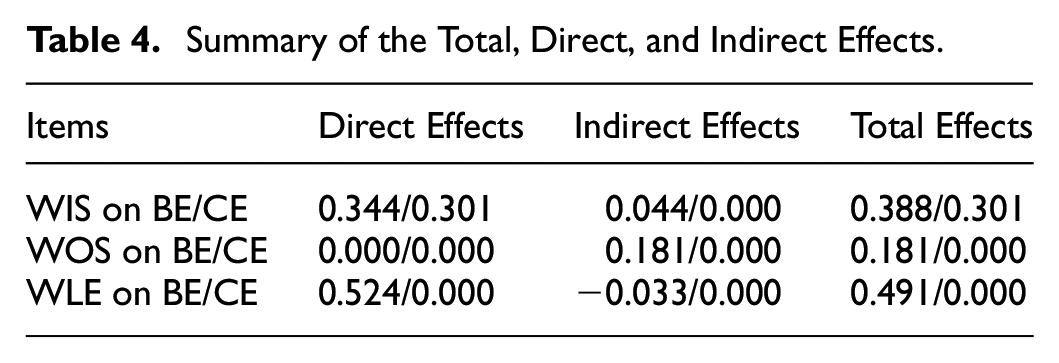
In terms of indirect effects, both writing motivation variables significantly affected BE through anxiety (p < .05). Interestingly, a negative indirect effect was observed between WLE and BE, with a coefficient of −0.033, which was much smaller than the direct effect of 0.524. Furthermore, WOS had an indirect effect on BE, with a coefficient of 0.181. More importantly, no indirect effect was found between CE and writing motivation, indicating that anxiety did not mediate the relationship between writing motivation and CE.
Overall, writing motivation influenced BE indirectly through the mediating role of anxiety, with most coefficients being positive. This highlights that anxiety served a mediator in the relationship between writing motivation and BE, but not for CE.
Evaluating the Influence of Different Task Groups on the Model
The first step in our analysis involved fitting the data from each task group (FC, LC, and NC) into the model individually to assess the Goodness of Fit. The results indicated that the three groups had similar outcomes when fitted into the same model, with only minor discrepancies. This similarity in results paved the way for the next step of the analysis—the multi-group analysis (see Table 5).
Multi-group Analysis (Different Task Groups).

Note. M1=Unconstrained, M2=Measurement weights, M3=Structural weights, M4=Structural covariances, M5=Structural residuals.
p < .001.
In the multi-group analysis, the model was segmented into five categories: M1 (Unconstrained), M2 (Measurement weights), M3 (Structural weights), M4 (Structural covariances), and M5 (Structural residuals). Upon scrutinizing the data under Model Fit (see Table 5), we found that the indicator values across the five models were fairly consistent, and each model had a p-value less than 0.01, indicating a significant level of consistency across all models.
To assess the level of significance, we calculated the difference between chi-square and degrees of freedom (M5 − M4, M4 − M3, M3 − M2, M2 − M1) and examined the p-value in the model comparison. The results revealed p-values of .257, .727, .133, and .313 respectively, all of which were significantly higher than .05. These results demonstrate that all the chi-square differences in the corresponding degrees of freedom differences were significant across all five models. This implies that the different data groups had a minimal impact on the model, and that the model was both stable and reliable. In other words, the “group” factor did not exhibit a moderating effect. In summary, the multi-group analysis results showed that all five model indicators were high and statistically significant. However, it was determined that the type of task did not influence the final results of the model.
Discussion
The Effect of Anxiety on Writing Motivation and Engagement
The final model of the present study confirmed the mediating role of writing anxiety, as established by testing relevant factors. Specifically, the indirect impact of writing motivation on Behavioral Engagement (BE) through writing anxiety was revealed. BE, in this context, refers to learners’ attention and effort (Skinner et al., 2009). The findings indicate that the three factors of writing motivation identified indirectly influence the BE of Vietnamese university students in Chinese writing, mediated by writing anxiety. This highlights the significant role of anxiety in their Chinese writing motivation. As a reflection of learners’ emotional responses, writing anxiety can affect the L2 writing process, such as reducing cognitive processing capabilities and attention, as suggested by Tahmouresi and Papi (2021). Nonetheless, there was a positive relationship between the factors of writing motivation (specifically, WIS and WOS) and BE. This implies that writing anxiety did not inhibit the BE of Vietnamese university students, but rather facilitated it. An increase in WIS and WOS was significantly linked with an increase in students’ BE. Conversely, WLE showed a negative indirect effect on BE, suggesting that a heavy writing workload could lead to a decrease in BE. However, considering that the Vietnamese university students in this study had approximately 3 years of experience in Chinese writing and were still improving, this negative impact did not influence their writing engagement. The study also found that CE, reflecting learners’ perceptions and attitudes towards writing tasks (Martin, 2010; Skinner et al., 2009), was not impacted by the mediating effect of anxiety. This suggests that the students’ attitudes towards the writing task, once established, were resistant to changes in anxiety levels.
The current study revealed that moderate levels of anxiety might enhance L2 writers’ motivation. The mediating role of writing anxiety was found to be not detrimental, but rather beneficial, in that an increase in anxiety levels boosted behavioral engagement among Vietnamese university students. This heightened arousal from anxiety could focus attention and stimulate effort towards writing tasks, potentially improving overall writing efficacy. However, a significant increase in WLE might eventually have a negative impact on the relationship between anxiety and performance. The evidence from this study suggests that writing anxiety can increase writing motivation and behavioral engagement among Vietnamese university students. Based on these findings, several pedagogical recommendations can be made. Firstly, educators might consider increasing the difficulty of existing Chinese writing tasks. This could be achieved by increasing word count requirements, decreasing the time allotted for composition, or expanding the range of topics for assignments. These strategies aim to induce a level of anxiety that, as suggested by the findings, may maintain or enhance students’ motivation and writing engagement. Secondly, considering the difficulty of altering established attitudes and perceptions towards Chinese writing among Vietnamese university students, language instructors are advised to focus on cultivating interest during the early stages of Chinese language learning. Pedagogical approaches that foster encouragement and confidence could be beneficial for beginners. For example, teachers could introduce various writing tasks, such as online writing contests and collaborative group assignments. These activities could diversify the writing experience and help maintain high levels of interest in the Chinese language, potentially boosting students’ intrinsic motivation and active engagement in Chinese writing.
Besides, the study demonstrated that moderate anxiety levels might facilitate L2 writers’ motivation, and writing anxiety was found to mediate not as a harmful variable but as a beneficial one, whereby an increase in anxiety levels strengthened behavioral engagement among Vietnamese university students. This heightened state of arousal from anxiety might sharpen focus and stimulate effort toward writing tasks, potentially enhancing overall writing efficacy. Nevertheless, an excessive increase in WLE might eventually exert a threatening influence on the relationship between anxiety and performance. Collectively, the evidence from this study implicates writing anxiety as a driver of increased writing motivation and behavioral engagement among the 229 Vietnamese university students. Informed by these insights, the study proffers several pedagogical recommendations. To begin with, teachers might consider escalating the complexity of existing Chinese writing tasks. It could involve increasing word count requirements, shortening the allotted composition time, or broadening the thematic range of assignments. Such strategies aim to induce a steadied anxiety, which, as suggested by the findings, may sustain or upgrade students’ motivation and writing engagement. Moreover, given the challenges in altering Vietnamese university students’ established attitudes and perceptions toward Chinese writing, language instructors are advised to concentrate on fostering interest in the early stages of Chinese language acquisition. Pedagogical approaches that promote encouragement and bolster confidence could benefit beginners. For instance, teachers might implement various writing tasks, from online writing contests to collaborative group assignments. These activities diversify the writing experience and help sustain high levels of interest in the Chinese language, potentially amplifying students’ intrinsic motivation and proactive engagement in Chinese writing.
Comparative Analysis Among Three Task Groups
The multi-group analysis results indicate robust stability in models across various task groups (p < .001). Previous studies have suggested that task selection can lead to cognitive stress in L2 learners, potentially impacting their learning experiences either positively or negatively (Patall, 2012). Tasks characterized by high selectivity have been found to increase learner engagement and motivation, while those with low selectivity may disrupt the normal perceptual faculties of L2 learners (Mozgalina, 2015).
In order to optimize the learning experience, it is suggested that a wide range of choices be provided to learners. This approach helps to increase their engagement and motivation (Mozgalina, 2015; Patall, 2012). Interestingly, the study contradicts previous research (Mozgalina, 2015), which proposed that anxiety in learners was significantly impacted by FC, LC, and NC. In this study, we found no evidence suggesting that different levels of task selectivity led to varying degrees of anxiety among Vietnamese university students. In addition to this, this research revealed that varying task conditions did not play a moderating role. Although we observed variations in motivation and engagement among the 229 Vietnamese university students across different task groups, these variations were not linked to task selection. This implies that task selection may simply be a method of learning for these students. Changing their learning method did not decrease their motivation or engagement. Instead, it potentially enriched their learning experience. The research further suggests that the relationship between writing anxiety and writing motivation and engagement of Vietnamese university students is significant and consistent, regardless of the task type.
We found that anxiety played a significant positive role across all three task groups. An increase in anxiety led to a corresponding increase in writing motivation and engagement among Vietnamese university students, irrespective of the task chosen. Intriguingly, the task selection appears to function merely as a medium for these students to immerse themselves in the Chinese learning experience, without significantly impacting their anxiety or motivation levels. Given the potential of task selection to enrich the learning experience, we recommend that Chinese language teachers increase the selectivity of writing tasks. This can be achieved by providing a broader range of reading materials for composition and designing more semi-structured and open-ended writing activities. By increasing task selectivity, educators can simultaneously stimulate and enhance the interest and motivation of Vietnamese university students in composing Chinese texts.
Conclusion
In this study, writing tasks were established to analyze the mediating effects of anxiety on the relationship between motivation and engagement in Vietnamese CSL learners. The theoretical impetus behind this study was to uncover the multifaceted influence of anxiety on writing motivation and engagement within the framework of diverse writing tasks. This inquiry enables a sharper comprehension of the degree to which varying anxiety-inducing factors exert influence over Vietnamese CSL learners’ motivation and engagement across different writing activities. From practical perspective, it was observed that instead of heightening anxiety levels, the variety of writing tasks enhanced the learners’ enthusiasm for learning, bolstered their motivation, and intensified their engagement with learning to write in Chinese, ultimately contributing to a promotion in their writing proficiency. Consequently, this suggests that teachers should consider deploying a range of flexible and dynamic writing tasks as a strategic approach to elevate motivation and engagement among Vietnamese CSL learners, thereby reducing the anxiety associated with other dimensions of Chinese language acquisition.
While this study provides valuable insights, it does have certain limitations that need to be addressed. Firstly, the data used in the study was obtained through a student questionnaire. Although this approach facilitated the exploration of anxiety, motivation to write, and engagement among CSL learners, the limitations of the questionnaire format and the quantitative nature of the data restricts our understanding of the nuances and shifting trends in these variables. To overcome this, future research should consider integrating qualitative data, possibly collected through semi-structured interviews with learners and teachers. This would provide a more comprehensive and dynamic understanding of CSL learners’ anxiety, motivation, and engagement from the learning perspectives. Secondly, the study’s participants had an average of over two years of experience in Chinese writing. Therefore, the impact of anxiety on motivation and engagement among CSL learners with different durations of writing training remains unknown. Future research should explore this aspect in detail, investigating the experiences of CSL learners with varying lengths of writing training experience. Finally, the study did not consider the potential variations in CSL learners’ anxiety across different life stages, such as the transition from school to the workplace. The impact of these variations on writing motivation and engagement is an important area for future research. Longitudinal surveys could be utilized in future studies to capture these changes over time and to understand their implications.
This study yields several forthcoming implications. We refined an existing questionnaire, building upon the efforts of prior researchers, thus supporting the instrument with acceptable reliability and validity. Consequently, this modified scale is well-suited for assessing writing anxiety, motivation, and engagement among CSL learners in diverse geographical contexts. Nevertheless, given the widespread interest in the writing of CSL learners from various regions and cultural backgrounds, it is critical to adapt the questionnaire items further to reflect the specificities of different learner environments accurately. Such adjustments are essential to ensure that the instrument accurately captures the genuine anxiety, motivation, and engagement levels while preserving the established reliability and validity of the questionnaire. Concurrently, the study encountered challenges in securing data from CSL learners with other different writing training durations, which led to the exclusion of writing ability from the analysis. Recognizing that learners’ writing proficiency may have a distinct influence on their anxiety, motivation, and engagement with writing is essential. Future research that evaluates writing ability among CSL learners would be invaluable. Such research could elucidate the extent to which, and in what ways, proficiency in writing modulates the interplay between anxiety, motivation to write, and engagement, contributing to a more nuanced understanding of these dynamics in L2.
Footnotes
Acknowledgements
We extend our heartfelt gratitude to the Chinese language teacher and university students in Vietnam for their invaluable contributions to this research. Their assistance, particularly in the recruitment of research participants and in facilitating communication with them, was instrumental to the success of this study. We are deeply grateful to the teachers for their support and assistance in translating the questionnaires. Without their time and efforts, this research would not have been possible.

Ethical Considerations
The studies involving human participants were reviewed and approved by the Human Research Ethics Program at The Education University of Hong Kong (Ref. no.2021-2022-0013). Written informed consent for participation was not required for this study, in accordance with both national legislation and institutional requirements.
Funding
The author(s) disclosed receipt of the following financial support for the research, authorship, and/or publication of this article: This work was supported by the PROCORE-France/Hong Kong Joint Research Scheme (Project No. F-EdUHK803-24), the French National Research Agency /Research Grants Council Joint Research Scheme (Project No. A_EdUHK802/22), the Guangdong Philosophy and Social Science Foundation (Project No. GD25YJY34), and the Center for Language Education and Cooperation (CLEC) (Project No. YHJXCX23-044).
Declaration of Conflicting Interests
The author(s) declared no potential conflicts of interest with respect to the research, authorship, and/or publication of this article.
Data Availability Statement
Data sharing not applicable to this article as no datasets were generated or analyzed during the current study.