



Abstract
In digital marketing environments, consumers are increasingly encountering advertising images created by artificial intelligence (AI). Nonetheless, the psychological mechanisms through which advertising images AI disclosure labels (present vs. absent) influence consumer responses remain under-explored. Grounded in the elaboration likelihood model and regulatory focus theory, this article proposes a double-edged sword framework and tests the hypotheses in three online experiments. Study 1 shows that AI disclosure labels enhance advertising attitude, product attitude, and purchase intention through increased perceived novelty, while simultaneously weakening these outcomes by reducing perceived authenticity. Study 2 further reveals a moderating role of regulatory focus: compared with prevention-focused consumers, promotion-focused consumers strengthen the positive effect of the novelty pathway and attenuate the negative effect of the authenticity pathway. Study 3 demonstrates that product type also moderates these effects. For utilitarian products, the positive influence of the novelty pathway is amplified, whereas the negative influence of the authenticity pathway is reduced. These findings elucidate the dual psychological mechanisms of AI disclosure labels in advertising images, deepen understanding of why consumers exhibit divergent attitudinal evaluations and decision tendencies under labeled versus unlabeled conditions, and offer practical guidance for balancing innovative appeal and perceived authenticity in advertising practice.
Plain Language Summary
People are seeing more ads that use images created by artificial intelligence (AI). Some ads include a label saying the image was made by AI. Our research shows that this label can help—but it can also hurt. When people see the AI label, they often find the ad more new and interesting, which can improve their attitudes and increase their willingness to buy. At the same time, the label can make the ad feel less real, which can reduce these positive reactions. These effects also depend on the person and the product. Consumers who enjoy new ideas respond more positively, while those who are more cautious focus more on the loss of authenticity. For practical, utilitarian products, the benefits of looking new become stronger, and concerns about authenticity become weaker. AI labels can shape how people feel about ads in both good and bad ways, and marketers need to balance novelty with authenticity.
Keywords
Introduction
AI technology has become a key driver of innovation in the advertising industry (Tang & Yu, 2025). By enabling advertisers to better identify target audiences’ needs and behaviors, AI-powered advertising facilitates the development of personalized strategies that enhance advertising effectiveness (Qin & Jiang, 2019). Moreover, AI advertising creates new opportunities for digital marketing (Song et al., 2024). With the rapid proliferation of AI technologies in marketing and advertising, the question of whether and how to disclose AI usage to consumers has become an increasingly prominent concern for both the public and regulators. However, many companies still fail to provide explicit disclosure. When consumers realize that AI has been used without their knowledge, they may feel deceived (Campbell et al., 2022), which can negatively impact their trust and attitudes toward the company. The use of AI may also trigger a phenomenon known as “AI aversion,” in which people tend to perceive AI-related behaviors or outputs as lacking humanity, and may even deny the humanness of those who use AI (Dang & Liu, 2024). As a result, consumers may view AI-generated content as lacking these uniquely human qualities, leading them to perceive it as psychologically less authentic or devoid of “human essence.”
The disclosure of AI-generated advertising has been shown to significantly influence consumer attitude, yet existing research findings remain inconsistent. Some studies suggest that revealing the AI identity can produce positive effects. For instance, disclosing that a short video advertisement was generated by AI can enhance users’ willingness to engage (Chen et al., 2025). In the context of social media advertising, when consumers perceive AI as capable of handling complex tasks, such disclosure can increase their willingness to engage in word-of-mouth communication (L. Wu et al., 2025). In service contexts, AI environments have been found to promote greater user participation (Yin et al., 2023), and disclosing AI-generated virtual endorsers can enhance purchase intention (Franke et al., 2023; X. Wang & Qiu, 2024). However, other studies have found that AI disclosure may weaken advertising effectiveness. Revealing AI involvement can reduce consumers’ trust and positive attitude toward advertisements (Grigsby et al., 2025), decrease donation intentions in prosocial advertising (Arango et al., 2023; Baek et al., 2024), and lower trust, perceived quality, and usage intentions in hedonic service settings (Xu et al., 2024). Similarly, disclosing the use of AI in recruitment can trigger algorithm aversion and reduce job seekers’ interest (Keppeler, 2024).
Although prior research has examined the role of AI disclosure in advertising, most studies adopt a unidirectional perspective, suggesting that AI disclosure either enhances (L. Wu et al., 2025) or diminishes (Grigsby et al., 2025) advertising effectiveness, while overlooking its potential to generate both positive and negative effects simultaneously. Moreover, it remains unclear under what conditions consumers’ regulatory focus influences the relationship between AI disclosure labels and advertising effectiveness. Existing studies primarily focus on the direct effects of AI disclosure on consumer trust, attitude, and purchase intention (Baek et al., 2024; Chen et al., 2025; X. Wang & Qiu, 2024), with limited attention to the moderating role of individual psychological traits. According to regulatory focus theory (Higgins, 1997), promotion-focused consumers emphasize growth and gains and tend to respond positively to information emphasizing novelty and efficiency, whereas prevention-focused consumers prioritize safety and risk control and are more likely to question uncertain information. Therefore, in the context of AI-generated advertising, consumers with different regulatory focus may exhibit divergent cognitive evaluations and emotional responses. In addition, prior research has shown that product type significantly affects consumer reactions to AI involvement in marketing. However, it remains unclear how product type affects advertising effectiveness in the context of AI disclosure labels in advertising images.
Therefore, we aim to explore three research questions:
Drawing on the elaboration likelihood model and regulatory focus theory, our study proposes an integrated framework that explains how AI disclosure labels in advertising images influence advertising effectiveness through different persuasion routes. Promotion-focused consumers tend to use the peripheral route and respond more positively to simple cues such as the perceived novelty of AI-generated content. Prevention-focused consumers tend to use the central route and process information more carefully to evaluate the authenticity and trustworthiness of the advertisement. The study also examines how product type (utilitarian vs. hedonic) affects these relationships.
Theoretical Background
AI Disclosure
There are two emerging fields of research that focus on consumer responses to AI disclosure. The first stream of research has examined the positive impacts of AI disclosure on consumer responses. For example, Chen et al. (2025) show that AI disclosure increases user engagement, particularly when users rate AI ability highly, which alleviates concerns about content quality. AI disclosure also shapes consumers’ word-of-mouth intentions, as people are more willing to share AI-generated advertisements when they believe AI can handle complex tasks (L. Wu et al., 2025). In contexts where a digital spokesperson’s AI identity is disclosed, purchase intention rises because transparency enhances perceived competence and experiential capacity (X. Wang & Qiu, 2024). Similarly, virtual spokespersons can boost the perceived novelty of advertisements, while clear labeling reduces confusion and discomfort, ultimately improving advertising effectiveness (Franke et al., 2023).
The second related stream of research in this domain pays attention to the negative impacts of AI disclosure. Luo et al. (2019) show that revealing a chatbot’s identity sharply reduces purchase conversion, as users perceive AI as lacking empathy. In service contexts, disclosure can lower trust, service quality, and usage intention, while also triggering fear and feelings of alienation (Xu et al., 2024). Early disclosure in high-contact services similarly diminishes satisfaction (Yu et al., 2024). In recruitment, informing applicants that AI screened their applications reduces job interest (Keppeler, 2024). In prosocial advertising, disclosure undermines perceived credibility, weakens advertising attitude, and decreases donation intention (Arango et al., 2023; Baek et al., 2024).
We summarize the main research findings about AI disclosure in Table 1. It can be found that previous research presents contradictory findings: some studies highlight its positive effects on consumer engagement and purchasing behavior, while others reveal negative consequences in terms of reduced trust and perceived authenticity. Consequently, it remains unclear whether, and in what ways, AI disclosure influences advertising effectiveness.
Overview of the research on AI disclosure.

Note.
Advertising Effectiveness
In social-media settings, the dynamic features of advertising, their interactive forms, and user-generated content turn consumers into co-constructors of meaning rather than passive receivers. Because of this shift, prior work on message–attitude congruence (Zeng et al., 2022) and the amplifying role of emotion in immersive experiences (Y.-L. Wu & Chen, 2024) has not yet clarified how the ad context must align with consumers’ mental schemas for brand feelings to translate into attitudes and behavior. At the same time, technological change keeps extending the sensory boundaries of advertising. Immersive media such as AR and VR raise perceived value (Uribe et al., 2022) and add immediacy and interactivity to brand stories. Value orientation (Jiang et al., 2020) and racial or cultural identity (Craddock et al., 2025) likewise shape advertising effectiveness by fostering cross-cultural matching and resonance. From a methodological perspective, integrating different types of data (Sharma et al., 2022) together with physiological and behavioral measures (To et al., 2021) offers more detailed insights into how immersion, informativeness, and attention are related. This encourages researchers to move beyond single measures and to test theories with evidence from multiple dimensions.
Drawing on these insights, the present study examines how AI disclosure influences users’ attitudes, emotions, and behavioral decisions. We assess advertising effectiveness using three indicators—advertising attitude, product attitude, and purchase intention—and test whether the presence or absence of AI disclosure labels in advertising images generates different consumer responses.
Elaboration Likelihood Model (ELM) and Regulatory Focus Theory (RFT)
Since Petty and Cacioppo (1986) introduced the ELM, scholars have applied it across domains such as advertising, information systems, and crowdfunding. According to the ELM, persuasion occurs through two distinct routes: a central route, involving effortful evaluation of argument quality, and a peripheral route, driven by salient cues and low elaboration. In integrated marketing communication, Garretson and Burton (2005) demonstrated that consistency between packaging and spokesperson strengthens brand attitude when brand relevance and motivation are high—conditions that activate the central route. More recent research has shown that contextual elements such as interface design (Li, 2013), social recommendations (Shao et al., 2023), and “likes” on influencer videos (Chen et al., 2025) can serve as peripheral cues. Similarly, in crowdfunding, Allison et al. (2017) found that highly motivated backers rely on central cues such as founders’ credentials, whereas less experienced supporters respond to peripheral signals like group identity.
Regulatory focus theory (Higgins, 2000) offers a complementary motivational lens. Individuals with a promotion focus pursue gains and approach-oriented goals, processing affective and novelty-rich messages more fluently, whereas prevention-focused individuals emphasize safety and accuracy, responding better to credible, authenticity-based information (Roy & Phau, 2014; Yi & Lee, 2024). This focus–message “fit” enhances persuasion by shaping information processing fluency (Kim et al., 2023; Mowle et al., 2014). In human–machine interactions, the same fit effect emerges: warm, personable chatbots resonate more with promotion-focused users, while competence-oriented designs better satisfy prevention-focused ones (Choi & Zhou, 2023; Sun et al., 2024).
Integrating ELM and RFT, our study proposes that promotion-focused consumers rely more on the peripheral route, being drawn to perceived novelty as a heuristic cue signaling innovation and excitement, whereas prevention-focused consumers rely more on the central route, emphasizing perceived authenticity as a diagnostic cue reflecting reliability and truthfulness. Thus, novelty and authenticity are not independent constructs but function as dual-route mechanisms that align with motivational orientation: promotion focus enhances peripheral processing (novelty), while prevention focus strengthens central processing (authenticity).
Research Hypotheses
AI Disclosure Labels, Perceived Novelty, and Advertising Effectiveness
Within the ELM, when consumers face limited cognitive resources or low involvement, they tend to rely on peripheral cues that evoke excitement (Petty & Cacioppo, 1986). This route requires minimal cognitive effort, so evaluations are based on cues at a surface level rather than deeper content. The introduction of new technologies often triggers perceptions of novelty and curiosity. For instance, in an AR shopping study, perceptions of novelty enhanced engagement and satisfaction (Tom Dieck et al., 2023), and the use of an AI influencer in social media advertising increased perceived novelty (Franke et al., 2023). Heuristic processing also leads to quicker adoption when consumers have not thoroughly examined a new technology (Khatri et al., 2018). In advertising images, AI disclosure labels serve as technological cues. When consumers realize an image is AI-generated, it triggers curiosity about the technology (Chen et al., 2025; H. Zhang et al., 2022), associates AI with innovation and uniqueness (Liu et al., 2024), and elevates perceived novelty. According to affect-transfer theory, positive perceptual experiences foster favorable attitude toward the source of the information, enhancing persuasion. As a result, when consumers perceive an advertising as novel, they are more likely to view it as creative, form positive associations with the product or brand, and ultimately improve advertising effectiveness. Therefore, we propose:
AI Disclosure Labels, Perceived Authenticity, and Advertising Effectiveness
Unlike novelty, authenticity is associated with the central route in the ELM, where persuasion depends on argument quality and source credibility (Petty & Cacioppo, 1986). When content is AI-generated, consumers often associate algorithmic creation with a lack of human insight and judgment (Y. Zhang et al., 2025), leading them to perceive lower authenticity and credibility (Arango et al., 2023; Baek et al., 2024). Empirical studies show that AI disclosure reduces trust and positive attitude toward service advertising (Grigsby et al., 2025). In donation contexts, perceiving an image as AI-made or low-cost diminishes empathy, thereby lowering donation intention (Arango et al., 2023). On social media platforms, revealing a video as AI-generated can prompt users to question the technology’s complexity and the content’s overall quality, reducing engagement (Chen et al., 2025). Even when an advertising image is explicitly labeled as AI-made, the disclosure can undermine confidence in the accompanying message. Authenticity serves as a belief-driven foundation for persuasion. When perceived authenticity is high, consumers are less resistant and more likely to form favorable attitude and purchase intention. Conversely, even in emotionally engaging or creative advertising, low perceived authenticity raises concerns about credibility and weakens persuasive effectiveness. Therefore, we propose:
Moderating Role of Regulatory Focus
Regulatory focus theory posits that individuals approach activities like investing or shopping with either a promotion focus, prioritizing gains and taking associated risks, or a prevention-focused orientation emphasizing risk minimization and self-protection (Higgins, 1997). Consumers with different regulatory focuses exhibit distinct consumption behaviors. Promotion-focused consumers are more attuned to the benefits of new products and perceive less risk, making them more willing to try new products. In contrast, prevention-focused consumers are more cautious, prioritizing risk avoidance and uncertainty reduction (Herzenstein et al., 2007). In the context of AI-generated advertising images, promotion-focused consumers, when aware that an image was created by AI, are more likely to focus on the advantages of this new technology, increasing their perceived novelty. They tend to have more positive attitude toward AI and perceive higher authenticity compared to prevention-focused consumers, who are more sensitive to risks and uncertainties. Therefore, we propose:
The Moderating Role of Product Type
Previous research shows that product type plays an important role in shaping consumer responses to AI-assisted marketing (Ahn et al., 2022). Utilitarian products emphasize practicality and functional attributes, whereas hedonic products emphasize sensory experience and emotional satisfaction (Holbrook & Hirschman, 1982). Because utilitarian products can be evaluated through objective criteria, AI disclosure tends to have a positive effect: consumers value information accuracy, and AI-generated advertisements and virtual spokespeople often increase purchase intention and willingness to pay (Song et al., 2024; H. Zhang et al., 2022). AI chatbots also improve satisfaction when the information needed is functional, as consumers view AI as capable of providing objective and rational advice (Longoni & Cian, 2022; Ruan & Mezei, 2022). Although AI disclosure may reduce perceived authenticity, this negative effect is weakened in utilitarian contexts. In contrast, hedonic products rely on subjective feelings and emotional connection, so consumers expect authenticity and human-like expression. When they learn that an ad is AI-generated, they tend to question its authenticity and empathy, leading to lower willingness to pay for AI-designed hedonic products and greater discomfort when AI virtual influencers recommend experiential goods (Song et al., 2024; H. Zhang et al., 2022). Prior studies also show that AI-recommended hedonic products receive lower evaluations than human recommendations, and AI customer service yields lower satisfaction for sensory attributes (Ruan & Mezei, 2022; Wien & Peluso, 2021). Neuroscience research further indicates that AI recommendations for hedonic products can trigger psychological resistance (Xie et al., 2022). Therefore, we propose:
Figure 1 presents the overall research model of this study. The research aims to examine how AI disclosure labels in advertising images influence advertising effectiveness through distinct psychological mechanisms and to test the boundary conditions of these effects. We propose that AI disclosure labels in advertising operate through two parallel routes: a peripheral route driven by perceived novelty, which enhances advertising effectiveness by evoking curiosity and freshness; and a central route driven by perceived authenticity, which, when reduced, undermines advertising effectiveness. Furthermore, consumers’ regulatory focus (promotion vs. prevention) is expected to moderate the strength of these two routes. Promotion-focused individuals, who rely more on affective and heuristic cues, are likely to strengthen the positive impact of the novelty-based route. In contrast, prevention-focused individuals, who value credibility and accuracy, are expected to attenuate the negative impact of the authenticity-based route. Building on this, product type (utilitarian vs. hedonic) is proposed as an additional boundary condition. When the advertised product is hedonic, consumers’ attention to emotional and sensory experiences makes the novelty induced by AI disclosure labels more persuasive. However, when the product is utilitarian, consumers depend more on rational evaluation and functional performance, making reduced authenticity from AI disclosure labels more detrimental to advertising outcomes.

Research model.
Study 1: Mediating Mechanisms of AI Disclosure Labels (Present vs. Absent) on Advertising Effectiveness
Study 1 was conducted to verify hypotheses
Pretest
To further explore the impact of AI disclosure labels on advertising effectiveness, the research design must pay particular attention to whether users can detect that the advertising images were generated by AI. In this study, participants were asked to imagine their frequently used shopping apps as the experimental environment. We adopted the Chinese-developed Jimeng app, which can intelligently generate advertising product images, to create the advertising images used as experimental materials.
To ensure the validity of the experimental data and the reliability of the results, we conducted a pretest before the formal experiment. The purpose of the pretest was to eliminate interference from other irrelevant variables and ensure validity and internal consistency. The pretest primarily focused on two aspects: (1) product interest, where participants rated how interested they were in the advertised product. (2) AI disclosure labels manipulation. Participants were randomly assigned to one of two conditions: the presence or absence of AI disclosure labels. The two advertisements were identical in all aspects except for AI disclosure labels. In the AI disclosure labels condition, a small text was displayed at the bottom of the image, stating, “This image was generated by AI.” In the no-label condition, no such text was present. These explicit labels were designed to signal the AI-generated nature of the image to participants, manipulating the presence of the disclosure cue. The pretest was conducted on Credamo, a widely used survey platform in China.
Participants first viewed the advertising image and then completed a short questionnaire consisting of two key measures: (1) Product interest, assessed using a seven-point Likert scale (1 = not at all interested, 7 = very interested), which measured participants’ level of interest in the advertised product. (2) AI disclosure labels manipulation, also measured on a seven-point Likert scale (1 = did not notice any AI-related statement, 7 = clearly noticed an AI-related statement), to evaluate the effectiveness of the manipulation.
A total of 60 valid responses were collected. An independent-samples t-test showed no significant difference in product interest between the two conditions (Mpresent = 5.30, SDpresent = 1.264, Mabsent = 5.60, SDabsent = 1.102, t(58) = 0.980, p = .331), indicating that the two advertisements were comparable in attractiveness. For AI disclosure recognition, the score was significantly higher in the AI-label condition than in the non-label condition (Mpresent = 6.57, SDpresent = 0.504, Mabsent = 2.23, SDabsent = 0.626, t(58) = −29.531, p < .001) demonstrating that participants clearly distinguished between advertisements with and without AI disclosure labels. These results confirm that the manipulation was successful.
Study 1 Design
Study 1 Process
Study 1 adopted a single-factor between-subjects design. The sample size was calculated with G*Power (α = .05, statistical efficacy = 0.80, effect size = 0.25). Both groups were assigned equal sample sizes, resulting in a minimum total of 128 participants for the formal experiment (Faul et al., 2007).
During the formal experiment, participants were randomly assigned to one of two conditions: AI disclosure labels present or absent. At the beginning of the questionnaire, an informed-consent screen appeared, and participants could freely choose to participate or withdraw. Those who agreed were informed that the task included two parts: a scenario-reading task and a questionnaire task. After entering the main procedure, each participant read the following scenario:
Recently, you have been troubled by the dryness in your room and plan to purchase a humidifier. During your lunch break, you opened your usual shopping app and browsed to see if there were any suitable options. While browsing, you saw an advertisement for a humidifier. You clicked the ad to view details, carefully examined the images and text, and began to form your impressions.
To ensure that participants in the online experiment fully understand and process the contextual information provided, the experiment design controls the minimum dwell time on the material page, requiring participants to spend at least 20 s reading the page to ensure they have sufficient time to carefully read the experimental context materials. After completing the first stage of the contextual reading task, the system interface will proceed to the second task of completing the relevant questionnaire.
Variable Measurement
To test hypotheses
Finally, participants completed a demographic survey. To ensure attention and avoid careless responses, two attention check items were included in the experiment. Participants who failed these items were treated as invalid cases and excluded from the data analysis.
Results and Discussion
After the experiment, 150 questionnaires were collected. After excluding those who failed the attention check, 149 valid questionnaires remained. Among them, 73 participants were in the AI disclosure group and 76 in the non-AI disclosure group. The sample included 64 male participants (42.95%) and 85 female participants (57.05%). The largest proportion of participants was aged 21 to 30, accounting for 41.61%.
The reliability analysis showed that all multi-item scales demonstrated good internal consistency. Cronbach’s α was 0.909 for perceived novelty, 0.843 for perceived authenticity, 0.866 for advertising attitude, 0.842 for product attitude, and 0.898 for purchase intention. All values exceeded the 0.7 threshold, indicating satisfactory reliability. The KMO values for each variable ranged from 0.699 to 0.756, all exceeding 0.60. In addition, Bartlett’s test of sphericity was significant (p < .001), indicating that the data were suitable for factor analysis. The measurement model was examined using item loadings, internal consistency reliability, and variance extracted. Supplemental Appendix A (Supplemental Table A1) reports the standardized factor loadings, Cronbach’s alpha, rho_A, composite reliability, and AVE for all multi-item constructs. All items loaded strongly on their respective constructs, with standardized loadings exceeding 0.70. The reliability indices (Cronbach’s alpha, rho_A, and composite reliability) were all above 0.70, indicating good internal consistency. In addition, all AVE values were greater than 0.50, providing evidence of satisfactory convergent validity. Correlations among the constructs and the Fornell-Larcker matrix are presented in Supplemental Appendix A (Supplemental Table A2). For each construct, the square root of its AVE was higher than the correlations with other constructs, indicating that the constructs exhibit adequate discriminant validity in this study.
We used PROCESS (Model 4, 5,000 bootstrap samples, 95% CI) to test the parallel mediated effects of perceived novelty and perceived authenticity on the relationship between AI disclosure labels (present vs. absent) and advertising outcomes. Advertising attitude, product attitude, and purchase intention served as dependent variables, and gender, age, and education were included as covariates. Results are shown in Figure 2.
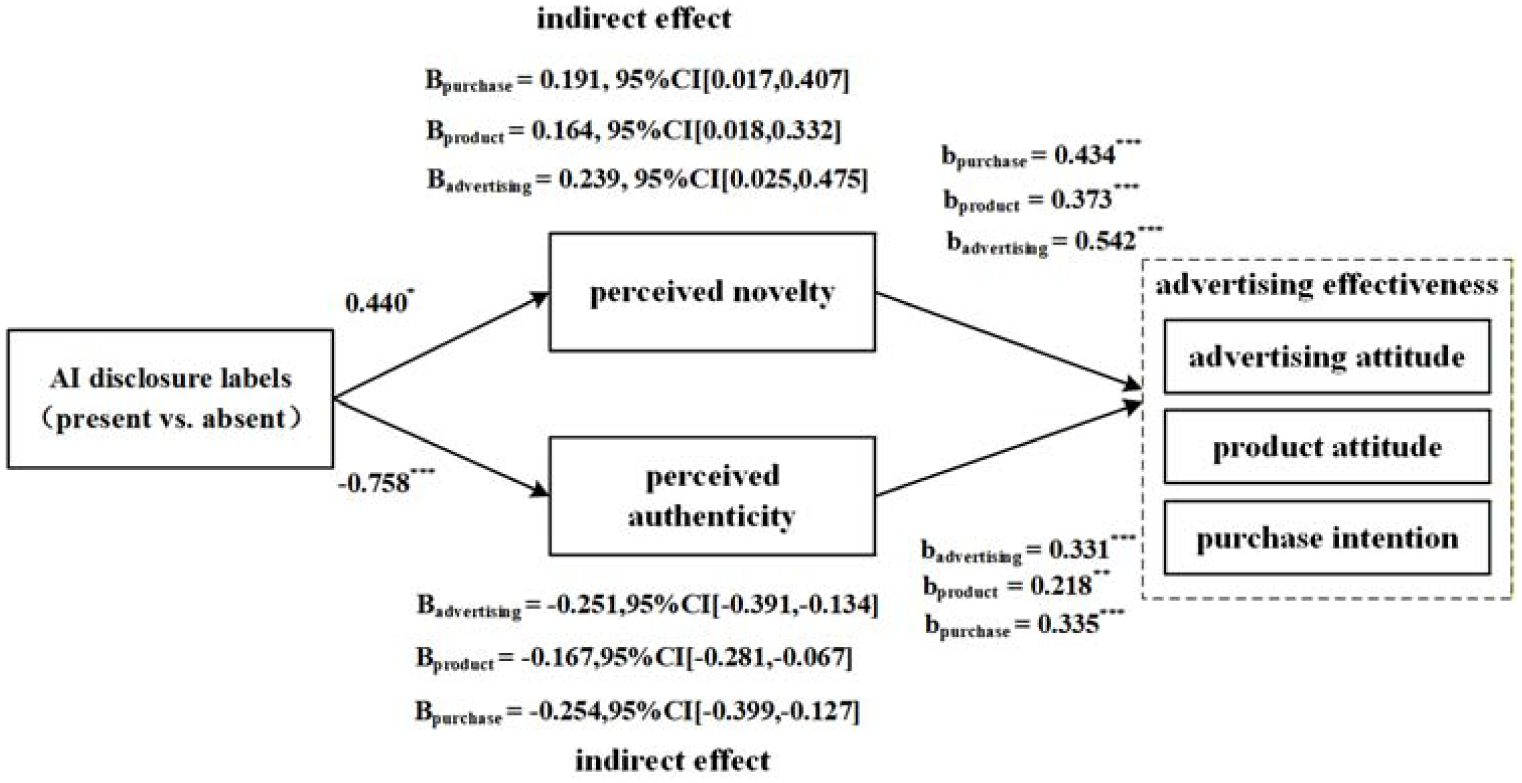
Mediation effect test results.
According to the research hypothesis, AI disclosure labels present were expected to increase perceived novelty (
Despite the significant correlations among advertising attitude, product attitude, and purchase intention, the results of this study show that the indirect effects differ across these outcome variables. The indirect effect through perceived novelty was strongest for advertising attitude (B = 0.239), followed by purchase intention (B = 0.191), and weakest for product attitude (B = 0.164). This pattern suggests that novelty primarily enhances evaluations of the advertisement itself, with more limited spillover effects on product attitude and purchase intention. In contrast, the negative indirect effect through perceived authenticity was more pronounced for purchase intention (B = −0.254) and advertising attitude (B = −0.251), while relatively weaker for product attitude (B = −0.167). This indicates that the reduction in authenticity has a stronger impact on affective responses and behavioral intentions.
Study 2: Moderating Role of Regulatory Focus
Study 2 tested
Pretest
To ensure the appropriateness of the materials and the effectiveness of the manipulation, a pretest was conducted for Study 2 prior to the formal experiment, following the same procedure as Study 1. participants were randomly assigned to one of two conditions: the presence or absence of AI disclosure labels. The two advertisements were identical in all aspects except for AI disclosure labels. In the AI disclosure labels condition, a small text was displayed at the bottom of the image, stating, “This image was generated by AI.” In the no-label condition, no such text was present. The pretest was administered on the Credamo platform, and a total of 60 valid responses were collected.
An independent-samples t-test showed no significant difference in product interest between the two conditions (Mpresent = 4.97, SDpresent = 1.326; Mabsent = 5.17, SDabsent = 1.085, t(58) = 0.639, p = .525), indicating that the two groups were comparable in terms of advertisement attractiveness. In terms of AI disclosure recognition, participants in the AI disclosure labels present condition reported significantly higher recognition than those in the label absent condition (Mpresent = 6.23, SDpresent = 0.626; Mabsent = 2.57, SDabsent = 0.504, t(58) = −24.988, p < .001), demonstrating that participants clearly distinguished between advertisements with and without AI disclosure labels, confirming the effectiveness of the manipulation.
Study 2 Design
Study 2 Process
Study 2 used a 2 (AI disclosure labels: present vs. absent) ×2 (regulatory focus: promotion vs. prevention) two-factor between-groups experimental design, with the sample size determined using the G*Power software to set the significance level α to 0.05, the statistical efficacy to 0.8, and the medium-level effect size to 0.25, and to set the four sets of The sample data were equal and the final output was a total sample size of not less than 179 for the formal experiment (Faul et al., 2007).
Study 2 followed the same procedure as Study 1 but used a different context and focal product. Participants then read the following scenario: “It is a weekend afternoon. You take the subway downtown to shop. The car is relatively empty, and you sit scrolling on your phone. When the train stops, you glance up and notice an ad on the platform. It is for a hair dryer (a product you have been considering recently), and it catches your attention. You carefully examine the ad’s images and copy and begin to form your impressions.”
Variable Measurement
The measurement of perceived novelty, perceived authenticity, attitude, product attitude, and purchase intention followed the same scales as in Study 1. Regulatory focus was assessed with the scale developed by Higgins et al. (2001), which contains six items for promotion focus and five items for prevention focus. Participants then provided demographic information. To ensure attentiveness and filter out careless responses, two attention check items were embedded in the survey; any respondent who failed either item was classified as an invalid case and removed from the analyses.
Results and Discussion
Before conducting the formal analyses, the data were first cleaned and examined. A total of 300 participants took part in the experiment. After excluding those who failed any attention check, 249 valid responses remained (56.22% female, Mage = 30.88). The Cronbach’s α values for perceived novelty (Cronbach’s α = .922), perceived authenticity (Cronbach’s α = .879), advertising attitude (Cronbach’s α = .894), product attitude (Cronbach’s α = .891), purchase intention (Cronbach’s α = .863), and regulatory focus (Cronbach’s α = .779) were all above 0.7, indicating satisfactory reliability of the scales. The KMO values for each variable ranged from 0.726 to 0.875, all exceeding 0.6. In addition, Bartlett’s test of sphericity was significant (p < .001), indicating that the data were suitable for factor analysis. The measurement model showed acceptable psychometric properties. Most standardized item loadings were above 0.70, and Cronbach’s alpha, rho_A, and composite reliability for all multi-item constructs exceeded .77, indicating good internal consistency. AVE values were above 0.50 for all constructs except regulatory focus (AVE = 0.461). When a construct’s AVE is slightly below 0.50 but its composite reliability (CR) is higher than 0.60, its convergent validity can still be considered acceptable (Fornell & Larcker, 1981). Given the satisfactory reliability indicators for the regulatory focus construct and the exploratory nature of this study, we retained this construct. The square root of each construct’s AVE was higher than its correlations with other constructs, indicating an acceptable level of discriminant validity (see Supplemental Appendix B, Supplemental Tables B1 and B2).
This study employed hierarchical regression analysis to examine the moderating effect of regulatory focus. To avoid multicollinearity, the regulatory focus variable was mean-centered in advance and used to construct an interaction term with the independent variable (AI disclosure labels). Subsequently, perceived novelty and perceived authenticity were entered as dependent variables in separate models, with control variables, the independent variable, the moderator, and the interaction term added stepwise. As shown in the Table 2, Model 3 indicates that the interaction between AI disclosure labels and regulatory focus has a significant positive effect on perceived novelty (β = .417, p < .001), with a positive ΔR2. Model 6 further shows that the interaction term also exerts a significant positive effect on perceived authenticity (β = .455, p < .001), with a positive ΔR2. Therefore, hypothesis
Regression analysis results.

Note. The table reports standardized regression coefficient, ***p < .001.
To further verify the moderating effect of regulatory focus, the high and low levels of the moderator (±1 SD) were entered into the regression model, and simple slope graphs were plotted based on the regression results (see Figures 3 and 4). Specifically, +1 SD represents promotion-focused consumers, whereas −1 SD represents prevention-focused consumers. Figure 3 shows that when consumers exhibit a higher level of promotion focus, the presence of AI disclosure labels significantly enhances perceived novelty. In contrast, when prevention focus is high, the effect of AI disclosure on perceived novelty weakens or even becomes negative. This indicates that promotion-focused consumers strengthen the positive relationship between AI disclosure and perceived novelty (Figure 3). Therefore,

Moderating role of regulatory focus in the relationship between AI disclosure labels and perceived novelty.
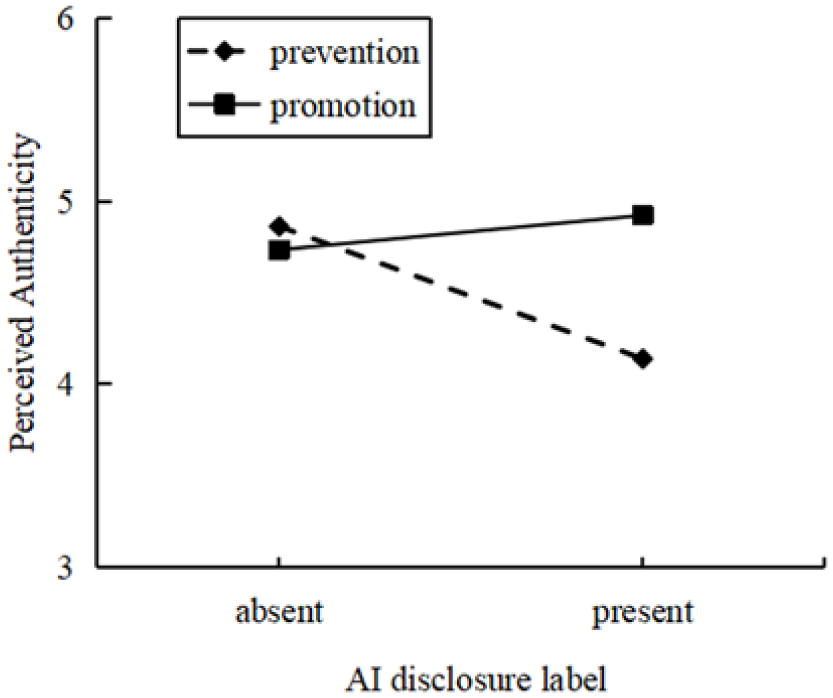
Moderating role of regulatory focus in the relationship between AI disclosure labels and perceived authenticity.
Study 3: Moderating Role of Product Type
Study 3 aims to test hypotheses
Pretest
This study selected a laptop computer as the experimental product. To ensure the appropriateness of the materials and the effectiveness of the manipulations, a pretest was conducted for Study 3 prior to the formal experiment. Participants were randomly assigned to either the “AI disclosure labels present” or “AI disclosure labels absent” condition. The two advertisement versions were identical except for whether the label “This image was generated by AI” was displayed. At the same time, following Wien and Peluso (2021), product type was manipulated through the advertisement copy. In the utilitarian product condition, the advertisement highlighted functional and practical attributes of the laptop: equipped with a next-generation high-performance chip, a lightweight body, and long battery life, allowing users to efficiently complete various tasks. Whether preparing reports, processing data, or working on the go during business trips, the laptop offers stable and reliable performance to support smooth and efficient work. In the hedonic product condition, the advertisement emphasized emotional and entertainment-related features: an ultra-high-definition display and surround-sound system provide an immersive audiovisual experience. Whether binge-watching shows, playing games, or editing creative content, users can enjoy smooth operation and visual pleasure, allowing entertainment and inspiration to flow freely. Product type manipulation was assessed using two items: “To what extent does purchasing this recommended laptop represent hedonic consumption?” and “To what extent does purchasing this recommended laptop represent goal-oriented consumption?”
The pretest was conducted via the Credamo platform, and a total of 60 valid responses were collected. An independent-samples t-test showed no significant difference in product interest between the two conditions (Mpresent = 6.52, SDpresent = 0.634; Mabsent = 2.52 SDabsent = 0.677; t(58) = −23.598, p < .001), indicating that the two groups were comparable in terms of advertisement attractiveness. Regarding AI disclosure recognition, participants in the AI disclosure labels present condition reported significantly higher recognition than those in the label absent condition (Mpresent = 5.69, SDpresent = 1.471; Mabsent = 2.49, SDabsent = 1.736; t(153.05) = −12.532, p < .001), demonstrating that participants clearly distinguished between advertisements with and without AI disclosure labels, confirming the effectiveness of the AI disclosure manipulation. For the product type manipulation, participants in the utilitarian product condition reported significantly higher ratings on the utilitarian consumption item than those in the hedonic product condition (Mutilitarian = 5.78, SDutilitarian = 0.863; Mhedonic = 2.82, SDhedonic = 1.289; t(58) = −10.296, p < .001). Conversely, participants in the hedonic product condition reported significantly higher ratings on the hedonic consumption item than those in the utilitarian product condition (Mhedonic = 5.79, SDhedonic = 0.995; Mutilitarian = 2.38, SDutilitarian = 1.100; t(58) = 12.526, p < .001). These results indicate that the product type manipulation was successful.
Study 3 Design
Study 3 Process
Study 3 adopted a 2 (AI disclosure labels: present vs. absent) ×2 (product type: utilitarian vs. hedonic) between-subjects experimental design. The required sample size was determined using G*Power software, with a significance level of α = .05, statistical power = 0.80, and an effect size of f = 0.25, assuming equal group sizes. The calculation indicated that the minimum required sample size for the formal experiment was 179 participants (Faul et al., 2007).
Participants were randomly assigned to one of the four conditions: “AI disclosure labels × utilitarian product,”“no AI disclosure labels × hedonic product,”“AI disclosure labels × hedonic product,” and “no AI disclosure labels × utilitarian product.”
The experimental scenario was described as follows: “It is a weekend evening, and you are preparing to buy a new laptop at home. While browsing online advertisements, one laptop ad catches your attention. You carefully look at the image and the accompanying text description, and begin to consider whether it meets your needs.”
To ensure that participants in the online experiment could fully understand and process the provided scenario information, the materials page included a minimum time control, requiring participants to stay on the page for at least 20 s to ensure they had enough time to carefully read the experimental scenario materials. After completing the first phase of scenario reading, the system interface proceeded to the second task of filling out the relevant questionnaire.
Variable Measurement
The measurement methods for perceived novelty, perceived authenticity, attitude toward the advertisement, attitude toward the product, and purchase intention were consistent with those used in Study 1. At the end, participants were asked to provide demographic information. To further verify participants’ attention, two attention check items were included in the experiment. Any participant who failed either of these items was considered an invalid sample and excluded from the data analysis phase.
Results and Discussion
Before conducting the formal analyses, the data were first cleaned and examined. A total of 300 participants took part in the experiment. After excluding those who failed any attention check, 283 valid responses remained (59.01% female; Mage = 32.43). The Cronbach’s α values for perceived novelty (α = .915), perceived authenticity (α = .872), advertising attitude (α = .899), product attitude (α = .898), and purchase intention (α = .915) were all above 0.7, indicating satisfactory reliability of the scales. The KMO values for each variable ranged from 0.739 to 0.760, all exceeding 0.6. Additionally, Bartlett’s test of sphericity was significant (p < .001), indicating that the data were suitable for factor analysis. The measurement model showed satisfactory psychometric properties, with all standardized item loadings exceeding 0.70, Cronbach’s alpha, rho_A and composite reliability above .70, AVE values greater than 0.50, and for each construct the square root of its AVE higher than its correlations with other constructs, supporting convergent and discriminant validity (see Appendix C, Supplemental Tables C1 and C2).
To test the moderating effect of product type, a moderated mediation analysis was conducted using the Bootstrap method (PROCESS, Model 7; 5,000 samples). The AI disclosure labels (present vs. absent) served as the independent variable, perceived novelty and perceived authenticity as two mediators, advertising attitude, product attitude, and purchase intention as the dependent variables, and product type as the moderator. Based on the analysis using PROCESS Model 7, the interaction effect between AI disclosure labels and product type significantly influenced perceived novelty (b = 0.991, p < .001) and perceived authenticity (b = 0.599, p < .01), indicating that product type significantly moderated the effect of AI disclosure labels on these two variables. Therefore,
Table 3 presents the direct and indirect effects of AI disclosure labels on advertising attitude, product attitude, and purchase intention through perceived novelty and perceived authenticity, moderated by product type. When advertising attitude was used as the dependent variable, the direct effect of AI disclosure was significantly negative (effect = −0.261, 95% CI [−0.472, −0.049]). For the mediation paths, perceived novelty exerted a significant mediating effect in the utilitarian product condition (effect = 0.765, 95% CI [0.548, 0.998]), whereas the mediation was nonsignificant in the hedonic product condition (effect = 0.156, 95% CI [−0.023, 0.346]. Conversely, perceived authenticity showed a significant negative mediating effect in the hedonic product condition (effect = −0.140, 95% CI [−0.248, −0.037]), but the effect was nonsignificant in the utilitarian product condition (effect = −0.043, 95% CI [−0.124, 0.005]).
Moderated mediation analysis.

When product attitude was used as the dependent variable, the direct effect of AI disclosure was nonsignificant (effect = −0.189, 95% CI [−0.411, 0.034]). For the mediation paths, perceived novelty again had a significant mediating effect in the utilitarian product condition (effect = 0.671, 95% CI [0.463, 0.905]) but was nonsignificant in the hedonic product condition (effect = 0.137, 95% CI [−0.024, 0.307]). In contrast, perceived authenticity demonstrated a significant negative mediating effect in the hedonic product condition (effect = −0.171, 95% CI [−0.281, −0.065]), whereas the effect was nonsignificant in the utilitarian product condition (effect = −0.052, 95% CI [−0.144, 0.006]).
When purchase intention was used as the dependent variable, the direct effect of AI disclosure was nonsignificant (effect = −0.191, 95% CI [−0.419, 0.037]). For the mediation paths, perceived novelty exerted a significant mediating effect in the utilitarian product condition (effect = 0.624, 95% CI [0.430, 0.836]) but not in the hedonic product condition (effect = 0.128, 95% CI [−0.025, 0.290]). Conversely, perceived authenticity showed a significant negative mediating effect in the hedonic product condition (effect = −0.176, 95% CI [−0.289, −0.075]), while the effect was nonsignificant in the utilitarian product condition (effect = −0.054, 95% CI [−0.141, 0.007]).
In summary, product type significantly moderates the mediating effects of perceived novelty and perceived authenticity. Compared to hedonic products, utilitarian products significantly enhance the positive impact of AI disclosure on consumers’ perceived novelty, while significantly weakening the negative impact of AI disclosure on perceived authenticity. Therefore,
Conclusion and Limitations
Conclusion
This study examined the impact and underlying mechanisms of AI disclosure labels in advertising images and their influence on advertising effectiveness, an issue that has not been fully explored. Through three online experiments, our findings were robustly validated. Study 1 revealed that AI disclosure labels can simultaneously stimulate consumers’ perceived novelty, which enhances advertising effectiveness, and evoke concerns about authenticity, which in turn diminish advertising effectiveness. From the perspective of the ELM, perceived novelty corresponds to affective and heuristic processing along the peripheral route, while perceived authenticity reflects cognitive evaluations of credibility along the central route. The coexistence of these two mechanisms suggests that AI disclosure activates dual routes of persuasion, leading to both positive and negative outcomes. These findings align with existing literature on the dual role of AI disclosure in either enhancing or undermining advertising effectiveness, yet they extend prior research by moving beyond studies that have predominantly emphasized only one side of the effects. Earlier studies mainly highlighted the positive outcomes of AI disclosure, such as increased purchase intention (X. Wang & Qiu, 2024) and greater willingness to share word-of-mouth (L. Wu et al., 2025), or the negative outcomes, such as diminished emotional resonance (Arango et al., 2023) and reduced credibility (Baek et al., 2024; Grigsby et al., 2025). By demonstrating both the positive and negative pathways, this study validates the dual mechanisms of AI disclosure and broadens the theoretical boundaries of this research domain. Moreover, the findings address limitations in the one-sided perspectives prevalent in prior studies and offer practical implications.
Study 2 demonstrated that consumers’ regulatory focus significantly moderated the effect of AI disclosure labels in advertising images. Specifically, compared to prevention-focused consumers, promotion-focused consumers strengthened the positive association between AI disclosure and perceived novelty, thereby improving advertising attitude, product attitude, and purchase intention. At the same time, promotion-focused consumers also effectively mitigated the negative impact of AI disclosure on perceived authenticity. Therefore, among promotion-focused consumers, AI disclosure is overall more likely to enhance advertising effectiveness. These findings echo prior research emphasizing the critical role of regulatory focus in information processing and risk perception (Kim et al., 2023; Roy & Phau, 2014), and further extend this line of theory to AI disclosure in advertising contexts. These results are consistent with RFT, which suggests that promotion-focused individuals respond more strongly to affective and novelty-related cues, while prevention-focused individuals are more sensitive to diagnostic and credibility-related cues. By integrating this motivational framework with the dual-route structure of the ELM, the findings show that novelty maps onto peripheral and affective processing, whereas authenticity maps onto central and cognitive processing.
Study 3 demonstrates that product type (utilitarian vs. hedonic) serves as a key boundary condition shaping consumer responses to AI disclosure labels. For utilitarian products, AI disclosure labels significantly enhance perceived novelty and attenuate the negative impact on perceived authenticity, thereby improving overall advertising effectiveness. This is consistent with the view that evaluations of utilitarian products rely on functional, objective cues for which AI is perceived as competent (Ruan & Mezei, 2022; Song et al., 2024; Xie et al., 2022). In contrast, for hedonic products, AI disclosure labels fail to offset the authenticity loss, leading to weaker attitudinal and behavioral responses. Because hedonic consumption depends heavily on affective experience and perceived human touch, AI-generated content is less able to meet these experiential expectations.
Theoretical Contributions
This study offers three main theoretical contributions to the field of AI disclosure in advertising images.
First, we propose and validate a “dual-path-dual-outcome” integration framework based on the ELM, which overcomes the limitations of prior studies that typically examined only single positive or negative effects. Previous research has largely focused on whether disclosure strengthens or weakens advertising effectiveness, thereby overlooking the multiple psychological mechanisms that may simultaneously operate during message processing. By demonstrating that perceived novelty (peripheral route) and perceived authenticity (central route) jointly mediate the influence of AI disclosure, this study integrates both the positive and negative outcomes into a unified explanatory model and extends the application of ELM to the emerging context of AI-generated advertising content.
Second, by introducing consumer regulatory focus (promotion vs. prevention) as a key moderator, this study uncovers systematic differences in how audiences with distinct motivational orientations process AI disclosure and the outcomes they derive from it. This contribution enriches the literature on audience segmentation and individual differences in advertising. Whereas prior research has primarily examined regulatory focus in the context of privacy-related advertising (Kim et al., 2023), we incorporate promotion-focus and prevention-focus into a moderation framework for AI disclosure effects in advertising images. The results demonstrate that consumers with different motivational orientations follow distinct cognitive routes and reach divergent attitudinal outcomes when confronted with AI disclosure, thereby advancing our understanding of personalized advertising and individual variability.
Third, by integrating RFT with the ELM, this study shows that the dominance of the peripheral versus central route is shaped by individuals’ intrinsic motivational orientation, rather than determined solely by message features or cognitive capacity. Our findings further demonstrate that motivation can initiate and amplify the processing route that best matches a person’s orientation: promotion-focused consumers magnify the influence of the peripheral route and reduce reliance on the central route, whereas prevention-focused consumers do the opposite. Consequently, future research on AI-related disclosures or advertising effectiveness should consider the interaction between message characteristics and individual motivation to provide a richer theoretical lens for explaining the complex formation and change of attitudes in real-world consumption settings.
Practical Contributions
First, advertisers can design disclosure strategies that vary across stages of the consumer journey in order to balance the benefits of perceived novelty with the costs of lower perceived authenticity. AI disclosure labels increase the perceived novelty of ad creativity and help capture attention in the early stages of the funnel, such as awareness and initial interest. However, because disclosure may weaken perceived authenticity, advertisers can mitigate this risk in later stages closer to conversion by providing more detailed product information, highlighting quality guarantees, or incorporating human elements such as expert or employee endorsements to restore credibility.
Second, advertisers should take consumers’ regulatory focus into account when deciding how and when to disclose AI use in advertising. Our findings indicate that promotion-focused consumers are more responsive to the novelty pathway and more tolerant of reduced perceived authenticity, whereas prevention-focused consumers are more sensitive to authenticity-related concerns. In practice, firms can assess the regulatory focus of their target segments through market research, customer surveys, or pretests, using methods that are ethical and privacy-safe, and then tailor disclosure messages accordingly. For audiences with a stronger promotion focus, creative executions that emphasize innovation and efficiency of AI-generated content may be more effective, whereas for audiences with a stronger prevention focus, messages that stress reliability, verification, and human oversight may be preferable.
Third, Marketers should consider product type when designing and delivering AI-generated advertising. For utilitarian products, AI-generated images with disclosure labels may enhance perceived novelty without substantially harming authenticity, making them suitable for campaigns emphasizing functionality and efficiency. In contrast, for hedonic products, where emotional resonance and authenticity matter more, human-created content may be more effective, as AI disclosure can dampen perceived authenticity and reduce persuasion. Tailoring creative formats to product type can therefore improve overall advertising effectiveness.
Limitations and Directions for Future Research
This study has several limitations that provide avenues for future research. First, the use of online scenario experiments ensures strong internal validity but does not fully replicate the continuous and dynamic advertising environments in which consumers naturally encounter AI disclosures. Future work could enhance external validity by conducting field experiments on real advertising platforms. Second, participants were recruited exclusively from China, and cultural background may influence how AI disclosure shapes perceived novelty and authenticity. Cross-cultural research is therefore needed to examine whether the dual-route mechanism and the moderating role of regulatory focus generalize across cultural contexts. Third, the negative impact of AI disclosure on perceived authenticity may not stem solely from a lack of human insight. In some contexts, AI-generated content may instead be interpreted as more objective or unbiased. Future research could explore these competing narratives and investigate whether the interaction between perceived novelty and authenticity, potentially including nonlinear or “uncanny valley” effects, shapes consumer responses in different AI-generated content. Fourth, consumers’ prior familiarity with AI, as well as the frequency and form of exposure to AI-generated advertising, may influence both novelty and authenticity perceptions. Future research could examine these boundary conditions and explore how situationally primed regulatory focus induced by advertisement content interacts with consumers’ chronic regulatory focus to influence reactions to AI disclosure. Fifth, individual differences such as need for uniqueness or technology anxiety may further moderate the effectiveness of AI disclosure labels, suggesting additional psychological factors worth investigating. Finally, this study relies on self-reported questionnaire data collected within a single survey session, which may introduce common-method bias. Future research could incorporate behavioral measures or multiple data sources to validate and extend the present findings.
Supplemental Material
sj-docx-1-sgo-10.1177_21582440261417793 – Supplemental material for Consumer Responses to AI Disclosure Labels: The Role of Novelty and Authenticity
Supplemental material, sj-docx-1-sgo-10.1177_21582440261417793 for Consumer Responses to AI Disclosure Labels: The Role of Novelty and Authenticity by Yuting Shi and Zhibin Jiang in SAGE Open
Footnotes
Acknowledgements
The authors would like to thank Credemo for providing support in data collection.

Ethical Considerations
This study received ethical approval.
Consent to Participate
All participants provided informed consent prior to participation in the study.
Funding
The authors received no financial support for the research, authorship, and/or publication of this article.
Declaration of Conflicting Interests
The authors declared no potential conflicts of interest with respect to the research, authorship, and/or publication of this article.
Data Availability Statement
The datasets used and/or analyzed during the current study available from the corresponding author (
Supplemental Material
Supplemental material for this article is available online.
References
Supplementary Material
Please find the following supplemental material available below.
For Open Access articles published under a Creative Commons License, all supplemental material carries the same license as the article it is associated with.
For non-Open Access articles published, all supplemental material carries a non-exclusive license, and permission requests for re-use of supplemental material or any part of supplemental material shall be sent directly to the copyright owner as specified in the copyright notice associated with the article.
