




Abstract
Based on Unified Theory of Acceptance and Use of Technology 2 (UTAUT2), this research investigates the key factors that influence postgraduate students’ engagement with Artificial Intelligence (AI)-powered chatbots in the context of academic writing, while also analyzing how gender moderates these relationships. A total of 232 postgraduate participants were randomly chosen to complete a structured questionnaire evaluating their responses to nine core constructs: performance expectancy, effort expectancy, social influence, facilitating conditions, hedonic motivation, price value, habit, behavioral intention, and actual use. The collected data were examined using the Partial Least Squares Structural Equation Modeling (PLS-SEM) approach. The findings reveal that effort expectancy, habit, and social influence significantly predict behavioral intention, whereas performance expectancy, hedonic motivation, price value, and facilitating conditions do not have a notable influence. Additionally, behavioral intention, habit, and facilitating conditions exert a significant positive effect on actual use behavior in AI-assisted academic writing. These predictors jointly account for 68.0% of the variance in the usage behavior of AI chatbots. Notably, gender significantly moderates the effects of habit and behavioral intention on usage behavior, while its moderating effect on facilitating conditions is not statistically significant. This study constructs a predictive model for postgraduates’ adoption behaviors in AI-based chatbots academic writing, aiming to elevate their writing proficiency, optimize educational decisions, and encourage their more proactive adoption of this technology. Moreover, it provides new theoretical and practical insights for educational technology in the higher education.
Plain Language Summary
Based on UTAUT 2, this study aims to explore the influencing factors on postgraduates’ use behaviour in academic writing based on artificial intelligence technology while examining the moderating effect of gender. This study randomly selected 232 postgraduates to participate in a survey, measuring their feedback on nine major factors (performance expectancy, effort expectancy, social influence, facilitating conditions, hedonic motivation, price value, habit, behavioural intention, and use behaviour). The data was analyzed using the Smart PLS method. The research results show that effort expectancy, habit, and social influence significantly impact behavioural intention. In contrast, performance expectancy, price value, hedonic motivation, and facilitating conditions do not significantly influence behavioural intention. Behavioural intention, habit, and facilitating conditions significantly and positively affect the use behaviour of postgraduates in AI-based chatbots academic writing. Collectively, these aspects explain 68.0% of the behaviour of postgraduates using AI-based chatbots for academic writing. Moreover, there are noticeable gender differences in the influence of habit and behavioural intention on use behaviour. In contrast, the relationship between facilitating conditions and use behaviour shows no significant gender difference. This study constructs a predictive model for postgraduates’ adoption behaviours in AI-based chatbots academic writing, aiming to elevate their writing proficiency, optimize educational decisions, and encourage their more proactive adoption of this technology. Moreover, it provides new theoretical and practical insights for educational technology in the higher education.
Introduction
Artificial Intelligence (AI) is an information technology that effectively reduces costs and enhances decision-making benefits (Tang et al., 2021). AI has become integral to diverse sectors amid the rapid technological advancement of the 21st century, including higher education, healthcare, consumer services, finance, and public services(Chou et al., 2024; Hanai et al., 2024; Jin et al., 2023; Mytnyk et al., 2023; Ogegbo et al., 2024). For instance, Jin et al. (2023) showed that AI can effectively measure and enhance students’ self-regulated learning abilities, thereby supporting their online learning. Particularly in education, AI brings unprecedented opportunities for educators and students. Research by Nazari et al. (2021) found that AI-driven writing tools can promote English academic writing learning behaviors and attitude technology acceptance among non-native postgraduates through formative feedback and assessment. AI-based learning systems offer students targeted learning guidance and materials (Liu et al., 2019), effectively enhancing learning outcomes.
AI chatbots utilize natural language processing to communicate with users, as noted by Aslam (2023), simulating human conversation to provide personalized interactions and services (Kuhail et al., 2023). With the rapid development of AI technology, chatbots’ application in higher education has been increasing, primarily in teaching assistance, management, and curriculum design (Ait Baha et al., 2024; Y. Chen et al., 2023; Mohamed, 2024). Mohamed (2024) investigated how ChatGPT can assist in the learning process of students studying English as a Foreign Language (EFL), highlighting that faculty members see great value in ChatGPT as a teaching aid. AI chatbots have been found to ease students’ writing anxiety and boost their confidence in academic tasks (Ait Baha et al., 2024; Song & Song, 2023). Studies in higher education have primarily concentrated on three key areas regarding the use of AI chatbots. Firstly, studies have explored how AI chatbots contribute to enhancing student learning (Labadze et al., 2023; R. Wu & Yu, 2024). Secondly, researchers explored what drives students and teachers to adopt these tools (Al-Sharafi et al., 2023; Menon & Shilpa, 2023; B. Zhang et al., 2023). For instance, Menon and Shilpa (2023) applied the Unified Theory of Acceptance and Use of Technology (UTAUT) framework to examine what shapes users’ acceptance and intention to use ChatGPT, and confirmed that Performance Expectancy (PE), Effort Expectancy (EE), Social Influence (SI), and Facilitating Conditions (FC) all serve as meaningful predictors. Lastly, researchers have studied how to further improve AI chatbots’ performance to better serve teachers and students (J.-S. Chen et al., 2021; Y. Chen et al., 2023). For example, J.-S. Chen et al. (2021) emphasized the need for future research to concentrate on optimizing AI chatbots’ interaction experience and response capabilities to provide more accurate and humanized services. Though prior studies (Malcolm, 2023; Niu & Wu, 2022; Xia et al., 2023) has mentioned AI chatbot use in writing, few studies have examined gender as a moderator. This study addresses that gap.
Theriores and Literature Review
Theoretical Basis
UTAUT2
In recent years, a range of theoretical models has been proposed to clarify what influences individuals’ intention to adopt and utilize technological systems. Among the most widely cited are the TAM, the Theory of Reasoned Action (TRA), and the Theory of Planned Behavior (TPB) (Alzahrani et al., 2018). After comparing, testing, and synthesizing the primary influential factors from the aforementioned models and theories, Venkatesh et al. (2003) introduced the UTAUT. This model facilitates the analysis of users’ Behavioral Intention (BI) toward system use (Morton et al., 2016). The model includes four main components: PE, EE, SI, and FC (Venkatesh et al., 2003). Specifically, PE reflects users’ belief that the system helps them perform tasks or enhance academic results; EE refers to the system’s simplicity and user-friendliness; SI describes the impact on a user from the perspectives of other groups, such as parents, friends, or teachers, regarding system use; and FC represent the convenience of the system in terms of software, hardware resources, and other technical support (Alshehri et al., 2019). Parts involving English names should remain unchanged.
The updated version of UTAUT, refined by Venkatesh et al. (2012), incorporates three additional constructs: Hedonic Motivation (HM), Price Value (PV), and Habit (HA) (Chao, 2019; Venkatesh et al., 2012). HM refers to the level of enjoyment a user feels when using the system (Chao, 2019); PV reflects the user’s judgment of the costs versus the benefits of using the system (Moorthy et al., 2019) and HA signifies the degree to which a user acts automatically (Malcolm, 2023). Additionally, the UTAUT2 recognizes age, gender, and experience as factors that moderate the relationships in technology adoption (Venkatesh et al., 2012).
Numerous researchers have employed and modified the UTAUT2 initially focusing on diverse study subjects. Instances of this include teachers’ use of online learning platforms (Tseng et al., 2019; X. Wu & Wang, 2020), and the adoption of e-learning systems by students in both developed and developing countries (El-Masri & Tarhini, 2017), and the intentions of staff in accepting and using e-learning systems (Mehta et al., 2019). Further, modifications and additions have been made to the research dimensions. Y. B. Zhang et al. (2021) proposed the PR and empirically examined the factors shaping users’ intentions toward engaging with online learning platforms. Tseng et al. (2019) used UTAUT2 to explore factors influencing teachers’ BI and Use Behavior (UB) in the context of MOOCs. Lastly, the UTAUT2 model has been combined with other theories or models for research (Agyei & Razi, 2021). For instance, Mehta et al. (2019) combined UTAUT2 with the Values-Enhanced Technology Adoption (VETA) model, confirming the significant predictive role of individual values on BI. Ameen et al. (2019) extended UTAUT2 by integrating TAM and adding quality-related variables to explain e-learning adoption in Iraq.
From the above analysis, this study focuses on the AI-based chatbots UB of postgraduates academic writing, based on the UTAUT2 model, exploring if there exists a significant gender difference in UB.
Literature Review
Performance Expectancy, Effort Expectancy, Social Influence, and Behavioral Intention
A considerable number of researchers have empirically shown a positive connection between PE and users’ intentions to engage with specific technological tools or platforms in academic or professional contexts (Azizi et al., 2020; Nikolopoulou et al., 2020; Sattari et al., 2017). Specifically, Azizi et al. (2020), based on the UTAUT2 model, confirmed that PE, EE, and SI significantly influence students’ adoption within medical training settings. In this context, the higher the PE and EE, the stronger the intention of postgraduates to utilize AI-based chatbots for academic writing. Moreover, research by Amid and Din (2021) and Moorthy et al. (2019) found that SI positively influences users’ intention to adopt systems like mobile learning or MOOCs. This study, too, suggests that SI from peers, teachers, and parents can significantly shape postgraduates’ intention to use AI-based chatbots for academic writing.
Facilitating Conditions, Behavioral Intention, and Use Behavior
FC have been extensively examined and found to positively influence both BI and UB (Amid & Din, 2021; Azizi et al., 2020; Sattari et al., 2017). Specifically, Amid and Din (2021) found that FC positively influence students’ BI to adopt MOOCs, which aligns with the findings of Azizi et al. (2020) and Sattari et al. (2017), who found that FC significantly influences students’ intention to adopt blended learning. Moreover, FC have been found to directly influence students’ actual UB. Bervell et al. (2022) and Zwain and Haboobi (2019) further established that FC, such as access to necessary resources, significantly drive actual UB in learning environments. In this study, if AI-based chatbots provide adequate learning resources, graduate students show a stronger tendency to apply these chatbots in academic writing.
Hedonic Motivation, Price Value, Habit, and Behavioral Intention
HM is considered crucial in influencing BI, with previous research consistently reporting a strong positive relationship between HM and students’ intention to adopt new systems (Amid & Din, 2021; Azizi et al., 2020; Moorthy et al., 2019). Azizi et al. (2020) and Moorthy et al. (2019) shows that HM significantly promotes students’ BI to use blended learning and mobile learning technologies. Recent studies show HM has more impact on students’ intention than PE or EE in mobile learning (Moorthy et al., 2019). Moreover, both PV and HA are critical determinants of students’ intention to utilize educational technologies. Moorthy et al. (2019) found that PV and HA influence mobile and blended learning. This study hypothesizes that HM, PV, and HA positively influence postgraduates’ intention to use AI chatbots.
Habit, Behavioral Intention, and Use Behavior
Numerous studies have indicated the significance of HA in the BI of users to adopt a system, revealing that HA has a marked influence on such intentions (Azizi et al., 2020; Moorthy et al., 2019; Nikolopoulou et al., 2020). Specifically, Moorthy et al. (2019) found, through studying the acceptance of technology in mobile learning, that HA plays the most substantial role in influencing students’ BI to adopt mobile learning. Similarly, Nikolopoulou et al. (2020) found that HA played the most influential role in shaping students’ BI to engage with mobile learning devices.
Furthermore, many researchers contend that HA directly affects UB (Amid & Din, 2021; Bervell et al., 2022; Zwain & Haboobi, 2019). For instance, Amid and Din (2021) investigated the key determinants affecting how university students accept and make use of MOOCs, determining that HA significantly drives students’ UB toward MOOCs. Bervell et al. (2022), in their study of students’ BI to utilize Google Classroom for online learning, found a significant positive role of HA in influencing UB. Zwain and Haboobi (2019), analyzing potential factors that might affect teachers’ and students’ acceptance of learning management systems, highlighted HA as a crucial determinant propelling teachers and students to adopt such systems.
Behavioral Intention and Use Behavior
Many studies have shown that BI is key to adopting learning systems, highlighting a significant positive correlation between users’ BI and system usage (Amid & Din, 2021; Azizi et al., 2020; Gharrah & Aljaafreh, 2021). Specifically, Amid and Din (2021) studied what drives students to adopt MOOCs, concluding that BI can drive students’ MOOC UB. Gharrah and Aljaafreh (2021) utilizing the UTAUT2, examined Jordanian students’ BI toward learning and found that BI positively predicts UB. Azizi et al. (2020) explored factors influencing students’ BI toward blended learning and found that BI significantly affects its acceptance and use.
The Impact of Gender on AI Chatbot Use Behavior
Gender differences are an important and non-negligible factor when exploring the factors affecting people’s BI toward AI chatbots. Studies have shown significant gender differences in technology acceptance, attitudes, usage frequency, and satisfaction (Campos & Scherer, 2024; Qazi et al., 2022). For example, males and females have different needs and expectations for technology, affecting their acceptance and UB of AI chatbots (Xia et al., 2023). Compared to females, males generally hold a more optimistic attitude toward using AI (Gherheş & Obrad, 2018). Moreover, there are gender differences in user satisfaction when using AI (Kashive et al., 2021; Lee et al., 2021).
Within the UTAUT2 model, Venkatesh et al. (2012) emphasized the significance of gender as a moderating factor within the UTAUT2 model. Studies indicate that user attributes such as age, gender, and experience can influence their HM and BI, subsequently impacting their UB. On the one hand, age and gender influence PV and BI. Conversely, age, gender, and experience lead to variations in UB and BI (Fuksa, 2013). Gender also moderates how FC and HA impact both BI and UB (Ameri et al., 2020; Guo & Li, 2022; F. Yang et al., 2022). For instance, F. Yang et al. (2022) investigated VR-based basketball instruction and the factors shaping students’ BI such technologies. They discovered that FC moderated the impact of gender on UB. Ameri et al. (2020) assessed pharmacy students’ intentions to accept and continue using mobile devices for learning based on UTAUT, showing that gender moderates the effect of HA on UB. Guo and Li (2022) investigated university students using English vocabulary apps for learning, and by establishing a model based on UTAUT2, they concluded that gender moderates the impacts of both HA and FC on UB.
Research Questions
This study applies the UTAUT2 to analyze factors influencing postgraduates’ adoption of AI chatbots in academic writing, and further examines whether gender moderates these relationships. It aims to identify core predictors of UB and assess how effectively these variables account for usage differences. Specifically, the analysis investigates whether the impacts of FC, HA, and BI on chatbot usage differ by gender. Data were collected from 232 randomly selected postgraduate students and analyzed using Partial Least Squares Structural Equation Modeling (PLS-SEM). The findings are expected to deepen understanding of the drivers behind AI chatbot adoption in academic contexts and clarify gender’s role in moderating these relationships.
Key research questions include:
What factors significantly influence postgraduate students’ UB of AI-based chatbots in academic writing?
How much do these factors account for the variation in postgraduate students’ UB of AI-based chatbots in academic writing?
Do FC, HA, and BI affect UB differently by gender?
The model of this study is shown in Figure 1.

Research model.
Methodology
Participants
Data were collected between March and July 2023 at three universities in China using Wenjuanxing. Instructors distributed the survey link in class and via official group chats to reach eligible students. Participation was voluntary and anonymous, with the option to withdraw at any time; no personally identifiable information was recorded. The study was approved by the institutional ethics committee. The design minimized risk, and the anticipated scholarly and educational benefits outweighed minimal risks. Electronic informed consent was presented before any items were shown, and all procedures complied with the Declaration of Helsinki.
Participants were eligible if they had used AI-based academic writing chatbots for at least one semester. Of the 256 responses received, 24 were excluded due to missing data (>20%) or extremely short completion time (<1s per item), indicating inattentiveness (Podsakoff et al., 2003). A total of 232 valid responses were retained. The sample size met the minimum requirement for structural equation modeling, following the rule of thumb proposed by Kline (2023), the sample size, determined by multiplying the number of indicators by 10 and adding 20%, was sufficient for SEM.
PLS-SEM was selected for its suitability in handling complex models and small sample sizes (J. F. Hair et al., 2021). A chi-square test confirmed that the gender distribution (Male = 41.38%, Female = 58.62%) did not significantly differ from institutional records (p = .512), supporting sample representativeness. Demographic details are presented in Table 1.
Sample Demographics.

Instruments
Key constructs such as PE, EE, SI, FC, HM, PV, HA, BI, and UB were measured using a 7-point Likert scale based on participants’ self-reports. The performance expectancy scale, developed by Onaolapo and Oyewole (2018) emphasizing how helpful AI chatbots are perceived in academic writing. The effort expectancy and social influence scales, developed by Nikolopoulou et al. (2021), addressing ease of use and perceived social influence. The facilitating conditions scale, developed by Sahin et al. (2022), which evaluates available technical support. The hedonic motivation, habit, and behavioral intention scales, developed by Rudhumbu (2022), focusing on enjoyment, behavioral habits, and intention to continue usage. The price value and use behavior scales, developed by Y. B. Zhang et al. (2021), capturing perceived value and actual use. Full item wordings and references for each instrument are provided in Table A1.
Statistical Analysis
Smart PLS 4.0 was used for data analysis. Given the relatively small sample size (n = 232) and the complexity of the research model, PLS-SEM was deemed appropriate (J. Hair et al., 2021). The analysis included three steps: assessing reliability and validity through item loadings, composite reliability, Cronbach’s alpha, AVE, HTMT, and Fornell–Larcker; testing collinearity, path significance, and predictive power; and examining gender differences in the effects of BI, FC, and HA on UB.
Results
Measurement Model
Following Sarstedt et al. (2021), we used a measurement model to evaluate reliability and validity. Indicator loadings and composite reliability confirmed construct reliability, with all loadings exceeding 0.708 and CR values above 0.7. Cronbach’s alpha (>.7) indicated good internal consistency. AVE (>0.5), HTMT (<0.85), and Fornell–Larcker results confirmed reliability and validity (Tables 2–4).
Reliability and Validity.

Discriminant Validity (HTMT Criterion).

Discriminant Validity (Fornell-Larcker Criterion).

Note. The bold numbers on the diagonal represent the square root of AVE.
Common Method Variance
The leading component contributed 35.28% to the total variance, which remains below the standard 50% cutoff point (Podsakoff et al., 2003). Additionally, the marker variable method (Lindell & Whitney, 2001) revealed a maximum shared variance of only 1.37% (Johnson et al., 2011). Together, these results indicate minimal common method bias.
Structural Model Evaluation
Collinearity
As shown in Table 5, all VIF values ranged from 1.433 to 3.754, staying within the acceptable threshold. According to Sarstedt et al. (2021), VIF should be below 5, and preferably under 3, to avoid collinearity concerns.
VIF Values of Predictor Constructs.

Significance of the Structural Model Relationship
The structural model significance was tested using bootstrapping in Smart PLS 4.0. Following Sarstedt et al. (2021), we evaluated significance using t-values above 1.96, p-values below .05, and confidence intervals that did not cross zero. Table 6 shows the results.
Significance of the Structural Model Relationship.

Specifically, the relationship between BI (β = .577, t = 8.908, p = .000), FC (β = .221, t = 4.128, p = .000), HA (β = .132, t = 1.987, p = .047) and UB was positive. Likewise, EE (β = −.165, t = 3.139, p = .002), HA (β = .560, t = 11.364, p = .000), and SI (β = .289, t = 4.396, p = .000) were positively related to BI. Finally, the relationship between FC (β = .046, t = 0.585, p = .559), HM (β = −.016, t = 0.183, p = .854), PE (β = .017, t = 0.279, p = .780), PV (β = .167, t = 1.900, p = .057) and BI was not positive. The path coefficient of the research model is shown in Figure 2.
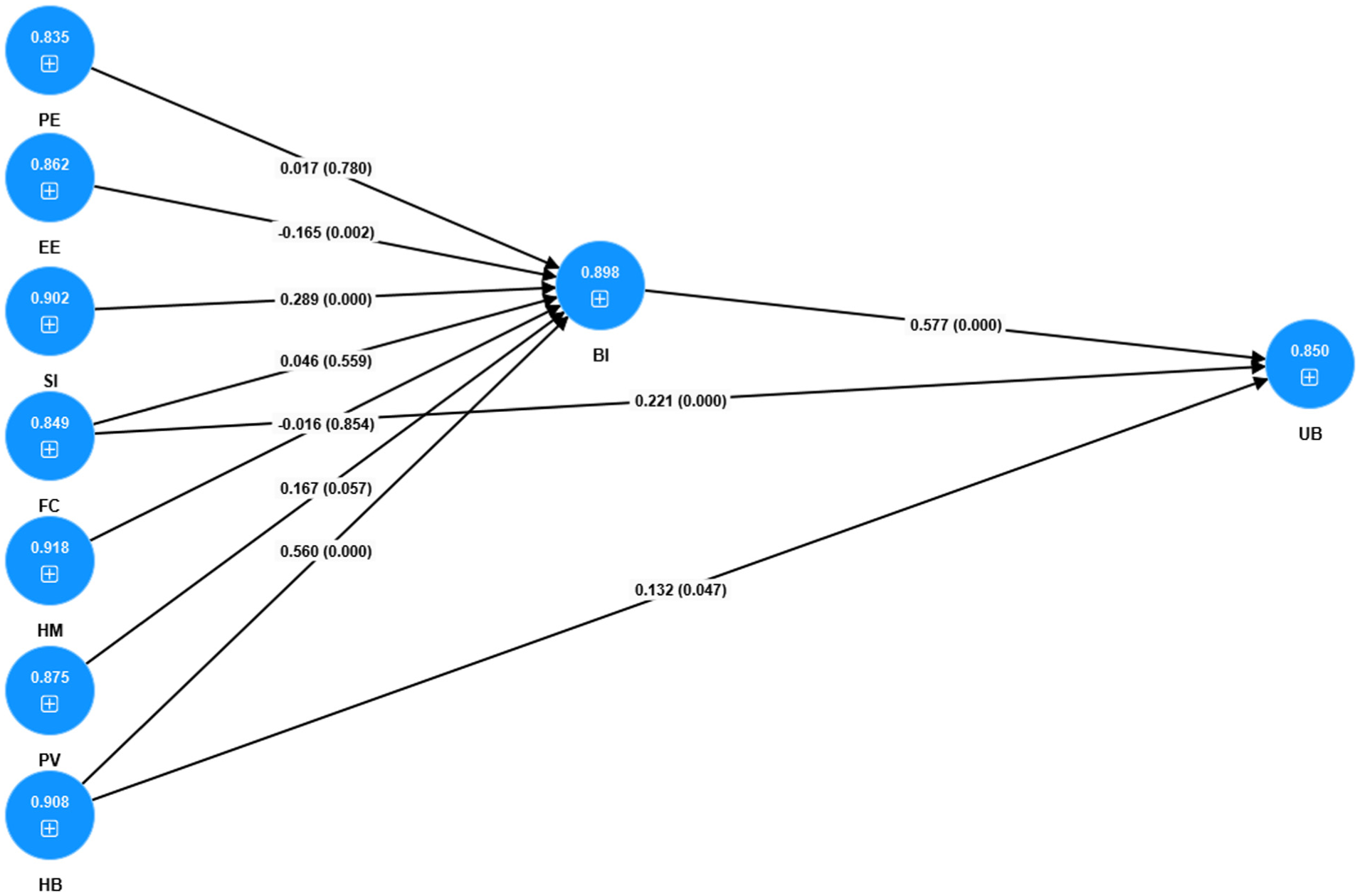
Path coefficients of the research model.
Explanatory Power and Predictive Validity
The R2 and Q2 values were used to assess explanatory and predictive power (Sarstedt et al., 2021). The model accounted for 68.1% of BI variance and 68.0% of UB. All Q2 scores were above zero, indicating good predictive ability (Table 7).
Explanatory Power and Predictive Relevance.

Multi-Group Analysis
Measurement Invariance Analysis
This study uses multi-group PLS analysis to examine gender-based differences in path coefficients, following prior research (Sargani et al., 2021). Prior to conducting the moderation analysis, the MICOM approach was employed to evaluate measurement invariance (Henseler et al., 2016).As Sarstedt et al. (2021) suggest, Multi-Group Analysis (MGA) requires structural and compositional invariance. This study ensured consistent path models and algorithm settings across gender groups, meeting the requirements for invariance testing, fulfilling the essential criteria for establishing structural invariance (Henseler et al., 2016). Evidence of compositional invariance is obtained if the score correlations surpass the lower 5% boundary of the empirical distribution (Henseler et al., 2016). As shown in Table 8, all correlations meet this criterion, confirming compositional invariance across groups (Sarstedt et al., 2021). Thus, measurement invariance is validated.
MICOM Step 2_Compositional Invariance: Across Males Versus Females.

Multi-Group Analysis
After confirming measurement invariance, multi-group analysis was conducted using a gender dummy variable to distinguish males and females (Venkatesh & Morris, 2000). Path differences between groups were analyzed (Zhou et al., 2014), with results shown in Table 9. Findings reveal that BI has a stronger effect on UB in males (β = .434) than in females (β = .123, p = .027). Similarly, HA more strongly predicts UB in males (β = .100) than in females (β = .010, p = .016). However, no significant gender difference was found for the FC–UB link (p = .704).
Comparison of Path Coefficients (Males and Females).

Discussion
This study explores key predictors of postgraduates’ use behavior (UB) regarding AI chatbots in academic writing. Based on prior research, factors including PE, EE, SI, FC, HM, PV, HA, and BI were identified as influential. The model, tested via Smart PLS 4.0, explained 68.1% of chatbot usage. Detailed discussions on the results pertaining to the initially posed research questions will be presented in the subsequent sections.
Firstly, in the direct predictive factors of UB, BI has the most significant impact, followed by FC and HA.
In academic writing, postgraduates’ BI significantly positively influences UB of AI-based chatbots. This result is consistent with the conclusions drawn by Gharrah and Aljaafreh (2021), Amid and Din (2021), and Azizi et al. (2020). When postgraduates strongly intend to adopt new tools, they are often more proactive in learning and adapting to the technology, further propelling their long-term usage of AI-based chatbots to aid academic writing. Furthermore, this BI may be driven by the emphasis postgraduates place on optimizing their use of time and resources. If postgraduates believe that using AI-based chatbots can manage their time more efficiently and enhance writing productivity, this positive cognition could translate into increased tool usage. In conclusion, the stronger the BI of postgraduates, the higher the frequency with which they incorporate AI-based chatbots into their academic writing.
When postgraduates employ AI-based chatbots for academic writing, the FC notably positively influences their UB. This observation is also corroborated by studies from Bervell et al. (2022), Amid and Din (2021), and Zwain and Haboobi (2019). On the one hand, robust software and hardware support ensures the smooth operation of AI-based chatbots, offering students swift literature searches, material organization, and other functionalities, thereby significantly enhancing their academic writing efficiency. On the other hand, user-centric designs mitigate potential challenges that postgraduates might encounter during use, facilitating their mastery and adaptation to AI-based chatbots and consequently increasing their enthusiasm and frequency of use. Thus, if an AI-based chatbots can provide efficient and ample resources and tools, postgraduates are more inclined to adopt AI-based chatbots for academic writing.
When postgraduates utilize AI-based chatbots for academic writing, HA was found to positively influence UB, a result that echoes the findings of Bervell et al. (2022), Zwain and Haboobi (2019), and Amid and Din (2021). On the one hand, habitual use of AI-based chatbots means that postgraduates can quickly master their functions, enabling them to utilize these tools more effectively and enhance the quality of their papers. Additionally, postgraduates achieve higher uniformity and efficiency in the writing process by consistently using these AI-based chatbots. This enables them to concentrate primarily on the research content without being hindered by technical challenges. Therefore, if postgraduates are accustomed to integrating AI-based chatbots into their daily academic writing, they will likely continue this practice throughout their future careers.
Secondly, gender significantly influences how BI impacts UB, and HA and UB, but not between FC and UB.
Among postgraduates using AI-based chatbots for academic writing, a notable gender-based variation exists in how BI relates to UB, aligning with the results reported by Fuksa (2013). Firstly, traditional societal role expectations might lead to differentiated attitudes and behaviors toward technology acceptance between men and women. In many cultural contexts, men are often more encouraged to explore and adopt new technologies, potentially aligning their technological acceptance of BI more closely with actual use. In contrast, women might face more conservative encouragement or expectations, leading to a larger discrepancy between their technological acceptance intentions and actual behavior. Secondly, different academic fields may have gender disparities in their distribution, affecting the accessibility of various resources (e.g., technical training and support) for postgraduates. For those student groups that can more easily access these resources, the transition between BI and actual behaviors might be more seamless.
Among postgraduates using AI-based chatbots for academic writing, the association between HA and UB varies significantly by gender. This result is supported and validated by studies from researchers like Guo and Li (2022) and Ameri et al. (2020). Firstly, gender biases may be present in different academic fields. Taking engineering or computer science as examples, historical and societal factors might lead to men having more exposure to and using technological tools in these domains. Conversely, women may be more dominant in areas such as the humanities. This disparity in gender distribution within disciplines might influence the formation and persistence of usage HA. Secondly, the habitual use of postgraduates is likely influenced by their social circles. Within a gender-specific group, if most members have already adopted a particular AI-based chatbots academic writing tool, other members within that group might be positively influenced and more readily form similar usage HA.
In using AI-based chatbots for academic writing, gender shows no significant moderating effect on the relationship between FC and UB in postgraduate students. This contrasts with the findings of Guo and Li (2022), who reported that gender significantly influenced the connection between FC and UB in the context of English vocabulary learning effectiveness. This inconsistency might be due to the following reasons: Firstly, the primary design goal of most AI-based chatbots academic writing tools is to meet the generic needs of a broad user base rather than targeting a specific gender group. As a result, the direction of tool design and optimization tends to cater to the common needs of all users without special consideration for gender differences. Secondly, the functional conveniences of AI-based chatbots academic writing tools, such as the system’s user-friendliness and abundant software and hardware resources, are objective technical attributes. These attributes are universally applicable to all users, regardless of gender.
The model explains 68.1% of BI variance. EE, SI, and HA positively influence BI.
For postgraduates using AI-based chatbots in academic writing, EE significantly impacts their BI. This finding aligns with the research outcomes of Sattari et al. (2017). Sattari et al. (2017) explored the factors influencing students’ acceptance of online training based on the UTAUT model, academic writing is a task that is both tedious and time-consuming. If postgraduates believe AI-based chatbots can significantly reduce their workload and optimize their workflow, they will likely adopt these technological tools. Additionally, AI-based chatbots offer robust support to postgraduates in areas such as data analysis, literature review, and citation management, subsequently reducing error rates and enhancing the accuracy and comprehensiveness of the research. Therefore, an increase in EE directly leads to an amplified BI among postgraduates to use AI-based chatbots for academic writing.
When postgraduates use AI-based chatbots for academic writing, SI has a significant positive impact on their BI. This finding aligns with prior research by Moorthy et al. (2019), Amid and Din (2021), and Azizi et al. (2020), suggesting that postgraduates’ BI may be shaped by perceived expectations from peers, instructors, or other influential individuals. In other words, when they sense encouragement or endorsement from their social environment, they are more likely to intend to use AI-based chatbots in academic contexts.
For postgraduates using AI-based chatbots in academic writing, HA positively impacts BI. This result is consistent with the work of Nikolopoulou et al. (2020) and Moorthy et al. (2019). On the one hand, postgraduates save time due to their habitual use of AI-based chatbots, leading to enhanced academic efficiency. Improved efficiency strengthens their intention to keep using these tools. Simultaneously, as postgraduates become increasingly accustomed to AI-based chatbots and experience their associated benefits, such as improved writing efficiency or error reduction, these positive experiences further solidify their decisions to use them, creating a sustained feedback loop.
Lastly, this study also found some results that contradict existing research.
For postgraduates using AI-based chatbots for academic writing, PE did not significantly influence BI. This finding contrasts with the conclusions drawn by Azizi et al. (2020), who reported a significant positive link between PE and BI in the context of blended learning for medical students. Several factors may explain this discrepancy. On the one hand, although AI-based chatbots technology is widely recognized in society, not all postgraduates possess the requisite skills and knowledge to effectively utilize these advanced tools. This might lead to them having unrealistic expectations of AI-based chatbots’s capabilities, either too high or too low. On the other hand, despite significant advancements in AI-based chatbots across various domains, it remains in a phase of rapid iteration and evolution. Cutting-edge technologies today might become obsolete shortly, undoubtedly heightening postgraduates’ concerns regarding the stability and reliability of AI-based chatbots.
When postgraduates use AI-based chatbots for academic writing, the FC does not significantly impact BI. This finding contrasts Amid and Din (2021) observation, which suggests that FC can notably drive BI when undergraduates accept and use MOOCs. Several reasons might account for this discrepancy. Firstly, academic writing demands depth, critical thinking, and profound comprehension of the research content. Although AI-based chatbots offer certain conveniences for academic writing, they are unlikely to replace genuine research insights and innovative thinking. Secondly, over-reliance on powerful and user-friendly AI-based chatbots might lead postgraduates to lose their capacity for independent thought and critical analysis in academic writing. Therefore, the FC may not always be the driving factor influencing postgraduates to adopt AI-based chatbots for academic writing.
For postgraduates using AI-based chatbots in academic writing, HM has not demonstrated a significant impact on BI. This result differs from the findings reported by Nikolopoulou et al. (2020), where it was discovered that HM positively affects BI in students’ acceptance of mobile learning devices. The reasons for this discrepancy might include: on one hand, postgraduates might be concerned that an over-reliance on AI-based chatbots in academic writing could lead to malpractices, such as plagiarism or arriving at inaccurate research conclusions. Such apprehensions might diminish their interest in AI-based chatbots academic writing derived from HM. On the other hand, as with many emerging technologies, the initial enthusiasm and interest in new technologies are often transient. Once the students’ curiosity is sated, they may be more inclined to revert to the traditional academic writing strategies they are familiar with.
When postgraduates utilize AI-based chatbots for academic writing, the PV did not significantly influence BI. This contrasts the findings of Amid and Din (2021), who concluded that PV significantly promoted BI in college students’ adoption and use of MOOCs. The inconsistency in these results could be attributed to several factors: Firstly, the primary objective pursued by postgraduates is the production of high-caliber academic achievements and papers. If an AI-based chatbots does not significantly elevate the quality of academic research, then its PV might be diminished, regardless of its cost positioning. Secondly, there might be concerns among postgraduates that over-reliance on AI-based chatbots could lead to allegations of academic malpractices, such as plagiarism. Such worries could further impact their valuation of the AI-based chatbots.
Implications
Based on the UTAUT 2 model, this study predicts the influencing factors of postgraduates’ UB for academic writing utilizing AI-based chatbots. Combined, all dimensions explained 68.0% of the variance in postgraduates’ AI-based chatbots academic writing usage behavior. Hence, the research model and findings of this study carry considerable persuasiveness. The conclusions drawn have both theoretical and practical implications.
Theoretical Implications
This study sheds light on graduate students’ behavioral tendencies toward AI-assisted writing by examining their technology usage patterns. Previous UTAUT 2 studies have primarily focused on fields such as educational technology, healthcare technology, and e-commerce. This study innovatively applies the UTAUT 2 model to the use of AI-based chatbots in academic writing by graduate students, a technology that has received less attention, filling a gap in the field and providing a new research perspective. Previous studies have mostly focused on a broad user base, while this study specifically targets graduate students, exploring their technology adoption behaviors in academic writing. The study further revealed that PE, FC, HM, and PV exert no significant influence on BI, contrasting with earlier research and suggesting new avenues for future investigation.
The study identified gender as a key moderator between HA, BI, and UB among postgraduates using AI chatbots, yet its moderating effect between “FC and UB” is not significant. This insight provides new research findings on how gender impacts postgraduates’ AI-based chatbots academic writing UB. It adds to prior research (Ameri et al., 2020; F. Yang et al., 2022) by providing a new viewpoint on technology use in higher education, marking the study’s second theoretical contribution.
The third theoretical contribution lies in the model’s effectiveness, as it explains 68.1% of the variance in BI and 68.0% in UB, indicating strong explanatory capability. This model boasts a higher predictive relevance and explanatory capability than previous models, which is particularly valuable for this study.
Practical Implications
Firstly, regarding the impact on postgraduates themselves. The research findings show that when postgraduates adopt and use AI-based chatbots for academic writing, EE, SI, and HA significantly influence their BI. It is suggested that postgraduates deepen their understanding of how their HA and social networks influence the effective and systematic use of AI chatbots for academic writing. For instance, students can proactively join or create study groups and online forums to share and discuss experiences and tips on using AI tools. By interacting with peers, students can understand how others enjoy and are motivated by these tools, thereby enhancing their willingness to use them. Additionally, students can participate in workshops organized by schools or community groups about using AI tools. These activities not only provide technical support but also allow students to learn how others utilize social networks and HM to enhance learning outcomes.
Secondly, for educators, understanding the driving factors and potential barriers for postgraduates when using AI-based chatbots for academic writing is crucial. The significant positive influences of EE, SI, and HA on students’ BI should be incorporated into teaching strategies and resource allocation. Additionally, educators need to be cognizant of gender differences and provide targeted support for students of different genders. Educators should organize regular technical training to enhance students’ proficiency in using AI tools, thereby strengthening their BI. By creating learning communities and encouraging students to share and discuss experiences with AI tools, SI can be leveraged to increase the acceptance and usage of these tools. Regular group discussions or online forums can foster interactions among peers, increasing students’ adoption of these tools. Finally, introducing gamification elements in the use of AI tools, such as setting challenges or rewards, can stimulate students’ HM, thereby enhancing their behavioral intention. These targeted strategies can effectively utilize the positive impacts of EE, SI, and HA, while considering gender differences to ensure all students benefit equitably.
Finally, the results provide useful guidance for developers aiming to tailor AI chatbots to the academic writing needs of postgraduate students. On the one hand, the significant positive influence of EE and SI on BI suggests that developers should emphasize the utility of their tools and ensure they garner positive word-of-mouth within communities. For example, studies have shown that enhancing the perceived ease of use and fostering a supportive community significantly increases users’ intention to adopt new technologies (M. Yang et al., 2021). On the other hand, considering the influence of HA, developers should focus on creating onboarding experiences that gradually build user familiarity and long-term engagement with AI tools in academic contexts. Recent research indicates that integrating enjoyable and engaging features into educational tools can significantly boost user adoption and sustained use (Bouchrika et al., 2019; Moorthy et al., 2019).
Limitations and Future Research
Though the study offers useful insights, several limitations are encountered during its implementation. Future research is needed to address and refine these limitations.
Firstly, this research relied mainly on survey data for information collection. Although widely used in the social sciences, the results are still affected by the number and quality of samples. In this study, we collected 232 valid samples, which we believe is sufficient to support generalizable conclusions. Additionally, measures have been taken to ensure sample representativeness and data reliability. Future studies may adopt a longitudinal approach for deeper data collection, revealing the trends in students’ continued willingness to use AI chatbots for academic writing and enhancing the value of the research.
In addition, although gender was examined as a moderator, this study did not incorporate age and experience—both essential moderators in the UTAUT2 framework. This omission might lead to overlooking their interaction effects with the primary research variables. To ensure the comprehensiveness and objectivity of the study, it’s recommended that future research employ advanced statistical methods, such as multi-group analysis, to delve deeper into the impact of age, experience, and other potential moderating variables. Doing so would not only enrich the content of this study but also contribute to the development of theoretical models.
Finally, the influence of AI-specific features on BI and UB was not thoroughly addressed in this study. This limitation may hinder a full grasp of the participants’ real-world challenges and benefits. Future research should more comprehensively analyze the characteristics of AI technology, such as its technical complexity, user-friendliness, and adaptability, to explore its specific impact on user behavioral intention and actual use behavior. This would help provide more accurate and targeted recommendations, enhancing the practical value of the research.
Conclusion
Grounded in the UTAUT2, this study examines the key drivers of postgraduates’ UB toward AI-based chatbots in academic writing and evaluates gender as a moderating factor. Findings show that BI has the strongest positive effect, followed by FC and HA. Gender was found to significantly moderate the effects of BI and HA on UB. Based on these insights, we provide targeted suggestions for students, educators, and developers to strengthen writing skills, enhance informed choices and advance the widespread utilization of AI technologies within academic writing contexts.
Footnotes
Appendix A
Measurement items.

| Constructs | Items | Measurement | Source |
|---|---|---|---|
| PE | PE1 | AI-based chatbots can enhance the efficiency of my writing process. | Onaolapo and Oyewole (2018) |
| PE2 | AI-based chatbots facilitates seamless literature search and information retrieval. | ||
| PE3 | AI-based chatbots can augment the quality of my academic writing. | ||
| EE | EE1 | The process of learning to utilize AI-based chatbots is straightforward for me. | Nikolopoulou et al. (2021) |
| EE2 | My interaction with AI-based chatbots is clear and comprehensible. | ||
| EE3 | My interaction with AI-based chatbots is clear and comprehensible. | ||
| SI | SI1 | People important to me think I should utilize AI-based chatbots. | |
| SI2 | People influencing my behavior think I should utilize AI-based chatbots. | ||
| SI3 | Those I respect advise me to adopt AI-based chatbots. | ||
| FC | FC1 | Having the necessary software and hardware in the AI-based chatbots system is pivotal for me during academic writing. | Sahin et al. (2022) |
| FC2 | User-friendliness of the AI-based chatbots system is a determinative factor in the academic writing process. | ||
| FC3 | It’s vital for the AI-based chatbots system to offer a wealth of resources to me during academic writing. | ||
| HM | HM1 | I find the process of academic writing using an AI-based chatbots system intriguing. | Rudhumbu (2022) |
| HM2 | The experience of academic writing with AI-based chatbots is pleasurable for me. | ||
| HM3 | I derive substantial enjoyment from the process of using AI-based chatbots for academic writing. | ||
| HA | HA1 | Using AI-based chatbots systems for academic writing has become a HA for me. | |
| HA2 | I believe that, during the process of academic writing, I must use AI-based chatbots systems. | ||
| HA3 | I believe that using AI-based chatbots systems for academic writing has become natural. | ||
| BI | BI1 | I plan to continue using AI-based chatbots systems for academic writing in the future | |
| BI2 | If given a choice, I would choose AI-based chatbots systems for academic writing. | ||
| BI3 | If given a choice, I would choose AI-based chatbots systems for academic writing. | ||
| PV | PV1 | I believe that the cost of using an AI-based chatbots system for academic writing is reasonable. | Y. B. Zhang et al. (2021) |
| PV2 | I opine that owning an AI-based chatbots system for academic writing is valuable. | ||
| PV3 | I believe that, in terms of academic writing, AI-based chatbots systems are worth the value. | ||
| UB | UB1 | I am willing to use AI-based chatbots systems for academic writing. | |
| UB2 | I am currently using and will continue to use AI-based chatbots systems for academic writing. | ||
| UB3 | When I need to, I will use AI-based chatbots systems for academic writing. |

Ethical Considerations
The researchers confirm that all research was conducted in accordance with relevant institutional and international guidelines (e.g., the Declaration of Helsinki). This study was approved by the Ethics Committee of Hainan Normal University (Approval No.: HNU-2023-01-0018).
Consent to Participate
All participants were informed of the purpose, procedures, and confidentiality principles of the study and provided their informed consent prior to participation. Participation was voluntary, and respondents could withdraw at any stage without penalty.
Author Contributions
Conceptualization: Na Qiu; Methodology: Na Qiu; Formal analysis and investigation: Na Qiu; Writing—original draft preparation: Na Qiu, Dan Zhu; Writing—review and editing: Dan Zhu; Supervision: Na Qiu, Dan Zhu. All the authors have read and agreed to the published version of the manuscript.
Funding
The authors received no financial support for the research, authorship, and/or publication of this article.
Declaration of Conflicting Interests
The authors declared no potential conflicts of interest with respect to the research, authorship, and/or publication of this article.
Data Availability Statement
The data that support the findings of this study are available on request from the corresponding author.*