



Abstract
With the global rise of digital education, fragmented academic reading has attracted increasing attention, as an emerging learning mode among university students in various countries. This study explores the factors influencing university students’ acceptance and use of fragmented academic reading through a comprehensive framework that integrates the Unified Theory of Acceptance and Use Behavior of Technology 2 (UTAUT2) with several key individual factors, including utilization of fragmented time, self-efficacy, and reading habit. 395 valid samples were collected from Chinese undergraduates through a well-structured online questionnaire survey, and the Structural Equation Modeling with Analysis of Moment Structures software were used to test the hypotheses. The results revealed that effort expectancy, utilization of fragmented time, and facilitating conditions positively affected university students’ behavioral intentions, with facilitating conditions exerting the most potent effect, and especially among science and engineering students. Nonetheless, the impact of performance expectancy and social influence differs across ages, genders, and disciplines; primarily, intentions of female, senior and humanities and social sciences students are positively affected. Moreover, behavioral intention, self-efficacy, and reading habit significantly affected university students’ use behaviors. Furthermore, self-efficacy can positively moderate the relationship between the utilization of fragmented time and behavioral intention, and the relationship between reading habit and use behaviors. This study contributes to the literature on traditional academic reading and general fragmented reading, extends the scope of the UTAUT2 model to informal reading settings, and provides valuable insights for guiding university students’ learning behaviors.
Plain Language Summary
Background
College students’ reading modes all over the world have undergone a revolutionary change with the global rise of digital education. As an informal reading mode emerged with digital education, fragmented academic reading is attracting increasing attention.
Purpose
Integrating the Unified Theory of Acceptance and Use of Technology 2 (UTAUT2) model with several individual factors, including utilization of fragmented time, self-efficacy and reading habit, and this study developed a comprehensive framework to explore the factors on college students’ acceptance and use behaviors of fragmented academic reading.
Methods
395 valid samples were collected from undergraduates in Chinese universities through a well-structured online questionnaire survey. The Structural Equation Modeling with Analysis of Moment Structures software was used to conduct an empirical analysis.
Findings
The results indicate that college students’ behavioral intentions were positively influenced by effort expectancy, utilization of fragmented time, and facilitating conditions (which exert the most substantial impact), and especially among the science and engineering students. However, the positive effects of performance expectancy and social influence differ across genders, ages and disciplines (mainly for female senior and humanities and social sciences students). Moreover, behavioral intention, self-efficacy, and reading habit can significantly promote college students’ use behaviors. Furthermore, self-efficacy can positively moderate the relationship between the utilization of fragmented time and behavioral intentions, and the relationship between reading habit and use behaviors.
Implications
This study enriches the literature on traditional academic reading and general fragmented reading, extend the scope of the UTAUT2 model by applying to informal learning contexts, and offers practical implications for guiding university students’ learning behaviors.
Keywords
Introduction
As a fundamental human activity, reading allows individuals to understand the world and learn about their cultural heritage (Brookes, 1988; W. Liu et al., 2022). The United Nations Educational, Scientific and Cultural Organization has acknowledged the significance of reading, designating April 23rd as “World Reading Day” since 1995. In the context of nationwide reading, with the rapid development of the digital era and the pervasive adoption of mobile devices, reading habits of university students worldwide are undergoing a profound transformation, gradually shifting toward digital reading formats. According to the 2023-2024 K-12 Digital Reading Report released by Sora, a platform under OverDrive (company.overdrive.com), digital reading activities continue to grow among students in 62,000 schools worldwide. Specifically, readings on Sora’s platform grew 10% from the previous year, with E-books accounting for 85% of all reading content, audiobooks making up 11%, and the usage of digital magazines rising by 91% year-over-year. Similarly, the 21st National Reading Survey showed that the penetration rate of digital reading among Chinese adults reached 80.3% in 2023, with 78.3% reading using mobile phones.
Academic reading is a core part of university students’ reading activities, serving as a key way to acquire disciplinary knowledge, stay updated on disciplinary frontiers, cultivate critical thinking, and fostering academic literacy (Gorzycki et al., 2020; Howard et al., 2018). Academic reading is widely acknowledged as essential for undergraduates’ academic success (Mason & Warmington, 2024). Given the critical role of academic reading, many universities in the United States, Europe, and East Asia are increasingly implementing various strategies to promote academic development (Galeano et al., 2012; W. Liu et al., 2022; Mason & Warmington, 2024). However, on one hand, developing research ability is a long-term process that transcends classroom learning, typically requiring students’ active engagement in extracurricular academic learning (L. Chang et al., 2023; Mizrachi, 2015). Owing to the fast-paced nature of college life, which is filled with coursework, club activities, discipline competitions, and part-time jobs (J. Zhou & Fang, 2024; Zhu et al., 2019), students must rely on fragmented time for self-directed academic reading (Z. Li & Yang, 2023). On other hand, the digitalization of academic institutions and the widespread use of electronic devices allow college students to access scholarly materials from domestic and international sources anytime and anywhere (Dumford & Miller, 2018; Singh & Thurman, 2019), resulting in dramatic changes in their reading mode (Sun et al., 2021). The COVID-19 pandemic has accelerated the transition from print to digital formats, making screen-based reading the new norm. These trends have led to college students’ academic reading becoming increasingly fragmented in terms of time and content (W. Liu et al., 2022). Scholars have suggested that screen-based reading is associated with more fragmented reading patterns (Delgado & Salmerón, 2021).
Therefore, academic reading increasingly exhibits fragmentation characteristics in digital reading context (W. Liu et al., 2022). It also leads to the generation of fragmented academic reading, referring to the discontinuous reading of academic monographs and cutting-edge literature to accumulate scientific knowledge through various online educational/ knowledge-sharing platforms with electronic devices (e.g., mobile phones, tablets, and computers) in a fragmented time (e.g., commuting, queuing, resting, etc.). This form of academic reading is unstructured, self-directed, outside formal learning settings, and belongs to an informal learning mode. Due to the characteristics of flexibility, convenience, specificity, and time efficiency, fragmented academic reading has become a valuable complement to traditional academic reading practices, enabling students to fully utilize fragmented time to acquire academic knowledge (Gómez & Vallecillo, 2021; Xie, 2019). Currently, this type of academic reading behavior plays a crucial role in facilitating college students’ research training and cultivating academic literacy.
Although university students can experience a novel academic reading mode using electronic devices through fragmented manners, they also embrace new challenges. Specifically, students are required to read efficiently within limited time, which may impede a more profound understanding of professional concepts, the formation of solid knowledge structures, and the construction of a complete knowledge structure, ultimately reducing reading effectiveness and cognitive development (Z. Li & Yang, 2023; W. Liu et al., 2022; Wu & Wei, 2017), even leading to learning failure (Zhong & Xu, 2025). Consequently, the shift in academic reading from the traditional to the fragmented mode raises two crucial questions: (1) How do college students’ intention to adopt fragmented academic reading? (2) What factors can influence their actual usage behavior? Clarifying these questions can offer educators, digital platforms and libraries valuable insights to guide college students’ academic reading behaviors.
Scholars have conducted qualitative and quantitative analyses of traditional academic reading (Aforo, 2014; Mizrachi, 2015; Yulia et al., 2020) and general fragmented reading (Gómez & Vallecillo, 2021; W. Liu et al., 2022; Xie, 2019), but largely ignored the determinants on university students’ fragmented academic reading. Moreover, the Unified Theory of Acceptance and Use of Technology 2 (UTAUT2) model, proposed by Venkatesh et al. (2012), has developed a robust theoretical framework for exploring how individuals adopt technology-related behaviors. Prior studies have widely applied it to analyze users’ adoption of digital learning tools, such as E-learning systems (El-Masri & Tarhini, 2017), emerging mobile applications or technologies (Du & Liang, 2024; S. Hu et al., 2020), online learning platforms (e.g., MOOCs; Tseng et al., 2022; Wan et al., 2020), and artificial intelligence (AI) tools (S. Xu et al., 2024). However, its application in fragmented academic reading settings remains limited. Fragmented academic reading relies largely on electronic devices, digital platforms and technologies, making the UTAUT2 model an appropriate theoretical framework. Furthermore, previous studies have also applied the UTAUT2 model to investigate students’ structured or formal learning behaviors (e.g., online learning, blended learning, etc.; Lv & Li, 2024; Zhang et al., 2021), while fragmented academic reading often occurs in informal forms. This distinction requires a nuanced understanding of how the UTAUT2 model performs when applied to the less structured, more self-directed behaviors of informally fragmented learning.
To address these gaps, this study adopts the UTAUT2 model as the theoretical foundation to explore the factors influencing university students’ acceptance and use behaviors of fragmented academic reading. A comprehensive research framework is developed by introducing three exogenous variables into the UTAUT2 model: the utilization of fragmented time, self-efficacy, and reading habit. First, students’ ability to utilize fragmented time significantly affects their learning intentions and effectiveness (Z. Li & Yang, 2023; W. Liu et al., 2022). Thus, fragmented time utilization is a key personal motivational factor that complement external variables (e.g., facilitating conditions) in the UTAUT2 model. Second, as a critical type of perceived competence, self-efficacy also strongly influences fragmented reading effect (Z. Li & Yang, 2023; Rafiola et al., 2020), especially when students face challenges such as screen-based reading and quick information processing. The inclusion of self-efficacy can strengthen the UTAUT2 model’s ability to explain the differences in individual learning behaviors. Finally, reading habit is a reliable predictor of long-term behavior, as it can enhance learning continuity and efficiency (Oriogu et al., 2017). Reading habit comprises the relatively stable patterns of behavior, preferences, and attitudes that individuals develop over a long period of reading practice (Oriogu et al., 2017). Reading habit is well-suited to the fragmented academic reading setting as a specific form of habit construct in the UTAUT2 model. Based on this theoretical framework, we propose eight hypotheses to examine how these variables affect college students’ fragmented academic reading. We conducted a questionnaire survey of undergraduate students from Chinese universities using the Sojump platform, collected 395 valid samples, and employed the Structural Equation Modeling (SEM) with the Analysis of Moment Structures (AMOS) software to empirically test all hypotheses.
This study makes the following contributions. In theory, first, this study focuses on the influencing factors of college students’ fragmented academic reading from the perspective of informal learning, thus extending literature related to general fragmented reading (Gómez & Vallecillo, 2021; W. Liu et al., 2022; Xie, 2019), and enriching literature on traditional academic reading (Aharony & Bar-Ilan, 2018; L. Chang et al., 2023; Howard et al., 2018). Second, this study adopts the UTAUT2 model as the theoretical foundation to construct a comprehensive research framework that explores the roles of individual factors (including the utilization of fragmented time, self-efficacy and reading habit) and their interactions in acceptance and usage of college students’ fragmented academic reading, thereby facilitating the expansion of the UTAUT2 model into the informal learning settings (Farooq et al., 2017; S. Hu et al., 2020; Nikolopoulou et al., 2020; Venkatesh et al., 2012). In practice, this study holds significant implications for guiding college students’ fragmented academic reading behaviors by effectively managing time and cultivating better reading habits.
Literature Review
Academic Reading
The concept of “academic reading” was first proposed by Ananda and Zhang (1987), who defined it as a series of advanced curricula and information behavior conducted by individuals engaged in scientific research. As an essential part of the reading paradigm in higher education, academic reading has attracted extensive attention from academics; however, its definition has not yet reached a consensus. For instance, Sengupta (2002) proposed that academic reading is the purposeful and critical reading of various academic texts to complete research in a specific area. Geisler (2013) indicated that academic reading involves extracting and constructing meaning by actively engaging with written language. Aforo (2014) suggested that academic reading is an active reading behavior that usually occurs when learners study in an educational institution. Falciani-White (2017) pointed out that when people engage in academic reading activities, appropriate reading strategies are employed based on the content being read, with notes, annotations, and citations as auxiliary tools. Owing to its focused, complex, challenging, and discipline-specific characteristics, academic reading is different from daily reading (Maguire et al., 2020). Moreover, existing studies have suggested that academic reading is a begrudged task for higher education students, because it has to be done for their exams, research, course learning, and academic requirements (Bottero, 2023; Mason & Warmington, 2024). According to these definitions, this study suggests that academic reading refers to learners’ reading and accumulation of academic monographs and cutting-edge literature to acquire scientific knowledge, improve scientific research ability and academic literacy.
Extensive attention has been paid to the factors that influence academic reading. Students’ personal characteristics are suggested to hold great significance in facilitating academic reading. Scholars have suggested that lack of confidence in academic reading and low self-perceived ability to handle challenging texts can greatly hinder students’ engagement in academic reading practices (Gao et al., 2018; Kimberley & Thursby, 2020). Expectations of academic achievement, attitudes, self-efficacy, academic experience can improve students’ intentions to adopt academic reading (Baker et al., 2021; Lin & Yu, 2023). As an important cognitive factor of reading ability (Diningrat et al., 2023), working memory capacity can significantly increase students’ academic reading proficiency and academic scores (Harvey, 2025). Moreover, the effective utilization of digital reading tools also plays an important role in students’ academic reading (Haleem et al., 2022). It has been proven that the diverse functions of digital reading tools make them well-suited for academic tasks and purposes (Inie et al., 2021). For example, M. Li and Li (2023) found that social annotation tools could improve students’ motivation for curriculum-based academic reading. X. Zheng and Fan (2024) indicated that AI-assisted reading tool significantly influence students’ academic reading effectiveness and experience. Furthermore, students usually read purposefully for exams, self-development, and improving their English speaking and writing (Oriogu et al., 2017); however, their academic reading skills and academic performance will be significantly enhanced if they engage in extensive general reading and inculcate better reading habits (Nhapulo et al., 2017; Oriogu et al., 2017). In addition to individual’ features, external factors also have greatly influence. According to Aforo (2014), social media, which provides access to diverse resources significantly facilitate students’ academic reading; however, its impact on academic performance is often unfavorable. Mizrachi (2015) pointed out that the accessibility, cost, complexity, and relevance of reading to courses play critical role in enhancing students’ intention on academic reading. Gao et al. (2018) demonstrated that reading interventions and providing instructions could improve students’ academic reading skills and outcomes. Moreover, teachers’ positive response and attitudes could positively predict students’ perceived attributes (i.e., ease of use and usefulness) of academic reading (Lin & Yu, 2023; Raygan & Moradkhani, 2022).
Fragmented Academic Reading
Traditional academic reading involves reading printed documents or long electronic materials over relatively concentrated periods (Mizrachi, 2015). However, against the backdrop of the rapid development of digital education, this reading mode has undergone a revolutionary change (Q. Zheng et al., 2025). Learners can acquire information more flexibly and diversely in various mobile educational platforms (e.g., Coursera, MOOC) and video/ knowledge-sharing platforms (e.g., Bilibili, Rednote, WeChat Public) with electronic devices through fragmented manners (e.g., commuting, queuing, resting, etc.), largely overcoming the constraints of traditional education (Gómez & Vallecillo, 2021). In particular, the college student population who often engage in multiple task activities (J. Zhou & Fang, 2024; Zhu et al., 2019), the traditional reading modes have difficulty to meet their needs, which in turn, lead to a higher willingness to adopt fragmented reading (Y. Liu & Gu, 2020). Thus, as an emerging reading paradigm come with digital education, fragmented academic reading supports college students in obtaining academic knowledge via electronic devices in fragmented time to broaden the knowledge scope. Moreover, according to the cognitive theory, reading is not the passive reception of information, but rather an active and flexible process of acquiring and processing information (Grow, 1990). Fragmented academic reading is a concrete manifestation of the active acquisition of academic knowledge and information. Compared to the formal mode of traditional academic reading, fragmented academic reading is a kind of informal learning mode with the characteristics of being less structured, more self-directed, placing greater emphasis on learners’ autonomy, independence and flexibility (Y. Liu & Gu, 2020), and is a beneficial supplement to formal learning mode (Zhong & Xu, 2025).
Although studies on fragmented academic reading are relatively limited, scholars have paid attention to fragmented reading, which is defined as reading in a scattered, discontinued, or incomplete manner, resulting from information, process and time fragmentation (Y. Liu & Gu, 2020). Fragmented reading provides college students with opportunities to obtain abundant information while simultaneously enabling them to deal with multiple tasks (Z. Liu & Huang, 2016). According to Dewan (2019), today’s students have grown up in a culture of fragmentation, and fragmented reading has become the new norm. N. Wang (2020) introduced fragmented reading into extensive reading teaching, demonstrating that college students’ reading interests, abilities, and horizons are significantly improved, and that they are more successful in passing diverse of proficiency tests. W. Liu et al. (2022) indicated that fragmented reading positively affects college students’ cognitive breadth. Although these studies have emphasized the advantages of fragmented reading, scholars have suggested that it is a double-edged sword that comes with significant disadvantages. Specifically, fragmented reading placed people under greater pressure, leading to attention dispersion (Alexander et al., 2010). Compared with reading traditional paper books in a fixed time span, fragmented reading might impair students’ attention, working memory and cognitive development (Feng et al., 2021), thereby exerting lower cognitive abilities and academic performance (Wu & Wei, 2017). Thus, fragmented reading negatively affects college students’ cognitive depth (W. Liu et al., 2022). Additionally, studies suggest that the effectiveness of fragmented reading largely depends on the reading materials, motivation and engagement of students. For instance, self-regulation is regarded as an essential factor that significantly influences effectiveness of fragmented reading (Housand & Reis, 2008). The negative effect of fragmented reading on comprehension or cognitive abilities can be reduced by the congruity of reading materials and processes (Y. Liu & Gu, 2020), and the low dissimilarity of reading text (Cao et al., 2024). Moreover, college students’ motivation and self-efficacy positively affect fragmented learning effectiveness (Z. Li & Yang, 2023), and their learning engagement plays the most influential role in the relationship between fragmented learning ability and satisfaction with online learning (Zhong & Xu, 2025).
Overall, although studies have explored the impact of multiple factors on students’ traditional academic reading and general fragmented reading, and also have initially revealed the dual effect and influencing mechanism of general fragmented reading; however, a unified theoretical framework to systematically investigate factors on the intention and use behaviors toward fragmented academic reading is still lacking, particularly college student population. As an emerging learning mode, fragmented academic reading has been a viable and significant form of college students’ academic reading engagement and literacy improvement (Y. Liu & Gu, 2020). Therefore, taking the UTAUT2 model as the foundation, this study develops a comprehensive framework to deeply understand college students’ willingness to accept and use fragmented academic reading, thus compensating for the theoretical gap in existing research, and holding great significance for helping college students fully utilize the advantages of fragmented reading and cope with its challenges, ultimately facilitating the more effective development of digital education.
Research Model and Hypotheses
Theoretical Foundation: The UTAUT2 Model
Studies have employed various theoretical models, such as the technology acceptance model (TAM), the theory of planned behavior (TPB) and the UTAUT2 model, to explore the factors on users’ intention and use behaviors of new information systems and technologies (Chen et al., 2022; P. Yang & Qian, 2025). However, TAM and TPB focus primarily on behavioral intentions, which narrow their explanatory power for use behaviors. Additionally, as in earlier theoretical frameworks with simple structures, the applicability of TAM and TPB to digital and emerging technological contexts has been limited. The UTAUT2 model proposed by Venkatesh et al. (2012) integrates eight theories and models related to technology adoption and includes a broader array of constructs. It has stronger predictive powers in explaining behavioral intentions and use behaviors (Venkatesh et al., 2012, 2016), making it more suitable for the informal learning behaviors in the digital education.
The UTAUT2 model is primarily used to examine the causal relationships between core factors—including performance expectancy, effort expectancy, social influence, facilitating conditions, price value, hedonic motivation, and habit—users’ behavioral intention, and use behavior of a new information system or technology, therein, behavioral intention plays a mediating role, and three variables—age, gender, and experience—have moderating effects on these relationships (as shown in Figure 1).
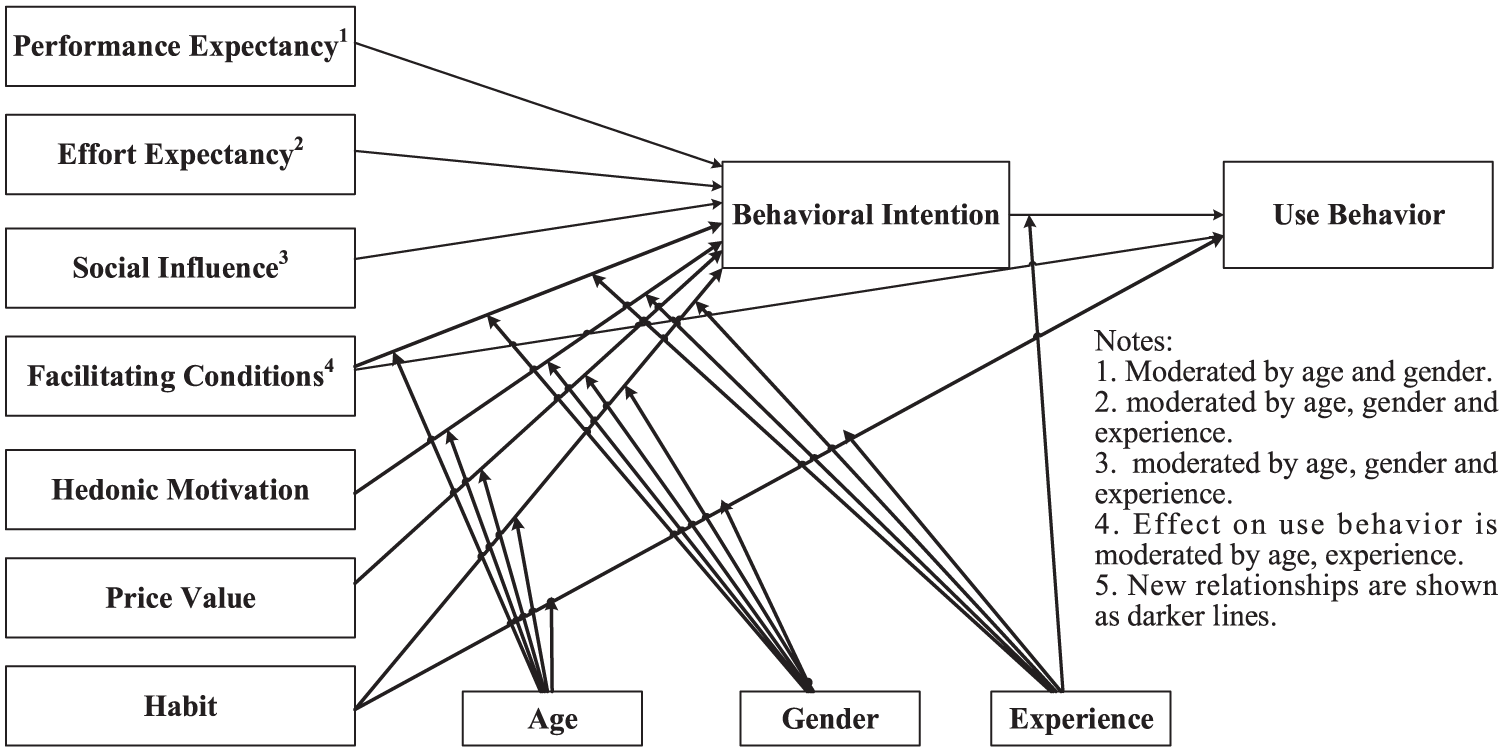
The UTAUT2 model was proposed by Venkatesh et al. (2012).
Scholars have introduced the UTAUT2 model into educational settings. To enhance its interpretability and application scope in diverse research scenarios, excepting for exploring how the original variables included in the UTAUT2 model (Sidik & Syafar, 2020; Tseng et al., 2022; S. Xu et al., 2024), many studies have generally combined it with external variables, such as trust (El-Masri & Tarhini, 2017), perceived risk (L. Chang et al., 2023), financial literacy (Fauziah & Sabandi, 2024), self-efficacy (Lv & Li, 2024), novelty value and perceived humanness (J. Xu et al., 2025). Therefore, to improve the suitability and interpretability of the UTAUT2 model in the fragmented academic reading setting, this study refers to prior studies and integrates the UTAUT2 model with individual characteristics—the utilization of fragmented time, self-efficacy, and reading habit—to develop a comprehensive framework to investigate the factors influencing university students’ acceptance and use behavior of fragmented academic reading.
Model Specification
Figure 2 illustrates the conceptual model. Referring to prior studies (e.g., L. Chang et al., 2023; El-Masri & Tarhini, 2017; J. Xu et al., 2025), we modified the original UTAUT2 model by adjusting its variables to closely align it more with the specific context of fragmented academic reading. According to Venkatesh et al. (2012, 2016), we expected performance expectancy, effort expectancy, social influence, and facilitating conditions to positively affect university students’ behavioral intention to adopt fragmented academic reading, which in turn has a positive impact on use behavior. For other variables, we made the following modifications. First, we excluded hedonic motivation and price value because of their limited relevance to fragmented academic reading. On one hand, hedonic motivation emphasizes the enjoyment or pleasure derived from technology use (Venkatesh et al., 2012), while fragmented academic reading is often goal-driven, closely tied to assignments, research tasks, or skill development, rather than entertainment or leisure. Therefore, hedonic motivation may play a minimal role in task-oriented academic reading and has weaker explanatory power (L. Chang et al., 2023; Venkatesh et al., 2012). On other hand, price value refers to the trade-off between the perceived benefits of technology use and the monetary cost (Venkatesh et al., 2012), while most academic reading tools and materials are freely accessible to students through university resources. Monetary considerations do not significantly influence students’ adoption and use behaviors; thus, price values are less applicable in this context. Moreover, this study intentionally extended the UTAUT2 model by incorporating individual-level characteristics and behavioral factors that are theoretically more aligned with the research target. Including moderators, such as age and gender, may introduce additional complexity without significantly enhancing explanatory power. Additionally, the value of these moderators may be more suitable for cross-group analyses, while the sample in this study is relatively homogenous (i.e., a similar age range). Thus, we excluded all moderating variables. This approach is consistent with those adopted in prior studies (El-Masri & Tarhini, 2017; P. Yang & Qian, 2025). Furthermore, the habit construct in the UTAUT2 model was replaced with reading habit, making it more suitable for fragmented academic reading setting (Oriogu et al., 2017). Subsequently, given the critical roles of time management and self-efficacy played in fragmented reading contexts (Z. Li & Yang, 2023; W. Liu et al., 2022), utilization of fragmented time and self-efficacy were added into the model.
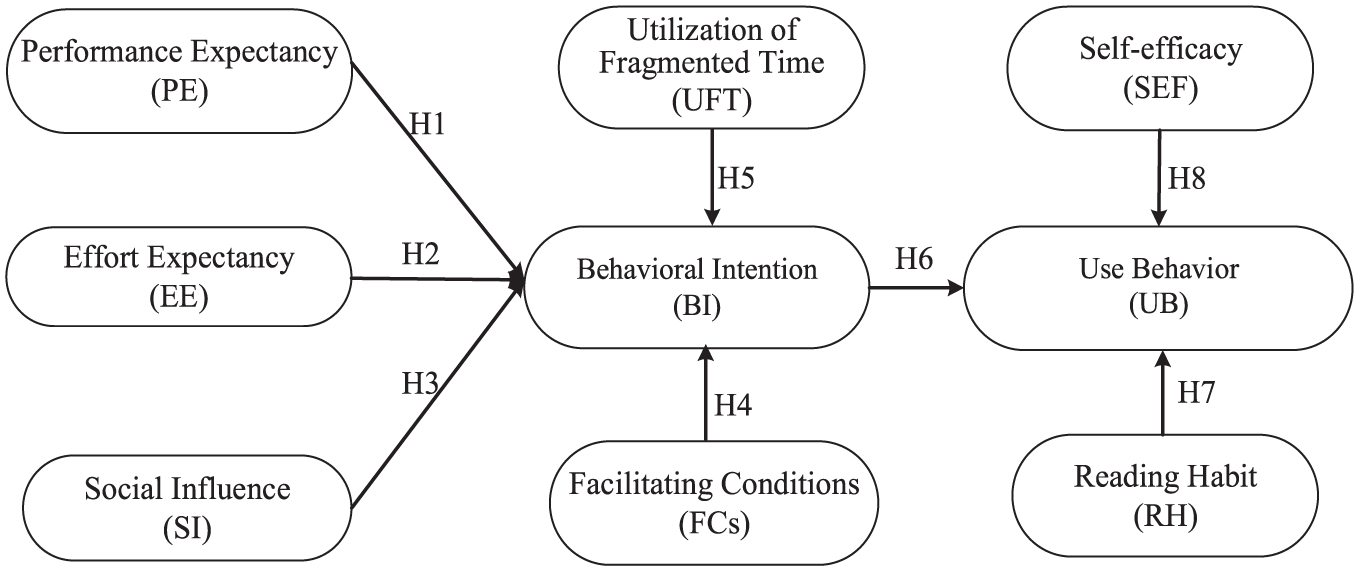
The conceptual model.
Hypotheses
Performance Expectancy (PE)
Performance expectancy is defined as individuals’ expectation of the extent to which a new information system or technology can enhance their performance (Venkatesh et al., 2003). Performance expectancy, regarded as a crucial factor in motivating users to adopt a new information system or technology (Venkatesh et al., 2012), has the most substantial impact on their behavioral intention (Tseng et al., 2022). In the educational field, many studies suggest that performance expectancy positively impacts students’ behavioral intention to adopt emerging learning systems or technologies, such as E-learning systems (El-Masri & Tarhini, 2017), mobile learning APPs (Sidik & Syafar, 2020), and AI tools (P. Yang & Qian, 2025). In a fragmented reading setting, performance expectancy refers to the extent to which college students believe that they can achieve better academic abilities or performance through electronic devices during their fragmented time. We suggest that the higher the expectation, the greater their willingness to adopt fragmented academic reading. Therefore, we propose the following hypothesis:
Effort Expectancy (EE)
Effort expectancy is the anticipated ease of using a new information system or technology (Venkatesh et al., 2003). If an emerging system or technology with complex operations is too difficult to use, students may be less inclined to use it. Consensus regarding conclusions of the impact of effort expectancy on behavioral intention are yet reached. Some studies indicate that effort expectancy positively impacts users’ behavioral intention toward a new information system or technology (Sidik & Syafar, 2020; J. Xu et al., 2025), while others point out that effort expectancy exerts a minor effect, or even negative effect (García Botero et al., 2018; Tseng et al., 2022). In this study, effort expectancy reflects how easily college students perceive the use and mastery of electronic devices for academic reading in a fragmented manner. We argue that effort expectancy positively affects college students’ behavioral intention. Today’s college students are proficient and can easily use all kinds of electronic devices, making them more likely to access academic resources from digital learning platforms (e.g., the CNKI app, WeChat public), and read them in their spare time. Thus, we propose the following hypothesis:
Social Influence (SI)
According to Venkatesh et al. (2016), social influence refers to the extent to which people perceive that crucial people around them affect their intention to use a new information system or technology. Prior studies indicate that social influence, especially recommendations from people in one’s surrounding environment, can significantly influence an individual’s decision-making (S. Liu & Huang, 2023). Social influence is a powerful indicator for predicting the adoption of mobile payment services (S. Yang et al., 2012) and online collaborative learning (J. Zhou, 2017). In this study, social influence is the degree to which college students perceive that the critical people surrounding them (e.g., teachers, friends, classmates, roommates, scholar leaders, and family members) believe that they should read academic literature via electronic devices in their fragmented time. Hence, whether college students engage in academic reading in fragmented reading activities using electronic devices may depend on the supports they perceive from their social circles (Radovan & Kristl, 2017). Moreover, when faced with academic pressure and the influence of instructors, college students are more likely to adopt fragmented academic reading (Gómez & Vallecillo, 2021). Thus, we hypothesize the following:
Facilitating Conditions (FCs)
Facilitating conditions refer to the technical or organizational support expected when using a new information system or technology (Venkatesh et al., 2003). Most studies suggest that facilitating conditions can positively affect both behavioral intention and use behavior (Tseng et al., 2022; Venkatesh et al., 2016), whereas others show that facilitating conditions have no significant impact (L. Chang et al., 2023). In this study, facilitating conditions are the degree to which students perceive support for fragmented academic reading, including technical and organizational infrastructures that eliminate the obstacles of using electronic devices and electronic literature retrieval tools to obtain academic resources and read in their spare time. If institutions and platforms provide accurate content recommendations, clear information presentations, and a user-friendly interface that allow students to access high-quality academic resources within a limited time, they may have a higher intention to adopt fragmented academic reading. Therefore, the following hypothesis is proposed:
Utilization of Fragmented Time (UFT)
The utilization of fragmented time refers to an individual’s ability to manage and use scattered time in daily learning effectively (X. Li, 2011). Extant studies have suggested that college students are particularly vulnerable to external distractions (e.g., environmental noise and social media notifications) during fragmented online learning, which can significantly reduce their attention (Feng et al., 2021; Wu & Wei, 2017). However, if university students have strong time management abilities, they can increase their learning frequency and efficiency by effectively planning schedules, enhancing concentration, and minimizing the influence of external distractions (Z. Li & Yang, 2023). In fragmented reading context, students’ reading experiences are significantly influenced by the scattered and limited accessibility of academic resources. Thus, if university students master proficient time management skills, they will allocate time appropriately and select suitable reading materials (Y. Yang et al., 2022), thereby increasing their reading effectiveness and willingness. In contrast, students with low abilities in time management may have difficulties in effectively selecting suitable materials for academic reading in fragmented time or may struggle with more complex reading content, leading to low reading enthusiasm and ultimately giving up reading (B. Li et al., 2020; Z. Li & Yang, 2023). Therefore, we propose the following hypothesis:
Behavioral Intention (BI)
According to Venkatesh et al. (2016), behavioral intention in the UTAUT2 model refers to an individual’s plan to use a particular information system or technology in the future. Actual use behavior is defined as the real-world frequency and manner in which an individual uses an information system or technology, emphasizing the actual occurrence of behavior (Venkatesh et al., 2012). Owing to external environmental distractions and resource constraints, behavioral intention sometimes fails to translate into actual behavior (namely, intention-behavior gap; Sheeran & Webb, 2016). However, the role of intention as a predictor of actual behavior is critical (Venkatesh et al., 2016). Many prior studies have shown that behavioral intention significantly and positively affects actual use behavior (L. Chang et al., 2023; Zhang et al., 2021). This study defines behavioral intention as the extent to which students tend to conduct academic reading via electronic devices in their fragmented time. We suggest that behavioral intention has a positive impact on university students’ use behavior of fragmented academic reading. On the one hand, in the digital era, most students have high willingness to acquire information and knowledge in their spare time from online platforms through electronic devices (L. Chang et al., 2023; W. Liu et al., 2022). On the other hand, college students are willing to participate in academic learning because it is an important part of academic courses or thesis requirements. Thus, the stronger the behavioral intention, the higher the likelihood of college students adopting fragmented academic reading in their learning practices. Therefore, the following hypothesis is put forward:
Reading Habits (RH)
The occurrence of actual behavior depends on the strength of intentions and individuals’ habits (Venkatesh et al., 2012). Habit is the degree to which an individual perceives a behavior to be performed automatically because of learning (Venkatesh et al., 2012, 2016). Reading habit, as a specific form of habit construct in the UTAUT2 model, refers to the frequency and consistency with which college students engage in academic reading activities via electronic devices during their fragmented time. Reading habits can facilitate the development of students’ lifelong learning skills, positively influencing their actual use behavior and academic performance (Oriogu et al., 2017). Existing evidence also indicates a positive relationship between reading habit and college students’ use behavior of mobile internet technology (Nikolopoulou et al., 2020). Therefore, students with good reading habits can improve their reading frequency and quality. They can achieve better reading experience and effectiveness even in a fragmented reading environment, which in turn, promotes their actual use behavior of fragmented academic reading in practice. Hence, we hypothesize that:
Self-efficacy (SEF)
Self-efficacy refers to an individual’s belief or confidence in their ability to complete a specific task (Tsai et al., 2011). Self-efficacy also significantly influences college students’ use behavior of fragmented academic reading. On the one hand, students with significant self-efficacy have strong learning motivation, and tend to adopt different reading strategies (e.g., goal-oriented reading and critical thinking) to connect fragmented knowledge with their academic tasks, thereby increasing reading effectiveness (Nahak & Mbato, 2022; Rafiola et al., 2020). On the other hand, self-efficacy can affect students’ persistence when facing difficulties. Students with high self-efficacy are less likely to give up when faced with problems, and they can fully utilize fragmented time to understand difficult content through multiple readings, thus improving reading effectiveness (Z. Li & Yang, 2023). Moreover, students with significant self-efficacy regulate their emotions and states better, reducing frustration due to reading difficulties and time constraints (Y.-C. Chang & Tsai, 2022). These students are more likely to remain calm when facing challenges and demonstrate a strong ability to overcome the challenges related to fragmented academic reading. Therefore, we propose the following hypothesis:
Methodology
Constructs and Scales
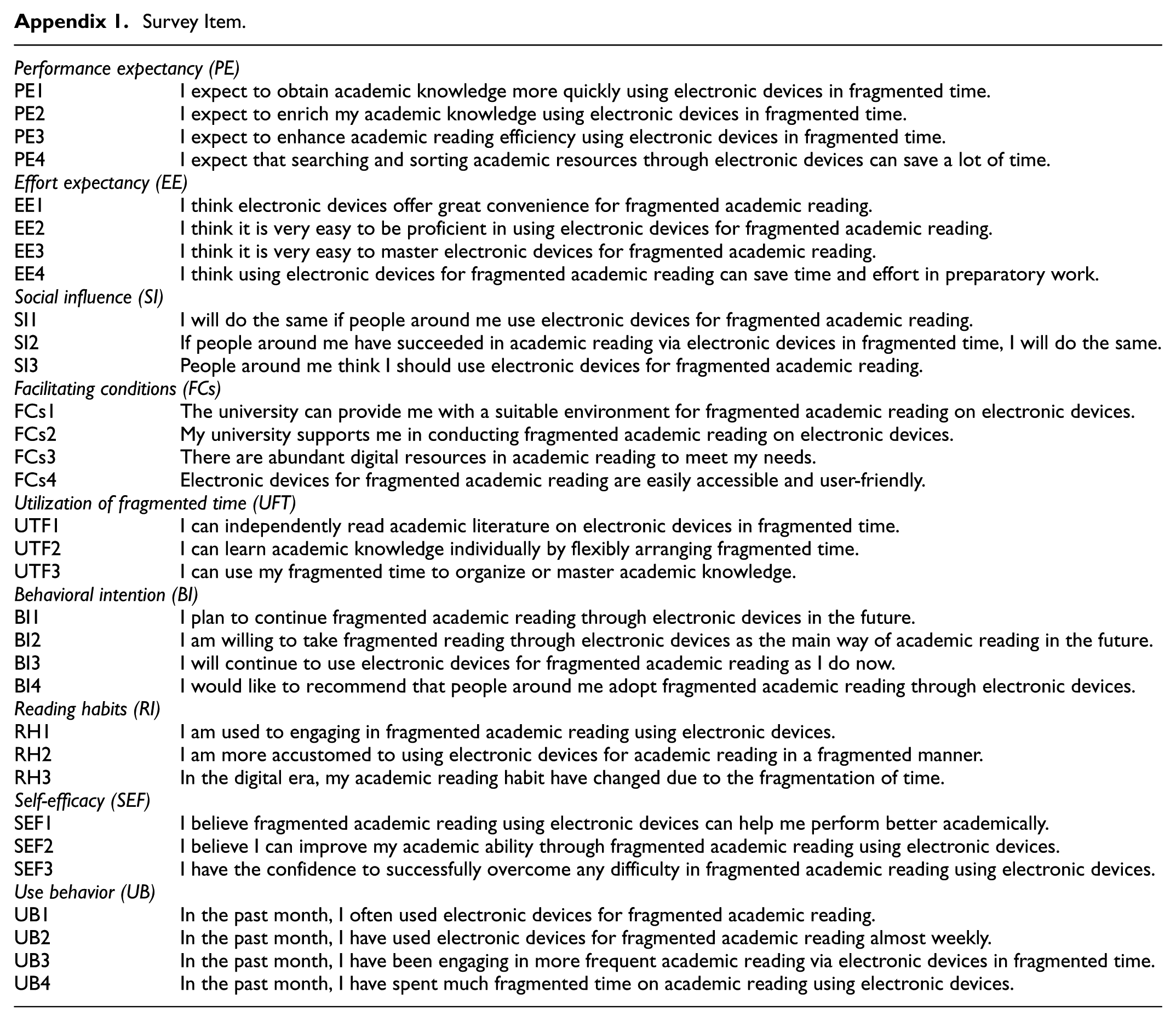
Based on the research model and hypotheses, we used an online questionnaire survey to collect data and conduct an empirical analysis. The questionnaire comprised two parts: a survey of the participants’ demographic information and the core constructs, the items of which were presented in the Appendix 1. A five-point Likert scale was used for each item, where 1 represents “strongly disagree,” 2 denotes “disagree,” 3 signifies “neutral,” 4 indicates “agree,” and 5 represents “strongly agree.” Each participant was permitted to select only one score per item.
Data Collection
This study focuses on Chinese university students as the primary research sample. During the process of data collecting, we primarily conducted a third-party online questionnaire survey via Sojump.com. First, we completed and verified a pre-survey to ensure the reliability of the questionnaire. Subsequently, we distributed the questionnaire to Chinese undergraduates who had engaged in fragmented academic reading using electronic devices between June 23rd and July 3rd, 2024. Participants were informed that all collected data would be used solely for educational research purposes and that their privacy would be rigorously protected. Moreover, several precautions were taken to guarantee the appropriateness: first, confirming whether participants had experience with fragmented academic reading on electronic devices; we set up multiple-choice questions: “Have you or are you currently engaged in academic reading through a fragmented manner?” and “Which electronic devices have you used or currently use for fragmented academic reading?” Second, allowing each IP address to appear only once; and third, deleting records if the answering time was excessively short or if all answers were consistent. Finally, 395 valid response were obtained. Among these samples, 48.1% were males 51.9% were females, and only 16.7% were first-year students, indicating that senior undergraduates were the primary participants.
Empirical Results
Reliability and Validity Tests
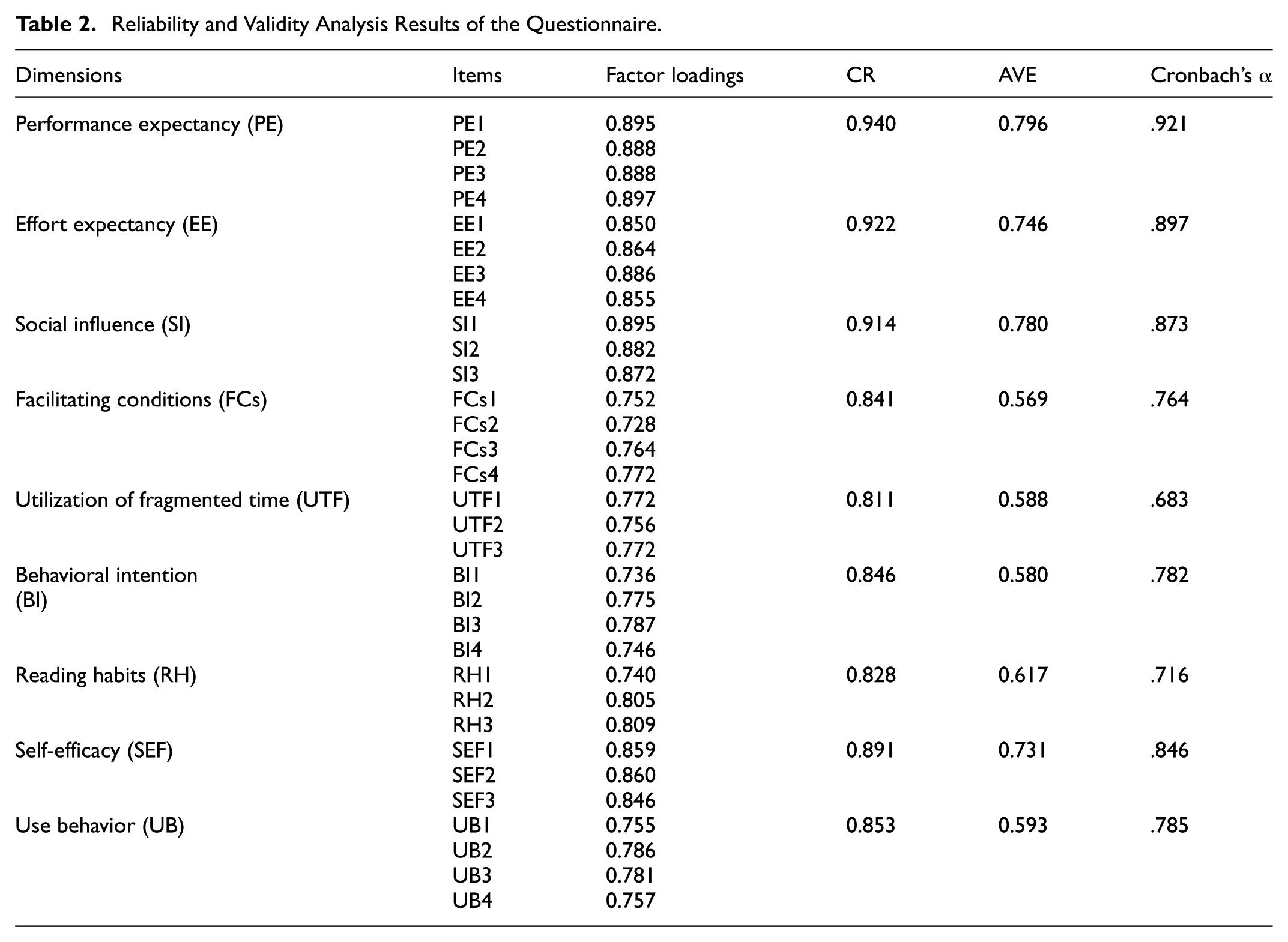
As shown in Table 1, the KMO (Kaiser-Meyer-Olkin) value was 0.789, exceeding the threshold of 0.7. The approximate chi-square value of the Bartlett sphericity test was 5,293.012 with 496 degrees of freedom. This was at a 1% significance level, indicating that the data is suitable for factor analysis. In the confirmatory factor analysis (CFA), the factor loading value of each item is greater than 0.6, indicating good validity of the constructs (Kaiser, 1974). In addition to guaranteeing the validity of the constructs, content validity was confirmed by rigorous refinement and modification through literature review and pre-project surveys. Additionally, according to extant literature (L. Chang et al., 2023; Nikolopoulou et al., 2020; J. Zhou, 2017), the scale’s reliability can be assessed through the internal consistency coefficient (Cronbach’s α), composite reliability (CR), and mean variance extracted (AVE). From the results in Table 2, the Cronbach’s α values for all core constructs exceeded 0.6. Each construct’s composite reliability (CR) surpassed 0.8, and the average variance extracted (AVE) for each factor loading value was greater than 0.5. These results indicate the strong reliability of all the questionnaire items (Fornell & Larcker, 1981).
KMO & Bartlett Test.

Reliability and Validity Analysis Results of the Questionnaire.
Discriminant validity was analyzed to compare the square root of a variable’s Average Variance Extracted (AVE) value with the absolute correlation coefficient between variables. If the former exceeds the latter, a higher level of discriminative validity will be observed, and the internal correlations will be stronger than the external correlations (Fornell & Larcker, 1981; Hakken, 1998). Table 3 shows that the bold numbers are the arithmetic square root of the AVE values of each variable, and their values are larger than the correlation coefficients between the variables, suggesting that the questionnaire meets the requirements of discriminative validity.
Results of Discriminatory Validity Analysis.

Note. The diagonal numbers in bold are the values of the square root of the average variance extraction (AVE). PE = performance expectancy; EE = effort expectancy; SI = social influence; FCs = facilitating conditions; UFT = utilization of fragmented time; BI = behavioral intention; RH = reading habits; SEF = self-efficacy; UB = use behavior.
Hypotheses Testing
Fitness Indices
AMOS software (version 28.0) was used to assess the overall model fit and test the hypotheses. As shown in Table 4, the value of χ2/df is 1.259, and GFI, AGFI, CFI, RMR, TLI, and RMSEA are 0.913, 0.900, 0.973, 0.073, 0.970, and 0.027 respectively, indicating that the model’s fitness meets the standard, and the collected data and the constructed model exhibit a strong consistency (L.-T. Hu & Bentler, 1998). Hence, the assumed relationships proposed previously were almost consistent with the actual observations, and the model coefficient results were deemed accurate and valid.
Model Fitness Parameters.

Common Method Deviation Tests
To assess common method bias, Harman’s one-factor test was conducted (Aguirre-Urreta & Hu, 2019). The results in Table 5 revealed that nine factors with eigenvalues greater than one, with the first factor accounting for only 14.704% of the variance, which is well below the 40% threshold. These results suggest that common method bias is unlikely to have significantly influenced the findings.
Results of Common Method Bias Tests.

Multicollinearity Tests
The results of the Variance Inflation Factor (VIF; in Table 6) show that all VIF values are below the commonly accepted threshold of 5, indicating that multicollinearity is not a major concern and suggesting that the model is relatively robust (Ryan, 2008).
Results of Multicollinearity Tests.

Note. PE = performance expectancy; EE = effort expectancy; SI = social influence; FCs = facilitating conditions; UFT = utilization of fragmented time; BI = behavioral intention; RH = reading habits; SEF = self-efficacy.
Regression Results
Tables 7 and 8 present SEM results, and Figure 3 shows the SEM with the standardized coefficients. As a whole, both performance expectancy (β = .072, p = .208) and social influence (β = .092, p = .115) have no significant impact on behavioral intention (In Table 7). However, their effects differ according to gender and age. Specifically, performance expectancy has a positive impact on females (β = .181, p = .007) and senior students (β = .135, p = .039), while social influence positively affects females (β = .113, p = .085) and junior students (β = .163, p = .023; In Table 8). Second, effort expectancy (β = .196, p < .01), facilitating conditions (β = .243, p < .01), and utilization of fragmented time (β = .162, p = .017) significantly predict behavioral intention, supporting H2, H4, and H5. Among them, facilitating conditions have the strongest effect. Finally, behavioral intention (β = .176, p = .006), reading habit (β = .125, p = .061), and self-efficacy (β = .137, p = .025) positively influence use behavior, with behavioral intention having the greatest impact. Therefore, H6, H7, and H8 are accepted.
Hypothesis Testing Results.

Note.***P < 0.001.
Results Based on Genders and Ages.

Note. Senior students mainly refer to those in the final year of college. PE = performance expectancy; SI = social influence; BI = behavioral intention.

SEM with the standardized coefficients.
Supplementary Analysis
The rise of digital education has promoted fragmented academic reading, but its adoption likely varies across disciplines. A subgroup analysis was therefore performed to explore these differences. We categorized the sample into STEM (coded as 1) and HSS (coded as 0), and created a dummy variable, Discipline. Interaction terms between Discipline and key predictors (PE, EE, SI, FCs, and UFT) were constructed to examine their effects on behavioral intention. Table 9 shows that the interaction terms EE×Discipline (β = .530, p = .010), FCs×Discipline (β = .795, p = .001), and UFT×Discipline (β = .710, p = .004) are significantly positive, while SI×Discipline (β = −.402, p = .057) is significantly negative, and PE×Discipline (β = −.092, p = .651) is not significant. These findings suggest that effort expectancy, facilitating conditions, and utilization of fragmented time have stronger effects on science and engineering students, whereas students in the humanities and social sciences are more influenced by social factors.
Results Based on Discipline Groups.

Note. PE = performance expectancy; EE = effort expectancy; SI = social influence; FCs = facilitating conditions; UFT = utilization of fragmented time; BI = behavioral intention.
Additionally, individual characteristics may not influence fragmented academic reading in isolation. We therefore examined interaction effects among SEF, UFT, and RH. Given the key role of self-efficacy in self-directed and independent learning (Z. Li & Yang, 2023; Rafiola et al., 2020), we propose that SEF moderates the effects of UFT and RH on students’ behavioral intention and usage. As shown in Table 10, both interaction terms—UFT×SEF (β = .114, p = .003) and RH×SEF (β = .112, p = .023)—are significantly positive. Figures 4 and 5 further illustrate that higher SEF strengthens the effect of UFT on behavioral intentions and the effect of RH on actual use behaviors. These findings suggest that self-efficacy enhances the impact of fragmented time use and reading habit on college students’ acceptance and use behaviors of fragmented academic reading, highlighting the joint influence of multiple individual-level traits.
Results of the Moderating Effect Tests.
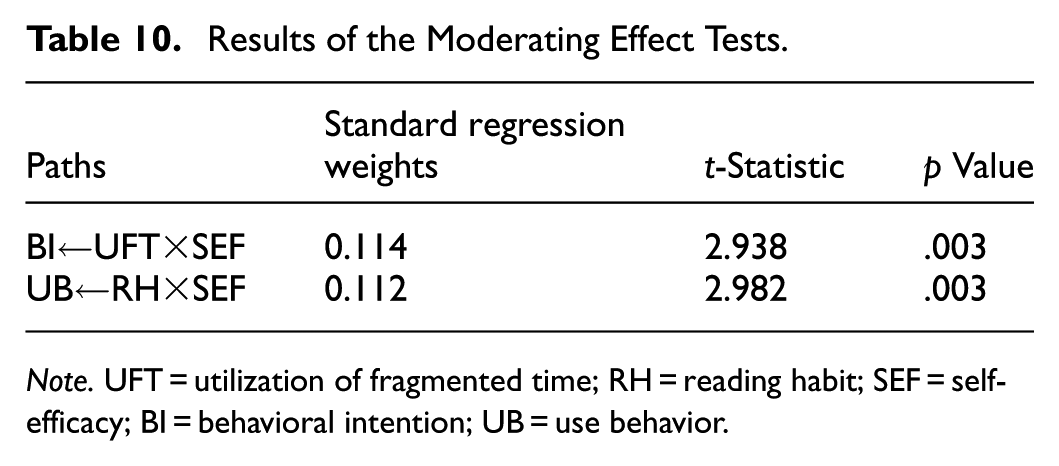
Note. UFT = utilization of fragmented time; RH = reading habit; SEF = self-efficacy; BI = behavioral intention; UB = use behavior.

Utilization of fragmented time and behavioral intention: The moderating effect of self-efficacy.
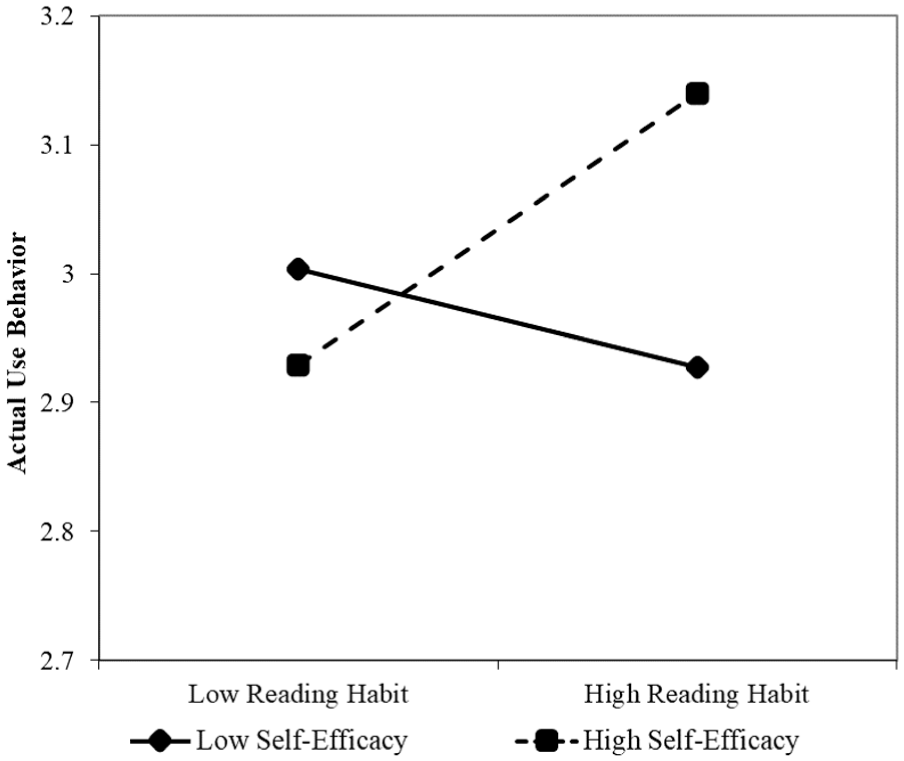
Reading habit and use behavior: The moderating effect of self-efficacy.
Discussions
This study analyzed factors influencing university students’ acceptance and use of fragmented academic reading by integrating the UTAUT2 model with several key individual factors. The validated model effectively explains their use behavior and extends the literature on informal learning among college students. The specific discussions are as follows:
(1) Effort expectancy, facilitating conditions, and fragmented time utilization significantly influenced college students’ intentions to adopt fragmented academic reading, with effects of 0.092, 0.243, and 0.162, respectively; facilitating conditions exert the most impact, and especially among science and engineering students.
Effort expectancy positively influenced college students’ behavioral intentions, consistent with previous studies (Du & Liang, 2024; W. Liu et al., 2022; Tseng et al., 2022; S. Xu et al., 2024). This suggests that the convenience, stability, and ease of accessing academic resources through electronic devices significantly shape their intentions. Scholars note that students prefer choosing online learning resources based on convenience, familiarity, and ease of use (Bringman-Rodenbarger & Hortsch, 2020). Post-millennial students or digital natives, are skilled with digital tools due to growing up with technology (Ardi & Putri, 2020). Such background helps them overcome device challenges and access digital academic resources easily. This finding indicates that effort expectancy substantially affects college students’ intention, revealing the importance of belief in the ability of informal learning mode to enhance intention as a predictor.
Consistent with previous studies (Du & Liang, 2024; El-Masri & Tarhini, 2017; S. Hu et al., 2020; Tseng et al., 2022), facilitating conditions positively influenced behavioral intentions. Our results showed that facilitating conditions had the strongest impact, differing from studies that emphasize performance expectancy (Venkatesh et al., 2012; J. Xu et al., 2025), but is aligned with Ullah et al. (2023) and P. Yang and Qian (2025), suggesting a robust and strong predictive correlation between facilitating conditions and behavioral intentions. This indicates that the technical support college students expect from universities, IT services, and libraries plays a key role in increasing their intentions. Students who felt supported by their universities were more likely to adopt fragmented academic reading, highlighting the importance of technical and organizational support for informal learning adoptions.
Fragmented time utilization positively influenced university students’ intentions to engage in fragmented academic reading. This finding aligns with previous studies emphasizing the importance of time management abilities for supporting fragmented reading and improving fragmented learning effect (Z. Li & Yang, 2023; W. Liu et al., 2022; S. Zhou, 2020). This suggests that students who use scattered time well are more likely to adopt this reading style. Fragmented time fits the idea of “temporal fragmentation” in fragmented reading (W. Liu et al., 2022). Effectively using fragmented time can boost university students’ motivation and learning outcomes (Z. Li & Yang, 2023; S. Zhou, 2020). Since improving academic ability requires extensive reading beyond class hours, students need to spend their spare time on academic resources (J. Zhou & Fang, 2024; Zhu et al., 2019). When students manage time well and choose suitable materials, they are more willing to read academically in fragmented ways.
Additionally, the results show that, compared to humanities and social sciences, science and engineering students reported higher behavioral intentions to use fragmented academic reading. This finding is consistent with prior studies that have suggested academic factors are especially beneficial for science and engineering students (Tsang, 2019). One possible explanation for this result is that science and engineering students are greater reliance on digital resources and modular information processing (Pilotti et al., 2023). For example, owing to the nature of problem-solving tasks, students in engineering or computer sciences often engage more with online databases, technical modular content, and coding platforms that support fragmented information processing, while those in humanities and social sciences may require more continuous and in-depth reading of theoretical texts.
(2) Overall, performance expectancy and social influence had no significant effect on students’ intention to adopt fragmented academic reading, but the results differed by genders, ages, and disciplines.
Overall, performance expectancy did not significantly predict college students’ usage intention, which contradicts the original UTAUT2 model and some prior studies (Du & Liang, 2024; El-Masri & Tarhini, 2017; Venkatesh et al., 2012; J. Xu et al., 2025). However, other studies have also found its impact to be insignificant (L. Chang et al., 2023; Kosiba et al., 2022; Mensah, 2019; Raman & Thannimalai, 2021). The insignificance of performance expectancy may be due to the unique nature of fragmented academic reading—an informal, self-directed activity that students may not associate with immediate academic benefits (B. Li et al., 2020). Particularly in the short term, students may not easily perceive meaningful returns from their reading efforts. However, age-based analysis showed that performance expectancy positively influenced senior students’ intentions, likely because they are focused on graduation projects and theses, while junior students lacked such goals (L. Chang et al., 2023). Moreover, gender-based results showed a positive effect for female students only, possibly because they tend to be more patient, perform better academically, and use more effective reading strategies (Oda & Abdul-Kadhim, 2017), thereby enhancing their willingness to adopt fragmented academic reading.
Our results showed that social influence did not significantly affect college students’ behavioral intention, differing from some earlier studies (L. Chang et al., 2023; Du & Liang, 2024; Venkatesh et al., 2012, 2016). However, this finding aligns with others that also reported no significant effect (Chu et al., 2022; S. Hu et al., 2020; Kosiba et al., 2022; S. Xu et al., 2024). One possible reason for the non-significant effect of social influence is cultural and generational differences—Chinese Gen Z students may value personal choice over peer or teacher suggestions when using technology for academic reading. Personalized, algorithm-based platforms like WeChat, Zhihu, and TikTok-style apps may also reduce the importance of social influence (Pilotti et al., 2023). However, subgroup analysis revealed differences by ages, genders, and disciplines. Social influence positively affected the intentions of female and younger students, who often seek emotional support and social recognition from peers and teachers (Valls, 2022). In contrast, senior male students, focused more on independence, were less influenced by others’ opinions (Han & Li, 2009). Discipline also mattered—students in the humanities and social sciences were more affected by social influence than those in science and engineering, likely due to their discussion-based learning style and the opinion-driven nature of their academic content (Pilotti et al., 2023; Tsang, 2019), which is more compatible with social media sharing.
(3) Behavioral intention, reading habit, and self-efficacy all positively influenced college students’ actual use of fragmented academic reading, with effects of 0.176, 0.125, and 0.137 respectively; behavioral intention had the strongest impact.
Behavioral intention was a strong and significant predictor of college students’ actual use of fragmented academic reading, aligning with prior research (L. Chang et al., 2023; S. Hu et al., 2020; Venkatesh et al., 2012, 2016; J. Xu et al., 2025). It had a stronger effect than reading habit and self-efficacy, supporting S. Hu et al. (2020). This means students with stronger intentions are more likely to engage in fragmented academic reading using electronic devices.
The results showed that reading habit positively affected use behaviors, aligning with previous research (El-Masri & Tarhini, 2017; S. Hu et al., 2020; Raman & Thannimalai, 2021; Venkatesh et al., 2012; S. Xu et al., 2024). This suggests that habits play a key role in shaping how students engage with new information systems or technologies. Habits related to fragmented academic reading are a form of automatic behavior, reflecting college students’ prior experience with using digital devices and online platforms to access academic resources. As a result, they are more likely to adopt this reading style regularly and intensively during fragmented time (B. Li et al., 2020; Nikolopoulou et al., 2020). Therefore, students’ habitual use of mobile devices for academic reading in short periods positively drives their actual use behaviors.
Self-efficacy was a strong predictor of college students’ actual use of fragmented academic reading. This supports past research showing that self-efficacy is key to continued use of new technologies (Bringula et al., 2017; C. Wang et al., 2013) and boosts learning in informal settings (B. Li et al., 2020; Z. Li & Yang, 2023). This indicates that students with high self-efficacy are more likely to use mobile devices for academic reading in their spare time. Previous studies also found that self-efficacy improves reading proficiency and motivation (Nahak & Mbato, 2022), which increases engagement in academic reading. Additionally, greater self-efficacy also helps students manage negative emotions and stay persistent when facing challenges. Therefore, building self-efficacy is important for supporting effective informal learning.
(4) The individual-level characteristics had a joint influence on college students’ acceptance and use behaviors of fragmented academic reading.
Self-efficacy positively moderated the effects of fragmented time utilization on behavioral intention, and reading habit on use behaviors of fragmented academic reading. This supports earlier studies emphasizing self-efficacy’s key role in self-directed and independent learning (Z. Li & Yang, 2023; Rafiola et al., 2020). Rather than acting alone, self-efficacy enhances how fragmented time use and reading habits influence students’ acceptance and use behaviors. Specifically, students with strong time management abilities can better turn fragmented time into effective reading if they have higher self-efficacy. Likewise, those with good reading habits benefit more from greater self-efficacy, engaging more actively with academic reading during fragmented time. These findings highlight how personal traits work together to shape learning behaviors in informal learning contexts.
Conclusions and Implications
Conclusions
This study examined what influences university students’ fragmented academic reading by combining the UTAUT2 model with several critical personal factors. Based on 395 valid responses and SEM analysis using AMOS, eight hypotheses were tested, and the model was supported. The key findings are as follows: First, performance expectancy and social influence did not significantly affect behavioral intention overall. However, subgroup analysis showed that performance expectancy positively influenced behavioral intention among female and senior students, while social influence had a positive effect among female, senior, and humanities and social sciences students. Second, all other factors had significant positive effects. Effort expectancy, utilization of fragmented time, and facilitating conditions boosted behavioral intentions, especially among science and engineering students. Behavioral intention, along with reading habit and self-efficacy, positively influenced actual use behaviors. Third, the influence of different factors varied. Facilitating conditions had the strongest impact on behavioral intention, followed by effort expectancy and fragmented time utilization. Behavioral intention was the strongest predictor of actual use behaviors, followed by self-efficacy and reading habit. Fourth, self-efficacy positively moderated the effects of fragmented time use on behavioral intentions and reading habit on actual use behaviors, highlighting that individual traits jointly shaped college students’ acceptance and engagement in fragmented academic reading.
Theoretical Implications
This study makes the following theoretical contributions. First, previous studies have explored the factors influencing learners’ intentions to adopt traditional academic reading (Kimberley & Thursby, 2020; Nhapulo et al., 2017; Oriogu et al., 2017) and general fragmented reading (Cao et al., 2024; W. Liu et al., 2022; Y. Liu & Gu, 2020; Zhong & Xu, 2025), but less attention has been given to fragmented academic reading. This study employs an extending UTAUT2 model to investigate determinants of college students’ acceptance and usage toward fragmented academic reading, thus enriching literature on general fragmented reading, and extending the line of literature on traditional academic reading from the perspective of informal learning. It also provides a comprehensive foundation for future studies on the intentions to adopt and use informal learning modes.
Second, prior studies have extensively applied the UTAUT2 model to formal educational systems to predict users’ acceptance and use behaviors, such as E-learning systems, blended learning, mobile learning, and online learning (El-Masri & Tarhini, 2017; Rafiola et al., 2020; Sidik & Syafar, 2020; Ullah et al., 2023). This study extends the application scope of the UTAUT2 model by applying it to new scenarios of informal learning—fragmented academic reading, thereby further contributing to a better understanding the nuanced distinction of how the UTAUT2 model performs differently in formal and informal learning settings.
Third, previous scholars have integrated the UTAUT2 model with context-specific variables (e.g., trust, perceived risk, and financial literacy) to provide a more comprehensive understanding of users’ behavioral intention and use behaviors (L. Chang et al., 2023; El-Masri & Tarhini, 2017; Fauziah & Sabandi, 2024; Lv & Li, 2024; J. Xu et al., 2025). This study extends this stream of literature by incorporating several important personal characteristics—utilization of fragmented time, self-efficacy and reading habit—into the UTAUT2 model, and simultaneously considering the interaction effects among these variables. This approach provides a more explanatory framework for fragmented academic reading, thus enhancing the explanatory power of the UTAUT2 model, as well as extending its theoretical boundary.
Practical Implications
Our study has practical implications for course design, digital platforms and library services to promote students’ adoption and usage of fragmented academic reading.
With respect to course design, educators in universities should integrate academic reading and information literacy training courses into college students’ curriculum. Particularly, they should set up “academic reading skills,”“information screening and integration skills” and “fragmented time management,” and incorporate them into general education courses or foundational courses within majors. Such courses can enhance students’ cognitive abilities, thereby boosting their self-efficacy, cultivating academic reading habits and time management skills (Z. Li & Yang, 2023; Nahak & Mbato, 2022), and ultimately increasing their intention to engage in academic reading during fragmented time. Most importantly, educators also need to design personalized reading courses according to gender-, grade- and discipline-specific academic reading preferences (S. Hu et al., 2020; J. Xu et al., 2025). For senior and female students, it is primarily to improve their research skills and the quality of graduation theses. Thus, educators should design reading curricula with clear objectives and expected outcomes. For junior and male students, it is important to lower reading barriers and reduce psychological pressure. Thus, universities can organize fragmented reading and sharing activities, combining the role modeling with interest-based guidance. For students in humanities and social sciences, educators should build communities or peer-led study groups to encourage adoption through positive peer examples in the courses, thereby strengthening the role of social influence, and guiding to form good reading habits.
In terms of digital platforms, universities should acknowledge the significant impact of digital platforms in boosting students’ effort expectancy and strengthening peer influence. Thus, digital platforms should enhance the compatibility with mobile phones, tablets, and other devices, and reduce use difficulties and costs. These platforms can provide diverse functions, such as “offline reading,”“progress synchronization,”“reading progress tracking,” and “cross-device annotation,” to lower the usage threshold and improve students’ effort expectancy (Sidik & Syafar, 2020). Moreover, universities should strengthen the platforms’ personalized recommendation and social functions. In this regard, digital platforms should integrate AI-content recommendation systems, and push academic resources aligned with students’ grade, gender and discipline based on students’ learning behavior data (J. Xu et al., 2025; X. Zheng & Fan, 2024), thereby fostering reading habits and enhancing their behavioral intentions. In addition, digital platforms should incorporate social features, such as comment sections and group studying, to strengthen the positive influence of social factors on students’ fragmented academic reading behaviors, particularly for students in humanities and social sciences. Furthermore, digital platforms should develop tools to track the use of fragmented time, such as “daily reading check-ins” and “short task reminders,” to enhance students’ self-efficacy and the sense of achievement in utilizing fragmented time (Z. Li & Yang, 2023; Zhong & Xu, 2025), thereby strengthening their behavioral intentions and use behaviors.
Regarding library services, universities should fully recognize that libraries, as key external facilitating factors, play an important role in supporting students’ fragmented academic reading (P. Yang & Qian, 2025). Therefore, libraries first should enhance their usability and guidance services. In this regard, librarians need to optimize the catalog search functions, simplify processes, and improve platform usability (El-Masri & Tarhini, 2017). They also can organize digital literacy workshops on digital reading skills to college students’ strengthen self-efficacy and reading habits, especially for students in science and engineering disciplines. Moreover, university libraries should expand fragmented forms of academic resources. For example, libraries can offer micro-learning resources, such as short video literature introductions, keyword knowledge cards, and mini-lectures, to help students quickly access valuable information during fragmented time. Furthermore, libraries can introduce incentive mechanisms, such as “Reading Challenge Programs” or “Reading Leaderboards,” to encourage students to transform reading intentions into actual use behaviors (Nikolopoulou et al., 2020).
Limitations and Future Research
This study focuses on Chinese university students, but our findings offer broader implications for understanding fragmented academic reading behaviors in other cultural or institutional contexts—particularly in countries or regions with similar educational systems. Although cultural differences may influence how students engage in fragmented academic reading, the technological foundation that underpins such behavior (e.g., mobile devices, digital reading tools) is globally ubiquitous. Cultural variation is more likely to affect the degree or manifestation of the behavior, rather than its core mechanism. Therefore, this study provides a theoretical framework for understanding learning behaviors among college students in the digital education context. Future research may further expand the model’s boundaries through cross-cultural comparisons to examine its adaptability and generalizability. Moreover, although some measurement items of the UTAUT2 model were adapted and validated within the Chinese context, this framework itself is theoretically universal. Thus, this study also lays the groundwork for future cross-cultural validation and comparative studies on fragmented academic reading behaviors among university students.
Footnotes
Appendix
Survey Item.
| Performance expectancy (PE) | |
| PE1 | I expect to obtain academic knowledge more quickly using electronic devices in fragmented time. |
| PE2 | I expect to enrich my academic knowledge using electronic devices in fragmented time. |
| PE3 | I expect to enhance academic reading efficiency using electronic devices in fragmented time. |
| PE4 | I expect that searching and sorting academic resources through electronic devices can save a lot of time. |
| Effort expectancy (EE) | |
| EE1 | I think electronic devices offer great convenience for fragmented academic reading. |
| EE2 | I think it is very easy to be proficient in using electronic devices for fragmented academic reading. |
| EE3 | I think it is very easy to master electronic devices for fragmented academic reading. |
| EE4 | I think using electronic devices for fragmented academic reading can save time and effort in preparatory work. |
| Social influence (SI) | |
| SI1 | I will do the same if people around me use electronic devices for fragmented academic reading. |
| SI2 | If people around me have succeeded in academic reading via electronic devices in fragmented time, I will do the same. |
| SI3 | People around me think I should use electronic devices for fragmented academic reading. |
| Facilitating conditions (FCs) | |
| FCs1 | The university can provide me with a suitable environment for fragmented academic reading on electronic devices. |
| FCs2 | My university supports me in conducting fragmented academic reading on electronic devices. |
| FCs3 | There are abundant digital resources in academic reading to meet my needs. |
| FCs4 | Electronic devices for fragmented academic reading are easily accessible and user-friendly. |
| Utilization of fragmented time (UFT) | |
| UTF1 | I can independently read academic literature on electronic devices in fragmented time. |
| UTF2 | I can learn academic knowledge individually by flexibly arranging fragmented time. |
| UTF3 | I can use my fragmented time to organize or master academic knowledge. |
| Behavioral intention (BI) | |
| BI1 | I plan to continue fragmented academic reading through electronic devices in the future. |
| BI2 | I am willing to take fragmented reading through electronic devices as the main way of academic reading in the future. |
| BI3 | I will continue to use electronic devices for fragmented academic reading as I do now. |
| BI4 | I would like to recommend that people around me adopt fragmented academic reading through electronic devices. |
| Reading habits (RI) | |
| RH1 | I am used to engaging in fragmented academic reading using electronic devices. |
| RH2 | I am more accustomed to using electronic devices for academic reading in a fragmented manner. |
| RH3 | In the digital era, my academic reading habit have changed due to the fragmentation of time. |
| Self-efficacy (SEF) | |
| SEF1 | I believe fragmented academic reading using electronic devices can help me perform better academically. |
| SEF2 | I believe I can improve my academic ability through fragmented academic reading using electronic devices. |
| SEF3 | I have the confidence to successfully overcome any difficulty in fragmented academic reading using electronic devices. |
| Use behavior (UB) | |
| UB1 | In the past month, I often used electronic devices for fragmented academic reading. |
| UB2 | In the past month, I have used electronic devices for fragmented academic reading almost weekly. |
| UB3 | In the past month, I have been engaging in more frequent academic reading via electronic devices in fragmented time. |
| UB4 | In the past month, I have spent much fragmented time on academic reading using electronic devices. |
Acknowledgements
We appreciate the editor and the reviewers’ suggestions, and the funding sponsors.

Ethical Considerations
Experimental protocol was approved by the ethical review board of Chengdu University of Technology (Ethics approval number: 2024007).
Consent to Participate
The data collected in this study had been agreed by all participants.
Consent for Publication
Written/online informed consent for publication was obtained from all participants.
Author Contributions
S-MY was responsible for conceptualizing, writing, and revising the manuscript; X-YY was responsible for collecting and conducting questionnaire survey, and analyzing the data, L-YY was responsible for validating and revising the manuscript; H-P was responsible for validating and revising the manuscript. All authors contributed to the article and approved the submitted version.
Funding
The authors disclosed receipt of the following financial support for the research, authorship, and/or publication of this article: This work was supported by the National Natural Science Foundation of China Youth Program (Grant number: 72504041; 7250012044); the Natural Science Foundation of Sichuan Province of China (Grant number: 2024NSFSC1074; 2025NSFSC1960); The General Project of Graduate Education and Teaching Reform in Chengdu University of Technology (Grant number: 2023YJG203); The Training and Research Center for College Student Affairs Work Teams of the Ministry of Education Project (Southwest Jiaotong University) (Grant number: CJSFZ23-33); Sichuan Provincial Higher Education Talent Training Quality and Teaching Reform Project (Grant number: JG2024-0586); Chengdu University of Technology Higher Education Talent Training Quality and Teaching Reform Project (Grant number: JG2430074); Sichuan Provincial Off-Campus Practice Education Base Construction Project for University Students (2024); Sichuan Provincial Innovative Experimental Project for Ordinary Undergraduate Universities (2024).
Declaration of Conflicting Interests
The authors declared no potential conflicts of interest with respect to the research, authorship, and/or publication of this article.
Data Availability Statement
The datasets used and/or analyzed during the current study are available from the corresponding author on reasonable request.