



Abstract
This study investigates macro factors influencing aggregate entrepreneurship in least-developed countries (LDCs). Panel data analysis methods were employed on a research sample of 32 LDCs during the period 2006 to 2019 to select the appropriate regression model, ultimately opting for the robust fixed-effects model. The research findings indicate that in LDCs, economic conditions such as GDP per capita and FDI play a decisive and positive role in stimulating aggregate entrepreneurship. However, factors such as GDP growth, international trade, and inflation show no significant impact on entrepreneurship. Social factors such as gross national expenditure, government spending on education, and inflation also do not significantly influence entrepreneurship, suggesting that broader social expenditures may not directly affect entrepreneurial activity in these contexts. Institutional entrepreneurial factors like the time required to start a business were found to have a significant negative impact on aggregate entrepreneurship, whereas the cost of business start-up procedures and the profit tax rate did not show significant effects on aggregate entrepreneurship in LDCs. These findings underscore the importance of practical economic conditions and financial regulation in driving entrepreneurship in LDCs.
Keywords
Introduction
For the national socio-economic development, promoting entrepreneurship attracts much attentions and engagements of researchers and policy-makers, especially in least-developed and developing countries. A consensus among scholars and policy-makers concurs on the role of entrepreneurship as a strategic driver for economic growth, creating jobs, reducing unemployment, enhancing innovation … (Galindo & Méndez, 2014; Gomes et al., 2023; Gries & Naudé, 2010; Komninos et al., 2024; Munyo & Veiga, 2024; Peprah & Adekoya, 2020; Stel et al., 2005). Therefore, research interests continuously focus on identifying and creating favorable conditions or factors for entrepreneurship within the context that, in this study, is limited to least-developed countries (LCDs).
In the entrepreneurship literature, substantial studies exist on entrepreneurship at the individual and firm levels; however, some studies at the macro level have only focused on the role and impact of entrepreneurship on the socio-economic development of countries. So, there remains a notable research gap at the national level in LDCs, often referred to as aggregate entrepreneurship, which has recently received increased attention and is progressively being explored across countries (Castaño et al., 2015; Harraf et al., 2021; Thorsteinsdóttir & Bandyopadhyay, 2024).
In this study, we limit the research context to LDCs, which are characterized by poor institutions and socioeconomic conditions such as corruption, low income, burgeoning populations, poverty, and high unemployment rates (S. Amit et al., 2023; ILO, 2022; Jeníček & Grófová, 2014; Navarro-Pabsdorf et al., 2024), all of which tend to exert adverse ramifications on entrepreneurial activities. Also, business success holds pivotal importance as a catalyst for essential socio-economic outcomes. Specifically, by creating jobs and enhancing income levels through employment opportunities and economic growth, successful businesses contribute significantly to economic prosperity, poverty reduction and living standards (Galindo & Méndez, 2014; Gomes et al., 2023; Komninos et al., 2024; Peprah & Adekoya, 2020). Therefore, fostering an entrepreneurial-supportive environment is essential for achieving sustainable economic development and improving societal well-being in long term for LDCs. Studying aggregate entrepreneurship offers an intriguing research perspective to identify and address country-specific conditions, contributing to the formulation of effective national strategies and policies that support and promote entrepreneurial activities in these countries.
In this research stream, we explore the economic, social, and institutional conditions by assessing the impact of macro factors on aggregate entrepreneurship in LDCs. Unlike most prior studies focused on developed or emerging economies, this study offers empirical evidence on aggregate entrepreneurship specifically within the institutional and socioeconomic environment of LDCs. On the basis of theoretical framework of Resource-Based View (RBV) and Institutional Theory, we develop the theoretical framework and research hypotheses in the next section. This combined framework provides a novel analytical perspective and contributes to the macro-level entrepreneurship literature on LDCs. The subsequent sections detail the research methodology, present findings and discussions, and conclude with policy implications.
Theoretical Framework and Hypothesis Development
Theoretical Framework
Defining Aggregate Entrepreneurship
The concept of entrepreneurship evolves in embedding with the one of entrepreneur. In the behavioral approach of entrepreneurship, scholars focus on individual entrepreneurs, who make favorable change adjustments by detecting and handling profitable business opportunities (Baumol, 1990; Kirzner, 1973; Schumpeter, 1934; Shane & Venkataraman, 2000). In the professional approach, entrepreneurship is a form of self-employment, that an individual, namely entrepreneur, decides to pursuit, when the financial and non-financial benefits from self-employment in her/his own business are expected higher than the sum of salary and benefits gained from engaging in an employment (Evans & Jovanovic, 1989; Murphy et al., 1991).
At the macro level, the entrepreneurship means the aggregate entrepreneurship in a territory (country, region) during a target period – usually 1 year. Specifically, the aggregate entrepreneurship is associated with the newly created enterprises and individuals’ intention of starting a new business in target territory per year. Therefore, the nature of aggregate entrepreneurship based on individual entrepreneurship (Wennekers, 2006). Thus, positive and negative conditions of individual entrepreneurship are also the ones of aggregate entrepreneurship. However, researches on aggregate entrepreneurship will focus on the macro conditions of entrepreneurship environment, but not on individual conditions and characteristics of entrepreneur (Pfeifer et al., 2021; Urbano et al., 2019).
This study focuses on the aggregate entrepreneurship in LDCs, in which entrepreneurs who start new businesses play an important role in the national socioeconomic development as catalysts of structural change and economic growth. Nevertheless, entrepreneurs in LDCs face various challenges when starting their new business ventures. These obstacles, including the lack of necessary resources (financial, human capital, etc.) or institutional barriers, arise from underdeveloped socioeconomic conditions, inadequate or absent infrastructure and institutions, which can hinder entrepreneurs from exploiting new market opportunities (Brixiova, 2010; UNCTAD, 2018). Therefore, these countries provide a natural context for studying the impact of socioeconomic and institutional conditions on the development of aggregate entrepreneurship.
Aggregate Entrepreneurship in the Resource-Based View
The resource-based view (RBV) postulates that the firm’s competitive advantage primarily lies in its efficient utilization of a set of tangible and/or intangible resources it possesses. This explains why certain firms outperform others, even when operating in similar environments such as in an industry; because they possess different resources (Barney, 1991; Grant, 1991). Resources, that are the source of firm’s sustainable competitive advantage, according to Barney’s VRIN model, must have four characteristics: Valuable, Rare, Inimitable, and Non-substitutable (Barney, 1991).
Analyzing entrepreneurship from a resource-based perspective, entrepreneurs will decide to start a business when they perceive they have sufficient internal and external resources. While internal resources, including all tangible and intangible factors owned and controlled by entrepreneurs and their firms (R. Amit & Schoemaker, 1993; Barney, 1991; Wernerfelt, 1984), have been extensively explored by many scholars; at the macro level, we focus on external resources that can influence internal resources and shape the business environment for entrepreneurs and their new ventures. Thus, external resources, which are tied to business opportunities and beyond the control of the potential entrepreneurs, directly influence their entrepreneurial decision. This is also the central approach of our study on aggregate entrepreneurship in LDCs. Accordingly, in addition to the internal resources they possess, potential entrepreneurs must capture external resources or convenient business opportunities to arrive at a favorable decision to start a business, thereby promoting the enhancement of aggregate entrepreneurship; and vice versa.
In the RBV perspective at the country level, we postulate that the aggregate entrepreneurship requires adequate macro-level conditions for business start. Specifically, these macro-level conditions refer to economic, social, and institutional conditions conducive to entrepreneurial activities. In LDCs, potential entrepreneurs often face numerous challenges due to insufficient internal resources (such as capital, high-quality labor, technology, and high administrative and legislative costs), which could be improved through favorable macroeconomic conditions. Additionally, the absence of suitable institutional frameworks negatively impacts entrepreneurship. Without adequate essential business resources, new enterprises cannot form, thereby adversely affecting aggregate entrepreneurship.
While RBV is widely adopted in entrepreneurship research, it has limitations when applied to the context of LDCs. Most RBV assumptions – such as the availability of resources and entrepreneurs’ strategic capacity to leverage them – presume a relatively stable and resource-rich environment. In LDCs, however, pervasive resource scarcity and institutional instability challenge these assumptions. Therefore, this study adapts the RBV by shifting the emphasis from firm-level resource optimization to macro-level conditions that may substitute or complement the lacking internal resources. This adaptation allows us to investigate how external economic and policy-level resources shape entrepreneurial opportunities in resource-constrained environments.
Aggregate Entrepreneurship in Institutional Approach
Institution is a set of formal constraints (rules, regulations, laws, etc.) and informal constraints (norms of behavior, customs, etc.) that regulate the behavior of actors through directed restrictions and incentives to encourage certain behaviors. In public administration, an institution is “a structure in which powerful people is committed to some value or interest” (Stinchcombe, 1968, p. 107). Jepperson (1991) see institutions as models that translate regulations and rules into practice, in which “departures from the pattern are counteracted in a regulated fashion, by repetitively activated, socially constructed, controls - that is by some set of rewards and sanctions” (p. 145). These definitions underscore the role of power and state in control mechanisms to ensure values and benefits for the country. Consequently, the institutions of each country have a comprehensive and pervasive impact on all aspects of life and activities of its inhabitants, including the aggregate entrepreneurship.
Whether a country is rich or poor is not determined by geographic conditions or culture but rather by its institutions, which are the drivers of wealth differentiation between countries (Acemoglu & Robinson, 2012). North (1990) also argues that institutions play a pivotal role in maintaining good governance, driving economic development, and ensuring a conducive environment for economic freedom. The fundamental idea of institutionalism emphasizes the role of institutions in socioeconomic development.
In institutional perspective, we imply that, in ensuring the values and benefits of country, governments can regulate the entrepreneurship in their territory through economic policies, infrastructure development, business development supports, and the imposition or easing related institutions. Therefore, the institutional approach provides a comprehensive perspective to understand how institutions influence business operations, as well as the aggregate entrepreneurship of LDCs. Institutions can either encourage or hinder the aggregate entrepreneurship by providing a conducive environment or by imposing barriers.
Although institutional theory provides a valuable lens for analyzing how rules and norms affect entrepreneurship, its traditional application often centers on institutional efficiency and enforcement in relatively mature economies. In LDCs, institutions are frequently weak, informal, or inconsistently applied, which necessitates a contextual reinterpretation. In this study, we extend the institutional approach by considering not only the presence or absence of institutions but also their functional quality and accessibility to entrepreneurs. This adjustment is crucial to accurately reflect the role of dysfunctional or inaccessible institutions that may formally exist but fail to support entrepreneurial action in practice in LDCs.
Hypothesis Development
Economic Factors for Aggregate Entrepreneurship
One common characteristic of LDCs is their economy’s susceptibility to external crises due to heavy reliance on the global economy. Economic instability often triggers political and social turmoil, disrupting entrepreneurship. This poses challenges for individuals aspiring to start businesses in LDCs, as they lack the requisite resources for entrepreneurial decision-making. In the RBV perspective, we believe that better economic conditions promote aggregate entrepreneurship in LDCs.
In the low economic conditions, we support that economic development such as GDP growth and GDP per capita level contributes to establishing an environment supportive of aggregate entrepreneurship in LDCs. Better economic development typically reflects a wealthier population, which translates into greater disposable income and higher consumption levels. This increased demand creates more market opportunities for new businesses to emerge and thrive (Castaño et al., 2015; Prieger et al., 2016). Additionally, better income often correlates with improved access to resources, such as education, healthcare, and financial services, which are crucial for entrepreneurial development. Albert et al. (2023) found that high-income households were adept at seizing new business opportunities, contributing to their relatively better performance during the COVID-19 recession.
The government of LDCs can also mobilize financial, technological and managerial resources through attracting foreign direct investment (FDI) and enhancing international trade for promoting aggregate entrepreneurship. Specifically, FDI contributes to entrepreneurship by bringing in capital, advanced technologies, and management know-how, which can stimulate local business development, enhance competition, and create spillover effects that benefit domestic entrepreneurs. Similarly, international trade promotes aggregate entrepreneurship by expanding market access, enabling knowledge transfer, and increasing competition, which can incentivize innovation and business formation. Greater trade openness exposes local entrepreneurs to global demand and best practices, encouraging them to adapt and scale their ventures to meet international standards. Empirical studies in different contexts, but underexplored in LDCs, support these positive relationship. Luu (2023) and Afi et al. (2022) found that, respectively in their studies in 17 Asian countries and 38 emerging economies, FDI has a direct influence on the entrepreneurship at different stages of development. Munemo (2018) studied 28 African countries in the period 2004 to 2014, and found that FDI enhances entrepreneurship. Y. Li and Huang (2023) indicated that inflows of FDI and net exports play a significant role in fostering international entrepreneurship activities, highlighting their positive impact on global economic engagement and entrepreneurial initiatives. M. M. Rahman et al. (2023) also found that trade openness, measured by the ratio of total imports and exports to GDP, enhances both the overall level of early-stage entrepreneurial activities and the rate of entrepreneurial intentions in BRICS countries.
The presence or absence of inflation in an economy can be gauged through the consumer price index (CPI), which measures the prices of goods and services. In the context of LDCs, despite often irregular inflation patterns, inflation remains a critical macroeconomic indicator that directly influences entrepreneurial decision-making. Moderate inflation yields advantages like reducing consumption, investment, reducing unemployment, and facilitating income and societal resource redistribution, which may incentivize investment in new ventures. However, when inflation becomes excessive and persistent, it leads to rising nominal interest rates, eroded purchasing power, increased input costs, and heightened uncertainty, all of which undermine entrepreneurial risk-taking. These effects are particularly acute in LDCs, where fragile economic and institutional conditions magnify the consequences of inflation. Empirical evidence supports this complex relationship: for example, Nnorom (2022) and Izuchukwu (2023) discovered that increasing inflation significantly and positively influences entrepreneurial development in Nigeria.
In general, creating an economic environment replete with necessary favorable economic elements plays a pivotal role in inspiring individuals to embark on business ventures, thereby fostering aggregate entrepreneurship in LDCs. Consequently, we propose the first hypothesis:
Social Factors for Aggregate Entrepreneurship
Similar to economic conditions, favorable social conditions also provide better resources and opportunities for entrepreneurs to decide to start a business, thereby promoting aggregate entrepreneurship. In the RBV perspective, we emphasize social factors such as gross national expenditure, government expenditure on education, and urbanization in LDCs.
“The theory suggests that training can do something to increase the supply of entrepreneurship” (Leibenstein, 1968, p. 82). In this perspective, we underscore the imperative for governments in LDCs to institute policies geared toward endorsing entrepreneurial education and training. Empirical studies indicated that education correlates with the aggregate entrepreneurship rate in countries. Education can influence entrepreneurial intentions through its impact on perceived self-efficacy, kindling motivations that impel individuals toward greater involvement in entrepreneurial activities (Goedhuys & Sleuwaegen, 2000; Jansen et al., 2015; X. Li et al., 2024). In LDCs, Puni et al. (2018) and Tessema Gerba (2012), based on their respective surveys respectively in Ghana and Ethiopia, indicated that education, encompassing acquisition of knowledge and opportunity recognition, positively enhances entrepreneurial intentions among final-year undergraduate students. Kolstad and Wiig (2015) utilized survey data from Malawi to demonstrate that an additional year of primary education has a positive impact on entrepreneurial profitability. S. Rahman and Amit (2022) affirm that in Bangladesh, participation in local knowledge training significantly enhances entrepreneurial propensity and income levels among female corn farmers, underscoring the critical role of targeted training programs in advancing rural women’s economic empowerment
Research highlights a reciprocal relationship between market size in term of social consumption and aggregate entrepreneurship of country (Kim, 2023; Sato et al., 2012). In LDCs, where external markets may be less accessible or reliable, gross national expenditure warrants attention as a broader indicator of economic demand and social consumption. Gross national expenditure, as a comprehensive measure of total spending on final goods and services, reflects both private and public consumption and investment. Economic expansion augments household income, thereby stimulating consumption, which in turn propels production and acts as a catalyst for investment and economic growth. A rise in gross national expenditure typically signals stronger domestic demand and greater market potential for new ventures, forming a demand-driven foundation for entrepreneurial activity. Moreover, gross national expenditure also captures the government and private sector’s capacity to invest in infrastructure, education, and innovation – critical enablers of entrepreneurship. Consequently, policies that enhance gross national expenditure may contribute to strengthening aggregate entrepreneurship in LDCs.
Urbanization denotes the expansion and development of urban areas and lifestyles, that yields positive effects on aggregate entrepreneurship (Naudé, 2018; Zheng & Du, 2020). It fosters integration with developed global economies, generates employment prospects, boosts income levels, enhances living standards, establishes larger and more diversified consumer markets, improves infrastructure, and beckons foreign investments. Leveraging these affirmative impacts of urbanization contributes to furnishing the essential resources for individuals to opt for new company establishments, thereby propelling aggregate entrepreneurship.
A social milieu endowed with favorable social conditions plays a pivotal role in nurturing entrepreneurship. Such an environment engenders favorable economic circumstances and minimizes risk, thereby stimulating the elevation of the aggregate entrepreneurship rate in LDCs, a research field often overlooked by scholars. Aligned with this rationale, the second hypothesis is posited as follows:
Institutional Entrepreneurial Factors for Aggregate Entrepreneurship
In institutional perspective, institutions and institutional changes play an important role in the aggregate entrepreneurship rate of a country. An institutional framework conducive to business activities creates favorable conditions that stimulate economic endeavors, cultivate an entrepreneurial mindset, and consequently boost the aggregate entrepreneurship rate. Conversely, a weak institutional framework can stifle business activities, heighten risks, curtail competitiveness and innovation, and amplify operational costs, all of which impede the establishment of new enterprises, consequently exerting a negative impact on aggregate entrepreneurship.
The ease of market entry into a country directly correlates with the level of business activity. Scholars have recognized that entrepreneurial institutions fostering freedom and convenience have a positive impact on nurturing entrepreneurship (Chambers & Munemo, 2019; Solomon et al., 2021). Regulations pertaining to business establishment should not merely support domestic entrepreneurs but should also incentivize and attract international entrepreneurs to invest and set up businesses. This contributes to job creation, diminishes unemployment rates, and bolsters government revenue. Thus, to cultivate a favorable environment for entrepreneurial initiation, governments must formulate supportive policies and incentives, such as tax rate policies, transparent information dissemination, establishment costs, and the time required to start a business.
In their entrepreneurship process, entrepreneurs encounter challenges related to capital sources, other resources, and regulations, administrative procedures, and the time needed for new business establishment (Chambers & Munemo, 2019; Djankov et al., 2002; Harraf et al., 2021; Van Stel et al., 2007). Thus, to boost the aggregate entrepreneurship rate, supportive policies from the government are imperative. Specifically, In their empirical study involving 119 countries, Chambers and Munemo (2019) demonstrated that institutional conditions, such as excessive entry barriers and a lack of high-quality governmental institutions, significantly reduce the rate of new business formation. Also, Harraf et al. (2021) and Ghura et al. (2020) demonstrated that formal institutions, including the number of procedures and the availability of education and training, significantly increase the likelihood of individuals choosing to become entrepreneurs and initiating new business activities. Munemo (2022) revealed that reducing regulation-induced time delays and having high-quality institutions together lower export costs and significantly increase export entrepreneurship.
Also, strategically applied tax policies have a stimulating impact on elevating the aggregate entrepreneurship rate in affecting a firm’s financial costs, profits, and business growth (Audretsch et al., 2022; Darnihamedani et al., 2018; Keuschnigg & Nielsen, 2003; Venâncio et al., 2022). Hence, if an individual contemplating entrepreneurship perceives high corporate income taxes and other associated business taxes, they are inclined to pursue well-compensated employment opportunities instead. Notably in LDCs, weighty tax policies can serve as a significant hurdle dampening national entrepreneurial zeal. Therefore, to foster an increase in the aggregate entrepreneurship rate, governments should study and develop appropriate business tax policies tailored to the country’s characteristics and context.
In summary, appropriate and effective entrepreneurship institutions create business environment with favorable conditions, minimizes regulations, procedures, and difficulties for individuals intending to initiate entrepreneurial ventures, thereby encouraging an increase in the aggregate entrepreneurship rate in LDCs, a research field often overlooked by scholars. Building upon these arguments, we posit the third hypothesis as follows:
Research Methodology
Data Collection, Data Analysis, and Research Data Sample
To verify the research hypotheses, we used the data from the open access database of World Bank (2023), that comprises over 2,000 indicators spanning a period of more than 50 years. These secondary data were collected according to internationally accepted standards, ensuring high consistency and reliability, making them suitable for empirical analysis at the country level.
Subsequently, we filtered the data to include only LDCs; next, we extracted indicators related to the economic, social, and institutional conditions for entrepreneurship in these countries. Year-observations without data or with missing data were also excluded. Finally, the research sample consists of 32 LDCs, with a total of 241 year-observations (countries having at least 1 year and up to 14 years of observations) during the period 2006 to 2019. As shown in Table 1, the dataset is unbalanced, with variation in the number of years available across countries. This imbalance stems from the unavailability of some country-year observations, rather than missing values within the observations. To address this, we employed panel data analysis methods suitable for unbalanced panels, selecting among random effects, fixed effects, and pooled OLS models based on standard specification tests.
Countries and Their Observation Years in the Dataset.

Source.World Bank (2023).
Variables
Our variables, selected from the open access database of World Bank (2023), include the following, measured by formulas with t representing the year from 2006 to 2019 and i representing the ith least-developed country. Specifically:
The dependent variable (Y) is the World Bank’s indicator of new business density per 1,000 working-age people (ages 15–64), used by scholars (Chambers & Munemo, 2019; Harraf et al., 2021; Munemo, 2018) as the most explicit manifestation of entrepreneurship is the emergence of new businesses. The indicator of new business density is computed as the total number of newly registered firms with limited liability (or its equivalent) per 1,000 working-age people per year. This index allows for the comparison of aggregate entrepreneurship among LDCs across different years.

The independent variables pertaining to the economic, social, and institutional entrepreneurial factors are selected as follows:
• Economic factors include:
GDP growth (X1) represents the economic development of a least-developed country, indicating the extent of expansion and development of the national economy in a given year. A high GDP growth reflects an increase in production, income, and consumption, thereby enhancing the populace’s quality of life. This indicator is expected to be positively associated with the aggregate entrepreneurship of LDCs. This metric is computed by dividing the GDP in the target year t by the GDP in the preceding year t − 1, all at constant 2015 prices and expressed in U.S. dollars.

GDP per capita (X2) is an economic indicator computed by dividing a least-developed country’s GDP in current U.S. dollars by its midyear population. In order to mitigate potential bias arising from large values, we employ the logarithm of the GDP per capita for our regression.

This indicator is regarded as pivotal for cross-country comparisons of economic development. A high GDP per capita signifies a higher average wealth level among its population. Conversely, a low GDP per capita might indicate lesser development and economic challenges within that country. The GDP per capita index provides insights into the purchasing power of an average individual within a country, while also supplying crucial information to policymakers and economic managers for evaluating the efficacy of economic policies, such as economic growth, industrial advancement, poverty reduction, income augmentation, and more. Consequently, we anticipate a positive correlation between this indicator and the aggregate entrepreneurship of LDCs.
Net inflows FDI (X3) is the net inflows of investment to acquire a lasting management interest (10% or more of voting stock) in an enterprise operating within an economy distinct from the investor’s economy. To mitigate the bias of economy size of countries, this variable is computed by dividing the net inflows of FDI by the Gross Domestic Product (GDP) of the respective target year.

Foreign Direct Investment (FDI) serves to augment resources and propel the scale of production growth across different economic sectors, thereby fostering economic expansion within countries characterized by lower levels of development. Additionally, FDI plays a substantial role in generating employment opportunities, contributing to the mitigation of unemployment rates and enhancing the caliber of human resources through both internal and collaborative training initiatives. As a result, FDI is also expected to wield a positive influence on the entrepreneurial landscape of LDCs.
International trade (X4) refers to the exchange of goods and services across national borders, encompassing both exports and imports. Rather than analyzing exports and imports separately, this study employs the concept of trade openness, measured as the ratio of the total value of exports and imports to GDP. This indicator captures a country’s overall level of integration into the global economy and reflects the extent to which domestic markets are exposed to international demand and supply dynamics.

International trade plays a crucial role in driving economic growth and contribute significantly to the promotion of entrepreneurship. Exporting from LDCs often holds the potential for substantial profits due to the competitive advantage of inexpensive labor and favorable exchange rates, which in turn encourages aspiring entrepreneurs to initiate businesses within the export supply chain. Conversely, LDCs frequently import goods that cannot be produced domestically at a reasonable cost, thereby creating market opportunities for entrepreneurs to enter these industries and their associated sectors. Consequently, trade variable is expected to exert a positive influence on the aggregate entrepreneurship of LDCs.
Inflation (X5) refers to the phenomenon of increasing prices of goods and services over a specific time period, resulting in the erosion of the purchasing power of currency. As indicated by the consumer price index (CPI), it represents the yearly percentage variation in the expenses incurred by an average consumer in purchasing a predefined basket of goods and services, which can remain constant or be adjusted at specified intervals, typically on an annual basis.

Inflation occurs when the money supply grows at a faster pace than the economic demand, leading to a depreciation in the currency’s value. As inflation rises, the amount of money an individual must spend to purchase goods and services increases, thereby diminishing consumer purchasing power, eroding the value of savings, diminishing investment incentives, and introducing additional costs for businesses. Consequently, this leads to a reduction in the business entrepreneurship rate within a country. For LDCs, the issue of inflation is particularly critical due to their status within underdeveloped markets and substantial external reliance, making their currency susceptible to swift devaluation by factors of hundreds or even thousands. Therefore, this situation is recognized as having a strongly negative impact on the aggregate entrepreneurship of LDCs.
• Social factors include:
Gross national expenditure (X6) is the sum of household final consumption expenditure, government final consumption expenditure, and gross capital formation. To mitigate any bias resulting from variations in the economic scale of different countries, this particular variable is computed by dividing it by the GDP in the target year.

Within the context of its relationship with entrepreneurship, gross national expenditure represents the cumulative spending or demand for domestic goods and services. It also signifies the business prospects within the market for potential entrepreneurs: the greater the gross national expenditure of a least-developed country, the higher the level of consumer demand, thereby fostering a more favorable environment for aspiring entrepreneurs. Consequently, an elevated gross national expenditure indicates an augmented probability of heightened aggregate entrepreneurship.
Government expenditure on education (X7) refers to the financial resources allocated by the government to support and invest in the national education system, encompassing expenditures across all levels of education from pre-school to university, as well as vocational training programs. To mitigate the bias of economy size of countries, this variable is calculated by dividing it by the GDP in the target year.

Education and training hold significant importance in elevating the intellectual acumen of the populace and advancing the development of human capital within the country. Moreover, they serve as the fundamental knowledge reservoir for aspiring entrepreneurs, essentially constituting their intellectual resource foundation for engaging in entrepreneurship. Hence, it is anticipated that this variable will yield a positive impact on the entrepreneurship landscape of a least-developed country.
Urbanization rate (X8) is measured by the proportion of the urban population within the total population:

The explosive growth of cities globally symbolizes the demographic shift from rural to urban settings and is intertwined with the transition from agrarian-based economies to mass-industrial, technological, and service-driven landscapes. Urbanization plays a constructive role in the lives of citizens by reshaping population distribution across areas, spawning employment opportunities and new income streams, enticing both domestic and international investments, and fostering multifaceted markets for consumption and production … As a result, this condition of urbanization is expected to yield a positive impact on the aggregate entrepreneurship of LDCs.
• Institutional entrepreneurial factors include:
Cost of Business Start-up Procedures (X9) refers to the aggregate amount that entrepreneurs need to expend in order to complete the requisite procedures and formalities for commencing business activities. This encompasses fees associated with steps such as company registration, acquiring operational licenses, tax procedures, obtaining business permits, document processing charges, and other related expenses. This variable is quantified as a percentage of the Gross National Income (GNI) per capita, specifically:

This index serves to indicate both the level of business-friendly environment within a targeted least-developed country and the financial burden potential entrepreneurs have to undertake when deciding to establish a business. Therefore, the cost of business start-up procedures is expected to have a negative impact on the aggregate entrepreneurship of LDCs.
Time required to start a business (X10) is calculated as the maximum number of days needed to complete all necessary procedures for a business to formally commence legal operations. The timeframe for establishing a business may vary, either quicker or slower, depending on whether the entrepreneur provides a complete and valid documentation. A shorter duration for business establishment contributes to motivating the entrepreneurial decision-making of individuals, thereby exerting a positive impact on the aggregate entrepreneurship of a least-developed country.
Profit tax rate (X11) refers to the tax rate applied to the commercial profits of businesses. It represents the percentage that a business must remit to the government based on the commercial profits earned after deducting costs and depreciation. For entrepreneurs, taxes have a detrimental effect on their motivation and subsequently influence their behavior, as well as the competitiveness of their newly established enterprises. Consequently, this variable is identified to have a negative impact on the aggregate entrepreneurship of a least-developed country.

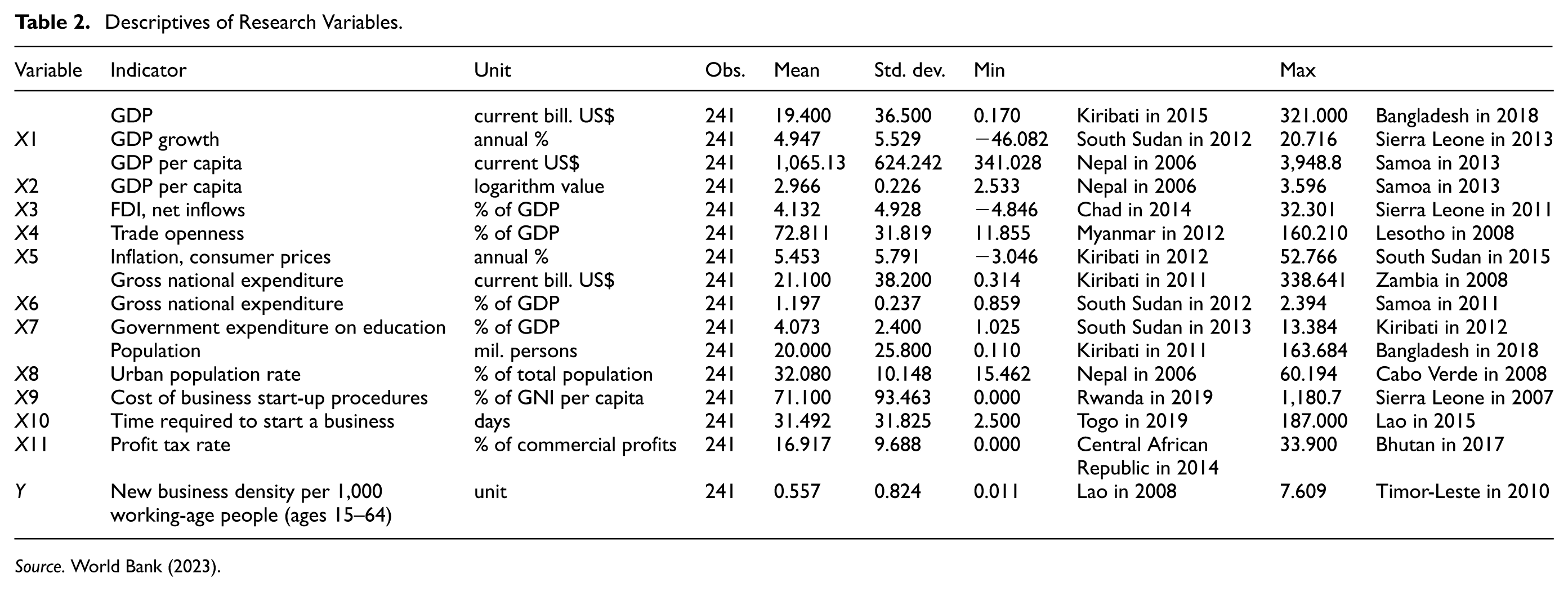
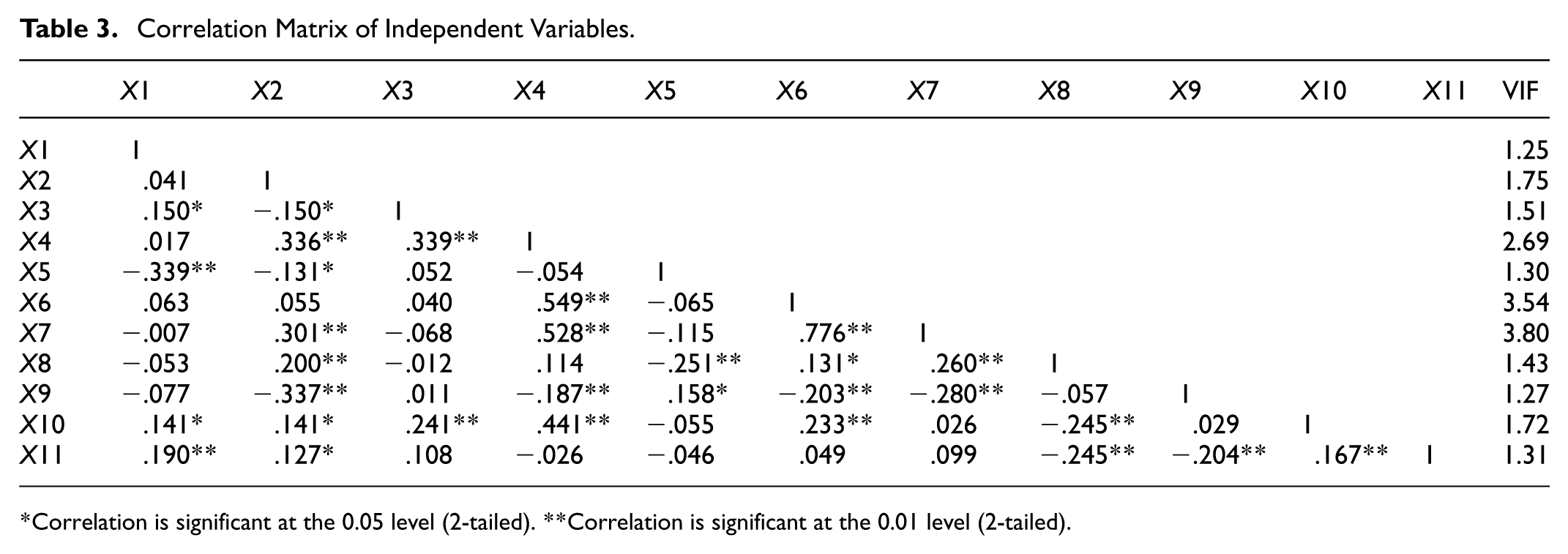
Descriptive statistics of the variables are provided in Table 2, and the correlation matrix of the independent variables is reported in Table 3.
Descriptives of Research Variables.
Source. World Bank (2023).
Correlation Matrix of Independent Variables.
Correlation is significant at the 0.05 level (2-tailed). **Correlation is significant at the 0.01 level (2-tailed).
According to Table 3, most Pearson correlation coefficients among the independent variables are below the conventional multicollinearity threshold of 0.7. However, Gross National Expenditure (X6) and Expenditure on Education (X7) exhibit a high correlation (r = .776, p < .01) and relatively elevated Variance Inflation Factor (VIF) values (3.54 and 3.80, respectively). These indicate a potential multicollinearity issue if both variables are included simultaneously in the regression model. To mitigate this, we decided to conduct two separate regression processes, each incorporating one of these variables while holding the others constant. This approach allows us to isolate and interpret their respective effects on entrepreneurship outcomes without compromising the validity of the model.
Regression Method
In our panel data analysis, we employ the procedure proposed by Dougherty (2011) and Torres-Reyna (2007) to select the appropriate regression model among fixed-effects, random-effects, and pooled OLS models, which are represented by the following econometric equations:
The equation of pooled OLS model:

where:
α is the intercept;
Y is the aggregate entrepreneurship of least-developed country;
Xi is the ith independent variable, respectively including: economic, social and institutional factors of LDCs;
β i is the ith coefficient of respective independent variables; and
ε is the error term.
The equation of fixed – effects model:

where: i = least-developed country and t = year from 2006 to 2019; and
α i (i = 1…n) is the unknown intercept for each entity (n entity-specific intercepts);
Yit is the aggregate entrepreneurship of ith least-developed country in year t;
Xit represents the independent variables, including: economic, social and institutional factors of ith LDCs in year t;
β i is the coefficient for respective independent variables; and
ε it is the error term.
The equation of random -effects model:

where: i = least-developed country and t = year from 2006 to 2019; and
α is the intercept;
Yit is the aggregate entrepreneurship of ith least-developed country in year t;
Xit represents the independent variables, including: economic, social and institutional factors of ith LDCs in year t;
β i is the coefficient for respective independent variables;
u it is the individual impact of ith least-developed country, is not measurable variables; and
ε it is the error.
As outlined by Dougherty (2011), the process of selecting a suitable regression model for panel data begins with verifying whether observations are drawn from a specific country through random sampling. In instances where these observations are obtained from a randomized sample, both fixed-effects and random-effects models are employed. Conversely, when data are not sourced from a randomized sample, a mixed-effects model is adopted. Subsequently, the Lagrange (LM) test is utilized to discriminate between the random-effects model and the pooled OLS model (Breusch & Pagan, 1980). Additionally, the Hausman test, also referred to as the Durbin-Wu-Hausman (DWH) test (Hausman, 1978), and the robust Hausman test or Sargan-Hansen test (Hansen, 1982) will be used to choose between the fixed-effects model and the random-effects model. The specific procedure is as follows (Figure 1):
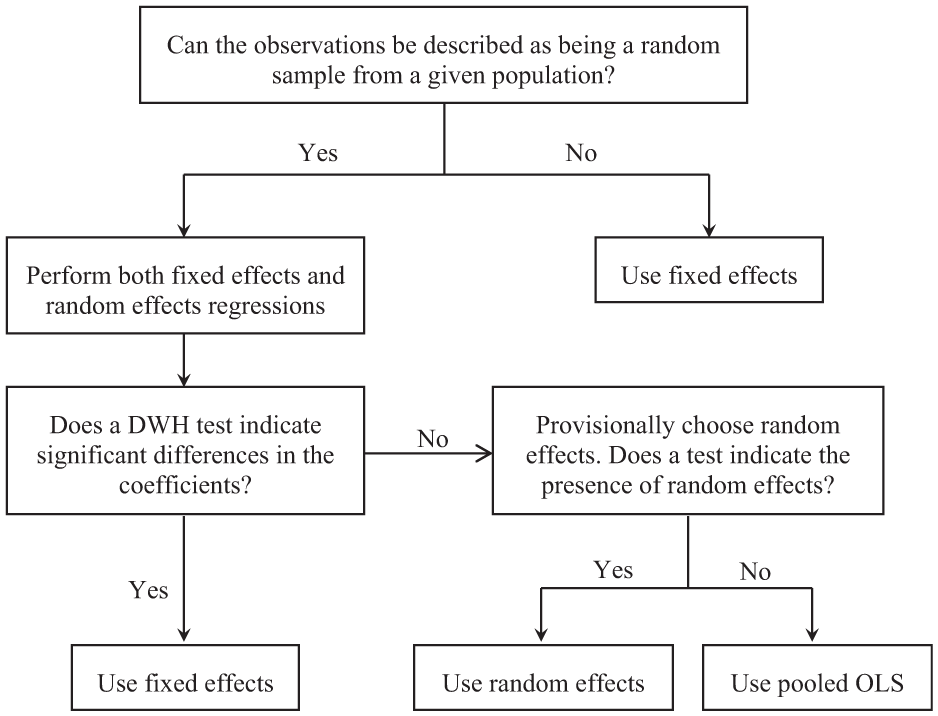
Process of selecting a regression model for panel data.
After completing the model selection process for panel data, the next step will be to test for heteroskedasticity by conducting a heteroskedasticity test. If the test results indicate the presence of heteroskedasticity, we will use robust models to test the proposed research hypotheses (Greene, 2008). As previously noted, we proceed with two separate regression processes, one M1 including variable X6 with the other independent variables and the other M2 including variable X7 with the same set of variables, in order to avoid multicollinearity resulting from the high correlation between these two variables. The final regression results are reported in Table 4.
Panel Analysis Results.

p < .05. **p < .01. ***p < .001. ****p < .10.
Research Results and Discussions
Our final regression results are summarized in the Table 4, in which, the significant Hausman’s test (chi2(12) = 59.39; Prob>chi2 = .0000) and Sargan-Hansen test (Chi-sq(12) = 39.967; p-value = .0001) at 95% confidence level allow us accepting the null hypothesis by refusing random-effects model and in favor of fixed-effects one. Also, the significant Breusch-Pagan Lagrange multiplier (LM; (chibar2(01) = 105.42; Prob > chibar2 = .0000) at 95% confidence level indicate that fixed-effects model is the appropriate one by refusing the Pooled OLS.
Our final regression results are summarized in Table 4, in which the significant Hausman’s tests (Model M1: chi2(10) = 42.56; Prob > chi2 = .0000; Model 2: chi2(10) = 31.65; Prob > chi2 = .0005) and significant Sargan-Hansen tests (Model 1: chi2(10) = 25.078; p-value = .0052; Model M2: chi2(10) = 24.876; p-value = .0056) at the 95% confidence level allow us to accept the null hypothesis by rejecting the random-effects model in favor of the fixed-effects model. Also, the significant Breusch-Pagan Lagrange Multiplier (LM) tests (Model M1: chibar2(01) = 100.23; Prob > chibar2 = .0000; Model M2: chibar2(01) = 102.70; Prob > chibar2 = .0000) indicate that the fixed-effects model is more appropriate than the pooled OLS. Furthermore, all VIF values in both models are below 3, with mean VIFs of 1.53 and 1.55, respectively, indicating that multicollinearity is not a concern in the selected models.
In the next step, we check the heteroskedasticity test for both selected fixed-effects models, which is significant (Model M1: Prob > chi2 = .0000; Model M2: Prob > chi2 = .0000) at the 95% confidence level. This indicates the presence of heteroskedasticity problems. Therefore, the robust option is applied to correct for this issue in both models. On the other hand, we did not address the issues of serial correlation and cross-sectional dependence, as these concerns are generally more relevant in macro panels with long time series (i.e., over 20–30 years; Baltagi & Maasoumi, 2013; Torres-Reyna, 2007), whereas our dataset covers a maximum of 14 years and is unbalanced, with many LDCs having only a limited number of year-observations. Accordingly, the results of the robust fixed-effects models are used to assess the proposed research hypotheses.
The results of the robust fixed-effects models have been summarized in Table 5, enabling us to scrutinize the hypotheses put forth. In accordance, hypotheses H1 and H3 exhibit partial validation, whereas H2 is found to be invalid. In the next sub-sections, we will analyze and discuss in detail the research findings.
Hypothesis Validity.

Impacts of Economic Factors on Aggregate Entrepreneurship
Regarding the impact of economic development or GDP growth: According to the regression outcomes derived from the robust fixed-effects models, the independent variable X1 shows coefficients of −0.004 (p = .399) in Model 1 and −0.005 (p = .195) in Model 2. These results do not exhibit statistical significance at the 95% confidence level. Consequently, within the context of LDCs, it can be concluded that economic growth does not significantly contribute to an increase in the aggregate entrepreneurship rate.
This finding can be rationalized by the limitation of GDP growth as an isolated indicator, which does not always reflect improvements in individual wealth, opportunity, or entrepreneurial capacity. As Ning (2021) highlighted, the context in which entrepreneurship operates in Africa and other LDCs differs substantially from that of developed countries. Many entrepreneurs in LDCs are driven by necessity rather than opportunity, and GDP growth may concentrate in sectors (e.g., extractive industries or aid-driven infrastructure) that do not directly benefit individual entrepreneurial actors. Moreover, macro-level growth might coexist with persistent inequality, unemployment, or informality, which can dilute the impact of GDP growth on entrepreneurial activity.
Regarding the impact of GDP per capita: According to the final robust fixed-effects models, the independent variable X2 exhibits statistically significant and positive effects in both models (Model 1: Coef. = 1.016 & p = .029; Model 2: Coef. = 1.107 & p = .024). This finding supports that in the context of LDCs, higher GDP per capita corresponds to an increased likelihood of national entrepreneurial activity. In practice, the establishment of businesses and the commencement of entrepreneurial endeavors necessitate an initial accumulation of capital by individuals, after which favorable opportunities play a pivotal role in motivating entrepreneurial decisions.
Nonetheless, it is imperative to recognize that individuals in LDCs predominantly grapple with poverty and low-income levels, placing considerable emphasis on day-to-day living expenses. Consequently, despite their intentions to engage in entrepreneurial pursuits, the hurdle of amassing capital poses a significant obstacle to embarking on business ventures. Hence, governments should formulate targeted measures and policies to enhance GDP per capita, given its pivotal role in mitigating the hindrance posed by capital accumulation for entrepreneurial initiatives.
Regarding the impact of FDI: As per the outcomes derived from the robust fixed-effects models, the independent variable X3 demonstrates a positive influence on the dependent variable Y, with statistical significance in Model 1 (Coef. = 0.011 & p = .019) and marginal significance in Model 2 (Coef. = 0.008 & p = .052). This result support the findings of Luu (2023) and Munemo (2018), and confirm that an increase of FDI within LDCs is associated with a heightened propensity for national entrepreneurial endeavors.
In practice, the majority of LDCs heavily rely on antiquated agricultural production methodologies, which consequently yield suboptimal productivity, inferior product quality, and diminished export valuation. To address these impediments, the pivotal role of FDI comes to the forefront. FDI engenders a favorable impact on entrepreneurship by infusing essential investment capital, introducing cutting-edge technological advancements, and sharing advanced management expertise. This catalyzes the enhancement of managerial proficiency, amplifies domestic entities’ competitive prowess, and ushers in new market vistas, encompassing specialized sectors aligned with FDI-driven industries. Thereby, this dynamic environment serves as a catalyst, nurturing entrepreneurial ambitions among individuals who are poised to engage in business pursuits.
Regarding the impact of international trade: According to the final robust fixed-effects models, the independent variable X4 (trade openness) does not exhibit statistically significant effects on the dependent variable Y (Model 1: Coef. = 0.003 & p = .358; Model 2: Coef. = −0.001 & p = .714) at the 95% confidence level. Thus, contrary to Y. Li and Huang (2023) and M. M. Rahman et al. (2023), we cannot assert a meaningful connection between international trade and the aggregate entrepreneurship of LDCs.
This outcome may reflect several structural limitations in LDCs. While trade liberalization is theoretically linked to increased market access and economic dynamism, many entrepreneurs in LDCs lack the capacity (such as capital, networks, or regulatory know-how) to participate effectively in international markets. Likewise, trade openness may disproportionately benefit larger or foreign-invested firms, while small-scale domestic entrepreneurs remain confined to subsistence-level or informal activities. Additionally, trade-related opportunities often require access to infrastructure, logistics, and stable institutions, which are often underdeveloped in LDCs.
Regarding the impact of inflation: The regression results in Table 4 reveal that the independent variable X5 does not exert a statistically significant influence on the dependent variable Y (Model 1: Coef. = −0.006 & p = .219; Model 2: Coef. = −0.003 & p = .588). Contrary to Nnorom (2022) and Izuchukwu (2023), we are unable to make definitive conclusions about the role of inflation in relation to aggregate entrepreneurship in LDCs.
This lack of significance may be due to the dual and often contradictory nature of inflation’s effects. Moderate inflation might encourage spending and reduce the real value of debt, while high and volatile inflation undermines purchasing power, increases input costs, and creates uncertainty – conditions that are especially harmful to small-scale entrepreneurs. In LDCs, where macroeconomic volatility is more frequent and institutions are weaker, inflation’s effect on entrepreneurship is likely to be highly context-dependent and nonlinear, thus making it difficult to detect a consistent impact in aggregate-level panel models.
In summary, our research findings on economic conditions indicate that while GDP per capita and FDI inflows exhibit statistically significant positive effects on aggregate entrepreneurship, GDP growth, trade openness, and inflation do not show consistent or significant impacts. These insignificant findings highlight the complex and often indirect relationship between macroeconomic indicators and entrepreneurship in LDCs. In such contexts, aggregate growth or liberalization does not automatically translate into opportunity-driven entrepreneurial activity, especially in environments marked by informality, structural inequality, and institutional fragility. Thus, hypothesis H1 is only partially supported.
Impacts of Social Factors on Aggregate Entrepreneurship
Regarding the impact of gross national expenditure: The outcomes of the final robust fixed-effects model M1 reveal that the independent variable X6 does not exert a statistically significant impact on the dependent variable Y at the 95% confidence level. The coefficient value is Coef. = −1.067, and the corresponding p-value is p = .051. This indicates that Gross National Expenditure does not play a noteworthy role in stimulating an augmentation of entrepreneurial inclination in the context of LDCs.
In practice, although Gross National Expenditure contributes to market development, its impact tends to be confined to the prevailing market, which is often monopolized by established large enterprises. Consequently, despite Gross National Expenditure potentially offering business prospects, it does not adequately empower individuals in LDCs, who largely grapple with economic limitations, to effectively engage in the contemporary competitive market landscape. This may also reflect the nature of public spending in LDCs, which is often geared toward consumption and debt service rather than investment in productive infrastructure that supports small and new enterprises. In this context, higher expenditure does not necessarily create direct or accessible opportunities for potential entrepreneurs.
Regarding the impact of government expenditure on education: The regression results obtained from the robust fixed-effects model M2 indicate that the independent variable X7 does not exert a statistically significant positive influence on the dependent variable Y at the 95% confidence level. The coefficient value is Coef. = −0.015, with a corresponding p-value of p = .674. Therefore, contrary to Puni et al. (2018), Tessema Gerba (2012), and Kolstad and Wiig (2015), we are unable to establish a substantive correlation between government investment in education and the aggregate entrepreneurship rate within LDCs.
In these countries, a majority of the population resides in impoverished conditions, and the educational attainment of the workforce remains severely constrained. Consequently, the appreciation for the pivotal role of education in economic development is often rudimentary and primarily foundational in nature. Thus, generating innovative and transformative changes to stimulate entrepreneurship proves to be a formidable challenge. Furthermore, prospective entrepreneurs are also reliant on a multitude of other resource-related factors such as financial capacity and market opportunities. Moreover, the long-term impact of education spending may not immediately translate into entrepreneurial outcomes, particularly when curricula are not aligned with market needs or entrepreneurial competencies. As such, education spending alone, without broader structural reform, may be insufficient to affect entrepreneurship in LDCs.
Regarding the impact of urbanization rate: According to the robust fixed-effects models, the independent variable X8 does not show statistical significance in either model (Model 1: Coef. = 0.006 & p = .808; Model 2: Coef. = 0.001 & p = .984), suggesting that the degree of urbanization alone may not be a strong determinant of aggregate entrepreneurship in LDCs. This implies that the level of urbanization is not a determinant of the entrepreneurship in LDCs, unlike the findings of scholars (Naudé, 2018; Zheng & Du, 2020).
In practice, urbanization does not uniformly correlate with increased business opportunities; it often represents a population shift toward areas with greater job availability rather than fostering an ideal business environment. Consequently, it may not create optimal conditions for capital accumulation and might not necessarily enhance the quality of human capital. On the contrary, the decision to engage in entrepreneurial activities is influenced by various other resource-related conditions. Additionally, urbanization in many LDCs is accompanied by slum development, informal labor markets, and infrastructure bottlenecks, which may suppress rather than support entrepreneurial growth.
In summary, we did not find significant impacts of any examined social factors, including gross national expenditure, government expenditure on education, and urbanization rate in LDCs. These insignificant findings suggest that structural limitations, informality, and weak institutional linkages may weaken the potential of social conditions to support entrepreneurship in such contexts. Therefore, hypothesis H2 is invalid.
Impacts of Institutional Entrepreneurial Factors on Aggregate Entrepreneurship
Regarding the impact of cost of business start-up procedures: The regression results in Table 4 indicate that the independent variable X9 does not have a statistically significant impact on the dependent variable in either model (Model 1: Coef. = 0.000 & p = .296; Model 2: Coef. = 0.000 & p = .309). This suggests that the costs associated with administrative procedures for establishing businesses do not serve as substantial hindrances or catalysts for entrepreneurial endeavors in LDCs.
In practice, when individuals opt to initiate a business venture, the decision to embark on entrepreneurial activities signifies their prior accumulation of adequate resources and a recognition of the significant profit potential stemming from business opportunities. Consequently, concerns about administrative costs might not hold substantial weight, despite prevailing circumstances where a majority of individuals within LDCs grapple with limited income and financial constraints. Notably, the administrative costs related to business start-up procedures do not appear disproportionately burdensome when contrasted with the expenses tied to formulating business concepts and managing the tangible operational aspects of nascent enterprises. Moreover, given the prevalence of informal entrepreneurship in LDCs, many individuals may bypass formal registration altogether, reducing the relevance of administrative cost as a factor influencing entrepreneurial decisions.
Regarding the impact of the time required to start a business: The results from both models indicate that X10 exerts a statistically significant and negative effect on entrepreneurship (Model 1: Coef. = −0.006 & p = .005; Model 2: Coef. = −0.007 & p = .015). This confirms that a shorter duration for starting business operations corresponds to a heightened level of national entrepreneurial fervor within the context of LDCs.
In practice, the financial outlays associated with the initiation of business endeavors encompass explicit costs, whereas the temporal dimension encompasses both implicit costs and the intricacy of administrative procedures. Certain authorities may insist on informal expenditures to expedite the process of business establishment. Failure to meet such demands could lead to delays or an extended business formation timeline beyond the norm. Furthermore, the intricacies and complexities inherent in administrative procedures can contribute to the propagation of corruption, thereby disincentivizing prospective entrepreneurs from pursuing business initiation. This, in turn, contributes to a decrease in the overall rate of entrepreneurial involvement.
Regarding the impact of profit tax: According to the robust fixed-effects model in Table 4, the independent variable X11 does not exhibit a statistically significant impact on the dependent variable Y at the 95% confidence level (Model 1: Coef. = −0.042 & p = .217; Model 2: Coef. = −0.043, p = .203). This suggests that the profit tax rate does not exert a noteworthy stimulating or obstructive influence on entrepreneurial zeal within the LDCs.
This outcome can be interpreted from two perspectives. Firstly, governmental bodies commonly introduce supportive measures for nascent enterprises, which may encompass tax incentives or reductions during initial operational years. Consequently, the effect of the profit tax rate is not deemed to be of substantial consequence in terms of instigating entrepreneurial motivation. Secondly, startup ventures within LDCs frequently operate without substantial profits or may even maneuver around legal stipulations to evade profit-based taxation. These insights underscore the intricate interplay between profit tax policies and the establishment of emerging businesses within contexts characterized by limited development. In addition, the limited enforcement capacity and the prevalence of informal economic activity reduce the sensitivity of entrepreneurship to changes in tax policy.
In summary, our research findings on institutional entrepreneurial factors consist of a significant negative impact of time required to start a business, but insignificant impacts of the cost of business start-up procedures and the profit tax rate. These results reflect the partial role of institutional factors and underscore that regulatory efficiency (not just formal policy variables) is key to encouraging entrepreneurship in LDCs. Therefore, hypothesis H3 is partially supported.
Conclusion
Main findings: Our study examines the impact of economic, social, and institutional conditions on aggregate entrepreneurship in LDCs by employing panel analysis method using data sourced from the World Bank’s database spanning the period from 2006 to 2019. In terms of economic conditions, the results demonstrate that financial and economic factors, specifically GDP per capita and FDI inflows, are the most prominent and consistent drivers of entrepreneurship in LDCs. In contrast, GDP growth, international trade and inflation do not show statistically significant impacts on entrepreneurship in LDCs.
Social factors, including gross national expenditure, government expenditure on education, and inflation, were also examined. Our analysis indicates that these variables do not significantly influence aggregate entrepreneurship in LDCs. This suggests that broader social expenditures and economic policies may not directly correlate with entrepreneurial activity in these environments.
Furthermore, our study assesses institutional entrepreneurial factors affecting entrepreneurship, focusing on the time required to start a business, the cost of business start-up procedures, and the profit tax rate. We find that only the time required to start a business demonstrates a significant negative impact on aggregate entrepreneurship. Conversely, the cost of business start-up procedures and the profit tax rate do not show significant effects on entrepreneurship in LDCs.
Policy implications: Based on the research findings, we propose recommendations for LDCs, specifically:
The government of LDCs should implement policies aimed at promoting economic development to increase GDP per capita, thereby fostering the abundant accumulation of entrepreneurial capital. Entrepreneurial capital is an essential factor necessary for encouraging or facilitating the emergence of new business ventures. Policies aimed at increasing GDP per capita may include: investing in infrastructure, such as roads and airports, to facilitate commercial activities; improving education and training to enhance workforce skills; liberalizing markets to boost competition and trade; advancing research and development initiatives; and implementing suitable monetary and fiscal policies. In particular, infrastructure development should prioritize logistics corridors and digital infrastructure, which are often underdeveloped in LDCs but essential for reducing transaction costs and enabling access to broader markets.
Furthermore, the governments of LDCs should also aim for policies to attract FDI to catalyze aggregate entrepreneurship. Attracting FDI remains a crucial challenge in LDCs to stimulate economic development. When domestic capital and expertise are insufficient, FDI can provide a boost to the economy, offering new possibilities and successes. Concrete policy measures may include establishing one-stop service centers to streamline FDI approval processes, offering targeted fiscal incentives for investors in startup ecosystems, and signing bilateral investment treaties that provide legal certainty to foreign investors. Additionally, the government should focus on directing FDI investments into startup enterprises or providing capital to new business ventures, thus creating a supportive environment for their development while mitigating the risk of FDI inflows.
Moreover, in LDCs, the issuance of entrepreneurship-supportive policies is of utmost importance. The government needs to pay particular attention to simplifying and transparentizing startup procedures, as well as reducing the time required for business establishment to create favorable conditions for aggregate entrepreneurship. Consequently, a significant portion of potential entrepreneurs who were previously deterred can be encouraged, leading to an increase in the number of new business ventures in the country. For example, digitalizing business registration platforms and reducing redundant licensing requirements could directly lower barriers to entry, especially in rural and underserved areas. Governments should also consider establishing public-private entrepreneurship hubs that provide training, seed capital, and mentorship – tailored to local contexts and informal sector realities, which dominate many LDC economies.
Research contributions: In this study, we have developed a theoretical framework based on Resource-Based View (RBV) and Institutional Theory to explain aggregate entrepreneurship in countries. The RBV framework helps identify how resource conditions contribute to entrepreneurial activities, while Institutional Theory elucidates how formal and informal institutions shape the entrepreneurial landscape across countries. By integrating these perspectives, our framework offers a comprehensive understanding of the macro factors influencing aggregate entrepreneurship in LDCs.
This study focused on aggregate entrepreneurship in LDCs, which is a pivotal topic in the current global and national economic development context. Furthermore, this research field is also a context that has not received sufficient attention in the literature, highlighting the need for deeper investigation into the dynamics and determinants of aggregate entrepreneurship within these specific conditions of LDCs.
In practice, our empirical findings underscore the critical and leading role of financial factors related to entrepreneurs in promoting aggregate entrepreneurship in LDCs. This suggests that policymakers in these countries should prioritize economic development and financial institutional enhancement as prerequisites for fostering entrepreneurship and achieving sustainable socio-economic development in the long term.
Research limits and perspectives: The research study, however, is subject to certain limitations concerning the availability of variables and the focus of the research on LDCs. The data used for the study were collected from the World Bank’s database from 2006 to 2019, with some data being unavailable for certain periods in some countries, resulting in incomplete and discontinuous data. Furthermore, with secondary data sources from the World Bank, variables that can proxy for social conditions may not be comprehensive, leading to some results of the research model possibly not being entirely suitable.
Moreover, the present study relies solely on macro-level data, which may overlook individual-level entrepreneurial behaviors, motivations, and constraints that are critical to understanding the dynamics of entrepreneurship in LDCs. Future research could adopt a multi-level approach that integrates both macroeconomic variables and micro-level survey or case data to provide a more holistic and context-rich analysis. This would enhance the explanatory power of the findings and inform more targeted interventions.
In addition, the study employs a fixed-effects panel model, which is appropriate for controlling for time-invariant country-specific characteristics. However, it may not fully capture the dynamic nature of macroeconomic factors or the lagged effects on entrepreneurship, particularly in LDCs where structural changes can occur rapidly. Future research should consider applying dynamic panel models such as the Generalized Method of Moments (GMM) to address potential endogeneity and reverse causality issues, and to better account for temporal dynamics in entrepreneurial responses.
Another important limitation concerns the heterogeneity across LDCs. While the current study aggregates findings across all LDCs, it does not explicitly account for cross-country variations in economic structures, institutional settings, or social factors. Future studies should explore sub-group analyses based on regional classifications, income brackets, or institutional indicators to yield more nuanced insights and tailor policy recommendations accordingly.
Footnotes

Author Contributions
All authors contributed equally to this work. Thi Nhu Quynh VU (25% – review, methodology, supervision), Khac Huy Nguyen (25% – data collection, editing), Van Kiem Pham (25% – conceptualization, draft writing), Thanh Tú Phan (25% – conceptualization, data analysis, revisions).
Funding
The authors disclosed receipt of the following financial support for the research, authorship, and/or publication of this article: This research was funded by Thuongmai University, Hanoi, Vietnam.
Declaration of Conflicting Interests
The authors declared no potential conflicts of interest with respect to the research, authorship, and/or publication of this article.