




Abstract
In recent decades, a number of initiatives have been undertaken to reduce poverty and improve the economic situation of Least Developed Countries (LCDs), but there are still problems that prevent them from progressing toward their goals. This article studies the scientific contributions related to the issue of the LCDs to detect how these countries can achieve sustained economic growth with full use of their capacities, allowing access to new forms of production that could generate products and activities with greater added value. The research has been carried out using bibliometric tools (Vosviewer and Biblioshiny) and the data have been extracted from Web of Science and Scopus. This method includes the topics that have been dealt with the most, the trend followed by these publications, the concentration of authors and the responses that scientific journals offer on LDCs. In conclusion, there has been increased concern about these issues, especially around the topic of trade, sustainability, and the African continent, albeit with gaps in aspects such as the importance of raw materials, official development aid, transportation, and the distribution of its products, as well as other key variables to achieve its future development. As a recommendation, we suggest that the group of researchers on the subject must be stimulated so that the message provokes a reaction regarding the importance of the issues affecting these countries, their painful consequences, and the need to find adequate solutions considering their social and humanitarian significance. It is about raising awareness among the scientific community on topics that have been largely overshadowed by more media-driven current issues.
Plain language summary
This work aims to analyse the evolution and concentration of studies on the issue of Least Developed Countries to detect the topics that researchers have most discussed. These are matters of great economic and social importance, affecting two-thirds of the planet. It analyses the work and research carried out to detect how these countries can achieve sustained economic growth with full use of their capacities, allowing access to new forms of production that could generate products and activities with greater added value. The work is therefore structured as follows: First, a description is given of the characteristics of LDCs and the different initiatives that have been taken over the last 50 years to reduce poverty and improve their socio-economic situation. Secondly, following the analysis carried out in the first part, it describes the problems that prevent LDCs from progressing in their objectives and highlights the main contributions in the existing literature on the subject. This is a summary of the different perspectives and theories that attempt to explain the problems related to LDCs, the most appropriate model designs that have been proposed, the most successful strategies, the validity of the data used, on which the conclusions of the studies will depend. Thirdly, we apply a bibliometric analysis of the works that have addressed the issue of LDCs. This method includes the topics that have been dealt with the most, the trend followed by these publications, the concentration of authors and the responses that scientific journals offer on LDCs. It should be noted that this is one of the few research studies to have used this methodology to address this issue. This article is of great interest to experts, public institutions and researchers sensitive to problems of such great importance and so widespread that they affect a large part of the world population.
Introduction
The category of “least developed countries” (LDCs) was established in 1971 as a group of developing countries characterized by low income levels and structural problems. It is also a group of countries with exclusive access to specific international support, particularly development assistance and trade (UNCTAD, 2014, 2020a, 2020b; UNESCAP, 2007).
There are currently 46 LDCs. This denomination is reviewed every 3 years by the Committee for Development (CDP), a subsidiary body of the United Nations Economic and Social Council (ECOSOC).These countries have a population equivalent to just over 10% of the world’s population, but their share of global GDP is less than 1% and they need special aid to achieve their development (United Nations, 1970; UNCTAD, 2002). Moreover, in the field of development economics this is an extremely important issue as the populations of these countries live in extreme poverty and in economies that suffer from profound structural weaknesses.
Over the last 50 years various initiatives have been taken in an effort to reduce poverty and improve the economic situation, bearing in mind the characteristics of the LDCs.
It is true that there are problems which stop the LDCs from advancing toward their goals. Further, these aspects have been approached from different perspectives and theories, such as better fitting model design, more successful strategies and more consistent data validity. LDCs tend to be more vulnerable to crises (economic, social, political, or environmental), a clear example of which has been seen with the recent covid-19 pandemic.
The positive growth performance of LDCs has not been sufficient to accelerate structural transformation (Guillaumont, 2004), reduce dependence on foreign investments, diversify exports, and control the rapid growth of imports (Simonis, 1992). They are countries in profound need of reforms to their economic, political, and social systems (Fan et al., 2008; UNESCAP, 2021). Their structural economic problems have been analyzed from various perspectives. Over the past 15 years or so, UNCTAD has consistently highlighted the need to develop their productive capacities and support them to reduce their vulnerabilities, which have been extensively studied (Gore & Kozul-Wright, 2011; Saleemul et al., 2004; Turvey, 2007; UNCTAD, 2008).
Considering that members of government and civil servants are generally non-scientists, it is necessary to increase and improve studies on their main weaknesses and that scientists participate in designing more suitable strategies. The governments of many developing countries do not support enough scientific research because they consider them to be irrelevant. Therefore, it is desirable that academic research or working groups about developing countries be applied.
Staying current with mainstream studies about developing countries is very important for scientists. Contacts, short scientific visits, and international meetings have proven useful and provide new information and ideas. Support fellowship programs is another way of improving research in developing countries.
To carry out the research, the following structure is presented:
Firstly, a description of the characteristics of the LDCs and the different initiatives taken over the past 50 years to reduce poverty and improve their socioeconomic situation is presented.
Secondly, following the analysis conducted in the first part, the problems hindering the progress of LDCs in achieving their goals are described, and the main contributions in the existing literature on the subject are highlighted. This includes a summary of different perspectives and theories attempting to explain the issues related to LDCs, the proposed models with the most appropriate designs, successful strategies, and the validity of the data that will determine the conclusions of the studies.
Thirdly, as the core of our research, a bibliometric analysis is applied to the works that have addressed the issues of LDCs. This method collects the most addressed topics, the trends followed by these publications, the concentration of authors, and the responses offered by scientific journals regarding LDCs. It should be noted that this is one of the few studies where bibliometric analysis has been used to address this issue.
Finally, after presenting the results and discussion, the conclusions provide a synthesis of the findings and offer an overview of the implications and recommendations derived from the research. They serve as a closure and guidance for future studies and actions related to the LDCs.
Category of Least Developed Countries
The LDCs host about 40% of world’s poor. Most are suffering conflict or emerging from one. LDCs account for 13% of world population but only about 1.3% of global GDP and less than 1% of global trade and FDI. Even if on the rise, still barely a fifth of the population in LDCs has access to the internet.
The low level of socio-economic development in LDCs is characterized by historically weak development capacity, low and unequally distributed income and scarcity of domestic financial resources. LDCs typically rely on agrarian economies which subsequently can be affected by a vicious cycle of low productivity and low investment, especially as wealthier countries develop and utilize more productive farming technologies.
Generally, LDCs rely on few primary commodities as major sources of exports and fiscal earnings, causing them to be vulnerable to external terms-of-trade shocks. Some LDCs have been able to diversify into the manufacturing sector though often remain limited to products in labor-intensive industries, such as textiles and apparel.
w?>As of 2023, 46 countries are considered by the United Nations as LDCs: Afghanistan, Angola, Bangladesh, Benin, Bhutan, Burkina Faso, Burundi, Cambodia, the Central African Republic, Chad, Comoros, the Democratic Republic of the Congo, Djibouti, Eritrea, Ethiopia, Gambia, Guinea, Guinea-Bissau, Haiti, Kiribati, Lao People’s Democratic Republic, Lesotho, Liberia, Madagascar, Malawi, Mali, Mauritania, Mozambique, Myanmar, Nepal, Niger, Rwanda, Sao Tome and Principe, Senegal, Sierra Leone, Solomon Islands, Somalia, South Sudan, Sudan, Timor-Leste, Togo, Tuvalu, Uganda, the United Republic of Tanzania, Yemen, and Zambia.
Among the most relevant issues that affect the LDCs are: Trade, commodities, official development aid, tourism, need for structural reforms, environment and climate change, or the need to progress in critical objectives.
Trade Support
Trade-related international support for LDCs aims to facilitate their integration into the global economy. The main categories of trade-related support for LDCs are: Preferential market access for goods; preferential treatment for services and service supplies; and special treatment regarding obligations and flexibilities under WTO rules (Aid for Trade, and in particular the Enhanced Integrated Framework) (Helble et al., 2012; Laborde, 2008; UNCTAD, 2004).
Commodities
Limited product diversification and fluctuating market value of traditional products are issues that have affected trade flows of LDCs for decades. Despite limited product and export diversification, mainly consisting of raw and low-value-added products (primarily commodities), a valuable array of traditional products and preparations is available in selected LDCs with the potential to graduate to products of excellence that can compete globally. However, bringing small local producers upfront into the global value system does not necessarily carry them beyond subsistence.
Regarding commodities, the short-term policies designed to improve commodity exports often conflict with long-term development needs. Policy reform needs to be backed by measures to compensate for shortfalls in commodity export earnings caused by factors outside their control (UNCTAD, 2019b).
Official Development Assistance
LDCs are given priority in resource allocation or access to mechanisms in several areas of development cooperation in the form of official development assistance (ODA) provided by members of the Development Assistance Committee (DAC) and other donors. Foreign aid is one of the most important policy tools that wealthy countries use to help poorer countries to improve population well-being and facilitate economic and institutional development. However, the role and effects of foreign aid on the economic growth of developing countries are considered to be controversial, both now and in the past (Alesina & Dollar, 2000; OECD-DAC, 2021; UNCTAD, 2006).
Tourism as a Key Sector
In many developing countries, tourism is the first export sector. Its activities create links to many other economic sectors contributing to national development. It is a crucial growth sector for LDCs. Tourism provides employment opportunities for women and youth and can stimulate entrepreneurship. Tourism was among the leading contributors enabling the graduation of Cabo Verde, Maldives and Samoa from their previous LDC status (International Trade Center, 2015; UNCTAD, 2019a). It is a sector with enormous potential for economic growth that, at the same time, can improve a country’s image, facilitate export diversification.
Need for Structural Reforms
Critical challenges for its development are infrastructure, access, and poor transport; the lack of hospitality accommodation which can limit its competitiveness; essential skilled and trained human resources in this labor-intensive sector; and statistics and data, a vital element for attracting private sector and foreign direct investors (UNCTAD, 2015).
LDCs have managed to keep up with other developing countries in structural reform in all areas except financial sector reform and public enterprise reform. Trade liberalisation has also proceeded further in the LDCs than in the other developing countries. However, economic growth is too slow to decrease the high poverty rates prevalent in the LDCs. The overall progress in increasing real incomes, reducing poverty, and achieving the international human and social development targets has been disappointingly slow, except for a few LDCs. The rates of social progress in the LDCs are generally far behind those required to meet the international targets established at the international conferences during the 1990s (UNCTAD Secretary-General, 2000a).
Environment and Climate Change
Finally, the LDCs have contributed the least to the emission of greenhouse gases, but they are the most vulnerable countries to the effects of climate change and have the least capacity to adapt to these changes. They will suffer from a possible increase in natural disasters such as floods and droughts due to climate change. When affected by natural disasters, LDCs depend on external aid, as they do not have the necessary funds to deal with the problems themselves. The LDCs also have the least capacity to adapt to climate change, as they lack the resources and money to carry out adaptation studies and implement the strategies emerging from these studies.
From 2024 onwards, all countries will need to meet climate change requirements under the Paris Agreement’s Enhanced Transparency Framework (ETF). For LDC, it is a significant step for understanding their capacity constraints and needs for greenhouse gas inventory reporting (Sokona & Denton, 2001). The main impacts of climate change are on water resources, food security and agriculture, natural resource management and biodiversity, and human health (Dieudonne, 2001).
The Need to Progress in Critical Objectives
The Fourth United Nations Conference on the Least Developed Countries, held in Istanbul in May 2011, adopted the Programme of Action for the Least Developed Countries for the Decade 2011 to 2020. The conference emphasized the need to progress in critical objectives such as production capacity, agriculture, food security, rural development; trade; commodities; human and social development; multiple crises and challenges, financial resources, and good governance (Bhattacharya, 2010; Cortez, 2011). In this regard, recent research suggests that appropriate policy and good governance will lead to inclusive growth that benefits human development (Chen et al., 2023). The LDCs are also dependent on external finance, and they need to break this dependency and build up production capacities and international competitiveness (UNCTAD Secretary-General, 2000b).
In the forthcoming Fifth United Nations Conference on LDCs in Doha in 2022, a new 10-year Program of Action will be adopted. This new program aims to harness the potential of new technologies (Hossain et al., 2010); increase employment (International Labor Organization, 2011), to face crises (Karshenas, 2009), attain sustainable debt levels; confront challenges from high rates of urban growth; education; and increase support for the transition of graduating countries.
At the same time, the Sendai Framework for Disaster Risk Reduction 2015 to 2030 outlines seven targets and four priorities to prevent and reduce disaster risks: Understanding disaster risk; Strengthening disaster risk governance; Investing in disaster reduction for resilience, and; Enhancing disaster preparedness for effective response (United Nations, 2015; UNCTAD, 2009). Likewise, exclusive mechanisms have been created for LDCs to promote their development, such as: Access to technology (UN-OHRLLS, 2021; UNCTAD/DER, 2019); to deal with climate change (UNFCCC Least Developed Countries Portal, 2021); Aid for Trade (Enhanced Integrated Framework); Last mile finance (UNCDF50); and the Investment Support Program for LDCs by IDLO and UN-OHRLLS, launched in September 2017, that will provide them with legal services related to foreign direct investment. The program is being developed through a partnership between the International Development Law Organization (IDLO) and UN-OHRLLS.
Summarizing, the poorer LDCs are failing to catch up with developed and developing countries, and nearly a quarter of the LDCs are caught in a downward spiral of economic stagnation and regress, social stress, and violent conflict.
In light of the above, this study aims to analyze the scientific literature related to least developed countries, to the world’s poorest people, its evolution throughout the period analyzed, and the concentration of topics studied to solve their problems, the results obtained, as well as to reveal those aspects in which there are fewer studies, and that should be treated in the future.
Using bibliometrics it is possible to analyze the research studies that have tackled the problem of LDCs. In this method we determine the themes which have been most dealt with, the trends which these publications have followed, the number of authors and the solutions proposed in the scientific publications on LDCs.
This work is of great interest to researchers sensitive to problems of such great importance and so widespread that they affect a large part of the world population and provides a starting point for future research which aims to focus on other aspects relating to LDCs.
Conceptual Framework
The study of development strategies forms an essential part of the analysis of the policies in LDCs. There are a wide range of subjects which affect these countries, among which the following stand out: the choice of a suitable development model, the distribution of income, trade policies, the liberalization of trade, fiscal policy, long term growth projections, necessary structural changes, currency shortages, the vulnerability of domestic economies to external pressures, dependence on basic products, foreign debt problems, the income gap, and the reduction of poverty; and also, since the 90s, environmental policies and the management of natural resources (United Nations, 1980).
In developing countries, it is very important to assess the links between growth and other phenomena such as the distribution of income. According to these connections, these countries follow different paths to reach their objectives, depending on their own situation as well as external factors and their own development agenda. (Mkandawire & Soludo, 2014; Olukoshi, 2008). At the heart of these processes the government structures and institutions which define domestic plans and policies must also be taken into consideration. This variables are the foundation of the national processes in developing countries. (Chimhowu et al., 2019; Fosu, 2009).
Adapting Analyses to the Case Studies
As development is a process of changes, a clear time framework is required along with a method to measure the advances made, as static focuses on economic development do not always provide satisfactory comparison criteria (Ravallion, 2016).
For their part, econometric studies, which have clear advantages, also present certain drawbacks, particularly in the case of LDCs. Estimating the required parameters is a difficult task due to the lack of data, something which is exacerbated when the aim is to assess the impact on poverty of the policies applied (Ahn & Schmidt, 1995; Barro, 1990; Khurshid et al., 2016; Mankiw et al., 1992; McMillan et al., 2017).
Frequently, it is also necessary to carry out regional disaggregation, which is extremely problematic in these countries due the lack of disaggregated data on social accounting or input–output tables.
Finally, structural changes, being multidimensional processes must take into account variables, which are difficult to quantify such as the accumulation of human capital and environmental variables (Herrendorf et al., 2014; Herrendorf & Schoellman, 2018; Jänicke et al., 2000; UNCTAD, 2018).
Some of these Countries’ Priorities
The particular characteristics of the LDCs provide the opportunity to delve deeper into the underlying factors which determine their development (UNCTAD, 2010).
Agriculture, due to its size and its share of the GDP, is a sector of particular importance as well as being the main employer in low income countries. Thus, investment in agriculture must play an important role in development policies.
There is also a great deal of literature regarding the impact of agricultural trade reforms in developing countries. Some works have focused on the importance of free trade for these products as it is evident that protectionism, particularly applied by industrialized countries, can limit exports. (Nissanke & Thorbecke, 2007; Warr, 2002).
Other areas, which can affect this crucial sector in these countries are related to consumer demand, factor mobility, land distribution, farming infrastructure and the high degree of public intervention in the agriculture and food sector. Therefore, future research should focus more on rural areas and their wellbeing (Christiaensen et al., 2011; UNCTAD, 2020a, 2020b).
Further, budget allocations to productive and non-productive sectors will determine both economic development and social wellbeing, albeit with different results depending on the country (Ghosh & Gregoriou, 2007; Shenggen, 2008). Government spending power and that of employers varies significantly between LDCs depending on the capacity of the state to mobilize domestic resources, international support and access to national and international loans. It is also necessary to have an institutional framework capable of using suitable fiscal and monetary tools which can support growth (Nnadozie et al., 2017).
As well as official development aid and technical support, trade is the principal area in which plans have been put into practice for LDCs, although the special needs of these countries are widely recognized by the international financial institutions (Gay, 2020; Makhlouf et al., 2015; Scott, 2019).
Accordingly, LDCs face a severe problem with regard to the behavior of the exports of basic products, which have low demand elasticity in relation to income in comparison with manufactured products (Parra-Lancourt, 2015; UNCTAD, 2019c, 2019d). These are economies, which are not able to generate sufficient resources to finance development and many of them lack the internal economic structure to compete on a global level (Flent & Ponte; 2017; Klasen et al., 2021; Mkandawire & Soludo, 2014).
Limitations in the Application of Certain Models
There is a broad debate concerning the value and suitability of the models used in policy analysis. Some of the main criticisms in the literature focus on unrealistic neoclassical suppositions and others are related to misgivings concerning data and parameter values. There are further shortcomings related to their coherence, accuracy and suitability with regard to LDCs.
Although model design has made significant advances in terms of size and complexity, a major part of its utility lies in the soundness of the foundations which are supported in economic theory. However further advances are required in the application of model design to LDCs, both with regard to methodological and analytical aspects. Important aspects such as the informal economy or the levels of integration should be included both in micro and macro analysis. In the application of macro models in these countries the literature suggests the use of different estimations to those made on a micro scale. Similarly, researchers should be wary of spurious correlations in time series (Ahn & Schmidt, 1995; Baltagi, 2008; Eberhardt, 2021).
Furthermore, in order to be useful in policy design for LDCs, economic models must include a series of characteristics: they must deal with relevant aspects, they should endeavor to achieve data validity and accurate estimation as well as including a broad variety in their focus. Much of the criticism has centered on the models having little relation with reality, although improvement will only be possible with the availability of a consistent and reliable database (Banerjee & Duflo, 2005). National surveys on poverty and inequality are unreliable due to the lack of sufficient observations thereby hindering accurate estimations.
Methodology
Bibliometrics makes it possible to discover the trends of a particular research field (Glänzel, 2003) at a global level (Li et al., 2009) through an exploration of keywords (Song et al., 2019) and offers information on current issues and their evolution (Pritchard, 1969) in any thematic area. Thanks to bibliometric analysis, it is possible to examine a research area and determine which terms have been addressed by the scientific community in the past, present, and future. This is why conducting this type of study is of paramount importance, as it allows identifying potential knowledge gaps (Bielański et al., 2022; Fady et al., 2022; Ghosh et al., 2021; Nobanee et al., 2021). By analyzing scientific publications and their associated citations, one can identify the topics and concepts that have received more attention and those that have been less explored (Barthel & Seidl, 2017; Liu et al., 2015; Orioli & Veríssimo, 2023).
The visualization of graphs provided by these tools enables the evaluation of research pertaining to each group and facilitates the discussion of empirical results, as well as theoretical and conceptual advancements(Davidescu et al., 2022; Sharma et al., 2022).
Figure 1 shows the methodological scheme applied in this study and its four stages. In the first stage, the concept of “least developed countries” was selected and expressed using the search criterion, “Least Developed Countr*”. In the second stage, the Web of Science (WoS) and Scopus databases were selected due to the breadth and quality of their content (Ahmad et al., 2020; Gao & Guo, 2014). In the case of (WoS), a total of 1,233 documents were retrieved. These results were then filtered by articles (894) to limit the sample to documents of a certain quality since impact journals have a very rigorous review process. Regarding the study period, it is a consolidated topic whose first publications date back to 1975.

Outline of the methodology.
In the search carried out in Scopus, 1,738 documents were obtained, and after applying a similar filter as on the WoS database, 1,178 articles were published in the period 1965 to 2021.
In the third stage, once the records of both databases had been retrieved, two tools were used to carry out the study: VOSviewer and biblioshiny. VOSviewer performed a cluster analysis of all keywords and created interesting mapping graphics (Van Eck & Waltman, 2014). In the latter case, biblioshiny, an R-Studio interface, facilitated the broader analysis at three levels such as sources, authors, and documents (Aria & Cuccurullo, 2017) and, for this study, the conceptual structure will be analyzed in detail.
Following this stage, two criteria were used in the conceptual structure to visualize the thematic evolution: Author Keywords and Keywords Plus. The field, Author Keywords, is provided by the author and expresses the essence of the research document. In turn, the field, Keywords Plus, is an algorithm that provides extended terms derived from the cited references or the record’s bibliography (Zhang et al., 2016). In addition, as they are extracted from the titles of the documents cited in their bibliographic records, Keywords Plus provide additional search terms (Garfield, 1990).
The strategic diagram based on the study of Keywords (Figure 2) offers an interesting classification of thematic maps. Four zones are differentiated according to two variables: centrality and density. The first quadrant addresses motor themes, basic and transversal themes are addressed in the second quadrant, the third quadrant refers to highly developed and niche themes, and the fourth quadrant group includes emerging or declining themes (Callon et al., 1991; Cobo et al., 2011).
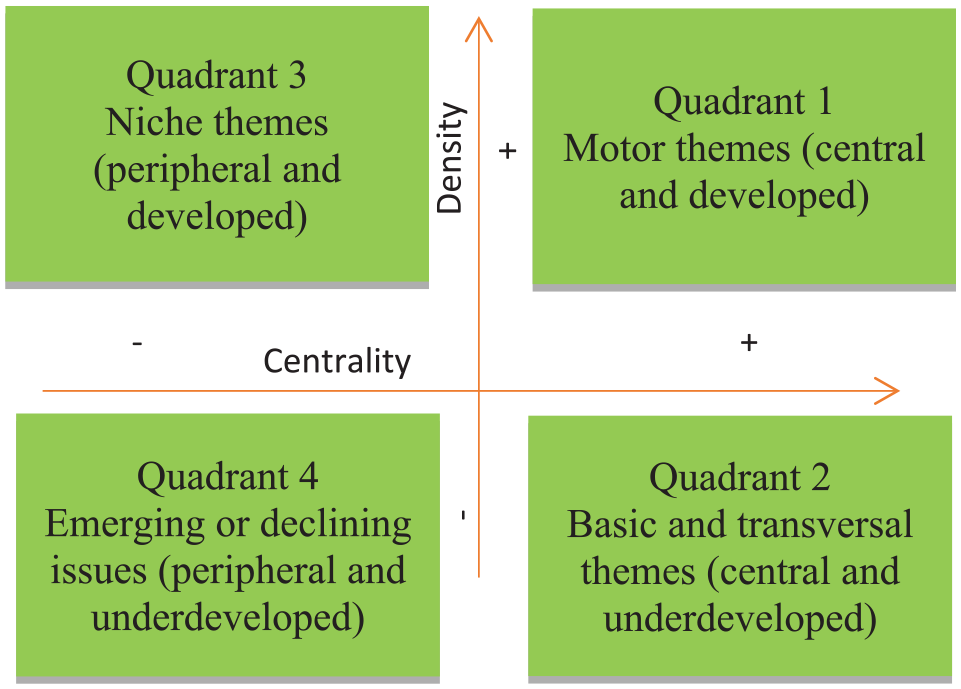
Thematic maps strategic diagram.
It has been observed in previous research work that the evaluation of the strategic diagram is of special interest to see those issues that could have a great potential to soon become an emerging point (Feng et al., 2021; Khasseh et al., 2017; Song et al., 2021; Wang et al., 2022).
Results and Discussion
Cluster Analysis
In the bibliometric map, the size of the clusters was determined using different factors such as all keywords (Keywords Plus and Author Keywords), the frequency of appearance and their weight. The resulting four thematic clusters define the main lines of research on Least Development Countries for WoS (Figure 3) and Scopus (Figure 4).
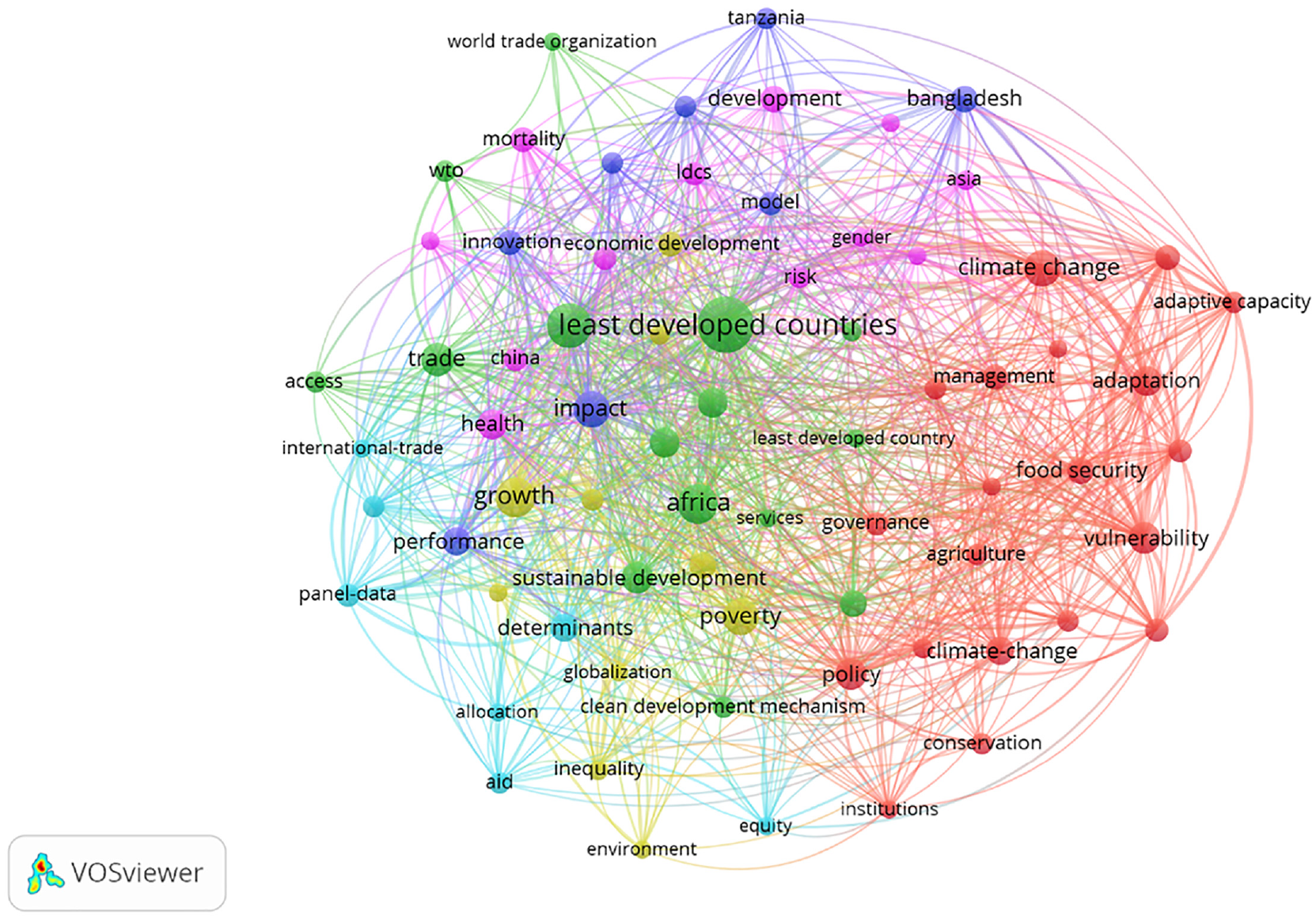
Keyword cluster—WoS.
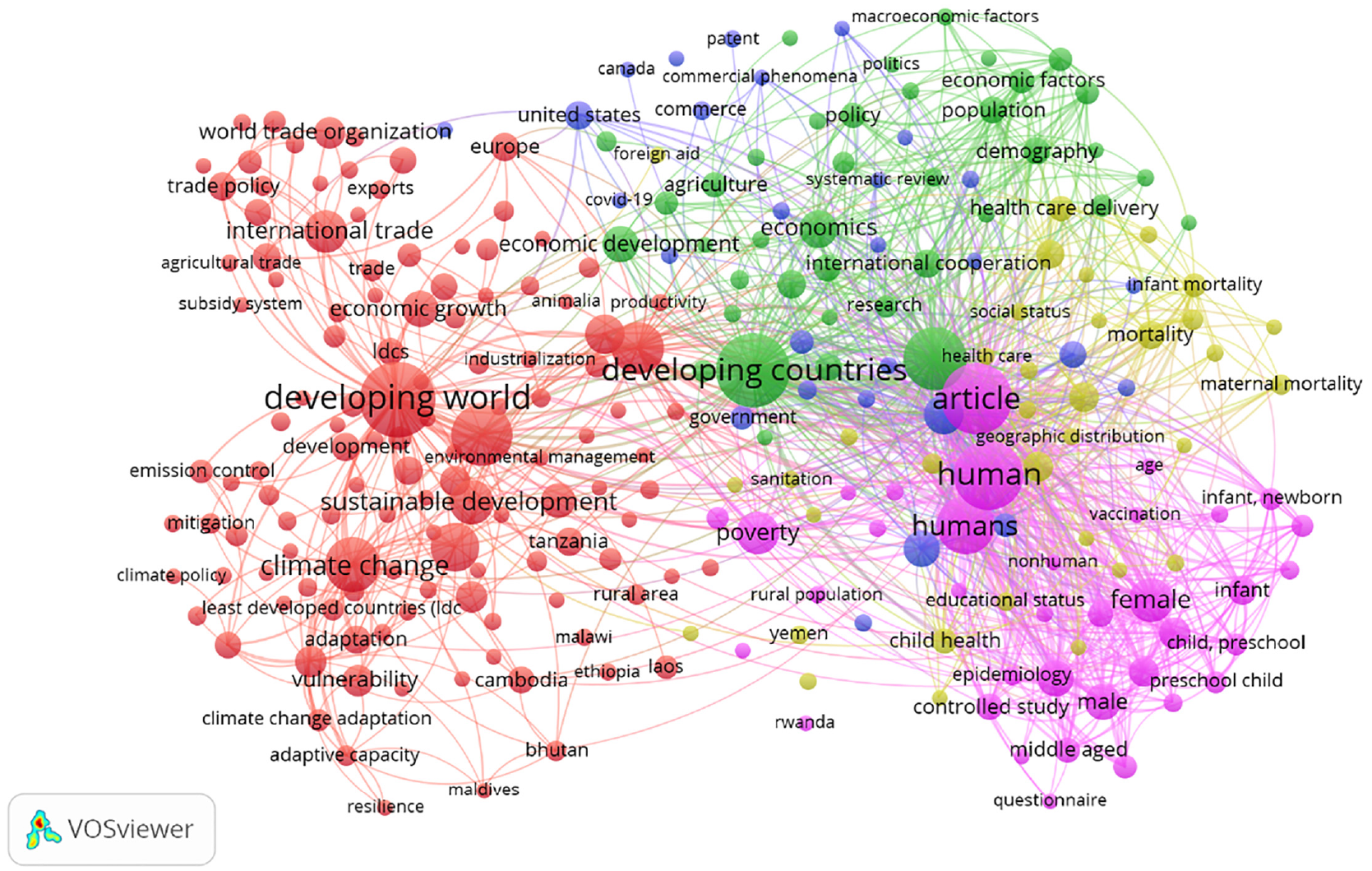
Keyword cluster—Scopus.
In Figure 3, concerning WoS, Cluster 1 (Red). It comprises terms related to the main threats facing these countries, such as policy, climate change, vulnerability, food security, adaptation, and resilience. One of the most significant challenges linked to these topics is ensuring increased investment in sustainable, productive, equitable and resilient agriculture through climate finance and agriculture finance (Deering, 2014; Hounmanou et al., 2018; Muñoz, 2016).
Cluster 2 (Green). It is made up of terms such as least developed countries, trade, Africa, countries, sustainable development. This cluster represents the greatest concentration of articles. Regarding the strategies of LDCs in Africa, measures related to exchange rates, public sector reform, and liberalization of markets are some of the essential policies of their national strategy. For sustainable development, policies and resources must be reorientated toward solving rural problems, including land reform, credit, improved extension, greater government accountability, and people’s participation (Agutu, 2012; Cheru, 1992; Dicker et al., 2021).
Cluster 3 (Pink) comprises terms such as health, mortality, gender and Asia. They are more social and health-related aspects. Studies carried out for Asian countries also stand out.
Although greater access to health care and increasing levels of education among less developed countries have clearly contributed to mortality decline, few theoretical models have explained the relationship. Aspects of women’s status have an essential effect. Indicators of women’s educational status, economic status, and reproductive autonomy are important variables to improve the situation in these topics (Fuse, 2010; Lee, 2000).
Cluster 4 (Yellow) comprises poverty, growth, inequality, and environment. Poverty and inequality are key factors for countries to develop. However, social attitudes toward poverty and inequality can vary across countries, cultures, and times (Naschold, 2004; Soludo, 2003).
Cluster 5 (Dark Blue). This cluster includes case studies from countries such as Bangladesh or Tanzania. Given the importance of these countries and their potential contribution to a better understanding of the problem of LDCs.
Bangladesh is about to leave the least developed country (LDC) group. It is one of the rare countries to meet the three graduation criteria (gross national income per capita, Human Assets Index, and Economic Vulnerability Index). Its graduation will be very significant, given its sizable economy and population (Abdin, 2018; Bhattacharya & Khan, 2018; Domínguez & Sequeira, 1993; Dornbusch et al., 1985).
Cluster 6 (Light Blue) is made up of terms such as allocation, equity, and international trade. Under free trade, LDCs experience technical progress and GDP growth. Free trade may improve the welfare of their consumers.
The proliferation of the term “country” indicates the need to explore better ways to manage the heterogeneity increase among developing countries. Great caution should be exercised in devising new country categories. To better address the problems and incentives associated with their actual situation, issue-based classifications of countries are preferred to broad categories (Alonso et al., 2014; Duhamel et al., 2016; Ocampo, 1986; Young, 1991).
In the case of Scopus (Figure 4), the most studied aspects largely coincide with those of WoS, themes whose importance have appeared in the previous figures.
Cluster 1 (Red). It is made up of terms such as developing world, climate change, international trade, sustainable, development, and Africa.
Cluster 2 (Green) comprises terms such as developing countries, economic development, demography, and population. Alleviating poverty in LDCs requires raising local workers’ income and focusing on small and medium enterprises (SMEs) because they are the more significant economic units to increase employment and reduce poverty in these countries.
Over the past 30 years, cities in developing countries have grown at almost twice the rate of those in developed countries. Absolute increases in the number of urban inhabitants have also been much higher in the developing world (Maksimov et al., 2017).
Cluster 3 (Pink). Formed by female, child, poverty and infant and Cluster 4 (Yellow) with terms such as maternal mortality, infant mortality geographic distribution, child health and mortality, they collect very relevant aspects when analyzing the problems of these countries (Fewtrell et al., 2005).
Finally, Cluster 5 (dark blue) groups terms such as infant mortality and Covid-19 have already been discussed (Carr et al., 2012; Ekman et al., 2008).
Analysis of Documents and WoS Resources
The following analysis has been developed with the WoS database. In Figure 5, three elements are represented: the most relevant journals, the Keywords Plus and the Author Keywords. The three elements are connected by a grey grid that indicates their relationships. The figure displays the most relevant journals on the left, Keywords Plus in the centre and Author Keywords on the left.

Three fields plot.
It can be seen how the most revealing journals are climate policy, mitigation and adaptation strategies for global change, and climate and development. The figure also represents the bulk of connections between terms such as adaptation and climate change or sustainable development and less developed countries. The most relevant keywords, such as least developed countries and developing countries, have strong links with Keyword Plus terms, with the most prevalent terms being policy, growth, and Africa.
At the global level (Figure 6), the two most cited documents belong to Mcgranahan et al. (2007) in his work, “The rising tide: assessing the risks of climate change and human settlements in low elevation coastal zones,” and Betrán et al. (2007), “Rates of caesarean section: analysis of global, regional and national estimates,” especially concerned about the vulnerability of the populations settled on the coasts derived from climate change; densely populated places. Many countries with high population density on the coasts are island countries. These authors highlight how the LDCs have a higher proportion of their population living in those areas. These circumstances generate migratory movements and settlement changes.

Top citations document by author.
In the case of Betran, his article has more than 574 citations. It addresses an important issue related to health, one of the most fragile aspects in these countries, providing an interesting perspective relating caesarean section care to women with the causes of maternal mortality, infant and neonatal mortality rates and the proportion of deliveries attended by trained health personnel. The analysis shows an inverse relationship between caesarean section performed and maternal, infant and neonatal mortality in countries with high mortality levels.
An analysis of the evolution of the most significant journals during the study period (Figure 7) shows that the year 2002 marks the beginning of publications, with 2010 being a critical year in which publications begins to increase until the present day. In this regard, the journal Climate Policy (JCR-Q1) is ranked first, followed by Sustainability (JCR-Q2) and the Journal of World Trade (JCR-Q3). These journals have displayed parallel growth and the same degree of growth. Growth in the number of works since 2000 is due to increased concern about meeting the Millennium Goals, about the effects of climate change with the enforcement of the Kyoto Protocol in 2005, and poor social conditions in the LDCs.
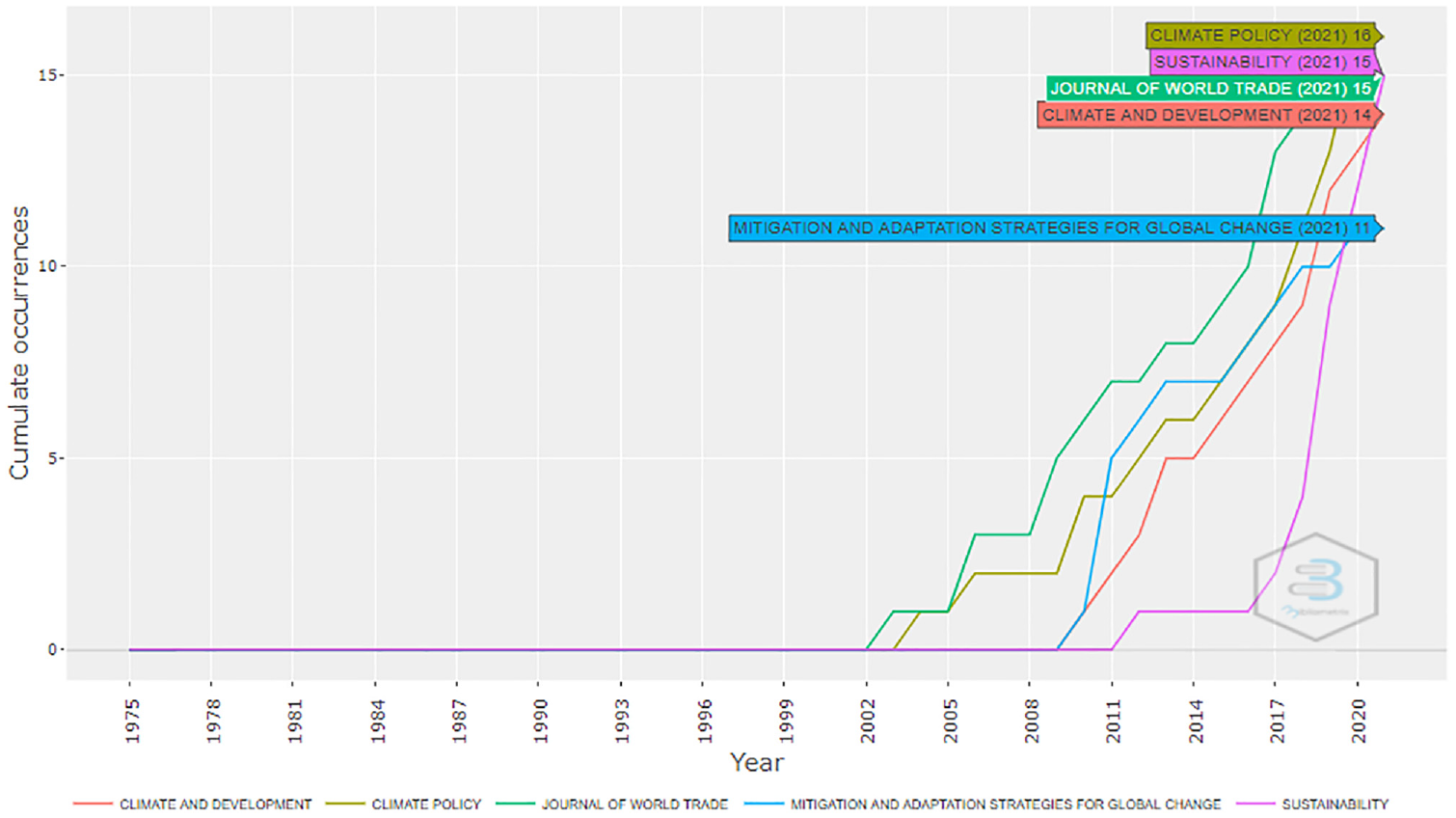
Source growth.
Analysis of WoS and Scopus Theme Trends
Table 1 lists the Keywords Plus and the Author Keywords by WoS by frequency, with differences in the top positions regarding the number of times the authors include the term LDCs in their keywords. The concern focuses on economic growth in developing countries in Africa, which appears as a group of prominent issues, followed by problems related to climate change, trade, and health, all subjects of great importance and concern among authors who have worked on LDCs. For the most part, the terms selected by the authors are also present in the Keywords Plus.
Keywords Plus and Author Keywords—WoS.

In the case of Scopus (Table 2), differences are observed between both criteria (In this instance, the term article is not considered as it is a word frequently used to describe researchers’ working documents). In the Keywords Plus, over 100 occurrences highlight the concern for developing countries and their problems, as well as gender issues, climate change and case studies in the context of African and Asian countries. This pattern of citations is repeated in the Authors Keywords but with somewhat less intensity in the occurrences.
Keywords Plus and Author Keywords by Scopus.

Analysis of WoS and Scopus Theme Trends
According to Keywords Plus, Figure 8 shows theme trends over time, observing a concern of LDCs for sustainability and climate change (Guillaumont & Simonet, 2014; Miyan, 2015). However, the term fertility appears as a future trend because, in recent years, many less developed countries have witnessed both an increase in life expectancy and a decrease in fertility. Fertility trends lag and depend on individual attitudes and levels of women’s empowerment (Gabrielli et al., 2021). Theories of social change share the fact that demographic patterns are converging. Demographers must become familiar with the concepts and methods of policies applied to these issues and expand their concerns beyond the mere production of demographic information (Mahar, 1984; Micklin, 1992).

Trend topics keywords plus—WoS.
In the case of Author Keywords (Figure 9), recent trends are related to countries such as Myanmar, education or social aspects (Abayo et al., 1993; Rasiah & Myint, 2013). Recent work has shown that Myanmar’s government structures are changing rapidly in response to natural disasters. It is an urgent priority in their fight against climate change (Gilfillan, 2019) and to cushion the impact of deforestation (Michinaka et al., 2020).

Trend topics author’s keywords—WoS.
On the other hand, for Scopus (Figure 10), the resulting trends show some differences. In the case of Keywords Plus, topics about countries, the case of Ghana, and health risk are shown, although terms related to climate change and sustainability are also present.

Trend topics keywords plus—Scopus.
Covid-19 is a topic highlighted by the author. In order to contain its spread and protect public health, many countries have introduced restrictions on the export of personal protective equipment, contravening WTO rules, the need for international solidarity, and the obligations to cooperate on health matters with least developed countries. In addition, the pandemic is eroding many of the achievements of the past decade in terms of poverty reduction. Without effective international support, this setback will threaten the geographic concentration of poverty in the least developed countries (Bonfanti, 2020; Valensisi, 2020) (Figure 11).
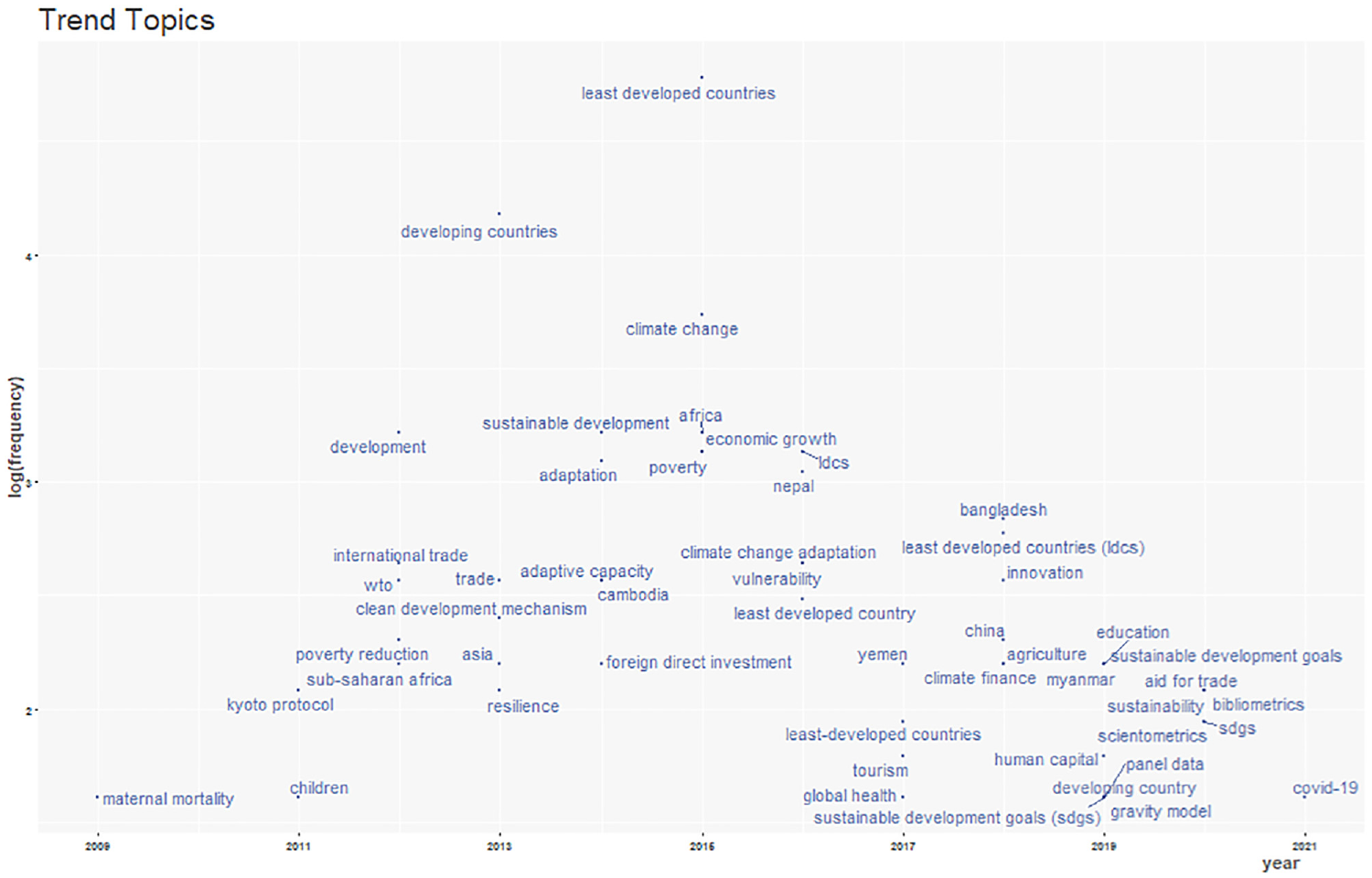
Trend topics author keywords Scopus.
In summary, generally speaking, there are many coincidences in the cases analyzed in the time horizon of the study period due to the main concerns in the analysis of the LDCs. Focusing on the latest trends, in the case of WoS, this database focuses on climate change and fertility. In the case of Scopus, it focuses on more specific areas such as Covid-19 and health risks.
We next use the strategic diagram based on keywords, classified according to two variables: centrality and density. Each of the circles represents a cluster, with the size of the circle representing the number of terms and/or keywords included.
In this sense, in Figure 12, the WoS Keywords Plus in the first quadrant present a single driving theme, Africa, because most of the LDCs and the most populated LDCs are located on this continent. In the second quadrant, growth and politics appear as cross-cutting themes since growth has been one of the variables that most concerned researchers when considering why these countries are in this situation. In the third quadrant, country development and impact are highly specialized topics; that is, specific studies related to particular characteristics of the countries or the subject to be discussed. Climate change is considered an emerging and consolidated theme in the lower-left quadrant due to its long history and the threats that hover over some LDCs when these issues are raised.

Thematic map by keywords plus—Scopus.
An analysis of Author Keywords (Figure 13) shows that trade and the development theme are located in the first quadrant (although the latter is only moderately developed. The second quadrant contains basic themes related to the search criteria (least developed countries). The developed and niche themes of economic development and countries stand out in the third quadrant. In contrast, the fourth quadrant contains more recently studied themes (2016–2018) such as health and Bangladesh. While some terms are repeated, the term “trade” stands out as authors consider this variable essential for these countries to grow and open to foreign trade, following the demands currently demanded by world trade. The Programmes designed by the WTO are an example of this. The case of Bangladesh and other countries mentioned last are examples that have attracted attention as studies of interest (Alam, 1991; Mahmud & Gope, 2009).

Thematic map by author keywords—WoS.
In the case of the Scopus database (Figure 14), the Keywords Plus terms do not offer themes for the motor and specific quadrants. In the first quadrant, the term article appears, due to the behavior of the Keyword Plus, since they are words or phrases that frequently appear in the reference titles of articles but not in the title of the article itself. The fourth quadrant characterized by declining themes includes terms such as “developing countries,” which has lost its validity among researchers given the complexity of the subject and given way to more emerging themes such as the “developing world.” Indeed, the term developing countries has become less prevalent among researchers given the complexity of the subject, and the disparity of models used for specific countries has led to this general term being used less frequently and greater emphasis being placed on specific aspects or, as mentioned above, the study of singular cases.

Thematic map by keywords plus—Scopus.
Finally, regarding Author Keywords (Figure 15), the core and developed drivers are WTO and Least Developed Country and climate change. Economic growth appears as an underdeveloped central theme in the second quadrant and less developed countries as a basic theme. As niche topics, there are the topic trips in the fourth quadrant, bibliometric as a current emerging topic (Dhanjee & De Chazournes, 1990).

Thematic map by author keywords—Scopus.
The following Figures 16 and 17 show the thematic evolution through a longitudinal thematic map, differentiating two periods 1975–2015 and 2016–2021 for the WoS Author Keywords and Keywords Plus criteria.

Thematic evolution of keywords plus—WoS.

Thematic evolution of author keywords—WoS.
According to the Keyword Plus (Figure 16), the themes have evolved towards impact, Africa, and growth for the term developing countries. It has diversified into impact, model, and growth (keeping part of its concept). On the other hand, the term growth has attracted varied topics such as health, determinants, climate change and developed countries.
Based on Author Keywords (Figure 17), the most interesting term is presented by climate change, which has evolved towards adaptation, sustainable development, and least and least developed countries. Other important terms are least developed countries, economic development and Tanzania, which have merged into developing countries.
However, factors such as SME innovation in LDCs have scarcely been studied. Considering the potential importance of internationalization for innovation for overcoming national limitations, the influence of foreign technology licenses, exports and imports on the innovation of SMEs in LDCs is detected.
As in the case of Tanzania, the analysis shows that technological capability is essential due to the weak links between foreign and local companies, an issue that governments should address (Abubakar et al., 2019; Diyamett & Mutambla, 2014).
To recapitulate, in recent years, the scientific community has multiplied the work on the problems that affect these countries and that, directly or indirectly, also affect economic and social balances worldwide. Growth, trade, sustainability, poverty, human, and social issues are the aspects that have been the most taken into account by researchers (Acharya, 2012), which requires greater awareness of those weaknesses that affect more than 2/3 of the world population (Haveman & Shatz, 2004; Nowzad, 1978; Nwadike, 2020; Pauw et al., 2019). That said, it is necessary to generate greater sensitivity and awareness about the needs of these countries. In this sense, it is necessary to increase and improve the debate not only on general issues but also on specific issues that affect this group or, as has been done, specific countries or with similar characteristics (Fialho, 2012).
One of the limitations of this work is that it does not contemplate studies by international organizations or reports from other institutions or books since the data contemplated in this study is limited to scientific articles.
Conclusions
According to the definition, least developed countries are the group of poorest countries in the world. Countries that need support to get out of their current situation and join the new trends in the global economy.
These countries show very particular characteristics due to their size, location, or geography (islands, archipelagos or without outlets to the sea).
The international community has developed specific programs and aid for them, trying to boost their growth, promote investment, increase official aid, promote foreign trade, stabilize the prices of basic products, advance in the fight against climate change, develop the tourism sector, improve governance, or supporting specific countries in exceptional circumstances, etc.
It is a topic of great importance in development theory that can be approached from very different points of view. Research aimed at finding solutions to their problems would have very positive effects, not only for the affected countries but also to achieve greater economic, political, and social stability worldwide.
Through bibliometric analysis, it has been possible to analyze the least developed countries, the poorest in the world, by comparing the information obtained from the selected databases (WoS and Scopus), as well as the countries in which the most significant number of publications were concentrated according to the items indicated. However, like all methods, it has its limitations since the type of publication can influence the number of citations it receives. Methodological documents, which introduce techniques or methods that are later referenced in each use, report a high citation rate. Likewise, specialized journals have higher citation rates than other types of documents because they handle a large bibliography.
A change in trend has been detected since 2002, particularly from 2007, the year before the 2008 crisis broke out, after which publications multiplied, especially on trade, development, and sustainability issues. It also saw an increase in publications related to Africa, the continent in which many of these countries are found and where their populations are often grouped together.
A trend is detected in WoS that goes from articles related to issues around population and gender, climate change, resilience and productivity, to analyses of specific countries, such as Nepal, Tanzania, and Bangladesh.
The problems generated by fluctuations in the price of raw materials, the impact on trade resulting from benefits derived from the World Trade Organization’s Official Development Assistance, the problem of maritime transport and the possibilities to increase south-south trade are relegated to second place.
The Least Developed Countries Fund (LDCF) was established in 2001 to finance the implementation of National Adaptation Programs of Action (NAPAs) and identify priority actions in countries and sectors, including water, agriculture and food security, health disaster risk management and prevention, infrastructure and fragile ecosystems.
The fund also aims to create a group of specialists who can spearhead pertinent research projects more scientifically and eliminate unnecessary bureaucracy.
Apart from the direct financial support for specific projects, there is a continuing need for international assistance through the provision of fellowships, visiting scientists, and facilities for other studies.
The main contribution of this research is to sensitise the scientific community about the problems that affect the least developed countries and reflect how they have been treated to date. It also highlights the scarcity of studies on other variables that we believe influence the situation in these countries. The information provided by the current and future analyses can be used to elaborate a more complete and in-depth diagnosis, adjusted to their realities, which allows governments and international institutions to work with more clarity on possible policies to be implemented.
Lastly, our findings show that are major problems when it comes to applying models or establishing theories on the behavior of socio-economic variables in these countries given the wide variety of existing cases, the lack of reliable date and difficulties of governability.
Regarding future lines of research, it is proposed that the complexity presented by the solutions to their problems of the least developed island and archipelago countries, with which UNCTAD is so aware, need to be studied further.
Footnotes
Data Availability Statement included at the end of the article
Credit Author Statement
Conceptualization:a M.N.-P.; methodology, M.N.-P., R.M.M.-V., and J.P.-V.; software, R.M.M.-V and J.P.-V.; validation, M.N.-P., R.M.M.-V., and J.P.-V.; formal analysis, M.N.-P., R.M.M.-V., and J.P.-V. investigation M.N.-P., R.M.M.-V., and J.P.-V.; resources, M.N.-P., R.M.M.-V., and J.P.-V.; writing—original draft preparation, M.N.-P. All authors have read and agreed to the published version of the manuscript.
Declaration of Conflicting Interests
The author(s) declared no potential conflicts of interest with respect to the research, authorship, and/or publication of this article.
Funding
The author(s) received no financial support for the research, authorship, and/or publication of this article.

Data Availability Statement
Data sharing not applicable to this article as no datasets were generated or analyzed during the current study.