



Abstract
The Fourth Industrial Revolution (4IR) and COVID-19 have increased the need for digitally capable school leaders who can lead Education 4.0. This study explored school leaders’ digital leadership practices in one school district in the Gauteng Province of South Africa, to inform leadership capacity for Education 4.0. A qualitative, single case study design was employed, using five focus group interviews with district officials, school management teams and teachers, complemented by document analysis. Thematic analysis revealed adaptive digital practices alongside challenges of technophobia, limited access and resource constraints. Despite barriers, school leaders actively adopted digital tools, leveraged immersive learning technologies, and pursued post-COVID-19 readiness initiatives. Emerging from this inquiry is a conceptual digital leadership framework for Education 4.0, with four empirically grounded dimensions: (a) Leading foundational digital leadership practices, which includes technology acceptance, technology integration in schools, and balancing traditional teaching and digital pedagogies; (b) Leading digital teaching, learning and communication, encompasses leading digital teaching and learning, using digital platforms for schoolwide operations, leading digital innovation, and leading digital communication; (c) Leading responsively to digital opportunities, threats and contextual challenges, which entails leading responsively to digital opportunities, leading responsively to digital threats, and leading responsively to contextual challenges; and (d) Leading school readiness for Education 4.0 consists of proactive engagement with the education department, strengthening School Governing Body (SGB) governance for digital school transformation and preparation of future-ready schools. This framework offers context-responsive practices to operationalise Education 4.0 in resource-constrained schools within South African schools.
Plain Language Summary
Why was the study done? The effective leadership of digital learning in schools has become a pressing concern with the advent of the Fourth Industrial Revolution (4IR) and Education 4.0. However, the challenges that school leaders face in leading digital learning are not well understood, which may hinder efforts to improve education. What did the researchers do? The research team conducted a case study in one school district, collecting data through focus group interviews with district officials, school management teams, and teachers to better understand the challenges school leaders face in leading digital learning and how to address them. What did the researchers find? The study identified several key challenges, including technophobia among older staff, underutilisation of technology, limited digital accessibility, funding and resource constraints, lack of technological skills, boundary blurring, and loadshedding. These challenges were found to be significant barriers to effective digital leadership in schools. What do the findings mean? This study has identified important targets for future efforts to improve digital leadership in schools. These include focusing on building staff capacity in digital skills, improving access to digital resources, and implementing strategies to address technophobia and boundary blurring. By addressing these challenges, school leaders can be supported and can have a practical roadmap for digital school transformation and improve Education 4.0 implementation.
Introduction
The digital aspect of school leadership has increasingly become a subject of interest to schools and researchers, motivated by the shift to Education 4.0. With Education 4.0 comprising a significant part of modern learning in recent years (Mudgil, 2021), the education sector has come to recognise “digital technologies, innovative methodologies, and learning spaces” as advancing the quality of education (de Souza & Debs, 2024, p. 1). Educational institutions now consider Education 4.0 as a necessity to adapt to the changing learning environment (Miranda et al., 2021). Research points to digital leadership as an effective approach to lead Education 4.0 in schools (Baglama et al., 2022; Orfanidou & Kopsidas, 2023; Ridho et al., 2023; Suryana, 2023). Sub-Saharan African studies reinforce these patterns, showing similar transitions towards digital learning despite systemic constraints (Eden et al., 2024; Ochieng & Waithanji Ngware, 2023). In South Africa, the Standards for South African Principals (SASP) (Department of Basic Education [DBE], 2016) embed digital leadership practices into school activities. National initiatives such as Operation Phakisa (Department of Planning, Monitoring and Evaluation of South Africa [DPME], 2017), the Policy Options Framework for the Fourth Industrial Revolution (Gastrow, 2018) and the National Digital and Future Skills Strategy (RSA, 2021) are aimed at preparing school leaders and learners for the 4IR. (DPME, 2017). Further initiatives include Coding and Robotics, digital literacy and the E3 programme (RSA, 2021) presents further guidelines for Education 4.0. However, these policies provide limited guidance on how school leaders should enact digital leadership in unequal, resource-constrained schools, leaving a gap between policy expectations and everyday leadership practice.
Digital leadership is grounded in pillars of communication, public relations, branding, engagement, professional development, innovative learning spaces and opportunities in education (Sheninger, 2019). Moreover, digital leadership requires “cultivating new opportunities to support and learn about new technologies” to advance Education 4.0 (Raptis et al., 2024, p. 100). Importantly, digital leadership assists in identifying challenges and new ways of thinking to mitigate these school challenges (Ridho et al., 2023). Despite efforts to enact digital leadership in schools (Karakose & Tülübaş, 2023), research shows persistent barriers to Education 4.0 implementation. In South Africa, studies found limited digital infrastructure (Carrim, 2022), leadership capacity gaps (Awodiji & Naicker, 2024; Letuma, 2022), loadshedding and inequality (Sehlako, 2023) and policy gaps (Sehlako et al., 2023; Sikhakhane et al., 2021). Research in the field revealed issues of digital divide, funding constraints and reluctance to change in South African schools (Mlangeni & Seyama-Mokhaneli, 2024). Similar findings emerged across other African contexts, where infrastructure gaps and varying levels of teacher readiness continue to shape Education 4.0 implementation (Awodiji & Naicker, 2024; Ochieng & Waithanji Ngware, 2023). These studies indicate that despite broad recognition of digital leadership’s importance, few studies offer context-responsive insights into how school leaders manage resistance, resource constraints and policy ambiguity in implementing Education 4.0. Furthermore, Orfanidou and Kopsidas (2023) argued that school leaders are confronted with problems of uncertain digital leadership activities and skills needed to lead Education 4.0. Awodiji and Naicker (2024) pointed out the need for South Africa’s Department of Basic Education (DBE) to develop leadership training programmes on Education 4.0 and digital leadership skills. Karakose and Tülübaş (2023) found that school leaders’ digital leadership plays a critical role in changing perceptions towards the successful implementation of Education 4.0, a notion supported by Sheninger (2019), who theorised that digital leadership paves the way for a mindset shift and the creation of a digital learning culture. Similar findings have been reported in recent global South Education 4.0 studies, where leadership mindset and community readiness strongly influence technology use and sustainability (Awodiji & Naicker, 2024; Ochieng & Waithanji Ngware, 2023). Few studies go beyond documenting challenges to offer empirically grounded, actionable leadership frameworks for the global South.
As schools transition to Education 4.0, school leaders face numerous challenges that hinder the successful implementation of this new paradigm. Despite its potential to transform teaching and learning, digital leadership remains largely under-researched in South African schools, creating a knowledge gap that needs to be urgently addressed. This study’s rationale was to provide school leaders with a much-needed leadership framework to effectively lead Education 4.0, to improve 4IR learning outcomes. The study’s objectives were two-fold: firstly, to identify the current and emerging obstacles that school leaders encounter while enacting digital leadership, and secondly, to conceptualise a digital leadership framework that can guide school leaders in navigating Education 4.0 complexities and in developing innovative, technology-enhanced learning environments. Thus, the study responds directly to the limitations of existing digital leadership frameworks by grounding the proposed model in empirical data from a South African school district and in organisational learning theory. The main research question that guided this research was:
What digital leadership framework can be conceptualised for school leaders to lead Education 4.0?
To address the research question, the next section outlines the conceptual perspectives that shaped the study’s lens on digital leadership and Education 4.0.
Conceptual Perspectives
Digital School Leadership and Education 4.0 from an Organisational Learning Theory Perspective
Organisational learning theory provides a valuable lens to examine digital school leadership and Education 4.0. It explains how organisations learn through reflection, correction and adaptation (Argyris & Schön, 1978). It involves three learning loops, each representing a deeper level of change. In this study, organisational learning provides a lens to understand how school leaders learn, adapt and lead digital transformation. It shows that digital leadership entails more than the use of technology, it is about creating a school culture where staff feel safe to experiment with technology, reflect and improve. Schools evolve when leaders foster openness and collaborative learning. In the context of Education 4.0, organisational learning theory guides digital school leaders in supporting continuous learning and promoting innovation where staff are encouraged to explore new technologies and pedagogies to improve the organisation (Argyris & Schön, 1978). Organisational learning is crucial for effective digitalisation, enabling learning and knowledge sharing from internal and external sources (Chiva et al., 2014). This process involves single-loop, double-loop and triple-loop learning (Argyris & Schön, 1978; Romme & Van Witteloostuijn, 1999) summarised in Table 1. For organisations to learn, individuals must learn and leadership has to play a vital role in supporting this process (Leithwood et al., 2004).
Organisational Learning Theory’s Learning Loops and Learning Outcomes for Digital Leadership and Education 4.0 (Author’s own).

In this study, organisational learning theory provides a conceptual bridge between school leaders’ digital practices and the needs of Education 4.0. The theoretical framework reflects on how the learning loops support shifts from basic corrective adjustments to deeper changes in beliefs, routines and school-wide practices. Through this lens, digital leadership becomes an approach through which schools iteratively learn and change. This study differs from current digital leadership literature, which focuses largely on technology tools, competencies or standards by highlighting underlying learning processes that enable schools to learn, adapt and sustain Education 4.0 reforms. Figure 1 depicts how schools benefit from organisational learning theory’s learning continuum to drive digital innovation.

Single-loop, double-loop and triple-loop learning in an organisation.
In the context of the 4IR, learning involves developing innovative, creative and critical thinking skills to solve complex problems (do Rosário Cabrita et al., 2020). The organisational learning theory thus helps digital school leaders to facilitate the transformation of their schools into adaptive, innovative and learner-centred Education 4.0 learning environments. By foregrounding organisational learning, the present study positions digital leadership as a continuous, learning process that is context-responsive. Having outlined the study’s theoretical lens, the focus turns to how Education 4.0 and digital school leadership are framed as a human rights priority.
Education 4.0 and Digital School Leadership as a Human Rights Priority
The United Nations’ fourth Sustainable Development Goal (SDG) positions quality education as a human right (Deloitte Global, 2018). Education 4.0 supports this goal by using technology to promote equitable access, personalised learning and inclusion, particularly for disadvantaged learners (World Economic Forum [WEF], 2022). Digital school leaders play a crucial role in ensuring Education 4.0 protects and fulfils the right to education for all. From a human rights perspective, inclusive learning environments must be prioritised through harnessing technologies to promote equity (OECD, 2023). Digital school leaders need to also protect learners’ rights in the digital age, including data privacy, safety, and freedom from online harassment, through school initiatives and partnerships (Martin et al., 2023; Vikaraman et al., 2021). Moreover, school leaders’ digital practices should include teaching learners to become ethical and responsible digital citizens (Walters et al., 2019). In prioritising human rights, digital school leaders can ensure Education 4.0 promotes learner well-being and empowerment. However, current frameworks often regard digital citizenship and equity as generic principles; with limited attention given to how school leaders in high-inequality settings negotiate issues such as device access, data costs, load shedding and online safety. This study’s framework explicitly locates digital leadership within these human rights aspects. The next subsection connects the outlined human rights concerns with the practical demands of leading Education 4.0.
Education 4.0 and Digital Leadership
Education 4.0 is a teaching and learning approach that is aligned to the 4IR supported by innovative technologies of Robotics, AI, AR, gamification, big data and digital platforms (González-Pérez & Ramírez-Montoya, 2022; Sabando Barreiro, 2022; Van Wyk, 2022). Digital school leaders play a critical role in implementing Education 4.0, requiring them to develop new competencies of digital literacy, communication, collaboration, data analysis and strategic planning (Orfanidou & Kopsidas, 2023). Effective digital school leaders help foster an innovative culture of experimentation and continuous learning, empowering learners to harness innovative technologies to enhance learning (AlAjmi, 2022; Daud et al., 2021; Ertiö et al., 2024; Karakose & Tülübaş, 2023). The transition to Education 4.0 requires digital school leaders to rethink and reimagine traditional notions of teaching, learning and assessment. This involves embracing adaptive, personalised learning (Adewale et al., 2024), gamification (de Souza & Debs, 2024) and project-based learning (World Economic Forum [WEF], 2019). Digital school leaders need to also prioritise the development of 21st century skills, which are essential for success in the 4IR (Göker & Göker, 2021; Sheninger, 2019). To effectively lead Education 4.0, digital school leaders have to navigate digital transformation and the integration of new technologies (Karakose & Tülübaş, 2023), the management of digital data (Ridho et al., 2023) and the mitigation of digital technology risks (Suryana, 2023). This necessitates digital school leaders to be resilient, adaptable and strategic, with a deep understanding of contextual implications of digital transformation (Karakose & Tülübaş, 2023). Studies from sub-Saharan Africa (Eden et al., 2024; Mlangeni & Seyama-Mokhaneli, 2024) show that adaptability is particularly important in unequal contexts where digital infrastructure and competencies vary widely across schools. By developing these competencies, digital school leaders can create future-focused learning environments that prepare learners for an increasingly interconnected world.
A growing body of research has proposed digital leadership frameworks in the field. However, practice-oriented models such as Sheninger’s (2019) seven pillars and the ISTE standards (ISTE, 2018) emphasise external structures and behaviours such as branding, and systems design, while others foreground internal capacities such as mindset, emotional intelligence and human-centred attributes (Ahlquist, 2014; Daud et al., 2021; Magesa & Jonathan, 2022). Ghamrawi and Tamim’s (2023) 5D digital leadership model, promotes organised governance, advocacy, differentiation, competence and culture. Despite these valuable contributions to the digital leadership concept, existing frameworks focus more on global North contexts with ideal conditions and less on systemic constraints, that characterise public schools in South Africa, and seldom show how leaders iteratively learn and adapt under such conditions. This study addresses this gap by drawing on organisational learning theory to conceptualise digital leadership as an ongoing learning process and by developing a context-responsive framework, that links practical leadership practices to deeper learning loops while addressing contextual challenges. Building on this conceptual grounding, the next section considers how the Education 4.0 culture can operate as a support strategy in South African schools.
Education 4.0 Digital Culture as a Support Strategy
In the South African context, where educational inequalities and disparities continue to persist (Clercq, 2020; Magesa & Jonathan, 2022), the building of an Education 4.0 culture can serve as a transformative support strategy in schools. Recent Education 4.0 studies in the global South (Awodiji & Naicker, 2024; Mlangeni & Seyama-Mokhaneli, 2024; Ochieng & Waithanji Ngware, 2023) highlight persistent digital inequality, uneven infrastructure and varying levels of readiness, mirroring many of the contextual challenges identified in this school district. School leaders need to harness the potential of emerging technologies to create inclusive, learner-centred learning environments that leverage “technology not only to enhance learning outcomes but also to bridge the digital divide and promote equity in education” (Eden et al., 2024, p. 1). An Education 4.0 culture can also facilitate the development of critical 4IR skills, such as problem-solving and digital literacy (Sharma et al., 2025), essential for South African learners to compete in a globalised 4IR economy. Furthermore, the Education 4.0 culture promotes collaboration and knowledge-sharing (Sharma et al., 2025) and “expands access to educational opportunities and resources, particularly for students in underserved or remote areas” (Eden et al., 2024, p. 2). The integration of Education 4.0 technologies enhances efficiency and learning outcomes (Başgül & Coştu, 2025; Haleem et al., 2022; Helbig et al., 2021). Additionally, Education 4.0 enables personalised learning, tailoring instruction to individual learner’s needs and abilities, creating a more equitable and effective learning environment (Almeida & Simoes, 2019). However, without deliberate digital leadership that is responsive to inequality and organisational learning, these aspirations risk remaining as innovation rhetoric. Thus, embracing the Education 4.0 culture, can help South African schools create a more inclusive and efficient education system that prepares learners for the 21st century. Having established the conceptual and contextual background, the article now turns to the research design and methodology used to explore digital leadership in a South African school district.
Research Design and Methodology
Research Design
This study used a qualitative approach to gain an in-depth understanding of school leaders’ experiences within their natural setting (Creswell, 1994). The social constructivism paradigm guided the study, allowing participants to share their personal experiences and meanings of digital leadership within their real-world context (Denzin & Lincoln, 2018, p. 57; Merriam, 2002, p. 5). A single case study design (Cohen et al., 2018, p. 384) was selected to allow for an in-depth exploration of digital leadership within one Gauteng school district. This approach enabled a detailed examination of contextual influences, participant experiences and emerging leadership practices. The first level of sampling involved selecting a case for investigation (Merriam, 2009), namely, one Gauteng school district. This district was chosen because it included diverse school typologies, operated as a Data Driven District (DDD) schooling district (DDD Dashboard, 2020) and had implemented numerous national and provincial ICT initiatives to enhance teaching and learning (Mlambo et al., 2020). Moreover, the school district offered a familiar research context which was accessible and feasible in terms of travel, scheduling and cost (Yin, 2014). Thus, the researcher’s insider status of being a female school principal in the district and having worked there for over 3 decades, provided contextual and cultural insight. In light of the researchers inside status, potential bias was managed through reflexive journaling and supervisor debriefing (Merriam et al., 2001) to ensure that interpretations remained grounded in the data rather than personal assumptions.
The second level of sampling involved selecting participants from the chosen case (Merriam, 2009). Purposeful sampling, which involved selecting participants based on their "insights into a phenomenon" was used (Onwuegbuzie & Leech, 2007, p. 243). The sample included school leaders from district and school levels, with over 3 years of experience (Merriam, 2009) and in a leadership role. Two schools from quintile three (middle-income schools), one primary and one secondary, with one being a town school and one a township school were purposefully selected. The selection of the two schools, with the help of the district director, was based on their implementation of various ICT initiatives, including DDD 2.0 utilisation and Coding and Robotics, consistent strong learner performance over the past 3 years, engagement in online professional development and digital platform use for education, and led by principals with more than 3 years of experience as the school head in those schools.
Sampling
The sample consisted of 33 participants comprising 8 senior district officials, 2 principals, 4 deputy principals, 6 departmental heads and 13 teachers, with more than 3 years of experience. This ensured that the selected school leaders had experienced transformation initiatives from traditional to digital learning environments from the pre to post Covid-19 pandemic era, providing valuable insights into their evolution as digital leaders. Moreover, Participants represented leadership at district, whole-school and classroom levels, enabling multiple perspectives on digital leadership in one school district context.
Data Collection
Data collection occurred through audio-recorded focus group interviews with each group of leaders separately, namely district officials, school management teams and teachers. A semi-structured interview guide was used across all five focus groups to ensure consistency, with open-ended questions aligned to the research questions and the study’s theoretical framework. The focus group method was advantageous as the study sits in a social constructivist paradigm, aiming to understand how participants’ views are shaped, challenged and co-constructed in a group across leadership levels. However, a limitation in the study was the potential for dominant voices to influence group responses, which was managed through neutral facilitation techniques, grouping participants by leadership role, encouraging quieter members to contribute and ensuring that certain participants were not beginning or leading the responses. Additionally, document analysis was employed as a secondary data collection method. This involved examining various school documents, including websites and social media platforms, meeting minutes, lesson plans, SMT termly reports, School Improvement Plans (SIP), Senior Subject Specialist school visit reports, and DDD dashboard reports. These documents offered an impartial perspective that strengthened the credibility of the study’s findings. In this study, document analysis was vital in providing valuable insights into the research problem by uncovering meaning and developing understanding (Merriam, 1998). The data collection process spanned a period of 1 year.
Data Analysis
Data was analysed using Braun and Clarke’s (2006) six-phase thematic analysis, depicted in Table 2.
Braun and Clarke’s Six-Phase Thematic Analysis Framework.

In addition, the researcher complemented thematic analysis with ATLAS.ti version 23 which supported the management of the large volume of qualitative data through reviewing, sorting, sifting and visualisation of data (Archer et al., 2017, p. ll). Coding took place iteratively, moving back and forth between thematic analysis and ATLAS.ti groupings to check alignment and strengthen meaning, but interpretation remained with the researcher and was guided by reflexive awareness.
Trustworthiness
To ensure the trustworthiness in this study, Lincoln and Guba’s (1985) criteria of credibility, transferability, confirmability and dependability were applied. Credibility was strengthened through methodological triangulation (Lincoln & Guba, 1985), in which focus group interview data were corroborated with school documents such as SMT reports, SIP plans and DDD dashboard records. This reduced the risks associated with relying solely on self-reported accounts and allowed for a more balanced interpretation of school leaders’ digital leadership practices.Credibility was further enhanced through rreferential adequacy (Lincoln & Guba,1985), authentic data support (Creswell, 2013) and voluntary participation (Shenton, 2004). Additionally, the project supervisor provided debriefing to enhance credibility (Lincoln & Guba, 1985).
Dependability and confirmability were reinforced through a clearly documented audit trail and reflective journal capturing decisions, assumptions and analytical reflections (Cohen et al., 2018; Lincoln & Guba, 1985). Transferability though restricted, provided analytical insights through rich, thick descriptions of the phenomenon (Lincoln & Guba, 1985) which school leaders in similar contexts can reflect on. A pilot study validated the focus group interview schedule. Anonymised coding and the use of verbatim quotations directly anchored interpretations to participants’ voices. Thematic interpretations were further checked through supervisor debriefing to ensure that interpretations were grounded in the data rather than the researcher’s beliefs and assumptions.
Limitations of the Study
This study was conducted within a single school district in Gauteng Province and drew on a sample of 33 participants, including district officials, principals, deputy principals, departmental heads and teachers from one primary and one secondary public school. While this sample enabled an in-depth qualitative exploration, its size and specificity limit the breadth of perspectives represented. The study’s focus on only two public school types further narrows the range of experiences captured, particularly in relation to the diverse conditions across other school districts. As a qualitative single-case study, the findings are therefore not intended to be generalised beyond this context. Rather, the value of the study lies in its rich, context-specific insights into school leaders’ digital leadership practices. Researchers and practitioners seeking to apply these insights elsewhere should consider the socio-economic conditions, resource and policy environments of their own settings when interpreting the relevance of these findings.
The study’s Strengths
The strength of this qualitative single instrumental case study allowed for the exploration of a specific case to add knowledge and provide insights into an emerging and under researched phenomenon (Stake, 2003, p. 137). A four-dimension framework was thus developed from the findings to guide school leaders in enacting digital leadership. Thus, the single instrumental case study served as a tool (Stake, 2000) to gain deeper insights into specific digital practices employed by school leaders in implementing Education 4.0.
Ethical Considerations
Ethical clearance for the study was obtained from the researcher’s university and the Gauteng Department of Education, followed by permission from the participating school district. All participants provided written informed consent and were assured that participation was voluntary and could be withdrawn at any time without consequence. To minimise potential coercion, participants were informed that their responses would not affect their employment or professional relationships. Anonymity and confidentiality were maintained through the use of pseudonyms and secure, password-protected data storage. Permission to audio-record the focus group interviews was obtained, and participants were informed that all data would be safely stored and disposed of after the study.
With the study’s methodology established, the following section presents the key findings from the five focus groups and document analysis in the selected school district.
Findings
The data from each of the five focus groups in school *District 1 were first analysed. Thereafter, findings across the focus groups in school *District 1 were analysed. Due to length limitations, the research findings presented stem from establishing comparisons across the five focus groups in school *District 1.
School Leaders’ Understanding of the Concept of Digital Leadership
The findings revealed school leaders varied and limited understanding about the concept of digital leadership based on their associated meanings. Participants in *District 1 associated the concept of digital leadership with technology acceptance as an imperative for the future, technology integration in schools and balancing traditional teaching and learning with technology, limiting digital leadership to its connection with technology. In associating technology acceptance as an imperative for the future with digital leadership, a participant (SMT member from *School A) explained: Doing things digitally and using technology to advance education is very good for the generation that we living in now because they are more fascinated and interested in digital platforms rather than working with hard copies and books (SMTA2, FG1).
A district official mentioned: I’m for technology in that for teaching and for communicating, and in this day and age, everything we do, we can do via technology, (DO3, FG5).
Participants acknowledged the value of technology acceptance as a digital leadership practice in their school district. Document analysis showed that *School A’s lesson plans explicitly listed smartboards and tablets as required resources for Mathematics and research tasks, while *School B’s CAT rotation timetables scheduled weekly computer-lab sessions, confirming that leaders were formally planning for technology use even if actual classroom uptake remained uneven. Participants also associated technology integration as an imperative for the future with digital leadership. One participant (SMT member from *School B) stated: We have to make it part of the teaching method, methodology and we’re not going to beat it by ignoring it, so we have to make it part of our syllabus, part of the way we going to teach (SMTB2, FG4).
Another participant (SMT member from *School A) affirmed: “…integration is key” (SMTA6, FG1).
The participants felt that digital leadership was the integration of technology in the learning environment which gave learners technology-infused learning experiences. This idea is supported by the organisational learning theoretical framework which underpins this study. Ochieng and Waithanji Ngware (2023) articulate that improved technology integration in the learning environment positively transforms the quality education in sub-Saharan African schools through inclusive and collaborative education which will progressively become more accessible and sustainable.
Digital leadership was perceived, by participants, to be the balance between the old and new leadership approaches. A participant (SMT member from *School A) stated: “Technology has its place, but it doesn’t have to take over everything in education” (SMTA4, FG1). The same participant similarly articulated earlier in the focus group discussion about technology and copying notes from the traditional classroom board: “…’,ve already noticed that it’s difficult for children to scribe from the board, and that is actually an important skill that children need, and they can’t do that anymore. So, I agree, I think it has its place but you can’t just say that that is the only way to go” (SMTA4, FG1).
School leaders agreed that digital leadership is about striking a balance between traditional teaching and learning and technology. Technology enhances conventional teaching and learning through innovative tools that support evolving educational needs in the 4IR context (Moloi & Mhlanga, 2021). This idea is supported by the organisational learning theory framework in this study, which emphasises the value of adaptation within organisations (Argyris & Schön, 1978) which can aid the transition to Education 4.0.
School Leaders’ Understandings of the Concept of Education 4.0
Participants understood Education 4.0 as incorporating digital learning, coding, robotics and innovative teaching tools such as smartboards, cellphones, gamification, auditive and visual aids as well as online teaching. They also recognised Education 4.0’s significance in the 4IR, highlighting benefits like increased accessibility, ease of use and enhanced learning experiences through technology. The following quotes support the findings: An SMT member in *School A stated: “Education 4.0 which is digital learning”, (SMTA2, FG1). In *School B, an SMT member added: “…smart board teaching, online teaching, using our cell phones for research”, (SMTA1, FG1).
A district official explained: It just creates a completely different learning experience… Education 4.0…auditive aids…visual aids… gamification in terms of content and learning a practical aspect that kids can actually enjoy when they are working, (DO2, FG5). In *School B, a teacher alluded to Education 4.0, noting: “Technological developments out there in the world. When they take place, they will also spill over to the school system”, (TeacherB5, FG3). An SMT member in *School A similarly noted: “We moving towards the 4th Industrial Revolution and Education 4.0 over this whole new world where technology is very important”, (SMTA2, FG1).
The participants’ understandings of Education 4.0 align with organisational learning theory’s emphasis on adaptation and innovation (Argyris, 1999; Argyris & Schön, 1978) as schools integrate new technologies and teaching approaches to stay relevant in a rapidly changing Education 4.0 environment (Başgül & Coştu, 2025; Hussin, 2018). Participants’ understandings of Education 4.0 were shaped by external factors, including inconsistent departmental guidance, uneven Coding and Robotics rollout and infrastructural disparities, which affected school readiness. This was reflected in school planning documents, where both schools prioritised Coding and Robotics, connectivity and smartboard integration, while subject minutes highlighted ongoing resource shortages.
School Leaders’ Understanding of their role in the Implementation of Digital Leadership Practices for Education 4.0
There was evidence that participants in all five focus groups had a clear understanding of their role in implementing digital leadership practices for Education 4.0. A district official stated: “The role of the digital leader is to take a proactive role in exploring how information technology can be used in an institution” (DO4, FG5).
In *School A, a teacher declared: In terms of Education 4.0, my role as a leader is…to get the older generation to move into the more advanced era. Yes, it will not be a hundred percent, but to get them to incorporate it like using the projectors and using laptops, I feel that that’s my role (TeacherA1, FG2).
Further, participants viewed their role in implementing digital leadership practices for Education 4.0, as preparing for Education 4.0 and any future crisis, post Covid-19. One district stated her role in empowering educators for the future. She stated: We need to have workshops, train them because there’s a lot of digitalisation… There’s too much, we need to start with the basics and have small, different types of workshops where you have for those who have very basic skills and technology and those who have more advanced skills and technology and we can empower them in that way (DO3, FG5).
Other district officials voiced a similar sentiment about empowering school leaders for Education 4.0 and future crisis, in the following quotes: Build capacity among school leaders (DO4, FG5). You need to develop the skill sets, the knowledge base, and you need to empower the people that are also working with schools to be able to support schools in terms of implementing technology (DO2, FG5).
Participants felt that their role was to also build their personal digital leadership skill sets and knowledge base as part of the readiness plans for Education 4.0 and any crisis that may arise. Thus, schools need to examine their fundamental principles, leading to innovation, adaptation and improvement, ultimately enhancing their readiness for any future challenges (Naicker & Everton, 2023). Participants further spoke about their self-directed learning and self-efficacy role as preparing for the future and adapting to Education 4.0. A teacher in *School B declared: “You need to invest in yourself, right. Invest in yourself and to obviously improve your knowledge of technology”, (TeacherB6, FG3).
Another teacher in *School A echoed the same view: “The more we avail ourselves as teachers, I think the more training we can receive… It’s also our own prerogative to go and find trainings to attend”, (TeacherA4, FG2). A teacher in *School B agreed with this perspective: “All educators then have to be hands-on and go for the development in accordance with that, go for your trainings and workshops etc. You just have to adapt to what is required now of you in the new era of education”, (TeacherB3, FG3).
Across the district, participants recognised their roles in implementing digital leadership for Education 4.0, as reflected in documents showing school leaders’ participation in ICT training and the sharing of digital tools and strategies through PLC and subject meetings. This finding is similar to Tai et al., (2022) research findings, where it was found that school leaders were familiar with the competencies that they needed to have to fulfil their roles in order to transform their schools. Comparative digital leadership research from Asia and Europe (Karakose & Tülübaş, 2023; Orfanidou & Kopsidas, 2023; Suryana, 2023) also reports similar challenges relating to capacity gaps, resistance to technology and the need for continuous adaptation, suggesting that the issues observed in this South African district reflect broader global leadership transitions for Education 4.0.
School Leaders’ Progress in Advocating and Promoting Digital Leadership Practices to Lead an Education 4.0 Culture
Across *District 1, there was evidence that participants had made progress in moving towards enacting digital leadership to lead an Education 4.0 culture in schools. There was compelling evidence that participants in both schools saw their digital leadership practice of digital communication as a means to advance and ‘strengthen communication’ with ‘a touch of a button’ for ‘easier communication’ and the ‘quick dissemination of information’. The shift to digital communication enhanced efficiency within their school *District 1 through a plethora of Education 4.0 digital applications which helped to modernise communication. Organisational learning theory’s double-loop and triple-loop learning supports school leaders’ digital communication structures to improve communication and enrich relations among school stakeholders (Shuping, 2024).
Participants perceived that digitising teaching and learning as part of their digital practices was evidence of progress. In school *District 1, the evidence revealed that participants’ digitising of teaching and learning ‘allowed for collaboration’ and digital assessments; and enhanced learner understanding, engagement and achievement, remote teaching and ‘accessibility from anywhere’, as well as easy resource sharing in this school district. The assessment timetables in the SMT files recorded e-tests for Grades 5 and 6 Natural Sciences and Technology in *School A and for Grades 10 to 12 CAT in *School B, and lesson-observation reports noted the use of Kahoot quizzes and other gamified tools, confirming that digital assessment and interactive technologies were being embedded into classroom practice.
Importantly, the participants in School A and B also noted that the human skills aspect of digital leadership was irreplaceable in guiding and inspiring the digitising of teaching and learning, declaring that ‘the teacher can never be replaced by technology.
The use of 4IR digital platforms for digital practices across *District 1 revealed progress in operationalising digital leadership and Education 4.0. There was convincing evidence that participants used various innovative 4IR digital platforms within the school district for logistical purposes, managing school resources, sharing school narratives and information and online meetings. Participants mentioned the use of ‘Google forms to keep track of the LTSM’. Another participant spoke of sharing school narratives on social media platforms “We post on Facebook, we post on Twitter, we post on Instagram,” to keep stakeholders informed of school activities and inspire the school community. Document analysis confirmed regular posts of school narratives, general notices, information and newsletters: *School A’s Facebook and Instagram pages featured regular posts on events such as the annual fundraising race, report collection notices and term-end messages, while *School B’s Instagram account shared posters for its Term 3 fundraiser, an e-newsletter and its 100% matric pass announcement, illustrating how digital tools were used to celebrate achievements and maintain a visible online presence. Further, in *District 1 “meetings are done over Microsoft Team,” to improve attendance. Document analysis of the minutes of staff meetings and PLC minutes revealed that meetings were held virtually in a few instances at both schools but were used in most district subject meetings with schools.
The challenges experienced by school leaders in implementing digital leadership and Education 4.0
The findings identified common challenges that school leaders in *District 1 encountered, which hinder digital leadership and Education 4.0. Technophobia among some school leaders was an area of concern, where school leaders acknowledged that there was a fear of technology. An SMT member from *School A shared: We’ve got our cautious teachers and well, we got some older teachers who are not interested and they terrified. We got teachers who are saying that I don’t even know how to switch the thing on, but we have to teach them how to switch it on (SMTA1, FG1).
Another participant (SMT member from *School A) painted a similar picture of fear of technology. The participant expressed: There’s a certain amount of fear from people…we are older and the younger groups are doing it. But we need to now encourage the older teachers, the teachers who are more in the talk and chalk to move away from talk and chalk and to become more proactive (SMTA1, FG1).
Technophobia was intensified by pressure to modernise amid limited training, uneven ICT resourcing and socio-economic constraints, increasing anxiety among older educators. DDD dashboard reports showing only 40% utilisation of digital tools corroborated participants’ accounts of low confidence and partial uptake. Interestingly, South African research (Mlangeni & Seyama-Mokhaneli, 2024) confirms that technophobia remains widespread in many schools and is often intensified by low confidence, anxiety about failure and limited exposure to digital tools, reinforcing the patterns observed in this district.
Across *District 1, participants expressed the underutilisation of digital resources as a barrier to digital practices. Participants acknowledged that the full potential of digital resources had not been explored. One of the participants (SMT member from *School B) mentioned: I think in this school still in our infancy stages in terms of the full utilisation of SASAMS, we use it for the basic needs I think for the running of the institution, but we haven’t touched on its full potential as yet (SMTB3, FG4).
Participants associated underutilisation to systemic factors of training on using digital platforms. This external constraint contributed to fragmented usage across the district. This finding aligns with Ochieng and Waithanji Ngware’s (2023) observations across sub-Saharan Africa, where digital resources are frequently underused due to inconsistent training, accountability concerns and organisational culture.
Digital accessibility came up in *District 1 as a challenge to digital practices. Some participants were vocal about learners not having access to the required equipment to engage in digital practices. A district official stated: “Majority of learners; they don’t have smartphones” (DO1, FG5).
A teacher noted: We can’t expect learners to join online platforms when many of them don’t even have data at home. Some of them share one device among three or four siblings (TB4, FG3).
Participants noted that network issues limiting digital accessibility was a barrier to digital practices. A District Official shared: We have network problems and we have a very poor community in most times that don’t have the facilities for the technology (DO3, FG5).
Digital accessibility challenges reflected deeper external inequalities related to community poverty levels and the digital divide. As a result, digital leadership was constrained by socio-economic realities beyond the control of individual schools. The school’s asset registers confirmed these constraints: *School A had 100 learner tablets and *School B had 40 computers, numbers far below total learner enrolments, and both schools possessed only a single generator each, substantiating participants’ concerns about insufficient devices and unstable digital infrastructure for sustaining digital practices.
Funding and resources were perceived as challenges to digital practices. A district official said: “The funding is always going to be an issue” (DO2, FG5).
An SMT member in *School A elaborated on the issue of schools not receiving equal funding and resources. The SMT member reported: Money is obviously and unfortunately a big issue. I think the fact, like one of the respondents mentioned that the department do not really assist with advancing technology at schools and then they are also selective which schools they would help (SMTA3, FG1).
Participants understood these funding barriers as systemically embedded, noting that these inequalities negatively affected schools. Such challenges reflect broader external pressures, including underfunding, unreliable national energy supply, unequal resource allocation and socio-economic barriers (Sehlako, 2023), all of which shape how digital leadership is enacted in South African schools.
Across the school district, it emerged that there was a lack of required technological skills which was a challenge to digital practices. One of the district officials reported: I think that lack of knowledge around the actual hardware that’s being used, that that plays a big, that that’s a big challenge. And then also the lack of knowledge around how ICT is used in classrooms, for example, that’s another one that that comes to mind (DO2, FG5).
Participants linked skills gaps to insufficient ICT training, with DMS and SMT reports showing that, despite increased workshop attendance, classroom application of digital skills remained inconsistent.
Digital leadership is about creating safe, cyber learning spaces that accommodates Education 4.0 pedagogy to cater learners’ 4IR needs. A concern that emerged across the school district was the inadequate establishment of boundaries during the enactment of digital practices in online spaces. Boundary blurring is about the unethical crossing of digital boundaries. Few of the participants complained about the problematic issue of boundary blurring among stakeholders and digital practices. A teacher from *School A asserted: There needs to be some sort of boundaries that they also need to respect (TeacherA5, FG2).
Another participant spoke about some learners blurring boundaries during teaching time, in terms of responding to messages and posting on social media. The participant (an SMT member from *School B) expressed: Unfortunately, every time we’re so busy in the Maths class, doing your Maths, no time to go and tell them when you’re using a phone, you have to ask someone permission to take their picture. You can’t just post someone’s picture without their permission (SMTB4, FG4).
A teacher stated: Learners sometimes create class groups without teachers, and then screenshots of private conversations end up circulating in the school. It becomes very hard to control (TeacherB2, FG3).
The absence of clear digital-ethics boundaries made it difficult for school leaders to manage these issues consistently. Without system-level direction on digital boundaries, schools were forced to navigate ethical challenges independently. This was supported by documentary evidence: *School B’s call logs recorded repeated parent meetings in response to bullying incidents, and SMT WhatsApp records showed frequent after-hours messages from parents and learners, confirming participants’ concerns about cyberbullying, privacy violations and blurred professional boundaries in digital spaces.
Another primary challenge to digital practices pointed out by participants was load shedding. Loadshedding is planned power outages administered by South Africa’s national power supplier. A general consensus expressed by participants was that school leaders’ digital practices were reliant on a stable power flow for internet access and the use of digitals. Thus, constant loadshedding had resulted in their digital practices being held hostage by load shedding.
The following utterance from a teacher best captured the sentiment on the loadshedding challenge in *District 1. The teacher from *School A articulated: The elephant in the room, the biggest issue with ICT in the classroom, loadshedding… I’ll get into my class, laptop on, loadshedding (TeacherA6, FG2).
Participants stressed that load shedding is an external national infrastructure barrier. Unreliable power supply and weak network coverage disrupted their ability to sustain Education 4.0 practices. The SIP termly reports for both schools explicitly listed “electricity interruptions”, “Wi-Fi instability during loadshedding”, and “limited generator capacity” as risks to curriculum delivery, and the asset registers confirmed that each school had only one generator, substantiating participants’ accounts of digital lessons being abandoned when power cuts occurred.
These findings show that digital leadership challenges arise not only from internal school capacity but also from external conditions. Departmental policy gaps, funding inequities, socio-economic disparities and infrastructural limitations significantly shape how digital leadership is enacted in *District 1.
Towards a Digital School Leadership Framework to Facilitate Education 4.0
The findings informed the development of a digital leadership framework to guide the operationalisation of Education 4.0 in South African schools. Grounded in data from Gauteng and organisational learning theory, the framework comprises four dimensions, each operationalised through actionable leadership practices. Examples drawn from the findings illustrate how school leaders can apply the framework in practice, enabling progressive adoption, contextual adaptation and use as a planning tool for Education 4.0 transformation. Figure 2 shows the conceptualised school leaders’ digital leadership framework to lead Education 4.0 (Dasruth, 2026, p.234).
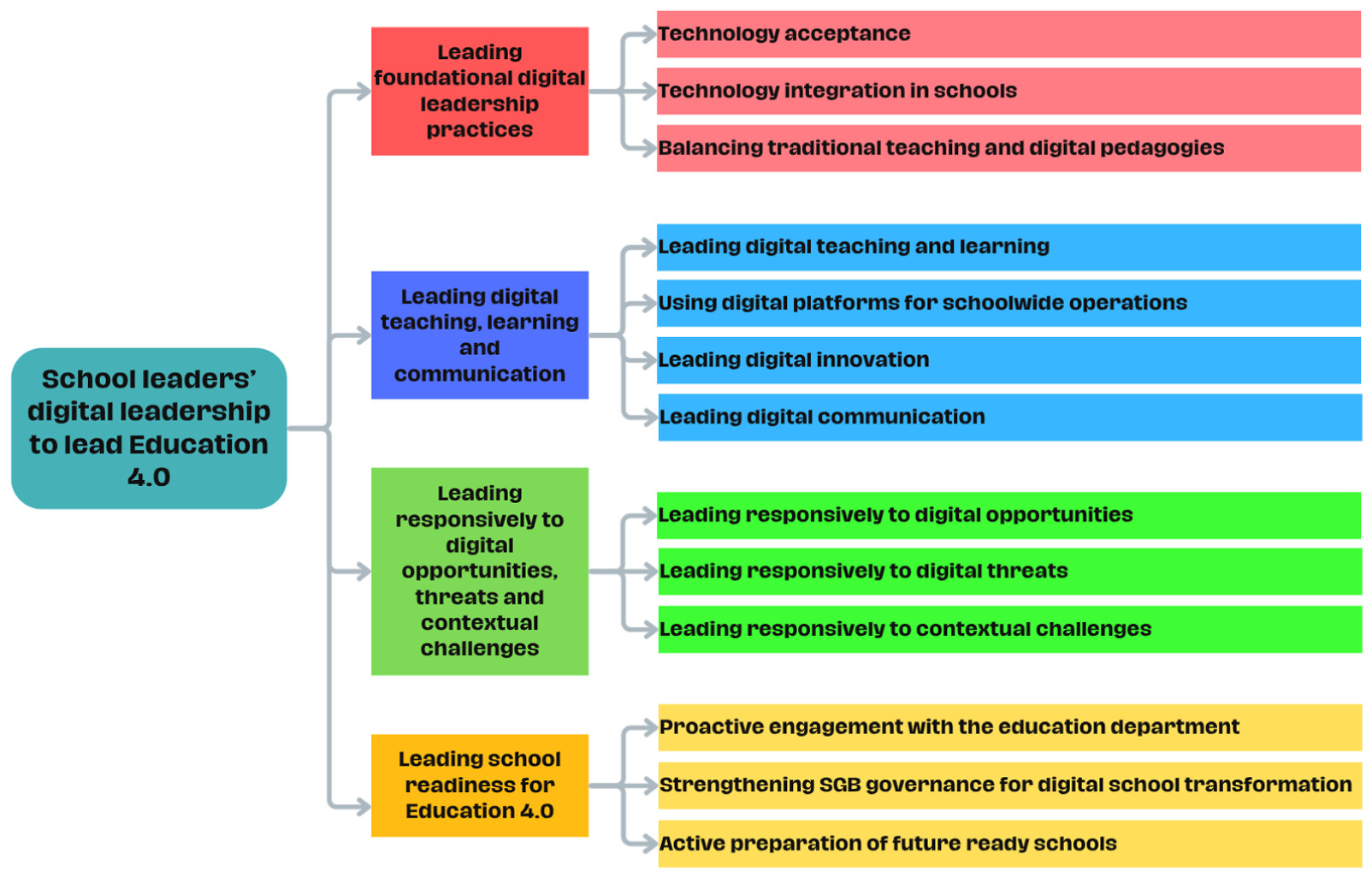
School leaders’ digital leadership framework to lead Education 4.0 (Dasruth, 2026).
The study’s findings demonstrated that in each dimension of the framework, single-loop learning was reflected where school leaders made incremental adjustments to maintain school operations.
Dimension One: Leading Foundational Digital Practices has Three Supporting Elements
Element 1: Technology Acceptance
The study showed that technology acceptance was a foundational step in moving schools toward Education 4.0, with teachers’ confidence and attitudes influencing how readily digital practices were adopted. Research shows that acceptance improves when digital change is introduced gradually and supported through emotional readiness (Daud et al., 2021; Ertiö et al., 2024). Some staff embraced technology quickly, while others were hesitant due to fear, unfamiliarity or prior negative experiences. Organisational learning loops can guide school leaders (Argyris & Schön, 1978) by introducing simple digital practices such as shared WhatsApp communication, online notices or basic digital forms before progressing to instructional tools. Leaders can pair confident staff with those needing support, encouraging experimentation at a manageable pace. This aligns with international Education 4.0 research showing that meaningful integration depends on aligning tools with curriculum goals and teacher confidence (González-Pérez & Ramírez-Montoya, 2022).
Element 2: Technology Integration in Schools
The study found that technology integration occurred when digital tools were incorporated into classroom teaching and everyday school operations in ways that enhanced learning and efficiency. Participants described using online quizzes, multimedia demonstrations and classroom platforms to strengthen engagement and support curriculum delivery, even when digital access was uneven. Integration developed progressively as teachers matched tools to learning outcomes and school leaders helped to scaffold their use in realistic ways. This showed that organisational learning aided the integration of technology which surfaced from relevance, adaptation and practical alignment (Argyris & Schön, 1978). To encourage technology integration, school leaders can encourage teachers to introduce one digital activity into lessons each week or share short demonstrations of successful classroom use. In limited-resourced schools, leaders can rotate device access, use offline materials or pair learners, ensuring that technology integration progresses without disadvantaging learners with limited access.
Element 3: Balancing Traditional Teaching and Digital Pedagogies
The study showed that school leaders consistently balanced digital practices with traditional teaching to ensure continuity, inclusion and equitable participation. Participants emphasised that while digital tools supported interaction and creativity, they could not replace structured explanations, interpersonal connection and familiar learning routines, particularly where digital access and internet connectivity was unstable. School leaders adapted teaching approaches when devices were limited or when internet connectivity failed, demonstrating that flexibility was needed for digital transformation to occur. This supports literature emphasising blended learning as a necessary bridge between traditional pedagogy and digital innovation, especially in unequal systems (Van Wyk, 2022). School leaders can maintain this balance by planning lessons that work both with and without technology, rotating digital access and reinforcing digital tools as enhancing teaching and learning rather than replacing strong pedagogy. This approach allows schools to adopt organisational learning to progress steadily while remaining responsive to contextual constraints (Argyris & Schön, 1978).
Dimension 2: Leading Digital Teaching, Learning and Communication has Four Supporting Elements
Element 1: Leading Digital Teaching and Learning
The study showed that school leaders guided digital teaching and learning through double-loop learning which emerged when school leaders questioned assumptions about teaching, communication norms, professional boundaries and leadership expectations, encouraging the use of tools that enhanced lesson delivery, learner participation and digital assessment practices. Participants described how platforms such as Google Classroom, digital quizzes and multimedia resources supported engagement and offered alternative ways for learners to interact with content. School leaders facilitated informal peer learning, shared strategies and encouraged experimentation, demonstrating that digital pedagogy developed through gradual exposure. This highlighted that digital teaching strengthened instructional flexibility when supported by ongoing learning and opportunities to observe successful use in classrooms (Argyris & Schön, 1978). Research similarly shows that learner-centred digital environments depend on school leaders who scaffold experimentation and reduce fear of failure (Göker & Göker, 2021). School leaders can enact this element by modelling simple digital lesson components. In schools with limited access, leaders can use downloaded videos, shared devices or rotational group tasks to ensure participation remains inclusive.
Element 2: Using Digital Platforms for Schoolwide Operations
The study found that school leaders used digital platforms to streamline administration, improve communication and coordinate school processes more efficiently. Participants described using virtual meetings, digital attendance systems, online document sharing and data dashboards to reduce manual work and strengthen collaboration among staff. These practices improved responsiveness and allowed school leaders to monitor learner performance and school operations in real time, even where infrastructure varied. This showed that digital platforms were adopted pragmatically and adapted to context (Argyris & Schön, 1978). School leaders can apply this by starting with manageable digital tools such as shared drives or online submission systems and gradually expanding their use to other school functions. Where resources are limited, leaders can implement blended systems that use digital tools with existing paper-based processes to ensure a smooth transition. This reflects wider findings that digital platforms enhance organisational responsiveness and enable data-informed leadership across schools (Helbig et al., 2021).
Element 3: Leading Digital Innovation
The study showed that school leaders supported digital innovation by introducing emerging technologies such as Coding, Robotics, VR and AR to stimulate curiosity and develop future-focused skills. Participants described how these tools generated excitement among learners and provided opportunities for creative problem-solving, even when access was limited. School leaders facilitated exploration by sourcing digital resources, forming partnerships and allocating time for experimentation, demonstrating that innovation could begin on a small scale. This revealed that innovation acted as a catalyst for shifting school culture (Argyris & Schön, 1978). Education 4.0 studies confirm that even small-scale innovation projects can trigger wider pedagogical change and future-oriented mindsets (Schwab, 2016). School leaders can foster innovation by piloting new technologies with a single grade. In low-resourced schools, leaders can use manual coding and shared rotation models to ensure innovation remains possible despite constraints.
Element 4: Leading Digital Communication
The study found that digital communication became central to how school leaders interacted with staff, parents and learners, improving communication and collaboration across the school community. Participants described using SMS systems and social media to share updates and coordinate activities, while also navigating challenges such as blurred boundaries and inappropriate messaging. School leaders recognised that effective digital communication required clear expectations, emotional awareness and consistent reinforcement of respectful conduct. This showed that digital communication expanded participation but required organisational learning and guidance (Argyris & Schön, 1978) to safeguard wellbeing and professional relationships. This aligns with research showing that digital communication reshapes relational dynamics and requires leaders to set boundaries to protect wellbeing (Cheng & Wang, 2023). School leaders can enact this by establishing communication time boundaries, modelling appropriate tone and addressing misuse sensitively and promptly. They can also create separate communication channels for different purposes, helping maintain clarity and reduce information overload.
Dimension Three: Leading Responsively to Digital Opportunities, Threats and Contextual Challenges
Element 1: Leading Responsively to Digital Opportunities
The study showed that school leaders capitalised on digital opportunities to enhance school functioning, improve learner engagement and streamline administrative processes. Participants described how technology strengthened parental involvement and supported the continuity of learning during disruptions such as COVID-19. School leaders recognised that digital opportunities could extend learning (Argyris & Schön, 1978) beyond the classroom and promote efficiency, even when applied incrementally. Similar studies highlight digital opportunities as yielding the greatest impact when adapted to context and used to close gaps (Haleem et al., 2022). This demonstrated that digital opportunities were most beneficial when school leaders adapted them to local needs and improved inclusive participation. School leaders can enact this by identifying available opportunities, such as using digital dashboards for monitoring learner progress and using messaging platforms to strengthen parent communication.
Element 2: Leading Responsively to Digital Threats
The study showed that school leaders faced digital threats such as cyberbullying, data privacy breaches, distractions and inappropriate online behaviour, which affected learner wellbeing. Participants described responding to emotionally distressing incidents and managing misinformation that spread through parent groups, highlighting the ethical complexity of digital schooling. This is consistent with global research showing that cyberbullying and digital misconduct require ethical, vigilant and relationally sensitive leadership responses (Karakose & Tülübaş, 2023). School leaders addressed threats by setting boundaries, monitoring platforms and offering guidance, demonstrating that digital safety required proactive and compassionate intervention. This showed that digital leadership involved organisational learning (Argyris & Schön, 1978) to protect learners and staff as much as adopting new technologies. School leaders can address threats by establishing clear conduct expectations, educating parents and learners about online behaviour and intervening quickly when issues arise. They can also incorporate digital safety discussions into assemblies, staff meetings to reinforce shared responsibility.
Element 3: Leading Responsively to Contextual Challenges
The study showed that contextual challenges such as technophobia, limited devices, unstable connectivity and loadshedding disrupted digital learning and slowed transformation, particularly in under-resourced schools. Participants described adapting plans, adjusting expectations (Argyris & Schön, 1978) and reverting to traditional methods when necessary, demonstrating that responsiveness was essential for maintaining teaching continuity. School leaders balanced aspirations for digital progress with the realities of availability, competence and infrastructure, ensuring that learners were not disadvantaged. Comparative studies show that contextual adaptation is central to effective digital leadership in resource-constrained systems (Magesa & Jonathan, 2022). This revealed that responsive leadership enabled schools to move forward while remaining sensitive to school community conditions. School leaders can enact this by planning backup strategies, rotating access to devices and offering personalised support to staff who lack confidence. They can also advocate for digital resources through partnerships with industry and non-profit organisations. These adaptive, reflective and transformative learning processes illustrate how digital leadership is evolving from incremental adjustment toward the reimagining of 4IR schooling.
Dimension Four: Leading School Readiness for Education 4.0
Element 1: Proactive Engagement with the Education Department
The study found that school leaders engaged with the education department to interpret expectations, request support and align digital initiatives with broader policy directions. Participants described inconsistencies in training and resource provision, prompting school leaders to seek clarity, raise concerns and adapt guidelines to their school contexts. This demonstrated that proactive engagement (Argyris & Schön, 1978) helped schools navigate ambiguity and positioned school leaders as active contributors in transforming their schools to Education 4.0. This reflects global findings that policy-engaged school leadership strengthens digital coherence and improves system-wide implementation (Ahlquist, 2014). It showed that readiness was strengthened when schools and the education department communicated regularly and constructively. School leaders can apply this by using district meetings to request clarification, submitting documented needs through official channels and sharing practical feedback on implementation challenges.
Element 2: Strengthening SGB Governance for Digital School Transformation
The study showed that SGB involvement was central to digital transformation where procurement, policymaking and digital safety required governance oversight. Participants described how collaboration between school leaders and SGBs helped establish policies on device use, cyberbullying responses and resource allocation. This demonstrated that transformation depended on cooperative relationships (Argyris & Schön, 1978). It showed that shared decision-making strengthened accountability and supported a safer, more coherent digital environment. School leaders can enact this by presenting data to SGBs, co-developing policies and involving governors in discussions about priorities and digital risks in schools. This shared approach ensures that digital decision-making reflects the school’s needs and values. Studies similarly emphasise that effective governance partnerships improve digital resourcing and strengthen responsible ICT use in schools (Vikaraman et al., 2021).
Element 3: Active Preparation of Future-Ready Schools
The study showed that school leaders prepared their schools for future disruptions and digital demands by developing blended learning approaches, securing devices through fundraising and maintaining digital communication systems. Participants described how post-COVID 19 experiences shaped more resilient and flexible practices, allowing schools to adapt quickly when needed. This supports research showing that crisis-informed blended learning models and resilience strategies are key components of future-ready Education 4.0 systems. This demonstrated that future readiness involved intentional planning, capacity building and collaboration rather than crisis-driven reaction. It showed that school leaders who prepared proactively positioned their schools to transition more smoothly toward Education 4.0. School leaders can enact this by uploading digital lesson materials onto virtual platforms, keeping emergency communication channels active and offering regular practice opportunities for staff. They can also build partnerships with local businesses to support access and infrastructure, strengthening long-term readiness.
The four dimensions present digital leadership as an interactive and context-responsive process. Grounded in organisational learning theory (Argyris, 1999; Argyris & Schön, 1978), the framework demonstrates that effective digital leadership in South African public schools extends beyond technology. It requires building foundational practices, embedding digital teaching and communication, responding thoughtfully to opportunities and risks, and preparing schools for long-term Education 4.0 transformation. The framework offers a theoretically sound and practical approach to understanding how school leaders can guide digital transformation in unequal and resource-constrained schools. Digital leadership can foster learning organisations capable of sustaining Education 4.0 transitions, advancing equity and inclusion aligned to SDG 4. The four dimensions were selected because together they capture both human and technical elements required for Education 4.0. Existing frameworks tend to emphasise either external behaviours such as Sheninger’s pillars (2019) and the ISTE standards (2018) or Ahlquist’s (2014) and Daud et al.’s (2021) internal competencies, but rarely integrate the two to reflect the realities of resource-constrained schools. Each dimension responds to core barriers identified in the findings, offering a context-responsive framework for leading Education 4.0.
Discussion
Although the findings align with prior research showing that digital leadership improves communication, collaboration and teaching innovation (Orfanidou & Kopsidas, 2023; Sheninger, 2019), they also extend the literature by highlighting the emotional and psychological conditions required before technical adoption can occur. Unlike studies that assume technology uptake follows once training and tools are provided, this study shows that fear, technophobia and low confidence act as deeper inhibitors of Education 4.0, confirming arguments by Daud et al. (2021) on the centrality of human skills. These findings also challenge more structurally oriented frameworks such as ISTE (2018), which presume stable infrastructure, by showing that loadshedding, device inequality and network failures reshape how digital leadership is enacted in under-resourced settings. The study shows that digital leadership in South Africa is adaptive, emotionally mediated and context-dependent.
Document analysis supported these patterns as school policies referenced ICT, but implementation was inconsistent; evidence of digital pedagogy in lesson plans was limited; and initiatives such as Coding and Robotics, DDD data use and early e-learning efforts occurred in isolation rather than as part of a coordinated digital strategy. Digital administration was substantially more developed than digital teaching, with platforms such as DMS and WhatsApp used routinely, while classroom integration remained emergent.
These findings refine organisational learning theory (Argyris, 1999; Argyris & Schön, 1978) by showing that learning loops in under-resourced schools are triggered as much by constraints such as loadshedding and technophobia, as by innovation. They further extend digital leadership literature by demonstrating that emotional readiness and contextual intelligence form the foundation upon which technical skills and Education 4.0 practices can be built.
Implications of the Study
Implications for Practice
School leaders must strengthen digital and human leadership by building staff confidence, encouraging experimentation and modelling positive attitudes toward digital change. Professional learning communities can reduce technophobia, while practical strategies are needed for device rotation, loadshedding and blended teaching. Clear digital boundaries and short coaching cycles support wellbeing and sustained adoption.
District support should be context-responsive, aligning training to teacher readiness, infrastructure and resources. Hands-on coaching, differentiated professional development and inter-school collaboration can reduce technophobia and support mentoring and resource sharing. Clearer guidance on Education 4.0 and digital safety is needed.
SGBs play a critical governance role by supporting resource acquisition, strengthening ICT policies and regulating responsible device use, including cyberbullying, privacy and digital misconduct.
Implications for Policy
The findings highlight several policy gaps. Clearer curriculum and resource provision policies are needed to meaningfully integrate Education 4.0, alongside aligned resources and practical teacher training.
Equity must be prioritised, as loadshedding, poor connectivity and limited devices undermine sustained digital practice. Policy should focus on reliable infrastructure, targeted funding and device provision for under-resourced schools.
COVID-19 exposed the absence of crisis-readiness policies. Schools require clear guidelines for blended learning, digital wellbeing, data privacy and continuity during disruptions.
SGBs need stronger support in digital governance, including training in ICT policy, procurement and cyber-risk management. National guidance on digital ethics, online conduct, privacy and wellbeing is essential.
Finally, the gap between departmental expectations and school realities must be addressed through clearer, context-sensitive and consistent policy communication that accounts for inequality and infrastructure constraints.
Implications for Sustainability
Sustaining digital leadership requires continued investment in people and infrastructure, supported by ongoing professional development and coaching to maintain teacher confidence and readiness.
Long-term sustainability depends on sustained funding for devices, connectivity and infrastructure, as well as blended learning plans, backup communication systems and strategies to manage loadshedding and connectivity disruptions.
Recommendations for Further Research
Future research could include longitudinal studies that track digital leadership practices over time to examine patterns, barriers and long-term impacts on school transformation and educational outcomes.
Comparative studies across South African provinces, and between urban and rural contexts, could further identify best practices, challenges and contextual conditions shaping digital leadership.
The proposed digital leadership framework could serve as a basis for further theory building and be empirically tested and validated as a guide for Education 4.0 implementation.
Further studies are needed to explore how schools address resistance to digital innovation and cultivate adaptive, technology-friendly cultures that support sustained Education 4.0 transformation.
Conclusion
The shift toward digital leadership and Education 4.0 is reshaping South African schools. While policy frameworks guide this transition, persistent challenges highlight the need for context-responsive leadership, professional development and resource mobilisation to support sustainable implementation.
This study proposes a digital leadership framework comprising four dimensions to guide school leaders in advancing Education 4.0. The framework emphasises cultivating an Education 4.0 culture and translating digital transformation intentions into practice, offering a viable, context-sensitive approach for leading Education 4.0 in South African schools.
Footnotes
Acknowledgements
None.

Funding
The authors received no financial support for the research, authorship, and/or publication of this article.
Declaration of Conflicting Interests
The authors declared no potential conflicts of interest with respect to the research, authorship, and/or publication of this article.
Data Availability Statement
Data sharing not applicable to this article as no datasets were generated or analysed during the current study.