



Abstract
Industry 4.0, whose effects have been more and more noticeable in recent years, and the digital change it brings call for a new educational model that aligns university instructional processes and curricula with the demands of business. This approach, known as University 4.0, intends to promote more technology-based applications, the power of innovation, the training of skilled specialists to satisfy industrial needs, and the development of competences that can achieve multidisciplinary projects. It is of utmost importance to adapt late-industrializing nations’ educational systems, such as Turkey’s, to this change process. The aim of this research, which takes the Turkish context as a reference, is to reveal how the curricula and educational processes of business schools should be shaped with a perspective that takes into account the human resources requirements of industry 4.0. A decision-making technique that integrates QFD, Delphi, and DEMATEL methods was employed in the study. The results clearly show that the most important expectation for social stakeholders is to provide university-industry cooperation. However, some of the most pressing problems include applied learning through collaborative educational experiences, teamwork skills, changing roles and competencies of academics. The findings point out that the educational activities of business schools must be linked with industry expectations through technology-based training activities and teamwork.
Plain Language Summary
The aim of this research, which takes the Turkish context as a reference, is to reveal how the curricula and educational processes of business schools should be shaped with a perspective that takes into account the human resources requirements of industry 4.0. A decision-making technique that integrates QFD, Delphi, and DEMATEL methods was employed in the study. The results clearly show that the most important expectation for social stakeholders is to provide university-industry cooperation. However, some of the most pressing problems include applied learning through collaborative educational experiences, teamwork skills, changing roles and competencies of academics. The findings point out that the educational activities of business schools must be linked with industry expectations through technology-based training activities and teamwork.
Introduction
From a hunter-gatherer to modern society, humankind has witnessed several industrial revolutions in both social and economic fields. The industrial revolution, which led to the digital transformation and delivers high productivity at a low cost, brings a new lifestyle compared to our usual daily life while also aiming to create a sustainable environment overall (Javaid et al., 2022, p. 206). The internet of things and systems, intelligent sensors, 3D printers, drones, robotics, intelligent manufacturing systems, artificial intelligence, data transfer, cloud and many other technological instruments present new market opportunities (Morrar et al., 2017, p. 16).
Creating machines primarily for the coal, textile, and iron industries marked the beginning of the first industrial revolution, which was largely confined to Britain. Then, beginning in the late 19th and early 20th century, companies began making use of alloys, lighter metals, and other natural and synthetic materials. The era of computers during the third industrial revolution was when the electronics and IT industries reached their height of development. Using computers to perform human labor was the initial stage of automation. Robots have uses in a variety of industries, including logistics, healthcare, combat zones, and other places where humans are unable to operate. Industry 4.0 used AI, intelligent robots, and techniques to increase productivity while reducing the need for human labor (Mathur et al., 2022).
The fourth industrial revolution was first mentioned at the Hannover Fair in Germany in 2011 (X. Xu et al., 2021, p. 530; L. Xu et al., 2018, p.2941). “In the current debate about the digitalization of industrial labor ‘industry 4.0’, the dystopic (away from utopia) vision of a deserted factory without any human agency is abandoned” (Reuter et al., 2017, p.354). Kagermann et al. (2013) states that with the intelligent monitoring and control system provided by industry 4.0, production will be more manageable, efficient, faster and economical, and the management of the business will be easier (International Controller Association [ICA], 2015). Production with fewer errors, less waste, improved manufacturing capabilities, acceleration of innovation, innovation process and integration into the system are the basis of the fourth industrial revolution. However, it is foreseen that it will not be easy to integrate all these new concepts covered by the revolution into our daily lives, especially in developing countries (D. Y. Lin, 2017), which is not only due to the economic factors but also the shortcomings of the educational infrastructure and lack of vision that manage this new system. There will be no chance to keep the industry 4.0 if the human resources (HR) are incompatible with industry 4.0. Therefore, there will be no possibility of catching up with the change in the world and being a part of it.
The fourth industrial revolution is the revolution that radically demands HR transformation. While the previous revolutions were the changes experienced in parallel with the development of HR and what the workforce learned, industry 4.0 is the establishment of a world not on what people learn, but on what machines learn. This difference requires human-machine collaboration (Javaid et al., 2022, p.210; X. Wang, 2023, p. 15). According to the World Economic Forum’s (2022) “Strategic Intelligence Report,” by 2025, there is a potential for the loss of more than 80 million jobs due to changes in how work is divided among humans, machines, and algorithms. However, on the positive side, this shift could also lead to the creation of over 100 million new jobs (Ciolacu et al., 2023, p. 178). Therefore, higher education, organizational structures and social dynamics are affected by the revolution as much as mechanical structures and technology. If machine learning replaces human learning in the workforce of the future, then the future of education must first consider where humans will fit into this system.
Undoubtedly, the key to evaluating the opportunities offered by industry 4.0 and transferring them to the business world depends on the regulations in education life and digital modernization. In the business world, it is expected that qualified individuals will be trained with the concept of “university 4.0’” to create an HR that is conscious of industry 4.0. University 4.0 refers to education in a digitally networked world that also meets the requirements of industry 4.0 (Wahlmüller-Schiller, 2017, p. 382). The university 4.0 is aimed to improve educational activities and create an HR suitable for industry 4.0 qualifications. University 4.0 is a response to the need for the Industry 4.0 revolution, whereby people unite to create new opportunities creatively and innovatively using technology (Lase, 2019). Industry 4.0 success cannot be expected without university 4.0.
Based on the shortcomings felt in educational practices, higher education in a developing country such as Turkey is expected to raise HRs to suit the needs of industry 4.0. This study aims to be a reference in the determination of these objectives and to ensure the integration of industry 4.0 strategies at the point of determining the future of education. Consequently, answers are sought to the questions of what is the current status of education given in business schools (e.g., Bajada et al., 2021; Tsai & Shen, 2016). At what point do revisions become required and the new HRs demanded by the business world will be equipped for the integration into industry 4.0?
Based on the above questions, this study attempted to provide a holistic and in-depth knowledge to develop efficient HRs being compatible with industry 4.0 by taking the opinions of all relevant stakeholders (public and private sector, national and international accreditation, quality councilors, students and academics). The data obtained from the sample is targeted to determine the expectations and targets of all stakeholders. Therefore, it is targeted to examine how well the Business School in Turkey can be harmonized with the targets that are determined considering industry 4.0, by comparing the solution suggestions offered by these stakeholders and the current education system. The result of this study aims to offer a new perspective by establishing a relationship between the HR structure expected by the business world and education revisions to examine this perspective in the context of university 4.0.
Therefore, the rest of the study is structured as follows: The next sections review the theoretical framework and country context respectively. The proposed methodology is then described in part four, and its application is covered in section 5. Sixth section summarizes the main findings, discussions and implications with respect to the results.
Theoretical Framework
Higher education evolves in response to changes in both society and industry and provides valuable human capital to organizations (Nafea & Toplu, 2020, p. 271). Higher education, which was focused on standard modes of learning (M. Xu et al., 2018, p. 93) started using technology at a level that met the basic needs of the industry and contained the motivation to support mass production during the second industrial revolution (Schwab, 2016, p. 11). Thus, during the third industrial revolution, technology and computer support have been completely incorporated into the education process (Lase, 2019, p. 50). Higher Education 3.0 included cognitive psychology and educational technology based on digital and mobile web (Hussain, 2013, p. 42). The fourth industrial revolution changed how people viewed education. This change is not just a teaching method but from the perspective of the education concept (Lase, 2019, p. 58). In this modern era, social sciences should at least understand the foundations on which the digital transformation is based (Butler-Adam, 2018, p. 1).
The fourth industrial revolution, called Industry 4.0, allows the creation of new business models (Schwab, 2016, p. 12). It is argued that the fourth industrial revolution will shape the future with its effects on the government and business world. It is also believed that people will have no control over technology or the destruction that may come with industry 4.0 (M. Xu et al., 2018, p. 91). It is accepted that industry 4.0 has nine components such as big data and analysis, autonomous robots, internet of things, cyber security, augmented reality, cloud technologies, simulation, additive manufacturing and system integration (Alloghani et al., 2018). However, the human capital to manage these processes is the center of these components.
Adaptation to the digital transformation and Industry 4.0, which play a crucial role in today’s knowledge economy, can only be achieved through higher education (Marks & Al-Ali, 2022). Nevertheless, it is possible to say that this situation may differ between developing and developed countries. Developed countries are trying to increase their efficiency in a competitive environment by using the automation and flexibility brought by the revolution well (Dalenogare et al., 2018). Emerging economies that have good business models and share common values invite both the consumer to benefit from the advantages of industry 4.0 by producing innovative and value-added products and services. Nonetheless, from the viewpoint of many developing countries still living in the industry 2.0 era, industry 4.0 is seen as a waste of time and costly as it requires a radical change (Iyer, 2018). It is a controversial issue to what extent are these countries ready for this process in terms of HRs. Hence, considering the perspectives of all stakeholders, suggestions will be presented about how to overcome the existing deficiencies in business schools to capture and manage industry 4.0 and digital transformation in an emerging country like Turkey. It is important to understand the context for analyzing the industry 4.0 process and business schools in Turkey.
Country context
Considering that technology and geography mutually affect each other, and digital transformation knows no borders, there are many questions to be asked such as “What will define the roles played by countries, regions and cities in the fourth industrial revolution? Will Western Europe and the USA lead the transformation as in previous industrial revolutions? Which countries will be able to take a step forward?” (Schwab, 2016, pp.71–72). Korea, Singapore, Germany, Japan, Sweden, Denmark, USA, Italy, Belgium and Taiwan are the 10 countries with the highest automation level in the manufacturing industry in the world. While Korea maintains its position as the country with the highest robot density worldwide since 2010, Singapore ranks second after Korea in the global robot density ranking with 488 robots per 10,000 employees in 2016 (Kiliç & Alkan, 2018, pp. 37–38). Considering the intense competition between manufacturers from America, Europe and the Far East, new production technologies can be seen as a response to intense competitive pressure, especially for European and American manufacturers, from countries such as China and India, which can produce at lower costs, especially in terms of labor (Aydın, n.d.). The distinction between high- and low-cost countries or emerging and mature markets will become increasingly less important in the future. Instead, the main question will be whether a country’s economy can innovate (Schwab, 2016, p.72). When an evaluation is made at this point, it is seen that Europe in general and Germany in particular are the pioneers of industry 4.0 (Mrugalska & Wyrwicka, 2017, p. 469). The Germany government is the first country to adopt the technology of the Internet of Things and Services as part of its High-Tech Strategy for the interdepartmental coordination of different research initiatives ongoing in the German region to strengthen Germany’s competitive position since 2006 (Kagermann et al., 2013, p. 67). On the other hand, it is known that US manufacturers are among the most zealous users of Industry 4.0 technology. “According to a recent ‘markets and markets’ report, the global Internet of Things (IoT) in the manufacturing sector was worth $10.45 billion and was targeted to reach $45.3 billion by 2022” (A Guide to Industry 4.0 in the US, 2019).
In parallel with this situation, digitalization is also considered as one of the most important tools in the economic development process in Turkey, which ranks 19th among the world’s major economies (World Bank, 2023). The “Turkey Digital Transformation Roadmap” has been published and has six components: people, technology, infrastructure, suppliers, users and governance (Republic of Turkey Ministry of Science Industry and Technology, 2018). However, it can be said that Turkey, which is a late industrializing country, is not at the same level as western countries in this transformation process. In this digital transformation process, there is a need for improvement and modernization in higher educational activities. Higher educational reforms are also important for business schools because business schools develop the HRs for all departments in organizations such as production, research and development, management and marketing that are suitable for the use of high technology and sectoral success. Business schools directly affect the digitization process of the country. Therefore, serious changes have been made in terms of higher education in recent years, reflecting the global trend of educational institutions worldwide adopting digital initiatives to enhance interactive learning environments (Komljenovic, 2022, p.126; Okoye et al., 2023, p. 2295).
Üsdiken (2004) states that the current education system of business schools in Turkey is a mixture of partly American and European curricula. Scholars from the Orthodox tradition emphasize the importance of focusing on academic tradition, while scholars who have adopted the American perspective argue that students should be trained for the market. Therefore, it is reasonable to assert that there is diversity, rather than a single viewpoint for the progress of university 4.0. In higher education, French influences and German educational peculiarities are recognized (Bugra, 1994, p. 65; Sargut, 2009, p. 51). In the 19th-century German education, the discipline of business economics, known as Betriebswirtschaftslehre, was represented in Turkish Business Education by German instructors in Turkey (Üsdiken, 2004). Turkey joined the Bologna process in 2001, spreading over a large territory, covering not just European countries but also the wider European Higher Education Area, which has 47 countries as members (Teichler, 2012, p.36; Verhoeven & De Wit, 2022; Yağci, 2010, p. 588). The key to the success of the Bologna Process is the underlying partnership approach, both in policy formulation and implementation. Accreditation is one of the most important tools that will provide targeted quality assurance in higher education (Chalmers & Johnston, 2012). Hence, there is intense interest and effort toward accreditation and quality assurance in business schools in Turkey currently.
Methodology
To address the research questions, this study’s methodology combines qualitative and quantitative methods. A method for gathering, scrutinizing, and processing data is shown in detail in Figure 1. In this study, firstly, the decision problem was determined. Then, the Quality Function Deployment (QFD) method was applied based on the house of quality. In the QFD method, DELPHI was used to determine Customer Requirements (CRs) and DEMATEL method was used to weight CRs. Building a complete QFD matrix includes the identification of CRs, TRs, correlation, importance and interrelations. The structure of the QFD decision-making process that we suggest is depicted in Figure 1 (Chan et al., 1999; Lee & Lin, 2011).

The proposed model.
Define the problem
The purpose of this study is to highlight the shortcomings of business schools in a developing nation like Turkey and to provide solutions for industry 4.0. To this end, the study combined the use of QFD, Delphi, and DEMATEL methodologies. Customer Requirements (CRs) or the Voice of the Customer are transformed into technical requirements (TRs) utilizing the matrix known as House of Quality (HOQ) by Quality Function Deployment (QFD), a comprehensive design tool (Akao & Mazur, 2003). It has found widespread use in decision-making situations where the goal is to rank a list of objectives in TRs according to a list of prerequisites in CRs (Lima et al., 2013). As a result, completing the HOQ is a prerequisite for investigating CRs. The two sections are: WHAT are the needs of the client, and HOW should the product be produced (Bottani & Rizzi, 2006). The HOQ created by Griffin and Hauser (1993) is used in this study is shown in Figure 2. A QFD matrix includes a variety of inputs in the form of evaluation and judgment. These inputs must generally be prioritized because they are necessary for quantitative analysis (M. C. Lin et al., 2004). Thus, an integrated decision-making model was preferred in this study.

House of quality (HOQ).
Examine the Expert Group
Using multi-criteria decision-making methods, validity and reliability depends on the accuracy of the expert group. Therefore, stakeholder theory was used while determining the expert group in this study. The concept of stakeholder is defined as a person who has a relationship with the business (Rawlins, 2006). The first academician suggesting the stakeholder approach to strategic management, Freeman (1994), asserted that companies should take into account the interests of a variety of external stakeholders in addition to their owners. Stakeholder theory explicitly sees ethics and values as a central feature in managing organizations (Donaldson & Preston, 1995). The goals of collaborative action and the ways to achieve these goals are critically examined in stakeholder theory, unlike many strategic management theories (Phillips et al., 2003, p. 481). The theory is used to describe the nature of the company, how managers think about the interests of corporate groups and how some companies are managed (Donaldson & Preston, 1995, p.70).
As shown in Table 1, the expert group was formed within the framework of stakeholder theory, in accordance with the scope of the research and to represent the interests of different stakeholders. The participants were selected through a purposive procedure. The following selection criteria were used to choose a purposive sample of the participants for the study from the overall population: (1) Participants represent different stakeholder groups in terms of social, cultural, economic status and education quality, (2) In this process, the participants represent the sample with the necessary knowledge and field experience about industry 4.0. Industry group members (employees and managers) have extensive experience and knowledge of industry 4.0. They work in companies that successfully operate smart factories as a major component of industry 4.0 in the world. The public administrators work in institutions that lead to the industry 4.0 process in Turkey at both the HR and employment levels. One of them is responsible for the training of human resources throughout the country, while three are working in the digitalization process in many areas in the public sector. They have different and broad educational visions because of having higher educational experiences abroad (both America and Europe). Academicians take part in the accreditation and quality processes of different universities. International Quality Board Members and Members of the Accreditation Agency are the people that lead the digital transformation in both business schools and universities. Undergraduate students come from different locations in terms of social, cultural, development level and educational quality. They are undergraduate students in the third and fourth grades. They have Erasmus experience and two of them are active members of business student clubs.
The Characteristics of Expert Groups Participants.

Determine the CRs (Whats) by Delphi
Identification, definition, and specification of CRs are the first steps in the construction of a HOQ. As a result, in this study, the issues with Turkish business schools are handled as CRs (Whats). Customer needs, customer attributes, and desired quality are other names for CRs. In this study, the Delphi technique is used in the criteria (the problems of the business schools in Turkey) finalization. The Delphi technique developed by the RAND Corporation merely a strategy for revealing and improving collective decisions (Dalkey, 1969). When complex problems and decision-making and agreement requirements arise in uncertain situations, the Delphi approach facilitates and promotes structured group conversation to acquire the expert consensus needed to give solutions (Grime & Wright, 2016). As a result, a sample of experts who are qualified to respond to research questions in the relevant field are chosen for the Delphi panel (J. Skulmoski et al., 2007). The number of experts on the panel can range from 5 to 20, depending on the purpose of the study (Rowe & Wright, 2001). The ability to bring together geographically dispersed panel experts, preventing direct or personal exchanges and evaluations of experts with one another (promotes adequate assessment, free of group prejudice), getting economical, adaptable, and versatile, and offering approval from experts (Hung et al., 2008) are some significant benefits of the Delphi technique. Following is a summary of the steps involved in the Delphi technique process (Grime & Wright, 2016):
Step 1- Determination of panel experts: As stated in Table 1, experts should be chosen from among those who have knowledge and expertise relating to the research topic.
Step 2- Design and distribution of the first-round questionnaire to experts: Both the study’s purpose and the questionnaire’s objectives are stated clearly. A Likert scale with seven points and answers ranging from 1 (never should be implemented) to 7 (should be implemented) is used for the questionnaire at each round. They are also asked to submit their ideas for brand-new questions that should be included in the survey. There are many ways to deliver the questionnaire to the experts, including through emails or websites.
Step 3- Analysis of the first Delphi questionnaire: The following statistical techniques connected to the Delphi method are used to determine the relevance level of each question: Median [Md], First Quartile [Q1], Third Quartile [Q3], and Interquartile Range [R].
Step 4- Preparation of second-round questionnaire and distribution to the experts: Under each first-round question, the expert’s prior round response and the Delphi statistics for that question are presented. The questionnaire is expanded with new questions that were introduced after the initial round of expert suggestions. Rephrase the pertinent question for the experts. The expert is asked to justify any views that deviate from the consensus if they do.
Step 5- Analysis of second-round questionnaire: The expert ideas in round 2 are calculated using Md, Q1, Q3, and R. If there are particular expert remarks, they are compiled in a separate way.
Step 6- Preparation of third-round questionnaire and distribution to the experts: The second-round questionnaire and this one are identical. The participant’s response to the relevant question and the second round’s statistics are appended to each question.
Step 7- Analysis of the third Delphi round and results: For the study of the third round, the statistics from the second round are used. The gap between the quartiles is examined to see if it has shrunk or not. A smaller range indicates a higher degree of agreement. By examining the Md and R values in relation to their importance and impact levels, the choice for this criterion is established.
Obtain Relative Importance of CRs by Decision-Making Trial and Evaluation Laboratory
The Geneva Research Center of Battelle Memorial Institute created the decision-making trial and evaluation laboratory (DEMATEL) method, which is an efficient method that provides analysis in terms of the magnitude and types of the direct and indirect relationship between factors (Chang & Chen, 2011; Han & Deng, 2018). By analyzing the overall relationships between components, DEMATEL can offer a perfect solution to better comprehend structural links and address issues with congruent systems (Y. Li et al., 2014). Determining the issues facing business schools in Turkey is a complex system with many interconnected components. As a result, the DEMATEL approach can be used to pinpoint the causes of and resolve issues with business schools. The following are the steps of the DEMATEL approach (Sharma et al., 2020; Zhang & Deng, 2019):
Step 1: Creating a Direct Relation Matrix: In order for the experts to make pairwise comparisons, a direct relation matrix (D) is generated using a “0–4 scale.” The pairwise comparison scale used in the DEMATEL method is given in Table 2.
Pairwise Comparison Scale.

Due to data collected through pairwise comparisons, nxn dimensional D is obtained. It is calculated with the mean value of evaluations by the “U” number of experts. Equation 1 below is used to obtain a direct relation matrix.

Step 2: Normalized Direct Relation Matrix: Following the D’s creation, a normalized relation matrix with a diagonal value of 0 is calculated. Equations 2 and 3 are utilized to produce a Normalized direct relation matrix (N).

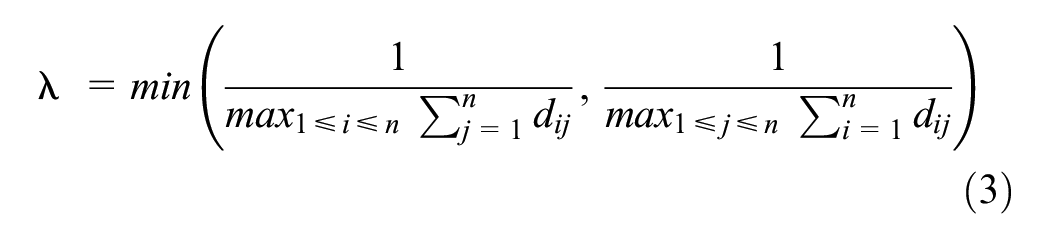
Step 3: Calculating Total Relation Matrix: Total Relation Matrix (T) is calculated using the unit matrix (I) via Equation 4:

Step 4: Computing Causal Relations between Factors: The values of D and R are calculated using the T matrix. Equations 5 and 6 are used to determine the D values derived from the sum of the rows and the R values derived from the sum of the columns of the T matrix.


The relevance and overall effects of the criteria are established in light of the values of D+R, whilst interactions among criteria are formed in light of the values of D-R. A greater D+R value for a factor indicates that it interacts with other factors more. The “sender (cause) group” is made up of criteria with positive D-R values, whereas the “receiver (effect) group” is made up of criteria with negative D-R values. Other criteria are affected by positive valued D-R criteria whereas other criteria are affected by negative valued D-R criteria.
Step 5: Determining Criteria Weights (W): Using Equations 7 and 8, criteria weights are computed.


Develop the TRs (HOWs) by the Expert Group
Product features, engineering attributes, technical attributes, engineering characteristics, and substitute quality characteristics are other names for TRs. They are connected to CRs. In this study, suggestions for eliminating the deficiencies concerning the goals and expectations of all social stakeholders are treated as TRs. These are determined by the QFD expert group as shown in Table 1. Thus, note that the purpose of this study is to explore the problems of the business schools in Turkey to respond to the expectations of industry 4.0 and develop solutions for these problems.
Build Relation Matrix Between CRs and TRs by QFD
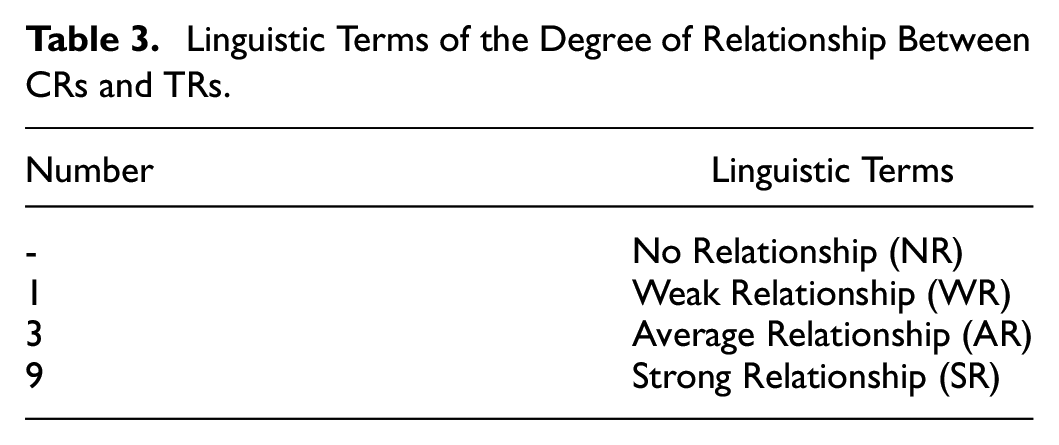
The relationship matrix shows how much each TR influences the corresponding CR. The body of the HOQ is made up of this matrix. It is made up of criteria in the columns and requirements in the rows. The decision-makers establish the criteria after a technical assessment of their compatibility with the chosen requirements. A score is used to represent the correlation between a requirement and a criterion in the relevant matrix cell. A numerical scale from 1 to 9 is employed in the traditional QFD, with 1 designating an inferior connection, 3 an acceptable connection, and 9 an intense connection. (J. Wang, 1999). As demonstrated in Table 3, the QFD technique was used in this study to establish correlations between CRs and TRs.
Linguistic Terms of the Degree of Relationship Between CRs and TRs.
Let the value of

The weight of the jth CR,

And, the absolute weight of the jth CR is converted to relative weights wcj according to Equation 11.

Build Correlation Matrix of TRs by Author of the Study
The correlation matrix shows the HOQ’s top floor. This matrix shows the favorable or unfavorable relationships among TRs and the symbols showing these relationships are included in Table 4 (Ayağ et al., 2013). These symbols indicate which solution suggestions are the same and which are opposite and opposite TRs emerge as a result of different CRs.
Relationships between TRs and Definitions.

Application
The purpose of this study is to explore the problems of the business schools in Turkey to respond to expectations of industry 4.0 and develop solutions for these problems. We examined the educational activities of business schools of universities in Turkey and offered some suggestions for overcoming deficiencies concerning the goals and expectations of all social stakeholders. The integration of QFD, Delphi and DEMATEL techniques were used in the study. Thus, the proposed model is illustrated in Figure 1.
Determining the CRs (the Problems of the Business Schools in Turkey) Via Delphi
The first section of the HOQ determines the CRs. The problems of the business schools in Turkey are handled as the CRs (Whats) in this study. Delphi technique was used to learn the feelings and thoughts of the experts who have a voice in industry 4.0 and university 4.0 applications and to provide controlled feedback on expert opinions. Detailed information about the expert group is given in Table 1. During the interviews, each participant in the expert group was asked open-ended at what points the new HRs expected in the business world should be equipped, what the deficiencies are, how to make revisions in education with industry 4.0 and, if necessary, how to revise the physical opportunities and internship teachings. At this moment, the distance between education and the industry to the innovative education system to be reached, what the goals are and what path should be taken to reach the goals were answered in detail by the participants. Thus, the first round of Delphi was completed. The questionnaire form that was created based on the answers from the participants, was sent to the expert group in the second round via e-mail. Participants stated their level of participation in the identified problems between 1 and 7. After the statistical calculations stated in the methodology section, the results were conveyed to the participants again and they were asked whether they were stable in their opinions. Here, all participants stated that they would not change their minds. This indicates that consensus has been achieved with the completion of the second Delphi round. Thus, all criteria with a range value (R) below 1.5 were clarified as the problems of business schools in Turkey and are listed below. Here each problem is denoted by P. The following CRs were adopted for the HOQ:
P1. Insufficient level of university-industry cooperation
P2. Lack of hands-on and collaborative learning and learning by doing
P3. The course curricula and plans are not up-to-date and in line with industry expectations
P4. Inability of instructor’s competencies to adapt to current technologies and industry expectations
P5. The physical conditions of universities are not suitable for the requirements of information age
P6. Instructor competencies do not comply with current technologies and industry expectations
P7. Lack of awareness, awareness and competence of students about the requirements of the digital revolution
P8. Inadequate career planning for graduate students
P9. Students’ lack of competence in data processing, data analytics, cloud computing, internet of things, big data, artificial intelligence and machine learning
P10. Lack of creativity, innovativeness and entrepreneurial capacity
P11. Insufficient level of project management competence
P12. Insufficient level of competencies in IT law
Obtaining the Relative Importance of CRs by DEMATEL
Getting the relative relevance ratings of the CRs is the second step of the HOQ. DEMATEL was applied here. To do this, the expert group was first given the DEMATEL questionnaire. Equation 1 was used to create the paired choice matrix from all participant responses. The final weights were then obtained using the DEMATEL and Equations 2 through 8 in the order shown in Table 5.
Weights of the CRs (The Problems of the Business Schools in Turkey [Whats]).

Table 5 shows that the problems that need to be solved primarily for the expert group are listed from the most important to the least. Accordingly, the three most important criteria are as follows:
P4. The inability of the instructor’s competencies to adapt to current technologies and industry expectations (0.1013)
P3. The course curricula and plans are not up-to-date and are in line with industry expectations (0.0921)
P1. Insufficient level of university-industry cooperation (0.0915)
When placed differently, DEMATEL results indicated that P4, P3, and P1 proved to be the most significant problems of the business schools in Turkey.
Determining the TRs (Suggestions for Eliminating the Deficiencies Concerning the Goals and Expectations of All Social Stakeholders) by the Expert Group
The HOQ’s third portion is developing the TRs. Suggestions for eliminating the deficiencies concerning the goals and expectations of all social stakeholders are treated as the TRs (How’s). These are determined by interviews with the expert group and are shown as follows:
Here, each suggestion is denoted by S.
S1. Establishment of advisory boards to strengthen university-industry cooperation
S2. Training human resources with doctorate degrees demanded by the industry with the cooperation of universities and industry
S3. Collaboration protocols and making internships compulsory
S4. Integrating simulation techniques of common applications in the field into programs
S5. Introducing the industrialist into the lesson
S6. Focusing on case analysis, creating a Council of Higher Education case database
S7. Spread of accreditation and quality culture
S8. Collaboration with overseas education institutions and integration with digital learning platforms
S9. Joint action of universities and industry on the determination of course curricula
S10. Inclusion of informatics programs in the curriculum during the transition period to the agile economy (must be courses such as business value of IT)
S11. Adding courses to the curricula for gaining managerial and behavioral competencies required by digital transformation
S12. More effective use of platforms such as YouTube
S13. Making educational tools suitable for digitalization more usable and accessible
S14. Thanks to loT, smart campuses should be created and access to smart devices should be provided from anywhere
S15. Simulation rooms, laboratories should be created, the concept of a technological campus should be created
S16. Cryptocurrencies, digital or smart payments, OR code validations should be made available in universities
S17. Organizing in-house trainings and raising awareness in order to ensure the adaptation of teachers to digital technologies
S18. Incentives and assignment criteria to encourage industry collaborations
S19. Increasing the industry experience of teachers
S20. Supporting the activities of student clubs
S21. Career lessons should be
S22. Alumni mentoring systems should be established
S23. General entrepreneurship should be given as a course with all its methodology
S24. Establishing the necessary infrastructure to increase the entrepreneurial capacity of students and to ensure adaptation processes
S25. Increasing students’ awareness of entrepreneurship and the business environment and improving their awareness of innovations
Building Relation Matrix Between CRs and TRs by QFD
To determine the CRs (What’s)–TRs (How’s) relation scores, each expert is needed to express an opinion regarding how each “TRs” affects each “CRs,” using the scale in Table 3. The average values of the experts’ opinions are presented in Table 6. This is the fourth section of the HOQ.
Relation Matrix between CRs and TRs.

Based on Table 6, the following statements can be made regarding the S1 (Establishment of advisory boards to strengthen university-industry cooperation) suggestion:
It has a strong relationship with solving p1 (Insufficient level of university-industry cooperation), p2 (Lack of hands-on and collaborative learning and learning by doing) and p3 (The course curricula and plans are not up-to-date and in line with industry expectations) problems.
It has an average relationship with solving problems p5 (The physical conditions of universities are not suitable for the requirements of the information age.), p6 (Instructor competencies do not comply with current technologies and industry expectations), p8 (Inadequate career planning for graduate students) and p10 (Lack of creativity, innovativeness and entrepreneurial capacity).
It has a weak relationship with solving problems p4 (Inability of instructor’s competencies to adapt to current technologies and industry expectations), p7 (Lack of awareness and students’ competence concerning the requirements of the digital revolution), p9 (Students’ lack of competence in data processing, data analytics, cloud computing, internet of things, big data, artificial intelligence and machine learning) and p11 (Insufficient level of project management competence).
It has no relationship with the solution of the p12 problem (Insufficient level of competencies in IT law).
Based on this logic, similar comments can be made for other solution proposals.
Calculating the Absolute Importance of TRs by QFD
The QFD was used to determine the final scores and ensuing ranks of TRs. At this stage, the absolute weights of the TRs are determined by multiplying the level at which each suggestion affects the problems and the importance weights of the problems. Therefore, the weights of the TRs were determined. This section is the fifth section of the HOQ. Hence, the TRs’ ratings and values were determined, as indicated in Table 7 below.
Absolute Importance Values of TRs (Suggestions for Eliminating the Deficiencies in the Light of the Goals and Expectations of All Social Stakeholders).
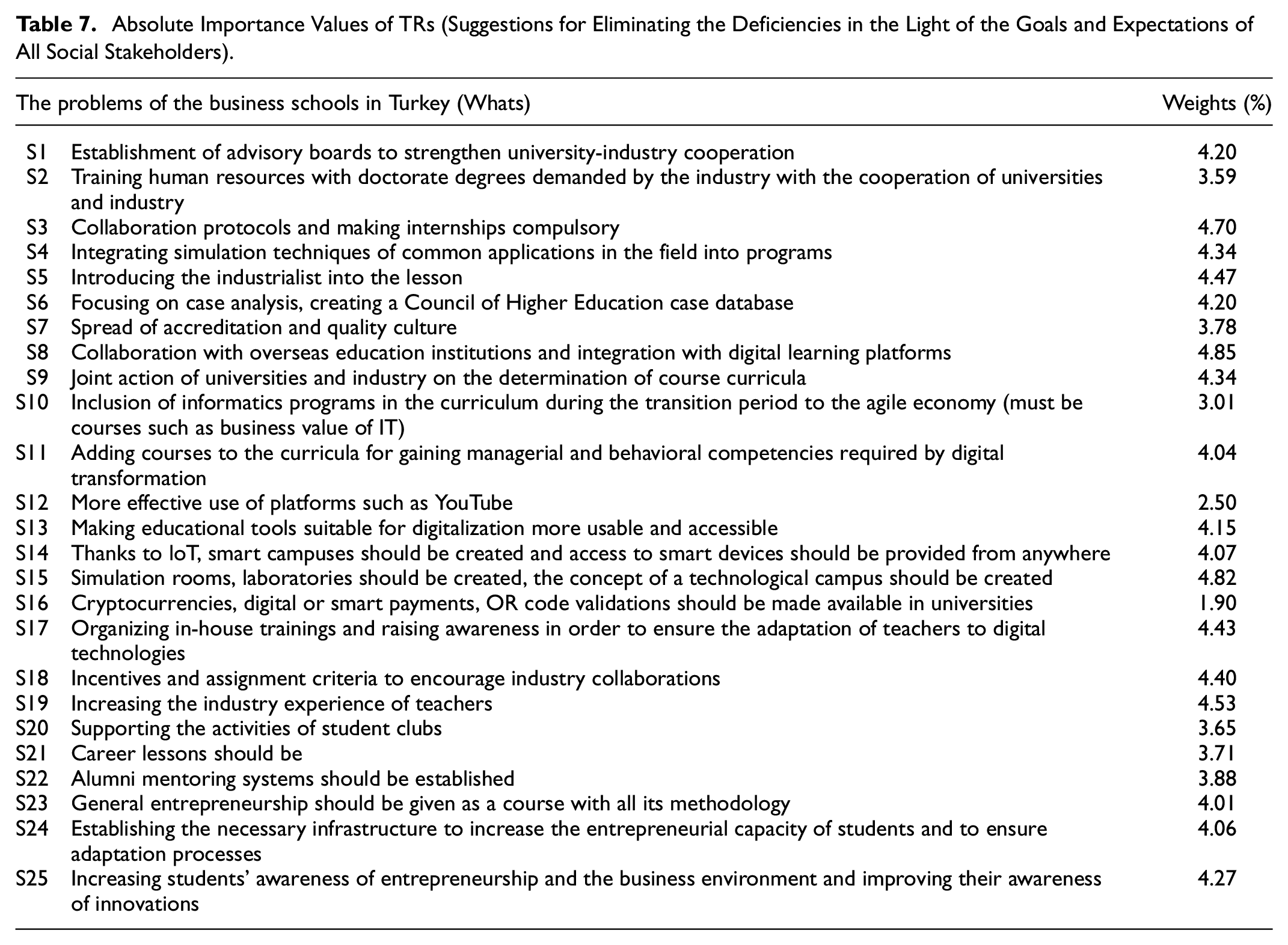
In light of Table 7; S8 (Collaboration with overseas educational institutions and integration with digital learning platforms), S15 (Simulation rooms, laboratories and the concept of a technological campus should be created), and S3 (Collaboration protocols and making internships compulsory) were found to be the most effective suggestions for eliminating the deficiencies concerning the goals and expectations of all social stakeholders.
Building Correlation Matrix of TRs by Author of the Study
To determine the TRs (How’s) correlation matrix, each author is needed to express an opinion using the variables in Table 8, determine how each “TRs” affects each “CRs.” This section is the last section of HOQ. Table 8 shows the correlation matrix of HOQ.
Correlation Matrix and HOQ.

According to Table 8, there is a significant association among S1 (Establishment of advisory boards to strengthen university-industry cooperation) and S2 (Training HRs with doctorate degrees demanded by the industry with the cooperation of universities and industry). In another example, there is also a positive correlation between S3 (Collaboration protocols and making internships compulsory) and S4 (Integrating simulation techniques of common applications in the field into programs).
Discussion and Conclusions
In business schools in Turkey, it is seen that there is an education system based on traditional professions, which is dominated by American and European (specifically German) perspectives (Kipping et al., 2004; Sargut, 2009; Üsdiken, 2004). The new world in which the pressure of change is felt as soon as society 5.0 and industry 6.0 are mentioned, requires a change in the mechanisms for educating students and reshaping the higher education model for adapting industry 4.0 applications. Industry 4.0 or digital transformation is not the only practical subject. Higher education systems and the industry should be synchronized. Business schools cannot be separated from the industry. Business schools must keep up with the changes brought about by industry 4.0. Industry 4.0 cannot be considered successful without business schools raising the HR management that is needed in these sectors. Therefore, industry 4.0 standards can be applied in business school education systems. The concept of university 4.0, which is formed by the inclusion of the components and requirements of the revolution in educational activities, should be taken into account in business schools. Business schools should make the necessary preparations for industry 4.0. This study aims to reveal the limitations of business schools in a developing country like Turkey and to offer solutions concerning industry 4.0.
When the findings of the analysis are fully evaluated, it can be seen that the main problems are the incompatibility of academician competencies with current technologies and industry expectations, the course contents and plans that are not up-to-date and in line with the expectations of the industry and insufficient university-industry collaboration. Consistent with related literature (e.g., Akgul et al., 2018), these findings reveal that industry 4.0 cannot go beyond being a course subject in business schools in Turkey as in many developing countries.
The recommendations to overcome these shortcomings are the cooperation with overseas business schools, the integration with digital learning platforms, the creation of simulation rooms, laboratories and technological campus concepts, the creation of an accreditation and quality culture with cooperation protocols. National or international cooperation and improvements can be made in educational activities with the establishment of accreditation and quality assurance systems (Billing & Thomas, 2000). It is seen that quality assurance and accreditation and the ability to respond to industry 4.0 requirements are related to each other. The Turkish Higher Education Quality Council (THEQC) institutional accreditation reports reveal that the audit team scrutinizes the quality assurance system (mission and strategic objectives, internal quality assurance, stakeholder participation, internationalization), education and training, research and development, social contributions and management standards (Turkish Higher Education Quality Council [THEQC], 2020).
In industry 4.0, Type T industry 4.0 personality (10 ingenuity on 10 fingers) is desired. In other words, the individual who has both good human relations and is theoretically good at their job will win the industry 4.0 context. It is expected that individuals would be open to learning everything in the business world (Kek & Huijser, 2011). HR has a growth mindset, he/she takes on challenges and learns from them, therefore increasing his/her abilities and achievement. The managers frequently asked ‘how should we develop the existing HR with the concept of a “reskilling revolution?.” Business schools can train HRs with these characteristics to market.
Although Turkey participated in the European Higher Education Area with the Bologna Process and continues to implement exchange programs, it is seen that it lags far behind in undergraduate education activities and applications. It is seen that there are efforts and sensitivities of some universities in Turkey to achieve university 4.0 standards. Consequently, it is necessary to make the right improvements at the right time to evaluate the opportunity of producing innovative and more value-added products offered by industry 4.0. Turkish business schools raise qualified HRs by following up-to-date technologies and reflecting them on training tools, improving the effectiveness of university-industry collaborations, teamwork, creating a quality culture and innovation consciousness.
Limitations and Future Research Recommendations
This study is motivated by a lack of understanding of the relationship between business school education systems and industry 4.0. Previous research on this subject is limited (Baygin et al., 2016; Fahim et al., 2021; L. Li, 2020; Nafea & Toplu, 2020). Although few high education kinds of research stress the effect of the industry 4.0 on the HR, it is difficult to find any empirical research on the effects of the industry 4.0 on the business schools, especially in developing countries in the related literature. Thus, this study has filled a crucial gap in understanding business schools of universities in developing countries like Turkey by exploring how industry 4.0 influences educational activities empirically.
However, despite these contributions, some limitations should be considered while interpreting the results of this study. The study is limited to a sample that consists of the business schools of the university in a developing country such as Turkey. In limited studies in the related literature, the business schools in developed countries are examined. Thus, their findings reflect the realities of the developed countries. Moreover, we sampled the business schools of the university in some developing countries, which constrains the generalizability of our study. This study may be reiterated in a new sample of business schools in various developing countries. Therefore, whether there are differences among developed and developing countries in the adaptation of the business schools to industry 4.0, if that is the case, which the classifications of countries based on their level of development affect their responses to industry 4.0 should be systematically investigated. More research on developing countries is needed to better understand the impact of industry 4.0 and higher education matters.
Footnotes
Author Note
In this study, we used to data from the master’s thesis whose title is “Transformation of Faculties of Economics and Administrative Sciences and Faculties of Business Administration with Industry 4.0” presented at Karadeniz Technical University.
Declaration of Conflicting Interests
The author(s) declared no potential conflicts of interest with respect to the research, authorship, and/or publication of this article.
Funding
The author(s) received no financial support for the research, authorship, and/or publication of this article.

Data Availability Statement
Data sharing not applicable to this article as no datasets were generated or analyzed during the current study.