




Abstract
Education is widely recognized as a key driver of human development, yet its environmental implications remain ambiguous. Existing studies provide conflicting evidence on whether education mitigates or exacerbates carbon emissions. Grounded in STIRPAT Model, Human Capital Theory, and Behavioral Economics, we propose a dual-mechanism framework to explain how education influences household carbon emissions. Using data from the China Family Panel Studies (CFPS), we employ baseline regression, threshold regression, and interaction moderation analysis to examine these mechanisms empirically. This study reveal that education influence carbon emissions through two distinct mechanisms: the “green effect,” which enhances environmental awareness and promotes low-carbon practices, and the “consumption effect,” whereby higher education levels lead to increased income and consumption, potentially raising emissions. The effect of education is significantly moderated by income. There is a significant difference in the effect of education on carbon emissions between whether or not to accept higher education. A four-quadrant analysis based on higher education attainment and income level confirms that only high-income, highly educated residents exhibit a significant carbon-reducing effect of education, whereas other groups are primarily influenced by income-driven consumption. This study provides an explanatory framework and empirical evidence for the complex impact of education on carbon emissions within the Chinese context, proposing differentiated mitigation policies tailored to various social groups to promote an efficient low-carbon transition.
Introduction
As global climate governance intensifies, achieving carbon emission reduction goals has become a shared challenge for all countries. While traditional sectors such as industrial emissions and energy structures remain focal points, indirect emissions from household consumption have increasingly emerged as a new driver of carbon growth (Guan et al., 2025). Statistics show that household consumption—both direct and indirect—accounts for nearly two-thirds of total global greenhouse gas emissions and continues to rise with economic development (Composto & Weber, 2022; Koide et al., 2021). Individual-level behaviors, such as energy use, transportation, dietary patterns, and housing choices, are profoundly reshaping the carbon landscape. Therefore, identifying the key factors influencing household carbon emissions from a micro perspective is crucial to designing behaviorally targeted strategies for low-carbon transitions. Without effectively addressing residential emissions, meaningful progress in climate mitigation will remain elusive (Bjelle, 2021).
Education, embedded in the formation of human capital, values, and decision-making processes, is a fundamental determinant of individual behavior. On one hand, education enhances environmental awareness and civic responsibility, shapes pro-environmental preferences, and encourages energy-saving behaviors, thereby suppressing carbon emissions through cognitive and behavioral pathways (Nielsen et al., 2021). On the other hand, higher education levels are often accompanied by increased income, complex lifestyles, and greater consumption capacity, which may result in higher energy use and material consumption, thus expanding carbon footprints (Dai, 2012; Sarkodie & Strezov, 2019; Sun et al., 2021). This dual structure—the “green effect” versus the “consumption effect”—complicates the relationship between education and carbon emissions.
Although previous studies have recognized the potential bidirectional impact of education on carbon emissions, most have focused on linear estimations of the overall effect, lacking further analysis of the two opposing effects within a unified framework. Meanwhile, educational variables are often simplified as linear or average-effect predictors, ignoring their heterogeneous impacts across different income groups as well as potential threshold effects. Whether education alone can drive behavioral transformation—or whether its effect depends on a certain level of socioeconomic foundation—remains a question that warrants deeper investigation.
This study aims to fill the above-mentioned gaps by utilizing large-scale microdata from the 2022 China Family Panel Studies (CFPS) to systematically examine the overall effect of education on household carbon emissions, the moderating effect of income, and its potential threshold mechanisms. Building upon existing research, the contributions of this paper are as follows:
(1) It establishes and empirically tests a “Green–Consumption Dual-Mechanism” moderation framework, providing theoretical innovation in understanding education’s complex environmental effects;
(2) It reveals the moderating role of household income in shaping the dual effects of education, thereby clarifying a long-standing academic controversy over whether education mitigates or exacerbates emissions;
(3) It employs threshold and quadrant regression models to identify nonlinear critical points and stratified effects, offering precise and policy-relevant insights;
(4) It utilizes nationally representative CFPS microdata to generate policy recommendations with high local value, enriching the empirical evidence from China.
Theoretical Framework and Research Hypotheses
Theoretical Foundation
The impact of education on carbon emissions is a complex process, involving macro-level socioeconomic structures as well as micro-level individual cognition and behavioral choices. This study draws upon the STIRPAT model, Human Capital Theory, and Behavioral Economics as three complementary perspectives to construct a theoretical framework for analyzing how education influences household carbon emissions, thereby laying the foundation for the subsequent “dual-mechanism” analysis.
The Macro-Level Theory
The STIRPAT model (Stochastic Impacts by Regression on Population, Affluence, and Technology) is an analytical framework for assessing environmental impacts, developed based on the traditional IPAT identity (Dietz & Rosa, 1997; York et al., 2003). The model posits that environmental pressure is jointly determined by factors such as population size, affluence, and technology level, providing theoretical support for examining the relationship between socioeconomic variables and carbon emissions. Within the STIRPAT framework, education can influence “affluence” by increasing income and consumption capacity, and simultaneously affect “technology level” by promoting technological progress, improving energy efficiency, and enhancing environmental awareness. Therefore, education possesses the dual attribute of being both a driver of economic growth and a core human factor in environmental change, making it a critical social variable influencing carbon emissions. The STIRPAT model provides the overarching logical starting point for understanding education’s role in carbon emissions.
The Micro-Level Theories
Human Capital Theory (Becker, 1964; Schultz, 1961) explains from a microeconomic perspective how education shapes individual capabilities. The “capital” accumulated through education includes not only economic resources but also multi-dimensional assets such as knowledge, skills, health, information processing ability, and social interaction capacity. Education enhances labor productivity, employment quality, and income levels, thereby altering household budget constraints and expenditure structures. It also strengthens an individual’s ability to identify, learn, and absorb new information, enabling them to better understand environmental issues, recognize the long-term costs of energy use, and grasp their social consequences. Furthermore, education cultivates individuals’ sense of social responsibility, risk and time preferences, and sustainable development values through socialization processes, making them more receptive to and internalizing the concepts of energy conservation and emission reduction.
Behavioral Economics complements Human Capital Theory by emphasizing that cognition and behavior are not always aligned. In contrast to the “rational actor” assumption of classical economics, behavioral economics posits that individuals in real-world settings are influenced by psychological, social, and environmental factors, and their actions may deviate from purely rational expectations. This phenomenon, known as the “value-action gap” (Gifford, 2011), suggests that even if individuals possess high levels of environmental knowledge or awareness, their actual behavior may still deviate from rational choice. In the context of education and carbon emissions, this means the cognitive enhancement brought by education may not fully translate into low-carbon behavior. Individuals may increase energy consumption due to higher income and the pursuit of convenience, even while maintaining environmental awareness.
Dual Effect Mechanism of Education’s Impact on Carbon Emissions
Based on the theoretical foundation above, education can affect carbon emissions through multiple dimensions, including economic structure, individual capacity, and behavioral decisions. This relationship is not simply linear but involves both promoting and inhibitory pathways. To systematically study the complexity of education’s impact, this study proposes the following dual effect mechanism.
The “Green Effect” stems from the cognitive and behavioral transformation induced by human capital accumulation. Education enhances individuals’ environmental cognition, information processing ability, and social responsibility through formal curricula and knowledge acquisition. This cognitive improvement lowers the barriers to adopting low-carbon technologies and lifestyles, prompting highly educated groups to favor energy-saving choices and green transportation. Therefore, the Green Effect is the mechanism by which education, as a form of environmental awareness capital, suppresses carbon emissions by improving energy efficiency and guiding low-carbon behavioral pathways.
Conversely, the “Consumption Effect” is rooted in the economic returns and resource expansion brought by education. Higher educational attainment typically translates to higher income and professional status. This wealth accumulation directly drives continuous growth in consumption capacity and material demand, particularly in carbon-intensive areas such as housing, transportation, and durable goods. Furthermore, education shapes the pursuit of comfort and quality of life, leading highly educated groups to favor more energy-intensive lifestyles. Therefore, the Consumption Effect is the mechanism by which education, as a form of economic income capital, promotes carbon emissions by expanding consumption scale and upgrading lifestyles.
The Green Effect and the Consumption Effect coexist, but their relative strength depends on economic constraints. When economic resources are limited, the income growth driven by education (Consumption Effect) tends to dominate its cognitive benefits. Only when income and educational accumulation reach a certain critical threshold do individuals possess the necessary economic capacity to translate environmental awareness into actual low-carbon consumption choices, allowing the Green Effect to become prominent. This dynamic balance mechanism serves as the theoretical basis for the subsequent empirical analysis of income moderation and threshold effects.
Research Hypotheses
The Green Effect of Education and Hypothesis H1
Corresponding to the “Green Effect” mentioned above, a large body of literature confirms education’s emission-reducing role, primarily from cognitive and technical perspectives. At the cognitive level, education enhances environmental awareness and social responsibility. Highly educated individuals are more likely to understand the complexity of environmental risks, possess a stronger sense of ecological responsibility (Franzen & Meyer, 2010; Nielsen et al., 2021), and are more inclined to adopt pro-environmental values (Zhang et al., 2024). This heightened awareness directly translates into low-carbon behaviors, such as reducing energy waste, rational use of household appliances, more frequent use of public transportation (Liu et al., 2021), maintaining sustainable consumption structures (Zheng et al., 2022), and exerting a demonstration effect on others’ behavioral choices (Wang et al., 2025). At the technical level, education promotes green transformation by driving industrial upgrading and supporting technological innovation. Higher education improves labor quality, facilitates the application of green technologies and energy-saving practices, ultimately increasing energy efficiency and reducing emission intensity (Lan et al., 2012). Education shapes enterprise innovation models and alters industrial structure by encouraging a shift from pollution-intensive to knowledge-intensive, low-carbon industries (Cagno & Trianni, 2013; Zhou et al., 2019).
Based on this, this study proposes:
The Consumption Effect of Education and Hypothesis H2
While the environmental benefits of education are widely recognized, some studies indicate that under specific conditions, education may promote carbon emissions, which aligns with the “Consumption Effect” mechanism proposed in this study. It is generally agreed that the economic returns of education expand the scale of carbon emissions. Education is a key factor in boosting income and wealth accumulation, and income growth is the primary driver of household consumption expansion and increased carbon emissions (Liu et al., 2021; Salo et al., 2021). Studies show that high-income groups spend significantly more than others on high-carbon emission areas such as housing size, private vehicles, and leisure travel, exacerbating carbon emission inequality (Zhang & Tan, 2016; Zheng et al., 2022). Furthermore, from a socio-cultural perspective, even if highly educated individuals possess high environmental awareness, they may still choose carbon-intensive lifestyles due to the pursuit of convenience, comfort, and the need to signal social status through consumption (Disli et al., 2016). This leads to the emergence of the “value-action gap” (Girod et al., 2014).
Based on this, this study proposes:
The Moderating Role of Income and Hypothesis H3
Income, as a core determinant of consumption behavior and lifestyle, plays a crucial role in shaping household carbon emissions. Amidst rapid urbanization and modernization, household expenditures are shifting toward carbon-intensive areas such as transportation, housing, and leisure. Research shows that carbon footprints for rural Chinese households grew by about 83% between 2007 and 2017, primarily driven by income-induced consumption expansion (Zheng et al., 2022). However, some scholars, based on international data, empirically suggest that income does not always exacerbate emissions. Due to budget constraints, low-income households may find it difficult to access high-carbon consumption opportunities, while middle-to-high-income groups are more likely to purchase green-labeled and energy-efficient products (Salo et al., 2021; Sarwar et al., 2021). The Environmental Kuznets Curve (EKC) hypothesis further proposes that beyond a certain income threshold, increased environmental awareness and green preferences may suppress further growth in carbon emissions (Jian et al., 2021). Income not only determines the scale of consumption but also reshapes consumption structure and behavioral logic. For instance, high-income households may shift emissions through complex supply chains, thereby obscuring their carbon responsibility (Rocco et al., 2020). Concurrently, low-income households may face “carbon poverty,” where inefficient housing or reliance on traditional fuels leads to high carbon emissions per unit of income.
Therefore, education and income must be examined jointly to comprehensively understand their impact on carbon emissions. Although education enhances environmental awareness and behavioral intent, the actual conversion into low-carbon choices often depends on economic capacity.
Based on this, this study proposes:
Methods and Data
Variable Selection
Dependent Variable
The dependent variable is per capita residential’s household carbon emissions (CEs), which consist of two parts: direct emissions and indirect emissions (Vringer & Blok, 1995). Direct emissions are primarily derived from household energy consumption, such as electricity and gas. In this study, we use electricity consumption as a proxy, estimating annual electricity use based on household electricity expenditure and regional electricity prices (Hu, 2019), and converting this to CO2 emissions using IPCC carbon coefficients. Indirect emissions are calculated using the “expenditure-carbon coefficient” method based on Wei et al. (2007), which links household consumption in eight major categories (e.g., food, clothing, housing, transportation) to corresponding sectors in the input-output table to estimate energy intensity and carbon emission coefficients. Total carbon emissions are the sum of direct and indirect emissions. To adjust for household size, per capita carbon emissions (CE) are used as the final dependent variable, expressed in kilograms per person.
Independent Variable
The core independent variable is educational level (EDU), measured by the highest degree obtained, as reported in the CFPS 2022 household questionnaire. The original categorical variable includes eight levels: illiterate/semi-literate, primary school, junior high school, high school/technical secondary school, associate degree, bachelor’s degree, master’s degree, and PhD. For regression analysis, these categories are recoded into an ordinal scale ranging from 1 to 8, where a higher value indicates a higher level of education. To capture potential non-linear effects, we also include the reciprocal of education level (1/EDU) in certain model specifications
Moderating Variable
Income is introduced as a moderating variable, measured by per capita household income (fincome1_per) from the CFPS 2022 economic dataset. It is computed as the sum of five income sources—wage, business, property, transfer, and other income—divided by household size, and expressed in units of 10,000 CNY.
Control Variables
Drawing on previous research (Hirsh, 2010; McCright, 2010; Zhang, 2018; Zhang & Tan, 2016), the model controls for individual and household characteristics that may influence carbon emissions:
Gender: Dummy variable (0 = female, 1 = male).
Age: Respondent’s age in years.
Hukou status: Household registration type (1 = agricultural, 3 = non-agricultural, 7 = residential).
Household size: Number of permanent residents in the household.
Total household assets: Total self-reported assets from the previous year (CNY).
Empirical Models
OLS Regression Model
To examine the overall effect of education level on household carbon emissions (Hypotheses H1 and H2), we employs an ordinary least squares regression model as the baseline specification:

where
Moreover, to capture the potential nonlinear relationship between education level and carbon emissions, we also introduce the reciprocal of education (1/EDU) as an alternative specification (Jarantow et al., 2023):

Moderation Model
To test the moderating role of income in the relationship between education and carbon emissions (Hypothesis H3), we introduce an interaction term between education and income into the regression model:

where
Threshold Model
Considering that the impact of education on carbon emissions may not be linear but rather stage-dependent, this study further employs a threshold regression model following Hansen (1999). We use education level as the threshold variable to identify whether there exists a critical education level at which the direction or magnitude of its impact on carbon emissions changes. This setting is theoretically consistent with the dual-mechanism framework discussed in section “Dual Effect Mechanism of Education’s Impact on Carbon Emissions,” where education simultaneously exerts an emission-promoting consumption effect and an emission-reducing green effect:

where
Data Source and Sample Description
The data used in this study come from the 2022 wave of the China Family Panel Studies (CFPS), a nationally representative longitudinal survey organized by the Institute of Social Science Survey at Peking University. The CFPS collects rich micro-level information on individuals and households across domains including economy, education, and health. The sampling strategy combines multistage stratified sampling with probability-proportional-to-size (PPS) techniques. After merging the individual and household modules and cleaning for missing and outlier values, we obtain a final cross-sectional dataset of 31,736 individuals. Descriptive statistics are presented in Table 1.
Descriptive Statistics of Variables.

Empirical Results
Baseline Regression Results
To preliminary investigate the relationship between education level and household carbon emissions, we estimate an OLS model using education level as the key independent variable, while controlling for gender, age, hukou status, household size, and total household assets. As shown in Model (1) of Table 2, the coefficient of education is significantly positive, suggesting that individuals with higher education levels tend to emit more carbon.
Baseline and Non-line Regression Results.
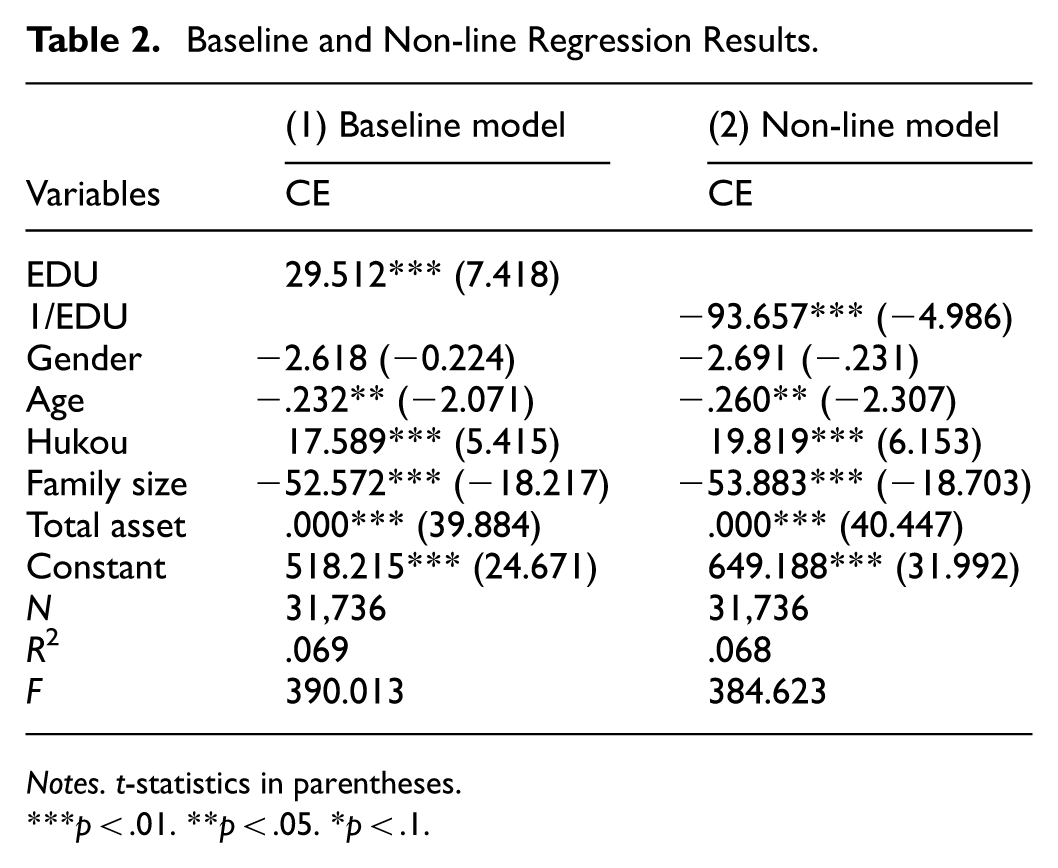
Notes. t-statistics in parentheses.
p < .01. **p < .05. *p < .1.
Considering the potential non-linearity in the effects of education, we further include the reciprocal of education to capture potential marginal changes in its impact. Model (2) shows a significantly negative coefficient, indicating a diminishing marginal effect: the positive impact of education on emissions is stronger at lower education levels and attenuates as education increases.
Taken together, the findings suggest that education exerts structurally differentiated effects on carbon emissions. Specifically, the empirical evidence supports the existence of both the green effect and the consumption effect. These results provide strong empirical confirmation of the carbon reduction hypothesis H1 for education and the carbon increase hypothesis H2 for education.
As for control variables, gender is not statistically significant. Age is negatively associated with carbon emissions, implying that older individuals may be more environmentally conscious or consume less. Urban hukou holders exhibit significantly higher carbon emissions than rural residents, reflecting differences in energy use and lifestyle. Household size is negatively associated with per capita emissions, likely due to economies of scale. Household asset level is positively and significantly associated with emissions, supporting the notion that greater financial capacity leads to higher consumption and, consequently, higher carbon output.
Moderation Regression Results
To further test the income moderation effect, we introduce an interaction term between education and income. The results are presented in Table 3. The interaction coefficient is significantly negative, indicating that as income increases, the positive effect of education on carbon emissions weakens. This suggests that the impact of education on carbon emissions is not uniform across income groups. Among high-income individuals, environmental awareness and pro-environmental intentions derived from education are more likely to translate into low-carbon behaviors, partially offsetting the consumption-driven emissions increase. Conversely, among low-income groups, education-induced awareness may be constrained by economic limitations, making behavioral transformation difficult. In short, the green effect of education is more pronounced in affluent households, whereas in poorer households, the consumption effect dominates. The results confirm the moderating effect of income hypothesis H3.
Moderation Regression Result.

Notes. t-statistics in parentheses.
p < .01. **p < .05. *p < .1.
Further Analysis
Threshold Regression Results
Based on the results presented in section “Baseline Regression Results,” the impact of education on carbon emissions appears to be complex and dual in nature, simultaneously reflecting both emission-reducing and emission-promoting effects. To further examine whether this duality arises from structural differences across educational levels, we conduct a threshold effect analysis following Hansen (1999). Specifically, we apply a threshold regression model using education level as the threshold variable and perform 500 bootstrap replications to ensure estimation robustness. As shown in Table 4, the single-threshold test is statistically significant, whereas the double-threshold test is not, indicating the presence of a single structural breakpoint in the relationship between education and carbon emissions.
Threshold Test Result.

The estimated threshold is at an education level of 4, corresponding to a “high school/technical secondary school” diploma in the CFPS scale. This result indicates that receiving higher education leads to a structurally different impact on carbon emissions.
Heterogeneity Analysis
Building on the threshold and moderation results, we conduct a quadrant-based heterogeneity analysis using a two-dimensional grouping strategy: education level (higher vs. lower) and income level (above vs. below the sample mean).
We perform separate regressions for each group to identify heterogeneous effects of education on carbon emissions. Table 5 presents the findings. In the high-education and high-income group, education exerts a significant negative effect on carbon emissions, confirming the presence of a green effect. In the high-education and low-income group, education’s effect is negative but not statistically significant, suggesting limited conversion of environmental awareness into low-carbon behaviors due to economic constraints. In both low-education groups, the effect of education is significantly positive. However, the magnitude of the effect is stronger among high-income individuals than among their low-income counterparts. This reinforces the interpretation that consumption effects dominate when educational background is weak, especially when purchasing power is strong.
Heterogeneous Regression Result.

Notes. t-statistics in parentheses. Column (1) “High–High” refers to households with both high education and high income levels. Column (2) “High–Low” refers to households with high education but low income levels. Column (3) “Low–High” refers to households with low education but high income levels. Column (4) “Low–Low” refers to households with both low education and low income levels.
p < .01. **p < .05. *p < .1.
These findings are consistent with the earlier results and reinforce the conclusion that only among individuals with both high educational attainment and sufficient economic resources can environmental awareness and pro-environmental behavioral tendencies be effectively translated into actual carbon-reducing actions—thus realizing the “green effect” of education. In contrast, among individuals with high education but limited economic means, the green effect of education is often constrained by insufficient income and overshadowed by the “consumption effect.” For low-education groups, the behavioral change potential brought by education’s green effect is unlikely to materialize due to weak cognitive foundations or limited resource capacity. Consequently, the consumption effect remains dominant in these populations.
Endogeneity and Robustness Tests
Endogeneity Test
To address the potential endogeneity arising from unobserved factors influencing both education and carbon emissions, we adopt an instrumental variable (IV) approach using two-stage least squares estimation. Specifically, we employ “the distance from the household to the nearest school during the respondent’s schooling years” as an instrument.
Table 6 presents the results. In the first-stage regression, the instrument is significantly and negatively associated with educational attainment, and positively correlated with the reciprocal of education, confirming instrument relevance. In the second-stage regression, the coefficient on education remains significantly positive, while the coefficient on its reciprocal remains significantly negative. The Kleibergen–Paap rk Wald F-statistics are significant at the 1% level, and the Cragg–Donald Wald F-statistics exceed the Stock–Yogo 10% critical values, indicating that the weak instrument problem is unlikely.
Endogeneity Test Result.

Notes. t-statistics in parentheses.
p < .01. **p < .05. *p < .1.
Robustness Tests
To further verify the stability of the baseline findings, we perform three robustness checks. Results are presented in Table 7.
Robustness Test Result.

Notes. t-statistics in parentheses.
p < .01. **p < .05. *p < .1.
First, we replace the dependent variable. Instead of using per capita carbon emissions, we re-estimate the model using total household carbon emissions. The coefficients on education level and its reciprocal remain significant and directionally consistent, confirming the nonlinear structure. Second, we exclude municipalities directly under the central government—Beijing, Shanghai, Tianjin, and Chongqing—to rule out bias from their distinct socio-economic and energy profiles. The main findings remain robust, suggesting the results are not driven by outlier cities. Third, we conduct a 2% winsorization of carbon emissions and education variables to mitigate the influence of extreme values. The estimated coefficients remain consistent with the baseline results, reaffirming the stability of the education-emissions relationship.
Discussion
Research Contributions
This study theoretically extends the application boundaries of the traditional STIRPAT model and Human Capital Theory in the environmental domain. Unlike prior literature, which often adopted a monolithic view of education (e.g., Liu et al., 2021), we avoid this limitation by abstracting education’s cognitive benefits and economic returns into the two core mechanisms—the “Green Effect” and the “Consumption Effect”—and empirically testing them within an Income Moderation Framework. By introducing this income moderation mechanism, we successfully quantify the dynamic equilibrium of education’s dual effects, thereby avoiding the one-sidedness prevalent in existing literature. This approach allows us to clearly reveal how the net effect of education on household carbon emissions is shaped by the conditional dynamic balance of two opposing forces. Our empirical evidence supports the role of education as a “socioeconomic amplifier,” suggesting that its final environmental outcome is not an intrinsic property of education but is determined by structural resource constraints.
Crucially, the core of this study lies in incorporating household income as a pivotal moderating variable. This clarifies that the income level determines the relative strength of education’s “Green Effect” and “Consumption Effect,” directly addressing the long-standing academic controversy over the net environmental impact of education. Compared to the EKC hypothesis, which only examines the relationship between aggregate income and emissions, this finding deepens the micro-mechanistic understanding: income acts as a critical economic enabler, conditioning the utility of education as a cognitive capital. Our results align closely with the “Value-Action Gap” proposed by Gifford (2011) and Kollmuss and Agyeman (2002), providing quantitative confirmation that high income levels are necessary to bridge this gap. Especially within China’s context of high returns to education and widening income disparity, our finding is critical: it explains the paradox of high awareness yet high emissions in highly educated groups, where the Consumption Effect driven by lack of economic means often overrides the Green Effect.
Furthermore, this study achieves a significant innovation in its empirical methodology by focusing on capturing structural breaks within the education-income impact pathway. The Threshold Regression analysis further identifies completion of higher education as a key critical point driving the structural shift. This not only rejects the assumption of a continuous effect on carbon emissions but also provides quantified evidence that the accumulation of cognitive capital must reach a specific, high-level threshold to effectively resist consumerist tendencies and induce meaningful low-carbon behavior change. Building on this, the combination with Quadrant Grouping Regression provides highly precise and applicable conclusions. It translates the theoretical concept of a “critical point” into actionable, quantified indicators, guiding policymakers on the exact educational or income stages where resource investment can achieve the crucial transition from “economic growth driver” to “environmental improvement force.”
Finally, this study is based on nationally representative Chinese micro-household data from the CFPS (China Family Panel Studies). Unlike previous studies heavily reliant on data from developed economies, our conclusions are specifically tailored to the complex effects of China’s unique social transformation, characterized by high educational returns, regional imbalance, and income disparity, on household carbon emissions. This specificity provides the findings with high local value and policy relevance. The conclusions offer the Chinese government empirically grounded guidance on optimizing educational investment and formulating differentiated low-carbon consumption subsidy policies during the synergistic advancement of the “Common Prosperity” and “Dual Carbon Targets.”
Policy Implications
Given that this study empirically reveals the income-dependent and asymmetrical nature of education’s influence on carbon emissions, policy formulation must shift toward a differentiated intervention strategy, requiring the government to precisely distinguish between different social groups and provide customized policy tools.
Specifically, for the high-education, high-income group (high-resource group), policy should focus on behavioral incentives and constraints to effectively reinforce the Green Effect and suppress the powerful Consumption Effect. This includes promoting positive incentives like carbon labels and green consumption rewards, while simultaneously considering the implementation of progressive pricing or high-carbon lifestyle taxes (e.g., targeting oversized housing or high-emission vehicles) to increase the cost of high-carbon consumption. In contrast, for the high-education, low-income group (low-resource group), policy must focus on resource enablement to bridge the “Value-Action Gap” they face. This study recommends providing targeted green consumption subsidies, low-interest loans for purchasing energy-efficient assets, and vigorously improving low-carbon public transportation infrastructure to ensure that highly educated individuals’ environmental intent possesses economic feasibility. By lowering the economic threshold for low-carbon choices, the government can help these groups translate cognition into actual emission reduction behaviors.
Furthermore, the threshold analysis suggests that education policy should not be viewed as a panacea for emission reduction but should strengthen its structural role. Policy resources should be targeted at the higher education stage to ensure environmental literacy education reaches the critical depth required to trigger structural behavioral change. Encouraging universities and vocational institutions to integrate green skills and sustainable consumption knowledge into their curricula is a long-term strategy to ensure human capital effectively translates into environmental benefits. From a broader global perspective, this study emphasizes that in formulating climate action policies, the universal constraint of income inequality on education’s mitigation potential must be acknowledged. For countries with uneven income distribution globally, climate policy must be designed in synergy with social equity and economic redistribution policies to prevent mitigation measures from exacerbating energy poverty or carbon poverty, providing crucial micro-level empirical support for the global climate justice debate.
Limitation
Firstly, in terms of data type, this study relies on cross-sectional data, which presents challenges for core causal inference. Although we employed instrumental variables and robustness checks to mitigate endogeneity, reverse causality (e.g., high-carbon behavior driving the pursuit of higher income/education) and potential omitted variable bias (e.g., unobserved household long-term environmental attitudes, social capital, or community norms) still exist. Future research should prioritize the use of panel data or quasi-experimental designs (e.g., natural experiments, regression discontinuity) to more accurately identify dynamic mechanisms and the net causal effect.
Secondly, there are inherent limitations in the precise measurement of key variables. Our carbon emission estimates are based on expenditure estimation, an indirect method that may not fully capture the entire scope of actual energy use (e.g., implicit or supply chain emissions). Moreover, while we focused on years of schooling, we did not examine internal educational heterogeneity. Factors such as field of study, quality of schooling, or individual environmental professional literacy could significantly influence the relative strength of the dual effects. Future studies should integrate high-frequency behavioral data (e.g., smart meters, traffic logs) for improved measurement accuracy and explore more detailed educational survey instruments to capture the differentiated effects of educational quality and background on environmental behavior.
Finally, this study’s conclusions are based on CFPS sample data. Although the CFPS is nationally representative, its sampling and questionnaire design may still be subject to certain measurement errors or self-reporting biases. Furthermore, the empirical context is China’s specific socio-economic transition—high educational returns and income differentiation—which limits the cross-context generalizability of the findings. We emphasize that future research needs to apply the proposed “Green-Consumption Dual-Mechanism” to other countries or regions characterized by differing educational return structures, social welfare systems, and energy poverty levels (e.g., developed economies or low-income nations) to test the global universality of the income moderation effect.
Conclusion
Drawing on microdata from the 2022 China Family Panel Studies (CFPS), this study empirically investigates the impact of educational attainment on household carbon emissions using multiple analytical strategies, including OLS, moderation analysis, threshold regression, and heterogeneity analysis. The key findings are as follows:
First, education exhibits a complex nonlinear effect on household carbon emissions. Baseline regressions show a significant positive association between education and carbon emissions, suggesting that more educated individuals tend to emit more. However, when including the reciprocal of education, the marginal effect of education on emissions diminishes as education level rises. This reflects two coexisting mechanisms: on one hand, education improves environmental cognition and awareness, promoting low-carbon behaviors (the “green effect”); on the other hand, it often coincides with higher income and upgraded consumption, leading to increased emissions (the “consumption effect”). These two mechanisms coexist, and their intensity varies according to individual characteristics, which validates the carbon reduction hypothesis H1 and carbon increase hypothesis H2 proposed at the beginning.
Second, income significantly moderates the relationship between education and carbon emissions. The interaction term between education and income is significantly negative, indicating that as income increases, the carbon-enhancing effect of education weakens. In high-income households, environmental cognition derived from education is more likely to be translated into concrete low-carbon actions, allowing the green effect to emerge. Conversely, among low-income groups, limited economic capacity constrains the behavioral realization of environmental awareness, and the consumption effect becomes more dominant, which validates the hypothesis H3.
Third, threshold regression results identify a clear structural breakpoint in the education-emission relationship. The green effect becomes salient only when individuals cross this threshold, suggesting that a certain degree of cognitive and institutional capital is necessary for environmental awareness to translate into consistent low-carbon behavior. Gives a deeper analysis of the explanation of the coexistence of hypotheses H1 and H2.
Fourth, heterogeneity analysis reveals that the effects of education and income vary significantly across social groups. In high-education, high-income groups, education has a significant negative effect on carbon emissions, implying that environmental awareness can be effectively activated when supported by adequate economic resources. In contrast, in high-education, low-income groups, the effect of education on emissions is statistically insignificant. Although these individuals may possess environmental awareness, it is difficult to implement low-carbon choices due to resource constraints—leading to a dynamic interplay between green and consumption effects. Among low-education groups, regardless of income level, education shows a positive association with emissions. This implies that for individuals with weak cognitive foundations or insufficient resources, education fails to generate meaningful behavioral shifts toward carbon reduction. In such cases, the consumption effect dominates. This pattern suggests that for low-education populations, increased education may be more strongly associated with social mobility and material aspiration than with environmental concern.
Taken together, the impact of education on household carbon emissions cannot be understood as a linear or unidirectional process. Rather, it is shaped by the interplay of cognitive capacity, income level, and social resource endowment (Figure 1). Education may act as a driver of sustainable lifestyles or, alternatively, as a catalyst for carbon-intensive consumption. A nuanced understanding of the duality of education’s impact is essential for designing differentiated low-carbon transition strategies and identifying target populations for behavior-based interventions.

Conceptual framework of research findings.
Footnotes

Ethical Considerations
This study uses the public China Family Panel Studies (CFPS) dataset. Original CFPS procedures complied with Peking University IRB standards and the 1964 Helsinki Declaration, with primary data collection IRB-approved. No additional ethical approval was required for this secondary analysis of de-identified public data.
Consent to Participate
No additional consent is needed for this study, as it uses de-identified, publicly accessible data without personal identifiers.
Funding
The authors received no financial support for the research, authorship, and/or publication of this article.
Declaration of Conflicting Interests
The authors declared no potential conflicts of interest with respect to the research, authorship, and/or publication of this article.
Data Availability Statement
The data that support the findings of this study are openly available in the China Family Panel Studies (CFPS) repository at Peking University. Researchers can access the data upon registration and acceptance of the user agreement.