




Abstract
This study aimed to examine the mediating role of media literacy in the relationship between information literacy and technology literacy and to investigate gender-based differences in this mediating effect. A cross-sectional correlational research design was employed, involving 390 prospective teachers (77.4% female, 22.6% male). The data were analyzed using structural equation modeling. The results indicated a significant correlation between information literacy, technology literacy, and media literacy, as well as a positive mediating role of media literacy between information literacy and technology literacy. However, it was revealed that the mediating role of media literacy in the relationship between information and technology literacy was similar in female and male groups. The results indicated that information-literate individuals tended to assess media content with a more conscious and critical perspective, and the skills they acquired in this process are related to their ability to use technology. The study’s findings were discussed and interpreted in detail in light of the relevant literature.
Keywords
Introduction
At no other point in human history has change occurred as rapidly and profoundly as it does today. The demands of the 21st century differ markedly from those of the 20th century, primarily driven by the accelerated advancements in information and communication technologies (Dede, 2010). The advancement of digital technologies has played a crucial role in transforming society from an industrial-based model to one focused on information and knowledge (Voogt, 2008). The information age has made it essential for educators, students, and citizens to possess various literacy skills to leverage the potential of innovative technologies and actively participate in economic, social, and cultural life. Historically, literacy referred to the ability to read, write, and perform basic arithmetic. However, the modern concept of “21st-century literacy” encompasses a range of skills, including communication, proficiency in using contemporary information and communication technologies, deep understanding of natural and social phenomena, problem-solving, informed decision-making, teamwork, and lifelong learning abilities (Špiranec & Banek-Zorica, 2008).
Numerous experts and organizations from diverse disciplines have defined and categorized the key skills necessary for individuals to navigate modern challenges and attain success in the 21st century (Geisinger, 2016). The critical importance of 21st-century skills is a recurring theme across various frameworks. This necessity is driven primarily by societal transformations, particularly the swift technological advancements and their profound influence on how we live, work, and learn. Among the most prominent and widely recognized frameworks addressing these skills is the P21 Framework (Chamba & Chikusvura, 2024). To support educators in embedding skills within core academic instruction, the Partnership created a comprehensive vision called “the Framework for 21st Century Learning.” This framework outlines the crucial blend of knowledge, skills, and competencies that pupils need to develop for both their professional and personal lives, combining content knowledge with critical skills, expertise, and various literacies (P21, 2019). These competencies are organized into three primary categories: “learning and innovation skills,”“information, media, and technology skills,” and “life and career skills” (Figure 1).
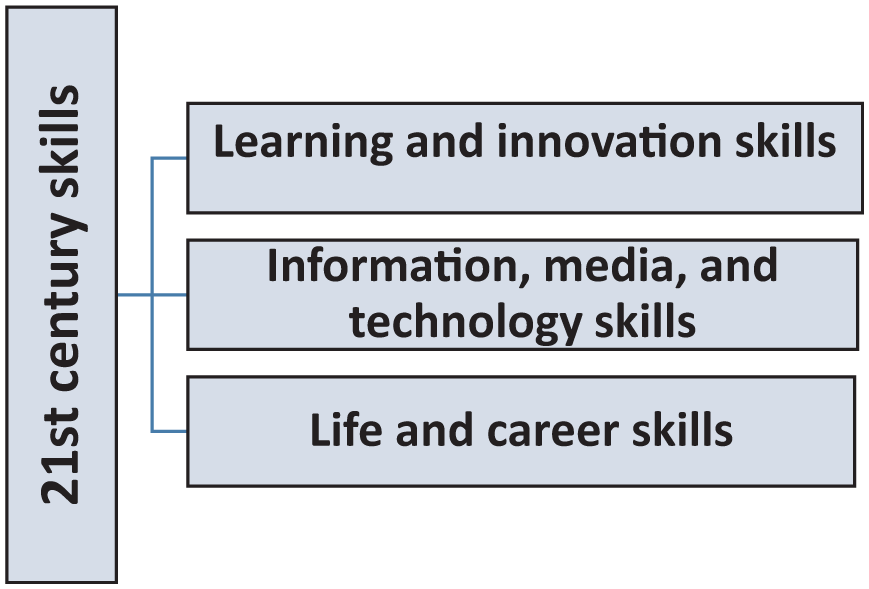
The 21st century skills (Trilling & Fadel, 2009).
Trilling and Fadel (2009) conceptualized information, media, and technology skills as digital literacy skills, emphasizing that these skills are the elements that most reflect the characteristics of the 21st century in the proposed framework. The 21st century presents individuals with a media and technology-centered environment offering them abundant access to information (Moto et al., 2018). For this reason, to be successful in the 21st century, individuals are expected to effectively develop and use information literacy, media literacy, and technological competencies (P21, 2019).
Information literacy refers to the ability to determine the need for information and the competence to search for, evaluate, and apply relevant data to resolve a particular issue or answer a specific question (Ferguson, 2001). This literacy forms the basis of lifelong learning and is an indispensable competence in all educational settings and levels. There are five basic components of information literacy (Catts & Lau, 2008): “Recognise information needs,”“Locate and evaluate the quality of information,”“Store and retrieve information,”“Make effective and ethical use of information,” and “Communicate knowledge.” Several academicians point out that in an increasingly complex digital environment, users are presented with comprehensive, unfiltered content in various formats, which significantly challenges their ability to assess the reliability and trustworthiness of information (De Paor & Heravi; 2020; Eshet-Alkalai, 2004). The ability to systematically access, critically evaluate, and use information effectively serves as a fundamental prerequisite for meaningful participation in contemporary information society (Adeleke & Emeahara, 2016).
Information is now accessible in vast quantities and diverse forms. The only effective way to manage these vast quantities of information is by utilizing additional digital tools (Koltay, 2011). The advancement of digital technology plays a crucial role in integrating media literacy with information literacy. The shift in information sources has made it essential for information-literate individuals also to possess media literacy skills. Media literacy shares a clear connection with information literacy, as the information obtained from various media sources frequently intersects with and enhances that derived from more formal library resources (Bawden, 2001). From a media literacy standpoint, individuals navigating the vast flow of information in the digital era are increasingly recognizing the importance of employing information literacy skills to locate, assess, and effectively structure information.
Media literacy encompasses the competencies needed to interpret, evaluate, and produce media content (Martens, 2010). While a range of definitions has been proposed to express the multifaceted nature of media literacy, one of the most frequently referenced is the description offered by Aufderheide (1993) during “the National Leadership Conference on Media Literacy,” where it was characterized as “the ability to access, analyze, evaluate and create media in a variety of forms” (Aufderheide, 1993; Erdem et al., 2023; Livingstone, 2004). Livingstone et al. (2005) further conceptualize media literacy through three central dimensions: (1) the ability to access media and its content, (2) the capacity for critical analysis and understanding of media operations, and (3) creative, communicative, and production-related competencies. It involves developing analytical skills to deconstruct media messages, producing and disseminating media content, and participating thoughtfully in public discourse (Hobbs et al., 2013; Mihailidis & Viotty, 2017).
Within the Information, Media, and Technology Skills defined in the P21 Framework, technology literacy stands out as a core element, emphasizing individuals’ capacity to competently utilize, comprehend, and assess technology across diverse settings. To be successful in today’s education and workforce environments, individuals cannot rely solely on their information or media literacy skills. They need to connect these skills with technology literacy (Sharkey & Brandt, 2008, p. 86). It is widely acknowledged that the majority of students in contemporary society have grown up immersed in a technology-rich environment, constantly surrounded by such devices as computers, video games, and mobile phones, which are regarded as indispensable parts of their daily lives (Judson, 2010). However, according to Judson (2010), technology literacy goes beyond merely using technological tools; it fundamentally involves the ability to leverage these tools for problem-solving, information analysis, and modeling complex concepts. A technologically literate person should possess the ability to utilize, oversee, and comprehend technological concepts and systems and be capable of designing, developing, managing, implementing, and evaluating technological systems and processes (Shackelford et al., 2004).
Education in the 21st century has been significantly shaped by advancements in technology and the effects of globalization (Drake & Reid, 2018). Continuous advancements in educational technology create growing expectations for teachers, requiring them to make daily decisions about the appropriate use, timing, and placement of technology in their classrooms (Hasse, 2017). Therefore, educators play a crucial role as foundational elements in achieving digital integration. Effectively integrating technology into educational environments is intricately linked to their ability to adapt to the fast-paced evolution of relevant digital tools and platforms (Çoklar & Kabakçı Yurdakul, 2017). Some international organizations emphasize that the shift toward a knowledge-based society necessitates significant transformations in educational systems (OECD, 2004). As society undergoes increasing digitalization and globalization, the expectation for teachers to possess 21st-century competencies has intensified, highlighting the necessity for educational and instructional uses of technology. Achieving a vision of 21st-century knowledge and skills for all learners requires a dedicated effort to develop and strengthen educators’ essential competencies, fostering effective learning outcomes. Given that information, media, and technology skills are consistently identified as critical competencies in numerous studies (Catts & Lau, 2008; Cordell, 2013; Dinçer, 2018; Gündüzalp, 2021; Jang et al., 2020), examining the relationships among these skills is of significant importance.
Numerous studies indicate that there is a positive correlation between information, media, and technology literacies. Lau (2013) suggests that media literacy and information literacy are closely related and often complementary, as both seek to cultivate similar information-processing and evaluative skills in individuals. Each term places a distinct focus on particular informational frameworks and media channels, highlighting different priorities within their respective scopes. Similarly, based on an online survey conducted with 363 distance education students, Van de Vord (2010) found a positive association between information and media literacy and concluded that each may enhance the other, and both literacies are essential for achieving success in the 21st century. Güven (2014) conducted a study with pre-service teachers, revealing a significant relationship between media literacy and information literacy levels, concluding that as media literacy increased, information literacy levels also rose. Hobbs and Frost (2003) integrated critical media literacy into a high school English curriculum and found that students in the program outperformed the control group in identifying key elements of media messages and demonstrated stronger critical thinking skills, particularly in recognizing missing information and the interplay between information, entertainment, and economics. These findings suggest that media literacy instruction can effectively enhance information literacy skills.
According to Zhu et al. (2021), university students’ information literacy significantly predicts both their social media competence and their technical proficiency in using social media platforms. A study by Demiralay and Karadeniz (2010) indicated that pre-service teachers who have long-term, advanced experience using ICT and access it from various locations report higher levels of perceived information literacy self-efficacy. Ugwulebo and Okuonghae (2021) conducted research in Nigeria and confirmed that the successful use of electronic information resources largely depends on the information literacy skills of the user. Motivated by the worries regarding the possible unreliability of online information and individuals’ capacity to assess it effectively, Metzger et al. (2003) examined college students’ use of web-based information, their judgments of information credibility, and their methods of verifying content online. Findings from their study indicate that college students depend extensively on the Internet for both academic and general information without verifying the information. Aharony and Bronstein (2014) indicated that academic librarians consider information literacy to be connected with computer literacy and view technology as an essential means for facilitating information literacy. Similarly, in another study, students who indicated a high level of computer proficiency also rated their Internet search skills more positively and demonstrated a higher level of information literacy (Aharony & Gur, 2017). Adeleke and Emeahara (2016) found a significant positive correlation between information literacy skills and the use of electronic information sources.
While the interconnections among these literacies have been conceptually discussed (Kivunja, 2015; P21, 2019) or empirically supported (Adeleke & Emeahara, 2016; Aharony & Bronstein, 2014; Aharony & Gur, 2017; Van de Vord, 2010), no empirical evidence has been found testing the mediating role of media literacy between information and technology literacy. Methodologically, most empirical studies have relied on correlational analyses that examine pairwise relationships among literacies, without testing possible mediation effects. Understanding this mediating mechanism is crucial, as media literacy can function as a pivotal skill that allows pre-service teachers to apply information-handling abilities effectively within technological contexts. Clarifying this relationship may inform the development of more cohesive and integrated teacher education programs.
A review of the literature available also reveals that the data on the effect of gender on these three literacies is not consistent. While some studies suggest that girls exhibit higher levels of information, technology, and media literacy compared to boys (Hohlfeld et al., 2013; Michalak et al., 2017; Ritzhaupt et al., 2013), others indicate that boys perform better than girls in these areas (Arsenijević & Andevski, 2016; Biokuromoye Fyneman, 2009; Hakkarainen et al., 2000; Houtz & Gupta, 2001; Liu & Sun, 2012; Zhong, 2011). There are also many studies showing no gender differences (Erişti & Erdem, 2018; Hatlevik & Christophersen, 2013; Noordin, 2024). Considering these mixed results, examining gender as a moderator helps to identify whether gender influences the relationships among the core constructs and provides a deeper understanding of literacy interactions among pre-service teachers. Thus, this study aims to examine the mediating role of media literacy in the relationship between information literacy and technology literacy while also exploring the potential gender differences in these mediation effects. The research hypotheses are presented as follows.
Method
Research Design
A cross-sectional correlational design was used, and structural equation modeling (SEM) was applied to test the hypothesized mediation model. In a cross-sectional study, researchers simultaneously assess both the variables and outcomes of participants, providing a “snapshot” of their characteristics at a single point in time (Cohen et al., 2017).
Participants
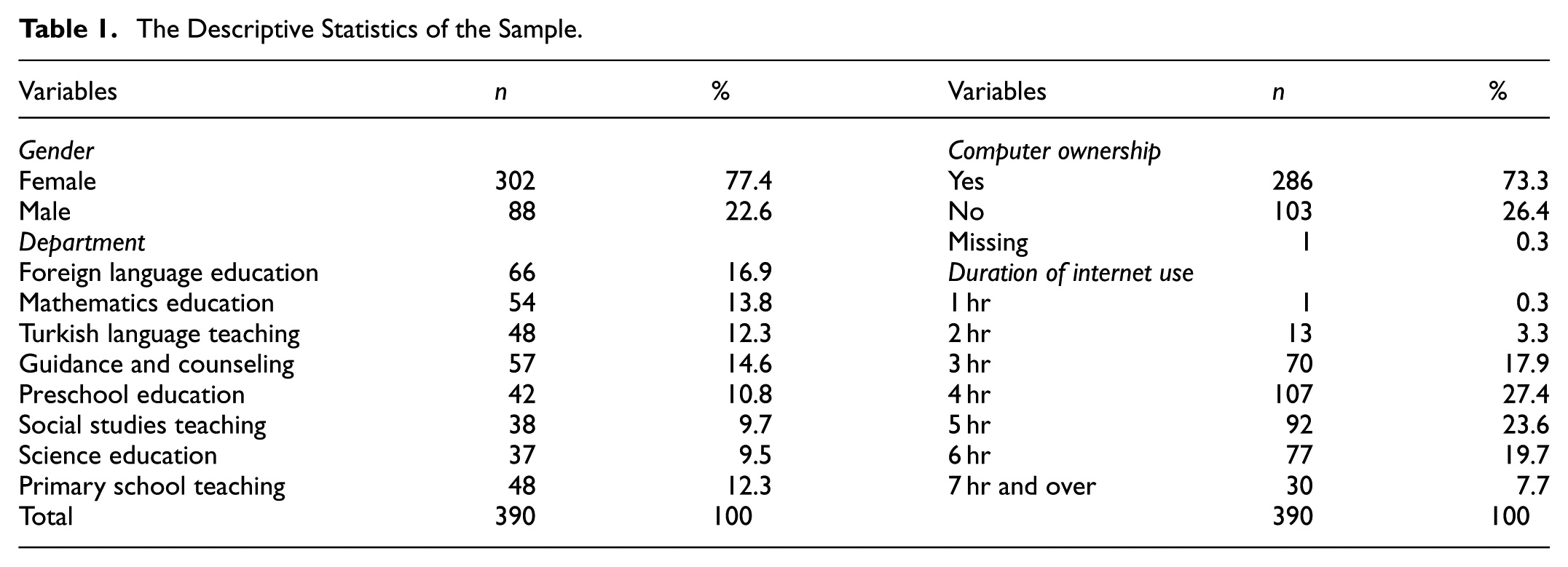
The study involved 390 pre-service teachers selected through a convenience sampling approach; 302 (77.4%) were female, and 88 (22.6%) were male. All pre-service teachers at the same class level in the faculty were included in the study. The gender imbalance among the participants reflects the actual situation in the Faculty of Education; that is, the number of female students in the Faculty of Education exceeds that of male students. According to Muthén and Muthén (2002), structural equation modeling studies that involve model construction require a sample size of at least 250 participants. While students from all available programs in the Faculty of Education were included, the majority of participants were from the English Language Education program (16.9%). Most of the pre-service teachers reported using the Internet for 4 hr (27.4%) or 5 hr (23.6%) daily, and 286 of them (73.3%) owned a personal computer (Table 1).
The Descriptive Statistics of the Sample.
Data Collection Tools
Information Literacy Scale
The “Information Literacy Scale” was developed by Kalaycı (2023) as a subcomponent of the “21st Century Digital Literacy Skills Scale.” It was designed in the form of a five-point Likert scale. The scale consists of 12 items, such as “I know where and how to access a source of information.” It includes two sub-dimensions: “Using Information and Legal Elements” with seven items and “Accessing Information and Sharing Information” with five items. The reliability coefficients were calculated as 0.77 for the first factor and 0.74 for the second factor. The overall reliability coefficient of the entire scale was found to be 0.84. As a result of the confirmatory factor analysis, it was found that there was sufficient evidence for validity and that the level of fit was quite good and acceptable (RMR = 0.03, χ2/df = 2.61, AGFI = 0.93, GFI = 0.95, RMSEA = 0.06, CFI = 0.94, NFI = 0.91, IFI = 0.94). Based on these results, it can be stated that the Information Literacy Scale has an adequately high level of construct validity and confirms its two-factor structure.
Media Literacy Scale
The “Media Literacy Scale,” developed by Kalaycı (2023) as a subcomponent of the “21st Century Digital Literacy Skills Scale,” was constructed using a five-point Likert scale. The scale consists of 16 items, such as “I take the necessary precautions to protect personal data when using media tools.” There are six items in the “Awareness and Paying Attention” sub-dimension, seven items in the “Having Knowledge” sub-dimension, and three items in the “Ability to Use Media Tools” sub-dimension. The reliability coefficients of the scale are 0.83 for the first factor, 0.80 for the second factor, and 0.63 for the third factor. The total reliability coefficient of the entire scale was calculated to be 0.89. As a result of the confirmatory factor analysis, it was found that there was sufficient evidence for validity and that the level of fit was quite good and acceptable (RMR = 0.03, χ2/df = 2.22, AGFI = 0.91, GFI = 0.93, RMSEA = 0.05, CFI = 0.95, NFI = 0.91, IFI = 0.94). Based on these results, it can be stated that the Media Literacy Scale has an adequately high level of construct validity and confirms its three-factor structure.
Technology Literacy Scale
The “Technology Literacy Scale,” developed by Kalaycı (2023) as a subcomponent of the “21st Century Digital Literacy Skills Scale,” was prepared in a five-point Likert-type format. The scale consists of 14 items, such as “I can classify technological tools according to their intended use.” There are seven items in the “Ability to Comprehend Technology” sub-dimension, four items in the “Ability to Use Technology” sub-dimension, and three items in the “Paying Attention” sub-dimension. The reliability coefficients of the scale are 0.86 for the first factor, 0.79 for the second factor, and 0.70 for the third factor. The total reliability coefficient of the entire scale was calculated to be 0.90. As a result of the confirmatory factor analysis, it was found that there was sufficient evidence for validity and that the level of fit was quite good and acceptable (RMR = 0.03, χ2/df = 2.22, AGFI = 0.91, GFI = 0.93, RMSEA = 0.05, CFI = 0.95, NFI = 0.91, IFI = 0.94). Based on these results, it can be stated that the Media Literacy Scale has an adequately high level of construct validity and confirms its three-factor structure (Supplemental Material).
Procedure
The research data were collected face-to-face from pre-service teachers in a classroom setting, and participation was entirely voluntary. All participants were informed of the study’s details before participating and provided written consent before data collection. No rewards or payments were offered to the participants in this study.
Data Analysis
Microsoft Excel 2019 was used for organizing the data, while IBM SPSS 26.0 (IBM Corp., 2019) was employed for preliminary analyses, and AMOS 24.0 (IBM Corp., 2016) was used for data analysis. Descriptive statistics were utilized to examine the characteristics of the variables, while Structural Equation Modeling (SEM) was applied to evaluate the proposed research hypotheses.
The SEM analysis followed the following steps, as outlined by Kline (2011): (1) model specification, (2) model identification, (3) parameter estimation, and (4) model testing and evaluation. The mediating role of media literacy was examined using the method proposed by Baron and Kenny (1986). According to their framework, three conditions must be satisfied to establish mediation. The independent variable should significantly influence the mediator (path a), the mediator must have a significant effect on the dependent variable (path b), and the independent variable must also significantly predict the dependent variable (path c). Once these conditions are fulfilled, a regression analysis including both the independent and mediating variables should show a reduced or non-significant effect of the independent variable on the dependent variable, demonstrating mediation.
The mediating role of media literacy in the relationship between information literacy and technology literacy (H1) was examined using SEM mediation analysis. The Bootstrap technique was employed to evaluate the mediation model, and a bootstrapped sample of 1,000 was generated through random resampling from the dataset. A 95% confidence interval was calculated for the indirect effect. To investigate gender differences hypothesized in H2, multi-group Structural Equation Modeling (SEM) was employed to assess whether the mediating role of media literacy in the link between information literacy and technology literacy varied across gender groups.
Results
Preliminary Analysis
Following the examination of missing and outlier data, data from 38 participants were excluded from the dataset. Subsequently, correlation coefficients and descriptive statistics for the variables were calculated and reported in Table 2. The obtained correlation coefficients were interpreted based on Büyüköztürk’s (2012) criteria, where correlation coefficients with absolute values ranging from 0.70 to 1.00 are considered strong, those between 0.30 and 0.70 are viewed as moderate, and values between 0.00 and 0.30 are interpreted as indicating a weak relationship.
Descriptive Statistics and Correlation Analysis.

Note. n = 390.
p < .01.
Table 2 shows that there are statistically significant (p < .001) moderate positive correlations between media literacy and information literacy (r = .502), media literacy and technology literacy (r = .580), and information literacy and technology literacy (r = .511). Based on the skewness and kurtosis values presented in Table 2, it can be concluded that the variables exhibit a normal distribution.
Structural Model and Hypotheses Testing
In this study, the theory-based model was specified, as shown in Figure 1. Since the model’s degrees of freedom (df) equal zero, it is a fully saturated model. Although parameter estimation can be performed for a fully saturated model in SEM, fit indices are not examined because df = 0 (Chi-square = 0.000, CFI = 1.000, RMSEA = 0.515, 90% CI [0.467, 0.564]).
According to Figure 2, the direct effect of pre-service teachers’ information literacy on their technology literacy is positive (β = .511, p < .001). After including media literacy as a mediating variable in the model, this effect decreases but remains statistically significant (β = .294, p < .001). This indicates that media literacy acts as a partial mediator. The 95% confidence interval for this coefficient ([0.175, 0.262]) further supports its significance. In summary, the standardized direct effect coefficient of information literacy on technology literacy is 0.294, the indirect effect coefficient is 0.217, resulting in a total effect coefficient of 0.511.

The standardized result of the mediation model.
Additionally, as shown in Figure 2, pre-service teachers’ information literacy has a positive effect on their media literacy (β = .502, p < .001), and media literacy has a positive effect on technology literacy (β = .433, p < .001). In other words, both the direct and indirect effects of information literacy on technology literacy are statistically significant. Finally, considering that standardized path coefficients also represent the strength of the relationships between variables, there is a moderate positive relationship between information literacy and both media literacy and technology literacy.
Multi-Group Analysis of Structural Models and Hypotheses Testing
To address Hypothesis 2, a multi-group SEM analysis was conducted, and the results are reported in Table 3. Initially, a baseline model (Model 1) was established by freely estimating all parameters across the female and male groups. Since this model is fully saturated, fit indices were not calculated (see Table 3). Subsequently, a more restrictive model (Model 2), which imposed equality constraints on the path coefficients between the female and male groups, was examined. A comparison between Model 2 and Model 1 revealed no significant difference between the groups (p = .914). In other words, the mediating role of media literacy in the relationship between information literacy and technology literacy is similar across both female and male groups.
Multi-Group Analysis: Testing for Path Coefficients Invariance Across Genders.

Standardized path coefficients for the male and female groups are reported in Table 4. Examination of Table 4 indicates that the path coefficients are similar across both groups. The similarity in the mediating effect of media literacy in both groups accounts for the resemblance in the path coefficients.
Path Coefficient Estimation Across Gender (Standardized).
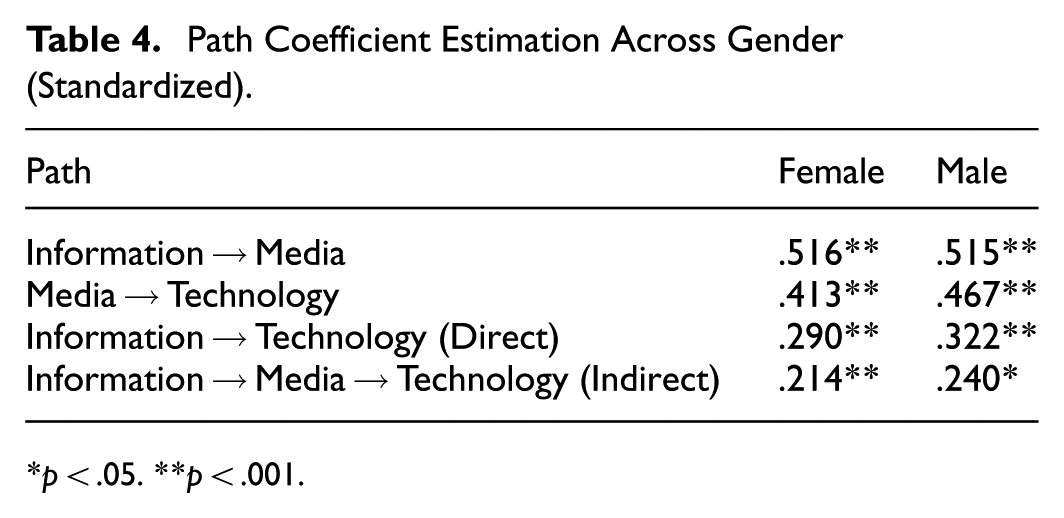
p < .05. **p < .001.
Discussion
This study employed Structural Equation Modeling to investigate the relationships among information literacy, media literacy, and technology literacy in a sample of pre-service teachers in Türkiye, with a specific focus on gender-based variations. In light of the relevant literature, the study proposed that media literacy may act as a mediating variable linking information literacy to technology literacy. The results indicated that media literacy significantly mediated the correlation between information literacy and technology literacy; however, this mediating effect did not differ across genders.
First, the findings revealed that there is a significant relationship between information literacy and technology literacy. At the initial state of the model, the direct impact of information literacy on technology literacy was positive and low (β = .511, p < .001), which may be interpreted as indicating that the ability to find, analyze, and use information increased competence in using digital devices. Including media literacy in the model as a mediator variable decreased this direct effect (β = .294, p < .001) but caused no change in its significance. Thus, it was empirically supported that media literacy had a partial mediator role in the relationship between information and technology literacy.
These findings indicated that media literacy served as a bridge to enhance individuals’ skills in utilizing technological devices. In other words, the results showed that the individuals’ information literacy enabled them to assess media content critically, which in turn positively affected their ability to use technology. Similarly, Van de Vord (2010) emphasizes that individuals with high information literacy can evaluate information presented in digital environments more critically and analyze media content more effectively. These findings also coincide with numerous studies in the literature. For example, UNESCO’s “Media and Information Literacy Curriculum and Competency Framework” unifies the traditionally separate domains of media literacy, information literacy, and digital literacy into a cohesive concept known as media and information literacy (Grizzle et al., 2021), which supports the belief that these literacies are indispensable to facilitate one another. According to Nikou et al. (2022), information literacy has a positive influence on the perceived ease of technology use, and individuals with higher proficiency in this literacy are more inclined to perceive technological tools as more user-friendly and accessible.
The relationship between information and media literacy is supported in several studies in the literature (Güven, 2014; Hobbs & Frost,2003; Lau, 2013; Van de Vord, 2010; Zhu et al., 2021). There are also studies showing a relationship between information and technology literacies. Adeleke and Emeahara (2016) found a significant relationship between the level of information literacy and the effectiveness of using digital information resources, emphasizing the critical importance of information literacy in developing users’ skills to utilize electronic tools and digital platforms effectively. The study by Demiralay and Karadeniz (2010) also revealed that pre-service teachers’ perceived self-efficacy in information literacy is shaped by various factors, including their previous experience with computers, digital proficiency levels, frequency of computer and internet use, and access to technological resources. Pre-service teachers who have long-term and advanced levels of ICT use and who can access ICT from various places are seen to have more positive perceptions of their information literacy self-efficacy. Katz (2007) argues that it is essential for students to develop information literacy and use this proficiency on digital platforms. Some studies have also shown that information literacy skills significantly increase individuals’ skills to use media resources more effectively (Amusan & Lawal, 2020; Odede & Zawedde, 2018; Toyo, 2017). Although accessing and using digital platforms may seem straightforward, a solid foundation in information literacy is necessary to use them effectively (Durodolu & Mojapelo, 2020). It is more likely for information-literate individuals to develop technological skills over time, or technological skills can lead to an increase in students’ level of information literacy, as suggested by Aharony and Gur (2017).
As for the second hypothesis, it was not supported by the findings. Although the current study confirmed that media literacy played a significant mediating role in the relationship between information literacy and technology literacy, it did not differ by gender. The findings showed that the mediating effect of media literacy on the relationship between information and technology literacy was similar for both female and male participants. Although minor differences were noted in the path coefficients between genders, the overall model was valid for both groups. This result may be attributed to the comparable levels of information literacy (Noordin, 2024; Omosebi & Omosebi, 2020; Xu & Shen, 2021), media literacy (Erişti & Erdem, 2018; Som & Kurt, 2012; Zhang & Zhu, 2016) and technology literacy (Hatlevik & Christophersen, 2013; Lee et al., 2015; Liang et al., 2021) reported for both genders, suggesting that gender has a minimal influence on the levels of these literacies.
Conclusion
This study contributed to the relevant literature by examining the relationships between information literacy, media literacy, and technology literacy in the context of pre-service teachers in Türkiye. The findings obtained using Structural Equation Modeling showed that media literacy had a mediating role in the relationship between information and technology literacies; which reiterates the fact that media literacy plays a significant role in the promotion of them. Contrary to the hypothesis assumed in the study, gender did not affect either the direct or indirect relationship between information and technology literacy. These findings suggest that there is a need for training programs that aim to increase pre-service teachers’ media literacy. The results emphasized the importance of strengthening media literacy as a way to develop the technology-related skills of prospective teachers who will educate future generations.
Limitations and Directions for Future Research
Although the study provides valuable insight into the relationships between information, media, and technology literacy, it has its own limitations. First, the participants in this study are students enrolled in the education faculty of a specific university. This situation constitutes an obstacle to generalizing the findings to diverse groups and educational environments. The findings of this study can be expanded by repeating the research with varying groups of samples. Second, in this study, female pre-service teachers were much more represented than male candidates. Therefore, this unequal distribution should be taken into account when examining the effects of gender on the mediating role among the variables. In the future, the mediation relationships among the same variables can be replicated with an equal or nearly equal number of female and male participants. In this study, self-report measurement tools were used to determine the participants’ own perceptions of the literacy levels examined. For this reason, the answers obtained may not accurately reflect the participants’ actual literacy levels due to factors such as exaggeration or the desire to present oneself positively. Future research could employ various data collection methods, including observation and interview. Another limitation is that only the mediating role of media literacy was emphasized. However, apart from media literacy, there may be other potential factors that may play a mediating role between information literacy and technology literacy. It would be wise to investigate other mediating factors between information and technology literacies in the future.
Finally, only the moderating role of gender among the demographic variables was examined, and other characteristics were not considered. Since demographic variables such as age, academic background, or socioeconomic status have the potential to influence the relationships between the literacy areas examined, future studies can incorporate these variables into their analyses to gain a more comprehensive understanding. Despite the above-mentioned limitations, this study is the first to investigate the relationships between information and technology literacy as well as media literacy among female and male pre-service teachers across Europe.
Supplemental Material
sj-docx-1-sgo-10.1177_21582440251414733 – Supplemental material for Information and Technology Literacy Among Female and Male Pre-Service Teachers
Supplemental material, sj-docx-1-sgo-10.1177_21582440251414733 for Information and Technology Literacy Among Female and Male Pre-Service Teachers by Gülnur Candan Hamurcu in SAGE Open
Footnotes
Acknowledgements
I would like to thank the Proofreading & Editing Office of the Dean for Research at Erciyes University for copyediting and proofreading service for this manuscript.

Ethical Considerations
During the research procedure, ethical approval for the study was first obtained from the Ethics Committee for Social and Human Sciences at Erciyes University (Application No: 033). The study was conducted in accordance with the ethical standards outlined in the 1964 Declaration of Helsinki and its subsequent revisions.
Consent to Participate
Informed consent was obtained from all individual participants included in the study.
Author Contributions
The author, is solely responsible for the conception, design, execution, and analysis of this research, as well as the preparation of the resulting manuscript.
Funding
The author received no financial support for the research, authorship, and/or publication of this article.
Declaration of Conflicting Interests
The author declared no potential conflicts of interest with respect to the research, authorship, and/or publication of this article.
Data Availability Statement
Data will be available on request.*
Pre-Registration Statement
This study was not pre-registered.
Supplemental Material
Supplemental material for this article is available online.
References
Supplementary Material
Please find the following supplemental material available below.
For Open Access articles published under a Creative Commons License, all supplemental material carries the same license as the article it is associated with.
For non-Open Access articles published, all supplemental material carries a non-exclusive license, and permission requests for re-use of supplemental material or any part of supplemental material shall be sent directly to the copyright owner as specified in the copyright notice associated with the article.
