



Abstract
This study investigates pre-service teachers’ conceptual understanding of technology by employing Feenberg’s Critical Theory of Technology as a theoretical framework. Since the 1960s, the field of educational technology has been troubled by widespread misconceptions of technology, leading to its reduction to mere tools and devices. This problem facilitated the commodification of education and evolved into what is referred to in this paper as the “T-word phenomenon.” Using a systematic metaphor analysis methodology, responses from 706 pre-service teachers who completed the prompt “Technology is like ____, because ____.” were examined. The analysis revealed eight distinct clusters of metaphorical conceptualizations, ranging from instrumentalist views of technology as neutral tools to deterministic perspectives on technology. Notably, participants displayed tendencies to anthropomorphize technology as an autonomous agent with its own development trajectory, or to reduce it to its most visible manifestations, such as information technology products and services. Cluster analysis demonstrated strong associations between positive sentiments and marketing jargon, as well as technological determinism and negative sentiments. The findings suggest that pre-service teachers often oscillate between Feenbergian instrumentalist and substantivist positions, frequently embodying problematic forms of technological determinism and reification that may hinder their ability to foster critical technological literacy among their students. These results carry significant implications for teacher education programs, highlighting the need for more robust approaches to developing technological literacy that go beyond mere technical competence to include a critical understanding of the societal implications of technologies.
Plain Language Summary
When teachers talk about “technology,” what do they really mean? This study looked at how 706 teachers in training described technology using metaphors (comparing it to something else) to better understand their views. For example, some teachers compared technology to tools like hammers, while others compared it to forces of nature like the ocean. The research found that teachers in training think about technology in several ways: as a positive problem-solver (using advertisement-like language), as something alive that grows by itself, as an information source like a library, as a guiding light, as powerful natural forces like stars, as a source of pleasure like food, as tools humans control, and as something potentially dangerous and addictive. Importantly, many teachers in training think about technology as if it were a living thing with its own will—something that develops and makes decisions by itself, often forcing people to follow its lead, rather than being shaped by human choices and society. This way of thinking could make it harder for teachers to help students develop a critical understanding of technology. The research suggests that teacher education programs should help develop a more complete understanding of technologies as tools and systems created by humans to serve specific purposes, not autonomous forces beyond our control. This matters because teachers’ understanding of technologies affects both how they implement these in their classrooms and help students learn about these.
Keywords
Introduction
When discussing chairs in conversation, we rarely feel compelled to define the term, confident that all participants share a standard cognitive schema. However, words like education or technology are infinitely more abstract and complex than chairs, so such shared understanding proves elusive. Considering that there exist entire branches of philosophy dedicated to each of these concepts—philosophy of education and philosophy of technology—perhaps we need to acknowledge that when we discuss technology in education, what we are discussing might be different from what our listeners believe we are discussing. The natural human challenge with abstract concepts takes on particular significance in educational contexts, where educational technologists argued as early as the 1960s that “technology is one of the most misunderstood words in our language” (Heinich, 1968).
Discussing the issue at hand first requires acknowledging that technology is, at its core, a word. The challenge lies in internalizing the abstract nature of the concept this linguistic unit represents. Historically, the term’s etymology reveals philosophical roots, derived from the Greek concepts of techné (skill) and logos (reason), which represent the practical and purposeful application of knowledge (Huang et al., 2019). Oliver (2013) elaborates on this classical understanding, describing techné as the rational, craft-based approach to either producing or achieving something. Building on this foundation, scholars have expanded the concept to encompass both scientifically informed activities and their tangible products, undertaken or developed by humans to address various challenges posed by the material world. Galbraith’s (2015) definition exemplifies this evolution, describing technology as the systematic application of scientific or other organized knowledge to practical tasks. This perspective has been echoed by Hlynka and Jacobsen (2010), who emphasize the nature of technology as the application of scientific knowledge for practical purposes. These definitions consistently emphasize technology’s nature as a systematic, knowledge-based approach rather than merely its tangible manifestations.
This alignment between Galbraith’s systematic conception and Heinich’s observations is particularly revealing. Whereas Galbraith emphasizes technology as the systematic application of organized knowledge, Heinich (1968) notes that educators tend to focus solely on the tangible end products of this process, stemming from a failure to view technology as a sufficiently abstract concept. This reduction of technology to its instrumental aspects is also evident in broader modern linguistic patterns: an analysis of the Corpus of Contemporary American English reveals that the most frequent collocate of technology as an immediately preceding verb is use, not apply (Davies, 2008; analysis conducted January 2025). In modern conversations, substituting the word technology with words like tools, computers, or electronics (which are much better suited for use with the verb use) indeed often preserves the intended meaning without loss. This underscores how thoroughly the term has been stripped of its broader conceptual significance.
This phenomenon goes in parallel with a trend discussed in recent academic literature on technology education, suggesting that the notion of technology literacy is often reduced to digital competencies (Ingerman & Collier-Reed, 2011; Pappa et al., 2024a) that emphasize the use perspective, while leaving out a holistic understanding of the concept (Fawns, 2022; Hallström, 2023) that encompasses the apply perspective. A recent systematic review of technology education in primary schools reveals that the majority of studies focus on computer science and informatics rather than broader technological literacy (Pappa et al., 2024b), suggesting that this reductive understanding has become institutionalized in even educational research itself. Perhaps, this reduction is not coincidental, as historical patterns reveal that the reduction of technology to gadgets has systematically benefited market forces seeking to commodify public education. What is clear however is that, despite decades of scholarship in technology education, both teachers (Pappa et al., 2024b) and K12 students (Blom & Abrie, 2021; Firat, 2017; Lind et al., 2024; Pappa et al., 2024a) still continue to misunderstand the concept of technology. This pattern is particularly concerning given research showing that teachers’ technological literacy directly influences their confidence and competence in fostering critical thinking about technology among their students (Pappa et al., 2024b; Sanal, 2022). The persistence of these misconceptions among future educators—what we collectively refer to as the T-Word Phenomenon in this paper—represents a critical challenge for developing technological literacy that resists market forces and extends beyond mere technical competence to include critical understanding of technology’s societal implications. In order to address this issue, a teacher education model that takes into account a more holistic form of technological literacy is necessary. This, in turn, requires a deeper examination of the underlying nature of educators’ technological misconceptions through critical theoretical frameworks (Hallström, 2022).
Aim of the Study
This study aims to investigate the conceptual understanding of the word technology among pre-service teachers through a critical analysis of metaphors. The participating pre-service teachers were asked to fill in the blanks in the statement “Technology is like ____, because ____” for eliciting their metaphors and the rationales behind them. Theoretical frameworks that inform the metaphor analysis were sought by examining relevant literature and findings from previous metaphor studies that did not display a critical stance, and was determined to be Feenberg’s Critical Theory of Technology. In doing so, it seeks to answer the following research questions:
What types of metaphors do pre-service teachers use to conceptualize technology, and how do they justify these metaphorical representations?
How may the pre-service teachers’ metaphors of technology and their underlying rationales be interpreted through critical theoretical frameworks of technology conception?
Relevant Literature
A glance at educational technology literature suggests that the problem of misconception of technology among educators has not simply persisted—it has actively resisted resolution. It was perhaps for this reason that the Association for Educational Communications and Technology (AECT) has had to revise its definition of educational technology numerous times over the decades (Ibrahim, 2015), as if attempting to rectify misunderstandings caused by a comprehensive understanding of technology with each new iteration. This pattern of repeated definitional revision underscores not only confusion within the field but also the ongoing struggle against reductive interpretations of technology in educational contexts. The consequences of this conceptual confusion became evident in the field’s struggle for disciplinary recognition. As Donald Ely noted in his initial critique (D. P. Ely, 1970) and subsequent revisitation three decades later (D. Ely, 1999), educational technology remained fragmented, lacking the cohesive structure characteristic of established disciplines. To this day, scholars continue to observe that the field suffers from poor theoretical foundations (Hew et al., 2019), a problem that is in part due to how technology was a misunderstood concept even in the past (Silverman, 1968) and has only intensified as the concept has become increasingly abstract in the digital age. There have been scholarly attempts, which acknowledge this problem and recommend addressing it by mapping and legitimizing multiple theoretical perspectives in educational technology (Czerniewicz, 2010). While such an approach aims to strengthen the field’s intellectual foundations, it might be argued that it may have inadvertently contributed to its conceptual fragmentation. By emphasizing theoretical plurality over systematic framework development, this approach may have made it more difficult for the field to maintain conceptual clarity and resist the reduction of educational technology to mere tools and devices.
This theoretical instability and conceptual reduction, in turn, proved to be fertile ground for the commodification of education since the term educational technology was first introduced. As Sekerak and MacDonald (1969) presciently observed in the 1960s: “Industry has viewed hungrily the “education market.” Millions in profits are being sought in sales to the schools, stimulated by federal grants… Salesmen are filling schools (and school closets) with all forms of audio-visual hardware. Each new gadget is being promoted as a panacea.” Recent literature also highlights that, although partnerships between governments and entrepreneurs in the EdTech sector may lead to improved educational quality in some cases, these partnerships often prioritize economic returns over educational efficacy (Buchanan, 2020; Regan & Khwaja, 2019; Udanoh, 2023). In a way, it can be argued that the history of educational technology also encompasses the history of how the misunderstanding of an abstract concept helped pave the way for the commercial exploitation of public education. Therefore, a critical question that may be raised at this juncture is: was such a misunderstanding purely coincidental?
Linguistic Hijacking of the Word Technology
Linguistic hijacking, as theorized by Anderson (2020), refers to the appropriation of politically or culturally significant terminology by dominant groups to serve their interests, often at the expense of marginalized perspectives. This phenomenon alters the semantic properties of a term through strategic misuse, fostering ignorance or misinformation about its original meaning. For example, Anderson highlights how terms like “racism” are often misappropriated to obscure systemic oppression. Similarly, it can be argued that, at least since the advent of the Internet, the term technology has been increasingly associated with consumer electronics and digital media, overshadowing its broader historical and practical connotations. However, there is more to the modern hijacking of the word technology than just a reduction of the term to shiny digital devices. Neil Selwyn’s provocatively titled editorial about the state of educational technology discourse tackles this issue head-on, challenging how the field’s trajectory has changed due to empty rhetoric and techno-optimistic promises that follow specific linguistic patterns (Selwyn, 2016).
Selwyn’s stark critique aligns with Hayes’ (2015) work, in which it is claimed that such language use serves to obscure rather than illuminate, creating a discursive environment in which critical engagement becomes increasingly challenging. Hayes demonstrates how a seemingly innocuous phrase like technology-enhanced learning (TEL) implicitly positions technology as an autonomous agent capable of enhancing learning, while obscuring the complex sociotechnical relationships and human agency involved in teaching and learning processes. This perspective aligns with that of Oliver (2013), who argues that the absence of robust theories of technology in educational research has left the field vulnerable to oversimplified accounts that position technology as a magical facilitator of learning rather than a complex sociotechnical system requiring careful implementation and understanding.
As Passey (2019) observes, this problem is pervasive; TEL, as a term, is rarely explicitly defined in the literature. It is most frequently reduced to discussions of equipment and infrastructure, further reinforcing Hayes’ argument that terminology can obscure rather than illuminate the complex relationships in educational technology. Similarly problematic is the even more popular term technology integration (TI)—while those well-versed in the field may recognize that effective integration encompasses robust instructional design processes, the term’s ambiguity often reinforces the misconception among practitioners that educational technology merely involves sprinkling technological pixie dust onto existing educational practices—an act that is perhaps best explained by what Morozov (2013, pp. 5) refers to as Technological Solutionism, explained as the Silicon Valley borne ideology that legitimizes and sanctions the “recasting all complex social situations either as neatly defined problems with definite, computable solutions or as transparent and self-evident processes that can be easily optimized—if only the right algorithms are in place!”.
Technological Literacy and the T-word
The modern reduction of technology to its instrumental, consumable, supposedly neutral, apolitical, cruelly optimistic, techno-utopian counterpart—what we might call the T-word phenomenon—represents more than just linguistic simplification. It fundamentally reshapes how society at large, including educators, thinks about technology and the world around them. From a critical perspective, it might be argued that this overused word, which becomes increasingly hollow with each use, eventually turns into a potential linguistic Trojan horse, carrying within it an implicit set of assumptions about the nature of technology or its progress. When educators singularly use this word (for example, technology as opposed to technologies) and without an identifier beforehand (technology as opposed to, say, agricultural technology), they often unknowingly appeal to a specific ideological framework that positions it as a singular, monolithic, autonomous force for positive change rather than sets of activities in various domains whose effectiveness depend entirely on human agency, scientific knowledge and careful implementation. Therefore, one might argue that today, educators’ misconceptions of technology carry implications that extend far beyond the realm of EdTech.
Research into technological literacy suggests that educators’ limited understanding of technology may fundamentally compromise their ability to prepare students for meaningful participation in an increasingly technological society (Roberts & Kruse, 2023). In this perspective, technological literacy involves much more than the ability to use digital tools. Rather, it also requires the capacity to engage in critical analysis of technology’s societal impacts (Pleasants et al., 2024) and to participate in democratic discussions about technological progress (Hallström, 2023). In other words, it may be argued that when educators lack robust technological literacy—encompassing not just functional knowledge but also critical and rhetorical understanding—there is also little hope for developing these crucial capacities in the primary stakeholders of K12 education: schoolchildren. Nevertheless, as early as the 1990s, Jarvis and Rennie (1998) found that teachers’ definitions of technology varied widely: although some possessed more mature conceptions of it (even though sometimes as simple as technology is applied science), others tended to reduce it to simply the creation of tangible products. It can be argued that this reductionist perspective was a precursor to the modern T-word perspective, where teachers and their students may develop a tendency to not only reduce technology to gadgets but also overlook its sociological and philosophical dimensions, inadvertently perpetuating a narrow view that privileges technological consumption over critical engagement.
The pervasiveness of this cycle and its implications for educational practice are not merely theoretical concerns—they are empirically documented through various studies examining educators’ conceptual understanding of technology through metaphor analyses. For instance, in a review of multiple metaphor studies conducted with Turkish educators (Çavaş et al., 2019; Gök & Erdoğan, 2010; Göksu & Koçak, 2020; Karadeniz, 2012; Sanal, 2022), it can be seen that all these studies discuss how educators tend to reduce technology to tools and substances, revealing a striking parallel with the limited conceptualizations observed in children as young as 2 to 6 years old, who are influenced by media exposure and parental occupations (Jarvis & Rennie, 1998). The persistence of such basic conceptual frameworks among educators—frameworks that mirror those of very young children—raises profound questions about technology education and the field of teacher training’s capacity to foster more sophisticated technological literacy among students. A glance at the findings sections of these studies reveal that, participant educators have shown tendencies in their responses to personify what they call technology, attributing agency to it and discussing it as a being with its own will and agenda. And yet, this phenomenon remained undiscussed from a critical standpoint in these papers.
These discussions, or lack thereof, acquire particular significance when considered alongside Roberts and Kruse’s (2023) arguments about technological literacy. The tendency of educators to conceptualize technology through simplistic metaphors—whether as tools with a dual nature (beneficial/harmful) or personified entities—suggests a fundamental gap in the kind of critical and rhetorical understanding necessary for meaningful technological literacy. The methodological limitations of the listed metaphor studies reflect a broader pattern in educational research: the tendency to document surface-level phenomena without engaging in deeper critical analysis regarding teachers’ understanding of technology. While these studies meticulously categorize educators’ metaphorical expressions, ranging from tools and machines to natural phenomena like the sun and moon, and even mythological beings like angels and dragons, they stop short of interrogating what these metaphors reveal about the underlying ideological frameworks and power structures.
Theoretical Framework
This analytical gap becomes particularly striking when one considers how various critical theoretical lenses could illuminate these findings. One such widely acclaimed theory, which provides a particularly relevant framework for examining how educators conceptualize and relate to technology, is Feenberg’s Critical Theory of Technology (Feenberg, 2008). This theoretical approach emphasizes the social construction of technology while critiquing the tendency to view technological systems as neutral or deterministic forces, making it especially suitable for analyzing the metaphorical and conceptual patterns that have emerged yet remained unaddressed in the aforementioned metaphor studies.
For instance, considering how technology is frequently conceptualized solely as tangible tools in these studies from Feenberg’s perspective, one may link the case with the concept of reification. Reification, a notion rooted in critical theory, particularly in the works of Georg Lukács, refers to the transformation of social relations into relationships between things, effectively objectifying human experiences and reducing individuals to mere commodities (Feenberg & McCarthy, 2023). From Feenberg’s perspective, reification extends to the notion of technology, where technological artefacts and systems become perceived as entities detached from their social contexts and implications (Kavoulakos, 2017). One can observe this phenomenon when educators make statements like technology enhances learning without specifying which technologies or how they are implemented. Such phrasing implicitly positions technology as an abstract force operating independently from (a) the teachers who choose it, (b) the students who use it, and (c) the social conditions that determine its effectiveness. This reification masks the fact that the impact of educational technologies depends entirely on human decisions about their selection, design, implementation, and use. This detachment from human agency can lead to a technocratic worldview, wherein technology is viewed as a simple, neutral tool, obscuring the social relations and power dynamics that shape its development and use.
The prevalence of naturalistic metaphors (“technology is like the sun/moon/river”) and personification (“technology is like an angel/dragon”) suggests an even more concerning pattern: when educators personify technology or conceptualize it through metaphors traditionally reserved for natural forces or divine entities, they may be unconsciously positioning it as an autonomous force beyond human control or critique. This framing aligns with the notion of technological determinism, a theory that posits technology as the primary driver of societal change, suggesting that technological advancements shape social structures and cultural values in a linear and deterministic manner (Cherlet, 2014; Joyce et al., 2023). This perspective has been critiqued for oversimplifying the complex interplay between technology and society, as it neglects the reciprocal influences that social contexts exert on technological development (Howcroft & Taylor, 2022; de la Cruz Paragas & Lin, 2016). From Feenberg’s perspective, technological determinism is problematic because it obscures the social dimensions of technology, reducing it to an autonomous force that dictates human behavior and societal evolution (Hallström, 2022; Hess, 2015). Feenberg advocates for a more nuanced understanding that recognizes technology as a product of human choices and social negotiations, emphasizing the importance of democratic engagement in shaping technological trajectories (Feenberg, 1999, 2005). He argues that by viewing technology through a critical lens, we can uncover the underlying social relations and power dynamics that influence technological design and implementation, thereby fostering a more participatory approach to it (Feenberg, 2008). This perspective aligns with the notion that technology should not be viewed as an external force, but rather as an integral part of a sociotechnical system that reflects and reinforces social values and power structures (Feenberg, 2005).
Once again, it should be considered that the positioning of technology by educators, either as a commodity that can be readily purchased and deployed or as an omnipotent being that forces its will upon people, rather than as a complex sociotechnical system requiring careful consideration and implementation, may serve commercial interests. However, existing metaphor studies, which focus solely on categorization, fail to discuss in critical depth the conceptualizations that might reinforce problematic narratives about technology’s role in education and society.
Methodology
This study employs systematic metaphor analysis (Schmitt, 2005) informed by Feenberg’s Critical Theory of Technology to examine how pre-service teachers conceptualize technology through metaphorical expressions. Systematic metaphor analysis offers a structured approach for identifying, categorizing, and interpreting metaphorical concepts while acknowledging their embedded social and cultural meanings. Unlike discourse analysis approaches that examine naturally occurring language, systematic metaphor analysis is particularly suited for studying explicitly elicited metaphors as representations of collective understanding. Metaphors serve as particularly rich sites for discourse analysis because they function as linguistic devices through which power relations and ideological positions are naturalized and reproduced (Charteris-Black, 2004).
Feenberg’s Critical Theory of Technology (Feenberg, 2008) guides the interpretation phase by providing analytical lenses through which to examine how metaphorical conceptualizations may reflect or resist a list of concepts, which include but are not limited to, reification of technology, technological determinism, instrumental reduction of technology or the recognition of technology as socially constructed and politically embedded.
This qualitative study employs systematic metaphor analysis as its primary methodology, with cluster analysis serving both to visualize and to analyze relationships between identified themes, thereby supporting theoretical interpretation through Feenberg’s Critical Theory framework.
Participants and Procedure
818 pre-service teachers participated in this study from a school of education at a Turkish university in the Thrace region, selected for convenience sampling. Data collection took place during the spring semester of 2022 to 2023, with participants accessing an anonymous digital form on a voluntary basis via a QR code during the first 5 min of their classroom sessions during the week of data collection. The form was presented in Turkish and contained a single section, asking participants to complete the prompt “Technology is like ____, because ____”. This structured elicitation format, although it does not capture naturally occurring discourse, allows for a systematic comparison of metaphorical conceptualizations across participants. The two-part prompt structure (metaphor + rationale) enables analysis of both the surface metaphor and its underlying conceptual basis.
From the initial sample of 818 responses, (N = 706) were retained after excluding those that did not contain valid metaphors. Responses were considered invalid if they (a) left the prompt incomplete, (b) used literal descriptions rather than metaphors, or (c) provided no rationale for the metaphor. The remaining participants were enrolled in Primary School Teaching (n = 100), Preschool Teaching (n = 102), Turkish Language Teaching (n = 56), English Language Teaching (n = 76), German Language Teaching (n = 44), Special Education (n = 63), Social Science Education (n = 86), and Psychological Guidance and Counseling (n = 179).
The participant metaphors and their underlying rationales were analyzed through content coding using NVivo v10.0.638.0. A coding framework was generated based on:
Source domains of metaphors (e.g., tools, natural phenomena, living beings)
Underlying conceptual models revealed in rationales
Alignment with theoretical frameworks from Critical Theory of Technology.
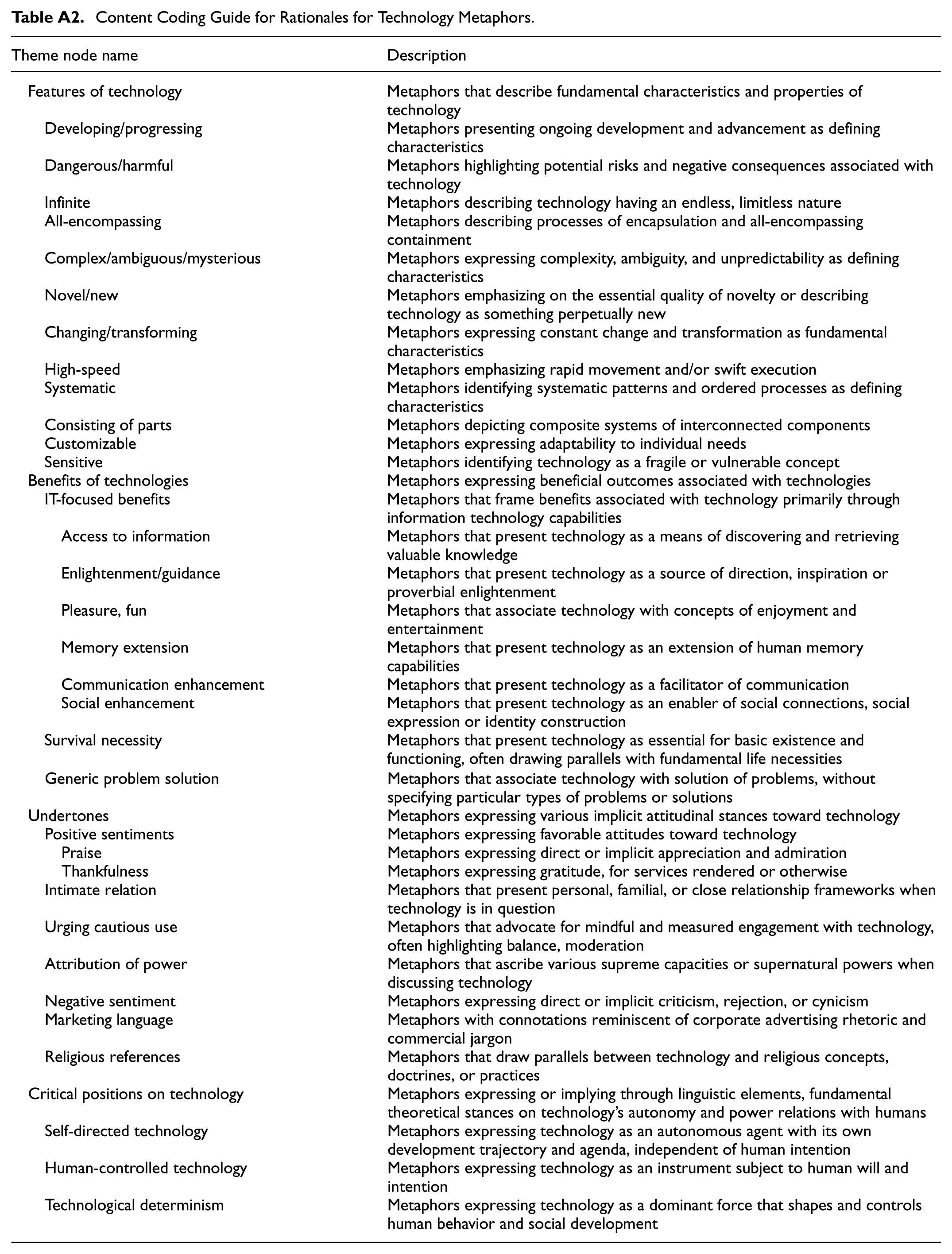
To ensure coding reliability, a randomly selected sample comprising 10% of the original data, as suggested by O’Connor and Joffe (2020), was independently coded by both the researcher and a scholar in educational technology using the thematic guides the English translations of which were provided in Tables A1 and A2, developed and manually translated by the researcher. The weighted Cohen’s Kappa coefficient for interrater agreement was .75, indicating substantial agreement (Landis & Koch, 1977). The entire coding process was carried out on original data in Turkish language, using original Turkish versions of the thematic guides, by coders both of whom were native Turkish speakers. For the purpose of preparing this research report, only the sample quotes from theme categories have been manually translated into English by the researcher, as shown in Tables 1 and 2. For cross-validation of translated content, participant id numbers have been provided after each translated quote.
Thematic Categories of Participant Metaphors Employed for Technology.

Note. f: number of coding references—participant #id numbers are shown in parentheses.
Thematic Categories for Participant Rationales of Technology Metaphors.

Note. f: number of coding references—participant #id numbers are shown in parentheses.
To analyze the relationships between metaphorical conceptualizations and their underlying rationales, a hierarchical cluster analysis was conducted using PAST 4.03 software. The analysis employed a matrix coding approach that examined relationships among all identified themes (both metaphor categories and their rationales). To maintain analytical clarity and ensure robust patterns, only the themes with coding frequencies exceeding 15 occurrences—a threshold that balanced comprehensive coverage with analytical precision, capturing approximately 90% of all coded responses while maintaining interpretative manageability—were included. The analysis utilized the paired group (UPGMA) algorithm, which iteratively clusters items based on average similarities, providing a more balanced representation of relationships than single or complete linkage methods (Hale & Dougherty, 1988). Correlation was selected as the similarity index rather than Euclidean distance, as it better captures conceptual relationships by focusing on patterns of co-occurrence rather than absolute frequencies (Romesburg, 2004). The analysis was conducted without constraints to allow natural clustering patterns to emerge, with 1,000 bootstrap iterations to ensure stability of the results.
This study was conducted with approval from Trakya University Social Sciences Research Ethics Board (Decision #11.38, Session 2022/11).
Findings
Research Question 1: Identification of Metaphorical Expressions and Underlying Rationales
As the first step in systematic analysis, the metaphors used by participants to describe technology were identified and categorized into themes through content coding. Table 1 displays the category structure and number of coding references for each theme node. Aggregate coding from child theme nodes is enabled in this representation. The content coding guide for this section has been shared in Table A1.
It was observed that pre-service teachers largely resorted to using Material Metaphors (f = 562, 83.8% of total coded responses), largely outnumbering usage of Abstract Metaphors (f = 109, 16.2%). Within Material Metaphors, Natural Phenomena (f = 169; “metaphors that understand technology through natural forces and phenomena in the physical world”) was the most frequent, exemplified by Water (f = 68) and Astronomical References (f = 36). This was followed by Manufactured Objects (f = 132; “metaphors that understand technology through human-made tools, devices, and products”), dominated by Tools (f = 68) and Addictive Substances (f = 42). Living or Sentient Beings was another prominent Material Metaphor category (f = 122; “metaphors that conceptualize technology as various forms of living beings”); most frequently featuring People (f = 88). On the other hand, Abstract Metaphors most frequently comprised the metaphors of Life (f = 40; “Metaphors that equate technology with life itself”), Temporal Concepts (f = 17; “Metaphors that understand technology through concepts related to time”) and Emotions (f = 16) that largely consisted of Love (f = 11).
Secondly, participant responses were evaluated holistically, along with rationales provided for metaphors. The aim was to analyze and interpret the rationales for identifying themes, including the perceived or implied nature, mannerisms, or features of technology, from various perspectives, such as Feenberg’s Critical Theory. Table 2 displays the category structure and number of coding references in this context. Aggregate coding from child theme nodes is enabled in this representation. The content coding guide for this section has been shared in Table A2.
Participant rationales most frequently addressed Features of Technology (f = 478), with Developing/Progressing (f = 123; “metaphors presenting ongoing development and advancement as defining characteristics”) being the dominant sub-theme. This was followed by Dangerous/Harmful (f = 81; “metaphors highlighting potential risks and negative consequences”), Infinite (f = 63) and All-Encompassing (f = 57). Discussions on Benefits of Technologies (f = 406, 57.5%) were primarily characterized by IT-Focused Benefits (f = 197), notably Access to Information (f = 99; “metaphors that present technology as a means of discovering and retrieving valuable knowledge”). In their Undertones (f = 283) participants frequently reflected positive sentiments (f = 60), including Praise (f = 43) and Thankfulness (f = 17). They tended to use Intimate Relation remarks (f = 54, “Metaphors that present personal, familial, or close relationship frameworks when technology is in question”) alongside Marketing Language (f = 35; “metaphors with connotations reminiscent of corporate advertising rhetoric”). Critical Positions (f = 224) featured Self-Directed Technology (f = 115, “Metaphors expressing technology as an autonomous agent with its own development trajectory and agenda, independent of human intention”) as the most common stance. This was followed by Human-Controlled Technology (f = 63; “metaphors expressing technology as an instrument subject to human will”). Although fewer, there were also remarks that reflected adoption of a technological determinist stance (f = 46, “Metaphors expressing technology as a dominant force that shapes and controls human behavior and social development”).
Research Question 2: Interpretation of Metaphorical Patterns Through Critical Theoretical Frameworks
The dendrogram (Figure 1) was achieved as a result of the cluster analysis procedure detailed in the methodology section. The figure reveals the strength of associations between different conceptualizations of technology, with the numbers on branches indicating bootstrap probability values. A similarity threshold of 0.30, marked with the dashed line, was established to delineate meaningful clusters. This means that, only groups with correlation values exceeding this threshold were considered distinct clusters. While the selection of similarity thresholds can be subjective, this value was determined through iterative analysis to optimize the balance between cluster granularity and interpretative meaning. In this decision, recommended practices in hierarchical cluster analysis (Mooi & Sarstedt, 2011) were followed. The robustness of the clustering solution was validated by a Cophenetic correlation coefficient of .8037, which is above the 0.75 threshold suggested by Rohlf (1970) and indicates a good representation of the underlying data structure.
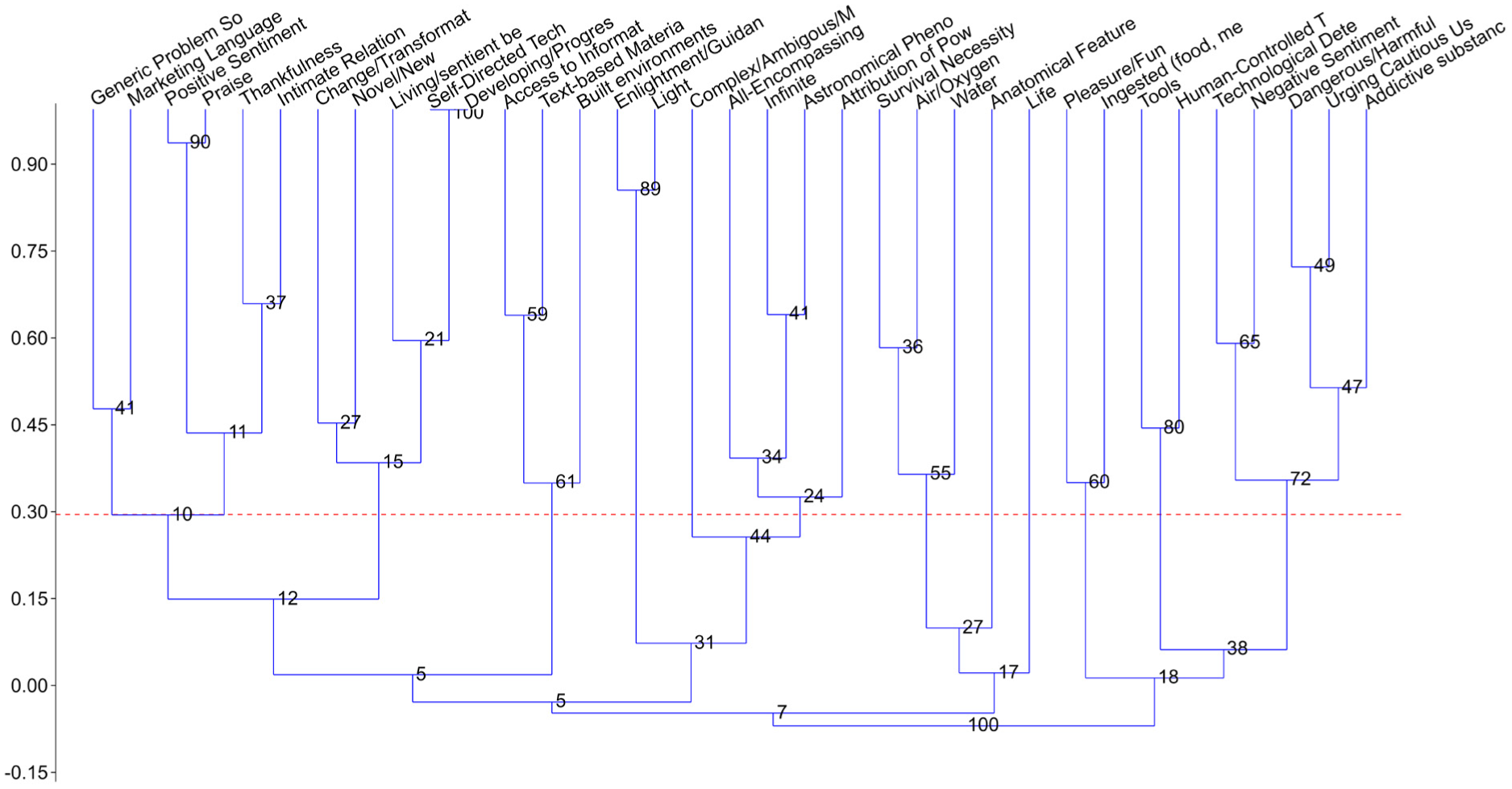
Dendrogram showing cluster analysis results.
The cluster analysis reveals several distinct patterns in how pre-service teachers conceptualize technology. These have been listed in Table 3, by encapsulating the themes in square brackets and using supportive wording for interpretation:
Theme Clusters Established Through Cluster Analysis.

It has been shown that pre-service teachers that participated in the study have shown in their elicited metaphors a use of language similar to those found in advertisement slogans or marketing campaigns, in explaining how technology is something that solves generic problems, while praising and expressing their thankfulness for these qualities, alongside remarks hinting at intimate relation with it (Cluster 1). They have also frequently likened technology to a self-directing, sentient or living being that is constantly changing and remaining perpetually in a novel/new state (Cluster 2). At times, participants referred to technology by using metaphors of text-based materials (e.g., books, encyclopedias), or built environments (e.g., libraries) that facilitate access to valuable information (Cluster 3). There have been frequent discussions that discussed how technology provided guidance or enlightenment, by way of metaphors that consist of beings that literally emit physical light (Cluster 4). In another theme cluster, technology has been likened to celestial objects or other astronomical phenomena (planets, comets, stars, galaxies, etc.) with qualities of being extremely large or somehow infinite and all-encompassing (Cluster 5). Technology also has been likened simply to food or medicine type of items that are ingested orally and somehow sensations of pleasure or fun (Cluster 6). In a simpler cluster, technology has been likened to physical metaphors of man-made tools (hammers, screwdrivers, etc.) and this was associated with the notion of humans being actors directly controlling such technology (Cluster 7). Finally, a theme cluster has shown that participants frequently discussed technology as a dangerously addictive thing which people should be wary about, and while doing so they seemed to convey beliefs of being powerless against this strong force that acts against their wish, which they also cursed (Cluster 8).
Discussion
Instrumentalization
Feenberg’s instrumentalization theory provides a compelling framework for analyzing how pre-service teachers conceptualize technology through their metaphorical expressions. This theory posits that technology involves two levels of instrumentalization: primary instrumentalization, which concerns the functional constitution of technical objects and subjects, and secondary instrumentalization, which deals with the realization of constituted objects and subjects in actual social contexts (Feenberg, 1999, 2005).
Primary instrumentalization is prominently reflected in Cluster 7, which frames technology through [Human-Controlled Technology] manifested as [Tools]. This cluster aligns with Feenberg’s description of the functional decomposition of objects from their original context, reducing them to their useful properties. The [Tools] theme in our coding framework specifically “emphasizes its instrumental and utilitarian nature,” demonstrating how pre-service teachers understand technology primarily through its functional attributes.
This decontextualization is further evident in Cluster 3’s representation of technology through [Text-Based Materials] and [Built-Environments] that facilitate [Access to Information]. The coding framework defines [Text-Based Materials] as “metaphors that compare technology to written or printed materials, emphasizing its role in information storage and transmission.” This understanding reduces technology to its basic functional role as an information management tool, stripping away broader social and cultural contexts.
This narrow functionalization reveals a concerning limitation in the technological understanding of pre-service teachers. Their metaphorical expressions, particularly through the combination of [Built-Environments] and [Access to Information], suggest they predominantly equate technology with information technology, likely limited to smartphones, computers, and internet-based tools. This reductionist view reveals a significant blind spot in their technological awareness, overlooking the vast array of technologies that shape modern life, from agricultural innovations and manufacturing systems to transportation infrastructure and medical technologies. Such a constrained conceptualization of technology through primarily IT-focused metaphors may limit their ability to critically engage with technology’s broader role in society and education. This aligns with what Feenberg cautions against: the danger of reducing technology to its most visible contemporary manifestations, thereby missing its deeper historical and societal implications.
In contrast, secondary instrumentalization is strongly evident in Cluster 1, where the use of [Marketing Language] is employed to explain how technology is associated with [Generic Problem Solution], while conveying [Positive Sentiments], [Praise], and [Thankfulness] through language that suggests an [Intimate Relation]. This cluster exemplifies what Feenberg refers to as the integration of technology into social contexts and natural environments.
The [Marketing Language] theme, as defined in the framework and inspired by Selwyn (2016), is characterized as “metaphors with connotations reminiscent of corporate advertising rhetoric and commercial jargon,” illustrating how technical objects are reintegrated into social discourse through commercial narratives. This recontextualization is further enriched by the presence of [Intimate Relation] themes, which the coding framework describes as “metaphors that present personal, familial, or close relationship frameworks when technology is in question”. Technology, as this cluster reveals, is perceived as something friendly and intimate, worthy of praise and gratitude, because it solves or facilitates the solution of problems (of any type). This idea is typically expressed in advertisement jargon.
Cluster 6’s association of [Pleasure/Fun] with [Ingested Items (food/medicine)] represents another dimension of secondary instrumentalization. The framework defines food-related metaphors as those “emphasizing aspects of necessity, satisfaction, or dependency,” while medication metaphors are described as those “that provide health benefits.” This integration of technology into daily life through consumption metaphors demonstrates what Feenberg terms the mediation aspect of secondary instrumentalization, where technical objects are clothed in aesthetically and ethically meaningful characteristics.
The interplay between [Positive Sentiments] and the various forms of social integration (through marketing, intimate relations, and consumption) reveals how secondary instrumentalization operates to embed technology within social and personal meaning systems. This is particularly evident in how the framework defines [Positive Sentiments] as “metaphors expressing favorable attitudes toward technology,” showing the emotional and social dimension of technological integration.
This analysis, viewed through the lens of instrumentalization theory, reveals how pre-service teachers’ metaphorical conceptualizations of technology encompass both the functional reduction necessary for technical control (primary instrumentalization) and the social integration required for meaningful technological practice (secondary instrumentalization).
Technology as an Autonomous Being
A particularly revealing pattern emerges in Cluster 2, which characterizes technology through [Self-Directed Technology] metaphors, depicting it as a [Living/Sentient Being] that is perpetually [Developing/Progressing], undergoing [Change/Transformation], and maintaining a [Novel/New] state. This anthropomorphization of technology as a singular, autonomous entity carries significant implications for how pre-service teachers conceptualize their relationship with technology and their own agency in technological contexts.
The coding framework defines [Living/Sentient Being] metaphors as those “conceptualizing technology as various forms of living beings, from microorganisms to humans,” including references to specific roles, professions, and growth stages. When combined with [Self-Directed Technology], defined as metaphors “expressing technology as an autonomous agent with its own development trajectory and agenda, independent of human intention,” we see a concerning linguistic pattern that strips humans of their agency in technological development and implementation.
This anthropomorphic view is reinforced by Cluster 5’s [Attribution of Power] to technology, which links it to [Astronomical Phenomena] characterized as [Infinite] and [All-Encompassing]. The framework describes [Attribution of Power] as “metaphors that ascribe various supreme capacities or supernatural powers when discussing technology.” This combination of metaphors suggests a view of technology as not just autonomous but possessing almost cosmic levels of agency and influence, far beyond human control or intervention.
A crucial distinction emerges between the two forms of deterministic thinking in the pre-service teachers’ metaphors. The explicit [Technological Determinism] theme, appearing in Cluster 8 alongside [Negative Sentiment] and [Dangerous/Harmful] aspects, represents a conscious critique. Here, pre-service teachers actively express their awareness and contempt for how technology strips humans of their agency, defining it as “a dominant force that shapes and controls human behavior and social development.” This critical awareness is accompanied by [Urging Cautious Use], suggesting a resistant stance against technological hegemony.
In contrast, the [Self-Directed Technology] theme in Cluster 2 represents what might be termed a somnambulant determinism—an unconscious acceptance of technology’s autonomy. This manifests in the very linguistic structure of how pre-service teachers discuss technology, as a monolithic being that does things on its own, without any apparent recognition of the implications of this framing. This uncritical acceptance is particularly evident in the combination of [Developing/Progressing] metaphors presenting “ongoing development and advancement as defining characteristics,” with [Change/Transformation] metaphors emphasizing “constant change and transformation as fundamental characteristics.” Unlike the explicit critique in Cluster 8, these metaphors naturalize technological autonomy, treating it as an unquestioned reality rather than a problematic social construction. The framework’s definition of [Dangerous/Harmful] as “metaphors highlighting potential risks and negative consequences associated with technology” takes on new significance when these risks are attributed to an autonomous technological agent rather than human decisions and implementations.
The contrast with Cluster 7’s [Human-Controlled Technology] and [Tools] metaphors is stark and revealing. While some pre-service teachers maintain a view of technology as an instrument subject to human will, the prevalence of anthropomorphic and deterministic metaphors suggests a competing narrative where technology has evolved beyond human control into an independent force. This tension reflects broader societal anxieties about technological advancement and human agency in an increasingly technologized world.
Particularly noteworthy is how the [Novel/New] characteristic, defined as “metaphors of novelty or describing technology as something perpetually new,” contributes to this narrative of autonomous development. The constant state of newness is attributed to technology’s own agency rather than human innovation and development, further reinforcing the deterministic view.
The anthropomorphization of technology takes an even more concerning turn when examined alongside Cluster 4’s association of technology with [Enlightenment/Guidance] through metaphors of physical [Light]. The framework defines [Enlightenment/Guidance] as “metaphors that present technology as a source of direction, inspiration, or proverbial enlightenment.” When combined with the autonomous agency already attributed to technology, this ascription of wisdom and enlightenment suggests a troubling deification of technology.
This tendency toward technological mystification, which Feenberg (2017) critiques, represents a particularly problematic form of technological consciousness. Feenberg’s concept of mystification describes how technology becomes perceived as an opaque, quasi-magical force that operates according to its own internal logic, beyond human understanding or intervention. This mystification serves to obscure the social relations and human decisions embedded in technological systems, replacing them with a reverence for technology’s apparent transcendental wisdom. It also takes on particularly intriguing forms when participants’ naturalistic metaphors are taken into consideration. As Houtman and Aupers (2010) observe in their analysis of technology practitioners in Silicon Valley, some specialists even explicitly embrace pagan identities, such as “cyberdruids” or “technopagans,” viewing their work with complex software as indistinguishable from performing naturalistic magic. The prevalence of natural and cosmic phenomena in participants’ metaphorical expressions—from celestial bodies to elemental forces—combined with their attribution of autonomous wisdom to technology, suggests that this tendency toward technological animism may be more widespread than previously recognized.
In the context of this analysis, by attributing not just agency but also wisdom and enlightenment to technology, pre-service teachers seem to be at risk of abdicating their own critical judgment and professional wisdom in favor of technological guidance. The metaphor of [Light] in this context does not just suggest illumination but takes on almost divine connotations—technology becomes not just an autonomous force but a source of truth and wisdom. The combination of [Enlightenment/Guidance] with [Light] metaphors particularly exemplifies what Feenberg terms the “technological veil”—a form of mystification that conceals the socially contingent nature of technology behind an appearance of pure technical rationality. This veiling process, the adverse effects of which Adorno (2012) also discusses eloquently in Education after Auschwitz, is especially evident when pre-service teachers frame technology as a source of enlightenment, effectively transforming what should be understood as tools and systems designed by humans into oracular sources of wisdom. Such mystification not only obscures the social character of technology but also naturalizes existing technological arrangements, making them appear inevitable rather than the product of specific social choices and power relations.
The combined pattern of anthropomorphization, implicit technological determinism, and technological mystification in pre-service teachers’ metaphorical expressions raises significant concerns. When technology is conceptualized as an autonomous, all-powerful, and wisdom-bearing entity with its own agenda, it becomes more difficult to foster critical engagement with technological systems or to develop agency in technological decision-making. This mindset may lead not just to passive acceptance of technological change but to an uncritical reverence for technological ‘wisdom’ over human judgment and experience. This point can also be analyzed from Ellul’s (2021) perspective, which raises concerns that technology, despite its progress and innovation, could eventually overwhelm the individual, leading to a mechanized and dehumanized society where human agency is constrained by the very systems we create. In The Technological Society, Ellul warns of a world where technology’s influence has become so pervasive that it dictates not only humans’ actions but also their thoughts and values.
Substantivism Versus Instrumentalism
The pre-service teachers’ metaphorical expressions reveal a complex oscillation between substantivist and instrumentalist views of technology. Feenberg (1999) outlines these contrasting philosophical positions: instrumentalism views technology as completely neutral tools serving human intentions without inherent value content, while substantivism (which was hinted at in the previous analysis) sees technology as an autonomous cultural force that subordinates human society to its own development logic. While Feenberg critiques both positions as inadequate for understanding technology’s role in society—instrumentalism for ignoring technology’s non-neutrality and substantivism for its fatalistic determinism—their presence in teachers’ conceptualizations provides insight into how future educators understand technology.
The instrumentalist position, which views technology as entirely neutral tools subject to human control, emerges strongly in Cluster 7’s [Human-Controlled Technology] and [Tools] metaphors, and Cluster 1’s use of [Marketing Language] to frame technology as a [Generic Problem Solution]. These metaphors portray technology as value-free, neutral, and generic instruments that serve human intentions and solve all problems, regardless of their nature. In stark contrast, substantivist undertones appear in Cluster 5’s [Attribution of Power] to technology through [Astronomical Phenomena] characterized as [Infinite] and [All-Encompassing], in Cluster 2’s depiction of [Self-Directed Technology] as a [Living/Sentient Being] and explicitly in Cluster 8’s [Technological Determinism]. These metaphors align with substantivism’s view of technology as an autonomous force that fundamentally reshapes human existence.
There is an interesting tension between the substantivist and instrumentalist perspectives reflected in how Cluster 8 combines assumptions of control ([Urging Cautious Use]) with substantivist fears of technological autonomy ([Technological Determinism]). The simultaneous presence of both perspectives suggests an unresolved contradiction, from a Feenbergian perspective, in how pre-service teachers conceptualize their relationship with technology.
The implications of this oscillation between the two positions are particularly significant for educators’ technology conceptions. This conceptual tension could manifest in either uncritical adoption of technological solutions (the instrumentalist trap) or a fatalistic stance towards technological change (the substantivist trap), rather than the critical engagement that Feenberg advocates.
Conclusion and Implications for Future Research
Summary of Key Findings
This study’s analysis of pre-service teachers’ metaphorical conceptualizations of technology reveals several concerning patterns that have significant implications for teacher education and technological literacy. The findings demonstrate how future educators’ understanding of technology often oscillates between instrumentalist and substantivist positions, frequently embodying problematic forms of technological determinism and reification that may hinder their ability to foster critical technological literacy among their students.
The cluster analysis revealed eight distinct patterns in how pre-service teachers conceptualize technology, ranging from marketing-influenced positive sentiments to anthropomorphic views of self-directed technology and deterministic perspectives coupled with disdainful sentiments. These patterns align with but significantly extend previous studies’ findings in the Turkish domain.
Implications for Teacher Education
While earlier research by Çavaş et al. (2019), Gök and Erdoğan (2010), and others has documented educators’ tendency to reduce technology to tools and substances, the current analysis reveals more complex patterns of technological mystification and anthropomorphization that were previously unexamined in these studies.
The comparison with Zengin’s (2023) findings is particularly revealing. While Zengin found that teachers’ definitions of technology were “partially correct” and focused primarily on practical implementation in educational settings, the current analysis suggests that the issue runs deeper than mere definitional accuracy. The metaphorical expressions analyzed in this study reveal fundamental misconceptions about technology’s nature and agency that may persist even when teachers provide technically correct definitions or implement successful educational interventions, utilizing IT tools within their classrooms. This finding conforms with recent studies indicating that pre-service teachers in many contexts receive minimal or inconsistent preparation in technology education, with such content often relegated to elective courses rather than core curriculum requirements (Pappa et al., 2024b).
Furthermore, a recent elicited metaphor research, carried out with 55 pre-service ICT teachers in Turkey in a similar vein with the current study, investigates utopian-dystopian views in technology related discourse, and reveals interesting results. In the report by Bardakci and Ünver (2020), it is stated that “technology or technological change is widely accepted in a utopian spectrum of viewpoints, particularly in an autonomous and improved state of affairs way of approach” by the participants of the study and this perspective has been explained to, again, be driven by technological determinism. Here, it is important that the participants in Bardakci and Unver’s research were prospective computer science teachers, who would most likely be considered more “technologically literate” in the traditional sense, than their counterparts in other teaching specialty areas. The traditional sense here meaning, technological literacy that is reduced to technical proficiency alone. And yet, even those who are expected to be technologically literate in this sense, have been shown in Bardakci and Unver’ study to display unrealistic conceptions of technology that may be argued to benefit market forces above all.
A recent systematic literature review of research on critical digital literacies education in schools has shown that the following subject were covered most frequently under the ‘critical’ umbrella term: e-safety, participation and presence, digital literacy, media literacy, digital citizenship, technology literacy, information literacy, data literacy, digital game literacy, online learning, digital creativity and innovation, and digital well-being (Ilomäki et al., 2023). It should be noted how it can be argued that this critical list appears to be devoid of perspectives informed by critical theories such as Feenberg’s or the Frankfurt School’s, which are not only critical but also political. Perhaps, due to a similar trend, technological literacy might be suffering from a similar lack of political critical perspective and calls have been made for a more expansive definition of the concept (Hallström, 2023; Ingerman & Collier-Reed, 2011; Pleasants et al., 2024; Roberts & Kruse, 2023). The results of both Bardakci and Unver (2020) and the current study both carry implications supporting the urgency of such recent calls to action. A technological literacy in the political sense would not simply focus on the poiesis aspect (e.g., how to code, how to build circuits, how to 3D print, how to operate machines) of human behavior but encompass the praxis aspect as well. In this context, a technologically literate person would therefore be expected to reflect on why we make what we make or who benefits from what we make as far as technology is concerned. She would also think about the impacts of technologies on people and societies in the context of power relations; and be aware of one’s agency and thus act with ethical-political awareness as far as technological processes are concerned.
The T-Word Phenomenon and Its Implications
The most important and immediate practical implication of this study is perhaps hidden in the provocative title of Selwyn’s (2016) editorial: “Minding Our Language.” When choosing to use the word “technology,” either in internal thought processes or in communication, educators may attempt to free it from the T-word context, starting by simply using mild linguistic alterations, such as using the word in the plural form or with an identifier before it, wherever possible.
Priorities for Future Research
Several key areas also emerge as priorities for future research, which may be listed as (a) increased efforts on the development of assessment tools that can capture the complexity of technological literacy (Ingerman & Collier-Reed, 2011) beyond mere technical competence (Avsec & Jamšek, 2016), (b) development of assessment tools that can measure misconceptions of technology in various dimensions, and (c) whether critical pedagogy (Apple, 2019; Freire, 1970; Giroux, 2020) awareness or critical media literacy (Kellner & Share, 2007; Masterman, 1985; McLaren, 1995) influences technological understanding.
Study Limitations
As this study employed a cross-sectional approach, a single-institution sample, and a single language/region, which limits generalizability, longitudinal studies that assess the impact of professional experience on technological conceptualization, or more expansive studies that examine technological conception through linguistic elements in broader linguistic or cultural groups, may be helpful. Another limitation of the study has been the structured elicitation of metaphors, which, while enabling systematic analysis, may not capture the full complexity of participants’ technological understanding. Future research into technological conception may therefore consider other approaches that employ different data collection strategies, such as interviews or the use of language corpora. Lastly, intervention studies that aim to design approaches in teacher education to foster critical views of technology and prevent problematic conceptualizations may also be necessary, so that future educators recognize and resist both instrumentalist and substantivist extremes in technological thinking.
Footnotes
Appendix A
Content Coding Guide for Rationales for Technology Metaphors.
| Theme node name | Description |
|---|---|
| Features of technology | Metaphors that describe fundamental characteristics and properties of technology |
| Developing/progressing | Metaphors presenting ongoing development and advancement as defining characteristics |
| Dangerous/harmful | Metaphors highlighting potential risks and negative consequences associated with technology |
| Infinite | Metaphors describing technology having an endless, limitless nature |
| All-encompassing | Metaphors describing processes of encapsulation and all-encompassing containment |
| Complex/ambiguous/mysterious | Metaphors expressing complexity, ambiguity, and unpredictability as defining characteristics |
| Novel/new | Metaphors emphasizing on the essential quality of novelty or describing technology as something perpetually new |
| Changing/transforming | Metaphors expressing constant change and transformation as fundamental characteristics |
| High-speed | Metaphors emphasizing rapid movement and/or swift execution |
| Systematic | Metaphors identifying systematic patterns and ordered processes as defining characteristics |
| Consisting of parts | Metaphors depicting composite systems of interconnected components |
| Customizable | Metaphors expressing adaptability to individual needs |
| Sensitive | Metaphors identifying technology as a fragile or vulnerable concept |
| Benefits of technologies | Metaphors expressing beneficial outcomes associated with technologies |
| IT-focused benefits | Metaphors that frame benefits associated with technology primarily through information technology capabilities |
| Access to information | Metaphors that present technology as a means of discovering and retrieving valuable knowledge |
| Enlightenment/guidance | Metaphors that present technology as a source of direction, inspiration or proverbial enlightenment |
| Pleasure, fun | Metaphors that associate technology with concepts of enjoyment and entertainment |
| Memory extension | Metaphors that present technology as an extension of human memory capabilities |
| Communication enhancement | Metaphors that present technology as a facilitator of communication |
| Social enhancement | Metaphors that present technology as an enabler of social connections, social expression or identity construction |
| Survival necessity | Metaphors that present technology as essential for basic existence and functioning, often drawing parallels with fundamental life necessities |
| Generic problem solution | Metaphors that associate technology with solution of problems, without specifying particular types of problems or solutions |
| Undertones | Metaphors expressing various implicit attitudinal stances toward technology |
| Positive sentiments | Metaphors expressing favorable attitudes toward technology |
| Praise | Metaphors expressing direct or implicit appreciation and admiration |
| Thankfulness | Metaphors expressing gratitude, for services rendered or otherwise |
| Intimate relation | Metaphors that present personal, familial, or close relationship frameworks when technology is in question |
| Urging cautious use | Metaphors that advocate for mindful and measured engagement with technology, often highlighting balance, moderation |
| Attribution of power | Metaphors that ascribe various supreme capacities or supernatural powers when discussing technology |
| Negative sentiment | Metaphors expressing direct or implicit criticism, rejection, or cynicism |
| Marketing language | Metaphors with connotations reminiscent of corporate advertising rhetoric and commercial jargon |
| Religious references | Metaphors that draw parallels between technology and religious concepts, doctrines, or practices |
| Critical positions on technology | Metaphors expressing or implying through linguistic elements, fundamental theoretical stances on technology’s autonomy and power relations with humans |
| Self-directed technology | Metaphors expressing technology as an autonomous agent with its own development trajectory and agenda, independent of human intention |
| Human-controlled technology | Metaphors expressing technology as an instrument subject to human will and intention |
| Technological determinism | Metaphors expressing technology as a dominant force that shapes and controls human behavior and social development |
Acknowledgements
The author extends gratitude to Belkis Mihci for her assistance with the interrater reliability analysis, and to all pre-service teachers who participated in this study. The Claude.ai generative AI tool was used for providing linguistic suggestions.

Ethical Considerations
This study was conducted with approval from Trakya University’s Social Sciences Research Ethics Board (Decision #38, Session 2022/11). All procedures performed in this study involving human participants were in accordance with the ethical standards of the institutional research committee. Informed consent was verbally obtained from all individual participants, who were explained the nature and purpose of the study. Participation was voluntary and completely anonymous.
Funding
The authors received no financial support for the research, authorship, and/or publication of this article.
Declaration of Conflicting Interests
The authors declared no potential conflicts of interest with respect to the research, authorship, and/or publication of this article.
Data Availability Statement
The datasets and NVivo project files generated during and/or analyzed during the current study are available from the corresponding author on reasonable request. Data sharing will be considered on a case-by-case basis due to participant privacy considerations.