




Abstract
Education plays a very important role in the development and progress of a certain nation. With the advancement of science and technology, it is indeed that globalization and internalization of education are considered as challenges that every country must uphold. And one of the emphases of today’s challenges in education is the promotion of 21st-century skills among students. However, it is also a reality that a huge number of the world population are dropouts, out-of-school youth, and even individuals who do not go to formal schooling. And as a result, these individuals who do not go to formal schooling have difficulties in understanding and learning 21st-century skills which enable them to cope with and to compete in the globalized world. And to cope with these challenges given by the changing world and knowledge economy, alternatives were presented and implemented by the countries around the world such as the Philippines to help individuals attain education through nonformal and informal education such as the Alternative Learning System (ALS). This study was conducted to determine the 21st-century skills of ALS learners of Northern Philippines. In all, 150 ALS learners across five schools in Northern Philippines participated in the study through descriptive survey method. Results revealed that the ALS learners have a low level of acquisition of 21st-century skills. Furthermore, results of the independent-sample t test and one-way ANOVA test revealed that sex, age, and employment status affect the acquisition of learners on 21st-century skills.
Introduction
Education plays a very important role in the development and progress of a certain nation. With the advancement of science and technology, it is indeed that globalization and internalization of education are considered as challenges that every country must uphold. And one of the emphases of today’s challenges in education is the promotion of 21st-century skills among students. With this, schools both in public and private must focus not just on imparting the basics but equally so on ensuring that students gain a suite of newly important thinking and reasoning skills (Silva, 2009). The 21st-century skills is defined as a broad set of knowledge, skills, work habits, and character traits that are believed to be critically important to success in today’s world, particularly in collegiate programs and contemporary careers and workplaces, and can be applied in all academic subject areas and in all educational, career, and civic settings throughout student’s life (Moyer, 2016; Rotherham & Willingham, 2009). The 21st-century skills are needed to be able to solve problems that are complex, collaborate and communicate well with others, acquire new skills and information independently, and adapt to rapidly changing conditions to compete in today’s rich and global economy (Gewertz, 2008).
It is then a reality that educational institutions around the world should be able to promote 21st-century skills to its students through formal education. However, it is also a reality that a huge number of the world population are dropouts, out-of-school youth, and even individuals who do not go to formal schooling. And as a result, these individuals who do not go to formal schooling have difficulties in understanding and learning 21st-century skills which enable them to cope with and to compete in the globalized world. And to cope with these challenges given by the changing world and knowledge economy, alternatives were presented and implemented by the countries around the world to help individuals attain education through nonformal and informal education (Colardyn & Bjornavold, 2004), especially in developing countries (Nath, Sylvia, & Grimes, 1999) such as the Philippines.
The Philippines is active in accepting the global challenge of providing Educational Services to the Filipinos. In fact, in the year 1990, the international development community birthed a massive global education initiative called Education for All (EFA) 2015 (Gonzales, 1999). The Philippine government has adopted this commitment of EFA goals in EFA assembly in Jomtien, Thailand, in 1990 and Dakar, Bangladesh, in 2000. The country also adapts Millennium Development Goals (MDG) in 2001 and the Decade for Literacy in 2003. But despite this educational goal, the country still continuously suffers a very high dropouts statistically 62% of the Filipino Student Population or 11,000,000 in total (United Nations International Children’s Emergency Fund, 2010). The Government efforts to combat school attrition through strengthening student programs and developing a system that will promote continuing education, thus, promulgated Republic Act 9155 in 2001 or the Governance Act of Basic Education which provides provisions for Alternative Learning System (ALS) that will address illiteracy and promote continuing education.
The implementation of ALS paved way to the rights for education to be asserted by marginalized groups like children, women, people with special needs, and Indigenous people communities (Doronila, 1997; Raywid, 1994; Valk, 2009) and also out-of-school-youths (OSY) who did not finish their basic education due to economic and support issues. Many studies had shown that globalization favors the educated, skilled, and mobile workers (Abinales & Dolan, 2012; Guerrero, 2007), and marginalized groups who are denied of access to education will most likely be unable to benefit from modernization. For the OSY and unprivileged Filipino learners to cope with the fast changing workplace, the Bureau of Alternative Learning System (BALS) under the Department of Education (DepEd) has designed a curriculum combining the formal and nonformal education (Philippine Education for All, 2009). The learning strands are not adapted according to their disciplinal case but according to their “functionality.” The ALS is identified as a Community-Based Learning Service (Pinca, 2015), where it pursues the growth of students’ intellectual capacity along their chosen career path and aims to promote their sense of social responsibility, providing them the opportunity to serve the community. This challenges ALS teachers to try their best to provide a meaningful learning experience to such a diverse group. Galima (2012) identified three teaching strategies. One is the use of informal sharing of experiences at the beginning of the session. This would inform the teacher about the condition of the learners, their current concerns, and interest. They carefully consider the learners’ interests before starting to teach them the contents of the module. Another strategy is the use of various computer-based technologies, especially video clips. This is done to keep the learners, especially the younger ones, motivated and engaged. The third one is the use of group activities which are meant to create a closer relationship among the learners. Eventually, the class becomes a support group.
The program also stresses that it is a parallel learning system that provides a viable alternative to the existing formal education instruction which encompasses both the nonformal and informal sources of knowledge and skills. Also, literatures suggest that ALS is an avenue for OSY and individuals to learn not only basic and life skills but, more importantly, 21st-century skills for them to cope with and to easily adjust with the changes in their environment (Caoili, 2007; Kim & Taylor, 2008; Le Clus, 2011). It can be understood then that students of ALS program are already equipped at least with 21st-century skills needed for their professional and personal growth.
Recent trends in research stressed the need in evaluating the effectiveness of nonformal education programs (Huffman, Lawrenz, & Thomas, 2008; Isaacs, Macomber, Rennane, & Steuerle, 2010; Walahoski & Suzanne, 2012), such as the ALS Program of the Philippines (Dela Rosa, 2015; Mercado, 2005; Oracion, 2002). The use of effective evaluation of such programs plays a critical role in revealing its outcomes specially in terms of assessing if the objectives of the programs are really met (Braverman & Arnold, 2008; Castleberry & Enger, 1998; Clavijo, Flemming, Hoerman, Toal, & Johnson, 2005). As such, assessing students’ outcomes is one of the best ways to measure the effectiveness of such programs (Dugger & Dugger, 1998; George & George, 2000) and to see to it that such programs promote and help students to become globally competitive through the acquisition of the 21st-century skills despite learning in nonformal school (Bozhovich, 2009). With this, it can be concluded that the importance of student engagement in 21st-century skills is at the forefront of educational reforms. However, little has been done to assess such engagement especially with nonformal learners (Feichas, 2010; Rotherham & Willingham, 2009), such as the ALS learners (Guerrero, 2007; Rogers, 2005). Hence, this study was conducted to assess the 21st-century acquisition of ALS learners in Northern Philippines.
21st-Century Skills
The Queensland Curriculum and Assessment Authority (2015) defined 21st-century skills as high priority skills and attributes believed to be the most significant to help students and learners live and work successfully in the 21st century. Furthermore, Johnson (2009) stressed that 21st-century skills are not only more than technological literacy but also include critical thinking, problem solving, communication, and teamwork that are necessary to succeed in work and life. Hixson, Ravitz, and Whisman (2012) identified eight skills that every student should possess in the 21st century.
Critical thinking skills refer to students being able to analyze complex problems, investigate questions for which there are no clear-cut answers, evaluate different points of view of sources of information, and draw appropriate conclusions based on evidence and reasoning.
Collaboration skills refer to students being able to work together to solve problems or answer questions, to work effectively, and, respectfully in teams, to accomplish a common goal and to assume shared responsibility for completing a task.
Communication skills refer to students being able to organize their thoughts, data, and findings and share these effectively through a variety of media as well as orally and in writing.
Creativity and innovation skills refer to students being able to generate and refine solutions to complex problems or task based on synthesis, analysis, and then combining or presenting what they have learned in new and original ways.
Self-direction skills refer to students being able to take responsibility for their learning by identifying topics to pursue and processes for their own learning, and being able to review their own work and respond to feedback.
Global connections refer to students being able to understand global, geopolitical issues including awareness of geography, culture, language, history, and literature from other countries.
Local connections refer to students being able to apply what they have learned to local contexts and community issues.
Using technology as a tool for learning refer to students being able to manage their learning and produce products using appropriate information and communication technologies.
Method
Respondents
The respondents in this study were sampled from a random sample of ALS schools in Northern Philippines. The sample consisted of 150 enrolled students of the ALS program. However, only those students enrolled under the Accreditation and Equivalency (A&E) program was considered in the study. Although it was not possible to reach a random sample of all schools offering ALS in Northern Philippines, care was taken to select schools from rural and urban communities to represent the composition of ALS students in Northern Philippines with regard to sex, age, civil status, and employment status. Table 1 shows the background variables of the respondents. Of the ALS students, 83% were female and the average age was 16.5 years. Also, 95% of the respondents were single and 65% are unemployed. These demographic characteristics of the respondents were similar to those found in comparable studies on ALS learners in other parts of the Philippines (Fernandez, 2013; Moralista & Delarierte, 2014).
Background Variables.

Research Instrument
A quantitative questionnaire using Likert-type scale was administered in April 2016 to 150 ALS students. The respondents were instructed to fill out questionnaire that asked a range of items about their 21st-century skills.
21st-Century Skills Instrument
The 21st-century skills of ALS learners were measured using the survey items taken from the International Innovative Teaching and Learning Study (Shear, Novais, Means, Gallagher, & Langworthy, 2010) and modified by Ravitz, Hixson, English, and Mergendoller (2012). The tool is a 62-item instrument on a 5-point scale (scored from 1 = strongly disagree to 5 = strongly agree). Factor analysis of the said tool revealed eight 21st-century skills. The dimensions and their internal consistency estimates (coefficient alphas) are critical thinking skills (.90), collaboration skills (.94), communication skills (.93), creativity and innovation skills (.94), self-direction skills (.95), global connections (.96), local connections (.95), and information and communications technology (ICT) (.95).
Data Analysis
The data gathered were analysis using frequency and percentage to describe the profile of the respondents, weighted mean and standard deviation to describe the 21st-century skills of the ALS learners, and independent-sample t test and one-way ANOVA test for the significant difference on the 21st-century skills acquisition of ALS learners when grouped according to their background variables.
Results and Discussion
21st-Century Skills of the ALS Learners in Northern Philippines
Table 2 presents the 21st-century skills of the students enrolled in the ALS in Northern Philippines. The findings revealed that the level of ALS learners’ acquisition of 21st-century skills is low. This implies that the learners enrolled on the program do not yet possess 21st-century skills. Under this area, local connections have the highest level of acquisition by the learners. This implies further that their local environment strongly affects the way they learn which includes the communal support they are receiving such as community learning centers which constitute the study of Gallardo (2010)saying that community and schools must collaborate in achieving specific objectives, thus enriching not just their intellectual capacity but also their social awareness. Moreover, the findings affirm the results of the studies of Jimes, Wiess, and Keep (2013) and Cheng (2002) that teachers should teach the importance of content of a certain topic that is rooted in the cultural context or in a local setting. Hence, ALS mobile teachers should adopt localized instructional materials to suit to the localized setting of learners. Meanwhile, the findings also show that most of the skills are low such as the creativity skill and the innovation skill. One likely explanation for this is the diverse status and learning styles of the learners. Moralista and Delarierte (2014) and Fernandez (2013) stated that increasing learning competencies are among the major problems encountered by mobile teachers as there are advance and slow learners affecting now the interference on cognition abilities to task-related factors such as complexity of a task or lesson. Furthermore, Craft, Jeffrey and Leibling (2001) stressed that creativity as a 21st-century skill can be enhanced and cultivated to students as it is often seen as a talent.
Descriptive Statistics on the 21st-Century Skills of the ALS Learners in Northern Philippines.
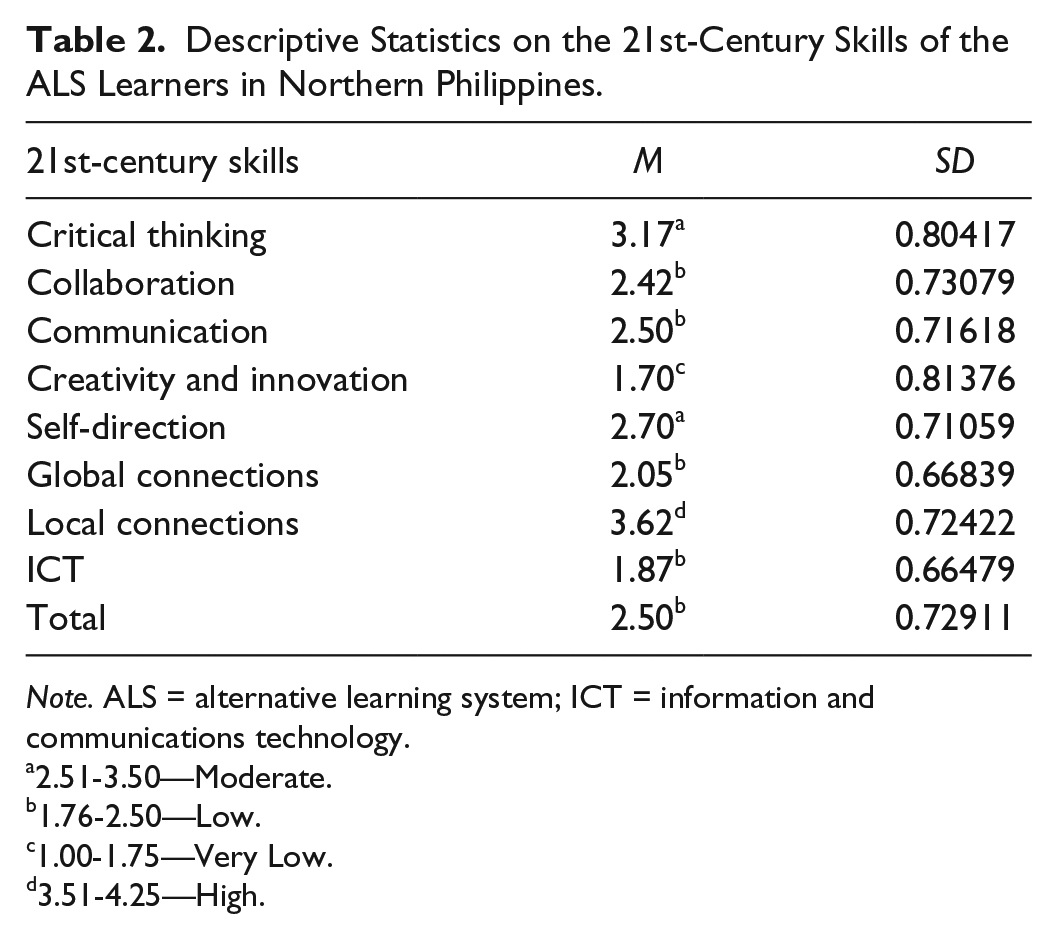
Note. ALS = alternative learning system; ICT = information and communications technology.
2.51-3.50—Moderate.
1.76-2.50—Low.
1.00-1.75—Very Low.
3.51-4.25—High.
On one hand, the findings revealed that the integration of ICT in learning is also low. This includes updating learning materials and providing modern approaches for learners. The findings affirm the study of Moralista and Delarierte (2014) where they stress that the availability of state-of-the-art equipment has significant implications to modern teaching, and learning of ALS beneficiaries. Moyer (2016) also stressed that teachers’ training in using technology in learning is vital and must be regularly instituted. Furthermore, Russell, Finger, and Russell (2000) and Hardy (1998) revealed in the study that the limited use of ICT can be characterized by the provision of minimal skills in educational technology for teachers in preservice education training courses. Hence, as a result, teachers do not employ the use of ICT, but rather stick to the traditional mode of teaching. And at the end, students will not have any avenue to develop their ICT skills. Meanwhile, the study also shows that collaboration is also one among the lowest developed 21st-century skills. Colardyn and Bjornavold (2004) found out that nonformal learners must provide meaningful learning experiences to such a diverse group. This implies that there must be informal sharing of experiences and multiple views, thus informing the mobile teachers about the condition of the learners, their current concerns, and interests. This would help both the learners and the teachers in modifying and developing approaches in providing an inclusive education. Moreover, most of the respondents stressed that working with other learners and presenting it to the class are not their mode of learning because of factors such as low self-esteem and age gaps. Bell (2010) suggested that for learners to develop or to enhance collaborative skills, teachers should teach students more on active listening skills and should employ project based in teaching.
The findings also revealed that the level of development of the learners to their communication skills is low. Mercado (2005) emphasized that learners should always express their ideas, and teachers, on the contrary, must provide learning opportunities for the students to speak their minds. He also further expressed that communication skill is one of the most important skills to adopt to the present. In addition, Silva (2009) stressed that the use of group activities is meant to create a closer relationship among the learners. Eventually, the class becomes a support group where they will feel no guilt or shame in sharing their ideas, thus giving them the self-confidence to react and be open. On the contrary, learners perceived their global connection skills as low. Moralista and Delarierte (2014) proved that there is strong pressure of fast modernization that is borderless and boundless. This implies that there is paradigm shift to the present society, hence forcing many to adapt including the ALS learners. Meanwhile, learners shared that they do not have competency dealing with studying global matters like global issues and cultural diversity. Ravitz et al. (2012) stated that a person without global connections is not prepared in facing the world outside his parameter or culture and forming conflict in engaging to other people making the other inferior or rather superior. In addition, Pinca (2015) emphasized that ALS learners must understand and be prepared in communicating and in collaborating to diverse individuals globally.
It can also be gleaned in the table that there is moderate level of development of learners in their self-direction and critical thinking skills. One likely explanation for this is their preference to work individually. This implies that they are directly involved in the learning process thus fostering their capabilities to correspond and to formulate own ways to learn. Pinca (2015) argued that excessive help and support denudes students of the opportunity to think for themselves. It stops them having to work through difficulties or solve problems. The tacit message is that there will always be someone else there to do it for them. He also suggests that effective formative feedback encourages students to be independent, because it allows them to take control of their own learning. If they know what they need to do to improve, they are in a position to make those improvements, therefore acting independently.
Significant Differences on the 21st-Century Skills of ALS Learners When Grouped According to Their Profile
Table 3 presents the significant differences on the 21st-century skills of ALS learners of Northern Philippines when grouped according to sex. The results reveal that critical thinking, collaboration, communication, self-direction, global connections, local connections, and ICT skills do not have any significant differences when grouped according to their sex. However, significant difference can be seen on creativity and innovation skills. The finding stresses that male learners are more creative and innovative than female learners. The findings affirm the results of previous researches (Abraham, 2015; Hong & Milgram, 2010; Miller, 2007). Furthermore, Abraham (2015) stressed the idea that differences between men and women in creative cognition are best explained with reference to the gender-dependent adopted strategies or cognitive style when faced with generative tasks.
Significant Differences on the 21st-Century Skills of Alternative Learning System Learners When Grouped According to Sex.
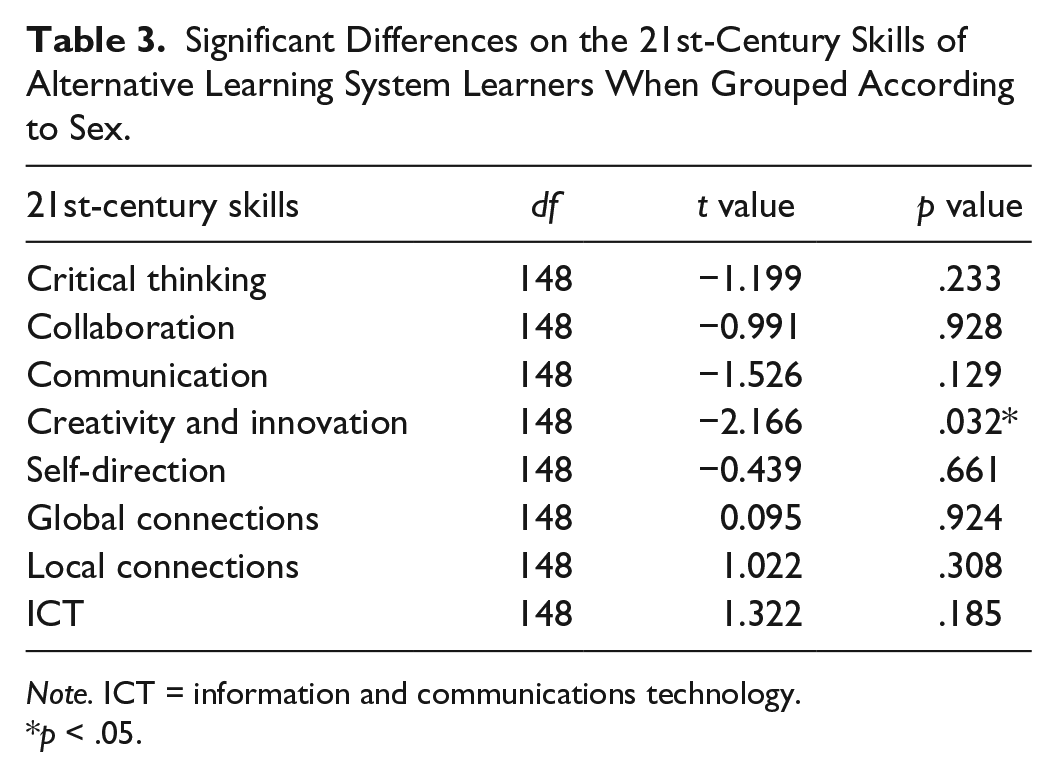
Note. ICT = information and communications technology.
p < .05.
Meanwhile, Table 4 shows the significant differences on the 21st-century skills of ALS learners of Northern Philippines when grouped according to age. It can be gleaned in the table that critical thinking, collaboration, communication, creativity and innovation, self-direction, and global connections do not have any significant differences with the different age groups. However, the findings also stress that local connections and ICT skills have significant differences between age groups. In terms of local connection skills, those learners who are 30 years old and above have the highest acquisition. This can be attributed to the fact that this age group has a high tendency of cultural appreciation and has a more possibility of being immersed in the community. Moreover, young learners who are 15 to 20 years old are those with highest acquisition of ICT integration. The findings affirm the results of previous studies on ICT integration between age groups (Stephen & Plowman, 2003; Yelland, Grieshaber, & Stokes, 2000). Moreover, the result can be attributed to the fact that teenagers nowadays have already an access and can easily use the Internet and social media sites.
Significant Differences on the 21st-Century Skills of Alternative Learning System Learners When Grouped According to Age.
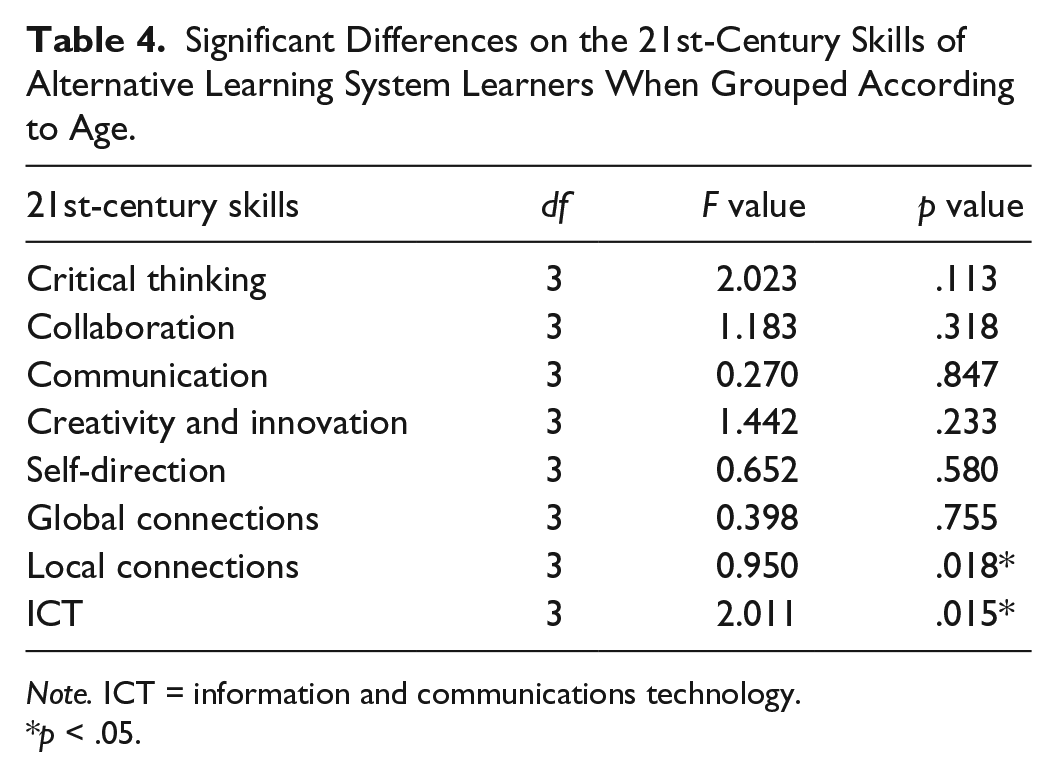
Note. ICT = information and communications technology.
p < .05.
Furthermore, Table 5 shows the significant differences on the 21st-century acquisition skills of ALS learners in Northern Philippines when grouped according civil status. Results show that critical thinking, collaboration, communication, creativity and innovation, self-direction, global connections, local connections, and ICT skills do not have any significant difference when grouped according to civil status. Hence, it can be implied from the results that civil status does not affect the acquisition of 21st-century skills among the ALS learners in Northern Philippines.
Significant Differences on the 21st-Century Skills of Alternative Learning System Learners When Grouped According to Civil Status.

Note. ICT = information and communications technology.
p < .05.
And finally, Table 6 shows significant differences on the 21st-century skills of ALS learners in Northern Philippines when grouped according to their employment status. Results reveal that critical thinking, collaboration, communication, creativity and innovation, global connections, local connections, and ICT skills do not have any significant differences among ALS learners in terms of their employment status. This implies that that employment status among learners does not affect the acquisition of 21st-century skills. However, it can also be gleaned from the results that self-direction skill has a significant difference among ALS learners in terms of their employment status. Those ALS learners who are working under technical and industrial types of profession have the highest level of acquisition of self-direction skills. This could be attributed to the fact that these students are more exposed to learning environments such as technical and technological activities that enable them to take responsibility toward their learning. Moreover, they have an array of professionals such as their bosses and other co-workers for them to learn more things and to acquire more knowledge besides the things that they learn from the ALS program.
Significant Differences on the 21st-Century Skills of Alternative Learning System Learners When Grouped According to Employment Status.

Note. ICT = information and communications technology.
p < .05.
Conclusion and Implications for Further Research
The present study examined the 21st-century skill acquisition of the ALS learners in Northern Philippines. The research findings indicated that ALS learners are not yet ready to face the globalized world due to the fact that their attainment of the required 21st-century skills is low, except for the local connection skill as this is the only skill that ALS learners already acquired. One very important contribution of the study is that it underscores and reveals how ALS learners are doing well in terms of the acquisition of 21st-century skills as it will serve as a basis for policy and intervention formulation to help uplift the ALS learners for them to cope with the challenges of globalization. Moreover, the study also reveals that sex, age, and employment status affect the acquisition of 21st-century skills among ALS learners in Northern Philippines.
Moreover, the study contributes to literatures on ALS and nonformal education as it sheds the light on the present status of ALS, especially in the Philippines in terms of the promotion of 21st-century skills among its clients and enrollees. More importantly, the study gave insights and recommendations to previous researches and studies with regard to the evaluation and assessment of nonformal education (Huffman et al., 2008; Isaacs et al., 2010; Walahoski & Suzanne, 2012) such as the ALS program of the Philippines (Dela Rosa, 2015; Mercado, 2005; Oracion, 2002), especially in terms of assessing the 21st-century skills of nonformal education such as the ALS learners (Guerrero, 2007; Rogers, 2005).
Possible extension of this study could be undertaken to examine the 21st-century skills and competencies of the ALS teachers. In addition, as the current study was conducted in Northern Philippines, it may be worthwhile also to investigate the 21st-century skills of ALS learners in other parts of the Philippines to determine whether the results presented here reflect the general situations of ALS learners in the whole Philippines.
Footnotes
Declaration of Conflicting Interests
The author(s) declared no potential conflicts of interest with respect to the research, authorship, and/or publication of this article.
Funding
The author(s) received no financial support for the research, authorship, and/or publication of this article.