



Abstract
Skills, such as critical thinking, creativity, communication, problem solving, collaboration, operational skills, and information management, have become increasingly important for 21st-century employees. These skills are often referred to as 21st-century skills and influence how employees handle novel situations. They are indispensable in an economy where the knowledge and skills of employees are seen as a measure for economic potential. This systematic literature review summarizes the current academic knowledge about organizational factors that influence 21st-century skills on an individual level. A search was performed in three databases. The factors found can be sub-divided into three main categories, namely leader characteristics, job characteristics, and organizational characteristics. Transformational leadership was the factor most mentioned in the literature found. Most research found during the search was done on the level of organizational output, exposing a clear gap concerning organizational factors that influence the skill-level of individual employees. These findings can have substantive implications when looking to improve employee skills by altering organizational determinants, by enabling targeted actions to improve these skills for the individual employee.
Keywords
Introduction
Increasing globalization and the technological revolution forced organizations to rethink their methods of business in order to stay competitive (Hitt et al., 1998). Globalization and technology also changed the way in which employee skills are applied and valued (Azim et al., 2010; Bakhshi et al., 2019). Employees are increasingly valued for the knowledge they possess and how they can use that knowledge to produce tangible ideas (Bejinaru, 2016; Serrat, 2017; Sokół & Figurska, 2017). In this regard, the concept of “knowledge workers” refers to professionals whose jobs are characterized by non-routine problem solving, which predominantly requires mental work and creative thinking (Reinhardt et al., 2011; Sokół & Figurska, 2017).
Based on large-scale data of more than 150 million job postings the framework of New Foundational Skills extracted 14 skills that are required by professionals across the whole economy to thrive. Possession of these skills gives employees a considerable advantage (Burning Glass Technologies & Business-Higher Education Forum, 2019. This framework includes skills like critical thinking, creativity, analytical reasoning, communication, collaboration, and analyzing, managing, and communicating data. Such skills are also often referred to as 21st-century skills, which differ from skills needed in the 20th century mainly due to the rise of information and communication technologies (ICTs) (Dede, 2010).
Twenty-first century skills refer to both higher-order cognitive skills, and to social and digital skills. These skills are needed for non-standardized tasks that require the processing of knowledge and information (OECD, 2017). Black and Lynch (1996) already established a few decades ago that the improvement of computer-skills is particularly important to boost the productivity of employees. Nowadays ICT can be considered an inherent resource to efficiently perform knowledge work (Jacobs, 2017). Twenty-first century skills are crucial for organizations that want to be innovative and competitive (Bejinaru, 2016; Sokół & Figurska, 2017) and national policies are developed around the world to improve these skills for both students and the workforce (e.g., Anderson, 2008; Ferrari, 2012; Voogt & Roblin, 2012).
For organizations, the incorporation of development policies for employees should be part of an organization wide business strategy (Gardiner et al., 2001). This should not only entail formal training of employees, but also keep into account what organizational factors can influence the level of 21st-century skills. By doing so, the development of 21st-century skills among knowledge workers can be optimized, which gives organizations a competitive advantage in an age in which knowledge, and what employees can do with this knowledge, is considered a valuable asset (Anderson, 2008; Sokół & Figurska, 2017; UNCTAD, 2019).
To evaluate what organizational factors influence the level of 21st-century skills according to empirical scientific research we conducted a systematic literature review. By doing so, we want to answer the following research question: What organizational factors are statistically significant in influencing the level of 21st-century skills of employees, according to academic literature? Knowing what organizational factors influence 21st-century skills of employees can help organizations to implement effective policies to develop the skills that are needed by knowledge workers.
Literature Review
Twenty-first Century Skills
As stated before, 21st-century skills are higher-order cognitive, social, and digital skills that knowledge workers need to produce tangible ideas from their knowledge (Bejinaru, 2016; Serrat, 2017; Sokół & Figurska, 2017). Higher-order cognitive and social skills, such as communication, problem solving and collaboration, are in high demand by employers (Rios et al., 2020). Ferrari (2012) uses the term digital competence to describe an individual that is able to understand (digital) media, search and find information and—once retrieved—be critical about its’ contents, and use ICTs to communicate with others. Anderson (2008) endorses the importance of knowledge workers being able to use ICTs to search, organize and evaluate information from a multitude of sources. Based on extensive job analysis reports, Jacobs (2017) divided knowledge-based tasks into five types of work behaviors: problem solving, decision making, conducting an inspection, developing a design, and facilitating a work process. These five work behaviors require the individual to employ their problem-solving skills, for instance by testing hypothesis and to recall available knowledge. Furthermore, it requires creativity and critical thinking. These findings draw parallels to the most important skills for knowledge workers found in a systematic review performed by Van Laar et al. (2017). This review of academic literature revealed that the seven most mentioned 21st-century skills in literature are: operational skills, information management, communication, collaboration, creativity, critical thinking, and problem solving. In this framework operational skills are “the skills to operate computer and network hardware and software” (Van Deursen & Van Dijk, 2010, p. 894). This definition is expanded on by Van Laar et al. (2017) by adding other (mobile) devices and the skills to recognize, navigate, and maintain orientation in specific online environments. So, knowledge workers have to be able to use contemporary tools, mostly in the form of ICTs. The remainder of the skills are so-called higher-order cognitive skills and social skills, which implies that these are not developed by rote learning, but involve higher cognitive processing. Table 1 gives an overview of the conceptual definitions of the seven core 21st-century skills as identified by Van Laar et al. (2017).
Framework With Core 21st-Century Skills.

Note. Adapted from Van Laar et al. (2017).
Determinants of 21st-Century Skills for Employees
Even though it is acknowledged that 21st-century skills are important, the work environment is often not optimally equipped to nurture these skills (Bryan & Joyce, 2005). Organizations have to adapt to be able to provide professionals the best possible circumstances to flourish. They need to invest in their employees, and give them the opportunity to gain knowledge and skills (Hitt et al., 1998). However, although some claim that the innovation and creation of new products is an accomplishment of individuals (McMullen & Shepherd, 2006) which necessitates the stimulation of individual employee skills, such as creativity (Wu et al., 2008), there is now a general agreement among authors that knowledge work is hardly ever a solitary undertaking (McDermott, 2005). Therefore, collaboration is an increasingly important skills for knowledge workers.
Most research so far has been focusing on the effects of organizational determinants directly on organizational output (e.g., Burnside-Lawry, 2012; Lloréns Montes et al., 2005), and not on the effect of these determinants on the skills of employees. However, some prior research has shown that there are several organizational factors that might play a role in employee skill development.
According to Amabile and Pratt (2016), organizational resources such as sufficient financing for projects, tangible materials, and infrastructure are needed for individual employees to perform creative tasks. Also, creativity and innovation should be stimulated through organizational culture. Organizational culture can be best described as the communal values and beliefs that people within an organization hold (Mumford et al., 1997). These values and beliefs heavily influence the behavior of people within the organization (Andriopoulos, 2001). In the case of promoting creativity and innovation among employees this requires “a bias toward clear-eyed risk-taking (vs. clinging to the status quo), a genuine openness to new ideas, a system for developing creative ideas, and an offensive strategy of leading the organization’s industry to the future” (Amabile & Pratt, 2016, p. 161). In other words, the organization needs a clear directive toward innovation, shown by the actions and statements of organizational members such as founders and leaders (Amabile & Pratt, 2016).
Leaders play a vital role in executing the values related to organizational culture (Wang et al., 2010). They can increase the appeal of a job by showing support, which in turn can influence creative behavior of employees (Oldham & Cummings, 1996). This leader-support is an aspect of a leadership style called transformation leadership (Bass, 1990; Bass & Avolio, 1994), which is shown to support creativity (Chang & Teng, 2017; Gilmore et al., 2013; Herrmann & Felfe, 2013; Jaiswal & Dhar, 2016; Wang et al., 2014) . It transpires when a leader is able to expand the interests of employees beyond their own self-interest, and make them aware and accepting of the goals of the group (Bass, 1990). Transformational leaders influence their employees by considering their individual preferences and the personalities, communicating a clear vision and being able to motivate employees by giving them the confidence to go beyond specified goals (Dvir et al., 2002).
Another manner in which an organization can develop the skills of their employees is through training. Training can be describes as a method of learning and development that improves the effectiveness of individuals or groups in a methodical and organized way (Goldstein & Ford, 2002). When an organization facilitates training for their employees, it is investing in knowledgeable employees. A highly skilled workforce can give organizations a competitive advantage, and multiple studies have shown that training can improve both employee and organizational performance (e.g., Arthur et al., 2003; Kraimer et al., 2011). Furthermore, it is also found that training has a positive effect on creativity (Ekore, 2014).
Job autonomy, task variety and routine (the degree to which a variety of tasks are required to perform a job), and decision latitude of the employee are factors that account for job complexity as defined by the Dictionary of Occupational Titles classification system (Roos & Treiman, 1980). When a job is complex, the work excitement of employees is raised, because they experience responsibility for work outcomes and job-significance (Coelho et al., 2011), and this has been shown to have a positive influence on creativity (Mathisen, 2011; Slåtten, 2014; Sung et al., 2017; Yeh & Huan, 2017). Job autonomy is “the degree to which the job provides substantial freedom, independence, and discretion to the employee in scheduling the work and in determining the procedures to be used in carrying it out” (Hackman & Oldham, 1975, p. 162) Job autonomy is also closely related to organizational culture and structure, since the accompanying values can influence the amount of freedom employees have to perform their jobs. According to Hackman and Oldham (1975) the responsibility that high job autonomy brings, results in more satisfaction at work and a higher quality of output.
Methodology
Systematic Literature Review
To answer the research question, a systematic literature review was performed. A systematic literature review conveys that unambiguous methods are used to systematically find, select and evaluate suitable research, and to analyze the included data to answer a research question (Moher et al., 2009). The review was performed using the PRISMA-protocol (Moher et al., 2009). This is a 27-step protocol and reporting guideline for systematic reviews, developed to minimize bias and increases the transparency of the research process in order to improve the reliability of published papers (Moher et al., 2015). Although this protocol is developed for systematic literature reviews in health care, it can serve the same function for social sciences, in that it focusses on reporting on research in a clear and concise manner. The protocol also helps to prevent publication bias, which is a major concern in the reporting of systematic reviews (Moher et al., 2009).
Sources and Search Strings
The final search for the systematic literature review was performed in November 2017. The databases used for the search were Scopus, Web of Science and EBSCO-host. Within EBSCO the choice has been made for the databases of Business Source Elite, PsycINFO and Psychology and Behavioral Sciences Collection, since these are most appropriate for social science research. The document types were limited to peer-reviewed articles. This choice was made to ensure a certain kind of scientific quality within the retrieved documents. Finally, all documents had to be in English.
Considering that within 21st-century skills research the included skills differ per framework, the researchers chose to include the skills identified in the systematic review by Van Laar et al. (2017). These skills, and related terms were used separately in the search string. The search-string consisted out of three parts, based on the research question: What organizational factors are statistically significant in influencing the level of 21st-century skills of employees, according to academic literature? The first part is made up out of “factors” and possible synonyms (e.g., determinants, predictors, indicators) (Table 2). The second part consists of the different skills as defined by Van Laar et al. (2017). Since operational skills is one of skills in the framework, the general terms “skills” and “competences” (and derivative terms) were used in hopes to also include articles considering operational skills or ICT competences, but also sets of skills closely related to 21st-century skills. Since early searches found very little to no articles on information management, related terms found in initial searches (i.e., knowledge transfer, learning transfer, knowledge management, and information literacy and derived terms) were included in the search string. Furthermore, since operational skills as defined in Table 1 might be termed in different ways in different frameworks and studies, it was decided to include broader terms like skills and competence (and derived terms) in the search string. Suitability of documents found using these terms was determined in later steps in the process, as described in the next chapter. The third part of the search string was related to the level in which the factors and skills had to emerge (i.e., at work, but on the level of the individual employee). Therefore we added terms related to the level of work and employment to the final part of the search string. These three parts resulted in the final search string showed in Table 2.
String for the Database Searches.

Inclusion Criteria and Selection
To help with the selection of articles to include, and to help prevent inclusion bias, criteria were formulated based on the research question. The criteria are shown in Table 3. Research that used moderators or mediators (indirect connections) in their research questions or hypotheses was allowed. Since the skills included in the search are considered 21st-century skills, it was decided to only include studies that were published after 2005.
Selection Criteria to Determine in- of Exclusion of Documents.

The selection and analysis of articles was done in multiple steps. First, duplicates of documents found in multiple databases were removed. After that, articles were screened based on title, after which articles were excluded on basis of summary. Of the articles that remained, the full text was analyzed to determine whether articles should be included. Since not all the terminology concerning the dependent variables was uniform, when in doubt the measure for and definition of the dependent variable was checked to see the article could be included in our study.
All the included articles contained empirical, quantitative data. So, the hypotheses and research questions were analyzed to report on the findings. Some articles contained multiple research questions and/or hypotheses of which not all were applicable for the current study. In that case only the hypotheses that were relevant were included in the analysis.
Study-Level Assessment
To prevent bias in the selection of included studies, a study-level assessment was performed. The principal researcher made an instruction document for a so-called second coder, whom had to select documents to include in the study using the criteria mentioned in Table 3. The study-level assessment was performed in multiple stages. In the first stage, the second coder performed its own search in the Scopus database with the search string given below. Scopus was used because this database gave the highest number of hits. This search was performed in the beginning of 2018. Considering the fact that the search of the principal researcher ended in November 2017, the years 2017 and 2018 were excluded from the search results. The documents found were sorted on date and the first 100 were selected for screening and selection by the second coder. After this initial round, differences in the findings were discussed between the principal researcher and the second coder, during which one criteria was more accurately defined. For a second round of screening and selecting by a different second coder, 100 different document-titles were given to this second coder, to ensure that there was no difference between the documents found by the principal researcher and the second coder. The selection in the second round had a Cohen’s Kappa of .83, which was deemed sufficient.
Findings
Figure 1 shows the PRISMA-flowchart for the exclusion and selection of documents. After the deletion of duplicate documents, 1,229 records were identified within the three database-hosts. Of those records, 1,011 were excluded after stepwise screening of the title and abstract. The remaining 217 documents were eligible for inclusion. There were ten reasons to not included 175 records, which were: (1) the full-text was not available (n = 51); (2) the dependent variable was not on an individual level (e.g., factors found influenced creative output on an organizational level) (n = 46); (3) not the right operationalization of the skill (e.g., the skill was operationalized as the intention to master ICTs) (n = 26); (4) the independent variable was not on an organizational level (e.g., only the moderator was on an organizational level, the independent variable was a personal trait) (n = 17); (5) the skill mentioned was not the dependent variable (wrong direction of influence) (n = 14); (6) the context of the research was not fitting for this research (e.g., nurse-physician collaboration, in which job-related tasks and factors are not generalizable to other organizations) (n = 8); (7) no empirical, quantitative data (n = 7); (8) the document was a book (n = 1); (9) the publication date of the article was before 2005 (n = 4); (10) one article turned out to be retracted and was therefore excluded from our research (n = 1). In the end, 42 documents remained.

PRISMA flowchart.
Table 4 shows what skills were studied in the included articles. It should be noted that research with creativity as the dependent variable was predominant. Of the 42 articles included, 83% (n = 35) mentioned creativity or a related dependent variable (e.g., creativity and innovation, employee creativity, creative discretion). Knowledge transfer was the second most mentioned skill (n = 4). The factors influencing knowledge management skills of individual employees largely overlap those of creativity, which can be seen in Table 5. ICT adaptability was not specifically mentioned in the framework of core 21st-century skills in Table 1, but was found using the more general search terms as mentioned in Table 2. By reviewing the operationalization of ICT adaptability it was found that it sufficiently overlapped the operationalization of operational skills. Therefore, it was decided that this study would also be included in the results. For six of the dependent variables that were used in the search string, no articles were found that mentioned organizational factors influencing the dependent variable on an individual level.
Skills Measured in Included Articles (n = 42).

Factors Per Skill, Subdivided in Categories.

Note. (−) a negative relation is found between the dependent and independent variable; (..x) times the factor is mentioned, when >1; (+/−) the hypothesis was partially supported. Only factors that showed a significant influence were included in this table.
Table 5 shows an overview of the factors found per skill. These are subdivided into three categories, based on the finding of this study. The first category is related to the leader. Due to the high number of factors found for “creativity,” for this skills the category is further subdivided into factors based on “leadership style” or “leader characteristics.” “Transformational leadership” as a leadership style was the most mentioned factor in the included articles, with it being mentioned influencing employee creativity seven times and influencing “skills” once. The second category are factors that were concerned with the job, and was subdivided into “job characteristics” and “task characteristics” for “creativity.” In the first subcategory both “job autonomy” and “job complexity” are mentioned multiple times. The final category is related to the organization in total and is subdivided into a “social-organizational” and “organizational policies” for “creativity.” In the first category, “social support” is mentioned five times as an influential factor and in the latter “pay for performance” is mentioned three times. For knowledge transfer “extrinsic rewards” is mentioned, of witch “pay for performance” is an example. Due to the shortage of factors found for the other skills, “creativity” is the only skill with subcategories.
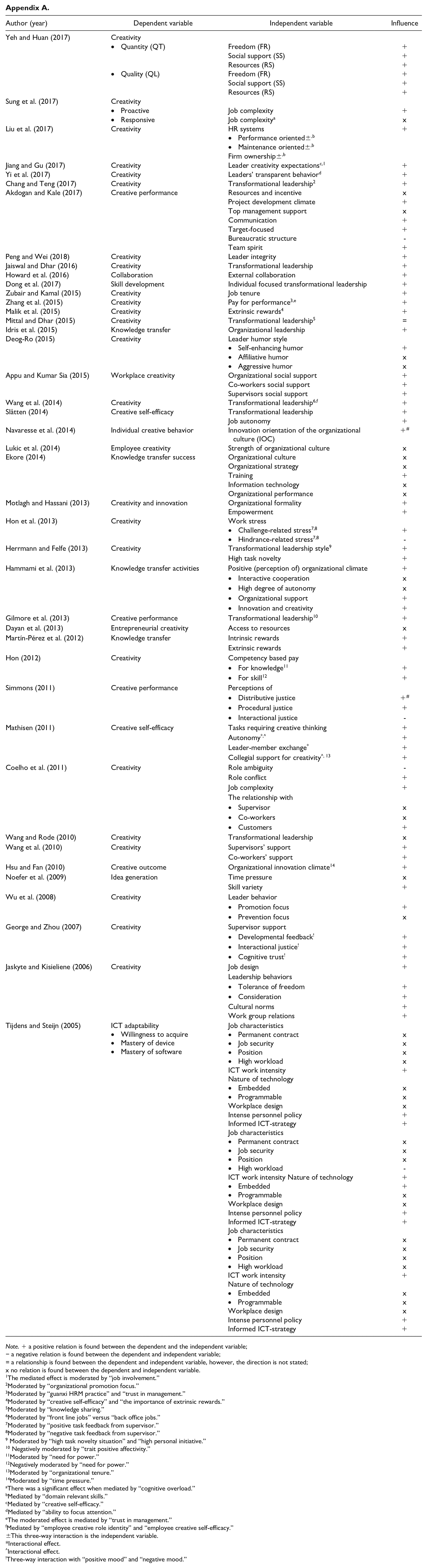
In Appendix A, a full list of the included articles is given, and includes information about the direction of the relations, studied mediators and moderators, interactional effects, and partially or non-supported hypotheses.
Discussion
Main Findings
This systematic literature review had the objective to identify organizational factors that are statistically significant in influencing the level of 21st-century skills of employees. To achieve our goal, we focused our search on a set of seven core skills: operational skills, information management, creativity, critical thinking, communication, collaboration, and problem solving (Van Laar et al., 2017) as dependent variables. Furthermore, we looked specifically for research that assessed the influence of the organizational factors on the level of the employee.
To answer our research question—“What organizational factors are statistically significant in influencing the level of 21st-century skills of employees, according to academic literature?”—we executed a search in three online databases. The organizational factors we found that influence the dependent variables could be subdivided into three main categories: (1) Leader-related, which included factors related to the style or characteristics of the leader, (2) job-related, which included factors concerning job or task characteristics, and (3) organization-related, which included factors related to the organization in total, such as factors associated with social norms or organizational policies.
In the leader-related category, leadership style and behavior were the most mentioned factors. Specifically, “transformational leadership” was the most mentioned factor in all articles included in this review, with it being mentioned as a leadership style in eight instances, for multiple skills. Transformational leadership is known to motivate, inspire and stimulate employees (Dvir et al., 2002), which is influenced by the culture within an organization. Swieringa and Wierdsma (1990) make a distinction between management and leadership. Management is the activation of employees to show the desired behavior, and leadership is the convincing, accompanying, advising and motivating of employees, which is similar to the four I’s of transformational leadership. So, great leadership is critical for an organization to be successful and to be able to change (Swieringa & Wierdsma, 1990). In the second category—job-related factors—autonomy and job-complexity were mentioned multiple times. According to Amabile (1993) autonomy can intrinsically motivate employees. It was also found that autonomy has a positive effect on creative self-efficacy (Mathisen, 2011). Finally, for organization-related factors social support, organizational support and rewards were the independent variables in multiple articles. Social support was the most mentioned factor for creativity. Organizational support and rewards were mentioned for multiple skills. These findings indicate that for employees to improve their skills and for them to go the extra mile with their work, they want to feel valued and taken seriously. In this regard research shows a reciprocal effect of organizational culture and leadership.
Analyzing our findings on the level of the dependent variables, showed that research into factors influencing creativity prevailed, with 35 of the 42 included articles focusing on this skill. For communication and collaboration, we did not find any articles that described organizational factors influencing the skill on an individual level. Most articles identified in the initial search covered business communication, or the communication skills of business-students and could therefore not be included in this review.
Critical thinking and problem solving also did not yield any suitable articles. For critical thinking almost all articles in the initial search results focused on critical thinking skills of students and were not included in this review. With regards to problem solving, some scholars argue that problem solving and creativity are closely related to each other; Basadur et al. (1982) state that problem solving is a part of the “complete” creativity process, which consists of problem finding, problem solving, and problem implementation. Furthermore, research by Van Laar et al. (2019) show that creativity is a condition for problem solving. This might explain why the search on problem solving skills generated little results.
Our systematic review also revealed several research gaps. First of all, most of the research that met all of our inclusion criteria was focused on creativity. In creativity research, the study of organizational factors influencing individual creativity goes back decades, as is shown in the review of Baker et al. (1976). This might have caused a bias toward creativity in our findings. Another gap identified concerns actual empirical studies that focus on organizational determinants of 21st-century skills. A fair amount of research focusses on factors that influence output on an organizational level (e.g., Burnside-Lawry, 2012; Lloréns Montes et al., 2005), however, much less has been written on what factors affect individual employee skill.
In summary, our review shows that there is a lack of research considering skills like information management, problem solving, critical thinking, communication and collaboration, even though these are the skills most mentioned in academic literature as important 21st-century skills. Furthermore, our search showed that when these concepts are being mentioned in literature, it is not in the context of studying organizational determinants of these skills. By further addressing the determinants found in this study in future research and policy, the development of the skills that are needed by knowledge workers in contemporary and future work will be supported. Eventually this makes organizations more competitive in the increasingly globalizing market.
Limitations
This research initially focused on factors that influence actual skill. However, it proved to be difficult to find a large body of research that focusses purely on skill, instead of performance or outcome. This might be mitigated by the fact that 21st-century skills are not unambiguously defined. Also, due to the cognitive nature of these skills they might be hard to measure without looking at outcomes. In this review, we assumed that skill and performance are positively related. By doing so, articles that seemed of great value for this research, but measured outcome or performance, could be included in this review.
Even though information management is the most mentioned 21st-century skill in literature (Van Laar et al., 2017), we did not find any study that focused on organizational determinants of information management skills of the individual employee. The low presence of articles about information management was previously noticed during preliminary searches, which was the reason to include knowledge transfer, learning transfer, knowledge management, and information literacy (and resembling terms) in the search string. However, as became clear during the scanning of abstracts and full-texts, the term knowledge management, which had the highest prevalence in the documents identified by the databases, is mostly used to describe a system or tool used by organizations to manage knowledge, and to a lesser extend as a skill held by individual employees. Even though knowledge management was the second most mentioned skill in the articles included in this study, there remains some unclarity about the exact correlation between information management and knowledge management. Another difficulty encountered that might have distorted the findings is the fact that 51 of the 217 documents that were selected for eligibility after reading the summaries had to be omitted due to non-availability of the full text.
Finally, the size of organizations included in the studies might also be a reason for concern. Due to the nature of the organizations and the design of the studies included in this review, it can be assumed that it mainly involves larger companies. This might cause bias, since for example in the Netherlands 99% of the companies have less than 250 employees, of which more than two-third are freelance or an independent contractor. However, in the case of companies with fewer than five employees, factors such as leadership or organizational culture would hardly apply. The aim of this research is to get insight in what influence organizational factors have on the individual skill level of employees. Therefore, the bias of research found in this article is not problematic, since the added value from this study is focused on larger organizations that have the capacity to invest in the development of their employees.
Future Research
The majority of articles found, focused on creativity. Although some consensus on the bilateral definition of creativity has been achieved, there is a continuing debate on how broad or specific it should be: “What is needed seems not to be so much the identification of previously unidentified characteristics associated with creativity and their subsequent formulation into a new definition, as is the development of a definition precise enough to indicate what is meant professionally by the term creativity yet broad enough to achieve some degree of consensus” (Parkhurst, 1999). With an ongoing discussion about this definition, one can imagine that measuring this concept is even more ambiguous. This, in turn, complicates the successful implementation of organizational policies for employee-development, since with obscure definitions and ways to measure a construct, the result of implementation becomes even more unpredictable. Further research—especially empirical research—into all 21st-century skills with more clear definitions and operationalizations might help with the writing and implementing of successful policies.
Also, for future research it will be interesting to examine not only whether there is a positive or negative relationship of the factors on the skill level of employees, but also what mechanisms are responsible for this relationship. In-depth qualitative research will be of great added value to retrieve insight in how exactly these factors influence certain skills. These insights will proof useful for organizations looking for practical recommendations for the improvement of 21st-century skills of their employees.
Footnotes
Appendix
| Author (year) | Dependent variable | Independent variable | Influence |
|---|---|---|---|
| Yeh and Huan (2017) | Creativity | ||
| ● Quantity (QT) | Freedom (FR) | + | |
| Social support (SS) | + | ||
| Resources (RS) | + | ||
| ● Quality (QL) | Freedom (FR) | + | |
| Social support (SS) | + | ||
| Resources (RS) | + | ||
| Sung et al. (2017) | Creativity | ||
| ● Proactive | Job complexity | + | |
| ● Responsive | Job complexity a | x | |
| Liu et al. (2017) | Creativity | HR systems | + |
| ● Performance oriented±,b | |||
| ● Maintenance oriented±,b | |||
| Firm ownership±,b | |||
| Jiang and Gu (2017) | Creativity | Leader creativity expectationsc,1 | + |
| Yi et al. (2017) | Creativity | Leaders’ transparent behavior d | + |
| Chang and Teng (2017) | Creativity | Transformational leadership 2 | + |
| Akdogan and Kale (2017) | Creative performance | Resources and incentive | x |
| Project development climate | + | ||
| Top management support | x | ||
| Communication | + | ||
| Target-focused | + | ||
| Bureaucratic structure | - | ||
| Team spirit | + | ||
| Peng and Wei (2018) | Creativity | Leader integrity | + |
| Jaiswal and Dhar (2016) | Creativity | Transformational leadership | + |
| Howard et al. (2016) | Collaboration | External collaboration | + |
| Dong et al. (2017) | Skill development | Individual focused transformational leadership | + |
| Zubair and Kamal (2015) | Creativity | Job tenure | + |
| Zhang et al. (2015) | Creativity | Pay for performance3,e | + |
| Malik et al. (2015) | Creativity | Extrinsic rewards 4 | + |
| Mittal and Dhar (2015) | Creativity | Transformational leadership 5 | = |
| Idris et al. (2015) | Knowledge transfer | Organizational leadership | + |
| Deog-Ro (2015) | Creativity | Leader humor style | |
| ● Self-enhancing humor | + | ||
| ● Affiliative humor | x | ||
| ● Aggressive humor | x | ||
| Appu and Kumar Sia (2015) | Workplace creativity | Organizational social support | + |
| Co-workers social support | + | ||
| Supervisors social support | + | ||
| Wang et al. (2014) | Creativity | Transformational leadership6,f | + |
| Slåtten (2014) | Creative self-efficacy | Transformational leadership | + |
| Job autonomy | + | ||
| Navaresse et al. (2014) | Individual creative behavior | Innovation orientation of the organizational culture (IOC) | +# |
| Lukic et al. (2014) | Employee creativity | Strength of organizational culture | x |
| Ekore (2014) | Knowledge transfer success | Organizational culture | x |
| Organizational strategy | x | ||
| Training | + | ||
| Information technology | x | ||
| Organizational performance | x | ||
| Motlagh and Hassani (2013) | Creativity and innovation | Organizational formality | + |
| Empowerment | + | ||
| Hon et al. (2013) | Creativity | Work stress | |
| ● Challenge-related stress7,8 | + | ||
| ● Hindrance-related stress7,8 | - | ||
| Herrmann and Felfe (2013) | Creativity | Transformational leadership style 9 | + |
| High task novelty | + | ||
| Hammami et al. (2013) | Knowledge transfer activities | Positive (perception of) organizational climate | + |
| ● Interactive cooperation | x | ||
| ● High degree of autonomy | x | ||
| ● Organizational support | + | ||
| ● Innovation and creativity | + | ||
| Gilmore et al. (2013) | Creative performance | Transformational leadership 10 | + |
| Dayan et al. (2013) | Entrepreneurial creativity | Access to resources | x |
| Martín-Pérez et al. (2012) | Knowledge transfer | Intrinsic rewards | + |
| Extrinsic rewards | + | ||
| Hon (2012) | Creativity | Competency based pay | |
| ● For knowledge 11 | + | ||
| ● For skill 12 | + | ||
| Simmons (2011) | Creative performance | Perceptions of | |
| ● Distributive justice | +# | ||
| ● Procedural justice | + | ||
| ● Interactional justice | - | ||
| Mathisen (2011) | Creative self-efficacy | Tasks requiring creative thinking | + |
| Autonomy*,^ | + | ||
| Leader-member exchange * | + | ||
| Collegial support for creativity^, 13 | + | ||
| Coelho et al. (2011) | Creativity | Role ambiguity | - |
| Role conflict | + | ||
| Job complexity | + | ||
| The relationship with | |||
| ● Supervisor | x | ||
| ● Co-workers | x | ||
| ● Customers | + | ||
| Wang and Rode (2010) | Creativity | Transformational leadership | x |
| Wang et al. (2010) | Creativity | Supervisors’ support | + |
| Co-workers’ support | + | ||
| Hsu and Fan (2010) | Creative outcome | Organizational innovation climate 14 | + |
| Noefer et al. (2009) | Idea generation | Time pressure | x |
| Skill variety | + | ||
| Wu et al. (2008) | Creativity | Leader behavior | |
| ● Promotion focus | + | ||
| ● Prevention focus | x | ||
| George and Zhou (2007) | Creativity | Supervisor support | |
| Developmental feedback ! | + | ||
| Interactional justice ! | + | ||
| Cognitive trust ! | + | ||
| Jaskyte and Kisieliene (2006) | Creativity | Job design | + |
| Leadership behaviors | |||
| ● Tolerance of freedom | + | ||
| ● Consideration | + | ||
| Cultural norms | + | ||
| Work group relations | + | ||
| Tijdens and Steijn (2005) | ICT adaptability |
Job characteristics | |
| ● Permanent contract | x | ||
| ● Job security | x | ||
| ● Position | x | ||
| ● High workload | x | ||
| ICT work intensity | + | ||
| Nature of technology | |||
| ● Embedded | x | ||
| ● Programmable | x | ||
| Workplace design | x | ||
| Intense personnel policy | + | ||
| Informed ICT-strategy | + | ||
| Job characteristics | |||
| ● Permanent contract | x | ||
| ● Job security | x | ||
| ● Position | x | ||
| ● High workload | - | ||
| ICT work intensity Nature of technology | + | ||
| ● Embedded | + | ||
| ● Programmable | x | ||
| Workplace design | x | ||
| Intense personnel policy | + | ||
| Informed ICT-strategy | + | ||
| Job characteristics | |||
| ● Permanent contract | x | ||
| ● Job security | x | ||
| ● Position | x | ||
| ● High workload | x | ||
| ICT work intensity | + | ||
| Nature of technology | |||
| ● Embedded | x | ||
| ● Programmable | x | ||
| Workplace design | x | ||
| Intense personnel policy | + | ||
| Informed ICT-strategy | + |
Note. + a positive relation is found between the dependent and the independent variable;
− a negative relation is found between the dependent and independent variable;
= a relationship is found between the dependent and independent variable, however, the direction is not stated;
x no relation is found between the dependent and independent variable.
The mediated effect is moderated by “job involvement.”
Moderated by “organizational promotion focus.”
Moderated by “guanxi HRM practice” and “trust in management.”
Moderated by “creative self-efficacy” and “the importance of extrinsic rewards.”
Moderated by “knowledge sharing.”
Moderated by “front line jobs” versus “back office jobs.”
Moderated by “positive task feedback from supervisor.”
Moderated by “negative task feedback from supervisor.”
Moderated by “high task novelty situation” and “high personal initiative.”
Negatively moderated by “trait positive affectivity.”
Moderated by “need for power.”
Negatively moderated by “need for power.”
Moderated by “organizational tenure.”
Moderated by “time pressure.”
There was a significant effect when mediated by “cognitive overload.”
Mediated by “domain relevant skills.”
Mediated by “creative self-efficacy.”
Mediated by “ability to focus attention.”
The moderated effect is mediated by “trust in management.”
Mediated by “employee creative role identity” and “employee creative self-efficacy.”
This three-way interaction is the independent variable.
Interactional effect.
Interactional effect.
Three-way interaction with “positive mood” and “negative mood.”
Author Note
Mirjam M. Koehorst is also affiliated to Vrije Universiteit Amsterdam, Amsterdam, The Netherlands.
Declaration of Conflicting Interests
The author(s) declared no potential conflicts of interest with respect to the research, authorship, and/or publication of this article.
Funding
The author(s) disclosed receipt of the following financial support for the research, authorship, and/or publication of this article: This research was supported by grants from Netherlands Organisation for Scientific Research (NWO) (project number 409-15-214).
