




Abstract
Drawing on the associative network memory theory (ANMT), this study aims to investigate the impact of social media marketing activities (SMMAs) on brand equity (BE) of luxury brands through the mediating role of brand image (BI) and the moderating role of word of mouth (WOM). This study employs a cross-sectional design to collect data from online adult users of Weibo in China. Data are analyzed in SmartPLS (v. 4.0.8.4) to evaluate the measurement model and the structural model. Findings of this study reveal that SMMAs have a significant positive impact on BI and BE. Besides, BI partially mediates the relationship between SMMAs and BE. Moreover, WOM moderates the association between SMMAs and BE such that the association is more potent at high levels of WOM and vice versa. This is one of the few studies that investigate the role of SMMAs on BE in the context of luxury brands, mediated by BI. Also, this is the first study that explores the moderating role of WOM in the relationship between SMMAs and BE through the mediating role of BI.
Plain language summary
Drawing on the associative network memory theory (ANMT), this study aims to investigate the impact of social media marketing activities (SMMAs) on brand equity (BE) of luxury brands through the mediating role of brand image (BI) and the moderating role of word of mouth (WOM). This study employs a cross-sectional design to collect data from online adult users of Weibo in China. Data are analyzed in SmartPLS (v. 4.0.8.4) to evaluate the measurement model and the structural model. Findings of this study reveals that SMMAs have a significant positive impact on BI and BE. Besides, BI partially mediates the relationship between SMMAs and BE. Moreover, WOM moderates the association between SMMAs and BE such that the association is more potent at high levels of WOM and vice versa. This is one of the few studies that investigates the role of SMMAs on BE in the context of luxury brands, mediated by BI. Also, this is the first study that explores the moderating role of WOM in the relationship between SMMAs and BE through the mediating role of BI.
Keywords
Introduction
Social media refers to “a group of internet-based applications that build on the ideological and technical foundations of Web 2.0, and that allow the creation and exchange of user generated content” (Kaplan & Haenlein, 2010, p. 61). A preponderance of studies report that social media plays a significant part in the daily lives of its users (Chung & Koo, 2015; Ismail, 2017; Okazaki, 2009; Seo & Park, 2018). Those applications take the forms of video, pictures, podcasts, wikis, microblogging, social blogs, weblogs, and rating and social bookmarking (Ismail, 2017). Several billion people are connected in real time via social media. The proliferation of social media has “reflected people’s need for interpersonal interaction” (Tuten, 2020). Social networking sites leverage social and professional activities into the online virtual world. Due to social media, traditional methods of information search are becoming obsolete (Chung & Koo, 2015), because new economic and social consequences are generated. Besides, as an important and convenient marketing channel, social media has rendered unparalleled opportunities to companies and brands (Seo & Park, 2018). In this milieu, social media has led companies and brands to seek new interactive ways of reaching and engaging their consumers.
Despite burgeoning interest in social media and its impact on branding and reputation building, empirical research is scarce on how social media marketing activities (SMMAs) impact brand equity (BE) (Seo & Park, 2018). According to Ansary and Hashim (2018), “building [BE] is a key issue in today’s business world.” Consumer-based BE could lead to reinforce price elasticity, establish product brand extensions, and robust distribution networks (Algharabat et al., 2020). In order to avoid becoming obsolete or to remain competitive, marketers are searching ways to build strong BE and giving particular attention to the future outlook of their brands (Zollo et al., 2020). In this regard, researchers and marketers have exaggerated the role of BE (Keller & Brexendorf, 2019). As consumers have affiliations with a limited number of brands (Thomson et al., 2005), this imperative makes this research all the more salient to find out ways to create an effective branding.
The purpose of this study is threefold. First, despite a growing academic and practical interest on SMMAs, most of the earlier scientific inquiries have found reportage of SMMAs on behavioral intention or customer satisfaction (Sano, 2015). However, “the importance of BE has been one of the main focal points in recent studies on SMMAs” (Seo & Park, 2018, p. 37). However, only a limited sample of studies has explored the role of SMMAs on BE (Godey et al., 2016). Specifically, the relationship is hitherto understudied in the context of luxury brands. Thus, the present study aims to address this gap by exploring the impact of SMMAs on BE.
Second, the study provides the first foray into understanding by investigating an unexplored mediating factor that might also underpin the relationship between SMMAs and BE: brand image (BI). According to Keller and Brexendorf (2019), BI is one of the most critical dimensions of branding. Marketers and researchers sanction BI as the key driver of consumers’ purchase decision (Ansary & Hashim, 2018). Kumaravel and Kandasarny (2012) argued that a good BI strategy helps companies differentiate their products from competitors, which ultimately paves the way for favorable associations and evaluations in the consumers’ mind. Consequently, BE can be leveraged through an effective BI. Previous studies have found associations between BI and BE (Ansary & Hashim, 2018). However, the link from SMMAs to BE, via BI is unexplored.
Third, this study expands the boundary effects that is under which conditions BE is more or less pronounced as a result of BI. We speculate that word of mouth (WOM) intervenes the relationship between BI and BE. WOM has emerged as an effective alternative to the traditional communication (e.g., advertising). Thus, the magnitude of WOM proliferates and affects consumer behavior in greater extent than any other forms of marketing communications (Trusov et al., 2009). Although WOM has been acknowledged as an effective marketing strategy, its impact on the association between BI and BE is yet to be explored (Ansary & Hashim, 2018). Therefore, we propose that (1) SMMAs have a positive impact on BE via BI and (2) WOM moderates the relationship between BI and BE such that the relationship is more pronounced at high levels of WOM (vice versa).
The study contributes to the existing literature in several ways. First, this article contributes to the SMMAs literature by providing a multi-dimensional approach for understanding the higher-order impact of SMMAs on BE through BI. Second, the study is unique such that it assesses a hitherto unexplored moderated mediation model that has not been studied earlier. We predict that casting SMMAs as an exogenous variable will help practitioners to enhance BI, which will ultimately elevate BE. Whereas, investigating WOM as the boundary effect of the SMMAs and BE association bridges a missing link in the literature. In addition, examining the role of SMMAs on luxury brands extends empirical support to both academicians and practitioners by offering a comprehensive framework that shows how SMMAs influence BE through BI, moderated by WOM.
The subsequent section presents the theoretical underpinning and relationship among variables followed by hypotheses development. The methodology section discusses the research design, sample and sampling, and instrumentation followed by discussion of the findings. Finally, the study concludes with presenting theoretical and practical implications and limitations of the study.
Literature Review and Hypotheses Development
Associative Network Memory Theory
Associative network memory theory (ANMT) relies on “how memory works” (Srull & Wyer, 1989). ANMT specifies that memory consists of nodes, that is, pieces of information (Smith, 2004). There is a connection between nodes, and each node functions as an activator for another node on the basis of internal information stored in the long-term memory or external information gained from external sources (Keller, 1993). Information retrieved from internal or external sources is decoded into “an abstract, mental language and is allocated to a node in the network knowledge structure” (Kreuzbauer & Malter, 2005).
From the ANMT perspective, Keller (1993) argued that memory principle stimulates BE by influencing understanding and knowledge about a brand. Ansary and Hashim (2018) suggested that it is important to understand the brand knowledge’s structure because this knowledge impacts consumers’ perception when they think of a brand. According to ANMT, semantic memory consists of a set of nodes that are arranged in a hierarchical order (Keller, 1993). The theory of ANMT reflects a comprehension of the functioning of individual’s cognitive process in response to informational stimuli sourced by various nodes. In addition, such informational node translates into increased BI, ultimately leading to BE. As these nodes are connected by association, therefore, the relationship between SMMAs, BI, BE, and WOM can be explained by ANMT.
SMMAs of Luxury Brands
Like other industries, technology development has a great influence on the world of fashion (Kim & Ko, 2012). Technology has made it convenient for customers to interact with brands. Involvement of fashion brands in such things as networking, blogging, and tweeting has led luxury brands to participate in the current trend. Past research has shown that technology has benefited the luxury brands rather than it has caused any threats (Ibrahim et al., 2020). Unlike perception of luxury brands, social media causes positive benefits to these brands. For instance, social media leads luxury brands to interact with customers, “builds up friendly attention, even affection, toward brands, and stimulates customers’ desire for luxury” (Kim & Ko, 2012). There has been a growing academic and practical emphasis to examine the impact of SMMAs on luxury brands. For instance, Godey et al. (2016) have found association between “social media marketing efforts and their impact on BE and consumer behavior of luxury brands.” Besides, Bazi et al. (2020) found connection between “customers’ motivation to engage with luxury brands and social media.” Henceforth, the study is unique and timely to carry out research encompassing SMMAs of luxury brands and its impact on BE.
SMMAs and BE
Social media is defined as “an online application program, platform, or media that eases interactions, joint work, or content sharing” (Richter & Koch, 2008).Since its conceptualization in June 2004 by Chris Shipley at a BlogOn conference, the concept has been extensively used by academicians and marketers (Kang, 2010). Social media leverages companies by providing opportunities to access customers and establish an individual relationship (Khatri et al., 2015). Researchers have shifted their focus to study users’ dynamics on social media, that is, “why they use social media,”“how much time they use social media,” and “number of use in specific time periods” (Bolton et al., 2013). Moreover, researchers categorized social media users on the basis on their participation from lukers to active participants by emphasizing on 90-9-1 rule, such as 90% users are “lukers” who just watch the contents, 9% play part by adding content, and 1% users make new content (Arthur, 2006).
SMMAs have been categorized into different components in previous studies. For instance, Kim and Ko (2012) identified five categories of SMMAs namely “entertainment,”“interaction,”“trendiness,”“customization,” and “word of mouth.” Besides, Sano (2015) classified SMMAs into four components such that“interaction,”“trendiness,”“customization,” and “perceived risk.” In another study, Seo and Park (2018) applied “entertainment,”“interaction,”“trendiness,”“customization,” and “perceived risk” as the five components of SMMAs. In the present study, we borrowed the conceptualization of Seo and Park (2018) to investigate the impact of SMMAs on BE of luxury brands, mediated by BI and moderated by WOM.
BE is “the net consequences of assets and debts related to a brand name and/or symbol” (Seo & Park, 2018). Barreda et al. (2020) explained BE that accrues to a company from the synergy of brand meaning and brand awareness. According to Seo and Park (2018), consumers combine various brand properties and perceive brand, carved in the memory, as a unique value that is discerned from other brands. Thus, BE gives a symbolic meaning to a brand that go beyond a mere product name (Keller, 2003). Aaker (2009) argued that BE is a viable option for firms, that want to assess the long-term effectiveness of the marketing programs.
According to Yadav and Rahman (2017), social media gives unparalleled opportunities to companies by influencing customers’ behavior or thinking as compared to one-sided communication led by companies. From the ANMT perspectives, Seo and Park (2018) suggested that brands which utilize social media to engage customers can seize their attention and affection toward brands. SMMAs are more likely to affect customers’ experience such that a positive experience could lead to positive BE in consumers’ mind. In this milieu, Zahoor and Qureshi (2017) have found positive impact of perceived SMMAs on consumer-based BE through brand experience. Moreover, Kim and Ko (2012) have found positive associations between SMMAs and brand value, relationship value, and equity value. Moreover, Chae et al. (2015) found that the use of SNS hashtags motivate consumers to participate, ultimately translating into elevated BE. Thus,
H1. SMMAs have a significant positive influence on BE.
Mediating Role of BI
BI has been considered a vibrant impression with its roots in 1950s (Gardner & Levy, 1955). In line with ANMT, Keller (1993, p. 3) defined BI as “perceptions about a brand as reflected by the brand associations held in consumer memory.” BI plays a vital part in giving meaning to consumers, and it builds on informal nodes stimulated by brand associations (Keller, 1993). That is to say, BI defines the way consumers think of a brand or drives feelings with that brand (Keller, 2001). Thus, a good BI can have significant impacts on firm’s financial performance (Narteh, 2018). According to Seo and Park (2018), SMMAs influence brand awareness and BI in distinctive ways. For instance, Qian et al. (2019) argued that SMMAs are part of promotional mix in the new brand communication paradigm. While traditional media has strong association with brand awareness, SMMAs strongly influence BI. Besides, Barreda et al. (2020), Bilgin (2018), Fiaz et al. (2019), and Seo and Park (2018) have found significant positive impact of SMMAs on brand awareness and BI. Thus,
H2. SMMAs have a significant positive influence on BI.
According to ANMT, consumers’ evaluation of a specific brand and consumer decision making is significantly influenced by BI (Ansary & Hashim, 2018). Ultimately, it results in creating a strong BE (Alhaddad, 2014). In this regard, in order to build BI, brand associations play dominant part (Torres & Bijmolt, 2009). According to Kumaravel and Kandasarny (2012), BE depends on brand associations that create BI. Similarly, Ansary and Hashim (2018) corroborated that a strong, favorable, and unique BI will remain in the consumer’s mind, subsequently, resulting in enhanced BE. Some other preliminary investigations on the link between BI and BE have found positive association between them (Ansary & Hashim, 2018; Poerwadi et al., 2020; Shabbir et al., 2017; Świtała et al., 2018). Thus,
H3. BI has a significant positive influence on BE.
Conclusively, the theoretical deduction suggests a mediating role of BI in the relationship between SMMAs and BE. SMMAs offer opportunities to consumers to build consumer-brand communications, thus, empower them to build distinctive brand identities (Farzin et al., 2022). Panigyrakis et al. (2020) found that increasing use of social media such as Twitter and Facebook as the interactive marketing strategies positively influence BI (Bilgin, 2018). Which, in turn, leads to increased BE (Seo & Park, 2018). The mediating role of BI has also been explored in several studies including Hien et al. (2020); Ramesh et al. (2019); Tariq et al. (2017). However, how does SMMAs transform into exaggerated BE through BI has remained unexplored. We predict that SMMAs enhance BI that turn into increased BE. Thus,
H4. BI mediates the relationship between SMMAs and BE.
Moderating Role of WOM
WOM is not a new concept in the field of marketing (Huete-Alcocer, 2017). Rather, it may be the oldest way of swapping ideas and thoughts on different products and services that markets offer (Sernovitz et al., 2006). WOM refers to an overall communication that happens among people regarding brands (Allsop et al., 2007). Moreover, WOM is the most significant source of information exchanged among consumers (Ansary & Hashim, 2018). WOM research suggests that people have varying degrees of influences from family, friends, and colleagues, and they depend on other peoples’ recommendations (Molinari et al., 2008). Similarly, Keller (1993) have found positive relationship between WOM and purchase decision-making. It is important to note that individuals look for information from reliable sources, thus by doing so, they may reduce the risks associated with their purchase (Ansary & Hashim, 2018). Furthermore, peoples’ judgments on brands are significantly affected by WOM communication (Yang et al., 2018). A massive stream of researches found evidence that consumers rely on reliable sources to make purchase decision (Perera et al., 2019; Prasad et al., 2017; Saleem & Ellahi, 2017; Tien et al., 2019). For instance (Lee et al., 2017) people make use of WOM to assess the potential purchase of new product or service. Moreover, Engel et al. (1969) found reportage of WOM in choosing an automotive diagnostic center and a physician. In a similar thread, Wu (2017) argued that WOM influences perception of consumers regarding brand. According to Srivastava (2009), consumer-based BE relies on consumers holding the brand in their mind. Besides, Ansary and Hashim (2018) found that WOM positively or negatively influences BE. As discussed above, SMMAs play significant role in elevating BI, thus, translating into enhanced levels of BE (Narteh, 2018; Seo & Park, 2018). Taken together these arguments, we predict that WOM underpins the positive relationship between SMMAs and BE. Thus,
H5. Word of mouth moderates the relationship between SMMAs and BE, such that the association is stronger at high levels of word of mouth.
Thus far, we have explained how SMMAs lead to BE via BI, and propose the moderating role of WOM on the SMMAs-BE nexus. Hypothetically, we further propose that high levels of WOM underpin the association between SMMAs and BI such that the relationship is more potent at higher levels of WOM and vice versa (Figure 1). Thus,
H6. Word of mouth moderates the relationship between SMMAs and BI, such that the association is stronger at high levels of word of mouth.

Conceptual model.
Method
Sample and Procedure
We used a cross-sectional research design in order to gather data from adult users of Weibo in China, who are following at least one luxury brand on their Weibo pages. Weibo is one of the largest social media platforms in China. Due to its huge popularity and usage, the study analyzed Weibo users to reveal the public opinion on the association between SMMAs and BE of luxury brands through BI, moderated by WOM. The study employed a non-probability, purposive sampling technique due to the time, money, and access limitation (Saunders et al., 2009). Specifically, despite several attempts, it is still impossible to reach a sampling frame of luxury brand followers from official source. On the other hand, due to the anonymous nature of social media and the huge number of users, it is unlikely for the researchers to develop a sampling frame with a given budget in the timescale. In addition, the use of purposive sampling is justified in light of recommendations of Saunders et al. (2009) due to its ability to generate arbitrary responses. We distributed 600 research questionnaires through an online survey among social media users of Weibo who follow at least one luxury brand in China. Of 600, the respondents returned 520 research questionnaires, of which, 27 questionnaires were eliminated due to incomplete or wrong information.
Finally, we processed 493 completely filled questionnaires using SmartPLS (v. 4.0.8.4). Of 493, 57% were male and 43% were female participants. Concerning age of the respondents, 12% were under 18 years of age, 22% were between 18 and 25, 15% were between 26 and 30, 10% were between 31 and 40, 21% were between 41 and 50, 13% were between 51 and 60, and 7% were above 60 years of age. Regarding education, 18% were holding high school degrees, 22% had Bachelor degree, 34% were holding Master degree, 16% possessed Doctorate, and 10% mentioned other. In addition, income slabs were also determined with the following responses. Such that 8% earned 3,000 Yuan, 11% answered 3,001 to 6,000 Yuan, 19% mentioned between 6,001 and 9,000 Yuan, 7% selected 9,001 to 1,2000 Yuan, 12% earned between 12,001 and 15,000 Yuan, 16% mentioned between 15,001 and 18,000 Yuan, and remaining of the respondents mentioned above 180,001 Yuan. With respect to occupation, 34% were self-employed, 44% were salaried persons, and 22% were professional students and others.
Measures
In order to test the hypothesized relationships, we adapted established scales for data collection. Research instrument to measure SMMAs was adapted from Kim and Ko (2012). The instrument was measured on 11-items scale concerning 5 dimensions of SMMAs scale, that is, “entertainment,”“interaction,”“trendiness,”“customization,” and “perceived risk.” The sample items included “using X brand’s social media is fun” and “it is easy to provide my opinion through X brand’s social media.” In order to measure BI, we adapted questionnaire from Ku and Lin (2018). The instrument was measured on 10-item scale including three dimensions: “functional image,”“experiential image,” and “symbolic image.” The sample items included “(X brand) has the best quality” and “(X brand) is stunning.” To measure the BE construct, we utilized Yoo et al.’s (2000) scale. The instrument was measured on 3-item scale and the sample items included “it makes sense to buy X instead of any other brand, even if they are the same” and “if there is another brand as good as X, I prefer to buy X.” Besides, we measured WOM by adapting research instrument from Seo and Park (2018). The instrument contained three items and the sample items included “I will post positive opinions about this X brand on social media” and “I will recommend this X brand to my social media friends.” All the measurement scales were anchored on 5-point Likert scale ranging from (“1 for strongly disagree”) and (“5 for strongly agree”). Appendix 1 illustrates the questionnaire items used in this study.
Results
Measurement Model
The study used a “reflective-reflective model” and checked, at the first stage, “internal consistency” using “Cronbach’s alpha” and “composite reliability” (CR) metrics, and “convergent and discriminant validity” by assessing “outer loadings,”“average variance extracted” (AVE), Fornell-Larcker and “heterotrait-monotrait” (HTMT) indices (Hair et al., 2017). In order to confirm “internal consistency” in the study, the cut off values of Cronbach’s alpha and CR are reported to be higher than 0.7 (Nunnally & Bernstein, 1994). Results in Table 1 provide the evidence of “internal consistency.” To examine “convergent validity,” AVE scores were estimated. Results ensure the convergent validity of the constructs because the obtained values are greater than the threshold of 0.5 (Hair et al., 2017). Similarly, “outer loadings” were also assessed to ensure the reliability of all items. The values above 0.5 were retained in the proceeding analysis except for PRISK3, which was eliminated due to poor loading (Hair et al., 2017).
Validity and Reliability for Constructs.

Note. SMMAs = social media marketing activities; BI = brand image; BE = brand equity; WOM = word of mouth; ENT = entertainment; INT = interaction; TREND = trendiness; CUSTOM = customization; PRISK = perceived risk; CR = composite reliability; AVE = average variance extracted.
After assessing the “convergent validity,” we also estimated “discriminated validity” in order to confirm that “intra-construct correlations” should be greater than “inter-construct correlations” (Hair et al., 2017). For this purpose, we assessed the Fornell-Larkcer and the “heterotrait-monotrait” (HTMT) criterion (Henseler et al., 2009). Fornell-Larcker test illustrates the square root of the AVEs and indicate that all the items of a variable are strongly correlated with their own constructs than other constructs (Table 2). The study employed the bootstrapping technique to measure the HTMT ratio, using a resample of 5,000 with “one-tailed t-test” at 90% significance level, “to warrant an error probability of 5%.”Table 3 illustrates results of HTMT ratio, all the values are below the maximum acceptable threshold level of 0.90 (HTMT.90).
Fornell-Larcker Criterion.

Note. SMMAs = social media marketing activities; BI = brand image; BE = brand equity; WOM = word of mouth; ENT = entertainment; INT = interaction; TREND = trendiness; CUSTOM = customization; PRISK = perceived risk.
Heterotrait-Monotrait (HTMT) Ration.

Note. SMMAs = social media marketing activities; BI = brand image; BE = brand equity; WOM = word of mouth; ENT = entertainment; INT = interaction; TREND = trendiness; CUSTOM = customization; PRISK = perceived risk.
In addition, the study employed a “reflective-reflective” conceptual model to test the study hypotheses (Hair et al., 2017). For instance, SMMAs have five dimensions, such as “entertainment,”“interaction,”“trendiness,”“customization,” and “perceived risk.” Therefore, we also treated this variable as a higher-order construct and examined the joint effect of each dimensions reflectively on this variable. Thus, SMMAs were treated as a higher-order construct in order to measure its combined effect on the endogenous variables. Tables 4 and 5 present the psychometric properties of the higher order construct (HOC). Results indicate that SMMAs as HOC validated through reliability and convergent and discriminant validity. The threshold values discussed above are used as a basis to validate the analysis and the findings ensure the reliability and validity of the HOC.
Reliability and Convergent Validity of HOC.

Note. ENT = entertainment; INT = interaction; TREND = trendiness; CUSTOM = customization; PRISK = perceived risk; AVE = average variance extracted; CR = composite reliability.
Discriminant Validity of HOC.

Note. SMMAs = social media marketing activities; BI = brand image; BE = brand equity; WOM = word of mouth.
Structural Model
In the second stage, after assessing the “measurement model,” the study measured the “structural model” by employing a “non-parametric, bias-corrected and accelerated” (BCa) bootstrapping technique using 5,000 resample to yield the “path coefficient” (β) values and their relevant t-values. Moreover, “coefficient of determination” (R2), “predictive relevance” (q2), and “effect size” (f2) are reported to evaluate the relationship between exogenous and endogenous latent variables (Hair et al., 2017). Table 6 presents the results of this analysis such that SMMAs have a significant positive relationship with BE (β = 0.369; t = 7.732; p = 0.000; f2 = 0.169), indicating a medium effect size, supporting H1. Besides, SMMAs have a significant positive impact on BI (β = 0.374; t = 6.997; p = 0.000; f2 = 0.177), indicating a medium effect size, supporting H2. In addition, BI has a significant positive relationship with BE (β = 0.321; t = 5.640; p = .001; f2 = 0.119), indicating a medium effect size, supporting H3.
Effects on Endogenous Variables.

Note. SMMAs = social media marketing activities; BI = brand image; BE = brand equity; WOM = word of mouth.
Significance p < .05 (1.96); **significance p < .1 (1.64).
Furthermore, the study proposed that BI mediates the positive association between SMMAs and BE. The study utilized Zhao et al.’s (2010) mediation approach to measure the relationship between SMMAs and BE, mediated by BI. The study obtained “point estimates of indirect effect” using “BCa bootstrapping technique,” with 5,000 resamples. Table 7 indicates that total effect of the association between SMMAs and BE was significant at 95% CIs (0.383, 0.606). Besides, indirect effect was also significant at 95% CIs (0.067, 0.177), thus, indicating “complementary mediation” (Zhao et al., 2010). Furthermore, “variance accounted for” (VAF) was also measured to validate the mediation analysis. VAF value below 20% indicate no mediation and above 80% indicate full mediation. The analysis found that BI partially mediates the relationship between SMMAs and BE with the VAF value of 24.48%, supporting H4. The value was statistically significant at 5% significance level with t-value above than 1.96.
Summary of Mediating Effect Tests.

Note. SMMAs = social media marketing activities; BI = brand image; BE = brand equity; WOM = word of mouth; VAF = variance accounted for (indirect effect/total effect) total effect = direct effect + indirect effect.
Significance p <.05 (1.96)
Goodness-of-Fit Index (GFI).

Note. SMMAs = social media marketing activities; BI = brand image; BE = brand equity; WOM = word of mouth; AVE = average variance extracted.
The study hypothesized a moderated mediation model. Thus, the moderating role of WOM was also assessed using a “two-stage approach” in the light of Hair et al.’s (2017) recommendations. The study analyzed the CIs to test the interaction effect. In addition, BCa “bootstrapping procedure” was adopted with a 5,000 resamples to yield the effect size. The analysis found that the interaction term (SMMAs*WOM) has a positive significant impact on BE (β = .060; t = 1.875; p = .061) with a significance level of 10% two-tailedt-test, with a medium effect size (Kenny, 2016). Moreover, the analysis found that the interaction term (SMMAs*WOM) has a positive significant impact on BI (β = −.092; t = 2.569; p = .010) with a significance level of 5% two-tailed t-test, with a medium effect size (Kenny, 2016). Table 6 illustrates that CIs did not straddle 0 in order to obtain the β value of the interaction effect, supporting H5 and H6. Figure 2 presents the graphical illustration of SEM.

Structural equation model.
Furthermore, the study assessed the simple slop analysis consistent with Dawson’s (2014) recommendations, to understand the relationship between SMMAs and BE, and SMMAs and BI, moderated by WOM. The simple slope analysis shown in Figures 3 and 4 illustrates the association between SMMAs*WOM and BE; and SMMAs*WOM and BI. The graphs show that the association between SMMAs and BE and SMMAs and BI are more pronounced at high levels of WOM and vice versa.
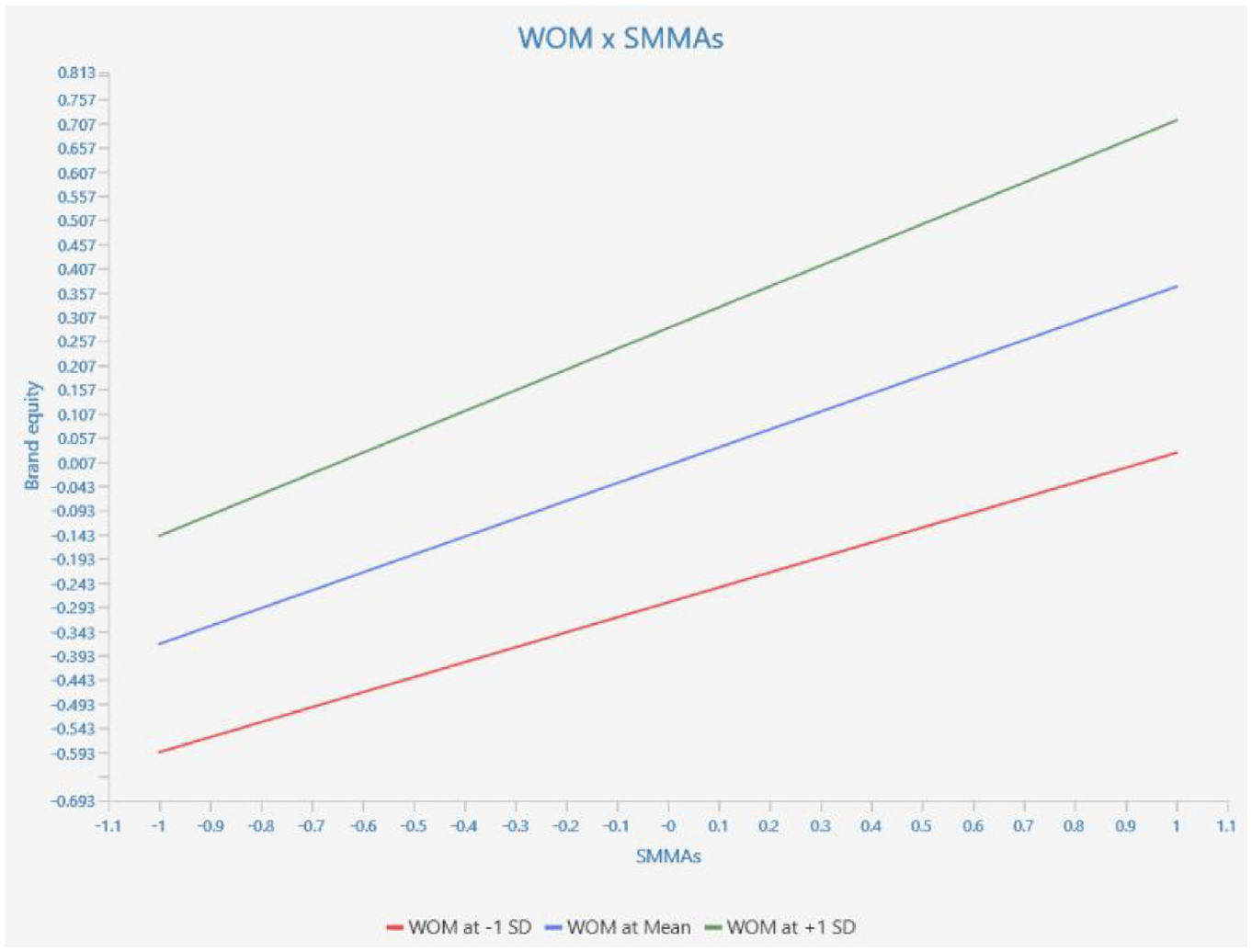
Interaction effect of SMMAs × WOM on brand equity.

Interaction effect of SMMAs × WOM on brand image.
In addition, using Tenenhaus et al.’s (2005) diagnostic tool, the study also evaluated good-of-fit index (GFI) (Table 8). The authors defined GFI as “the geometric mean of the average communality and average R2.” Results reveal that GFI value of 0.609 indicates a large effect size as this value is greater than the cut off value of 0.36, thus, confirming a good model fit (Hoffmann & Birnbrich, 2012). Finally, the study also tested the “predictive relevance” of the proposed model using “Stone-Geisser’s”Q2 with an omission distance of 5. The analysis yielded the Q2 value greater than 0. Hence, model’s predictive relevance was also established.
Discussion and Conclusion
There is a growing interest in SMMAs that warrants continued investigations of the consequences of SMMAs in predicting BE. In this milieu, the current study explored a hitherto understudied mediating mechanism of SMMAs, that is, the impact of SMMAs on BE through the mediating role of BI and the moderating role of WOM. Using a cross-sectional research design, the study collected data from adult users of Weibo in order to investigate the impact of SMMAs on BE of the luxury brands in China. We found that SMMAs significantly influence BE of the luxury brands. In addition, the study also found significant positive associations between SMMAs and BI; and BI and BE. Besides, the results found partial mediating effect of BI in the relationship between SMMAs and BE and SMMAs and BI. Moreover, the study also found significant result of the interaction effect of WOM in the relationship between SMMAs and BE and SMMAs and BI such that the associations between SMMAs and BE and SMMAs and BI are stronger at high levels of WOM and vice versa. There are several theoretical and practical implications of this study discussed in the subsequent section.
The results of the study substantiate that SMMAs significantly impact BI in the context of luxury brands. The luxury brands are the mainstream brands and people easily identify and dissociate themselves from ordinary brands. Due to their prominence, these brands face multiple threats such as existence, maintenance, and enhancement of their BI and BE. The digital platform is the source to create or demolish the goodwill of luxury brands. More specifically, the role of social media activities is inevitable for these brands. In the related stream, the use of SMMAs enhances the customer life cycle value. It means the young people consuming the information on social media will use luxury brands in future due to reinforcement of the brands on the social media. Wherein, the role of WOM serves as a catalyst that propagates the core of SMMAs in leveraging BE of the luxury brands.
The findings support the following conclusions. First, the relationship between SMMAs and BE is significant and mediated by BI. That is, luxury consumption in the many Asian markets has been remarkably increasing in the face of global competition (Ku & Lin, 2018). Furthermore, burgeoning demands in the Middle-East, India, and China has fueled the overall luxury markets in recent years (Seo & Park, 2018). However, the pace at which luxury markets are saturating exceeds the pace by which luxury brands are exploiting SMMAs not only to sustain but also elevate the BE of their luxury products (Bazi et al., 2020). Therefore, the findings with respect to luxury brands emphasizing the significance of SMMAs for leveraging BE is pertinent and timely. Our study thus extends the current line of enquiry that emphasize the importance of BE of luxury brands and its connection with SMMAs (Godey et al., 2016; Ku & Lin, 2018; Zollo et al., 2020). The examination of the role that BE has in the social media setting and the emerging relationship was also suggested by Algharabat et al. (2020). As predicted, a significant parameter affecting this relationship is the existing degree to which BE is determined by a socio-cultural phenomenon such as the emerging use of SMMAs to translate into superior BE. That is, likely to advancing research supporting the association between BI and BE (Ansary & Hashim, 2018).
Second, the effect of SMMAs on BE through the mediating role of BI is moderated by WOM. Specifically, for consumers with heightened degree of WOM, the impact of SMMAs on BE of the luxury brands will be more pronounced and vice versa. The findings of this analysis are in line with research emphasizing how WOM can affect the perceived bond (Farzin et al., 2022). Moreover, the findings are in accordance with research stressing the importance of WOM in the context of social media to explain BE (Godey et al., 2016),specifically, of the luxury brands (Seo & Park, 2018). The subsequent section presents an in-depth analysis of the theoretical and practical implications.
Theoretical Implications
First of all, this study answered the call of Seo and Park (2018) to investigate the impact of SMMAs on BE. Although previous studies have linked SMMAs with BE (e.g., Godey et al., 2016; Seo & Park, 2018); however, the association has relatively received limited empirical scrutiny in the context of luxury brands (Godey et al., 2016). Second, the study investigated a mediated mechanism through which SMMAs translate into enhanced BE; BI. The study found that SMMAs have a substantial effect on BI, which culminates into BE of the luxury brands. Considering BI as a mediating variable extends contribution such that it is one of the few attempts that examines BI as one of the relevant recipes transforming into exaggerated BE. However, some preliminary studies have encapsulated BI as a component of the BE (e.g., Seo & Park, 2018). Nevertheless, examining BI as a mediating variable in the relationship between SMMAs and BE adds unique insights in the existing literature on BE. Third, in addition to testing a mediating mechanism, this study draws on the ANMT theory to examine the underlying linkage. In order to examine the relationship between SMMAs and BE, past research has emphasized on the schema theory (Eysenck, 1984),attachment theory (Bowlby, 1969), and BE model (Ansary & Hashim, 2018). However, examining the impact of SMMAs on BE through the mediating role of BI using ANMT is unique and pertinent. Seo and Park (2018) corroborated that brands that utilize social media to engage customers can seize their attention and affection toward brands. SMMAs in this perspective possess the ability to generate positive experience in consumers’ minds which could ultimately lead to enhanced BE. Last but not the least, this study expands the boundary conditions of BE such that under which conditions BE is more likely to elevate. In this regard, we examine the boundary effects of WOM in the relationship between SMMAs and BE of luxury brands. Our findings render support to the moderated mediation model such that WOM strengthens the relationship between SMMAs and BE, mediated by BI, and SMMAs and BI. Our findings are in harmony in several well-cited preliminary studies. For instance, Onofrei et al. (2022) conducted study on social media interactions such as e-WOM and identified their impact on purchase intention and behavioral engagement. The authors found significant positive association between eWOM and behavioral engagement and purchase intention. Similarly, another host of researchers in the recent year studied eWOM as a form of online reviews and found positive correlates between information adoption from online reviews on accommodation (Filieri & McLeay, 2014). Hence, our study extends and provides support to the prior studies on the significant impact of WOM as a stimulating agent between SMMAs and BE via BI.
Practical Implications
The current study has several practical implications especially for the marketers. First, research studies encompassing critical factors such as SMMAs and BI to determine BE of luxury brands is limited. Hence, this is one of the few studies to empirically assess a complex model that might predict BE of luxury brands. The study presented evidence on the basis of data gathered from a large audience about the significance of SMMAs in leveraging BE. Such as, it is of focal interest to the marketers and practitioners to enhance BE of luxury brands. Compliance with the previous studies (e.g., Ansary & Hashim, 2018; Godey et al., 2016; Seo & Park, 2018), this study offers meaningful insights inferred upon the empirical findings that will help marketers to maneuver their SMMAs more aggressively. Therefore, significant investments in effective SMMAs will result in generating elevated BE for companies.
Second, with respect to the mediating role of BI, the study emphasizes the importance of cognitive factors that help marketers to better understand and leverage through their social media marketing efforts. In today’s dynamic and connected world, it is becoming increasingly difficult for companies to distinguish themselves from their competitors. In this milieu, technology leaders optimize growth in business through product proliferation, whereas, faced with innovation as a major challenge. This is because competitors offer a variety of similar products with only little differentiation. Therefore, it is important for companies to identify ways to remain competitive in the marketplace. Hence, BI is one of the important factors that serves the cause. Although there are a variety of factors that affect consumers’ decision making process, nevertheless, BI is highly relevant to marketers to manipulate consumers’ preferences. Thus, focusing on BI will help companies to enhance BE.
Last but not the least, in order to remain competitive, organizations must continuously innovate their products and offerings. This corollary has implications for all kinds of organizations, however, in the context of luxury brands, losing a BE can impose huge costs. Since luxury brands are of supreme value and importance to customers, therefore, emphasizing the cognitive aspect, that is, BI is of paramount importance. Because consumers associate with a brand that not only satisfies their needs but also renders superior meanings in relating with that brand. Hence, the proposed theoretical model offers substantial managerial implications particularly in the context of luxury brands. In addition, findings with respect to the moderating role WOM emphasize the importance of SMMAs for enhancing BE. The interaction effect of WOM supports our theoretical deduction that firms which substantially invest in their SMMAs are more likely to be intervened by a positive experience shouted through WOM. In addition, the implications of this study extend beyond its impact on Chinese market to a larger context with the similar cultural characteristics, for example, in a collectivist culture, the impact of WOM in strengthening the association between SMMAs and BE and SMMAs and BI is plausible.
Limitations and Future Research Directions
Although this study offers significant theoretical and managerial implications, however, its findings should be linked with several limitations. First, this study examined the impact of SMMAs on BE through the mediating role of BI and the moderating role of WOM, collected using a cross-sectional research design. Although findings of this study are unique and are justified in light of numerous well-cited studies. Nevertheless, it is still questionable to expand the findings of study that was conducted in a single time period. Besides, all the measurement scales to assess the study’s variables were self-rated, which may cause possible illusory collision in explaining the impacts. Therefore, this warrants future studies to investigate the hypothesized theoretical model using longitudinal research design.
Second, the study’s purpose is to measure the impact of SMMAs on BE of luxury brands, in the context of Chinese market. The authors argue that the results of this study extend significant insights for the developing as well as emerging markets. However, Chinese culture is primarily characterized with collectivism as opposed to the Western culture, that is, based on individualism (Hofstede, 1983). Therefore, it is a plausible assertion that impacts of SMMAs will be magnified for cultures based on collectivism. However, either the model allows similar results in the Western cultural context needs to be investigated.
Third, as discussed above, the present study examined the impact of SMMAs on BE, mediated by BI. However, past research has shown mixture of studies in conceptualizing the construct of BE. For instance, Godey et al. (2016) and Seo and Park (2018) investigated BI as a component of BE. However, several other studies treated BI as a stimulating factor that affects BE (Yu & Yuan, 2019).Therefore, the present study delimited theoretical conceptualization of BE and BI by theorizing and assessing both variables indistinctively.
Last but not the least, the study investigated the moderating role of WOM in the relationship between SMMAs and BE, mediated by BI. We recommend future studies to explore the boundary conditions of the SMMAs-equity linkage by investigating other intervening variables, for example, trust (Chahal & Rani, 2017) and co-creation behavior (Koay et al., 2020), that might also influence the association.
Footnotes
Appendix
Questionnaire.

| Social media marketing activities |
| •Using X brand’s social media is fun |
| •Content of X brand’s social media seems interesting |
| •X brand’s social media enable information-sharing with others |
| •Conversation or opinion exchange with others is possible through X brand’s social media |
| •It is easy to provide my opinion through X brands social media |
| •Content of X brand’s social media is the newest information |
| •Using X brand’s social media is very trendy |
| •X brand’s social media offer a customized information search |
| •X brand’s social media provide customized service |
| •I would like to pass information on brand, product, or services from X brand’s social media to my friends |
| •I would like to upload content from X brand’s social media on my blog or micro blog |
| Brand image |
| •X brand has the best quality |
| •X brand is sophisticated |
| •X brand is superior |
| •X brand is unique |
| •X brand is attracting |
| •X brand is stunning |
| •X brand is conspicuous |
| •X brand is expensive |
| •X brand is for the wealthy |
| Brand equity |
| •It makes sense to buy X instead of any other brand, even if they are the same |
| •Even if another brand has same features as X, I would prefer to buy X |
| •If there is another brand as good as X, I prefer to buy X |
| •If another brand is not different from X in any way, it seems smarter to purchase X |
| WOM |
| •I will post positive opinions about X brand on social media |
| •I will recommend X brand using social media |
| •I will recommend X brand to my social media friends |
Declaration of Conflicting Interests
The author(s) declared no potential conflicts of interest with respect to the research, authorship, and/or publication of this article.
Funding
The author(s) received no financial support for the research, authorship, and/or publication of this article.

Data Availability Statement
Data sharing not applicable to this article as no datasets were generated or analyzed during the current study.