




Abstract
This study aimed to specify the group of inner imitation–emotional empathy–emotional commitment, which is the path of emotional commitment induced by emojis. To determine whether this relationship is moderated by gender, inner imitation was set as the independent variable, emotional empathy as the mediating variable, and emotional commitment as the dependent variable. Results showed that the relationship between emotional empathy and emotional commitment and the mediating effect of emotional empathy when inner imitation affects emotional commitment through emotional empathy were stronger in women than in men. This suggests that the inner imitation–emotional empathy–emotional commitment process, which is an emotional commitment path via emojis, is mainly a conscious process for women. Furthermore, in that emotional empathy in inner imitation in this mediating process is regarded as a low-consciousness process based on mirror neurons, the movement of emojis is speculated to play a key role in strengthening this process.
Plain Language Summary
This study confirmed that the inner imitation–emotional empathy–emotional commitment process, which is the path of emotional commitment induced by emojis is a consciousness process mainly for women. Furthermore, in that emotional empathy in inner imitation in this mediating process is regarded as a low-consciousness process based on mirror neurons, the movement of emojis is speculated to play a key role in strengthening this process.
Currently, social media and mobile communication have become a cyberspace where brands and consumers are directly connected and where interactions occur between individuals (Chappuis et al., 2011). In particular, messenger spaces such as WhatsApp, WeChat, and KakaoTalk, where messages can be exchanged in real time using data communication functions without a physical connection, have established themselves as spaces that enhance communication by conveying the feeling that the other person is right next to you. In addition, in these communication spaces, emojis have an influence on building positive relationships between communicators beyond simple substitutes for emotions—that is, emojis have a positive effect on emotional commitment (attachment) by empathizing with the sender’s emotions in interpersonal interactions (H.-J. Jeon, 2020) and induce greater brand attachment by moderating consumer participation in marketing (Arya et al., 2018). In particular, these psychological reactions or positive marketing results by emojis were confirmed to be induced by facial emojis such as smiles (Landwehr et al., 2011; Li et al., 2019; Pancer et al., 2017; L. W. Smith & Rose, 2020).
This is probably because in the online environment, facial emojis with human characteristics help the receiver warmly (affectionately) recognize the sender (Li et al., 2019), thereby generating positive emotions (Das et al., 2019). Therefore, to strengthen the interaction and marketing effect via emojis, the principles and processes of emojis, such as facial expressions, which cause positive psychological responses and the methods to strengthen them should be studies and understood.
In this regard, H.-J. Jeon (2020) confirmed that emotional empathy and emotional commitment arising from the emotional expression of emoji, including facial expressions, had a correlation with “perspective taking” and “inner imitation,” which are two ways of mind-reading; meanwhile, it has been confirmed that facial emoticons are processed as attributes similar to faces in the field of neuroscience (Churches et al., 2014; Gantiva et al., 2020; Yuasa et al., 2011). This suggests that although emoticons/emojis are not innately the same as face-to-face nonverbal expressions, they are likely to be recognized as mind-reading methods, such as facial expressions, as was confirmed by the results of H.-J. Jeon (2020).
These findings show that the mechanism for the process by which recipients are emotionally empathetic and emotionally attached to their counterparts is via emojis. In addition, we can see that the process varies depending on the recipient’s perception method of emojis. Here, perspective taking and inner imitation, which correspond to two mind-reading methods, are regarded as cognitive methods in different dimensions. In other words, perspective taking is a cognitive process that occurs during the mentalization process, whereas inner imitation is regarded as a cognitive process that occurs automatically and reflexively in the consciousness at a low level based on mirroring by mirror neurons (H.-J. Jeon, 2020). H. J. Jeon (2019) reported that perspective taking was highest in the emoji type combined with movement and contextual information, whereas inner imitation was highest in the moving emoji type, which seems to reflect these cognitive differences. These results suggest that the type of emojis that reinforces the process may differ depending on the recipient’s cognitive method, in that emotional responses such as emotional commitment and brand attachment induced by emojis are causal results according to the recognition of emojis. If so, this is a part that needs to be analyzed to further maximize the interaction between individuals and between brands and consumers via emojis. In addition, even if these are analyzed, recipient groups for different routes must be specified in order to actually apply those emoji types. This can be particularly important in relation to relationship marketing, where marketing effects must be maximized by applying emojis that match the cognitive characteristics of the target audience. However, the current research on emoji is focused on the positive functions of emoji; thus, studies related to this are still insufficient.
Hence, as a starting point for these studies, this study aimed to specify the recipient group for the emotional commitment process mediated by emotional empathy in inner imitation, which was identified as a path from interpersonal interaction to emotional commitment via emojis (H.-J. Jeon, 2020). To this end, this study analyzed whether gender differences occurred in this mediated pathway. It stems from the idea that this mediating pathway would be mainly women’s consciousness process, based on the fact that in empathic situations, women have more activation of the inferior frontal gyrus (IFG) (Schulte-Rüther et al., 2008), a domain in mirror neurons, and have higher mirroring, and potentially, greater empathy, than men (Cheng et al., 2008; Yang et al., 2009). In addition, it was hypothesized that, even if gender has no moderating effect on the primary memory-based process (inner imitation–emotional empathy) due to the experimental conditions, it would occur in the secondary memory-based process (emotional empathy–emotional commitment), as the sexual socialization factor acts as the information processing level increases. In this study, by linking the results of facial electromyography (fEMG) and functional magnetic resonance imaging (fMRI), the differences in the consciousness process of men and women that occur in the emotional commitment process induced via emojis are discussed in detail according to the level of information processing.
Theoretical Background and Hypotheses
Relationship among Inner Imitation, Emotional Empathy, and Emotional Commitment Based on the explanation of Lipps (1903), this study referred to inner imitation as a recipient’s act of mimicking nonverbal expressions (facial expressions, gestures/postures, motions) of emojis in one’s mind and the internal impulse to imitate them. This is a phenomenon that occurs unconsciously. Here, unconscious means it occurs in a state of consciousness but is automatic and without awareness. Inner imitation is also considered a “low-level simulation” by mirroring that occurs in the face-based emotion recognition process described by Goldman (2006).
Originally, inner imitation refers to an internal phenomenon that occurs upon injecting emotions as an instinctive human conscious experience, as explained by Lipps (1907, 1909). Specifically, Lipps explained that, in response to the expressive movements of others, we understand others’ emotion and conscious state by internally reenacting (i.e., inner imitation) a similar experience using our innate instinctual device. Lipps’ concept of inner imitation was scientifically proven in the 1990s when mirror neurons as an intrinsic device were discovered and is consistent with the embodied simulations (Gallese, 2003; Gallese et al., 2007; Gallese, 2009, 2010).
Such inner imitation is a variable that can directly affect emotional empathy; emotional empathy refers to the ability of the perceiver to feel and share the same emotional experience as that of the sender (Blair, 2005). In other words, subconsciously imitating someone else’s feelings can provoke emotional sharing, which can lead to empathy (Decety & Jackson, 2004; Decety & Lamm, 2006; Schuler et al., 2016). In general, imitating others’ facial expressions is a subconscious signal-decoding process induced by mirror neurons and is associated with an ability to recognize emotion (Neal & Chartrand, 2011; Wood et al., 2016) and to experience an emotion similar to that of others (Dimberg & Thunberg, 2012; Wood et al., 2016). In addition, Facial mimicry has been described as a crucial element of emotional contagion (Lischetzke et al., 2020; Olszanowski et al., 2020; Prochazkova & Kret, 2017; Sato et al., 2013), which is an initial form and an automatic element of emotional empathy (Sonnby-Borgström, 2002).
Moreover, even if we do not imitate it externally, we can experience the same emotion by imitating it internally (Gallese, 2009; Lipps, 1907, 1909). In this regard, Basch (1983) explained that even if the receiver does not directly imitate the sender’s emotional expression, it experiences the same emotion as the sender’s by internally forming an autonomous response related to the emotional expression of the other party. Emotional contagion according to such emotional imitation occurs at the same time as imitation (Hsee et al., 1990; Lundqvist & Dimberg, 1995), and emotional contagion is known to cause emotional empathy immediately. As if to support this, emotional empathy was confirmed to be generated through inner imitation in response to the recipient’s emoji (H.-J. Jeon, 2020).
In addition to empathy, inner imitation can have a direct effect on emotional commitment. Here, emotional commitment refers to an internal psychological state (emotional attachment) that the receiver feels related to the sender (Jaros et al., 1993; Lydon et al., 1996) and a recipient’s desire to continue his/her relationship with the sender (Moorman et al., 1992). Generally, emotional commitment is considered to occur through empathy as an emotional response. In other words, empathy is strongly associated with relationship quality as a direct variable of pro-social behavior. Therefore, emotional commitment appears to increase as the empathy ability increases (Lee et al., 2021; Oh et al., 2013). In particular, Cha et al. (2018) confirmed that emotional empathy has a significant positive effect on emotional commitment. However, a report states that since injecting positive emotions strengthens the emotional link, relational emotion further increases the intimacy of a relationship (Bless et al., 1996). This suggests that inner imitation, which occurs as an internal phenomenon during the process of injecting emotions, strengthens the emotional link and, therefore, can have a positive affects emotional commitment. In fact, emotional commitment has been confirmed to be directly generated just by inner imitation, which appears in the process of empathizing in response to an emoji (H.-J. Jeon, 2020).
As discussed above, inner imitation, emotional empathy, and emotional commitment are correlated with each other, and this relationship can be mediated by emotional empathy. In other words, previous studies confirmed that by identification with others, empathic response occurs as a result of injecting emotions, and commitment and attachment can be drawn from the result (Choi et al., 2012; Yoon, 2012). Based on these contents, this study developed the following hypotheses.
Hypothesis 1. Inner imitation will have a significant positive effect on emotional empathy.
Hypothesis 2. Emotional empathy will have a significant positive effect on emotional commitment.
Hypothesis 3. Inner imitation will have a significant positive effect on emotional commitment.
Hypothesis 4. Emotional empathy will mediate the relationship between inner imitation and emotional commitment.
Moderating Effect by Gender
It is generally explained that women empathize with greater mirroring and potential (Cheng et al., 2008; Yang et al., 2009) and simulate more than men (Jabbi et al., 2007). In this regard, Schulte-Rüther et al. (2008) reported that when assessing others’ emotional state or their own emotional response to others’ emotions, the IFG, a core domain in mirror neurons, was more strongly activated in women than in men (Derntl et al., 2010), whereas the temporal parietal junction (TPJ), a domain in the theory of mind, was more strongly activated in men; the IFG plays a crucial role in determining the intention of expressions by generating neural activity that creates an expression similar to that observed (Rizzolatti et al., 2009). Moreover, the IFG is known to provide the neural basis for automatic facial imitation (Desmurget et al., 2009), emotional contagion, and emotional empathy (Bernhardt & Singer, 2012; Keysers & Gazzola, 2006; Oliver et al., 2018; Shamay-Tsoory et al., 2009). Meanwhile, the TPJ is involved in separating and maintaining oneself from others (Decety & Sommerville, 2003; Quesque & Brass, 2019) and in inferring and understanding the mental state of others (Saxe & Kanwisher, 2003; Saxe & Wexler, 2005; Schurz & Perner, 2015; Spengler et al., 2009).
These results suggest that gender differences are highly likely to occur in the inner imitation–emotional empathy–emotional commitment process, which is a pathway to the recipient’s response to emoji. Previous studies have confirmed that emoticons are treated as face-like attributes (Churches et al., 2014; Gantiva et al., 2020; Yuasa et al., 2011) and that recipients imitate expressions of emoticons/emojis (Gantiva et al., 2021; O'Neill, 2013). Based on these findings, when an emoji of emotional expression is presented, women are more likely to internally imitate the emotional expression of the emoji because the IFG is more strongly activated in women than men, which enhances mirroring. However, in the same situation, men are more likely to cognitively interpret and infer the sender’s emotions based on the theory of mind through perspective taking rather than inner imitation, as the TPJ is more activated than the IFG; perspective taking is the most important cognitive activity for understanding and accepting others (Iannotti, 1978; LeMare & Rubin, 1987), and fMRI research has confirmed that perspective taking appears in the brain area postulated by the theory of mind (Schurz et al., 2015).
Based on these findings, the moderating effect by gender in this study could be expected from the relationship between inner imitation and emotional empathy. However, in the pilot test of this study, gender had no moderating effect in these relationships. In fact, looking at the results of the fEMG experiment, there were cases where differences in facial imitation were found between men and women, but it is confirmed that there are many cases where this is not the case (Blairy et al., 1999; Bush et al., 1989; Rymarczyk et al., 2011; Schneider et al., 2013; Sonnby-Borgström et al., 2003; Stel et al., 2010). According to Lehane (2015), who systematically reviewed gender differences for unconscious imitation, the experimental conditions may be the cause of these differences in results; that is, gender differences may or may not be observed in facial imitation, depending on the type of stimulus used (static, dynamic), length of stimulus exposure, and social context.
For example, with respect to stimulus type, dynamic stimuli are better than static stimuli at activating the IFG (Leslie et al., 2004) associated with automatic face imitation (Desmurget et al., 2009). Therefore, the dynamic stimuli in this study have the potential to narrow the gap in auto-imitation responses between men and women by strengthening the mirroring of men whose mirroring is weaker than that of women. In particular, the stimulus in this study was a whole-body figure holding the belly button and smiling, showing a big laugh. Laughter is basically a pro-social emotion, which can provoke more imitative responses than a frown (Hinsz & Tomhave, 1991) or angry face (Gantiva et al., 2021). The emotional intensity (arousal level) of a pleasurable facial expression is also known to affect the imitative intensity (Fujimura et al., 2010; Greenwald et al., 1989; Witvliet & Vrana, 1995). Considering these points, it is highly likely that inner imitation, which occurs at the automatic level, would occur to a similar degree in both men and women due to stimulation.
Along with these possibilities, from the perspective that both biological sex differences and sexual socialization factors should be considered when examining differences in imitation between men and women (Lehane, 2015), this study focused on the result of Sonnby-Borgström et al. (2008). Their results show that gender differences in facial imitation and emotional contagion increase with increasing conscious intervention. That is, in the experiment by Sonnby-Borgström et al. (2008), there was no difference in facial imitation between men and women at the subconscious (23 ms) and borderliminal levels (70 ms). However, as exposure time to stimuli increases (2,500 ms), when the level of information processing became more sophisticated (in response to happy pictures), the biologically pre-wired imitation tendencies increased in women but decreased in men. As a result of imitation, emotional contagion also increased more in women but decreased in men. The authors explained that the cause of these results is that the gender socialization factor of men and women works as the conscious intervention is strengthened. In other words, while men learn to suppress most emotional expressions during growth (Brody, 1985), women learn to amplify socially acceptable smiling behaviors (Eder & Parker, 1987; Hall et al., 2000), and these sexual socialization factors can affect imitation more when there is a greater degree of conscious intervention than automatic response.
These contents show that even if the moderating effect by gender does not occur in the process based on primary memory (inner imitation–emotional empathy) in this study due to the experimental conditions, it may occur in the process of interaction with secondary memory (emotional empathy–emotional commitment), as the sexual socialization factor comes into play when the level of information processing increases; in this study, in inner imitation, emotional empathy is regarded as a process dependent on primary memory (schematic, archetypal level of memory that operates without conscious awareness), and emotional empathy and emotional commitment are regarded as processes interacting with secondary memory (external memory that enables the creation of conscious and reflective records). This is based on the fact that face imitation is generally described as an unconscious, automatic, and reflexive process (Chartrand & Lakin, 2013; Hatfield et al., 1993; Lipps, 1907) and that the process related to emotional empathy is related to an automatic and voluntary response dependent on primary memory (Sonnby-Borgström, 2002). Additionally, in this study, when there is an appearance of involvement of a facial imitation that is more amplified as consciousness, the form in mental imitation is no longer regarded as an automatic reflex inner imitation but as a “high-level simulation” expanded by knowledge (Goldman, 2006, p. 150).
In light of the results of Sonnby-Borgström et al. (2008) and Schulte-Rüther et al. (2008), the following results would be expected when the level of information processing becomes more sophisticated. As women do not control the automatically generated inner imitation and extend it to high-level simulation based on secondary memory, even if conscious intervention increased, more amplified emotional empathy would enhance emotional commitment. Meanwhile, when conscious intervention increases, men would suppress the automatically generated inner imitation, as the TPJ is activated more strongly than the IFG, and objectively judge and reason about the emotion through perspective taking and the theory of mind. As a result, men would have a weaker relationship between emotional empathy and emotional commitment than women, as cognitive empathy increases instead of decreases in emotional contagion; the generation of emotional empathy and cognitive empathy according to the activation of the IFG and TPJ can be seen in the brain diagram for the theory of mind and empathy by Walter (2012) and in the diagram for cognitive and emotional systems by Dvash and Shamay-Tsoory (2014).
Based on these contents, this study finally developed the following hypotheses to specify the group of the inner imitation–emotional empathy–emotional commitment process.
Hypothesis 5. The relationship between emotional empathy and emotional commitment will be more strengthened in women.
Hypothesis 6. When inner imitation affects emotional commitment through emotional empathy, the mediating effect of emotional empathy will be stronger in women.
Methods
Study Model
To specify the group of the inner imitation–emotional empathy–emotional commitment process, which is the path of emotional commitment via emojis (H.-J. Jeon, 2020), this study set inner imitation as the independent variable, emotional empathy as the mediating variable, and emotional commitment as the dependent variable. Moreover, to test the moderating effect by gender on the relationship between emotional empathy and emotional commitment and the moderated mediating effect by gender on inner imitation, emotional empathy, and emotional commitment, PROCESS Macro Model 14 (Hayes, 2012) was applied to establish the research model as shown in Figure 1.

Model of the moderating effect by gender in inner imitation, emotional empathy, and emotional commitment.
Measurement Instruments
All variables in this study were measured on a 5-point Likert scale (1 = strongly disagree; 5 = strongly agree) using the following measurement tools. To measure inner imitation, four questions were adapted and applied from a questionnaire used in a study by Lim (2003) on behavior imitation resulting from identifying oneself with media characters and a questionnaire used in studies by Song (2009) and H. S. Kim (1995) on imitation impulses. Cronbach’s α was 0.942, which was found to be satisfactory. Emotional empathy was measured by referring to the questionnaire of Shen (2010) and measuring four items. Cronbach’s α was 0.748, which indicated a satisfactory reliability level. Emotional commitment was measured using six questions obtained from the items measuring emotional commitment developed by Allen and Meyer (1990). Cronbach’s α was 0.850, which indicated a satisfactory reliability level. For gender, used as the moderating variable, men was coded as “0” and women was coded as “1,” with higher score indicating women. Gender could be interpreted as “being a woman.”
Participants and Stimulus
This study was conducted with KakaoTalk users in their 20s residing in South Korea. This was based on the 2017 Survey on the Internet Usage Summary Report that 99.4% of the Korean population use KakaoTalk, and the age group that uses mobile messenger the most is in their 20s (Ministry of Science and ICT, 2017). In addition, based on the fact that the 20 s is the age group with the highest frequency of mobile emojis use (Trend Monitor, 2021), participants in this study were selected to derive natural emotional responses through the age group familiar with using emojis. The general characteristics of the participants were based on gender [106 men (49.5%) and 108 women (50.5%)] and occupation [93 college students (43.5%), 77 Office workers (36.0%), and 44 others (20.5%)]. The age was 20–25 years for 81 participants (37.9%) and 26–29 years for 133 participants (62.1%). The region was metropolitan area for 120 participants (56.1%) and non-metropolitan area for 94 participants (43.9%) (Table 1). The survey was conducted so that the proportions between the groups were as similar as possible.
Demographic Characteristics of Study Participants (n = 214).

As a stimulus, the “APEACH” character emoji from Clash Royale Friends (Kakaoemoticon shop, 2021)—created by combining characters from Clash Royale and Kakao Friends (which had the highest purchase rate in the domestic smartphone emoji character preference survey; S. H. Kim, 2015)—was used. Among them, a moving whole-body emoji with a big laugh was selected and modified; the degree of laughter was expressed by the emoji’s holding of the belly button and laughing while rolling on the floor. This was based on the fact that happy emoticon faces induce greater imitation than angry emoticons (Gantiva et al., 2021) and that dynamic expressions rather than static ones promote various psychological processes, including face imitation, emotion elicitation, and emotion recognition (Sato et al., 2013).
The emoji stimuli was placed in front of sentences that further explain their emotional situation. To match the emoji’s emotional expression, the sentence was composed of “we were going to die laughing because of him/her today.” In addition, based on the fact that imitation reactions occur within the same group (Bourgeois & Hess, 2008), the KakaoTalk chat window is designed in the situation where a message arrives from a friend. To give the subjects a similar feeling to the situation of receiving emoticons on mobile, a manipulated stimulus was presented in the liquid crystal image of the mobile phone.
The time the stimulus was played was set to 5 s. This was chosen as the time that the spontaneously induced inner imitation interacts with the secondary memory system to create a difference in the conscious process of men and women while the participant’s concentration may not decrease. After the stimulus was played for 5 s, the stimulus was stopped at the first image in the gif.
Experimental Method
The experimental method was conducted using a questionnaire in a self-report format. Based on the microgenetic theory, this study determined that even if inner imitation occurs at the subconscious or automatic level (even if the recipient is not aware of it at the moment), it can be confirmed in the consciousness as it continues and evolves; in the microgenetic theory, mental phenomena are described as appearing in the consciousness as they evolve and persist through qualitatively different stages of processing (Breitmeyer & Oegmen, 2006; Brown, 1985; Hanlon, 1991; Hman, 1993; Leventhal, 1984; G. J. W. Smith, 1991). This may be supported by the fact that in the fEMG studies, participants reported that they recognized and felt emotions consistent with facial imitation on self-reported measurement taken immediately after seeing exposed stimuli at the subconscious or automatic level. In addition, the questionnaire-based self-report measurement was considered suitable for the purpose of this study in that it can successfully capture inter-individual changes that occur in this process (Drimalla et al., 2019) by measuring the characteristics of the emotional sharing response that changes over time. Moreover, these experimental and survey methods have already been used in previous studies on the causal pathways of emoji-induced inner imitation, emotional empathy, and emotional (relationship) commitment (H.-J. Jeon, 2020) as well as in previous studies that measured the difference between emoji-induced emotional empathy (H.-J. Jeon, 2022).
The survey was conducted through a questionnaire constructed so that the stimuli were presented on a personal PC, and then questions to measure the recipient’s responses were sequentially generated. Each participant completed the survey online via a personal computer after being notified that the collected data would be used for emoji research and after providing written consent. The participants were instructed on the scenario of receiving a message from a friend, and after seeing the emojis presented in the KakaoTalk chat window, they were asked to answer a question about their feelings, as shown in Figure 2. In addition, the following system was established to prevent inaccurate responses to the questionnaire. First, to determine the sincerity of the responses, a question was presented for entering a specific response (not at all) during the measurement. Second, it was systematized so that the measurement items were exposed one by one after stimulus presentation. Third, the measurement items were randomized to prevent the learning effect on the measurement items.

An illustration of the conducted survey.
Data Collection and Statistical Analysis
In this study, a pilot test was conducted once from July 2 to 3, 2021, for data collection, and the actual data collection was conducted through a PC from July 6 to 12, 2021. Of the 286 people who participated in the survey, only 249 people who passed the pre-qualification question (people in their 20s living in South Korea who use KakaoTalk) finally participated in the survey, and data from 214 people who passed the sincerity test were finally selected from the collected data.
Statistical analysis of the data was performed using SPSS version 22.0 (IBM Corp., Armonk, NY, USA). First, exploratory factor analysis was performed to analyze the validity of the measurement tool, and the reliability of factors constituting the factors was analyzed using Cronbach’s α coefficient. Second, frequency analysis was conducted to identify the demographic characteristics of the study participants, and descriptive statistics analysis was conducted to understand the level of study variables. Third, Pearson’s correlation analysis was performed to examine the correlations between the variables. Fourth, the mediating effect model (model 4) and the moderated mediating effect model (model 14) were analyzed using the SPSS Process Macro to verify the main research hypothesis. The significance of the mediating effect and the moderated mediating effect was confirmed through the bootstrapping test (sample: 10,000). Statistical analysis was performed with a significance level of 5% to determine the statistical significance of the results.
Results
Analysis of Validity and Reliability of the Measurement Tools
Exploratory factor analysis
Exploratory factor analysis was performed through principal component analysis and varimax rotation to verify the validity of the variables used in this study. The results of the factor analysis showed that the validity of the measurement tools was secured by satisfying all the significance criteria such as the Kaiser–Meyer–Olkin (KMO) measure and Bartlett test result (Table 2).
Exploratory Factor Analysis.

Reliability analysis
Reliability analysis was performed using Cronbach’s α value to confirm whether respondents responded consistently in the scale of this study. The reliability condition was based on Cronbach’s α value of 0.6 (Hair et al., 1998). The Cronbach’s α values of inner imitation (0.942), emotional empathy (0.748), and emotional commitment (0.850) were > 0.6, confirming the good reliability of all variables (Table 3).
Reliability Analysis.

Descriptive statistics
The results of descriptive statistical analysis performed to confirm the characteristics of major variables are presented in Table 4. Additionally, to check the normality of each variable, skewness and kurtosis values were checked, and the absolute values of all skewness and kurtosis were less than 3 and 10, confirming the normal distribution (Kline, 2005).
Descriptive Statistics.

Correlation analysis
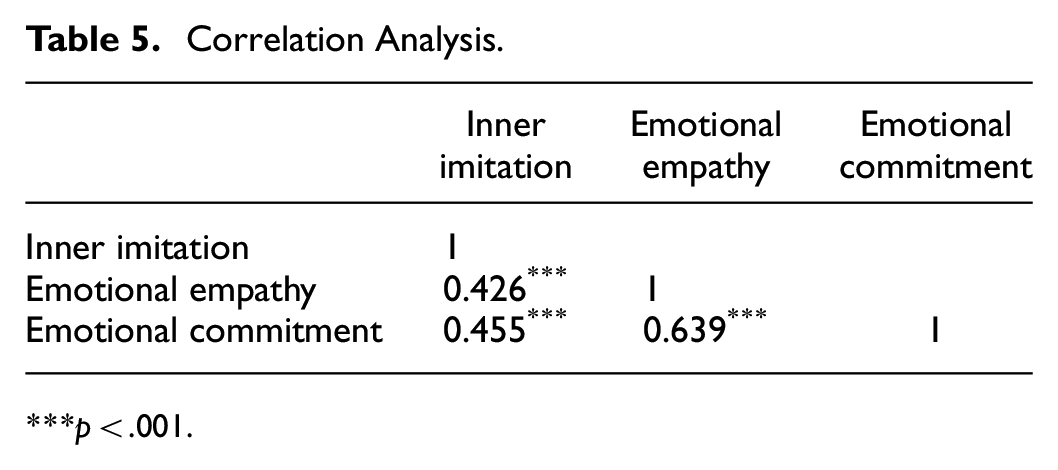
Pearson’s correlation analysis was conducted to understand the correlation between variables in this study; inner imitation showed a statistically significant positive correlation with emotional empathy and emotional commitment, and emotional empathy showed a statistically significant positive correlation with emotional commitment (Table 5).
Correlation Analysis.
p < .001.
Verification of the Mediating Effect of Emotional Empathy
To confirm the mediating effect of emotional empathy in the relationship between inner imitation of emojis and emotional commitment, an analysis was conducted using PROCESS Macro Model 4 proposed by Hayes (2012). Age was inputted as a control variable. First, model 1 is the result of the analysis of the effect of inner imitation, an independent variable, on emotional empathy, a mediating variable. The F value was statistically significant (F = 26.792, p < .001); hence, the model was suitable, and the explanatory power of the model was 20.9%. The result of the analysis showed that inner imitation had a significant positive effect on emotional empathy (β = .46, p < .001). Therefore, Hypothesis 1 was supported.
Model 2 is the test result of the model in which the independent variable, inner imitation, and the mediating variable, emotional empathy, affect emotional commitment. The F value was significant; hence, the model was fit (F = 56.760, p < .001), and it showed a high explanatory power of 45.7%. Both inner imitation (β = .19, p < .01) and emotional empathy (β = .56, p < .001) had a significant positive effect on emotional commitment. Therefore, Hypothesis 2 was supported.
Model 3 is the result of the analysis of the direct relationship between the independent variable, inner imitation, and the dependent variable, emotional commitment. The F value was significant; hence, the model was fit (F = 26.444, p < .001), and the explanatory power was 20.7%. As with the model that had the mediating variable inputted together, inner imitation had a significant positive effect on emotional commitment (β = .45, p < .001) (Table 6). Therefore, Hypothesis 3 was supported.
Mediating Effect of Emotional Empathy in the Relationship Between Inner Imitation and Emotional Commitment.

p < .001, **p < .01.
The result of the bootstrapping test (sample: 5,000), which was performed to verify the significance of the mediating effect, showed that the effect of inner imitation on emotional commitment through emotional empathy was positive (Figure 3), and the effect was confirmed to be statistically significant because 0 was not included between the lower and upper limits (Table 7). Therefore, Hypothesis 4 was supported.

Mediating effect of emotional empathy in the relationship between inner imitation and emotional commitment.
Bootstrapping Test for Mediating Effects (Sample: 5,000).

Verification of Moderated Mediating Effects by Gender
PROCESS Macro Model 14 was applied to verify the moderating effect by gender on the relationship between emotional empathy and emotional commitment and the moderated mediating effects by gender on the structural relationship of inner imitation, emotional empathy, and emotional commitment. Model 1 is a model that analyzes the relationship between inner imitation and emotional empathy by controlling for age. The F value was significant; hence, the model was suitable (F = 23.53, p < .001), the explanatory power was 18.2%, and inner imitation had a significant positive effect on emotional empathy.
Model 2 is a model that verifies the moderating effect by gender in the relationship between emotional empathy and emotional commitment; the influence of the independent, mediating, moderator, and interaction variables on emotional commitment is shown. In this model, the F value was also significant (F = 36.39, p < .001), and the explanatory power was 46.7%. The result of the analysis showed that gender itself did not have a significant effect on emotional commitment, but the interaction effect with emotional empathy was positively significant (B = 0.21, p < .05) (Table 8), confirming that the positive relationship of emotional empathy and emotional commitment was strengthened in women. Therefore, Hypothesis 5 was supported.
Moderating Effect by Gender on the Relationship Between Emotional Empathy and Emotional Commitment.

p < .001, *p < .1.
In the result of conditional indirect effect, the mediating effect was significant in both men and women. However, the coefficient size was 0.130 for men and 0.188 for women, confirming that inner imitation had a greater effect on emotional commitment through emotional empathy in women (Table 9). In addition, in the bootstrapping test for the moderated mediating effect, 0 was not included between the lower limit and the upper limit; hence, that the moderated mediating effect was verified as significant (Table 10). This means that the hypothesis that the mediating effect of emotional empathy is stronger in women is statistically significant when inner imitation affects emotional commitment through emotional empathy. Therefore, Hypothesis 6 was supported.
Conditional Indirect Effect by Gender.

Bootstrapping Test for Moderated Mediating Effects (Sample: 5,000).

Discussion and Conclusion
The findings in this study can be summarized as follows. Based on the hypotheses tested in a previous study (H.-J. Jeon, 2020), the effects of inner imitation on emotional empathy, of emotional empathy on emotional commitment, and of inner imitation on emotional commitment were all significantly positive in this study. In addition, the mediating effect of emotional empathy between inner imitation and emotional commitment was also significantly positive. In other words, the findings confirmed not only that a higher level of inner imitation for emojis increased the level of emotional empathy and emotional commitment but also that an increase in emotional empathy also increased the level of emotional commitment. Such findings supported previous studies that reported that we can experience the same emotion by internally generating an autonomous response associated with that expression even if we do not imitate it externally (Basch, 1983; Gallese, 2009; Lipps, 1907, 1909;) and that empathy, which is an emotional response that appears as a result, can draw out commitment and attachment (Choi et al., 2012; Yoon, 2012).
With respect to gender-based difference in the process of emotional commitment via emojis, which was investigated in this study, the moderating effect by gender on the relationship between emotional empathy and emotional commitment and the moderated mediating effect by gender on inner imitation, emotional empathy, and emotional commitment were stronger among women than men. Such results demonstrated that the inner imitation–emotional empathy–emotional commitment process is mainly a consciousness process of women rather than men. Therefore, our results shared the same context as previous studies reporting that women empathize with greater mirroring and potential (Cheng et al., 2008; Yang et al., 2009), and simulate more than men (Jabbi et al., 2007). This is significant in that it is not a biased result by a biased group, but an objective result obtained from a group with an almost equal men and women composition ratio.
This study assumes that the difference in the consciousness process of men and women generated in the process of emotional commitment via emojis is fundamentally caused by biological sex differences—that is, this may be the result of differences in empathetic temperament between men and women related to activation of an area related to mirror neurons and the level of activation. In this regard, Baron-Cohen et al. (2005) claimed in the empathizing-systemizing theory that the brain of a “typical female” has superior empathizing ability than systemizing ability, whereas the brain of a “typical male” shows an opposite pattern. Actual fMRI studies also reported results that support such claim. For example, a study by Cheng et al. (2009) reported that the female brain has larger gray matter volume in the area related to mirroring (the human mirror neuron system) than the male brain, whereas Schulte-Rüther et al. (2008) and Derntl et al. (2010) reported that the activation of the area related to mirror neurons was stronger in women than men under empathetic situations. As demonstrated, women innately have a brain structure with higher empathetic temperament than men, and as a result, they show stronger imitation response as mirroring emotions of others or resulting emotional resonance and emotional contagion. For this reason, this study inferred that the influence of inner imitation on emotional commitment through emotional empathy could be higher in women than in men.
However, in this study, the moderating effect by gender was confirmed not in inner imitation and emotional empathy, but in emotional empathy and emotional commitment. This suggests that the gender difference in this conscious process increases in the process of interaction with secondary memory rather than automatic response. There may be various causes for this, but this study assumes that these results were caused by experimental conditions (especially types of stimuli) and sexual socialization factors. A moving whole body with a laughing face was used as a stimulus in this study. The degree of laughter was expressed by the holding of the belly button and laughing while rolling on the floor. These laughs elicit more mimic responses than other emotions (grimaces or angry expressions) (Gantiva et al., 2021; Hinsz & Tomhave, 1991), and the intensity of laughter influences the intensity of facial imitation (Fujimura et al., 2010; Greenwald et al., 1989; Witvliet & Vrana, 1995). In addition, the dynamic face is better than the static face in activating the IFG (Leslie et al., 2004) and amygdala (Sato, Kochiyama et al., 2004), which are involved in automatic face imitation and emotional induction (Sato, Yoshikawa et al., 2004). Considering these points together, we believe that the stimulus used in this study may have been helpful in reinforcing the automatic imitation response of men who are temperamentally less prone to mirroring than women. This may be the reason why the moderating effect by gender did not appear in inner imitation and emotional empathy in the pilot test of this study.
However, it is explained that imitation is influenced by sexual socialization factors as well as biological differences. That is, while men learn to suppress most emotional expressions while growing up (Brody, 1985), women learn to amplify socially acceptable smiling behaviors (Eder & Parker, 1987; Hall et al., 2000). This learned rule-based sexual socialization factor can have a greater impact on imitation when conscious intervention increases as information processing becomes more sophisticated. These contents may be the reason why the moderating effect by gender, which did not appear in the relationship between inner imitation and emotional empathy (process based on primary memory), appeared in emotional empathy and emotional commitment (process interacting with secondary memory). In this regard, the results of Sonnby-Borgström et al. (2008) show that when the level of information processing increases, the gender gap for facial imitation and consequent emotional contagion increases; their results showed when conscious interventions increased beyond the subconscious and automatic levels, women further amplified the automatically pre-wired imitation responses, whereas men decreased imitation. In relation to these results, the authors explained that the gender differences in face imitation and consequent emotional contagion are interpreted as a result of differences in emotional regulation, not simply physiological responses. However, as there were cases in which differences in imitation between men and women were confirmed at the subconscious and automatic levels (Hermans et al., 2009; Sonnby-Borgström, 2002), and as the indirect effect of this study was also higher for women than for men, this study concludes that biological sex differences cannot be ignored in imitation.
In summary, this study assumes that despite a biological difference in imitation between men and women, there was no moderating effect by gender in a process based on primary memory (inner imitation–emotional empathy), as the difference became small due to the experimental conditions (especially the type of stimulus). However, the imitation response generated at the automatic level and the resulting emotional response are not cut off; rather, it evolves and develops through conscious activity over time. At this time, as the sexual socialization factor acts and the difference in conscious activity between men and women increases, it is believed that the moderating effect by gender has occurred in emotional empathy and emotional commitment.
By linking the fEMG results of men and women according to the information processing level (Sonnby-Borgström et al., 2008) and the fMRI results of men and women in empathic situations (Schulte-Rüther et al., 2008), the changes in the consciousness process of men and women according to the information processing level shown in this study are inferred in detail as follows. Because of the experimental conditions in this study, at the automatic level, it is highly likely that inner imitation and emotional contagion occurred to a similar degree in both men and women as the IFG was strongly activated. However, it is speculated that as the conscious intervention increased, women expanded their inner imitation to high-level simulation based on secondary memory, which further amplified their emotional empathy and strengthened their emotional commitment. Meanwhile, as men suppressed imitation, which occurred automatically as conscious intervention increased, and objectively judged and interpreted such emotions through perspective taking and the theory of mind (influence of the TPJ), cognitive empathy, rather than emotional empathy, may have been strengthened as a result. For this reason, it is speculated that the relationship between emotional empathy and emotional commitment in men is not as strengthened as in women.
The present results show the need to consider the cognitive characteristics of recipients in order to strengthen emotional commitment through emojis. In particular, in the mediating pathways of this study, the emotional empathy process in inner imitation is considered to occur at a low level of consciousness based on mirror neurons. In addition, women’s empathy processes may occur more automatically (Jie et al., 2019). Therefore, for women with such cognitive characteristics to effectively reach emotional commitment, activation of mirror neurons, which is the starting point of such conscious process, should be strengthened to increase emotional empathy. From this point of view, it can be inferred that the movement of the emoji plays a key role in reinforcing the inner imitation–emotional empathy–emotional commitment process through the results of the fEMG (Rymarczyk et al., 2011; Sato et al., 2008; Weyers et al., 2006) and the measurement of inner imitation induced by emojis (H. J. Jeon, 2019).
However, the process in which the emotional empathy that occurs in inner imitation induces emotional commitment corresponds to the process in which interaction with secondary memory occurs. Therefore, there is also the possibility that this mediating process will be further strengthened by emojis that combine movement and contextual information rather than emojis with only movement. However, a previous study confirmed that when movement and context information (background) were combined, inner imitation was lower than when movement alone (H. J. Jeon, 2019); this can be interpreted as inhibiting/interfering with the automatic tendency as an automatic element and a cognitively interpreted element collide in one stimulus, such as the Stroop interference effect (Stroop, 1935). These findings suggest the need to consider the cognitive availability aspect when adding contextual information to enhance the inner imitation–emotional empathy–emotional commitment process. Therefore, considering all these factors, when analyzing the emoji types that reinforce the mediating pathway of this study, this study recommends checking the degree of expression that, when contextual information is combined with movement, can positively influence the reinforcement of emotional commitment when it interacts with secondary memory without interfering with inner imitation.
Implications and Future Research
This study confirmed that the inner imitation–emotional empathy–emotional commitment process via emojis is a consciousness process mainly for women. The study also suggested points to consider when analyzing emoji types, along with the assumption that the movement of emojis could be a key factor in reinforcing this process. The findings in this study present the following implications. First, through unbiased data, the gender effect on inner imitation, emotional empathy, and emotional commitment relationships was confirmed in the field of social science. Second, the findings may serve as important basic data for setting the target group in terms of relationship marketing as well as interactions between individuals through emojis. In addition, it can be helpful in analyzing the emoticon types that enhance emotional commitment according to gender via emojis. Third, in this study, by linking the results of the fEMG and fMRI studies, the difference between men and women according to the information processing level was explained in detail, which may help in understanding gender differences in emotional empathy and emotional commitment processes based on mirroring. Finally, with the explanation of the causes of the moderating effect by gender that arises from emotional empathy and emotional commitment rather than inner imitation and emotional empathy, in terms of experimental conditions and gender socialization based on biological sex differences, this study provides a comprehensive view on the differences in imitation between men and women.
However, the findings in this study are from the analysis of a big, moving, and laughing whole-body type of stimulus; thus, future studies are needed to confirm whether the same results could be derived with different stimuli. In other words, this could lead to research into whether emoji movements, emotion types, emotional intensity, or other factors influence this process, in relation to the reason why gender differences were not identified in the relationship between inner imitation and emotional empathy in this study. Furthermore, if the recipient’s recognition method and the emotional and behavioral process are different depending on the type of emoji, this can be extended to various studies in the field of marketing in that imagery information processing brings more positive marketing results than analytical information processing (MacInnis & Price, 1987).
In other words, inner imitation can be regarded as image information processing in that it is a cognitive method that directly imitates the sender’s emotions or situations and expands to higher simulations while interacting with secondary memory. Meanwhile, perspective taking can be regarded as analytical information processing in that it is a cognitive method that objectively judges emotions or situations based on the theory of mind. Therefore, the group that directly recognizes the emoji and the message contained therein by perspective taking without going through inner imitation may have a relatively low positive marketing effect than the group with strong inner imitation and the group moving from inner imitation to perspective taking. Based on these, it can be determined whether applying an emoji type that can reinforce inner imitation to this group brings more positive marketing results.
However, these studies may be limited to emojis in which emotions are expressed. In other words, the imitation phenomenon discussed in this study and the resulting emotional contagion are highly unlikely to occur in artificial emojis that are not emotional expressions. In the case of artifact emojis, it is assumed that most recipients are more likely to recognize the emoji through perspective taking rather than inner imitation, regardless of the mirroring level. Therefore, since the expression of emoji used in computer-mediated communication is diverse in addition to emotional expression, further studies are needed on the recipient’s recognition method for artificial emoji expression and the corresponding emotional response.
Footnotes
Acknowledgements
No
Declaration of Conflicting Interests
The author declared no potential conflicts of interest with respect to the research, authorship, and/or publication of this article.
Funding
The author received no financial support for the research, authorship, and/or publication of this article.

Data Availability Statement
The data underlying this article are available in the article and in its online supplementary material.